







Abstract
BACKGROUND:
Critical care medicine is a young branch of medicine, of which the development was much faster in High Income Countries (HICs) than in Low Resources Settings (LRS). Slovenia, as one of the successor states of former Yugoslavia, passed the process of transition and joined the European Union successfully. On the contrary, Bosnia and Herzegovina (B&H) went through the extremely difficult process of transition (four years of civil war), which left a deep scar to the healthcare system, including critical care medicine.
OBJECTIVE:
To examine the impact of HICs on the development of critical care in LRS.
METHOD:
This review examined the process of growing up the first modern Medical Intensive Care Unit (MICU) in the Republic of Srpska.
RESULTS:
The five-year process of transferring critical care knowledge from Slovenia to the health care system of Republic of Srpska has contributed to the existence of modern and state of the art MICU with tremendous social effects.
CONCLUSION:
The model of using the impact of HICs for improving critical care in LRS can be extrapolated to other similar settings.
Introduction
Historical background
The west-central part of Balkan Peninsula (region of former Yugoslavia) is a region with a turbulent and dramatic history. After dissolution of former Yugoslavia (ex Yu), six new countries emerged (Fig. 1). Thirty years later, these countries have different socio-economic characteristics, some are classified by World Bank as a High-Income Countries (HICs) and belongs to the European Union (EU) and some are still in transition (and belong to area well known as a Western Balkan). Slovenia as a one of the successor states of ex Yu successfully passed the processes of transition and joining the EU. On contrary, Bosnia and Herzegovina (B&H) went through extremely difficult process of transition characterized by four year of civil war, international isolation (sanctions imposed by the international community) and severe social and economic devastation, including numerous refugees and displaced persons. Each of these events has left a deep scar to the B&H (as well as Republic of Srpska/entity of B&H) healthcare system, including critical care medicine [1].
Critical care medicine in low resources settings – what do we know now?
From the point of view of pandemic situation and generally, the care of critically ill patients remains a substantial component of health care system of any country. For low-resource settings, particularly in low- and low-middle-income countries (LMICs) with still growing health care systems, the burden of critical illness is higher and patients’ outcomes are worse in comparison with HICs [2, 3]. Sometimes, results of treatment of critically ill patients in HICs are similar to the results from LMICs, and then these HICs can be defined as a low-resource setting (LRS) regarding treatment of critically ill patients [4]. During the pandemic, the problem of mortality rates is probably even bigger in these settings. When we talk or write about low resources countries, we have to know that these countries are not always situated somewhere in Africa, but in the heart of Europe (the Western Balkan where is Bosnia and Herzegovina situated). None of the well-known world organizations (the WHO, the World Bank, the United Nations) defines the term “low-resource setting – LRS” or its equivalents. There are a lot of similar phrases used in the medical literature: resource-constrained setting, resource-poor setting, developing country, non-industrialized setting, resource-limited setting and austere environment. Each term is vague but generally defines a setting with a paucity of material and financial means or critical care workers. The definition of LRS is used throughout this review to refer to health care systems in LMICs (as well as upper middle-income countries), acknowledging that LRS exist even in HICs [4, 5]. On the other hand, providing of critical care services in LRS are challenged with the high costs, insufficient numbers of ICU beds, lack of trained staff (doctors and nurses) and with insufficient academic and research resources. Intensive care, well known also as critical care, basically is the provision of proper medical care to the critically ill patients at high risk of death [6, 7]. Therefore, critical care does not necessarily require intensive care units or expensive resources, but well-trained health care workers. The way in which critical care is delivered mostly depends on the local situation due to heterogeneity of political, social economic, educational, and cultural factors between and within geographic regions globally [6].
Geographical position and structure of ex-Yugoslavia (1991).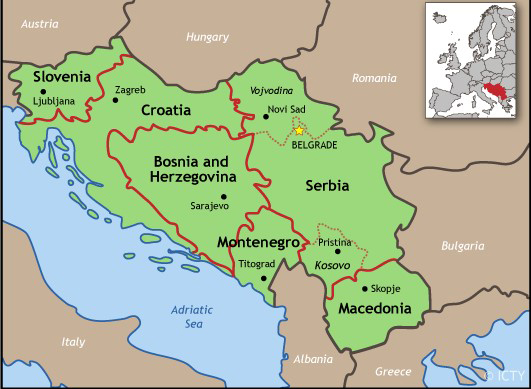
Due to the COVID-19 pandemic, healthcare systems worldwide were challenged by a high rate of patients and the shortage of medical products. This problem was much more prominent in LRS then in HICs. To address an increased need for essential medical products, national authorities, worldwide, made various legislative concessions. This has led to essential medical products being produced by automotive, textile and other companies from various industries and approved under the emergency use authorizations or legal concessions of national regulatory bodies. Emergency use authorizations for production, import and approval of medical products should be strictly specified and clearly targeted from case to case and should not be general or universal for all medical products, because all of them are associated with different risk level [9, 10, 11].
The Dayton Peace Agreement that ended the war, defined today’s Bosnia and Herzegovina as a country consisting of two parts, the Republic of Srpska (RS) and the Federation of Bosnia and Herzegovina (FB&H) [1, 7, 8]. Currently, the World Bank classifies B&H (as well as RS) as an upper-middle income country, but health care system and problems related to treatment of critically ill patients are quite similar to LMICs and accordingly it can be defined as a Low Resources Settings (LRS) [12]. Presently, B&H has four university hospitals (University Clinical Centers, UCCs): UCC Sarajevo, UCC RS in Banja Luka (University Clinical Centre of the Republic of Srpska), UCC Mostar and UCC Tuzla. Until recently, most of these UCCs have had only surgical intensive care units (SICUs) with few ICU beds (1 ICU bed per 100,000 inhabitants). Scarce literature sources indicate that less than 10% of critically ill nonsurgical (medical) patients have access to SICU beds. Approximately ten years after the end of civil war, the Republic of Srpska has slowly started to open towards developed European countries with increase access to knowledge and experience in different areas including healthcare. To help in this process, international institutions and agencies (European Commission, Coimbra Croup, Union for International Cancer Control, etc.) offered a number of visiting fellowships and cost reimbursements for clinicians willing to learn [6].
Characteristics of critical care in HICs – developmental path of intensive medicine in Slovenia: A historical review
From a historical point of view, the development of modern critical care began in the mid-1950s as a response to a poliomyelitis outbreak at the time, where the mass application of mechanical ventilation and its subsequent technical advancement helped manage large number of patients with respiratory failure [13, 14, 15]. This branch of medicine evolved much faster in HICs than in LRS [6]. Even in period when the Yugoslavia existed, Slovenian medicine was considered as most advanced in this country having the most prominent institution, University Clinical Centre of Ljubljana (UCC Ljubljana) where first medical ICU was established in 1973 [1]. At the beginning of the 1980s, five different ICUs started to evolve in this hospital: two surgical intensive care units (SICUs): center for intensive therapy-general SICU and cardiovascular intensive therapy, medical intensive care unit (MICU), neurological intensive care unit (NICU) and infectology intensive care unit. At the end of twentieth century (in 2006), Slovenia started with the implementation of critical care fellowship (subspeciality), following the European guidelines of ICU training. Slovenia has started this process as the first country in the region of Ex Yu.
Establishment of the first modern medical ICU in the Republic of Srpska (B&H)
Key authorities of UCC RS and Ministry of Health of the Republic of Srpska started the project of establishing the first modern MICU at UCC RS Banja Luka. The MICU started operating at the end of 2008 [6, 16]. Over the next 15 years MICU has moved to the newly built north wing of UCC RS with staff expansion to 22 physicians (10 critical care specialists) and 60 nurses. The primary specialties of these physicians include pulmonology (10 physicians), internal medicine (9 physicians), anesthesiology (1 physician), neurology (1 physician), and infectious diseases (1 physician). The new space and equipment allow admission and treatment of up to 28 critically ill patients, with provision of full support to all organ systems. At present, this MICU is the only level three MICU and ISO 9001:2015 and EN 15224:2016 certified MICU in the Republic of Srpska (and in B&H as well). MICU was defined as a referral center for treatment of critically ill patients for the region of the Republic of Srpska (approximately 1000000 inhabitants) [6].
Intervention from abroad (intervention from HICs) in the process of growing up the first modern MICU in the Republic of Srpska
Role of HICs in the early phase
In the early stage of preparing the health care system of the Republic of Srpska for implementation and development of critical care, the impact of developed countries – HICs (Germany and United States of America – USA) was dominant. Well known universities and hospitals hosted and educated young doctors in the field of critical care. At a later stage, doctors who worked in the mentioned hospitals, originally from Bosnia and Herzegovina, took an advisory role in the creation and opening of the first modern MICU in the Republic of Srpska [6, 16, 17].
Role of HICs in the late phase
After the establishment of the first modern MICU in the Republic of Srpska and after the successful development of multidisciplinary staff, the third phase of cooperation with HICs started. At the beginning of 2015, reconstruction of UCC RS and building of new, north wing with much bigger MICU began. Newly built MICU was planned to have capacity for admission of 28 medical critically ill patients. Both the hospital and the MICU managements stood up the challenge of increasing the bed capacity, knowledge and skills of medical staff for a new, much larger MICU. The answer to this question and to this great challenge is sought in professional and scientific cooperation with doctors – intensivists from Slovenia.
Intervention from Slovenia in three steps
Slovenia, as the nearest country with most advanced critical care service was the most acceptable solution for health care system of the Republic of Srpska regarding further improvement of critical care capacity, generally. It is important to notice that support of local health care institutions and authorities (University Clinical Centre of the Republic of Srpska, Ministry of health and welfare of the Republic of Srpska and Medical School University of Banja Luka) were crucial.
First step (exploration on the field)
Critical care professionals from the UCC Ljubljana visited MICU (UCC RS) for the first time at the beginning of 2017 and the visiting team consisted of intensive care physicians (professors in the field) and experienced nurses. The main aim of the visit was to learn the current status of critical care in the UCC RS and to provide some suggestions for improvement of critical care regarding doctors and nursing staff.
Second step (official intervention)
After initial exploration and suggestions (first step) medical team from UCC Ljubljana continued to cooperate with doctors and nurses from MICU (UCC RS) providing activities which included unofficial education lectures, (seminars for medical students and doctors, morbidity-mortality conference) and education “at the bed side” in ICU environment. This was realized by enrolment of UCC Ljubljana doctors in the list of visiting doctors of UCC RS. The Chamber of Doctors of Medicine of the Republic of Srpska has issued temporary work licenses to visiting doctors (intensivists) from the UCC Ljubljana. At the same time nurses had education and hands on trainings provided by their colleagues from Slovenia. That was also the only option and the key decision that new methods of treatment could had been introduced in the therapy.
Third step (official and two way cooperation)
After the involvement of medical professionals (UCC Ljubljana) from the fields of internal medicine, neurology and infectology (intensivists) in the unofficial education of medical staff, the final step was to start with official education at the Medical Faculty University of Banja Luka. This was achieved by enrolment of UCC Ljubljana doctors in the list of visiting professors at the Medical School University of Banja Luka. This was a way to start an official education using well experienced professors of the University of Ljubljana (Slovenia) within the educational system of the Republic of Srpska (Banja Luka). At the end the final activities included the exchange visits of doctors and nurses in both directions (the Republic of Srpska – Slovenia). All three links (treatment, education and research) in the chain of treatment of critically ill patients in the Republic of Srpska gained the comprehensive support (intervention) of Slovenian doctors – intensivists (Fig. 2).
Cooperation between countries that emerged after dissolution of Yugoslavia: UCC RS – Banja Luka (The Republic of Srpska – B&H) and UCC Ljubljana (Slovenia) with geographical position of two countries.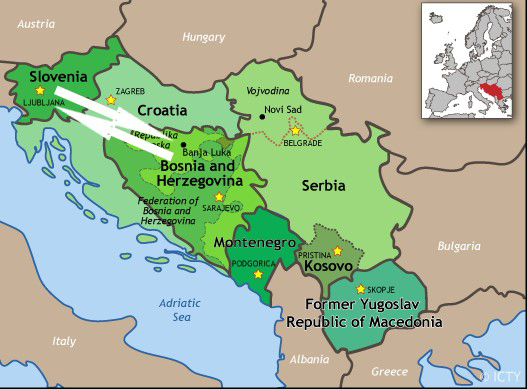
Many would agree that global economic and health inequalities demand our attention, especially from the pandemic outbreak point of view. In that light the question is, should intensivists from HICs pay particular attention to critical illness in the developing world? Analyzing the process of establishing the first modern MICU in the Republic of Srpska (B&H) and all the activities that followed aftermath, which were initiated from HICs, it is clear that the impact of HICs is tremendous [6, 16, 17].
Conclusion
It is obvious that impact of HICs on development of critical care in LRS can be crucial. Sometimes, the HICs can serve as catalysators of the process of a painful transition. Slovenian model clearly shows how it is possible to translate principles of modern critical care to the low resources settings (LMICs). Briefly described process of translation is not simply “copy/paste”, but it is rather adaptation of modern models in host environments. Creation of modern and state of the art MICU in LRS have tremendous social impact, and this was obvious during the COVID-19 pandemic. In this vulnerable period for the Republic of Srpska’s health care system and generally, the MICU in UCC RS was generator of educational processes for other regional hospitals in the Republic of Srpska. At the same time, doctors (intensivists) form the MICU served as consultants for other health care authorities and institutions who created measures to combat COVID-19. At the end, it is important to note that LRS are not always situated somewhere in Africa, but LRS can be found in the heart of Europe: the whole region of the West Balkan (and wider) has characteristics of LRS regarding critical care. The development of critical care in LRS and impact of HICs on this process can be extrapolated to other similar settings.
Footnotes
Conflict of interest
None to report.