






Abstract
OBJECTIVE:
In order to improve nursing quality management and protect patient medical safety, it is necessary to change the default mode and completely integrate information technology and nursing quality control utilising lean management.
METHODS:
A database was created, the nurse quality control scoring standard was entered into the computer and after the inspection, and various inspection reports were entered into the computer to precisely and promptly preserve data. The computer was then utilised to precisely assess the intensity and quality of nursing work, compute, count, and analyse the stored data, output the quality of nursing work in each department as a report, and adopt lean management for the gathered issues.
RESULTS:
To reach the objective of raising nursing quality, data analysis makes it simple to identify flaws and consistently strengthen the weak points. In order to create an information-based nursing quality control system with a simple and effective method as well as results that are scientific and objective, lean management is brought into the construction process.
Introduction
The information-based nursing quality control system, which is a crucial component of the medical behaviour security system, has entered a phase of rapid development. The objective of hospital management is nursing quality management [1, 2]. Information technology has helped improve the speed and effectiveness of nursing quality control. The inspection link of quality control has not changed, but the original information technology has modified the nursing quality control summary link. The entire quality control system’s inspection and quality control procedures are still operating at their original level, and little has been done to change the objective, unscientific, and excessively human interference-related status quo [3, 4]. The intrinsic model needs to be scrapped, integrated, and reworked before it can be effectively utilized in the process of integrating information technology and nursing quality control. By doing so, nurse quality management may be advanced, and medical safety for patients can be ensured. Based on the concept of lean management, this article develops a collection of information quality control systems that have an uncomplicated technique, high efficiency, and conclusions that can be defended both scientifically and objectively. Within the context of the lean vision of our hospital, the application and experience of establishing an information-based nursing quality control system are presented in this paper.
Research methods
Implement fine benefit management for the problems that are collected by consulting literature and books. Carry out three-level quality control of nursing through informatization, pay attention to the process, eliminate waste, pay attention to high quality, standardisation, continuous improvement, and improve patient satisfaction. There are four stages to this research.
Phase I: Preparation (2 months) [baseline=(char.base)] [shape=circle,draw,inner sep=0.2pt] (char) 1; Stage of mobilisation: Hold a mobilisation meeting for “integrating the lean management concept into the development of an information-based nursing quality control system.” The team members came to an agreement on the following topics at the meeting: clarifying the importance and purpose of this effort; Describe each member of the nursing information team’s duties in detail. The team consists of eight people, including a director of the nursing department, two head nurses, and five nurses; Examine the nursing information group’s operational procedures. [baseline=(char.base)] [shape=circle,draw,inner sep=0.2pt] (char) 2; Stage one of a systematic one-month training programme for lean management includes expert lectures, group discussions, role plays, and brainstorming sessions. Lean management theory, practise, tools, applications, connotations, etc. are mostly covered in the programme. Learning the meaning of lean management, using lean management tools proficiently, and being able to approach and resolve issues using lean management concepts are the objectives. Phase II: process reengineering (6 months) [baseline=(char.base)] [shape=circle,draw,inner sep=0.2pt] (char) 1; From the standpoint of lean management, the quality control process should be revised. To do this, create a lean quality control process based on the original quality control process using the value stream map and the “8S” management approach. The initial links used in the quality control process are updated by deleting, combining, and changing the links. Relevant members of the information team prepare the paperwork needed for the applicable process. [baseline=(char.base)] [shape=circle,draw,inner sep=0.2pt] (char) 2; Trial update procedure: Members of the information technology team direct the quality assurance staff as they put the revised procedure to the test. Following the quality control, semi-structured interviews are done with the clinical nurses and quality control members, and the interview data is documented and organised. [baseline=(char.base)] [shape=circle,draw,inner sep=0.2pt] (char) 3; List the procedures that require ongoing improvement in accordance with the analysis of the data from the interviews and the quality control tests. The members of the information team, who are producers, reevaluate the entire quality control process, apply the brainstorming approach, and reoptimize it in accordance with the lean management principle. A closed-loop management is created in this manner. The quality control process is continuously optimised through process improvement up until the best quality control system is attained (details are shown in Fig. 1). The necessary forms for completing the associated process need to be modified by the appropriate information team members.
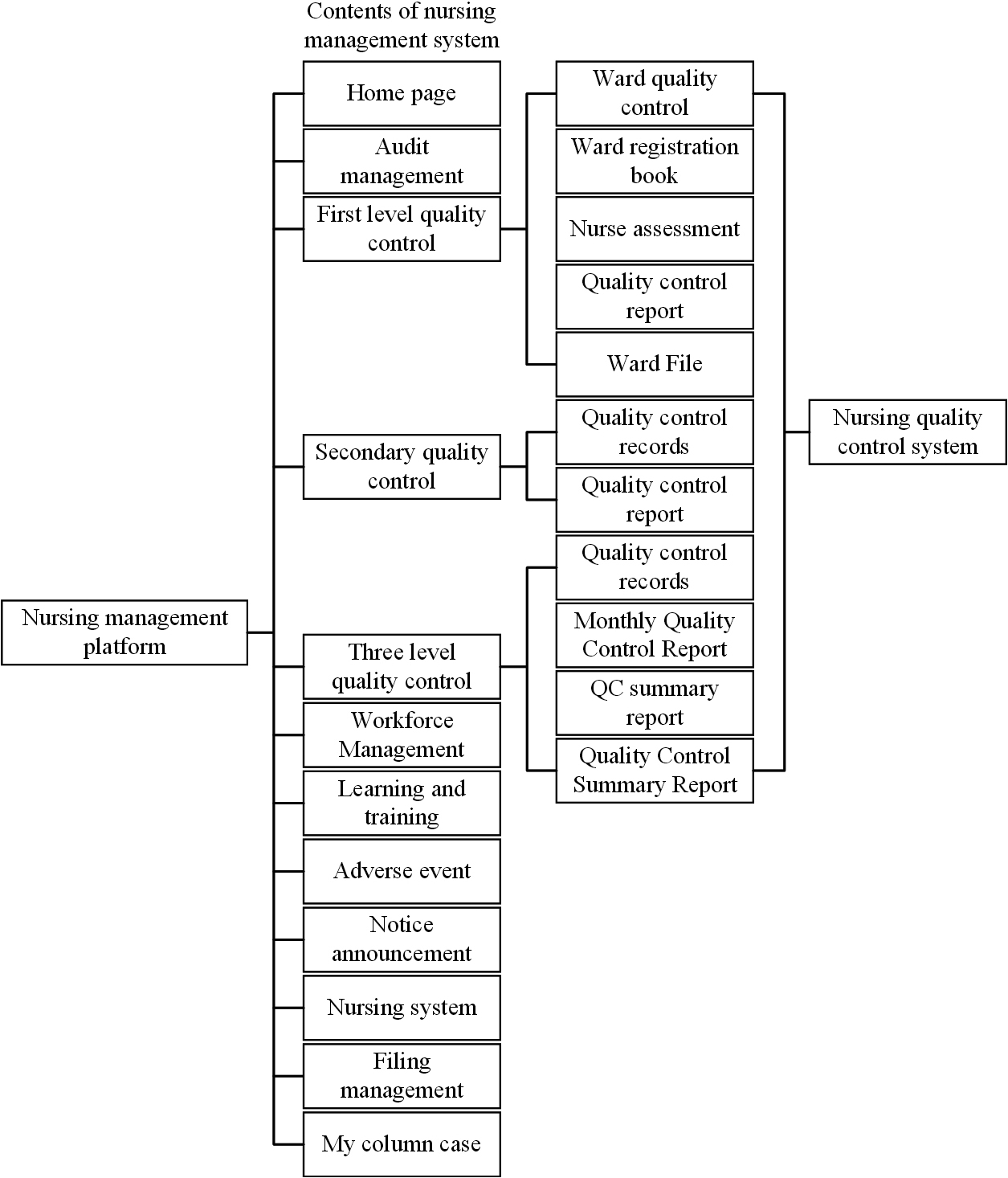
Quality control framework structure. The third stage: lean management The information company must receive the quality control system method and the necessary forms. To complete the development of the nursing management (including the nursing quality control system) platform, the information company will receive the optimised quality control flow chart, along with the quality control framework structure, quality control scoring standards, and summarised and exported quality control templates. Members of the information team will also assist in the testing work. Phase IV: Operation period of the new quality control system A reliable and effective nursing quality control system from a lean perspective was created after the previous three stages of work and implemented in the formal library. Evaluation index The subjects for this study were 100 patients, 100 before and 100 after the adoption of a lean management informationized nursing quality control system. 52 men and 48 women, with ages ranging from 24 to 65 and an average of 44.5 4.3 years old, were present prior to the implementation. Following implementation, there were 54 men and 46 women, aged between 24 and 64, with an average age of 44.04.1 years. The data did not differ between the two groups ( [baseline=(char.base)] [shape=circle,draw,inner sep=0.2pt] (char) 1; The quantity of workers, the duration of on-site inspections, and the satisfaction of quality control staff were compared before and after the adoption of the new quality control system. Using a satisfaction questionnaire, the satisfaction of quality control staff was examined, and the quality control personnel independently rated based on the given items. Each item received a score ranging from 0 to 10, with a score of 7 or more being judged satisfactory. [baseline=(char.base)] [shape=circle,draw,inner sep=0.2pt] (char) 2; Nursing excellence: Ward management, specialist management, specialist technology, nursing records, nursing safety, and goods management are among the topics covered in the material. Each topic receives a full score of 100 points. Disease awareness: full score of 100 for each area, including hospitalisation notification, hospital regulations, examination items, disease information, and treatment material. [baseline=(char.base)] [shape=circle,draw,inner sep=0.2pt] (char) 3; Rates of adverse events and patient satisfaction (split into extremely satisfied, satisfied, and not satisfied) before and after the introduction of the nursing satisfaction of patients. Before and after adoption, the prevalence of negative nursing events was compared.
To perform the statistical analysis, SPSS version 16.0 software package was used. Measurement data was expressed as mean standard deviation (xs), comparisons between groups were expressed as t tests, count data was written as frequency and percentages, and comparisons between groups were evaluated using Chi-square tests. Statistics were judged significant at
Responsibilities of nursing informatization team members
A set of methodical and scientific management techniques is helpful for enhancing nursing quality, raising the bar for nursing management, and fostering the growth of nursing discipline [5, 6]. A three-level quality control approach dominates traditional nursing quality control. The use of three levels of quality control has certain disadvantages as well. For instance, the departments cross-check, evaluate, and promote one another, and the inspection’s objectivity is uneven because the quality control members are made up of personnel with varying levels of nursing experience and nursing specialists; The inspector’s subjective initiative is diminished because it is possible to link the inspection’s issues to specific people. The model for enhancing nursing quality continuously has some flaws. The State Council published the Opinions on Deepening the Reform of the Medical and Health System in 2009, which clearly proposed the goal of gradually establishing a medical and health information system that is “efficient, unified, system integrated, interconnected, and information shared” and pointed hospitals in the right direction to speed up this process [7, 8]. An essential component of hospital information technology development is nursing IT. The use of information technology in the nursing sector is the foundation for more effective and scientific nursing management and the trend of nursing development in the era of informatization construction’s rapid development. The primary goal of nursing management and the cornerstone of nursing quality assurance is nursing quality control. The level of information technology adoption has a significant impact on how quickly nursing quality is improved [9, 10]. The term “traditional quality control inspection” refers to a general survey or spot check conducted by inspectors using paper inspection standards on-site. Each division has its own shape. The data is manually filtered and analysed after the inspection. The term “informatization of nursing quality management” refers to the following steps: entering the quality control scoring standards into the computer, creating a database, entering various inspection reports into the computer once the inspection is complete, accurately and promptly storing data, and finally computing, counting, and analysing the data stored through the computer, producing a report that accurately assesses the nursing work quality of each department. By comparing the data for analysis, we can quickly identify any flaws and work to consistently strengthen the weak points in order to improve nursing quality [11, 12]. The effectiveness and timeliness of information networks have been applied to nursing work as a result of the development of information technology. Through the network terminal, nursing managers can quickly ascertain the state of each ward’s quality control, transforming the traditional form of final quality evaluation feedback into process quality control and enabling real-time tracking quality control and real-time continuous quality improvement [13, 14]. According to the study, using hospital information systems for nursing quality control significantly decreased the frequency of unsafe nursing safety occurrences and raised the standard of nursing care.
Comparison of manpower requirements
Comparison of manpower requirements
Comparison of on-site inspection time
Comparison of satisfaction of quality control personnel
Comparison of the number of quality control employees needed for tertiary quality control inspections in our hospital before and after indicator system monitoring was put into place, as well as the amount of time spent on-site inspecting, are shown in Tables 2–4. According to reports, using information technology in the nursing industry promotes improved nursing quality, increased nurse satisfaction (from 75% to 93%), and more effective nursing practice [15, 16]. While relying on information technology, nursing quality control does become quick and effective. However, we also understand that while the inspection link of quality control has not changed, the summary link has. To put it another way, the entire quality control system inspection process and quality control process are still at the initial level, which is not impartial, unscientific, and has several human interference issues [17, 18]. The nursing quality control system can only be elevated by changing the intrinsic mode and completely merging informatization with nursing quality control.
Comparison of nursing adverse events before and after implementation (%)
The incidence of disagreements, complaints, and errors in nursing writing was extremely low following the introduction of lean management information nursing quality control, and the data difference was substantial
Comparison of total nursing satisfaction before and after implementation (%)
Total patient satisfaction was 92% prior to the installation of information nursing quality control, and it was 98% afterwards. The difference between the two groups was significant (
Basic nursing, ward nursing, specialised nursing, nursing safety, and associated ratings for illness awareness all had greater nursing quality scores after the implementation than they had before (Tables 7–8).
Comparison of nursing quality of patients
Comparison of patients’ disease awareness
Each nursing job process, in our opinion, consists of a number of steps or linkages. Lean management is the idea of eliminating any non-value-added time, activities, and stages in order to maximise results with the least amount of investment using finite amounts of people, materials, and resources. Lean management is a notion for a quality management system that is scientific and unbiased, implements link control, and caters to the demands of the nursing discipline [24].
Lean management principles were incorporated into the development of the informatization nursing quality control system in order to meet the objectives of a straightforward and efficient informatization nursing quality control system and objective, scientific quality control outcomes. Consider the length of the nursing quality control process and the degree to which the results of the nursing quality control are accurate as the effective and scientific measurement indicators of the nursing quality control system. Objectively assess the nursing quality control system from the standpoint of lean management [25].
The rapid expansion of the hospital’s overall informatization construction in the “Internet
Conclusion
The findings of the study are very encouraging. The approach that was proposed was effective at locating nurse quality issues with a high degree of precision. Additionally, the system was able to discover nursing quality concerns that were not identified by standard nursing quality control approaches. This was made possible by the system’s ability to analyze large amounts of data. Consequently, while it is essential to exercise extreme caution when extrapolating the findings of the study to broader contexts, it is reasonable to draw the conclusion that deep learning models can be applied to the development of efficient information-based nursing quality control systems. Based on these findings, it appears that nursing quality control systems that are based on deep learning have the potential to improve the standard of nursing care. Having said that, it is essential to point out that the research was carried out on a rather small sample size of nurses who worked in a single hospital in China. Additional research is required to discover whether or not the findings of the study can be generalized to other contexts and whether or if deep learning-based nursing quality control systems are useful in those other settings.
Limitations
Due to the fact that the study was carried out on a sample size of only one hundred registered nurses, it is probable that the findings cannot be generalized to other populations of registered nurses. This research was carried out in just one hospital in China, it is probable that the findings cannot be generalized to nurses working in other nations or contexts. In addition, the research did not evaluate the suggested system in relation to any of the other nursing quality control systems. The research is still in its preliminary phases, and additional investigation is required to evaluate the suggested system and determine how well it works in conditions that are more representative of the actual world.
Data availability statement
The experimental data used to support the findings of this study are available from the corresponding author upon request.
Funding
No specific funding was obtained to support this research.
Footnotes
Conflict of interest
The authors declare that they have no conflicts of interest regarding this work.