






Abstract
BACKGROUND:
Danshen Chuanxiong Injection (DCI) has demonstrated significant clinical efficacy in the treatment of acute pancreatitis (AP); however, the precise molecular mechanisms underlying its therapeutic effects remain incompletely understood.
OBJECTIVE:
In this study, we employed network pharmacology analysis to comprehensively investigate the active components, potential targets, and signaling pathways involved in DCI-mediated treatment of AP.
METHODS:
We utilized the mouse pancreatic acinar cell line 266-6 to establish an cholecystokinin (CCK)-induced AP cell injury model and evaluated cell viability using the Cell counting kit-8 assay. Western blotting and quantitative PCR were employed to determine the expression levels of key target proteins and genes.
RESULTS:
Network pharmacology analysis identified a total of 144 active components and 430 potential targets within DCI. By integrating data from public databases, we identified 762 AP-related genes. Among these, we identified 93 potential targets that may be involved in the therapeutic effects of DCI for AP. These targets were significantly enriched in biological processes such as oxidative stress, regulation of cytokine production, leukocyte migration, and the TNF signaling pathway. Molecular docking studies revealed a high binding affinity between the active components and the key targets AKT1 and NFKBA, indicative of potential interaction. Additionally, CCK-induced acinar cell injury led to upregulation of AKT1, NFKBA, and P53 proteins, as well as TNF, IL6, and MMP9 genes. Conversely, treatment with DCI dose-dependently attenuated CCK-induced acinar cell injury and restored the expression levels of the aforementioned proteins and genes.
CONCLUSION:
Overall, this study provides a comprehensive understanding of the molecular mechanisms underlying the therapeutic effects of DCI in the treatment of AP. Our findings confirm the protective effect of DCI against CCK-induced acinar cell injury and its regulation of key targets.
Keywords
Introduction
Acute pancreatitis (AP) is an inflammatory disorder affecting the pancreas characterized by an escalating incidence rate in recent decades [1, 2]. AP exhibits a spectrum of clinical presentations, ranging from mild pancreatic inflammation to severe pancreatic necrosis and multiple organ dysfunction syndrome, with varying degrees of severity [3]. Despite extensive research, the complete pathogenesis of AP remains elusive; however, established risk factors include gallstones, alcohol abuse, high-fat diet, obesity, and certain medications [4, 5]. Furthermore, genetic factors and viral infections may also contribute to the development of AP. Presently, the primary therapeutic approach for AP involves supportive care encompassing pain management and correction of fluid, electrolyte, and pH imbalances [6]. Regrettably, there are no universally approved pharmacological interventions available for AP [7], underscoring the pressing need for alternative treatment strategies to enhance the prognosis of AP patients.
With the extensive utilization of traditional Chinese medicine (TCM), it has been established that herbal decoctions exhibit noteworthy efficacy in the treatment of AP [8]. Danshen Chuanxiongqin Injection (DCI) is a traditional Chinese medicine formulation composed of ligustrazine and extracts from Danshen (Salvia miltiorrhiza). Research has demonstrated the remarkable therapeutic effects of DCI in AP treatment through the suppression of inflammatory responses, with enhanced efficacy observed when combined with Western medicine [9, 10]. However, the precise underlying mechanisms remain incompletely elucidated. Investigations have revealed that Danshen possesses the capacity to ameliorate the inflammatory response in severe acute pancreatitis (SAP) rats, regulate cellular apoptosis, and confer protection to various organs [11]. Salvianolic acid IIA, a prominent active constituent of Danshen, has been shown to safeguard against AP in mice by inhibiting oxidative stress via the Nrf2/ROS pathway [12]. Ligustilide, the principal active component of Chuanxiong, exhibits the potential to alleviate acute renal injury in a rat model of acute necrotizing pancreatitis [13]. While these scattered findings provide some theoretical foundation for the application of DCI in AP treatment, further research is imperative to fully comprehend its clinical utility in AP.
The advent of network pharmacology has greatly enhanced our understanding of the mechanisms underlying the therapeutic effects of traditional Chinese medicine in various diseases [14, 15, 16]. From a systems science standpoint, network pharmacology offers a systematic approach to comprehensively elucidate the mechanisms of well-known herbal formulas [17], thus providing a promising avenue for future investigations into the mechanisms of traditional Chinese medicine. In light of this, the present study employed network pharmacology analysis to investigate the principal bioactive constituents, key targets, and mechanisms involved in the therapeutic effects of DCI in the treatment of AP. Furthermore, we conducted in vitro experiments using a cell injury model to validate the efficacy of DCI and its impact on the regulation of key targets.
Materials and method
Network pharmacology analysis
The active constituents and their corresponding target data of DCI were obtained from the Traditional Chinese Medicine Systems Pharmacology Database and Analysis Platform (TCMSP,
Molecular docking
The protein structure of the designated key target was retrieved from the Protein Data Bank (PDB,
Cell culture and treatment
In vitro experiments were performed utilizing the mouse pancreatic acinar cell line 266-6, which was obtained from the American Type Culture Collection (ATCC, Manassas, VA, USA). The cells were cultured in Dulbecco’s Modified Eagle Medium (DMEM) supplemented with 10% fetal bovine serum (Gibco, Thermo Fisher Scientific), 100 U/mL penicillin, and 100 mg/mL streptomycin. The cells were maintained at 37∘C in a humidified incubator with 5% CO2 in a standard atmospheric environment.
The experimental design consisted of four distinct groups: the control group (NC), the model group (CCK), the low-dose Danshen Chuanxiong Injection (DCI) group (CCK
CCK-8 cell viability assay
Mouse pancreatic acinar cells (266-6) were cultured in a specific medium supplemented with varying concentrations (0, 1, 5, 10, 20, 30 mL/L) of DCI for a duration of 24 hours. To evaluate cellular toxicity and determine the optimal concentration of DCI for subsequent treatment, the CCK-8 assay was employed. The CCK-8 assay kit was utilized to assess both cell viability and the potential toxic effects of DCI. In brief, cells from each experimental group were seeded at a density of 2
Western blot
Immunoblot analysis was performed to evaluate the protein content in pancreatic tissues. The BCA Protein Assay Kit (Thermo Fisher Scientific, MA, USA) was utilized for protein quantification. Subsequently, protein samples were resolved on 10% SDS-PAGE gels and transferred onto PVDF membranes. To block non-specific binding, the membranes were incubated with 5% skim milk at room temperature for 2 hours. Following this, the membranes were subjected to overnight incubation at 4∘C with primary antibodies against AKT1 (diluted 1:100), NFKB p65 (diluted 1:100), P53 (diluted 1:100), and GAPDH (diluted 1:250) in a suitable blocking buffer. Subsequently, the membranes were thoroughly washed with TBST (three washes, 10 minutes each) and incubated with the corresponding horseradish peroxidase-conjugated secondary antibodies at room temperature for 1 hour. After a final wash, protein bands were visualized using the ECL Plus chemiluminescence system.
Quantitative real-time PCR
Acinar cells were isolated and cultured in 6-well plates. Subsequent to treatment (or harvesting pancreatic tissues from mice), total RNA was extracted from the cells/tissues using TRI reagent (Molecular Research Center, Cincinnati, OH, USA), and RNA integrity was evaluated by assessing the A260/280 ratio. Reverse transcription quantitative polymerase chain reaction (RT-qPCR) was performed following established protocols [18]. The relative expression levels of the target genes were normalized to the reference gene GAPDH. The primer sequences employed for RT-qPCR analysis are documented in Table 1.
Primers used for RT-PCR
Primers used for RT-PCR
Statistical analysis was conducted using GraphPad Prism 9 software (GraphPad, San Diego, CA, USA). The comparison between two groups was assessed using the
Results
Active ingredients and targets of DCI
Through the utilization of the TCMSP database, a comprehensive analysis revealed that DANSHEN encompassed a repertoire of 143 bioactive constituents, which exhibited associations with 309 molecular targets. Moreover, ligustrazine was predicted to have potential interactions with 137 target molecules. To visually represent this intricate network, Fig. 1 presents a diagram illustrating the interplay between these 144 active ingredient nodes and their corresponding 430 targets.
Network diagram of the active compounds and target proteins of DCI. Green represents target proteins, and orange represents active compounds.
The discernment of DCI’s putative therapeutic targets in AP was accomplished by intersecting its molecular targets with a set of AP-related genes, as depicted in Fig. 2A. A comprehensive screening yielded a total of 93 potential targets, which were found to exhibit extensive interactions as demonstrated in Fig. 2B. In total, 1594 interaction information was extracted from the STRING database. A network analysis further revealed that this network possessed an average degree value of 35. Notably, AKT serine/threonine kinase 1 (AKT1) and albumin (ALB) emerged as pivotal proteins in the interactome, both exhibiting the highest degree centrality with 75, signifying their integral roles in the network. The KEGG enrichment analysis conducted on these targets unveiled their association with 231 pathways, including noteworthy pathways such as the TNF signaling pathway, IL-17 signaling pathway, and HIF-1 signaling pathway, as visualized in Fig. 2C. Additionally, our GO enrichment analysis revealed significant engagement of the identified targets in critical biological processes linked to AP progression, notably oxidative stress response, cytokine production regulation, and leukocyte trafficking, as depicted in Fig. 2D.
Identification of potential targets and molecular mechanisms of DCI in the treatment of AP. (A) Venn diagram of potential targets of DCI and AP-related genes, resulting in 93 potential targets for DCI in the treatment of AP. (B) Protein-protein interaction network of the 93 potential targets. (C) Top 10 KEGG pathways ranked by Gene Count in the KEGG enrichment analysis. (D) Top 10 GO terms ranked by Gene Count in the GO enrichment analysis.
According to the
Key targets and signaling pathways in the treatment of AP with DCI. (A) Network diagram of key signaling pathways and their associated genes in the treatment of AP with DCI. (B) Network diagram of active compounds, target proteins, and key signaling pathways in the treatment of AP with DCI. (C) Identification of 10 core key targets by cytoHubba.
By employing molecular docking techniques, we conducted a thorough evaluation of the binding affinities between AKT1 and NFKB1A with the respective active compounds, as presented in Table 2. Exceptionally, the docking complex composed of AKT1 and beta-carotene displayed a binding energy surpassing
DCI regulates the expression of key target genes and proteins to alleviate acinar cell injury
To further elucidate the protective effect of DCI, we established a cell damage model using the 266-6 cell line induced by CCK. Initially, cell viability experiments were conducted to assess the cytotoxicity of DCI at concentrations ranging from 0 to 10 ml/L on acinar cells (Fig. 4A). Notably, no discernible cytotoxic effects were detected, thereby substantiating the safety profile of DCI when applied to pancreatic acinar cells. Subsequently, we proceeded to investigate the protective effect of DCI on the CCK-induced damage model by pretreating acinar cells with varying doses of DCI. The results demonstrated that both
Comprehensive findings from molecular docking analysis of AKT1 and NFKB1A interactions with active compounds
Comprehensive findings from molecular docking analysis of AKT1 and NFKB1A interactions with active compounds
low-dose DCI (LDCI) and high-dose DCI (HDCI) significantly ameliorated the decreased cell viability caused by CCK (Fig. 4B). Additionally, western blot analysis was performed to assess the protein expression levels of AKT1, NFKB p65, and P53. Remarkably, CCK stimulation led to a significant increase in the protein expression of these factors, whereas DCI intervention exerted a dose-dependent reduction in their expression levels (Fig. 4C). Furthermore, to validate the impact of DCI on other key target genes, quantitative polymerase chain reaction (qPCR) was conducted. The results demonstrated that, apart from VEGFA and RXRA, CCK stimulation significantly upregulated the expression of other genes, whereas DCI intervention significantly attenuated the upregulation of gene expression induced by CCK (Fig. 4D).
In vitro effects of DCI on acinar cell injury and its regulation of key targets. (A) Cytotoxicity of DCI on acinar cells. (B) Protective effect of DCI on CCK-induced acinar cell injury. (C) Impact of DCI on the protein expression of AKT1, NFKB p65, and P53 during acinar cell injury. (D) Influence of DCI on the gene expression of PTGS2, IL6, RELA, TNF, VEGFA, RXRA, and MMP9 during acinar cell injury.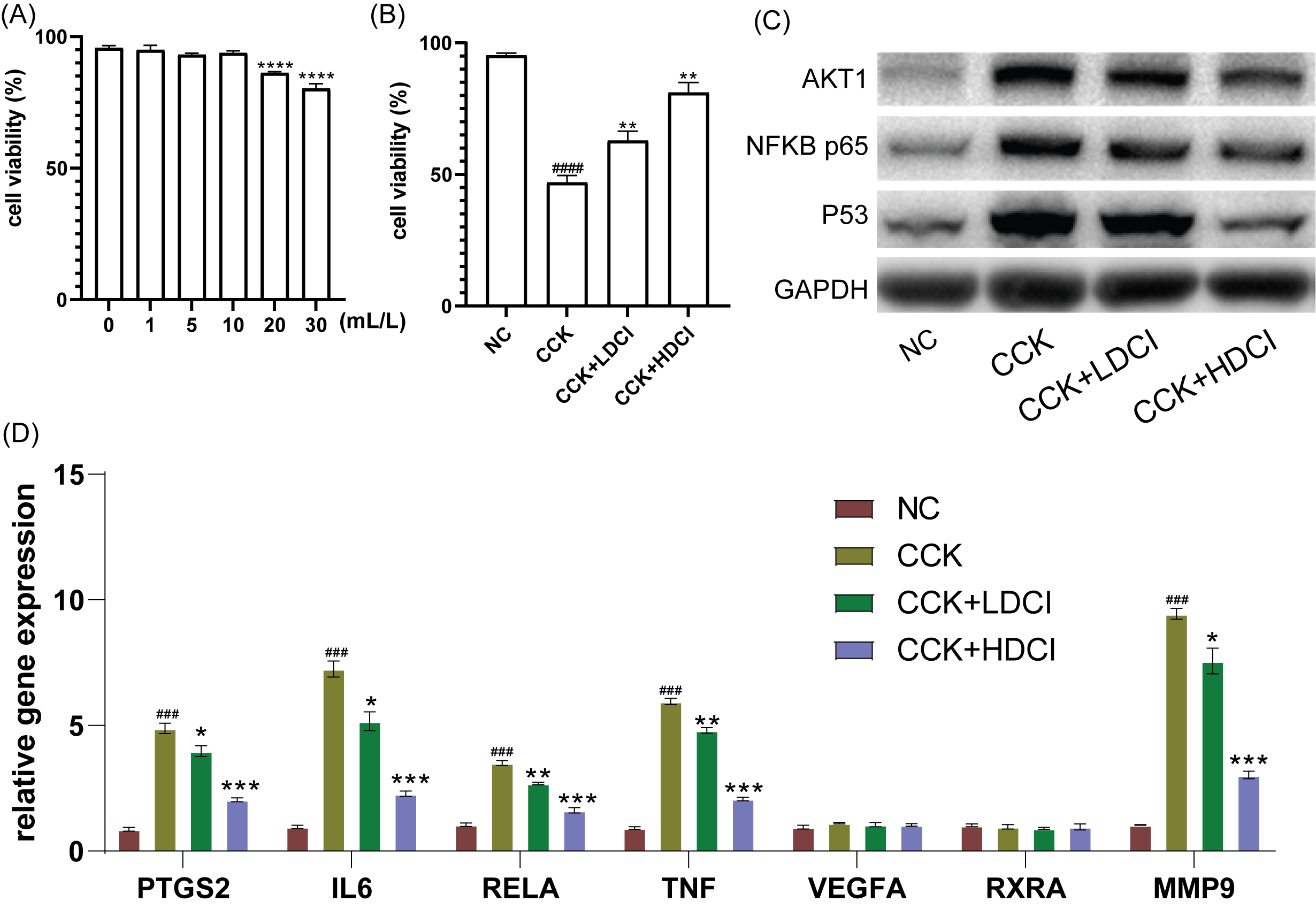
Traditional Chinese medicine has gained significant popularity as a complementary and alternative approach for managing AP on a global scale. Extensive basic and clinical research has demonstrated the efficacy of TCM in treating AP [21]. Moreover, the application of systems analysis techniques, such as network pharmacology, has facilitated the elucidation of the molecular mechanisms underlying the therapeutic effects of TCM in AP. Although the clinical efficacy of d-chiro-inositol (DCI) alone or in combination with Western medicine has been confirmed for AP, the precise underlying mechanism remains unclear. In this study, we employed a combination of network pharmacology and experimental validation to investigate the active ingredients of DCI, as well as the associated targets and mechanisms involved in AP treatment. By identifying key targets and conducting in vitro mechanistic investigations, we aim to establish a solid theoretical foundation for the future clinical application and advancement of DCI therapy in AP.
DCI has been proven to possess therapeutic effects on AP and its underlying mechanisms through modern pharmacological experiments, thereby establishing a sound theoretical foundation for the synergistic treatment of AP. Danshen, a cost-effective and readily available traditional Chinese medicine, has become an essential component in the comprehensive management of AP. Its pharmacological properties include promoting blood circulation, resolving blood stasis, unblocking meridians, alleviating pain, dilating microvessels, and enhancing microcirculation. Numerous clinical studies have reported significant efficacy of Danshen in AP treatment [22]. Animal experiments have demonstrated that Danshen exhibits protective effects on various organs, such as the spleen, thymus, and kidneys, in severe AP models [23, 24]. Additional evidence suggests that Danshen possesses a beneficial impact on lymph nodes in severe acute pancreatitis [25]. The observed multi-organ protective effects of Danshen may be attributed to its modulation of inflammatory responses and regulation of cellular apoptosis [11]. In terms of active compounds, Tanshinone IIA has been identified as a key component that reduces serum amylase and lipase levels, improves the pathological features of pancreatic tissue in AP, and its underlying mechanism involves the inhibition of oxidative stress through the Nrf2/ROS pathway [12]. Moreover, Ligustrazine exhibits positive effects on multiple organ dysfunctions, including the pancreas and intestines [26], in models of mild chronic pancreatitis, ultimately exerting a protective influence on AP by reducing caerulein-induced NF-
However, the understanding of the key active compounds and targets of DCI in the treatment of acute pancreatitis (AP) has been limited in previous studies. Network analysis has revealed quercetin as a critical active compound in DCI, which has been reported to ameliorate caerulein-induced AP in mice [28]. Mechanistically, quercetin exhibits inhibitory effects on inflammatory responses and acinar cell necrosis [25]. Another significant active compound following quercetin is luteolin, which protects mice from severe AP by exerting anti-inflammatory and antioxidant effects mediated by ho-1 [29]. Regarding targets, PTGS2, also known as COX-2, stands out with the highest degree value, highlighting its important role in DCI treatment of AP. The overexpression of COX-2 in AP rats suggests its involvement in the inflammatory response during AP, and subsequent experiments have demonstrated that COX-2 inhibitors can alleviate pancreatic severity while improving kidney and respiratory functions [30, 31, 32]. Recent clinical studies have confirmed the significant reduction in the occurrence of severe acute pancreatitis (SAP) with the use of COX-2 inhibitors [33]. In our in vitro experiments, we have illustrated the significant reduction in CCK-induced acinar cell damage and the concurrent upregulation of the COX2 gene by DCI. Moreover, DCI has also been observed to decrease the overexpression of genes such as TNF, IL6, and MMP9 in acinar cells induced by CCK.
Notwithstanding the identification and validation of pivotal targets for DCI in the management of AP in our investigation, several limitations remain to be addressed. Firstly, the absence of additional validation at the animal model level hinders the assessment of DCI’s effects on diverse tissues and cell types in vivo, as well as the underlying mechanisms. Secondly, our validation efforts were confined to select key targets, without verifying crucial biological processes and pathways based on enrichment analysis results. As a result, further in vitro and in vivo experiments are warranted to corroborate the findings of our network pharmacology study.
Conclusion
In summary, employing the methodology of network pharmacology, we systematically investigated the active compounds and candidate targets of DCI in the therapeutic management of AP. Through in vitro acinar cell injury models, we successfully validated the modulation of pivotal targets, including AKT1, NFKBA, and P53. These valuable findings not only contribute to the establishment of a solid theoretical framework for the clinical utilization of DCI in AP treatment but also emphasize the necessity for comprehensive mechanistic validation through extensive in vitro and in vivo investigations. Furthermore, these investigations will facilitate the exploration of additional target options and facilitate the development of novel therapeutic agents for AP.
Author contributions
YL and QF conceived and designed the research; HR contributed to data collection, analysis, and manuscript writing. YL, QF, HR and HZ were responsible for data analysis. LX conducted the validation experiments, YL and HZ helped revise the manuscript. All authors have read and approved the final manuscript.
Funding
None to report.
Availability of data and materials
All data in this study are included in this article.
Ethical approval
Not applicable.
Footnotes
Acknowledgments
None to report.
Conflict of interest
The authors declare no competing interests.