






Abstract
BACKGROUND:
According to the Global Burden of Disease Study the prevalence of stroke worldwide has significantly increased from 1990 to 2019, making it the second leading cause of death worldwide. Approximately 70%–80% of stroke patients are unable to live independently due to disability.
OBJECTIVE:
To explore the therapeutic effect of proprioceptive neuromuscular facilitation (PNF) combined with muscle energy technique (MET) on post-stroke dysphagia.
METHODS:
A total of 122 stroke patients with dysphagia admitted to our hospital from January 2017 to December 2020 were divided into the control group (
RESULTS:
After treatment, the study group showed lower SSA score (
CONCLUSION:
Compared with traditional rehabilitative training strategies, PNF combined with MET can effectively improve swallowing function, and enhance the quality of life in patients with post-stroke dysphagia.
Introduction
According to the Global Burden of Disease Study the prevalence of stroke worldwide has significantly increased from 1990 to 2019, making it the second leading cause of death worldwide [1]. Approximately 70%–80% of stroke patients are unable to live independently due to disability [2]. Among them, the incidence of dysphagia among stroke patients in acute and recovery periods was 46.3% and 56.9%, respectively [3]. Dysphagia was an indirect cause of death in 33% of patients within six months [4]. In addition, post-stroke dysphagia can also affect the prognosis and quality of life of patients, bringing serious living and economic burdens to patients and their families [5]. Conventional rehabilitation measures for recovering swallowing function include indirect basic training, direct ingestion training, acupuncture and moxibustion, and electrical stimulation of swallowing muscles, yet with limited therapeutic effects [6].
With rapid development of neuro-regulatory technique, neural stimulation has been widely used in the functional rehabilitation of stroke patients. The proprioceptive neuromuscular facilitation (PNF) was used for the first time in the rehabilitation treatment of patients with cerebral palsy and other neurological disorders [7]. The treatment principle is to stimulate the sensory receptors of proprioceptions such as position and motion, supplemented with visual input to enhance the central nervous system’s regulation of muscles [8]. Research has explored the impact of PNF techniques involving movements against maximum resistance on stimulating motor neurons, potentially increasing contraction force in weak muscles. Additionally, studies have examined the effectiveness of PNF exercises involving tongue, facial, and breathing movements, as well as short neck flexion exercises, in addressing swallowing difficulties [9, 10].
Muscle energy technique (MET) is a soft tissue manipulation technique used to treat muscle shortening, muscle weakness and limited joint mobility. Through precise control of the magnitude and direction of force application by the operator, MET allows specific muscles to contract, relax, and interact with each other based on active patient participation and isometric contraction to counteract resistance, which can regulate muscle length and tension, enhance muscle strength and stability, and alleviate pain [11]. MET rapidly and painlessly reduces stimulation to trigger points, alleviating pain and associated functional impairments. This intervention may potentially improve swallowing function in stroke patients. Research has demonstrated that combining MET with the Neurac method resulted in significantly higher Fugl-Meyer scores compared to conventional rehabilitation in stroke patients [12]. Furthermore, the integration of the Neurac method with MET has been shown to enhance the independent mobility of stroke patients with hemiplegia and diabetes, alleviate pain, improve balance and stability, mitigate limb dysfunction, and enhance overall quality of life [13].
However, there is currently no research on the application of MET combined with PNF for the treatment of dysphagia in post-stroke patients. Therefore, by including post-stroke dysphagia patients, this study explored the therapeutic effect of MET combined with PNF on alleviating dysphagia, so as to offer a new strategy for the treatment of dysphagia in stroke patients.
Subjects and methods of study
Subjects of study
Using a convenient sampling, this study enrolled 122 stroke patients with dysphagia who were admitted to the Department of Rehabilitation Medicine, the First Affiliated Hospital of Soochow University from January 2017 to December 2020. Enrolled subjects were divided into the control group (
The flow diagram of this study.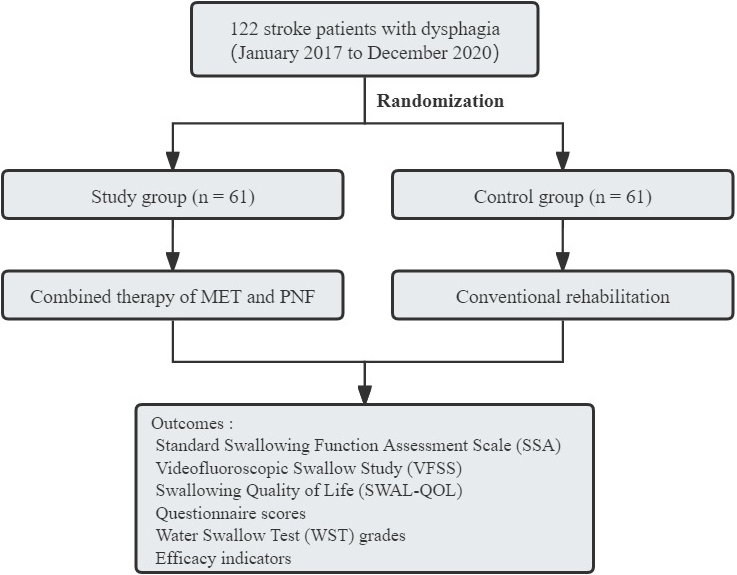
Inclusion criteria: (1) patients who met the diagnostic criteria for stroke: The diagnostic criteria for patients with hemorrhagic stroke and ischemic stroke referred to the “Chinese Guidelines for Diagnosis and Treatment of Cerebral Hemorrhage (2019)” [14] and “Chinese Guidelines for Diagnosis and Treatment of Acute Ischemic Stroke 2018” [15], respectively, combined with confirmation by cranial MRI or CT; (2) patients who meet the diagnostic criteria for dysphagia: Water Swallow Test (WST) grade III
Exclusion criteria: (1) patients with dysphagia caused by other diseases (such as esophageal tumors, traumatic brain injury, etc.); (2) patients with critical illness and unstable vital signs (such as shock, respiratory failure, etc.); (3) patients with severe underlying diseases or major organ dysfunction (such as persistent atrial fibrillation, acute kidney failure, acute liver failure, etc.); and (4) patients with severe mental disorders or cognitive impairment who were unable to cooperate with relevant treatment and assessment.
This study was approved by the Ethics Committee of this hospital, with written informed consent provided by all patients.
Conventional rehabilitation
Patients in the control group adopted a conventional rehabilitation treatment plan, which included two parts. (1) Basic treatment: Referring to the “2015 Chinese Guidelines for Primary Prevention of Cerebrovascular Disease” [17], patients were treated for underlying diseases according to the “stroke unit model”. (2) rehabilitative training for dysphagia: rehabilitative training for dysphagia was performed according to “A Study on Comprehensive Rehabilitation Therapy and Dysphagia after Stroke” [18], including cold stimulation of the pharynx breath-holding vocal training, facial movements shaker exercises and turning head to the affected side. The above swallowing rehabilitative training was conducted once a day, six times a week. Continuous training for four weeks was considered one course of treatment, with a total of one course of treatment.
MET treatment
MET treatment plan was developed by referring to previous research [19, 20]: (1) Patients were instructed to forcefully open their mouth for 5 seconds before relaxing. (2) Patients were instructed to tightly close their mouth for occlusion, allowing them to maintain a strong occlusion and chewing state for 5 seconds before relaxing. (3) Patients were instructed to move the left and right sides of the mandible, allowing patients to resist resistance on one side of the mandible and keep the mandible in a neutral position for 5 seconds before relaxing. (4) Patients were instructed to forcefully extend their tongue, which was pressed towards the direction of the tongue tip using a tongue depressor. The tongue tip should resist resistance and contract continuously for 5 seconds. (5) Patients were instructed to tightly hold the tongue depressor with their lips to resist the therapist’s outward pull of the tongue depressor, and apply force to maintain the contraction for 5 seconds before relaxing. (6) Patients were instructed to perform a cheek-bulging motion, allowing the patient to maintain cheek-bulging forcefully. Each step described above was repeated 3–5 times, once a day, with a 4-week course of treatment.
PNF training
PNF training consisted of three parts [21]: (1) Centripetal contraction training: With the head resisted resistance, patients were instructed to rotate from the end of the left extension to the end of the right extension, opening their mouth diagonally. (2) Stable contraction training: The posture was maintained for 6 seconds at the end of the training. (3) Eccentric contraction training: Patients were instructed to maintain their current head and mouth position, and then the therapist rotated patients’ head to move their head and mouth to their initial position. The above actions were repeated 30 times a day for training, and stopped if the patient felt tired or unable to tolerate. With one course lasting for 4 weeks, the treatment effect was evaluated after one course of treatment.
Randomization and blinding
Patients were randomly assigned to treatment arms using computer-assisted random permuted blocks at one-to-one allocation ratio. The randomization schedule was managed remotely from the study coordinating center. The remote study coordinator communicated assignments by phone to the onsite coordinator and treating therapists in each group. Research personnel involved in the study remained unaware of treatment allocation. No communication between treating therapists regarding the study content was allowed or occurred. All subjects underwent evaluation following the usual management procedure, with all swallowing assessments and data collection conducted by blinded clinician.
Data collection
This study collected the general data (gender, age, type of stroke, etc.), Standard Swallowing Function Assessment Scale (SSA), Videofluoroscopic Swallow Study (VFSS), Swallowing Quality of Life (SWAL-QOL) Questionnaire scores, WST grades, and efficacy indicators of the enrolled patients.
SSA mainly consisted of three parts. Specifically, Part I scored between 8
The VFSS score was mainly obtained by quantification of the observation results of the entry of contrast agents in the oral, pharyngeal, and esophageal regions, with a score range of 0–10 points. Subjects with 10 points indicated normal swallowing function, while those with 6–9, 3–5 and
The specific implementation and efficacy grading criteria for WST were as follows: Patients were instructed to drink 30 ml of warm water to observe whether the process was smooth and whether there were symptoms such as coughing, thereby determining the level and recovery of the patient’s swallowing function [24]. The results were divided into 5 grades: Grade 1 of excellent: patients were able to drink water all at once without coughing or changing voice; Grade 2 of good: patients needed to swallow the water at
SWAL-QOL was specifically designed to assess the relationship between swallowing and quality of life in patients with dysphagia [27]. The Cronbach’s
The therapeutic effect was determined based on WST results [20]: ⟀ Ineffective: No significant difference observed before and after treatment; ⟁ Effective: Improvement in dysphagia, with the grading increased by one grade after treatment compared to that before treatment; ⟂ Significant effective: Significant improvement in dysphagia, with the grading increased by two grades after treatment compared to that before treatment; ⟃ Cure: Swallowing function recovered to normal. The effective rate
Statistical analysis
Statistical analysis of this study employed SPSS 26.0. For the continuous variables, the normality testing we performed by kolmogorov-Smirnov test and the homogeneity of variance was tested by Breusch-Pagan test Measurement data that met normality and homogeneity of variance, were expressed as (
Results
Baseline data
There were 61 cases (34 males and 27 females) in the study group, with an average age of 62.71
Baseline data
Baseline data
There was no statistically significant difference in SSA and VFSS scores between the study group and the control group before treatment (
Comparison of SSA and VFSS scores between the two groups before and after treatment
Comparison of SSA and VFSS scores between the two groups before and after treatment
Note: SSA: Standard Swallowing Function Assessment Scale; VFSS: Videofluoroscopic Swallow Study.
After treatment, both the study group and the control group showed a decrease in WST grading (
Comparison of grading changes in Water Swallow Test between two groups of patients before and after treatment
Comparison of grading changes in Water Swallow Test between two groups of patients before and after treatment
Note: *: Statistically significant difference compared to the study group after treatment,
Before treatment, no statistically significant difference was found in SWAL-QOL Questionnaire scores between the two groups of patients (
Comparison of SWAL-QOL Questionnaire scores between the two groups before and after treatment
Comparison of SWAL-QOL Questionnaire scores between the two groups before and after treatment
Note: SWAL-QOL: Swallowing Quality of Life Questionnaire.
Among 61 patients in the study group, 16 cases were cured, 14 were significantly effective, 17 were effective, and 14 were ineffective; while 2 cases were cured, 20 were significantly effective, 13 were effective, and 26 were ineffective among 61 patients in the control group. In Table 5, the effective rate of patients in the study group was higher than that in the control group (77.05% VS 57.38%,
Comparison of effective rates between the two groups of patients [
(%)]
Comparison of effective rates between the two groups of patients [
Note: Total effective rate
Dysphagia is a common complication in stroke patients. In this study, there was no statistically significant difference in pre-treatment SSA, VFSS, and SWAL-QOL Questionnaire scores between the study group and the control group. After treatment, the SSA, VFSS, and SWAL-QOL Questionnaire scores of both groups improved significantly than those before treatment, and the improvement in the study group was significantly better than that in the control group. In terms of dysphagia treatment, PNF combined with MET can promote the recovery of proprioceptive sensation in neck nerves and muscles; increase
It has been reported that correct use of PNF can effectively restore and enhance the limb movement, balance, gait, and swallowing functions of post-stroke patients with hemiplegia, thereby improving their activities of daily living and quality of life [29]. The use of PNF for neck movement is an effective swallowing rehabilitation strategy that enhances functional exercise and improves swallowing function by activating, strengthening, and relaxing cervical muscles involved in the control of swallowing. By adjusting the posture of the head and neck when swallowing, it can help to change and alter the direction and size of the swallowing channel, as well as the position of certain swallowing organs (e.g., the throat, tongue, and cartilage), thereby avoiding aspiration and residue during eating, eliminating symptoms such as coughing, and preventing the occurrence of aspiration pneumonia [17]. A study showed investigated the effects of facial, tongue, and breathing exercises using the PNF technique on swallowing function after stroke, highlighting their effectiveness [10]. However, a separate study demonstrated that the PNF technique yielded greater improvements in swallowing performance compared to the Shaker exercise [20].
MET can further relax tense muscles, activate relaxed muscles, restore muscle length, tension, and stability, enhance the function of the musculoskeletal system, and alleviate pain eventually [11]. By applying MET, contraction, relaxation and cross-inhibition of specific muscles can be motivated to adjust muscle length and tension, increase muscle strength and stability, restore normal biomechanics of joints, and achieve good therapeutic effects [30, 31]. Concerning the related mechanism, through promoting blood supply to muscle fibers by activating target muscles, it may contribute to rebuilding and strengthening tissue fibers, stretching and contracting muscle fibers, enhancing muscle strength, increasing joint range of motion, and promoting uniform distribution of external forces to individual muscles that restore stable muscle groups. Under the guidance of a physical therapist, patients receive rehabilitation using a sling system, which can reconstruct normal movement pattern through high-level neuromuscular stimulation. It has been applied to treat skeletal muscle diseases with pain or loss of function [32]. Furthermore, MET has been shown to enhance the independent mobility of stroke patients with hemiplegia and diabetes, alleviate pain, improve balance and stability, mitigate limb dysfunction, and enhance overall quality of life [13].
In this study, the proposed method, suitable for patients of different ages, can maintain normal physiological functions of patients without the need for special force during swallowing, with no obvious adverse reactions. Patients in the study group undergoing neck control training using PNF combined with MET had significantly better swallowing function and quality of life than those of the control group, suggesting that the reported now strategy can significantly improve the therapeutic efficacy of dysphagia and shorten the length of stay in the hospital.
This study still has some limitations. Firstly, the assessment of swallowing function requires active cooperation from patients, proposing certain requirements for patient cooperation and cognitive function. Secondly, subjects usually show low acceptance of barium swallow for imaging. Therefore, various scales were mainly employed for evaluating indicators to observe the therapeutic efficacy of dysphagia in this stud, producing potential subjectivity of the scores of these scales when compared to barium swallow examination. Additionally, the sample size in this study remained insufficient to conduct subgroup analysis based on the severity of dysphagia. Therefore, we advocate for studies with larger sample sizes to analyze swallowing improvement using videofluoroscopic swallowing evaluation, which provides functional parameters.
Conclusion
To sum up, this study suggests that compared with traditional rehabilitative training strategies, PNF combined with MET can reduce SSA score, improve VFSS and SWAL-QOL Questionnaire scores, effectively improve swallowing function, and enhance the quality of life in patients with post-stroke dysphagia.
Ethical approval and consent to participate
This study was conducted in accordance with the Declaration of Helsinki and approved by the ethics committee of The First Affiliated Hospital of SOOCHOW University, with written informed consent provided by all patients.
Consent for publication
Not applicable.
Data availability
All data generated or analyzed during this study are included in this published article.
Funding
Not applicable.
Author contributions
NBY conceived of the study, and JHP and WW participated in its design and data analysis and statistic. All authors helped to draft the manuscript, read and approved the final manuscript.
Footnotes
Acknowledgments
Not applicable.
Conflict of interest
All of the authors had no any personal, financial, commercial, or academic conflicts of interest separately.