







Abstract
BACKGROUND:
Esthetic orthodontic wires are preferred for their ease to fit in with natural tooth color, but their susceptibility to staining in the oral environment poses a concern. Various Coatings such as Teflon and Epoxy aim to enhance appearance and biocompatibility but may still result in discoloration. Understanding the color stability of these wires under different staining conditions is crucial for a better and enhanced treatment plan.
OBJECTIVE:
This study intended to assess the color stability of esthetic orthodontic wires under various staining solutions that are often used in daily life.
METHOD:
Color changes of Teflon and Epoxy-coated esthetic orthodontic wires were meticulously measured at baseline, 7, 14, and 21-day intervals utilizing the precise CIE Lab* color measurement system. A total of thirty-two samples of wires from each brand were prepared (
RESULTS:
Significant variations in color stability were observed across different staining solutions. Saffron emerged as the most potent agent, inducing the most pronounced color changes, whereas cola demonstrated the least impact. Furthermore, Epoxy-coated wires consistently exhibited superior color stability compared to their Teflon-coated counterparts across all staining solutions and time intervals.
CONCLUSION:
This study underlines the significance for orthodontists to consider staining agents’ possible effects on orthodontic wires into account when selecting the orthodontic wires. The findings suggest that Epoxy-coated wires hold promise in mitigating discoloration issues during orthodontic therapy.
Introduction
The orthodontic wire has been an integral part of orthodontic appliances. The increasing emphasis on esthetics in orthodontic treatment, driven by patient preferences and advancements in materials like composite and ceramic brackets, has spurred research into the development of esthetically compatible orthodontic wires [1].
In pursuit of esthetically pleasing orthodontic wires, composite materials, incorporating ceramic fibers within a polymeric matrix, show promise [2]. However, solid polymeric wires, prized for their transparency or translucency [3], lack essential mechanical properties such as rigidity and strength required for orthodontic applications [4].
The predominant materials used for orthodontic wires remain metals, including stainless steel (SS) and nickel-titanium (NiTi) [5, 6]. The current solution to address this esthetic challenge involves coating stainless steel and NiTi orthodontic wires with tooth-colored resin materials like Teflon or Epoxy. However, certain authors have suggested that over time, the color of coated archwires may change, and there is a risk of the coating splitting during intraoral use, thus revealing the underlying metal [7, 8].
Color stability is a crucial clinical characteristic and an alteration in color might suggest deterioration or aging of a material [9]. Similarly, the color stability of esthetic orthodontic wires during orthodontic treatment is clinically important, any staining or discoloration will not only affect the cooperation and acceptance from the patient [7, 10] but also affect the mechanical properties. The intake of food and drinks together with the absorption of water cause alterations in color and esthetic attributes [11]. Additionally, smoking can impact the color stability of dental appliances and exacerbates discoloration and deterioration to both the esthetic and functional integrity of the appliances [12]. Quite a few factors, such as oral hygiene, water sorption, and food dyes, can influence the extent of color change [13]. Our daily intake of tea, coffee, and cola drinks and the use of spices, e.g., saffron in food promotes the discoloration of these wires. All these are considered the most chromogenic agents.
The CIE L*a*b* color space is a contemporary and highly recommended system for color evaluation, particularly proficient in discerning even minute color discrepancies. Numerous investigators have employed
Therefore, this study intended to evaluate the color stability of two widely used brands of esthetic orthodontic wires using a CIE L*a*b* color measurement system after staining in above-named agents. It was hypothesized that there will be no significant variation in color over time at each time point when subjected to four distinct staining solutions in both esthetic orthodontic wires.
Materials and methods
Study sample
The study was conducted on a total of 84 coated esthetic orthodontic wires. The parameters were recorded at 4 different intervals i.e., baseline (0 days; T0), 7 days (T1), 14 days (T2) and 21 days (T3). The study samples included Epoxy-coated NiTi and Teflon-coated NiTi orthodontic wire of dimensions 0.019
NiTi wire with coating type and cross-sectional size used in study groups and subgroups
NiTi wire with coating type and cross-sectional size used in study groups and subgroups
Four types of staining solutions were prepared for the study. The details are present in Table 2.
Preparation of staining solution
Preparation of staining solution
NiTi orthodontic wires with 0.019 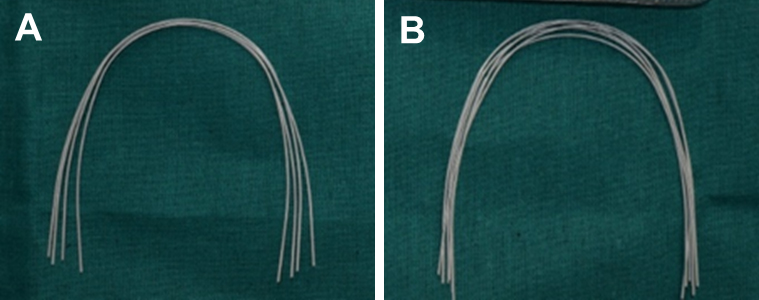
The findings were transformed to National Bureau of Standards (NBS) units in the manner described below to correlate the magnitude of colour change (
Critical marks of color change according to the national bureau standards
Color measurements were conducted using the Vita Easyshade V spectrophotometer (Vita Zahnfabrik, Bad Sackingen, Germany), adhering to the CIELAB system. Readings were taken for each wire band and solution. The color differences were presented as
Statistical analysis
The Statistical Package for Social Sciences (SPSS) version 28.0 of the statistical analysis software was used to examine the data. For every research group, the mean and standard deviation of the descriptive statistics were computed. The color change within the groups at different time intervals was evaluated using a paired sample
Mean 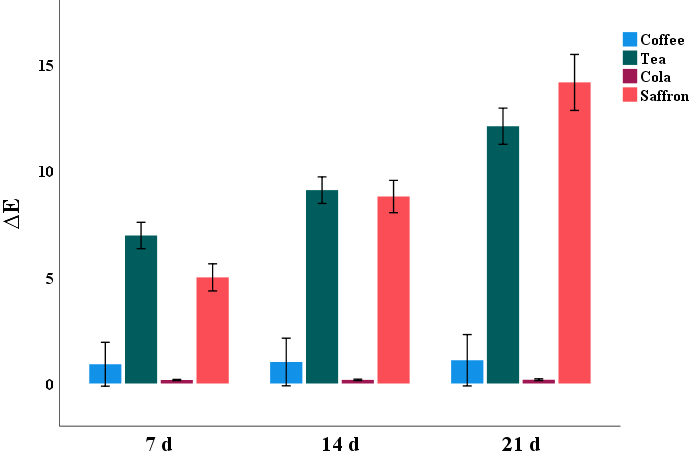
Figure 2 shows the
Figure 3 presents the mean
Paired differences analysis on
E across time intervals due to immersion of Teflon-coated orthodontic wires in different staining solutions
Paired differences analysis on
Mean 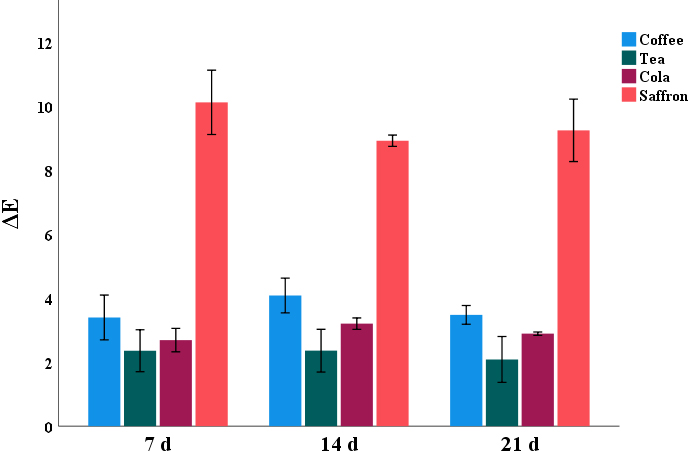
Table 4 presents the data of Teflon-coated orthodontic wires immersed in coffee solutions. A consistent decline in color stability (
Paired differences analysis on
Table 5 presents the data related to Epoxy-coated orthodontic wires when exposed to different staining solutions. In the coffee solution, a significant decrease in color stability at 7 days (
Inter-group comparison of coating types over time on
Table 6 displays data on two coating types (Teflon-coated and Epoxy-coated) at different time intervals (Baseline, 7 days, 14 days, and 21 days). Notably, the results suggest variations between the coating types over time, with significant differences observed at certain intervals, implying potential influences of coating type on the measured parameter.
It was observed that there was a color change over time at each time point when both esthetic orthodontic wires were subjected to four distinct staining solutions. Therefore, the hypothesis is rejected.
There is no agreement on the most effective approach to recognize color shifts. Since a spectrophotometer can discriminate between each color scale, it is utilized to lessen subjectivity in the highly subjective visual color comparison approach. Furthermore, color measurements made with a spectrophotometer yield data that are more consistently assessed and more reproducible [16]. The esthetically coated wire should demonstrate ideal biocompatibility, frictional characteristics, color stability, force deflection, and surface coating [8].
The results showed that saffron solution induced the most significant color alteration in both Teflon-coated and Epoxy-coated orthodontic wires, while cola solution consistently produced the lowest mean color change values. In contrast, coffee and tea solutions fell between these extremes, with intermediate color change values. Notably, Teflon-coated orthodontic wires exhibited a decline in color stability over time when exposed to coffee and saffron solutions, with significant decreases observed at each interval. Conversely, minimal color alterations were noted when exposed to cola and tea solutions.
Epoxy-coated orthodontic wires displayed a significant decrease in color stability when immersed in coffee solutions at 7 days, followed by potential stabilization at 14 days and a slight increase at 21 days. Saffron staining consistently led to significant color alterations in Epoxy-coated orthodontic wires across all periods. In contrast, cola solutions induced negligible color changes, while tea staining resulted in notable decreases in color stability over the 21-day period.
Inter-group comparisons highlighted that saffron caused the most significant discoloration in both Teflon-coated and Epoxy-coated orthodontic wires, followed by tea and coffee solutions. Cola solution exhibited the least color change, indicating minimal staining effects. The NBS units further categorized the color changes, with saffron and tea solutions leading to appreciable or marked changes, while coffee and cola solutions resulted in trace or extremely slight alterations.
Intra-group comparisons between Teflon-coated and Epoxy-coated orthodontic wires demonstrated that Epoxy-coated wires were less stained compared to Teflon-coated wires, with significant differences in color stability. The study emphasized the susceptibility of esthetic orthodontic wires to color changes in the oral environment, influenced by the chromogens present in food and beverages. The causes of esthetic archwire’s color differences is due to water absorption, the adsorption or absorption of colorants from solutions [17].
The study by Mundim et al. (2010) reported that when exposed to coffee, cola, tea, and spices for 72 hours, spices and coffee had the most significant effect on color stability, while cola had the least impact [18]. This finding aligns with the notion that different staining solutions can have varying effects on the color stability of esthetic orthodontic wires. The interaction between orthodontic wire materials and staining solutions, as well as the chemical properties of the coatings, likely contribute to these observed differences in color alteration [19].
In contrast, a study by Darabi et al. (2019) suggested a different order of color change when exposed to staining solutions. According to their findings, coffee had the maximum color change, followed by turmeric, tea, and cola [20]. This discrepancy highlights the complexity of color stability in orthodontic materials and the need for further research to understand the underlying mechanisms driving these variations.
The observed variations in color stability among esthetic orthodontic wires might be attributed to a confluence of factors such as the composition of these orthodontic wires, including the chemical properties of Teflon and Epoxy coatings, likely plays a pivotal role, influencing their susceptibility to staining [21, 22]. Interactions between orthodontic wire materials and the diverse chromogens present in staining solutions, each with distinct chemical compositions, could lead to the observed differences in color alteration [4, 23]. Surface properties, microstructural variances, and the chemical stability of coatings over time may contribute to the varying degrees of color stability [6, 24]. Additionally, the absorption and retention of chromogens, influenced by the orthodontic wire’s ability to resist or retain stains, could contribute to the observed outcomes [25]. The chemical properties of staining solutions, such as saffron inducing more significant color changes compared to cola, further underscore the complexity of this interaction [26]. Moreover, the duration of exposure and potential influences of food and beverage components warrant consideration [27]. This research proved that that the type of material, coloring agent, and duration of exposure influence the color stability [11]. Therefore, in order to reduce the staining impact, clinicians should advise patients to rinse their mouths with tap water after intake of coloring food [9].
These findings emphasize the need for orthodontists to carefully select orthodontic wires based on optimal color stability and educate patients on minimizing consumption of staining agents to mitigate discoloration issues [28, 29]. However, caution is advised in interpretation of the results. Achieving reproducibility of oral cavity conditions is intricating owing to myriad factors such as the complex microbial flora and their metabolic by-products, as well as the deposition of biofilms on the tested materials [30]. Therefore, clinical studies are necessary in addition to future research related to nuanced interactions between orthodontic wire materials and staining solutions for advancing the development of esthetically pleasing and durable orthodontic wires [31, 32].
Conclusions
Within the limitations we can draw the conclusions that the saffron solution induced the most significant color alterations, while cola solution resulted in the least color change in both orthodontic wires. Although Epoxy-coated wires generally exhibited better color stability compared to Teflon-coated wires. These findings emphasize the importance of selecting orthodontic wires with optimal color stability and educating patients on minimizing consumption of staining agents to mitigate discoloration issues. Further research is warranted to understand the underlying mechanisms driving variations in color stability and to develop more durable orthodontic materials.
Funding
Princess Nourah bint Abdulrahman University Researchers Supporting Project number (PNURSP2024 R331), Princess Nourah bint Abdulrahman University, Riyadh, Saudi Arabia.
Data availability
The datasets used and/or analyzed during the current study are available from the corresponding author on reasonable request.
Footnotes
Conflict of interest
The authors declare no conflict of interest.