






Abstract
Objective:
To measure the time required in patients with tympanic perforation to reverse paradoxical stimulation (reverse pseudo-nystagmus) and to create a physical model of the process.
Method:
An analytical, observational, cross-sectional study with vestibular evaluation (electronystagmography) of 52 individuals with tympanic membrane perforation without otorrhea or concomitant disease. Increased duration of caloric stimulation in the presence of paradoxical stimulation (reverse pseudo-nystagmus) reverses nystagmic responses.
Results:
Reversal of nystagmus was observed in 90.9% of patients. The average reversal time was 105.5 seconds. The physical model we prepared provided supporting evidenced for the effects seen in these individuals: warm stimulation in a moist environment initially caused a decrease in temperature (nystagmus to the unexpected side, which characterizes paradoxical stimulation in the warm caloric test); but, as time passed by, the moisture evaporated, and the temperature gradually increased (reversal of nystagmus).
Conclusions:
Increasing the stimulation time can be used as a strategy to differentiate reverse nystagmus from paradoxical stimulation. Confusion is thus avoided in diagnostic findings, allowing peripheral alterations to be distinguished from central ones.
Introduction
The caloric test is the most informative part of a vestibular evaluation and assesses each labyrinth separately. Warm stimulation of the labyrinth causes endolymphatic current in the semicircular canals, polarizing or depolarizing the sensorial cells of the ampullary crest, triggering the vestibular-ocular reflex. The stimulus generates an ampule current, towards the utricle, exciting the stimulated lateral semicircular canal and causing nystagmus in the same direction of the labyrinth being tested. The cold stimulus results in a current in the opposite direction of the utricle, inhibiting the stimulated semicircular canal and causing nystagmus in the opposite direction of the assessed labyrinth. The most important parameter for the caloric test quantitative assessment, which can be analyzed thanks to the possibility of recording the response, is the maximum slow component angular velocity (SCAV) [7].
Paradoxical stimulation is a phenomenon that can be observed during the caloric test because of excessive moisture in the middle ear. In these circumstances, a nystagmus may appear in the opposite direction, and be mistaken for another condition such as central nystagmus [9, 12].
Many authors [1, 13] have observed a reversed response in individuals having alterations in the middle ear, mistakenly describing it as a reverse nystagmus.
This response, known as reverse nystagmus, occurs in the opposite direction to that which is expected. It can be present either in individuals with central alterations [10], or in individuals with alterations in the middle ear [1, 12]. In order to differentiate one condition from the other, it has been suggested that the latter should be referred to as paradoxical stimulation in the warm caloric test [10] instead. This response is elicited by the cooling caused when moisture present in the middle ear evaporates upon warm stimulation – in other words, the system paradoxically ends up receiving a cold stimulation when it is being stimulated with warm air [2, 13].
This phenomenon was described [2] by means of an experiment in which the temperature inside the tympanic cavity of monkeys with alterations in the middle ear was measured during warm stimulation. A decrease in temperature was observed to occur with warm stimulation due to cooling and evaporation of the moisture from the mucosal lining of the ear canal.
An example of the phenomenon of heat loss are the mechanisms involved in keeping body temperature constant. A human being needs to keep their temperature around 37°C, and it can vary 0.5°C–1.5°C. In the presence of temperature instability, there are several mechanisms for gaining or losing heat. One of the mechanisms for heat loss is that of evaporation: when water, like that contained in sweat, loses heat and thereby causes the skin to cool down, which consequently decreases body temperature [8].
For this reason, caloric testing with warm stimulation in a moist environment actually produces a response similar to cold stimulation. Hence nystagmus in the opposite direction to that which was expected. It is, however, thought that paradoxical stimulation in the warm caloric test can be reversed by increasing the stimulation time, because once all moisture has evaporated, the system begins to warm up. Thus, nystagmus would reverse in the correct direction [10].
There are no studies describing either the best procedure to use during the caloric test in individuals with middle ear alterations, or the characteristic responses found in these individuals. Our objective was therefore to study the effects of increasing warm caloric stimulation time in individuals with tympanic membrane perforation without complaints of dizziness. We also aimed to build a physical model that exemplifies the paradoxical stimulation effects occurring in warm caloric testing. The physical model will be proposed to illustrate the phenomenon described in an experiment with monkeys [2], because it is difficult to assess the effects of paradoxical stimulation in specific conditions in the human middle ear.
Materials and methods
This was a cross-sectional, observational, analytical study approved by the Institution’s Research Ethics Committee, process number no. 507.283/2013.
We evaluated 52 individuals with tympanic membrane perforation without otorrhea and without concomitant disease in the period from 2014 to 2016. All of them were referred by a physician from the Department of Otorhinolaryngology at the Institution after they had given their consent in writing and signed a voluntary and informed consent form.
The participants underwent otoscopy, which was performed by the otorhinolaryngologist before the audiological evaluation and vestibular evaluation to rule out the presence of secretion in the middle ear. The size of the perforations in the tympanic membranes of participants were classified according to percentage by the same physician as small (up to 20%), medium (20% to 50%), and large (greater than 50%).
The audiological evaluation was performed with a Madsen® Itera audiometer. Tonal audiometry and speech recognition (Speech Recognition Threshold - LRF and Speech Recognition Index - IRF) tests were carried out.
For the vestibular evaluation, electronystagmography was performed in the periorbital region of the eyes with surface electrodes and one on the forehead, so placed as to obtain an isosceles quadrilateral, as well as serve as a ground electrode. The equipment used was from Contronic Sistemas Automáticos Ltda., which has a specific computer program (Nystagmus® software) and a light bar that presents the visual stimuli to the participants. The caloric test was done with the E107AR air stimulator of the same brand. The individuals remained in a seated position, 1 meter away from the light bar, for the eye movement calibration tests and the spontaneous nystagmus tests with their eyes either open or closed. Subsequently, the chair was tilted backwards, with the patient in a supine position with the head elevated 30 degrees upwards in order to conduct the caloric test.
The warm caloric test using an air stimulus was initially performed at 50°C with an 8 liters/minute flow rate. In the presence of paradoxical stimulation in the warm caloric test, the stimulation time was prolonged until nystagmus reversal was observed (up to 300 seconds - the maximum recording time allowed by the equipment software). Following nystagmus reversal, warm stimulation continued for another 60 seconds (standard time interval for caloric stimulation), at which time the nystagmus slow component angular velocity (NSCAV) was calculated.
The cold caloric test at 24°C and 8 liters/minute air flow rate for 60 seconds was only performed at least 3 minutes after the warm stimulation had ended or when total improvement of the patients’ symptoms was observed.
The test was suspended in those individuals showing no signs of paradoxical stimulation response in the warm test.
The vestibular evaluation tests were recorded by the Nystagmus® software and analyzed by the examiner using the nystagmus slow component angular velocity (NSCAV) measurement. Stimulation times in the caloric test were also recorded by the same software.
The physical model was constructed using PVC tubing 6 cm in length and 2 cm in diameter, open at one end and closed at the other by a cap made of the same material. A hole, 0.5 cm in diameter, was then drilled in this cap. A digital Incoterm Ind de Termômetros® thermometer was placed in this hole and supplemented with a cylindrical termination 0.4 cm in diameter and 2 cm in length. The cylindrical termination of the thermometer was wrapped with a cotton cloth of the same size (hood). It was made by a seamstress of a fine, light, white, 100% cotton fabric (similar to “tricoline”) with the same measurements as cylindrical termination (i.e. 0.4 cm in diameter and 2 cm in length) (Fig. 1).
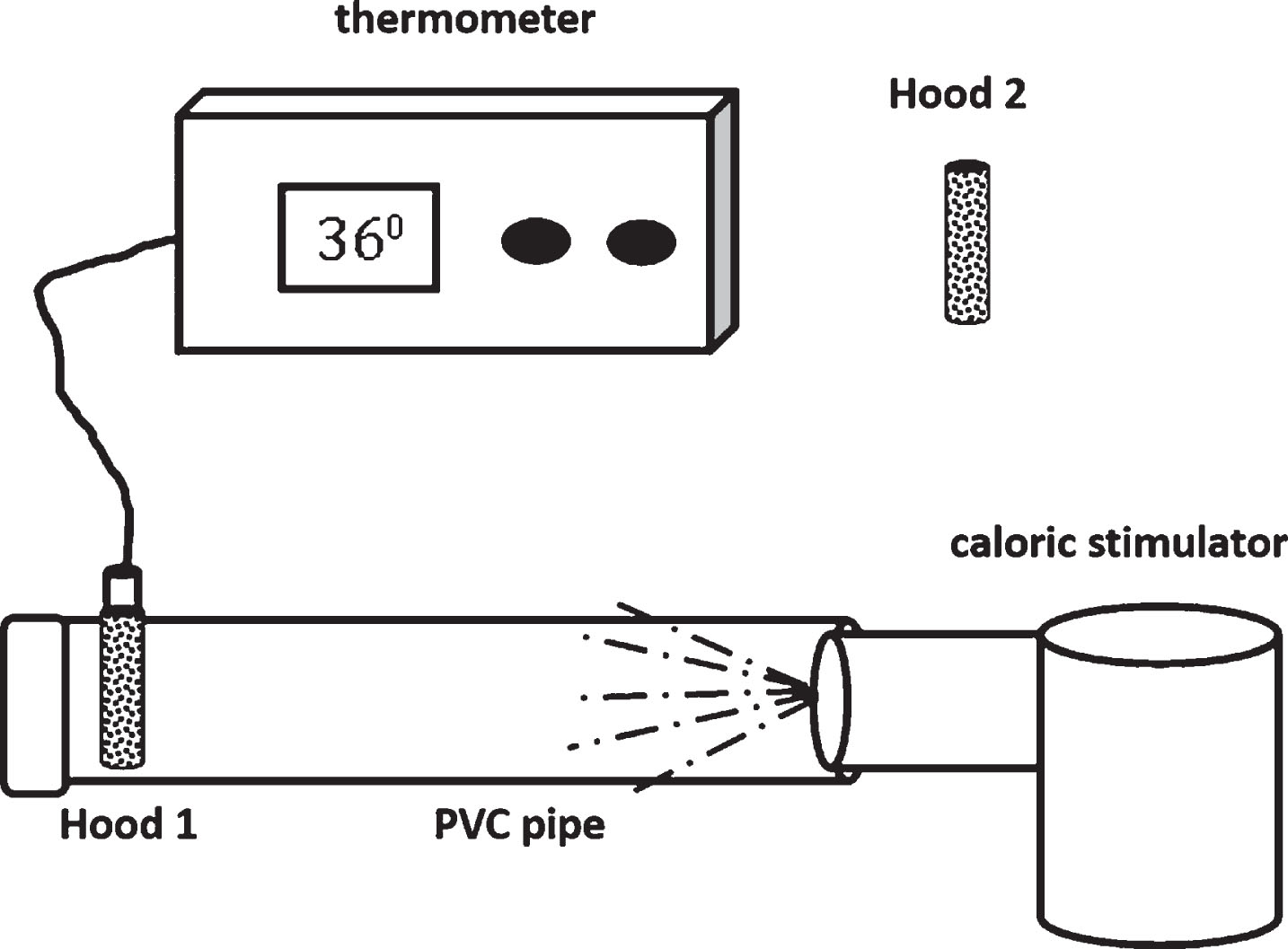
Physical Model Components.
The same model of thermal stimulator used with the patients was used with the physical model at 50°C and 24°C, 8 liters/minute, for 400 seconds. The temperature was recorded every 10 seconds using the air stimulator timer. Initially, we carried out thermal stimulation with one dry hood. In order to mimic the moisture of the middle ear mucosa lining in individuals with tympanic membrane perforation, the hood was made moist by being inserted into a container with water and any excess was squeezed out, and the stimulation was repeated. Finally, we performed the thermal stimulation on the physical model with 2 moist hoods. The placement of two moist hoods was intended to increase the moisture in the system.
Thermal stimulation on the physical model was conducted in the following order: 50°C with one dry hood; 50°C with one moist hood; 50°C with two moist hoods; 24°C with one dry hood; 24°C with one moist hood; 24°C with two moist hoods.
Throughout the experiments, we started providing thermal stimulation at a temperature close to 36°C (approximately at body temperature): we held the cylindrical termination of the thermometer in the palm of our hand and closed it until the desired temperature was reached. Each thermal stimulation was performed 3 times, and the simple average was calculated using the values obtained for the analysis.
The data obtained were then statistically analyzed using SPSS 13.0 software, under the supervision of a statistician. Pearson’s Chi-squared test was used to analyze the parametric data, whereas the Kruskal-Wallis test and the unpaired Wilcoxon test were used for the non-parametric data. A significance level of lower than 5% was used throughout theanalysis.
Fifty-two individuals participated in the study, and 60 ears were evaluated. The paradoxical stimulation in the warm caloric test was observed in 22 ears (36.67%) (Table 1).
The amplitude of the responses (slow component angular velocity) during the paradoxical stimulation and after 60 seconds of the reversal
The amplitude of the responses (slow component angular velocity) during the paradoxical stimulation and after 60 seconds of the reversal
Of the 60 ears evaluated, 18 were classified as having a large perforation (greater than 50%), 22 as having a medium perforation (20% to 50%), and 20 as having a small perforation (up to 20%). In comparing the presence of paradoxical stimulation with the size of the perforation, no statistical significance (p = 0.441) was found (Table 2).
Size of perforations in the tympanic membrane correlated with the presence or not of paradoxical stimulation in the warm caloric test
Chi-squared statistical test.
Paradoxical stimulation was observed in 22 ears in the warm caloric test but in 20 ears nystagmus reversal occurred following an increase in the stimulation time.
The average time to nystagmus reversal was 105.50 seconds, the shortest time being 33 seconds and the longest time being 180 seconds. A nonparametric Kruskal-Wallis test was used to evaluate whether perforation size had an influence on reversal onset time, though with no significant result (p = 0.098).
After nystagmus reversal, warm caloric stimulation was carried out for another 60 seconds. The nystagmus slow component angular velocity (NSCAV) was calculated after 60 seconds, resulting in an average value of 20.80°/s for the 20 ears. The nonparametric Kruskal-Wallis test showed no significant relationship between perforation size and nystagmus size after 60 seconds of stimulation (p = 0.077).
The average NSCAV in the cold caloric test was 24.95°/s for the 20 ears. The nonparametric Wilcoxon test for unpaired samples found the values to be correlated (p = 0.341).
In respect of the physical model, average temperature values were obtained during warm and cold stimulations with the dry hood, with one moist hood and two moist hoods (Graph 1). Warm stimulation (50°C) with the dry hood caused the initial temperature to rise from 36.16°C to 44.80°C (an 8.63 °C increase). The same warm stimulation with a moist hood initially caused the temperature to fall during a 90-second period (from 36.06°C to 25.26°C), but then, after 190 seconds, a progressive rise in temperature was observed. After 400 seconds, the temperature reached 33.50°C (a 2.57°C decrease relative to the initial temperature). With two moist hoods (hence a larger amount of water), temperatures initially also decreased, but then remained constant at around 26°C, with a 9.20°C decrease relative to the initial temperature, without any subsequent increase in temperature.
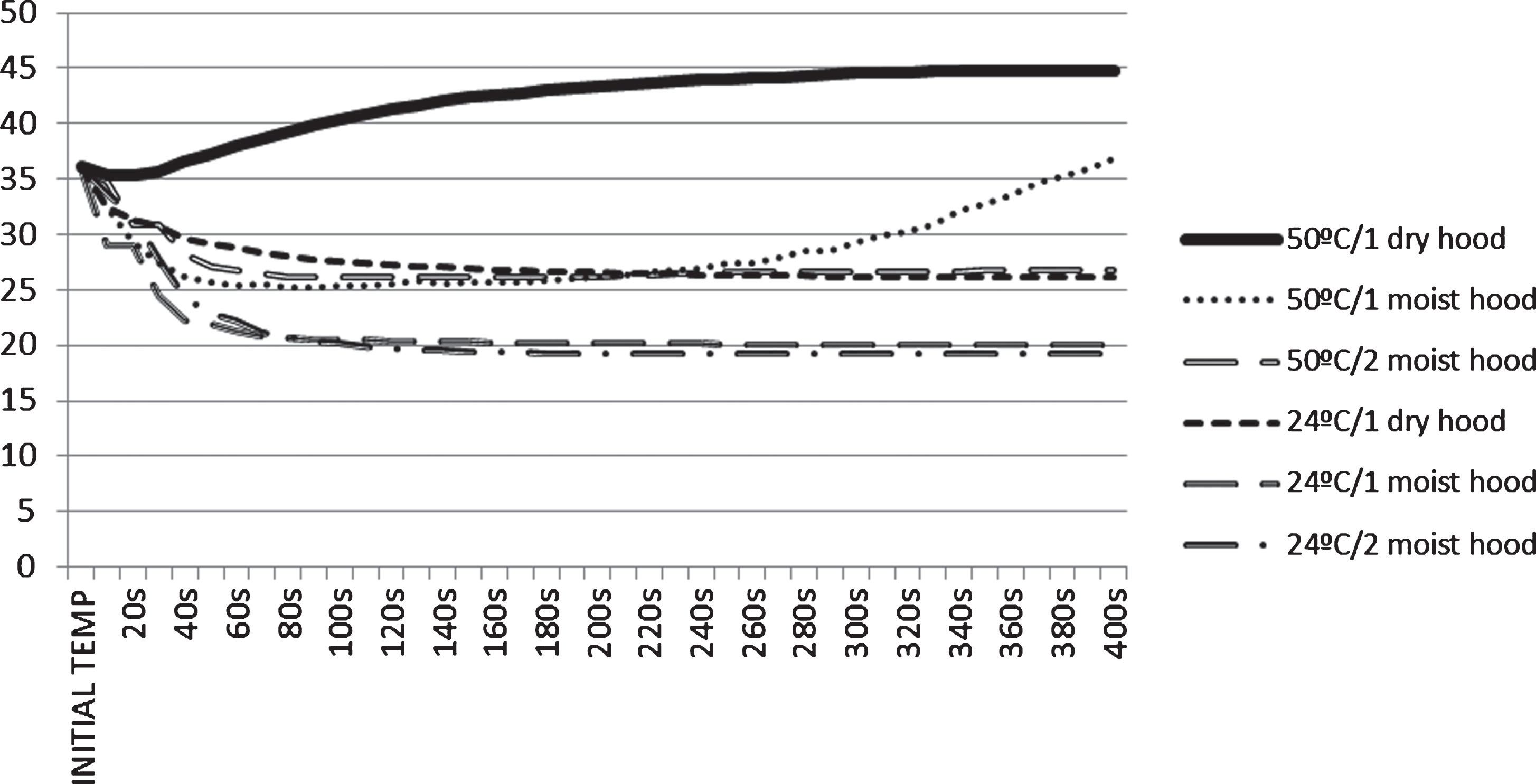
Average of stimulations at 50°C and 24°C in dry, one moist hood and two moist hoods, and their difference over time.
Cold stimulation under the same circumstances only caused the temperature to fall. However, with a dry hood, the decrease in temperature was lower, around 9.93°C. With a moist hood, though, the temperature fall was 16.03°C, and with two moist hoods, the temperature drop reached 16.8°C with respect to the initial temperature of 36.00°C.
The paradoxical stimulation in the warm caloric test was a frequent finding (36.67%) and similar to that reported in the literature (39.39%) [10]. Nystagmus reversal occurred even in participants with no apparent secretion (without otorrhea) as assessed with the otoscope, a fact that is dissonant with that which can be found in the literature, which indicates that response reversal is more frequent due to the presence of secretion in individuals with a perforation in the tympanic membrane [1, 12]. Moisture, although not visible, was possibly present in the 22 ears.
The size of the perforation in the tympanic membrane did not influence the appearance of the paradoxical stimulation, because it was seen to occur irrespective of perforation size. We can thus infer that the paradoxical stimulation in the warm caloric test is related only to the presence of moisture in the middle ear mucosa, the same conclusion reached by authors in other studies findings [10].
Perforation size did not influence the intensity of nystagmus after 60 seconds of warm stimulation following nystagmus reversal either, which is contrary to the findings reported by some authors [13], who stated that patients with extensive perforations may exhibit hyperactive responses. The non-significant results of the relationship between perforation size and nystagmus size are, however, in agreement with those found by other authors, who stated that having a perforation in the tympanic membrane does not favor the appearance of exacerbated responses [10].
There are no studies in the literature on the increase in the time of warm caloric stimulation and on the characteristics of the responses in individuals who presented paradoxical stimulation that would allow a comparison to be made with the data we obtained in our study. For this reason, the physical model was intended for illustrative purposes only, aimed at proving the effects we observed in the evaluated individuals, but it was not intended to precisely simulate the human ear cavity [14] (given that it was constructed with different measurements andproportions).
Warm stimulation with one or two moist hoods caused a decrease in temperature, a similar finding to that reported by Barber et al. [2], who observed a decrease in temperature during warm stimulation in their experiment with monkeys with middle ear had alterations. Warm stimulation in a moist cavity caused responses equal to that elicited by cold stimulation, thus characterizing the paradoxical stimulation in the warm caloric test described in the literature [10].
According to the physical model, warm stimulation with a moist hood initially caused a decrease in temperature (from 36.06°C to 25.36°C), and as the liquid evaporated, the temperature rose. This experiment can help to explain nystagmus reversal with an increased stimulation time. Warm stimulation initially caused cold stimulation (a decrease in temperature and nystagmus in the opposite direction to that which was expected: paradoxical stimulation) due to the moisture present in the tympanic cavity; and gradually, as the liquid evaporated and the system dried, the temperature increased (reversal in the nystagmus: warm stimulation and nystagmus in the expected direction). We did not compare the time it took for the physical model temperature to increase with the nystagmus reversal time in the patients, since the physical model was constructed only to prove that the effect happens, with different dimensions than those of the human ear.
In two ears (9.10%), we observed no nystagmus reversal, even when we increased the stimulation time. According to the physical model (experiment with two hoods), the presence of too much moisture can hinder its total evaporation, thus keeping the temperature low for much longer. Hence, in these two ears, we can assume that the amount of moisture in the tympanic cavity was greater.
The response reversal in individuals with alterations in their middle ear during warm caloric stimulation is described in several studies [1, 13], but this phenomenon was not clinically differentiated from reversal nystagmus associated with central alterations. The position V of Brunnings [3, 11] is used in the differential diagnosis of central nystagmus from nystagmus of peripheral origin. Nevertheless, both in the paradoxical stimulation in the warm caloric test and in reverse nystagmus, the maneuver causes nystagmus reversal, making diagnosis difficult. Increasing the duration of warm stimulation to ears with alterations in the middle ear in the presence of paradoxical stimulation in the warm caloric test allows us to differentiate reverse nystagmus of central origin, thus avoiding making a misdiagnosis. The proposed physical model proved that there is a possibility that all of the system’s moisture evaporated and that the temperature, initially cold, rises gradually. Thus, increasing warm stimulation time in the presence of paradoxical stimulation in the warm caloric test may be an option for reaching a response in the expected direction and allowing for differentially diagnosing responses of central origin, thus reducing the number of false positives in central patients.