






Abstract
This case study will focus on the “evolution” of finding meaningful occupation for a young man, Patrick, 27, in spite of his multiple disabilities within his rural home environment in Stowe, Vermont. The purpose of this case study is to show others (family members, therapists, support service individuals and adult agencies) that it is possible to be self-employed despite life’s challenges, and that with some creativity (and funding), there is a niche of meaningful occupation available for all!
Patrick
Patrick was born 27 years ago, entering the world in a big hurry, 14 weeks prior to his arrival date. He weighed 1 pound, 14 ounces at birth, and was quickly whisked into his new world of tubes and beeps and people in scrubs: the world of the Neonatal Intensive Care Unit. He soon dropped to 1 pound, 8 ounces. With the support of modern medicine, and love pouring in from everywhere, Patrick began to flourish and survive in the world of his isolette. When he was 26 days old, we, his parents, Mary Anne and George, were finally able to hold him briefly. But in just a few minutes, he had to go back to his familiar environment, as his body temperature was dropping dangerously low.
In 1990, some 10.6 percent of all births in the United States were preterm births. A preterm birth means that a child was delivered after less than 37 weeks of gestation [1]. Survival rates for extremely early preterm babies have improved dramatically over the past 15 years [2]. In 1995, practically no children survived when born as early as 22 weeks gestation age, while in 2008 21% survived. The most dramatic improvement has been noted among infants born in week 24 and week 25. In 1995 24% of the infants born in week 24 survived, while the rate in 2005 was 41%. In 2008, the share had risen to 60% according to the above study.
There are numerous medical and neurological problems that can be associated with prematurity [3]. Premature birth can lead to long-term intellectual and developmental disabilities for babies. These problems may be seen in learning, communication skills, self care skills, behavioral problems, or neurological problems like cerebral palsy. In addition, premature babies are at risk for developing retinopathy of prematurity [4]. “Retinopathy of prematurity (ROP) is a potentially blinding eye disorder that primarily affects premature infants weighing about 2¾ pounds or less that are born before 31 weeks of gestation. The smaller a baby is at birth, the more likely that baby is to develop ROP. This disorder— which usually develops in both eyes— is one of the most common causes of visual loss in childhood and can lead to lifelong vision impairment and blindness”.
As Patrick grew, so did his list of diagnoses: he has cerebral palsy (spastic diplegia), seizure disorder, severe to profound intellectual delay (non-verbal), and Retinopathy of Prematurity (ROP), which left him totally blind (NLP or no light perception). In spite of his diagnoses, Patrick was loved immeasurably, and grew to be a relatively healthy young man, who enjoys many pleasures in life…. from time spent with family to music to pizza to swimming to adaptive skiing and adaptive paddle boarding. But the question always remained in my mind, “What would Patrick “do” when he grows up?
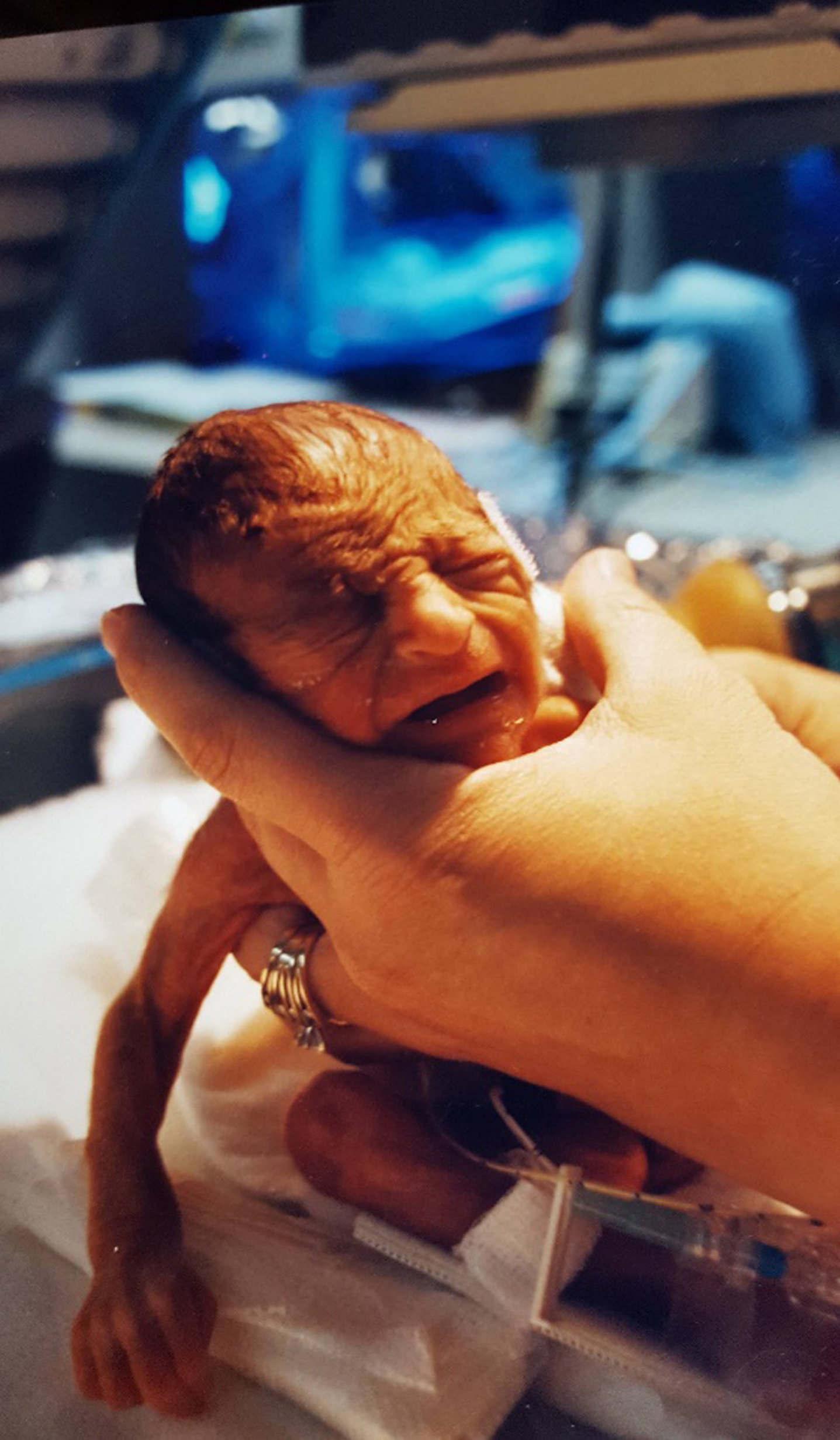
Patrick receiving a respiratory treatment in the NICU at approximately 4 weeks old.

Patrick participating in Adaptive Skiing at Stowe Mountain Resort.

Patrick loves the water!
When my daughter was 7, she asked me if Patrick (then aged 9) would go to college. I replied that I really didn’t think so. Not understanding college fully, she asked, “why not?” I explained to her that college was just going to be too hard for Patrick, to which she replied, “Well, what will Patrick do when he grows up?” Tearfully, I answered, “I really don’t know at this point”. To which she exclaimed, “Oh, I know! Patrick’s job will be to make everyone happy!” And while this gave my heart great consolation, it began me thinking, “Really, what will Patrick do when he grows up?”
We researched the “typical” day options for an individual “like Patrick”, which is an ironic statement unto itself as there really is no one else like Patrick. (And I believe that can and should be said about absolutely everyone).
Typically, the programs for those with developmental disabilities fell into 4 categories: residential programs, day programs, respite and employment. We wanted Patrick to continue to live with us, so we researched options between day programs and employment. The day programs were mostly activity based and did not seem to meet Patrick’s needs: watching several movies weekly doesn’t work for Patrick, unless they are musicals, participating in hand over hand activities doesn’t appeal to someone who is blind and wants/needs to use their hands to explore on their own, and the recreational pieces of these programs were not geared towards Patrick (he does not enjoy bowling with a ramp, when he would rather be participating in adaptive skiing or paddle boarding).
The “traditional” employment opportunities were not available (or appeared to be of interest!) to Patrick either. Sadly, the areas open to individuals with developmental disabilities at this time was primarily the “Three F’s: food, flowers, and filth,” none of which seemed to be a good fit for Patrick.
Thus, the birth, or the evolution of “Purely Patrick”, which admittedly was a process of learning, experimenting and “going back to the proverbial drawing board” numerous times. As a bit of background, I, Patrick’s mom, had been an Occupational Therapist for years, (yes! 12 years before Patrick was born) so I was aware of the importance of meaningful occupation. I was also used to looking at tasks, and breaking them down into smaller components (good old task analysis). And I was also skilled at looking at what an individual COULD do, not what they COULDN’T do. So, keeping that in mind, I thought,
Patrick was really skilled at “squishing” his hands together and making noises that would make all teenage boys laugh. And Patrick’s O.T. and myself thought, how can we capitalize on that hand motion? Our family was in the process of buying a Bed and Breakfast, so, it was decided that Patrick would use that motion to mix up bath salts (the salts, the scent and the coloring) in a zip-lock baggie using his favorite repetitive hand motion. But then what? After some thought, it was decided that Patrick could use his pouring device [5] to pour the bath salts into small containers and sell them at the school store and the Inn. (Patrick had used this device over the years to help water the plants, pour his milk to make a milk shake, dump the eggs into the cake mix, etc.)
The pouring device is operated by a switch that Patrick pushes, and is hooked up with a goose neck and a measuring cup on the end. When Patrick hits the switch, the cup pours. (We quickly learned that this process was enhanced with the use of a funnel).
This seemed to be a great start, but we weren’t sure if Patrick should or could be doing more (we were always thinking about expanding his business). Homemade soap was considered as a possibility, however that idea was quickly ruled out after basic research as most soaps use lye (not good for someone who mouths a lot and pokes his eyes [6]. Sarah J. Blake, once an eye poker, agrees that the stim behavior (of eye poking/pressing), serves a purpose for the child and must be replaced with something else. She explains how parents can help their children in an article called “Beating Blindisms.” Eye pressing is as normal for a blind person as biting of nails or sucking of thumbs is for a sighted person. One reason for eye pressing, she says, is that the child sees flashes of light as the retina is stimulated. Others do so because their eyes hurt.
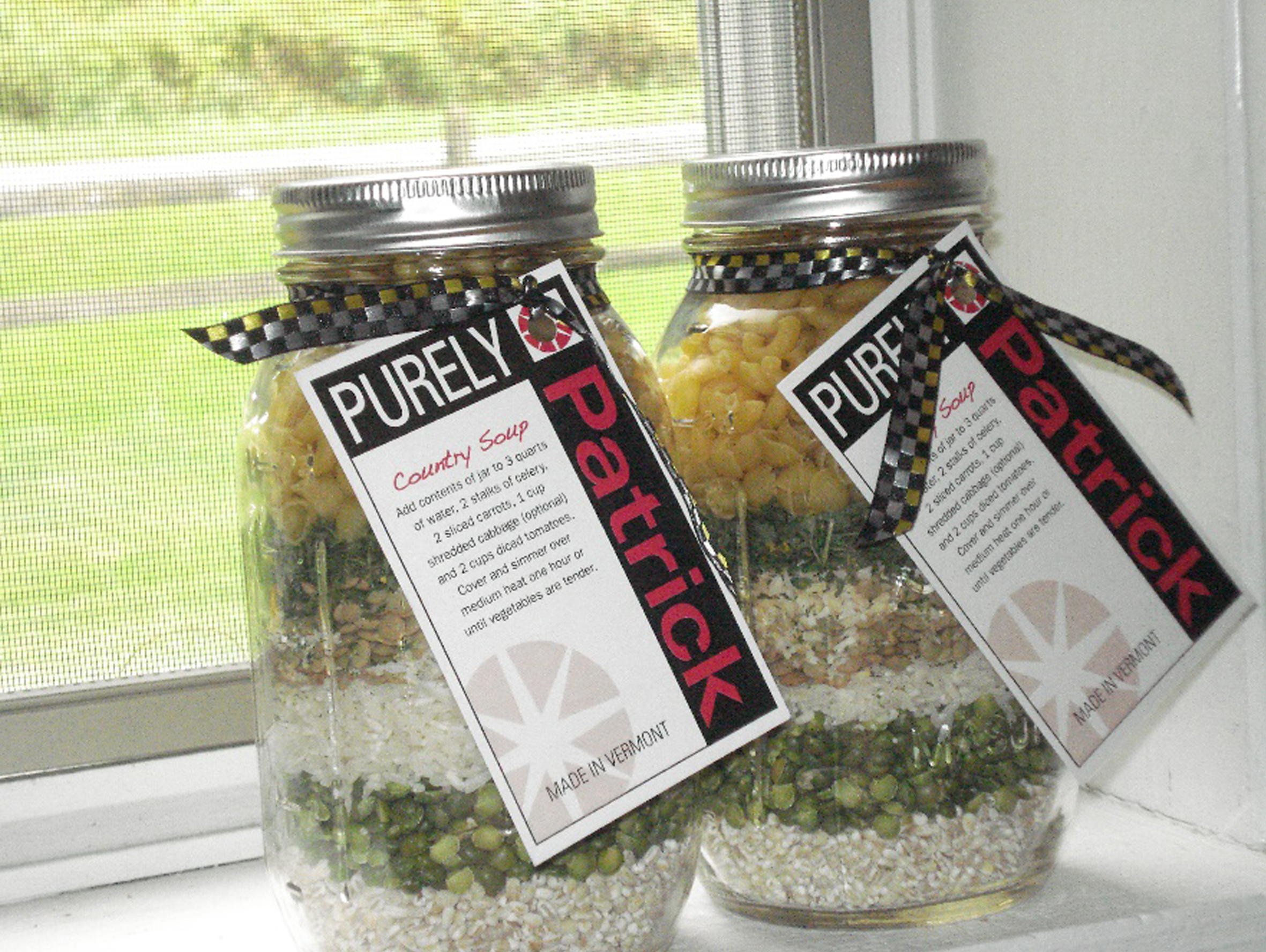
Purely Patrick Jars: Country Soup.
So, then the next idea was for Patrick to make homemade dog treats. At this same time, we had a graphic designer helping us with our Inn business, and I asked her to help me with marketing for Patrick. How do I tie bath salts and dog treats together from a marketing standpoint? Her response was, “What if Patrick could make little kits, and people could make their own dog treats?” I started researching different dog treat recipes, and one recipe was in a Ball jar, with layered dry ingredients, and instructions for adding the “wet” ingredients and baking it along with the jar. The O.T. in me, thought, “Wow! Patrick could make these using his pouring switch!” and thus an entire business was born. (This was so much better than the pre-made dog treats because that did not really provide many components that Patrick could do. His school aid would help Patrick roll out the dough (with hand over hand assistance) and then together they would use a dog bone shaped cookie cutter to cut out the cookies. This step, too, involved hand over hand assistance. It soon became very evident that Patrick did not like hand over hand assistance at all [7].
“For many children who are blind, their hands are a primary learning tool. Children must explore with their hands and use their hands to do tasks to make this learning channel efficient. But some children resist when an adult tries to show their hands how to do things. Using a hand-under-hand approach, instead of hand-OVER-hand, has been demonstrated to be a far superior way to encourage children to learn with their hands. Instead of moving the child’s hands through actions, the adult’s hands lightly touch beside the child’s or the child’s hands ride on the adult’s hands and feel what the adult hands are doing. In hand-under-hand touching the child and adult explore together, are interested in the object together. The child is invited to feel, not forced or heavily manipulated”.
But hand UNDER hand assistance just did not get the job done. The pre-made dog cookies also had a strong smell, which Patrick disliked as well.
We decided on 5 different “jar” recipes to get started: a soup, the dog treats, and 3 different cookie mixes. They were all assembled by Patrick using his pouring switch. We further enlisted the help of the graphic designer to help us develop “hang tags” that would go on the jars with ribbons, and look professional. Concurrently we were trying to come up with a name for Patrick’s business, when once again the graphic designer came up with “Purely Patrick”. We loved the name: it expressed everything we wanted to say … . that this business was Purely “Patrick’s”. For example, if it took him awhile to fill an order, that was fine. It was not about us doing the work for him. If we ran out of a certain item, that was a good problem, and we, as family members were not going to jump in “just to get it done”. No, it was to be “Purely Patrick.” The graphic designer designed the hang tags with the directions for assembly on one side, and a picture of Patrick and “his story” on the other side. At this point Patrick was still in school, and his school aid came to the house three morning a week and helped Patrick with his jars. As Patrick’s job coach, Carrie, says, “If it’s in the jar, Patrick put it there.” Patrick does, however, need help measuring out the ingredients, which is where the aid came in. It soon become evident that Patrick really enjoyed this, especially the “noisy” jars to assemble. For example, his Country Soup is layers of dried beans, peas, rice, and lentils, each one making a distinct sound as it pours into the jar.
We also sought out other components that Patrick could participate in within his newly found job. For example, the oatmeal in the dog treats had to be blended into flour. Patrick has an environmental control unit (ECU) with switches, and he was able to use a switch through his ECU to operate the blender to make the oatmeal into flour himself. Also using 2 other switches, through the ECU, Patrick could operate the fan if he got hot, and the music if he felt like listening while he worked. The other components that Patrick participated in was in the community: he went to the grocery store to buy the necessary ingredients for his jars, and to the hardware store to buy the Ball jars, and eventually to Farmer’s markets and craft shows to sell his products.
At this point, Patrick began selling his items at the school store and at our little gift shop within the inn. Ironically, bath salts were sadly being abused by kids, and were no longer permitted to be sold, so that initial part of his business faded out. (We also found out that the bath salts were corrosive to the whirlpool jets within the Inn). And even though the bath salts concept was put to rest, it truly was an integral part of our thinking process on the road to Patrick’s successes!
Patrick’s team (school members and family) started working with an Employment Specialist from the local designated agency. She absolutely loved the direction that Patrick’s business was heading in, and she encouraged us to apply for funding “sooner, rather than later” as she was noticing a steady decrease in available funding. At this point Patrick was 19 years old. So, I put together a business plan for Patrick, and the employment specialist carried Patrick’s torch, so to speak, “taking it to Equity.” This is the process whereby all the ideas are presented to the state, and funding is requested. After looking at the big picture, the “powers that be” determine who gets what funding. We were thrilled when Patrick received funding for a job coach 25 hours a week, the exact amount we had requested! We had never imagined that Patrick would graduate from school before his entitled age of 21, but after a brief consideration, we quickly decided to take advantage of the funding at that point. (“A bird in the hand is worth two in the bush.”)
With the advent of a job coach 25 hours a week (“supported employment”), we needed to find other venues to sell Patrick’s products. There are numerous seasonal craft shows and summer outdoor markets in our area of Vermont, that Patrick could participate in. He continued to sell his products at our Inn, which is still where he makes the most sales today on a yearly basis.
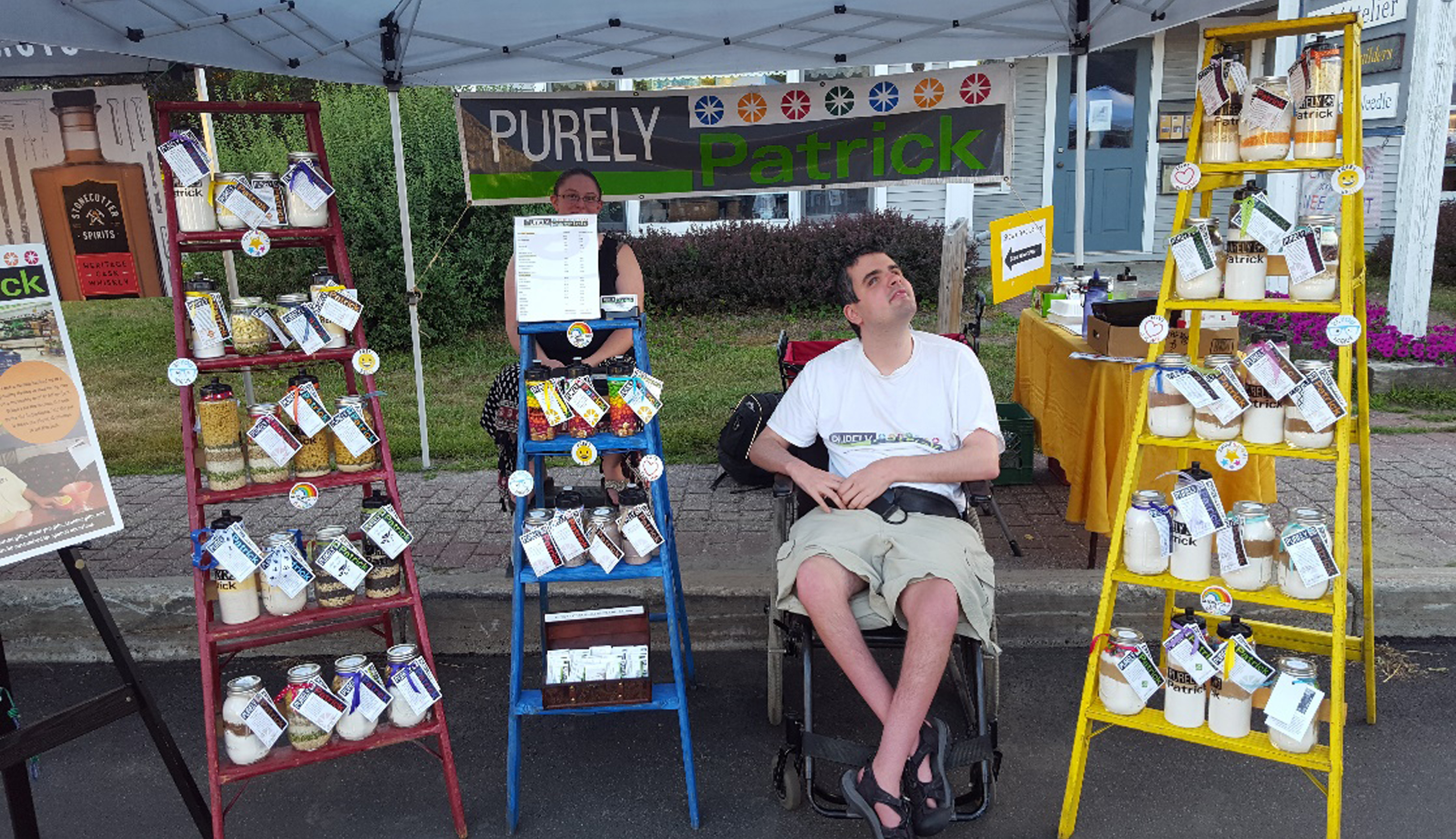
Purely Patrick at a weekly summer artisan market, Stowe, Vermont.
As marketing continued and developed, so, too, did Patrick’s product line. To date, 6 years after the inception of his business, Patrick now makes 22 different products, including 2 gluten-free options, a birdseed mixture in addition to his dog treats, 3 different kinds of soup mixes, brownies and breads as well as chai tea and hot cocoa.
One of Patrick’s most recent recipes is his Grandmother’s cookie recipe, fondly named “Grandma Jo’s Snickerdoodles”. We have partnered with the Vermont Walk to End Alzheimer’s, and $2.00 from every jar of the snickerdoodles goes to the support, care and research of individuals affected by Alzheimer’s, the disease that sadly robbed Patrick’s Grandmother of her soul. This past year, Patrick contributed over $600 to the Alzheimer’s Foundation. This has been an invaluable lesson to Patrick and his fan base about giving back!
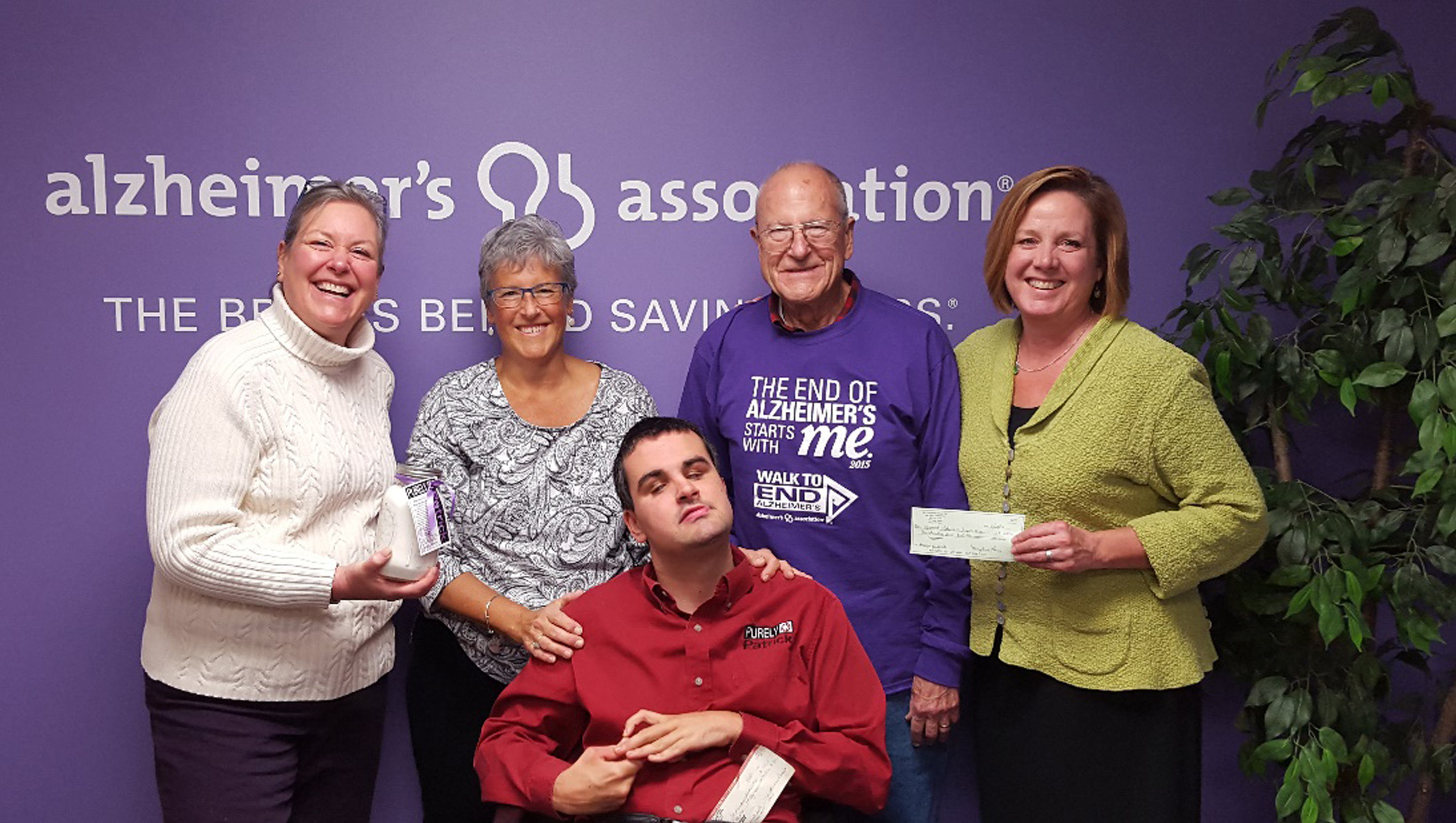
Patrick with his Grandfather and mother making a donation to the Vermont Alzheimer’s Association on behalf of his Grandma Jo.
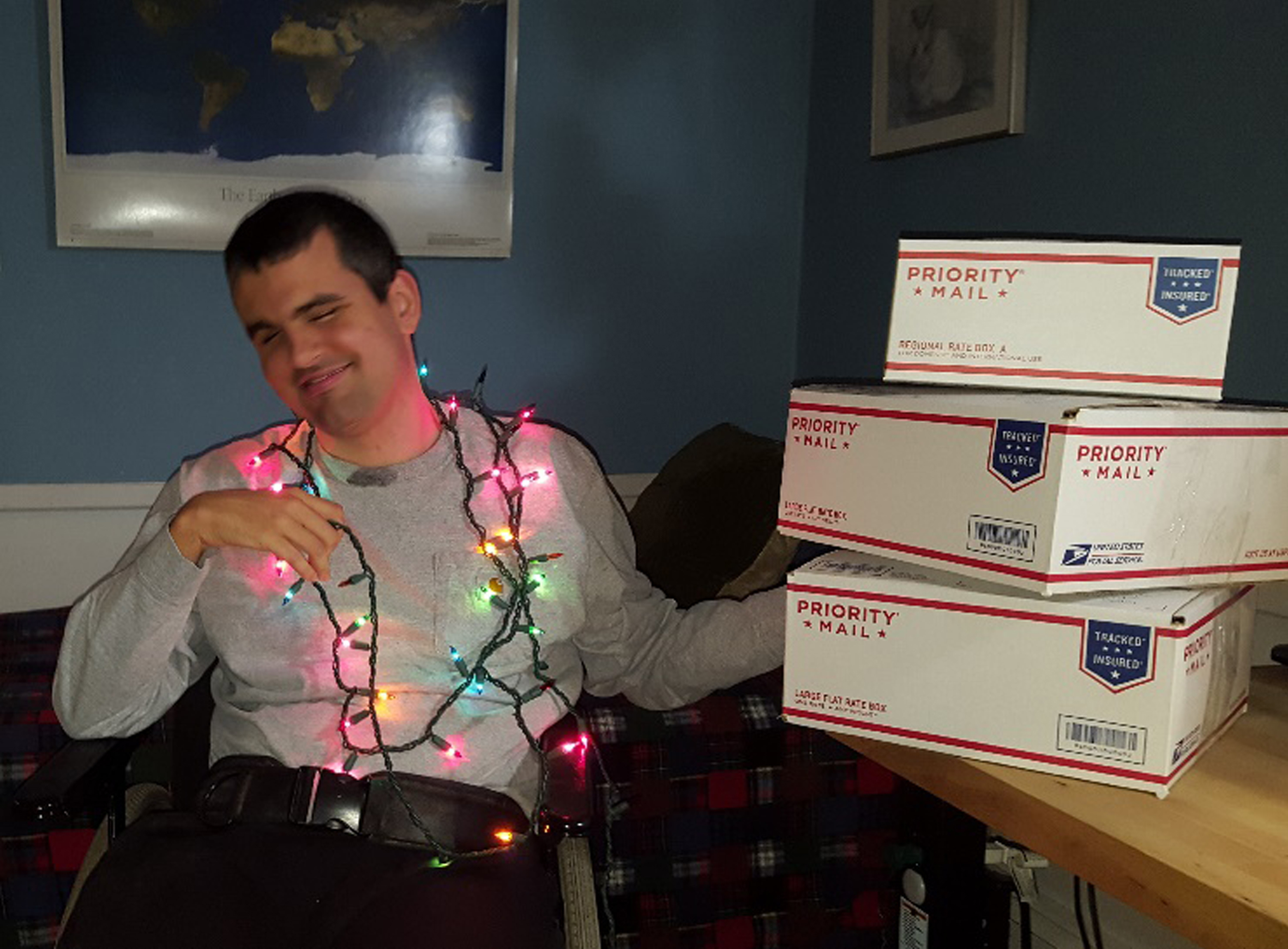
The online orders are ready to go!

Patrick always has a song in his heart!
Approximately 3 years ago, we (the job coaches and our family) felt that is was time for Patrick to have an on-line presence. A web site was developed www.purelypatrick.com and shipping of Patrick’s products commenced. However, this, too, was a learning process. The first shipping experiment was to a friend, in the original Ball jars. Not only was this heavy and expensive to ship, two out of the three jars in our “experiment” did not arrive safely. The next shipping was done in a zip lock baggie, which was efficient however not visually appealing. We then tried gusseted, flat bottomed cellophane bags which looked nice, but we soon learned that when shipped a long distance, in a non-pressurized section for cargo, the seams were literally bursting wide open. This problem was temporarily fixed by reinforcing the seams with packing tape, however this method did nothing for the aesthetics of Patrick’s products either. Finally, we came up with the idea of using clear (reusable) water bottles, complete with Patrick’s logo printed on the side. And, we had success!
Patrick has a Purely Patrick Facebook page, along with an Instagram account. He has business cards (both paper and magnetic), as well as Purely Patrick gear that he wears at markets and craft shows. Patrick has just recently starting to sell these items (sweatshirts, tee shirts) to his fans who have expressed an interest in them.
And just like any business, we track Patrick’s business expenses, and monitor his Profit and Loss on Quickbooks. Patrick pays quarterly sales tax to the state (in Vermont the “people” food is not taxed, but the birdseed, dog treats, and shipping is all taxable). We submit a “Schedule C” to the IRS along with Patrick’s income tax filing every year. Based on his income for the year, his disability benefits are adjusted accordingly.
It gives us great satisfaction to see Patrick working hard, being self-employed in spite of the challenges that life has presented him, and above all else, maintaining a sense of dignity and self-worth! Hopefully, Patrick’s business model will be sustainable, and that the funding source for his job coaches will continue.