







Abstract
BACKGROUND:
Mothering and caring for children have been associated with a decrease in mothers’ wellbeing. Limited research has been conducted from the ergonomics perspective of mothering and caring for children due to the belief that being a mother is not considered an occupation.
OBJECTIVE:
To observe the ergonomics of mothering and caring for children (ergoMOMics) among Indonesian mothers and the prevalence of related musculoskeletal symptoms (MSS).
PARTICIPANTS:
Five hundred and twenty-five Indonesian mothers.
METHOD:
The prevalence of MSS was assessed using Nordic Body Map questionnaire. An adapted questionnaire on mothering and child care activities and their consequences were also used.
RESULTS:
Most Indonesian mothers reported some negative consequences of mothering and child care activities, including MSS in the back (50%), neck (26%), and upper shoulder (43%). Demographic data that significantly influences MSS includes the domicile category and help from others. Mothers in large cities reported higher MSS than those residing in small- to medium-sized cities (t (523) = 7.43, ρ< 0.01). The help of family members (commonly children’s grandparents) significantly increased reported MSS (F(2, 524) = 3.57, ρ= 0.02). A specific child care activity that influences MSS is the lifting for children.
CONCLUSIONS:
Mothering and child care are very demanding activities that can result in MSS. Therefore, steps must be taken to prevent and overcome these symptoms.
Introduction
Mothering and child care are common activities experienced by all mothers. These activities have been hypothesized as the cause of several negative effects among mothers, such as psychological stress and physical tension. However, these issues have received relatively little attention. Limited research conducted on the child care activities have focused on child care workers, since it has become a booming business recently. Child care workers are exposed to the risk of occupational injuries such as infections, psychological strains, and trauma (see [1, 2] for examples).
Another cause of the limited available research on mothering and child care activities, in particular for housewives, is the belief that performing domestic activities is not considered an occupation. The definition of occupation is “everything people do to occupy themselves including looking after themselves (self-care), enjoying life (leisure), and contributing to the social and economic fabric of their communities (productivity)” ([3], p.3). Occupation is also defined as a person’s engagement in self-care, productivity, or leisure in the context of their physical or social environment by investing time and energy on it [4]. These two definitions underline the importance of occupations for the social and environmental contributions they provide, and that they are not merely related to economic considerations in the form of salary or other economic advantages. Thus, mothering, which has been defined as “a woman engaging her resources of time and energy in actions directly or indirectly related to the care or nurturing of a child to whom she is a mother, in the context of her physical or social environment.” ([5], p. 11) should be considered a unique occupation.
Awareness of the importance of research in mothering and child care has been starting in recent years and is aimed to make children safer while resulting in minimal negative effects for mothers (see [5, 6] for examples). Notably, although empirical studies in this area have been recently conducted, such research remains limited. Research have underlined the stress experienced by mothers; in particular, when they must arrange their child care activities alongside other home activities and occupations ([7, 9]). In particular, carpal tunnel syndrome—a type of musculoskeletal symptom (MSS)—have been reported being experienced by pregnant women due to fluid retention and tightness in the carpal tunnel [10]. In caring for children in particular, MSS have been related to the chosen lifting methods of parents [11].
Focus has been placed on MSS in many studies due to its potential to result in severe long-term pain as well as physical disability among individuals. Consequently, MSS can result in serious economic and social impacts on communities ([12–16]). Understanding the causes and characteristics of MSS cases and their associated risk factors represents a crucial step for the reduction of such consequences [12].
Despite the limited amount of research in this area and the hypothesis that mothering and child care activities may be related to MSS, the importance of research in mothering and child care should be highlighted for other reasons. First, the population size of mothers suggests that they should be prioritized in research. There are over 2 billion mothers worldwide, and the mother population in each country shows a high number as well. In New Zealand, 40% of women over 15 years of age are mothers residing with children [17]. In the United States, the population of mothers is approximately 56% [18]. Second, being a mother represents a critical role in society. Mothers are often the primary caregivers of future generations [7]. They also act to safeguard child health and help socialize their children to become responsible community members [19]. Third, women have struggled to balance their careers with home life in recent decades ([8, 20]). Therefore, the fact that mothering activities are under-researched becomes particularly surprising.
In Indonesia, the number of full-time resident mothers is approximately 53.69%, compared to 46.31% of mothers working outside the house/professional workers in 2017 [21]. Although the child care industry is booming, the number of full-time and resident mothers remains higher than that of the working mother. In Indonesia, mothering (i.e., activities including manual dishwashing, using a washing machine for clothes, and cleaning the house) and caring for their own children in their home are activities perceived as daily activities that are given little attention by researchers.
Although some research into mothering and child care has been conducted in some countries, the domestic situation of child-rearing in Indonesia is quite different to other countries. For example, support from family in child care in Indonesia is high, and some new couples live with their parents. In addition, the use of different traditional baby carriers for child care activities in Indonesia (i.e., jarik, a long traditional Indonesian shawl) is also something particularly unique. Such differences might also influence mothering and child care activities. Therefore, specific research targeting mothering and child care activities in Indonesia is pivotal to reducing the possible negative consequences that may arise from these activities. Such research will also enrich the picture of mothering and caring for child-related activities in general.
The purpose of the present study is to observe ergoMOMics—the ergonomic aspect of mothering and child care in Indonesia—with the aim identifying factors affecting the well-being of mothers and preventing the negative consequences of mothering and child care activities. The present study involved a survey regarding mothering and child care activities conducted in cities throughout Indonesia. The survey included the demographic data of respondents, their daily activities, and the physical and social symptoms of mothering and child care activities. The study is approved by the Ethical Committee of Ergonomics and Work Safety and Health Research Group, Institut Teknologi Bandung, Indonesia.
Method
Respondents
A total of 525 Indonesian females (mean age = 34.3 years, SD = 8.82 years) voluntarily participated in the present study by completing a questionnaire. With 14 million housewives’ population in Indonesia, the sample size needed for the survey with a 95% confidence interval and 5% margin error is 385. The study only focused on females, since mothering and child care activities in Indonesia are primarily conducted by this gender. Convenience sampling was applied in the selection of respondents. Sampling was conducted in public spaces, and a personal approach was applied to obtain participant involvement. An explanation of the study was provided prior to their agreement for involvement in the present research. A souvenir (a gadget pouch) was provided as a reward for participation.
Respondents were recruited from several cities in Indonesia, with Bandung and Jakarta representing large cities, and Solo and Yogyakarta representing small- to medium-sized cities in Indonesia (based on the population size, [21]).
Measures
Recorded demographic data included age, weight, and height. The questionnaire used in the present study was developed based on a version investigating the ergonomics of caring for children ([5, 22]). The original questionnaire was adapted into Indonesian using a back-translation procedure ([23, 24]). First, the original questionnaire (in English) was translated into Indonesian by two Indonesian bilinguals with a TOEFL score greater than 550 out of 677. The best Indonesian version was chosen and then back-translated into English by a third person who also had a TOEFL greater than 550 who had not seen the original questionnaire. The original and back-translated version were compared, and a consensus was made. In addition, a modification had been made to the original questionnaire to create some items specifically applicable to the Indonesian context. The reliability and validity of the questionnaire items were tested for the first 30 participants using Cronbach’s alpha for reliability and the item correlation for validity test, with the results indicating high reliability and validity for all items.
The items in the questionnaire are as follows: information about the number of the children, demographic information about the mother such as age weight, height, occupation, marital status, spouse participation or other support in child care, time available to perform household duties, child care practices, bodily discomfort or pain, daily activities in child care that may cause physical discomfort, child lifting method, and activities that are influenced by MSS (including outdoor activities, ability to sleep at night, quality of relationship with the children, ability to perform household chores, ability to perform paid employment outside the home, ability to perform personal self-care, and ability to fully perform tasks related to child care).
Respondents were asked to provide their responses by ticking the appropriate answer on a questionnaire sheet. A Nordic Body Map [25] was also used to observe musculoskeletal symptoms (MSS) for mothering and child care activities in general. The scale of this map ranges from 0 (minor) to 2 (severe) in order to record the severity of symptoms in the different body parts. The consequences of MSS on normal activities were also recorded.
Procedures
The paper questionnaire was given to respondents for in situ completion. On average, 15 minutes was required to complete the questionnaire. However, when respondents required assistance in the completion process, surveyors would help fill in the survey on behalf of respondents.
Data analysis
Data analysis was performed using SPSS software version 21.0 (SPSS Inc., Chicago, IL, USA).
Results and analyses
The demographic data of respondents based on domicile category (large and small- to medium-sized cities) is presented in Table 1.
Demographic data of respondents
Demographic data of respondents
The sum of reported MSS during mothering and child care activities is presented in Table 2. Since the sum of reported MSS is represented by interval data, an independent t-test was applied to observe the influence of some demographic factors of having two groups (i.e., job –working mother and full-time mother; domicile –small- to medium-sized and large cities; and transportation method –public and private). Demographic factors with more than two groups (i.e., mobility level –once a day, several times a week and once a week; number of children; and the existence of supporting help –no help/spouse, babysitter/daycare, and family members) were analyzed using ANOVA (Table 2). Demographic categories that were observed to influence the sum of reported MSS included domicile and help from others.
Demographic group mean differences tests on the reported MSS
*α= 0.05.
Musculoskeletal symptoms (MSS) were present in various parts of the body in relation to both mothering and child care activities in general (Fig. 1). In general, MSS in the back and right shoulder were commonly found. In addition the result that the highest percentage of reported MSS in the lower back and upper back, followed by shoulder, neck, and knees is in line with study of McKay with New Zealand sample (2008) and sanders and Morse (2005) with the USA’ sample.
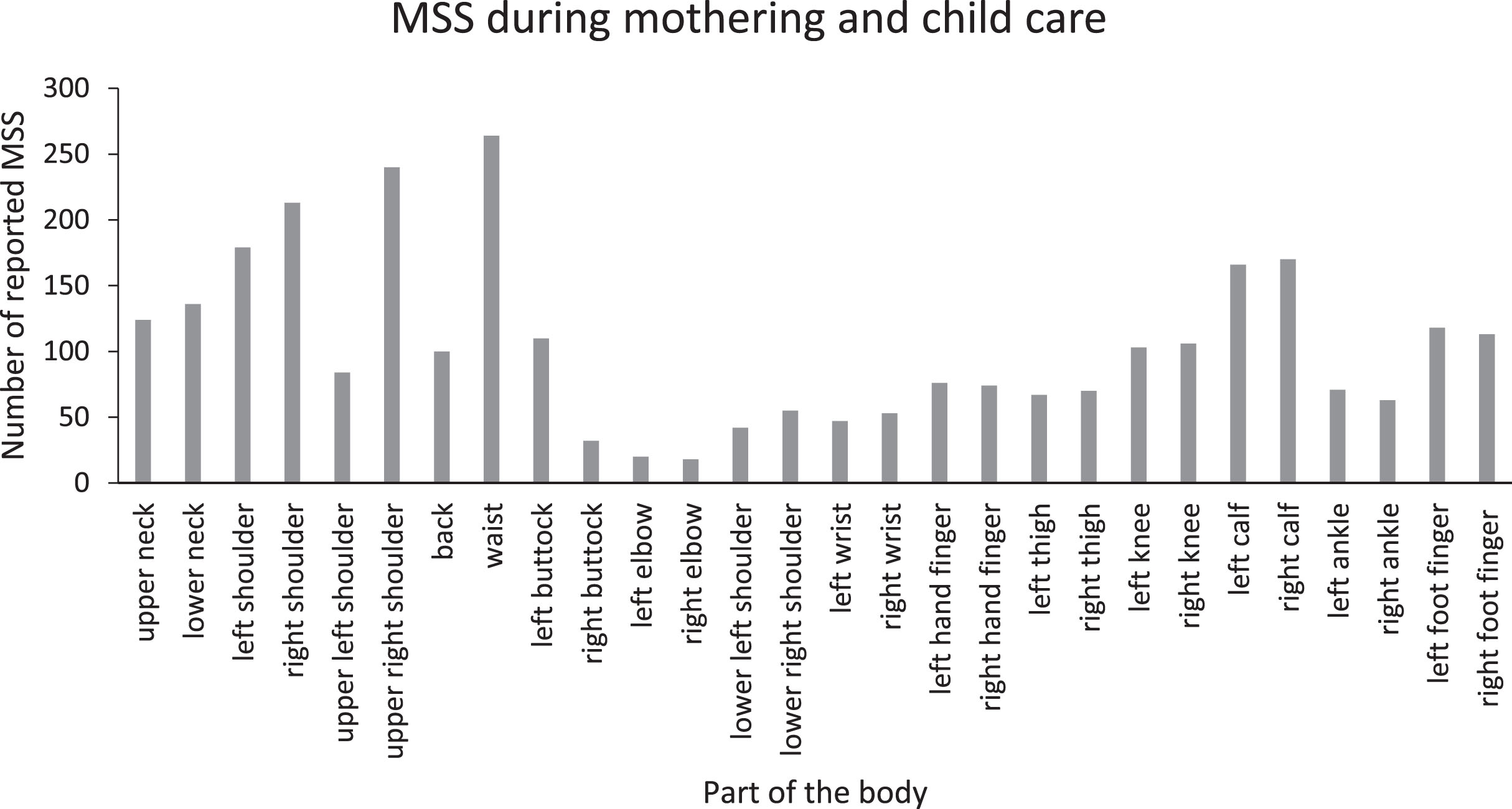
MSS in different parts of the body in relation to mothering and child care.
In child care activities, the MSS reported by the respondents is presented in Fig. 2.
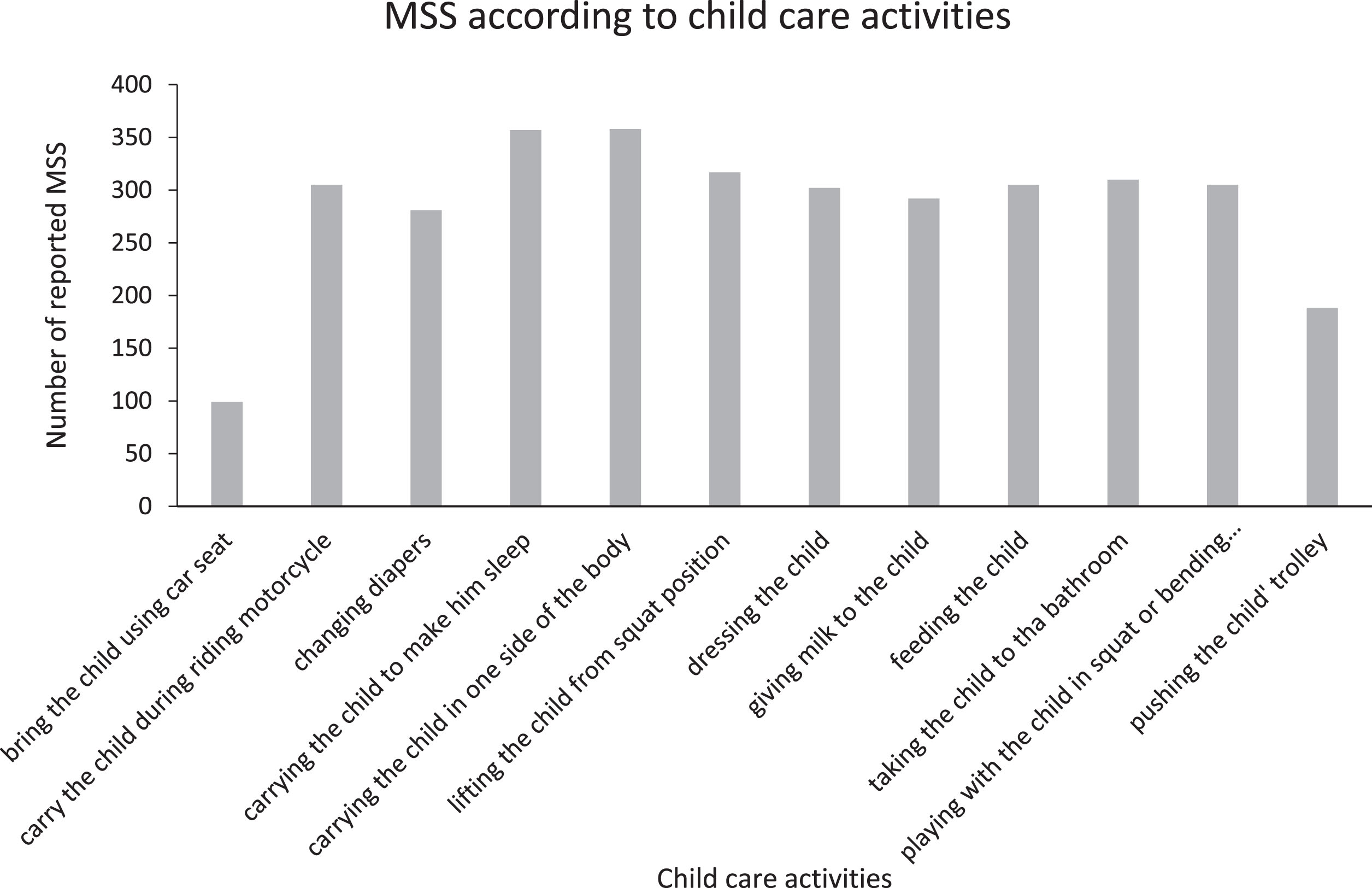
MSS in different parts of the body in relation to child care.
Results regarding MSS in relation to child care activities that affect mothers’ activities are presented in Table 3. Mothers’ activities that are influenced most by the MSS include the ability to sleep at night and the relationships with their children.
ANOVA was applied to determine the child care activities that influence the most commonly reported areas for MSS (upper back, lower back and right shoulder). Lifting children from the squatting position was identified as an activity that significantly influences MSS in the right shoulder (F(6, 369) = 2.747, ρ= 0.013, MSE = 0.091).
MSS in relation to child care activities that affect mothers’ activities
This study observed the ergonomics of mothering and child care in Indonesia, the consequences of care, and the prevalence of musculoskeletal symptoms (MSS) among Indonesian mothers. Respondents living in different cities in Indonesia were voluntarily involved in the present study by filling out a questionnaire. The results of demographic data indicate different reported MSS.
A significant difference in reported MSS was observed for different domiciles. Mothers in large cities reported significantly lower mean MSS scores than mothers in small- to medium-sized cities (4.64 vs. 7.71 mean MSS score for large cities and small- to medium-sized cities respectively). Additional cross-tab analysis was conducted to observe the cause(s) of the results. Mothers in large cities are characterized by a low number of children, the use of private transportation, and the availability of helpers (i.e., daycare or babysitter), which might influence the lower reported incidence of MSS compared to mothers in small- to medium-sized cities.
Based on the availability of support from others in mothering and child care, mothers with appropriate support reported nearly similar MSS scores to those who take care of their children alone or with only spousal help. Surprisingly, the help of family members (mostly from the children’s grandparents) significantly increased reported MSS. Additional interviews conducted with a small number of respondents (i.e., 30 respondents) revealed that additional job(s) and responsibilities in serving family members also influenced reported MSS.
A higher number of children was accompanied by slightly higher reported MSS scores. This result is in line with the results of a previous study [5], where higher reported MSS was potentially due to cumulative MSS starting from the first child and moving on to the next. However, the MSS reported by mothers with less than three children exhibited slightly different results compared to the reported MSS of mothers with four or more children. This is likely due to an unbalanced number between respondents in the group with over three children and the group with less than three children (5.7% and 94.3%, respectively).
Regarding additional demographic data, only small differences were identified in the reported MSS among groups. Working mothers had slightly higher MSS scores than full-time mothers (5.79 and 5.65 of mean MSS, respectively). This finding can be explained in the context of a large variety of tasks being conducted by working mothers, as working mothers were exposed to activities apart from mothering and child care activities at home (i.e., their work/office duties). These conditions are congruent with the results of another study [27], in which MSS in women was related to their work environment as well as non-work factors such as domestic situation.
As expected, mothers with a high frequency of engaging in outdoor activities (i.e., several times a week) reported significantly higher MSS than others. A high frequency of engaging in outdoor activities influences MSS, since mothers typically travel with their children, and the act of lifting or lowering children from a car represents the riskiest activity when traveling with children. Notably, 41.3% of the respondents in the present study did not possess proper knowledge regarding the correct methods for lifting, carrying and lowering their children.
Moreover, the different availability of time to engage in hobbies also exhibits a slight difference in reported MSS. Mothers who always have time to spend on their hobbies seem to relax and release their psychological tension, resulting in their reported MSS scores being the lowest, particularly compared to mothers who some or no time to spend on their hobbies. The condition of whether mothers have time to engage in their hobbies is particularly important, since it reflects the mental and psychosocial aspects of mothering. When mothers lack “me time”, it implies that they devote all of their time to mothering and child care activities, which will lead to the issue of losing their identity and other mental/psychosocial problems [5]. This finding is in agreement with a previous study [22], who observed a significant negative relationship between musculoskeletal pain and hobbies. Participants who engaged in hobbies had fewer complaints of musculoskeletal pain than those who did not, thus indicating that hobbies have a protective effect.
In the present study, the body parts most influenced by MSS due to the mothering and child care activities of Indonesian mothers primarily include the waist, back, and right shoulder—a result congruent with those of previous studies ([5, 22]). A comparison of the percentage of reported MSS among mothers and child care workers revealed similar MSS results for the waist (lower back) and shoulder [2]. An in-depth analysis of MSS based on the levels of pain revealed that MSS in the lower back and shoulder was the most prevalent area for MSS among those engaged in mothering and child care.
The most physically demanding activity in child care is lifting children from a squatting position. This result is in line with the results of a previous study [11], which reported physical tension among mothers in the USA. This physical tension is caused by the stoop lift method (i.e., bending at the waist with knees straight). This method is considered to be safe and efficient for the child, which considers the needs of children while neglecting those of mothers.
Regarding MSS and daily life, reported MSS among mothers appears to influence the daily lives of Indonesian mothers in aspects such as the quality of sleep, the quality of mother-children relationships, and the ability to perform housework. This finding supports the notion that child care is a highly demanding occupation, which is consistent with the results of previous studies ([7, 26]).
The present study is the first to evaluate the ergonomics for mothering and child care in Indonesia, which is representative of many developing countries. In contrast with the results of previous studies on the ergonomics of mothering in developed countries (i.e., US and Australia) coupled with consideration of the various styles and activities of mothering and child care between developed and developing countries, the results of the present study can be considered as a picture of ergonomics for mothering and child care in developing nations.
This project represents is the first epidemiological study to explore associations between child care activities and MSS. As stated by UNICEF [28], occupational health professionals must continue to include housework and homemakers within their research and policy agendas. In particular, future studies should explore the interactions between specific occupations, housework, and specific MSS. Future interventions and policies might intervene in communities, targeting families with messages that emphasize the health costs of excessive housework and the need to share household tasks between family members.
Applications for ergonomics in non-work-related settings (unpaid work) have likely not been given adequate attention due to lack of direct monetary incentives for improving ergonomics outside of the workplace [29]. However, it should be noted that the application of ergonomics in mothering is particularly important. Furthermore, this application of ergonomics will ensure the long-term physical functioning of mothers [30]. In particular, as expressed in the saying “Happy Mother, Happy Family”, the psychological development of children is greatly influenced by their mother’s physical and psychological well-being.
The present study has several notable limitations. First, included respondents were limited to individuals from cities in Indonesia, thus representing people in the urban areas of Indonesia. As such, further research involving mothers from rural areas would enrich the analysis. Second, the respondents were limited to females, since Indonesia exhibits a culture of high masculinity [31]. In such a masculine culture, clear distinctions exist regarding the role of gender in society. In this context, males focus on material success, whereas females are generally concerned with the quality of life. Therefore, males rarely become the primary caregiver in Indonesia. However, considering male participants in this kind of study may provide a different perspective. Third, for reporting MSS, respondents were given instructions to report MSS perceived to be related to mothering and child care activities. Thus, perceived MSS might be inaccurate due to difficulties in categorizing whether the MSS is only triggered by mothering and child care activities, or if it is affected by other activities such as MSS in relation to work (particularly for working mothers). However, such an approach is worth considering in a limited study on mothering and caring activities among mothers. Fourth, there is an unbalanced number of respondents according to demographic data (such as the job, the education, the number of children, etc). Although the number of respondents is considered high, acquiring a balanced number may provide different statistical results. Last, some individual factors are not considered in the present study, such as individual fitness and exercise frequency (that must be checked by physical examination) and individual’ outside home job physical demand; therefore, further research covering these factors should be conducted.
The present study enriches the existing knowledge of mothering and child care activities, as well as the effect of these activities on daily life and MSS among mothers. The present study also provides novelty in the research setting, as mothering and child care activities in Indonesia are rarely explored. Based on the results, interventions will be proposed and applied to reduce MSS amongst Indonesian mothers, such as campaigning during regular monthly housewife meetings (family wellbeing education meeting/Pendidikan Kesejahteraan Keluarga in Indonesian) and raising awareness of proper mothering and child care methods by imparting knowledge regarding the correct methods of lifting, lowering, and carrying children. These interventions are important, since they have been proven to be effective in reducing the unexpected results of activities such as MSS among child care workers [32].
Conclusion
Mothering and child care are very demanding activities that may result in musculoskeletal symptoms (MSS), particularly in the waist, back, and right shoulder. The availability of demographic data on mothers, such as the various categories of domicile, the availability of help, and levels of mobility results in these factors being linked to various levels of MSS. Steps must be taken to overcome MSS to improve the wellbeing of mothers in Indonesia and beyond.
Conflict of interest
None to report.
Footnotes
Acknowledgment
Authors thank to ITB for funding this research under scheme of P3MI fiscal year 2017.