






Abstract
BACKGROUND:
An appropriate match between a product and its end-users requires anthropometric data, which show variations among different countries. Proper Personal Protection Equipment (PPE) fit is key for safety and comfort. Chile had no head and facial anthropometric data available in order to design face/head PPE.
OBJECTIVE:
To describe face/head anthropometric characteristics of Chilean workers. Additionally, this study compared those dimensions against other populations (United States (US), South Korea and China).
METHODS:
An anthropometric survey involving 21 measures was conducted between September 2013 to May 2016 using stratified sampling. The measurements were based on ISO/TS 16976-2 and ISO 15535 to ensure the highest standards possible, and a total of 474 workers, aged from 18 to 66 years old, participated in the survey.
RESULTS:
The biggest differences were in Neck circumference, Weight, Nose breadth, Nose protrusion, Bitragion chin arc, Face length, Subnasale-sellion length, Face width, Bigonial breadth and Bitragion subnasal arc. Head length of Chileans were longer than Chinese and South Korean ones, but shorter than US Head length. Chilean Head breadth is smaller than Chinese and South Korean ones. Chileans Face length was the largest observed. Face width of Chileans was smaller than US and Chinese ones. Gender specific differences were also observed in the inter-country comparisons. Chilean males had larger anthropometric dimensions than females.
CONCLUSION:
Chilean Head and face dimensions differed significantly when compared against US, South Korean and Chines Head and Face dimensions. Chileans have longer and narrower faces with wider mouths, with a head size in between the US and Asian heads. Face and head PPE for Chileans should use dimensions in the current paper in order to ensure proper fit.
Introduction
Anthropometric data has been used for design in a wide variety of contexts and applications, such as industrial settings [1–3], hand tools [4, 5], vehicles of all types [6–9], sport equipment for people with disabilities [10], plus size women brassieres [11] and personal protective equipment (PPE) [12–15], among several other fields. Not accounting for anthropometry of specific end users can certainly compromise health, safety and product sustainability [2, 17]. In that context, due to the current worldwide COVID-19 pandemic, PPE fit and comfort have been put to test. Specific worker groups, such as healthcare workers, are required to use them for extended periods of time being unable to adjust them frequently due to preventive protocols [16, 18]. Unlike “traditional” PPE use, the COVID-19 outbreak has generated several guidelines. Transmission mechanisms of the virus puts great emphasis on the use of face masks, respirators, goggles, face shields and other “bigger” PPE, such as aprons and hoods. A recent study revealed problems with these PPE in UK healthcare workers. Face PPE (i.e. masks, goggles and visors) in those workers, presented significant issues with fit, comfort and performance [18]. Another recent study has also shown significant increase in headaches due to PPE use in healthcare workers [16]. Reducing mismatch between end users and the design as much as possible is paramount, often aiming at 10% or even lesser levels of mismatch in critical products such as PPE [19–21]. When mismatch occurs, the design does not fit end users. Mismatch occurs when the anthropometric dimension(s) in question are either under the minimum or above the maximum limits of the product dimensions [22]. In order to create well-fitting products, such as face/head PPE, designers should start from the analysis of the anthropometric data of the target population or ethnic group. This assumes that the relevant anthropometric data exists and that dimensions must have been properly measured and documented following standard and validated procedures and tools by trained observers [23, 24]. International standards as well as technical reports, account for specific ethnical, occupation and/or geographic differences. For example, ISO 7250-2 [25] presents data from seven countries and both ANSUR and MC-ANSUR which focus on US Army and Marines [26–28]. Other studies have focused specifically on head/face differences considering ethnic groups and gender in order to have the data to design head/face gear and PPE [12, 29–34]. Reports and standards as the ones previously cited, are often preferred by designers since they provide straight forward dimensions which spare them of cumbersome calculations, facilitating the overall design process [35].
In 2019, a study was published with an update of the Chilean population anthropometric dimensions for Chilean workers, with 32 dimensions, where only 4 dimensions involved the head and one neck dimension [36]. This study also compared 18 of their dimensions with other ISO 7250-2 databases that have also collected the same dimensions. Even though all of them collected a baseline of similar dimensions, not one population is equal to another population’s dimensions. Up to this point, there were no face and head dimensions available for PPE design aiming at Chilean workers, nor comparisons made against other populations. Therefore, the aim of the current research is twofold, namely, to describe head and face anthropometric dimensions of Chilean workers and compare them against other populations, discussing those differences in the design impact of face/head gear and PPE.
Methods
Chilean sample
Sample size
A stratified sampling design was used with two age groups: 18–37 and 38-66 years old, both female and male. Sample size was calculated using ISO 15535 recommendations using the coefficient of variation [37]. The standard propose that the sample size shall be estimated to be sufficient for technological design. As such, the minimum number of randomly sampled subjects, N, needed to ensure that the database’s 5th and 95th percentiles estimated the true population’s 5th and 95th percentiles with 95% confidence. The estimated sample size was 440, with 110 participants from each of the 4 clusters. Workers belonged to different industrial sectors from two central regions of Chile (Metropolitana and Libertador General Bernardo O’Higgins). Exclusion criteria were having any facial malformation, physical impediment to perform a quantitative fitting or having abundant beard. A total of 474 workers were measured and the number of participants for each cluster was achieved (Female age 18-37:119, Female age 38-66:110; Male age 18-37:253, Male age 38-66:221).
Ethics and procedure before data collection
The data collection process was approved by the Committee of Ethics at the Chilean Public Health Institute (Instituto de Salud Pública de Chile), dated August 20th, 2013, through the Technical Report N°. 003-10SEP2013. Written consent was obtained from the workers previous to measurements.
Dimensions were collected manually by a single group of three observers, who underwent a one week theoretical and practical training by an expert in ergonomics and anthropometrics. The training focused on landmarking and measurement procedure to avoid measurement errors [24]. At the end of the training period, the team proceeded to mark and measure a group of volunteers. Afterward, the obtained values were compared with the maximum error values allowed by NIOSH [14].
Data collection
Data collection was carried out from September 2013 to May 2016. All the data were recorded, in millimeters (mm), in a paper spreadsheet and then entered into a software developed by NIOSH (Feichter, M. and Zhuang, Z). The software was designed to indicate to technicians any anomalous values outside of an expected range for each measurement. If data entered fell outside the specified range, the computer provided a warning, and the measurement was reevaluated [14]. Measurements were made with the subjects sitting in an erect posture on a height-adjustable chair paced on a flat surface, with legs flexed at a 90° angle, and with feet flat on the ground or on an adjustable footrest. Subjects wore shoes and regular clothing. All measurements were collected manually using a sliding caliper (GPM®., Switzerland) except for Interpupillary distance, which was measured using a digital pupillometer (Gilras, GR-4, China).
Before collecting the anthropometric measures, one of the researchers was responsible for the detection and marking of the anthropometric reference points on the subjects considered the principles of the ISO standard [38]. Afterwards, the following anthropometric measures were collected according to the respective ISO standard [38] (Table 1 and Fig. 1).
Anthropometrics dimensions considered in this study (from ISO/TS 16976-2)
Anthropometrics dimensions considered in this study (from ISO/TS 16976-2)
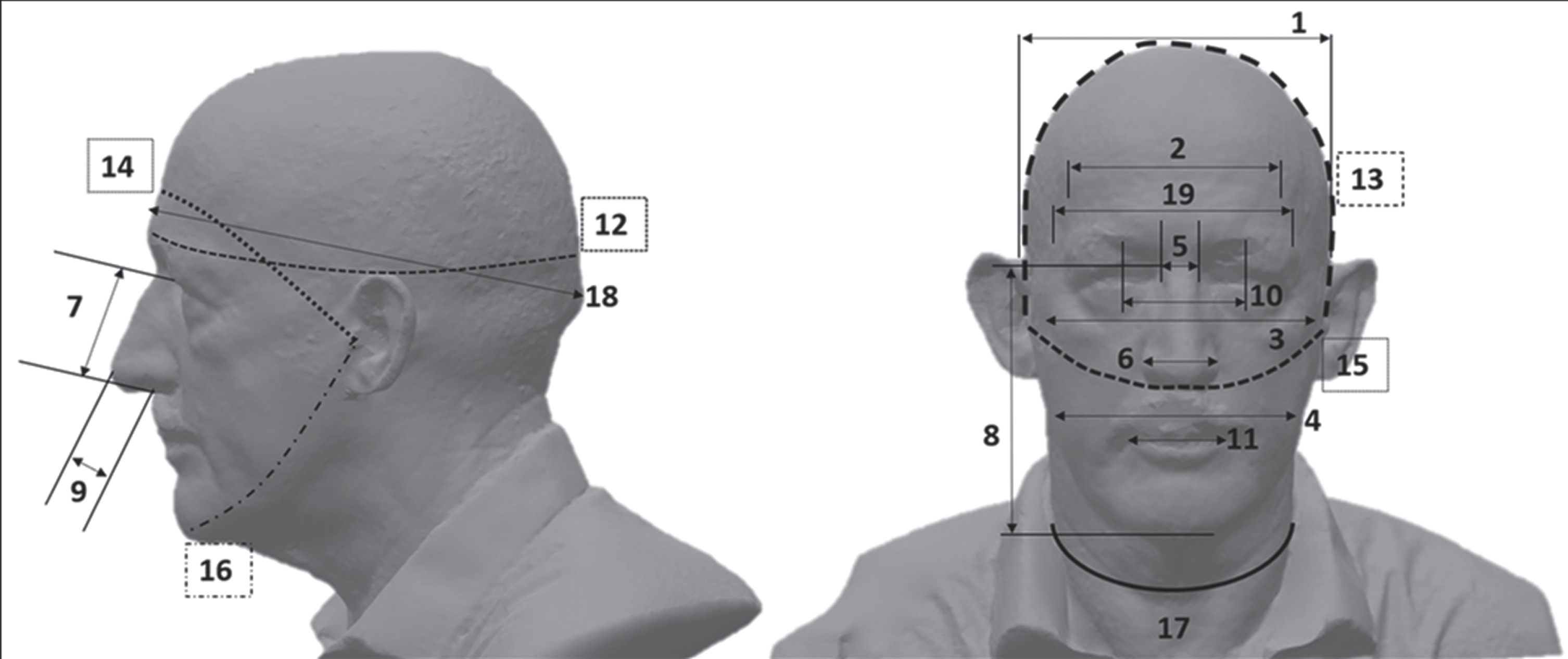
Anthropometric measurements gathered in this study 1. Head breadth, 2. Minimum frontal breadth, 3. Face width, 4. Bigonial breadth, 5. Nasal root breadth, 6. Nose breadth, 7. Subnasale-sellion length, 8. Face length, 9. Nose protrusion, 10. Interpupillary distance, 11. Lip length, 12. Head Circumference, 13. Bitragion coronal arc, 14. Bitragion frontal arc, 15. Bitragion subnasale arc, 16. Bitragion chin arc 17. Neck circumference, 18. Head length, 19. Maximum frontal breadth.
As proposed in ISO 15535 (2012), further error checking was done using outlier detection of the mean±3 standard deviations.
Other samples
Comparisons were made against three other databases, namely South Korea, United States and China. They were chosen since they used most of the dimensions present in the Chilean sample, thus, were more suitable for comparisons. Each sample will be briefly described in the following sections.
United States
This sample was composed of 3,997 workers from 8 different States (1,454 females and 2,543 males). It had 21 face/head anthropometrics measures detailing the face size distributions aiming at the design of respirator. The sample consisted of workers from four ethnic groups (White, Black, Hispanic, and Others) aged 18 to 66 years old [31]. Manual and 3D scanner methods were used, and are well described by Zhuang and Bradtmiller [31].
South Korea
Data was extracted from the Size Korea anthropometric database. The Size Korea anthropometric database has been established by the Korean Agency for Technology and Standards (KATS) through multiple years through nation-wide anthropometry surveys. The Size Korea anthropometric database is quite large, with dimensions of 45,311 individuals (22,245 females and 23,066 males) aged 0- to 85-year-old. It was conducted in two time periods: 2003–2004 [39] and 2015 [40]. Data was extracted from both cohorts for the current study. Through the surveys, more than 200 of anthropometric variables have been measured in total, but the list of measured body dimensions is slightly different between studies. The current study used data of adults (over 17 years old) from 2004 and 2015 surveys, as those included the head-related variables that can be compared against the other countries in the current study. It is important to mention that 7 dimensions were not available in any of the Korean databases (see Table 3 4)
Comparison of the Chilean female anthropometric data with other populations
Comparison of the Chilean female anthropometric data with other populations
*p < 0.05 ∧p < 0.01.
Comparison of the Chilean male anthropometric data with other populations
*p < 0.05 ∧p < 0.01.
The 2004 data included direct measurements (3,473 females and 3,466 males) as well as 3D measurements (1,986 females and 1,953 males). In the current study, face length and interpupillary distance were extracted from direct measurements taken in 2004. Nose breadth, Lip Length and Nose Protrusion were taken from the 3D measurements.
Finally, the remaining 9 anthropometric measurements were taken from the 2015 database. This database used direct measurements of 2,734 females and 2,664 males.
The Chinese sample included 3,000 civilian workers from 5 different occupational sectors (974 females and 2,026 males) aged between 18 and 66 years of age. A total of 24 anthropometric measurements were gathered using traditional techniques. For more information about the sample read Du et al. [14].
Statistical analysis
All anthropometric data were analyzed using MS Excel and SPSS (v24.0, SPSS Inc., Chicago, IL, USA). An independent t-test (with a 95% confidence interval) was performed to examine the differences between the Chilean data and the data from the other countries. Normality of non-Chilean samples was not calculated, due the impossibility to access to the full data set. Only sample size, percentile values, average and standard deviations were available. Despite that, t-tests can be considered fairly robust for validity against non-normality [41], thus they were used for making the comparisons. Furthermore, in a large sample, as presented in the currently study, the t-test is a useful default tools for analyzing differences and trends in many types of data, not just those with normal distributions [42].
Finally, an independent t-test (with a 95% confidence interval) was performed to examine the differences in measurements between genders in the Chilean sample. Also, absolute and relative differences between the two genders were calculated, with positive changes (+) indicating higher mean values of males and negative changes (–) indicating higher female mean values.
Results
Characteristics of the Chilean sample
Table 2 shows the dimensions of both female and male Chilean workers. Note from Table 2 that all dimensions are significantly different between genders, where males have bigger dimensions than females. Percentual differences were highest for Neck circumference (20.0%), Weight (19.7%), Nose breadth (12.6%), Nose protrusion (11.0%), Bitragion chin arc (9.2%), Face length (9.2%), Subnasale-sellion length (7.8%), Face width (7.3%), Bigonial breadth (6.4%) and Bitragion subnasal arc (6.4%). The smallest differences were found in Interpupillary distance (1.7%), Head circumference (3.1%) and Bitragion coronal arc (3.1%). These findings are similar of those found in previous research which will be further explained in the discussion section.
Chilean anthropometric data collected in the present study
Chilean anthropometric data collected in the present study
*p < 0.05; ∧p < 0.01; AV: Absolute value = mean values of males - female mean values; % = ((mean values of males - female mean values)/female mean values) x 100.
Tables 3 4 show the comparisons made against the US, South Korea and China, for both genders. If an anthropometric dimension was not present in a given database, it was coded with a dotted line. Note from Tables 3 4, that dimensions critical to mask designs are significantly different with other populations. For example, Face length is significantly larger in both genders when compared against the other three populations. Thus, Chilean faces are longer than faces of the US, South Korea and China. Similarly, Face width of Chilean females and males are smaller than those of US and China. Face width of Chilean males is bigger than face width of South Korean males. Bigonial breadth, also used in Full face mask design, shows a similar trend. Both genders show narrower Bigonial breadths than US and Chinese faces. Only Chilean female Bigonial breadth is also narrower than South Korean females. Thus, in general it can be stated that Chilean faces are longer and narrower than the ones of the other populations.
Other dimensions associated to mouth and nose have also been considered critical for respirators. Tables 3 4 show, that Lip length of Chileans is significantly bigger than the ones of US, South Korea and China, for both genders. Thus, Chileans have wider mouths than those of US, South Korea and China. Nose dimensions that are also used for mask designs, Nose protrusion and Subnasale-sellion length, show significant differences. Subnasale-sellion length is longer than the one of US and Chinese populations for both genders. In the case of Chilean female nose protrusion, it is less prominent than their US and Chinese counterparts, but more protruded than South Korean females. Nose protrusion in the case of Chilean males is significantly bigger when compared against US males and smaller when compared against South Korean males. These implications will be further analyzed in the discussion.
Tables 3 4 also show that other dimensions critical for designing glasses and goggles also show significant differences. For example, Interpupillary distance in both genders is smaller in Chileans when compared against the US and China, but bigger than the values of South Korea. Similarly, Nasal root breadth in both genders is wider when compared against the US, however in the case of males it is only wider than Chinese Nasal root breadth. The opposite occurs with Chilean females, since they have a narrower Nasal root breadth than Chinese females. Significant differences can be observed in dimensions used in safety goggle designs, such as Bitragion subnasal arc and Maximum frontal breadth. Bitragion subnasal arc in Chileans for both genders are bigger than the one of US and smaller than Chinese populations respectively. Similarly, both Chilean females and males have smaller Maximum frontal breadths than the Chinese.
For those dimensions that are critical for helmet design, Tables 3 4 also show significant differences. For example, Head length of Chilean females and males are longer than Chinese and South Korean Head lengths, but shorter than US Head length. Head breadth of Chileans is narrower in both males and females when compared against China and South Korea, however only Chilean males showed significantly wider Head breadths than US males. Head circumference of Chileans is bigger for both genders only when compared against Chinese Head circumference. Only, for Chilean males, Head circumferences is smaller than US and South Koreans.
Discussion
Gender design implications
As it was described previously in the Results section, Chilean Males have significantly bigger dimensions than their female counter parts. This was expected since, with a few exceptions such as hip breadth, females tend to have smaller average anthropometric dimensions. Weight and Neck circumference where the ones where Chilean males had the highest difference. Increased weight is often associated with and obesity increase, where neck circumference also increases [36]. Regarding facial dimensions, there are significant gender differences in all of them between Chilean males and females, which are similar to the findings of previous research [32, 43]. In that regard, Nose breadth, Nose Protrusion, Bitragion chin arc, Face length, Subnasale-sellion length, Face width and Bigonial breadth are amongst the ones with the highest differences, which are similar to the findings of previous research of other populations [32]. These findings in the current research, show that Chilean females have smaller faces than Chilean males. Therefore, gender is a key factor when selecting full face and half face masks for Chileans, similar to what it was found by Zhuang et al. [32].
Masks and respirators design implications
Comparisons of Chilean face dimensions also proved being significantly different than face dimensions of the US, South Korea and China. Both Chilean females and males have significantly longer Face lengths when compared against the other three populations, this was also observed by Zhuang et al. [32] between Hispanic and Caucasian ethnic groups. Face width of Chilean females and males is narrower than US and Chinese Face width, however only Korean males have a narrower Face width than Chilean males. Chilean females have smaller Bigonial breadth than all the three other databases used in the current study. The previous finding regarding Face length and width, coupled with a narrower Bigonial breadth, leads to the conclusion that Chilean faces, especially female ones, are in general longer and narrower. These findings imply that using either a full face or half face mask that do not consider Chilean anthropometry, can cause issues when using them. This potential mismatch (i.e. too big or too tight) can cause leakage or increased turbulence [32, 33]. In the first case protection is compromised while on the second, more resistance inside respirator masks is generated, compromising comfort. This is particularly true for Chilean females, reinforcing the gender differentiation in PPE sizing when designing full face masks and respirators and half face mask. Mouth and nose dimensions also contribute significantly to full face and half face respirators fit [14, 44]. Lip length was significantly larger in Chilean males and females when compared against US, South Korea and China. This is of particular relevance when testing or using the Los Alamos National Laboratory (LANL) fit panel for respirators, where lip length has a significant relevance [14, 43]. Therefore, other fit panels should be used for Chileans, such as NIOSH or ISO panels to ensure a better fit [43]. Zhuang et al. [32] also stated that nose dimensions, such as Nose breadth, Nose protrusion and Subnasale-sellion length, are important for respirator fit and comfort, and should be taken into account when designing respirators. All those previously stated dimensions in Chileans proved to be significantly different when compared against other populations. Both Chilean females and males, had smaller Nose breadths than Koreans and Chinese, but wider Nose breadths than the US sample. Similarly, Subnasale-sellion length is larger also for Chilean females and males when compared against the US and Chinese Subnasale-sellion lengths. Nose protrusion of Chilean females is less prominent than US and Chinese females, but more prominent than Korean female‘s Nose protrusion. In the case of Chilean males, Nose protrusion is less prominent than the one of Korean males, but more protruded than the one of US males. Therefore, for half-mask respirator design, these Nose protrusion differences should be taken into account. Nose protrusion together with face length, lip length, face width, nasal root breadth and bitragion–chin arc, have been correlated to half mask respirators fit and protection [32]. The malar region in the cheekbone, chin and nose regions account for more than 70% of leak sites [33], thus the relevance of considering Chilean dimension in order to design either full face or half face respirators. The current pandemic situation due to COVID-19 has putted face PPE as one of the most recommended measures to control the disease, especially in healthcare workers [16]. Therefore, proper fit and comfort must be of major concern, since these type of sanitary conditions restrict the possibility to adjust PPE once on the body and, as mentioned in the introduction, can cause a reduction in both protection and comfort [16, 18]. New methods that put customization and adjustability in front, could be another solution to reduce mismatch and elevate protection respirator design and use. Considering the rapid progress of exponential technologies, in a near future, it might be possible to have customizable respirators through the joint use of 3D scanning and 3D printing, as the method proposed by Makowski & Okrasa [45]. Although each day 3D printing is becoming more and more mainstream, 3D scanners are still very expensive and thus, the method proposed by Makowski & Okrasa [45] of having a body part scanned and custom fit a design, has its financial constrains specially in the case of developing countries. Despite those limitations, new designs, technologies and business models in PPE development could reduce the overall costs of implementing customizable PPE.
To a minor magnitude but to a major scale, the entire population can be affected by inproper fit of traditional half face mask fit, especially since they are recommended by the World Health Organization to be used by citizens in their everyday “new” normal life until vaccines against the pandemic are available worldwide [46]. The facial dimensions presented in the current study should be used for designing and test face masks for Chilean workers and general public.
Glasses and goggles design
Dimensions related to goggles and glasses design also showed significant differences in Chileans when compared against the other databases. Namely, Chileans show a smaller Interpupillary distance in both genders than the ones of US and China, but bigger than South Korea. Nasal root breadth of Chilean males and females is also wider than the one of the US, but only males have wider Nasal root breadth when compared against China. Contrarily, females show narrower Nasal root breadth than Chines females. Significant differences were also observed in Bitragion subnasal arc and Maximum frontal breadth, which are used in goggle design [47]. Chilean Bitragion subnasal arc for both genders is bigger than the one of US and smaller than Chinese populations respectively. Similarly, both Chilean females and males have smaller Maximum frontal breadths than the Chinese. As mentioned previously, these dimensions should also be considered for respirators and masks, therefore the dimensions presented in the current study should be given extra attention. Chilean faces are in general longer and narrower than the ones present in the three other databases, reinforcing the need of using the dimensions presented in this research paper when designing for the Chilean population.
Head gear and helmet design
Head length of Chilean females and males are longer than Chinese and South Korean Head lengths, but shorter than US Head length. Head breadth of Chileans is narrower in both males and females when compared against China and South Korea. Only Chilean males showed significantly wider Head Breadths than US males. Thus, it can be said that in general, Chilean heads are “in between” US and the Asian countries heads used in this study. Previous studies have accounted for head differences among populations. For example, Ran et al. [48] showed that Head length in Asian men (China, Japan and South Korea) was shorter than Dutch, US and Kenyan heads, observing the inverse situation regarding Head breadth. Similarly, Ball et al. [49] found differences in Head shapes of Caucasian and Chinese head, where the Caucasian head was more oval than the Chinese head, being the latter more round with a flatter fore head and back. The same authors reinforce the need to use specific dimensions in order to design for the Asian market and vice versa, which can definitively be applied for head gear an PPE, such as helmets for the Chilean population. Falling between the two head shapes, indicates that specific designs for head gear should consider the dimensions presented in the current study. Head circumference in both Chilean females and males was only larger than the Chinese one. Only for Chilean males, Head circumference was smaller than the US and Korea. This gender specific difference highlights the need to produce and test gender specific designs regarding head gear for the Chilean population.
Further studies and limitations
Future studies could also compare Chilean head/face dimensions against other Caucasian dimensions (i.e. Europe), therefore a wider perspective can be given on the subject.
Mismatch levels of respirators have already been tested recently in the Chilean population [43], therefore further research could be conducted testing mismatch using other commercially available products or standards aimed at the Chilean population, such as safety glasses, goggles and helmets, considering the significant differences between ethnic groups presented which ultimately will impact the target population in the design process of a product.
It is noteworthy that the dimensions presented in this paper where collected in Chilean born people previous to a major migration peak of Haitian people, mainly of African ethnicity [50], which peaked in 2017 [51]. Until then, historically the Chilean populations was quite homogeneous in its ethnicity. According to the first and only genetic study of the Chilean population, no differences along the country were found, where on average, Chilean genetics were 51% European, 44% Amerindian and 3% African [52]. Thus, the current research can be used as a starting point and future ethnic differences within the Chilean populations should be taken into account when collecting face/head dimensions, as it has been done in previous research [32].
Conclusion
Chilean male workers presented significantly bigger dimensions than their female counterparts, as it has also been observed by previous research. The biggest differences were present in Neck circumference, Weight, Nose breadth, Nose protrusion, Bitragion chin arc, Face length, Subnasale-sellion length, Face width, Bigonial breadth and Bitragion subnasal arc. These differences highlight the relevance of having gender as a major consideration in PPE face/head for Chilean workers.
Head length of Chilean workers are longer than Chinese and South Korean Head lengths, but shorter than US Head length. In turn, Head breadth of Chilean workers is narrower than the one of Chinese and South Koreans. Only Chilean males showed significantly wider Head breadths than US males. Head circumference of Chileans is bigger for both genders only when compared against Chinese Head circumference. Similarly, to Head breadth, only Chilean males Head circumferences is smaller than US and South Koreans.
Chileans have significantly longer Face length than the other three populations. Face width of Chilean females and males is narrower than US and Chinese Face width, however only Korean males have a narrower Face width than Chilean males. Chilean females have smaller Bigonial breadth than the three other databases. Therefore, based on the results of the current study, it can be concluded that Chilean faces, especially female ones, are in general longer and narrower than the other three populations, with a head shape that falls in between the US head shape and the Asian head shape.
The implications of these differences affect dir-ectly head/face PPE design, since they should focus specifically in the Chilean population. Not doing so could produce lower levels of match, thus reducing protection and comfort. Further research should introduce ethnic differences, which up to recently, was not an issue in the Chilean population.
Conflict of interest
The authors declare no conflict of interest.