






Abstract
BACKGROUND:
Research suggests reducing sedentary behavior improves low back pain; however, the impact on presenteeism, health, productivity, and sleep in desk workers with chronic low back pain is not known.
OBJECTIVE:
Evaluate the effect of a sedentary behavior intervention on multiple dimensions of workplace health.
METHODS:
24 participants with chronic low back pain and desk jobs were randomized to either a sedentary behavior reduction intervention group or control. Outcomes included a modified Global Physical Activity Questionnaire (GPAQ), the Stanford Presenteeism Scale (SPS), Profile of Mood States (POMS), Health and Work Questionnaire (HWQ), SF-36 Health Survey (SF-36), and Pittsburgh Sleep Quality Index (PSQI). Six-month changes in outcomes were compared across intervention groups using ANCOVA regression, adjusting for baseline values. Cohen’s d effect sizes were calculated for outcomes to explain the magnitude of group differences.
RESULTS:
The intervention group reported 1.5 hours/day less sitting time (p < 0.001) compared to controls at 6 months. SF-36 subscales of energy/fatigue, social functioning, and pain improved, and sleep disturbance was reduced among intervention participants. Productivity, concentration, and presenteeism were unchanged.
CONCLUSIONS:
A sedentary behavior reduction intervention may improve well-being and workplace health without impacting productivity and concentration in desk workers with chronic low back pain.
Keywords
Introduction
Low back pain (LBP) causes more disability than any other condition and has a global point prevalence of 9.4% [1, 2]. In a recent study, the 3 month prevalence of low back pain was estimated to be as high as 26.4% among workers in the United States [3]. Furthermore, occupational LBP is estimated to account for 9–26% of all insurance claims in the United States [4]. However, these direct medical costs account for only a small portion of the overall costs associated with LBP [5]. While most patients recover from acute episodes of LBP within 6 weeks, up to 33% of patients may experience recurrence of back pain [6], and 10% of individuals develop chronic LBP which is more difficult to manage [7, 8]. Chronic LBP is characterized by pain that lasts greater than 3 months and has resulted in pain on at least half the days in the past 6 months [7].
Low back pain is a costly condition. A recent study shows that low back and neck pain are conditions that account for the largest amount of healthcare spending in the United States [9]. The indirect costs of chronic LBP include higher rates of absenteeism, early retirement, and sick leave; increased household and transportation costs; and reduced presenteeism and productivity [5, 10–12]. LBP is the second most common condition, behind headaches, resulting in lost workplace productivity among working adults in the United States [13]. Additionally, people with LBP report significantly worse physical function, physical limitations, pain, vitality, social functioning, emotional limitations, mental health, and sleep compared to the general population [14–16]. Several treatments are shown to counteract the negative physical and psychosocial effects of chronic LBP including physical therapy [17], chiropractic care [17], massage therapy [18], cognitive behavioral therapy [19], and mindfulness meditation [20]. However, the treatment of chronic LBP is difficult as the etiologies are often complex, and sometimes unknown, and many patients have persistent pain [21]. Given the sustained high prevalence of LBP, additional research is warranted to identify novel treatments for pain relief and improving health-related quality of life (HRQOL) in those with chronic LBP.
Research has indicated that sitting for prolonged periods may increase risk for LBP [22–25]. As a result, decreasing sedentary behavior has been proposed as a potential treatment to mitigate back pain [26]. We have previously shown that an intervention that targets a reduction in sedentary time results in a significant decrease in LBP disability [27]. Despite these promising results, few studies have examined the effects of sedentary behavior interventions on other health measures commonly associated with LBP in the workplace, such as HRQOL, sleep, presenteeism, and productivity.
The Take-a-Stand project found that, in addition to reduced upper back and neck pain, decreased time spent sitting improved mood states among employees with sedentary jobs [26]. It has also been suggested that highly active employees show greater workplace satisfaction, better mental well-being and work performance with less total and occupational sitting time [28, 29]. Though this preliminary research suggests benefits on some workplace health outcomes in general occupational samples, additional research is needed to determine whether interventions which target reduction in prolonged sitting impact well-being and other workplace health outcomes. This is particularly important in those who have underlying conditions such as LBP, which may interfere with one’s HRQOL and ability to perform work-related tasks.
The purpose of this study is to examine the effect of a six-month sedentary behavior intervention on workplace measures of health including presenteeism, HRQOL, mood, productivity, and sleep in desk workers with chronic LBP. A better understanding of how these health outcomes may be impacted by workplace interventions is needed. We hypothesized that desk workers with chronic LBP would experience a beneficial effect of sedentary behavior reduction on workplace health outcomes.
Methods
The Stand Back randomized trial was conducted at the University of Pittsburgh, with data collection occurring between October 2015 and November 2016. The impact of the Stand Back intervention on LBP and disability has been published previously [27]. The current study reports on secondary outcomes of the Stand Back trial including presenteeism, HRQOL, mood, productivity, and sleep.
Participants were recruited from the greater Pittsburgh area using electronic mailing, fliers, and university research registries. Participants were included if they reported: 1) chronic LBP, defined as persistent LBP for at least 3 months and resulting in pain on more than half of the days in the past 6 months [30]; 2) LBP disability, defined by an Oswestry Disability Index (ODI)> 10%; 3) currently performing deskwork ≥20 hours per week at a desk compatible with the sit-stand desk attachment; 4) stable employment (at least 3 months at a current job; plan to stay at current job for at least 6 months); 5) supervisor approval to participate and install a desk attachment; and 6) access to internet to complete monthly online questionnaires. Participants were excluded if they: 1) did not provide informed consent; 2) had a cardiovascular event in the past 6 months; 3) had a comorbidity that limited the ability to reduce sedentary behavior (e.g., currently undergoing treatment for cancer); 4) had a recent (< 3 months) or planned surgery; 5) reported symptoms consistent with a more serious spinal condition (e.g., compression fracture, infection); 6) were currently using a height-adjustable/standing workstation or activity prompter; 7) were currently or planning to get pregnant; or 8) had blood pressure ≥160/100 mmHg. There were no specific criteria related to age as long as the participant was an adult (age > 18 years) and the individual met inclusion criteria. All procedures were approved by the University of Pittsburgh Institutional Review Board and all participants provided written informed consent. Participants were randomized 1 : 1 to the intervention group or control group. Randomization was stratified by ODI (> 10% to < 20%,≥20%). In each stratum, randomization was assigned via a sealed envelope method in blocks of 4.
Intervention
The 6-month intervention consisted of behavioral counseling, the provision of a sit-stand desk attachment, and an activity prompter with the goal of reducing prolonged sedentary behavior and facilitating self-management of LBP. Participants assigned to the intervention received an initial in-person counseling session at their worksite lasting approximately 1.5 hours followed by monthly phone calls with a trained interventionist. The interventionist was an exercise physiologist and was supervised by a physical therapist with a PhD in exercise physiology with research experience in delivery of lifestyle interventions. The physical therapist monitored the fidelity of the interventions through modeling and direct observation of the interventionist for each new lesson for the first 5 participants and provided remediation as needed. The interventionist stayed constant throughout the intervention and was present for all intervention sessions throughout the study.
The initial face-to-face, in-person lesson included education about the health risks of sedentary behavior, behavioral counselling for reducing sitting, installation of a QuickStand sit–stand desk attachment (Humanscale, New York, NY, USA), provision of the wrist-worn activity prompting device (UP wristband, Jawbone, San Francisco, CA, USA) and cognitive behavioral therapy for pain management. Participants were encouraged to stand 2-4 hours per day and to change working posture with the sit-stand desk attachment every 30 minutes; however, goals were individualized for each participant as needed [31]. The Jawbone UP activity prompter was set to vibrate on the participant’s wrist after 30 minutes of no movement, at which time participants were encouraged to stand and take a 2-3 minute walk. The prompter was programmed to vibrate during waking hours that were self-selected by participant for all 7 days of the week. Self-management of LBP used cognitive behavioral therapy to target participants’ beliefs about pain and symptom management via the intervention methods. Written materials were given to each participant and a behavioral contract was completed with individualized goals and strategies. Participants were encouraged to self-monitor breaks from prolonged sitting and the total amount of time spent in standing during the workday using a calendar provided by the interventionist.
Following the initial session, five monthly phone calls were conducted by the interventionist. Each phone call included a review of goals, problem solving, and the introduction of one behavior change strategy [32–34]. Phone calls followed a semi-structured format where the interventionist utilized a scripted document to review the participant’s past goals and progress over the past month. The participant was asked to identify barriers to standing and the interventionist encouraged the participant to problem solve various solutions. If the participant met goals from the prior month, the interventionist assisted with the development of new goals. After goals were established, the interventionist introduced one new concept to facilitate behavior change such as the use of social support or stimulus control. The average call duration for the monthly phone calls was 14 minutes (standard deviation (SD) 4 minutes).
Participants assigned to the control condition were asked to complete online surveys at baseline and 6 months and did not receive any intervention during the 6-month period. However, control participants were offered a 60-minute in-person meeting to review the Stand Back intervention materials at the end of the study.
Participants were compensated up to $100 dollars for completing all assessments and all participants kept or received the wrist-worn activity prompter at the end of the study. The sit-stand desk attachment was retrieved from the participants’ offices upon completion of the study.
Measurement
Demographics and pain medications were self-reported at baseline. Participants’ height and weight were measured using a digital scale (WB-110A, Tanita, Japan) and wall-mounted stadiometer (Perspective Enterprises, Portage, MI, USA) with shoes off and in light clothing. At baseline and 6 months, online questionnaires were completed (Qualtrics, Provo, UT, USA).
Physical activity (occupational, recreational, and transportation) and sitting (at work and overall) were assessed using an adapted Global Physical Activity Questionnaire (GPAQ) (35). Those reporting ≥150 minutes per week of moderate-to-vigorous, ≥75 minutes per week of vigorous physical activity, or an equivalent combination were classified as meeting physical activity recommendations.
The Stanford Presenteeism Scale (SPS-6) [36] assessed the impact of the participant’s perceived ability to concentrate on work tasks despite the distractions of health impairments and pain. On this 6-item questionnaire, individuals are asked to rate their work experiences within the past month using Likert scale (from strongly disagree to strongly agree) with 6 work-related statements. Statements include items such as “Despite having my concern(s), I was able to finish hard tasks in my work” and “Despite having my concern(s), I felt energetic enough to complete all my work.” SPS-6 scores range from 6–30 and lower scores indicate lower presenteeism [36].
HRQOL was measured using the RAND 36-Item Health Survey (SF-36) Version 1.0 [37]. The SF-36 is comprised of 36 items that assess eight health concepts including physical functioning, role limitations caused by physical health problems, role limitations caused by emotional problems, social functioning, emotional well-being, energy/fatigue, pain, and general health perceptions. Higher values on the SF-36 indicate greater health in each domain [37]. The SF-36 is the most common measure used to study HRQOL in individuals with back pain [38] and it has been shown to be a valid measure in multiple studies [39].
Well-being was measured using the 40-Item Profile of Mood States (POMS) [40]. The POMS is a validated scale that has been used extensively in exercise and sedentary behavior studies to measure self-reported mood [41]. The POMS consists of 40 adjectives that are used to assess seven subscales: tension, depression, fatigue, vigor, confusion, anger, and esteem-related affect. The individual is asked to score each adjective on a scale of 0 (not at all) to 4 (extremely). In addition to the seven subscales, a total mood disturbance score is calculated by summing the scores for the negative mood subscales (tension, depression, fatigue, confusion, anger), subtracting the scores for the positive mood subscales (vigor, esteem-related affect), and finally adding a constant value of 100 [42]. Higher total mood disturbance scores indicate a more negative mood.
The Health and Work Questionnaire (HWQ) was used to measure subjective workplace productivity in relation to workplace health [43]. The HWQ consists of 24 items comprising six subscales: productivity, concentration and focus, supervisor relations, personal life satisfaction, work satisfaction, and impatience and irritability. Individuals are asked to rate their work quality, quantity, and efficiency from the perspective of their supervisor, the perspective of their co-worker, and from their own perspective. All items on the HWQ have a 10-point response scale that is specific to each question (e.g., “very dissatisfied” to “very satisfied” for questions dealing with work satisfaction; “not easy at all” to “very easy” for questions dealing with communication). The HWQ was scored using standard scoring instructions; higher scores indicate greater expression of the scale descriptor [43].
Sleep was assessed with the Pittsburgh Sleep Quality Index (PSQI) [44]. The PSQI consists of 19 items that inquire about sleep over the past month, which can be used to generate seven component scores: sleep quality, sleep latency, sleep duration, habitual sleep efficiency, sleep disturbances, use of sleep medications, and daytime dysfunction. A global score between 0–21 was calculated from summing the seven component scores. Higher PSQI global scores indicate worse sleep quality, with a global score > 5 commonly used to indicate poor sleep quality [44]. The PSQI is the most commonly used measure of self-reported sleep quality and has been shown to have good internal consistency (α= 0.83) and test-retest reliability (r = 0.85) (44).
Statistical analyses
A power analysis was completed for the primary outcome of the trial (LBP disability), assuming a clinically meaningful difference of 6 points between groups, a standard deviation of 5 points [45], a two-sided α= 0.05, and 80% power, which yielded a requirement for n = 24 participants (n = 12 per group). A post hoc power analysis for the outcomes featured in this analysis suggested that we had 80% power to detect effect sizes ranging from d = 0.8–1.2, with n = 12 per group, assuming alpha = 0.05, and a range of observed within-subject correlations for the outcomes (r ranging from 0.0–0.7).
Baseline characteristics of each group were summarized by means (SD) or frequencies and compared by independent t-tests or Chi-square tests. All 6-month changes in questionnaires and subscales were analyzed across intervention groups using ANCOVA regression, adjusting for baseline values. Cohen’s d effect sizes were calculated for all outcomes to explain the magnitude of group differences by dividing the group effect by the standard deviation of the baseline value in the control group. Effect sizes were interpreted as 0.8 or greater = large, 0.5 to 0.8 = moderate, 0.2 to 0.5 = small,<0.2 = negligible [46]. Education level was distributed differently at baseline across intervention and control groups; therefore, ANCOVA regression was used to analyze the effect of education level on all questionnaires and subscales. No significant education effect was observed in any questionnaires or subscales; thus, the results presented do not include education as a covariate in the models. Type I error rate for all tests was set at 0.05.
Results
A total of 267 potential participants were screened for eligibility, which resulted in 27 randomized subjects (Fig. 1). The most common reasons for ineligibility during screening were that the LBP was too mild or acute (n = 87) or that the sit-stand desk attachment was not able to be installed due to incompatibility with the employee’s workstation (n = 42). Infrequent reasons for not being randomized are listed as other (n = 46), but it is notable that only two potential participants were unable to obtain supervisor consent to participate in the study during screening.
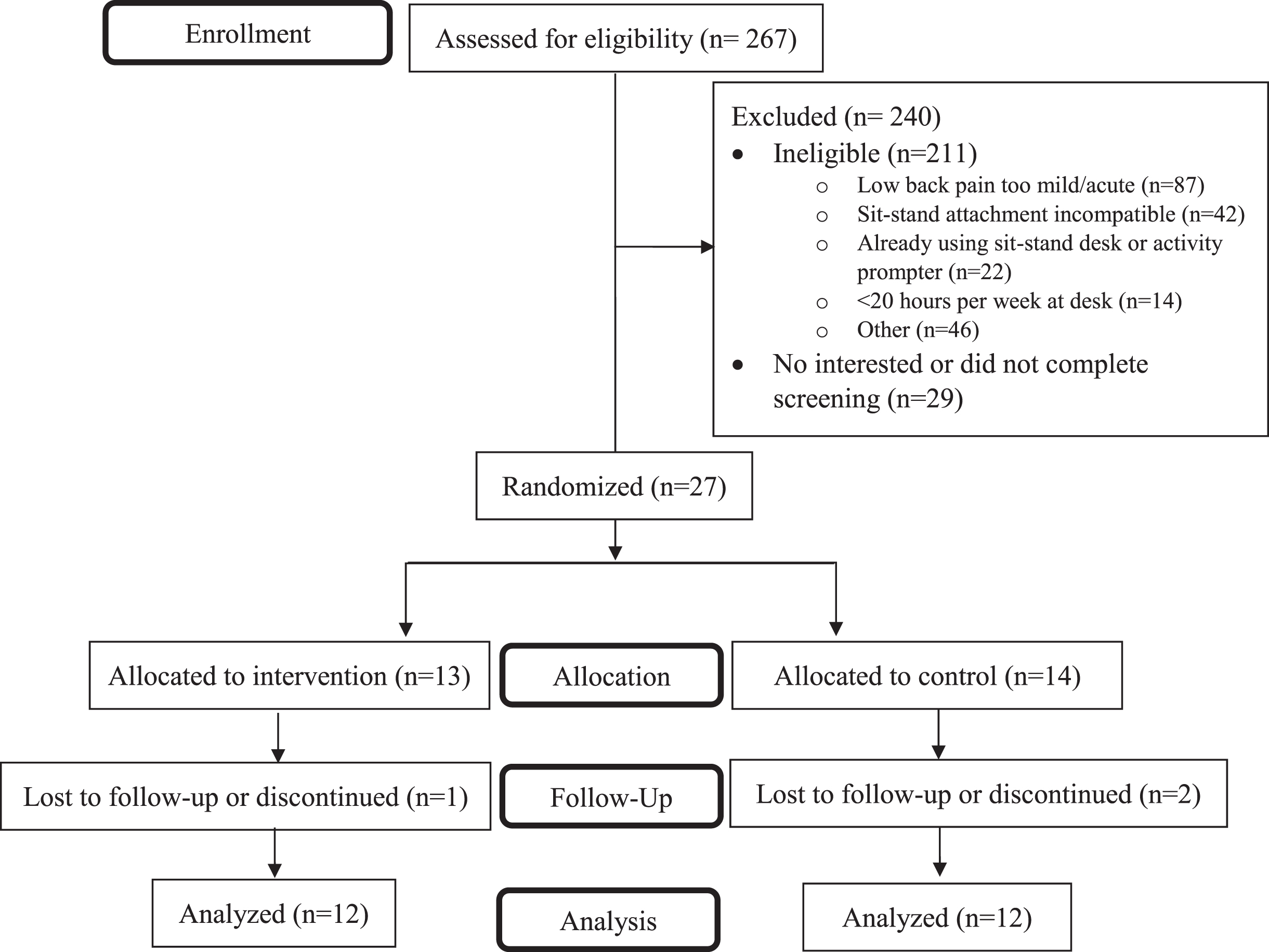
Participant flow diagram.
Of the 27 randomized participants, three subjects dropped out of the study prior to completion. One intervention participant withdrew after 1 month for personal reasons. One control participant withdrew at 2 months for personal reasons and one control participant withdrew due to extended work leave for a medical procedure unrelated to LBP. As a result, 24 participants completed the study and were included in this analysis (Intervention n = 12, Control n = 12, Fig. 1) [27].
Baseline characteristics of the sample are summarized in Table 1. The mean age of the participants was 51.5 (SD: 9.2) years in the intervention group and 48.8 (SD: 12.5) years in the control group. On average, participants were classified as having moderate LBP disability based on the Oswestry Disability Index. Most participants were white (79%) and female (75%). At baseline, participants reported about 7 hours/day of sitting while at work and 10 hours/day overall. Also, 58% of participants reported engaging in recommended levels of physical activity.
Baseline characteristics (n = 24)
*significant difference between groups p < 0.05
The majority of participants worked in a university setting (n = 19), with the remaining participants having office locations in the greater Pittsburgh area including a home office (n = 1), a hospital (n = 1), and corporate offices (n = 3). Most participants worked in separate locations, with the exception of some university employees working on the same floor of a building. The investigators asked these participants not to discuss the study among each other to limit contamination.
Baseline characteristics across intervention and control groups did not significantly differ except for the distribution of education level. No significant effect of education was observed in any questionnaires or subscales.
As reported previously, at six-month follow-up, the intervention group reported 1.5 hours/day less sitting time (p < 0.001) and a 7.8% reduction in lower LBP disability (p = 0.027) compared to controls [27].
Table 2 displays the 6-month intervention effects (β) for each questionnaire and associated subscales as compared to the control group. Analyses showed no group effect of POMS-assessed total mood disturbance (β= –8.55, p = 0.266, d = 0.42). However, vigor showed a significant positive group effect (β= 4.14, p = 0.007, d = 0.80). Esteem-related affect showed a positive group effect of moderate effect size that approached statistical significance (β= 1.79, p = 0.090, d = 0.65). All other POMS subscales showed no difference by group and small or negligible effect sizes (Table 2).
Well-being and workplace health questionnaire results
* = p-value ≤0.05, β= ANCOVA beta coefficient, d = Cohen’s d.
The SF-36 general health score was not significantly different across groups (β= 5.61, p = 0.268, d = 0.32). However, the energy/fatigue subscale showed a significant positive effect by group (β= 18.13, p≤0.001, d = 0.84). Social functioning as measured by SF-36 increased in the intervention relative to control (β= 11.92, p = 0.024, d = 0.62). Additionally, the pain SF-36 subscale showed a significant improvement by group (β= 8.85, p = 0.036, d = 0.48). Despite a non-significant positive group effect, a moderate effect size was observed for the SF-36 emotional limitations subscale (β= 18.79, p = 0.115, d = 0.56). All of the other SF-36 subscales showed no group differences and small or negligible effect sizes (Table 2).
The HWQ total score showed no significant group effect (β= –0.04, p = 0.905, d = 0.03).Notably, the HWQ productivity subscale showed no significant effect by group (β= –0.17, p = 0.675, d = 0.16). No other HWQ subscales showed significant group effects, although a moderate effect size was observed for reduction in the impatience/irritability subscale (d = 0.64) (Table 2).
The PSQI global score showed no significant group effect (β= –0.86, p = 0.452, d = 0.23). None of the 7 PSQI components were found to differ significantly by group except for sleep disturbance (β= –0.38, p = 0.030, d = 0.77). Other than the sleep disturbance component, all effect sizes were small to negligible in magnitude (Table 2).
Participant adherence to in-person and monthly telephone intervention contacts was monitored and was 100% for all participants in the intervention who completed the study.
The purpose of this study was to examine the effects of a six-month sedentary behavior reduction intervention on workplace health (including presenteeism and productivity), well-being, and sleep in persons with chronic LBP using a randomized controlled trial design. Overall, the intervention yielded a reduction of 1.5 hours/day in sitting time in the intervention group compared to controls. At six-month follow-up, the intervention group showed significantly increased vigor, energy, and social functioning compared to controls. This effect was observed with no change in productivity or concentration. Furthermore, the intervention group reported lower pain and a reduction in sleep disturbance after six months compared to controls. No significant change in presenteeism was observed between intervention and control groups. These study findings are particularly relevant given the unprecedented disruptions in the workplace with the COVID-19 pandemic which may cause many individuals to become more sedentary [47]. It has been proposed that the hazards of sedentary behavior and physical inactivity are escalated due to the pandemic and several have identified the need for strategies to interrupt sitting for optimal health [48, 49].
Vigor and energy were found to increase following the six-month sedentary behavior intervention in persons with chronic LBP. This result is consistent with the findings of Dutta et al., who found that a four-week sedentary behavior intervention reduced work sitting time by 21% and increased energy and decreased fatigue in 28 sedentary office workers [50]. Furthermore, it has previously been reported that working women who are less sedentary during the day have lower levels of fatigue compared to those who are more sedentary [51]. The current investigation yields results consistent with previous studies; however, our study adds to these findings by focusing on individuals with chronic LBP. Persons with chronic LBP typically report decreased energy and vitality, which could negatively affect the quality of life of the individual compared to the general population [14]. Therefore, a sedentary behavior reduction intervention may be particularly effective in restoring energy levels and improving stamina during the workday in individuals with LBP.
The current study showed significantly increased social functioning in those in the intervention group compared to controls. Our results are consistent with other studies which have shown that sedentary time may be negatively associated with social functioning. For example, in a study of older adults, the number of sitting hours per week was inversely related to multiple domains of health including social functioning [52]. It has been hypothesized that certain sedentary behaviors, such as computer usage and reading, reduce social interaction and may lead to less social engagement [53]. Furthermore, it has been previously reported that social functioning, as measured by the SF-36, may be compromised in those with chronic LBP [14]. These findings are important because a reduction in social interactions in the workplace may result in a perception of a significant loss of social role and have a negative impact on psychological well-being. On the other hand, social relationships can be a support for patients with LBP and positive social support should be promoted to reduce the impact of LBP. Thus, individuals who are highly sedentary with chronic LBP may particularly benefit from a sedentary behavior intervention in terms of social functioning.
This study found that individuals in the intervention had a significant improvement in pain as measured by the SF-36. These improvements in pain may have contributed to the observed reduction in LBP disability that were previously reported in this study [27]. Our findings are consistent with other studies that suggest that breaking up sitting with standing or moving breaks can reduce LBP intensity in desk workers [54, 55]. In a systematic review of 11 studies, it was found that active breaks with postural change during computer work were most consistently associated with improved musculoskeletal discomfort and pain reduction (56). Another recent meta-analysis found that sit-stand desk use was associated with small decreases in LBP discomfort (d = 0.23). These small decreases in pain were noted in individuals who did not report back pain at study onset [57]. Our results expand these findings to include individuals with moderate LBP disability based on the Oswestry Disability Index.
Our intervention also led to a significant reduction in sleep disturbance following the 6-month intervention. Prior studies have reported a direct association between sedentary behavior and sleep disturbance [58]. In addition, sleep disturbance is highly prevalent among adults with LBP [16, 59]. The current study suggests that sedentary behavior reduction may be an effective approach to reduce sleep disturbance in this population.
Our study suggests our low-touch approach is feasible and able to be delivered with limited resources as our intervention adherence was 100% for in-person sessions and monthly telephone contacts. The total cost of the equipment for the intervention was $435.00 which included $400.00 for the QuickStand sit–stand desk attachment (Humanscale, New York, New York, USA) and $35.00 for the wrist-worn activity prompting device (UP wristband, Jawbone, San Francisco, California, USA). In addition, the monthly follow-up intervention visits were conducted by phone and outcomes were administered using an online platform. This approach saved time and expense by eliminating the need for study staff to travel to the participants’ work site after the initial visit. Given that much of the intervention was delivered remotely and limited equipment were required, it is one that may be more scalable and economical compared to more intensive face-to-face interventions. Thus, we believe the intervention has great potential to impact workplace health given the common condition of back pain, the high prevalence of sitting behavior, and the low burden of intervention delivery on the employer. Moreover, our intervention is likely acceptable across a wide range of work settings including the home setting which will likely be more prevalent as more workers shift to remote settings during and after the COVID-19 pandemic. Larger studies that utilize objective monitoring of sedentary behavior and activity, evaluate intervention components separately, and consider the delivery of the intervention within remote home settings will be important for designing future interventions for workers with chronic LBP. In addition, the examination of socioecological factors including supervisor/coworker social support, team dynamics, job type/sector, and workplace policies should be examined as potential drivers to inform future translation and policy recommendations.
Our study had several limitations, including a small sample size (n = 24) and the resulting increase in the risk of a type II error and the measurement of sedentary behavior by self-report. Our study did not examine the impact of the office environment which may have influenced participant adherence to the intervention. Also, we excluded many potential participants with LBP that was too acute or mild and who had a desk that was not compatible with our sit-stand desk attachment. These exclusions, along with the lack of diversity in the sample, limit the generalizability of the findings. Furthermore, the follow-up period of the study was only 6 months, limiting our ability to determine whether the effects of the intervention persist over time. Our study strengths include a randomized controlled design and the collection of multidimensional workplace health and well-being outcomes that are especially relevant in desk workers and those with LBP.
Conclusions
The Stand Back sedentary behavior intervention led to improvements in energy, social functioning, pain, and sleep disturbance without having a detrimental impact on productivity and concentration in desk workers with chronic LBP. Larger studies that examine the impact of sedentary behavior interventions on multiple dimensions of health in the workplace are warranted.
Conflict of interest
None to report.
Funding
This study was funded by the Virginia Kaufman Endowment Fund for pain research at the University of Pittsburgh Clinical and Translational Science Institute (CTSI) at the University of Pittsburgh. In addition, recruitment support through the University of Pittsburgh CTSI was funded by the National Institutes of Health (UL1TR000005).