






Abstract
BACKGROUND:
Noise in work environments is regarded as a serious issue. Hearing loss leads to socio-economic problems and huge costs to families and communities. Agriculture is one of the professions in which individuals face occupational noise. Farmers are the second leading group in suffering from hearing loss in the world.
OBJECTIVE:
This study aims to predict the hearing protection behavior of farmers by using the Protection Motivation Theory (PMT).
METHOD:
This descriptive study was conducted through a survey. The questionnaire was the main tool for data collection. The population of the study consisted of wheat farmers in Kermanshah province (N = 126,900). By using Krejcie and Morgan’s table and stratified random sampling method, 382 farmers were taken as the research sample. The validity of the questionnaire was confirmed by the experts of this field, and the reliability was proved through a pilot study to calculate Cronbach’s alpha.
RESULTS:
The findings showed that perceived self-efficacy, perceived response efficacy, perceived vulnerability, and perceived response costs had the strongest effects on farmers’ motivation to protect their hearing, respectively. Furthermore, protection motivation had a significant effect on farmers’ protection behavior.
CONCLUSION:
Threat and coping appraisals as cognitive mediating processes determined farmers’ behavior for hearing protection. The results illustrated that the components of PMT were appropriate predictors of farmers’ hearing protection behavior.
Introduction
There is a sound in any human activity. Noise can be of two types: work noise that refers to the sound of the work environment, and environmental noise such as traffic, music, stadiums, etc. The existence of noise in work environments is regarded as an important problem throughout the world [1]. Exposure to noises is threatening individuals’ health in such a way that the resulting hearing loss may have negative impacts on life quality, physical and mental performance, social life, and employment. In addition, hearing loss leads to socioeconomic problems and huge costs to families and communities. Although there were great efforts to provide health services in rural areas and to alleviate inequalities between rural and urban areas, rural citizens are still struggling with more problems and health challenges [2, 4]. One of the most important problems in rural areas is poor personal abilities (such as health knowledge, attitude, and self-efficacy) and health behaviors [5]. Agriculture is one of the sectors in which employees suffer from work noises as with other industries, heavy vehicles drivers [6], spinning factory workers [7], construction industries [8], and so on. But, farmers are the second leading group in suffering from hearing loss in the world. In the agricultural sector, 1.5 million workers (43.3%) are exposed to work noise [9]. The world reports show that 30 percent of Swedish farmers suffer from deafness [10]. Around 60–70% of Australian farmers are losing their hearing [11]. Hearing loss is common among farmers and villagers from North Dakota [12] to North Korea [13]. Studies in Iran have also indicated that tractor drivers [14] and combine drivers [15] are exposed to noise and hearing loss. Ehlers and Graydon’s study showed that farmers did not regularly use hearing protection devices and the beginning age of hearing loss was unknown [16].
Exposure to noises usually threatens farmers’ health for which the protection behavior of farmers should be considered since the behavior of individuals has a direct effect on the events and diseases at work. Thus, this study mainly aims to analyze the hearing protection behavior of farmers using the Protection Motivation Theory (PMT).
Researchers argue that the theory-based interventions outperform non-theoretical approaches to shaping health-related behaviors since they provide a reasonable framework for developing and evaluating interventions [17]. But, research has not addressed hearing protection measures among farmers. Furthermore, farmers’ behavior to protect hearing in the workplace and its dimensions has not been studied yet. There is a research gap as to whether farmers emphasize their hearing protection on the farm. Also, previous research has not identified what causes farmers to protect their hearing.
The present study employed the PMT as it is a theory widely used in the literature for behavior protection. The findings contribute to the growing body of the literature implicating the PMT in behavioral decision-making with respect to hearing protection behavior. In other words, the use of the PMT significantly contributed to the overall understanding of the farmers’ behavior to hearing protection. In addition, the results indicate the level of farmers’ hearing protection behavior and their threat and coping appraisals.
The PMT is one of the theories used to identify factors affecting motivation and behavior. This theory was first introduced by Ronald Rodger in 1975. It is a framework for predicting health-related behaviors and designing educational interventions [18]. In this theory, it is assumed that the adoption of protection behaviors is a direct action of individual motivation for protecting himself [19, 22]. The model is based on individuals’ motivation to perform a behavior. The theory emphasizes how an individual’s perception creates motivation and movement and makes him/her perform a behavior. Overall, HBM focuses on the changes in beliefs, which in turn leads to changes in behavior [23, 25]. According to the HBM, there are two main types of beliefs that influence people to take adoption decisions: beliefs related to readiness to take action and beliefs related to modifying factors that facilitate or inhibit action. The HBM is different from other models in that there are no strict guidelines as to how different variables predict behaviors [26, 28]. In other words, the basic components of the HBM depend primarily on two variables: (1) the value of a goal to an individual, and (2) the individual’s appraisal of the likelihood of an action achieving that goal [29, 30].
The PMT is composed of various components: perceived response costs, perceived severity, perceived vulnerability, perceived response efficacy, self-efficacy, and fear. Perceived response efficacy is defined as the extent to which an individual estimates the proposed behavior will be effective [31]. Perceived vulnerability is mentioned as an individual’s beliefs in vulnerability to health threats [32]. Perceived severity is the personal belief that the health threat is serious [32]. Perceived response costs are estimates of costs associated with doing protection behavior [31]. Self-efficacy is the perceived ability of a person to actually carry out the adaptive response [33]. Fear affects the protection of motivation through five structures and the protection motivation ultimately provokes health behavior [34]. In this study, protection behavior is farmers’ actions and behaviors in the face of farm noises (Fig. 1).
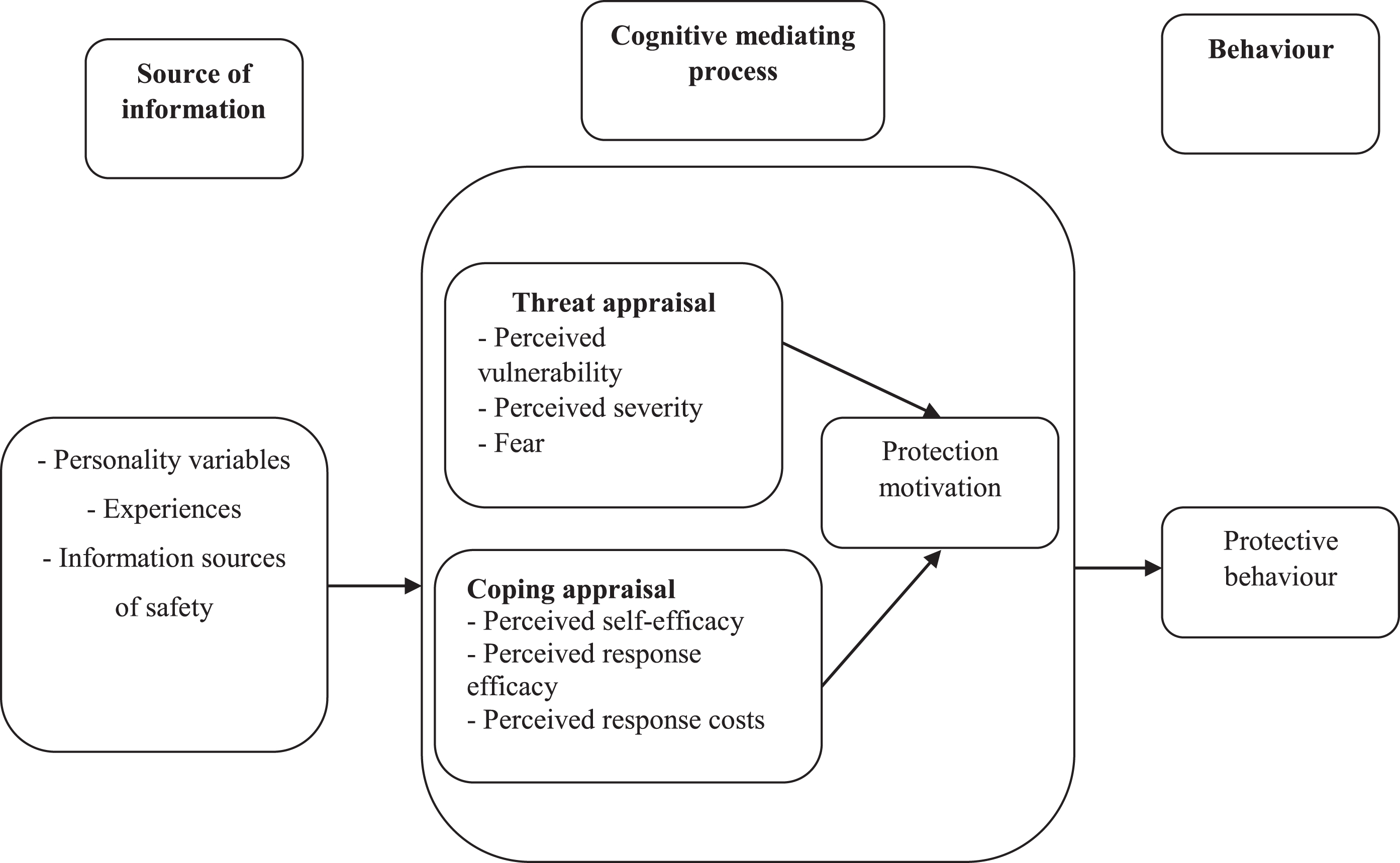
Conceptual framework of the research (adapted from [33]).
This theory has also been used in the agricultural sector and among farmers and villagers. The studies in this field have illustrated that this theory is sufficient for considering the protection behavior of farmers and villagers [18,35,36,37, 18,35,36,37]. A review of the literature shows that the PMT has long been successfully used to investigate a wide variety of farmers’ behaviors such as skin cancer preventive behaviors [18], adolescent drug trafficking [32], injury prevention intervention [35], effects of fear arousal on the practice of social distancing [20], promotion of preventive behaviors from brucellosis [28], pro-environmental behavior [37], pro-adaptation behavior [30], and response to renewable energy [25]. According to the literature, the PMT can well predict the behavior of farmers in various fields. However, previous studies have not examined the hearing protection behavior of farmers using the PMT. Therefore, this study can contribute to developing the PMT in understanding the hearing protection behavior of farmers.
Ashida et al. used PMT in their study and assumed that this theory was sufficient for understanding the motivation obstacles and also for developing strategies to overcome the implicit obstacles [35].
Zare Sakhvidi et al. demonstrated a positive significant correlation between self-efficacy and response efficacy with health behavior [38]. Arabtali et al. concluded that there were significant positive correlations between perceived vulnerability and self-efficacy, perceived response efficacy and protection motivation, perceived response efficacy and coping appraisal, and protection motivation and behavior. On the other hand, there were negative significant correlations between perceived response costs and coping appraisal [39].
Coping appraisal (self-efficacy and response efficacy) and threat appraisal (perceived vulnerability and perceived severity) were directly and significantly related to behavior and these two variables could predict 11 percent of the variance in behavior [40]. Sharifirad et al. also found a positive significant correlation between preventive behaviors and perceived vulnerability, severity, and perceived self-efficacy [41]. Barriers against the use of hearing protection devices by farmers (for example, difficulties in connection with others) had a negative relationship with the use of devices. The availability of protection equipment had a positive relationship with the use of devices. Generally, farmers use hearing protection devices lowly [9].
The present study aimed to (1) determine the demographic and professional characteristics of the farmers, (2) investigate farmers’ hearing protection behavior, and (3) determine the factors underpinning farmers’ hearing protection behavior.
The study was applied in terms of aim and a descriptive-correlational study in terms of data collection, variable control and monitoring, and generalizability. It was conducted as a survey. The research population including all wheat farmers (N) amounted to 126,900. Given that the sampling method was multi-stage by proportional allocation, Kermanshah province was initially divided into five parts (north, south, east, west, and center) in geographical directions, and then a county was selected in each direction. The sample size was determined to be 382 farmers by Krejcie and Morgan’s table [42]. The sample size in each county was specified by proportional allocation (Table 1). A questionnaire was the main data collection instrument. The questionnaire was composed of two sections: first, farmers’ demographic characteristics (gender, farming experiences, level of education, age, farm size, and yield); second, components of the PMT, including fear (five items), perceived severity (five items), perceived vulnerability (three items), perceived response costs (nine items), perceived response efficacy (three items), perceived self-efficacy (three items), protective motivation (three items), and protective behavior (five items). The variables were measured on a five-point Likert scale. The content validity of the questionnaire was confirmed by a panel of experts. A pilot test was conducted to estimate the questionnaire’s reliability. Then, Cronbach’s alpha coefficients were calculated for different sections of the questionnaire (0.70–0.89, Table 2). The data were analyzed using Amos22 and SPSS23. The statistical tests included frequency, percentage, mean, standard deviation, and path analysis. Also, farmers’ protection behaviors were categorized by the Internal Standard Deviation from the Mean (ISDM).
Research population and samples
Research population and samples
The Cronbach’s alpha coefficient of variables
D < M-
M -
D > M+
Mean (M) and standard deviation (SD) are two important indicators in the ISDM formula. First, the mean and standard deviation of the dependent variable should be calculated. At a weak level, the value of M-
Farmers’ demographic characteristics
The findings as to the demographic characteristics of the farmers indicated that 98.4 percent were male and 1.6 percent were female. Also, the farmers aged between 18 and 54 years with an average age of 45.82 years and a standard deviation of 14.2. Their average farming experience was 22.55 years. These results show that the farmers were highly experienced. In terms of the educational level, the majority of farmers had less than a high school education (70.10%), 5.5% were illiterate (no formal education), and 8.6% had academic degrees. Considering the agronomy characteristics, the average farm size was 46.8 ha and the average yield was 61.2 t/ha. Also, the average hours of agricultural activities of the farmers were 8.53 hours per day.
Analysis of factors underpinning the protection behaviors of the farmers
To analyze the farmers’ hearing protection behavior model, path analysis was used. Path analysis evaluates the effects of variables on one another for which a coefficient of < 0.1 means the weak influence, 0.3 means the average influence, and 0.5 or higher means the strong influence of a variable on the other variable. In data analysis, the ratio of Chi-square to the degree of freedom (df) should be smaller than 5, and Relative Fit Index (RFI), Comparative Fit Index (CFI), and Normed Fit Index (NFI) should be greater than 0.9.
Chi-square: Based on this statistic, the null hypothesis is that the model fits completely with the statistical population data. When the chi-square is statistically significant, it results in the rejection of the null hypothesis.
Root mean square error of approximation (RMSEA): When this value is less than 0.05, it shows that the model is well-fitted. If the value is between 0.05 and 0.08, the fit is acceptable, if it is between 0.08 and 0.1, the fit is average, and if it is greater than 0.1, the fit is poor.
Goodness of Fit Index (GFI): The value of this index should be between zero and one. A value greater than 0.9 indicates an acceptable fit of the model.
Tucker-Lewis Index, Comparative fit index (TLI, CFI): These indicators show the extent to which the model fits better than the baseline, which is the independence model. The values of all these indices are between 1 and 0. The closer it is to 1, the better the fit of the model will be.
Root Mean Square Residual (RMR): When it is less than 0.05, it indicates an acceptable fit of the model.
Incremental Fit Index and Normed Fit Index (IFI, NFI): These two values are between zero and one. The closer it is to 1, the better the fit of the model will be.
Figure 2 shows the mechanism of causal relations between the variables with the farmers’ protection behaviors.
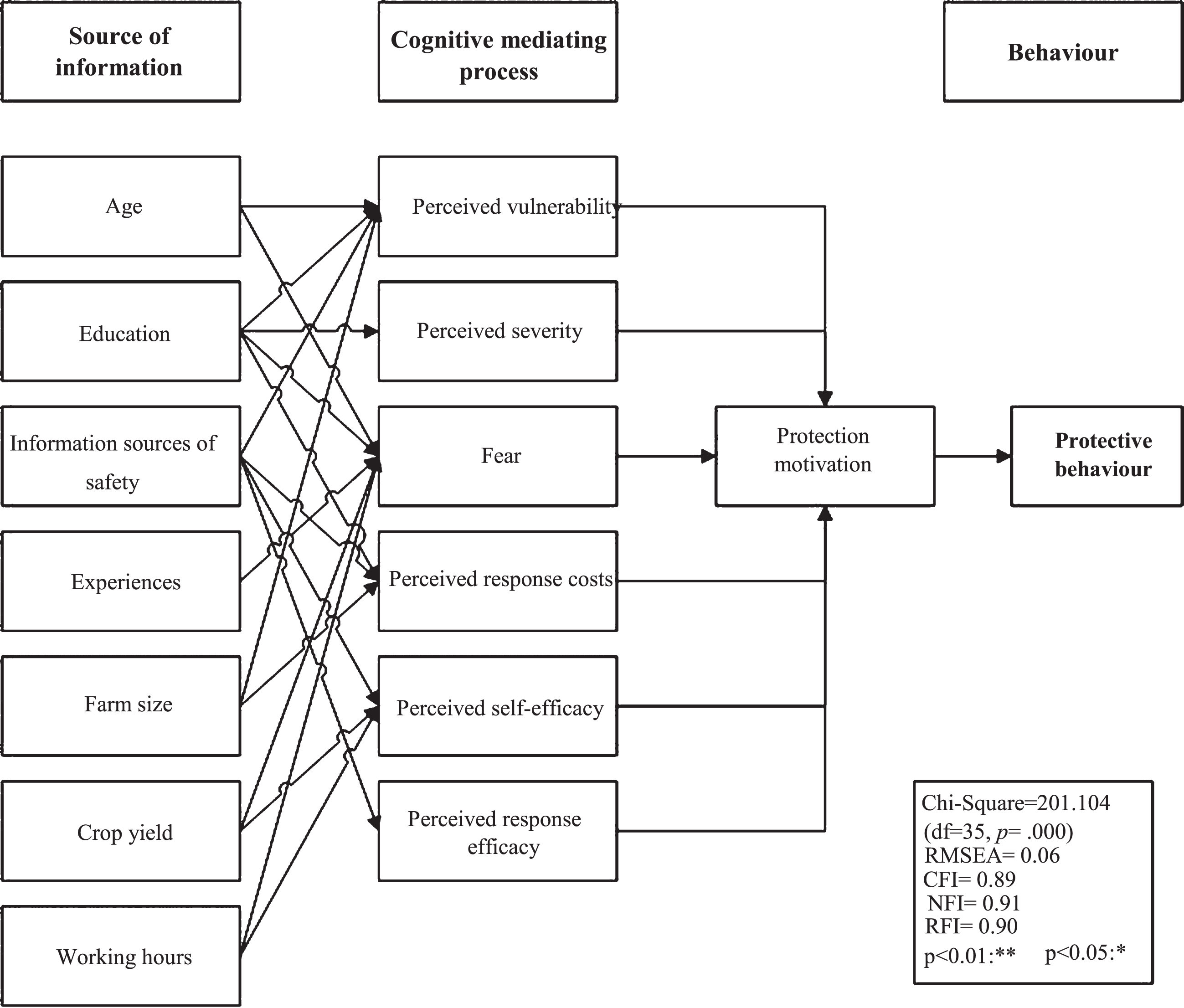
The model of farmers’ protective behaviour.
The division of the causal effects of the demographic variables on the components of PMT suggests a direct significant and negative effect of age on perceived vulnerability (β=–0.25) and positive effects on fear (β=0.66). This result shows that as the farmers become older, the perceived vulnerability for protecting their hearing decreases and their fear increases. Also, education level has a direct, positive, and significant effect on perceived severity (β=0.14), perceived vulnerability (β=0.11), fear (β=0.26), and perceived response costs (β=0.14). On the other hand, the exogenous variable of the educational level was a significant predictor of the endogenous variables of perceived severity, perceived vulnerability, fear, and perceived response costs. So, more educated farmers have a higher perception of the seriousness of the consequences of contracting hearing problems. As well, farmers with higher educational levels reinforced their subjective perception of the impending possibility of a negative event happening to them. Also, the educational level can influence farmers’ fear and perceived response costs. On the other hand, if the educational level of the farmers increases, any costs associated with performing the adaptive coping response will be improved among the farmers and will lead to increased fear about hearing problems. In addition, the results showed that the variable of experience in farming had a positive, direct, and significant effect on fear (β=0.36). In other words, the farming experience is a significant predictor of the endogenous variable of fear.
One of the other moderating variables is farm size. This variable had positive significant effects on perceived vulnerability (β=0.19) and perceived response costs (β=0.18). Farmers’ protection behavior and protection costs are increased with their farm size. On the other hand, the variables of crop yield and working hours had positive significant effects on the two variables of perceived self-efficacy and fear. In the other words, as crop yield and working hours increase, they exhibit higher self-efficacy for protecting their hearing, and their fear of hearing loss at work is enhanced. Also, information sources of safety had a positive significant influence on perceived vulnerability (β=0.30), perceived response costs (β=0.15), perceived self-efficacy (β=0.45), and perceived response efficacy (β=0.13)(Table 3).
The effects of moderating variables on the components of PMT
In examining the effects of PMT components on farmers’ motivation to protect their hearing, it was realized that among six components of this theory, four components, including perceived vulnerability, perceived response costs, perceived self-efficacy, and perceived response efficacy, had significant effects on farmers’ motivation to protect hearing (p < 0.01). In other words, the components of PMT are adequate predictors of farmers’ hearing protective behaviors. However, perceived self-efficiency (β=0.45), perceived response efficacy (β=0.29), perceived vulnerability (β=0.22), and perceived response costs (β=–0.15) had the highest effect on farmers’ protection behavior, respectively. In addition, the motivation for hearing protection (β=0.52) had a positive significant influence on farmers’ protection behaviour (Table 4).
Analysis of direct and indirect effects of variables on farmers’ protection motivation
This study analyzed farmers’ behavior to protect hearing at their farms. In the analysis of the hearing protection behavior, it was recognized that farmers’ protection behaviors were weak. In other words, farmers do not use protection devices during their agricultural activities, such as the application of earmuffs and less exposure to noisy environments at work. These results show that farmers attach little importance to hearing protection in the workplace. It may lead to various injuries and diseases in thefuture.
The findings indicated that farmers’ demographic and professional features can influence different components of the PMT. Particularly, this finding illustrates the importance of demographics and professionals of farmers. Some individual characteristics, such as age, educational level, and job experience, are the key features of the PMT. It was seen in this study that the younger farmers perceived more vulnerability for protecting their hearing and they were less fearful than the older farmers. Other studies [39,41,43,44,45, 39,41,43,44,45] has also verified this result. Also, the results showed that the PMT was an adequate confirmation of the protection behaviors of farmers. The PMT help understand individual human responses to fear appeals. The PMT proposed that farmers protect hearing based on two factors: threat appraisal and coping appraisal. Threat appraisal assesses the severity of the situation and examines how serious the situation is, while coping appraisal is how farmers respond to the situation. Coping appraisal evaluates farmers’ expectations to carry out the hearing protection actions. More specifically talking, it can be said that there is a significant relationship between perceived vulnerability and protection motivation. The higher the perceived hearing vulnerability is, the higher the motivation is to use earmuffs. In other words, the motivation for protection behavior is increased when farmers believe in hearing loss. Fear plays an essential role as a mediator in the process of hearing protection behavior. On the other hand, fear should be considered an equal component with severity and vulnerability within the threat appraisal. Also, fear may hinder the establishment of precautionary motivation through the initiation of fear control processes[46].
There is a significant negative relationship between perceived response costs and protective motivation. It can be understood that if perceived response costs such as the cost of protection devices increase, the motivation to protect hearing will be reduced because farmers’ estimation of the costs (such as money, time, and effort) related to hearing protection behavior influences their protective motivation. Thus, it can be concluded that the low earning and poor economic status of farmers is a factor limiting their use of protection tools. Moradhaseli et al. concluded that unsuitable economic conditions are one of the farmers’ challenges regarding safety at work [47]. Buranatrevedh and Sweatsriskul concluded that farmers paid less attention to safety rules and their health in working environments due to the economic issues to reduce costs and savemoney [48].
This is rooted in the lack of information about hearing loss. Information sources about safety can improve farmers’ perceived vulnerability, perceived response costs, perceived self-efficacy, and perceived response efficacy. Other scholars have emphasized the main role of information sources in the process of individuals’ hearing protection behavior[47, 49].
Jeihooni et al. reported that people would change their behavior when they realized that the disease and event were serious; otherwise, their behavior would not be changed to healthy performance [50]. In this study, there was a significant positive relationship between perceived self-efficacy and protection motivation. Different researchers have concluded that self-efficacy can be an effective element in adopting protection behaviors [51, 52] so that self-efficacy was the strongest predictor of protective motivation [53]. Moeini et al. concluded that when a person believes that the health risk can be reduced by adopting a healthy behavior, he or she will be less prone to inconsistent behavior and tolerance outcomes [54]. Finally, it was found that protection motivation can be an important predictor of hearing protection behaviors. In other words, the higher the motivation of farmers is to protect their hearing, the higher the probability to take these behaviors. Thus, motivation can be an essential feature in doing protection behaviors [55, 58].
Generally, the main driver to encourage protection and health actions is to enhance people’s awareness. Therefore, education can be considered a development tool. Education can play an important role in developing protection behaviors [59, 63]. According to the findings, the weakness of the protection behavior of farmers seems to be a lack of training programs in this case. Also, other scholars emphasize these programs for improving safety behavior [64, 67]. Thus, agricultural organizations can enhance development by performing different types of education. It is suggested that organizations, such as Agricultural Extension and Education, prepare educational courses to develop individuals’ knowledge of work-related hazards and harmful agents and to make them aware of work-related vulnerability so that they are encouraged to take adequate protection behaviors against damaging factors in the work environment. In addition, these educations can increase farmers’ awareness of the negative impacts of the non-use of protection devices.
Given the significant negative relationship between perceived response costs and protection motivation in that one of these costs was the inadequate economic prosperity of farmers, it is suggested that the government provide solutions for improving the economic life of farmers. Example solutions include the guaranteed purchase of agricultural commodities, subsidies for the purchase of devices and inputs, and low-interest loans. Also, the government can provide low-cost or free protective tools for farmers by which different levels of farmers’ community can easily use the protective devices. On the other hand, in designing protection devices, designers should consider the comfort of the users along with tools’ safety. One of the other suggestions is the cooperation of agricultural organizations with general practitioners. Hence, they should take care of farmers’ health and make them aware of the effects of agricultural activities and lack of protection standards overthe year.
Limitations
The findings of this study should be interpreted in light of several study limitations. First, all participants were males so the results are not generalizable to female farmers. As well, we couldn’t compare the variables between two genders. Second, farmers’ hearing protection behavior was investigated by the self-report. So, it can be suggested to measure farmers’ behavior by observation and interview. Another limitation of the research was the difficulty of finding farmers who had machinery.
Ethics approval
Not applicable.
Informed consent
Not applicable.
Conflict of interest
The authors report no conflicts of interest regarding the material and results of the study.
Footnotes
Acknowledgments
The authors would like to express their appreciation to the farmers in Kermanshah province who participated in the study.
Funding
This research did not receive any specific grant from funding agencies in the public, commercial, or not-for-profit sectors.