






Abstract
BACKGROUND:
Much is known about the physical effects of work and health, but less is known about how older workers unwind mentally from work, and their post-work ruminative thinking.
OBJECTIVE:
The present study aimed to explore the association between age, gender and two types of work-related rumination: affective rumination, and problem-solving pondering.
METHODS:
This study utilized a sample of 3991 full-time employees (working 30 or more hours per week), who were stratified into five age bands (18–25, 26–35, 36–45, 46–55, and 56–65 yrs.).
RESULTS:
Affective rumination was found to significantly decline in the older age groups (46 + yrs.), but this finding was moderated by gender. Males reported lower work-related rumination over the entire age range, but the greatest difference between males and females was observed in the 56–65 age category. The results for problem-solving pondering mirrored those of affective rumination but with the only exception that there was no significant difference in gender between those aged 18–25 years.
CONCLUSION:
These findings add to our understanding about how workers (between different age groups) mentally switch off from work and highlight the need for interventions to help older workers mentally recover from the effects of work.
Introduction
A number of social and demographical changes in most industrialized countries have led to an increased average age of the working population and thus a rise in the number of older workers in the workforce [1]. As life expectancy increases, the age at which people can start receiving state pension is predicted to rise in most OECD countries [2], and as the need to continue working longer into later life takes effect, it has become vital to understand how working life affects health and wellbeing. Research suggests that whilst age in itself does not significantly relate to mental distress, older workers may find it difficult to cope with elevated psychosocial workloads [3]. Other studies have found that high psychosocial work demands are associated with an increased risk of experiencing mental health problems in older workers [4], and that older workers are more likely to report fatigue from work and a greater need for rest and recovery [5].
There are a number of theoretical models that have highlighted the importance of recovering from the effects of work [6–8]. For example, Hobfoll’s Conservation of Resources (COR) model, hypothesizes that individuals are instinctively motivated to develop, and nature personal resources such as those needed to sustain survival, and boost a sense of worth and well-being [7]. Work demands are particularly believed to be resource expending and a drain on resources. With regards to the Effort-Recovery model, Meijman and Mulder argued that working drains vital psychological and physical resources that can only be restocked after a period of rest [9]. Zijlstra et al. [8] consider recovery to be a continuous, dynamic process; a state where complete recovery can never be attained, as there is no defined point when you can identify that someone is fully ‘recovered’. Recovery in this model is ongoing by an individual, as they attempt to regulate their mental and psychophysiological state. While these models clearly differ, their underlying tenet is that respite from work demands is crucial in the safeguarding of health and wellbeing.
A situation with sustained inadequate recovery and forced effort mobilization is thought to lead to a state of allostatic load (i.e., the cost of chronic exposure to high demands/stress), due to the constant demands placed on the body [10]. It has been shown for example, that strenuous working conditions and frequent or long-term demands cause allostatic load, eventually leading to illness and disease. Moreover, a lack of adequate recovery over the weekend has been shown to be a major cause of cardiac arrests among the working population [11]. Thus, the need for recovery can function as a measure of the severity of stress [12], and need for recovery from work is thought to be indicative of short-term problems affecting post-work recuperation but may also be considered an early indication or more serious work-related fatigue or distress [13].
The association between demanding work, with physical and psychological health problems, has been well documented in the literature [14, 15]. Research suggests, however, that work demands/stress in itself, may not directly cause health issues so long as there is sufficient time to mentally unwind and switch off from work between shifts [16]. There are many conceptual ways of thinking about work outside of work [17, 18] but mentally switching off from work can be considered in terms of two opposite poles. At one end, a worker is fully mentally disengaged and detached from work during their free time, whilst at the other, they continue to dwell on and ruminate about work-related matters. We define work-related rumination as the practice of thinking/perseverating about issues associated with work [16, 19]. For example, a worker may continue to cogitate over unfinished tasks, worry about a future meeting, or dwell on something said to them by a colleague or their line manager [20, 21]. Irrespective of the initial trigger, the event continues to take its toll, as individuals perseverate over the issue during their leisure time.
Persistent failure to mentally detach from work weakens the body’s physiological restorative system, and therefore is very detrimental to health. Indeed, work-related rumination has been related to a plethora of serious psychological and physical health symptoms, such as negative mood [22], fatigue [23–25], sleep disturbance [26–28], and even cardiovascular disease/risk [11, 29]. Thus, continual lack of recovery from work, contributes towards an aspect of the overall risk profile among employees. Switching off and mentally unwinding from work is therefore an essential part of the recovery process and a prerequisite for good health.
Given that the literature regarding the association between physical aspects of work and the health and wellbeing of the ageing workforce is expanding, there is a notable lack of studies specifically designed to examine how older workers disengage and mentally switch off from work. At present, and to our knowledge, it has not yet been explicitly investigated how work-related rumination varies across the lifespan. This is surprising considering what is known about how psychological detachment from work— or lack of it— affects health [30], and the increasing rise in pension-age across many countries. Studies that have examined detachment from work, however, have tended to use relatively small datasets or treat age as a control variable, so in most studies it has not been possible to examine the effects of age. Large datasets are needed to adequately investigate the effects of age. To this end, utilizing a dataset of 3991 workers collated from previous studies, the principle aim of this research was to explore how or whether work-related rumination changes across the age span.
In order to assess rumination, we drew upon the conceptual model of Cropley and Zijlstra [16] and examined two types of post-work thinking called ‘affective rumination’ and ‘problem-solving pondering’. Affective rumination is a negatively valanced form of thinking exemplified by the experience of invasive, persistent, and repetitive thoughts about work [16]. Individuals who regularly engage in affective work-related rumination demonstrate high levels of fatigue, poorer psychological and physical well-being [23, 24], and reduced safety behaviours outside of work [31]. Problem-solving pondering is a pattern of thinking where people direct their attention and focus on a problem or problems associated with work. They may direct thoughts to a problem in order to see how it can be bettered or improved. Problem-solving pondering is an analytical way of thinking that is not emotionally arousing, unlike affective rumination [16]. People may find it mentally stimulating when directing attention to a work-related problem they were unable to solve during working hours. Thus, the crucial difference between the affective and problem-solving states relates to emotional arousal. During affective rumination, psychophysiological arousal becomes elevated, which is counterproductive to solving the problem or recovery in general. Problem-solving pondering occurs with lower psychological and physiological arousal, hence it is less detrimental to individuals’ recovery. Problem-solving pondering seems to be associated with creativity [32], and if the act of problem-solving leads to resolution of the problem, this could actually boost self-efficacy, positive affect, and well-being [33]. Consequently, engaging in problem-solving pondering, could in fact, be helpful for recovery [27, 34]. While problem-solving pondering and affective rumination are considered to be distinct constructs, they are not orthogonal as they do share variance. It is natural for someone who is engaging in affective rumination to try to find reasons to stop themselves ruminating and thus problem-solve, while someone who is trying to find a resolution to a problem related to work (that is, problem-solving pondering) may become frustrated and tense if they fail to find the solution they are looking for. Taking a regulatory viewpoint, however, individuals who find it useful to ponder problems during their free time may switch off when necessary.
As stated above, to our knowledge there are at present no large-scale studies that have examined work-related rumination across the age span. Drawing on the general literature on rumination that shows a decline in rumination over the lifespan [35], it was tentatively predicted that affective rumination and problem-solving pondering would decrease with age. By experience, older workers are more likely to have developed the skills to deal with or avoid work stressors, e.g., by job crafting [36, 37], but stress experiences may be moderated by gender [38]. It has also been suggested that the meaning and importance of work changes with age [39], as work may not be as central or important as it was in one’s earlier years. Moreover, older people appear to have a greater developed self-regulatory capacity and thus are able to better regulate their mood/affect compared to younger people [40, 41]. It is therefore likely that older workers would ruminate less about work-related issues during non-work time.
The secondary aim of the current paper was to explore the effects of gender. Differences in levels of depressive rumination (e.g., brooding and reflection) between men and women are well documented. Self-reports of rumination are typically higher in women relative to men [42]. Although there are fewer studies that have analysed rates of work-related rumination between genders, there is evidence to suggest that women ruminate about work issues to a greater extent than men [27, 44]. Therefore, based on previous evidence, it was also predicted that women would report greater rumination relative to men across the life span.
Methods
Data and demographic information
Data was pooled across seven studies [45–51] that included workers, working in the UK, aged 18 years and above, in full-time employment (classified in this study as working 30 or more hours per-week). Each participant participated in only one study. The final data set comprised of 3991 employed adults (Female = 2592 (64.8%); Male = 1397 (34.9%, not provided 0.3%) 1 with ages ranging between 18–65 years (M = 38.20, SD = 11.38)). The participants worked an average of 41.9 hours per week (SD = 9.26). We had marital status data from 3048 individuals; 2050 reported they were married or were living with a partner, 770 were single, and 228 reported that they were separated/divorced or widowed. The majority of the participants reported working in the education sector (40.2%, n = 1604), followed by healthcare (11.9%, n = 474), law enforcement (9.5%, n = 378), energy (5.2%, n = 209), business/consulting/management (3.9%, n = 155), human resources/recruitment (3.1%, n = 122), administration (2.9%, n = 117), legal/lawyers (2.9%, n = 114), accountancy/finance (2.8%, n = 110), research/scientist (2.5%, n = 99), engineering/manufacturing (2.0%, n = 78), marketing/advertising (1.9%, n = 77), information technology (1.9%, n = 74), government (1.2%, n = 47), sales (1.2%, n = 47), media/arts (1.0%, n = 39), leisure/sports/tourism (0.9%, n = 37), hospitality (0.6%, n = 21), charity (0.5%, n = 21), property/construction (0.5%, n = 19), transport (0.3%, n = 10), other (3.2%, n = 128), and 0.2%, (n = 8) did not provide information about their occupation.
Measures
Work-related rumination
Affective rumination and problem-solving pondering were assessed using the Work-Related Rumination Questionnaire (WRRQ) [47]. Five items are used to assess affective rumination, and relate to being tense or troubled by thinking about work; and five items are used to assess problem-solving pondering, relating to solving problem and improving work performance. Responses to these items are given within a 5-point scale, from, 1 = “Very seldom/never” to 5 = “Very often/always”. The scale is reported to have high reliability and validity [27, 52]. Confirmatory factor analysis supported the two conceptualized factors, explaining 69.4% of the variance. Cronbach’s values for the current study were.91 for affective rumination, and.81 for problem-solving pondering.
Data analysis
To assess differences in post-work thinking the data were separated into five age groups: 18 to 25, 26 to 35, 36 to 45, 46 to 55, and 56 to 65yrs. These age bands are consistent with research examining age related changes in psychological parameters [53]. To examine the effects of affective rumination and problem-solving pondering by age and gender, two Gender (female, male) by Age Group (18 to 25, 26 to 35, 36 to 45, 46 to 55, 56 to 65) Analysis of Variance (ANOVA) were conducted. Between-group comparisons were further investigated using additional one-way ANOVAs and Tukey tests.
Results
Affective rumination – the effects of age and gender
The results of the ANOVA for age and gender on affective rumination are presented in Fig. 1. There was a significant main effect of Gender (F(1,3955) = 183.56, p < .001), with females (M = 15.86, SD = 4.83) reporting significantly higher ratings of affective rumination relative to men (M = 13.55, SD = 4.73), and a significant effect of Age (F(4,3955) = 5.24, p < .001). Post hoc tests revealed that workers in the youngest age group, group 1 (18 to 25yrs) ruminated less, relative to those in groups 2 (26 to 35yrs) and 3 (36 to 45yrs). The oldest group, group 5 (56 to 65yrs), reported lower ratings of rumination relative to groups 2 and 3 (all ps< = 0.01) (N.B. groups 1 (M = 14.5, SD = 5.0); 2 (M = 15.2, SD = 5.0); 3 (M = 15.2, SD = 4.6); 4 (M = 14.8, SD = 4.9); and 5 (M = 14.2, SD = 4.9). There was also a significant Age by Gender interaction (F(4,3955) = 2.57, p < .05). Females in group 1 (18 to 25yrs) ruminated less relative to those in group 2 (26 to 35yrs). For males, those in group 3 (36 to 45yrs) ruminated significantly more compared to the other 4 age groups (all ps< = 0.01). In all comparisons across age and gender, females reported higher ratings of affective rumination compared to men (all ps< = 0.001).
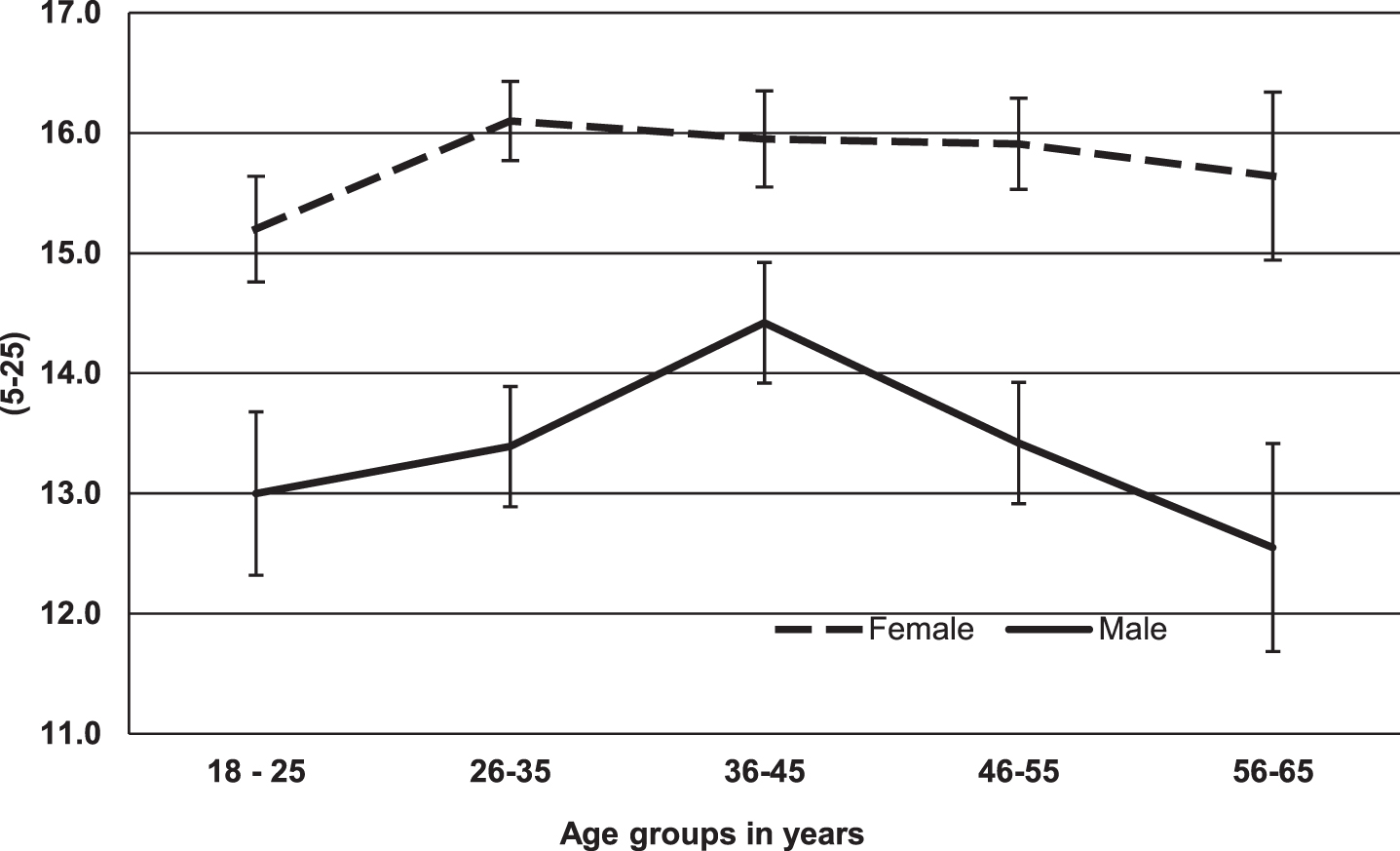
Mean and+/- 2 SE of affective work-related rumination across age.
The results of the ANOVA for age and gender on problem-solving pondering are presented in Fig. 2. There was a significant main effect of Gender (F(1,3954) = 76.30, p < .001) with females (M = 16.73, SD = 3.79) reporting significantly higher levels of problem-solving pondering relative to men (M = 15.50, SD = 3.98); there was also a significant effect of Age (F(4,3954) = 5.49, p < 0.001). Post hoc tests indicated that workers in the youngest age group, group 1 (18 to 25yrs) engaged in less problem-solving pondering relative to those in groups 2 (26 to 35yrs), 3 (36 to 45yrs), and 4 (46 to 55yrs) (all ps< = 0.001) (N.B. groups 1 (M = 15.3, SD = 4.1); 2 (M = 16.4, SD = 3.9); 3 (M = 16.3, SD = 3.8); 4 (M = 16.6, SD = 3.6); and 5 (M = 16.0, SD = 3.8)). There was also a significant Age by Gender interaction (F(4,3954) = 5.85, p < .001). Females in groups 2-5 engaged in greater problem-solving pondering relative to those in group 1 (18 to 25yrs). For males, older adults aged between 56 to 65yrs engaged in considerably less problem-solving pondering relative to those in group 2 (26 to 35yrs) (p< = 0.05). In comparing across age and gender, females were found to engage in higher levels of problem-solving pondering relative to males in all age groups except group 1. Thus, there was no significant difference in problem-solving pondering between females and males aged 18 to 25 years.
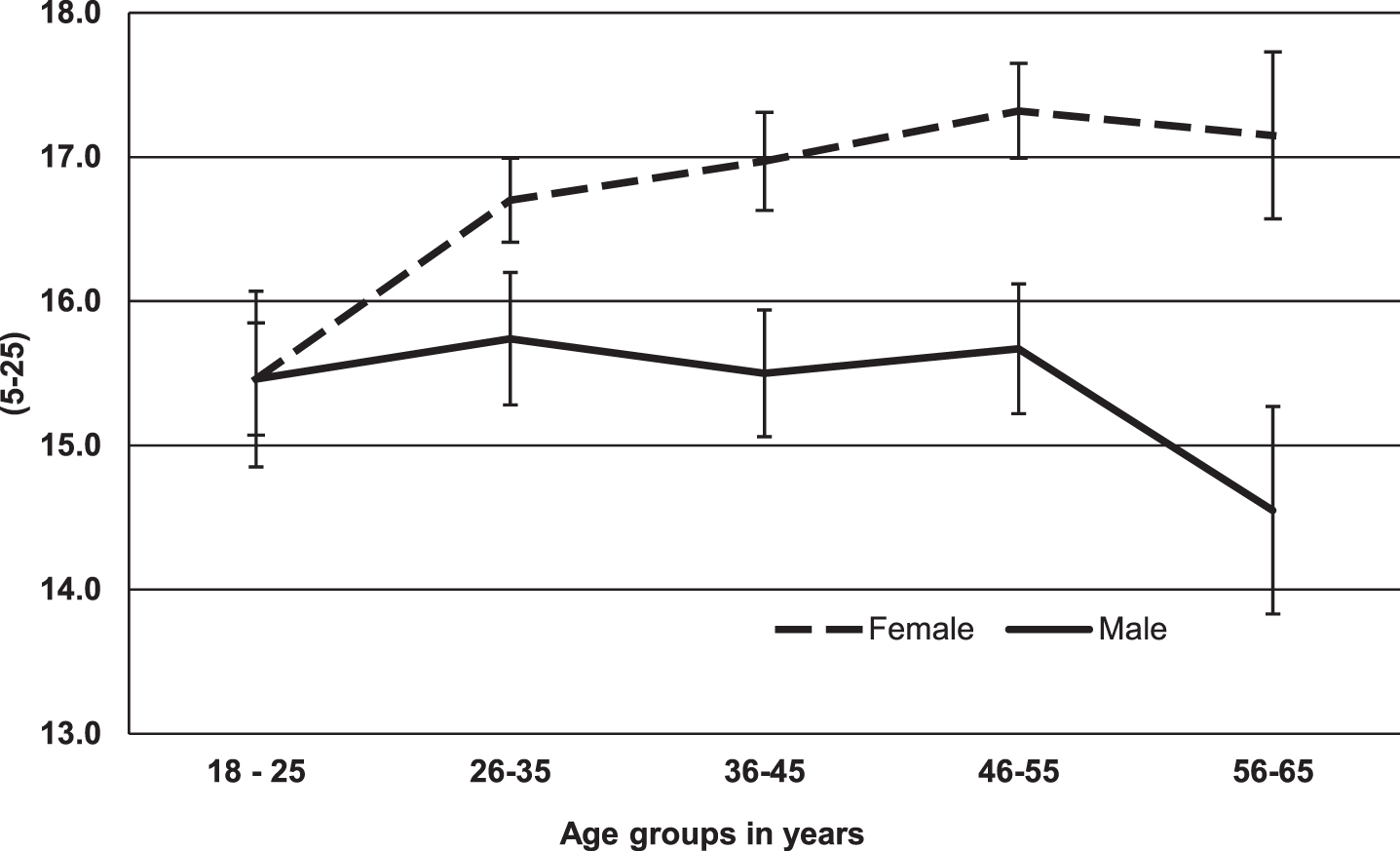
Mean and+/- 2 SE of problem-solving pondering across age.
The aim of this study was to examine the association between age, gender and two different styles of work-related rumination, to add to our understanding of how people mentally unwind from work across the working age span. As expected, and consistent with previous literature, women were found to ruminate more about work during their free time relative to men [43], and rumination declined with age [35]. The main and novel finding of the study, however, is that rumination and gender interacted across the age span. Interestingly, work-related rumination appeared remarkably stable over time in women, but it dramatically varied in men. Within the present study, affective rumination in males was lower relative to females between the ages of 18 to 35yrs, it then peaked around 36 to 45yrs, and then declined with increasing age. Intriguingly, the difference between males and females was found to be greatest between the ages of 56 and 65 years with men ruminating less than women.
As the consequences of rumination on health and wellbeing are well-recognized, our results therefore have significant implications for health, especially for women, as retirement age is set to rise. As reported earlier, there are several distress symptoms associated with work-related rumination including anxiety, depression, fatigue, insomnia, and even cardiovascular disease. As the difference in rumination between men and women appears to magnify with age, increasing retirement age may therefore increase the risk of women experiencing poorer health and well-being. It is noteworthy that gender and age differences in affective rumination are very similar to the distribution of insomnia across the age span [53]. Poor sleep may therefore reflect or be a consequence of rumination, and there is some evidence to support this [27]. Although undoubtedly, observed gender differences may also be due to a third unknown mediating variable or other variables. A recent qualitative study on work/home conflicts among female office employees found that while family responsibilities were equally shared between the genders, women still felt the main responsibility for “the third shift” of planning and organizing these activities [54]. It may be possible that the pressure from higher family responsibilities felt by women may also lead to increased affective work rumination.
Frankenhaeuser and colleagues noted gender disparities in the way managers recover from work, with women demonstrating greater physiological arousal during the evening relative to men [55]. It is unlikely in the present study, however, that gender differences in rumination were solely due to management/supervision responsibilities, as we found no interaction effects in respects to rumination between gender and management/supervision responsibilities within each age band. There may however be a lagged effect for women in terms of work-related rumination, as men may move into managerial roles earlier in their careers [56]. This needs to be investigated in future studies. It would also be of interest for further research to explore physiological correlates such as heart rate variability, blood pressure, or cortisol secretion between age, gender, and rumination.
Gender differences in rumination within the present study are typical and appear to mirror gender differences within the general literature on rumination [42]. There is uncertainty within the literature, however, as to why women have higher rumination tendencies than men, although there have been many theories put forward. One explanation is that women feel more open to share their thoughts compared to men [42] or that women respond stereotypically to ruminative questions [57]. Another explanation suggests that differences in rumination reflect differences in distress, but this interpretation has not been supported. Gender differences may also reflect beliefs about control of emotions and mastery [58]. Perhaps gender differences in rumination within the present study simply reflect engagement in so called ‘recovery activities’, such as hobbies. Engaging in a stimulating hobby after work will automatically distract attention away from work matters. UK men spend a greater amount of time on leisure activities than UK women, and in particular, men spend more time playing sports, practicing hobbies, gaming and computing than women. Interestingly, the time spent on leisure activities between men and women appears to magnify with age [59]. Women therefore may have more difficulty switching off from work than men, because men tend to engage in more active recovery processes during their free time.
Interestingly, the findings for problem-solving pondering were similar, and mirrored those of affective rumination, and this is perhaps not unsurprising. If a person is ruminating about work issues they would naturally try to identify, and problem solve the reasons why, to stop themselves ruminating further. Conversely, if a person freely engages in problem-solving during their free time but is unable to find the solutions to the problem they are seeking, this could lead to frustration and increased affective rumination.
The current study produced some unique findings, and has several strengths including the large dataset, the representation of a variety of occupations, and the examination of two different types of post work ruminative thinking. Further, this work adds to our understanding of how individuals mentally disengage from work. There were, nonetheless, some limitations. It was not possible within the present dataset to examine, with integrity, personal or work characteristics (e.g., organizational climate [60]), that may explain gender and age difference in work-related rumination, as the same variables were not collated consistently across the different studies. Future research— possibly utilizing qualitative or diary methods— is required to identify variables that may mediate or moderate the effects of age and gender on work-related rumination. The gender split was not equal as there was a higher proportion of females. Finally, it is not possible within the present dataset to definitively conclude that the findings represent a true ageing effect— one that is independent of time— or whether the findings are specific for this particular period of time. Further studies using longitudinal designs that track the same individuals across time are needed to reduce the possibility that the findings simply represent a cohort effect. Nonetheless, given the known association between affective rumination and health, the present findings demonstrate that older female workers may be particularly at risk of developing distress symptoms associated with not being able to psychologically detach and switch off following work.
Conclusion
It is an undisputed fact that the population is ageing, and as the population grows older, so do the challenges to health and wellbeing and pressures on health care resources. Given the significance of promoting healthy lives for older adults, it is imperative to investigate the effects working in later life has on mental health, and in particular, how older workers mentally unwind following work. The current study adds to our knowledge of how workers across the age span switch off mentally outside of work and the findings may serve to stimulate future investigations on age, gender, and recovery from work. As differences in work-related rumination between men and women appear to increase with age, this suggests that future interventions are particularly needed to promote recovery activities in older women.
Ethical approval
Not applicable.
Informed consent
Not applicable.
Conflict of interest
None to report.
Funding
None to report.
Footnotes
Numbers and percentage may not always match total cases/percentages due to individuals not choosing to give the requested information.