






Abstract

Grapefruit interacts with medications by inhibiting cytochrome P450 3A4 isoenzymes, and possibly by inhibiting p-glycoprotein, in the gut. 1 Cytochrome P450 enzymes catalyze some medications' oxidation. Inhibiting a medication's metabolism may elevate the area under the curve (AUC) and/or maximum concentration, increasing the risk of adverse effects. P-glycoprotein transporters flush drugs out of the gut, limiting their absorption. If p-glycoproteins are inhibited, less drug will be flushed out, and more drug will be absorbed. The extent that the inhibition of p-glycoprotein contributes to the statin-grapefruit interaction is not known. Atorvastatin, lovastatin and simvastatin are all mainly metabolized by cytochrome P450 3A4. Rosuvastatin is minimally metabolized by cytochromes 2C9 and 2C19. 2 Fluvastatin is mainly metabolized by cytochrome 2C9, and to a lesser extent 3A4 (20%), 2D6 and 2C8. 2 Pravastatin is extensively metabolized by the liver but not by 3A4. 2 Therefore, atorvastatin, lovastatin and simvastatin tend to interact with grapefruit more than fluvastatin, rosuvastatin and pravastatin.
Reports state that grapefruit juice increases the AUC and maximum concentration of atorvastatin, lovastatin and simvastatin. The constituents in grapefruit implicated in this interaction include naringen, naringenin and the furanocoumarins, bergamottin and 6',7'-dihydroxybergamottin. 1 One study found that the AUC and peak concentration of simvastatin was increased by 355% and 393%, respectively, after subjects drank 200 mL of grapefruit juice per day for 2 days prior to taking the medication and then concurrently with the medication on day 3. 3 Similar effects have been documented about atorvastatin and lovastatin. A study found that the AUC of atorvastatin acid and atorvastatin lactone was increased three-fold after drinking 200 mL of grapefruit juice 3 times a day for 2 days prior, and 2 days after taking the medication. 4 The maximum concentration of lovastatin increased eleven-fold, and AUC increased fifteen-fold after subjects drank 200 mL of grapefruit juice 2 days before, then 2 more doses 30 and 90 minutes after taking the medication (Table 1). 5 Note the study limitations, as none report the clinical significance of an elevated statin concentration in the body and actual experienced side effects.
Statins and grapefruit interactions
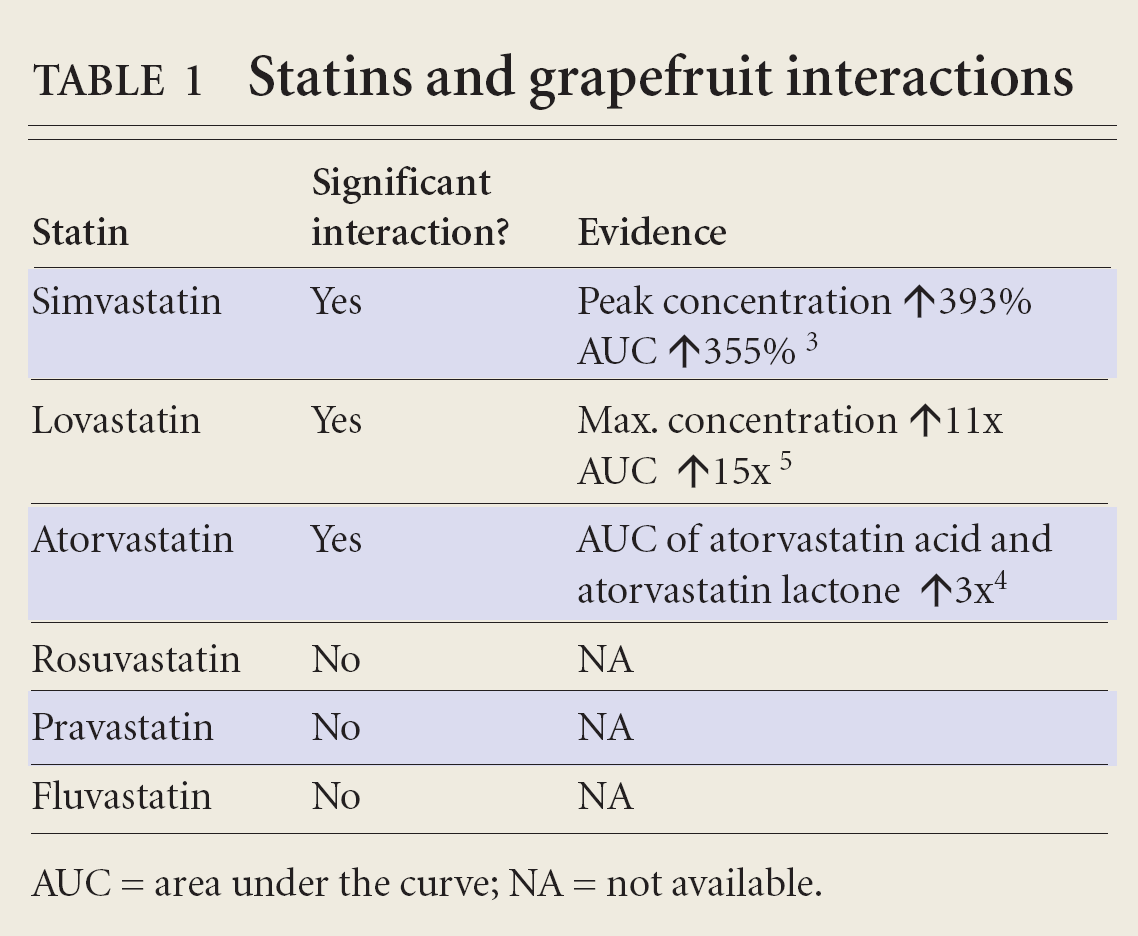
AUC = area under the curve; NA = not available.
The exact extent of interaction and clinical consequence is not predictable for individual patients. Patients with less cytochrome P450 3A4 isoenzymes than others may be at a higher risk of experiencing an adverse effect. It seems a single glass (250 mL) of grapefruit juice is enough to give the maximum effect. 1 Grapefruit juice interacts with medications for up to 3 days. 1 An interval of 24 hours before starting an interacting medication can usually prevent a clinically relevant interaction. 1
It is important to notify patients taking atorvastatin, lovastatin or simvastatin of the significance of avoiding grapefruit and grapefruit juice. Orange juice may be suggested instead. Lower medication doses should not be recommended because of the unpredictability of interactions with individual patients. Patients should be made aware of the increased risk of adverse effects such as myopathy, or in extreme and rare cases, rhabdomyolysis, if grapefruit or grapefruit juice is ingested while one is being treated with an interacting statin. If a patient cannot or will not avoid grapefruit or grapefruit juice, suggest switching to rosuvastatin, pravastatin or fluvastatin.
It is also important to remember that atorvastatin, lovastatin and simvastatin have the potential for more interactions, as they are metabolized by cytochrome P450 3A4. There are many inhibitors (such as erythromycin and itraconazole) and inducers (such as St. John's wort) of 3A4. Patients on these medications should be carefully screened for potential interactions. If the duration of the interacting medication will be short, then holding the statin for the duration of therapy of the interacting medication may be suggested. If therapy duration will be long, consider recommending an alternate statin with decreased interaction potential.