






Abstract
Background:
Plan B recently became a schedule III product in Canada. Patients can now access Plan B without a pharmacist consult and may rely only on the packaging information provided to learn about the medication. It is recommended that health information materials directed at patients be written at or below a grade 8 level. We assessed the reading grade level of the Plan B packaging information and of patient information materials on Plan B and emergency contraception.
Methods:
Plan B packaging information was obtained from the manufacturer, and a convenience sample of 10 patient information materials on Plan B and emergency contraception were collected from pharmacies and clinics in Edmonton, Alberta, and from Canadian websites. The Fry graph and SMOG formula were used to measure readability of the materials.
Results:
The Plan B packaging information had a mean reading grade level of 12.8. The mean reading grade level of patient information materials was 12.9 for print materials and 13.4 for online materials.
Conclusions:
Plan B packaging information and patient information materials relating to Plan B and emergency contraception are written at reading grade levels beyond the recommendations for patient health literature.
Introduction
Emergency contraception (EC) is any method of contraception used after intercourse and before implantation of a fertilized egg. 1 Plan B (levonorgestrel) was first introduced to Canada in 2000 as a prescription medication, and is the only product indicated for emergency contraception by Health Canada. In 2005, Plan B was changed from a prescription medication to a nonprescription product with behind-the-counter status (schedule II), and subsequently moved to over-the-counter (OTC) or schedule III status in May 2008. Plan B was also reformatted from requiring 2 separate doses 12 hours apart, to 2 tablets taken at once. This method has been found to be equally effective to taking 2 separate doses and is meant to improve convenience for patients. 2 Additionally, the packaging for Plan B was changed to a larger box size with patient information readily available on the outer box, for display on pharmacy shelves. As with other schedule III medications, a woman is no longer required to consult with a pharmacist before taking EC, relying only on the instructions on the outer box and the package insert provided inside the box.
Written materials for OTC products should be clear and easily understandable, as this is often the only source of information patients consult when using a product. For example, reports of overdose from parents incorrectly measuring a dose from over-the-counter pediatric cough and cold medications led to the recent relabeling of pediatric cough and cold medications in Canada to avoid use in children under 6. 3 “Health literacy” refers to the ability to obtain, understand and use health information to maintain one's health and make appropriate health decisions. 4 Many studies have documented an association between literacy, level of education and level of health. 4 Health literacy requires not only reading skills, but other complex skills such as listening, understanding, communicating and decision-making. 5 Health literacy skills are important for patients to correctly interpret the instructions of OTC medications. To ensure proper use of the product, the instructions must be well written and easy to understand.
The Canadian Public Health Association (CPHA) recommends that information for the public be written at a grade 8 level. 6 Patient information handouts, prescription labels and over-the-counter medication information should be written in plain language to prevent misunderstandings. Often this is not the case. Studies examining the readability of patient health information materials have found that the reading grade level is frequently much higher than the grade 8 level that the CPHA recommends. 7 –10 Two studies from the United States (US) reported that prescription drug labels and auxiliary warning labels were easily misunderstood by patients with low literacy levels (defined as reading at or below a grade 6 level). 11,12 In Canada, an estimated 60% of people aged 16 and older have health literacy skills below Level 3, the minimum level of proficiency to meet the demands of modern life. 5 In other words, only 2 out of 5 Canadian adults have adequate health literacy.
For prescription medications and behind-the-counter products, pharmacists play an important role in ensuring that patients understand what their medication is for, how to take it and how to manage side effects. In the case of OTC products, which patients can self-select without consulting a pharmacist, it is even more important that instructions be clear. A small study conducted in the US in 2004 found that readability of EC packaging, which was prescription-only at the time, ranged from grades 10 to 12. 9 To our knowledge, no similar study has been published in Canada. The purpose of this study was to evaluate the readability level of the package information on Plan B, as well as provide an evaluation of the readability levels of patient information materials on Plan B and emergency contraception.
Methods
We reviewed the readability of Plan B packaging information (this includes the instructions on the outer box and the enclosed patient information insert, also referred to as the consumer product monograph) and a convenience sampling of 10 patient information materials (both print and online) on Plan B or emergency contraception. Plan B packaging information was obtained from the manufacturer, Paladin Labs Inc. Patient information sheets were obtained from community pharmacies, a campus health clinic providing services to students and a birth control clinic in Edmonton, Alberta. Community pharmacies were stratified by type (mass merchandiser, grocery store, chain, etc.), and both pharmacies and clinics were approached by the pharmacy student for a sample of available written information sheets. We obtained information posted on the Internet from websites of Canadian organizations and health provider associations such as the Public Health Agency of Canada, the Canadian Federation for Sexual Health (formerly Planned Parenthood Federation of Canada) and the Canadian Paediatric Society. Only English language materials were included.
Knowledge into practice
Due to their knowledge and accessibility, pharmacists are still in an ideal position to provide information to patients on emergency contraception, even after its change to a schedule III product.
The Canadian Public Health Association (CPHA) recommends that patient health literature be written at or below a grade 8 reading level.
We found that the Plan B box information and enclosed consumer monograph have a mean reading grade level of 12.8, much higher than CPHA recommendations.
Pharmacies and health organizations should follow CPHA guidelines on plain language whenever possible when developing patient information materials.
Data analysis
All materials were analyzed using the Fry readability graph and the SMOG readability formula. There are many methods of measuring readability, however, these 2 methods have been recommended for evaluating health-related literature. 13 –15 Readability measurements provide an indication of a material's readability based on characteristics such as word length, number of syllables and sentence length. As per the Fry analysis, we took 3 sample sections of 100 words from each text; the number of sentences in each section to the nearest one-tenth and the number of syllables in each section were counted. 16 The average sentence length and number of syllables were plotted on the Fry graph to approximate a reading grade level. As per the SMOG readability formula, we used the number of words in 30 sentences of analyzed text that contain 3 or more syllables to determine a reading grade level. 17 For both methods, long sentences with a semi-colon were considered as 2 sentences and abbreviations were read through as if unabbreviated (e.g., STI is read as “sexually transmitted infection” and contains 10 syllables or 3 polysyllabic words). 16,17 For materials containing less than 30 sentences, the entire text was analyzed and a modified SMOG formula was used to assess the grade level. 17 The SMOG test has a correlation of 0.985 and a standard error of 1.5 grades. 17 Standard error for the Fry graph is unknown but has been suggested at 0.4 grades. 18 Mean values reported in the results were calculated by averaging the results of both readability formulas for each category, and all values were recorded to 3 significant digits.
Results
We collected 14 materials in total. After excluding 2 duplicate patient information materials, 12 materials remained for analysis. The breakdown of materials collected and analyzed is described in Table 1.
Summary information for all materials assessed
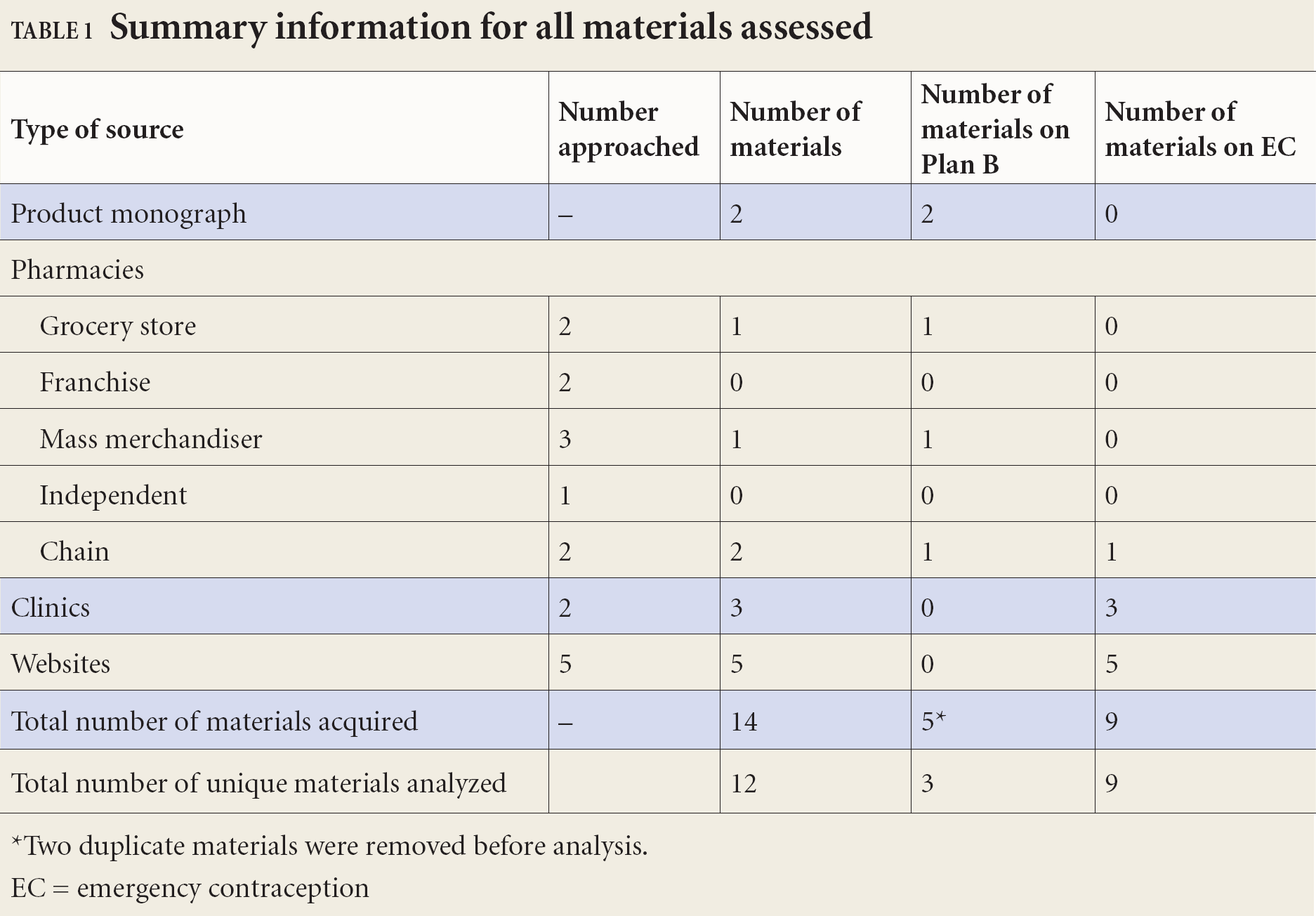
Two duplicate materials were removed before analysis.
EC = emergency contraception
Plan B product monograph
Two materials from the Plan B packaging were collected and analyzed: the outside of the box and the enclosed patient monograph. The information on the Plan B box had a reading grade level of 12.5, while the patient monograph had a reading grade level of 13.0.
Patient information material
Ten unique patient information materials were analyzed. Reading levels for both online and print patient information sheets ranged from grade 10 to grade 17. The mean reading grade level for patient information materials specific to Plan B was 13.0 and the mean reading grade level for patient information material on EC was similar, at 13.1(Figure 1). Print materials were written at a slightly lower reading level than online materials (12.9 and 13.4).
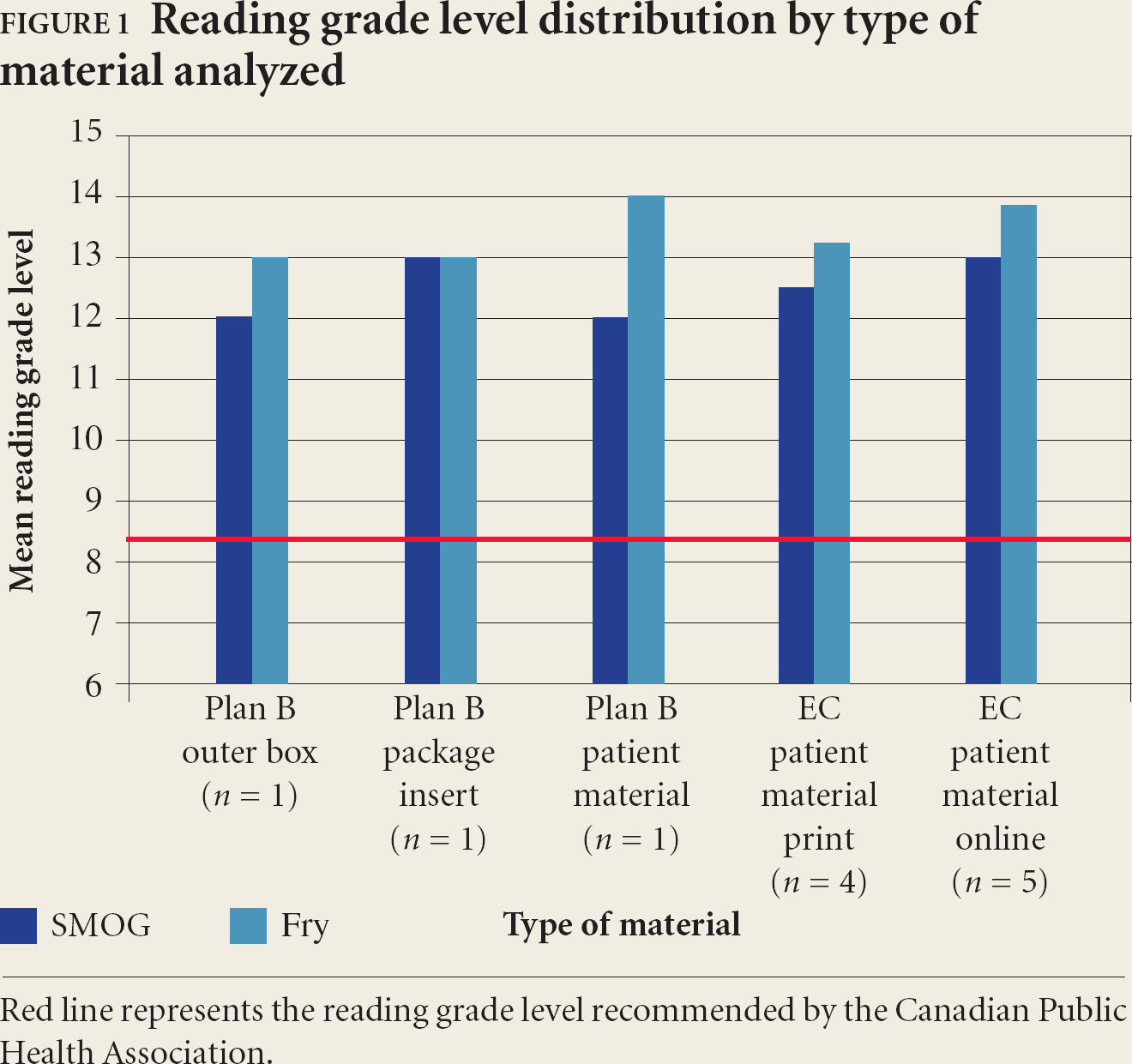
Reading grade level distribution by type of material analyzed
Discussion
Reading grade levels of the Plan B package information and patient monograph were found to be higher than the grade 8 level recommended by the Canadian Public Health Association. Our results show that women wishing to use Plan B would need to read at a grade 13 reading level or higher in order to read and understand the instructions. Patient information materials for both Plan B and EC were also consistently found to be written at a high grade level, with a mean of 13.1.
Our results were similar to a study by El-Ibiary et al. that assessed the readability of instructions for condoms, spermicides and EC. 9 Two different brands of EC available as prescription in the US at the time of the study were evaluated and the mean EC reading level was between grade 10 and 12. 9 Interestingly, our findings show that the reading level needed to understand Plan B packaging remains high, even now that it is an OTC product in Canada. This is of concern, as many patients may rely only on the packaging for information about Plan B.
In the literature, reading grade levels for OTC packaging instructions and for written patient information material in general have been reported to be high. 7 –10,19 –21 Helitzer et al. reviewed written material on cervical cancer prevention and found that the overall reading grade level of the materials ranged from grades 2 to 17+, with an average of 11. 7 A study assessing end-of-life patient education materials reported that all materials reviewed were written above a grade 6 reading level and almost one-third of materials were at a college/university grade level. 8 Our study found that the mean reading grade level for online materials was higher than print-based materials, which is consistent with other studies that have looked at the readability of Internet-based health information. 22 –25
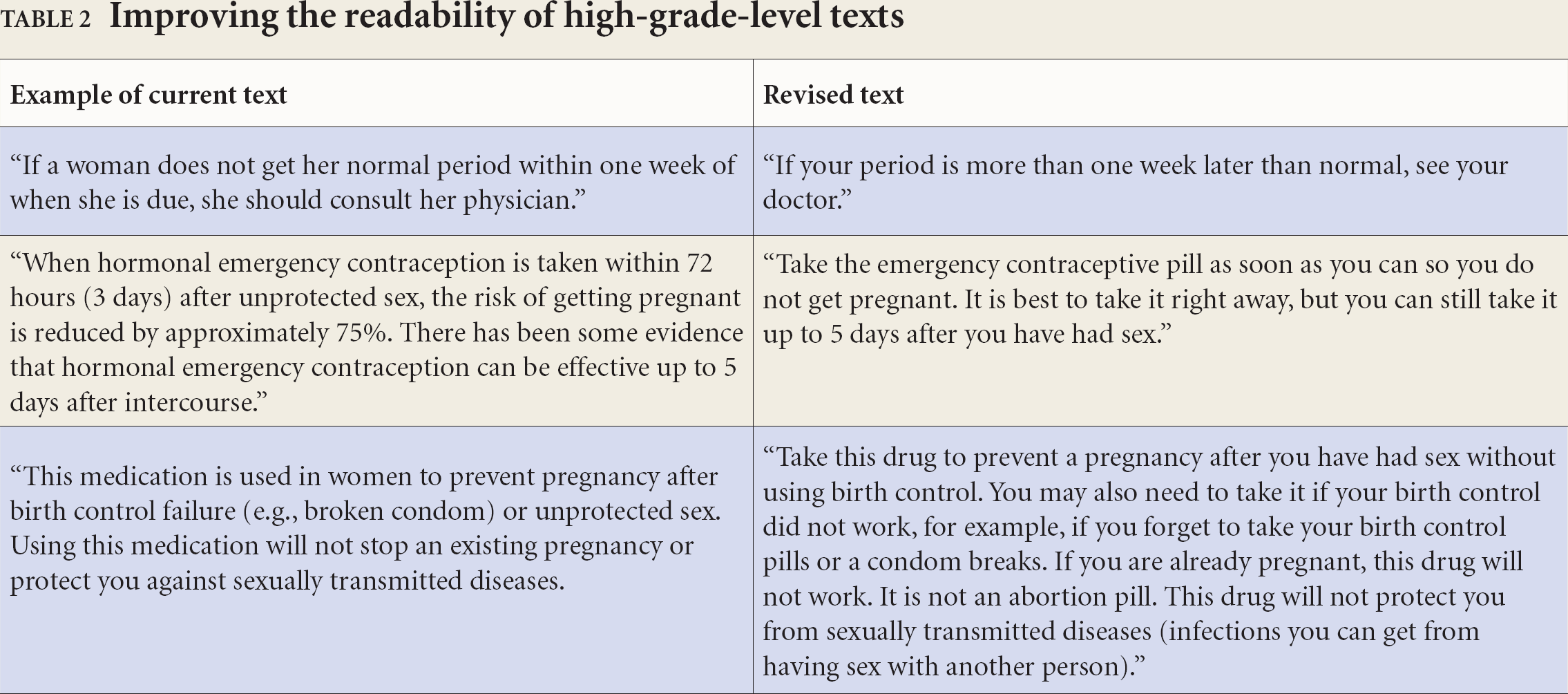
The use of medical terminology, such as “emergency contraception,” “luteal phase length” and “progestin hormone” results in higher reading grade levels in the materials; many of the materials did not use plain language to explain complex concepts. Materials could be written to improve readability by using an active voice, using common words and short sentences and giving examples to explain unfamiliar concepts. 25,26 Selected passages with higher reading grade levels and suggested revisions for improved readability are listed in Table 2. Ideally, packaging information and patient information materials should be revised to be written at a lower reading grade level to meet the Canadian Public Health Association guidelines and to aid patients in using emergency contraception correctly.
Improving the readability of high-grade-level texts
Limitations in this study include the small sample size of patient information materials, and using an analysis that approximates reading grade level only. The reading grade level tests used do not take into account the effect that visuals or design of the materials may have on comprehension. Our study looked at only one aspect of health literacy, readability, but did not address other aspects, such as comprehension. Studies that have looked at comprehension of EC material have shown that women do understand the instructions, indications and side effects. 27,28 More than 85% of the women in a study by Raymond et al. understood 7 of 11 communication objectives after they were given a prototype of EC packaging to read and then asked questions addressing indications, contraindications, instructions and side effects. 27 Literacy levels of the women surveyed ranged from less than 6th grade to college or higher. Cremer et al. surveyed female adolescents in a similar study and found that after reading an EC package insert, high percentages of girls knew that EC should be taken within 72 hours (83%), can be used as a way to prevent pregnancy after unprotected sex (92%) and will not protect from HIV/AIDS (95%). 28 In these studies, design and layout elements, such as use of graphics, bulleted point form or highlighting of important information, may have improved the comprehension of materials with a high reading grade. 29 –31 Testing of patient comprehension of Plan B's packaging information as an OTC product in Canada and of other information materials directed at patients may be a worthwhile area for further study.
La connaissance en pratique
Grâce à leurs connaissances et à leur accessibilité, les pharmaciens se trouvent toujours dans une position idéale pour fournir des renseignements auxpatientes sur les contraceptifs d'urgence, même si ceux-ci figurent maintenant à l'Annexe III.
L'Association canadienne de santé publique (ACSP) recommande de rédiger la documentation pour les patients en fonction d'un niveau de lecture de 1èr secondaire.
Nous avons constaté que les renseignements sur la boîte de Plan B et la monographie à l'intention du consommateur qui l'accompagne correspondent à un niveau moyen de lecture de fin du secondaire, nettement au-dessus des recommandations de l'ACSP.
Les pharmacies et les organismes de santé devraient se conformer, dans la mesure du possible, aux lignes directrices de l'ACSP sur l'utilisation d'un langage clair et simple dans la documentation destinée aux patients.
Conclusion
Our analysis found that current Canadian patient information materials on Plan B and EC are written at reading grade levels higher than the recommended grade 8. Based on our findings, women would need to read at least at college level (grade 13 or higher) to understand the information provided with Plan B, as well as other pharmacy- and clinic-provided materials on emergency contraception. These findings are important, as they indicate a need for pharmacists to continue educating patients on emergency contraception despite Plan B now being an OTC product. Our results also suggest that Plan B packaging information and patient information materials should be rewritten at a lower reading grade level.