






Abstract
Background:
A prior learning assessment (PLA) is a summative statement of an individual's learning acquired through education and experience. We developed PLA surveys for 3 groups of pharmacy staff: experienced pharmacists with supervisory or clinical roles; pharmacists entering a pharmacy practice residency program; and experienced pharmacy technicians.
Methods:
Each PLA survey was developed based on a literature review and desirable learning outcomes for a regional pharmacy program. PLAs consisted of numerous potential learning needs, including possible job roles, competencies, essential skills and areas of practice expertise in 11 domains. Pharmacy staff scored past exposure, perceived ability (prior experience) and interest for each potential learning need. Learning needs were calculated as interest score minus ability score.
Results:
23 of 38 (61%) experienced pharmacists, all 24 (100%) pharmacy residents and all 17 (100%) pharmacy technicians invited to complete the PLA responded. For each of the 11 domains, Cronbachs alpha scores were greater than 0.69. For experienced pharmacists, the highest learning needs occurred in technical domains (drug distribution and computer/informatics), with low needs in practice management and patient care. For pharmacy residents, the highest learning needs occurred in patient care domains. Pharmacy technician learning needs were greatest in human resources and drug distribution.
Conclusion:
We developed PLA surveys for experienced pharmacists, pharmacy residents and pharmacy technicians that demonstrate internal consistency reliability. Regulatory bodies, education providers, employers, managers and individual pharmacy personnel can use PLA to identify learning needs either prior to a practice change or as part of continuing professional development planning.
Background
Prior learning assessment (PLA) is a summative statement of an individual's learning that has been acquired through education and experience. By contrast, PLA recognition is a systematic process by which prior learning is assessed and then recognized by granting credit towards requirements for an academic or professional certification or for entry into the labour market. 1 PLA goals include documenting the point from which to measure progress in acquiring or refining competencies; guiding self-reflection about one's entering level of knowledge, skills or attitudes; and encouraging self-identification of learning needs and personal learning goals. 2 PLA minimizes learning duplication; identifies areas requiring further study or training; promotes understanding of personal strengths and likes; establishes a professional development baseline; and can serve to prepare learners for workplace transition. 2
PLA can take many forms, including learning portfolio assessment, oral or written examination, or self-assessment survey by direct observation and evaluation. 3 Underlying assumptions of PLA are that learning occurs across the lifespan, in various contexts (formal, informal); learning obtained in formal educational settings is not necessarily better than learning from informal settings; and learning gained in informal contexts should be recognized. 3 Using PLA as a tool to help learners identify learning needs and outcomes through reflection on their own experience incorporates basic principles of adult education theory — learning is self-directed, teachers are facilitators, a learning agenda is negotiated with learners and reflection is critical for learning. 2,4 –6
There is a paucity of literature describing the use of PLA as a tool for continuing professional development (CPD); most existing studies focus on PLA as a mean of credentialling. 2,7 In pharmacy, PLA has been used to determine equivalent credit for courses in the setting of pharmacy education 8 and develop curricula and individualized learning plans for pharmacy students and foreign-trained pharmacists seeking Canadian licensure. 9 –11 Some regulatory authorities and pharmacy CPD bodies have used PLA in the context of program development, but these are generally knowledge-based 12,13 and not broadly inclusive of the array of skills and abilities that individuals may identify as learning needs in a professional workplace.
Knowledge into practice
Prior learning assessment (PLA) is a summative statement of learning acquired through education and experience, but it has had minimal application in pharmacy practice.
This study describes the development of PLA tools to identify learning needs among experienced pharmacists with supervisory or clinical roles; pharmacists entering a pharmacy practice residency program; and experienced pharmacy technicians.
Regulatory bodies, education providers, employers, managers and individual pharmacy personnel can use PLA to identify learning needs prior to a practice change, or as part of continuing professional development.
The modern workplace is an appropriate venue for PLA to support worker learning, training and CPD. 2,7,14 Pharmacists and technicians must employ a broad range of knowledge, skills and attitudes to ensure the safe and effective use of medications. Essential skills for pharmacy technicians include working harmoniously with others, numeracy, critical thinking and problem-solving skills. Other essential skills for pharmacy technicians and pharmacists include reading text, document use, written and oral communication (including English and sociocommunicative competency skills), computer skills and continuous learning. 9,15 We describe the development and use of workplace PLA surveys over a 10-year period in 3 separate contexts: experienced pharmacists with supervisory and/or advanced practice clinical roles; pharmacists entering a pharmacy practice residency program; and experienced pharmacy technicians. These PLA surveys are used to identify individual and group learning needs for workplace development, education and training in the Winnipeg Regional Health Authority Regional Pharmacy Program (WRHARPP).
Mise en pratique des connaissances
La reconnaissance des acquis est un résumé des enseignements acquis par l'intermédiaire des études et de l'expérience, mais son application était très réduite pour la pratique pharmaceutique.
Cette étude décrit la mise au point d'outils de reconnaissance des acquis afin de déterminer les besoins en matière d'apprentissage de pharmaciens expérimentés occupant des rôles de supervision ou cliniques, de pharmaciens qui entrent dans un programme de résidence en pratique pharmaceutique et les techniciens en pharmacie expérimentés.
La reconnaissance des acquis peut être utile aux organismes de réglementation, aux fournisseurs de services d'éducation, aux employeurs, aux gestionnaires et aux membres du personnel des pharmacies afin de déterminer les besoins en matière d'apprentissage avant un changement de pratique, ou bien dans le cadre du perfectionnement professionnel continu.
Methods
The Winnipeg Regional Health Authority (WRHA) is a publicly funded organization in Winnipeg, Manitoba, Canada (population catchment areas 800,000) that delivers and manages acute, long-term and community health services. Pharmacy personnel in the WRHARPP (150 and 200 full-time equivalent unionized pharmacists and technicians, respectively) deliver and manage pharmacy services throughout 8 hospitals with a total of approximately 2000 beds. The WRHARPP develops and provides education for pharmacy personnel, including workplace CPD programs, experiential programs for pharmacy and pharmacy technician students and an accredited pharmacy practice residency program.
PLA development
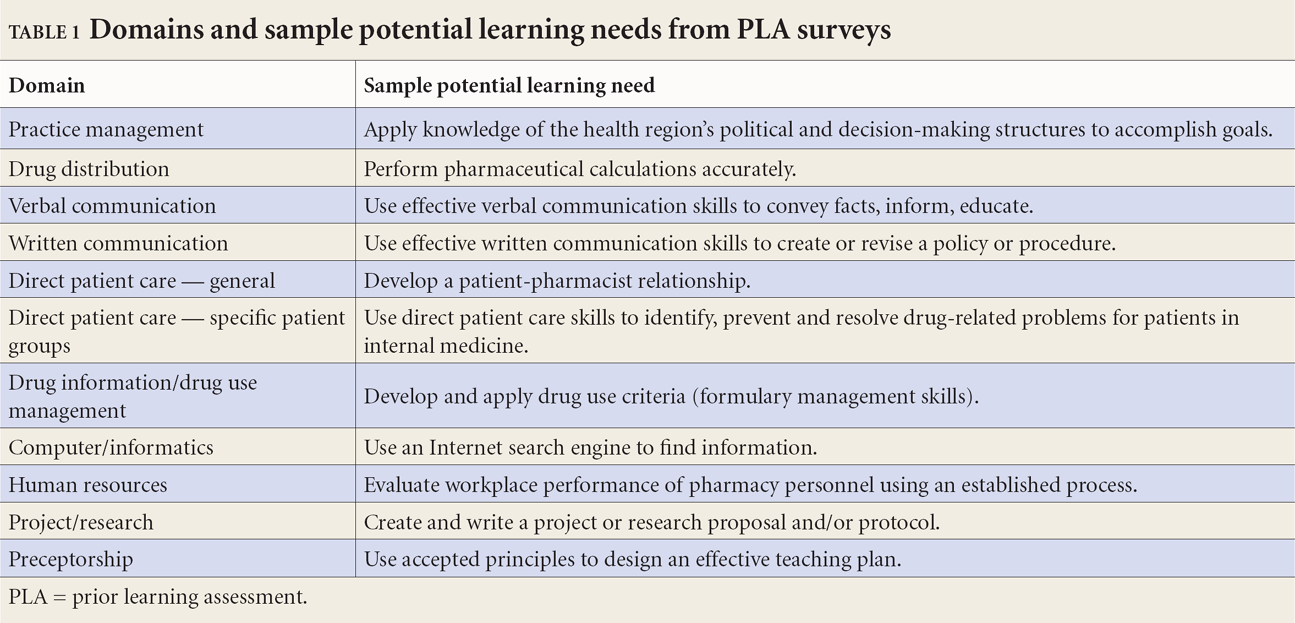
To develop 3 separate PLA surveys, we reviewed the literature (including National Association of Pharmacy Regulatory Authority [NAPRA] competencies 16 ); sampled existing PLA tools (in particular the University of Cincinnati pharmacy residency program [1996], used with permission 17 ) and pharmacist manager competencies 18 ; and clarified our program's desired learning outcomes. Each PLA survey consisted of numerous potential learning needs, including possible job roles, competencies, essential skills and areas of practice expertise in a pharmacy department. However, as a result of the literature review, each PLA had slightly different areas of emphasis depending on the targeted group of pharmacy personnel. For example, the pharmacy technician PLA contained a greater number of potential learning needs related to drug distribution than the experienced pharmacist PLA. Individual survey potential learning needs were grouped into broad domains of practice. Practice domains and sample survey potential learning needs from each practice domain are described in Table 1.
Domains and sample potential learning needs from PLA surveys
PLA = prior learning assessment.
The following individuals were invited to complete the PLA:
Pharmacy residents entering a residency in the WRHARPP from the 2000–2001 to 2009–2010 academic years.
All experienced pharmacists who performed management activities or advanced practice clinical pharmacy services (e.g., post-baccalaureate Doctor of Pharmacy) and who were employed by the WRHARPP in 2008.
All pharmacy technicians employed at the WRHARPP for a minimum of 5 years and who entered a technician supervisory skills course offered by the WRHA in 2008. 19
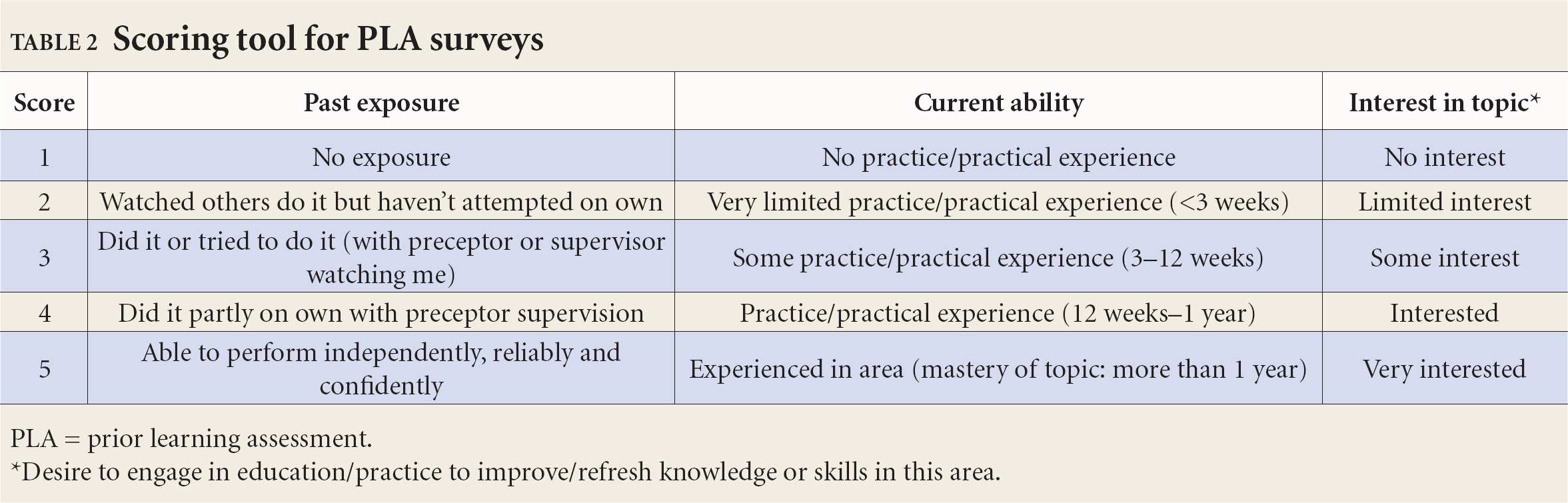
Individuals were asked to score each statement according to past exposure, current ability and interest in the topic, according to the scale outlined in Table 2. For each potential learning need, an individual felt needs score was calculated (felt needs score = interest — current ability). Since each scale ranged from 1 through 5, a positive score (high interest, low ability) would indicate a felt learning need, and a negative score (low interest, high ability) would indicate that the individual did not identify a learning need. Within each domain of practice, a Cronbach's alpha score was calculated for each group of respondents to determine internal consistency reliability, or how the survey items (potential learning needs) within the domain varied together. 20 All analyses were conducted using SAS version 9.0 (SAS Institute Inc., Cary, North Carolina).
Scoring tool for PLA surveys
PLA = prior learning assessment.
Desire to engage in education/practice to improve/refresh knowledge or skills in this area.
Results
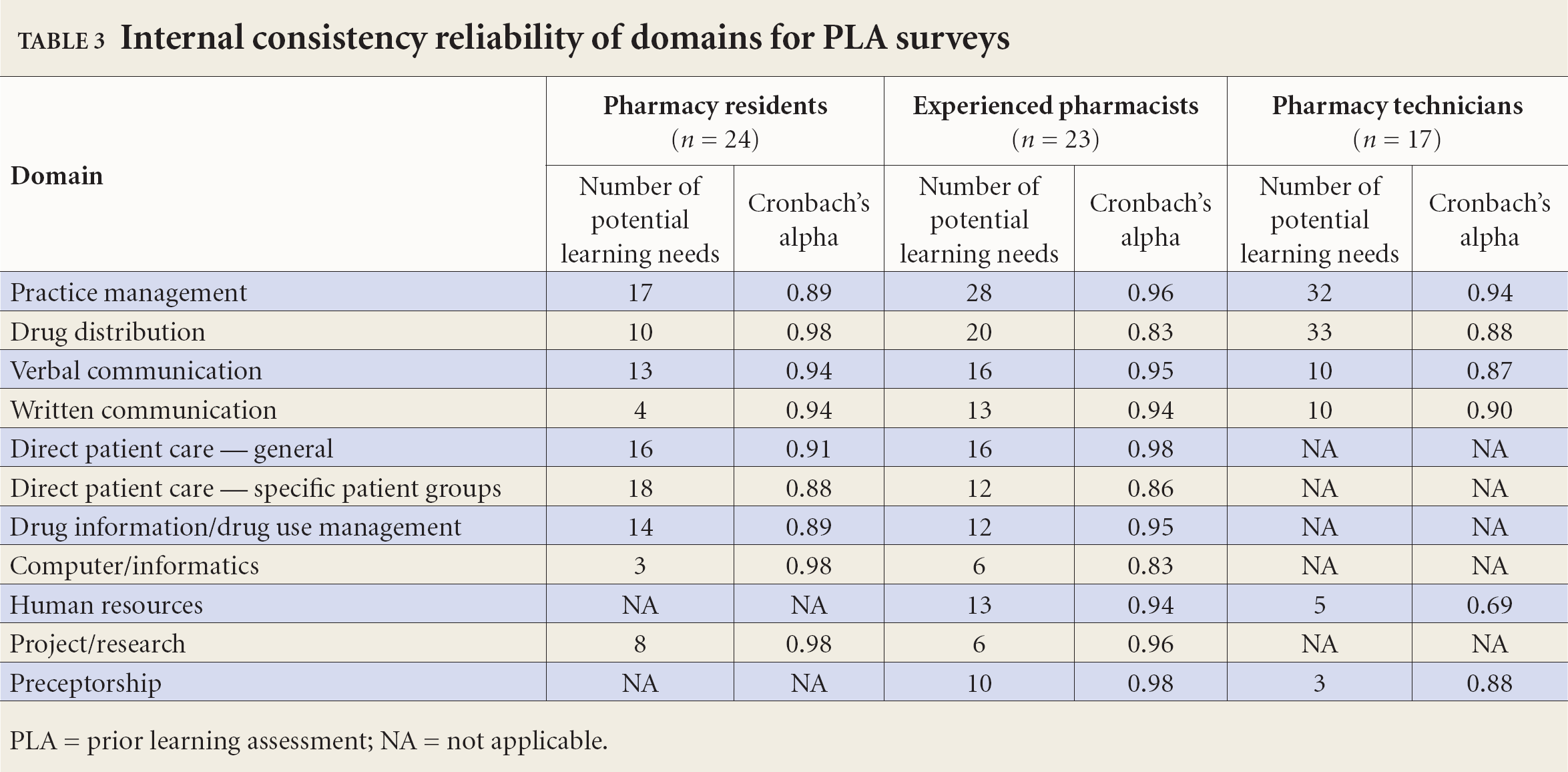
For entry-to-practice pharmacy residents, a 103-item survey of potential learning needs was created. Similarly, surveys were created for experienced pharmacists (152 potential learning needs) and pharmacy technicians (93 potential learning needs). All 24 (100%) of the pharmacy residents, 23 of 38 (61%) experienced pharmacists and all 17 (100%) pharmacy technicians returned the surveys. Survey domains and Cronbach's alpha scores for each group are presented in Table 3.
Internal consistency reliability of domains for PLA surveys
PLA = prior learning assessment; NA = not applicable.
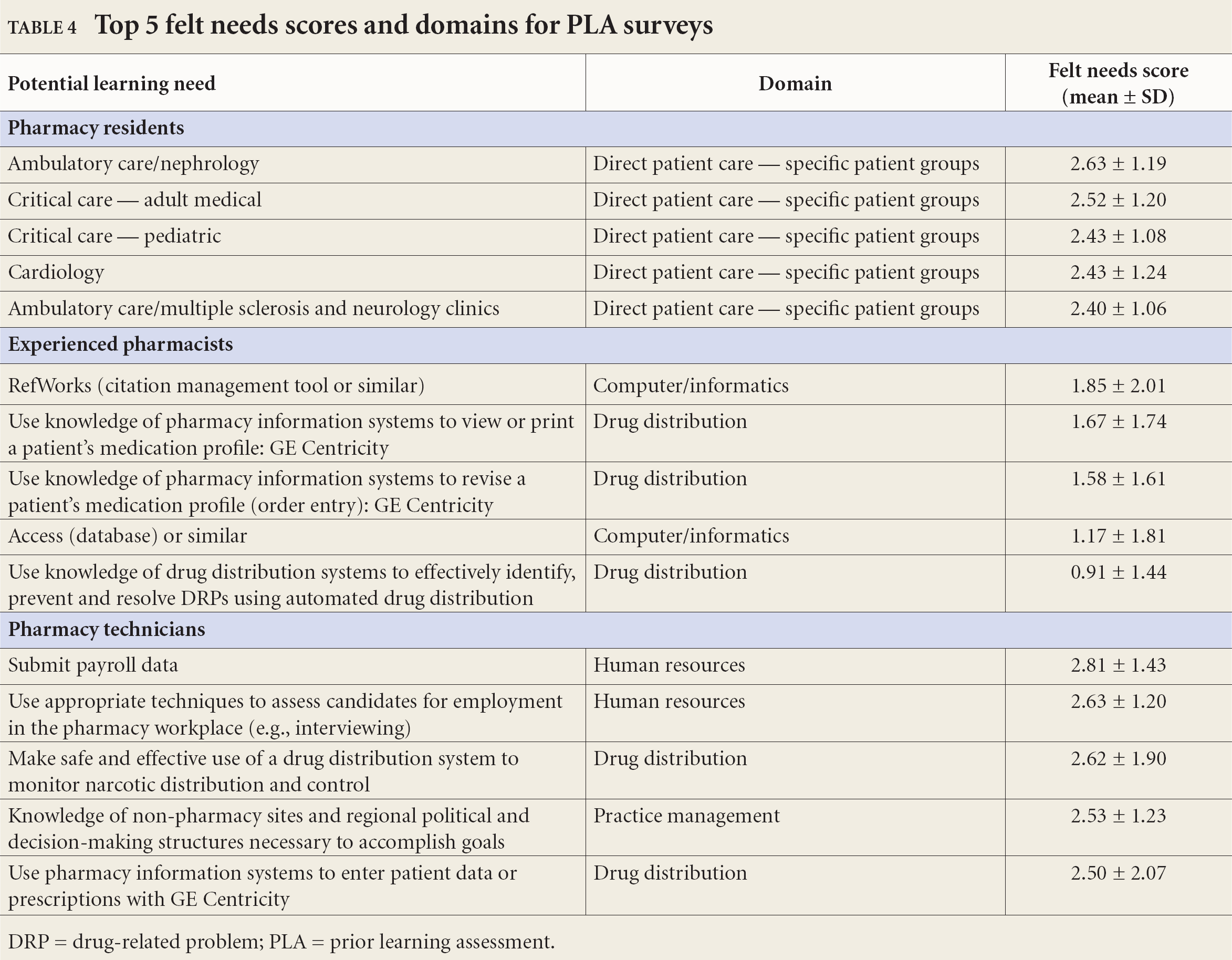
The top 5 felt needs scores for each group of respondents are presented in Table 4. For pharmacy residents, the highest learning needs occurred in the specific patient care domain. For experienced pharmacists, the highest learning needs occurred in technical domains (drug distribution and computer/informatics), with low learning needs across areas of practice management and patient care. Pharmacy technician learning needs were greatest in human resources and some aspects of drug distribution.
Top 5 felt needs scores and domains for PLA surveys
DRP = drug-related problem; PLA = prior learning assessment.
Discussion
We describe the development and utilization of PLA surveys in the context of workplace development, education and training for pharmacy managers and clinical pharmacists, pharmacy residents and experienced pharmacy technicians. Compared to more in-depth PLA portfolio assessments, 7 our methodology is relatively easy to conduct in a pharmacy workplace and has broad application for identifying individual and group learning needs. As would be expected, the learning needs of experienced pharmacy managers and clinical pharmacists differed from those of pharmacy residents, possibly reflecting a shift in career focus over time. It is likely that the upcoming adoption of new technologies in the WRHARPP (such as new automated narcotic distribution and control systems or a new pharmacy information system) influenced several of the top learning needs for experienced pharmacists and technicians.
In the WRHARPP, PLA has provided independent personal assessment for change or learning and served as the basis of training for new managers. We have also used PLA to develop training plans for experienced pharmacy personnel with new roles (e.g., new positions in a new organizational structure). The use of PLA ensures that training plans are adjusted to emphasize improving existing performance and developing new competencies. This ensures that valuable workplace learning time will be spent in areas that match individual learning needs.
We have employed aggregate PLA results to design regional pharmacy educational programs for pharmacists and technicians. In the WRHARPP residency program, for example, individual and aggregate PLA data have prompted the development of new electives; improved the matching of residents to projects and practice sites; encouraged residents to register for additional courses where required (e.g., conflict resolution, Access database); improved scheduling of learning experiences; and enhanced career counselling and mentorship. 21 The residency PLA also identified learning needs for pharmacy residents, and this served as the basis for a new staff orientation program. 22 As well, we have used technician PLA to identify individual and group learning needs as part of a technician supervisory skills training course, 19 and part of the detailed technician PLA to identify individual and group learning needs prior to the implementation of a specific validation program for aseptic technique. 23 Common learning needs identified for pharmacists and technicians across the WRHARPP (e.g., potential learning needs related to working within teams) have prompted educational resources to be directed towards this issue.
In a broader context, PLA could be employed across groups of pharmacy employees to identify areas for skills development before, during and after periods of practice transition to enhance CPD. As Canadian pharmacy technicians move toward regulation, licensure and management of drug distribution systems, 24 PLA could be used to help identify learning needs. For example, it is possible that not all pharmacy technicians enter the workforce with all of the knowledge, skills or abilities listed in the “practice management” domain of our technician PLA. 15 An important potential learning need in the practice management domain, “knowledge of nonpharmacy site and regional political and decision-making structures necessary to accomplish goals” was among the top 5 learning needs for pharmacy technicians in this study. Pharmacists could employ PLA prior to practice change, such as upon starting a new position or engaging in newer clinical practice roles, such as collaborative practice, pharmacist prescribing or medication management.
CPD is an important aspect of the pharmacy profession, and PLA can provide individuals with an organized process to reflect on their career development and help them to define career and personal development goals. 2 Pharmacy personnel can employ PLA to reflect on learning and self-direction, gain confidence in knowledge and abilities, discover new areas of professional interest and (either independently or with mentor support) set goals for action that contribute to lifelong learning. 2,7
Nevertheless, both the current analysis and the broad application of PLA across the pharmacy profession are subject to several limitations. First, PLA surveys are long, and there is a potential for survey fatigue. 25 However, each PLA typically took 30 to 40 minutes to complete and an important component of the PLA is reflection, so it is assumed that the time commitment was beneficial to learners. Second, relatively few individuals participated in our PLA surveys. For the experienced pharmacist PLA, there was a potential for selection bias, where respondents were different from nonrespondents. However, the survey response rate of 61% suggests generalizability Across all 3 surveys, we obtained generally high Cronbach's alpha scores. The majority of results among each of the 3 groups of respondents and domains was greater than a commonly accepted value of 0.7, 20 suggesting that each domain demonstrated internal consistency reliability. Third, our technician sample was limited to individuals practising as technicians for a minimum of 5 years who were admitted to a course, potentially limiting the generalizability to new technicians; however, the potential learning needs were derived from the NAPRA technician competencies, which would be expected of newly employed pharmacy technicians. Similarly, the pharmacy resident sample was limited to those participating in a hospital pharmacy practice residency, thus potentially limiting the generalizability to all new pharmacy graduates. Fourth, survey data were self-reported, and individuals might not rate their learning needs as an employer would. Studies have demonstrated a low correlation between self-report measures and actual performance and achievement 26 –29 ; however, those studies were largely related to students, not experienced employees. Fifth, some of the survey domains demonstrated a very high Cronbach's alpha, suggesting that respondents identified potential learning needs within these domains very similarly, and that some of the potential learning needs may be redundant. Within each domain of practice (e.g., drug distribution) there were similar potential learning needs (e.g., use pharmacy information systems to look up a patient profile and use pharmacy information systems to modify a patient profile); however, based on the literature review, published competencies and different areas of practice within a regional pharmacy program, we felt that they were sufficiently different to include all of the potential learning needs. Finally, the use of PLA alone in the absence of verification or provision of evidence to support the learner's self-assessment has been called into question. 30 It is possible that the PLA tool or the learners may not be able to reliably distinguish between experience and learning. 14 As a result, it maybe possible for the person completing the survey to have experienced something without completely understanding the concept, or for the person to be extremely adept at doing something incorrectly and therefore not perceive it as a learning need. Alternately, the individual might not perceive a potential learning need as interesting, despite the fact that the item is a requirement of employment. In the workplace, concerns about faulty self-assessment of knowledge, skills or abilities are addressed by having a preceptor or trainer directly observe and assess the learner, thereby validating or reframing self-reported scores. In our use of PLA for new manager training, we also allowed for experienced supervisors to identify learning needs during the initial training period. Several new managers also chose to repeat the PLA survey 1 year after the initial assessment (data not included in this analysis), resulting in identification of new or evolved learning needs. This demonstrates the utility of the PLA as an individualized tool for personal growth over time.
Conclusion
We have developed PLA surveys for pharmacy residents, experienced practising pharmacists and pharmacy technicians that are easy to administer and demonstrate internal consistency reliability. Regulatory bodies, CPD providers, pharmacy employers, managers and individual pharmacy personnel can use PLA in order to identify learning needs either prior to a practice change, or as part of CPD planning.
Footnotes
This work was funded by the Winnipeg Regional Health Authority.