






Abstract
Osteoporosis and its consequence, fragility fracture, are increasingly common problems, particularly with the aging population. There are a number of effective therapeutic options for treatment, including oral and intravenous bisphosphonates, hormone therapy, selective estrogen receptor modulators, new biological agents such as denosumab, and a recombinant human parathyroid hormone (teriparatide), a bone formation—stimulating therapy.
Patients' lack of adherence (comprising both compliance and persistence) to treatment is an issue for many chronic diseases, including osteoporosis. 1 A recent American retrospective analysis of a pharmacy claims database of more than 64 million members assessed compliance in a number of conditions. The mean 12-month adherence rates for bisphosphonates was 60%, compared to 72% for all antidiabetic medications and 35% for overactive bladder medications. 2 Achieving effective protection from future fractures is more complicated than just a simple prescription. A number of impediments exist, including correct diagnosis, appropriate follow-up after fracture and continuing to take the therapy as prescribed and correctly. Patients who do not receive or adhere to treatment are at risk for future fracture, which carries a significant cost to the patients themselves in terms of quality of life, including morbidity and even mortality with some fractures (e.g., hip fractures). 3 Moreover, nonadherence to treatment recommendations will also increase the utilization of health care resources.
Osteoporosis has often been called “the silent thief” due to the lack of symptoms until a fracture. A low-impact fragility fracture should be a trigger for physicians to investigate further to diagnose and treat osteoporosis. Numerous studies have highlighted a clear diagnostic and treatment care gap for patients with osteoporosis and this has been emphasized by Osteoporosis Canada. 4 The new 2010 guidelines address this care gap problem as well as other diagnostic and therapeutic issues by providing evidence-based recommendations for health care professionals. 5
To decrease the disease burden in individual patients, it is necessary to understand the factors that contribute to treatment effectiveness in clinical practice. Evidence for the efficacy of osteoporosis treatments comes from randomized, placebo-controlled clinical trials, in which compliance and persistence are usually good, as the participants are monitored closely. However, in the real-world clinical practice setting, numerous studies have shown that this level of adherence is unusual. An example of this discrepancy between clinical trial and real world practice is demonstrated in the study by Siris et al., which showed that 57% of those prescribed a bisphosphonate were noncompliant and 80% were nonpersistent within 2 years of initiating therapy. 6 An important message is that patients who took only half their medication over the 2 years did not achieve the fracture-risk reduction expected with these treatments. Indeed, they achieved no better efficacy than if they had never taken any medication.
Improving patient adherence to medication 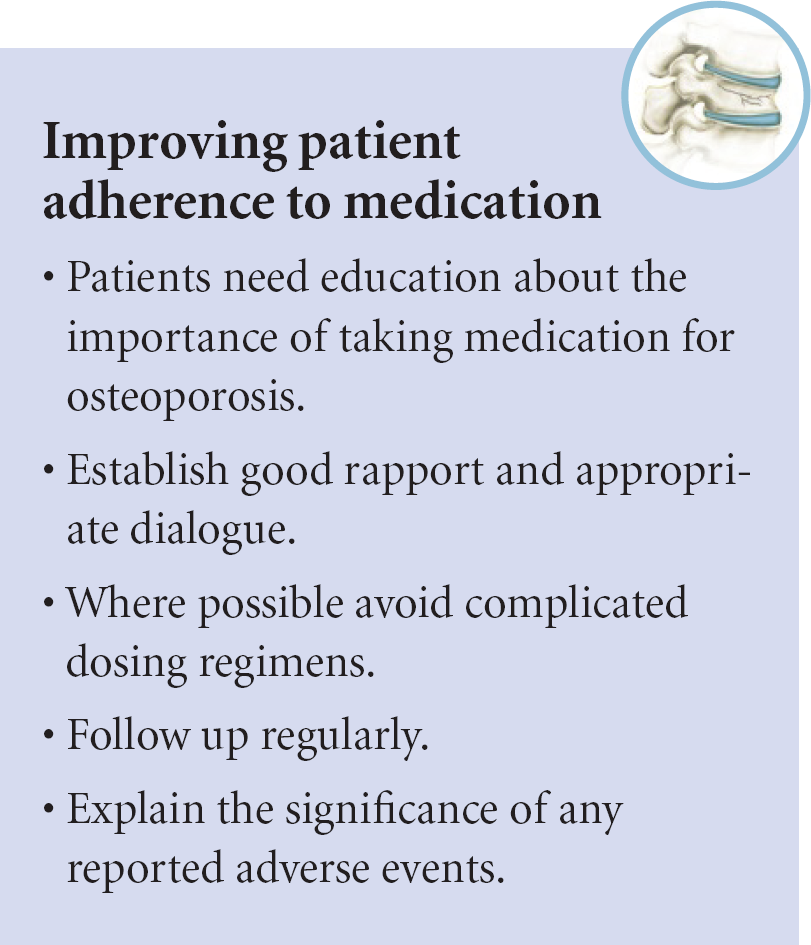
Patients need education about the importance of taking medication for osteoporosis.
Establish good rapport and appropriate dialogue.
Where possible avoid complicated dosing regimens.
Follow up regularly.
Explain the significance of any reported adverse events.
Other factors may affect adherence beyond adverse events, either real or perceived (see tips for adherence). 7 There may also be a disconnect between the perception physicians have about their patient's adherence and what it is in reality. 8
I hope the new guidelines will refocus attention on osteoporosis and its consequences. The new risk assessment recommendations should ensure that patients are appropriately diagnosed and monitored, particularly after a fragility fracture, since they are at high risk for another fracture. Once diagnosed, patients must be persuaded of the importance of continuing treatment. Failure to tackle this issue will have significant consequences for both patients and for our health care system, which will be required to invest additional funds to treat fractures that could have been prevented.