






Abstract

Background
In December 2007, pharmacists within the province of Alberta were granted the privilege of applying for “additional prescriptive authority.” 1 To gain this authority, pharmacists must apply to the Alberta College of Pharmacists (ACP) with a detailed application that encompasses the pharmacist's ongoing professional development, experience, practice environment and ultimately requires the submission of patient care plans. 2 While there are approximately 4263 pharmacists across the province, as of November 2011 only 143 (3.4%) had been granted “additional” prescriptive authority (personal communication, Alberta College of Pharmacists, November 29, 2011). While undergraduate programs can be altered to reflect new requirements for practice, those pharmacists already practising require access to supplemental educational courses that can build on existing skills and facilitate the evolution of their clinical practices. 4 The purpose of this review is to provide an overview of the design and planned evaluation of a multistaged course targeting practising pharmacists, in order to expand their skill set in the management of anticoagulation therapy. While this course addressed one area of therapeutics, the concepts and principles are applicable to all areas of patient care.
Course description
This course combined the clinical expertise of 2 pharmacist leaders in the largest Anticoagulation Management Services (AMSs) in Alberta, namely the AMS at the University of Alberta (Edmonton) (TB) and the Calgary Zone AMS (CB), as well as educators from the Faculty of Pharmacy and Pharmaceutical Sciences, U of A (TS), and was supported by the ACP. The course was the result of the consolidation of earlier, less practical training programs, 4 and consisted of several stages using different methods of delivering education (i.e., didactic, interactive small group activities, experiential learning one-on-one with an expert, ongoing mentorship while back in home practice, and self-directed reflection of learnings). Aspects of this course encompassed a basic print-based course, a 2-day workshop, a 3-day experiential training session and a mentorship phase (Figure 1).
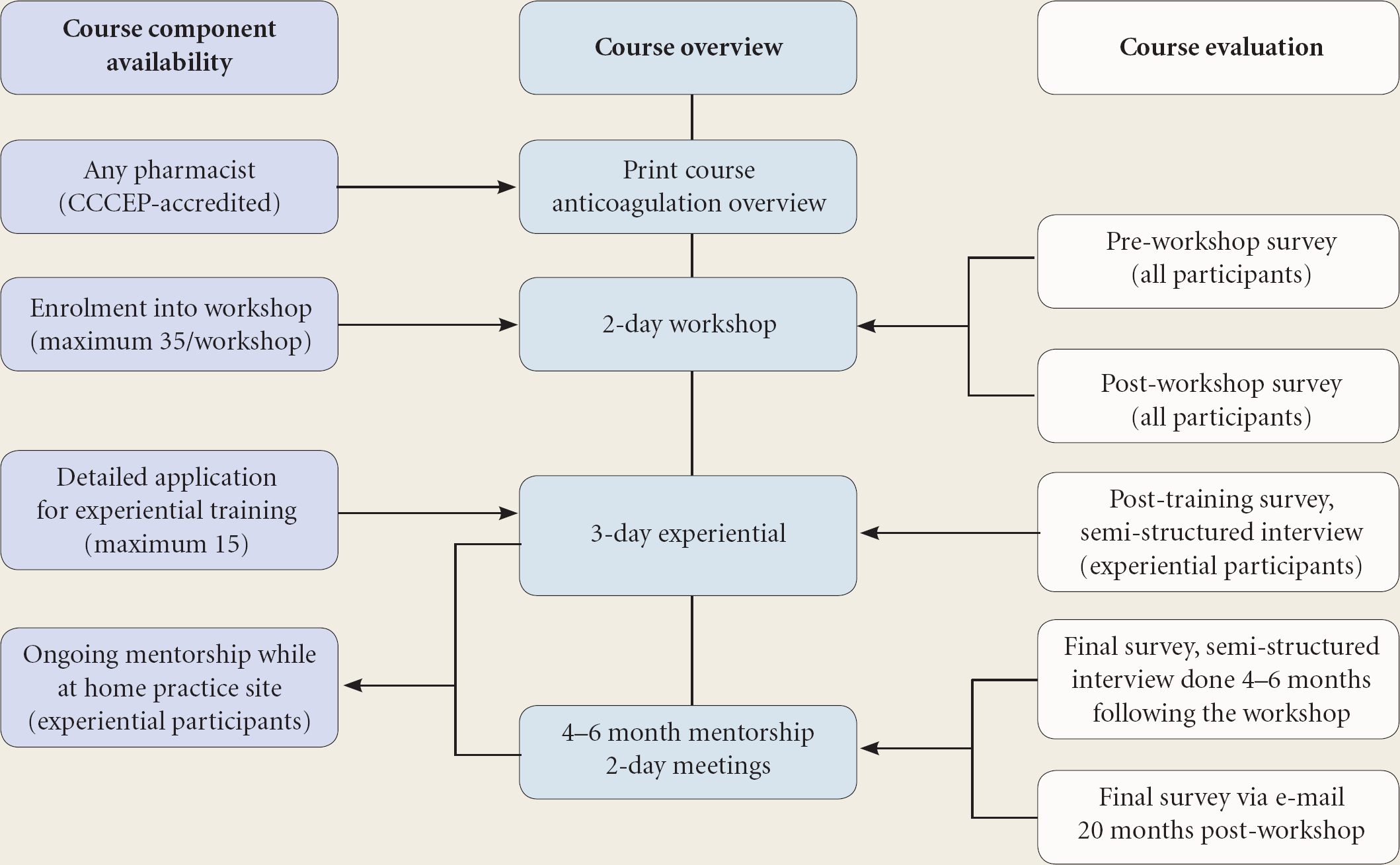
Overview of study design — sequential mixed-methods approach
Print-based course
A print version of PHARMALearn-Anticoagulation provided an introduction to anticoagulation management encompassing antithrombotic therapy, patient assessment, atrial fibrillation and venous thromboembolism. 5 This was also available for continuing education credit (CCCEP-approved) for any pharmacist to purchase and complete. Its content helped pharmacists assist patients based on information they were provided by other health care providers. It was deemed necessary in this course to ensure that all participants had similar baseline knowledge and to allow subsequent course components to build upon the foundation contained in this 6-hour course.
Workshop
The overarching goal of the workshop was to model professional activities and enable participants to understand their role in anticoagulation management. The 2 expert instructors (TB, CB) had either directed or managed AMSs for several years. Over the 2 days, instructors described their practice in anticoagulation through both didactic and narrative techniques. Peer role facilitators supported small group learning at each table of 5 to 6 workshop participants — enrolment was limited to 35 participants per workshop to ensure effective interactions. Facilitators were pharmacist clinicians in AMSs who had previously completed facilitator training. Their role was to moderate discussions at each table and role play as the patient. This enabled all trainees to establish a process for assessment, implementation and ongoing delivery of patient-centred care in a controlled setting.
Experiential training
The experiential phase provided the opportunity for one-on-one coaching with an instructor (TB) in a well-established AMS, with the primary goal being to apply prior learning to the patient being managed within the AMS. This aspect of the course had limited availability (<15 participants), given the resources necessary for individualized preceptorship and the need to assess feasibility for expansion to a larger number of pharmacists. To this end, and in an attempt to augment learning among trainees, pharmacists were paired for the 3 consecutive experiential days at the AMS. In pairing the participants, efforts were made to ensure they had similar practice settings (i.e., either community or hospital-based). Participants were provided with a self-study manual of primary literature to supplement their experience at the AMS. This experience allowed the participants to have a general orientation to the operations of a pharmacist-directed AMS, provided role modelling for proactive direct patient care and introduced a practice model to be modified as needed within the participant's practice setting. 6
Mentorship
A 3- to 5-month mentorship phase provided ongoing access to experts following the training. This component was intended to support trainees as they managed anticoagulation therapy for patients in their own practice. As part of the mentorship phase, 2 day-long meetings were conducted at 5 and 7 months following completion of the workshop. These meetings were designed to bring together those pharmacists completing the experiential phase, to enable networking and discussion of their professional activities post-training. A formal educational session was also included. The format of both meetings was similar. Pharmacists submitted documentation of patient experiences from their own practice and received feedback from the instructors, facilitators and peers. This provided support for pharmacists getting ready to apply for additional prescriptive authority 2 Participants were also given an opportunity to communicate with experts and peers through an electronic blackboard system.
Evaluation
An extensive evaluation was incorporated into this educational course — both to determine its impact on pharmacists' knowledge, confidence and daily practice and to measure resources necessary for the mentorship aspect of the course. 7 Further, we sought to compare characteristics of those completing the entire course to those only completing up to the workshop. This evaluation was approved by the University of Alberta Health Research Ethics Board.
The evaluation used mixed methods, including surveys (to assess knowledge and confidence) and semi-structured interviews conducted by an independent evaluator (Figure 1) throughout the course. Survey content was created to assess comfort in performing certain elements of clinical care (5-point Likert-type scale ranging from very comfortable to very uncomfortable) and pharmacist knowledge (25 multiple choice questions). Semi-structured interviews were used to assess the impact on practice and were only performed for those completing the experiential training (immediately after completing the training, then again after 3 to 5 months of ongoing mentorship). Resources necessary for the mentorship aspect were captured based on the frequency, method (phone, e-mail, facsimile, etc.) and nature of contact (clinical, operational, etc.) with mentors once pharmacists were back practising at their home site.
Interpretation
While many continuing education courses are offered for pharmacists, we are unaware of any continuing professional development course(s) that offer the spectrum of didactic / small group interactive discussion, and hands-on expert supervised experiential training, with ongoing mentorship to foster practice change at one's home practice. Specific to anticoagulation management, several unique initiatives have been developed. The Anticoagulation Forum, an American-based multi-disciplinary organization, was founded in 1981. 8 To enhance the provision of anticoagulation care, the Forum developed consensus statements outlining suggested policies and procedures. 9,10 In designing our AMS, these were considered and implemented in our daily operations. Second, the Anticoagulation Forum offers a certification examination. 11 To be eligible to apply for certification, one must have a minimum of 2 years' experience in proactively managing anticoagulant therapy. While this is an admirable initiative to encourage ongoing professional development and consistent care delivery, we identified a need of the front-line practitioner for training with mentoring in this specialized area. The goal of our course was to offer support and mentoring for the implementation of practice change for the practising pharmacist. As the profession evolves from dispensing drugs and providing information to working collaboratively to select, implement and monitor pharmacotherapy, the scope and breadth of educational delivery must change. As Canada transitions to entry-level Doctor of Pharmacy programs, pharmacists currently in practice will need to supplement their education and its application to direct patient care. We recognize that this course targeted only one therapeutic area (namely anticoagulation management), however, we strongly believe the course design and principles are applicable to other therapeutic areas. In light of this, the evaluation surrounding the effectiveness and feasibility of this course is paramount.