






Abstract
Efforts are being made to breathe new life into Canada's participation in an international exchange program for pharmacy students.
The Canadian Association of Pharmacy Students and Interns (CAPSI) is trying to reverse a disappointing trend: in recent years, there have been fewer Canadian host sites available for students from other countries, and as a result, fewer Canadian pharmacy students are able to travel abroad for placements.
“The number of students we receive in Canada dictates the number that we are allowed to send to other countries,” says Cynthia Cho-Kee, CAPSI's International Pharmaceutical Students Federation (IPSF) Student Exchange Officer. For every one international student placed in Canada, this country is eligible to send 1.5 students abroad the following year.
The program has been operating internationally since 1958 and currently more than 40 countries participate. The IPSF website states that the program helps give students a broader education: “Mobility in pharmacy education is an important factor in preparing pharmacy students to work as health professionals in the dynamic global health care environment.”
Ms. Cho-Kee, a 4th-year student at the Leslie Dan Faculty of Pharmacy, University of Toronto, got involved in promoting the IPSF program because of the valuable experience she had during a placement at a pharmacy in Finland in 2006. “I find that it really gave me the opportunity to see pharmacy from a whole different perspective,” she says. “The opportunity to see how health care systems and pharmacy operate in other countries really opens your eyes.”
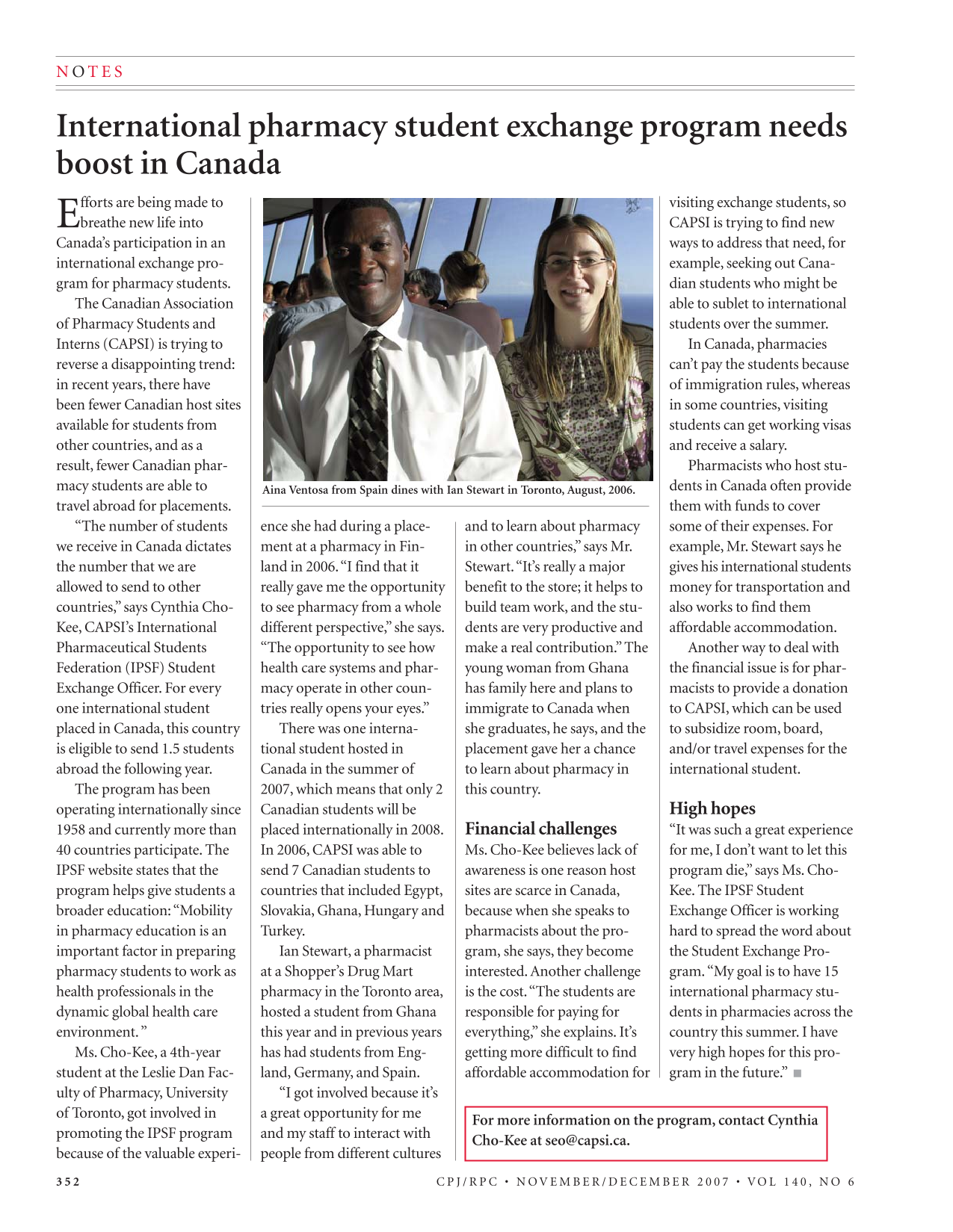
Aina Ventosa from Spain dines with Ian Stewart in Toronto, August, 2006.

There was one international student hosted in Canada in the summer of 2007, which means that only 2 Canadian students will be placed internationally in 2008. In 2006, CAPSI was able to send 7 Canadian students to countries that included Egypt, Slovakia, Ghana, Hungary and Turkey.
Ian Stewart, a pharmacist at a Shopper's Drug Mart pharmacy in the Toronto area, hosted a student from Ghana this year and in previous years has had students from England, Germany, and Spain.
“I got involved because it's a great opportunity for me and my staff to interact with people from different cultures and to learn about pharmacy in other countries,” says Mr. Stewart. “It's really a major benefit to the store; it helps to build team work, and the students are very productive and make a real contribution.” The young woman from Ghana has family here and plans to immigrate to Canada when she graduates, he says, and the placement gave her a chance to learn about pharmacy in this country.
Financial challenges
Ms. Cho-Kee believes lack of awareness is one reason host sites are scarce in Canada, because when she speaks to pharmacists about the program, she says, they become interested. Another challenge is the cost. “The students are responsible for paying for everything,” she explains. It's getting more difficult to find affordable accommodation for visiting exchange students, so CAPSI is trying to find new ways to address that need, for example, seeking out Canadian students who might be able to sublet to international students over the summer.
In Canada, pharmacies can't pay the students because of immigration rules, whereas in some countries, visiting students can get working visas and receive a salary.
Pharmacists who host students in Canada often provide them with funds to cover some of their expenses. For example, Mr. Stewart says he gives his international students money for transportation and also works to find them affordable accommodation.
Another way to deal with the financial issue is for pharmacists to provide a donation to CAPSI, which can be used to subsidize room, board, and/or travel expenses for the international student.
High hopes
“It was such a great experience for me, I don't want to let this program die,” says Ms. Cho-Kee. The IPSF Student Exchange Officer is working hard to spread the word about the Student Exchange Program. “My goal is to have 15 international pharmacy students in pharmacies across the country this summer. I have very high hopes for this program in the future.”
For more information on the program, contact Cynthia Cho-Kee at