






Abstract
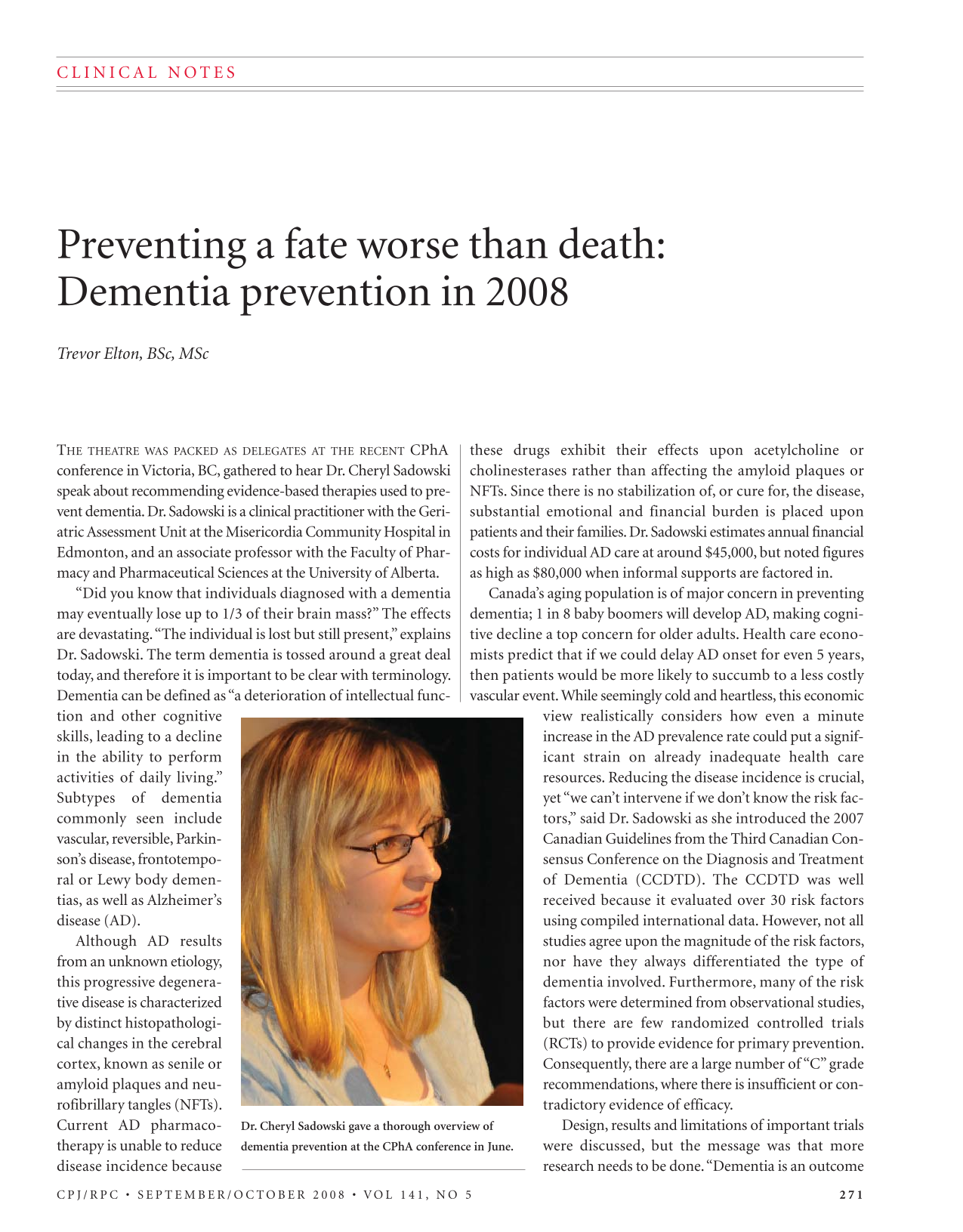
The theatre was packed as delegates at the recent CPhA conference in Victoria, BC, gathered to hear Dr. Cheryl Sadowski speak about recommending evidence-based therapies used to prevent dementia. Dr. Sadowski is a clinical practitioner with the Geriatric Assessment Unit at the Misericordia Community Hospital in Edmonton, and an associate professor with the Faculty of Pharmacy and Pharmaceutical Sciences at the University of Alberta.
“Did you know that individuals diagnosed with a dementia may eventually lose up to 1/3 of their brain mass?” The effects are devastating. “The individual is lost but still present,” explains Dr. Sadowski. The term dementia is tossed around a great deal today, and therefore it is important to be clear with terminology. Dementia can be defined as “a deterioration of intellectual function and other cognitive skills, leading to a decline in the ability to perform activities of daily living.” Subtypes of dementia commonly seen include vascular, reversible, Parkinson's disease, frontotemporal or Lewy body dementias, as well as Alzheimer's disease (AD).
Although AD results from an unknown etiology, this progressive degenerative disease is characterized by distinct histopathological changes in the cerebral cortex, known as senile or amyloid plaques and neurofibrillary tangles (NFTs). Current AD pharmacotherapy is unable to reduce disease incidence because these drugs exhibit their effects upon acetylcholine or cholinesterases rather than affecting the amyloid plaques or NFTs. Since there is no stabilization of, or cure for, the disease, substantial emotional and financial burden is placed upon patients and their families. Dr. Sadowski estimates annual financial costs for individual AD care at around $45,000, but noted figures as high as $80,000 when informal supports are factored in.
Dr. Cheryl Sadowski gave a thorough overview of dementia prevention at the CPhA conference in June.
Canada's aging population is of major concern in preventing dementia; 1 in 8 baby boomers will develop AD, making cognitive decline a top concern for older adults. Health care economists predict that if we could delay AD onset for even 5 years, then patients would be more likely to succumb to a less costly vascular event. While seemingly cold and heartless, this economic view realistically considers how even a minute increase in the AD prevalence rate could put a significant strain on already inadequate health care resources. Reducing the disease incidence is crucial, yet “we can't intervene if we don't know the risk factors,” said Dr. Sadowski as she introduced the 2007 Canadian Guidelines from the Third Canadian Consensus Conference on the Diagnosis and Treatment of Dementia (CCDTD). The CCDTD was well received because it evaluated over 30 risk factors using compiled international data. However, not all studies agree upon the magnitude of the risk factors, nor have they always differentiated the type of dementia involved. Furthermore, many of the risk factors were determined from observational studies, but there are few randomized controlled trials (RCTs) to provide evidence for primary prevention. Consequently, there are a large number of “C” grade recommendations, where there is insufficient or contradictory evidence of efficacy.
Design, results and limitations of important trials were discussed, but the message was that more research needs to be done. “Dementia is an outcome more complex than those commonly studied, such as heart attack or stroke,” says Dr. Sadowski, and yet it is typically analyzed as an add-on to another study. Issues also arise regarding whom to enroll in prevention trials as well as the risk of the intervention in light of the failed AD vaccination trial, which was discontinued following 21 cases of meningoencephalitis.
Many of the risk factors and potential preventative measures discussed by Dr. Sadowski related to cardiovascular and metabolic disease states. Blood pressure has a confusing U-shaped risk relationship to AD, but there is compelling evidence that strokes increase the risk of dementia. Control of systolic blood pressure to 140 mmHg is therefore important, but any further lowering of blood pressure would be excessive and is discouraged. Metabolic conditions such as type 2 diabetes, hyperlipidemia or hyperhomocysteinemia are risk factors for all-cause dementia too. Lifestyle factors such as high fat intake and smoking have also been linked to dementia. Dr. Sadowski also highlighted that based on limited observational studies, pharmacists may consider advising their patients on the benefits of a Mediterranean diet involving increased fish and vegetable servings, reduced dietary fat and moderate red wine consumption. Unfortunately, while most people may enjoy trying other foods occasionally, many are unwilling to substantially change their overall diet. Other risk factors of special interest include serious head injuries, use of benzodiazepines in geriatric populations and exposure to toxins.
However, we must take the time to determine how these general statements about risk factors are applicable to our practice and our patients. For instance, advocating protective clothing for toxin exposure may be very relevant to farmers who administer large amounts of pesticides and fertilizers. NSAIDs, vitamin E or C, estrogens and gingko have all been considered for dementia prevention but with disappointing results. In fact, there is good evidence to avoid the use of estrogens and high-dose vitamin E (>400 IU/day) for this purpose, as they increase all-cause mortality. There is also insufficient evidence that enhanced levels of physical or mental activity assist in the prevention of dementia. On the benefits of Nintendo's popular Brain Age, a spokesperson for the company has stated: “Nintendo has never claimed to improve anyone's health with any of the brain games.”
Impact of dementia has severe emotional and financial burdens
1 in 8 baby boomers will develop Alzheimer's disease
Know your modifiable risk factors for dementia:
Cardiovascular conditions such as hypertension and stroke
Metabolic conditions such as type 2 diabetes, hyperlipidemia or hyperhomocysteinemia
Lifestyle aspects such as high fat intake or smoking
Factors such as serious head injury, benzodiazepine use and exposure to toxins
Be aware that most recommendations for primary prevention of dementia are grade “C” — insufficient or contradictory evidence of efficacy.
Recommended interventions include:
Antihypertensive therapy to 140 mmHg target to reduce risk of stroke (grade A)
Management of metabolic disorders (grade C)
Avoiding the use of estrogens and high dose vitamin E for dementia prevention
Dietary changes to include increased consumption of fish, reduced consumption of dietary fat and moderate consumption of wine (grade C)
Engaging in low to moderate intensity physical exercise such as walking for 30 minutes a day
Engaging in enjoyable cognitively stimulating activities ranging from crossword puzzles to meeting for coffee
In the absence of definitive measures to prevent AD, Dr. Sadowski stressed that patients should find an activity that they enjoy — do not use Sudoku (the Japanese number game) as mental exercise if you really hate doing it! Remember too that physical exercise need not be an overwhelming task. Recent studies have suggested that benefits can be gained from a low-intensity activity like walking, as long as the duration is at least 30 minutes per day. The key message is to base your preventative recommendations on the patient's overall health and personal interests.