






Abstract
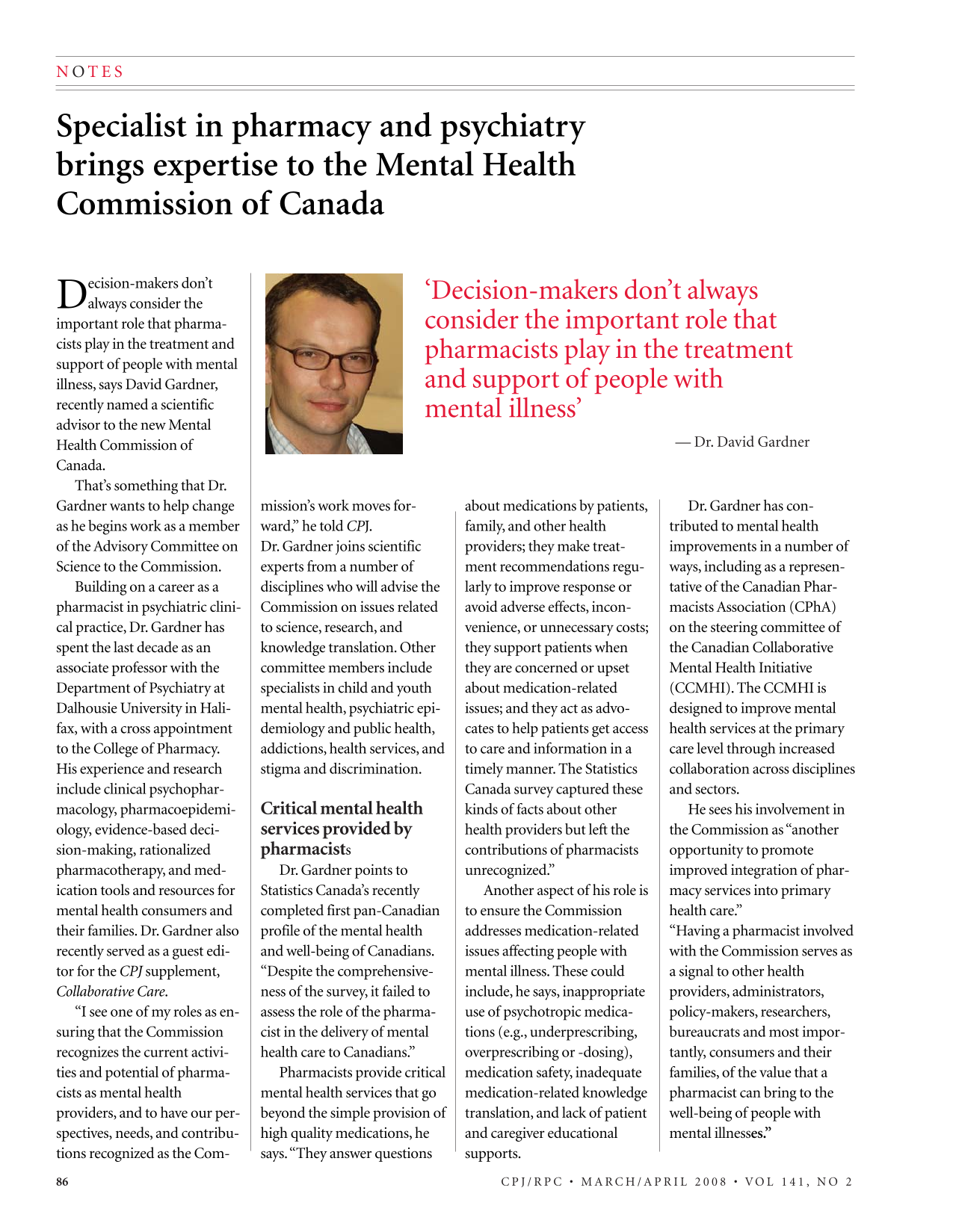
Decision-makers don't always consider the important role that pharmacists play in the treatment and support of people with mental illness, says David Gardner, recently named a scientific advisor to the new Mental Health Commission of Canada.
That's something that Dr. Gardner wants to help change as he begins work as a member of the Advisory Committee on Science to the Commission.
Building on a career as a pharmacist in psychiatric clinical practice, Dr. Gardner has spent the last decade as an associate professor with the Department of Psychiatry at Dalhousie University in Halifax, with a cross appointment to the College of Pharmacy. His experience and research include clinical psychopharmacology, pharmacoepidemiology, evidence-based decision-making, rationalized pharmacotherapy, and medication tools and resources for mental health consumers and their families. Dr. Gardner also recently served as a guest editor for the CPJ supplement, Collaborative Care.
“I see one of my roles as ensuring that the Commission recognizes the current activities and potential of pharmacists as mental health providers, and to have our perspectives, needs, and contributions recognized as the Commission's work moves forward,” he told CPJ.
Dr. Gardner joins scientific experts from a number of disciplines who will advise the Commission on issues related to science, research, and knowledge translation. Other committee members include specialists in child and youth mental health, psychiatric epidemiology and public health, addictions, health services, and stigma and discrimination.

— Dr. David Gardner
Critical mental health services provided by pharmacists
Dr. Gardner points to Statistics Canada's recently completed first pan-Canadian profile of the mental health and well-being of Canadians. “Despite the comprehensiveness of the survey, it failed to assess the role of the pharmacist in the delivery of mental health care to Canadians.”
Pharmacists provide critical mental health services that go beyond the simple provision of high quality medications, he says. “They answer questions about medications by patients, family, and other health providers; they make treatment recommendations regularly to improve response or avoid adverse effects, inconvenience, or unnecessary costs; they support patients when they are concerned or upset about medication-related issues; and they act as advocates to help patients get access to care and information in a timely manner. The Statistics Canada survey captured these kinds of facts about other health providers but left the contributions of pharmacists unrecognized.”
Another aspect of his role is to ensure the Commission addresses medication-related issues affecting people with mental illness. These could include, he says, inappropriate use of psychotropic medications (e.g., underprescribing, overprescribing or -dosing), medication safety, inadequate medication-related knowledge translation, and lack of patient and caregiver educational supports.
Dr. Gardner has contributed to mental health improvements in a number of ways, including as a representative of the Canadian Pharmacists Association (CPhA) on the steering committee of the Canadian Collaborative Mental Health Initiative (CCMHI). The CCMHI is designed to improve mental health services at the primary care level through increased collaboration across disciplines and sectors.
He sees his involvement in the Commission as “another opportunity to promote improved integration of pharmacy services into primary health care.”
“Having a pharmacist involved with the Commission serves as a signal to other health providers, administrators, policy-makers, researchers, bureaucrats and most importantly, consumers and their families, of the value that a pharmacist can bring to the well-being of people with mental illnesses.”
Prime Minister Harper announced the launch of the Mental Health Commission of Canada in August 2007. The creation of such a national body was a core recommendation of the Senate Health Committee's report on mental health, mental illness and addiction in Canada. The Chair of the Senate Committee, Michael Kirby, has been named the Chair of the new Commission.
The first meeting of the full Commission — the Board of Directors and members of all 8 advisory committees — was held in late January and according to Dr. Gardner, it “had an electric energy.” The key goals of the organization are to launch an anti-stigma campaign, promote development of a national mental health strategy for Canada, and to create a Knowledge Exchange Centre. “A goal for all involved is to work towards having mental health programs supported equally to programs for cancer and cardiovascular care,” he ▴ay▴.