






Abstract
The aim of this Campbell systematic review is to synthesize the extant empirical evidence on the effects of boot-camps and boot camp like programs on the criminal behavior (e.g., postrelease arrest, conviction, or reinstitutionalization) of convicted adult and juvenile offenders. The participants are kept extremely busy from early morning until late in the evening with physical training, drills and ceremonies. Punishment for even minor offences is immediate and usually involves physical activity. Boot camps for young offenders will typically also include academic education and therapeutic elements.
The analyses covered by this research review are based on 43 outcome studies, involving almost 120,000 young people and adults in total who participated in boot camps or militaristic programmes. Of these studies, 40 come from the USA, one from Canada and two from the UK. The studies measure recidivism in several different ways, such as arrests, sentences, imprisonment. For the studies that conducted measurements over several durations of time (e.g. after 12, 24 and 36 months), the authors of the research review chose the measurement with the longest timeframe that still covered at least 90% of the original participants.
Regardless of which of these measurements was studied, the conclusion was the same: boot camps are neither worse nor better than e.g. imprisonment.
Abstract
Background
Correctional boot camps were first opened in United States adult correctional systems in 1983. Since that time they have rapidly grown, first within adult systems and later in juvenile corrections, primarily within the United States. In the typical boot camp, participants are required to follow a rigorous daily schedule of activities including drill and ceremony and physical training, similar to that of a military boot-camp. Punishment for misbehavior is immediate and swift and usually involves some type of physical activity like push-ups. Boot-camps differ substantially in the amount of focus given to the physical training and hard labor aspects of the program versus therapeutic programming such as academic education, drug treatment or cognitive skills.
Objectives
To synthesize the extant empirical evidence on the effects of boot-camps and boot camp like programs on the criminal behavior (e.g., post-release arrest, conviction, or reinstitutionalization) of convicted adult and juvenile offenders.
Search Strategy
Numerous electronic databases were searched for both published an unpublished studies. The keywords used were: boot camp(s), intensive incarceration, and shock incarceration. We also contacted U.S and non-U.S. researchers working in this area requesting assistance in locating additional studies. The final search of these sources was completed in early December of 2003.
Selection Criteria
The eligibility criteria were (a) that the study evaluated a correctional boot camp, shock incarceration, or intensive incarceration program; (b) that the study included a comparison group that received either probation or incarceration in an alternative facility; (c) that the study participants were exclusively under the supervision of the criminal or juvenile justice system; and (d) that the study reported a post-program measure of criminal behavior, such as arrest or conviction.
Data Collection and Analysis
The coding protocol captured aspects of the research design, including methodological quality, the boot-camp program, the comparison group condition, the participant offenders, the outcome measures and the direction and magnitude of the observed effects. All studies were coded by two independent coders and all coding differences were resolved by Drs. MacKenzie or Wilson. Outcome effects were coded using the odds-ratio and meta-analysis was performed using the random effects model.
Main Results
Thirty-two unique research studies met our inclusion criteria. These studies reported the results from 43 independent boot-camp/comparison samples. The random effects mean odds-ratio for any form of recidivism was 1.02, indicating that the likelihood that boot camp participants recidivating was roughly equal to the likelihood of comparison participants recidivating. This overall finding was robust to the selection of the outcome measure and length of follow-up. Methodological features were only weakly related to outcome among these studies and did not explain the null findings. The overall effect for juvenile boot camps was slightly lower than for adult boot camps. Moderator analysis showed that studies evaluating boot-camp programs with a strong treatment focus had a larger mean odds-ratio than studies evaluating boot camps with a weak treatment focus.
Conclusions
Although the overall effect appears to be that of “no difference,” some studies found that boot camp participants did better than the comparison, while others found that comparison samples did better. However, all of these studies had the common element of a militaristic boot camp program for offenders. The current evidence suggests that this common and defining feature of a boot-camp is not effective in reducing post boot-camp offending.
Linked article:
Linked article:
1 Background for the Review 1
Correctional boot camps, frequently called shock or intensive incarceration, were first opened in adult correctional systems in Georgia and Oklahoma in 1983. Since that time they have rapidly grown, first within adult systems and later in juvenile corrections. Today, correctional boot camps exist in federal, state and local juvenile and adult jurisdictions in the United States.
In the typical boot camp, participants are required to follow a rigorous daily schedule of activities including drill and ceremony and physical training. They arise early each morning and are kept busy most of the day. Correctional officers are given military titles and participants are required to use these titles when addressing staff. Staff and inmates are required to wear uniforms. Punishment for misbehavior is immediate and swift and usually involves some type of physical activity like push-ups. Frequently, groups of inmates enter the boot camps as squads or platoons. There is often an elaborate intake ceremony where inmates are immediately required to follow the rules, respond to staff in an appropriate way, stand at attention and have their heads shaved. Many programs have graduation ceremonies for those who successfully complete the program, and family members and others from the outside public frequently attend the graduation ceremonies.
The camps for adjudicated juveniles differ somewhat from the adult camps. Less emphasis is placed on hard labor and, as required by law, the camps provide juveniles with academic education. Juvenile camps are also apt to provide more therapeutic components. However, in many other aspects the juvenile camps are similar to adult camps with rigorous in-take procedures, shaved heads, drill and ceremony, physical training, immediate physical punishment for misbehavior (e.g., push-ups), and graduation ceremonies.
While there are some basic similarities among the correctional boot camps, the programs differ greatly in other aspects (MacKenzie and Hebert, 1996). For example, the camps differ in the amount of focus given to the physical training and hard labor aspects of the program versus therapeutic programming such as academic education, drug treatment or cognitive skills. Some camps emphasize therapeutic programming; others focus on discipline and rigorous physical training. Programs also differ in whether they are designed to be an alternative to probation or to prison. In some jurisdictions judges sentence participants to the camps, in others, participants are identified by department of corrections personnel from those serving terms of incarceration. Another difference among programs is whether the residential phase is followed by an aftercare or re-entry program designed to assist the participants with adjustment to the community.
Despite their continuing popularity, correctional boot camps remain controversial. The debate primarily involves questions about the impact of the camps on the adjustment and behavior of participants while they are in residence and after they are released. According to the advocates, the atmosphere of the camps is conducive to positive growth and change (Clark and Aziz, 1996; MacKenzie and Hebert, 1996). In contrast, critics argue that many of the components of the camps are in direct opposition to the type of relationships and supportive conditions that are needed for quality therapeutic programming (Andrews, Zinger, Hoge, Bonta, Gendreau, and Cullen, 1990; Gendreau, Little and Groggin 1996, Morash and Rucker, 1990; Sechrest 1989).
Research examining the effectiveness of the correctional boot camps has focused on various potential impacts of the camps. Some have examined whether the camps change participant's attitudes, attachments to the community or impulsivity (MacKenzie, Styve, Gover, and Wilson, 2001; MacKenzie and Shaw 1990, MacKenzie and Souryal, 1995). Others have examined the impact of the camps on the need for prison bed space (MacKenzie and Piquero 1994; MacKenzie and Parent, 1991). However, the research receiving the most interest appears to be that examining the impact of the camps on recidivism. Past reviews of this research, such as MacKenzie (1997), have concluded that boot camps are ineffective in reducing recidivism with the caveat that those boot camps that emphasize therapeutic activities and aftercare may be successful.
2 Objectives of the Review
The objective of this systematic review was to synthesize the extant empirical evidence (published or otherwise) on the effects of boot camps and boot camp like programs on the criminal behavior of convicted adult and juvenile offenders. The focus of this review was on the effectiveness of these programs with respect to recidivism. According to a survey of state correctional officials by Gowdy (1996), reduced correctional costs and recidivism were the primary goals of boot camps. This review did not examine research on the cost effects of these programs, nor did it review the potential secondary effects on outcomes such as antisocial attitudes.
3 Methods
3.1 Criteria for inclusion and exclusion of studies in the review
The scope of this review was experimental and quasi-experimental evaluations of boot camp and boot camp like programs for juvenile and adult offenders that utilized a comparison group. The eligibility criteria were (a) that the study evaluated a correctional boot camp, shock incarceration, or intensive incarceration program (i.e., a residential program for convicted offenders that incorporates a militaristic environment and/or structured strenuous physical activity other than work); (b) that the study included a comparison group that received either probation or incarceration in an alternative facility, such as jail or prison (study design may be experimental or quasi-experimental; one-group research designs were not eligible); (c) that the study participants were exclusively under the supervision of the criminal or juvenile justice system (i.e., convicted of or adjudicated for an offense); and (d) that the study reported a post-program measure of criminal behavior, such as arrest or conviction (the measure may be based on official records or self-report and may be reported on a dichotomous or continuous scale). The form for evaluating the eligibility of studies is in Appendix A of the protocol (http://www.aic.gov.au/campbellcj/reviews/titles.html).
3.2 Search strategy for identification of relevant studies
Several strategies were used to identify studies, published or otherwise, that met the above criteria, including a keyword search of computerized databases, contact with authors working in this area, and examination of study registries. We searched the following databases: Criminal Justice Periodical Index, Dissertation Abstracts Online, Government Publications Office Monthly Catalog, Government Publications Reference File, NCJRS, PsychINFO, Sociological Abstracts, Social SciSearch, and U.S. Political Science Documents. The keywords used were: boot camp(s), intensive incarceration, and shock incarceration. Several of the searched databases index nonpublished works. We searched the Campbell Collaboration Social, Psychological, Educational and Criminological Trials Register. The final search of these sources was completed in early December of 2003. We also contacted U.S and non U.S. researchers working in this area requesting assistance in locating additional studies.
All references identified as potentially eligible for this review were be entered into a bibliographic database program created in FileMaker Pro(TM) by D. B. Wilson and J. H. Derzon specifically for use in managing bibliographies for meta-analysis. Identified documents were retrieved and two coders assessed eligibility through an examination of the full report.
3.3 Description of methods used in the component studies
The methods used by the studies included in this review were variations on a treatment versus comparison group research design with a post-test and possible follow-up measurement points. In all cases the participant samples were adjudicated juvenile delinquents or convicted adult offenders, a sample of whom participated in a boot camp program and a sample of whom participated in some other traditional correctional program, such as probation or short-term incarceration and parole.
The studies were varied with respect to the method of constructing the comparison group. The types of the comparison groups used are detailed in the findings section.
All studies included in this review included a post-program measure of criminal recidivism, that is, criminal behavior. These were mostly dichotomous indicators of arrest, conviction, or reincarceration or more differentiated indicators that specify specific types of offenses or the frequency of offenses. A few studies also included self-report measures of criminal involvement (these were not used in the meta-analytic analyses).
A few studies reported other noncriminal behavior related outcomes. We did not code these ancillary outcomes.
3.4 Criteria for determination of independent findings
A complication in conducting a systematic review of studies in this area is that most studies reported multiple indicators of recidivism and recidivism indicators at multiple time points (e.g., 12 months post-program, 24 months post-program). The statistical methods outlined below require that the findings (effect sizes) be independent, that is, come from unique samples. Several strategies were be used to address this problem.
For each study, all findings related to criminal behavior were coded and entered into the data file. The data for each finding were used to compute an odds-ratio (the effect size for this review). Most studies reported data that allowed for the computation of multiple odds-ratios. Rather than simply average the odds-ratios within a study to arrive at a single odds-ratio per study for analysis, we applied a selection criteria that resulted in four sets of odds-ratios, one per study. The selection criteria gave preferences to general measures (all crime types, preferably excluding technical violations), longer follow-up periods, and odds-ratios adjusted for baseline differences. More details on the selection of independent sets of odds-ratios for analysis are presented below in the findings section.
3.5 Details of study coding categories
The coding protocol developed for this project is provided in Appendix B of the synthesis protocol (http://www.aic.gov.au/campbellcj/reviews/titles.html). The protocol recognized the nested nature of effects within studies and as such was hierarchical in nature. Any number of effects could be coded for any number of dependent variables for each program-comparison contrast contained within a study. See Lipsey and Wilson (2001) for a discussion of this issue.
The coding protocol captured aspects of the research design, including methodological quality, the boot camp program, the comparison group condition, the participant offenders, the outcome measures and the direction and magnitude of the observed effects. All studies were coded by two independent coders and all coding differences were resolved by Drs. MacKenzie or Wilson.
3.6 Statistical procedures and conventions
The primary effect of interest was recidivism or a return to criminal activity on the part of the offender after leaving the program. Recidivism data were most typically reported dichotomously. As such, the natural index of effectiveness is the odds-ratio (see Fleiss, 1994) and was the index of effect used in this review. One study reported recidivism on a continuous scale in addition to a dichotomous scale. These effect sizes were computed as standardized mean differences and transformed into an equivalent odds-ratio (see Lipsey and Wilson, 2001, page 198). The primary analyses used dichotomous indicators of recidivism.
The odds-ratio is an index of the failure (or success) of one condition relative to another. As such, an odds-ratio of 1 indicates that both conditions had an equal odds of failure. The odds-ratio from a study where the boot camp and comparison group recidivated at the same rate would equal 1. An odds-ratio greater than 1 indicates that the boot camp recidivated at a
The mean odds-ratio and homogeneity of effects across studies was computed using the inverse variance weight method. A random effects model was assumed and the random effects variance component was estimated using the methods outlined by DerSimonian and Laird (1986) and Raudenbush (1994). The computations were performed using macros written by D. B. Wilson and available for use with SAS, SPSS, and Stata (Lipsey and Wilson, 2001). The Stata version of these macros were used for all analyses reported below. These macros use the same methods of computation as those used by the Cochrane Collaborative MetaView program (Deeks, 1999).
3.7 Treatment of qualitative research
We did not include qualitative research in this systematic review. We would welcome any collaborator with expertise in the area of qualitative research to update this review with a synthesis of qualitative evaluations.
4 Findings
4.1 Description of Eligible Studies
The search strategy identified 152 potentially eligible studies, of which we were able to obtain copies of 144. Of these 144 documents, 43 meet our eligibility criteria. These 43 documents reported the results of 32 unique research studies. Most of these studies evaluated boot camps in the United States. One evaluated a Canadian program and one evaluated two separate programs in Great Britain.
Close to two-thirds (22) of these studies were reported in government reports. A quarter (eight) were reported in a peer-reviewed journal and (two) were only available as unpublished technical reports. Publication selection bias is unlikely to have a substantial affect on the results of this synthesis given the high percentage of grey literature (government and unpublished technical reports). This is supported by a trim-and-fill analysis that determined that no odds-ratios needed to be trimmed (Duval and Tweedie, 2000).
Three of the studies reported results from multiple treatment-comparison contrasts. MacKenzie and Souryal (1994) reported results for nine different geographic areas (states), eight of which were eligible for this synthesis. Farrington, et al. (2001) reported results from evaluations of two distinct boot camp type programs. Zhang (2000) reported the results of a matched comparison and an unmatched comparison group evaluation of the same boot camp program. The samples for these two evaluations from Zhang (2000) were distinct and as such both were coded and treated separately in the analyses below. The Florida Department of Juvenile Justice (1997) evaluation of the Polk County boot camp program reported results separately for boys and girls and this distinction was maintained in the results below. As a result of these multiple treatment-comparison contrasts in some studies, the 32 studies produced 43 independent samples for analysis. The independent treatment-comparison samples were the unit-of-analysis for this synthesis.
4.2 Overall Mean Effects Across Studies
The 43 treatment-comparison contrasts generated a total of 199 odds-ratios, with most studies reporting multiple outcomes. Only one odds-ratio could be computed from four studies and one study had 28 odds-ratios. Seventy-two percent of the studies had four or fewer odds-ratios. To maintain statistical independence, only a single odds-ratio (or composite odds-ratio) could be included in any aggregation (mean odds-ratio). The mean odds-ratios reported on each row of Table 1 handles the complexity of multiple effect sizes using a different method, as detailed below.
Overall Mean Odds-Ratio by Outcome Type
Note: These are full-information maximum likelihood random effects mean odds-ratios.
p < .05
Number of odds-ratios (i.e., number of distinct samples).
This analysis made use of all 199 odds-ratios by first computing an average odds-ratio for each of the 43 treatment-comparison contrasts.
We identified what we judged to be the most general measure of recidivism within a study. Our criteria gave preference to measures of arrest over conviction and conviction over reinstitutionalization. Measures that included all crimes, excluding technical violations, were preferred over measures that were specific to one type of crime, such as property offenses or drug use. When a general measure of crime was reported for multiple follow-up periods, such as 12-months, 24-months, and 36-months, the longest follow-up that maintained at least 90 percent of the baseline sample was used. Although longer follow-up periods provide a more robust assessment of the effectiveness of a boot camp, we did not want to select odds-ratios that were compromised by attrition when an uncompromised odds-ratio was available from that study. We also selected odds-ratios that were adjusted for baseline covariates (e.g., via a logistic regression model) over unadjusted odds-ratios. Finally, we used only dichotomous indicators of recidivism. Only a few studies reported continuous measures of recidivism and all of these studies also reported the recidivism dichotomously. This selection process produced a single odds-ratio per treatment-comparison contrast. The random effects mean odds-ratio for this subset of odds-ratios, labeled “Any Recidivism” in Table 1, was 1.02, indicating that the likelihood that boot camp participants recidivating was roughly equal to the likelihood of comparison participants recidivating. The distribution was heterogeneous, indicating more variability than would be expected due to sampling error alone, raising the plausibility that the effect of boot camps is moderated by study characteristics. However, the overall results suggest no general reduction in recidivism attributable to boot camps.
To ensure that these overall findings weren't biased as a result of our preference for odds-ratios representing arrest over conviction over reinstitutionalization, we analyzed each type of outcome indicator separately. Within each type, we selected a single odds-ratio using the same criteria as above, that is, the most general and longest follow-up with at least 90 percent of the baseline sample. The mean odds-ratio for each of these outcome indicator types is also presented in Table 1. Our preference clearly selected the effects that were, on average, smaller in magnitude. The affect on our overall results, however, appears to be modest. All three mean odds-ratios were near 1 (a no difference effect) and none were statistically significant. We believe that, of these three, arrest is the better outcome indicator, as it is the least likely to be influenced by criminal justice system actors, such as prosecutors and judges. A judge's decision to sentence an offender to jail or prison (reinstitutionalize) may be influenced by whether that offender had previously been incarcerated in a boot camp facility. Arrest, while not a perfect measure of criminal involvement, is less likely to be influenced by an offenders prior status (i.e., boot camp or prison).
The above analyses still do not make use of all of the outcomes reported in the studies. The final row in Table 1, labeled “All Crime Outcomes,” is based on a composite within study odds-ratio. All odds-ratio within a treatment-comparison contrast were averaged (simple average). Because the composite odds-ratio should be more precise than the individual odds-ratios, the composite inverse variance weight was the maximum weight across the average odds-ratios. This assumption, while reasonable, will not always be true (e.g., when precision within study varies substantially). The mean odds-ratio across studies for this composite effect size was 1.00 and statistically non-significant.
Finally, we assessed the affect of selecting the odds-ratio reflecting the longest follow-up period on the results. It is plausible that boot camps have a short term effect on criminal behavior that diminishes over time and if this were the case our selecting the longest follow-up would skew the results towards finding a null effect. Therefore, we re-ran the above analyses using the first available post program results. The results (not shown) were quite similar. Thus, our initial analysis appears robust to the method of selecting recidivism outcomes.
Figures 1 through 5 show forest plots for each of these effect size distributions. These figures clearly show a central tendency that centers around a no difference finding (odds-ratio = 1) with some studies finding positive effects and others finding negative effects. The following section explores potential study features that may account for these differences across studies.
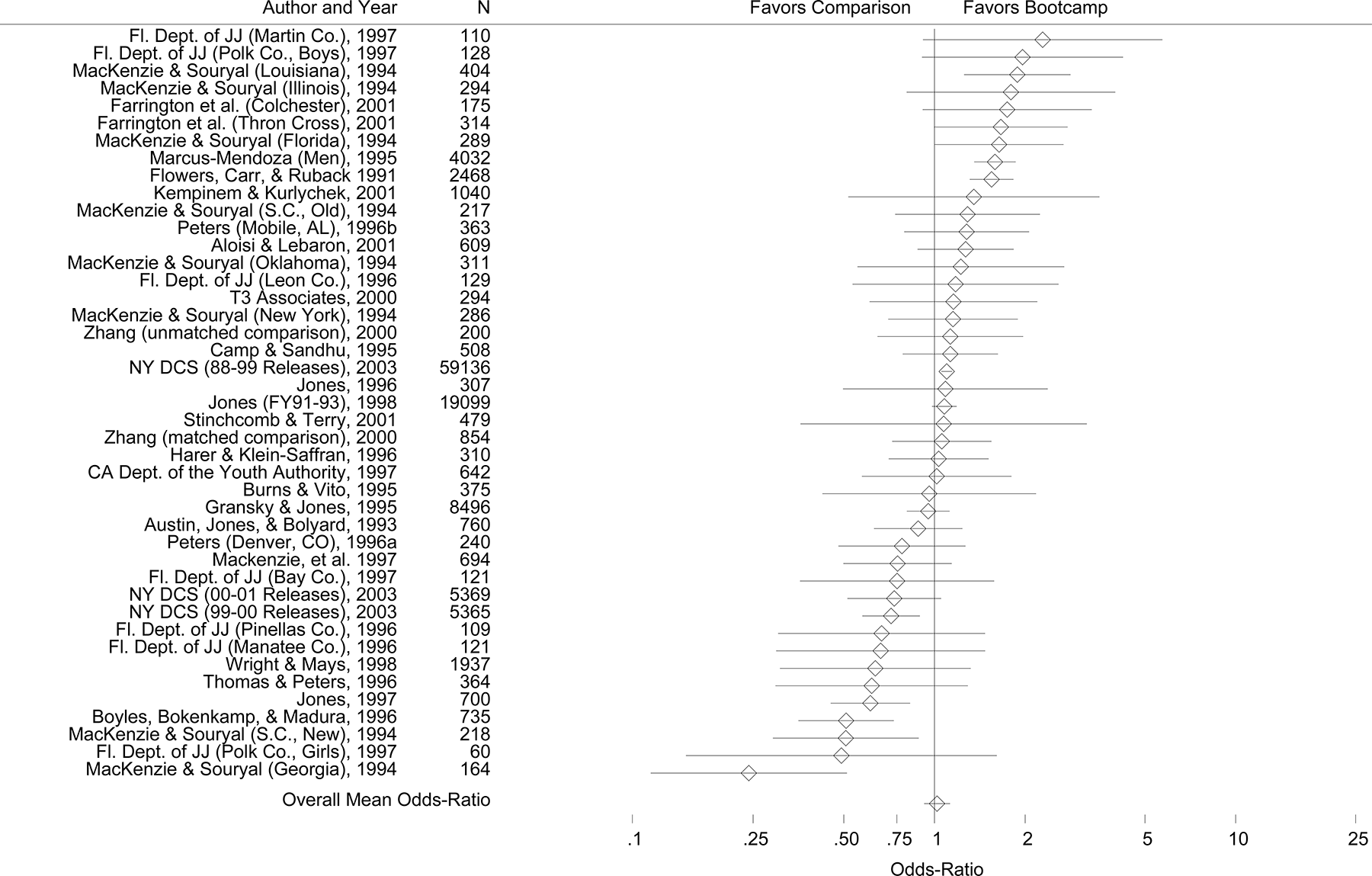
Odds-Ratio and 95% Confidence Interval for Any Recidivism (most general outcome)
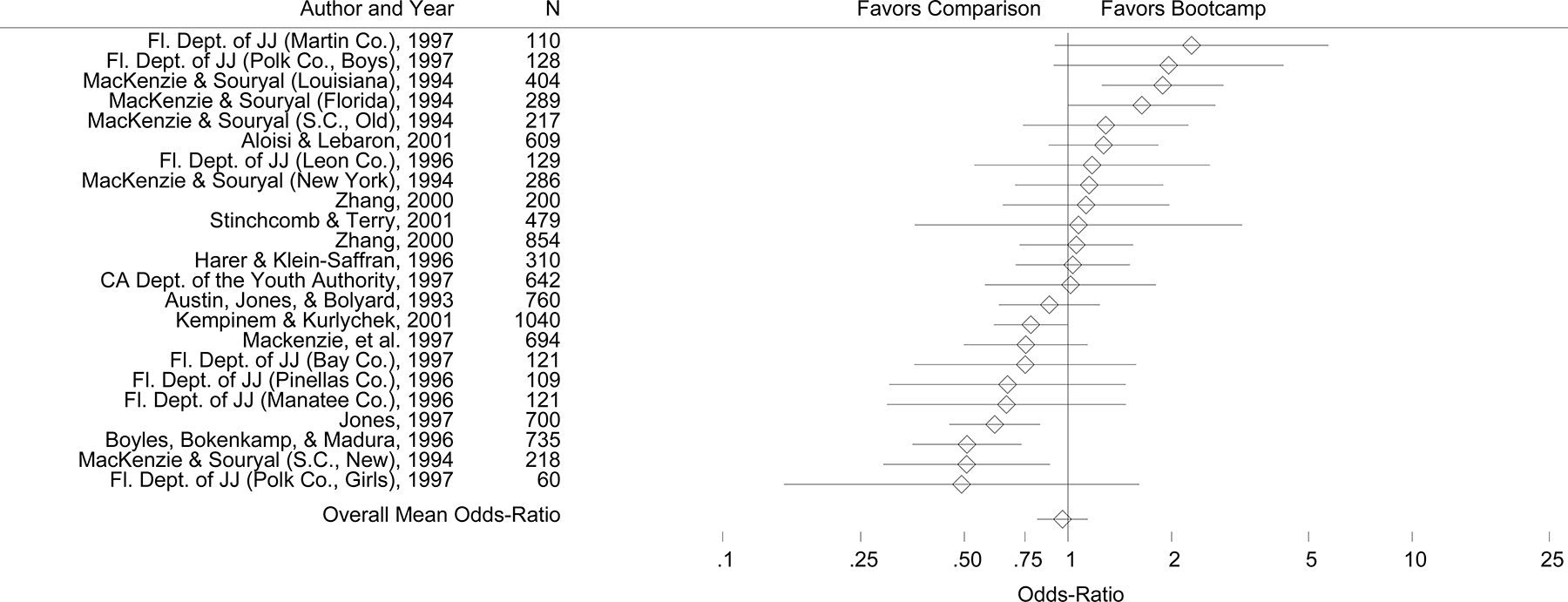
Odds-Ratio and 95% Confidence Interval for Arrest Only Outcome Measures
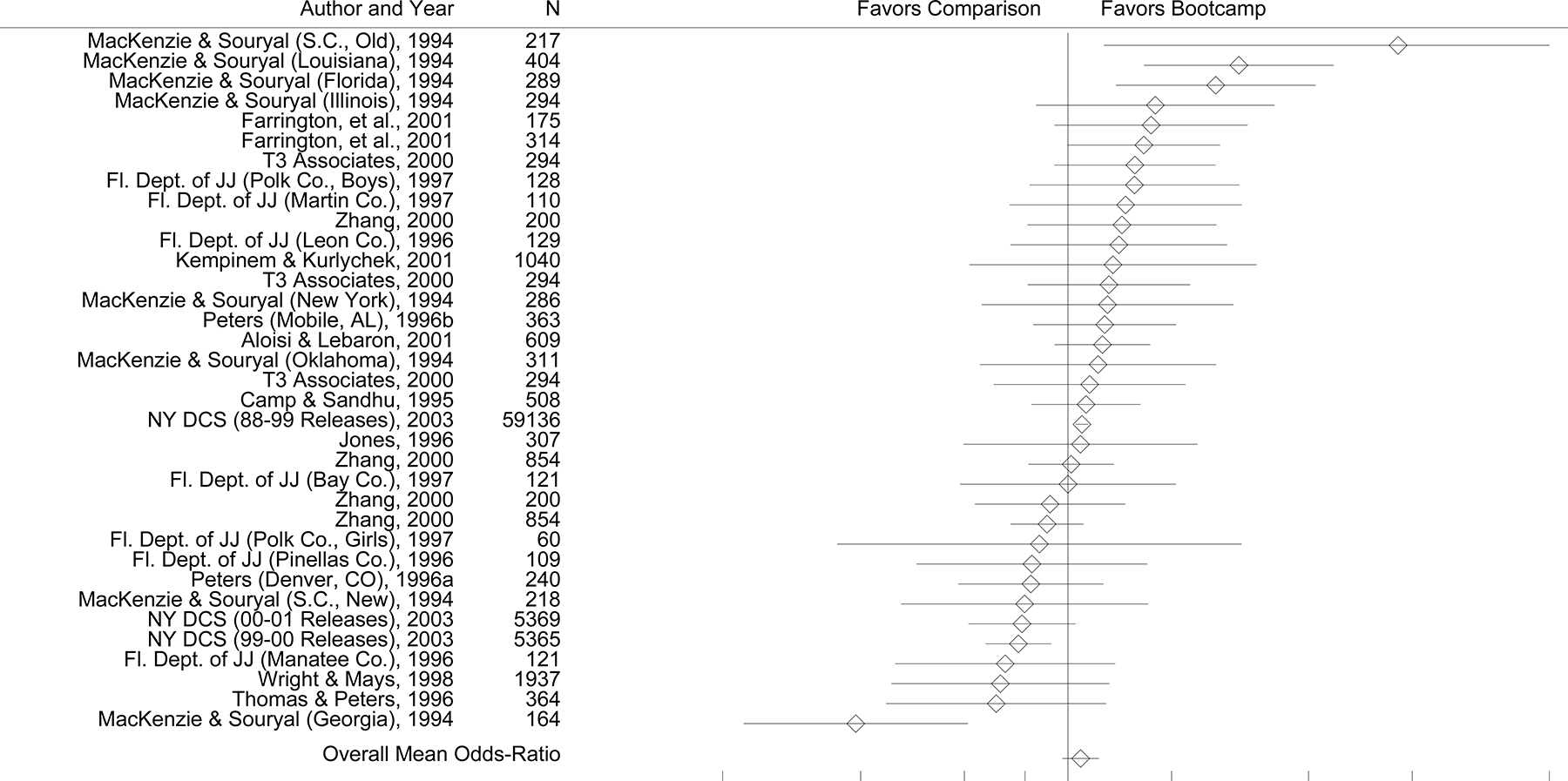
Odds-Ratio and 95% Confidence Interval for Conviction Only Outcome Measures
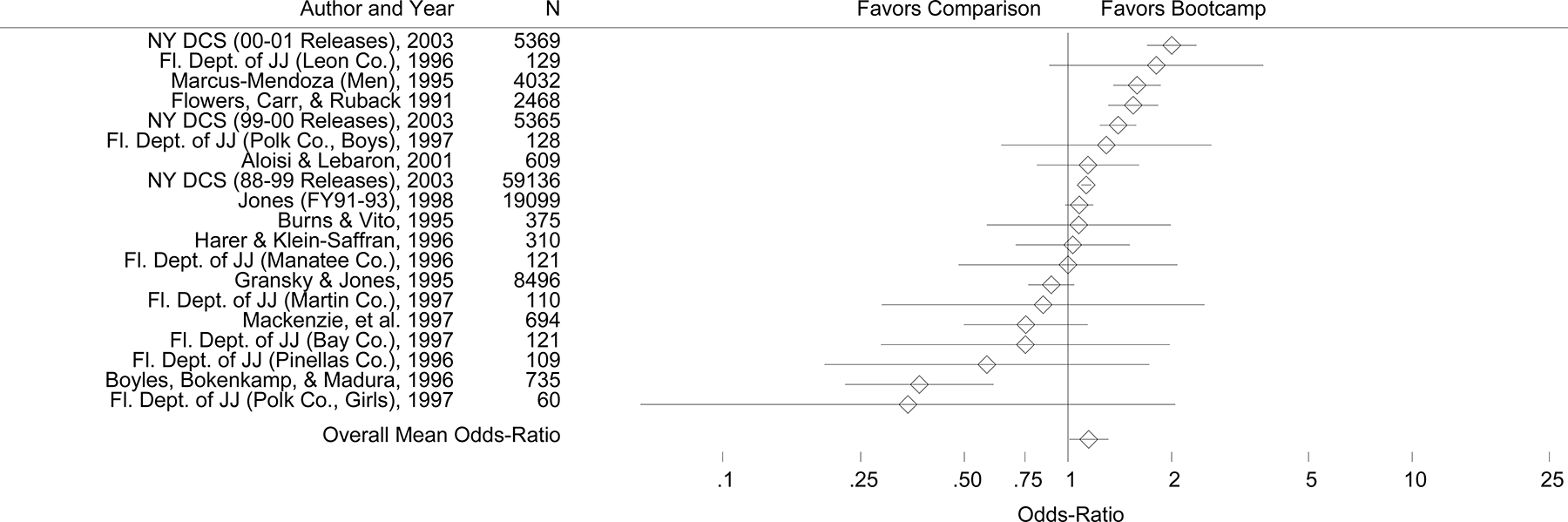
Odds-Ratio and 95% Confidence Interval for Reinstitutionalization Outcome Measures
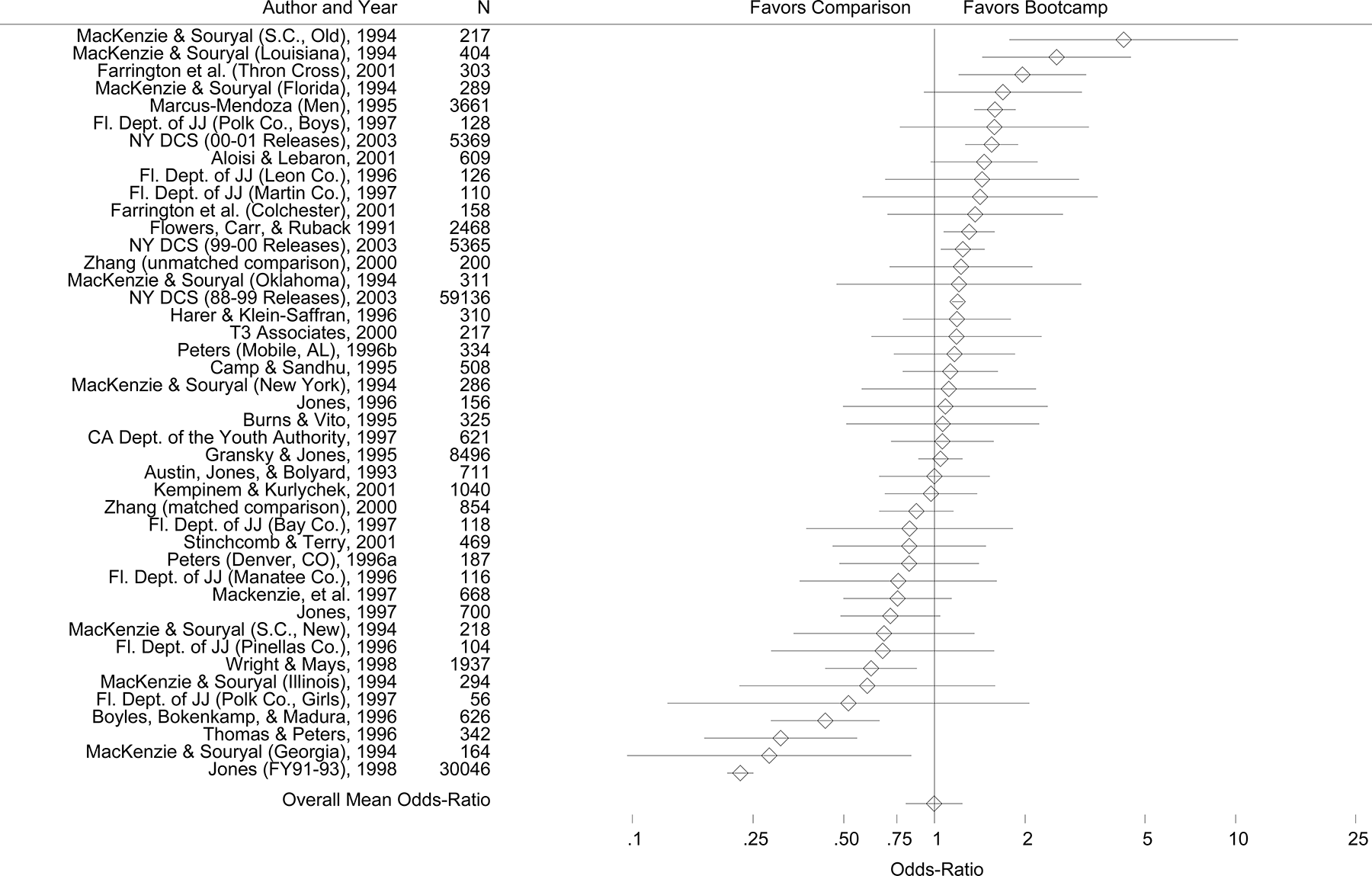
Odds-Ratio and 95% Confidence Interval for All Crime Outcome Measures (composite)
4.3 Analysis of Moderator Effects
The analysis reported above did not address the possibility that certain types of boot camps may be effective (or harmful) and others not or the effectiveness (or harmfulness) may interact with offender characteristics. Additionally, the overall analysis did not address the methodological soundness of the evidence and the potential influence of methodological features on observed results. The moderator analyses will address these issues to the extend possible given the typically limited descriptive information regarding the nature of the boot camp program and offender sample. The moderator analysis will examine the influence of method, offender, and treatment characteristics on observed results.
4.3.1 Method Characteristics
The collection of studies included in this systematic review varied substantially with respect to methodological rigor. Before examining the relationship between substantive features (e.g., offender and treatment characteristics) and outcome it is important to establish that the findings are not biased as a result of methodological variations.
Table 2 shows the mean odds-ratio by several method features, such as whether the study used random assignment to conditions and whether it included program dropouts in the analysis (Table 5 shows how each study was coded on these variables). At issue is whether the overall conclusion of no effect is robust to the method differences across studies. Studies that used random assignment observed a smaller overall effect, although the difference was trivial and not statistically significant. It is important to note that three of these four random assignment studies suffered methodological weaknesses that undermined the random assignment, such as excluding boot camp program dropouts from the analysis (three of the four) or severe overall or differential attrition (two of the four). For our purpose, overall attrition was loss of participants in both conditions such that external validity is compromised; differential attrition was unequal attrition between conditions. The exclusion of dropouts for three of the four randomized designs should have upwardly biased the results. The boot camp dropouts were unlikely to be a random subset of the boot camp participants, potentially biasing the results. Thus, the negative overall effect was surprising and gives weight to the conclusion that boot camp programs are ineffective relative to the existing alternatives to which they were compared.
Mean Odds-Ratio and 95% Percent Confidence Interval by Method Variables
Note: These are full-information maximum likelihood random effects mean odds-ratios.
∗ p < .05 (mean odds-ratio statistically significantly different from 1)
a Number of odds-ratios (i.e., number of distinct samples).
b Excludes random assignment studies.
c Difference between means statistically significant at p < .05.
Among the studies that did not use random assignment to conditions, roughly two-thirds employed matching or statistical controls to improve the comparability between the boot camp and comparison samples. The results from these higher quality quasi-experimental designs were essentially the same as from those quasi-experimental studies that did not employ matching or statistical controls. Similarly, a prospective research design that tracks participants at or before entry into the boot camp and comparison condition produced results that were, on average, essentially the same as post hoc designs that relied on archival data.
Many evaluations of boot camps exclude from their final analysis boot camp participants who failed to graduate or otherwise complete the program. Although this may seem reasonable, given that they did not receive the “full dose” of the boot camp, this approach is widely known to compromise the research design. Boot camp dropouts are likely to differ from those who completed the program in ways that related to recidivism. Without the ability to identify which comparison group participants would have dropped-out of the boot camp had they gone, any analysis that excludes them is likely to be biased. Surprisingly, the results from studies that included dropouts in the analysis (or provided us with data that allowed us to compute an effect size that included the dropouts) observed a slightly larger mean effect size (see Table 2). Thus, this potentially serious source of bias does not appear to have affected the overall finding of the ineffectiveness of boot camps.
A strong research design can be compromised by sample attrition. Attrition may occur roughly equally across both conditions or may affect one condition more than the other. The former, referred to here as overall attrition, reduces the generalizability of the findings, assuming that the same types of offenders were lost from both conditions. The latter, referred to here as differential attrition, reduces the comparability of the two conditions, potentially biasing the estimate of the effectiveness of the program. Studies that had apparent problems with attrition, either overall or differential, had slightly smaller odds-ratios, on average, than studies that did not.
Also reported in Table 2 is the nature of the comparison group. The most common comparison groups are jail, prison, or residential treatment. The latter are all studies of adolescent boot camps. The studies that used a jail or prison as a comparison group observed a small positive boot camp effects. The three studies that used a probation sample as a comparison and two studies in the “other” category observed rather large negative effects. Given the small number of studies in each category, little weight should be given to these potentially anomalous findings.
The above moderator analyses were re-run using the first post program odds-ratio (results not shown), rather than the longest follow-up available. The results were quite similar with no important differences.
Taken together, the finding of the ineffectiveness of boot camps at reducing recidivism appears robust to methodological differences across studies. Furthermore, methodological features were only weakly related to outcomes among these studies.
4.3.2 Offender Characteristics
Studies typically provided limited information regarding the characteristics of the offenders in the boot camp and comparison programs. Most of the samples were exclusively male, with only two studies examining the effects of female only boot camps, and seven studies evaluating mixed gender boot camps. Eight studies made no mention of the gender of the sample. In the analyses below, we assumed in these cases that the sample was all male. The average effect did not vary substantially by gender (see Table 3). There was a very small negative effect for the two studies that evaluated female only boot camps. There is not enough evidence at present, however, to make any conclusion regarding differential effects of boot camps for male and female offenders.
Mean Odds-Ratio and 95% Percent Confidence Interval by Offender Characteristics
Notes: These are full-information maximum likelihood random effects mean odds-ratios. None of the moderator analyses (differences between mean odds-ratios) shown in this table were statistically significant.
a Number of odds-ratios (i.e., number of distinct samples).
Correctional boot camps were initially created for adult offenders with juvenile boot camps developing later. Thus, it was not surprising that there were more evaluations of adult boot camps than juvenile programs. The overall effect for juvenile boot camps was slightly lower than for adult boot camps, although the difference was not statistically significant (compare totals for juveniles and adults in Table 3). Furthermore, juvenile boot camps that restricted their population to nonviolent/non-person offenders observed slightly larger effects than boot camps with a more diverse and mixed offender population (broader range of offense types and more extensive criminal histories), although the difference was small and statistically nonsignificant. Table 6 shows how each study was coded on these variables.
The above moderator analyses were re-run using selecting the first post program odds-ratio (results not shown). The results were quite similar with no important differences.
4.3.3 Boot Camp Program Characteristics
Dominant features of boot camps are physical exercise, military drill, and ceremony, all carried out in the context of strict discipline. The distribution of effects across studies suggests that there is no general positive effect of boot camps; that is, the common features of boot camps do not appear beneficial. Many boot camps, however, incorporate other traditional rehabilitative programs, such as drug abuse treatment, vocational education, and aftercare transition assistance. These expressly rehabilitative components may add value to a boot camp program, producing a beneficial effect for the offenders. Table 4 shows the mean odds-ratio by features of the boot camp program and does so separately for juvenile and adult boot camps (Table 7 shows how each study was coded on these variables).
Mean Odds-Ratio and 95% Percent Confidence Interval by Program Characteristics
Note: These are full-information maximum likelihood random effects mean odds-ratios.
∗ p < .05 (mean odds-ratio statistically significantly different from 1)
a Number of odds-ratios (i.e., number of distinct samples).
b Excludes random assignment studies.
c Difference between means statistically significant at p < .05.
Method Variables by Study
Sample Variables by Study
Treatment Variables by Study
Coding the program characteristics was difficult. Descriptions of the rehabilitative component of the boot camps were seriously lacking in most reports. A particular treatment component, such as drug treatment, was coded as present if the written report made any mention of that treatment component. We were unable to identify the quality of the components based on the descriptions given in the reports.
Of the program characteristics examined, only counseling as an integral component of the boot camp program was appreciably related to the mean odds-ratio. This difference was statistically significant for the juvenile boot camp programs. Juvenile boot camp programs without a counseling component had a negative overall impact (higher rates of recidivism). This difference was reduced when statistically adjusting for methodological features using a meta-analytic regression model, suggesting that the finding might not be robust to methodological variation across studies. Furthermore, this finding is based on only three juvenile boot camp programs without a counseling component. Small statistically nonsignificant differences in the expected direction were also observed for the incorporation of an aftercare component, drug treatment, and academic programming (adult only). These findings were robust to the selection of the longest follow-up period, that is, the findings were replicated (results not shown) when the first post program odds-ratio was used.
It was not possible to clearly disentangle the various effects of program components given that boot camp programs tend to include a mix of vocational, educational, and psychosocial programming. To try to better assess the potential effectiveness of incorporating these therapeutic elements into a boot camp, we rated boot camps as having either a primary or secondary emphasis on treatment. The boot camp program was judged as having a primary rehabilitative emphasis if the report described the boot camp in that way or if a substantial portion of each day was spent in traditionally rehabilitative type programs (e.g., counseling, education, drug treatment) rather than physical exercise, military drill, and ceremony. These judgments were often difficult to make. The results show that studies evaluating boot camp programs with a strong treatment focus had a larger mean odds-ratio than studies evaluating boot camps with a weak treatment focus. The difference favored the programs that had a more intensive rehabilitative focus (1.10 versus 0.90 for primary versus secondary rehabilitative focus, respectively, for both adult and juvenile boot camps), although the difference was not statistically significant (p = .11). The results are essentially the same using the firs post program odds-ratio, rather than the longest follow-up (results not shown). Thus, the data do not allow for a strong conclusion regarding the additive benefit of a rehabilitative emphasis.
5 Conclusions 2
This systematic review addressed the question: Are correctional boot camps effective at reducing criminal behavior among offenders? It should be clear from the discussion thus far that boot camp is a general term for a category of correctional programs that vary substantially from one-to-another. All boot camps, however, do have a common set of features that include the militaristic atmosphere, a rigorous and rigid daily schedule that includes physical training or labor, and strict discipline. We believe it is meaningful to ask whether this common component of boot camps is effective and should inform the policy debate regarding the continued funding, use, and proliferation of these programs.
Advocates and critics of boot camps are likely to be disappointed by this review. Advocates of the program expect the programs to successfully reduce the future criminal activities of adults and juveniles. Critics argue that boot camps are poorly conceived as therapeutic programs and they will not reduce recidivism and may actually have the opposite effect by increasing criminal activities. Our results do not support either side of this argument. Correctional boot camps are neither as good as the advocates expect nor as bad as the critics hypothesize.
Although the overall effect appears to be that of “no difference,” some studies found that boot camp participants did better than the comparison, while others found that comparison samples did better. There are many plausible reasons for these differences, including methodological variation across studies, differential effectiveness for various offender groups, and differences in the nature of the boot camps themselves. Our examination of the methodological variables showed that no single methodological feature accounted for much variation in effect, and there was no clear bias across method features. Therefore, the failure to establish that boot camps were effective or harmful does not appear to be the result of the inclusion of methodologically weak studies.
The primary studies provided limited information on the offender characteristics. Most evaluations conducted to date have been of either all male boot camps or mostly all male boot camps. Although the two evaluations of female only boot camps produced slightly negative findings, the difference in findings across different gender mixes was small and statistically unstable given the small number of studies with female samples. Comparing juvenile and adult samples and nonviolent samples with mixed samples showed no apparent interaction between the effectiveness (or lack there of) of boot camps and offender characteristics.
Advocates for boot camps will point out that not all boot camps are alike. We were able to code and analyze the impact of six program boot camp characteristics. These characteristics were limited to general information about the presence or absence of a programmatic component, such as aftercare treatment. We assume the quality and intensity of these components may differ greatly and data was insufficient to permit coding of such distinctions. For example, some programs consider Narcotics Anonymous (NA) or Alcoholics Anonymous (AA) meetings to be drug treatment, whereas others provided a more intensive drug treatment experience using a Therapeutic Community-type model.
The potential impact of the programmatic differences discussed above on recidivism cannot be overlooked. Our ability to disentangle these potential effects was limited. We did find, however, larger positive effects for boot camp programs that incorporated counseling and, more generally, for programs that had a primary focus on therapeutic programming beyond discipline, physical training, and military drill and ceremony. These findings, however, were not statistically significant for the full sample of studies and as such, this pattern may reflect chance variation. Further research is clearly needed to establish whether a rehabilitative emphasis within a boot camp is an effective combination.
What do these findings mean? All of these studies had the common element of a militaristic boot camp program for offenders. We reason that if this common component across studies is truly effective at reducing the future criminal behavior of offenders, then we would expect to see a distribution of effects that is positive, on average. That is, if a militaristic atmosphere, strict discipline, and rigorous physical exercise are beneficial, then the boot camp samples would have shown lower rates of recidivism than the comparison samples, even though the effects may have varied substantially due to other programmatic elements incorporated into the boot camp programs. This is not what we found. Thus, the extant evidence suggests that the military component of boot camps is not effective in reducing post boot camp offending.
Should boot camps be abolished? Although this review questions the effectiveness of boot camps as a correctional practice, the evidence also suggests that they are no worse than the alternatives examined in these studies (e.g., jail and prison time). The large variation in the distribution of effects suggests that effective treatment components, such as those identified by other meta-analyses (Andrews et al., 1990; Gendreau and Ross, 1987; Lipsey, 1992; Lipsey and Wilson, 1998), may be added to boot camps, resulting in an effective program. We do not know whether effective correctional programming is more (or less) effective within the boot camp environment than when provided within a prison or as an adjunct to probation. Furthermore, boot camps may have other benefits, such as reduced need for prison beds (e.g., MacKenzie and Piquero, 1994; MacKenzie and Parent, 1991) or improved prosocial attitudes, attachment to community or reduced impulsivity (MacKenzie et al., 2001; MacKenzie and Shaw, 1990; MacKenzie and Souryal, 1995). Justifying the adoption or continued use of boot camps should not, however, be made on claims of their potential to reduce crime within a community.
6 Plans for Updating the Review
We plan to update this review every three years in accordance with Campbell Collaboration guidelines.
7 Acknowledgments
We would like to thank the Jerry Lee Foundation for partial support of this project.
8 Statement Concerning Conflict of Interest
Drs. MacKenzie and Wilson, Ms. Kider, and Mrs. Michell have no financial interest in any existing or planned boot camp program. Dr. MacKenzie has argued in prior publications that boot camps are ineffective, at least in the absence of therapeutic elements and aftercare components. Thus, the only potential conflict of interest is consistency with prior scholarly publications. The research team strived to interpret the results without prejudice.
Footnotes
1
This section borrows heavily from MacKenzie, Wilson, and Kider (2001).
2
This section borrows heavily from Wilson and MacKenzie (2005) and MacKenzie, Wilson, and Kider (2001).