






Abstract
This Campbell systematic review examines the effectiveness of farmer field schools in improving intermediate outcomes (such as knowledge and pesticide use) and final outcomes (such as agricultural yields, incomes and empowerment) in low- and middle-income countries (LMICs), as well as implementation factors associated with programme success and failure. The review sythesises evidence from 92 impact evaluations, of which 15 were of sufficient quality for policy-oriented findings, and 20 qualitative studies.
Farmer field schools improve farmers' knowledge and adoption of beneficial practices, and reduce overuse of pesticides. This leads to positive outcomes for farmers: on average, a 13% increase in agricultural yields and a 20% increase in income. Farmer field schools also reduce pesticide use and environmental degradation. However, the evidence for these outcomes comes from short-term evaluations of pilot programmes, and no studies with a low risk of bias are available.
In programmes that were delivered at a national scale, studies conducted more than two years after implementation did not show any positive outcomes from the programme. For large-scale programmes, recruiting and training appropriate facilitators was problematic.
Authors' conclusions
Farmer field schools (FFS) are a common approach used to transfer specialist knowledge, promote skills and empower farmers around the world. At least 10 million farmers in 90 countries have attended such schools.
FFS are implemented by facilitators using participatory “discovery-based” learning based on adult education principles. Many different implementing bodies have been involved. Field schools have a range of objectives, including tackling overuse of pesticides and other harmful practices, improving agricultural and environmental outcomes, and empowering disadvantaged farmers such as women.
We conducted a systematic review of evidence on FFS implementation to investigate whether FFS make a difference, to which farmers, and why or why not. We synthesised quantitative evidence on intervention effects using statistical meta-analysis, and qualitative evidence on the barriers and enablers of effectiveness using a theory of change framework.
The results of statistical meta-analysis provide evidence that FFS are beneficial in improving intermediate outcomes relating to knowledge learned and adoption of beneficial practices, as well as final outcomes relating to agricultural production and farmers' incomes. The findings suggest this to be the case for FFS promoting integrated pest management (IPM) technology, as well as other techniques. However, the rigorous impact evaluation evidence base is small and there are no studies that we were able to identify as having a low risk of bias.
There is no evidence that neighbouring non-participant farmers benefit from diffusion of IPM knowledge from FFS participants. Therefore, they do not experience improvements in IPM adoption and agriculture outcomes.
The evidence of positive effects on agricultural outcomes is largely limited to short-term evaluations of pilot programmes. In the few examples where FFS have been scaled up, the evidence does not suggest they have been effective in improving agricultural outcomes among participating farmers or neighbouring non-participants.
Although empowerment is a major objective of many FFS, very few studies have collected information on this outcome in a rigorous manner. A few studies suggest farmers feel greater self-confidence.
What explains the lack of scalable effects among FFS participants, or diffusion of IPM practices among the community? FFS differ from standard agricultural extension interventions, which tend to focus on disseminating knowledge of more simple practices such as application of fertiliser and pesticides, or adoption of improved seeds. The experiential nature of the training, and the need for the benefits of the FFS technology to be observed, are barriers to spontaneous diffusion. Furthermore, the effectiveness of scaled-up interventions has been hampered by problems in recruiting and training appropriate facilitators at scale.
The review provides implications for policy, practice and research.
Executive Summary
BACKGROUND
After almost three decades of decline in public support, agriculture is now back on the development agenda. Since the late 1980s, support to agriculture has shifted from top-down approaches to those identifying technologies and methods of communicating technologies which are suitable to support farmers' livelihoods in a sustainable manner, including participatory approaches based on the notion of creating spaces for farmer self-learning. One such approach is the farmer field school (FFS), an adult education intervention which uses intensive “discovery-based” learning methods with the objectives of providing skills in such areas as integrated pest management (IPM) and empowering farmers and communities. FFS have been implemented in 90 countries worldwide, reaching an estimated 10-15 million farmers. Farmer field schools may appear to be the latest tool, but what does the evidence say regarding their effectiveness?
OBJECTIVES
This systematic review synthesises evidence on interventions identified as “farmer field schools” conducted in low- and middle-income countries. The review aims to provide answers to the following research questions:
Review question (1): What are the effects of farmer field schools on final outcomes such as yields, net revenues and farmer empowerment? What are the effects of farmer field schools on intermediate outcomes such as knowledge and adoption of improved practices (e.g. reduced use of pesticides)? What are the effects on outcomes for non-participating neighbouring farmers living in the same communities as FFS farmers?
Review question (2): What are the enablers of and barriers to FFS effectiveness, diffusion and sustainability?
STUDY SELECTION CRITERIA
Studies included in the review satisfied the following criteria.
Eligible participants included farmers growing arable crops, living in low- or middle-income countries at the time of the intervention. The review included those participating directly in the field school and also non-participant neighbour farmers who may benefit through spillover effects or more formal dissemination methods.
Eligible interventions were those identified as “farmer field schools,” regardless of the design or implementation, including FFS programmes providing training in IPM and other techniques. Studies combining FFS with other intervention components, such as input or marketing support, were also included.
Comparisons eligible for the effectiveness review were farmers who received no intervention, or access to agricultural extension services from another source, including IPM (or equivalent) training.
All outcomes reported were eligible for the review.primary Primary outcomes were agricultural outcomes, including yields and profits (net revenues). Secondary outcomes included other final outcomes such as environmental outcomes, health status and empowerment; and intermediate outcomes, including farmer knowledge and adoption of practices. Qualitative evidence on barriers to and enablers of effectiveness and sustainability were also included, including process and implementation information and measures of beneficiaries' attitudes and experiences with FFS.
Eligible study designs for the effectiveness synthesis (review question 1) were measurable using counterfactual impact evaluations, including experimental or quasi-experimental study designs and methods of analysis. Studies eligible for the synthesis of barriers and enablers (review question 2) were based on primary data collected from FFS participants, extension agents or experts, analysed using qualitative methods or descriptive statistics. The qualitative studies needed to report at least some information on the research question, procedures for collecting data, sampling and recruitment, and at least two sample characteristics.
SEARCH STRATEGY
The search included electronic academic databases, internet search engines, websites and theses, as well as handsearches of key journals and literature snowballing. Searches included general social science sources as well as agriculture subject-specific sources of published and unpublished literature. All searches were updated in October 2012.
The farmer field schools evaluation community has generated a large number of evaluations. We screened the titles and abstracts of over 28,000 papers, the majority of which were irrelevant to the topic. Four-hundred-sixty (460) relevant papers on FFS were assessed for inclusion based on full text. After the final screen by two authors, 134 quasi-experimental studies comprising 92 distinct evaluations meeting the inclusion criteria were eligible for the review. The impact evaluations provide quantitative estimates of effects on outcomes for 71 FFS projects. However, only 15 of the impact evaluations meeting the inclusion criteria were judged to be of sufficient internal validity to make predictions for policy. The review also includes 20 qualitative evaluations meeting the inclusion criteria, which discuss the barriers to and enablers of change in 20 FFS projects. A portfolio review of 337 project documents was also conducted.
DATA COLLECTION AND ANALYSIS
Two independent reviewers assessed the full text papers against the inclusion criteria; discrepancies were resolved by consensus or by a third author if needed. Two reviewers extracted data from included studies. Quantitative impact evaluation studies were critically appraised according to the likely risk of bias according to threats to internal validity (causal identification), external validity (generalisability) and file-drawer effects (publication bias). Qualitative evaluations were assessed according to adequacy of reporting, data collection, presentation, analysis and conclusions drawn.
We used a hypothesised programme theory of change (White, 2009) as the framework for integrating the evidence. We collected data on programme design, implementation, targeting and contextual factors, and linked individual studies by programme in order to assess whether heterogeneous programme effects were correlated with study design, implementation and context.
For the quantitative synthesis (review question 1), we extracted effect size estimates from included studies, calculating standard errors and 95 per cent confidence intervals using data provided in the studies, where possible. We used random effects meta-analysis, estimating average effects of farmer field schools on the different outcomes, and examining heterogeneity. The results of the publication bias analysis suggested under-reporting of small sample studies with negative or insignificant findings for studies reporting evidence on agricultural yields, which is evidence for possible publication bias.
For the synthesis of qualitative evidence (review question 2), we used a thematic approach (Thomas & Harden, 2008), combining predetermined themes based on the links and assumptions in the theory of change model, as well as any other themes emerging from the detailed coding of the included studies.
In the final stage of analysis, we used an iterated approach in which some effect moderators identified during the qualitative synthesis were tested in meta-analysis and meta-regression.
RESULTS
Review question (1)
No studies with a low risk of bias were identified for the review of effects and only 15 (out of 92) quasi-experimental studies were assessed as being of medium risk of bias and therefore policy-actionable. The results of these medium-risk-of-bias studies (reported in Summary of Findings Table 1) suggest farmer field schools impact positively on intermediate and final outcomes for participating farmers in the short to medium term.
Findings for intermediate outcomes were as follows: There was a significant increase of 0.21 standard deviations on knowledge about beneficial practices among farmer field school participants over comparison farmers (SMD=0.21, 95% confidence interval (CI)=0.07, 0.35; Q=5, Tau-sq=0.008, I-sq=55%; evidence from 3 studies). There was a significant reduction in pesticide use by 23 per cent for IPM and IPPM FFS participants over comparison farmers (RR=0.77, 95% CI=0.61, 0.97; Q=40, Tau-sq=0.07, I-sq=83%; 8 studies). Effects on pesticide use were particularly large and consistent for cotton IPM projects in Asia. There was a significant increase in indices of adoption of other beneficial practices by 0.22 standard deviations over comparison farmers (SMD=0.22, 95% CI=0.06, 0.38; Q=10, Tau-sq=0.02, I-sq=80%; 3 studies).
For final outcomes, the findings were as follows: A significant increase in agricultural yields was estimated among FFS participants, by 13 per cent over comparison farmers (RR=1.13, 95% CI=1.04, 1.22; Q=53, Tau-sq=0.008, I-sq=81%; 11 studies). A significant increase in profits (net revenues) was estimated, by 19 per cent among FFS participants over comparison farmers (RR=1.19, 95% CI=1.11, 1.27; Q=1, Tau-sq=0, I-sq=0%; 2 studies). The increase in profits was higher for FFS projects which also included complementary interventions involving input or marketing support (RR=2.51, 95% CI=1.51, 4.16, Q=1, Tau-sq=0, I-sq=0%; 2 studies). There was a 39 per cent reduction in estimated environmental impact quotient (EIQ) score as a result of reduced pesticide use among FFS farmers over comparison farmers (RR=0.61, 95% CI=0.48, 0.78; Q=3, Tau-sq=0.01, I-sq=33%; 3 studies). We could not identify any studies which provided valid estimates of impacts on farmer health outcomes. Very few studies assessed empowerment using quantitative counterfactual methods, and only one provided estimates of statistical precision.
However, there is no evidence of effects on outcomes over the longer term (follow-up surveys greater than two years after implementation) in programmes which have been scaled up nationwide.
For IPM farmer field schools, there is no evidence that diffusion from FFS participants to non-participating neighbour farmers usually happens: Overall, studies found no significant change in knowledge among FFS neighbours over comparison farmers. There was also no evidence for improvements among neighbours on pesticide use, yields or environmental impact quotient. When relatively better-educated farmers are targeted to participate in the IPM field schools, diffusion may occur for simple practices (such as reduced pesticide use) and yields. However, even in a few cases where diffusion appeared to occur, the evidence does not suggest diffusion to non-participants is sustained over time.
Review question (2)
Qualitative evaluations (reported in Summary of Findings Table 2) in the review helped us to understand the different types of farmer field schools implemented around the world, the reasons for heterogeneous impacts among FFS participants, and the limited diffusion to non-participating neighbour farmers. FFS use discovery-based learning methods which differ from agricultural extension interventions that tend to focus on disseminating knowledge of more simple practices, for instance application of fertiliser and pesticides, or adoption of improved seeds. However, there are several barriers to spontaneous diffusion of knowledge and practices. The FFS curriculum is complex and the training should be experience-based, so that farmers are able to observe that FFS practices have a relative advantage over conventional farmer practices. Existing levels of social capital, the reach of social networks, and approaches to targeting FFS participants were found to be potentially important factors in influencing diffusion. More generally, the studies identify some of the more common problems in implementation, notably where a top-down “transfer of technology” approach has been implemented for an intervention which is intended to be based on a “bottom-up” participatory approach. All qualitative evaluations presented some evidence of use of triangulation to verify their findings, although most studies had weaknesses in reporting on sampling, analysis, and presentation of data, making quality appraisal of this evidence base challenging.
IMPLICATIONS FOR POLICY AND PROGRAMMES
Farmer field schools can have beneficial effects for participating farmers, in pilot programmes in the short term. The impacts on agricultural outcomes may be of substantial importance to farmers, in the region of a 10 per cent increase in yields and 20 per cent increase in profits (net revenues). The effects are particularly large when FFS are implemented alongside complementary upstream or downstream interventions (access to seeds and other inputs, assistance in marketing produce) for cash crops.
However, the few studies of scaled-up programmes measuring outcomes over the longer term (more than two years post-training) do not find any evidence of effects of FFS. Farmers may also feel more confident, but again very few studies have assessed empowerment outcomes rigorously.
There is little evidence of diffusion of improved practices or outcomes from FFS participants to non-participating neighbour farmers. Field schools targeting more educated farmers may be better able to diffuse simple practices, such as on reduced pesticide use, than field schools that target less educated farmers. However, there is no evidence that any diffusion of practices is sustained over time, nor any evidence for adoption of more complex IPM practices via diffusion.
As a method of rural adult education, FFS appear suited for gradual scale-up provided there is a clear focus on ensuring local institutionalisation (i.e. favouring intensiveness of coverage in each community over geographical breadth of coverage). On the other hand, FFS seem unsuited to solve the problems of large-scale extension. The approach may not be cost-effective compared with agricultural extension in many contexts, except where existing farming practices are particularly damaging, for example due to overuse of pesticides. This is because of the highly intensive (and therefore relatively costly) nature of the training programme, the relative successes in targeting more educated farmers as compared with disadvantaged groups, and failures in promoting diffusion of IPM practices.
Targeting FFS participants: Proponents of FFS have recommended targeting more highly educated farmers, those with greater land endowments, younger farmers and women, favouring those with relatively low opportunity costs of labour or farmers with relatively high pesticide costs. Problems were highlighted in targeting women who lived in household where they were not in a decision-making position, and youth who were unable to dedicate sufficient time to the FFS plot or their fields.
Where the aim is to include women and disadvantaged members of the community, implementers may need to tailor the intervention to enable their participation in the programme. The curriculum needs to be relevant and consistent with the needs and opportunities of women and the poor. Most obviously, in contexts where women are primarily responsible for growing subsistence crops, a curriculum that covers only commercial crops is unlikely to attract women participants. More generally, the curriculum and crops covered in FFS should also be adapted according to the local agricultural system and the needs of the farmers targeted by the programme. Curricula need to deal with the major challenges facing farmers. In most cases, these challenges will be multifaceted, highlighting the need to balance comprehensiveness with being able to cover all issues in sufficient depth to ensure appropriate learning. A cumulative approach over several seasons, including exchanges between field schools, may be preferable.
FFS facilitators: The evidence also suggests that appropriate targeting and training of FFS facilitators is important. The theory of change suggests FFS should be delivered according to a participatory and discovery-based approach to learning, including opportunities for farmers to experiment and observe new practices, particularly if farmers are to be empowered with lifelong skills capacity development. Attempts to target facilitators based on education or literacy levels may be less effective than targeting based on ability to communicate, and appropriate training which enables facilitators to use a bottom-up approach. This is most obviously a barrier in scaled-up programmes where FFS facilitators are recruited from extension staff who previously used more top-down agricultural extension methods. Recruitment of facilitators should take into account personal attitude, maturity, literacy, leadership skills, knowledge in local language and experience with farming. In many contexts the gender of the facilitator should be carefully considered. Facilitators should have access to ongoing support and backstopping from supervisors and technical experts connected to local research centres. Regular monitoring of facilitators may help to identify schools where additional support is required.
Complementary policies: Institutional actors involved in FFS should consider farmers' needs and interests in the design and implementation of the FFS programme. In some contexts stronger policies and regulatory measures may be necessary to counteract the activities of the pesticide industry, including the promotion and sale of pesticides by extension workers who are promoting FFS. New policies facilitating participatory agricultural extension approaches, replacing earlier extension policies aimed at promoting off-the-shelf technologies and input packages, may also be necessary.
Local institutionalisation: Formal support and encouragement of FFS alumni, including technical assistance and backstopping, may be important for the sustainability of FFS practices and related activities. Given the skills-based nature of the practices promoted in FFS, formal community-building activities, support and successful attempts to institutionalise the approach, to encourage FFS graduates to train other farmers, are likely to be needed for any broader diffusion to non-participating neighbour farmers, although the evidence base does not indicate that such attempts have been successful in the past.
IMPLICATIONS FOR RESEARCH
The majority of FFS impact evaluations (68 out of 92) use designs of questionable internal validity, and are therefore of limited value in determining whether farmer field schools have made a difference to outcomes. We were not able to locate any completed evaluations which used randomised assignment, an approach which is feasible for FFS. In three-quarters of evaluations, no serious attempts were made to control for confounding through statistical matching or other statistical analysis, and in one-third of cases statistical significance tests were not reported. The likely consequence, as indicated in the meta-analysis, was the systematic overestimation of effects for all outcomes. The extent of resources that has been devoted to farmer field schools evaluations might therefore be usefully re-allocated to conducting fewer but more rigorous impact evaluations, particularly those based on a solid counterfactual, with prospective cluster-level assignment (randomised or otherwise) to allow measurement of community-wide diffusion and to assess effects on agriculture and empowerment outcomes in the medium to longer term (three years or more).
Evaluations should report information on both intervention design and implementation processes so that it is possible to assess whether programme causal chains break down because the intervention design is simply not appropriate for the context or because of poor implementation.
Many qualitative evaluations need to report aspects of the research process in greater detail to allow users to assess their credibility and applicability. In particular, clear reporting on objectives, on methods of sampling, data collection and analysis should be provided. Greater use of structured abstracts will facilitate easier access to quantitative and especially qualitative research. Future studies should include data on views and experiences of FFS facilitators and agricultural extension workers.
Summary of Findings Tables
Summary of Findings Table 1: Effectiveness studies (review question 1)
Notes: 1/ RR = response ratio. 2/ SMD = standardised mean difference.
3/ The rating guide used for the assessment of the quality of the evidence was adapted from GRADE and is available from
the authors.
Outcomes
Summary of findings
No. of studies (participants)
Relative effect size (95% CI)
Percentage change compared with control group
Quality assessment3
Statement
Yields (primary outcome)
11 (3,198)
1.13 RR1 (1.04, 1.22)
13% increase in yields of FFS participants on average relative to comparison group (4%, 22%)
++oo Low Moderate risk of bias and publication bias strongly suspected
FFS may increase yields of FFS participants by an average of 13% relative to comparison group, though there is notable variation across populations and contexts
Net revenues (primary outcome)
2 (488)
1.19 RR (1.11, 1.27)
19% increase in net revenue of FFS participants on average relative to comparison group (11%, 27%)
++oo Low Moderate risk of bias and small number of studies
FFS may increase net revenues (profits) of FFS participants by an average of 19% relative to comparison group
Empowerment
1 (200)
2.13 RR (1.46, 3.12)
FFS participants 1.13 more likely to report positive empowerment outcomes relative to comparison group (0.46, 2.12)
+ooo Very low Moderate risk of bias, serious indirectness and very serious imprecision
The evidence on the impact of FFS on empowerment for FFS participants is inconclusive
Environmental outcomes (environmental impact quotient)
3 (1,149)
0.61 RR (0.48, 0.77)
39% reduction in environmental impact quotient of FFS participants on average relative to comparison group (52%, 23%)
++oo Low Moderate risk of bias and small number of studies
FFS may reduce the environmental impact quotient by 39% on average relative to comparison group
Knowledge test scores
3 (426)
0.21 SMD2 (0.07, 0.35)
The knowledge test scores achieved by FFS participants are on average 0.21 standard deviations greater than in the comparison group (0.07, 0.35)
++oo Low Moderate risk of bias and small number of studies
FFS may increase knowledge of FFS participants by 0.21 standard deviations on average relative to comparison group
Pesticide use (IPM/IPPM FFS only)
9 (2,335)
0.83 RR(0.66, 1.04)
17% decrease in pesticide use by FFS participants on average relative to comparison group (-34%, 4%)
++oo Low Moderate risk of bias and serious imprecision
FFS may decrease pesticide use of IPM/IPPM FFS participants by 17% on average relative to comparison group though there is notable variation across populations and contexts
Adoption of beneficial practices
3 (794)
0.22 SMD (0.06, 0.38)
The number of practices adopted by FFS participants is on average 0.22 standard deviations greater than in the comparison group
+ooo Very low Moderate risk of bias, serious inconsistency and small number of studies
Evidence on the effect of FFS on the adoption of beneficial practices is inconclusive
Pesticide demand neighbours (pesticide use, pesticide costs)
5 (1,115)
0.95 RR (0.64, 1.39)
No statistically significant effect on pesticide use of FFS neighbours relative to comparison group
++oo Low Moderate risk of bias and serious imprecision
FFS may not have any diffusion effect on pesticide use
Yields
4 (986)
1.02 RR (0.97, 1.08)
No statistically significant effect on the yields of FFS neighbours relative to comparison group
++oo Low Moderate risk of bias, serious inconsistency
FFS may not have any diffusion effect on yields
Summary of Findings Table 2: Barriers to and enablers of effects (review question 2)
Outcomes
No. of studies
Statement
Barriers to and enablers of knowledge acquisition
17 studies
Barriers to and enablers of adoption
18 studies
Barriers to and enablers of effectiveness and sustainability
14 studies
Barriers to and enablers of diffusion of knowledge and practices
11 studies
Linked article:
List of Abbreviations
International Initiative for Impact Evaluation
Agricultural Extension Component, Bangladesh
agro-ecosystem analysis
Agricultural Sector Program Support, Bangladesh
average treatment effect
average treatment effect on the treated
Campbell Collaboration
Critical Appraisal Skills Programme
confidence interval
International Maize and Wheat Improvement Center
International Potato Center
difference-in-differences
East Asia & Pacific
environmental impact quotient
Effective Practice and Organisation of Care Group
Food and Agriculture Organization of the United Nations
focus group discussion
farmer field school(s)
integrated crop management
integrated crop and pest management
integrated disease management
impact evaluation
International Fund for Agricultural Development
International Food Policy Research Institute
International Rice Research Institute
integrated pest biosystem management
integrated crop and pest management
integrated pest management
integrated plant nutrient management
integrated production and post-harvest handling management
integrated production and pest management
integrated pest and vector management
integrated soil management
integrated soil nutrient management
integrated soil productivity improvement
interrupted time series
instrumental variables
integrated vector management
intention-to-treat
International Water Management Institute
integrated water and soil management
Junior Farmer Field and Life Schools
Latin America & Caribbean
local average treatment effect
low- and middle-income countries
Millennium Challenge Corporation
Middle_East & North Africa
non-governmental organisation
Network of Networks on Impact Evaluation
official development assistance
ordinary least squares
propensity score matching
randomised controlled trial
regression discontinuity design
response ratio
South Asia
standardized mean difference
safe pesticide use and handling
sub-Saharan Africa
weighted least squares
1 Background
1.1 DESCRIPTION OF THE PROBLEM
Agriculture is the main source of income for around 2.5 billion people in the developing world (FAO, 2003, p. 1). Around 70 per cent of the extreme poor – or over 1 billion people – live in rural areas in low- and middle-income countries (IFAD, 2010, p. 233), most of whom rely directly or indirectly on agriculture for their livelihoods. Investment in agriculture has been shown to have beneficial impacts on agricultural growth (Fan & Rao, 2003) and, since the poorest population groups benefit significantly more from agricultural growth than from growth in other sectors of the economy, poverty reduction (United Nations, 2008; World Bank, 2007).
The modernisation of farming practices in the 1960s and 70s during the “Green Revolution” improved agricultural yields substantially in those areas it reached and raised national production and food security (IFAD, 2001). However, a number of challenges emerged. The first problem was that poor farmers were being left behind, particularly in Sub-Saharan Africa where many were not reached by modernisation approaches. Those technologies that were promoted were not appropriate to the challenges facing smallholders in the African context, particularly women farmers (Inter-Academy Council, 2004). Second, where modernisation was successful, it was also associated with adverse environmental and health consequences, relating to water pollution, declining soil quality, soil erosion, pest resistance and loss of biodiversity (Van den Berg & Jiggins, 2007).
A particular problem emerged around the environmental and health consequences of chemical pesticide use. Chemical pesticides were so heavily promoted and publicly subsidised under the modernisation agenda that their overuse led to pesticide resistance and major outbreaks of insect pests in rice crops in Asia in the 1970s and 80s. In addition, prolonged exposure to pesticides was associated with chronic and acute health problems among rural residents (Pingali & Roger, 1995). Use of broad-spectrum insecticides in agriculture has also been linked to mosquito resistance to insecticides used in malaria control programs (Diabate et al., 2002; cited in Van den Berg & Jiggins, 2007).
It was increasingly recognised that different approaches were required to reach smallholders. These approaches needed to fulfil a broad range of objectives, including tackling the use of harmful pesticides (and other inputs), and reaching disadvantaged farmers, in particular women, for whom appropriate technologies and methods of dissemination were needed.
1.2 DESCRIPTION OF THE INTERVENTION
From agricultural extension to adult education
Agricultural extension and advisory services (hereafter extension services) comprise “the entire set of organisations that support and facilitate people engaged in agricultural production to solve problems and to obtain information, skills and technologies to improve their livelihoods” (Anderson, 2007, p. 6). Extension was traditionally viewed as a means of transferring technologies developed in research stations as well as farm management practices to farmers, and used top-down institutions of delivery, as characterised, for example, by the World Bank's Training and Visit System (Gautam & Anderson, 2000).
These traditional extension approaches were criticised for providing a “one size fits all” approach (Birner et al., 2006), which failed to factor in the diverse socioeconomic and institutional environments faced by farmers, or involve farmers in the development of technology and practices appropriate to their contexts. Ultimately, extension is considered to have failed in achieving its main objective of farm productivity improvements and in reaching the poor, particularly in Africa (Anderson, 2007; Birkhaeuser, Evenson, & Feder, 1991).
Since the 1980s, the approach to reaching rural smallholder farmers has drawn increasingly on more participatory methods, which enable farmer self-learning and sharing, and also allow those facilitating farmer training, as well as agricultural researchers further upstream, to learn from the farmers (Birner et al., 2006). 1 More intensive training is considered necessary to disseminate complex messages, such as on integrated pest management. It may also empower farmers more generally to become problem-solving decision-makers, more adaptive and resilient to change.
The IPM farmer field school
Farmer field schools (FFS) have become a prominent participatory and learner-centred approach for agricultural development (see Appendix A for more information on the implementation of FFS around the world). FFS originated in Asia as a means of improving farmers' analytic and decision-making skills, of which a key objective was to promote use of integrated pest management as an alternative to intensive pesticide spraying, which was severely damaging farm production, the environment and farmers' health. Integrated pest management (IPM) was developed in the 1960s and 70s (Kogan, 1998; cited in Kelly, 2005) and aimed to minimise pesticide use through use of more natural pest management techniques. Integrated pest management methods promoted in FFS typically range from more simple practices, such as not applying pesticides in the first 30 days after planting (“no early spray”) and placing branches in rice fields for birds to perch on, to more complex methods that require in-depth agro-ecological and crop management knowledge, such as being able to differentiate beneficial from harmful insects, and creating a conducive environment for pest predators (Ricker-Gilbert et al., 2008).
The core of FFS is experiential learning resulting from participation in the FFS process (Pontius et al., 2002). The FFS intervention contains a handful of components which can be broadly categorised into three groups: the inception phase (field school development); the training phase (technology and curriculum); and the dissemination phase (components to promote diffusion of messages to non-participants (field days) or other farmer field schools (exchange visits), and institutionalisation of the schools through platform building and training of farmer trainers) (Figure 1). A bottom-up participatory approach should underlie each component of the farmer field school intervention. Thus, the approach to group learning should be “discovery based” (Khisa, 2004). The choice of curriculum should be based on priorities identified by farmers. And the aim of schools should not be just to disseminate IPM technology but also to focus on building problem-solving capabilities to “empower farmers to solve problems” for themselves (Kenmore, 1996).
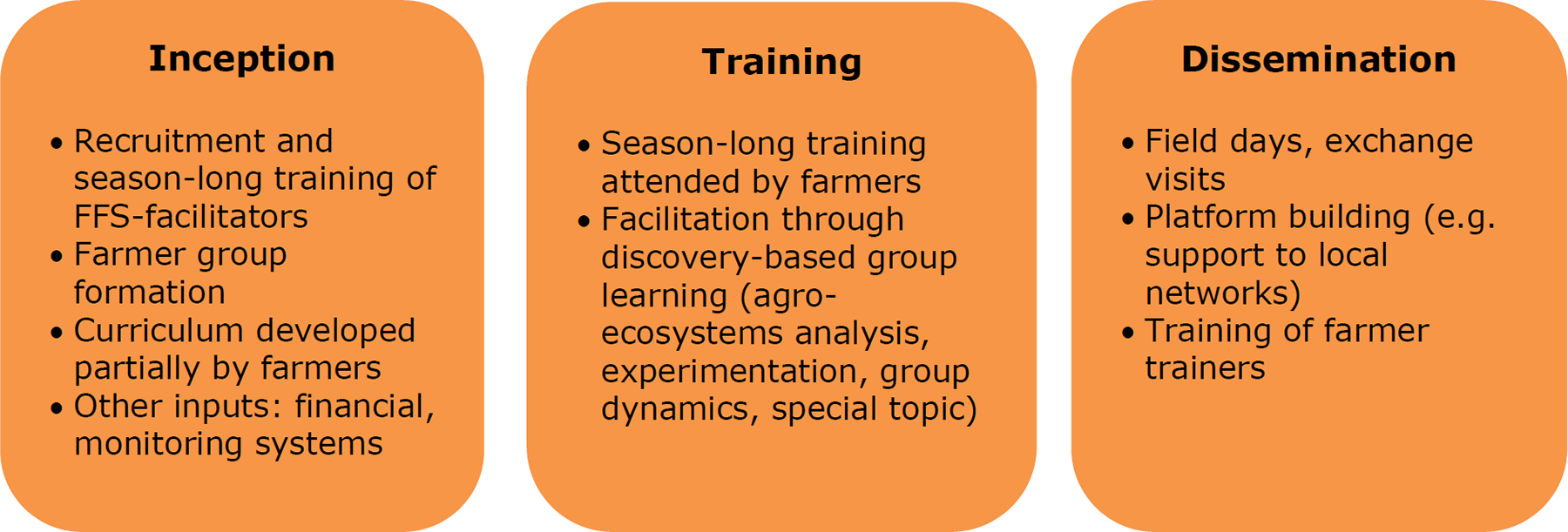
Components of a farmer field school intervention
The standard FFS training involves a field-based season-long programme overseen by an FFS-facilitator, with weekly meetings near the plots of participating farmers (Pontius et al., 2002). Each FFS typically has 20 to 25 participants, with farmers working together in smaller groups. FFS-facilitators can be extension agents or selected graduates from previous FFS who undergo a training-of-trainers course tailored to equip them to facilitate field schools (Braun & Duveskog, 2008). The facilitators should use experiential, participatory and learner-centred educational methods, including experimentation through use of demonstration plots using the new practices based on the FFS technology (e.g. integrated pest management) with existing (business-as-usual) “farmer practice” plots, to enable farmers to observe benefits (Pontius et al., 2002). Standard field school curriculum includes agro-ecosystem analysis, involving presenting pictorially the factors which affect crops, special topics comprising locally specific problems, and activities to improve group dynamics. In addition, exchange visits to other field schools are organised to promote lessons learning, as are field days, in which participants present course material and the results of their studies to the broader community. Diffusion to the wider community may also involve encouraging participating farmers to engage in informal farmer-to-farmer communication, training of farmer trainers or approaches to institutionalise field schools locally.
Broadening the farmer field school curriculum
While all FFS are supposed to be based on the same process, the approach can be adopted to suit particular needs, crops or contexts (Pontius et al., 2002). Thus, as FFS have been promoted around the world, the technology has been modified to address the needs of farmers in different contexts, and applied to other food staples, vegetables and cotton (Appendix A). In Africa, integrated production and pest management (IPPM) has been promoted. IPPM reflects a more “holistic” approach to improving production, in which pests and pesticide use are not necessarily the main production problems (Stathers et al., 2005). 2 Other variants include integrated disease management (IDM), integrated crop management (ICM), integrated plant nutrient management (IPNM) 3 and integrated water and soil management (IWSM). The main types of technology incorporated in FFS projects are shown in Figure 2, which indicates that IPM and pesticide management are the most common technologies that have been promoted.
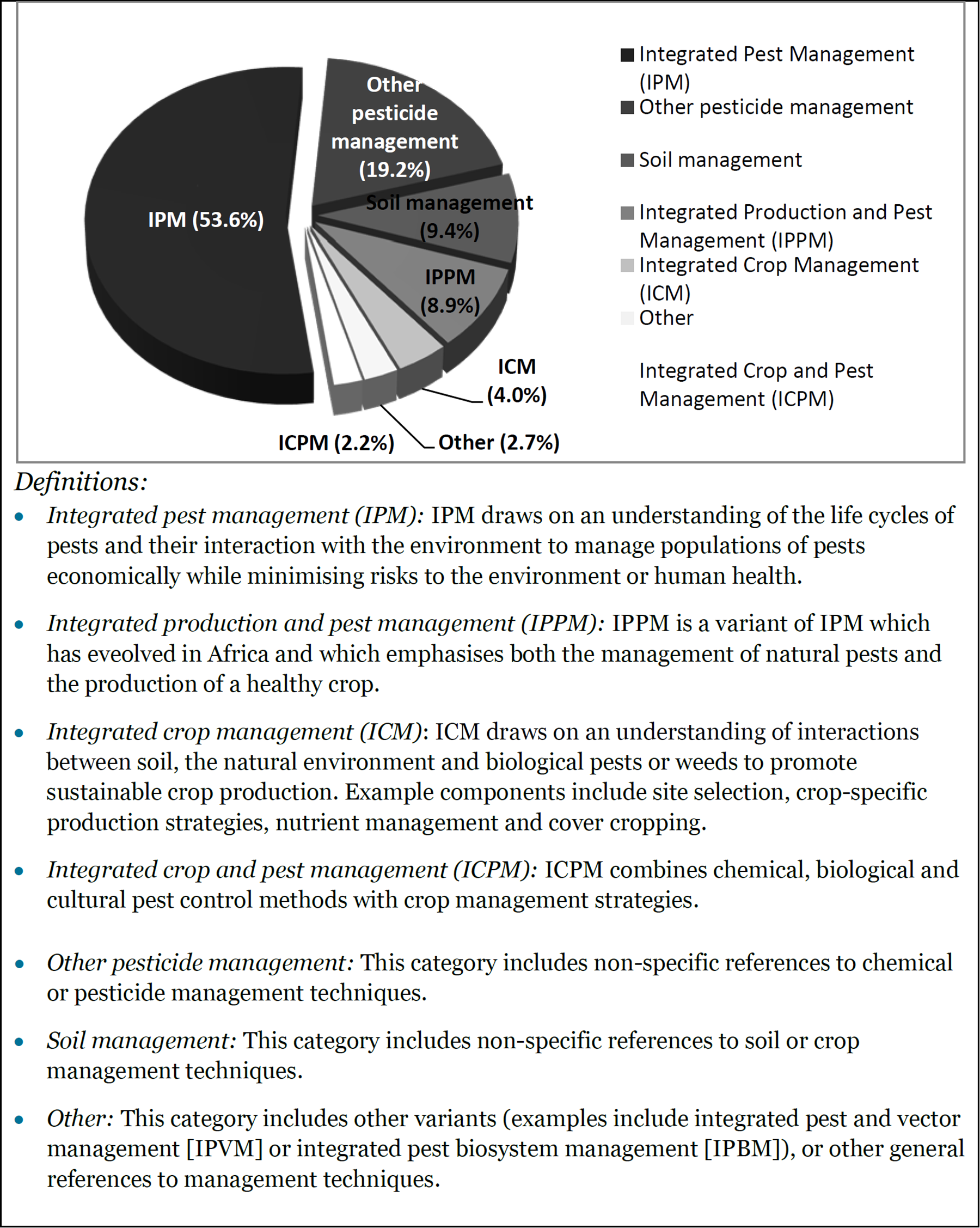
Technologies incorporated in farmer field school curricula (percentage of projects)
As the approach has gained prominence, FFS have been implemented using different intervention components. FFS have also been implemented alongside complementary interventions to improve access to inputs, markets or collectivisation. Figure 3 shows the curricula and complementary interventions incorporated in farmer field schools design. Most project designs include FFS inception, but relatively few project documents indicated that the FFS training or dissemination involved key curriculum activities such as agro-ecosystems analysis. A minority of projects incorporated input supply and/or produce marketing interventions.

FFS curricula and complementary components
FFS are seen as a way to overcome the traditional problems of extension in reaching and empowering disadvantaged farmers, particularly women in Africa (see, for example, Saito & Weidemann, 1990; World Bank & IBRD, 2009). In addition, the curriculum has also been broadened to tackle populations in particular contexts, such as Junior Farmer Field and Life Schools (JFFLS) which have been implemented with youth across Africa and include HIV-risk reduction in addition to the agriculture components more standard to FFS (Braun & Duveskog, 2008). Other variants, such as business or marketing FFS, are intended to develop additional skills which can improve farmer livelihoods, or to adapt the original approach for an alternative type of farming.
1.3 HOW FARMER FIELD SCHOOLS ARE SUPPOSED TO WORK
Farmer field school programmes aim to build farmers' capacity and promote adoption of better practices, and consequently improve farmers' lives in terms of agricultural outcomes, health, environment and empowerment. The FFS approach has roots in Paulo Freire's (1970) approach to “dialogical education” using discovery-based learning. The FFS process aims to enable farmers to internalise the advantages of the improved agricultural practices through learning by doing and observation. FFS aim to empower farmers by encouraging them to develop skills in problem-solving using “scientific” methods of analysis, while the group activities aim to empower farmers both within and outside their own communities and promote social cohesion through increased cooperation.
A hypothesised causal chain for farmer field schools is depicted in Figure 4, which links farmer field school delivery inputs with final outcomes for FFS participants and for neighbouring non-participants who benefit through knowledge spillovers, via the intermediate outcomes of capacity building and technology adoption. The causal chain is rooted in transfer-of-technology models of extension (Bennett, 1975; cited in Funnell & Rogers, 2011) due to the objectives of many field schools to disseminate technology such as IPM. However, a key objective of FFS may also be to empower farmers cognitively through skills development, organisationally through group activities, and politically through collective action (Friis-Hansen, 2008). As recognised by Mancini and Jiggins (2008, p. 540) FFS “have social goals beyond mere changes in pest-management techniques: goals that seek to position farmers as field experts, who collaborate with the extension staff to find solutions relevant to the local realities. FFS programmes emphasise farmers' ownership of development processes, partnership with other development agents, and group collaboration.”
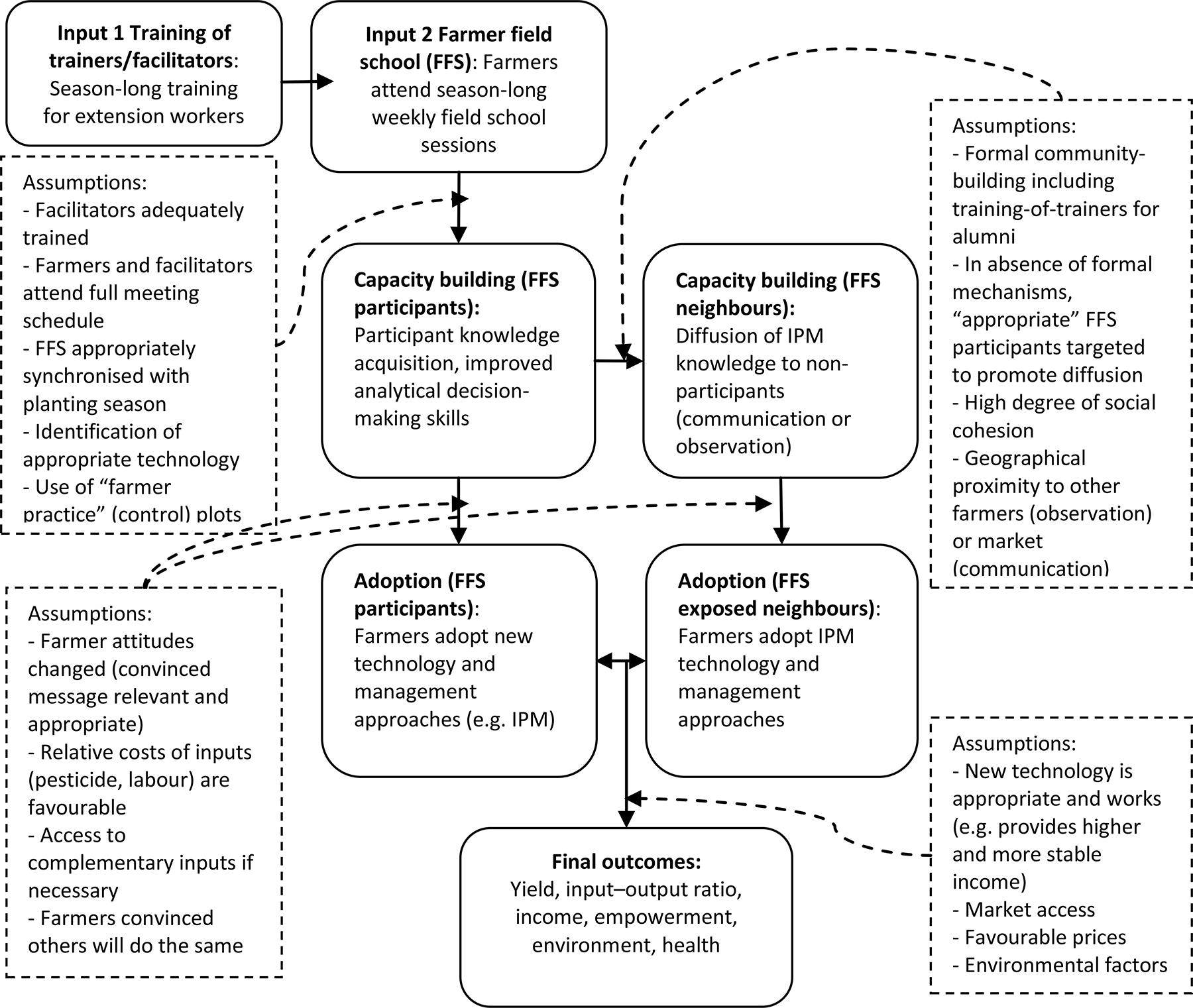
Farmer field school hypothesised causal chain
Underlying each link in the causal chain are the assumptions theorised to be important for changes to take place at each stage, and which therefore determine the extent to which impacts are likely to materialise in practice. These can be broadly grouped into intervention design and implementation characteristics, and local characteristics including those of farmers themselves.
For instance, with respect to implementation, facilitators are a key input. Facilitators may be “traditional” extension agents who have received training in the FFS approach, meaning they are required to move away from the top-down approaches to which they are familiar, and adopt a more participatory, learner-centred approach (Feder et al., 2004a). Facilitators should be adequately trained, involving season-long theoretical and practical training. Similarly, the relevance of the FFS curriculum to farmers – the extent to which the new practices are appropriate given inputs availability, and are observed to work compared with existing farmer practices (control plots which use standard approaches to pest management) – will likely influence farmers' attitudes and behaviour change. Indeed, Pontius et al. (2002) state that existing “farmer practice” plots should be a part of every FFS for comparison purposes.
Farmers also need to be trained adequately, so that they have attended sufficient meetings over the planting season, which means identifying the “right” farmers who are willing and able to participate in FFS training throughout the full season, and be able to implement FFS practices in their fields. Characteristics of local communities, such as heterogeneity in terms of land- and asset-holdings, ethnicity, education, gender roles and the degree of social cohesion, will determine the ability of the schools to reach appropriate beneficiaries, including disadvantaged farmers such as women.
In the case of IPM field schools, diffusion to neighbouring farmers who have not attended formal training may be necessary for sustained adoption due to externalities associated with pesticide overuse – that is, where the social costs of pesticide use for the community exceed the private costs to the individual farmers. 4 Approaches to diffusion may be through informal farmer-to-farmer communication, one-off activities such as field day visits, or formal attempts to institutionalise community-based field schools and conduct training-of-trainers programmes for FFS alumni (Figure 1) (Pontius et al., 2002). In the absence of such approaches, characteristics of local communities may be important determinants of the degree of diffusion of knowledge and practices from participants to non-participants.
The assumption that there will be some diffusion of IPM practices between farmers may not be an unreasonable one in principle for simple practices. However, FFS graduates may be limited in their ability to transmit all but the simplest of messages effectively to other farmers through informal means. 5 Guidelines from the Food and Agriculture Organization of the United Nations (FAO) on “community IPM” indicate formal approaches involving FFS alumni are considered necessary: “without post-FFS educational opportunities, there will be no community movement” (Pontius et al., 2002). Whether the diffusion mechanism is informal or formalised will, therefore, have implications for beneficiary targeting (Feder & Savastano, 2006). Without formal mechanisms, participants would ideally be selected if they have characteristics which will enhance diffusion, such as those respected in their communities and those with strong social networks. This may conflict with other objectives of FFS, such as targeting women farmers.
Contextual factors, notably weather conditions, soil fertility, plant disease and climate trends, are obvious factors determining production and yields. The policy environment is also important, including whether FFS are implemented in the context of complementary agricultural policies, including those relating to input supply and marketing. Market prices and market access, both to purchase inputs and sell produce, determine the value of production and therefore farmer income. The price of inputs such as pesticide relative to (opportunity costs of) labour is also likely to determine adoption of IPM and othertechnologies, where adoption involves substantial increases in demands on farmers' time. Indeed, FFS projects commonly incorporate complementary components, such as seeds or tools, setting up of farmer organisations and networks, and providing marketing training (Appendix A).
Finally, it is also possible that the technologies promoted by FFS do not act to change yields (the amount of crop produced per unit of land area), but still act to improve income and net revenues (value of production less input costs) by reducing pesticide costs, provided these are not offset by any net increases in other costs such as labour in applying the new technologies. Moreover, in contexts where pesticides and pest management are not necessarily the key constraints to production, improvements in productivity may not necessarily arise from reduced pesticide use but as a result of adoption of the other practices being promoted, such as soil management.
1.4 WHY THIS REVIEW IS NEEDED
Since the 1980s there has been a decline or stagnation in public expenditure on agriculture in most developing countries (Akroyd & Smith, 2007). Likewise, the proportion of official development assistance (ODA) going to agriculture is estimated to have declined from around 20 per cent in 1979 to a low of 3.7 per cent in 2006, and has remained around 5 per cent since (Cabral & Howell, 2012). As noted in the World Development Report on Agriculture, “extension services, after a period of neglect, are now back on the development agenda… [but] more evaluation, learning, and knowledge sharing are required to capitalize on this renewed momentum” (World Bank, 2007, p. 175). Poverty reduction strategies in 24 African countries also listed extension as a top agricultural priority (InterAcademy Council, 2004; cited in Davis, 2006). Nevertheless, age-old questions in agriculture remain, including how to raise yields and farmer incomes, how to ensure environmentally sustainable development, and how to empower the poorest farmers and particular groups such as women farmers in developing skills in adoption and resilience to shocks. There is increasing criticism as to whether extension services are capable of achieving these broad objectives, or whether a more intensive approach is required such as that provided by the farmer field school initiative.
Originally developed for rice crops in Indonesia in the 1980s by the FAO, farmer field schools have been introduced to at least 90 countries worldwide (Figure 5), by a range of organisations, producing 10–15 million field school graduates by 2008 (Appendix A). They are largely funded by multilateral development agencies and implemented by developing country governments and non-governmental organisations. Over half of all FFS projects have been based in Africa; however, the majority of beneficiaries (around 60%) have been Asian, indicative of the fact that some Asian FFS programmes have been implemented on a national scale. Figure 5 presents the growth in implementation of the FFS approach since the early 1990s, illustrating a marked increase in the number of projects in Asia and especially in Africa since 2000.
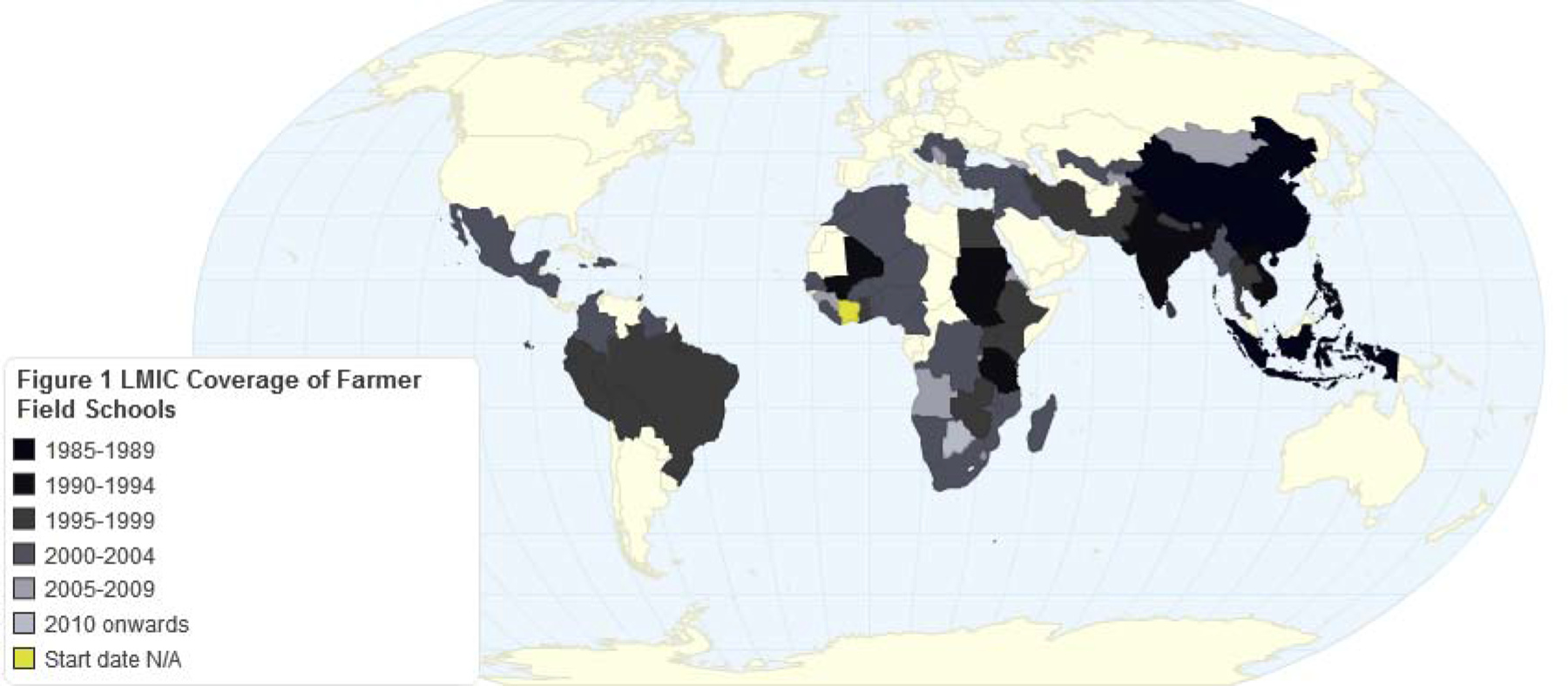
Coverage of farmer field schools in low- and middle-income countries (LMICs)
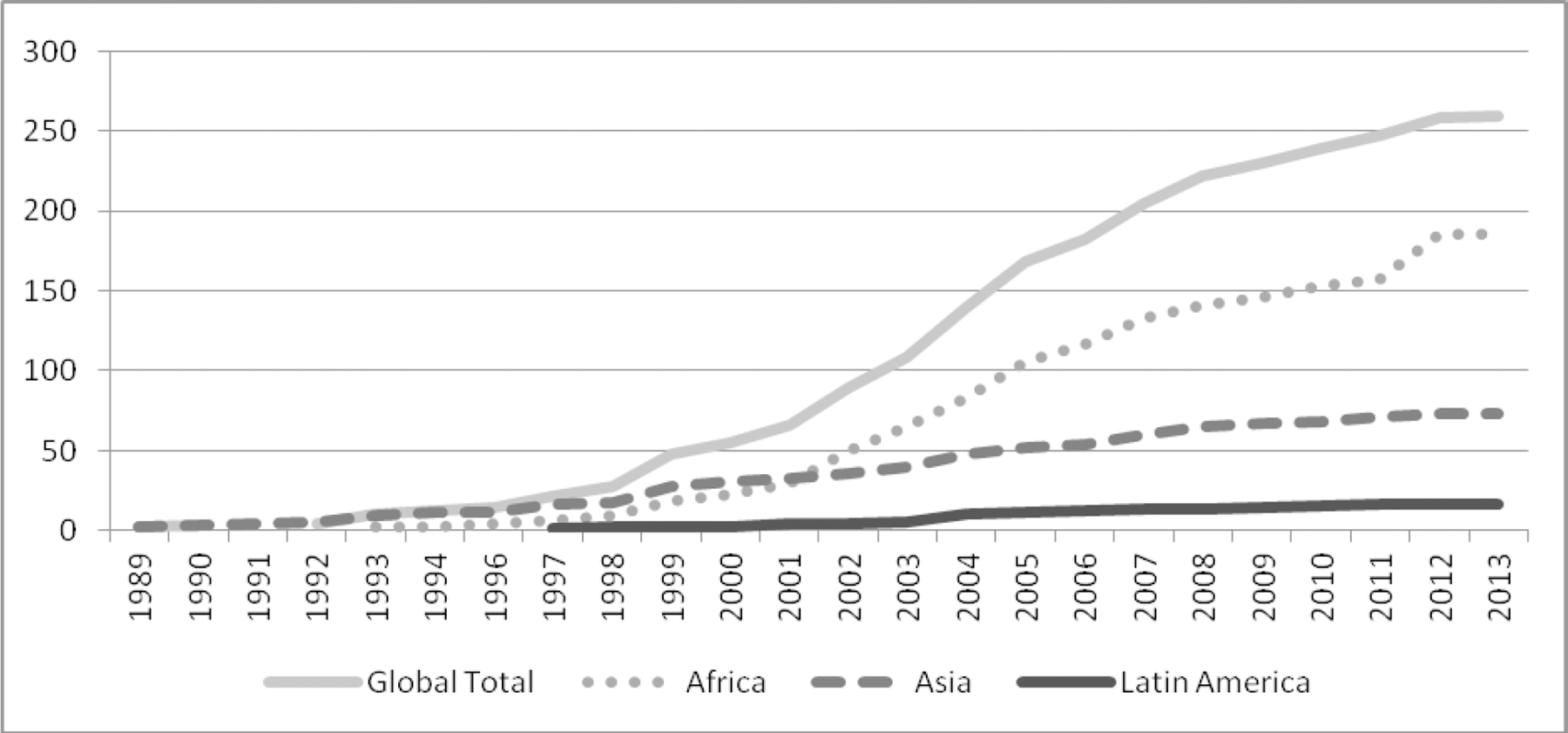
Cumulative number of farmer field school projects implemented
Hundreds of studies have evaluated farmer field schools. These studies provide conflicting conclusions on effectiveness. One particularly influential impact evaluation of the National IPM-FFS Programme in Indonesia concluded that “[t]he analysis, employing a modified ‘difference-in-differences’ model, indicates that the program did not have significant impacts on the performance of graduates and their neighbors” (Feder et al. 2004a, p. 45). The study appears to have been highly influential in the policy community, including contributing to the World Bank pulling out of the Global IPM Facility multi-donor trust fund (Kelly, 2005).
Reviews drawing on evaluations from more than a single context have tended to be rather more positive. Van den Berg (2004) synthesised 25 IPM-FFS evaluation studies, concluding that, “Studies reported substantial and consistent reductions in pesticide use attributable to the effect of training. In a number of cases, there was also a convincing increase in yield due to training … Results demonstrated remarkable, widespread and lasting developmental impacts” (p. 3). Van den Berg and Jiggins (2007) also argued that FFS have had additional benefits to those of IPM, including facilitating collective action, leadership, organisation and improved problem-solving skills.
However, Tripp et al. (2005) noted the lack of rigorous evidence on the effectiveness of the approach, despite the sizeable investments in FFS in Asia. Reviewing seven studies, they concluded that while “the FFS approach has undoubtedly succeeded in lowering insecticide use in a number of Asian rice examples, judgments on its overall impact await further study” (p. 1,711). They also found little evidence to suggest effective diffusion of IPM knowledge between FFS participants and non-participants, nor sufficient evidence to conclude that FFS groups continue on their own.
In addition to the debate about effectiveness, the scalability and financial sustainability of FFS has also been questioned. FFS are a particularly intensive intervention, with high costs in terms of both facilitation and opportunity costs of beneficiaries' time. Leading authors from the literature have therefore noted that FFS are unlikely to be a solution to problems of extension delivery, and only scalable under certain circumstances (Braun et al., 2006; Davis, 2006). Quizon et al. (2001) noted the lack of fiscal sustainability as a generic problem affecting large-scale public extension services, concluding that FFS face the same issues as other approaches. The cost per farmer is likely to be high compared with agricultural extension approaches and the evidence from Indonesia suggested a low rate of informal diffusion from direct beneficiaries of the schools to neighbours. 6 The authors suggested that as the situation for farmers, in terms of political power, governance systems and day-to-day interactions among farmers, is quite similar in many other developing countries in Asia and Africa, the results were relevant for discussions of similar extension activities in these areas. They also warned that, while pilot projects might indicate the viability of the FFS approach in certain circumstances, the issue of fiscal sustainability becomes particularly relevant when scaling up.
However, Braun and Duveskog (2008) argued that the relative cost-effectiveness of FFS should be put in the context of rural adult education rather than extension “when FFS are regarded as a form of public investment in farmer education to tackle rural poverty – and hence as a tool for achieving the Millennium Development Goals” (p. 19). Van den Berg and Jiggins (2007) also noted that discussions on the fiscal sustainability of FFS should take into consideration who will pay for the externalities of pesticide use.
The existing reviews provide some suggestive evidence of the effects of FFS, but come to widely different conclusions in a hotly debated, policy- and operations-oriented literature.
However, while single studies are unable to provide a complete picture of the evidence, none of the existing reviews draws on a systematic search for all available quantitative and qualitative studies, or applies inclusion criteria or approaches to critical appraisal sufficiently transparently. In addition, the conclusions of these reviews are based on significance-based vote counting, rather than sample-weighted meta-analysis of effects. 7 This systematic review thus aims to provide a systematic and exhaustive search, together with a comprehensive and unbiased synthesis of the existing evidence on FFS.
2 Aims and Report Structure
The primary objective of the review is to synthesise evidence on the effectiveness of interventions identified as “farmer field schools” and conducted in low- and middle-income countries. The review aims to provide an integrated synthesis based on analysis of two main research questions:
We followed Campbell and Cochrane Collaboration approaches to systematic reviewing (Shadish & Myers, 2004; Hammerstrøm et al., 2010; Becker et al., n.d.; Shemilt et al., 2008; Higgins & Green, 2011), and drew on theory-based impact evaluation (White, 2009). 8 To answer review question (1), we systematically collected and synthesised all relevant and available quantitative evidence from impact evaluations of FFS programmes. We used narrative review and, where possible, statistical meta-analysis, presenting outcomes along the theory of change (Figure 4), from intermediate outcomes such as capacity building, technological adoption and diffusion to indirect beneficiaries, to final outcomes such as agricultural yields, household income and other indicators of wellbeing in the areas of health, environment and self-esteem, examining heterogeneity in findings narratively and in meta-regression. Studies that measured outcomes at any point along the causal chain were eligible for inclusion, and evidence is presented outcome by outcome for all studies that reported each particular outcome.
Farmer field schools are complex interventions implemented using different methods of delivery in a range of different contexts. For the review to be useful to a broader group of decision-makers, we extended it by including qualitative studies to address review question (2), focusing on underlying factors that determine or hinder the effectiveness of FFS, following Noyes et al. (2011). 9 Most quantitative impact evaluations do not include research addressing this question so, as outlined in the following chapter on Approach, we adopted different inclusion criteria for studies addressing this question. We conducted the two syntheses in parallel, before integrating the findings in a narrative synthesis using the theory of change (Figure 4) as a framework for the analysis.
We also reviewed FFS project documentation to provide a global portfolio review of implementation experiences (Appendix A). 10
Figure 7 provides a detailed outline of the review process for review questions (1) and (2). The strategy for systematic searches and synthesis, elaborated in Chapter 3, was published in the study protocol (Waddington et al., 2012a). As is standard in reviews of development topics, a large number of initial search results were returned. Of the 28,500 potentially relevant papers identified, over 9,000 were identified from databases, 18,000 from Google or Google Scholar, 65 from bibliographic searches of reviews and 29 from contact with organisations and researchers. After applying inclusion criteria, 92 distinct impact evaluation studies (from 134 papers) and 20 qualitative studies (27 separate papers) were included in the review. A total of 337 FFS interventions were included in the portfolio review (Appendix A).
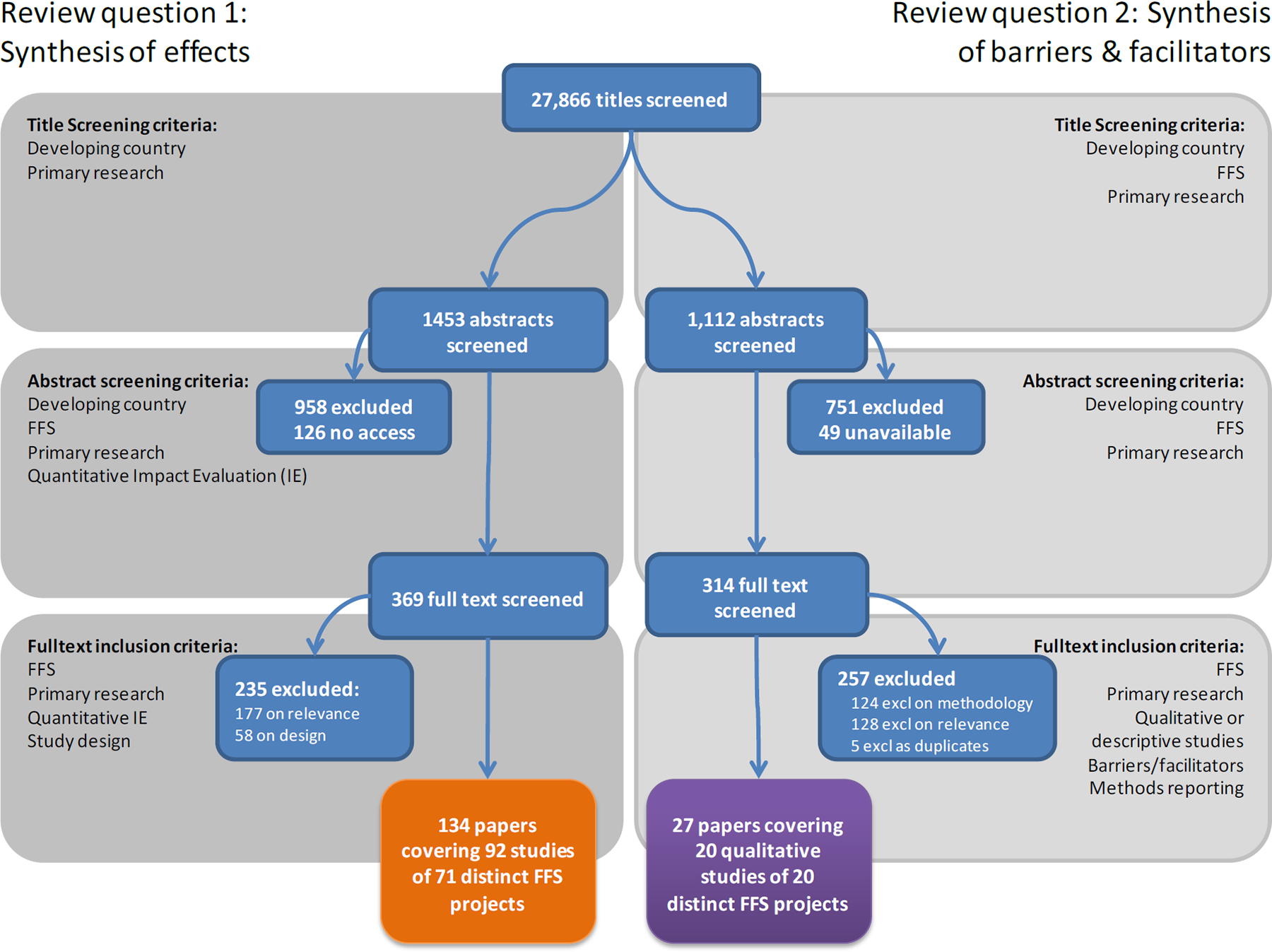
Review process
The remainder of the report is structured as follows. Chapter 3 on Approach summarises the review methodology. Chapter 4 presents the results from the synthesis of impact evaluative evidence, including quantitative meta-analysis, indicated on the left-hand side of Figure 7. Chapter 5 presents the results of the synthesis of barriers and enablers based on qualitative evidence, indicated on the right-hand side of Figure 7. Chapter 6 then presents the results of the integration of the two syntheses. Chapter 7 provides implications for policy, practice and research.
3 Approach
3.1 STUDY SELECTION CRITERIA
Studies included in the review met the following selection criteria.
Types of interventions
Studies needed to report specific “farmer field school” interventions. Interventions were identified as farmer field schools if they contained both of the following components: Involved intensive, facilitated group training, normally involving season-long weekly meetings and use of control plots farmed using standard farmer practices. Provided information on holistic techniques to inputs use, such as reducing use of pesticides and insecticides, improved use of fertiliser, or other production practices and disease control methods such as integrated pest management, integrated production and pest management, integrated crop management and integrated disease management.
It was often difficult to identify the exact components of the FFS, so the approach we took involved including interventions identified as “farmer field school” in the report, even where the FFS may have been designed or implemented differently. Studies were eligible that investigated provision of FFS alone or combined FFS with other intervention components, such as input or marketing support.
Types of participants
The review included farmers growing arable crops (“temporary” crops including food and cash crops) and permanent crops (such as cocoa, coffee and tea), living in developing (low- or middle-income) countries, as defined by the World Bank, at the time the intervention was carried out. Studies were included which collected and reported on data at the farm or household level. The review excluded programmes for livestock farmers, who received different types of training than crop farmers, and those for farmers based in high-income countries where the challenges faced in terms of poverty, land size, crops, and agro-ecological and environmental contexts are usually very different.
The review examined effects on two groups of beneficiaries: the farmers who participated directly in the field school and non-participating neighbour farmers who lived in the same communities as field school graduates and may have been exposed to the approach through their interactions with FFS-trained farmers (spillover effects) or more formal dissemination methods; effects for FFS farmers and neighbour farmers are analysed separately. We report information from studies that assessed outcomes for either type of beneficiary.
Types of comparisons
If farmers in low- and middle-income countries do have access to sources of information about agricultural practices, it is usually through visits from government or private-sector agricultural extension agents, through observation of public agricultural demonstration plots, or through agricultural extension provided by the private sector. Public extension may take the form of centralised or more decentralised systems (Birner et al., 2006). We included studies which compared farmers receiving FFS education with comparison groups who received no intervention, or agricultural extension services from another source, including IPM (or equivalent) training. We collected relevant information on the intervention received by comparison groups, and where possible calculated FFS effects across appropriate groups. To take one example, in Godtland et al. (2004), FFS farmers were chosen from among farmers who had previously received another extension implemented by a non-governmental organisation (NGO) – the Andino programme. Godtland and colleagues compared FFS plus Andino with farmers receiving the Andino programme only and with farmers not receiving either extension programme. We therefore used the FFS–Andino versus Andino comparison to calculate the net impact of FFS. Where we did suspect differential access to another relevant agricultural intervention in the comparison group, we conducted sensitivity analysis.
We would have preferred to limit the review to studies with comparison groups which were separated geographically from treatment groups to avoid possibilities of spillover (contamination). However, many studies reviewed did not report sampling procedures in sufficient detail to assess the geographic separation of groups. Thus, we included separate and non-separate comparisons, and assessed the likelihood of spillover effects in risk of bias analysis. We also conducted sensitivity analysis for potential spillover effects (contamination).
Types of outcome measures / data collected
Intermediate and final outcomes
We included all eligible studies to answer review question (1), irrespective of whether they reported impacts on intermediate or final outcomes. The review focused primarily on agricultural outcomes, including agricultural yields (production per unit of land), and net revenues (profits per unit of land) as indicated in the study protocol (Waddington et al., 2012a). We examined secondary intermediate outcomes including farmer knowledge and capacity and adoption of new approaches (e.g. reduction in pesticide use). We also examined secondary final outcomes including health, environment and empowerment outcomes such as feelings of self-esteem. Table 1 shows the different ways of measuring outcomes reported in included studies. Data on outcomes along the theory of change are reported outcome by outcome, for all studies reporting that particular outcome. Unless otherwise specified, outcome data are not reported along the theory of change by individual study.
Outcomes reported in effectiveness studies
Other data
To answer review question (2) we included evidence on barriers to and enablers of FFS effectiveness, diffusion and sustainability. This included process and implementation information together with measures of beneficiaries' attitudes and experiences with FFS.
Study design and methods of analysis
Review question (1): What are the effects of farmer field schools on intermediate and final outcomes, for FFS particiants and neighbour farmers?
Studies eligible for inclusion in the quantitative synthesis used experimental or quasi-experimental study designs. Study designs which collected longitudinal data at baseline and endline and those using cross-sectional (endline) data only were included. In addition, data needed to be collected at the farm or household level contemporaneously in both groups. Studies that used the following methods of allocating FFS to participants were eligible: allocation rules based on prospective randomised or quasi-randomised (e.g. alternate) assignment (randomised controlled trials or RCTs, and quasi-RCTs); assignment based on other known allocation rules, including a threshold on a continuous variable (regression discontinuity designs or RDDs) or exogenous variation in the treatment allocation (“natural experiments”); assignment based on other rules, including self-selection by programme planners or participants, provided data were collected contemporaneously in a comparison group (non-equivalent comparison group design), or where at least three data points were collected for FFS participants both before and after a discrete intervention (six-period interrupted time series or ITS
11
).
We included studies which used statistical matching (e.g. propensity score matching or PSM, or covariate matching), regression adjustment (e.g. difference-in-differences or DID, and single difference regression analysis, instrumental variables or IV, estimation and Heckman selection models), as well as other cross-sectional or longitudinal designs which used less rigorous approaches. Given the breadth of designs included, we conducted rigorous assessment of internal validity based on risk of bias categories (see below).
Excluded studies are those which did not use a comparison group design, or employed less than a six-period ITS design. For example, Tin (2009) used a pre-test post-test design with no comparison group, and Armen et al. (2009) collected post-test data among field school participants only (see Appendix B).
Review question (2): What are the enablers of and barriers to FFS effectiveness, diffusion and sustainability?
We included qualitative studies and studies using descriptive statistics which met the following criteria: reported on interventions as identified as “farmer field schools”, although not necessarily the same interventions as those included in the review of effects (review question 1); assessed determinants of service delivery quality, knowledge acquisition, adoption of technological improvements, diffusion, or sustainability (either directly or indirectly – for example, studies that were relevant to addressing barriers to and enablers of FFS effectiveness); were based on primary data collected from clients, FFS facilitators, extension agents or experts analysed using qualitative methods or descriptive statistics; reported some information on all of the following: the research question, procedures for collecting data, sampling and recruitment, and at least two sample characteristics.
We adopted a two-stage approach to inclusion of the qualitative studies, which, in addition to removing studies based on the usual relevance criteria (intervention, population, relevance to research question, study type and location), removed studies of particularly low quality in the first round (Thomas et al., 2003; Spencer et al., 2003), using the criteria set out in point 4 above. We then assessed the quality of the included studies using a detailed quality appraisal checklist in the second round, as described below.
Given the limited reporting of programme and contextual characteristics in the impact and qualitative evaluation literature, in the final stages of the review we systematically searched for implementation documentation (see Appendix A for details), collecting data on project, programme and implementation characteristics which we linked to the impact evaluations in order to conduct more in-depth analysis of moderators. This analysis was conducted a posteriori.
3.2 SEARCH STRATEGY
Searching the social science literature can be challenging as it is not as well indexed as the medical literature. We developed the search strategy based on the guidance provided in Hammerstrøm et al. (2010) and using “pearl harvesting” methods (Sandieson, 2006).
We searched a range of different databases, including general social science databases, agriculture subject-specific databases and libraries, as follows: AgEcon, CAB Abstracts, Web of Knowledge (Social Sciences Citation Index and Social Science Conference Proceedings), International Bibliography of the Social Sciences, EconLit and the US National Agricultural Library (Agricola). For the updated searches, we additionally searched an EBSCO multifile group of databases: Academic Search Research and Development, Africa-Wide Information, Business Source Complete, SocIndex. The list of databases, together with the time of original search and update is provided in Appendix B. Detailed search strategies, together with the number of hits for each database, can be provided by the authors on request.
We used the following basic search strategy, adapted for each database to include thesaurus terms where these were available:
“farmer* field* school*” OR ((“integrated” AND “management”) AND (“field* school*” or “farmer* field*”))
The following example of a full search strategy is for CAB Abstracts using the Ovid platform incorporating both text words and thesaurus terms: (integrated control or integrated pest management or crop management).sh. (((integrated adj (production or management or pest or nutrient)) or crop management).ti,ab. 1 or 2 on-farm training.sh. (field school* or farm* school* or farmer* field* or (farmer* adj field* adj school*)).ti,ab. (practical education or extension education or education programmes or community education or agricultural education or inservice training or vocational training or innovation adoption).sh. extension/ (participatory extension or agricultural advisory or agricultural extension or rural extension).ti,ab. 6 or 7 or 8 exp developing countries/ or exp africa/ or exp asia/ or exp south america/ or exp central america/ or exp latin america/ or exp pacific islands/ or exp middle east/ or mexico/ 3 and 9 and 10 5 and 9 and 10 4 or 11 or 12
To ensure maximal coverage of unpublished literature, we searched JOLIS, BLDS, IDEAS, the Networked Digital Library of Theses and Dissertations, Index to Theses, the ProQuest dissertation database and the 3ie impact evaluation database, adapting the search strategy above for each database. We also searched Google Scholar, screening the first 1,000 hits. In addition, we searched the websites of a large number of international organisations, development agencies and non-governmental organisations active in the sector. Details about the procedures followed when searching each website, together with the number of hits for each database, can be provided by the authors on request.
We screened the bibliographies of included studies and existing reviews for eligible studies. We also handsearched development journals and identified and contacted key researchers and organisations working in the field of agricultural extension, as specified in the study protocol. All searches were updated in October 2012. Further details are provided in Appendix B, which presents the full search strategy and dates of searches. In the final stages of the review we also conducted a systematic search for project implementation documentation, documented in Appendix A. Titles and abstracts were screened against the inclusion criteria and relevant records were downloaded into the reference management software EndNote. The initial records search was conducted by two reviewers, who were over-inclusive to ensure relevant studies were not omitted because sufficient information was not reported in title or abstract. Two reviewers independently reviewed the downloaded abstracts in more detail to determine which papers should be retrieved and reviewed at full text, and included in the review.
3.3 DATA COLLECTION AND ANALYSIS
Selection of studies and data extraction
Two independent reviewers assessed the full text papers against the inclusion criteria. Discrepancies were resolved by consensus or by a third author if needed. Owing to the broad study design eligibility for impact evaluations, there was only one disagreement on inclusion, relating to a participatory agricultural extension project reported in Smale et al. (2010), which was judged as ineligible due to lack of relevance. Five reviewers extracted data from included studies.
JH extracted data from included papers and then two reviewers (JH and HJW) made risk of bias assessments and effect size calculations referring to the original papers. For studies assessed as having medium risk of bias, effect sizes were calculated by bother reviewers using Microsoft Excel. In all other instances, JH extracted and calculated effect sizes and HJW reviewed a random selection of ten papers. There were no disagreements on risk of bias status or effect size calculation for medium-risk-of-bias studies. A Campbell Collaboration peer reviewer disagreed with the positive assessment of ‘other risk of bias’ for many studies due to lack of blinding of outcome assessors and data analysts, which we subsequently amended by downgrading this risk of bias criterion for relevant studies. There were five effect size disagreements in total (from three papers) for the high-risk-of-bias studies. Disagreements were resolved through an audit of data extraction spreadsheets by the lead reviewer (HJW).
Two reviewers (BS and MV) independently conducted the critical appraisal of studies included in the qualitative synthesis using an adapted version of the CASP checklist as described below, with any disagreements resolved by a third author (PD). We used the FFS programme theory, as well as Rogers' theory of diffusion (2003) to develop a data extraction sheet for the studies included in the qualitative synthesis a priori. The data extraction sheet is provided in Appendix B. Three reviewers (BS, DP and MV) extracted information from included studies, using NVivo and Excel. Two reviewers then checked the coding of all the included studies, extracting any additional information missed by the first coder.
Critical appraisal
Review question (1): Critical appraisal of studies of effects
Studies were critically appraised according to risk of bias in internal validity and external validity (generalisability), and publication bias. The assessment of risk of bias was based on: 1) quality of attribution methods (addressing confounding and sample selection bias); 2) the possibility of spillovers to farmers in comparison groups; 12 3) outcome and analysis reporting biases; and 4) other sources of bias (Appendix C). Risk of bias was assessed on both study design and implementation of the evaluation methodology. “Low-risk-of-bias” studies were identified as those in which clear measurement of and control for confounding was made, including selection bias; there were no sources of unobserved confounding which were likely to affect our degree of confidence in the findings; intervention and comparison groups were described adequately (in respect of the nature of the interventions being received) so that risks of spillovers or contamination were small; and where reporting biases and other sources of bias were unlikely. We rated the likelihood of spillover effects as low when comparison farmers were living in a different village from the farmer field school participants.
Studies were identified as “medium risk of bias” when there were moderate threats to validity of the attribution methodology, or likely risks of spillovers or contamination (arising from inadequate description of intervention or comparison groups or possibilities for interaction between groups such as when they are from the same community), or possible reporting biases.
“High risk of bias studies” were all other studies, including those where the study design was of questionable internal validity (such as those where comparison groups were not matched on observables, differences in covariates were not accounted for in multivariate analysis or where there were serious threats to the validity of the statistical procedure used to deal with attribution), or where there was evidence for spillovers or contamination, and reporting biases were evident. Two reviewers (JH and HJW) undertook the critical appraisal, the results of which are presented in Appendix F. 13
The assessment of external validity of studies (generalisability) was based on two sources of information. Firstly, data were collected on the sampling methodology to assess whether the whole population or a random or purposive sample of FFS farmers and neighbours were covered. Second, the socioeconomic and demographic characteristics of farmers in the included studies were compared to average characteristics of farmers to assess whether FFS farmers were more or less representative of farmers in developing countries. We attempted to reduce publication bias by searching for and including unpublished studies in the review. However, we also assessed the likelihood of file-drawer effects resulting from selective outcome reporting and conducted statistical tests for under-reporting of small sample studies with negative or insignificant findings using funnel plots and Egger's (Egger et al., 1997) tests for those outcomes with more than ten observations.
Review question (2): Critical appraisal of studies examining barriers and enablers
We assessed the quality of included studies using an adapted version of the Critical Appraisal Skills Programme checklist (CASP, 2006), making judgments on the adequacy of reporting, data collection, presentation, analysis and conclusions drawn. The checklist is presented in Appendix C. In accordance with our inclusion criteria we filtered out studies of particularly low quality (Hannes, 2011) and studies where questions 1–5 on the checklist were assessed as “No” were excluded at this stage. The critical appraisal was conducted by two reviewers independently (results reported in Appendix F). Any discrepancies were resolved through discussion, with a third person acting as an arbitrator.
Measures of treatment effect
Calculation of effect size
We calculated effect size estimates, standard errors and 95 per cent confidence intervals using data provided by included studies, where possible. We report two types of effect sizes in this review. All outcomes were measured using continuous variables. We calculated response ratios to measure effects, which are expressed as the difference in outcome in the intervention group as a proportion of the outcome in the comparison group. The response ratio (RR) is centred around 1, which is the point of “no effect”; the distance above and below the no-effect point are translatable as percentage changes in the outcome in the treatment group over the comparison, giving the same interpretation as a risk ratio. Thus, an RR of 1.10 translates as a 10 per cent average increase in the treatment condition, while an RR of 0.90 would translate as a 10 per cent average reduction.
The response ratio has the twin advantages of ease of interpretation and ease of calculation, since it requires less information than the standardised mean difference to compute. However, the use of the response ratio is subject to limitations for some variables, since it is only meaningful when the outcome is measured on a true ratio scale that has a natural zero point, although is unlikely to be equal to zero in practice (Borenstein et al., 2009). Thus, we calculated RR for some of the outcomes, including pesticide use, environmental measures estimated from pesticide use, production yield and revenues, and variables measuring probabilities such as disease incidence, and empowerment. In the cases of knowledge test scores and indices of adoption of practices, we estimate the Hedges' g (sample size corrected) standardised mean difference (SMD) which measures the effect size in units of standard deviation of the outcome variable.
We have used appropriate formulae to calculate zero-order and partial effect sizes, respectively, from (unadjusted) bivariate and (adjusted) multivariate specifications. Appendix D provides details of all effect size calculations.
However, caution is needed regarding the synthesis since most of the studies included in the review of effects, including all of the studies assessed as being of medium risk of bias, have used multivariate specifications in their analyses. As such, the meta-analysis synthesises both partial and bivariate effect sizes. However, effect sizes are only strictly comparable in studies employing a common model, meaning that “suitable proxies for the same constructs [i.e. the outcome variable, treatment variable and covariates] are included in all the studies being synthesized” (Keef & Roberts, 2004, p. 103). This is due to the degree of correlation between the variables included in the model, over and above any problems due to model misspecification. In other words, the partial effect size based on the regression coefficient measures the treatment effect “holding all other variables constant”. It is therefore measuring a different quantity to the bivariate relationship where the treatment effect is correlated with the other explanatory variables. The partial and bivariate effect sizes are equal only where coefficients of explanatory variables are the same in treatment and comparison groups (the “constant slopes” assumption), as would be indicated, for example, by insignificant interaction terms between treatment variable and covariates (ibid.).
As indicated in Appendix D, several solutions have been proposed to address this problem. Becker and Wu (2007) notably propose drawing on the variance–covariance matrix from the included studies to estimate generalised least squares meta-regression analysis. However, there are several problems in applying Becker and Wu's solution. First, not all multivariate models control for the same covariates, nor should models estimated for different study designs using data collected in different contexts necessarily do so. And where they do use common covariates, the variance–covariance matrices are seldom reported and difficult to obtain. Indeed, we were not able to identify any included studies in this systematic review which reported the full variance–covariance matrix.
We have opted not to eliminate studies which did not report bivariate effect sizes from the synthesis, due to the loss of information this would entail and the likely high risk of bias in included studies which did not use multivariate specifications (since none of the studies used randomised assignment or similar design-based methods to reduce biases). While the risk of bias assessment evaluated likely specification errors, included studies did not report diagnostic test statistics for multicollinearity or results of models estimated with full interaction terms. Our RR and g effect size calculations therefore implicitly assume zero correlation between treatment effect variable and other covariates in the model. However, many of the commonly used covariates (socioeconomic status, demographic characteristics and location) in the farmer field schools literature are likely to be correlated with the treatment, violating the constant slopes assumption. With the aim of partially ameliorating this problem, where different studies did report bivariate and partial effect sizes for a particular outcome, we have conducted sensitivity analysis to examine evidence for systematic differences (with the corollary that these are indirect comparisons across studies, not direct comparisons of bivariate and partial effect sizes within the same study).
Dependent effect sizes
We only included one effect estimate per study in a single meta-analysis. Where multiple outcomes were reported from alternate specifications, we selected the specification according to likely lowest risk of bias in attributing impact, for example the most appropriately specified regression equation, which may in some instances be the least parsimonious. In some cases, where studies reported multiple dependent effect sizes, for example according to different outcome sub-groups (such as the paper by Ricker-Gilbert et al., 2008, which reported simple, intermediate and complex knowledge), we calculated a “synthetic effect size” based on the sample-weighted average, using appropriate formulae to recalculate variances according to Borenstein et al. (2009, chapter 24), making covariance assumptions as necessary (more information is available in Appendix D). We used the same approach where studies reported multiple effect sizes according to different follow-up periods, although we also discuss in the report differences in reported follow-ups for those studies which did so. Where studies reported multiple effect sizes according to sub-groups of participants, we report data on relevant sub-groups separately (as in the case of FFS participants and neighbours).
We report data in the meta-analysis according to the paper in which the effect size originated. However, we attempted to avoid synthesising dependent effect sizes from multiple studies in any single meta-analysis by linking papers prior to analysis, and conducting sensitivity analysis as necessary. This was deemed necessary in the case of Feder et al. (2004) and Yamazaki and Resosudarmo (2008), which replicate analysis of the same data. In a number of cases, information has been collected on the same programme at the same or different periods of time, but in most cases this did not cause problems for the analysis since the papers either reported data on different outcome constructs which are eligible for inclusion in separate meta-analyses, or they did not report sufficient information on standard deviations or outcome means to extract effect sizes.
For example, David and Asamoah (2011) reported knowledge outcomes based on a survey of farmers in 2007-08 in Ghana, while Gockowski et al. (2010) reported on adoption and yields for farmers in the same programme in 2005; David (2007) and Wandji et al. (2007) also reported outcomes in Cameroon for the same multi-country programme in West Africa as Gockowski et al. (2005), although the latter only reported impacts on adoption and yields in the project areas of Nigeria. Chi et al. (1999) and Murphy et al. (2002) both collected data on the FAO National IPM Programme in Vietnam, but only Murphy reported sufficient information to estimate the effect size. Mutandwa and Mpangwa (2004) and Maumbe and Swinton (2003) both reported on cotton IPM-FFS in Sanyati District, Zimbabwe, but only Mutandwa and Mpangwa presented statistical information. Dankyi et al. (2005) and Carlberg et al. (2012) reported different outcomes for the same programme, as did Reddy and Suryamani (2005) and Pananurak (2010) for the same Indian programme; DANIDA (2011) and Islam et al. (2006) reported data on the same Bangladesh programme but for different outcomes and different years. Similarly, Friis-Hansen and Duveskog (2012) and Friis-Hansen et al. (2004) collected data on empowerment and adoption outcomes, respectively, for the FAO's East African IPPM-FFS Pilot Project in Uganda, while Davis et al. (2012) collected data on agricultural outcomes for the expansion phase of the same project. Torrez et al. (1999) reported on the pilot of the IPM programme for potatoes in Bolivia evaluated in Bentley et al. (2007), although Bentley and colleagues do not report sufficient information on sample distribution to calculate effect sizes.
There are cases, however, where effect sizes were likely to be dependent. 14 Hiller et al. (2009) and Waarts et al. (2012) both reported on the same outcomes for a pilot and up-scaled tea IPPM project in Kenya, and Pananurak (2010) and Wu (2010) reported, respectively, short-term (one-year follow-up) and medium-term (three-year follow-up) outcomes from the same survey of households in China for yields. In these cases we included results for the scaled-up project (Waarts et al., 2012) and longer-term follow-up (Wu, 2010) in meta-analysis, discussing differences by follow-up time period in the report narratively. 15 In the case of the Indonesian National IPM Programme, two papers reported analyses of the same data (Feder et al., 2004a; Yamazaki & Resosudarmo, 2008). Given the prominence of these papers in the literature, in this case we opted to assess sensitivity of meta-analysis findings to inclusion of these studies rather than calculate a synthetic effect size (Appendix G reports results from sensitivity analysis excluding these studies; results are not affected).
Rejesus et al. (2010) and Huan et al. (1999) estimated impacts on the National IPM Programme in Vietnam, collecting data at different points in time. Only a subset of observations appeared to be from the same province of Long An. However, we used the results from Rejesus on the grounds of preference according to risk of bias, dropping the higher-risk-of-bias observations in Huan et al. (1999). Finally, there were two instances of studies which reported two measures of the same adoption construct – Yang et al. (2005) and Khan et al. (2007), which both reported pesticide use and cost outcomes – in which we included only pesticide costs in the pooled meta-analysis of pesticide adoption.
We have identified effect sizes in the meta-analysis forest plots by author citation and country location in the main text. However, we also show the same forest plots identified by programme name in Appendix G, so that readers can see which FFS programmes are included within each meta-analysis.
Unit of analysis
We provided an assessment of the unit of analysis error for the included studies based on whether the included studies account for differences in demographic and socioeconomic household and village characteristics across individuals in different clusters (Appendix F). For those studies that reported moderate or high probability of relevant unit of analysis error, corrections were applied to the standard errors and the confidence intervals of the effect size using the following formula (Higgins & Green, 2011):
where m is the number of observations per cluster and ICC is the intra-cluster correlation coefficient, which we assume to be o.05. 16 We used this formula to correct for likely unit of analysis errors in four studies (Bunyatta et al., 2006; Palis, 1998; Rejesus et al., 2010; Ricker-Gilbert et al., 2008). The nature of reporting on cluster assignment in the original studies in the majority of cases meant that we were not able to reach firm conclusions about unit of analysis errors. We therefore conducted sensitivity analysis in which additional studies assessed as being of “unclear risk” were corrected for unit of analysis errors (Appendix G).
Missing data
Where possible, we contacted primary study authors to obtain missing information in order to facilitate effect size extraction and risk of bias analysis. Given the large number of studies included in the review, we limited contact to authors of studies which were originally assessed as of medium risk of bias (no studies were originally assessed as of low risk of bias).
Moderator analyses
The coding sheet contained in the protocol (Waddington et al., 2012a) indicated the variables we expected to include in moderator analysis a priori. We identified effect moderators according to likely contextual factors which could affect outcomes, such as geographical region, crop type, implementation characteristics and length of follow-up period. Some moderator variables based on intervention and farmer characteristics were determined a posteriori following the review of qualitative literature. We used programme name and country to link across quantitative, qualitative and project portfolio implementation documentation to enhance the analysis of moderators. We report all moderator analyses conducted.
Methods of synthesis
We synthesised quantitative data on effectiveness in order to assess the direction and magnitude of effects in particular contexts, and mixed methods (quantitative and/or qualitative) data on barriers and enablers.
Review question (1): Effectiveness synthesis and sensitivity analysis
We synthesised quantitative information on impacts using inverse-variance weighted statistical meta-analysis. We implemented random effects meta-analysis because we can reasonably expect effect sizes to differ across studies due to a range of factors including contextual variation (e.g. relating to the location, type of crop, beneficiary groups, intervention design and implementation process and follow-up period) and study design, over and above the effects of chance alone on findings. Random effects meta-analysis produces a pooled effect size with greater uncertainty attached to it, in terms of wider confidence intervals than a fixed effect model.
We reported effect sizes on predefined sub-groups of interest, including FFS participants and neighbouring farmers potentially exposed to knowledge, to assess the extent of spillovers. We also investigated sources of effect heterogeneity according to contextual moderators and factors relating to study design. As noted above, there are important issues relating to comparability of bivariate and partial effect sizes (Keef & Roberts, 2004; Becker & Wu, 2007; Aloe & Thompson, 2013), due to likely collinearity between treatment variable and commonly used covariates such as socioeconomic status and demographic characteristics. We therefore conducted sensitivity analyses to examine whether there were any systematic associations with effect size magnitude.
Effect sizes shown using forest plots were synthesised in inverse-variance weighted random effects meta-analysis, estimated using Stata software (Stata Corporation, College Station, TX, USA). All response ratio analyses were conducted using the natural logarithm of the effect size, with results exponentiated back to the response ratio metric for forest plots and discussion.
Review question (2): Barriers and enablers synthesis
For the synthesis of evidence relating to question (2), we conducted the synthesis in two stages, using the hypothesised programme theory as our overall framework throughout. After having completed the detailed coding of all of the included studies we re-reviewed the coding and identified descriptive findings which remained close to the findings in the primary studies (following Thomas & Harden, 2008). We summarised the descriptive findings across studies, using headings corresponding to the key stages of the FFS programme theory (and the categories used for data extraction) to structure our synthesis. The full text of this synthesis is provided in Appendix H.
The descriptive synthesis provided the basis for a more analytical synthesis. We analysed the descriptive findings across studies in detail, and identified themes relating to potential barriers and enablers of FFS effectiveness. We then reviewed and compared the original FFS programme theory with the emerging evidence on barriers and enablers, and revised the theory and assumptions to reflect the findings of our synthesis.
Integrated synthesis (review questions 1 and 2)
We used the programme theory (Figure 4) as a framework for integrating the findings from the two syntheses (Noyes et al., 2011) with the aim of providing an integrated narrative synthesis along the causal chain addressing the objectives of the review. We used an iterative approach, in which the intermediate outcomes and assumptions underlying the causal chain were further developed as part of the analytical approach. We used programme names to link studies included in quantitative, qualitative and project portfolio analyses to facilitate moderator analysis. We discuss the implications of the findings for policy, implementation and research.
4 Results of Effectiveness Synthesis
4.1 SEARCH RESULTS
This section reports the results of the synthesis of quantitative studies addressing review question (1) on the effects of farmer field schools on intermediate and final outcomes for FFS participants and non-participating neighbour farmers. We discarded 28,156 search records from the quantitative synthesis at the title or abstract stage, as they did not meet the inclusion criteria, being irrelevant to the topic (Figure 8). Of the 369 potentially relevant full text copies which we were able to obtain, 92 evaluation studies were included in the review of effects representing 71 FFS interventions conducted in 25 countries. All studies reported in English except one in Spanish (Orozco Cirilo et al., 2008). Studies reported on any intermediate or final outcomes along the causal chain, some reporting only findings for single outcomes, others reporting findings on multiple outcomes.
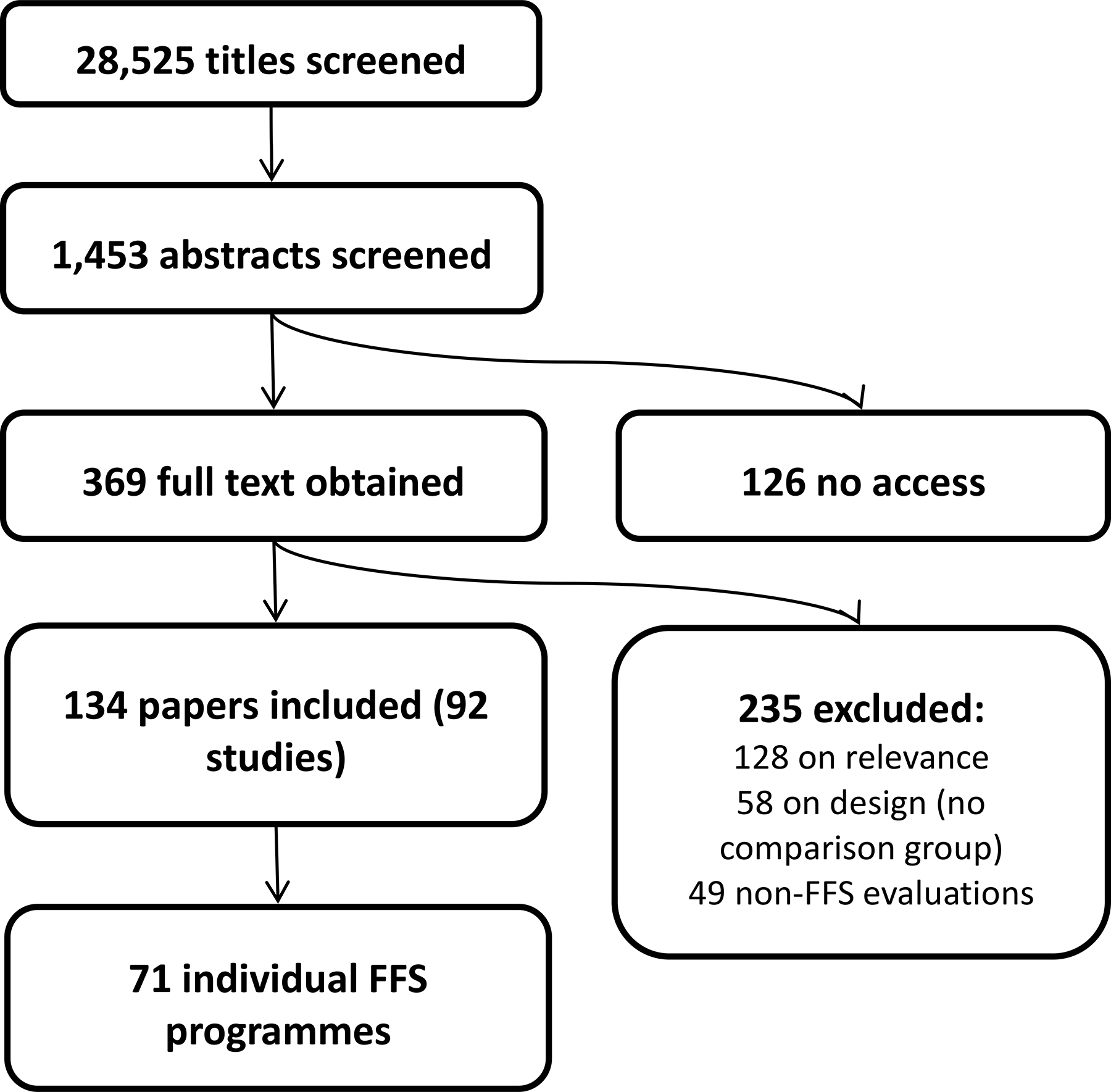
Quantitative synthesis search results
4.2 STUDY DESCRIPTIVE INFORMATION
Table 2 summarises descriptive information (reported in full in Appendix E) on the 92 included impact evaluation studies measuring effectiveness on a range of intermediate and final outcomes across the causal chain. Studies were identified from all global regions: 24 in East Asia, 25 in South Asia, 11 in Latin America, 1 in Central Asia and 31 in Sub-Saharan Africa. Most studies evaluated integrated pest management (IPM) and, particularly in Africa, integrated production and pest management (IPPM) farmer field school curricula, although a number implemented training on other intensive input management approaches, such as integrated crop management (ICM), integrated disease management (IDM) and integrated soil management (ISM).
FFS was provided as part of a multi-component intervention package alongside additional intervention components in 11 studies, which included support in procuring inputs and/or marketing produce (Table 2). Sixteen studies collected data from two treatment groups, the FFS participants and the non-participating neighbour farmers living in close proximity to participants (usually in the same villages) who may benefit from knowledge spillovers via contact with FFS farmers.
Included impact evaluation studies: summary descriptive information by region
Notes: FFS type: IPM=integrated pest management; IPPM=integrated production and pest management; ICM=integrated crop management; ICPM=integrated crop and pest management; IDM=integrated disease management; ISM=integrated soil management; ISNM=integrated soil nutrient management. Study design: DID=difference-in-differences; IV=instrumental variables; PSM=propensity score matching.
Source: based on data reported in Appendix E and Appendix F.
The studies collected data on a range of outcomes. Intermediate outcomes were collected for knowledge (32 studies) and adoption (59 studies). Agricultural outcomes were frequently measured (45 studies), usually in terms of physical measures of production (yields) and monetary measures of production which factor in prices (yields value) or take account of input costs (net revenue). A few studies reported other outcome dimensions, such as environmental risk factors (6 studies), self-reported health outcomes (4 studies) and empowerment (5 studies). For all outcomes, we attempted to calculate effect sizes and 95 per cent confidence intervals. However, as explored in Section 4.3 on study quality, in over one-third of cases (35 out of 92 FFS programmes) insufficient information was provided on sample distribution in order to estimate standard errors and therefore statistical precision of the effect sizes; these studies were therefore excluded from statistical meta-analysis. While many studies report multiple outcomes, no single study reported data on all intermediate and final outcomes along the theory of change.
The 92 included studies covered 71 distinct FFS programmes (see Section 3.3 for a discussion of dependent effect sizes). The activities forming the components of included FFS interventions are summarised in Figure 9. 17 In most cases detailed information on the intervention activities was not recorded clearly. For example, although one-third of programmes did mention training-of-trainers, almost all of these did not clarify the training used and it was clear in only three cases that the training approach was inadequate.
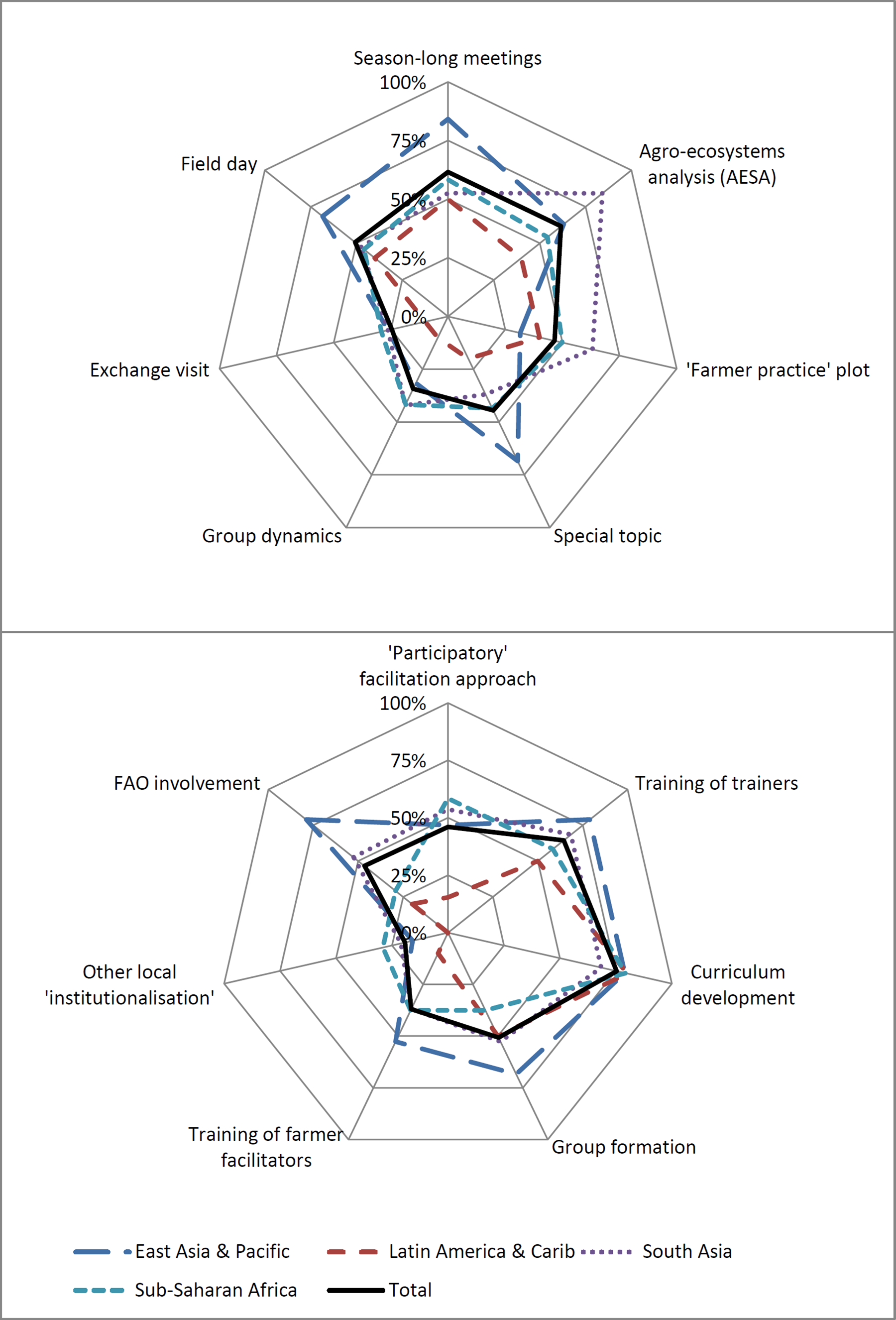
Characteristics of programmes included in review of effects
The extent to which FFS adapted to different contexts are based on the same process, both in the design and implementation of the programmes, varies (Davis et al., 2012). There appear to be two main types of FFS programme implemented in practice. About half of FFS impact evaluations were implemented by (or in partnership with) the FAO based on a participatory facilitation approach. Several studies appeared to implement a top-down transfer of technology approach based on “lecturing” (Todo & Takahashi, 2011; Yang et al., 2008). However, in a large number of cases it was simply unclear how the intervention was designed or implemented. Thus, while half clearly indicated that they used participatory facilitation, it was not clear in most of the remaining half which teaching pedagogy was used. Schools were usually preceded by development of specific curricula relevant to the context in which schools were being implemented. Farmer group formation and facilitator training for extension workers or other field school staff were usually also carried out prior to FFS training. In some cases training of facilitators appeared to be limited to attendance at a workshop (e.g. Erbaugh et al., 2010), rather than season-long theoretical and practical training, while in other cases facilitator training was judged unnecessary given existence of previously trained facilitators as, for example, in Kenya and Tanzania (Friis-Hansen & Duveskog, 2012).
Most schools held weekly season-long sessions, although in a few cases arable crop meetings were held fortnightly rather than each week (e.g. Erbaugh et al., 2010). In the case of permanent crops, such as tea and cocoa, meetings were often held fortnightly over the course of several months (Hiller et al., 2009; David & Asamoah, 2011) or years (e.g. Endalew, 2009). The activities implemented by the schools appeared to include agro-ecosystem analysis and “farmer practice” control plots in 50 per cent of cases each, while group dynamics, special topics and exchange visits were less common or were not reported.
The extent to which diffusion of IPM practices is assumed to occur informally through FFS graduates' social networks, rather than needing to be formally encouraged through training-of-trainer programmes for alumni, varies from programme to programme. Follow-up activities to foster dissemination such as field days, training-of-trainer programmes for farmer facilitators and other means of community institutionalisation were only reported in a minority of cases (see also Appendix A).
4.3 ASSESSMENT OF STUDY VALIDITY
Risk of bias assessment
Designing impact evaluations of agricultural programmes is complicated by the wide range of factors that influence agricultural outcomes and by biases caused by self-selection of individuals and communities into programmes. Thus, differences in outcomes between participants and non-participants might result from pre-existing differences rather than being attributable to the programme under evaluation (Romani, 2003).
These problems arise in attempts to attribute the impact of farmer field school programmes on agricultural (or other ‘final’) outcomes. For instance, where “the selection of participants into the training is done with strong community involvement through its established leadership and existing social structures” (Feder et al., 2010, p. 10), certain farmers, such as community leaders or those of relatively high socioeconomic status, may be more likely to benefit from the intervention than others. Other programmes, particularly those in Africa, aimed to target disadvantaged farmers such as women (see Appendix A). In addition, pilot programmes may be explicitly placed where they are likely to have the greatest impact. And in the case of IPM field schools, explicit programme objectives were that benefits spill over from FFS participants to non-participating neighbour farmers. In other words, the unit of assessment should be at the community rather than the household level.
In the case of evaluating impacts on agricultural outcomes, such as yields and incomes, the likelihood of serious confounding, particularly by weather and market prices, means that appropriate methods of addressing the attribution challenge necessarily involve equivalent or matched comparison groups. One might argue that impact evaluations drawing on less causally rigorous standards of evidence would be appropriate for intermediate outcomes of interest, such as knowledge or adoption of new technologies, particularly where it is unlikely that beneficiaries would otherwise know about the technologies, especially in the case of complex messages.
In the case of adoption, farmer behaviour is influenced by a range of factors, including policy changes, which are likely to confound impact estimates. Removal of subsidies and banning of certain pesticides, as happened in Indonesia in the late 1980s (Braun & Duveskog, 2008), are examples of factors that would likely influence farmers' pesticide (dis-)adoption behaviour. In such contexts, a “before versus after” evaluation (pre-test post-test with no comparison group) would not enable researchers to attribute changes to any specific extension interventions. Similarly, farmers might gain knowledge from several places, including public information campaigns, other farmers and other extension interventions. For instance, in Vietnam a “no early spray” media campaign was run at the same time as FFS, and a study comparing neighbouring farmers who were exposed to the media campaign with those also attending FFS and a comparison group not exposed to either intervention found that beliefs about insecticide spraying changed among those exposed to both FFS and the media campaign and that the two interventions appeared complementary (Huan et al., 1999). In this case, a simple “before versus after” comparison would have overestimated the impact of the FFS programme on knowledge of simple practices (although not more complex knowledge).
During the period in which we conducted the analysis, we were unable to identify any completed experimental studies based on randomised assignment. 18 Despite the threats to validity being well known, and the feasibility of conducting cluster-randomised controlled trials (RCTs) for FFS interventions, the majority of FFS impact evaluations use designs of questionable internal and statistical conclusion validity, and therefore have high risk of bias in attributing final outcomes to the intervention. Treatment effects were usually estimated relative to a non-intervention comparison population, using contemporaneous cross-section data, although there are 30 studies of longitudinal design utilising panel data or group comparison (Table 2).
The summary risk of bias report by categories of selection bias and confounding, spillovers, reporting biases, and other sources of bias is provided in Figure 10 (individual assessment for each study is reported in Appendix F). 19 Of the included studies, 68 were classified as of high risk of bias, many of which were retrospective evaluations without baseline measurement, and, in a large number of cases, no attempt was made to match participant and non-participant covariates or control for such covariates in analysis. Twenty-four studies used more rigorous quasi-experimental approaches, including multivariate propensity score matching (e.g. Godtland et al., 2004) and covariate matching (Davis et al., 2012), multivariate instrumental variables regression (e.g. Ricker-Gilbert et al., 2008) and, where baseline and endline data were collected, multivariate difference-in-differences (or fixed effects) panel data regression (e.g. Feder et al., 2004; Wu, 2010). These studies adjusted for different covariates in the outcome equations, usually involving measures of household socioeconomic status and farmer demographics. However, our assessment also found many of these studies to be at serious risk of bias, usually due to problems of confounding (e.g. lack of tests for covariate balance or adjustment for unbalanced covariates in outcome equations, or inappropriate instrumental variables employed). Only 15 intervention studies were considered sufficiently rigorous to qualify as of medium risk of bias (Table 2), all of which used multivariate estimation methods, although none of these studies indicated that they used blinding either of outcome assessors or of data analysts. We were not able to identify any studies which could be described as having a low risk of bias in attributing outcomes to the intervention.
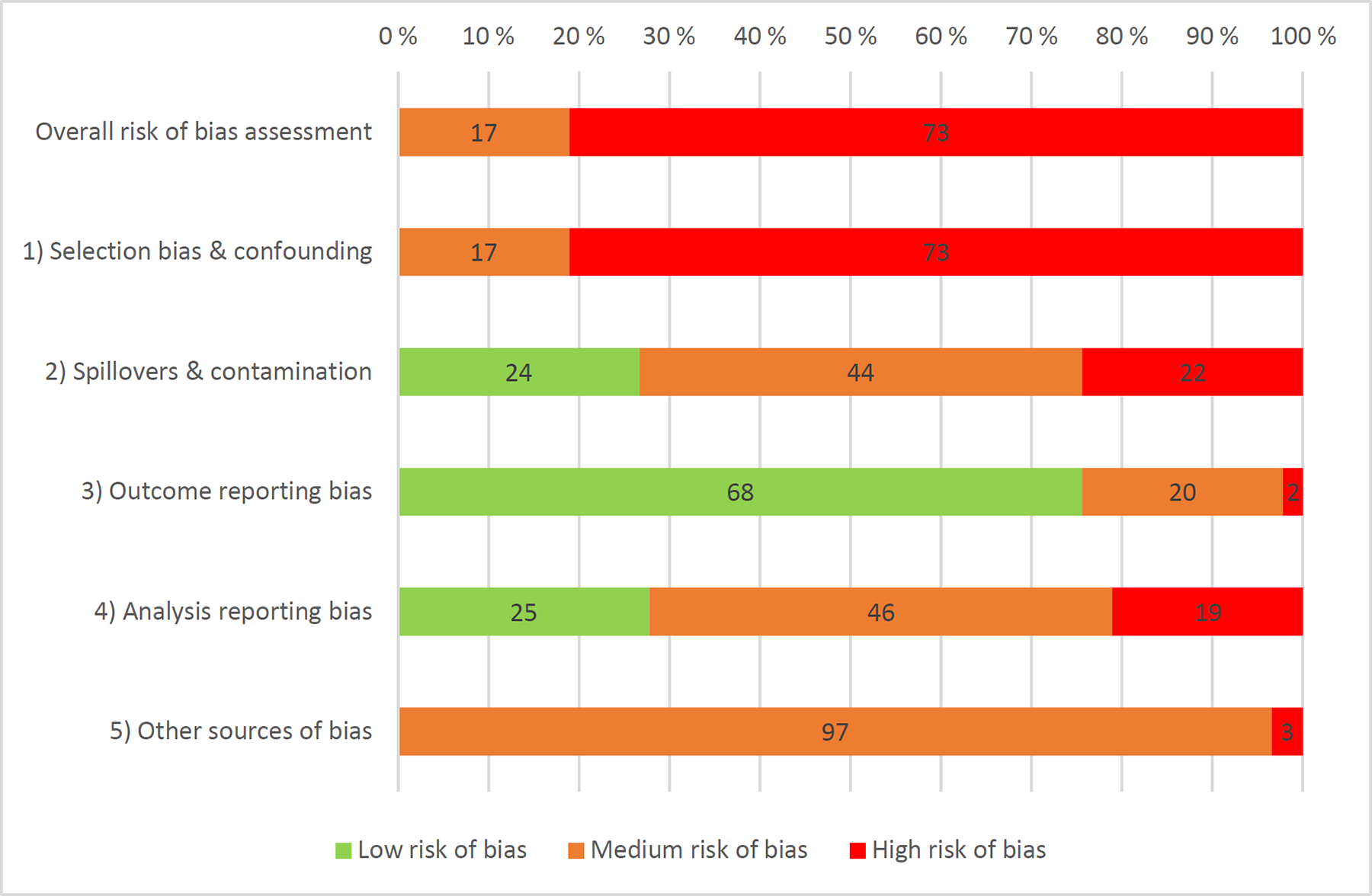
Summary of risk of bias appraisal for effectiveness studies
Another common weakness of the FFS impact evaluations was that they mostly relied on small samples. The median sample size is 185 farmers and samples range from 21 to 960.
Often only a handful of primary sampling units are covered (median of 8 clusters or villages across treatment groups). Statistical power is thus limited.
Most studies appeared to assess pilot or small-scale projects rather than scaled-up programmes. There are two prominent exceptions: the Indonesia National IPM Programme (evaluated by Feder et al., 2004 and Yamazaki & Resosudarmo, 2008) and the Vietnam National IPM Programme evaluated by Rejesus et al. (2009). However, both have comparably small sample sizes (in the case of Feder et al., n=320; in the case of Rejesus et al., n=43 and there is only one commune primary sampling unit).
The availability of details on the intervention and comparison groups varied and was often limited. Most studies provided little information on the comparison group intervention apart from stating that the comparison farmers did not receive FFS training, or that there was no FFS intervention in the village; in a few cases, the studies indicated where comparisons had access to other sources of information about intensive input management approaches (e.g. Davis et al., 2012, in Uganda). We assessed whether there were any effects from these potentially contaminated comparisons in heterogeneity analysis by risk of bias status. In many cases, the comparison group was selected from among farmers living in the same village as the FFS (e.g. Carlberg et al., 2012; Dankyi et al., 2005; Islam et al., 2006; Kabir & Uphoff, 2007; Mutandwa & Mpangwa 2004; Pouchepparadjou et al., 2005; Price, 2001; Rao et al., 2012; Wandji et al. 2007), or included both non-FFS farmers from different locations and neighbouring farmers living in the same location (e.g. Rejesus et al., 2010; Ricker-Gilbert et al., 2008).
Given the voluminous impact evaluation literature on farmer field schools, our estimation has indicated that there are a number of high-risk-of-bias studies which are of very limited validity in attributing causal effects, particularly for final outcomes such as agricultural yields and revenue. We therefore interpreted the results of the synthesis with caution, reporting both pooled and stratified analyses based on risk of bias categories in meta-analysis, and making implications for policy in terms of effect sizes based only on those 15 studies regarded as being of medium risk of bias. Table 1 provides more detailed information on studies that we consider appropriate for informing policy due to their risk of bias assessment.
Of the full sample of studies, we estimated unit of analysis errors were “highly probable” in four studies, for which corrections were applied to all effect size standard errors. We also estimated unit of analysis errors to be “unclear” but possible in 47 studies, largely due to lack of clarity in responding on cluster sampling (Appendix F 20 ). We therefore also presented sensitivity analyses for additional studies which were assessed as of “unclear” unit of analysis error (Appendix G), the results being broadly similar to the main findings for medium risk of bias studies, although the pooled effect sizes for high risk of bias studies tended to be of smaller magnitude for FFS participants.
Included impact evaluation studies: summary descriptive information by region
Notes: Average years from start of implementation of intervention to endline survey.
Total number of farmers in treatment and comparison groups.
Comparison group in FFS effect estimates is FFS neighbour group.
External validity
Of the 92 impact evaluations covered by the quantitative review of effects, 42 provided descriptive information about FFS farmers (rather than characteristics of the farmers in the village as a whole) together with information on sampling methodology. Through this information we were able to say something about external validity (generalisability) for farmers who underwent FFS training in programmes covered by the effectiveness review, as well as for farmers in low- and middle-income countries more generally.
Table 4 provides an overview of the sampling approach used by these studies, most sampling either the entire population of FFS farmers or a random sample.
Sampling approach used in studies providing data on FFS farmer characteristics
Six studies collected data on the entire population of FFS farmers, while a further 26 employed random selection either of field schools or villages or of participants, or both. Of those remaining, five reported that they had selected the FFS purposively, but were unclear how FFS farmers were sampled or whether the entire population of FFS farmers was included. Three reported that FFS farmers had been selected purposively with the goal of including either a balanced sample of male and female farmers (Endalew, 2009) or to ensure that full-time farmers that had attended FFS sessions regularly were included (Khalid, n.d.). The selection criteria of farmers in Todo and Takahashi (2011) was unclear, although the authors stated farmers were selected “as randomly as possible” (p. 11), and a final study drew on random sample household survey data in Indonesia, although it is not clear to what extent the sampling frame was representative of the population of field school farmers (Feder et al., 2004).
The included studies provided information on the characteristics (e.g. age, sex, education levels, size of landholdings) of participating and non-participating neighbour farmers for 48 of the 71 FFS interventions. As shown in Figure 11, the results suggested FFS farmers are on average more likely to be male, over 40 years of age, to have access to at least 1 hectare of land, and have completed primary education (attended seven years of education). However, analysis across the different programmes indicated that there are FFS interventions that involve a high degree of participation of poorer, younger and less-educated farmers, as well as those that include large numbers of educated and better-off farmers in terms of landholdings. FFS programmes employ a variety of targeting criteria to reach different groups, reflecting the often contrasting overarching aims and objectives of different programmes (Phillips et al., 2014). Some programmes included a majority of participants that can be considered the most capable farmers in a community – those who are well educated, well connected and organised, and have access to resources – with the explicit goal of ensuring that participants were those most capable of capitalising on the training. Other programmes explicitly set out to be pro-poor or inclusive of a range of different groups, including women and youth. Indeed, years of education varies between five and nine years (based on 20 observations), while the size of landholdings ranged between less than half a hectare and around nine hectares (based on 21 observations), reflecting the studies drawn from regions with different population densities. The average participation of women was 32 per cent, although the proportion of female participants ranged from as low as 8 per cent to as high as 72 per cent (based on 17 observations) (Figure 11).
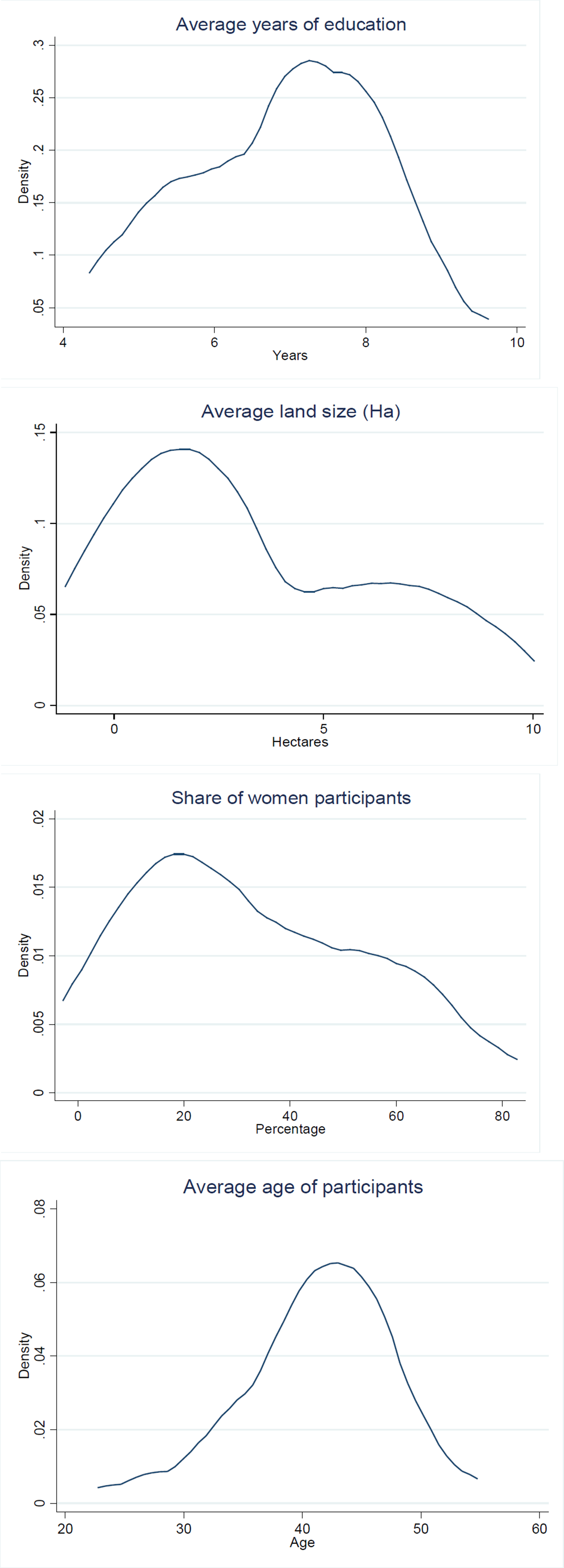
Kernel density histograms showing farmer characteristics
In summary, while there are prominent examples where it is not clear how representative study participants are of the broader FFS programme (Feder et al., 2004; Yamazaki & Resosudarmo, 2009), in the majority of cases study participants appear to have been selected at random. On the other hand, the farmer groups of which FFS participants are representative vary according to the FFS project; some appear to involve more educated farmers, while others explicitly target women and marginalised groups.
File-drawer effects and publication bias assessment
A large number of studies reported data on intermediate and final outcomes. According to the risk of bias criteria reported in Figure 10, we did not consider studies with outcome reporting biases to outweigh those without. However, it is particularly difficult to assess file-drawer effects in retrospective studies where results-related choices can be made in selecting outcomes to report. No single study collected data on all outcomes along the theory of change. Some 27 studies did not provide information on yields or other agriculture outcomes despite collecting data on knowledge or adoption, which might suggest under-reporting of the former. But agriculture outcome data are notoriously more difficult to collect (yields, for example, requiring accurate information on both weight or value of produce and land size). These are usually study designs where causal inferences on final outcomes would in any case be challenged.
Nevertheless, as in many other areas of social science research, we believe there were potentially severe problems of file-drawer effects in the FFS impact evaluation literature. Studies used a wide range of different outcome definitions to measure similar constructs (Table 1 and Appendix E). 21 Moreover, sufficient information was only available to calculate effect sizes in 95 out of 151 cases in total, while insufficient information was provided to be able to estimate standard errors, and therefore statistical precision of the effect sizes, in one-third of cases (Appendix E), indicating serious problems in under-reporting. 22
We conducted statistical analyses to assess likelihood of publication bias, including funnel graphs and meta-regression analysis incorporating the standard error of the effect size as an explanatory variable (Egger et al., 1997). Funnel graphs for those outcomes with ten or more observations (Figure 12) suggest under-reporting of small sample studies for knowledge, adoption of practices and yields. However, visual inspection is unreliable and, in any case, funnel plot asymmetry may be due to other factors such as methodological quality (smaller studies with lower quality may have exaggerated effect sizes), sources of artefactual variation such as heterogeneity in outcome measurement, and true heterogeneity due to intervention characteristics (Sterne & Egger, 2001).
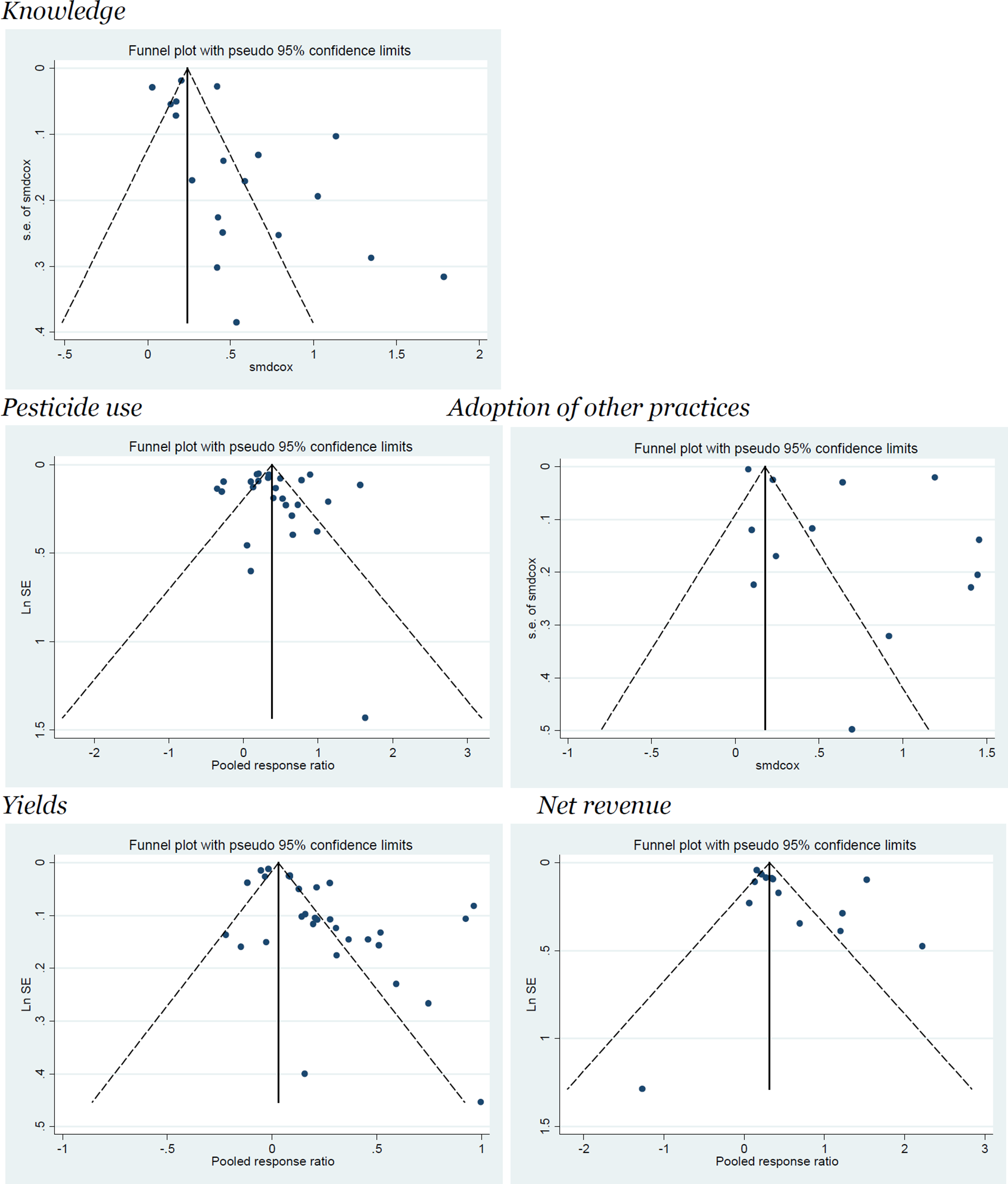
Funnel graphs by outcome
Meta-regression analysis enabled the inclusion of additional covariates measuring these factors, including the summary risk of bias assessment, differences in outcome measurement and contextual factors such as intervention type, crops and region (Table 55 specifications 2). The meta-regressions suggested small study effects may be present using bivariate Egger's tests (Table 5 specifications 1). However, the small study effects are robust to inclusion of additional covariates in the case of yields only, providing evidence suggestive of publication bias for that outcome variable. The significantly positive coefficient estimate on the dummy variable indicating whether the study was published in a peer-reviewed journal also provides further support for publication bias in favour of studies with larger effects for yields outcomes. 23
Meta-regression analysis of small study effects (Egger's test) for FFS participants
Note: Meta-regressions based on response ratio (RR) effect sizes are estimated using logged RR and logged standard errors; exponentiated coefficients reported. Absolute value of t-statistic reported in parentheses; *, **, *** indicates coefficient significant at <10%, <5% and <1% levels. Models estimated using inverse-variance weighted random effects analysis.
4.4 META-ANALYSIS RESULTS
This section reports the results of meta-analysis for effectiveness of farmer field school training for participants and non-participant neighbour farmers potentially experiencing diffusion effects through their interactions with beneficiaries. We present results using the theory of change (Figure 4), for intermediate outcomes (knowledge and adoption) and final outcomes (agriculture, health, environment and empowerment). The meta-analysis is reported by outcomes rather than study. No single study reported all outcomes along the causal chain, although we have attempted to link outcomes for individual studies in order to explain heterogeneity in findings.
The FFS were carried out using different intervention designs, for participants of different demographic and socioeconomic backgrounds, by different implementing bodies, and using different impact evaluation estimation methods, which we would reasonably expect to have an impact on effect size over and above sampling error. We therefore used random effects meta-analysis to synthesise the findings. We present effects for IPM/IPPM FFS and other FFS curricula, and also present results for diffusion to neighbours of IPM-FFS where these were reported in the original studies. We synthesised findings from bivariate and partial effect sizes, which are only strictly comparable under the assumption of constant slopes (there is no collinearity between treatment effect and covariates; see Appendix D). We therefore conducted and report extensive sensitivity analysis by evaluation design features, including whether effect sizes were estimated from bivariate or multivariate analyses. All medium-risk-of-bias studies, on which policy implications regarding effects are based, used multivariate estimation strategies producing partial effect sizes. However, not all used the same variable constructs and are therefore not strictly comparable where collinearity exists. Finally, we analysed heterogeneity according to context and implementation factors using moderator analysis and meta-regression.
Capacity building and knowledge dissemination (intermediate outcomes)
Effect sizes for knowledge are measured in terms of standardised mean difference (SMD), indicating the change in knowledge scores among FFS (or neighbour) farmers over the non-FFS comparison, measured in terms of standard deviations of the outcome variable. SMD scores are interpreted as the number of standard deviation changes in the outcome.
The studies presented a range of knowledge variables (Appendix E), the majority comparing beneficiaries to non-beneficiaries according to average points on a test score (or a knowledge index as in the case of Huan et al., 1999) across multiple categories of crop management. Evidence suggests farmer field schools lead to significant capacity building in farming techniques among FFS participants.
The meta-analysis of standardised mean differences (Figure 13) indicates positive effects of FFS training on knowledge of beneficial farming practices for both IPM/IPPM curricula (SMD=0.56, 95% confidence interval (CI)=0.31, 0.80; Q=114, Tau-sq=0.12, I-sq=92%; 10 observations) and curricula (SMD=0.38, 95% CI=0.22, 0.54; Q=131, Tau-sq=0.04, I-sq=95%; 8 observations), in comparison with untrained farmers. 24 While all observed studies showed positive impacts on participant knowledge for FFS farmers, there is significant variation in magnitude of impacts (as indicated by the value of I-squared).
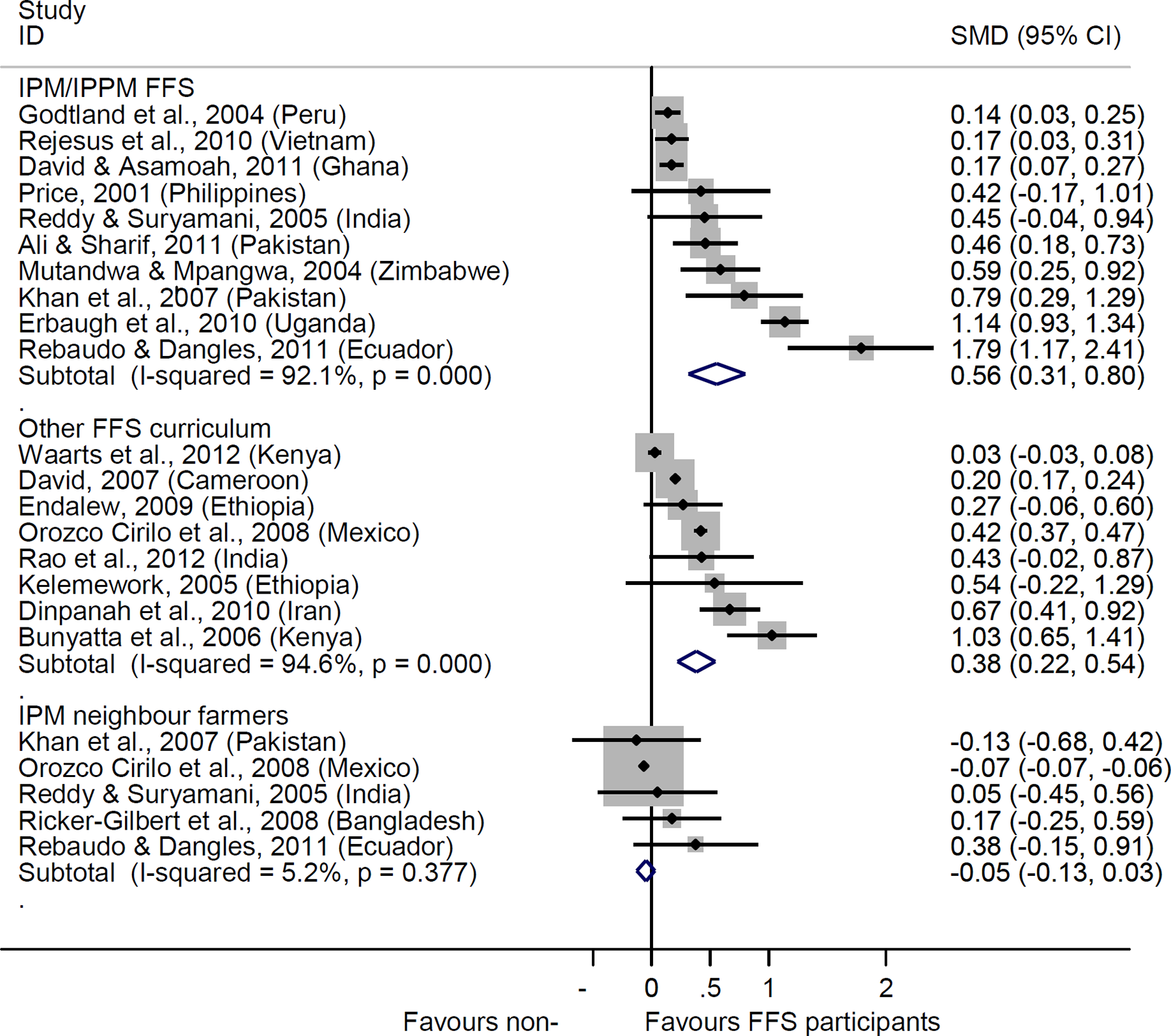
Knowledge outcomes for FFS participants and neighbours versus non-FFS comparison
We attempted to explain the heterogeneity through sensitivity and moderators analysis. We examined whether the findings are sensitive to the types of studies included, risk of bias, effect size estimate and outcome measures, and length of follow-up (Table 6). 25 Results of the sensitivity analysis suggest that findings are not sensitive to choice of outcome measure. However, rigorous quasi-experimental studies (including double differences, propensity score matching and instrumental variables estimation) and multivariate regression studies produce smaller effect sizes than other types of study designs using unadjusted analyses. Similarly, studies assessed as being of lower risk of bias also show smaller effects on average (SMD=0.21, 95% CI=0.07, 0.35; Q=5, Tau-sq=0.008, I-sq=55%; 3 observations) (Figure 14), as do SMD effect sizes which were calculated using Cox-transformed response ratios or odds ratios.
Sensitivity analysis of knowledge outcomes for FFS participants: study design characteristics
Note: * indicates data incomplete due to missing observations.
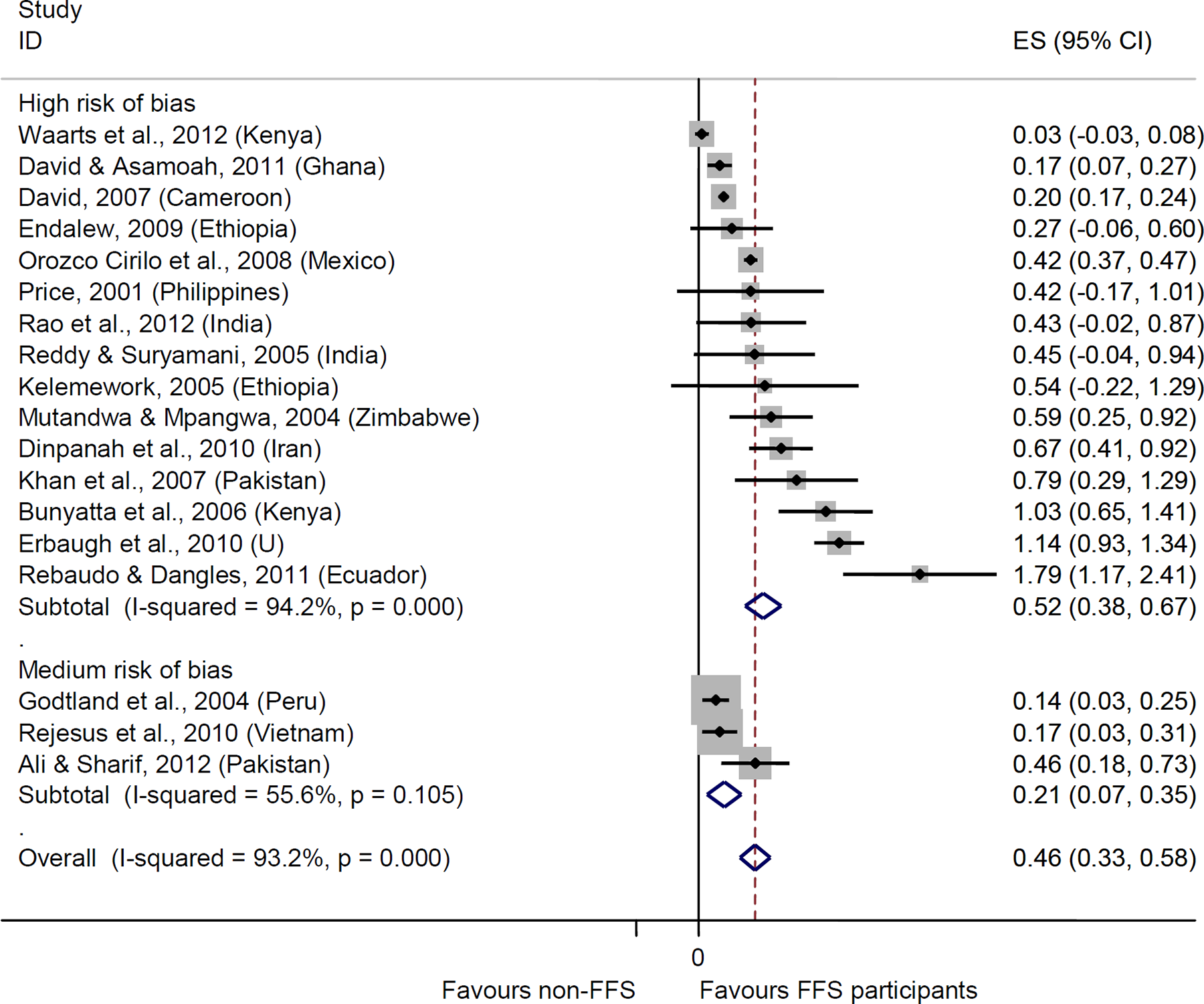
Knowledge outcomes for FFS participants by risk of bias status
We also examined whether findings are moderated by characteristics of interventions and farmers (Table 7). Unfortunately, the information on FFS design and implementation was incomplete, both that reported in the impact evaluations themselves and other documents we were able to link with the impact evaluations such as those collected for the portfolio review (Appendix A). We were therefore only able to obtain evidence suggesting FFS interventions were more effective in improving knowledge where they used “farmer practice” control plots or made attempts at institutionalisation in the local community such as through dedicated training of farmer trainers. Results do not suggest that FFS in which women farmers were known to participate are systematically associated with larger or smaller effects on knowledge; and the same applies with other characteristics of participants such as years of education (Table 7). We did, however, find more robust evidence that FFS interventions promoting IPM, as opposed to other curricula, tend to have bigger effects on participant knowledge, while FFS for permanent crops (including coffee, tea and cocoa) tend to have smaller effects on knowledge. The latter may be due to the method of implementation for permanent crop field schools, which are conducted only fortnightly rather than weekly, but we were not able to test for this possibility due to insufficient data.
Moderator analysis of knowledge outcomes for FFS participants: intervention and farmer characteristics
Note: * indicates data incomplete due to missing observations.
We conducted meta-regression analysis to assess robustness of variables which seem to explain differences in effect sizes in bivariate analysis (Table 8). Due to the limited sample size, we restricted the analysis to those variables which were associated with significant differences in effect sizes in bivariate analysis, and we included the log standard error (Egger's test coefficient) in specification 1, given possibilities for publication bias. 26 The analysis suggests variables significantly associated with smaller impacts on farmer knowledge included studies subject to medium risk of bias (as opposed to high risk of bias), measurements for neighbour farmers and FFS which targeted permanent crops. The results were not sensitive to exclusion of insignificant variables (Table 8 specification 2, conducted given the low number of observations and consequently limited power of the analysis). The test statistics suggest that the model explains substantial heterogeneity between studies (adjusted R-squared and Tau-squared), although unexplained heterogeneity remains (I-squared).
Meta-regression analysis of knowledge outcomes
Note:
Few IPM-FFS studies included in our review assessed diffusion of IPM knowledge to non-participant neighbour farmers who were potentially exposed to the message; all of the studies which reported these outcomes were assessed as being of high risk of bias. The meta-analysis evidence does not suggest there are knowledge spillovers among the few studies which measured knowledge among neighbours (Figure 13) (SMD=-0.05, 95% CI=-0.13, 0.03; Q=4.2, Tau-sq=0.002, I-sq=5%; 5 observations). The values of I-squared and Tau-squared indicate that this finding is highly consistent across studies, and do not suggest there are contexts in which spillovers to neighbours are more likely. Moreover, as noted above, we also found evidence suggestive of file-drawer effects in terms of under-reporting of insignificant or negative findings. For example, despite reporting increases in knowledge among FFS participants over comparison farmers (RR=1.14), Rola et al. (2002) reported no difference in knowledge between exposed and comparison farmers (RR=0.99); however, they did not report on statistical precision of their findings. In a similar study which demonstrated knowledge improvements among FFS participants but did not present information to estimate statistical precision of findings, Tripp et al. (2005) reported limited knowledge among exposed farmers based on both insecticide knowledge test scores (RR=0.90) and number of natural enemies mentioned (RR=0.94). Feder et al. (2004) could not detect a statistically significant effect on knowledge diffusion to FFS-exposed farmers in Indonesia, and consequently did not report findings.
Some studies examined different types of knowledge diffusion. In the single study in Bangladesh which examined diffusion of “simple” and more “complex” practices, Ricker-Gilbert et al. (2008) found that non-participant neighbour farmers living in FFS villages were significantly more likely to have knowledge of simple IPM practices – such as placing branches in rice fields for birds to perch o – than comparison farmers living in non-FFS villages who were exposed to other sources of information on IPM (Appendix G). However, neighbours were not more likely than comparison farmers to have knowledge of intermediate or more complex IPM practices such as setting insect traps and using beneficial insects, which FFS farmers were shown to have, suggesting spillovers to neighbours may be possible for simple practices only, over and above IPM marketing information. 27
As several studies noted, not all the knowledge in the FFS curriculum is observable or can be learned through self-study by non-participants and it is difficult to transmit complex knowledge such as agro-ecosystem concepts, analysis and decision-making principles through conversation alone (Feder et al., 2004; Pananurak, 2010; Wu, 2010). Due to the limited heterogeneity in findings for FFS neighbours, and limited reporting of sub-groups in primary studies, it is not possible to test whether there are systematic differences in spillovers across studies based on farmer characteristics. 28
Adoption of improved practices (intermediate outcomes)
Adoption of practices is the most frequent outcome measure reported in the studies. We report two main types of adoption variables: variables measuring pesticide use for FFS programmes involving IPM and IPPM, and variables measuring adoption of other improved practices and labour costs (detail on outcomes variables is reported in Appendix E).
Pesticide use for IPM/IPPM farmer field schools
Measures of pesticide use usually took the form of the volume of pesticides used per unit of land area or the number of sprays per cropping season, or total pesticide expenditure. For these outcomes, we have estimated response ratio (RR) effect sizes. Reduced pesticide demand is considered a beneficial outcome, since all interventions included in this meta-analysis promoted IPM or IPPM farmer field schools (with or without complementary input and/or marketing interventions). Reductions in pesticide use – and therefore positive impacts of FFS training – are measured as values of RR between 0 and 1. Increases in pesticide use over the comparison group are measured as values of RR greater than 1. RR are interpretable as percentage changes over the comparison.
The meta-analysis suggests that demand for pesticides, measured in terms of amount sprayed or total expenditure, is estimated on average to be significantly lower among IPM/IPPM FFS graduates than comparison farmers (RR=0.68, 95% CI=0.57, 0.81; Q=172, Tau-sq=0.09, I-sq=90%; 18 observations), but not IPM/IPPM FFS interventions which included additional intervention components of input or marketing support (RR=0.77, 95% CI=0.30, 1.96; Q=158, Tau-sq=0.90, I-sq=98%; 4 observations) (Figure 15). Furthermore, and commensurate with the lack of knowledge gains reported above, we did not find evidence for diffusion to neighbouring farmers, estimating non-significant reductions in pesticide demand for this group on average (RR=0.91, 95% CI=0.66, 1.26; Q=47, Tau-sq=0.12, I-sq=85.2%; 8 observations). 29
There is, however, substantial variation in effect sizes which appears to be in large part due to heterogeneity across studies (indicated statistically by high values of I-squared and Tau-squared). We therefore also conducted additional sensitivity and moderator analyses to explore the heterogeneity. Similarly to knowledge outcomes, we found that less rigorous study designs (Table 9) and high-risk-of-bias studies were likely to overestimate impacts on pesticide adoption (Figure 16 reports the forest plot excluding high-risk-of-bias studies). Indeed the best estimate of average effects on pesticide use for IPM/IPPM curricula FFS suggests a reduction in pesticide use of 23 per cent on average (RR=0.77, 95% CI=0.61, 0.97; Q=40, Tau-sq=0.07, I-sq=83%; observations=8). Impacts measured over shorter-term follow-up periods (up to two years) tended to be bigger than longer-term periods, as did studies which measured pesticide costs. The heterogeneity analysis for pesticide use by neighbouring farmers suggests results are not sensitive to dropping high-risk-of-bias studies (RR=0.95, 95% CI=0.64, 1.39; Q=45, Tau-sq=0.14, I-sq=91%, 5 observations). Results are also not sensitive to exclusion of the studies by Feder et al. (2004) and Yamazaki and Resosudarmo (2008) (see also forest plots in Appendix G).
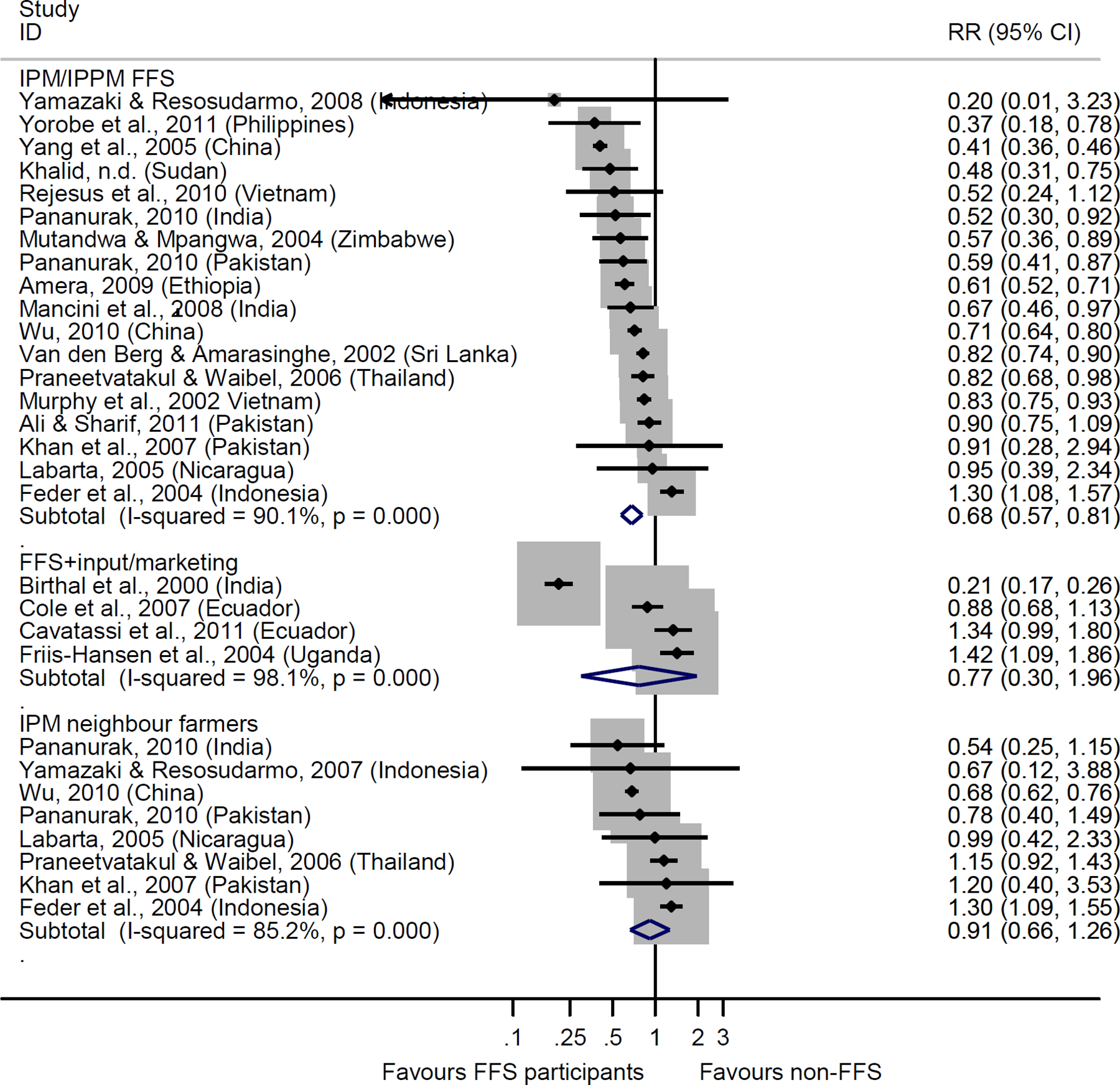
Pesticide use for IPM/IPPM FFS participants and IPM neighbours versus non-FFS comparison farmers
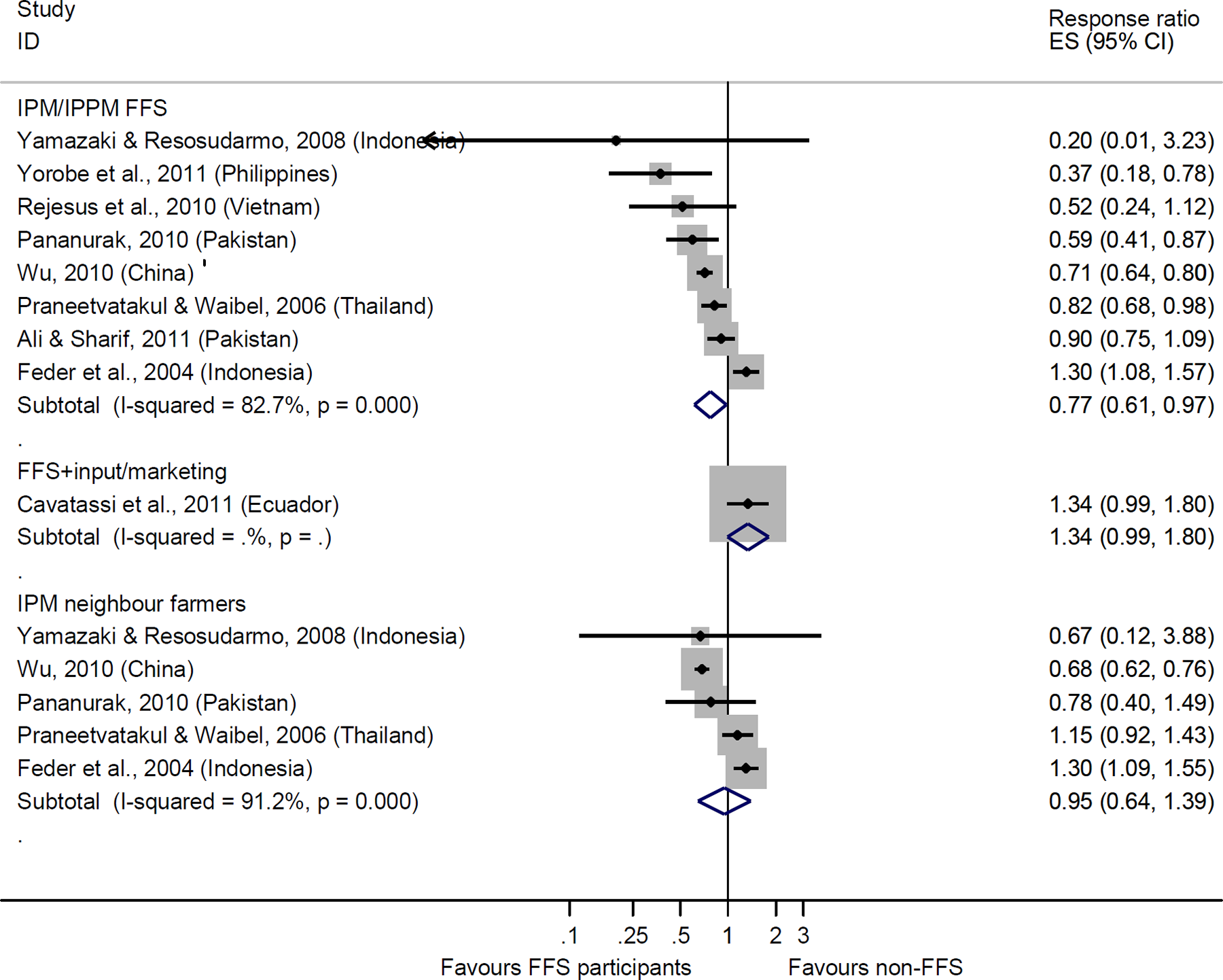
Pesticide use for FFS participants and neighbours excluding high-risk-of-bias studies
Sensitivity analysis: pesticide use for IPM/IPPM FFS participants and neighbours
Note: * 2 studies measuring both pesticide use and costs (Khan et al., 2007; Yang et al., 2005) are included in sub-group analysis by outcome measure.
We conducted additional analyses of moderators to explore the variation in findings across studies according to intervention and participating farmer characteristics (Table 10). The results suggest that the intervention characteristics which are associated with systematically smaller and insignificant impacts on pesticide use programmes implemented at national scale, programmes which involved complementary input or marketing components (as opposed to “pure” IPM/IPPM), and programmes in Latin America; in contrast, the results suggest impacts on pesticide use were biggest for cotton crops. We did not find differences for other variables describing intervention activities or length of implementation, with the exception of lack of impact for the single FFS for which it was clear that “farmer practice” control plots were not implemented (Labarta, 2005). However, the analysis by characteristics of participating farmers suggests socioeconomic status may affect pesticide adoption, as measured by education levels and landholdings. Field schools targeting women also seemed to have lower levels of adoption, although due to limited data available on many of the interventions and farmer characteristics variables, these results should be interpreted cautiously.
Moderator analysis of pesticide use for IPM/IPPM FFS participants: intervention and farmer characteristics
Note: * indicates data incomplete due to missing observations.
Sensitivity analysis for IPM-FFS neighbour farmers suggests that there may be diffusion in terms of reduced pesticide use for communities growing cotton over the short term (follow-up periods less than two years after FFS training), where FFS farmers are relatively highly educated. This finding is robust to exclusion of high-risk-of-bias studies (Table 11). The overall results also suggest diffusion effects among FFS communities in which participants had larger landholdings, although these findings are neither statistically significant nor robust to exclusion of high-risk-of-bias studies. It does not seem unreasonable to expect there to be diffusion of simple practices like reduced pesticide use due to interaction between FFS graduates and their communities, at least in the short term; indeed, as noted above, one study did find evidence for diffusion of “simple” knowledge (Ricker-Gilbert et al., 2008). However, those studies which examined sustainability found that any initial adoption among neighbouring farmers in terms of pesticide use fell within a few years (e.g. Wu, 2010, in China; Pananurak, 2010, in India). In addition, evidence from the one programme implemented at scale does not suggest any effects on diffusion (the Indonesia National IPM Programme evaluated by Feder et al., 2004 and Yamazaki & Resosudarmo, 2008). The findings in terms of diffusion should be interpreted with caution due to the limited sample size and problems of confounding in bivariate analysis. We also examined heterogeneity for FFS neighbour groups using intervention design variables which might reasonably be expected to foster diffusion (i.e. farmer exchanges and field days, efforts at local institutionalisation, FAO involvement, years of implementation of the programme), but did not find systematic differences across studies according to these characteristics, since many were poorly reported in the included studies and project documents we not available.
Moderator analysis of pesticide use for IPM-FFS neighbours: intervention and farmer characteristics
Note: * indicates data incomplete due to missing observations.
Finally, we explored robustness of effect size moderators in multivariate meta-regression analysis (Table 12). The analysis across the full sample (specification 1) suggests studies which were assessed as being of high risk of bias, which targeted cotton crops, were significantly associated with larger effects on pesticide use, while neighbour farmers had significantly smaller effects. We did not find significant correlations between effect size and whether studies measured outcomes by pesticide costs (rather than use), length of intervention and follow-up, or programme scale (results not reported). In a second meta-regression analysis for the subsample of studies in which education data were available (specification 2), we also tested for the association between years of education (continuous variable) and variation in effects on pesticide use. Due to the limited sample size we included only those variables found to be statistically significant in specification 1. The results suggest that FFS which targeted farmers with a relatively greater number of years of education, and those targeting cotton crops, were significantly associated with bigger decreases in pesticide use, both for FFS participants and IPM-FFS neighbours.
Meta-regression analysis of pesticide use outcomes
Notes: * coefficient estimates reported as natural logarithm.
Other reported measures of practices adopted
Many studies, including those which were assessing field schools providing training in technologies other than IPM/IPPM, reported measures of numbers of improved practices adopted. Studies used a range of outcomes including indices of adoption and numbers of practices adopted, and probability of farmers adopting positive practices (Appendix E). Similar to the variables used to measure knowledge outcomes, given the lack of a natural scale in many such outcomes, we considered it appropriate to calculate standardised mean difference effect sizes.
The forest plot shows similar positive average impacts on adoption among FFS participants (SMD=0.63, 95% CI=0.32, 0.94; Q=3,192, Tau-sq=0.314, I-sq=99.6%; 14 observations) as compared with non-FFS farmers across the whole sample (Figure 17). 30 The findings do not suggest differences on average for IPM and other (non-IPM/IPPM) FFS curricula. No studies estimated effects on IPM-FFS neighbour farmers. The very high level of variability in effect sizes is likely to substantial between-study heterogeneity. Similar to other outcomes, we found medium risk of bias studies tended to produce effects of smaller magnitude (SMD=0.22, 95% CI=0.06, 0.38; Q=10, Tau-sq=0.02, I-sq=80%, 3 observations) than high risk of bias studies (Figure 18). Other factors relating to study design, effect size calculation and implementation appeared to be associated with variation in effects (Table 13), but we were unable to explain the variation in effects further using meta-regression analysis (results not reported).
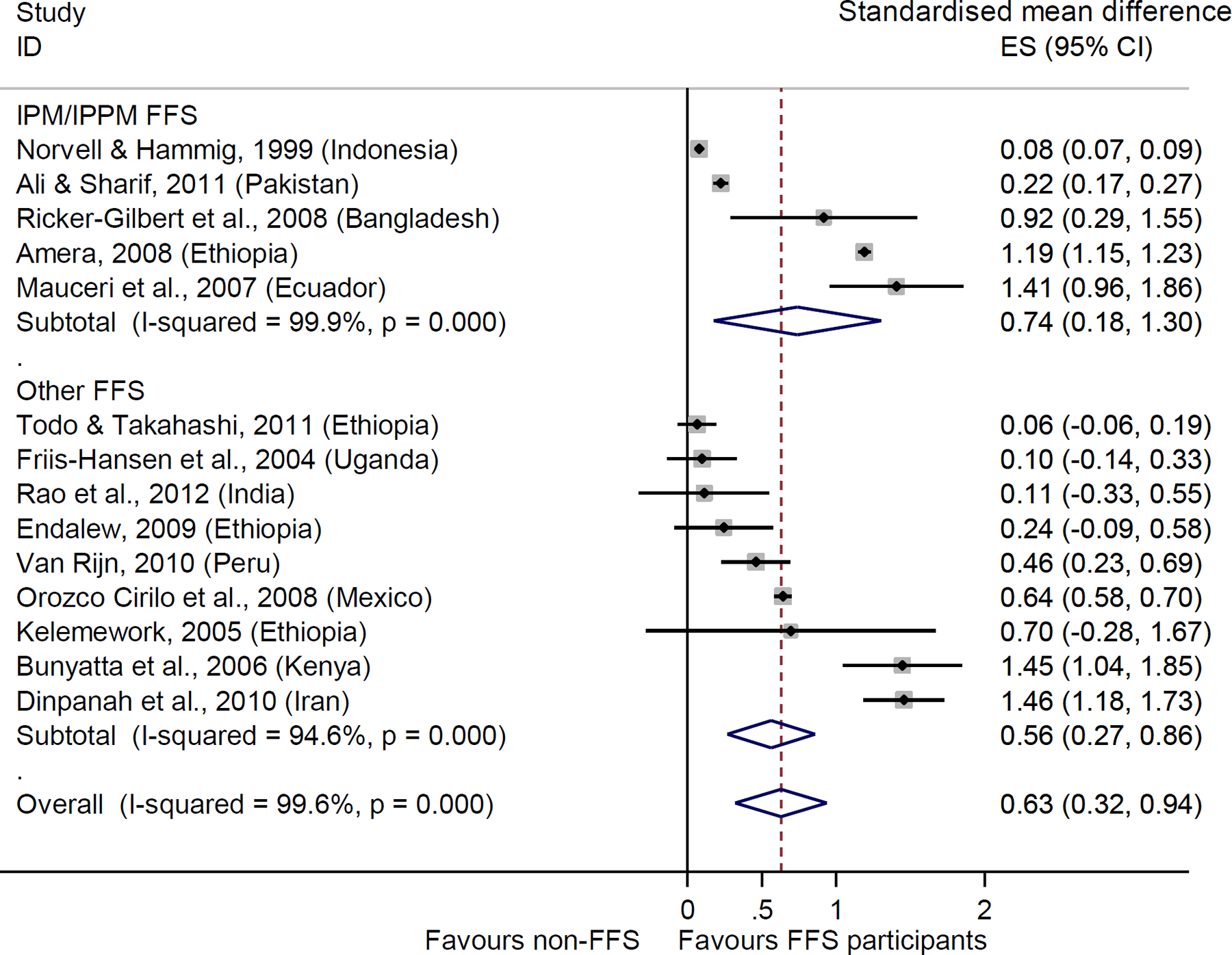
Beneficial practices adopted by IPM and other curricula FFS-participants
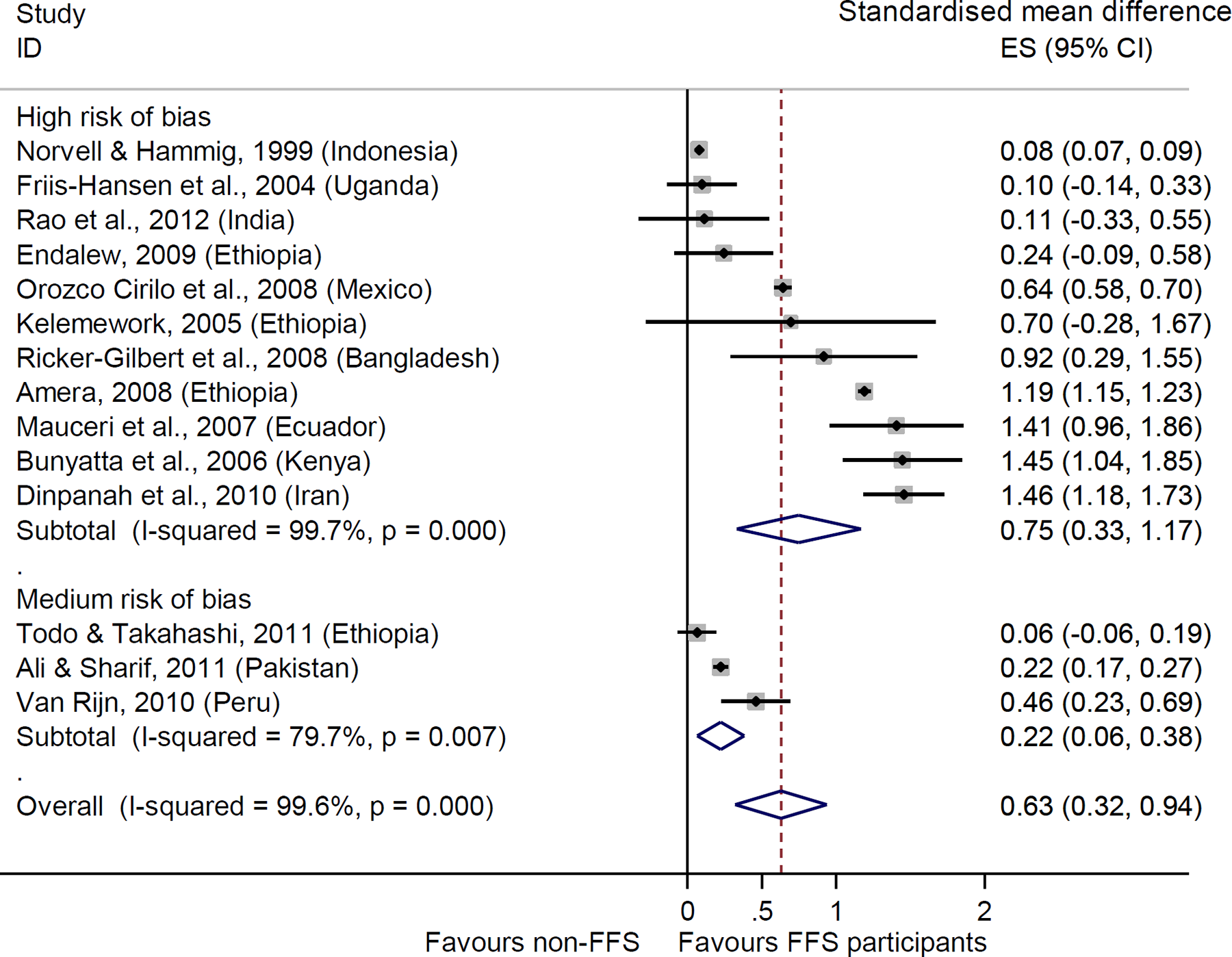
Beneficial practices adopted by risk of bias status
Sensitivity analysis: other adoption measures
Note: * indicates data incomplete due to missing observations.
Impacts on farmers' time use
A small number of IPM-FFS studies also measured the burden of labour time (Birthal et al., 2000; Tripp et al. 2005; Khan et al., 2007; Mancini & Jiggins, 2008; Wu, 2010), estimating increases with adoption in India (Birthal et al., 2000; Mancini & Jiggins, 2008). Birthal et al. (2000) noted that the increased time burden may be due to both time monitoring crops as well as harvesting bigger yields. The study found an increase of 25 per cent in labour time on IPM cotton farms as compared with farms using pesticides, only about one-tenth of which was borne by women handpicking insect larvae, while one-third was due to time harvesting larger yields on FFS farms. However, the study was classified as high risk of bias because the FFS had a larger average farm size and more irrigation than the comparison group, and these differences were not controlled in the analysis. Mancini and Jiggins (2008) noted the burden of time for plant protection shifted towards women household members in India, and suggested therefore that availability of women might be a factor determining adoption of
IPM. Indeed, the relative costs of pesticide and labour may be important factors determining adoption. One study with medium risk of bias which found modest effects on outcomes noted pesticide costs were not a high share of variable production costs and dwarfed by costs of labour (Praneetvatakul & Waibel, 2006). In this study, farmers with more farm area per household member were also more likely to drop out of field school training due to labour shortages and high opportunity costs of labour.
Agriculture outcomes (primary outcomes)
Agricultural outcomes were measured in terms of yields (production per unit of land area cultivated, or its monetary value) or net revenues (value of production less cost per unit area of land) (Appendix E). To take a few examples, Feder et al. (2004), Rejesus et al. (2010), Pananurak (2010) and Wu (2010) measured production per unit of land; Ali and Sharif (2012) measured total production; Davis et al. (2012) measured the monetary value of yields, which also captures output prices; Pananurak (2010) and Labarta (2005) measured net revenues, which capture both production but also (input and output) prices. We calculated the response ratio (RR) for agriculture outcomes, positive impacts being measured as values of RR significantly greater than 1.
Impacts on yields
Meta-analysis findings suggest that FFS training does on average lead to higher yields among FFS graduates as compared with non-FFS farmers, both for IPM/IPPM and other field school training (including other production techniques and/or additional input or marketing support) (Figure 19).
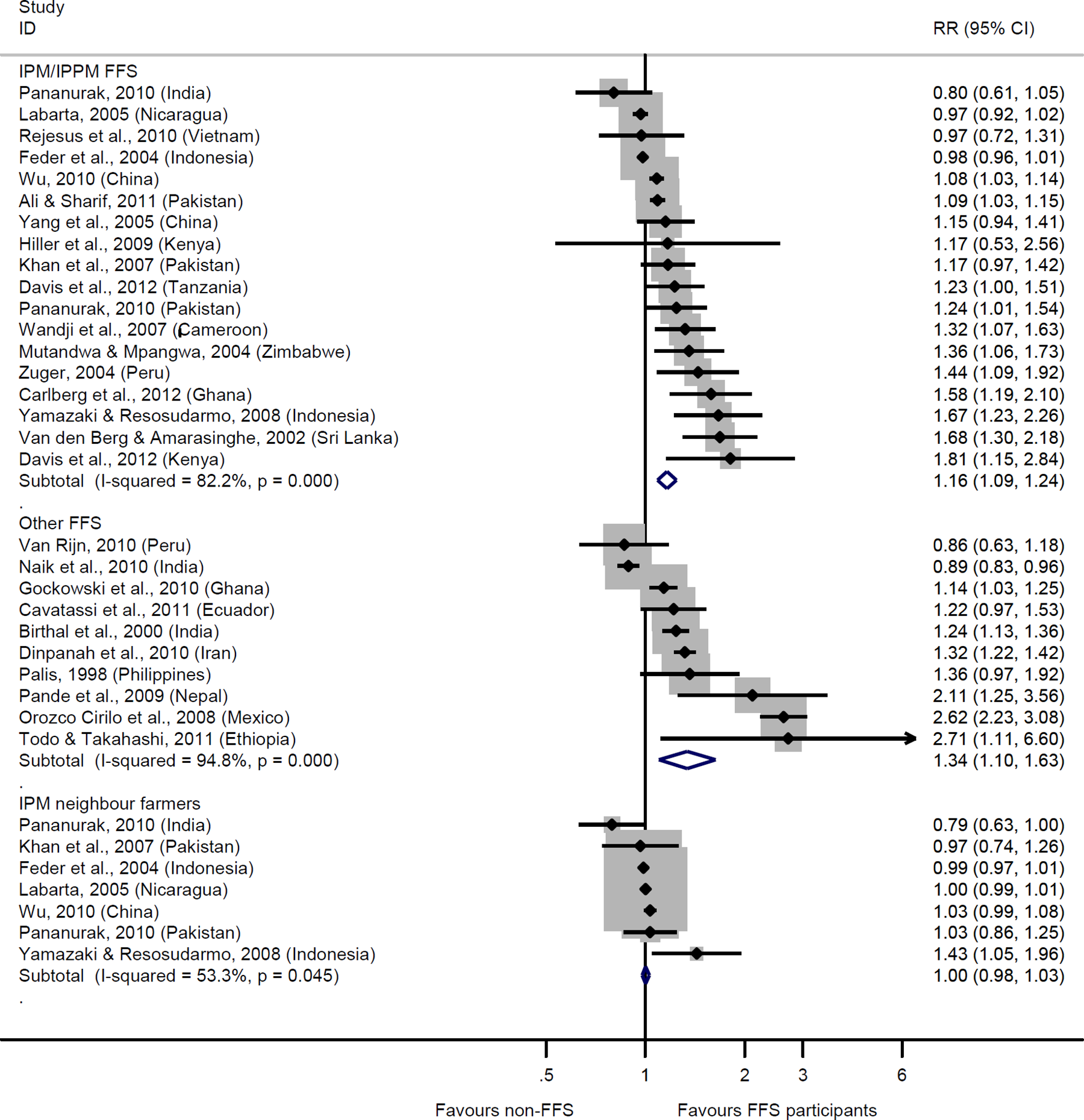
Yields for IPM/IPPM and other FFS farmers and IPM neighbours versus non-FFS comparison
There appears to be substantial between-study heterogeneity (as measured by I-squared). Sensitivity analyses (Table 14) to explore possible sources of heterogeneity proceeded as per other outcomes. For IPM/IPPM FFS participants, we found average effects to be small but statistically significant for medium risk of bias studies, representing an estimated increase of 13 per cent in yields on average (RR=1.13, 95% CI=1.04, 1.22; Q=53, Tau-sq=0.008, I-sq=81%; 11 observations) (Figure 20). Similarly, we estimated average effects to be smaller for more rigorous quasi-experimental evaluation designs, and for outcomes measured in terms of yields as opposed to monetary measures of output. For outcomes measured at follow-up periods longer than two years (excluding high-risk-of-bias studies), there is no evidence for statistically significant effects on yields. Moderator analysis suggests FFS have been relatively more successful in boosting yields of staples and vegetables in Africa using IPPM curriculum. Outcomes for FFS neighbours were fairly homogeneous across studies and analysis does not suggest outcomes are sensitive either to risk of bias or length of follow-up.
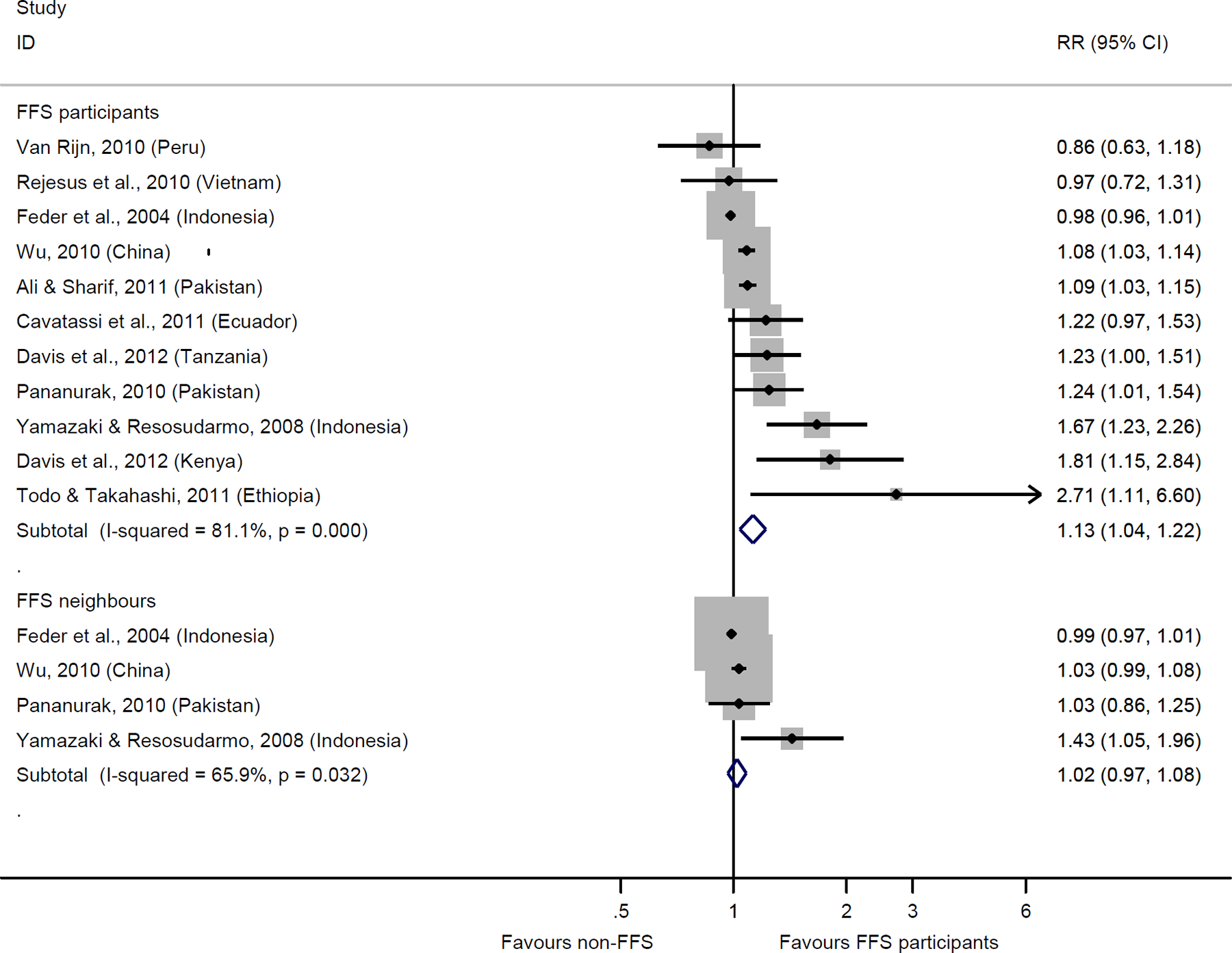
Yields for FFS participants and neighbours: excluding high-risk-of-bias studies
Yields sensitivity analysis
Note: * indicates data incomplete due to missing observations.
We did not find evidence for spillovers to neighbour farmers living within FFS communities across all studies (RR=1.00, 95% CI=0.98, 1.03; Q=13, Tau-sq=0.000, I-sq=53%; observations=7) (Figure 19), when we exclude high-risk-of-bias studies (RR=1.02, 95% CI=0.97, 1.08; Q=9, Tau-sq=0.002, I-sq=66%; 4 observations) (Figure 20) or indeed for the majority of individual studies. 31
Notably, as indicated in Table 14, we did not find significant effects for FFS participants (nor neighbours – results not reported) for the two programmes implemented at national scale (Indonesia and Vietnam National IPM Programmes). Two studies replicated analysis of the Indonesian data (Feder et al., 2004 and Yamazaki & Resosudarmo, 2008), coming to different conclusions regarding effectiveness in terms of agricultural outcomes. Feder et al. (2004) found no effect of FFS on trained or exposed farmers' adoption of reduced pesticides or rice yields, mentioning poor implementation delivery as a possible explanation for poor performance (although not providing any evidence of this). They suggested scaling up of the programme may have had a negative effect on the average quality of trainers and their commitment to bottom-up approaches, given many of them may have been experienced extensionists trained to deliver using top-down methods in the past. Moreover, they noted that delays in transfers of funds to the field training organisers meant that FFS were not fully synchronised with the rice-growing season calendar and supplies of materials were irregular, and suggested that this may have had a negative impact on the quality of knowledge achieved by FFS graduates.
Yamazaki and Resosudarmo (2008) re-analysed the data from Feder et al. (2004), but additionally controlled for time exposed to FFS prior to FFS training, since FFS were carried out in the same villages for different farmers over a number of seasons, and time after graduation. This was in principle a sensible approach, given the authors' hypothesis about bigger short-term rather than longer-term effects, and they did find that allowing for time variables produced positive impacts of FFS training on rice yields in the short term. However, like Feder et al. (2004), they did not find any significant impact on adoption as measured by changes in pesticide costs (as reported in Figure 15). 32 We examined sensitivity of our findings by excluding these studies from analysis, in part because of potential spillovers suggested by Van den Berg and Jiggins (2007). Our results were insensitive to their exclusion (Table 14), as well as exclusion of studies with possibilities for other studies with possible spillovers (Rejesus et al., 2010) and active control groups (Davis et al., 2012 in Uganda) (see forest plots in Appendix G).
We conducted additional moderator analyses to assess whether findings vary by FFS curriculum, length of implementation, crop, region and farmer characteristics (Table 15). Due to the important policy relevance of the outcome, we examined whether findings differed when we excluded high-risk-of-bias studies, and we limit the following discussion to these results. We were able to identify significantly positive impacts among FFS graduates on yields for IPM-FFS training (9% increase; 6 observations) and FFS with complementary input or marketing support (20% increase; 3 observations), growing cotton (9% increase; 3 observations) and other staples/vegetables (37% increase; 4 observations). In addition, FFS which had been implemented for longer than two years experienced more significant effects (17% increase; 6 observations) than those which had been operating for less (no significant difference; 5 observations). However, there was no evidence for effects in programmes operating at national scale (no significant difference; 3 observations). We also found that only field schools which involved farmers of relatively high education levels exhibited significantly positive impacts on yields (9% increase; 3 studies), although we did not find any significant differences for landholdings. We were not able to identify significantly positive effects on average for any other sub-groups, due to the limited numbers of studies available.
Yields moderators analysis for FFS participants: excluding high-risk-of-bias studies
Note: * indicates data incomplete due to missing observations.
Consistent with the moderator analysis for adoption, we did not find significantly positive effects for rice FFS on yields. One study suggested that additional yield gain in technologically advanced rice production systems might be small and difficult to measure by recall surveys (Praneetvatakul & Waibel, 2006). In contrast, we estimated significant effects for cotton farmers in terms of both adoption and yields. Two of these studies based on evaluations of (genetically modified) Bt cotton programmes (Pananurak, 2010; Wu, 2010) found benefits of high yields and reduced pesticide use in incorporating improved seeds in the FFS curriculum.
The positive estimated effects of FFS for shorter-term studies (and conversely insignificant effects for longer-term studies) were found for both adoption and yields outcomes. However, most data are from indirect comparisons over programmes in different contexts with different follow-up periods. Several studies directly compared impacts over short and longer time periods among the same farmers. Praneetvatakul and Waibel (2006) reported impacts at one and three years after the intervention for FFS farmers in the Philippines, while Pananurak (2010) and Wu (2010) reported impacts at one and four-year follow-ups in China. Neither found significant differences in impacts for yields (or adoption) over these time periods, and both concluded FFS graduates retained their knowledge and continued applying IPM practices over time. However, more long-term impact evaluations are necessary to assess whether benefits are indeed sustained over time as these authors suggest.
We also examined heterogeneity of diffusion from IPM field schools to non-participating neighbour farmers (Table 16). The only studies which measured diffusion did so for programmes which had been implemented for more than two years. An initial positive diffusion effect found in China was not sustained (Wu, 2010), with both yield and knowledge gains in the neighbouring farmer groups diminishing considerably over time. 33
Yields moderator analysis for IPM-FFS neighbours
Note: * indicates data incomplete due to missing observations.
In the final analysis of yields, we attempted to explain the heterogeneity using meta-regression (Table 17). Specification 1, which includes the full sample of 35 studies reporting yields effect sizes, confirms much of the bivariate analysis, namely staples and vegetable crops tended to exhibit the biggest impacts, rigorous quasi-experimental studies tend to show significantly smaller impacts than other studies, and publication bias due to small study effects may be present (as indicated by Egger's regression test).
Meta-regression analysis of agricultural yields
Notes: coefficient estimates reported as natural logarithm. Bold indicates coefficient statistically significant at 10% level.
Specifications 2 adds follow-up period and specification 3 additionally includes average education of FFS-participants (both variables are measured in years); these specifications reduce the sample size due to missing observations. To conserve degrees of freedom, the fourth specification excludes variables which are not statistically significant in specification 3. The analysis suggests impacts measured over longer periods were generally smaller while impacts were significantly bigger for more educated farmer participants. As per other outcome variables, years of education significantly increased the explanatory power of the model, suggesting field schools which targeted better educated farmers were also more effective in improving yields. In addition, an interaction between FFS-participant education and the neighbour farmer dummy variable is not statistically significant (results not reported), suggesting that field schools targeting better educated farmers may also have been more effective in promoting diffusion to neighbours. However, given the small sample size and relative instability of coefficients over specifications, these results should be interpreted cautiously. Until further evidence becomes available on the relationship between programme effects and characteristics of participating farmers such as education, income and social standing, we will not be able to conclude whether targeting farmers of higher socioeconomic status does lead to bigger increases in agricultural outcomes for FFS participants or neighbours.
Impacts on net revenue
It is possible that the production technologies promoted in FFS may lead to improved net revenues or profits (monetary value of production less costs), even where they do not improve yields, due to reduced reliance on pesticides and other purchased inputs. 34 We differentiated FFS programmes providing only training in IPM and those providing training in other (non-IPM/IPPM) curricula, from “FFS-plus” programmes which provided additional components of support for inputs and/or marketing (Figure 21). 35 At least two points are worth noting here, the first being that the impacts on net revenues are larger in magnitude than yields, as we might also expect based on the bigger average impacts on pesticide expenditure than pesticide use. For the “FFS-plus inputs/marketing” farmer group in particular, we estimated revenues on average to be 150 per cent greater, although over a small sample size with wide dispersion in the pooled confidence interval (RR=2.57, 95% CI=1.18, 5.58; 4 observations) and substantial estimated heterogeneity due to contextual factors (I-squared=96%, Tau-squared=0.56). For IPM-FFS participants, 36 revenues increased by a lesser amount. The results were sensitive to exclusion of high-risk-of-bias studies (Figure 22 and Table 18); for medium-risk-of-bias studies we estimated revenues to increase by 19 per cent on average (RR=1.19, 95% CI=1.11, 1.27; Q=1, Tau-sq=0, I-sq=0%; 2 observations).
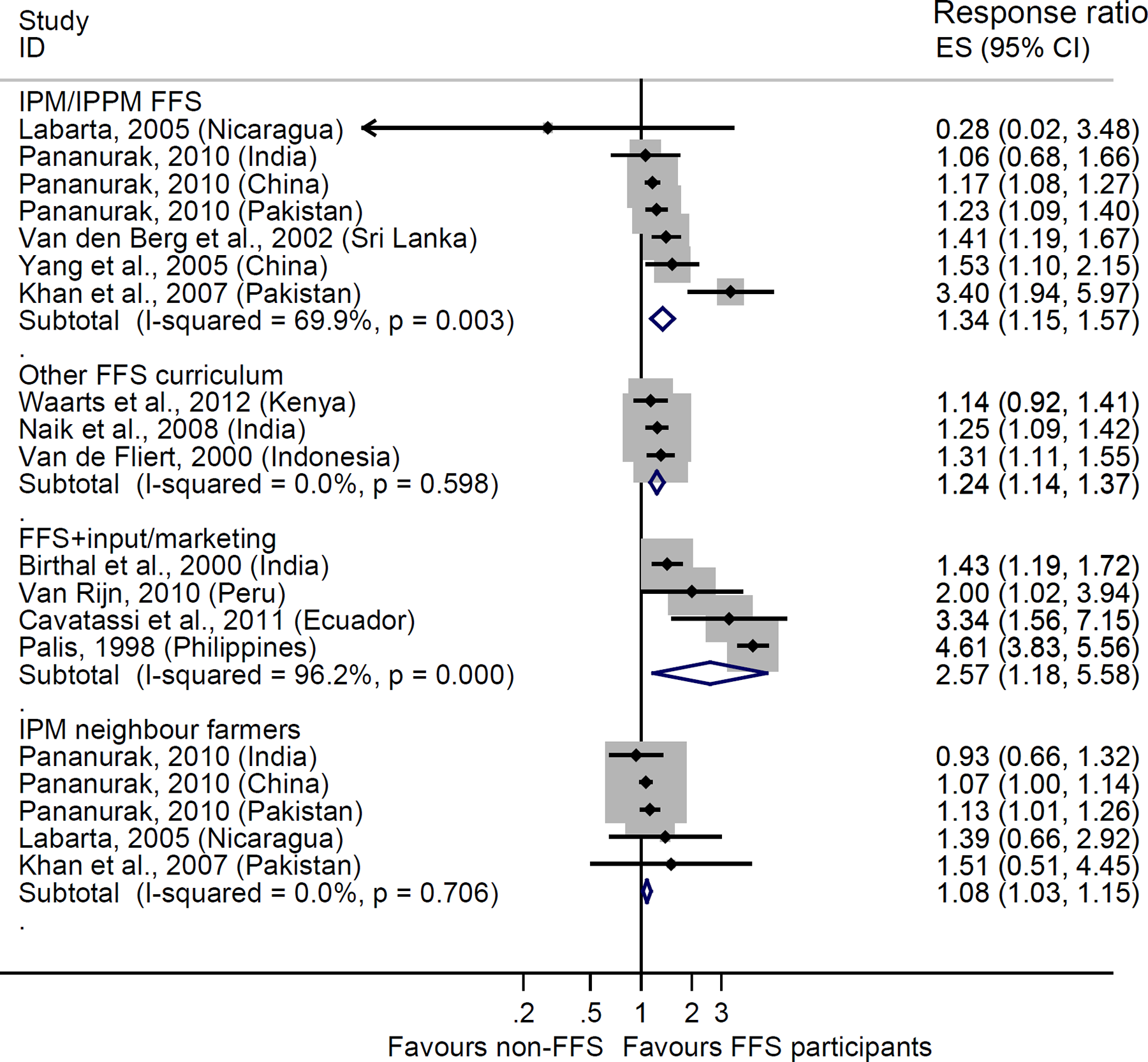
Net revenues for FFS farmers and neighbours versus non-FFS comparison
A second point of note is that the pooled effect size suggests that there may have been spillovers to non-participant neighbour farmers, although only partially in terms of magnitude of effect as compared with FFS graduates (RR=1.08, 95% CI=1.03, 1.15; Q=1, Tau-sq=0, I-sq=0%; 2 observations). However, the analysis excluding high-risk-of-bias studies (Figure 22) comprises only two interventions in China and Pakistan (Pananurak, 2010), both of which found positive effects in terms of revenues which were not reflected either in reductions in pesticide use or in improved yields, casting doubt on the credibility of the findings. In contrast, the increase in revenues for FFS participants in the same study was mirrored by improvements in both yields and pesticide reduction.
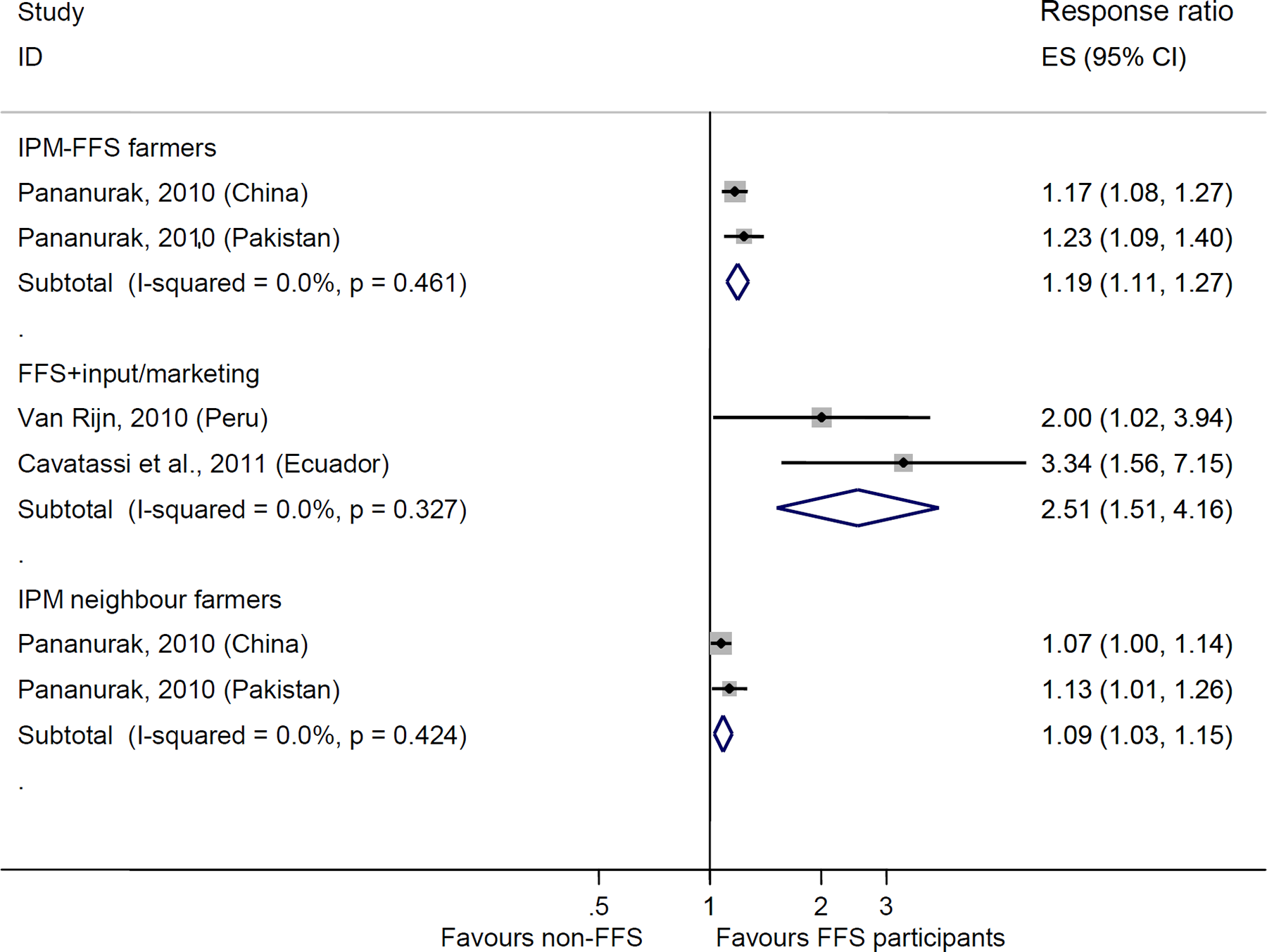
Net revenues excluding high-risk-of-bias studies
The sensitivity and moderators analysis (Table 18) suggests that there may be differences in impacts on net revenues by crop, region and curriculum, but there were simply too few rigorous studies to draw conclusions.
Net revenues: sensitivity and moderator analyses
Finally, we examined heterogeneity of revenues using meta-regression (Table 19). The meta-regression indicated that FFS which were provided alongside inputs and/or marketing support lead to significantly better outcomes, when controlling for crop type, study design, and farmer. Although heterogeneity remained high (I-sq=78%), the small sample size limited our ability to explore other sources of differences across studies. However, no evidence was found for publication bias or for significant effects for other variables such as FFS-participant education (results not reported).
Meta-regression analysis of net revenues
Notes: coefficient estimates reported as natural logarithm. Bold indicates coefficient statistically significant at 10% level.
Other final outcomes (secondary outcomes)
Effects on environment
Five studies of IPM/IPPM farmer field schools reported effects on environmental outcomes; in three cases we were able to calculate effect sizes and standard errors (Appendix E). One study measured positive effects on soil fertility of IPPM-FFS among FFS participants in Uganda (RR=1.79, 95% CI=1.15, 2.78; Friis-Hansen et al., 2004). Four further studies measured impacts of five IPM-FFS interventions on environmental outcomes using the environmental impact quotient (EIQ) score (Kovach et al., 1992), which estimates changes in outcomes indirectly based on reported reductions in chemical pesticide use. 37 The findings of the meta-analysis for EIQ scores are suggestive of benefits to FFS graduates (Figure 23). Walter-Echols and Soomro (2005) also estimated reductions in EIQ in India (RR=0.68) and Pakistan (RR=0.58) but did not report information to calculate standard errors so are not included in the meta-analysis.
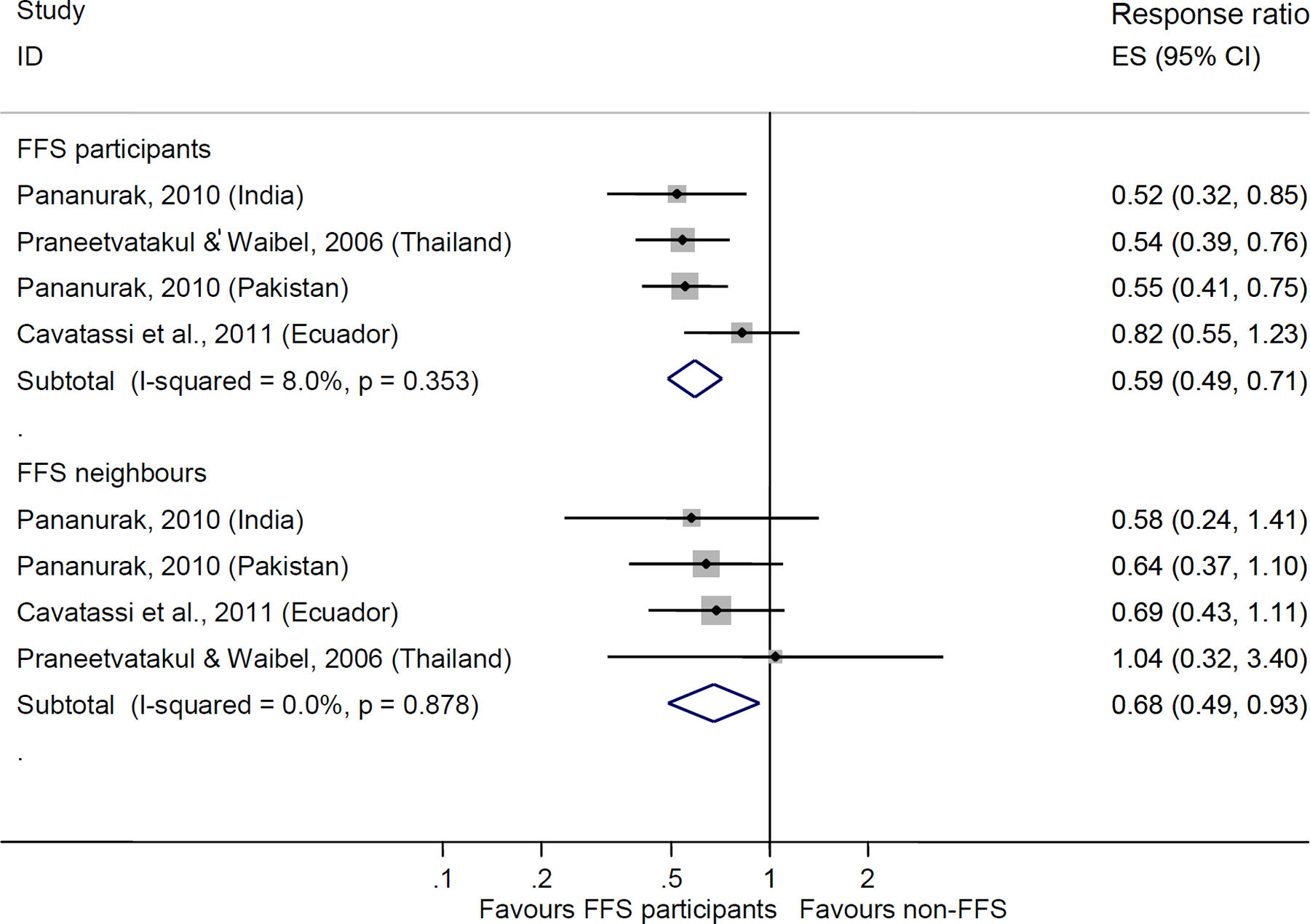
Environment outcomes: environmental impact quotient (EIQ)
EIQ is the only outcome for which estimated effects on non-participant neighbour farmers were significantly positive across all studies regardless of risk of bias. However, given the EIQ is estimated from reported pesticide use, for which we did not find any impacts on neighbour farmers, it seems unlikely that these significant effects on average are common. Indeed, when we excluded high-risk-of-bias studies from the analysis (including results for neighbour farmers from Cavatassi et al., 2011, for which we have approximated standard errors) the results for FFS participants remained significant (RR=0.61, 95% CI=0.48, 0.78; Q=3, Tau-sq=0.01, I-sq=33%; 3 observations), while those for neighbours were no longer statistically significant (RR=0.70, 95% CI=0.43, 1.14; Q=0.5, Tau-sq=0.00, I-sq=0%; 2 observations) (Figure 24).
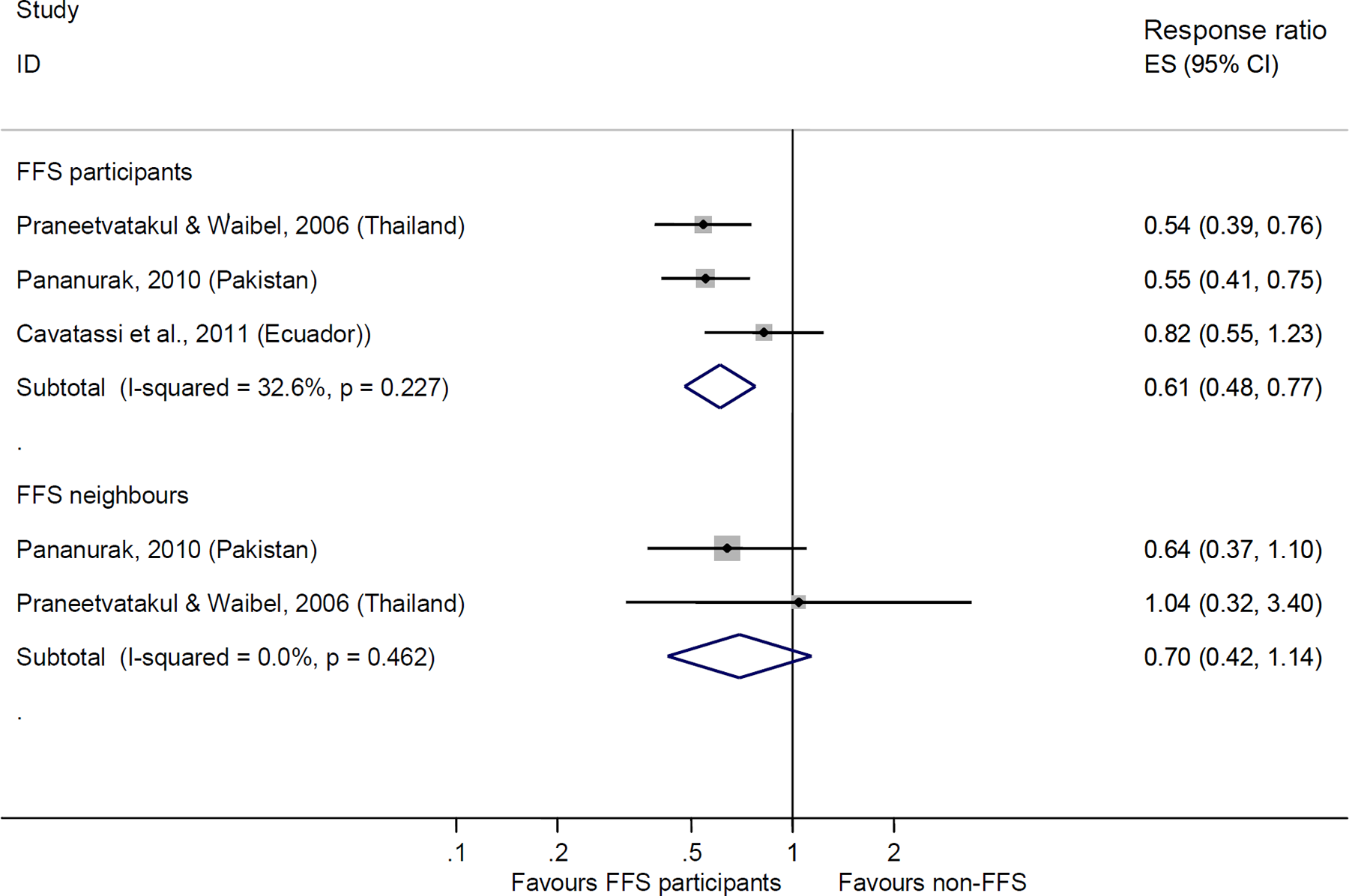
Environmental impact quotient (EIQ) excluding high-risk-of-bias studies
Effects on health
Health outcomes were measured in four studies, all of which were assessed as being of high risk of bias. We were able to calculate effect estimates and confidence intervals in two studies (Amera, 2009; Labarta, 2005) (Appendix E). 38 One study in Nicaragua compared self-reported health outcomes among FFS participants with those of non-participants (Labarta, 2005). The results, shown in Figure 25, suggest – counter-intuitively – that FFS beneficiaries experienced greater respiratory difficulties, though cases of eye irritation, stomach ache and blurred vision were not significantly different. In addition, neighbour farmers experienced greater eye irritation than non-FFS comparison farmers. However, the specifications used also found that the length of time after graduation from FFS significantly reduced the incidence of respiratory difficulties.
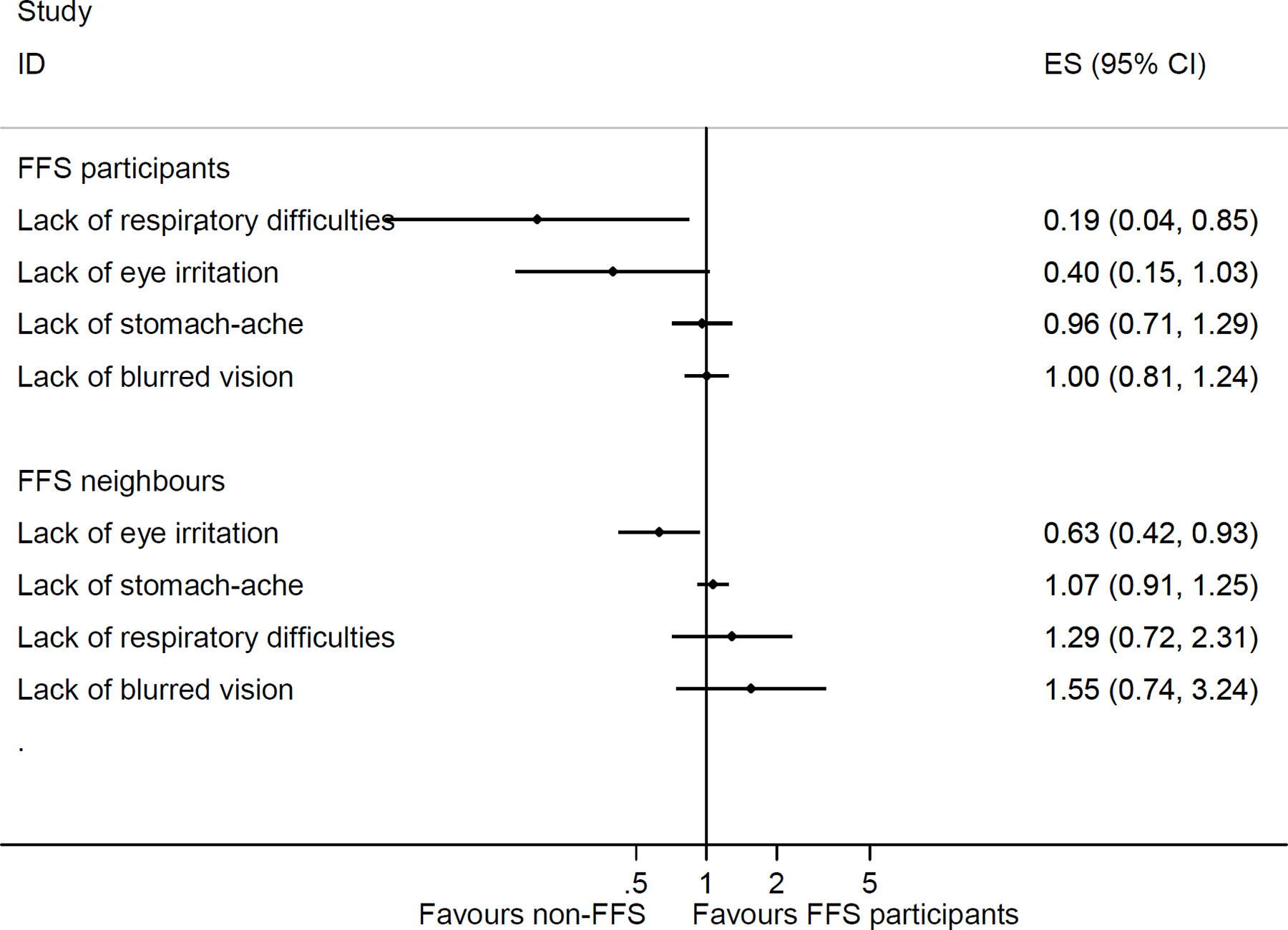
Health outcomes in Nicaragua (Labarta, 2005)
It appears that adoption of practices was a problem in Labarta (2005), as the authors indicated that 5 of the 13 FFS did not include a conventional “farmer practice” (control) plot; of the 8 that did, half observed lower yields in the IPM plot compared with the control plot, while 6 observed lower net revenue in the IPM plot compared with the conventional plot. In these cases, when comparative trials of IPM found higher revenues or yields in the IPM plot relative to the conventional plot, farmers were more likely to adopt the IPM practices included in the curriculum. A second study (Amera, 2009) reported perverse results in terms of pesticide poisoning in Kenya (RR=1.10, 95% CI=0.93, 1.30), despite significant estimated reductions in pesticide use (RR=0.61, 95% CI=0.52, 0.71).
It is difficult therefore not to conclude from these studies that reverse causality is driving the counter-intuitive outcomes, where farmers who most recently participated did so because of an existing respiratory problem for which analysis was unable to account. 39
Effects on empowerment
A total of four studies collected quantitative data on some measure of empowerment (Appendix E). Some outcomes were reported more clearly than others, and in only one case were we able to calculate confidence intervals (Van Rijn, 2010). Thus, Rusike et al. (2004) reported “empowerment attitudes” and Hiller et al. (2009) measured change over time in farmers' perceptions of empowerment; further details on the definition of empowerment were not reported. In contrast, Friis-Hansen and Duveskog (2012) reported empowerment indices for innovation uptake, access to services, engaging with markets and collective action/social relations, from which we calculated a pooled point estimate. In the case of Van Rijn (2010), we calculated a pooled variable measuring the probability that farmers felt improvements in self-esteem, including feeling capable of solving problems in the field, feeling comfortable in giving an opinion, and participating in the community (RR=2.13, 95% CI=1.46, 3.12). Figure 26 shows the forest plot for empowerment outcomes, including point estimates only for those studies where confidence intervals could not be calculated. The limited evidence suggests beneficial impacts, which is supported by qualitative evidence reported in Chapter 5, although further quantitative studies are needed to support the validity findings.
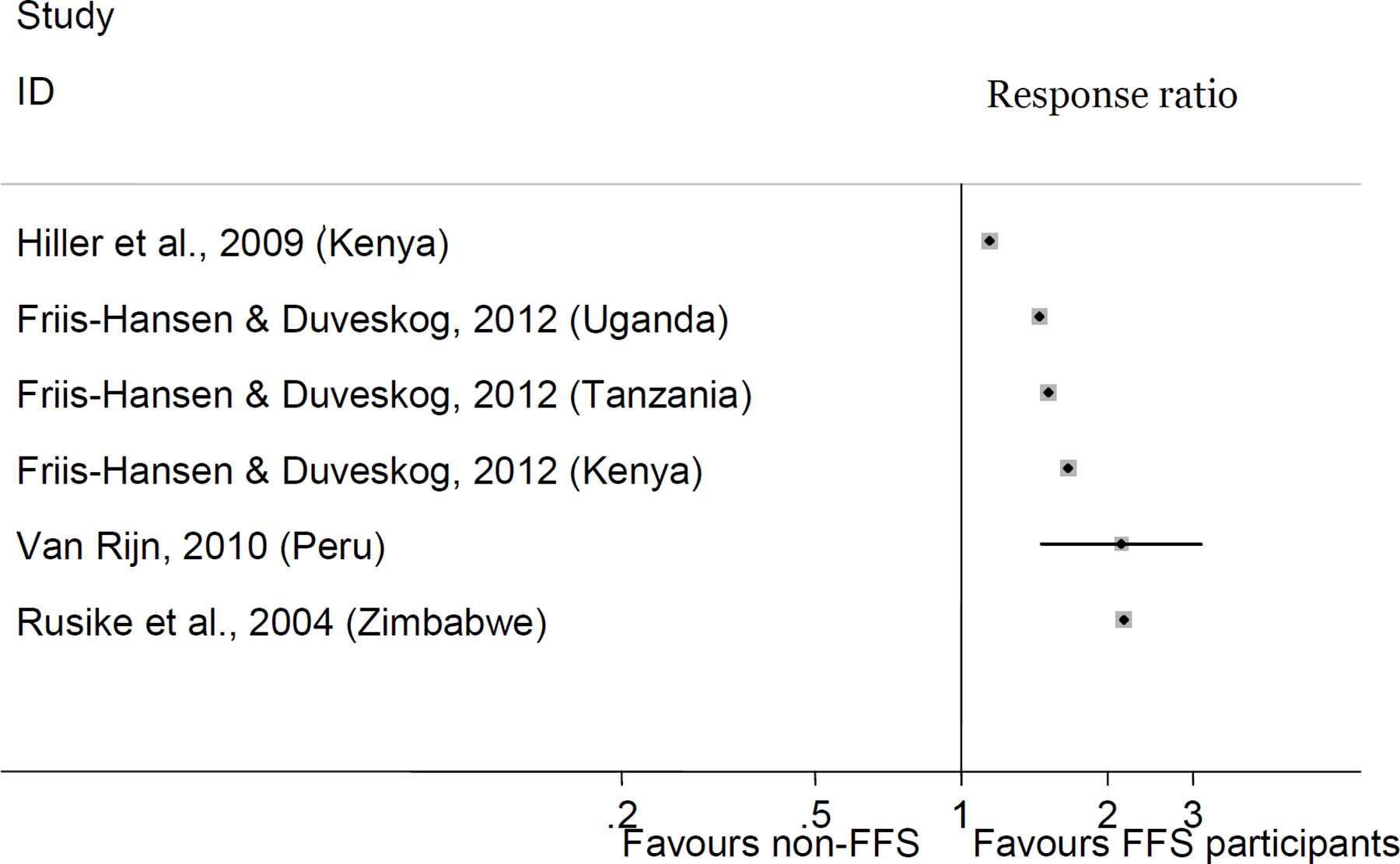
Empowerment outcomes (includes studies without standard error estimates)
A study of the IFAD-FAO East African FFS programme examined impacts on production by gender (Davis et al., 2012). The study showed high rates of FFS participation by women, who comprised two-thirds of field school participants in Kenya and half of those in Uganda. While women did not seem to have problems attending the FFS, female FFS participants did not benefit significantly more than female non-participants in both of these countries in terms of improved income. While women form a large part of the agricultural labour force, they may not be the household or community decision-makers and therefore the agents of change in adoption of practices. However, women FFS participants did benefit more than women non-participants in Tanzania, where women's participation made up one-third of the FFS programme intake. Davis et al. (2012) also found that increases in productivity for participants with no formal education were greater than for any other group of farmers, suggesting the experiential learning and demonstration focus of the FFS appears to allow low-literacy farmers to actively participate and learn.
5 Results of Qualitative Synthesis
5.1 SEARCH RESULTS
In this section we report the results of the synthesis of qualitative studies addressing review question (2) on the barriers to and enablers of FFS effectiveness. The included studies do not necessarily report on the same interventions as the included effectiveness studies.
Figure 27 provides a detailed outline of the search strategy and review process for the studies included to address our second review question. The search for qualitative studies was implemented in parallel with the search for evidence on effectiveness. Over a thousand (1,112) abstracts were systematically screened to assess whether full texts of the papers should be obtained for the qualitative synthesis component of the review according to the separate inclusion criteria for studies answering review question (2); 314 papers were retrieved for full text analysis. Two independent researchers systematically reviewed the texts and assessed whether the papers should be included for qualitative synthesis. Disagreements were resolved by discussion. Most (252) of these studies were excluded on relevance (they did not report on FFS nor provide evidence on barriers to and enablers of FFS effectiveness), or methodology (they were not primary research or failed to meet the methodology criteria as set out in the study selection criteria). Twenty studies (corresponding to 27 articles) were included in the analysis.
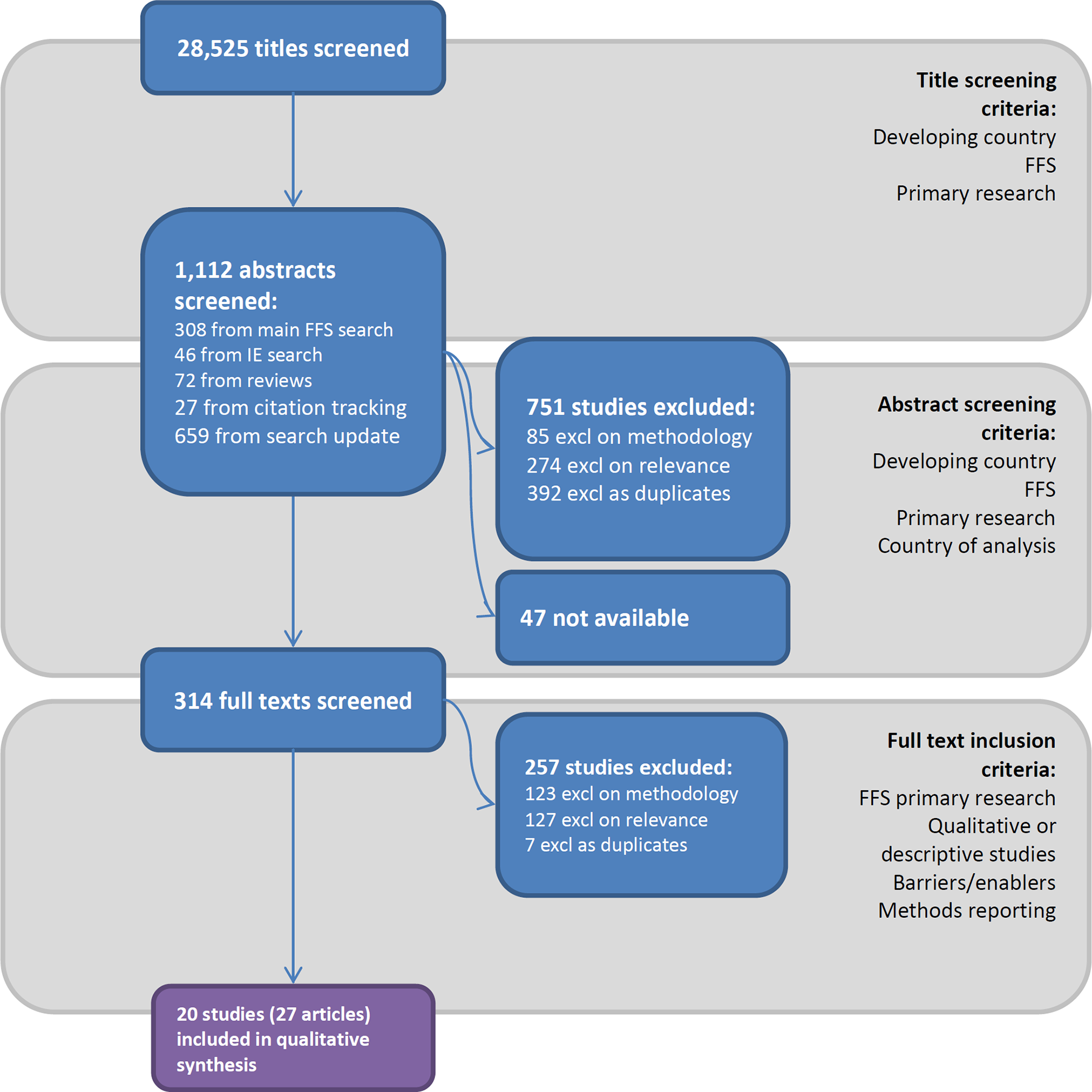
Qualitative synthesis search results
5.2 STUDY CHARACTERISTICS
Table 20 displays the basic characteristics of the included studies. Eleven of the studies were conducted in Africa (Cameroon, Kenya, Liberia, Uganda, Tanzania and Zimbabwe), seven of the studies were conducted in Asia (Bangladesh, Cambodia, Indonesia, the Philippines and India) and two in Latin America (Honduras, and Trinidad and Tobago). All the studies were addressing issues pertaining to FFS, including process and implementation, knowledge formation and farmers' experiences of FFS participation.
Summary characteristics of included studies
Where multiple studies reported evidence from the same country, the data were collected from different FFS in different districts. For example, two studies reported on evidence from Indonesia. However, one study reported evidence from Central Java province (Van de Fliert, 1993), while the other reported evidence from the West Java province (Winarto, 2004). Similarly, there were five studies that reported evidence from Kenya. Of these, three of the studies collected data from different districts (Friis-Hansen et al., 2012; Machacha, 2008; Najjar, 2009), and two studies collected data from different FFS programmes (Hiller et al., 2009; Karanja-Lumumba et al., 2007). Finally, there were two studies reporting evidence from the Philippines, each reporting on a different FFS programme (Palis, 2002; Rola and Baril, 1997).
The studies differed in the methods they used, the quality of reporting and the implementation of these methods. As is described in more detail in Appendix C, we assessed the quality of the included studies using a predetermined checklist. Full results of the quality appraisal are reported in Appendix F, and Figure 28 provides a summary of the quality assessment for each included study according to each criterion in our quality appraisal checklist.
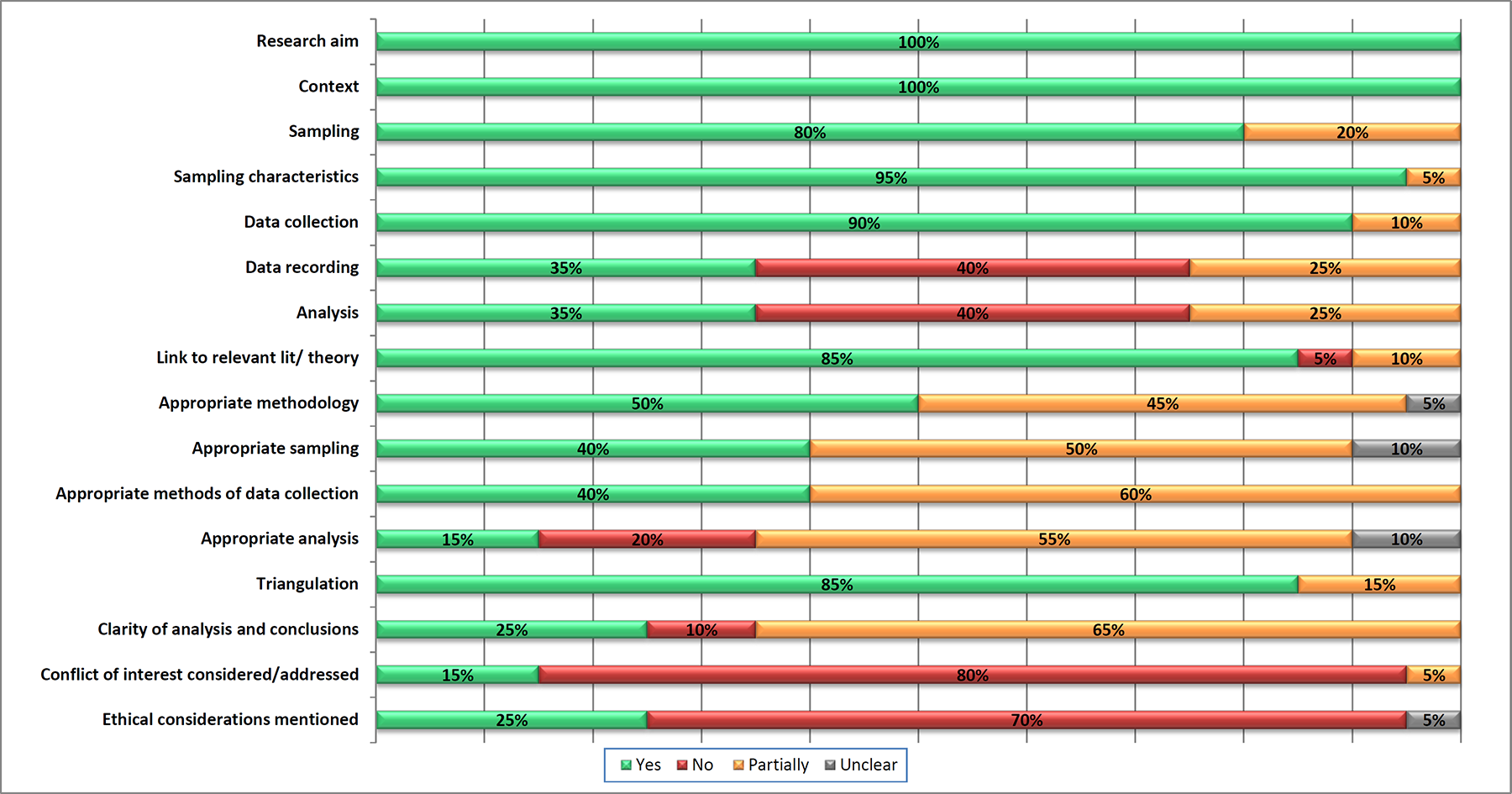
Summary of critical appraisal across all included studies
A large number of the studies suffered from weaknesses in reporting, making quality appraisal more challenging. Of particular concern was the limited reporting on sampling and sample characteristics, clarity of analysis and lack of presentation of data to support findings.
All the papers clearly stated their research aim and provided contextual background. The vast majority also contained a description of appropriate participant selection procedures (sampling) and provided details of sample characteristics such as sample size and location. Most studies also included adequate details of how data were collected, but only around one-third set out how data had been recorded. Furthermore, only 35 per cent of the studies provided a clear and explicit explanation of how data were analysed. Nearly all the studies (85%) situated the research within the relevant literature or set out a clear theoretical framework. The methodology was judged appropriate for the research question with the author(s) offering a clear justification for their approach in 50 per cent of the cases and doing so partially in 45 per cent of the cases; 5 per cent of the studies did not provide clear enough information to make a judgment regarding the appropriateness of the methodology. Criteria for appropriate sampling included providing an explanation of why the selected participants were suitable to provide the knowledge sought by the study and whether there were any issues around recruitment such as some potential participants choosing not to take part. Eight of the twenty studies addressed all these issues, ten did so partially and two others did not provide clear enough information for the criterion to be properly assessed.
The “appropriate methods of data collection” criterion required studies to use appropriate and justified methods, including that data be collected in a way that addressed the research issue at hand and for the researcher to discuss saturation of data. Sixty per cent of the studies partially satisfied these requirements and the remaining 40 per cent fully satisfied them. The “appropriate analysis” criterion required studies to provide the data that supported reported findings, and required that the relationship between researcher and participants had been considered, and judged the extent to which contradictory data were taken into account. Fifteen per cent of the studies fulfilled these requirements, 55 per cent did so partially, 20 per cent did not satisfy the criteria at all and 10 per cent were not sufficiently clear to make a judgment. Two of the most common weaknesses were the failure to consider the relationship between researcher and participant and the effect this might have on the data collected, and the absence of any real consideration of the significance of contrary evidence or explanations. Another common shortcoming of the included studies was incomplete reporting of data supporting the findings.
All the included studies provided at least some evidence of having triangulated their results, with 15 per cent of studies satisfying one of the following requirements and the remaining 85 per cent satisfying two or more of them: the verification of findings using two or more data sources; the application of multiple methods; employment of multiple investigators; investigation of multiple theories. However, none of the studies employed theoretical triangulation approaches. To satisfy the “clarity of analysis and conclusions” criterion, researchers needed to have done all of the following: discussed the credibility of their findings; discussed evidence both for and against their own arguments; made their findings explicit and discussed them in relation to the original research question. Twenty-five per cent of studies satisfied all these requirements, 65 per cent did so partially while 10 per cent failed to address them adequately. Finally, only small proportions of the papers clearly set out any ethical considerations (25%) or addressed potential conflicts of interest (15%) in terms of author relationships with funder or implementer.
5.3 SYNTHESIS RESULTS
This section reports the results of the synthesis of findings from the qualitative studies, presented using the hypothesised programme theory as an overall framework for structuring the synthesis. Based on the findings from the synthesis we also present an updated programme theory (Figure 29). The figure includes revised assumptions as well as statements about the barriers and enablers related to each step in the causal chain, based on the evidence in the included studies.
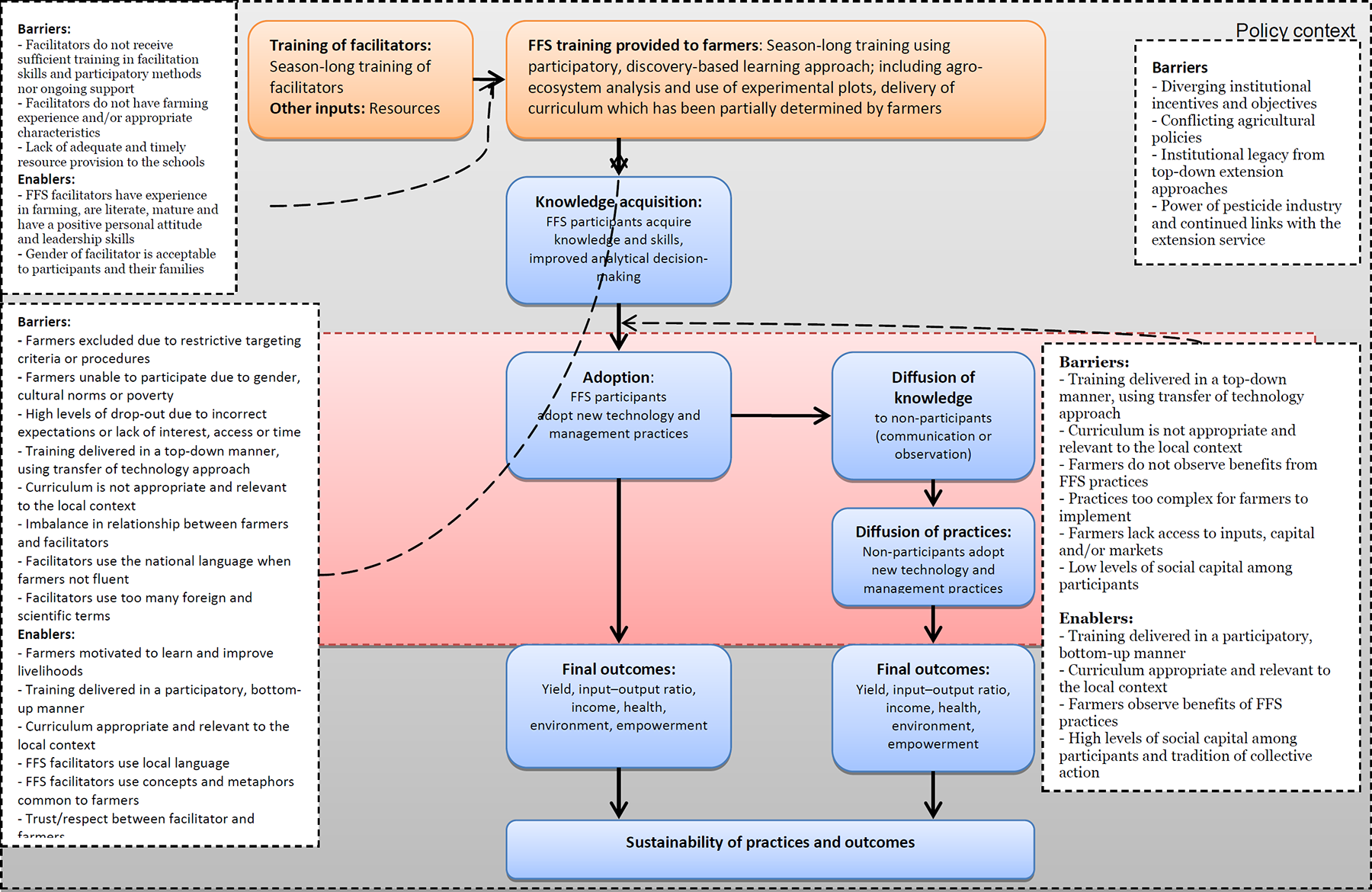
Barriers to and enablers of knowledge acquisition, adoption and improved final outcomes
As can be seen from the critical appraisal (Figure 28), there are considerable weaknesses in the underlying evidence base. The findings should therefore be interpreted with caution and the findings presented below should be considered suggestive rather than definitive. There were likely biases in terms of what is studied. For instance, a lot of the qualitative evidence related to barriers, rather than enablers.
Programme components
General inputs
As with any programme FFS require a range of different inputs at the outset in order to establish the programme and start delivering services to participants. There was a lack of systematic reporting of the resources devoted to individual FFS interventions and assessment of the quality of the services delivered to farmers in the included studies. However, some studies reported a lack of (timely) funding and inadequate provision of resources, including inputs and finances, as potential reasons for implementation failures (Pedersen et al., 2008; Najjar, 2009; Winarto, 2004). These included insufficient and incidental provision of inputs, discrepancies between budgeted and received payments, payment delays and difficulties with logistics and dissemination. In addition, selection of inappropriate FFS sites and a lack of adequate follow-up and support during pest outbreaks were noted as constraints.
Facilitators
The facilitator is an important input in FFS programmes, and according to the programme theory adequate training of facilitators is a key assumption for the FFS training to lead to improved knowledge and skills among participating farmers. If facilitators are not adequately trained the quality of the training received by farmers may be lower, affecting knowledge formation, adoption and final outcomes.
Six of the seven studies that reported on training of facilitators suggested that there were issues related to a lack of appropriate training, resources and ongoing support of facilitators (DANIDA, 2011; Gottret & Córdoba, 2004; Hofisi, 2003; Pedersen et al., 2008; Rola & Baril, 1997; Simpson, 1997). Examples of deficiencies included gaps in the curriculum covered in the training of facilitators and lack of focus on participatory techniques and facilitation skills. The studies also highlighted issues related to a lack of ongoing support or backstopping, and lack of inputs to support facilitators in their roles.
One theme which was not included in the original programme theory relates to the selection and characteristics of FFS facilitators. Four studies suggested appropriate criteria for selecting facilitators were important for identifying candidates suitable to be facilitators (DANIDA, 2011; Hofisi, 2003; Machacha, 2008; Winarto, 2004). These studies found that rather than high levels of education, characteristics such as personal attitude, maturity, literacy, leadership skills and experience with farming might be more important for facilitators to perform their role successfully. Facilitators not having the right characteristics from the outset appeared to have influenced their ability to successfully perform the role of FFS facilitator.
Moreover, a large difference between farmers and facilitators in terms of socioeconomic characteristics may prevent farmers from fully participating and making suggestions or raising concerns (Simpson, 1997). Finally, the gender of the facilitator might be important, in particular in more conservative contexts. Some studies found that women preferred female facilitators (Hofisi, 2003; Van Der Wiele, 2004), suggesting that FFS programmes aiming to target women farmers should take account of this when selecting facilitators.
The characteristics of the facilitators and the training they receive in turn effect another theme which was highlighted by several of the included studies: the relationship between facilitators and participants. Three of the studies suggested an imbalance in the farmer–facilitator relationship as a potential barrier to farmers' learning and adoption (Isubikalu, 2007; Najjar, 2009; Simpson, 1997), with farmers not feeling comfortable enough to admit when they did not understand something, or to voice concerns or make suggestions.
Targeting criteria and procedures
While not included in the original programme theory our synthesis suggests a key assumption in the FFS programme theory may be that the right farmers are targeted and reached by the FFS. The targeted farmers must be willing and able to participate in FFS training throughout the full season, and be able to implement FFS practices in their fields. Those studies that provided information on targeting, selection procedures and group composition, have been linked to FFS effectiveness analysis above, and are covered in a separate piece on FFS targeting (Phillips et al., 2014).
Available evidence suggests that structural factors such as socioeconomic status, gender and cultural norms influence both who is targeted and who is able to participate in FFS. In some cases targeting procedures privileged the elite and more affluent (DANIDA, 2011; Simpson, 1997; Van de Fliert, 1993), or excluded women and the poor (DANIDA, 2011; Najjar, 2009; Simpson, 1997). In other cases poverty and ill health prevented farmers from participating (Gottret & Córdoba, 2004; Najjar, 2009). In yet another case, an absence of targeting criteria was suggested as a barrier to effectiveness (Pedersen et al., 2008).
While several studies found that women were able to participate in FFS (Hofisi, 2003; Machacha, 2008; Najjar, 2009; Rola & Baril, 1997), other studies found that women were often not allowed to participate by their husbands or could not participate due to time constraints and lack of access to resources and land (DANIDA, 2011; Hofisi, 2003; Najjar, 2009; Van de Fliert, 1993, Van Der Wiele, 2004).
Farmers' education levels and motivation to participate was another key determining factor highlighted by existing evidence (Gottret & Córdoba, 2004, Hofisi, 2003). The most commonly cited reason to join a field school was to improve knowledge, skills and livelihoods (DANIDA, 2011; Friis-Hansen, 2008; Hofisi, 2003, Najjar, 2009). Several studies found high levels of drop-out (Friis-Hansen, 2008; Gottret & Córdoba, 2004; Machacha, 2008; Najjar, 2009; Rola & Baril, 1997; Winarto, 2004). Unmet expectations of hand-outs or loans were the most commonly cited explanation in the literature (Friis-Hansen, 2008; Hofisi, 2003; Machacha, 2008; Najjar, 2009). Additional reasons for drop-outs included lack of interest, access and time (Gottet & Córdoba, 2004; Machacha, 2008; Najjar, 2009).
Overall, the review identified several key barriers related to targeting, such as inappropriate selection criteria and targeting procedures, and structural barriers to participation such as gender, poverty and cultural norms. If there is not a considered approach to targeting, this may result in farmers participating for the wrong reasons and ultimately dropping out. Alternatively, beneficiaries may not have the right characteristics, such as education levels, or access to land and resources, to be able to fully benefit from the FFS training. FFS should target farmers with appropriate education levels, motivation and access to land, and those who do not live too far away to attend the weekly FFS sessions.
Approach to learning
A key characteristic of FFS design is that programmes should follow a participatory approach, based on theories of adult education and discovery-based learning (Pontius et al., 2002). A participatory, bottom-up approach to the training is considered important in communicating complex concepts, strengthening problem-solving capabilities and ultimately convincing farmers to adopt the practices promoted in FFS.
Over half of the included studies included themes pertaining to the way in which FFS were delivered in the field (DANIDA, 2011; Dolly, 2009; Friis-Hansen, 2008; Gottret & Córdoba, 2004; Hofisi, 2003; Isubikalu, 2007; Machacha, 2008; Najjar, 2009; Pedersen et al., 2008; Rola & Baril, 1997; Van de Fliert, 1993, Winarto, 2004). Some of the studies represented cases where FFS were delivered in a top-down manner, using a transfer of technologies approach rather than according to the original approach characterising FFS (Isubikalu, 2007; Pedersen et al., 2008; Najjar, 2009; Simpson, 1997). The top-down approach seemed to have occurred at different levels – a bias towards talk, rather than practice, experiments being managed by the facilitators rather than farmers, or the delivery of the FFS in terms of the overall approach, budgeting, monitoring and inputs provided.
Nevertheless, a greater proportion of the included studies represented cases where FFS were delivered in a participatory manner (DANIDA, 2011; Dolly, 2009; Friis-Hansen, 2008; Gottret & Córdoba, 2004; Hofisi, 2003; Machacha, 2008; Rola & Baril, 1997; Van de Fliert, 1993; Winarto, 2004), 40 with farmers taking part in field trials and development of the curriculum. According to the participating farmers of one FFS, their active experimentation and information-sharing enhanced their learning and increased knowledge and ownership of the resulting farming systems.
Related to this, there is consistent evidence that due to the complexity of the curriculum, observability is important for farmers to trust the messages promoted in FFS and to develop analytical skills (Dolly, 2009; Hofisi, 2oo3; Machacha, 2008; Palis, 2002; Simpson, 1997; Van Der Wiele, 2004; Winarto, 2004). The observability of IPM practices and their relative advantage compared with conventional methods was found to be important in enhancing farmers' confidence and trust in IPM messages. Similarly, in a few cases facilitators were unable to demonstrate observable benefits from FFS practices and this acted as a barrier to adoption.
The extent to which the FFS in the included studies were delivered according to the original principles upon which the intervention was designed varied, ranging from approaches to learning similar to traditional extension, to “true FFS”. Where implementation in practice was characterised by a more top-down, transfer of technology approach farmers were not able to see and practice IPM, and this appeared to have been a barrier to farmers developing their knowledge and analytical skills.
The evidence highlighted the importance of empirical study, successful demonstration plots, and visibility of benefits in other farmers' plots in convincing farmers to adopt new practices. The apparent importance of observability and relative advantage of FFS practices in farmers' adoption is consistent with Rogers' theory of diffusion (2003), which suggests peoples' perceptions of these characteristics are among the important attributes determining adoption of innovation.
FFS content and coverage
The FFS curriculum is another major component of the intervention. For farmers to learn and adopt the practices promoted in FFS, an assumption is that the content of the curriculum is relevant to the needs of farmers, appropriate for the local context in terms of the crops it covers and feasible for farmers to implement in their fields. Most of the included studies reported themes relating to the FFS curriculum (DANIDA, 2011; David, 2007; Dolly, 2009; Gottret & Córdoba, 2004; Hiller et al., 2009; Hofisi, 2003; Isubikalu, 2007; Mancini et al., 2007; Najjar, 2009; Palis, 2002; Simpson, 1997; Van de Fliert, 1993; Van Der Wiele, 2004).
From the studies it appears that in most cases the FFS curriculum was relevant and appropriate to the local context (DANIDA, 2011; Dolly, 2009; Gottret & Córdoba, 2004; Hiller et al., 2009; Hofisi, 2003; Mancini et al., 2007; Van de Fliert, 1993), for instance by responding to local concerns over economic and environmental costs of pesticides (Dolly, 2009; Mancini et al., 2007).
However, in some cases FFS curricula appeared to lack relevance to the local context (Isubikalu, 2007; Najjar, 2009; Simpson, 1997), and the major barrier in these cases seemed to be that the curriculum was not sufficiently tailored to the needs and resources of the farmers it was targeting. For instance, in some cases the practices were seen to be too labour- or time-intensive (Isubikalu, 2007) or failed to address the issues that were of highest priority among farmers (Simpson, 1997).
Farmers may have a range of concerns, such as water management, fertilisation, diversification and marketing. A failure to incorporate a broader range of concerns in the curriculum was perceived by farmers to be a weakness in several studies (DANIDA, 2011; Mancini et al., 2007; Najjar, 2009; Van de Fliert, 1993, Winarto, 2004), who expressed that the curriculum was not sufficiently comprehensive in its coverage. Therefore a broader focus might encourage participation in FFS, and could potentially also facilitate greater improvement of agricultural outcomes. Nevertheless, as one case from Kenya demonstrates (Pedersen et al., 2008), trying to cover too many topics or crops in one cycle may put the technical quality of the intervention at risk.
Limited evidence suggests that in some cases the complexity of IPM made it difficult for farmers to implement all the IPM practices on their crops (Gottret & Córdoba, 2004; Van de Fliert, 1993; Winarto, 2004). Some of the analytical tools used were too complex and perceived as impractical in relation to the time, energy and resources they required (Winarto, 2004). For instance, the use of forms to record field sampling with formulae to calculate percentages for damages and prevalence of insects was found to be of little practical use for the farmers, who abandoned this in favour of simply recording what they observed in their fields (Van de Fliert, 1993). On the other hand, some studies found that including indigenous and practical knowledge, rather than theoretical concepts, may enhance farmers' understanding of FFS practices (David, 2007; Hofisi, 2003).
Related to the complexity of the curriculum is the discourse and language used for communication in FFS. An assumption not included in our original programme theory, but which emerged from the synthesis is that the curriculum needs to be communicated in a language farmers understand. Evidence from Indonesia suggested that when facilitators used unfamiliar foreign and scientific terms which were part of their vocabulary, such as “economic threshold level” (ETL) and “ecosystem”, these terms were not easily understood by farmers (Van de Fliert, 1993; Winarto, 2004). On the other hand, the use of common concepts and metaphors, such as “natural enemy” (musuh alami) or “farmers' friends” (teman petani), were more easily understood and facilitated knowledge formation and adoption (Dolly, 2009; Winarto, 2004).
Moreover, farmers might not be sufficiently fluent in the national language to be able to comprehend the FFS content (DANIDA, 2011; Najjar, 2009), and in one case farmers' understanding was improved when facilitators used the local language (Van de Fliert, 1993).
External/contextual factors
A range of contextual factors external to the programme can act to promote or hinder FFS effectiveness. Several of the included studies contained findings related to the policy context and institutional set-up, the community context and the infrastructure and physical context within which FFS were implemented.
Policy context and institutional set-up
FFS are implemented within the context of existing and emerging policies, institutional structures and industry activities. A range of actors are involved in agricultural extension, including international donors, national, regional and local governments, research institutions, NGOs and various industry actors. Several studies noted that diverging institutional incentives and objectives of these various actors influence how FFS are implemented in practice, with a tendency for some of the participatory elements to be eroded (Isubikalu, 2007; Pedersen et al., 2008; Simpson, 1997).
There is some evidence suggesting that the existence of conflicting agricultural policies can act as a barrier to adoption of FFS practices. In some cases, the involvement of a multitude of institutions each promoting their own mandate resulted in each impacting on the design, content and implementation of FFS, crowding out the beneficiary needs and interests (Isubikalu 2007, Simpson, 1997). In other cases, the institutional legacy of existing extension systems influenced the implementation of FFS (Isubikalu 2007; Mancini et al., 2007; Van de Fliert, 1993; Winarto, 2004). Institutional structures associated with earlier top-down agricultural extension systems, such as subsidised input schemes, trickle-down messages and off-the-shelf technology promotion, remained and contradicted the bottom-up, participatory approach of FFS.
Other evidence suggested that the power of the pesticide industry and their continued links with the extension system can act as a barrier to adoption and diffusion of FFS practices. In at least two cases, studies found that the pesticide industry maintained close links with the extension system at the local level (Mancini et al., 2007; Van de Fliert, 1993), paying commission to extension workers and local cooperatives to promote pesticides, hampering farmers' efforts to practice IPM.
Community context and social capital
Several of the included studies highlighted the role of the community in influencing farmers' practices (Dolly, 2009; Machacha, 2008; Najjar, 2009; Palis, 2002; Simpson, 1997; Van Der Wiele, 2004; Winarto, 2004). One of the hypothesised assumptions in the programme theory was that for sustained adoption of FFS practices it was important “farmers are convinced others will do the same”. There was limited evidence to support this assumption, which was based on the suggestion by Feder et al. (2004a) that lack of adoption of IPM practices by neighbouring farmers might curtail the effectiveness of the intervention, as pests from their fields may re-infest the fields of adopters, eventually leading to disadoption of IPM by FFS participants. In one case farmers in Indonesia found it difficult to practise new strategies when the rest of the community continued applying old practices (Winarto, 2004). However, the reason for this seems to be that they faced discouragement and disbelief from their untrained peers, rather than a fear of re-infestation.
In our original programme theory we suggested that a “high degree of social cohesion” might be an assumption that needs to hold for knowledge to diffuse to neighbouring farmers not participating in FFS, but we did not include it as a factor that might affect adoption among FFS participants. Several of the included studies suggested that existing social capital and reach of social networks may also influence adoption among FFS participants (Dolly, 2009; Gottret & Córdoba, 2004; Palis, 2002; Simpson, 1997). In some cases high levels of social cohesion and a tradition of collective action from existing farmer groups may have encouraged a willingness to learn and succeed with the training, facilitating adoption (Dolly, 2009; Gottret & Córdoba, 2004; Palis, 2002). On the other hand, in one case low levels of social capital and little sense of community in the FFS villages may have been a barrier to FFS effectiveness.
Access to inputs
One of the assumptions included in the programme theory was that farmers have access to any complementary inputs necessary to adopt FFS practices. Five studies highlighted issues related to availability of inputs, labour and markets (DANIDA, 2011; Machacha, 2008; Mancini et al., 2007; Najjar, 2009; Van Der Wiele, 2004). In all cases the lack of access to inputs, capital and/or markets were suggested as factors influencing uptake of FFS practices or final outcomes of the FFS training. These issues are common challenges for farmers, and are not particular to FFS programmes, but in some cases they appear to have remained a barrier for FFS farmers to adopt FFS practices and fully benefit from adoption.
Other themes
Sustainability
FFS aim to provide farmers with skills which enable them to solve problems for themselves. An implicit assumption behind this is that the FFS training will enable farmers to continue with FFS practices and deal with any new challenges after they graduate. The sustainability of these skills and practices, along with their successful diffusion to broader farmer communities are an important outcome for cost-effectiveness of FFS interventions. Eleven out of 20 studies discussed factors affecting sustainability of FFS (DANIDA, 2011; David, 2007; Dolly, 2009; Friis-Hansen, 2008; Gottret & Córdoba, 2004; Karanja-Lumumba et al., 2007; Machacha, 2008; Simpson, 1997; Van de Fliert, 1993; Van Der Wiele, 2004; Winarto, 2004).
Based on the descriptive themes, all studies highlighted that ongoing support and follow-up are important for sustainability of FFS practices and the establishment and sustainability of FFS-related activities (DANIDA, 2011; David, 2007; Dolly, 2009; Gottret & Córdoba, 2004; Karanja-Lumumba et al., 2007; Machacha, 2008; Simpson, 1997; Van Der Wiele, 2004; Winarto, 2004). In particular, included studies identified a lack of technical assistance and backstopping from researchers and extensionists to support farmers in continuing development of local practices (Dolly, 2009; Gottret & Córdoba, 2004; Simpson, 1997; Winarto, 2004). The studies that reported on follow-up group activities taking place suggested that active follow-up and continued support by the implementing agency, encouragement to establish farmer clubs and additional sessions on club formations may facilitate the establishment of sustainable and effective groups and practices.
In addition, four studies also suggested that particular group characteristics may affect sustainability of farmer groups and FFS-related practices (DANIDA, 2011; David, 2007; Machacha, 2008; Van Der Wiele, 2004). Studies reporting successful follow-up farmer activities suggested consistent membership, good leadership, collective goals and a supportive group environment might be important in maintaining FFS groups and providing impetus for further farmer-led initiatives.
Overall, the studies suggested that lack of ongoing support and follow-up is an important barrier to the sustainability of the FFS approach. In the absence of formal follow-up, the implicit assumption is that the FFS training is sufficient to enable farmers to continue with FFS practices and deal with any new challenges. However, the evidence suggested that this might not hold in most cases, as farmers expressed the need for additional follow-up support and technical backstopping to be able to continue the development of local practice. A lack of formal follow-up activities therefore appears to be a barrier to sustainability of FFS practices.
An assumption missing from the original theory of change is that the group characteristics may play a crucial role in enabling sustainability of FFS practices and related activities. Based on the available evidence, it appears that choosing groups with common goals, good leadership and high attendance rates might be important enablers of sustainability of FFS-related practices.
Perceived outcomes: gender and empowerment
Proponents of FFS suggest empowerment is a key outcome of FFS. While few impact evaluation studies looked at these outcomes, empowerment and improved gender relations were frequently highlighted in the qualitative literature (DANIDA, 2011; Dolly, 2009; Friis-Hansen, 2008; Friis-Hansen et al., 2012; Hofisi, 2003; Machacha, 2008; Mancini et al., 2007; Najjar, 2009; Simpson, 1997, Van Der Wiele, 2004; Winarto, 2004). Evidence based on participants' perceptions suggests FFS may influence empowerment positively. Some studies also suggest participation in FFS may lead to women's empowerment and improve gender relations.
IPM diffusion to neighbour farmers
The evidence from quantitative impact evaluations overwhelmingly supports the notion that there is little, if any, diffusion of IPM knowledge and adoption to neighbouring farmers who do not participate in FFS. Over half of the studies included in the qualitative synthesis covered themes relevant to the diffusion of FFS knowledge and practices to non-participants (David, 2007; Gottret & Córdoba, 2004; Hiller et al., 2009; Karanja-Lumumba et al., 2007; Machacha, 2008; Mancini et al., 2007; Palis, 2002; Rola & Baril, 1997; Simpson, 1997; Van de Fliert, 1993; Winarto, 2004). Overall they suggested both characteristics of FFS and contextual factors influenced diffusion, summarised in the updated programme theory (Figure 30).
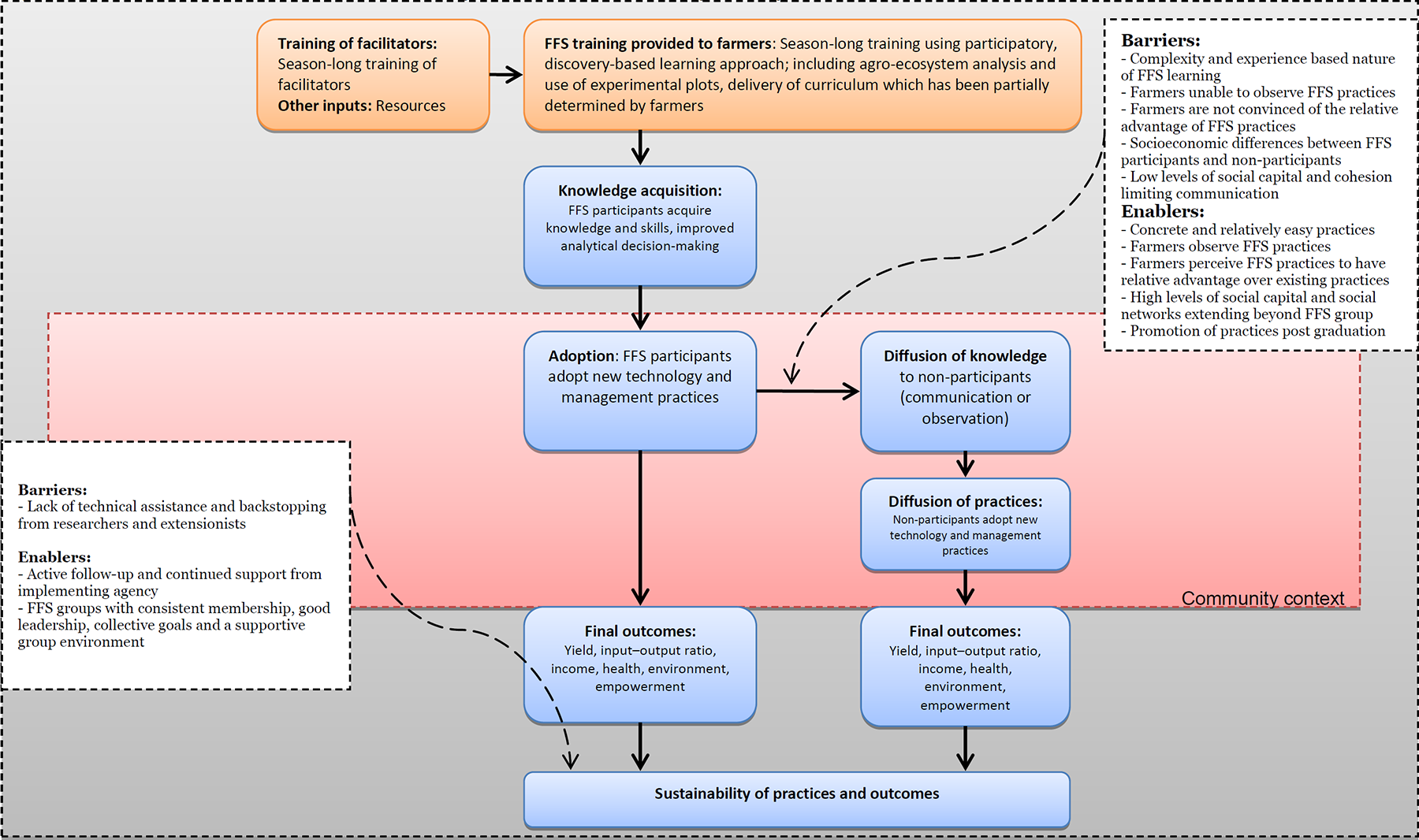
Barriers to and enablers of IPM diffusion to non-FFS neighbour farmers and sustainability
Several characteristics of FFS may explain why practices promoted in IPM-FFS do not appear to diffuse spontaneously to farmers who have not participated in training. Four studies highlighted the complexity and the experiential nature of FFS learning as a barrier to diffusion (David, 2007; Mancini et al., 2007; Van de Fliert, 1993; Winarto, 2004). They noted that, despite high awareness of IPM by non-participants (Van de Fliert, 1993; Winarto, 2004), the skills and practices are complex and their experiential nature makes them difficult to convey via verbal communication (Mancini et al., 2007; Van de Fliert, 1993; Winarto, 2004). In two studies where some diffusion was observed, the findings suggested concrete practices were more likely to diffuse than theoretical concepts and principles (David, 2007; Hiller et al., 2009), with relatively simple practices, such as pruning and weeding techniques, being more easily disseminated.
Just as observability of IPM practices and their relative advantage compared with conventional methods was found to be important in encouraging FFS farmers to adopt new practices, the evidence suggested observability is important for convincing non-FFS farmers to adopt IPM practices (David, 2007; Gottret & Córdoba, 2004; Palis, 2002; Machacha, 2008; Simpson, 1997; Winarto, 2004; Van de Fliert, 1993). In theory this should be done on the plot so that non-participant farmers can see what is done and trained farmers may not have the time or skills to do so. In two cases non-FFS farmers perceived FFS practices as having relative advantage compared with existing practices, facilitating interest in IPM (Gottret & Córdoba, 2004; Hiller et al., 2009).
For many observers the lack of diffusion of IPM practices may not be surprising. FFS differ from agricultural extensions that focus on disseminating knowledge of more simple practices, such as application of fertiliser and pesticides, or adoption of new, improved seeds. Instead of heavy reliance on external inputs, the practices promoted in FFS typically rely on analysis and use of what is available in farmers' fields and local ecosystems. Given the skills-based nature of the practices promoted in FFS, the rate and nature of diffusion will differ from the diffusion of more simple technological innovations.
One of the assumptions included in our initial programme theory was that a “high degree of social cohesion” would be important for diffusion. Evidence from five studies suggests existing levels of social capital may influence diffusion of IPM knowledge and practices (David, 2007; Gottret & Córdoba, 2004; Palis, 2002; Rola & Baril, 1997; Simpson, 1997). In some cases low levels of social capital and cohesion limited communication within the community and presented a barrier to diffusion of FFS messages (David, 2007; Simpson, 1997). On the other hand, in the Philippines, high levels of social capital, in particular among farmers with kinship ties, facilitated sharing of IPM concepts with farmers who did not participate in FFS training. Awareness of the main sources of social capital in a particular context, as well as analysis of social networks, might provide an opportunity to facilitate greater diffusion.
In our original programme theory one of the assumptions for IPM knowledge and practices to diffuse was that formal community-building activities and training of FFS alumni to train other farmers were implemented. Overall the themes emerging from the synthesis of issues related to diffusion seemed to confirm this, and supported the assumption that, in the absence of formal mechanisms promoting diffusion, targeting “appropriate” farmers for FFS participation is particularly important.
This issue was highlighted in a study from Indonesia, which found that socioeconomic differences between FFS participants and non-participants impeded diffusion (Van de Fliert, 1993). The non-representative composition of the FFS groups impeded interaction between participants and non-participants. FFS participants communicated to a “selective audience in the villages” and made no deliberate efforts to train other members of the community in IPM principles. However, another study from Indonesia found that a few inquisitive farmers played a prominent role in the ongoing process of knowledge formulation and transmission. These farmers progressively established their position within the community as “experts”, “farmer professors” and “consultants” (Winarto, 2004, p. 351), suggesting some spontaneous diffusion may be possible, but that careful targeting of farmers with the appropriate characteristics may be necessary.
6 Integrated Synthesis
What are the effects of farmer field schools on farmers' wellbeing in terms of intermediate and final outcomes? What explains differences in effects across different contexts? Are these effects sustainable? This chapter integrates the two syntheses with the aim of answering these questions.
The findings and conclusions regarding the effect of FFS on intermediate and final outcomes are based on the meta-analysis of quantitative impact evaluations addressing review question (1): What are the effects of farmer field schools on intermediate and final outcomes for FFS participants and non-participating neighbours? The findings and conclusions regarding the possible reasons for differences in FFS effectiveness are based on the qualitative synthesis addressing review question (2): What are the enablers of and barriers to FFS effectiveness, diffusion and sustainability?
We updated the theory of change based on the findings from the syntheses, and also attempted to explain heterogeneity in findings using causal chain analysis (White, 2009). Figure 31 shows the updated programme theory, indicating where the causal chain breaks down, together with assumptions based on the identified barriers and enablers.
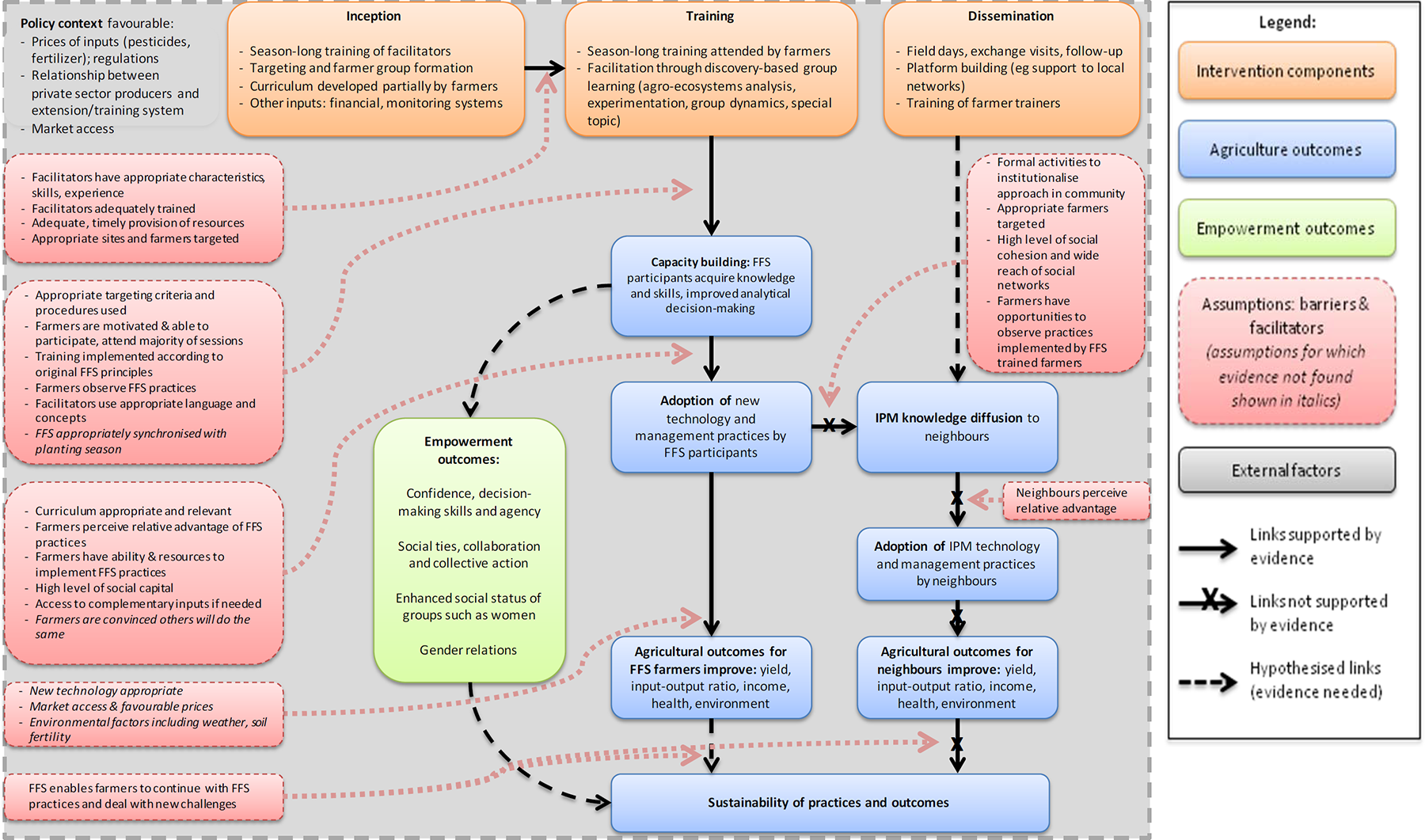
Farmer field schools theory of change: integrated synthesis of evidence
6.1 INTERMEDIATE OUTCOMES
Knowledge
No studies with a low risk of bias were identified and only three quasi-experimental studies were assessed as of being of medium risk of bias in measuring knowledge outcomes. The meta-analysis findings indicated that field school participants improved their knowledge of farming technology, both on average across evaluations as well as in all sufficiently powered individual studies. The improvements in scores were measured across a range of knowledge tests and also appeared to be both for simpler and more complex types of knowledge among the few studies, which differentiated these. However, the policy-relevant findings of effects are based on only three studies and owing to the range of methods used hence the heterogeneity in effects was particularly high for these outcomes. Knowledge outcomes improved across all FFS curricula, although they were greatest for IPM-FFS graduates. The finding across three medium-risk-of-bias studies suggested consistent increases in knowledge for FFS farmers of 0.21 standard deviations in test scores over comparison farmers (SMD=0.21, 95% CI=0.07, 0.35; Q=5, Tau-sq=0.008, I-sq=55%; evidence from 3 studies) (Figure 14). The quantitative studies did not, however, attempt to assess other aspects of capacity such as farmers' problem-solving capabilities, which is also an important weakness of the evidence on empowerment.
While the evidence indicated knowledge acquisition among participants, it also suggested participant targeting and participation, facilitator training and the programme implementation as important barriers and enablers which might influence it.
Farmer targeting and participation
A key assumption in the FFS programme is that the “right” farmers are targeted and reached by the FFS. The targeted farmers must be willing and able to participate in FFS training throughout the full season, and be able to implement FFS practices in their fields.
Overall, the review identified several key barriers related to targeting, such as inappropriate selection criteria and targeting procedures, and structural barriers to participation such as gender, poverty and cultural norms. If there is not a considered approach to targeting, this may result in farmers participating for the wrong reasons and ultimately dropping out. Alternatively, beneficiaries may not have the right characteristics, such as education levels, or access to land and resources, to be able to benefit fully from the FFS training. We were able to assess whether there were differences in knowledge gains among field schools which targeted farmers based on education levels and land size, but due to limited data provided in most included studies the results, though suggestive of benefits for higher socioeconomic status, were not conclusive.
General inputs
FFS require a range of different inputs at the outset in order to establish the programme and start delivering services to participants. Some studies reported a lack of (timely) funding and inadequate provision of resources, including inputs and finances, as potential reasons for implementation failures (Pedersen et al., 2008; Najjar, 2009; Winarto, 2004). These included insufficient and incidental provision of inputs, discrepancies between budgeted and received payments, payment delays and difficulties with logistics and dissemination. In addition, selection of inappropriate FFS sites and a lack of adequate follow-up and support during pest outbreaks were noted as constraints for IPM field schools.
Facilitator training, performance and support
The facilitator is an important input in FFS programmes, and adequate training of facilitators is a key assumption in the theory of change for the FFS training to lead to improved knowledge and skills among participating farmers. Six of the seven studies that reported on training of facilitators suggested that there were issues related to a lack of appropriate training, resources and ongoing support of facilitators (DANIDA, 2011; Gottret & Córdoba, 2004; Hofisi, 2003; Pedersen et al., 2008; Rola & Baril, 1997; Simpson, 1997). Examples of deficiencies included gaps in the curriculum covered in the training of facilitators and lack of focus on participatory techniques and facilitation skills. The studies also highlighted issues related to a lack of ongoing support or backstopping, and a general lack of inputs to support facilitators in their roles.
One issue relates to the selection and characteristics of FFS facilitators. Studies in Bangladesh, Indonesia, Kenya and Zimbabwe suggested appropriate criteria for selecting facilitators were important for identifying candidates suitable to be facilitators (DANIDA, 2011; Hofisi, 2003; Machacha, 2008; Winarto, 2004). These studies found that rather than high levels of education, characteristics such as personal attitude, maturity, literacy, leadership skills and experience with farming may be more important for facilitators to perform their role successfully. Facilitators not having the right characteristics from the outset appear to have been less successful in performing their role as a FFS facilitator.
A big difference between farmers and facilitators in terms of socioeconomic characteristics might prevent farmers from fully participating and making suggestions or raising concerns (Simpson, 1997). Some studies also suggested that the gender of the facilitator is important, in particular in more conservative contexts (Hofisi, 2003; Van Der Wiele, 2004).
The characteristics of the facilitators and the training they receive in turn effect another theme which was highlighted by several of the included studies: the relationship between facilitators and participants. Three of the studies suggested an imbalance in the farmer–facilitator relationship as a potential barrier to farmers learning and adoption (Isubikalu, 2007; Najjar, 2009; Simpson, 1997), with farmers not feeling comfortable enough to admit when they did not understand something, or to voice concerns or make suggestions.
Adoption of practices
No studies with a low risk of bias were identified and only 11 quasi-experimental studies were assessed as being of medium risk of bias in measuring pesticide use and adoption of practices. The majority of quantitative impact studies measured adoption of new agricultural practices. The more traditional farmer field schools delivering IPM or IPPM training usually measured adoption in terms of reduced amounts of pesticide application, and the meta-analysis found evidence for adoption among these FFS beneficiaries on average across medium-risk-of-bias studies, in terms of reduction in pesticide use by 23 per cent on average (RR=0.77, 95% CI=0.61, 0.97; Q=40, Tau-sq=0.07, I-sq=83%; 8 studies) ().
Other practices, whether promoted by IPM/IPPM field schools or those utilising other technology, were also adopted according to the evidence, leading to average improvements of 0.22 standard deviations in adoption indices (SMD=0.22, 95% CI=0.06, 0.38; Q=10, Tau-sq=0.02, I-sq=80%, 3 observations) (Figure 18).
However, there was substantial heterogeneity in findings, the most consistent effect sizes from the best-quality studies being for adoption of cotton crops in Asia. Furthermore, several prominent studies of longer-term, scaled-up projects estimated null or negative impacts; that is, no significant change or lower rates of adoption among FFS participants than non-participants. The qualitative synthesis suggested several key factors may influence adoption.
Approach to learning
A key characteristic of the design of FFS is that they follow a participatory approach, based on theories of adult education and discovery-based learning (Pontius et al., 2002).
Over half of the qualitative studies included themes pertaining to the way in which FFS were delivered in the field (DANIDA, 2011; Dolly, 2009; Friis-Hansen, 2008; Gottret & Córdoba, 2004; Hofisi, 2003; Isubikalu, 2007; Machacha, 2008; Najjar, 2009; Pedersen et al., 2008; Rola & Baril, 1997; Van de Fliert, 1993; Winarto, 2004). The extent to which the FFS were delivered according to the original principles upon which the intervention was designed varied, ranging from approaches to learning similar to traditional extension, to bottom-up FFS. Where implementation in practice was characterised by a more top-down, transfer of technology approach, the qualitative evidence suggests that farmers were not able to see and practice IPM, which appears to have been a barrier to farmers developing their knowledge and analytical skills. However, we were not able to test whether this made a difference to FFS effectiveness in quantitative analysis due to inadequate reporting of intervention delivery in those (and linked) studies.
Related to this, the qualitative evidence suggests that due to the complexity of the curriculum, observability is important for farmers to trust the messages promoted in FFS and to develop analytical skills (Dolly, 2009; Hofisi, 2oo3; Machacha, 2008; Palis, 2002; Simpson, 1997; Van Der Wiele, 2004; Winarto, 2004). The observability of IPM practices and their relative advantage compared with conventional methods was found to be important in enhancing farmers' confidence and trust in IPM messages. Similarly, in a few cases facilitators were unable to demonstrate observable benefits from FFS practices which may have acted as a barrier to adoption.
FFS content and coverage
For farmers to learn and adopt the practices promoted in FFS, the content of the curriculum should in theory be relevant to the needs of farmers, appropriate for the local context in terms of the crops it covers and feasible for farmers to implement in their fields. Most of the qualitative studies reported themes relating to the FFS curriculum (DANIDA, 2011; David, 2007; Dolly, 2009; Gottret & Córdoba, 2004; Hiller et al., 2009; Hofisi, 2003; Isubikalu, 2007; Mancini et al., 2007; Najjar, 2009; Palis, 2002; Simpson, 1997; Van de Fliert, 1993; Van Der Wiele, 2004). It appears that in most cases the FFS curriculum was indeed relevant and appropriate to the local context (DANIDA, 2011; Dolly, 2009; Gottret & Córdoba, 2004; Hiller et al., 2009; Hofisi, 2003; Mancini et al., 2007; Van de Fliert, 1993), for instance by responding to local concerns over economic and environmental costs of pesticides (Dolly, 2009; Mancini et al., 2007).
However, in some cases the FFS curriculum appears to have lacked local relevance (Isubikalu, 2007; Najjar, 2009; Simpson, 1997), and the major barrier in these cases seemed to be that the curriculum was not sufficiently tailored to the needs and resources of the farmers it was targeting. A failure to incorporate a broader range of concerns in the curriculum was perceived by farmers to be a weakness in several studies (DANIDA, 2011; Mancini et al., 2007; Najjar, 2009; Van de Fliert, 1993; Winarto, 2004).
In some cases the complexity of IPM made it difficult for farmers to implement all the IPM practices on their crops (Gottret & Córdoba, 2004; Van de Fliert, 1993; Winarto, 2004). Some of the analytical tools used were too complex and perceived as impractical in relation to the time, energy and resources they required (Winarto, 2004).
Related to the complexity of the curriculum is the discourse and language used for communication in FFS, which needs to be in a language farmers understand (DANIDA, 2011; Dolly, 2009; Najjar, 2009; Van de Fliert, 1993; Winarto, 2004).
Policy context
Field schools are inevitably embedded within a policy and community context which can act to promote or hinder FFS effectiveness. Some evidence suggested that the existence of conflicting agricultural policies can act as a barrier to adoption of FFS practices. In some cases, the involvement of a multitude of institutions each promoting their own mandate resulted in each impacting on the design, content and implementation of FFS, crowding out the beneficiary needs and interests (Isubikalu 2007; Simpson, 1997).
In other cases, the institutional legacy of existing extension systems influenced the implementation of FFS (Isubikalu 2007; Mancini et al., 2007; Van de Fliert, 1993; Winarto, 2004). Institutional structures associated with earlier top-down agricultural extension systems, such as subsidised input schemes, trickle-down messages and off-the-shelf technology promotion, remained and contradicted the bottom-up, participatory approach of FFS.
There was also some evidence suggesting the power of the pesticide industry and continued links with the extension system acted as a barrier to adoption and diffusion of FFS practices. At least two studies found that the pesticide industry maintained close links with the extension system at the local level (Mancini et al., 2007; Van de Fliert, 1993), paying commission to extension workers and local cooperatives to promote pesticides, hampering farmers' efforts to practise IPM.
Several studies suggested that policy context was key for FFS effectiveness and sustainability, although no studies provided any systematic analysis (Praneetvatakul & Waibel, 2006; Pananurak, 2010; Wu, 2010). In particular, high levels of subsidies for inputs, including pesticides, might have provided strong incentives against IPM (Pananurak, 2010). Incentives to use pesticides, such as subsidies, and different market-based as well as institutional disincentives to the adoption of IPM, may have reduced adoption rates (Praneetvatakul & Waibel, 2006; Pananurak, 2010). This was the case in Thailand where, after a period of high-level support for FFS in the Department for Agricultural Extension, a change of leadership in the department reversed priorities towards pesticide-based crop protection and the FFS programme declined (Praneetvatakul & Waibel, 2006). In China, plant protection stations at township and county levels were found to be involved in pesticide sales due to shortages of operation funds, resulting in a diversion of human resources or even outright subversion of extension agents' attitudes towards pesticide use (Wu, 2010).
Community and social capital
Another emerging theme was the potential role of existing social capital in influencing FFS effectiveness. Several of the qualitative studies highlighted the role of the community in influencing farmers' practices (Dolly, 2009; Machacha, 2008; Najjar, 2009; Palis, 2002; Simpson, 1997; Van Der Wiele, 2004; Winarto, 2004).
There was limited evidence to support the assumption that sustained adoption of FFS practices requires community-wide uptake (Feder et al., 2004a). In one study, farmers in Indonesia found it difficult to practise new strategies when the rest of the community continued applying the existing practices (Winarto, 2004). However, the reason for this seems to be that they faced discouragement and disbelief from their untrained peers, rather than a fear of re-infestation.
Several of the qualitative studies suggested existing social capital and reach of social networks may also influence adoption among FFS participants (Dolly, 2009; Gottret & Córdoba, 2004; Palis, 2002; Simpson, 1997). In some cases high levels of social capital and a tradition of collective action from existing farmer groups may have encouraged a willingness to learn and succeed with the training, and facilitated adoption (Dolly, 2009; Gottret & Córdoba, 2004; Palis, 2002). On the other hand, in one case low levels of social capital and little sense of community in the FFS villages may have been a barrier.
Access to inputs
Five studies highlighted issues related to availability of inputs, labour and markets (DANIDA, 2011; Machacha, 2008; Mancini et al., 2007; Najjar, 2009, Van Der Wiele, 2004). In all cases the lack of access to inputs, capital and/or markets were suggested as factors influencing uptake of FFS practices or final outcomes of the FFS training. These issues are common challenges for farmers, and are not particular to FFS programmes, but they appear to have remained a barrier for FFS farmers to adopt FFS practices and benefit fully from adoption. Indeed, the analysis suggested field schools involving farmers who were of higher socioeconomic status (measured by education and landholdings) tended to have greater impacts in terms of adoption as well as agricultural outcomes.
6.2 FINAL OUTCOMES
Agriculture and other outcomes
No studies with a low risk of bias were identified and 11 quasi-experimental studies were assessed as being of medium risk of bias in measuring agricultural outcomes. The meta-analysis found evidence that FFS improved agricultural outcomes among participants, as measured by a 13 per cent increase in yields on average across medium-risk-of-bias studies (RR=1.13, 95% CI=1.04, 1.22; Q=53, Tau-sq=0.008, I-sq=81%; 11 observations) (Figure 20) and 19 per cent increase in profits or net revenues (RR=1.19, 95% CI=1.11, 1.27; Q=1, Tau-sq=0, I-sq=0%; 2 observations) (Figure 22). However, the analysis also found evidence for publication bias for yields outcomes, suggesting effects may be smaller or non-significant.
The estimated impact on net revenues was proportionately greater than yields, a likely consequence of the combination of both improved agricultural output and reduced costs in terms of pesticide use. The effects were similar both for IPM/IPPM field schools and field schools promoting other curricula, although the extent of evidence for FFS promoting these other curricula was relatively weak. However, impacts of FFS do not appear to be significantly positive for longer follow-up periods (greater than two years) and scaled-up programmes implemented at national level.
There was no evidence that longer-term programmes implemented at national scale are effective, although only two such programmes in Asia have been evaluated.
Authors have suggested that FFS are likely to result in substantial benefits only in areas where farmers overuse pesticides, practise intensive methods of farming or have so far ignored economic considerations in their decisions to apply pesticides (Praneetvatakul et al., 2007). Furthermore, barriers in going to scale may arise due to problems in recruiting and training sufficient numbers of facilitators, as noted above.
The qualitative evidence suggested ongoing support and/or follow-up are important for sustainability of the FFS approach, including sufficient technical support and backstopping from researchers and extensionists to allow farmers to continue the development of local practices (DANIDA, 2011; David, 2007; Dolly, 2009; Gottret & Córdoba, 2004; Karanja-Lumumba et al., 2007; Machacha, 2008; Simpson, 1997; Van Der Wiele, 2004; Winarto, 2004).
The studies which reported on follow-up group activities taking place suggested that active follow-up and continued support by the implementing agency, encouragement to establish farmer clubs and additional sessions on club formations may facilitate the establishment of sustainable and effective groups and practices. Existence of support and follow-up was also found to contribute to the establishment and sustainability of FFS-related activities.
Several factors were highlighted as important for the sustainability of FFS groups following graduation. These include consistent membership participation, leadership, collective goals and activities, and group support and validation important in building up confidence in FFS practices of FFS graduates. There was also a suggestion that reimbursing participants for FFS attendance may have undermined sustainability of the FFS groups.
The evidence on outcomes relating to health and the environment was very limited. No studies of sufficient internal validity measured health outcomes. A number of studies measured the environmental impact quotient score, which is an indirect measure based solely on estimates of pesticide use, finding improvements for FFS farmers only (RR=0.61, 95% CI=0.48, 0.78; Q=3, Tau-sq=0.01, I-sq=33%; 3 observations) (Figure 24).
Empowerment and gender relations
Proponents of FFS suggest empowerment is a key outcome of FFS. Few quantitative studies were able to report on aspects of empowerment such as self-esteem. One medium-risk-of-bias study in Peru (Van Rijn et al., 2010) estimated increases in the probability of feeling capable of solving problems in the field, feeling comfortable in giving an opinion, and participating in the community (RR=2.13, 95% CI=1.46, 3.12) (Figure 26).
While few impact evaluation studies looked at these outcomes, empowerment and perceived improvements in gender relations were frequently highlighted in the qualitative literature (DANIDA, 2011; Dolly, 2009; Friis-Hansen, 2008; Friis-Hansen et al., 2012; Hofisi, 2003; Machacha, 2008; Mancini et al., 2007; Najjar, 2009; Simpson, 1997; Van Der Wiele, 2004; Winarto, 2004). Evidence from these studies based on participants' perceptions suggests FFS may influence feelings of empowerment and gender relations positively. However, there is a lack of causal evidence to support these findings.
6.3 DIFFUSION TO NON-PARTICIPATING NEIGHBOUR FARMERS
The quantitative impact evidence overwhelmingly supported the notion that there was little, if any, diffusion of integrated pest management (IPM) to non-participating neighbour farmers through their interactions with FFS participants or other outreach activities. The impact evaluations did not provide any evidence for diffusion of knowledge to neighbouring farmers. Only four high-risk-of-bias studies estimated impacts which were insignificantly different from zero, individually and pooled. Consequently, there was no evidence for adoption among neighbours in terms of pesticide use (RR=0.95, 95% CI=0.64, 1.39; Q=45, Tau-sq=0.14, I-sq=91%; 5 observations) on average across studies (no studies measured adoption of other practices for neighbours), nor any significant changes in outcomes for neighbour farmers in terms of yields (RR=1.02, 95% CI=0.97, 1.08; Q=9, Tau-sq=0.002, I-sq=66%; 4 observations) (Figure 32).
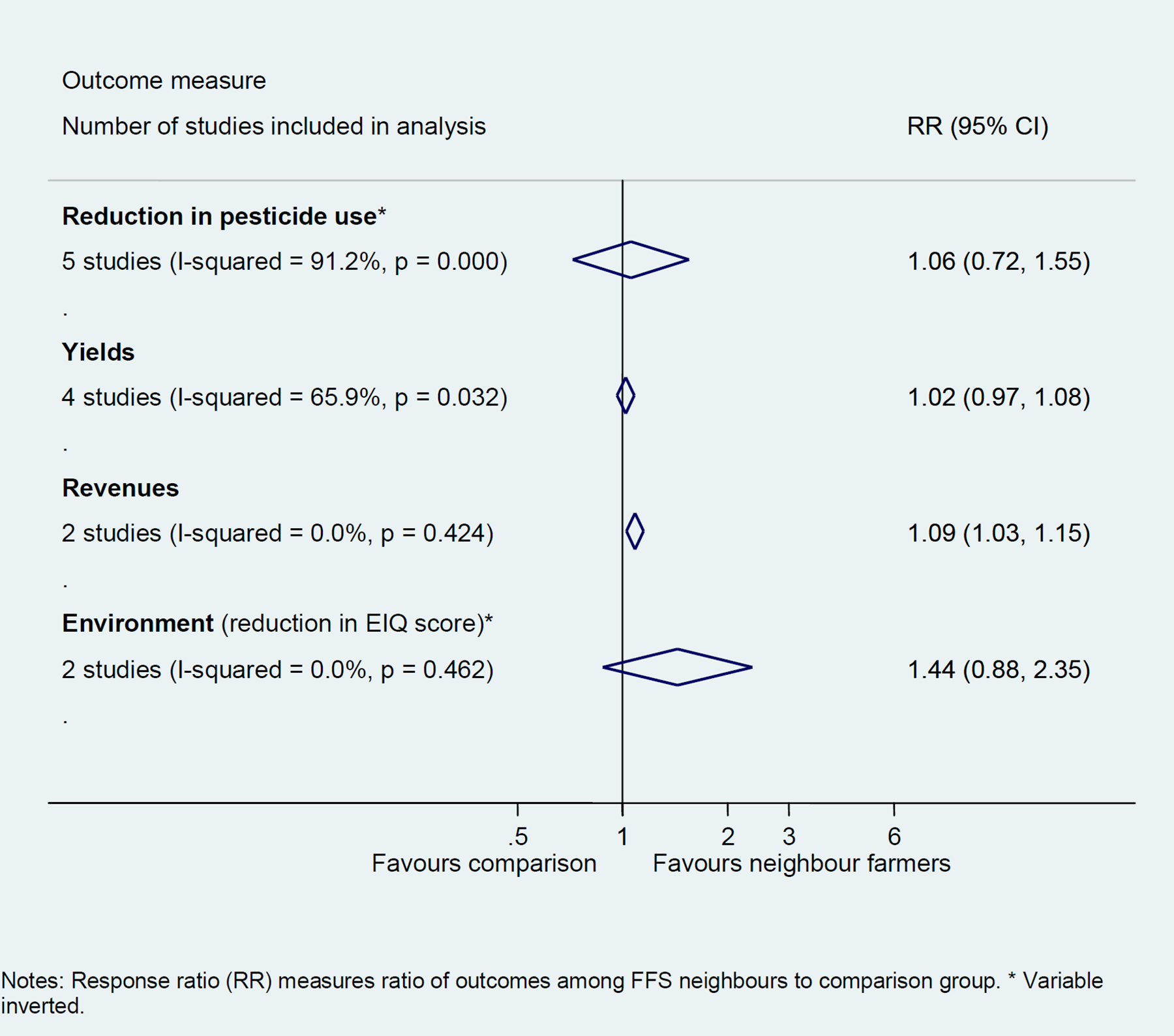
Summary meta-analysis findings for IPM-FFS neighbours
Some evidence suggested that there may have been diffusion of simple messages in the short term, where FFS participants were relatively well educated, but not in the long term and no studies collected data for more complex practices.
Over half of the studies included in the qualitative synthesis covered themes relevant to the diffusion of FFS knowledge and practices to non-participants (David, 2007; Gotret & Córdoba, 2004; Hiller et al., 2009; Karanja-Lumumba et al., 2007; Machacha, 2008; Mancini et al., 2007; Palis, 2002; Rola & Baril, 1997; Simpson, 1997; Van de Fliert, 1993; Winarto, 2004). Overall they suggested both characteristics of FFS and contextual factors act as barriers to diffusion.
Characteristics of FFS: Complexity, observability and relative advantage
Several characteristics of FFS may explain why practices promoted in FFS did not spontaneously diffuse in the community. Studies in Cameroon, India and Indonesia highlighted the complexity and the experiential nature of FFS learning as a barrier to diffusion (David, 2007; Mancini et al., 2007; Van de Fliert, 1993, Winarto, 2004). They noted that, despite high awareness of IPM by non-participants (Van de Fliert, 1993; Winarto, 2004), the skills and practices are complex and their experiential nature makes them difficult to convey via verbal communication (Mancini et al., 2007; Van de Fliert, 1993; Winarto, 2004). In two studies in Cameroon and Kenya where some diffusion was observed, the findings suggested concrete practices were more likely to diffuse than theoretical concepts and principles (David, 2007; Hiller et al., 2009). The studies also found that relatively simple practices, such as pruning and weeding techniques, were more easily disseminated than more complex practices, as also found in one quantitative study in Bangladesh (Ricker-Gilbert et al., 2008).
Just as observability of IPM practices and their relative advantage compared with conventional methods were found to be important in encouraging FFS farmers to adopt new practices, the evidence suggested observability of FFS practices were important for convincing non-FFS farmers to adopt FFS practices (David, 2007; Gottret & Córdoba, 2004; Palis, 2002; Machacha, 2008; Simpson, 1997; Van de Fliert, 1993; Winarto, 2004).
Contextual factors
Five qualitative studies suggested existing levels of social capital influenced diffusion (David, 2007; Gottret & Córdoba, 2004; Palis, 2002; Rola & Baril, 1997; Simpson, 1997).
In some cases low levels of social capital and cohesion limited communication within the community and presented a barrier to diffusion of FFS messages (David, 2007; Simpson, 1997). On the other hand, in the Philippines, high levels of social capital, in particular among farmers with kinship ties, facilitated sharing of IPM concepts with farmers who did not participate in FFS training. Awareness of the main sources of social capital in a particular context, as well as analysis of social networks, might provide an opportunity to facilitate greater diffusion.
Targeting FFS farmers
Meta-analysis suggested that, while IPM messages did not spill over to neighbour farmers on average, there may have been diffusion in terms of reduced pesticide use and improved yields among cotton growers in the short term (less than two years after FFS training), where field schools targeted participants who were more highly educated. The findings should be interpreted with caution due to the limited sample size. However, those studies that examined sustainability found that any initial adoption among neighbouring farmers, in terms of knowledge gains, pesticide use and yields, fell considerably over time.
6.4 AUTHORS' CONCLUSIONS
In this review we have synthesised evidence on the effectiveness of farmer field schools in improving intermediate outcomes (farmers' knowledge, adoption), and final outcomes (yields, revenue, health, empowerment, environmental outcomes). Farmer field schools are complex interventions implemented using different methods of delivery in a range of different contexts. For the review to be more useful for decision-makers, we also synthesised qualitative evidence on barriers to and enablers of the effectiveness of FFS programmes.
The results of meta-analysis provide evidence that FFS are effective in improving intermediate and final outcomes among farmers participating in the training. Although no single study reported on all outcomes, this finding is consistent across the theory of change – farmers appear to learn as a result of training, they adopt simple practices such as reduced pesticide use in the case of IPM, and they experience improvements in outcomes such as yields and revenues. The finding also appears to hold for different types of FFS curricula including the more standard IPM as well as IPPM and farming approaches based on other curricula.
The vast majority of evaluations were assessed as being of high risk of bias due to the approach to counterfactual generation. No studies randomly assigned farmer groups or villages to the programme, an approach which is very feasible for FFS, and most did not use rigorous quasi-experimental designs and methodologies. Due to the nature of the evidence, it is not possible to say at this point whether the benefits were sustained, as few studies have collected follow-up data for more than two years. And the evidence suggests that the few FFS programmes which have been implemented on a national scale have not been effective in improving farmer outcomes. Data from more rigorous evaluations with longer follow-ups are urgently needed.
Evidence suggests that there are no significant effects of diffusion of IPM to neighbouring farmers who did not participate in the FFS training. For many observers the lack of evidence for sustained diffusion of FFS practices in the case of IPM may not be surprising. FFS differ from other interventions such as those that focus on disseminating knowledge of more simple practices, for instance application of fertiliser and pesticides, or adoption of new, improved seeds. The qualitative evidence suggests that both characteristics of FFS and contextual factors are the primary barriers to diffusion. In particular, the complexity of FFS practices, the need for experiential training, and the importance of observing FFS practices to recognise their relative advantage over conventional farmer practices, appear to act as barriers to spontaneous diffusion. Existing levels of social capital and the reach of social networks are also potentially important.
7 Implications
7.1 IMPLICATIONS FOR POLICY
The systematic review provides evidence that farmer field schools can be effective in the short term in improving farmer knowledge and adoption of better practices, and improving yields, revenues and environmental outcomes among field school beneficiaries. These beneficial impacts have been recorded across different types of field school, including those incorporating IPM, IPPM and other techniques.
The impacts on agricultural outcomes are potentially of substantive importance to farmers, in the region of a 13 per cent increase in yields and a 20 per cent increase in profits (net revenues). The effects on revenues appear to be particularly large when FFS are implemented alongside complementary upstream or downstream interventions (access to seeds and other inputs, assistance in marketing produce).
For IPM field schools there is no convincing evidence for diffusion to neighbour farmers who live in the same communities as field school graduates. If diffusion is important for sustained adoption, this is a potentially important weakness of the approach as it has been implemented thus far.
There is also no evidence that the impacts on trained farmers are sustained over time or scalable. Studies of scaled-up programmes measuring outcomes over the longer term (more than two years post-training) do not find any evidence of effects.
As a method of rural adult education, the farmer field school appears suited for gradual scale-up with a clear focus on ensuring local institutionalisation (i.e. favouring depth of coverage in each community over geographical breadth). On the other hand, FFS seem unsuited to solve the problems of large-scale extension from the past. The highly intensive nature of the training programme, the relative successes in targeting more educated farmers as compared with disadvantaged groups, and failures in promoting diffusion of IPM practices, suggest that the approach is not cost-effective compared with agricultural extension in many contexts, except where existing farming practices are particularly damaging.
Stronger policies and regulatory measures may be necessary to counteract the activities of the pesticide industry, including the promotion and sale of pesticides by extension workers. New policies facilitating participatory agricultural extension approaches, replacing earlier extension policies aimed at promoting off-the-shelf technologies and input packages, may also be necessary.
7.2 IMPLICATIONS FOR PROGRAMME IMPLEMENTATION
The review also highlighted factors which are relevant to implementation of farmer field school projects and programmes.
Training of facilitators: In terms of intervention delivery, the training and performance of FFS facilitators is important for the success of FFS and this does require considerable initial investment. This is likely to be particularly problematic for programmes implemented at scale. Recruitment of facilitators should take into account personal attitude, maturity, literacy, leadership skills, knowledge in local language and experience with farming. In many contexts the gender of the facilitator should be carefully considered. Training of facilitators should provide sufficient substantive expertise in IPM or other relevant practices as appropriate to the local context. The training should also focus on participatory techniques and facilitation skills and emphasise the need to use language and concepts with which farmers are familiar. Facilitators should have access to ongoing support and backstopping from supervisors and technical experts connected to local research centres.
Field school design and approach: Our underlying theory of change suggests FFS should be delivered according to a participatory and discovery-based approach to learning, including opportunities for farmers to experiment and observe new practices, where the main objectives are skills development and other forms of empowerment. Regular monitoring of facilitators may help to ensure this happens in practice, and to identify schools where additional support is required.
Consultation and needs assessments are important to ensure the appropriateness of the curriculum to the local context, as well as its relevance to farmers' needs. The curriculum and crops covered in FFS should also be adapted according to the local agricultural system and the needs of the farmers targeted by the programme. Curricula need to deal with the major challenges facing farmers. In most cases these challenges will be multifaceted and there is a need to balance comprehensiveness with the ability to cover all issues in sufficient depth. A cumulative approach over several seasons might be preferable.
Complementary interventions, such as access to finance and inputs such as improved seeds, as well as assistance with marketing, may improve profits (net revenues).
Efficient monitoring and evaluation systems should be put in place alongside FFS implementation to ensure adequate and timely delivery of resources, and to ensure that sites selected for FFS are appropriate.
Dissemination of information to farmers about the resources allocated to FFS might enhance accountability and improve the likelihood of resources reaching FFS.
Targeting: Proponents of FFS have recommended targeting younger farmers, those with greater land endowments, and women, favouring those with relatively low opportunity costs of labour and/or farmers with relatively high pesticide costs. Indeed, Davis et al. (2012) suggest that the FFS approach could serve as a key strategy to provide agricultural extension services to female farmers in Africa, whose access to agricultural extension is generally poor. Women are frequently targeted by FFS, but field schools will be less effective if women are from households where they are not in a decision-making position (as was found in several of the studies included in this review). There were also some problems highlighted with targeting youth that cannot dedicate their time to the FFS plot or their fields.
Analysis suggests field schools involving relatively better-educated farmers tend to produce larger effects on adoption and agricultural outcomes. Nevertheless, FFS may be more effective if they adopt a considered approach to targeting based on who the intended beneficiaries are and in-depth analysis of the local context, including agricultural practices, cultural norms and gender relations. Strategies which include sensitisation around an interest to learn new skills might be successful at recruiting relevant participants.
If the aim is to include women and disadvantaged members of the community, the implementing agency may need to tailor the intervention to enable their participation in the programme. The curriculum needs to be relevant and consistent with the needs and opportunities of women and the poor. For example, in contexts where women are primarily responsible for growing subsistence crops, a curriculum that covers only commercial crops is unlikely to attract women participants.
Sensitisation exercises in the community might facilitate participation of disadvantaged groups, for example where men do not allow their wives to participate in the training because they do not see the benefits or are uneasy about the prospect of their wives working with other men.
Institutional actors involved in FFS should consider beneficiary needs and interests in the design and implementation of the FFS programme.
Sustainability: Formal support and encouragement of FFS alumni, including technical assistance and backstopping may be important for the sustainability of FFS practices and related activities. Working with FFS groups to support common goals, good leadership and high attendance rates might facilitate sustainability of FFS activities after the end of the training. Particular contexts may be more relevant for sustainability such as areas with clear overuse of pesticides and therefore clearer benefits from IPM adoption.
Adoption of IPM by neighbouring farmers: Awareness of the main sources of social capital in a particular context and analysis of social networks to inform targeting may enhance the efficiency of farmer-to-farmer diffusion of FFS practices. Complementary interventions such as mass media campaigns are likely to improve diffusion for simple messages (such as “no early spray”) only. However, given the skills-based nature of the practices promoted in FFS, formal community-building activities, support and attempts to institutionalise the approach, to encourage FFS graduates to train other farmers, are likely to be needed for any diffusion to neighbours. However, the evidence does not suggest that such approaches have been effective so far.
7.3 IMPLICATIONS FOR RESEARCH
A large number of impact evaluations aim to demonstrate the effects of farmer field schools, mainly on agriculture outcomes. A smaller number examine other outcomes such as health, empowerment and environmental impacts. However, the majority of available studies are not sufficiently rigorous to inform policy.
Most quantitative impact evaluations were classified as having a high risk of bias. In many studies, no serious attempts were made to control for confounding through statistical matching or in other statistical analysis, and in many cases statistical significance tests were not reported. Many studies stated that they matched communities although this matching does not appear to be statistically rigorous. The consequence was the systematic overestimation of impacts, as demonstrated in the analysis for nearly all outcomes (Figure 33). We were not able to identify any high-quality impact evaluations which we could classify as of low risk of bias in causal attribution. No studies used randomised assignment, although cluster randomised trials are feasible for studying FFS impacts on participating communities. More studies using rigorous counterfactuals, especially those based on prospective assignment (randomised or otherwise), allocated at cluster level to measure spillovers, together with long-term follow-ups to determine sustainability, are needed.
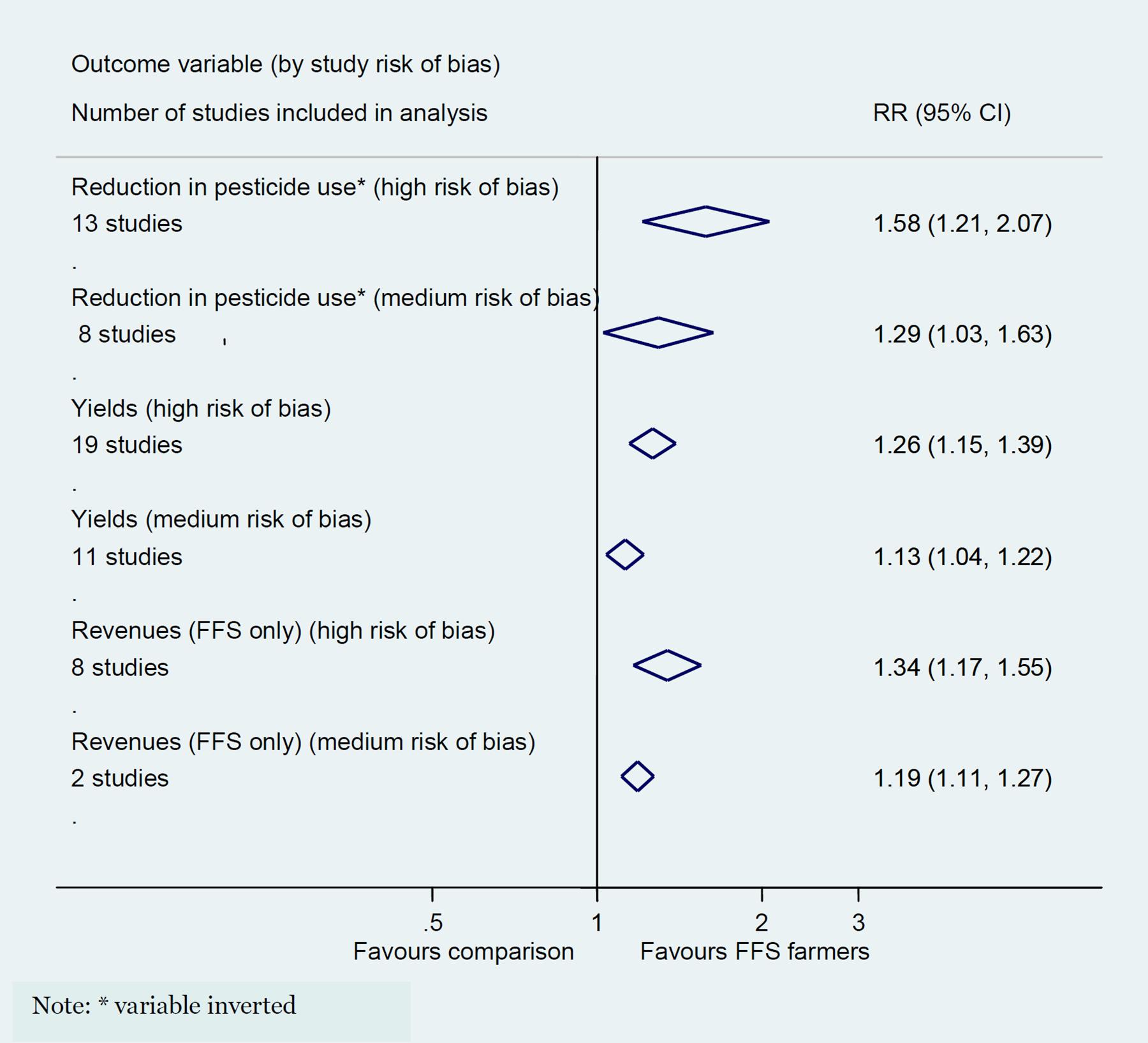
High-risk-of-bias studies produce systematically larger effects
Impact evaluations should routinely report information needed to calculate effect sizes in particular means and standard deviations of outcome variables and sample sizes including numbers of clusters and cluster sample sizes per treatment arm.
A body of high-quality, theory-based impact evaluations that report and analyse a hypothesised causal chain is needed to improve policy relevance and usefulness of findings. Evaluations should collect and report data on intermediate and endpoint outcomes, and incorporate qualitative assessment of implementation processes where possible. Studies should also assess whether FFS have heterogeneous effects across sub-groups of farmers.
Studies need to measure a broader range of policy-relevant outcomes. More studies are needed to assess the effects of attending FFS on empowerment outcomes. In addition to measuring empowerment quantitatively, such studies should also attempt to assess the mechanisms underlying any empowerment effects. In addition to empowerment, some FFS also aim to improve health and environmental outcomes, but few existing studies included in our review have measured these. Future studies should collect data on these outcomes using high-quality research methods, drawing on the programme theory and consulting with stakeholders to identify all relevant important outcomes.
The analysis presented here suggests that causal chain analysis can be useful. However, studies need to measure consistently the full range of intermediate and final outcomes along the causal chain in order to enhance understanding of where the theory of change breaks down in particular programmes. Better access by donors and implementers to project documents and evaluation reports would also enable more rigorous analysis of programme design and implementation. In addition, as shown by the large number of studies that were excluded due to a lack of detail on methods, qualitative evaluations need to report aspects of the research process in greater detail to allow users to assess their credibility and trustworthiness. In particular, clear reporting on objectives, on methods of sampling, data collection and analysis are needed. Use of structured abstracts and more structured reporting of the full text of primary studies will also enhance our ability to assess the credibility of qualitative research and to use that research in evidence syntheses.
Few studies reported on the subjective views and experiences of FFS facilitators. This is a weakness of the existing evidence base and future studies should include perspectives of FFS facilitators and, where relevant, agricultural extension workers.
7.4 LIMITATIONS OF THE REVIEW
Due to the large number of quantitative impact studies included in this review, we did not undertake double-coding for studies assessed to be of high risk of bias, nor did we contact authors to obtain additional information not reported in these high-risk-of-bias studies. The data from these studies are particularly unreliable, hence we have not drawn any conclusions for policy based on those findings. The review reports information on the extent of agreement between coders, although tests for inter-rater reliability based on Cohen's kappa were not calculated.
A second important limitation is that the meta-analysis has involved the synthesis of quantitative studies that come from different study designs, estimating both bivariate and multivariate relationships, and multivariate models with different study covariates. While all medium-risk-of-bias studies, which were used to make implications for policy, did report results from multivariate analyses, these effect sizes are not truly comparable due to the different covariates included in each model (see Appendix D).
There are limitations to the qualitative synthesis both due to the quality of the included studies, as well as the way in which we conducted the review of those included studies. As highlighted by the quality appraisal, there are clear limitations to the evidence base, and therefore the findings of the synthesis should be interpreted with caution.
There remains some disconnect between the effectiveness synthesis and the qualitative synthesis, as there is not a clear link between the interventions studied in the quantitative and qualitative studies. We attempted to link the studies by FFS programme name, but information on implementation was insufficiently reported in either the included impact and qualitative studies or the project documentation we were able to identify. We are not able to conclude strongly about heterogeneity in effects with respect to the moderating factors identified in the qualitative synthesis, particularly FFS design and implementation, and therefore we are not able to provide strong policy guidance on how to amend programme design or implementation to maximise impacts. There are no cases where we have information about intervention effects based on rigorous counterfactual analysis and detailed information about implementation and other barriers and enablers that may moderate intervention effectiveness.
7.5 DEVIATIONS FROM PROTOCOL
The protocol suggested we would include all qualitative and quantitative studies relevant to assessing the barriers to and enablers of FFS effectiveness to answer review question (2). However, during the review process we realised that synthesising such a broad range of studies presented challenges for data extraction, quality appraisal and synthesis. Hence we revised the inclusion criteria for barriers and enablers synthesis to exclude correlation, regression and simulation or modelling studies. However, we collected additional data on farmer characteristics and programme targeting from all effectiveness studies (including linked papers) to supplement the quantitative analysis for review question (1), conducting moderator analyses across all studies where these data were available. Some of the moderator variables, such as on intervention components, were identified a posteriori after the qualitative synthesis had been completed. For mixed methods studies that included an impact evaluation component, we assessed, coded and synthesised only those sections relevant for the qualitative synthesis (i.e. those sections that presented evidence about the barriers to and enablers of FFS effectiveness). The impact evaluation evidence in these studies was separately assessed for inclusion for the quantitative review component.
8 Support and Authorship
SOURCES OF SUPPORT
We would like to thank the Millennium Challenge Corporation (MCC) of the US Government, Peter Tugwell, Julia Littell and the anonymous peer reviewers for helpful comments, and Sandra-Jo Wilson of the Campbell Collaboration for expertly leading the peer review.
We would also like to thank Jock Anderson, Kristin Davis, Gershon Feder, Elske Van de Fliert, Francesca Mancini, Ephraim Nkonya, Jake Ricker-Gilbert, Scott Swinton and the researchers who responded to our requests for further information. Wafaa El Khoury kindly facilitated access to IFAD documents, and Gracia Pacillo contributed data collection and analysis to the systematic portfolio project review (Appendix A). We thank participants at conferences and workshops at the Network of Networks on Impact Evaluation (NONIE), Paris, South Asia Conclave of Evaluators, Kathmandu, Campbell Collaboration annual meetings, Global Development Network, Delhi, IFAD, Rome, and the Institute of Development Studies for comments.
The views in this report are not attributable to MCC, 3ie or 3ie's member organisations. All errors are the responsibility of the authors.
DECLARATIONS OF INTEREST
We are not aware of any conflicts of interest arising from either researcher interest or financial sources.
REVIEW TEAM
The lead authors developed and coordinated the review team, discussed and assigned roles for individual members of the review team, liaised with the editorial base and will take responsibility for the ongoing updates of the review.
ROLES AND RESPONSIBILITIES
The study was undertaken by Jorge Hombrados (JH), Daniel Phillips (DP), Birte Snilstveit (BS), Martina Vojtkova (MV), and Hugh Waddington (HJW). HJW and BS developed the study protocol. HJW led the quantitative effectiveness synthesis and compiled the overall systematic review report. BS led the qualitative synthesis of barriers and enablers.
JH, BS, MV and HJW conducted the search, using EndNote reference management software. Decisions on inclusion for impact evaluation studies were made by JH and HJW, with conflicts resolved through discussion and consensus. Decisions on inclusion for qualitative impact evaluation studies were made by BS and MV, with Philip Davies (PD) acting as an arbiter. Qualitative study coding was carried out by BS, MV, JH and DP, while critical appraisal and effect sizes estimation was undertaken by JH and HJW. HW and PD provided technical support. DP also undertook the portfolio systematic review reported in Appendix A, with support from Gracia Pacillo (IFAD) and HW.
PLANS FOR UPDATING THE REVIEW
We will update the review once sufficiently rigorous studies and resources become available.
Potential conflicts of interest
We are not aware of any vested interest in the outcomes of this review, nor any incentives to represent findings in a biased manner.
Footnotes
Appendix A
Appendix B
Appendix C
Appendix D
Appendix E
Appendix F
Appendix G
Appendix H
1
There has been a similar evolution in the use of more bottom-up approaches to technology development through agricultural research, such as the local agricultural research committees (CIALs) approach (Braun et al., 2000).
2
Drawing on the lessons of IPM, integrated vector management (IVM) is being applied in the health sector to combat malaria and other vector-borne diseases (van den Berg et al., 2007). This variant is beyond the scope of this review.
4
Lack of adoption of IPM practices by neighbouring farmers is theorised to curtail the effectiveness of the intervention, as pests from fields of non-adopters may re-infest the fields of adopters, eventually leading to disadoption of IPM by FFS participants (Feder et al., 2004b).
5
6
7
8
3ie's approach to systematic reviewing is provided in Waddington et al. (2012b) and  .
.
9
Our methodology was also informed by Chapter 20 in the Cochrane Handbook (Noyes et al, 2011), the additional guidance developed by the Cochrane Qualitative Methods Group (Hannes, 2011; Noyes & Lewin, 2011) and the increasing number of examples of systematic reviews in international development based on or incorporating qualitative evidence (e.g. Munro et al., 2007; Williamson et al., 2009; Berg & Denison, 2012).
10
We also conducted an additional systematic review of data on targeting contained in the full text studies we obtained for the systematic review research questions detailed in this report. We synthesised a small part of the information on targeting in the moderator meta-analysis section of this report, although readers are encouraged to access the report of the systematic review of targeting for the full analysis (Phillips et al., 2014).
11
We followed Effective Practice and Organisation of Care (EPOC, n.d.) in adopting these criteria, based on the logic that at least three data points either side of the cut-off are needed to identify a trend.
12
Note that, in contrast, spillovers to non-participant neighbour farmers are desirable for the intervention, and are assessed by the measured effects reported on these groups, in separate meta-analysis.
13
Full details of the critical appraisal assessment are available on request from the authors.
14
There were a few cases where it was not clear whether studies referred to the same programme. Cole et al. (2007) and Mauceri et al. (2007) reported impacts of FFS in the same region of Ecuador, but seemingly for different interventions. Yang et al. (2005) and Wu (2010) appeared to estimate impacts on the same programme but not the same samples, Yang referring to data in a single province only. It was not clear whether Palis (1998) and referred to the same intervention conducted in Central Luzon Philippines; however, the studies measured different outcomes so there is no risk of violation of the independent effect size assumption.
15
Results were not sensitive to the choice of outcome.
16
17
Data were coded on intervention design not implementation, which was usually unavailable.
18
We are aware of two on-going experimental studies (randomised assignment) of FFS in China (Rodriguez et al. : http://www.3ieimpact.org/en/evidence/impact-evaluations/details/206/) and the Philippines (Masset & Haddad, see ).
19
Full details of the critical appraisal are available on request from the authors.
20
The assessment was reported as not applicable (N/A) mainly in those cases where we were unable to compute standard errors, as well as for a smaller number of studies which did not use cluster design.
21
This was not necessarily due to file-drawer effects. For example, in the case of , the authors used monetary value of yields rather than the more conventional yields weight used in most other studies, which the authors noted is due to the extent of multi-cropping (farmers growing multiple crops on the same plot and growing season).
22
In addition, seven studies did not provide sufficient information to calculate effect sizes for relevant comparison groups (Achonga et al., 2011; Bentley et al., 2007; Mangan & Mangan, 1998; Maumbe & Swinton, 2003; Olanya et al., 2010; Pouchepparadjou et al., 2005; Yang et al., 2008).
23
Results were not sensitive to inclusion of additional covariates, including categorical variables measuring outcome, global region and crop type (findings not reported). Results were not sensitive to exclusion of high risk of bias studies from the analysis: exponentiated coefficient on log standard error for yields=5.00, t-statistic=2.33, P-value=0.049.
24
The forest plots showing programme name rather than authors are in Appendix G.
25
Exposure length is measured imprecisely in the original studies, so we have adopted cut-off values of up to one year, up to two years and greater than two years to distinguish longer- from shorter-term effects.
26
In order to maximise sample size, we also excluded variables with insufficient observations such as FFS which incorporated local institutionalisation or training of farmer trainers.
27
found that there was greater acquisition for some aspects of knowledge (such as entomological knowledge) among farmers with lower initial levels of knowledge about IPM. The same study finds that the initial gains in knowledge observed in FFS graduates compared with exposed farmers do not persist over time. However, it is not possible to infer whether this was due to diffusion within communities, or erosion of the FFS graduate's knowledge over time, or indeed due to some other reasons such as changes in the implementation of the project over time, resulting in differing levels of effectiveness across the years that were included in the analysis.
28
One study in Indonesia used statistical network regression analysis to find diffusion was maximised at an optimal level of social ‘superiority’ of opinion leaders, when opinion leaders who received intensive training are slightly superior to ‘would-be followers’ in terms of socioeconomic status and farming skill attributes, but not excessively so. In contrast, when the social or educational ‘distance’ between opinion leaders and followers was too large, their effectiveness in diffusing skills and knowledge fell (Feder & Savastano, 2006).
29
The forest plot showing programme name rather than authors is in Appendix G.
30
The forest plot showing programme names rather than authors is in Appendix G.
31
The forest plot showing programme names rather than authors is in Appendix G.
32
33
34
Assuming, due to small farm size, any additional costs of labour are either met through in-kind contributions of family members or that costs of hired labour do not outweigh revenue gains.
35
The forest plot showing programme names rather than authors is in Appendix G.
36
We were not able to locate any studies of IPPM-FFS which measure revenues outcomes.
37
38
DANIDA (2011) estimated reductions in health expenditure (RR=0.19) but did not report information to calculate standard errors. estimated increases in use of protective clothing and gloves during pesticide preparation and spraying, measures of adoption of practices which may affect health outcomes.
39
The effect sizes calculated from Labarta used in this analysis are from standard regression analysis (ordered probit) without control for possible endogeneity; Haussman tests were performed and the authors were unable to reject the null hypothesis of exogeneity of FFS participation.
40
The description and analysis of actual implementation of FFS is limited in both Friis-Hansen (2008) and . They provide what is a rather generic description of an “ideal type” FFS, backed up with very limited description and no data on implementation.
41
In particular, the FAO were unfortunately unable to release internal documentation on FAO-funded FFS projects. The information provided by different source documents is also of a varying standard and completeness.
43
The authors would like to thank Arnaud Braun for sharing this data with us.
44
A school is typically a single cohort receiving FFS training for a determined time. Typically this would be in one (or occasionally) multiple specified locations (though not wide geographic areas). The total figures are approximate given problems in identifying the unit of analysis, and acknowledged as such in the text. A school was defined in one of two ways: some projects reported that they included a given number of schools; others reported a number of participants only and this figure was divided by 25 to produce a proxy number of schools.
47
A distinction is made here between project duration, or the number of months or years that an FFS project lasts for, and the FFS duration, or the length of time for which a given cohort of benefiting farmers receive training.
51
In interpreting these results it is important to bear in mind that not all the available documentation for the portfolio projects comprehensively reported on curricula. The growth in the number of farmer field school interventions has also made it possible for some projects to recruit trained staff and borrow or adapt existing curricula. In addition, some FFS have actively targeted pre-existing farmer groups.
53
A project was only coded as targeting production where it was clearly stated as a goal or this was clear from context in the documentation available. In reality, improved production is such a universal goal for FFS that the figure here may well underestimate the proportion of projects targeting it.
59
We drew on 3ie (n.d.) and EPOC (n.d.) in developing this tool.
60
Note that, in contrast, spillovers to “exposed” farmers are desirable for the intervention, and will be assessed by the measured effects reported on these groups, in separate meta-analysis.
61
If the instrument is the random assignment of the treatment, the reviewer should also assess the quality and success of the randomisation procedure in part a).
62
An instrument is exogenous when it only affects the outcome of interest through affecting participation in the programme. Although when more than one instrument is available, statistical tests provide guidance on exogeneity (see background document), the assessment of exogeneity should be in any case done qualitatively. Indeed, complete exogeneity of the instrument is only feasible using randomised assignment in the context of an RCT with imperfect compliance, or an instrument identified in the context of a natural experiment.
63
Accounting for and matching on all relevant characteristics is usually only feasible when the programme allocation rule is known and there are no errors of targeting. It is unlikely that studies not based on randomisation or regression discontinuity can score “YES” on this criterion.
64
Knowing allocation rules for the programme – or even whether the non-participants were individuals that refused to participate in the programme, as opposed to individuals that were not given the opportunity to participate in the programme – can help in the assessment of whether the covariates accounted for in the regression capture all the relevant characteristics that explain differences between treatment and comparison.
65
Matching strategies are sometimes complemented with difference-in-difference regression estimation methods. This combination approach is usually superior since it only uses in the estimation the common support region of the sample size, reducing the likelihood of existence of time-variant unobservables differences across groups affecting outcome of interest and removing biases arising from time-invariant unobservable characteristics.
66
The Hausman test explores endogeneity in the framework of regression by comparing whether the ordinary least squares (OLS) and the IV approaches yield significantly different estimations. However, it plays a different role in the different methods of analysis. While in the OLS regression framework the Hausman test mainly explores endogeneity and therefore is related to the validity of the method, in IV approaches it explores whether the author has chosen the best available strategy for addressing causal attribution (since in the absence of endogeneity OLS yields more precise estimators) and therefore is more related to analysis reporting bias.
67
Contamination, that is differential receipt of other interventions affecting outcome of interest in the control or comparison group, is potentially an important threat to the correct interpretation of study results and should be addressed via PICO and study coding.
68
“Common methods” refers to the use of the most credible method of analysis to address attribution given the data available.
69
A comprehensive assessment of the existence of “data mining” is not feasible particularly in quasi-experimental designs where most studies do not have protocols and replication seems the only possible mechanism to examine rigorously the existence of data mining.
70
i) For PSM and covariate matching, score “YES” if: where over 10% of participants fail to be matched, sensitivity analysis is used to re-estimate results using different matching methods (Kernel Matching techniques). For matching with replacement, no single observation in the control group is matched with a large number of observations in the treatment group. Where not reported, score “UNCLEAR”. Otherwise, score “NO”. ii) For IV (including Heckman) models, score “YES” if: the authors test and report the results of a Hausman test for exogeneity (p≤0.05 is required to reject the null hypothesis of exogeneity), the coefficient of the selectivity correction term (Rho) is significantly different from zero (P<0.05) (Heckman approach). Where not reported, score “UNCLEAR”. Otherwise, score “NO”. iii) For studies using multivariate regression analysis, score “YES” if: authors conduct appropriate specification tests (e.g. reporting results of multicollinearity test, testing robustness of results to the inclusion of additional variables etc.). Where not reported or not convincing, score “UNCLEAR”. Otherwise, score “NO”.
71
Note that for studies using a matching strategy the outcome level for the treatment group and control group used to estimate the effect size is the outcome level for each group after matching. If kernel matching is used substitute
72
For some maximum likelihood regression models such as Logit or Probit (for dichotomous outcomes) and Tobit (for continuous outcomes), it is not possible to use the regression coefficient to estimate the RR. In such a case, β refers to the “impact effect” calculated from the regression coefficient for Logit, Probit or Tobit models. For semi-logarithmic difference-in-differences multivariate regression we calculate the response ratio as RR = eβ * 100.
73
There are two main approaches to the calculation of the pooled standard deviation from regression-based studies: in Cohens approach
74
For studies with large n, c(v) is considered equal to 1.
75
The authors interviewed around two-thirds of all FFS participants.
76
The description and analysis of actual implementation of FFS is limited in both Friis-Hansen (2008) and . They provide what is a rather generic description of an “ideal type” FFS, backed up with very limited description and no data on implementation.
77
The Presidential Decree of 1986 (Inpres 3/1986) represented a “commitment to a national policy of Integrated Pest Management (IPM) to replace the method of pest control that depended on pesticides only (Oka 1991; Fox 1991)” (Winarto, 2004, p. 23). The decree included a ban of broad-spectrum pesticides, the removal of pesticide subsidies and gave high importance to the improvement in human resource development (through official instructions of both official agricultural officials and farmers), and biological and cultural controls in pest management (Van de Fliert 1993; Winarto, 2004, p. 23).
78
The FFS networks arose independently of the FAO-implemented East African Sub-Regional Pilot Project for Farmer Field Schools, with the aim to “sustain Farmer Field Schools, link Farmer Field Schools to input and output markets, link farmers to information sources and facilitate information flow, form a forum for Farmer Field Schools for information exchange and experience sharing in relation to farming and promote the FFS concept as an extension methodology in addressing emerging issues especially in agricultural development” (Karanja-Lumumba et al., 2007, p. 1,347).