






Abstract
Introduction
This document provides an overview of the Campbell Collaboration policy regarding the use of network meta-analysis methods in systematic reviews of intervention effects. In addition, this policy briefing note aims to provide the reader with an understanding of what network meta-analysis is, when network meta-analysis might be useful, and the core concepts of the method. References to useful resources, including software, are also provided. This policy-briefing note is not a tutorial on how to conduct a network meta-analysis and does not provide an exhaustive treatment of all aspects of the method.
Network meta-analysis
Network meta-analysis is an extension of standard meta-analysis methods to the synthesis of two or more interventions (defined broadly here to include interventions, treatments, policies, programs, or practices). The goal of network meta-analysis is to take advantage of studies that compare these interventions with a standard comparator condition (such as a placebo or other control condition) as well as studies that compare these interventions with each other. Thus, this approach makes use of all available comparisons within a network of related studies addressing a common condition on a common outcome.
Network meta-analysis is well suited for comparing the effectiveness of multiple drugs for a common condition. For example, Cipriani, et al. (2009) compared the effectiveness of 12 new generation antidepressants for treating depression. The goal was to estimate which drug was most effective. This review included 117 randomized controlled trials. These trials were a mix of studies that compared one or more of the 12 drugs to a placebo or compared two or more drugs with each other. Thus, these 117 studies provided a network of comparisons among the drugs. Network meta-analysis can be applied to social interventions as well but it is important that the interventions are for a common problem (i.e., addressing a common population) and the studies are examining the same outcome construct.
To illustrate the concepts of network meta-analysis, we will use a simple example that only includes three interventions for adolescent drug use: a group based cognitive-behavioral program (labeled
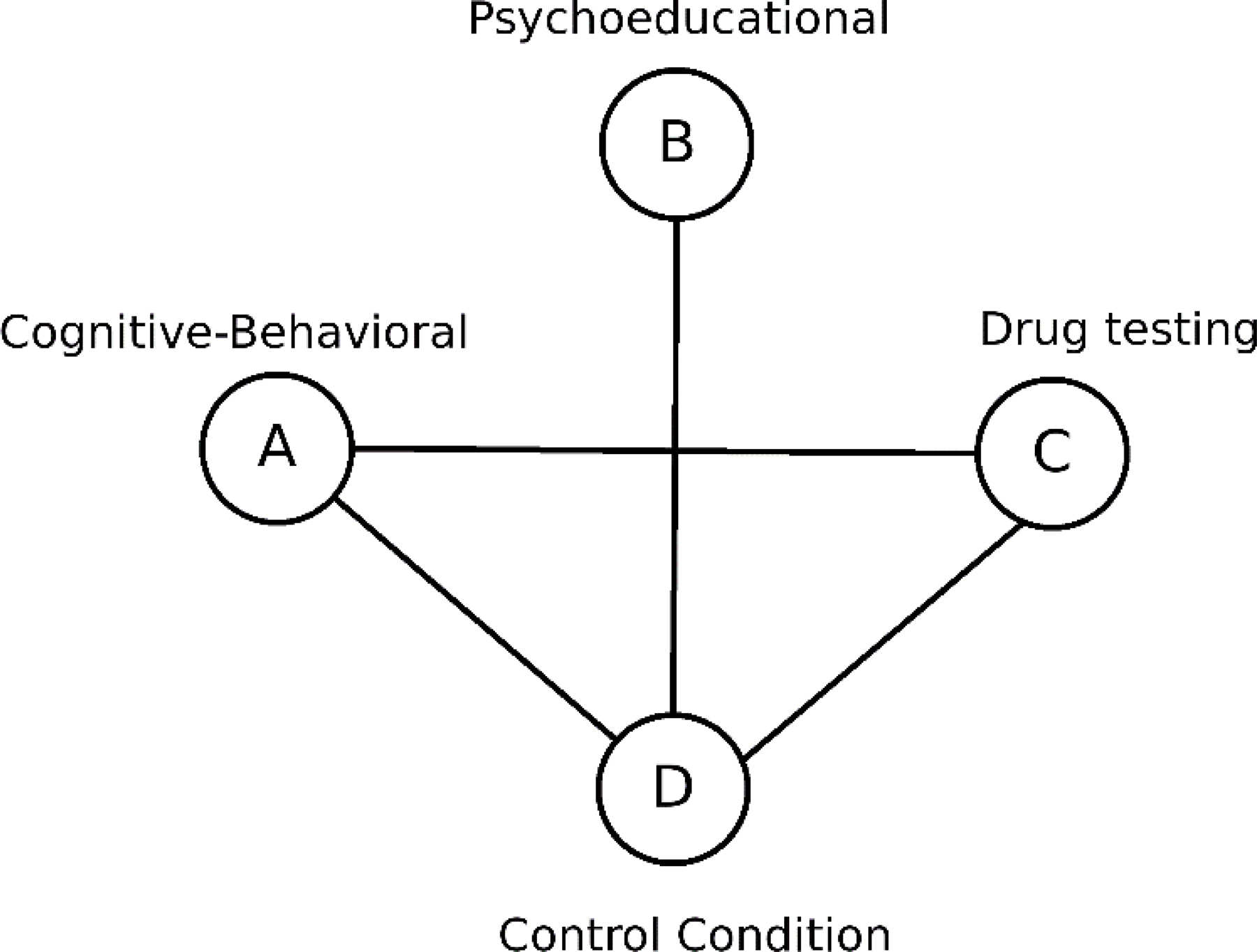
Example of a simple network
An important concept in network meta-analysis is the distinction between direct and indirect effects. Any two nodes that are connected by a line can be estimated directly, that is, there are studies that provide effect sizes comparing the two nodes. As the name implies, indirect effects are not estimated directly but rather based on the relative effects of two nodes compared to a common third node. In a network plot, these are typically represented as dashed lines. Figure 2 illustrates both the direct and indirect effects for our example.
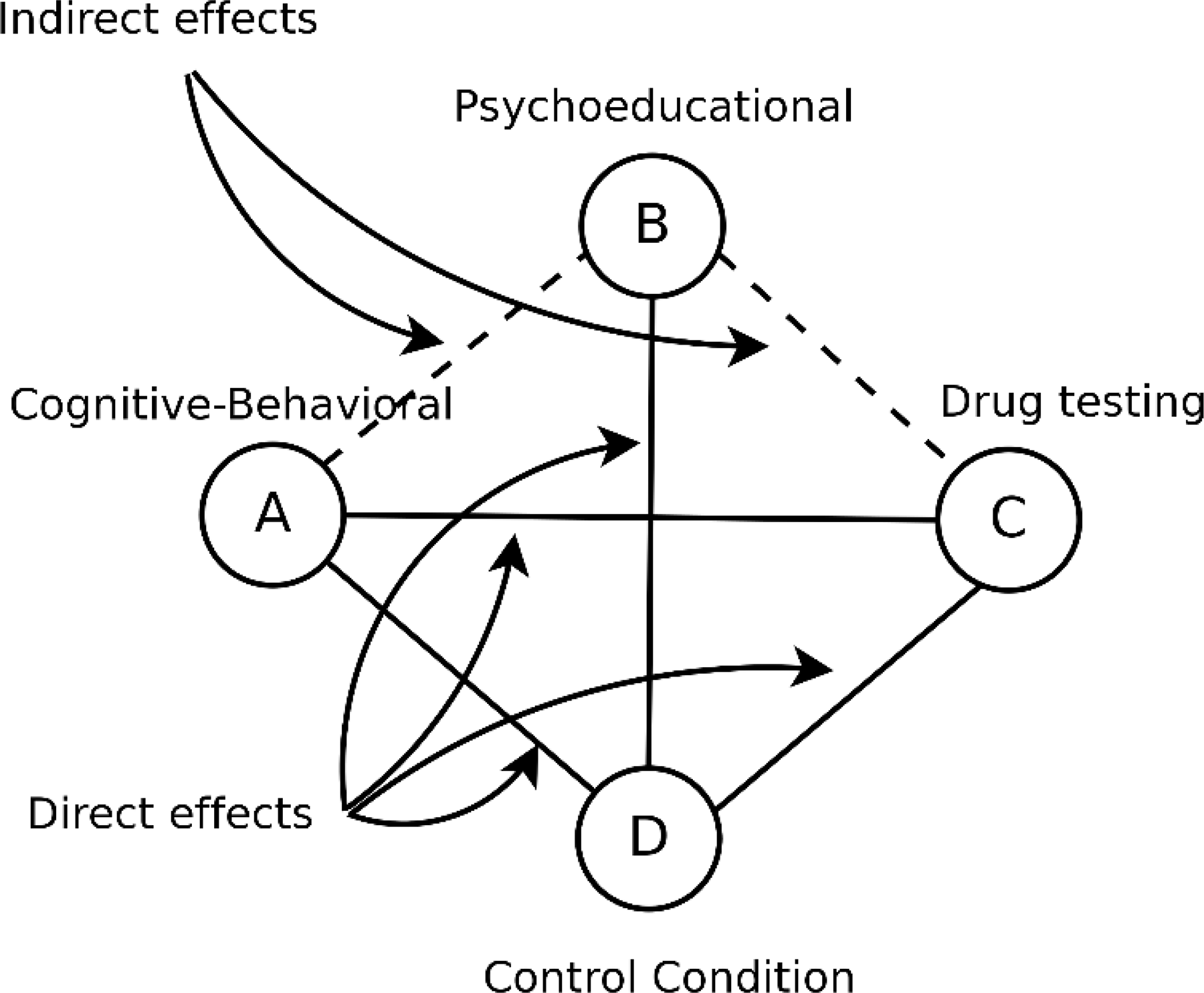
Example with both direct and indirect effects
Indirect effects are estimated by comparing the difference in the effectiveness of related nodes. In our example, we can estimate the indirect effect between
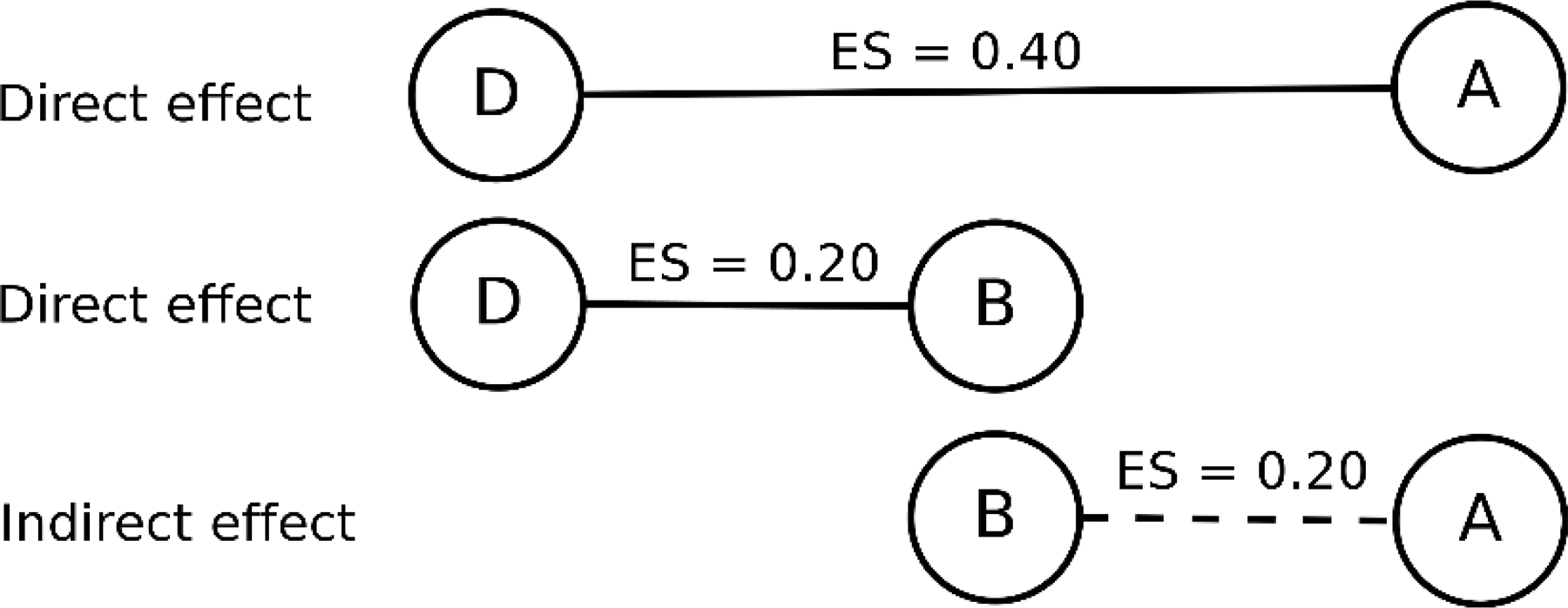
Example showing how an indirect effect is estimated
The estimate of the indirect effect makes the assumption that the effects are transitive. In its simplest form, the transitive property assumes that if
Transitivity requires that the anchor intervention is the same for both sets of comparisons. In our example, if the comparator condition (
The credibility of the consistency assumption can be tested when both indirect and direct effects are available between two nodes. Both direct and indirect effects are available for closed loops only. In our example, we have one closed loop (
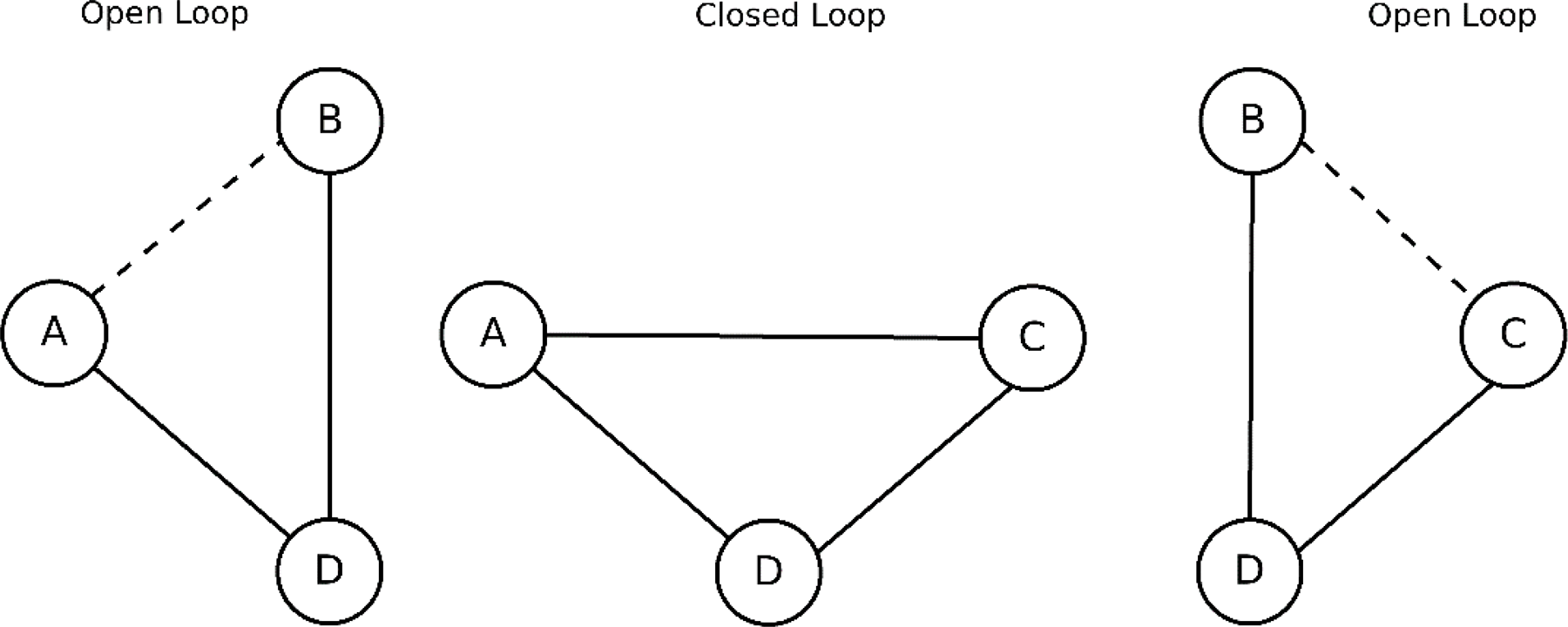
Example illustrating open and closed networks
Comparing the direct and indirect estimates for an effect between two nodes assesses consistency. In a closed loop, all three possible pairings have both a direct effect and an indirect effect estimate, as shown in Figure 4. Network meta-analysis provides a statistical assessment of the consistency between direct and indirect effects. A lack of consistency indicates that the transitivity assumption is untenable.
The benefit of network meta-analysis over conventional meta-analysis with moderator analysis comparing different intervention types is the combining of both direct and indirect evidence and assessing the consistency of that evidence. This requires studies that not only compare the interventions of interest to a control condition but also studies that compare interventions with each other (i.e., at least some closed loops). In the absence of any closed loops, network meta-analysis and an analog to the ANOVA type moderator analysis produce comparable findings and share a common underlying statistical model.
Another benefit of network meta-analysis over conventional meta-analysis with moderator analysis is the ability to estimate the probability that a particular intervention is the best, the second best, etc., in a network. All of the interventions can be ranked in terms of effectiveness on the assessed outcome and we can produce rankograms and cumulative ranking plots that depict visually which intervention is the most effective (Salanti et al., 2011). This is particularly useful for a condition with multiple viable intervention options.
An important limitation of network meta-analysis is the observational nature of the indirect comparisons. This is a common concern for all moderator type analyses in meta-analysis. There is always a concern that there are differences in the distribution of effect modifiers between the two sets of studies producing the indirect effect estimate. That is, there may be a difference between the
For more detailed information on network meta-analysis, see the following references: Cipriani et al. (2009), Lumley (2002), Salanti et al. (2008), and White et al. (2012).
Campbell policy
The following methods policy was proposed for consideration by the Campbell Collaboration at its Steering Group meeting in Dublin on 24 May 2015.
Network meta-analysis is an acceptable method for Campbell reviews. Reviewers using this method are expected to attend to the following issues in the review. Discuss the appropriateness of network meta-analysis for the literature being reviewed. Present a network diagram that with variation in the thickness of the lines connecting nodes that reflects the number of studies (or combined sample size) for each direct effect. Provide a table with the inconsistency factors and the global test for inconsistency (e.g., White et al., 2012). Discuss possible sources of inconsistency and implications for the results. Provide a league table with the relative effect between each pair of interventions. Provide a ranking of interventions using rankograms and cumulative ranking plots. Authors should interpret these graphs carefully if inconsistency in the network is detected.
Further resources
A YouTube video of a workshop on network meta-analysis by Dimitris Mavridis given at the Campbell Collaboration Colloquium at Queen's University Belfast (16-19 June 2014) can be found at: https://www.youtube.com/watch?v=SWfi9v-TaV4
Footnotes
Appendices
References
Supplementary Material
Please find the following supplemental material available below.
For Open Access articles published under a Creative Commons License, all supplemental material carries the same license as the article it is associated with.
For non-Open Access articles published, all supplemental material carries a non-exclusive license, and permission requests for re-use of supplemental material or any part of supplemental material shall be sent directly to the copyright owner as specified in the copyright notice associated with the article.
