






Abstract
This Campbell systematic review assesses the impact of exhaustion of employment benefits on the job-finding rate for unemployed individuals. The review summarises findings from 47 studies. The majority of studies were conducted in Europe, with just two of the studies taking place in the USA and one in Canada. Participants were unemployed individuals receiving any form of time-limited benefit during their period of being unemployed.
The exhaustion of unemployment benefits encourages unemployed individuals to find work. The exhaustion of benefits results in an increase of about 80% in the exit rate from unemployment to employment. The effect starts to occur approximately two months before benefits expire, increasing as the expiration date approaches.
There was no significant effect observed prior to the two months before benefits expire. There was insufficient evidence to address the secondary outcome of whether the prospect of benefit exhaustion has an impact on the exit rate from the re-employment job, i.e. workers soon leave the new job and return to benefits. Thus, the evidence that exhaustion of unemployment benefits reduces overall unemployment level is inconclusive.
Executive Summary/Abstract
BACKGROUND
In order to reduce unemployment levels, policymakers may wish to reduce the generosity of the unemployment system. While it may be politically intractable to lower the amount of unemployment benefits, the length of the unemployment benefit eligibility period is often used as a political instrument to create work incentives for the unemployed. If the prospect of exhaustion of unemployment benefits results in a significantly increased incentive for finding work, shortening the benefit eligibility period may reduce the share of long and unproductive job searches and thereby decrease the overall unemployment level.
OBJECTIVES
The primary objective of this systematic review was to study the impact of exhaustion of unemployment benefits. The primary outcome was unemployed individuals' exit rate out of unemployment and into employment prior to benefit exhaustion or shortly thereafter. To determine if benefit expiration was associated with poor job matches, the secondary outcome of exit rate from the re-employment job was also explored.
SEARCH STRATEGY
Relevant studies were identified through electronic searches of bibliographic databases, government policy databanks, Internet search engines, and hand searching of core journals. We searched to identify both published and unpublished literature. The searches were international in scope. Overall, 23,991 references were screened, 454 full text reports were retrieved, and 47 studies were finally included. In addition to the general search, the reviewers have searched citations and reviews of related subjects.
SELECTION CRITERIA
All study designs that used a well-defined control group were eligible for inclusion in this review. Studies that utilised qualitative approaches were not included in the review due to the absence of adequate control group conditions.
DATA COLLECTION AND ANALYSIS
The total number of potential relevant studies constituted 23,991 hits. A total of 47 studies, consisting of 65 papers, met the inclusion criteria and were vetted by the review authors. The final group of 47 studies were from 19 different countries. Only 21 studies provided data that permitted the calculation of an effect size for the primary outcome. Of these 21 studies, 4 studies could not be used in the data synthesis due to too high risk of bias, and a further 5 studies could not be used in the data synthesis due to overlap of data samples. Only 12 studies were therefore included in the data synthesis. Only 4 studies provided data that permitted the calculation of an effect size for the secondary outcome. Of these, 1 study could not be used in the data synthesis due to overlap of data samples.
Random effects models were used to pool data across the studies. We used the point estimate of the hazard ratio. Pooled estimates were weighted with inverse variance methods, and 95% confidence intervals were used. Subgroup analysis was used to examine the impact of gender. Sensitivity analysis was used to evaluate whether the pooled effect sizes were robust across components of methodological quality and in relation to the quality of data. Funnel plots were used to assess the possibility of publication bias.
RESULTS
A statistically significant exhaustion effect in the month/week of benefit exhaustion was found. The effect estimate translates into an increase of approximately 80% in the exit rate from unemployment into employment. The increase in the exit rate starts even earlier: two months before benefits expire. The analysis revealed a statistically significant exhaustion effect one and two months before benefit exhaustion, though these effects were smaller than the effect in the month/week of exhaustion. The effect estimate one month before benefit exhaustion translates into a 30% increase in the exit rate from unemployment into employment. The effect estimate two months before benefit exhaustion translates into a 10% increase in the exit rate from unemployment into employment. No significant effects were found more than two months before exhaustion and no significant effects were found after benefits had expired. Thus, available evidence supports the hypothesis that there is an incentive effect of approaching benefit exhaustion but only shortly prior to exhaustion and at the time of exhaustion. The incentive effect is stronger at the time of exhaustion than one and two months before expiration. However, in all time periods, the hazard rate into employment increases from a low level. There was insufficient evidence to address whether the prospect of benefit exhaustion has an impact on the exit rate from the re-employment job.
The results are robust in the sense that sensitivity analyses of the exhaustion effect evidenced no appreciable changes in the results. We found no strong indication of the presence of publication bias.
We found no evidence to support the hypothesis that the exhaustion effect differs by gender. It was not possible to examine if the exhaustion effect differs for particular age or educational groups, or if factors such as good/bad labour market conditions, high/low initial maximum entitlement, availability of alternative benefits, and whether compulsory activation is part of the institutional system have an impact on the exhaustion effect.
AUTHORS' CONCLUSIONS
In this review we have found clear evidence that the prospect of exhaustion of benefits results in a significantly increased incentive for finding work but only shortly (one and two months) prior to exhaustion and at the time of exhaustion. A significant benefit exhaustion effect is the result of a meta-analysis where we pooled measures from seven different European countries, the US, and Canada. Thus, the theoretical suggestion that the prospect of exhaustion of benefits results in a significantly increased incentive for finding work has been confirmed empirically by measures from a variety of countries. Hence, shortening the benefit eligibility period may reduce the share of long and unproductive job searches.
Whether the increased job finding rate close to benefit expiration implies a significant decrease in the overall unemployment level depends on how quickly those who found a job return to unemployment. We found studies from three different countries, which provided data for re-employment exit rates. Based on this low number of studies, the evidence is inconclusive with respect to the hypothesis that the prospect of benefit exhaustion has an impact on the quality of the job measured as the exit rate of re-employment. Thus, whether the unemployed workers who are affected may actually be worse off than policy-makers intend them to be, in the sense that they accept “bad” jobs, has not yet been fully investigated. While additional research is needed, the findings of the current review support the hypothesis of an increased incentive for finding work as unemployment benefit exhaustion approaches.
1 Background
1.1 DESCRIPTION OF THE CONDITION
In 1970, the unemployment rate in the US was 5%, while the unemployment rate in the European Union was 3% (Solow, 2000). Since the first oil crisis in 1973, the unemployment rates in Europe and the US have diverged. While it remained relatively steady in the US, there was an upward trend in Europe. By the end of the century, the unemployment rates in most European countries did not seem to go back to the low levels that were commonplace 30 years ago, when the average unemployment rate in the European Union was around 10%. 1 This steady contrast has posed the inevitable question: what explains the difference between the levels of unemployment in Europe and the US? Many hypotheses have been put forward to explain this difference, but no single factor has been identified. In labour market research, the conventional understanding is that the difference rests on differences in labour market “institutions.” The variables considered are, among others, the unemployment benefit system, trade union power, taxes, employment protection, barriers to labour mobility, and wage inflexibility (Layard, Nickell, & Jackman, 2005; Nickell, Nunziata, & Ochel, 2005). Among these variables, the benefit system is shown to be one of the key factors (Layard et al., 2005). 2 The main aspect of the benefit system that influences unemployment is the generosity of the system either in amount or in duration of benefits. In the US, replacement rates 3 are low and duration is short compared to most European countries. According to the Organisation for Economic Co-operation and Development (OECD, 2007), the maximum duration 4 in 2005 was shortest in the US at 6 months, 5 and longest in Denmark, Norway, Portugal, the Netherlands, France, Finland and Spain where it varied between 23 and 48 months. The gross initial replacement rate was around 50% in the US, and in the before mentioned European countries, it varied between 62% and 90%. The natural consequence is that higher levels of active searches and a greater willingness to accept inferior jobs by unemployed workers are seen in the US than in Europe.
From a societal point of view, the optimal benefit system is determined as a trade-off between protection and distortion. Benefit programmes protect individuals against loss of income and provide unemployed individuals the possibility of finding a better match between their qualifications and job vacancies. In fact, this positive aspect of inducing risk-averse workers to achieve better job matches has been shown to increase economic efficiency (Acemoglu & Shimer, 1999; Marimon & Zilibotti, 1999). However, the same benefit can also distort incentives through job searches that are long and unproductive. Therefore, unemployment benefits should aim for a balance between protection and distortion (Feldstein, 2005; Mortensen, 1987).
In order to reduce the high unemployment level, European policy-makers may wish to reduce the generosity of the unemployment system. While it may be politically intractable to lower the replacement rate (indeed, examples of reductions of benefit rates and amounts are rare), the length of the unemployment benefit eligibility period is often used as a political instrument to create work incentives for the unemployed. For example, the benefit period was altered in Spain in 1992, in Slovenia in 1998, in Norway in 1997, in the UK in 1996, in Denmark in 1996, 1998 and 1999, and, more recently, in the Czech Republic in 2004, in Hungary and Portugal in 2006, and in Denmark in 2010. 6
This review focuses on the effect of exhaustion of unemployment benefits and looks at the unemployed workers' exit rate into employment prior to exhaustion of unemployment benefits or shortly thereafter. The effect occurring prior to benefit exhaustion or shortly thereafter, which we denote the “incentive effect,” is relevant because several studies, empirical as well as theoretical, suggest that the prospect of exhaustion of benefits results in a significantly increased incentive for finding work (Card, Chetty, & Weber, 2007; Caliendo, Tatsiramos, & Uhlendoff, 2009; Feldstein, 2005; Katz & Meyer, 1990; Meyer, 1990; Mortensen, 1987). Hence, shortening the benefit eligibility period may reduce the share of long and unproductive job searches and thereby decrease the overall unemployment level.
1.2 DESCRIPTION OF THE INTERVENTION
The intervention that is the topic of this systematic review is the exhaustion of any kind of unemployment benefit with a known expiration date. The review focuses on the incentive effect, i.e., the exit rate out of unemployment into employment prior to exhaustion of unemployment benefits or shortly thereafter, which can be attributed solely to the prospect of benefits exhaustion.
The benefits may be unemployment insurance (UI) benefits, or they may be unemployment assistance (UA)/social assistance (SA) benefits as long as they have a known expiration date.
In the majority of OECD countries, the UI benefit has a time-limit. In fact, only Belgium has an unlimited UI period. In other countries, the maximum duration varies between 6 months (as for example in the UK and the US) and 36 months (in Iceland).
In most OECD countries, a secondary benefit is available for those who have exhausted regular UI benefits. This is known as SA benefits. Unlike UI benefits, SA benefits are generally means-tested without any necessary connection to past employment, pay a lower level of benefit, and are indefinite. We know of only one example of a SA benefit with a time limit: the Temporary Assistance to Needy Families (TANF) available in the US. The federal government requires states to impose between 2- or 5-year limits (Gustafson & Levine, 1997). In a minority of OECD countries, UA benefits are paid after exhaustion of UI benefits. Like SA benefits, they are generally means-tested, pay a lower level of benefits, and, excepting Hungary, Portugal, and Sweden, they are generally indefinite.
1.3 HOW THE INTERVENTION MIGHT WORK
Search theory offers an explanation as to why we might expect to find an effect for this intervention. According to search theory, one can derive a relationship between the job-finding rate and the time to benefit exhaustion when the maximum benefit duration is fixed and predictable (Mortensen, 1977). This relationship is driven by adjustments in search effort and reservation wages. The reservation wage is the minimum wage at which the unemployed are willing to accept a job. The benefit exhaustion gives the unemployed individual a strong incentive to gain employment to avoid the drop in income after the exhaustion date. How strong the incentive is depends on the magnitude of the income drop. If no secondary benefit is available for those who have exhausted their current benefit, the incentive to gain employment will be stronger. As the unemployed worker approaches benefit expiration, the search intensity goes up and the reservation wage goes down, thus increasing the job finding rate. If an increased job finding rate is mainly driven by lowering the reservation wage, a lower job match quality is to be expected, for example, in the form of lower wages and/or lower re-employment duration.
A number of factors may have an impact on the magnitude of the expected increase in the job finding rate when approaching benefit exhaustion. In general, the overall labour market conditions, i.e. the vacancy rate 7 and, in particular, the unemployment rate, have an impact on the availability of and competition for jobs. If the vacancy rate is high, i.e. the number of vacancies is high in relation to job seekers, we would expect a bigger effect than if the vacancy rate is low. We would further expect a lower effect if the unemployment rate is high, regardless of the vacancy rate. If the vacancy rate is low, competition for available jobs is likely to be high. If the vacancy rate is high coincident with a high unemployment rate, it suggests mismatch in the labour market, i.e., the process by which vacant jobs and job seekers meet is not efficient (Filges & Larsen, 2000; Pissarides, 2000).
The maximum benefit duration is also expected to have an impact on the size of the exhaustion effect. The longer the initial benefit eligibility period, more sorting may be expected to occur and, hence, a smaller benefit exhaustion effect would be expected. Sorting refers to a dynamic selection mechanism based on a relationship between individual heterogeneity (i.e., heterogeneity in the individual characteristics of the unemployed) and the hazard of leaving unemployment. Heterogeneity is related to job performance; those perceived to be most productive and more desirable to employers are hired first (Jackman & Layard, 1991; Salant, 1977). Several studies find sorting effects. For example, Lancaster (1979), Narendranathan and Stewart (1993), and, more recently, the analysis in Kalwij (2010), identify significant sorting effects. They show that both observed (to the researcher) heterogeneity (e.g., age and education) and unobserved (to the researcher) heterogeneity (e.g., motivation and ‘drive‘) are important determinants of the unemployment hazard.
The extent to which those left unemployed by the end of the benefit eligibility period are considered unproductive and not desirable to employers has an effect on their unemployment hazard and, therefore, an impact on the exhaustion effect (i.e., it may be impossible to find an employer willing to hire the unemployed regardless of the search intensity or reservation wage).
Whether compulsory participation in active labour market programmes is part of the unemployment system may result in additional sorting. The compulsory aspect may provide an incentive for unemployed individuals to look for and return to work prior to programme participation (Geerdsen, Bjørn, Filges, & Jensen, 2011). Further, participation in active labour market programmes may improve some of the participants' qualifications, thus helping them to find a job. Hence, those left unemployed by the end of the benefit eligibility period may be considered even more unproductive if participation in active labor market programmes did not improve their qualifications or lead to a job. Alternatively, active labor market programmes may have negative stigmatisation and signaling effects to employers. Programmes associated with participants having poor employment prospect may carry a stigma. Because of asymmetric information, employers do not know the productivity of new workers, some of whom they might hire from the pool of the unemployed. Prospective employers might then perceive participants in such programmes as low productivity workers or workers with tenuous labour market attachment (Kluve, Lehmann, & Schmidt, 1999; Kluve et al., 2007).
Finally, the type of unemployment benefit may have an impact on the job finding rate close to exhaustion. As mentioned above, some countries employ two systems to provide benefits to unemployed individuals: an unemployment insurance system for individuals who typically have a strong labour market attachment (UI benefits) and a social welfare system for individuals who often have other problems in addition to unemployment (SA or UA benefits). The effect size in social welfare systems offering unemployment benefits with a known expiration date is expected to be less than the effect size in unemployment insurance systems with a known expiration date.
1.4 WHY IT IS IMPORTANT TO DO THIS REVIEW
There are many empirical papers on the effect of benefit exhaustion on unemployed individuals (Caliendo et al., 2009; Card et al., 2007; Katz & Meyer, 1990; Lalive, van Ours, & Zweimüller, 2006; Meyer, 1990), but the empirical research has not been summarised in a systematic review to obtain a clearer picture of the available evidence on the employment effect of benefit exhaustion. One paper provides a review of the recent literature on how incentives in unemployment insurance can be improved (Fredriksson & Holmlund, 2006). However, it is not a systematic review, and, furthermore, the authors do not make the important distinction between exits to employment and exits to other destinations such as secondary unemployment benefits. Distinguishing between destinations is vital. As shown in Card et al. (2007), the exit rate from registered unemployment increases over 10 times more than the rate of re-employment at the expiration of benefits. The difference between the two measures arises because many individuals leave the unemployment register immediately after their benefits expire without returning to work.
There is a great deal of political interest in optimising the unemployment benefit system, so it balances the protection and distortion dimensions. The political interest is to reduce the unemployment level, to prevent exploitation of the unemployment benefit system and at the same time protect the unemployed individuals with real difficulties in finding a job. It is therefore of great importance to examine what effect unemployment benefit exhaustion has on employment probabilities.
2 Objectives
The primary objective of this systematic review is to study the impact of exhaustion of unemployment benefits on the job finding rates of unemployed individuals. The primary outcome is unemployed individuals' exit rate out of unemployment and into employment prior to benefit exhaustion or shortly thereafter. Due to the fact that a higher exit rate from re-employment jobs may indicate that benefit expiration forces unemployed individuals into less optimal jobs, the review will also examine the exit rate from the re-employment job as a secondary outcome.
3 Methods
3.1 TITLE REGISTRATION AND REVIEW PROTOCOL
The title for this systematic review was registered on 21 May 2010. The systematic review protocol was approved on 14 October 2011. Both the title registration and the protocol are available in the Campbell Library at: http://campbellcollaboration.org/lib/project/171/. Note that the published titles on the title registration and protocol have changed.
3.2 CRITERIA FOR CONSIDERING STUDIES FOR THIS REVIEW
3.2.1 Types of Studies
The study designs eligible for inclusion in this review were: Controlled trials (all parts of the study are prospective, i.e., identification of participants, assessment of baseline, allocation to intervention, assessment of outcomes, and generation of hypotheses (Higgins & Green, 2008)): RCT - randomised controlled trial QRCT - quasi-randomised controlled trial (i.e., participants are allocated by means such as alternate allocation, person's birth date, the date of the week or month, case number, or alphabetical order) NRCT - non-randomised controlled trial (i.e., participants are allocated by other actions controlled by the researcher) Non-randomised studies (includes truly observational studies where the use of an intervention has occurred in the course of usual treatment decisions or peoples' choices) NRS - the allocation is not controlled by the researcher, and there is a comparison of two or more groups of participants. Participants are allocated by means such as time differences, location differences, decision makers, policy rules, or participant preferences.
No controlled trials were identified. We have only included study designs that used a well-defined control group, i.e., unemployed persons whose benefit expiration was not immediate. Studies that utilised qualitative approaches were not included in the review due to the absence of adequate control group conditions.
3.2.2 Types of Participants
The participants were required to be unemployed individuals who received some sort of time-limited benefit during their unemployment spell. We included participants receiving all types of unemployment benefits with a known exhaustion date. The only restriction was that the benefits needed to be related to being unemployed. Therefore, studies examining individuals receiving other types of benefits not related to being unemployed were not eligible. We did not restrict our attention to certain types of participants, since the main focus of this review was on the incentive effect to find a job when benefits expire. Therefore, we included all unemployed participants regardless of age, gender, etc., who received some sort of time limited benefit during their unemployment spell.
3.2.3 Types of Interventions
The intervention of interest is the exhaustion of any kind of unemployment benefit with a known expiration date. The review focuses on the incentive effect, i.e., the exit rate out of unemployment into employment prior to exhaustion of unemployment benefits or shortly thereafter (one month after). The benefits were allowed to be unemployment insurance (UI) benefits or unemployment assistance (UA)/social assistance (SA). The only requirement was that the benefit must have had a known expiration date. The UI benefit usually has a known time-limit, whereas UA and SA usually are indefinite. Unemployment benefits with an indefinite time limit or non-financial benefits were not included in this review.
3.2.4 Types of Comparison Conditions
Studies of the effect of benefit exhaustion typically use data that describe individuals over time, making it possible to see when people move between the different states on the labour market, e.g., from unemployment to employment. This type of data facilitates the use of hazard ratios 8 to express the effect of benefit exhaustion. The hazard ratio measures the proportional change in hazard rates between unemployed persons approaching exhaustion (i.e., unemployed persons whose benefit expiration is immediate) and unemployed persons not approaching exhaustion (i.e., unemployed persons whose benefit expiration is not immediate).
A hazard is the rate at which an event happens (in the present context, finding a job) in a short time interval conditional on survival (staying unemployed) until that time or later (see Section 3.4.4 for a more thorough description of hazard rates).
The central problem in studies of benefit exhaustion is the identification of the incentive effect. Often the variable describing time to benefit exhaustion is a function of variables which all have a direct effect on an individual's duration of unemployment. But identification of the incentive effect requires that at least one of the variables be omitted from the modelling of the hazard rate (the exclusion restriction). 9 Examples of exclusion restrictions used in the primary studies are differences in benefits entitlement between individuals due to age or work experience (Card et al., 2007; Jenkins & Garcia-Serrano, 2004; Portugal & Addison, 2008). 10 In order to use the variation in entitlement to disentangle the incentive effect from other time varying effects, one has to assume that the entitlement does not, on its own, have an effect on individuals' hazard rate.
Sources of individual variation in entitlement (age and work experience) are often, however, correlated with personal characteristics, which may themselves have an impact on the exit rate. For example, in Portugal older individuals are entitled to longer benefit durations. Therefore, if individuals entitled to longer benefit durations find jobs at a slower rate, it can be attributed not only to the entitlement of longer benefit duration, but also to their age. To disentangle these two effects, variation in entitlement across individuals uncorrelated with work experience or age is needed. Legislative changes of the maximum entitlement provide such variation. Identification driven by legislative changes of the maximum entitlement period is used, for example, in van Ours and Vopodevic (2004), Vodopivec (1995), and Schmitz and Steiner (2007). Legislative changes make it possible to compare individual's labour market behaviour just before and after the change was implemented.
The incentive effect in the primary studies is given by the ratio of hazard rates prior to, or within one month of, benefit exhaustion for unemployed persons who approach exhaustion to the ratio for unemployed persons who do not approach exhaustion. All included studies examine the exhaustion effect of unemployment insurance benefits, i.e., the treated persons are unemployed receivers of unemployment insurance benefits whose benefit expiration is immediate. The majority of included studies use unemployed receivers of unemployment insurance benefits whose expiration is not immediate as the comparison, using individual variation in benefit entitlement (due to age or work experience) and/or legislative changes as mentioned. One included study (Addison & Portugal, 2004) used unemployed non-receivers of unemployment insurance benefits (whose expiration is not immediate, as they do not receive unemployment insurance benefits) as the comparison condition. Some studies estimate the incentive effect using indicator variables for the number of months or weeks until exhaustion (Portugal & Addison, 2008; Schmitz & Steiner, 2007; van Ours & Vopodevic, 2004), whereas others uses a spline function describing the same time period (Card et al., 2007; Jenkins & Garcia-Serrano, 2004; Vodopivec, 1995).
3.2.5 Types of Outcomes
The objective of the review is to determine whether the prospect of unemployment benefit exhaustion motivates unemployed individuals to find a job. Distinguishing between destinations is therefore vital. The primary outcome is exit to employment. Studies only looking at exits to other destinations, such as other types of social benefits or non-employment, were not included in this review. Studies that do not distinguish between destinations were excluded from this review.
In addition to the primary outcome measure, we planned to include the following secondary outcomes: duration of re-employment and re-employment wage. None of the included studies provided data that enabled the calculation of effect sizes for the re-employment wage. A few studies, however, provided data on the exit rate from the re-employment job, though none measured it directly as mean duration. We included the measure of exit rate from the re-employment job in the analysis of secondary outcomes. A higher exit rate from the re-employment job may indicate that the exhaustion of benefits forces unemployed individuals to find jobs that do not match their qualifications and, therefore, return to unemployment quickly.
Primary outcomes Exit rate from unemployment to employment
Secondary outcomes Exit rate from the re-employment job
3.3 SEARCH METHODS FOR IDENTIFICATION OF STUDIES
The search was performed by one review author (AKJ) and one member of the review team (PVH). 11
3.3.1 Electronic Searches
Relevant studies were identified through electronic searches of bibliographic databases, government policy databanks, and Internet search engines. No language or date restrictions were applied to the searches. The searches were conducted between November 2010 and March 2011. Copies of relevant documents were downloaded, recording the exact URL and date of access.
3.3.2 Search Terms
An example of the search strategy for Business Source Elite and modifications of the search are listed in Appendix 10.1. As this review includes non-randomised study designs, trial filters were not used.
The following databases have been searched: Business Source Elite (1985 - December 2010) EconLit (1993 - December 2010) PsycInfo (1800 - December 2010) SocIndex (1895 - December 2010) Social Science Citation Index (1956 - December 2010) The Cochrane Library International Bibliography of the Social Sciences (1951 - December 2010) IDEAS/Economist Online/Social Care Online
12
Dissertation Abstracts International Theses Canada
3.3.3 Searching Other Resources
Reference lists of included studies and reference lists of relevant reviews have been searched. The Journal of Labor Economics and Labour Economics have been hand-searched for the year 2010 and the available issues of 2011.
Google was used to search the web to identify potential unpublished studies. Advanced search options were used to refine the grey search strategy. OpenGrey was used to search for European grey literature (http://www.opengrey.eu/).
Unpublished theses and dissertations were located through the databases: Theses and Dissertations and Theses Canada.
The websites for the following private independent research institutes and economic networks were examined for potentially eligible studies: IZA – Institute of the Study of Labor (www.iza.org) CEPR – Centre for Economic Policy Research (www.cepr.org) NBER – National Bureau of Economic Research (www.nber.org) MDRC – the Manpower Demonstration Research Corporation – (www.mdrc.org) CESifo – the cooperation between CES (Center for Economic Studies) and IFO (Institute for Economic Research) – (www.cesifo-group.de/portal/page/portal/ifoHome) are all covered via IDEAS.
In addition, we searched the following websites: Danish Economic Councils (www.dors.dk) OECD - the Organisation for Economic Co-operation and Development (www.oecd.org) IMF - The International Monetary Fund (www.imf.org) AIECE - Association of European Conjuncture Institutes (www.aiece.org) ESRC - Economic Social Research Council (www.esrc.ac.uk) Copenhagen Economics (www.copenhageneconomics.com) The Social Science Research Network (www.ssrn.com) was also searched to uncover potential preprint discussion papers.
3.4 DATA COLLECTION AND ANALYSIS
3.4.1 Selection of Studies
One review author (ADK) and two members of the review team (SHF, SLO) independently read titles and available abstracts of reports and articles identified in the search to exclude reports that were clearly irrelevant. Citations considered relevant by at least one reviewer were retrieved in full text versions. If there was not enough information in the title and abstract to judge relevance, the full text was retrieved.
Two reviewers (ADK, TF) and one member of the review team (SHF) read the full text versions to ascertain eligibility based on the selection criteria. Any disagreements were resolved by discussion. A screening guide (see Appendix 10.3) was used to determine inclusion or exclusion and was provided in the protocol (Filges et al., 2011).
3.4.2 Coding and Numeric Data Extraction
One review author (ADK) and one member of the review team (SHF) independently coded the included studies (see Appendix 10.4). A coding sheet was piloted on several studies (Filges et al., 2011). Disagreements were resolved by consulting a third review author (TF). Information was extracted on: characteristics of participants, intervention characteristics and control conditions, research design, sample size, and censoring. Numeric data extraction (outcome data) was performed by one review author (TF) and was checked by a second review author (ADK). Extracted data were stored electronically. Analysis was conducted in RevMan5.
3.4.3 Assessment of Risk of Bias in Included Studies
Two review authors (TF & ADK) independently assessed the risk of bias for each included study. There were only minor disagreements, and they were resolved by discussion. We assessed the methodological quality of studies using a risk of bias model developed by Prof. Barnaby Reeves in association with the Cochrane Non-Randomised Studies Methods Group. 13 This model, an extension of the Cochrane Collaboration's risk of bias tool, covers risk of bias for RCTs as well as risk of bias for non-randomised studies that have well-defined control groups.
The point of departure for the risk of bias model is the Cochrane Handbook for Systematic Reviews of Interventions (Higgins & Green, 2008). The existing Cochrane risk of bias tool needs elaboration when assessing non-randomised studies because particular attention must be given in these studies to selection bias/risk of confounding. It is also important to try to discriminate between non-randomised studies with varying risk of bias, so the model requires assessment on a 5-point scale for some items.
3.4.3.1 Risk of Bias Judgement Items
The risk of bias model is based on 9 items (see Appendix 10.5). Some items are judged by High/Low/Uncertain and some by a 5-point scale. Using the 5-point scale, 1 corresponds to Low risk of bias and 5 correspond to High risk of bias. Five corresponds to a risk of bias so high that the findings will not be considered in the data synthesis (because they are more likely to mislead than inform).
The 9 items concern
3.4.3.2 Selection Bias and Confounding
An important part of the risk of bias assessment of non-randomised studies (NRCT and NRS) is how the studies deal with confounding factors (Filges et al., 2011). Selection bias is understood as systematic baseline differences between groups and can therefore compromise comparability between groups. Baseline differences can be observable (e.g., age and gender) and unobservable (to the researcher; e.g., motivation and ‘ability‘). There is no single non-randomised study design that always solves the selection problem. Different designs attempt to solve the selection problem under different assumptions and require different types of data. Most important, there is variation in how different designs deal with selection on unobservables. The “right” method depends on the model generating participation, i.e., assumptions about the nature of the process by which participants are selected into a programme. For examples of identification strategies used in the primary studies included in this review, see Section 3.2.4.
As there is no universal correct way to construct counterfactuals for non-randomised designs, we looked for evidence that identification was achieved, and that the authors of the primary studies justified their choice of method in a convincing manner by discussing the assumption(s) leading to identification (the assumption(s) that make it possible to identify the counterfactual). Preferably the authors should make an effort to justify their choice of method and convince the reader that the only difference between an individual approaching time to exhaustion and an individual not approaching time to exhaustion is exactly the time to exhaustion and that the source of difference between their time to exhaustion is not endogenous to the individuals' exit rate to employment. The judgment is reflected in the assessment of the confounder “unobservables” in the list of confounders considered important at the outset and defined in the protocol for this review.
In addition to unobservables, for this review, we identified the following observable confounding factors to be the most relevant: age, gender, education, ethnicity, labour market conditions, censoring, and unemployment duration. In each study, we assessed whether these confounding factors had been considered, and in addition we assessed other confounding factors considered in the individual studies. The motivation for focusing on age, gender, education, and ethnicity was that they are major determinants of the risk of being unemployed (Layard et al., 2005).
Concerning unemployment duration, most studies find that the genuine duration dependence is negative, i.e., the longer the unemployment spell, the smaller is the chance of finding a job (see Serneels (2002) for an overview). 14 If the study does not disentangle the effect of the benefit exhaustion from the negative duration dependence the effect of benefit exhaustion will be biased.
Another potential source of bias is differences in labour market conditions. If the study, for example, explores changes in the maximum benefit entitlement over time or space as the source of variation, it is very important to control for changes in labour market conditions over time (as a consequence of the business cycle, for example) or over space as the exit rate to employment most certainly will depend on this factor.
Censoring may also introduce bias. The effect of benefit exhaustion is often measured with survival data. Participants who do not leave the unemployment system before the end of the study are censored from the outcome data. If not adequately accounted for, such censoring has the potential for introducing bias. Therefore, censoring of participants is a potential threat, both in relation to the level of censoring and in relation to whether censoring is taken into account.
3.4.4 Measures of Treatment Effect
Our main interest was to include studies in a meta-analysis where hazard ratios and variances were either reported or were calculable from the available data. All the effect sizes used in the data synthesis were measured as log hazard ratios. We performed the meta-analyses on the individual included studies using the log hazard ratio and variance. We report the 95% confidence intervals. The secondary outcome, exit rate from the re-employment job, was also measured as hazard ratios and the effect sizes were measured as log hazard ratios. We report the 95% confidence intervals.
The hazard ratio measures the proportional change in hazard rates between unemployed persons approaching exhaustion and unemployed persons not approaching exhaustion. The hazard rate is defined as the event rate (in the present context, the event is finding a job) at time t conditional on survival (staying unemployed) until time t or later. A hazard rate is constructed as follows: 15
The length of an unemployment spell for an unemployed individual (in the present context the length of stay in the unemployment system until finding a job) is a realization of a continuous random variable T. In continuous time the hazard rate, θ(t), is defined as:




Introducing covariates the hazard rate becomes:

The incentive effect is the difference in hazard rates prior to benefit exhaustion or shortly thereafter between persons who approach exhaustion and persons who do not approach exhaustion. In all studies included in the meta-analyses the incentive effect was given as a proportional change in hazard rates. A proportional hazard rate is given by:

The vector x of personal characteristics includes the individuals' remaining time to exhaustion. Other personal characteristics typically included in the studies used in the meta-analyses are age, gender, education, ethnicity, labor market conditions, individual labor market history, family and disability.
In the description of the hazard rate it is, so far, implicitly assumed that all relevant differences between individuals can be summarized by observed explanatory variables. But if there are unobservable differences, e.g. motivation and ‘ability’ (in the literature termed unobserved heterogeneity) and these differences are ignored, the estimated parameters will be biased towards zero. It is therefore common to control for both observed factors given by the vector x as well as unobserved factors, i.e. unobserved heterogeneity. The hazard rate, including unobserved heterogeneity, is now given by:

In order to control for unobserved heterogeneity, it is of enormous importance for applied duration analysis that multiple spell data are available. Multiple spell data provide durations of multiple spells in a given state for a given individual (in the present context, more than one unemployment spell for a given individual). If two observations are available for each v, then the estimation no longer requires an untestable assumption on the tail of the unobserved heterogeneity distribution as with single spell data, and and need not be independent anymore. 16 Overall, eight studies used in the data synthesis controlled for unobserved heterogeneity; of these, two used multiple spell data to control for unobserved heterogeneity.
In the assessment of the third item in the risk of bias table (i.e., confounding) it was not considered vital whether unobserved heterogeneity was controlled for in the manner described above. Instead, the assessment paid particular attention to whether the authors of the primary studies had justified their choice of method in a convincing manner, by discussing the assumption(s) leading to identification (the assumption(s) that make it possible to identify the counterfactual, see Section 3.4.3).
Moreover, we assessed whether the observable confounding factors, defined in the protocol, had been considered. Other confounding factors considered in the primary studies, as mentioned above typically individual labour market history, family background, and disability have been assessed. The judgment is reflected in the risk of bias score.
3.4.5 Unit of Analysis Issues
To account for possible statistical dependencies, we examined a number of issues: whether individuals were randomised in groups (i.e. cluster randomised trials), whether individuals had undergone multiple interventions, whether there were multiple treatment groups, and whether several studies were based on the same data source.
3.4.5.1 Multiple Intervention Groups
There were no studies with multiple intervention or control groups (with different individuals).
3.4.5.2 Multiple Interventions per Individual
There were no studies with multiple interventions per individual.
3.4.5.3 Multiple Studies using the Same Sample of Data
Several studies used the same or overlapping sample of data, i.e., the studies used administrative register data from the same country covering the same time period or overlapping time periods. For example, in the case of Slovenia, the administrative registers provide complete coverage; 17 that is, all registered unemployed in the selected period are included in the administrative registers. We identified two primary studies analyzing a 6% random sample from these administrative registers in Slovenia covering the years 1997-1999 and one primary study analyzing a random sample covering the years 1997-2001. The data used in these primary studies were thus representative of the same population of unemployed at the same time (or there was overlap), and the effect estimates from these studies were not independent. We reviewed all such studies, but in the meta-analysis we only included one estimate of the benefit exhaustion effect from each sample of data. The choice of which estimate to include was based on our quality assessment of the studies. We chose the estimate from the study that we judged to have the lowest risk of bias, and the judgment paid particular attention to the confounding item. In case of equal scoring on the confounding item, we based the choice on the incomplete data item.
3.4.5.4 Multiple Time Points
It was possible to group the time points as follows: the week or month of exhaustion, 18 one month before exhaustion, two months before exhaustion, 2-4 months before exhaustion, and one month after exhaustion. If a study provided multiple estimates within a time period, we calculated and used a synthetic (average) effect size to avoid dependence problems. This method provides an unbiased estimate of the mean effect size parameter but overestimates the standard error (Hedges, 2007). Each time point was analysed in a separate meta-analysis.
3.4.5.5 Cluster Randomisation
No studies using cluster randomisation were found.
3.4.5.6 Other Sources of Dependency
Where studies reported separate effect estimates, for example separated by gender, a synthetic (average) effect size was calculated and used to avoid dependence problems. This method provides an unbiased estimate of the mean effect size parameter but overestimates the standard error. Also, tests of heterogeneity when synthetic effect sizes are included are rejected less often than nominal (Hedges, 2007).
3.4.6 Dealing with Missing Data and Incomplete Data
Missing data and censoring were assessed in the included studies. For studies using questionnaire data, a sensitivity analysis was performed to assess potential bias. For studies in which the censoring level was high (more than 25%) or the level was not reported, a sensitivity analysis was performed to assess potential bias in the analysis. The extent to which the results might be biased by a high censoring level was included in the sensitivity analysis (see Section 4.4.4).
3.4.7 Assessment of Heterogeneity
Statistically significant heterogeneity among primary studies was assessed with a Chi-squared (Q) test and I-squared (Higgins, Thompson, Deeks, & Altman, 2003). A significant Q (p<.05) and I-squared of at least 50% were considered to indicate statistical heterogeneity.
3.4.8 Assessment of Publication Bias
We used funnel plots to identify possible publication bias.
3.5 DATA SYNTHESIS
Studies that were coded with a very high risk of bias (i.e., 5 on the risk of bias scale) were not included in the data synthesis.
In the majority of studies, results were measured at multiple time points. The outcome at each time point was analysed in a separate meta-analysis with other comparable studies taking measures at a similar time point. As outlined in Section 3.4.5, it was possible to group outcomes as follows: 2-4 months before exhaustion, 2 months before exhaustion, 1 month before exhaustion, the month or week of exhaustion, and 1 month after exhaustion.
We carried out our meta-analyses using the point estimate of the hazard ratio. All analyses were inverse variance weighted using random effects statistical models that incorporate both the sampling variance and between study variance components into the study level weights. Random effects weighted mean effect sizes were calculated using 95% confidence intervals.
3.5.1 Subgroup and Moderator Analysis and Investigation of Heterogeneity
We performed single factor subgroup analysis. The assessment of any difference between subgroups was based on 95% confidence intervals. No conclusions from subgroup analyses were drawn, and interpretation of relationships was cautious, as they were based on subdivision of studies and indirect comparisons.
3.5.2 Sensitivity Analysis
Sensitivity analysis was used to evaluate whether the pooled effect sizes were robust across components of methodological quality. For methodological quality, we performed sensitivity analysis for the confounding, incomplete data, and selective reporting items of the risk of bias checklists, respectively. Sensitivity analysis was further used to examine the robustness of conclusions in relation to the quality of data (outcome measures based on weekly or monthly data and whether data were based on questionnaires or administrative registers).
4 Results
4.1 RESULTS OF THE SEARCH
We ran the searches between the end of 2010 and during the first months of 2011. Two additional databases, Dissertations and Thesis and Social Care Online, were added and searched in June 2011.
The total number of potential relevant studies from “white literature,” “grey literature,” and the hand-search constituted 23,991 hits (white: 22,328; grey: 1,476; hand-search: 178). Hand-searching was done in two journals (see Section 3.3.3 for journals and dates). The results were screened by two individual screeners based on title and abstract.
In total, 454 hits (including results from the hand search) were retrieved for full text screening. The results were screened by two individual screeners. Of these 454 hits, 384 did not fulfill the screening requirements. One article was excluded because of a language barrier, 19 and four articles were unobtainable. No papers from hand-searching or the grey literature were included. See Section 4.2.2 for further details regarding excluded and unobtainable studies.
A total of 47 studies, consisting of 65 papers, met the inclusion criteria and were vetted by the review authors.
Figure 4.1 illustrates the flow chart for the literature search and screening. Furthermore, Figure 4.1 shows the division of studies used in the data synthesis and studies that could not be included in the data synthesis.
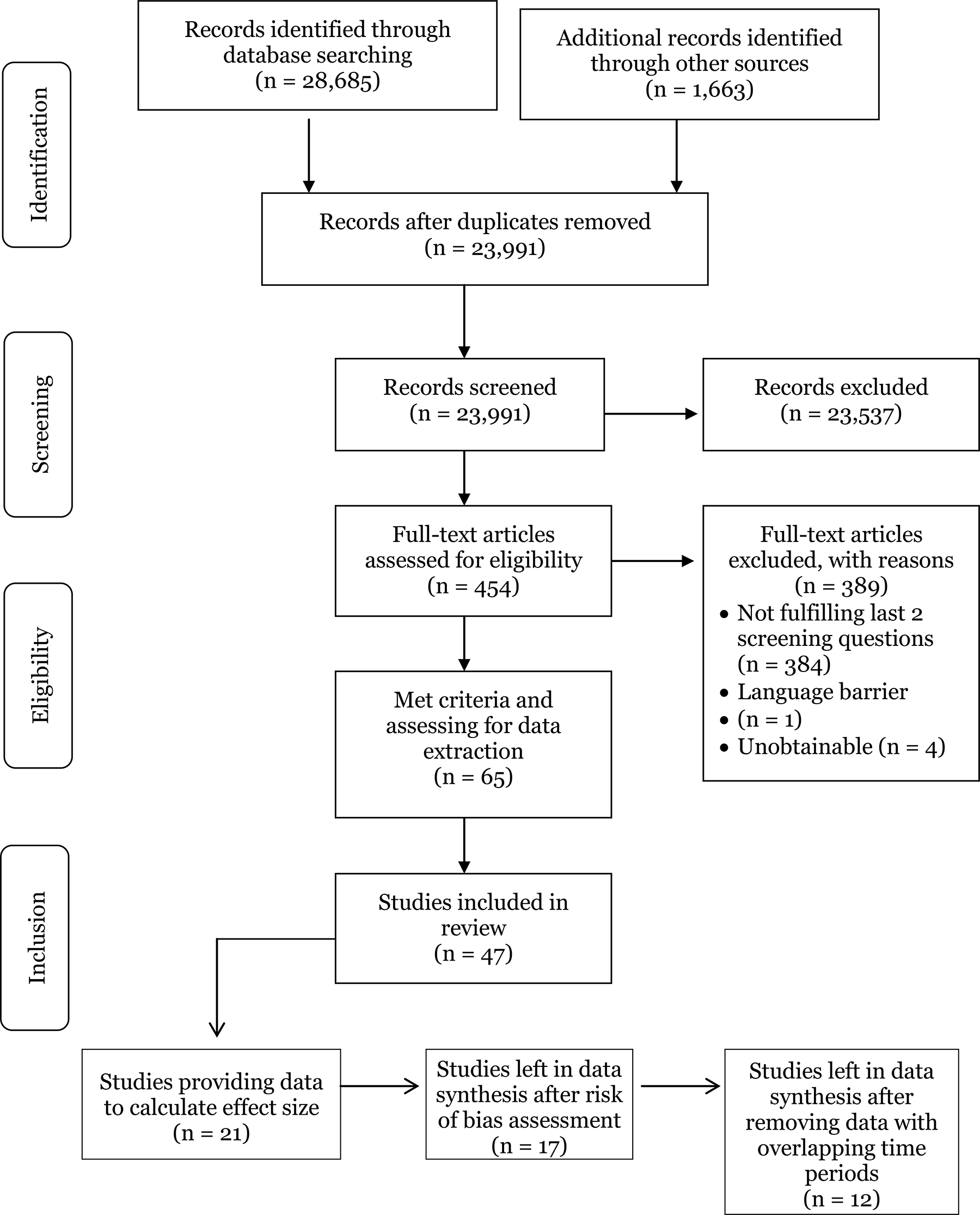
FLOW CHART FOR THE LITERATURE SEARCH
4.2 DESCRIPTION OF THE STUDIES
4.2.1 Studies Included in the Systematic Review
The search resulted in a final selection of 47 studies that met the inclusion criteria for this review. Of the 47 studies that met the inclusion criteria, 26 did not provide data that permitted the calculation of an effect size. Of the remaining 21 studies, 4 studies were coded with a very high risk of bias (5 on the risk of bias scale) and were therefore not used in the data synthesis. An additional five studies could not be used in the data synthesis due to overlapping data samples (i.e., the studies used administrative register data from the same country covering the same time period or overlapping time periods; see Section 3.4.5 for this methodological issue). These studies analysed benefit exhaustion in Spain, Slovenia, Germany, and the US. After these exclusions, 12 studies remained and were included in the data synthesis.
In Table 4.1, we show the total number of studies that met the inclusion criteria for this review. The first column shows the total number of studies grouped by country of origin. The second column shows the number of these studies that provided enough data to calculate an effect estimate, in total 21 studies. The third column gives the number of studies that were coded with very high risk of bias. The fourth column gives the number of studies that were excluded from the data synthesis due to overlapping samples. The last column gives the total number of studies used in the data synthesis, in total 12.
NUMBER OF INCLUDED STUDIES
Note: The reduction due to too high risk of bias preceded the reduction due to overlap of data sample.
1The data samples used are representative for the same population at a given time (see section 3.4.5 for this methodological issue).
The choice of which study to use in the data synthesis among the studies with overlapping data samples was based on our quality assessment of the studies. The citations for the 21 studies that provided effect size estimates can be found in Section 8.1. In cases of overlap, the study that we judged to have the least risk of bias was chosen. 20 In the case of Germany and the US, there were differences in our judgments of confounding, so the studies with the least risk of bias were chosen. In the case of Spain, the two studies were judged to have the same risk of bias due to confounding, so the study we judged to have the least risk of bias due to incomplete outcome data was chosen. In the case of Slovenia, the three studies were judged to have the same risk of bias in both confounding and incomplete outcome data. Two of the studies provided only an estimate of the exhaustion effect in the month of exhaustion, so we chose the one study that provided an estimate of the exhaustion effect in the month of exhaustion as well as one month prior to exhaustion and one month after exhaustion. In total, we were left with effect estimates for 12 unique populations. These are listed in Section 9.1.
The characteristics of the 12 studies that were used in the data synthesis are shown in Table 4.2. A description of the individual studies is provided as a supplementary document.
The studies were mainly from European countries. Two studies were from the US and one study was from Canada. Nine studies analyzed data from the 1990s. One of these nine studies used data from 1981 to 2001. Two studies used data from the 1970s and 1980s, and one study analyzed the period 2000-2007. The outcome measures were based on weekly data in five studies, and the remaining seven were based on monthly data. Data were drawn mainly from administrative registers. Some primary studies report sample size by number of unemployment spells rather than number of individuals. The number of unemployment spells will be different from the number of individuals only if data providing multiple spells is used. Two studies used in the meta-analyses used multiple unemployment spells to control for unobserved heterogeneity. The sample sizes were generally large; all but two studies had sample sizes of more than 2,500 unemployment spells.
All studies analysed the exhaustion of unemployment insurance benefits. None of the studies reported whether compulsory labour market activation was part of the unemployment system. Most studies did not report on the availability of alternative benefits; those that did only reported that means tested unemployment assistance was available. Only one study restricted the analysis to a specific age group (18-25 years), and none restricted the analysis to a specific educational level. Three studies included only males in their analysis, and five studies provided separate effect estimates by gender.
The majority of studies did not report the labour market conditions – only four studies reported the unemployment level. All studies reported the maximum entitlement but in almost all studies there was a high degree of variation in individual entitlement, as individual entitlement in most countries depends on work experience and/or age. All but one study used this individual variation in entitlement as part of the identification strategy.
The relevant variation in the individual entitlement for the countries and time periods of the studies included in the data synthesis are shown in Table 4.3, and a more comprehensive description of the existing rules applicable in the respective countries and time periods is given in Appendix 10.2. The individual entitlement investigated within a country varies considerably. In the case of Slovenia, it also varies considerably between time periods.
4.2.2 Excluded Studies
In addition to the 47 studies that met the inclusion criteria for this review, several studies at first sight appeared relevant for the review but did not end up meeting our criteria. Four studies examined a mix of destinations after unemployment, which could not be separated, and two further studies examined an intervention that was a mix of active labour market programmes and exhaustion of benefits. Two studies analysed the effect on the overall unemployment duration and not the effect for time of exhaustion. Furthermore, one study examined an active labour market programme instead of the exhaustion of benefits, and one study examined temporary benefit exhaustion. None of these studies fulfilled our inclusion criteria and were therefore not included in the final review. One study was excluded due to language barrier. These studies are listed in Appendix 8.2.
4.2.3 Studies Awaiting Classification
Due to long delivery time and unknown information, two references were not obtained in full text despite repeated attempts to locate them. The known information for these two studies is listed in Section 9.3.
CHARACTERISTICS OF STUDIES USED IN THE DATA SYNTHESIS
Note: One study used data from 1981 to 2001. This study is counted up in the 1990s category.
RANGE OF INDIVIDUAL ENTITLEMENT IN THE COUNTRIES AND TIME PERIODS OF THE STUDIES USED IN THE DATA SYNTHESIS
a: Individual entitlement of the unemployed included in the analysis of the primary study
b: No lower level of entitlement is stated
4.3 RISK OF BIAS IN INCLUDED STUDIES
The risk of bias coding for each of the 21 studies from which we could extract an effect estimate is shown in a supplementary document. Because all included studies used non-randomised designs, they were all judged to have a high risk of bias on the sequence generation item and the allocation concealment item. We did not judge the studies on the blinding item. This review focuses on the incentive effect of benefit exhaustion, i.e., the exit rate out of unemployment into employment prior to exhaustion of unemployment benefits. The treated group has to know they are treated in order to react to it; therefore, it is not relevant to consider blinding of the participants. Furthermore, the nature of the outcome, exit into employment, is objective and obtained from administrative registers or questionnaires, which were not collected with the aim of analysing unemployment benefit exhaustion.
The central problem associated with risk of bias in the primary studies included in this review is identification of the incentive effect; this judgement is reflected in the score on the confounding item of our risk of bias instrument. Using sources of individual variation in entitlement such as age and work experience carries the risk of being correlated with personal characteristics, which may have an impact on the exit rate. Variation in entitlement across individuals uncorrelated with work experience or age may be achieved through legislative changes of the maximum entitlement. Studies using legislative changes are generally better off with respect to risk of bias in terms of confounding.
Ten studies used both legislative changes and individual variation in entitlement as their source of identification, six studies used only individual variation in entitlement, one study used unemployed non-receivers of unemployment insurance benefits as comparison, and four studies were given a score of 5 on the confounding item. None of the studies had an a priori protocol or an a priori analysis plan.
A summary of the risk of bias associated with confounding, incomplete data, and selective reporting for the 21 studies from which it was possible to extract an effect estimate is shown in Table 4.4. Four studies were given a score of 5 on the confounding item, corresponding to a risk of bias so high that the findings should not be considered in the data synthesis. For these four studies, we did not find it relevant to judge on the selective reporting item because of their already high risk of bias. None of the other studies were given a score of 5 on the incomplete data and selective reporting items.
4.4 EFFECTS OF THE INTERVENTION
In order to carry out a meta-analysis, every study must have a comparable effect size. All 12 studies used in the meta-analyses reported hazard ratios. The approach shared by the majority (9) of the 12 studies was to use indicator variables for the number of months or weeks until benefit exhaustion; the remaining studies (3) used a linear spline function. The comparison condition was benefit exhaustion that was not immediate.
RISK OF BIAS - DISTRIBUTION OF THE 21 STUDIES REPORTING AN EFFECT SIZE
Notes: The judgment is based on a 5-point scale, where 1 indicates low risk of bias and 5 indicates high risk of bias. Four studies scored 5 on the confounding item and were thereby not included in the data synthesis. Therefore, it was not relevant to judge on the selective reporting item for these four studies.
In the majority of studies, the results were measured at multiple time points. The effect estimates at different time points were independent, as the effect sizes were measured as the proportional impact on the hazard rate which is the event rate (in the present context, the event is finding a job) at time t conditional on survival (staying unemployed) until time t or later.
The outcome at each time point was analysed in a separate meta-analysis with other comparable studies taking measures at similar time points. Two studies reported separate effect measures based on number of weeks or fortnights. For these two studies, the average effect size was calculated and used to avoid dependence problems.
Five studies reported separate effect measures for men and women. Of these, two studies further reported separate effect measures for two different regions, and one study reported separate effect measures for recall and exit to new job. For these five studies, the average effect size was also calculated and used to avoid dependence problems.
We rely on results of random effects models. We carried out our meta-analyses using the point estimate of the hazard ratio. A hazard ratio greater than 1 favours the treated group, which means that the conditional exit rate from unemployment into employment is higher for persons who approach exhaustion than for persons who do not approach exhaustion.
4.4.1 Primary Outcome Results
4.4.1.1 The Month or Week of Exhaustion
Nine studies provided effect estimates in the month or week of exhaustion. All nine studies reported results that indicated a positive exhaustion effect; only two of the study-level effects were statistically nonsignificant. Pooled results showed a significant exhaustion effect. The random effects weighted mean hazard ratio was 1.78 (95% CI 1.33 to 2.38, p<.0001); however, there was significant heterogeneity of effects among studies (τ2=0.16, Q= 120.62, df=8, p<.00001). The forest plot is displayed in Figure 4.2.
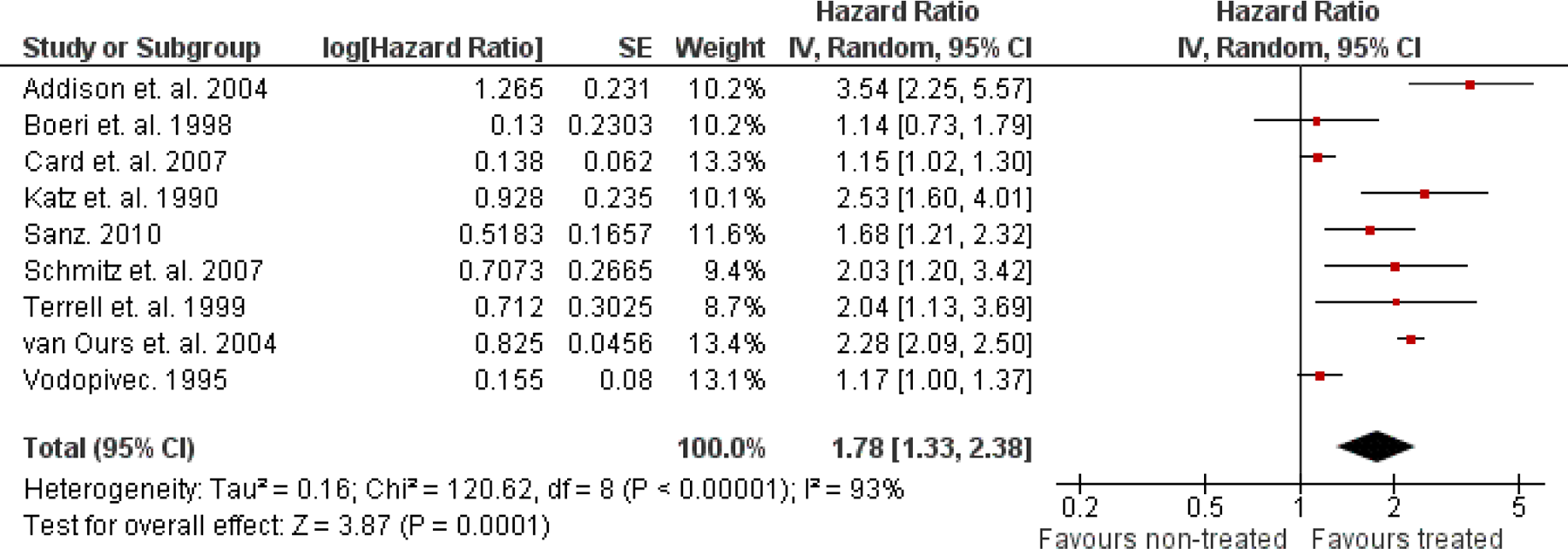
FOREST PLOT, THE WEEK/MONTH OF EXHAUSTION
4.4.1.2 One Month Before Exhaustion
Nine studies provided effect estimates one month before benefit exhaustion. All nine studies reported results that indicated a positive exhaustion effect. Five of the study-level effects were statistically nonsignificant, but pooled results showed a significant exhaustion effect. The random effects weighted mean hazard ratio was 1.30 (95% CI 1.12 to 1.50, p<.0001); however, there was significant heterogeneity of effects among studies (τ2=0.03, Q= 53.63, df=8, p<.00001). The forest plot is displayed in Figure 4.3.
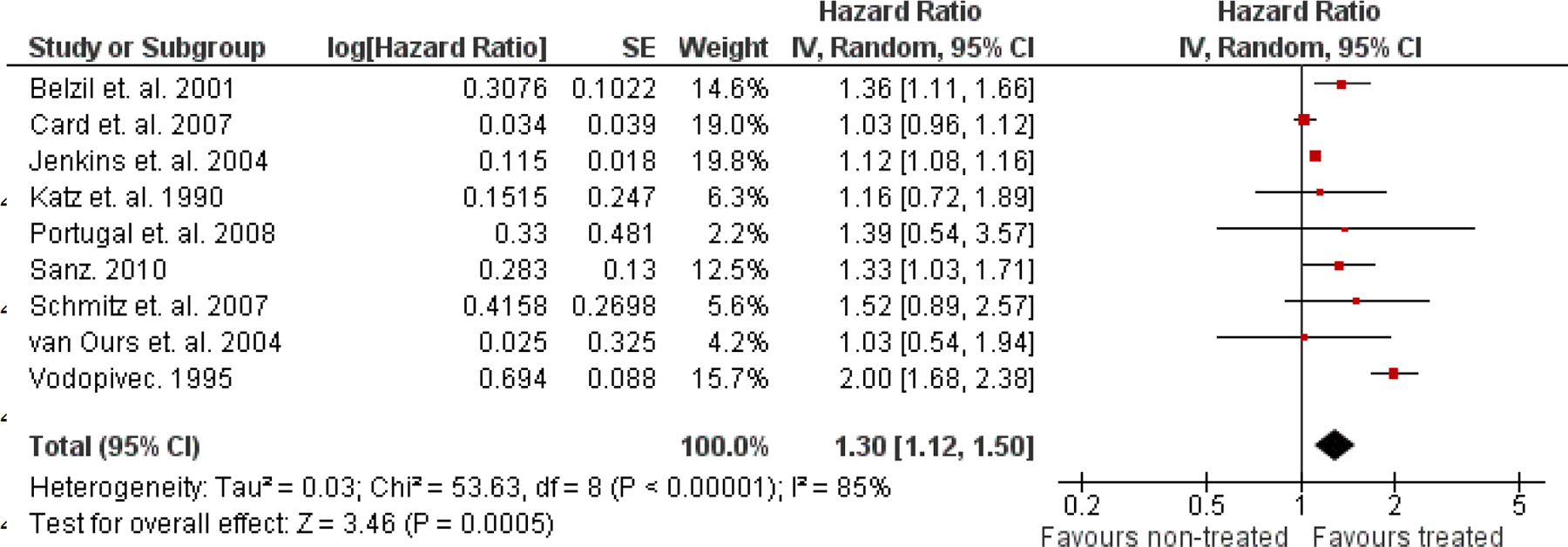
FOREST PLOT, 1 MONTH BEFORE EXHAUSTION
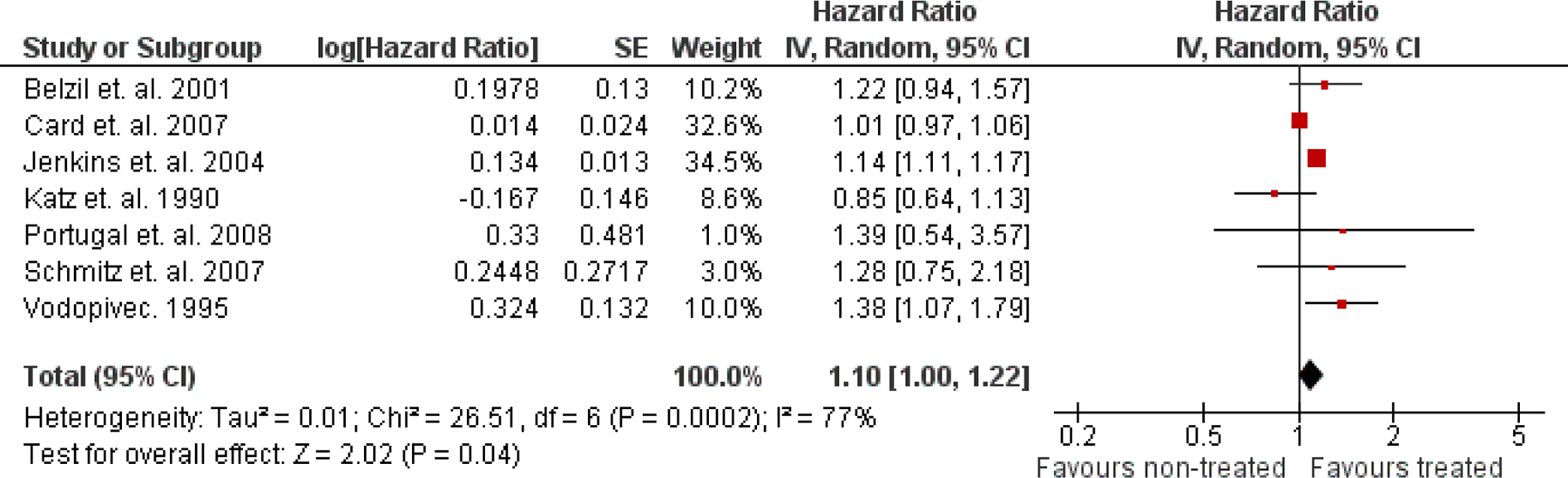
FOREST PLOT, 2 MONTHS BEFORE EXHAUSTION
4.4.1.3 Two Months Before Exhaustion
Seven studies provided effect estimates two months before benefit exhaustion. A nonsignificant negative threat effect was found in one study, while six studies reported results that indicated a positive exhaustion effect. Only one of the individual study-level effects was statistically significant, and in the positive direction. Pooled results showed a significant exhaustion effect. The random effects weighted mean hazard ratio was 1.10 (95%CI 1.00 to 1.22, p=.04). There was significant heterogeneity of effects among studies (τ2=0.01, Q= 26.51, df=6, p=.0002). The forest plot is displayed in Figure 4.4.
4.4.1.4 Between Two and Four Months Before Exhaustion
Three studies provided effect estimates between two and four months before benefit exhaustion. A statistically significant negative effect was found in Jenkins and Garcia-Serrano (2004), while two studies reported results that indicated a statistically significant positive exhaustion effect. Pooled results did not show a significant exhaustion effect. The random effects weighted mean hazard ratio was 1.32 (95%CI 0.60 to 2.87, p=.49). There was significant heterogeneity of effects among studies (τ2=0.46, Q= 98.23, df=2, p<.00001). The forest plot is displayed in Figure 4.5.
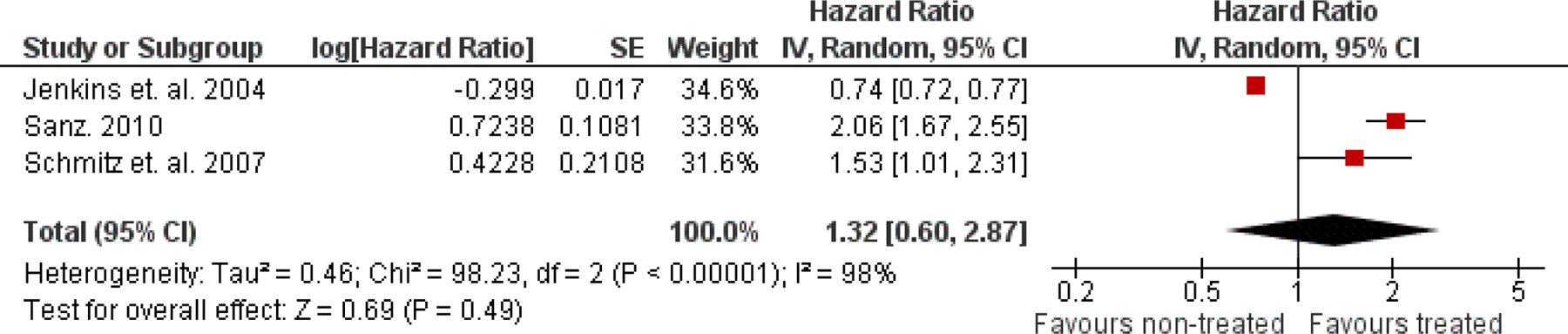
FOREST PLOT, BETWEEN 2 AND 4 MONTHS BEFORE EXHAUSTION
4.4.1.5 One Month After Exhaustion
Four studies provided effect estimates one month after benefit exhaustion. A statistically significant negative effect was found in one study, while three studies reported results that indicated a statistically significant positive exhaustion effect. Pooled results did not show a significant exhaustion effect. The random effects weighted mean hazard ratio was 0.98 (95%CI 0.57 to 1.67, p=.93). There was significant heterogeneity of effects among studies (τ2=0.29, Q= 120.18, df=3, p<.00001). The forest plot is displayed in Figure 4.6.
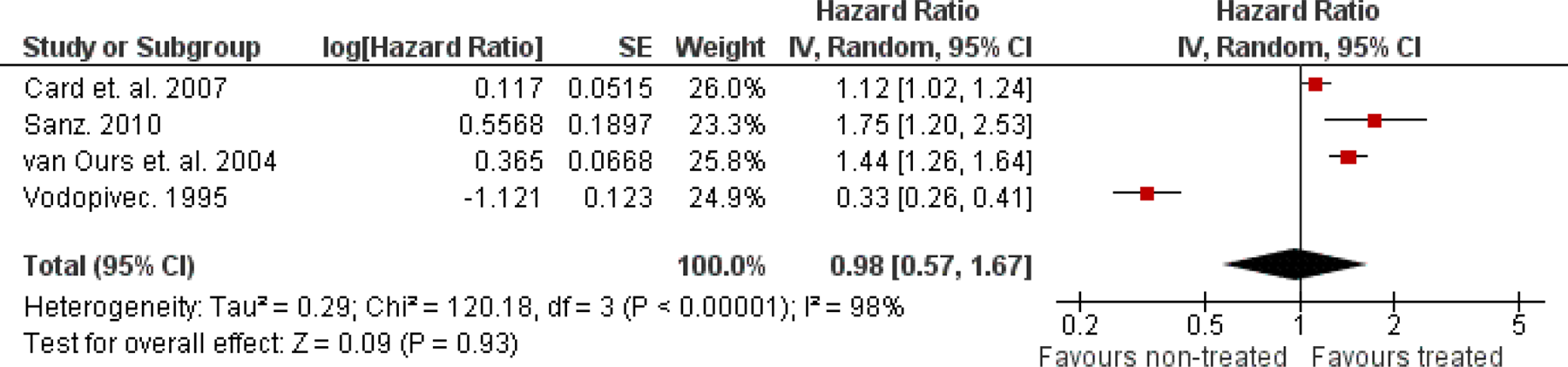
FOREST PLOT, 1 MONTH AFTER EXHAUSTION
4.4.1.6 Summary of Primary Outcome Results
The data synthesis for the primary outcome, the impact of exhaustion of unemployment benefit, revealed a significant exhaustion effect in the month/week of benefit exhaustion, one month before exhaustion and two months before exhaustion. No significant effects were found more than two month before exhaustion or one month after benefits have expired.
4.4.2 Secondary Outcome Results
In addition to the primary outcome, exit rate from unemployment into employment, we planned to consider secondary outcomes in terms of the impact of exhaustion of benefits on the exit rate of the re-employment job and on the re-employment wage. No studies provided data on the re-employment wage. However, estimates of the relative exit rate from the re-employment job, i.e., the re-employment hazard ratio, were provided. We included this measure in the analysis of secondary outcomes. A higher exit rate from the re-employment job indicates that the exhaustion of benefits forces unemployed individuals to find jobs that do not match their qualifications and, therefore, they may return to unemployment quickly. One study, Gaure, Røed, and Westlie (2008), analysed both re-employment hazards and monthly earnings, but the study did not provide data that permitted the calculation of an effect size. Four studies provided an effect size in the form of re-employment hazard ratios, of which two were from Slovenia analysing the same time period. The choice of which study to use in the data synthesis could not be based on our quality assessment. The two studies were almost identical, using the same data, method of estimation, and both used legislative changes and individual variation in entitlement due to labour market history to identify the effect. The only difference was that in van Ours and Vodopivec (2006), work experience was included (among other variables) as a confounding factor in the analysis, and this factor was not controlled for in Boone and van Ours (2009). We therefore chose to use van Ours and Vodopivec (2006) in the data synthesis. The effect sizes from the two studies do not differ much, and a sensitivity analysis shows that the pooled effect size from using the one or the other study does not differ. Only the lower limit of the 95% confidence interval of the pooled effect size differs marginally (by 0.01).
Of the three studies used in the meta-analysis, two studies reported hazard ratios using indicator variables for the number of months or weeks until benefit exhaustion, and one study used a linear spline function. It was not possible to analyse the exit rate of jobs found at different time points before benefit exhaustion. Two studies reported separate effect sizes for men and women, and one study reported separate effect sizes for permanent and temporary jobs. For all studies, a synthetic (the average) effect size was calculated and used to avoid dependence problems.
We carried out our meta-analysis using the point estimate of the hazard ratio. A hazard ratio of less than 1 indicates that treatment groups are favoured. That is, the conditional exit rate from the re-employment job into unemployment is lower for persons who found the job when they approached benefit exhaustion than for persons who found the job when not approaching benefit exhaustion.
All three studies reported individual non-significant exhaustion effects. Pooled results were also non-significant. The random effects weighted mean hazard ratio was 1.03 (95%CI 0.99 to 1.07, p=.09). There was no evidence of significant heterogeneity of effects among studies (τ2=0.00, Q= 1.44, df=2, p=.49). The forest plot is displayed in Figure 4.7.
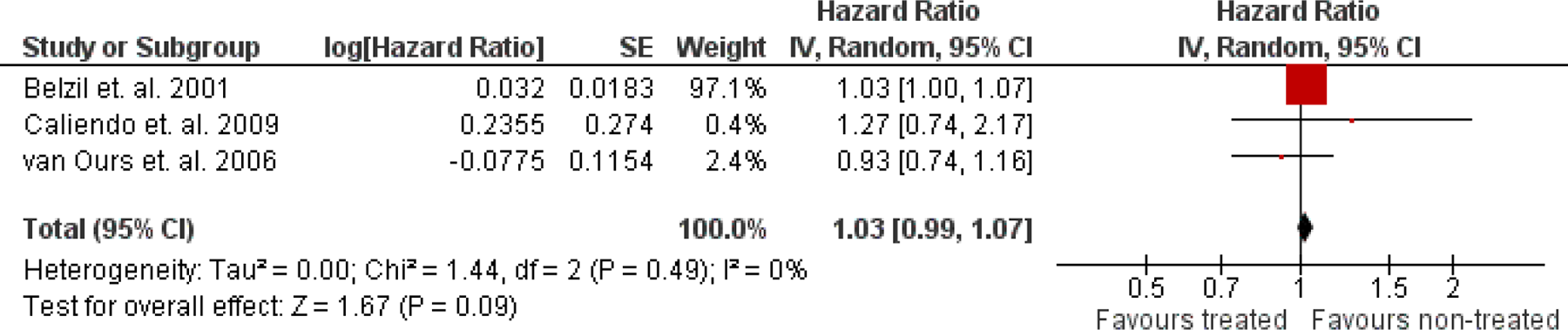
FOREST PLOT, EXIT FROM RE-EMPLOYMENT JOB
4.4.3 Moderator Analysis and Investigation of Heterogeneity
The included studies differed in terms of their sample characteristics, comparison conditions, and methodology. With between three and nine studies in a single meta-analysis, the statistical power to detect heterogeneity of effects was quite low; nevertheless, evidence of statistical heterogeneity was found.
With the aim of explaining observed heterogeneity, we planned to investigate the following factors: study-level summaries of participant characteristics (e.g. specific age group, gender or educational level), labour market conditions (good/bad), type of unemployment benefit (UI or SA/UA), maximum entitlement (less than one year, between one and two years, more than two years), whether alternative benefits were available, and if compulsory activation was part of the system.
Among the studies used in the data synthesis, only one study restricted its analysis to a specific age group (18-25 years), and none restricted their analyses to a specific educational level. No separate estimates for young/old or low/high educational level were available. The majority of studies did not report the labour market conditions and, among those that did, there was hardly any variation in this covariate. All studies reported the maximum entitlement, and almost all studies reported the individual entitlement as well (see Table 4.3). As all but one study used individual variation in entitlement as part of the identification strategy, and effect estimates were not provided separated by individual entitlement, it was unfortunately not possible to analyse the impact of entitlement on the between-study variation in exhaustion effects. Even a comparison of effect sizes by countries with low/high maximum entitlement does not provide the ‘right’ guidance as to whether a larger effect size was found for lower maximum entitlements. For example, a comparison of the effect size for the Czech Republic, with a maximum entitlement of 6 months, and the effect size for Spain, with a maximum entitlement of 24 months, would be misleading. The individual entitlement in Spain in the period 1987-1992 was 3 months if tenure in the last 48 months was 6-12 months, it then increased in 3-month intervals for each incremental 6 months of tenure in the last 48 months up to a maximum of 24 months with tenure more than 48 months. The effect size for Spain is thus an average of unemployment benefit exhaustion effects at various individual entitlements. Thus, a country comparison of the reported effect sizes is not a comparison of high (in Spain) versus low (in Czech Republic) maximum entitlement as one might think.
Concerning the three covariates: type of unemployment benefit, availability of alternative benefits, and compulsory activation, they were either not reported or there was no variation in the covariate.
Five studies provided separate effect estimates by gender. Although these five studies comprise a subset of the included studies, we chose to investigate the impact of gender using effect estimates separated by gender within studies. In general, the strength of inference regarding differences in treatment effects using subsets of studies is controversial. However, making inferences about different effect sizes among subgroups on the basis of between-study differences entails a higher risk compared to inferences made on the basis of within study differences (Oxman & Guyatt, 1992).
Subgroup analysis was therefore performed using effect estimates separated by gender from the five studies where separate estimates were available. We have drawn no overall conclusion because the analysis is based on a subset of the studies used in the data synthesis. The assessment of any difference between the subgroups is based on 95% confidence intervals and interpretation of relationships is cautious.
Of the five studies that reported separate effect measures for men and women, two studies further reported separate effect measures for two different regions, and one study reported separate effect measures for recall and exit to new job. For these two studies, a synthetic (the average) effect size was calculated and used to avoid dependence problems.
4.4.3.1 The Month or Week of Exhaustion
The forest plot for the five studies reporting gender breakdowns is displayed in Figure 4.8. Pooled results for both subgroups showed significantly positive exhaustion effects; HR=1.67 (95% CI 1.17 to 2.39) for men and HR=1.85 (95% CI 1.38 to 2.48) for women. There was significant heterogeneity of effects among studies in both subgroups (τ2=0.13, Q= 21.66, df=4, p=.0002 for men and τ2=0.06, Q= 9.64, df=4, p=.05 for women). The confidence intervals for the subgroups differed only marginally. There was no evidence to support the hypothesis that the exhaustion effect in the week or month of exhaustion differs by gender.
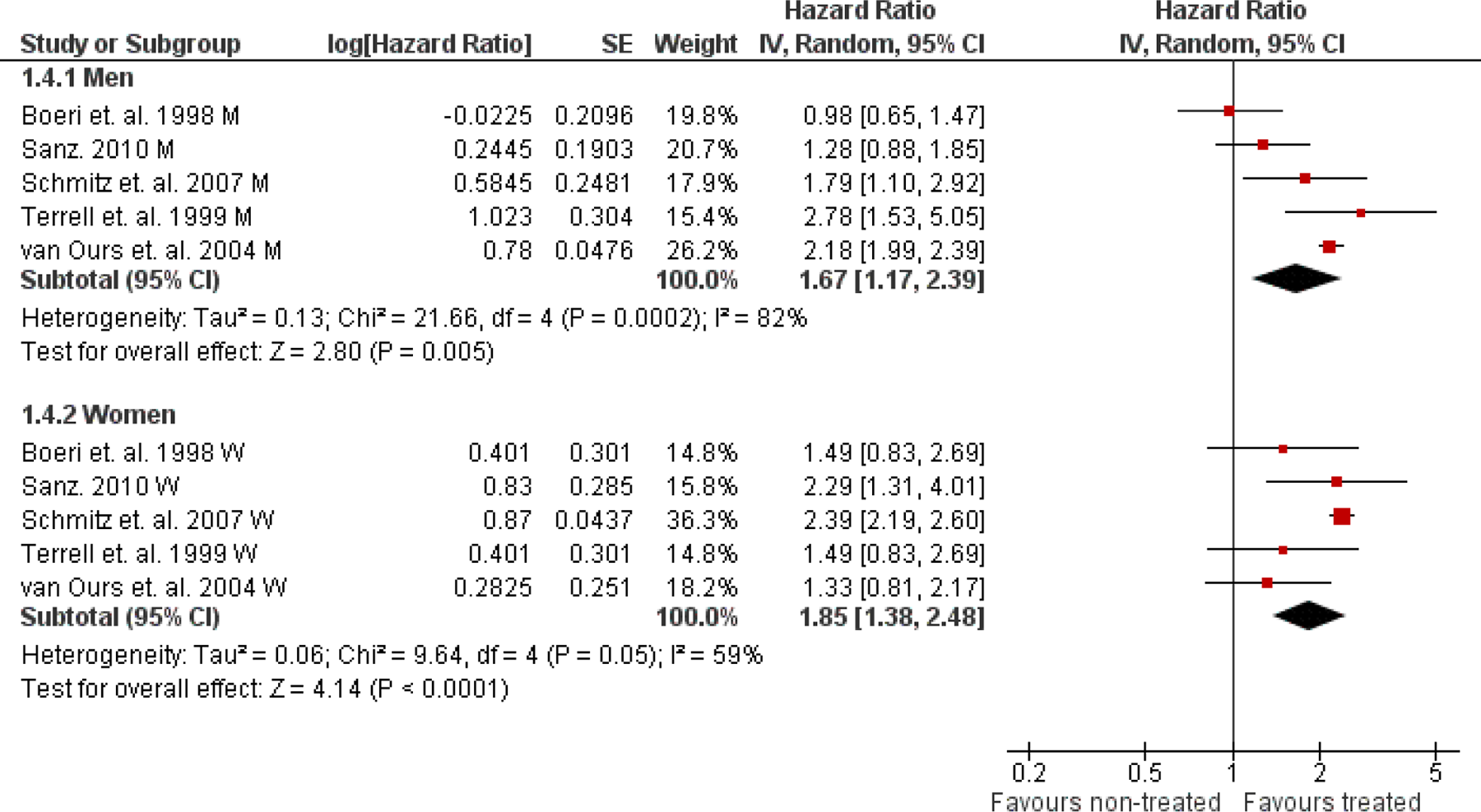
FOREST PLOT, SUBGROUP – THE WEEK/MONTH OF EXHAUSTION
4.4.3.2 One Month Before Exhaustion
Three studies reported estimates separated by gender for the one month time period. Pooled results for men showed a nonsignificant exhaustion effect, whereas pooled results for women showed a significant positive exhaustion effect. The forest plot is displayed in Figure 4.9. There was no significant heterogeneity of effects among studies in either of the subgroups (τ2=0.00, Q= 2.37, df=2, p=.31 for men and τ2=0.00, Q= 1.08, df=2, p=.58 for women). The confidence intervals of the subgroups did not overlap (95% CI 0.88 to 1.16 for men and 95% CI 1.48 to 2.19 for women). However, making inferences about different effect sizes among subgroups entails a higher risk when the difference is not consistent within the studies (Oxman & Guyatt, 1992). Only in the Sanz (2010) study was there a clear difference between men and women. The effect estimates in both the Schmitz and Steiner (2007) and the van Ours and Vodopivec (2004) studies were nonsignificant for both men and women and the 95% confidence interval for women included the 95% confidence interval for men in the van Ours and Vodopivec (2004) study, whereas the 95% confidence interval of men included the 95% confidence interval for women in the Schmitz and Steiner (2007) study. There is no evidence to support the hypothesis that the exhaustion effect one month before exhaustion differs by gender.
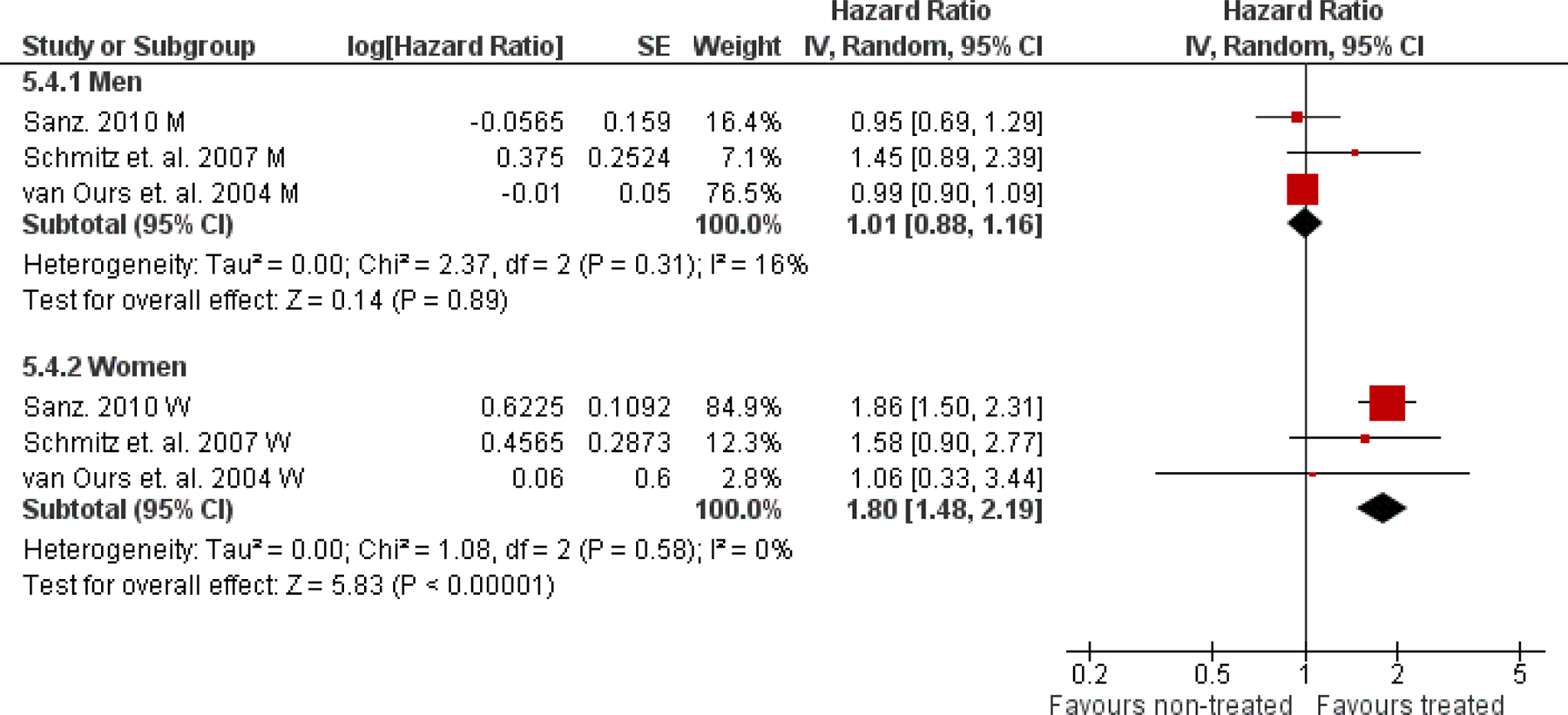
FOREST PLOT, SUBGROUP – 1 MONTH BEFORE EXHAUSTION
4.4.3.3 Two Months Before Exhaustion
No effect estimates separated by gender were available.
4.4.3.4 Between Two and Four Months Before Exhaustion
Two studies reported estimates separated by gender for the 2-4 month time period. Pooled results for both subgroups showed a positive exhaustion effect; HR=1.85 for men and HR=1.76 for women. There was significant heterogeneity of effects among studies in the subgroup of men but no significant heterogeneity of effects among studies in the subgroup of women (τ2=0.13, Q= 6.08, df=1, p=.01 for men and τ2=0.00, Q= 0.02, df=1, p=.88 for women). The confidence interval of the subgroup of men was wide and inclusive of the confidence interval of the subgroup of women (95% CI 1.06 to 3.21 for men and 95% CI 1.48 to 2.10 for women). There is no evidence to support the hypothesis that the exhaustion effect between two and four months before exhaustion differs by gender. The forest plot is displayed in figure 4.10.
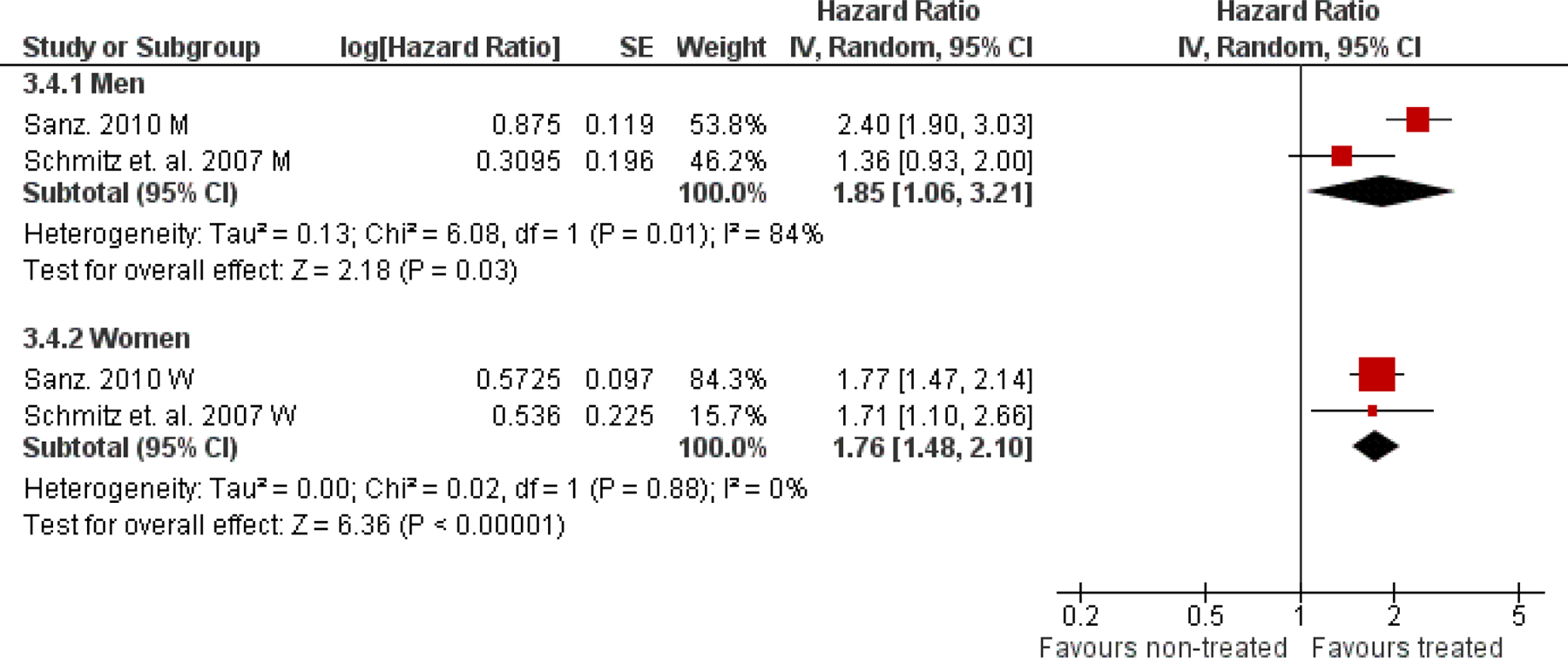
FOREST PLOT, SUBGROUP – BETWEEN 2 AND 4 MONTHS BEFORE EXHAUSTION
4.4.3.5 One Month After Exhaustion
Two studies reported estimates separated by gender for the one-month period after benefit exhaustion. Pooled results for both subgroups showed a positive exhaustion effect; HR=1.63 for men and HR=1.36 for women. There was no significant heterogeneity of effects among either of the subgroups (τ2=0.01, Q= 1.29, df=1, p=.26 for men and τ2=0.00, Q= 0.45, df=1, p=.50 for women). The confidence intervals of the subgroups overlapped (95% CI 1.33 to 2.00 for men and 95% CI 1.21 to 1.53 for women). There is no evidence to support the hypothesis that the exhaustion effect one month after exhaustion differs by gender. The forest plot is displayed in Figure 4.11.
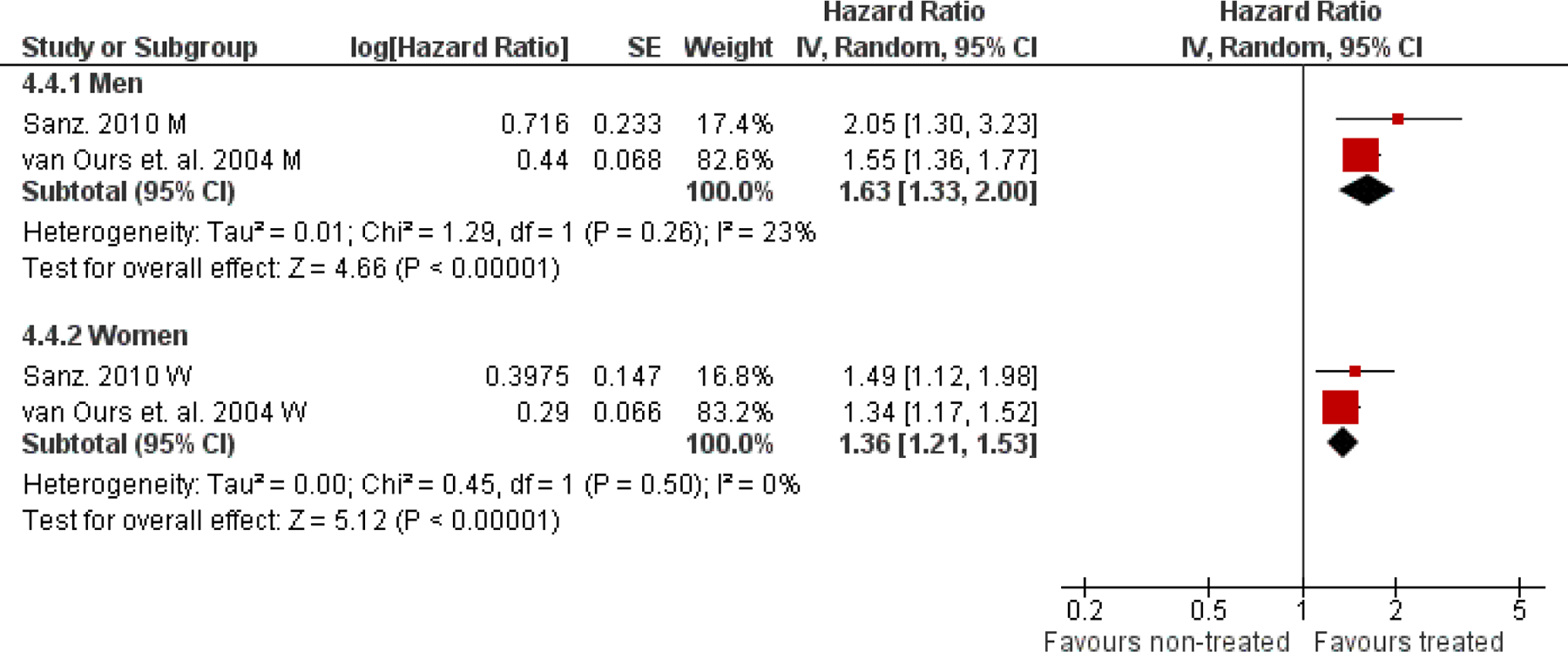
FOREST PLOT, SUBGROUP – 1 MONTH AFTER EXHAUSTION
4.4.4 Sensitivity Analysis
Sensitivity analyses were planned to evaluate whether the pooled effect sizes were robust across study design and components of methodological quality. Due to the fact that we found no randomised controlled trials, we could not evaluate the impact of study design. For methodological quality, we carried out sensitivity analyses for the confounding, incomplete data, and selective reporting components of the risk of bias checklists, respectively. Two sets of sensitivity analyses were performed. First, we examined the robustness of conclusions when we excluded studies with risk of bias scores of 4 on confounding, incomplete data, or selective reporting. Second, we examined the robustness of our conclusions when we excluded studies with risk of bias scores of 3 or 4 on confounding, incomplete data, or selective reporting. Sensitivity analyses were further used to examine the robustness of conclusions in relation to the quality of data (outcome measures based on weekly or monthly data collection and whether data were derived from questionnaires or administrative registers).
Due to the small number of studies providing effect estimates for the time intervals 2-4 months before exhaustion and 1 month after exhaustion, we only performed sensitivity analyses for the following three time points: (1) the month or week of exhaustion, (2) one month before exhaustion, and (3) two months before exhaustion. The results are provided in Table 4.5 and displayed in forest plots in Section 11.1.
For the exhaustion effect in the month or week of exhaustion, there were no appreciable changes in the results either due to exclusion of studies where the effect estimates were based on weekly data or due to exclusion of studies using questionnaire data. There were no appreciable changes in the results either due to exclusion of studies with a high/unclear censoring level or due to exclusion of studies with scores of 4 on the confounding, incomplete data, or selective reporting components of the risk of bias checklists. Finally, there were no appreciable changes in the results due to exclusion of studies with scores of either 3 or 4 on the confounding, incomplete data, or selective reporting components of the risk of bias checklists. The overall conclusion that the hazard rate significantly increases in the month or week of exhaustion does not change. In fact, when we only included the studies with the highest scores on the confounding component of the risk of bias checklist (1 and 2), the pooled effect was higher and the confidence interval was narrower compared to inclusion of all studies.
SENSITIVITY ANALYSIS - RESULTS
Notes: Some of the confidence intervals narrow considerably. For a technical comment see section 11.1. “-” indicates that no studies providing effect estimates at the time intervals in question scored 4 in the confounding item.
For the effect estimate one month before exhaustion, there were no appreciable changes in the results either due to exclusion of studies where the effect estimates were based on weekly data or due to exclusion of studies using questionnaire data, or due to exclusion of studies with a high/unclear censoring level. There were no appreciable changes in the results either due to exclusion of studies with scores of 4 on the confounding, incomplete data, or selective reporting components of the risk of bias checklists, or due to exclusion of studies with a scores of either 3 or 4 on the confounding, incomplete data, or selective reporting components of the risk of bias checklists. The overall conclusion is that the hazard rate increases but less than at the week or month of exhaustion. The exhaustion effect estimate one month before exhaustion is only sensitive in the sense that the confidence intervals narrow when studies with high/unclear censoring levels or studies with high risk of bias are excluded.
For the effect estimate two months before exhaustion, there were no appreciable changes in the results either due to exclusion of studies where the effect estimates were based on questionnaire data or due to exclusion of studies with scores of 4 on the confounding, incomplete data, or selective reporting components of the risk of bias checklists. Finally, there were no appreciable changes in the results due to exclusion of studies with scores of either 3 or 4 on the confounding, incomplete data, or selective reporting components of the risk of bias checklists. The exhaustion effect estimate two months before exhaustion is, however, sensitive to the exclusion of studies where the effect estimates were based on weekly data in the sense that the confidence interval narrows. The point estimate increases only slightly but is now very precisely estimated and significant within a 95% confidence interval.
4.4.5 Publication bias
We have assessed the possibility of publication bias for the three time intervals: (1) the week or month of exhaustion, (2) one month before exhaustion, and (3) two months before exhaustion. We did not consider the remaining time intervals (between two and four months before exhaustion and one month after exhaustion), as there were too few studies that provide effect estimates (three respectively four). We assessed the possibility of publication bias visually by examining funnel plots. The three funnel plots are displayed in Section 11.2. There are too few studies and not enough variation in the standard errors to assess whether the funnel plots are symmetric. However, there is no striking asymmetry visible in any of the funnel plots.
5 Discussion
5.1 SUMMARY OF THE MAIN RESULTS
This review focused on the incentive effect of benefit exhaustion, i.e., the increase in the exit rate out of unemployment into employment of an unemployed person approaching benefit exhaustion. The available evidence supports the hypothesis that there is an incentive effect of approaching benefit exhaustion but only shortly prior to exhaustion and at the time of exhaustion. Furthermore, the available evidence suggests that this incentive effect diminishes as time increases both before and after the time of expiration.
We found a statistically significant exhaustion effect in the month/week of benefit exhaustion. The effect estimate translates into an increase of approximately 80% in the exit rate from unemployment into employment. The exit rate, also termed the hazard, is the rate within a short time interval at which the unemployed find a job conditional on staying unemployed. In other words, the probability of finding a job in that short time interval is the hazard rate. The time intervals used in primary studies varied; they were either one week or one month. This means that, for an unemployed person who has stayed unemployed until the month/week of benefit exhaustion, the probability of finding a job increases with 80% in that time interval solely due to the prospect of benefit exhaustion.
The increase in the hazard rate associated with benefit exhaustion starts even earlier. We found a statistically significant exhaustion effect one month before benefit exhaustion, though this effect was smaller than that found for the month/week of exhaustion. The effect estimate one month before benefit exhaustion translates into a 30% increase in the exit rate from unemployment into employment. A significant effect of a 10% increase in the exit rate from unemployment to employment was found two months prior to benefit exhaustion. No significant effects for benefit exhaustion were found more than two months before exhaustion, and no significant effects for benefit exhaustion were found after benefits had expired.
Interpretation of the results would ideally involve a measure of the average hazard rates for the comparison. However, none of the included studies reported such rates. Most of the studies, however, displayed figures of the average hazard rates over the entire unemployment period. Using these figures, we were able to estimate that the relevant hazard rates (depending on the reference used in the estimation which varies between studies) lie in the interval 0.02-0.08, i.e., the conditional probability of finding a job in a short time interval (a week or a month depending on the unit of analysis in the primary studies) lies between 2% and 8%. Thus two months prior to exhaustion the hazard rates have increased with 10% to the interval 0.022-0.088, i.e., the conditional probability of finding a job in a short time interval has increased to 2.2-8.8% solely due to the prospect of benefit exhaustion. One month prior to exhaustion the hazard rates have increased with 30% so the conditional probability of finding a job in a short time interval has increased to 2.6-10.4%. In the week/month of exhaustion the hazard rates have increased with 80% so the conditional probability of finding a job in a short time interval has increased to 3.6-14.4% solely due to the prospect of benefit exhaustion.
It was possible to assess the impact of gender using a subset of studies. We found no evidence to support the hypothesis that the exhaustion effect differs by gender.
Concerning secondary outcomes, we analysed the effect of benefit exhaustion on the subsequent exit rate from the re-employment job. Only three studies could be used in this analysis. Based on the low number of studies the evidence was inconclusive with respect to support of the hypothesis that the prospect of benefit exhaustion has an impact on the quality of the job measured as the exit rate of re-employment.
5.2 OVERALL COMPLETENESS AND APPLICABILITY OF EVIDENCE
In this review we included 12 studies in the data synthesis. In the light of the large number of studies meeting the inclusion criteria for this review (n=47), this number is quite low. The reduction was caused by three factors. Unfortunately, 26 of the 47 studies did not report effect estimates or provide data that enabled the calculation of an effect size. Disregarding studies without a usable effect estimate, it was still possible to include 21 studies in the data synthesis. Of these 21 studies, four were judged to have a risk of bias of 5 on the point scale. In accordance with the protocol, we did not use these studies in the data synthesis. The score of 5 corresponds to a risk of bias so high that the findings of those studies are more likely to mislead than inform. Due to overlap of the samples used in several studies, the number of studies in the synthesis was further reduced to 12. If all the 47 studies had provided an effect estimate or provided data that enabled the calculation of an effect size, the final list of useable studies in the data synthesis would have been larger which again would have provided a more robust literature on which to base conclusions.
During the reduction from 47 studies to 12 studies, the list of countries represented became shorter. The 47 included studies originated from 19 different countries, whereas the 12 studies used in the data synthesis originated from only 9 different countries. The coverage became narrower as studies from many Western European countries could not be used in the data synthesis, including Norway, Sweden, Finland, Netherlands, Belgium, the UK, and Switzerland. The 12 studies used in the data synthesis covered the US, Canada, Portugal, Spain, Slovenia, Germany, Czech Republic, Austria, and Poland.
The 12 studies included in the data synthesis were used to consider the effect on the primary outcome, namely individuals' exit rate out of unemployment and into employment.
It was not possible to examine if the exhaustion effect differed for particular age or educational groups, or if factors such as good/bad labour market conditions, high/low maximum entitlement, availability of alternative benefits, and whether compulsory activation was part of the system had an impact on the exhaustion effect. It was possible to study the impact of gender but only using a subgroup of five studies.
To obtain a clearer picture of the effect of the prospect of benefit exhaustion on the quality of the job, the intention was to consider the duration of re-employment and the re-employment wage as secondary outcomes. Unfortunately, no studies provided data for re-employment wages. However, four studies provided data for the effect of benefit exhaustion on the subsequent exit rate from the re-employment job. We included the measure of exit rate from the re-employment job in the analysis of secondary outcomes. A high exit rate from the re-employment job could indicate that the exhaustion of benefits forces unemployed individuals to find jobs that do not match their qualifications, and therefore they return to unemployment quickly. Due to overlap of data samples, only three studies were eligible for further analysis. The small number of studies reporting this outcome makes us reluctant to draw a conclusion.
5.3 QUALITY OF THE EVIDENCE
The quality of each study from which it was possible to extract an effect size (21 studies) was examined using a newly developed tool for assessing risk of bias incorporating non-randomised studies. One of the main points in this tool is that a study with a risk of bias equal to 5 on the point scale corresponds to a risk of bias so high that the findings should not be considered in the data synthesis. Therefore, the quality of the evidence in this review is guaranteed to be at an acceptable level, as the studies that are more likely to mislead than inform were not used in the data synthesis.
Furthermore, we have performed a sensitivity analysis to check whether the obtained result is robust across methodological quality and data quality. To check the robustness across methodological quality, the studies with relatively high risk of bias in confounding, incomplete data, and selective reporting, respectively, were excluded from the analysis. To check the robustness across data quality, studies with estimates on weekly data were excluded. In addition, studies based on questionnaire data were excluded from the main analysis. The overall conclusion that the hazard rate significantly increases in the month or week of exhaustion did not change. Neither were there appreciable changes in the results for the effect estimate one month and two months before exhaustion. Due to the low number of studies, it was not possible to perform sensitivity analyses for the remaining time intervals.
5.4 POTENTIAL BIASES IN THE REVIEW PROCESS
We believe that all of the publicly available studies of the unemployment benefit exhaustion effect on exits to employment up to the censor date were identified during the review process. However, two references were not obtained in full text due to unknown information and long delivery time.
One review author (ADK) and one member of the review team (SHF) independently coded the included studies. Disagreements were resolved by consulting a third review author (TF). Decisions about inclusion of studies and assessment of study quality were made by two review authors (ADK, TF) independently, and disagreements were resolved by discussion. Data extraction was made by one review author (TF) and was checked by a second review author (ADK).
5.5 AGREEMENTS AND DISAGREEMENTS WITH OTHER STUDIES OR REVIEWS
To our best knowledge, there is no other systematic review on this topic.
6 Authors' Conclusion
6.1 IMPLICATIONS FOR PRACTICE
In order to reduce high unemployment levels, policy-makers may wish to reduce the generosity of the unemployment system either in amount (the replacement rate) or in maximum potential duration. The positive correlation between unemployment insurance benefit generosity in terms of the replacement rate and unemployment duration is well established at the empirical level (Layard et al., 2005). However, it may be politically intractable to lower the replacement rate, and there are indeed strong efficiency and equity arguments for having a reasonable value of unemployment benefits (Acemoglu & Shimer, 1999; Marimon & Zilibotti, 1999).
Search theory suggests that the prospect of exhaustion of benefits may result in a significantly increased incentive for finding work. Hence, shortening the benefit eligibility period may reduce the share of long and unproductive job searches.
In this review, we have found clear evidence that the prospect of exhaustion of benefits results in a significantly increased incentive for finding work but only shortly prior to exhaustion and at the time of exhaustion. Thus, the theoretical suggestion of an exhaustion effect on job finding rates has been confirmed empirically.
Whether the increased job finding rate close to benefit expiration implies a decrease in the overall unemployment level depends on whether it is caused mostly by an increase in search intensity or a decrease in reservation wages. If increases in the job finding rates close to benefit exhaustion are explained by decreases in reservation wages, those who are close to benefit exhaustion might accept jobs that do not match their qualifications from which they are more likely to quit in the future. If the increased job finding rates are explained by increases in the search effort, there is no reason to expect that exhaustion of benefits forces unemployed individuals to find jobs that do not match their qualifications.
We found no studies that provided data for re-employment wages. We found three studies that could be used for analysis of the exit rate from the re-employment job. Based on this low number of studies, we found no evidence to support the hypothesis that the prospect of benefit exhaustion has an impact on the quality of the job in terms of the exit rate from the re-employment job. Thus, whether the unemployed workers who are affected may actually be worse off than policy-makers intend them to be, in the sense that they accept “bad” jobs, have not yet been fully investigated.
It was not possible to examine a number of factors which we have reasons to expect have an impact on the magnitude of the exhaustion effect. Knowledge of whether the effect depends on labour market conditions and benefit system factors such as the maximum entitlement, availability of alternative benefits, and compulsory activation may be crucial to policy-makers. The factors are all potential moderators of the exhaustion effect that policy-makers need to be able to assess in relation to the context of their country. The results of this review, however, merely suggest that across a number of countries there is an overall incentive effect of benefit exhaustion on job finding rates.
6.2 IMPLICATIONS FOR RESEARCH
In this review, we have found clear evidence that the prospect of exhaustion of benefits results in a significantly increased incentive for finding work.
Whether the increased job finding rate close to benefit expiration implies a decrease in the overall unemployment level however, remains an open question. More information is needed about what triggers the transition out of unemployment.
Further research should be directed at the possible side effects of the benefit exhaustion, in particular whether the unemployed leave unemployment due to a higher acceptance of low-paid employment or due to an increased search effort.
The planned examination of potential moderators of the exhaustion effect was not possible, as the covariates often were not reported. Further, many of the available studies did not provide data that permitted the calculation of an effect size. If effect sizes of these studies had been available, valuable information about the heterogeneous effects of the exhaustion of benefits derived from moderator analyses may possibly have been provided.
These considerations point to the need for studies considering heterogeneous effects of the exhaustion of benefits and for reporting detailed results that permit their inclusion in systematic reviews.
7 Acknowledgements
We thank Madina Saidj for her invaluable help with screening studies written in French and Maiken W. Pontoppidan for her invaluable help with screening studies in German.
We thank Mette Deding for her comments and suggestions and Lise Sand Ellerbæk for her contributions at an early stage of the process of creating this review.
We would like to thank Dr. B. C Reeves from the Cochrane Non-Randomised Studies Methods Group for materials and training regarding the assessment of risk of bias.
We appreciate the guidance and comments of Sandra Jo Wilson, Emily E. Tanner-Smith, Karianne T. Hammerstrøm, and three anonymous peer reviewers.
The review authors are responsible for any remaining errors.
8 References
8.1 INCLUDED STUDIES 8.1.1 Studies with Effect Estimates
8.1.2 Studies without effect estimate This second part consists of references linked to the 26 studies which did not provide data that permitted the calculation of an effect size. References indicated with * is the primary reference
8.2 EXCLUDED STUDIES References denoted with * is the primary reference
8.3 STUDIES AWAITING CLASSIFICATION
8.4 ADDITIONAL REFERENCES
9 Characteristics of Studies
9.1 CHARACTERISTICS OF INCLUDED STUDIES
This section lists important characteristics for the 12 studies included in the data synthesis. For further characteristics of all 47 included studies see the supplementary document.
9.2 CHARACTERISTICS OF EXCLUDED STUDIES
9.3 CHARACTERISTICS OF STUDIES AWAITING CLASSIFICATION
Footnotes
Appendices
1
By the end of the previous decade, however, the financial crisis turned things upside down. The US unemployment rate was 10% in 2010, whereas the unemployment rates in major European countries as Italy, the UK, and Germany was lower than in the US. The average unemployment rate in the European Union was, however, at the same level as in the US.
2
Other key factors are the co-ordination level of the wage bargaining and employment adjustment costs.
3
The replacement rate is the ratio of the unemployment benefit and previous earnings.
4
For a 40-year-old single worker without children and with a 22-year employment record.
5
The maximum duration was also around six months in the Czech Republic, the Slovak Republic, and the United Kingdom.
6
However, the benefit period was extended by six months in March 2012, just prior to the expiration of benefits for those who were first unemployed under the reduced period.
7
The number of unfilled jobs expressed as a proportion of the labour force.
8

9
10
If, for example (as in Portugal in 1992-1997), an unemployed person of age 24 is entitled to 10 months of benefits, and an unemployed person of age 39 is entitled to 18 months of benefits, and both survive (stay unemployed) 9 months of unemployment, the 24 year old unemployed person's benefit expiration is immediate after 9 months of unemployment whereas the 39 year old persons benefit expiration is not immediate after 9 months of unemployment.
11
Members of the review team at SFI Campbell are: the research assistants Pia Vang Hansen, Simon Helth Filges, and Stine Lian Olsen.
12
The search strategy has been modified to a great extent to search these databases. The search interfaces do not allow complex searching. Even though these databases contain similar references, we have searched both trying to perform as thorough a search as possible.
13
This risk of bias model was introduced by Prof. Reeves at a workshop on risk of bias in non-randomised studies at SFI Campbell, February 2011. The model is a further development of work carried out in the Cochrane Non-Randomised Studies Method Group (NRSMG).
14
The reason for this is that unemployment implies a loss of skills or that long periods of unemployment lead to a loss of self-confidence. This “genuine” duration dependence should not be confused with sorting which is another mechanism.
16
Only some fairly innocuous regularity assumptions and normalisations are needed (of course, in addition to proportionality assumptions on the hazard function).
17
Complete coverage of administrative registers applies to other countries as well.
18
Some studies report the time of exhaustion on a weekly basis, and some studies report the time of exhaustion on a monthly basis.
19
The abstract was written in English but the article was written in Chinese. None of the review authors or members of the review team understand Chinese.
20
The judgment paid particular attention to the confounding judgment, and in case of equal scoring, the choice was based on the incomplete data scoring.
21
This risk of bias model was introduced by Prof. Reeves at a workshop on risk of bias in non-randomised studies at SFI Campbell, February 2011. The model is a further development of work carried out in the Cochrane Non-Randomised Studies Method Group (NRSMG).
22
See user guide for unobservables
Supplementary Material
Please find the following supplemental material available below.
For Open Access articles published under a Creative Commons License, all supplemental material carries the same license as the article it is associated with.
For non-Open Access articles published, all supplemental material carries a non-exclusive license, and permission requests for re-use of supplemental material or any part of supplemental material shall be sent directly to the copyright owner as specified in the copyright notice associated with the article.
