






Abstract
This Campbell systematic review examines the effectiveness of technical and vocational education intervention (‘TVET’) in developing countries on employment and employability outcomes of young people. The review summarises findings from 26 studies conducted in Latin America, the Caribbean, Europe, East Asia, South Asia and sub-Saharan Africa. Participants were between the ages of 15 and 24. Ten studies were used for statistical meta-analysis.
Overall, TVET interventions have a small but positive effect on all but one of the employment outcomes measured.
However, there was considerable variation in effects between studies. A main factor driving these differences was study quality. Lower quality studies find a significantly larger effect. Hence the meta-analysed effect size is inflated, and should be based on studies of at least medium quality.
No one model of TVET intervention was found to be better than others and there was inadequate statistical power to detect moderating effects of the variables tested.
Executive summary
BACKGROUND
The increase of low-income, low-skilled youth in the labour market, particularly in developing countries, is a major concern internationally. In some regions of the world, young people are nearly three times as likely as adults to be unemployed. They are also more likely to work in the informal labour market than adults, in low quality jobs that offer limited socio-economic security, training opportunities, and working conditions. This enormous unlocked potential represents a substantial loss of opportunity for both individuals and society. With increasing emphasis being given to work- and skills-based solutions to economic competition and poverty in the developing world, comes a renewed focus on technical and vocational education and training (TVET) as a means to expand opportunities for marginalised youth. Although several reviews have attempted to summarise the existing research in this area, there are a number of limitations to these reviews. There is a need to systematically examine the evidence base to provide a picture of the types of TVET interventions being used to raise employment, to identify those that are effective and ineffective, and to identify areas in which more research needs to be conducted.
OBJECTIVES
The main objective of this systematic review was to summarise the available evidence on the effects of TVET interventions for young people in developing countries to inform policy, practice, and research.
The questions guiding this study were: What are the effects of different models of technical and vocational education and training (TVET) interventions on the employment and employability outcomes of young people, aged 15-24 years, in low- and middle-income countries? What do the findings suggest about moderating effects?
SEARCH STRATEGY
A systematic and comprehensive search was used to locate both published and unpublished studies. A wide range of major bibliographic databases were electronically searched, along with specialist and grey literature databases, and websites of relevant organisations. Reference lists of previous reviews and included studies were examined. In addition, we conducted forward citation checking exercises and attempted contact with authors and other relevant stakeholders.
SELECTION CRITERIA
Studies eligible for inclusion in the review were required to meet several eligibility criteria. First, studies must have evaluated a TVET intervention. Second, studies must have investigated outcomes for young people aged 15-24 years. Third, the geographical location of the studies must have been a low-or middle-income country. Fourth, studies must have utilised an experimental or quasi-experimental research design, including random assignment, quasi-random assignment (and groups generated were shown to be equivalent, or there was sufficient information to permit calculation of pre-treatment group equivalence), non-random assignment with matching, or non-random assignment with statistical controls. Fifth, studies must have reported at least one eligible outcome variable measuring employment (e.g., gaining paid employment) or employability (e.g., changing attitudes to work, or gaining job search skills). Finally, the date of publication or reporting of the study must have been between 2000 and 2011. No language restrictions were applied.
DATA COLLECTION AND ANALYSIS
The electronic literature search yielded a total of 8072 potentially relevant reports, 145 of which were retrieved for full-text screening and nine were judged relevant. Handsearching identified a further 46 eligible reports. A total of 30 studies, reported in 55 publications, met the eligibility criteria. However, due to resources limitations, four of the eight eligible Spanish language papers we identified were not included in the review. Of the 26 studies included in the review, 3 utilised a randomised controlled trial (RCT) design, and 23 utilised a quasi-experimental design. The studies were coded independently by pairs of reviewers using a structured coding tool. Descriptive analysis was undertaken to examine and describe data related to the characteristics of the included studies and interventions. Ten of the 26 studies had data that allowed calculation of effects sizes. The findings from these 10 studies were statistically combined using meta-analytic techniques. The effect sizes were calculated using the standardised mean difference, corrected for small sample bias (i.e., Hedges' g). Analysis of the mean effect size, the heterogeneity of effect sizes, and the relationship between effect size and characteristics of the studies, participants and interventions was conducted.
RESULTS
The 26 included studies assessed the effectiveness of 20 different TVET interventions from various countries in Latin America, the Caribbean, Europe, East Asia, South Asia and Sub-Saharan Africa. Publication dates ranged between 2001 and 2011. Study settings included ten upper-middle income countries (Argentina, Bosnia and Herzegovina, Brazil, Chile, China, Colombia, Dominican Republic, Latvia, Mexico, Panama and Peru); two lower-middle income countries (India and Bhutan); and one low-income country (Kenya).
The following summary of evidence focuses on the results of the statistical analyses of 10 studies included in the review.
Employment
The overall mean effect of TVET on paid employment was positive and significant; however, significant heterogeneity was observed (Q = 23.8; df = 7; p = 0.00124; I2 = 70.6%; tau2 = 0.0153). Four variables were tested for moderating effects. Evidence of a statistically significant relationship between study quality and effect size was observed (Qb = 6.49; p = 0.0108). It is reasonable, therefore, to conclude that the overall mean effect may be inflated and that our conclusions about treatment effect on paid employment should be based only on those studies rated medium quality (g=0.06; 95% CI [-0.01, 0.12]). No significant differences in mean effects were observed between studies according to type of TVET intervention (Qb = 1.43; p = 0.231), length of follow-up period (Qb = 0.273; p = 0.601), or gender (Qb = 2.1; p = 0.147).
Formal employment
The overall mean effect of TVET on formal employment was positive and significant; however, significant heterogeneity was observed (Q = 11.1; df = 4; p = 0.0256; I2 = 63.9%; tau2 = 0.0131). One variable was tested for moderating effects. Evidence of a statistically significant relationship between study quality and effect size was observed (Qb = 10.6; p = 0.00116). It is reasonable, therefore, to conclude that the overall mean effect may be inflated and that our conclusions about treatment effect on formal employment should be based only on those studies rated medium quality (g=0.12; 95% CI [0.05, 0.19]).
Monthly earnings
The overall mean effect of TVET on earnings was positive and significant; however, significant heterogeneity was observed (Q = 25.5; df = 8; p = 0.00128; I2 = 68.6%; tau2 = 0.00815). Four variables were tested for moderating effects. No evidence of a statistically significant relationship between study quality and effect size was observed (Qb = 0.204; p = 0.652. It is reasonable, therefore, to conclude that the overall mean effect is not inflated and that our conclusions about treatment effect on monthly earnings should be based on all studies in the analysis (g=0.127; 95% CI [0.043, 0.21]). No statistically significant differences in mean effects were observed between studies according to type of TVET intervention (Qb = 0.397; p = 0.529), length of follow-up period (Qb = 0.186; p = 0.666), or gender (Qb = 1.26; p = 0.262).
Self-employment earnings
The overall mean effect of TVET on self-employment earnings was negative and non-significant (g=-0.025, 95% CI [-0.11, 0.061]). No significant heterogeneity was observed (Q = 0.206; df = 1; p = 0.65; I2 = 0%; tau2 = 0). This analysis was based on two medium quality studies. One variable was tested for moderating effects. No significant differences in mean effects were observed between studies according to gender (Qb = 1.27; p = 0.259).
Weekly hours worked
The overall mean effect of TVET on number of weekly hours worked was positive but non-significant. No significant heterogeneity was observed (Q = 1.8; df = 5; p = 0.876; I2 = 0%; tau2 = 0). Four variables were tested for moderating effects. No evidence of a statistically significant relationship between study quality and effect size was observed (Qb = 1.41; p = 0.234). It is reasonable, therefore, to conclude that the overall mean effect is not inflated and that our conclusions about treatment effect on weekly hours should be based on all studies in the analysis (g=0.043; 95% CI [-0.017, 0.104]). Statistically significant differences in mean effects were observed between studies according to gender (Qb = 10.1; p = 0.00151). Treatment effects for female youth were positive, g=0.16 (95% CI [0.04, 0.28]), while those for male youth were negative, g=-0.09 (95% CI [-0.2, 0.01]). No significant differences in mean effects were observed between studies according to type of TVET intervention (Qb = 0.0677; p = 0.795), or length of follow-up period (Qb = 0.109; p = 0.741).
AUTHORS' CONCLUSIONS
The studies included in this systematic review represent the best empirical evidence currently available for the impact of TVET on youth employment outcomes. As the review improves upon prior work by statistically synthesising TVET intervention research, its findings strengthen the evidence base on which current policies and practices can draw. That being said, interpreting the evidence and drawing out the implications for policy and practice is nonetheless challenging.
Although this review provides some evidence of the causal impact of TVET on certain labour market outcomes, several limitations of both the included studies and the review itself mean that drawing strong inferences from the results of the analyses is not recommended and caution should be used when applying the findings of the review. A number of additional points are worth emphasising. First, attempts to explain the observed heterogeneity in overall mean effects suggest that methods matter. The low quality studies have consistently larger mean effects than the medium quality studies. In addition, for paid employment, and formal employment, statistically significant differences in mean effects were observed between studies according to study quality, suggesting that the overall mean is inflated and that the treatment effects should be based on the medium quality studies only. Second, effects are generally small and difficult to detect. The mean effects for paid employment (medium quality studies only), self-employment earnings, and working hours are relatively close to zero, and statistically insignificant. The mean effects for formal employment (medium quality studies only) and monthly earnings, although larger, are still relatively small, but they are statistically significant. Third, due to an insufficient number of studies reporting relevant data, only some of the variables for which moderator analyses had been planned a priori could be performed. Of the participant and intervention characteristics that were tested, only one demonstrated a significant relationship with treatment effect.. For weekly hours, statistically significant differences in mean treatment effects were observed between studies according to gender. It would be premature to conclude, however, that there are not in fact real differences between young men and women for other labour market outcomes, or between different types of TVET interventions, or that treatment effects do not diminish over time. We may not have had adequate statistical power to detect moderating effects of the variables tested in this review. There may be other moderating variables that could account for the differences in effects between studies that we were unable to test.
In summary, the existing evidence shows that TVET interventions have some promise. Overall, interventions included in this review were found to demonstrate a small, positive effect on all but one of the employment outcomes measured, with the strength of the evidence being stronger for formal employment and monthly earnings than for the other outcomes measured. Furthermore, TVET appears to increase the number of hours worked in paid employment by young women but not young men. Thus, it is both important and worthwhile to continue to invest in TVET provision for youth in developing countries. Although, statistically, the overall effects of TVET may be small, even a small increase in the rate of paid employment, for example, could translate into large numbers of young people entering the labour market, where programmes are delivered nationally. A recommendation cannot be made either for, or against, any one type of TVET included in the review. So, in the absence of evidence in support of a particular, and possibly expensive, intervention, opting for the cheapest and/or most culturally acceptable models may be the best approach. At the same time, because the effects observed in this review are generally small and were difficult to detect, it is of some importance that future programmes are evaluated rigorously and that the different stakeholders involved think carefully about how to improve programmes to create larger effects on the outcomes. To build the evidence base further, many more of the TVET interventions currently in existence in developing countries need to be rigorously evaluated, and the results reported and disseminated efficiently.
There is a clear need for additional research in this area. The methodological inconsistencies and weaknesses of the current evidence base, and specific knowledge gaps, suggest a number of future research priorities. These include: (a) evaluating all types of TVET; (b) testing the effects of different intervention components, and analysing all other relevant variables that may influence the effect; (c) measuring all key intermediate outcomes, long-term outcomes, and net outcomes; (d) improving reporting (e.g., description of interventions and outcome measures, data needed to calculate effect sizes, information needed for risk of bias judgments and study replication); and (e) evaluating the application of quasi-experimental techniques. Acting on these will also require the various stakeholders engaged in TVET research taking a critical look at the barriers affecting research production and dissemination.
1 Introduction
1.1 RATIONALE
In the 21st century, both developed and developing nations are faced with the demands of a rapidly changing, more globally competitive world. Major forces are driving change in the world of work, including advances in information and communication technology (ICT), the introduction of new manufacturing processes, increased economic integration between countries, and increased competition due to trade liberalisation. The impact of economic globalisation, however, has been uneven. Whilst some developing countries, particularly China and India, have considerably improved their standing in the global economy, others have not fared so well. Many are seeing an expansion of the informal economy, characterised by a reliance on unskilled work combined with stagnation in the formal economy. Recent development progress in education has meant that there are more skilled workers in the world than available job prospects. Simultaneously, global unemployment is on the increase, as shocks provoked by the international financial crisis continue to reduce the capacity of the global economy to add new jobs.
Youth have been particularly hard hit by the recent global economic crisis. The youth unemployment rate rose sharply between 2008 and 2009, from 11.8% to 12.7%, reversing the pre-crisis trend of declining youth unemployment rates since 2002 (International Labour Organization [ILO], 2011). In 2011, 74.8 million youth aged 15–24 were unemployed; globally, young people are nearly three times as likely as adults to be unemployed (ILO, 2012). There is significant regional variation in youth unemployment. Countries of the Middle East, Africa, South Asia, and Latin America are particularly affected (United Nations [UN], 2012; United Nations Department of Economic and Social Affairs [UNDESA], 2011). Many young people worldwide are underemployed and/or work in low quality jobs that offer limited socio-economic security, few training opportunities, and poor working conditions. The majority of the world's youth work in small-scale, often family-based jobs in the informal economy, many of which are labour-intensive and require low levels of skills.
In many countries, young women are much more likely to be un/underemployed than young men (UN, 2012). The marginalisation of women in employment and training is a relevant issue globally given the potential impact on human capital, but particularly in those countries in which women constitute the majority of the
population (Misola, 2010). Other groups of young people more prone to unemployment and underemployment include youth with disabilities, those affected by HIV/AIDS, indigenous youth, demobilised young soldiers, and young migrant workers. Many developing countries, particularly those in Sub-Saharan Africa, Southern Asia, the Middle East, and the Pacific Islands, are experiencing a ‘youth bulge’ (that is, have two-thirds of their populations under the age of 30). One billion young people are predicted to reach employment age within the next decade (ILO, 2012), compounding what are already severely limited opportunities for integrating youth into the labour market.
For young people and their families, prolonged absences from the labour market, underemployment, and employment in poor quality jobs contribute to high levels of poverty. Over 40% of all young people live on less than $2 a day; in developing countries, youth are disproportionately among the working poor (ILO, 2012). This enormous unlocked potential represents a substantial loss of opportunity for economic growth. Increasing numbers of youth are moving to urban areas in search of employment; simultaneously, however, many cities in the developing south lack the infrastructure and resources to support large bursts of population growth. There are also concerns that rising levels of youth un/underemployment, and the social exclusion which results from prolonged frustration in the search for status and livelihood, may be a source of social and political instability and conflict, often in already unstable countries.
The labour productivity gap between developing and developed regions, although decreasing, continues to be significant (ILO, 2012). Education and training are widely perceived to be relevant to debates about productivity and competitiveness, with increasing emphasis being given to work- and skills-based solutions to economic competition and poverty. Following a decline in interest from the mid-1990s to the mid-2000s, technical and vocational education and training (TVET) has returned to the agenda of governments and donor agencies internationally, particularly in sub-Saharan Africa and South Asia (King & Palmer, 2010). The political and policy communities in many low-and middle-income countries (LMICs) remain attracted by the assumed link between TVET and a reduction in unemployment, through its equipping of individuals with relevant skills and knowledge, thus enabling them to respond to employment opportunities (see, for example, African Union, 2007). UNESCO is amongst those highlighting the policy importance now being placed on higher-order skills and their central role in the global knowledge-based economy, particularly with regard to poverty reduction, economic growth and social stability (United Nations Educational, Scientific and Cultural Organization [UNESCO], 2010a). This shift in priorities is evident in the 2012 Education for All (EFA) Global Monitoring Report, which strengthens the focus on TVET and skills development that might expand opportunities for marginalised groups (UNESCO, 2012). TVET has become a key area for investment in developing countries and many initiatives have been implemented to address unemployment issues and improve economic growth. Local and national governments, private organisations and companies, national and international non-governmental organisations (such as the Asian Development Bank, the International Labour Organisation, and the World Bank), and, on a more personal level, trainees themselves, have all made varying levels of investments in TVET. For instance, the national expenditure for TVET activities in the Philippines in 2002 was estimated at $200 million, or 0.3% of GDP (Péano, Vergel de Dios, Atchoaréna, & Mendoza, 2008).
1.2 TVET INTERVENTIONS
1.2.1 Definition
There is no universally accepted definition of technical and vocational education and training (TVET). As a field, it is continually changing, usually in response to the demands made upon it (Maclean & Wilson, 2009). Broadly defined, TVET is concerned with the acquisition of knowledge and skills for the world of work. Here, we follow UNESCO's definition of TVET as ‘….a comprehensive term referring to those aspects of the educational process involving, in addition to general education, the study of technologies and related sciences, and the acquisition of practical skills, attitudes, understanding and knowledge relating to occupants in various sectors of economic and social life’ (UNESCO, 2010b).
A great diversity of TVET models can be found worldwide. Various terms are used to describe the diverse elements of the field that are now conceived as comprising TVET, many of them specific to particular geographical areas (for example, in the United States, the current term is career and technical education). Furthermore, the organisation of TVET varies widely, both between and within countries. With no internationally accepted set of definitions of the different types that can be distinguished, the following definitions have been used for the purposes of this systematic review:
Technical education: theoretical vocational preparation of students for jobs involving applied science and modern technology; compared to vocation education (which focuses on the actual attainment of proficiency in manual skills), technical education emphasises the understanding of basic principles of science and mathematics and their practical applications; usually delivered at upper-secondary and lower-tertiary levels to prepare students for occupations that are classified above the skilled crafts but below the scientific or engineering professions (although diploma- and degree-level courses also exist).
Vocational education: organised activities designed to bring about learning as preparation for jobs in designated (manual or practical) trades or occupations; traditionally non-theoretical and focused on the actual attainment of proficiency in manual skills; usually considered part of the formal education system and thereby falling under the responsibility of the Ministry/Department of Education.
Vocational training: prepares learners for jobs that are related to a specific trade or occupation; but, compared to vocational education, is better linked to the labour market and employment development system, and therefore usually falls under the responsibility of the Ministry/ Department of Labour.
On-the-job training: workplace-based training that uses real jobs as a basis for instruction and for practical purposes.
Apprenticeship training: combines on-the-job training for a highly skilled craft or trade (from someone who is already a skilled leader in the field) with academic/ theoretical instruction; ranges from informal work-based ‘learning-by-doing’ to formal structured programmes sponsored by large industrial firms.
1.2.2 How the intervention might work
The following logic model provides a very simple representation of the relationships among (a) the resources that are invested; (b) the activities that take place; and (c) the benefits or changes that result, as a sequence of events.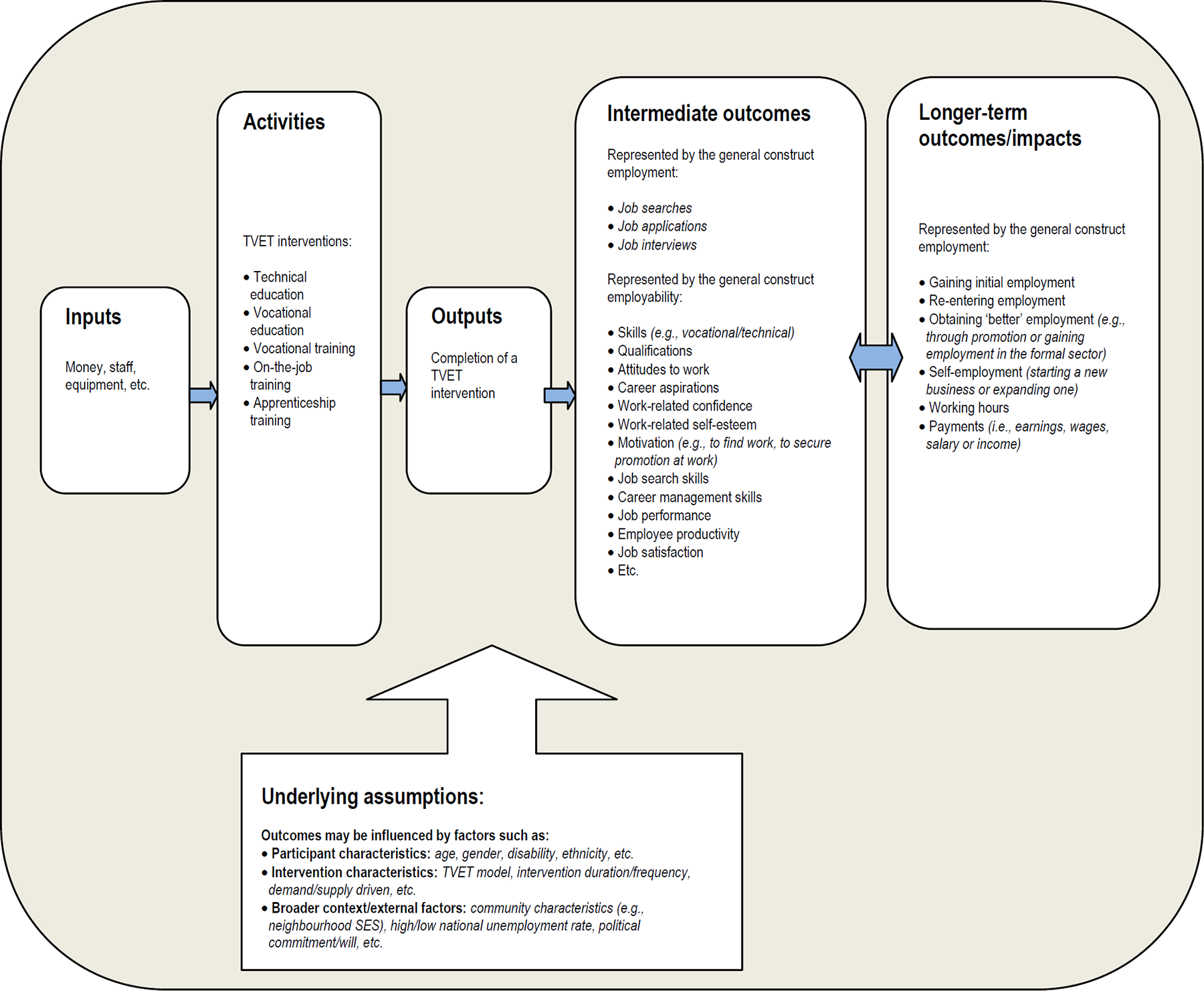
Preliminary thoughts on some of the underlying assumptions are indicated. Employability refers to a person's capability of gaining initial employment, maintaining employment (including the ability to make transitions between jobs and roles within the same organisation to meet new job requirements) and/or obtaining new employment if required (Hillage & Pollard, 1998). It is therefore a concept that can be applied to both employed people seeking alternative jobs or promotion and unemployed people seeking work. The concept of employability has become a cornerstone of labour market policies and employment strategies internationally, with many policymakers viewing the development of individual employability as a crucial step towards improving access to employment and as a means of offering workers the opportunity to develop the skills allowing self-sufficiency within the labour market (McQuaid & Lindsay, 2005). There is increasing recognition that employability is dependent not only on individual characteristics but also the environmental, social, and economic context in which work is sought (Department for Employment and Learning, Northern Ireland [DELNI], 2002).
Most interventions will have positive and negative impacts, both of which should be taken into account to assess the net difference that results from the intervention, over and above what would have taken place anyway. A key question concerning labour market interventions, including those offering TVET opportunities, is whether job creation is additional or not. It is changes in the net employment rate that are of primary interest to policy-level organisations and departments. Therefore, estimates of gross employment outcomes should, ideally, be adjusted to take into account displacement and substitution effects. 1 In instances where no adjustments have been made, it will be important to remember that, even if found to be effective, the TVET intervention may not generate any additional employment; it may only be affecting who gets employed, not the level of employment. It is recognised that determining the ‘additionality’ of any employment effects is methodologically very challenging.
1.3 PREVIOUS REVIEWS
The body of literature taking stock of the evaluation evidence on TVET in relation to young people is relatively limited. In many of the existing reviews, evaluations of training and retraining are presented alongside other typical active labour market programmes (ALMPs), such as employment services, public works, wage and employment subsidies, and self-employment assistance. Few reviews have focused specifically on young people and/or developing or transition countries.
Kluve and Schmidt (2002) compared the results of a sample of European impact evaluations of ALMPs implemented between 1983 and 1999 to programmes from the United States previously studied by Heckman, LaLonde, and Smith (1999). Their analysis suggests mixed effects across different categories of intervention and target population. Young workers were found to be the most difficult group to assist among the unemployed. Kluve (2006) followed this up with a meta-analysis of European ALMPs in the later 1990s and 2000s. More recently, Card, Kluve, and Weber (2010) present the results of a meta-analysis of evaluations of ALMP impacts from 97 studies conducted between 1995 and 2007 (the vast majority set in high income countries). The sample is derived from responses to a survey of academic researchers affiliated with the Institute for the Study of Labour (IZA) and the National Bureau of Economic Research (NBER). The authors report that, when comparing across different participant groups, interventions specifically targeted at youths are less likely to yield positive impacts than untargeted programmes, although in contrast to some earlier reviews, they find no large or systematic differences by gender. Within-country, cross-programme comparisons were undertaken by Greenberg, Michalopoulos, and Robins (2003) who synthesised findings from 15 publicly-funded training programmes in the United States to measure effects on participants' earnings. Results of their meta-analysis suggest highly heterogeneous earning effects among assisted groups. The overall training effect on youth was negligible, but some control variables showed small positive effects: (i) across training types, classroom skills training courses yielded consistently better effects than on-the-job training, while (ii) gender and race controls suggested lower effectiveness of training for white and female beneficiaries than for all other participants. A global review of skills development and transition to work (Van Adams, 2007) reports positive findings from evaluations of TVET interventions for youth, although again these findings are mostly from advanced countries.
There have been a number of reviews based on information in the Youth Employment Inventory (YEI), the first comprehensive database to provide comparative information on youth employment interventions worldwide. Originally initiated by the World Bank, the YEI comprises more than 400 youth employment interventions from around 90 countries (see, for example, Betcherman, Godfrey, Puerto, Rother, & Stavreska, 2007; Betcherman, Olivas, & Dar, 2004; Fares & Puerto, 2009; Katz, 2008; Puerto, 2007; Stavreska, 2006). Betcherman et al. (2007) summarised information on a large number of international programmes supporting young people in their early years in the labour market. A substantial number of the reviewed interventions were from countries in Eastern Europe and Central Asia, Latin America, and the Caribbean (primarily middle-income countries). The review identified training as the most common form of intervention used to help young people improve their employment situation, and suggested that such programmes have a more positive impact in developing counties than in developed countries. A more recent review by Angel-Urdinola, Semlali, and Brodmann (2010) analysed the main design features of ALMPs targeted at youth in Arab-Mediterranean Countries. Interventions from nine countries were examined: Morocco, Algeria, Tunisia, Egypt, Lebanon, Syria, Jordan, West Bank and Gaza, and Yemen.
Although there is growing consensus that TVET is important for economic growth and social cohesion, it is still not clear who should fund, provide, and regulate it, or who should take it. Collecting evidence from studies that have analysed these issues is crucial for purposes of policy making. Since most prior reviews have focused on high-income countries and/or adults of all ages, there are grounds for concentrating this review solely on the effects of TVET interventions on youth in low- and middle-income countries. There is also motivation for this systematic review from a methodological perspective. Few reviews in this area are based on a systematic search for literature, and several use a ‘vote-counting’ approach to synthesis. These are problems that this review aims to remedy, thereby adding value to the existing body of research on this topic.
1.4 OBJECTIVES OF THE REVIEW
This systematic review aims to answer the following questions: What are the effects of different models of technical and vocational education and training (TVET) interventions on the employment and employability outcomes of young people, aged 15-24 years, in low- and middle-income countries? What do the findings suggest about moderating effects?
To help in decisions as to whether and what kind of intervention should be undertaken, the main objective of the review is to systematically gather and synthesise the relevant evidence, and to show variation in treatment effects, magnitude of effects, and the relationship between magnitude and mode of TVET. In addition, evidence of differential effects for youth with different characteristics will be explored (e.g., in relation to gender). Possible reasons for varying or conflicting results will be discussed. A final objective of the review is to identify gaps in the literature and highlight potential avenues for future research.
2 Methods
2.1 TITLE REGISTRATION AND REVIEW PROTOCOL
The title for this systematic review was published in The Campbell Collaboration Library of Systematic Reviews on 14 November 2011. The review protocol was published on 1 September 2012. Both the title registration and protocol are available at: http://campbellcollaboration.org/lib/project/227/.
2.2 ELIGIBILITY CRITERIA
To be eligible for inclusion in the review, studies were required to meet the following criteria.
2.2.1 Interventions
Inclusion in the systematic review was restricted to TVET interventions
2
with the following characteristics: Technical education, vocational education, vocational training, on-the-job training, apprenticeship training (as defined in the Introduction); Formal and non-formal types of learning arrangements; All modes of delivery: e.g., online, face-to-face, distance learning, apprenticeship; All types of settings: e.g., schools, colleges, apprenticeship training centres, worksites, other private enterprises; All types of provider/regulator: public (e.g., government-funded schools and training centres); private (e.g., companies, churches, non-government organisations, private colleges) and traditional (e.g., craft guilds); TVET offered at secondary and post-secondary levels (including vocational diplomas and degrees); Provision of (i) initial training for young people from the age of 15/16 years after compulsory school, but prior to entering work; (ii) continuing education and training for adults in the labour market leading to personal, flexible, and/or vocational competencies; or (iii) training for unemployed persons who are currently available for work and seeking work (including retraining for those made redundant); TVET delivered for any length of time or frequency.
Multi-service interventions (for example, combining on the-job training with wage subsidies) were eligible for inclusion in the review. Also eligible were studies focused on the provision of financial assistance to purchase training where trainees' participation in such training was then evaluated. Labour market programmes that did not incorporate any training, but were restricted to the provision of other services, such as job search assistance or financial subsidies, were not eligible. Interventions promoting entrepreneurship through, for example, technical and business training, were eligible, whilst those promoting self-employment by providing technical assistance only were not. Continuing professional development (CPD) interventions (i.e., those designed to upgrade the knowledge and skills of practitioners in the medical and other professions) were not eligible. Interventions targeted specifically at youth with particular special needs, such as learning disabilities, physical disabilities, emotional problems, or behavioural problems, were outside the scope of this review. However, studies in which youth with special needs participated in mainstream TVET/skills training were considered eligible.
2.2.2 Participant characteristics
The focus of this review is on young people. Countries vary considerably in their definition of young people. The standard United Nations definition of youth as those belonging to the 15-24 years age group was applied to this review (UN, 1992).
Eligible participant populations included youth with the following characteristics: Age: Young people aged 15 - 24 years. In addition to samples in which all participants were aged 15-24 years, samples consisting of both young people and adults older than 25 years were eligible if (i) the average age of the sample lay between 15 and 24 years; (ii) the majority of participants were aged 15-24 years; or (iii) findings were disaggregated by age and reported for 15-24 year olds. Geographical location: From low- or middle-income countries (as defined by the World Bank: see Appendix 8.2); Gender: Male and/or female (i.e., both dual- and single-sex studies were eligible for inclusion in the review); Employment and education: Any employment status at time of service receipt (i.e., not in paid employment or in paid full- or part-time employment); Any skills level, prior experiences, achievements or level of qualification.
2.2.3 Research designs
To fulfil the eligibility criteria, studies were required to be impact evaluations that used an experimental or quasi-experimental design. Eligible research designs included those in which the authors used a control or comparison group, and in which: participants were randomly assigned (using a process of random allocation, such as a random number generation); a quasi-random method of assignment was used and pre-treatment equivalence information was available regarding the nature of the group differences (and groups generated were essentially equivalent); participants were non-randomly assigned but matched on pre-tests and/or relevant demographic characteristics (using observables, or propensity scores) and/or according to a cut-off on an ordinal or continuous variable (regression discontinuity design); participants were non-randomly assigned, but statistical methods were used to control for differences between groups (e.g., using multiple regression analysis, including difference-in-difference, cross-sectional (single differences), or instrumental variables regression).
For this review, the control or comparison conditions in eligible studies included youth receiving no treatment, treatment as usual, or an alternative treatment. No restriction was placed on duration of follow up.
2.2.4 Outcomes
To be included, a study had to assess intervention effects on at least one eligible outcome variable. Qualifying outcome variables were those falling into the following general construct categories: (a) employment and (b) employability. primary outcomes represented by the general construct employment: for example, gaining initial employment; re-entering employment; obtaining ‘better’ employment (e.g., through promotion or gaining employment in the formal sector); self-employment (starting a new business or expanding one); working hours; and payment levels (i.e., earnings, wages, salary or income) intermediate outcomes represented by the general construct employment: for example, job searches, job applications, job interviews intermediate outcomes represented by the general construct employability: for example, vocational or technical skills/knowledge/qualifications; attitudes to work; career aspirations; confidence; self-esteem; motivation (to find employment, secure promotion, etc); job search skills; career management skills; job performance; employee productivity; job satisfaction
Studies measuring either gross employment or net employment (i.e., where displacement and substitution effects have been taken into account) were eligible for inclusion.
Qualitative studies were not eligible for inclusion in the review, including any studies using perception measures only (i.e., those examining the views of employers and/or the workforce about their employability), regardless of whether or not they quantified their findings.
2.2.5 Other study characteristics
The date of publication or reporting of the study must have been in 2000 or later. This date was chosen due to time and funding limitations. The funder approved the cut-off for that reason. Eligible studies could be published in any language provided they met all other eligibility criteria. We did not exclude specific forms of publication, such as theses and dissertations.
2.3 LITERATURE SEARCH
A comprehensive search strategy was used to search the international research literature for qualifying studies. Different types of sources were searched, including sources with a particular focus on low- and middle-income countries (many of which were sourced from the Cochrane Effective Practice and Organisation of Care (EPOC) Group's list of sources relevant to LMICs:
2.3.1 Information Sources
A wide range of general and specialist electronic bibliographic databases was searched (see Appendix 9.3).
A tailored search query was developed for each bibliographic database relying on the database's index terms (where available) and/or free-text terms. In most cases, the search strategies combined a comprehensive list of search terms related to the intervention, outcomes, and research design. Database thesauri were consulted to ensure that all appropriate synonyms were included. Synonyms and wildcards were applied as appropriate. There were no country or language restrictions to the search. A publication year filter was used. The search strategy for ERIC is presented in Appendix 9.4.
To supplement the electronic bibliographic database search, we hand searched websites/gateways, checked the bibliographies of all included studies and relevant reviews, and performed forward citation tracking (through the ISI Web of Knowledge and Google Scholar). A list of websites/gateways searched is presented in Appendix 9.5. We emailed specialists in the field, including authors of included studies, for information about any potentially relevant studies. A specific request for assistance with the location of study reports published in languages other than English was made. Authors and funding sources were also contacted regarding the availability of translated versions of included studies. Requests for relevant literature were also made through the Network for Policy Research, Review and Advice on Education and Training (NORRAG) and the UNESCO-UNEVOC e-forum. Again, a specific request for assistance with the location of studies published in languages other than English was made. We did not undertake a keyword search using Google Scholar, hand search individual journals, or search for conference proceedings or dissertations separately.
2.3.2 Study selection
Selection of primary studies was based on the pre-developed selection criteria described above. These criteria were piloted by two researchers who screened a sample of reports independently and compared their results. Discrepancies were resolved by further review of the respective titles and abstracts. This process was repeated until consistency in application of the selection criteria was achieved. The study selection process then proceeded as follows: The review team manually examined the titles and abstracts of records identified through the searches of electronic databases to assess eligibility. The relevance of each item was assessed by an individual reviewer (i.e., single screening) and decisions recorded in the reviewing software, EPPI-Reviewer. Items were included at this stage if they appeared to meet the criteria on the basis of the information in the title and abstract, and excluded if they were clearly ineligible. Where there was any doubt as to their eligibility, items were marked as ‘unsure.‘ Where the title and/or abstract were not in English, the translation service offered by Google, http://translate.google.com/, was used to translate the information into English; screening against the selection criteria then proceeded as normal. In cases where only the title of the study was available, reference within the wording of the title to (a TVET intervention) AND (a relevant employment-related outcome OR a term suggesting the study was an evaluation) automatically warranted a full length review of the article. Following the manual screening of all items from the electronic searches, the hand searches referred to above were conducted. Here, the searching and screening processes ran concurrently. Study eligibility was assessed by an individual reviewer, who kept a manual record of all items that appeared to meet the inclusion criteria and those over which there was any doubt. Where only the title was available, and/or the information was not in the English language, the same procedures as for items identified through the electronic searches were followed. The full-length reports of all studies promoted from the first level of screening that either (a) appeared to meet the inclusion criteria, or (b) were marked as ‘unsure,‘ were obtained. Detailed manual examination of the full-length reports was undertaken independently by pairs of reviewers. Reviewers then compared and discussed their assessments. Any disagreements between the reviewers' decisions were resolved by identification of the source of the disagreement, re-reading of the text, and discussion. If a final decision could not be reached, a third reviewer was asked to reconcile differences.
2.3.3 Data collection
Reviewers used a coding tool to capture both substantive and methodological characteristics. The tool modified an existing EPPI-Centre tool in accordance with Campbell Collaboration guidelines, and also drew upon previous work by Wilson, Lipsey, Tanner-Smith, Huang, and Steinka-Fry (2010). Piloting of the coding tool was undertaken by members of the review team who worked independently on a random sample of eligible studies before meeting to compare their decisions. Reviewers were retrained on any coding items that showed discrepancies during this process and the coding manual was adapted accordingly. This process was repeated until a very high level of consistency in reviewers' application of the codes was achieved, at which point the tool was finalised. The remaining studies were double-coded.
For eligible studies published in English, different pairs of reviewers independently extracted information from each study report and then came together to compare their decisions. Any uncertainties and discrepancies were resolved by discussion, further review of the respective study reports, and consultations with a third reviewer (JT, MN or JH), where necessary. Guidance on advanced statistical issues was provided by JH. For eligible studies published in languages other than English, attempts were made to contact authors and funding sources regarding the availability of translated versions. Where these could not be obtained, two Spanish-speaking reviewers were identified and invited to join the research team (KS-F, EW). They used the coding tool to extract the relevant information and critically appraise the four studies in question.
Reviewers entered data directly into the EPPI-Reviewer 4 database (Thomas, Brunton, & Graziosi, 2010). Information was collected relating to general study characteristics (such as year of publication); participant characteristics; the nature of the intervention and its implementation; study methods; outcome variables; and findings. The coding process also incorporated a careful consideration of the potential methodological limitations of the included studies, focusing on the following key domains: selection bias, confounding, spillovers, outcome reporting bias, and analysis reporting bias. This involved use of a tool developed by researchers at the International Initiative for Impact Evaluation (3ie) specifically for assessing risk of bias in experimental and quasi-experimental designs based on statistical methods. The coding tool was detailed in the review protocol. 3
The approach taken to formulating summary assessments of risk of bias and study ‘quality’ is presented in Table 2.1 (adapted from the suggested framework in Higgins et al., 2011).
ASSESSMENTS OF STUDY QUALITY
To help identify implications of the review findings for policy and practice, we used an interpretation framework that considered the strength of evidence for each set of results. This interpretation framework has evolved over several reviews by staff at the EPPI-Centre, spanning different disciplines.
2.4 ANALYTICAL METHODS
2.4.1 Effect size indices
Where data allowed, effect sizes were computed for each study. Standardised mean differences (SMDs) were the metric used in the meta-analyses to synthesise the effects of TVET interventions on both continuous outcomes (e.g., earnings) and dichotomous outcomes (e.g., employment). Although other effect sizes such as risk ratios or odds ratios might be methodologically more adequate to synthesise dichotomous outcomes (Higgins & Green, 2011), most of the studies included in the review using dichotomous outcomes do not report sufficient information to use risk ratios and odds ratio. Thus, the use of risk ratios or odds ratios may lead to a substantial loss of information for the analysis. Therefore, we followed Petrosino, Morgan, Fronius, Tanner-Smith, and Boruch (2012) in the use of SMD for synthesising both continuous and dichotomous outcomes.
Each meta-analysis included a single type of outcome measure. In the primary studies, the causal effects of the programmes were expressed as a: Mean difference: i.e., a difference in the mean outcomes from the treatment and control groups (for example, in the mean level of earnings, weekly hours, etc.). For earnings, this value was reported in local currency or USD($). Probability: this is also a difference, this time in the employment rates of participants and non-participants, or more precisely differences between the two probabilities of working. For example, a value of 0.065 indicated that those in the treatment group had ceteris paribus 6.5 percentage points more probability of working than control group individuals. Often, this value was also in the form of a mean (where, for instance, the probability of being employed for trainees in each participating institution, and their control counterparts, was calculated and then effects averaged over the sample).
In the majority of cases (see below for exceptions), SMDs were calculated using the following formulae.4 The numerator represents the causal raw impact of the programme on the outcome. In matching-based studies, this was the average treatment effect on the treated (ATT): the difference in outcomes between groups after matching (i.e., Y treatment - Y control). In a regression analysis, this is the coefficient of interest (β).
For matching-based studies:
To calculate the pooled standard deviation (the standard deviation of the outcome variable for both treated and control individuals) we used the Hedges' approach described in Lipsey and Wilson (2001):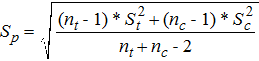
For regression-based studies we first used the formula described in Keef and Roberts (2004):
The denominator σ is the standard deviation of the error term in a regression. Where σ was not reported, we used the following formula as an equivalent
5
.
Standard errors were calculated using the following formulae
6
, where t is the t test associated with the treatment effect of a regression: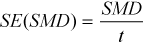
In a small number of cases7, SMDs were computed using the following input data: means, standard errors, and sample size information t-test statistic, sample size information proportion with event/without event (in each group)
The following effect-size calculator was used: http://gunston.gmu.edu/cebcp/EffectSizeCalculator/index.html
The review also corrected for sample bias in the effect sizes due to small sample sizes by using the correction for sample bias procedure developed by Hedges and Olkin (1985). All effect sizes were coded such that positive effect sizes represented positive outcomes (e.g., less unemployment, higher wages).
Basically corrected SMD and corrected SE were estimated as follows: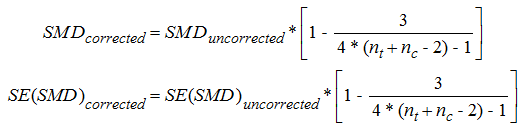
2.4.2 Synthesis methods
A meta-analysis was conducted on a set of studies answering a particular question where there was a minimum of two studies rated medium quality (see Table 2.1). The data synthesis was carried out using random effects statistical models. To account for differences in sample sizes for individual studies, effect sizes were averaged across studies by using inverse variance weighting of the individual effect sizes. This weighting resulted in the individual effect sizes from larger n studies being given more weight in the combined effect size. To visibly examine between-study variability in the effect size estimates, forest plots are used to display the estimated effect sizes from each study along with their 95% confidence intervals. Heterogeneity tests were used to examine whether variation in effect size estimates was larger than expected from sampling error alone (Deeks, Altman, & Bradburn, 2001). Heterogeneity was explored using both the Q test and the I2 index. The Q test reveals the presence versus absence of heterogeneity as indicated by a p value of <0.05, while the I2 index quantifies the degree of heterogeneity (Higgins & Green, 2011). If significant heterogeneity was found, possible reasons for the differences between studies was explored through analysis of sub-groups of studies (see below).
2.4.3 Missing data
If we had studies that were missing essential data, our approach involved thorough attempts to contact the original investigators and funding sources, and discussion of the potential impact of missing data on the findings of the review (Higgins & Green, 2011).
2.4.4 Moderator analyses
Moderator analyses were performed to examine potential variability in effects due to study, participant, and intervention characteristics. An analogue to the ANOVA analysis (univariate) approach was used, as described in Lipsey and Wilson (2001). It was not possible to conduct multivariate moderator analysis using meta-regression models, as we did not have the minimum of 10 studies for each individual moderator variable (Borenstein, Hedges, Higgins, & Rothstein, 2009). Moderator analyses were used both to explore heterogeneity and also to answer questions about the effectiveness according to specific characteristics of interventions and population groups. The categorical variables that identified the sub-groups used in this exercise were specified in advance of the meta-analysis.
2.4.5 Publication bias analyses
Due to an inadequate number of studies, we did not attempt to detect or exclude the existence of publication bias using statistical methods, such as funnel plots or ‘trim and fill’ analyses (Duval & Tweedie, 2000; Egger, Davey Smith, Schneider, & Minder, 1997; Lau, Ioannidis, Terrin, Schmid, & Olkin, 2006). This issue is discussed further in Chapter 5.
2.5 SELECTING DATA FOR ANALYSIS
Many of the studies included in the review used several estimation methods within the same study, principally matching and regression (covariance) adjustment. When there are large differences in the covariate distributions between the groups, standard model-based adjustments are known to rely heavily on extrapolation and assumptions. In response, matching has become a widely used non-experimental method of evaluation over the past three decades (D'Agostino, 1998; Rosenbaum & Rubin, 1983). Matching is done with the aim of creating treated and control groups with similar observed covariate distributions, thereby increasing robustness in observational studies by reducing reliance on modelling assumptions. Since the work of LaLonde (1986), many have investigated whether non-experimental methods can yield results similar to those from randomised experiments. The work of Dehejia and Wahba (1999), in particular, generated great interest regarding the ability of (propensity score) matching methods to potentially produce unbiased estimates of a programme's impact. A number of authors have specifically evaluated matching methods (Glazerman, Levy, & Myers, 2003; Heckman, Ichimura, & Todd, 1997; Heckman, Ichimura, Smith, & Todd, 1998; Heckman, Ichimura, & Todd, 1998; Michalopoulos, Bloom, & Hill, 2004), with many supporting the use of methods as a means of limiting reliance on inherently untestable modelling assumptions and the consequential sensitivity to those assumptions (for a discussion, see Stuart & Rubin, 2007). Others who have compared estimates from propensity score matching with different regression (covariance) adjustment analyses have found that no method is consistently better than the others (e.g., Michalopoulos et al., 2004). This presents major challenges for reviewers faced with assessing the potential of a wide range of matching and covariance adjustment methods for reducing bias in observational studies.
Drawn from some of the available practical guidance on this topic (e.g., Stuart & Rubin, 2007), the following outlines our approach for choosing between different methodologies when extracting outcome data.
Combining methods (i.e., matching and regression-based model adjustment) was judged to be more efficient in reducing bias in the estimate of the treatment effect than using those methods individually (Cochran & Rubin, 1973; Glazerman et al., 2003; Ho, Imai, King, & Stuart, 2007; Rubin, 1973a, 1973b, 1979; Rubin & Thomas, 2000). Combination could take the form of either: a two-step procedure in which matching is followed by regression analysis (linear regression, logistic regression, hierarchical modelling, and so on) to remove any remaining differences between groups. (Here, results should be less sensitive to the modelling assumptions and thus should be fairly insensitive to the model specification, as compared with the same analysis on the original unmatched samples.) a model incorporating a polynomial of the propensity scores (i.e., regression adjustment on matched sample)
Where matching and covariate adjustment were both used in a single study and then the findings from each method of estimation compared (i.e., the methods were not used in combination) matching was usually judged to be the more efficient estimator (especially in cases where the difference-in-differences version had been implemented). However, there was potential for model-based adjustment methods to be considered more efficient if: there was substantial bias between the groups in the matched samples (e.g., imbalance in the propensity score of more than 0.5 standard deviations), and the model-based approach used high-quality data with a rich set of covariates (Glazerman et al., 2003); matching was undertaken using a small set of covariates and the model-based approach involved the use of a rich set of covariates; or the matching procedure resulted in very small sample sizes (furthermore, much better balance is achieved when there are many controls available for the matching) (Rubin, 1976), and the model-based approach involved the use of a rich set of covariates.
In short, particularly in cases of cross-sectional versions of matching, if a model was correctly specified then it tended to be judged as more efficient than matching. 8
In deciding which outcome data to select, making a choice between different matching techniques was sometimes required. Matching techniques differ in both the way they define similarity and the way weights are computed.9 Where different techniques for constructing a matched sample (using the propensity score) were used in a single study included in the review, our approach to the selection of data was as follows:
10
If the authors reported which technique led to the most closely related/matched samples (i.e., best balance between the covariates in the treated and control groups) the outcome data based on this technique were extracted. Where no such information was presented by the authors, the following hierarchy applied: local linear (most efficient)11 kernel12 stratified nearest neighbor
13
(also called pair-wise matching) (least efficient) In situations where different numbers of nearest neighbours were used, the general principle was that we extracted outcome data relating to the technique using the greatest number of neighbours (unless the authors reported better balance between the covariates in the treated and control groups using a different number of neighbours, or reviewers determined this). For kernel regression matching conducted using more than one bandwidth (0.1, 0.2 and so on), our approach was to extract the outcome data relating to the highest bandwidth.14
A large body of techniques for carrying out regression analysis has been developed. In cases where the authors reported several models with different combinations of control variables in the same paper, our approach was to focus on the effect estimates that were derived from the most similar models across studies. In so doing, the aim was to minimise (although not eliminate) the differences in what was adjusted across studies.
For studies using cross-sectional and difference-in-differences estimation strategies, we extracted the outcome data for both. For studies reporting different estimation parameters (e.g., average treatment effects, marginal treatment effects, and so on) we extracted the outcome data relating to each of these.
Many of the included studies reported results separately for different cohorts and/or different sub-groups of participants. When it could be established that the different cohorts or sub-groups contained no overlapping subjects, we treated them as independent samples. Where different sized samples were used (and these samples were overlapping), the general principle was that the impact effects for the largest sample would be used. In practice, however, decisions about which to include in the meta-analysis were made on a case-by-case basis (taking into consideration relevant issues relating to the selection of the sample, such as whether there was likely to be more overlap between control and treatment individuals in terms of observable and unobservable characteristics). Where no such issues were noted by the authors or identified by the reviewers, the approach was to select the largest sample.
3 Results of searches
This chapter outlines the results of the literature search and the key characteristics of the included studies. Appendix 8.6 shows the flow of literature through the review process. Additional details about each included study are provided in Appendices 8.7, 8.8 and 8.9. The term ‘publication’ in this chapter refers to a report of the methods and outcomes of a research study, and the term ‘study’ refers to an instance/piece of research work. Where more than one study evaluated the same intervention, and/or the study data overlapped, they were treated as unique studies if they involved the use of different methods of evaluation. No two studies drawing on the same data are used in any individual meta-analysis presented in Chapter 5.
3.1 LITERATURE SEARCH AND STUDY IDENTIFICATION
Electronic searches of bibliographic databases identified a total of 8514 citations. After removal of 442 duplicates, the titles and abstracts of the remaining 8072 items were manually screened for relevance. This process resulted in the exclusion of 7925 items due to their not meeting the inclusion criteria and the retrieval of 145 full-length publications for closer examination. Two publications were unobtainable. Full text screening of the 145 publications resulted in 136 being excluded. Nine publications were judged as meeting the inclusion criteria. Hand searches as described above were then undertaken, leading to the identification of a further 46 eligible publications. On closer inspection, a number of publications was found to be linked to others, in that they described the same study (occasionally reporting on different aspects of it). A total of 25 publications were consequently coded as companion publications. At the end of this process, 30 unique studies, reported in 55 publications, had been identified for inclusion in the review. Four studies, however, could not be included (see below). In total, therefore, 26 studies, reported in 51 publications, were included in the review.
Of the 55 publications detailing relevant studies, 8 were published in Spanish, and we were unable to identify English language versions of the publications. For 4 of these 8 studies, additional resources were obtained in order to extract data, and they were included in the review. One eligible Spanish-language study could not be included in the review, as efforts to obtain a copy of the publication were unsuccessful. 15 The 3 remaining eligible non-English language studies were not included in the review because financial resources had been exhausted. 16
Publication dates ranged between 2001 and 2011. The majority of studies were published as technical reports, many of which were described as working papers. Most were published by corporations such as the World Bank or regional development banks (primarily, the Inter-American Development Bank). A small number were published by non-governmental organisations and independent research institutes. Occasionally, this information was not reported.
3.2 INCLUDED STUDIES
Information about the methodological and participant characteristics of the 26 included studies is presented in the remainder of this chapter, including a brief overview in Tables 3.1 and 3.2. Details about individual studies are presented in Appendix 8.9.
3.2.1 Methodological characteristics
The majority of the 26 studies were conducted independently by teams based in universities and/or other research organisations; others were carried out exclusively by researchers who were closely related to the funding body or by teams comprising both independent and related evaluators.
The 26 studies employed different methodologies for evaluating the impacts of the interventions. Three studies used a randomised experimental design, and 23 used a non-experimental design (of these, 2 were natural experiments and 21 were quasiexperiments). There was heterogeneity within the 23 non-experimental studies in terms of the selection of the comparison group. In around half of the non-experimental studies, the comparison group was constructed ex-ante, for example, from registered applicants who did not start the course or from eligible non-applicants. The remaining non-experimental studies involved ex-post selection of the comparison group, for example, from similar individuals identified in household or labour force survey data. The non-experimental evaluations used different econometric techniques to address selection bias and net out the impacts of other factors (each of which imposes different assumptions and have different strengths with respect to internal validity). These techniques are broadly classified into two main types: matching and covariate/regression adjustment. The most common matching method used was propensity score matching (Rosenbaum & Rubin, 1983); other matching methods included log-odds ratio matching and the use of non-parametric reweighting techniques. Studies using covariate adjustment methods used different model specifications, most commonly ordinary least squares regression. The majority of studies used more than one estimation method, often as a means to verify robustness of the results. 17
In terms of measurement of outcomes, the majority of studies utilised a cross-sectional impact estimator; that is, they compared the outcomes for treatment and comparison group persons measured at some time period after the intervention ended. By exploiting the panel structure of the data, around a third of the included studies attempted to purge time-invariant unobservables through the use of the difference-in-difference estimator. This involves subtraction of the before and after change in outcomes for comparison group members from the before and after change for treatment outcomes (where the change is measured relative to some pre-intervention benchmark time period). 18
Most studies measured average treatment effects on the treated (ATT): the differential impact that the treatment showed for those individuals who actually participated in the intervention. A minority of studies measured average treatment effects (ATE), which can be defined as the average effect for the population, and/or conducted intention-to-treat (ITT) analyses which were based on the initial treatment intent, not on the treatment eventually administered. 19 Other parameters of interest included marginal treatment effects (MTE) and average treatment effects on the untreated (ATU).
There was variation between studies in relation to the time that had elapsed between completion of the TVET intervention and the measurement of outcomes (see Table 3.1). Nine of the 26 studies investigated the sustainability of treatment effects over time, with a maximum of three post-test measurements. To examine whether the impact of the intervention was robust to the data collection period, 7 studies collected data for several cohorts covering a number of years (with results reported separately for the different year groups and/or pooled).
In the case of 11 studies, a single cohort of a multi-cohort intervention was used for the evaluation. Two studies focused on the entire universe of trainees. Two-thirds of all studies estimated heterogeneity of treatment effects, most commonly by gender. Sixteen studies involved analysis with a sample size of more than 250 participants, and 7 with a sample size of 250 participants or less. The sample size was not specified in 3 studies. Finally, a very small number of studies dealt specifically with the issue of trainees with partial instruction.
3.2.2 Participant characteristics
The majority of studies included both male and female participants (fairly evenly balanced), with a single study focused exclusively on young women. In 19 studies, the average age of the study participants lay between 16 and 24 years. One study focused on 12-22 year olds, but no average age was provided. Of the 5 studies that did not report the average age, 2 reported the age range: 1 study focused on participants aged 16-35 years, and another included individuals aged 18-65 years. Each of these 5 studies conducted sub-group analyses by age. Finally, in 1 study, the average age of participants was 36 years; it too conducted sub-group analyses by age. The majority of study samples included some participants in employment and others who were not in employment. In a single study, none of the training beneficiaries were employed at the start of the study.
Outcomes
The studies measured a number of different labour market outcomes (see Table 3.2). The main outcomes fell into three main categories: employment, hours worked, and income. Most studies measured paid employment and/or monthly earnings. Studies examined gross employment only, with none measuring changes in net employment (where displacement and substitution effects have been taken into account). Intermediate outcomes were examined in only 2 studies. The focus of the evidence synthesis is on the outcomes that are not italicised in Table 3.2.
The ways in which outcomes were measured varied. For example, for earnings and weekly hours of work, a few studies restricted their analysis to participants who were working at the time of the follow-up interview, but most studies included everyone in their calculations (i.e., authors imputed zero earnings/hours etc., for those who reported being unemployed or otherwise out of the labour force).
CHARACTERISTICS OF TVET STUDIES (N=26)
OUTCOMES
4 Intervention characteristics
The 26 studies included in the review evaluated 20 different programme interventions (hereafter interventions) providing TVET opportunities to young people in terms of specific outcomes. The number of reviewed studies is greater than the number of interventions because three interventions were evaluated by more than one team of investigators. Four studies evaluated different programme components/modalities available to trainees, sometimes in addition to an examination of the intervention as a whole. One study evaluated several different interventions. One study evaluated an intervention comprised of different projects operating internationally. 20 This chapter outlines the key characteristics of the 20 interventions, with further details provided in Appendix 8.10.
4.1 SETTING AND COVERAGE
Fourteen of the 20 interventions were located in Central/South American countries, with three situated in Asia, one in Africa, and two in Europe. Settings include ten upper-middle income countries (Argentina; Bosnia and Herzegovina; Brazil; Chile; China; Colombia; Dominican Republic; Latvia; Mexico; Panama and Peru); two lower-middle income countries (India and Bhutan); and one low-income country (Kenya). Some were intended to provide a small-scale demonstration effect, whilst others were large-scale operations (sometimes involving complete transformation of previous training systems).
Twenty studies evaluated an intervention (and/or different sub-components or modalities) in one country only (Acero, Alvarado, Bravo, Contreras, & Ruiz-Tagle, 2011; Aedo & Nuñez, 2004; Aedo & Pizarro, 2004; Alzuá & Brassiolo, 2006; Analítica Consultores, 2006; Attanasio, Kugler, & Meghir, 2011; Benus, Rude, & Patrabansh, 2001; Bidani, Goh, & O'Leary, 2002; Card, Ibarraran, Regalia, Rosas-Shady, & Soares, 2011; Chong & Galdo, 2006; Chong, Galdo, & Saavedra, 2008; Chun & Watanabe, 2011; Delajara, Freije, & Soloaga, 2006; Díaz & Jaramillo, 2006; Dmitrijeva, 2009; Elías, Ruiz Núñez, Cossa, & Bravo, 2004; Espinoza, 2010; Hicks, Kremer, Mbiti, & Miguel, 2011; Ibarraran & Rosas-Shady, 2006; Jaramillo, Galdo, & Montalva, 2007; López-Acevedo, 2003; Mensch, Grant, Sebastian, Hewett, & Huntington, 2004; Ñopo, Robles, & Saavedra, 2007; van Gameren, 2010). 21 One study evaluated several different interventions within a single country (Medina & Nuñez, 2005). One study evaluated an intervention in two different countries (Alzúa, Nahirñak, & Alvarez de Toledo, 2007).
Argentina:
Bosnia and Herzegovina:
Bhutan:
Brazil:
(see above)
Chile:
China:
Colombia:
Dominican Republic:
India:
A
Kenya:
Latvia:
Mexico:
Panama:
PROCAJOVEN: an independent sub-programme of the Assistance Program for the Building of a Training and Employment System in Panama (one of a series of Latin American training programmes sponsored during this period by the Inter-American Development Bank). Approved in 2002, PROCAJOVEN operated nationally until 2009. This intervention was evaluated by Ibarraran and Rosas-Shady (2006).
Peru:
4.2 TVET MODELS
This section outlines some of the key characteristics that differentiate between the different TVET interventions considered in the review.
4.2.1 Type of TVET intervention
The interventions involved different forms of TVET (see Table 4.1). The most common form of intervention was a two-phase TVET intervention that combined both theoretical and practical training (usually in the format of classroom-based vocational training followed by a period of on-the-job training to provide beneficiaries with work experience). Typically, these interventions were aimed at short-term semi-skill training in specific occupations demanded in the private sector, and provided basic job readiness skills and some trade-specific skills. Nine interventions were of this type. Two interventions consisted of different TVET-related sub-components, and young people seeking training could choose between the available options. The majority of the remaining interventions offered a single form of TVET.
4.2.2 Implementation
Various agencies were involved in the design and planning of the reviewed interventions, most commonly government agencies (Ministries of Labour, employment offices, etc.). Funding for the interventions came from a number of sources; many involved public/private partnerships between national and/or local government agencies, international development agencies (such as USAID) and multilateral organisations (most commonly, the Inter-American Development Bank). Social partners, in the form of employers, contributed to the financing of one intervention.
CHARACTERISTICS OF TVET PROGRAMMES (N=20)
Participation of the private sector in the provision/delivery of training was a feature in around two-thirds of the reviewed interventions. Most of these adopted a ‘demand driven’ approach whereby the content of the courses they offered were customised to meet the needs of the local labour market: the assumption being that there would be job vacancies for the trainees when they graduate. In these cases, the government selected the training providers and courses competitively, through a bidding process where usually both private and public firms and/or training institutions could participate. For example, one intervention was executed by private sector NGOs from across 18 countries, with each NGO entirely responsible for eligibility criteria, obtaining the internships, defining the course contents, and so on. Of the remaining interventions, a small number adopted a centre-based model whereby the government was responsible for not only the financing and regulation of training, but also its content and provision (through a national training institution). 23 A notable exception was an intervention that employed peer-to-peer instructors.
4.2.3 Target group
The target groups for the reviewed interventions fell into two main categories. The majority were specifically targeted at disadvantaged young people, based on criteria such as household income, education level, and employment experience. The remaining interventions tended to be occupation- rather than age-focused (targeting, for example, demobilised soldiers or unemployed former employees of state-owned enterprises). A small number of interventions were directed exclusively at either urban or rural residents.
4.2.4 Intervention aims
The aims of the reviewed interventions were broadly uniform, although on the whole they were not clearly or consistently reported. Overall, the main emphasis was at the individual-level. Most interventions sought to increase levels of employment/ employability for beneficiaries, with a small number having the joint aim of increasing the value of the wages received. The broader policy goal of tackling rising unemployment attributed to the global recession of the early- to mid-1990s underpinned many interventions. In a few cases, tackling a specific issue lay at the root of the intervention. For example, the stated aim of one programme was to mitigate the degree of poverty amongst rural residents who relied heavily on agriculture; another programme addressed the problem of displaced former employees of nationalised industries.
4.2.5 Intervention duration, frequency and format
The majority of the reviewed interventions lasted for periods of less than six months. The format for the two-phase interventions was most commonly three months classroom-based training followed by a further three months of on-the-job internships (with the shortest about three months overall, and the longest taking place over eight months). Interventions consisting solely of theoretical instruction delivered at training institutions ranged from one to six months. Those comprised solely of a period of practical on-the-job internship ranged from one to three months duration. For one intervention, the majority of trainees chose courses that lasted two years or more. Trainees on eight of the interventions were required to attend daily (Monday to Friday), and for one intervention the beneficiaries attended once a week. For the majority of the remaining interventions it was implicit that trainees attended daily. All interventions were delivered face-to-face.
4.3 OTHER FEATURES
All the interventions appeared to be voluntary. In only one instance was it reported that trainees were charged part of the training costs (e.g., they were required to purchase books and practice materials). Several interventions provided financial and other benefits to trainees, including a stipend to cover transportation costs, meals, childcare, and medical or accident insurance. No intervention appears to have offered financial support for undertaking job search activities. Trainees participating in three of the interventions involving on-the-job training were paid a wage. None of the interventions appeared to be linked to a national or international qualifications framework. One intervention incorporated a competency-based model for careers developed as part of the Education Modernisation Project financed by the World Bank. In general, study authors provided very little information on course content, curriculum, or exit qualifications. Finally, none of the interventions appeared to have incorporated a gender strategy.
5 Synthesis of results
5.1 INTRODUCTION
The synthesis examines the impact of technical and vocational education and training (TVET) delivered to young people in low- and middle-income countries. It sought to address two main review questions: What are the effects of different models of technical and vocational education and training (TVET) interventions on the employment and employability outcomes of young people, aged 15-24 years, in low- and middle-income countries? What do the findings suggest about moderating effects?
To address Review Question 1, we attempted to answer a number of sub-questions:
Employment
Does participation in TVET have an effect on young people's chance of obtaining paid employment? Does participation in TVET have an effect on young people's chance of obtaining employment in the formal sector? Does participation in TVET have an effect on young people's chance of obtaining self-employment?
Income
Does participation in TVET have an effect on young people's earnings? Does participation in TVET have an effect on young people's self-employment earnings? Does participation in TVET have an effect on young people's hourly wages?
Hours worked
Does participation in TVET have an effect on the number of weekly hours worked by young people?
The synthesis is structured according to these three outcome categories, with findings reported in the following order: employment status (Section 5.2), income (Section 5.3), hours worked (Section 5.4), and other outcomes (Section 5.5).
Review Question 2 is concerned with finding out whether any observed relationship between TVET and these outcomes varies according to participant, intervention, or study characteristics. Using the analogue to the ANOVA approach, the following categorical variables were tested for moderating effects: study quality (medium/low quality), type of TVET intervention (two-phase models/other models), length of follow-up (short-/medium-term), and participant characteristics (female/male). The available data did not allow the use of this approach to assess the role of other potential effect size moderators, as outlined in the protocol. The moderator analysis results are presented in the text with additional statistics in Appendices 8.13 - 8.17. On the whole, given differences between studies in how many of the sub-groups were constructed, the small sample sizes in some of these analyses, and other sources of bias, we need to be wary of drawing strong inferences from the findings of these analyses.
In this review, authors of included studies often did not provide all the necessary data for calculating effect sizes. It was possible to calculate at least one effect size for only 10 of the 26 included studies. These 10 studies, and the interventions they evaluated, are detailed in Table 5.1. The intervention identification numbers correspond to the descriptions of the interventions in Chapter 4, and will be used throughout this Chapter. The findings from these 10 studies have been statistically combined using meta-analytic techniques to answer a range of sub-questions. The studies by Ibarraran and Rosas-Shady (2006) and Medina and Nuñez (2005) will occasionally appear in the same meta-analysis (as they evaluated more than one intervention). The studies by Aedo and Nuñez (2004) and Elías et al. (2004) both evaluated the Proyecto Joven programme using data from the fifth wave; however, the effect sizes from these studies are used in different meta-analyses.
The findings from the 16 studies not included in the meta-analyses will be discussed when they shed additional (or, in some cases, the only) light on a particular subquestion. Whilst meta-analysis is a more valid analysis strategy than narrative review, we decided to retain the 16 studies because their inclusion helps provide a clearer picture of the gaps in the knowledge base. We will not draw any conclusions regarding effective interventions based on these 16 studies.
STUDIES/INTERVENTIONS INCLUDED IN THE META-ANALYSES
The interventions evaluated in the 1o studies included in the meta-analyses comprised three distinct types (see Table 5.2).
INTERVENTION DETAILS
All analyses were inverse variance weighted using random effects statistical models. The results of each meta-analysis are presented graphically in a forest plot. Each forest plot shows (i) the standardised mean difference for each individual study (represented by the dots) and the confidence intervals for that effect size (the bars on each side of the dot), and (ii) the overall weighted mean effect size (diamond) and its confidence interval (the points of the diamond represent the width of the confidence interval), which was obtained by combining the individual effect sizes from each study. 24 A standardised mean difference greater than zero indicates that, on average, the group who received the TVET intervention had a better outcome than the group who did not (a positive effect). A standardised mean difference less than zero indicates that on average the group who received the TVET intervention had a worse outcome than the group who did not (a negative effect). Confidence intervals show the precision of the estimates of the effect size, by indicating the range within which the true mean is likely to be, given the observed data. For example, a 95% confidence interval of g=0.08 to g=0.51 around a mean effect size indicates a 95% probability that true mean effect size is somewhere between these two values. If the confidence interval does not cross zero (the ‘line of no effect‘) the calculated difference between the intervention and control groups can be considered as statistically significant, suggesting that the impact of the intervention is, on average, either positive or negative (depending on the direction of effect). However, interpreting the findings from the meta-analyses was challenging, due largely to the small number of studies involved.
5.2 EMPLOYMENT STATUS
The majority of studies examined the impact of a TVET intervention on overall paid employment, but smaller numbers also considered their impact on formal employment, and/or self-employment (see Table 5.3).
5.2.1 Does participation in TVET have an effect on young people's chance of obtaining paid employment?
The reported data allowed the calculation of effect sizes for seven studies, and these were combined. The studies of interventions nos. 8, 12, 20, and 14 (Attanasio et al., 2011; Card et al., 2011; Espinoza, 2010; Hicks et al., 2011) were rated medium quality. The studies of interventions nos. 6, 5, and 19 (Acero et al., 2011; Aedo & Pizarro, 2004; Ibarraran & Rosas-Shady, 2006) were rated low. This analysis uses the data from each study that were closest in time to a 12-month post-training follow-up. The mean effect size and confidence intervals for each study are shown in the forest plot in Figure 5.1.
EMPLOYMENT STATUS OUTCOMES
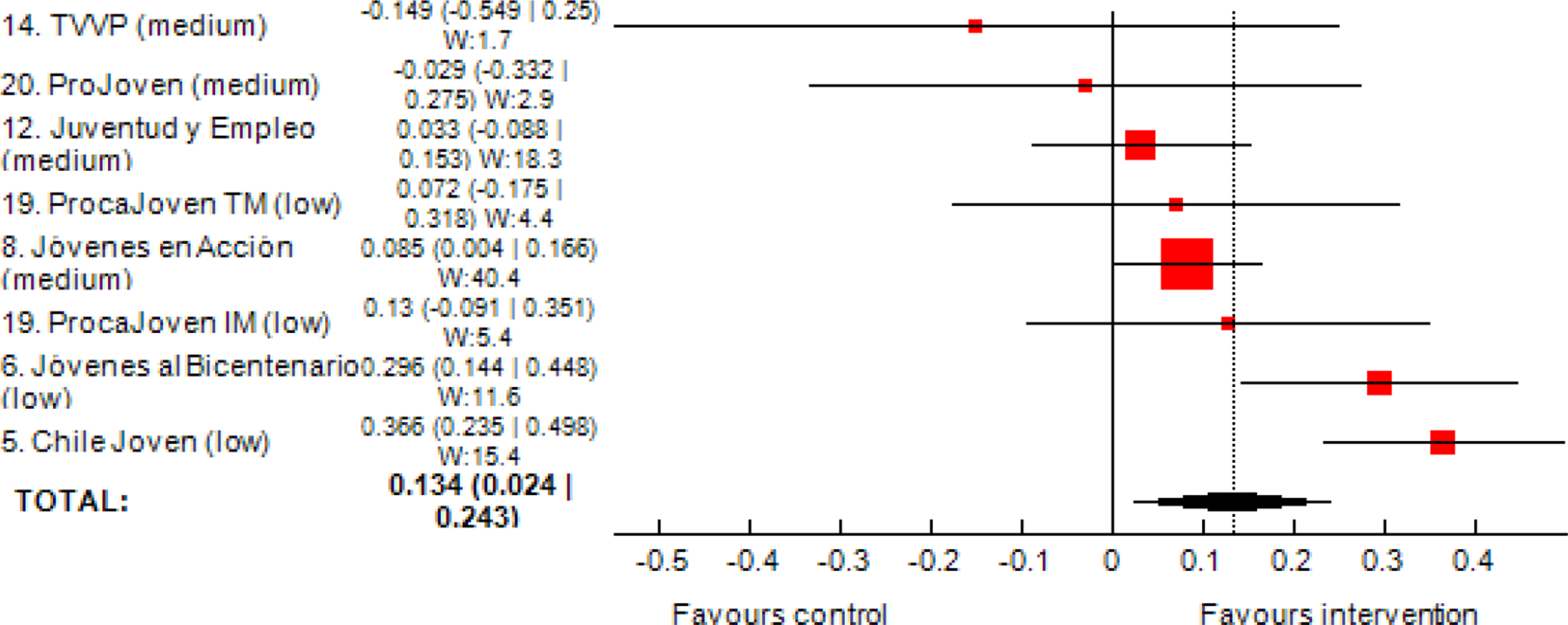
FOREST PLOT OF MEAN EFFECTS ON OVERALL PAID EMPLOYMENT
The pooled estimate of effect (g=0.134) suggests that the TVET interventions were, on average, effective; in other words, that those who experienced a TVET intervention had a greater chance of paid employment than those who did not. However, the high degree of heterogeneity between the studies (Q = 23.8; df = 7; p = 0.00124; I2 = 70.6%; tau2 = 0.0153) suggests differential effects across studies.
The first possible explanation that we considered for the pattern of variation seen in the meta-analysis was differences in study quality. Separate meta-analyses were conducted for (i) medium quality and (ii) low quality studies, and these were entered into a sub-group analysis. The mean effect size and confidence intervals for each study are shown in the forest plot in Figure 5.2.
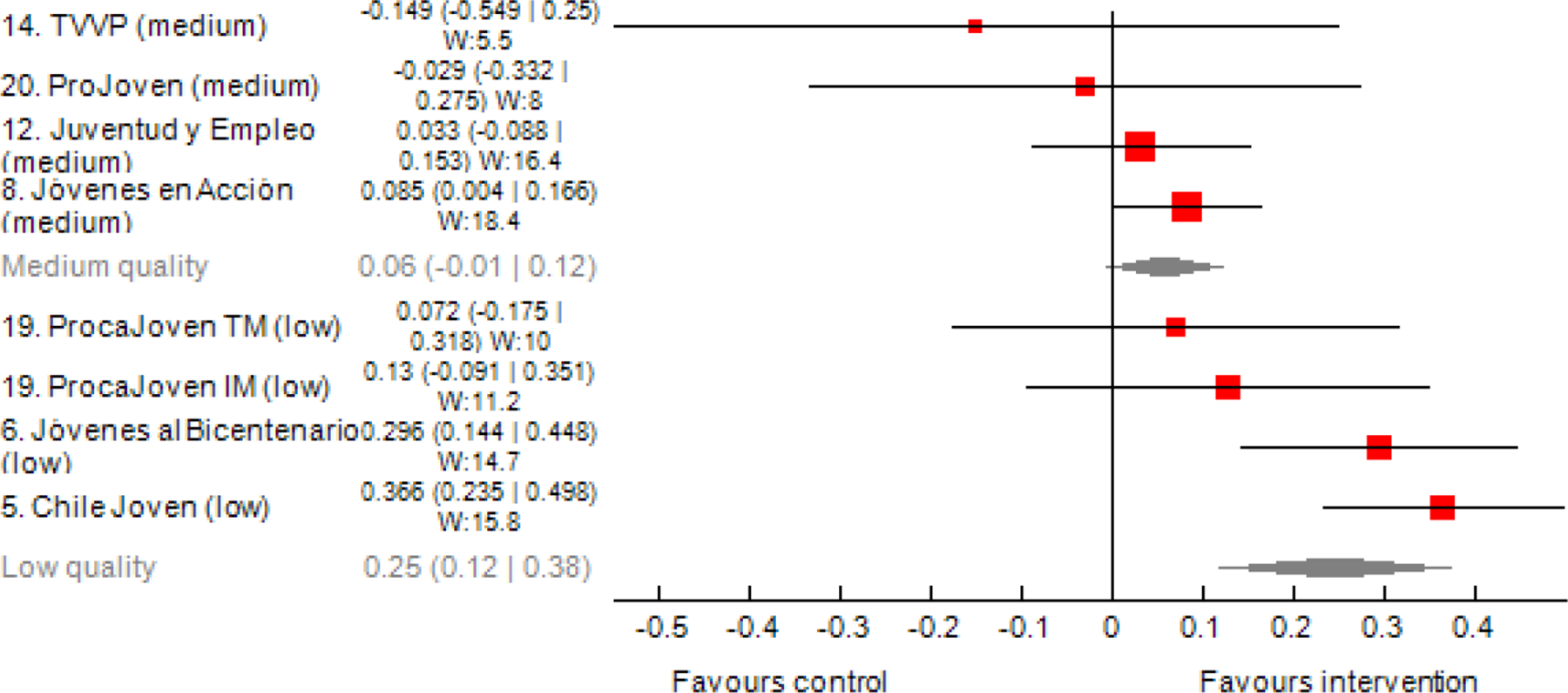
FOREST PLOT OF MEAN EFFECTS ON OVERALL PAID EMPLOYMENT (BY STUDY QUALITY)
Treatment effects for the low quality studies, g=0.25 (95% CI [0.12, 0.38]), appear to be greater than for those rated medium quality, g=0.06 (95% CI [-0.01, 0.12]). Furthermore, the observed differences in mean effects were statistically significant (Qb = 6.49; p = 0.0108).
Note: It was also observed that the majority of studies not included in this meta-analysis because effect sizes could not be calculated found that young people who had participated in TVET had a higher probability of being in paid employment than youth who had not participated (see Appendix 8.18).
5.2.1.1 Does participation in different types of TVET have different effects on overall paid employment for young people?
The TVET interventions evaluated in the seven studies included in the meta-analysis presented in Figure 5.1 comprised three distinct types (see Table 5.2). Separate meta-analyses were conducted for studies comprised of (i) two-phase TVET interventions and (ii) other TVET models. These meta-analyses were then entered into a sub-group analysis. The mean effect size and confidence intervals for each study are shown in the forest plot in Figure 5.3.
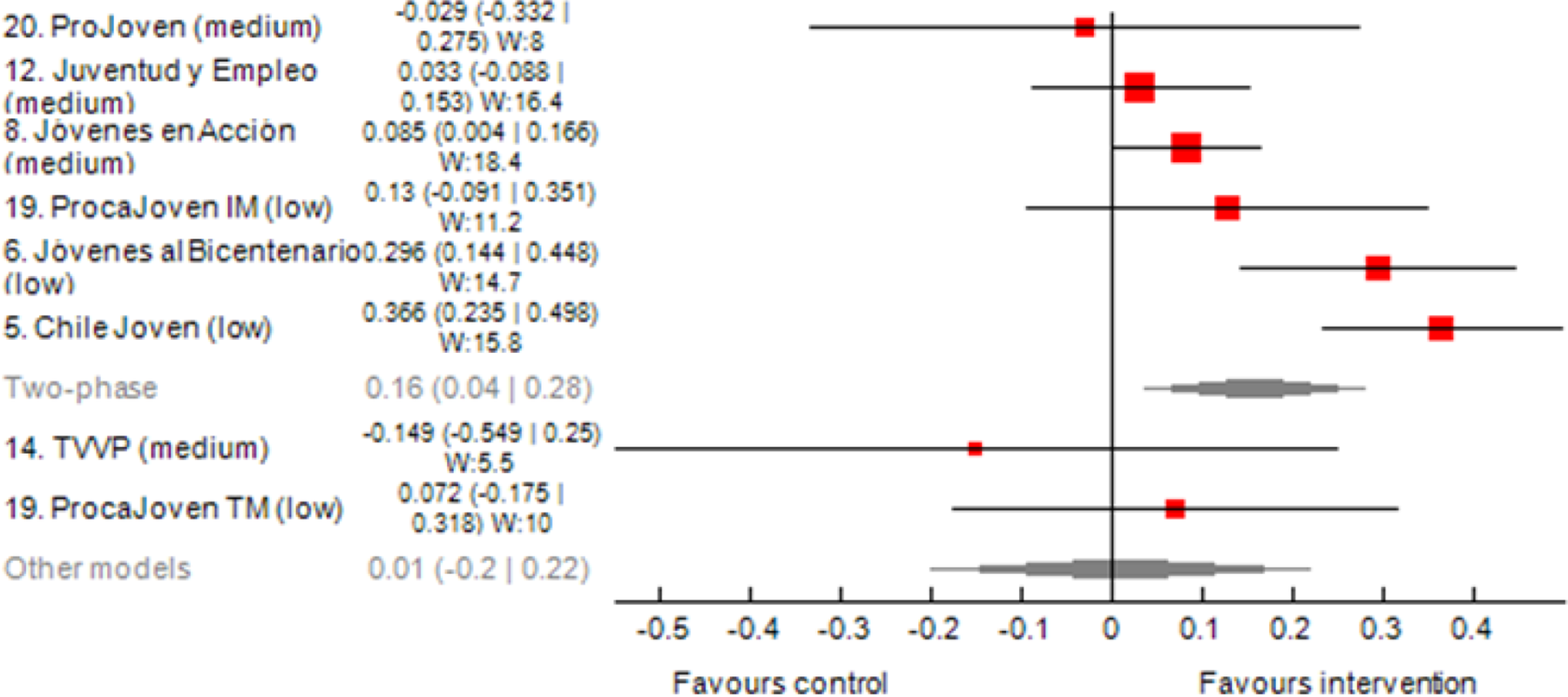
FOREST PLOT OF MEAN EFFECTS ON OVERALL PAID EMPLOYMENT (BY PROGRAMME TYPE)
For two-phase TVET interventions, a weighted average effect size of g=0.16 was observed (95% CI [0.04, 0.28]). For other TVET models, the pooled estimate of effect was positive, but negligible (g=0.01), and the confidence intervals do not exclude a negative effect (95% CI [-0.2, 0.22]). However, although treatment effects for two-phase TVET interventions appear to be greater than for other TVET modalities, the observed differences in mean effects were not statistically significant (Qb = 1.43; p = 0.231).
5.2.1.2 Does participation in TVET have different effects on overall paid employment for young people in the short- and medium-term?
In this section, we explore whether differences in time since completion of the training might be a cause of any observed variance in outcomes. Studies included in the review varied in the length of time that elapsed between completion of the intervention and measurement of its impact on paid employment. Six of the seven studies included in the meta-analysis for overall paid employment (see Figure 5.1) assessed the impact of the intervention at a single point in time after training had ended, either at approximately 6 months or around 12-15 months. The remaining study examined impacts over time, measuring outcomes at 6, 12, and 18 months (Espinoza, 2010). Information about individual studies is presented in Appendix 8.9. Separate meta-analyses were conducted for studies comprised of (i) short-term and (ii) medium-term follow-up periods. These meta-analyses were then entered into a sub-group analysis. The mean effect size and confidence intervals for each study are shown in the forest plot in Figure 5.4.
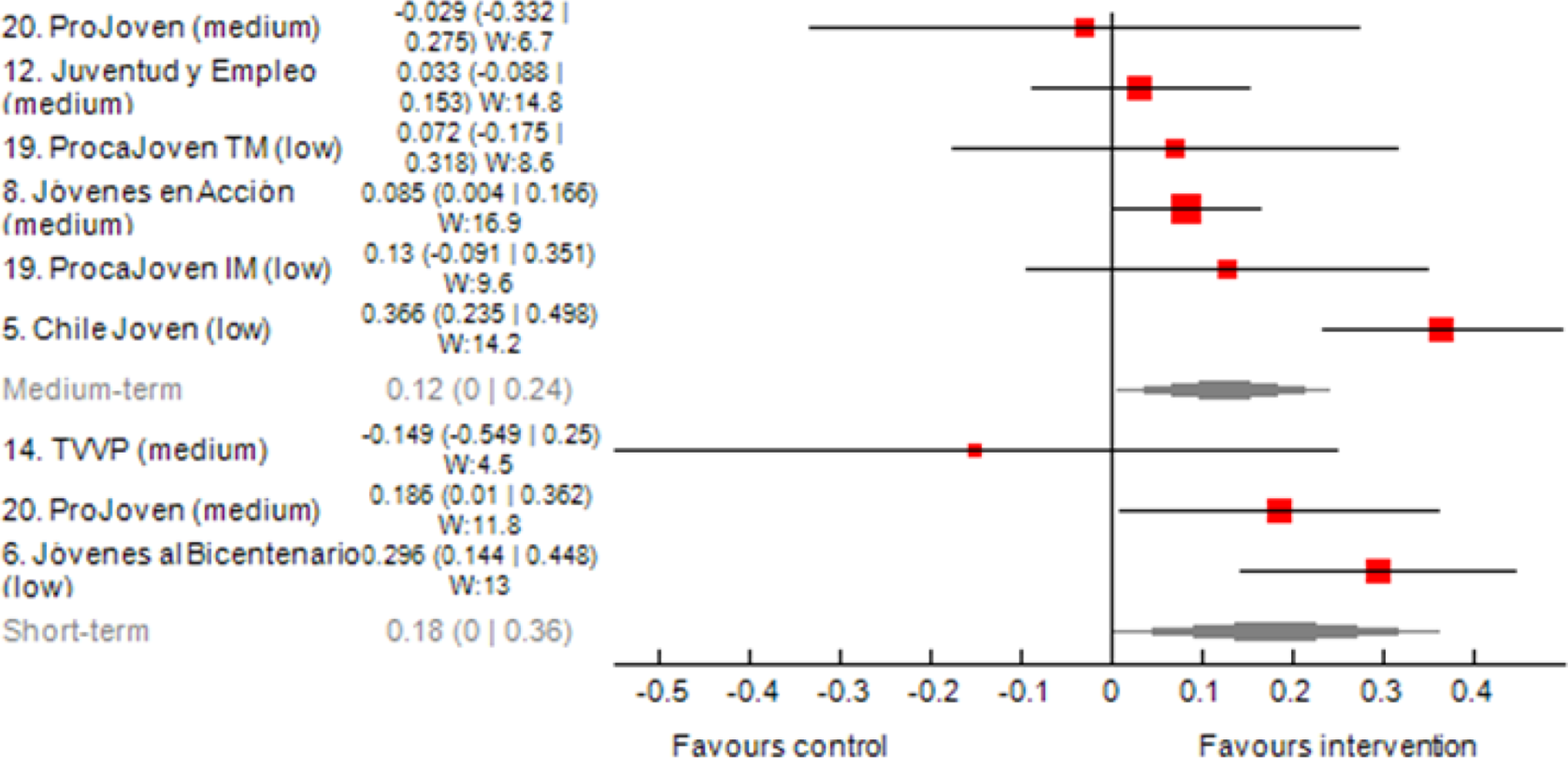
FOREST PLOT OF MEAN EFFECTS ON OVERALL PAID EMPLOYMENT (BY LENGTH OF FOLLOW-UP)
Short-term treatment effects, g=0.18 (95% CI [0, 0.36]), appeared to be greater than medium-term effects, g=0.12 (95% CI [0, 0.24]). However, the observed differences in mean effects were not statistically significant (Qb = 0.273; p = 0.601). When the sub-group analysis was re-run with only those studies rated medium, the differences remained insignificant (Qb = 0.000628; p = 0.98).
5.2.1.3 Does participation in TVET have different overall paid employment effects on different sub-groups of young people?
Several studies explored this issue. Fifteen studies disaggregated the employment effects of TVET on young people by gender; six studies estimated other sub-group impacts of TVET (see Appendix 8.12). Information about individual studies is presented in Appendix 8.9.
The data from the following five studies were amenable to meta-analysis. The studies of interventions nos. 8, 12, and 14 (Attanasio et al., 2011; Card et al., 2011; Hicks et al., 2011) were rated medium quality. The studies of interventions nos. 2 and 19 (Aedo & Nuñez, 2004; Ibarraran & Rosas-Shady, 2006) were rated low. Separate meta-analyses were conducted for studies comprised of samples with different gender compositions. These meta-analyses were then entered into a subgroup analysis. The mean effect size and confidence intervals for each study are shown in the forest plot in Figure 5.5.
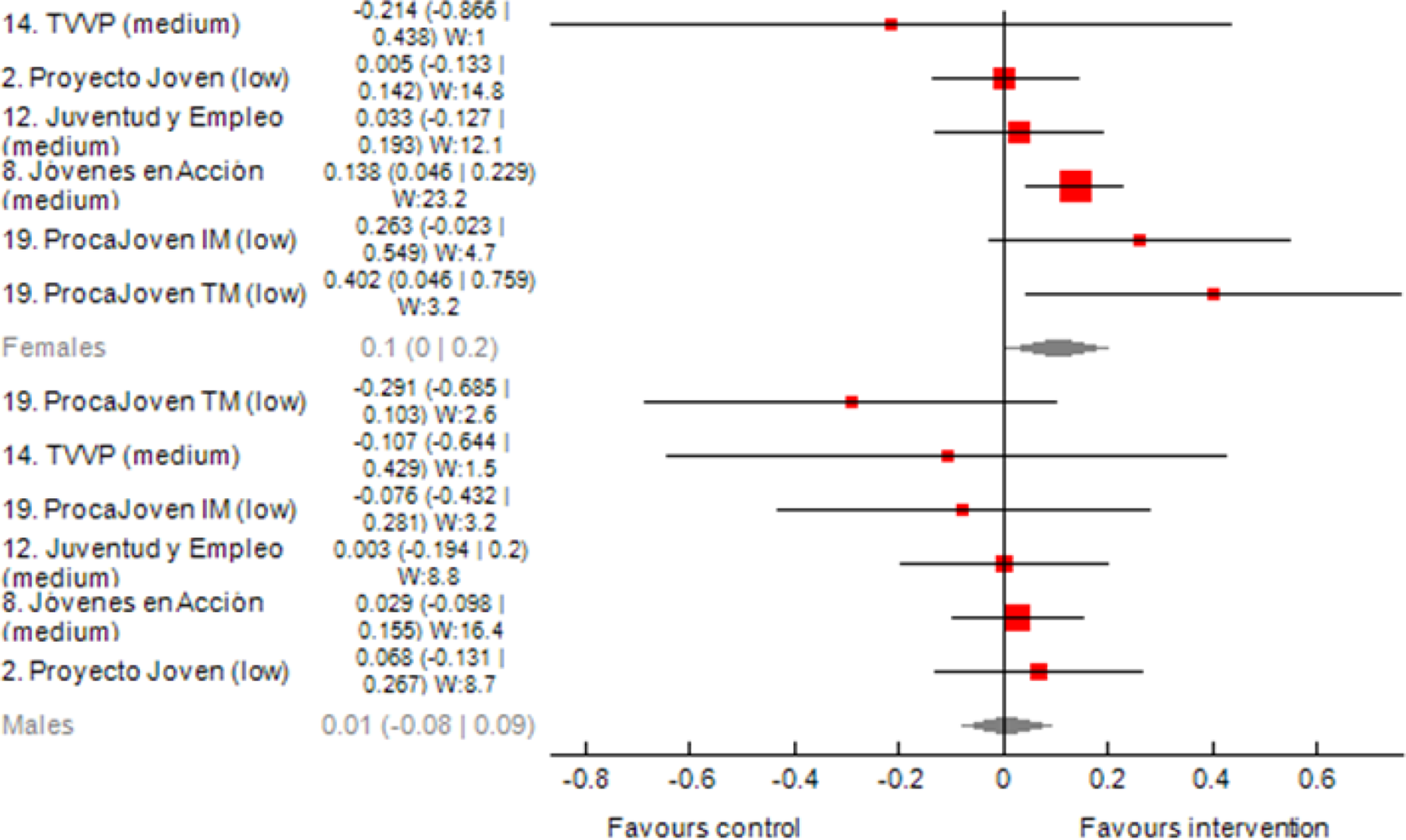
FOREST PLOT OF MEAN EFFECTS ON OVERALL PAID EMPLOYMENT (BY GENDER)
Treatment effects for female youth, g=0.1 (95% CI [0, 0.2]), appear to be slightly larger than for male youth, g=0.01 (95% CI [-0.08, 0.09]). However, the observed differences in mean effects were not statistically significant (Qb = 2.1; p = 0.147). When the sub-group analysis was re-run with only those studies rated medium, the differences remained insignificant (Qb = 1.49; p = 0.222).
The studies of interventions nos. 12 and 20 (Card et al., 2011; Espinoza, 2010) were rated medium quality. The studies of interventions nos. 18, 20, 19, and 20 (Delajara et al., 2006; Díaz & Jaramillo, 2006; Ibarraran & Rosas-Shady, 2006; Jaramillo et al., 2007) were rated low. As the two medium studies did not examine differential treatment effects for the same population sub-groups, no meta-analysis was performed.
One of the three studies that examined differences in impact by location (e.g., comparing impacts for young people from the capital city with those in other regions of the country) observed regional variation (Ibarraran & Rosas-Shady, 2006). Two of the three studies exploring treatment effect heterogeneity by level of education found larger positive effects for more educated workers, compared to the less educated (Card et al., 2011; Delajara et al., 2006). Two studies of the ProJoven intervention did not agree on the influence of poverty level. Espinoza (2010) observed that programme participation yielded no additional returns to individuals in the lowest household capita quartile prior to training, whereas Jaramillo et al.
(2007) concluded that that the strong treatment heterogeneity was not due to the variation in the initial poverty level of the beneficiaries. One of the two studies that were able to divide an evaluation sample of young people into two age groups found slightly higher point estimates among the youngest trainees in their sample (Díaz & Jaramillo, 2006). One study found that the programme increased the employment likelihood of individuals with no work experience prior to training (Espinoza, 2010).
5.2.2 Does participation in TVET have an effect on young people's chance of obtaining employment in the formal sector?
Several of the existing evaluations of TVET interventions have sought to capture not only whether trainees moved into employment as a result of the training, but also the quality of the position they secured. When talking about quality of employment, the focus is generally on the distinction between formal and informal employment. Whilst formal employment is government regulated, and workers are insured a wage and certain rights, informal employment tends to take place in unregistered enterprises, and often deprives people of financial stability and safe working environments.
In total, 10 studies assessed the impact of TVET interventions on formal employment (see Appendix 8.9 for details). Different benefit variables (proxies) were used to capture the quality of the employment position, including employment in a job with employer-provided health or social insurance, and/or formal written contract.
The reported data allowed the calculation of effect sizes from five of these studies, and these were combined in a meta-analysis. The studies of interventions nos. 8, 12, and 20 (Attanasio et al., 2011; Card et al., 2011; Espinoza, 2010) were rated medium quality. The studies of interventions nos. 5 and 19 (Aedo & Pizarro, 2004; Ibarraran & Rosas-Shady, 2006) were rated low. The mean effect size and confidence intervals for each study are shown in the forest plot in Figure 5.6.
The overall mean effect for formal paid employment is a standard mean difference of g=0.199. The confidence intervals do not cross the line of ‘no effect’ (95% CI [0.055, 0.344]). Although the analysis presented in Figure 5.7 provides evidence that the TVET interventions were, on average, effective, the heterogeneous nature of the distribution (Q = 11.1; df = 4; p = 0.0256; I2 = 63.9%; tau2 = 0.0131) suggests differential effects across studies.
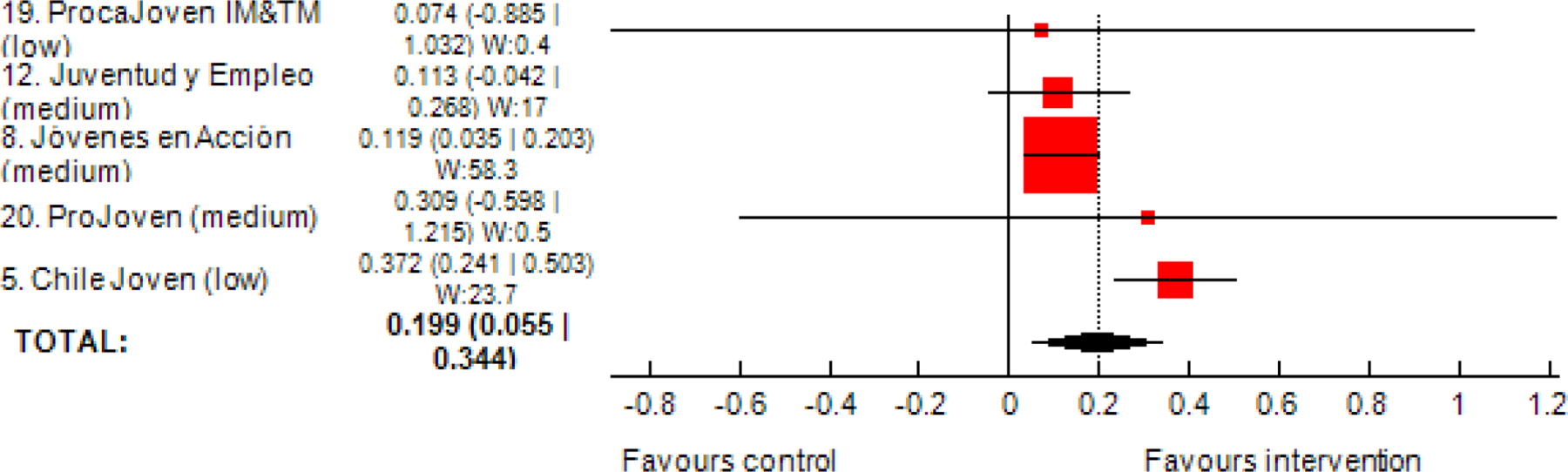
FOREST PLOT OF MEAN EFFECTS ON FORMAL PAID EMPLOYMENT
The first possible explanation that we considered for the pattern of variation seen in the meta-analysis was differences in study quality (see the forest plot in Figure 5.7). Treatment effects for the low quality studies, g=0.37 (95% CI [0.24, 0.5]), appeared to be greater than for those rated medium, g=0.12 (95% CI [0.05, 0.19]). Furthermore, the observed differences in mean effects were statistically significant (Qb = 10.6; p = 0.00116).
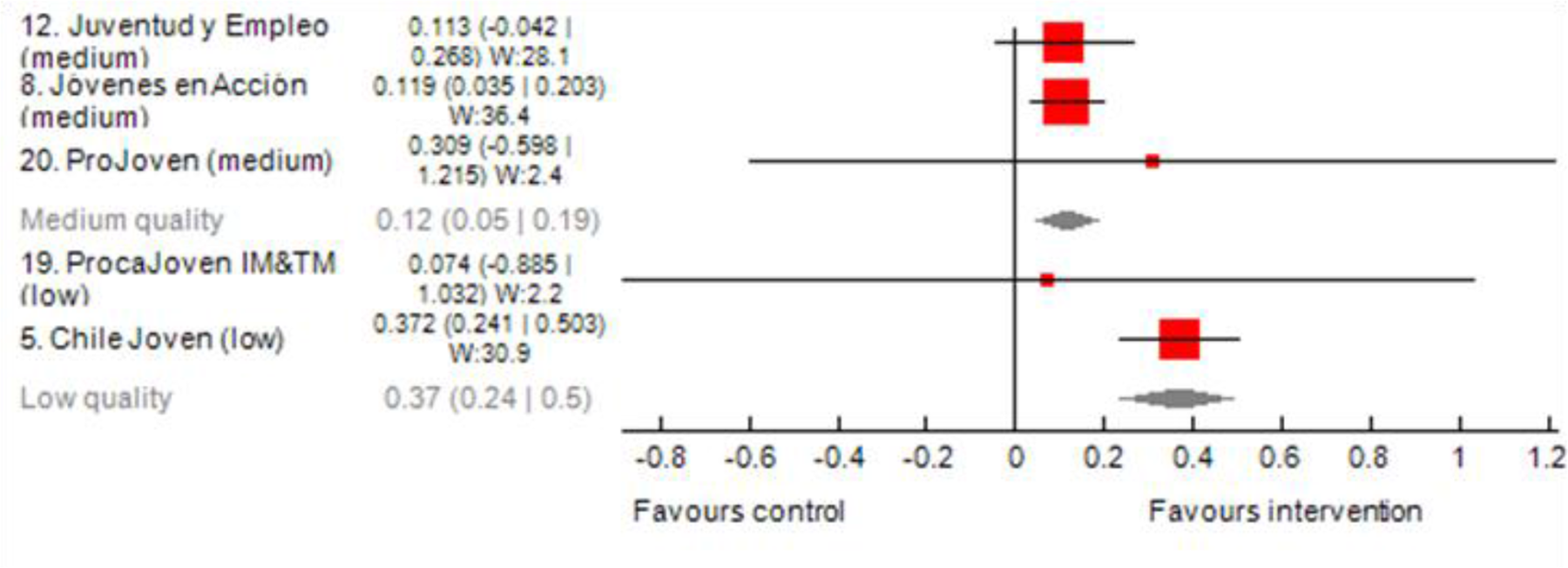
FOREST PLOT OF MEAN EFFECTS ON FORMAL EMPLOYMENT (BY STUDY QUALITY)
It was not possible to examine the variation in effect sizes (seen in Figure 5.6) by type of TVET or length of follow up due to an insufficient number of studies.
5.2.2.1 Does participation in TVET have different formal employment effects on different sub-groups of young people?
Several studies examined whether the impacts of TVET on formal employment differed according to population sub-group. Eight studies examined variation in treatment effects by gender, and three studies estimated differential effects for other sub-groups (see Appendix 8.12). Information about individual studies is presented in Appendix 8.9.
The studies of interventions nos. 8 and 20 (Attanasio et al., 2011; Espinoza, 2010) were rated medium quality. The studies of interventions nos. 5, 2, 20, 20, 19, and 16 (Aedo & Pizarro, 2004; Alzuá & Brassioli, 2006; Chong et al., 2008; Díaz & Jaramillo, 2006; Ibarraran & Rosas-Shady, 2006; van Gameren, 2010) were rated low. Effect sizes were computable for one medium quality study, and so no meta-analysis was performed. On the whole, studies observed relatively similar effects for males and females; although some authors found that young women benefitted most out of programme participation.
The study of intervention no. 20 (Espinoza, 2010) was rated medium quality. Two other studies of interventions nos. 19 and 20 (Díaz & Jaramillo, 2006; Ibarraran & Rosas-Shady, 2006) were rated low. The study by Espinoza (2010) found that training produced additional returns to those individuals with no work experience and those in the lowest household income quartile. One study found slightly larger programme effects on the likelihood of having a formal job among 16-20 year olds than among 21-25 year olds for some of the year cohorts, and for the others the larger effects were observed for the group aged 21-25 years (Díaz & Jaramillo, 2006). Ibarraran & Rosas-Shady (2006) reported that treatment effects were relatively evenly distributed across the sample.
5.2.3 Does participation in TVET have an effect on young people's chance of obtaining self-employment?
Three studies separated salaried and self-employed workers and examined the impact of TVET interventions on the probability of self-employment among young people. The study of intervention no. 14 (Hicks et al., 2011) was rated medium quality. The studies of interventions nos. 18 and 17 (Delajara et al., 2006; López-Acevedo, 2003) were rated low. As there was a single medium study, no meta-analysis was performed.
Two of the three studies (Hicks et al., 2011; López-Acevedo, 2003) found a slight positive treatment effect. The remaining study (Delajara et al., 2006) found an irregular effect on self-employment; in some years, treatment effects were positive, and in other years they were negative.
5.2.3.1 Does participation in TVET have different self-employment effects on different sub-groups of young people?
Two studies addressed this question. Delajara et al. (2006) reported that due to insufficient observations, many sub-groups could not be evaluated, and no clear pattern could be described. The study by Hicks et al. (2011) examined variation by
gender but found treatment effects to be relatively evenly distributed across the sample.
5.3 INCOME
The majority of studies examined the impact of a TVET intervention on monthly earnings, but smaller numbers also considered their impact on earnings from self-employment, hourly wages, or household/monthly income (see Table 5.4).
INCOME-RELATED OUTCOMES
5.3.1 Does participation in TVET have an effect on young people's earnings?
The available data allowed the calculation of effect sizes for eight studies. For this outcome, the studies of interventions nos. 8, 12, 2, and 14 (Attanasio et al., 2011; Card et al., 2011; Elias et al., 2004; Hicks et al., 2011) were rated medium quality, while studies of interventions nos. 6, 5, 20, and 19 (Acero et al., 2011; Aedo & Pizarro, 2004; Espinoza, 2010; Ibarraran & Rosas-Shady, 2006) were rated low.
Effect sizes from these eight studies were combined. The mean effect size and confidence intervals for each study are shown in the forest plot in Figure 5.8. The pooled estimate of effect is g=0.127 (95% CI [0.043, 0.21]).
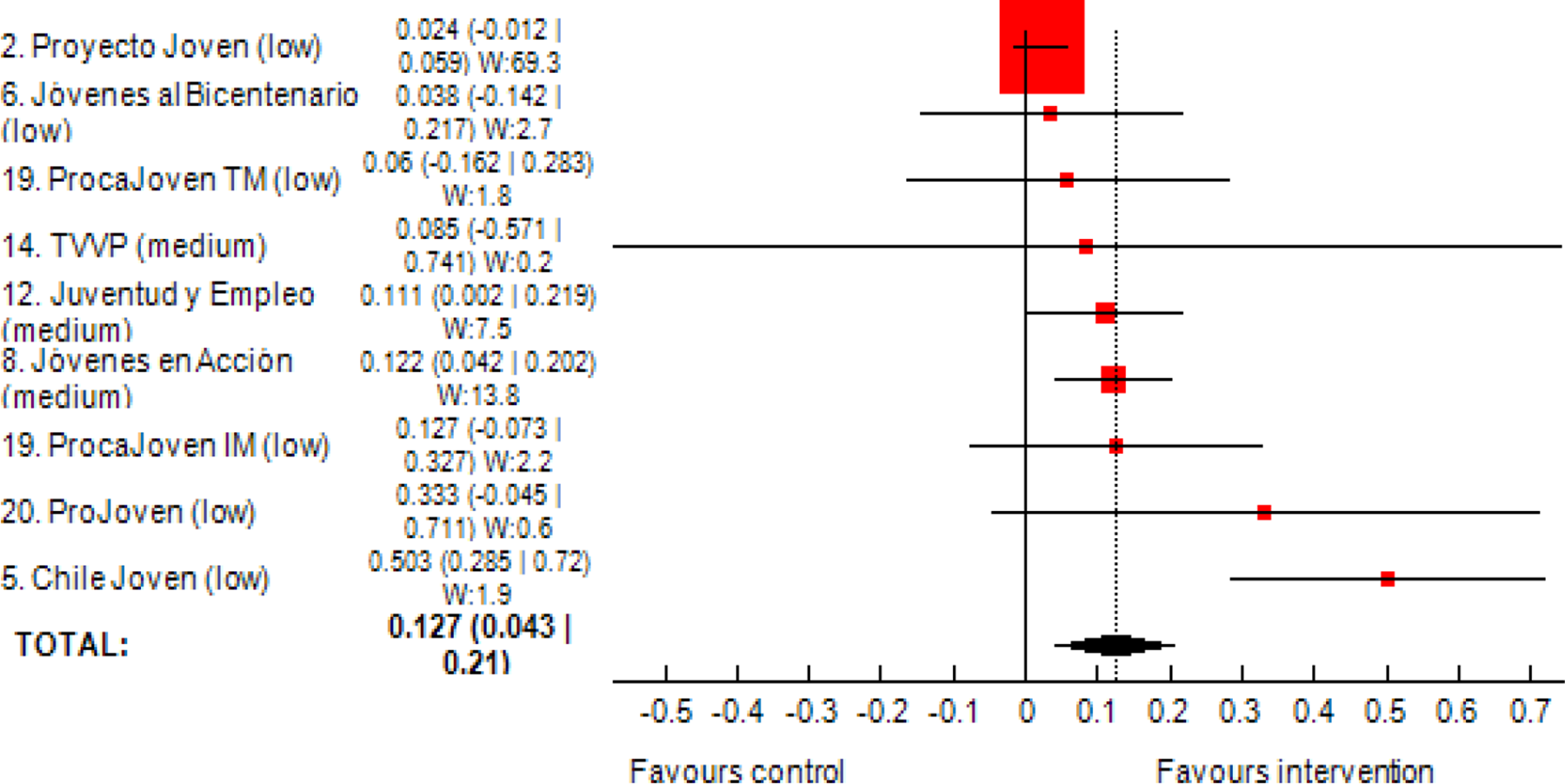
FOREST PLOT OF MEAN EFFECTS ON EARNINGS
The overall mean effect size (g=0.127) suggests that, on average, young people who received a TVET intervention have higher monthly earnings than those who did not. The confidence interval for this point estimate (95% CI [0.043, 0.21]) is relatively precise and does not cross the line of ‘no effect.‘ However, the results of the statistical tests for homogeneity (Q = 25.5; df = 8; p = 0.00128; I2 = 68.6%; tau2 = 0.00815) suggest differential effects across studies.
We first explored whether the pattern of variation seen in the meta-analysis could be explained by differences in study quality (see the forest plot in Figure 5.9). It looks as if treatment effects for the low quality studies, g=0.15 (95% CI [0.01, 0.3]), are very similar to those rated medium, g=0.12 (95% CI [0.05, 0.18]). The slight differences in mean effects were statistically insignificant (Qb = 0.204; p = 0.652).
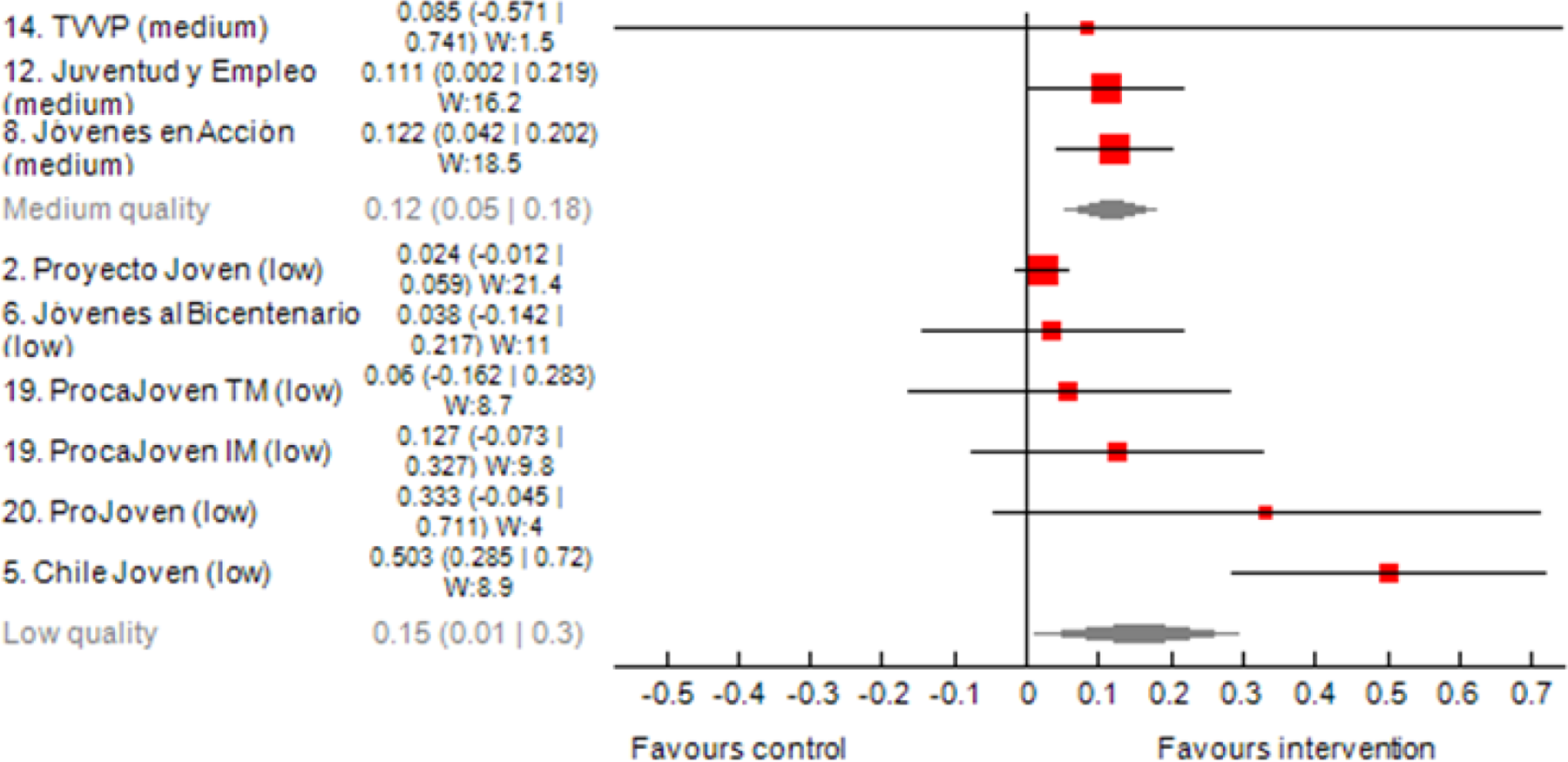
FOREST PLOT OF MEAN EFFECTS ON EARNINGS (BY STUDY QUALITY)
5.3.1.1 Does participation in different types of TVET have different effects on young people's earnings?
The TVET interventions evaluated in the eight studies included in the meta-analysis presented in Figure 5.8 comprised three distinct types (see Table 5.2). Separate meta-analyses were conducted for studies comprised of (i) two-phase TVET interventions and (ii) other TVET models. These meta-analyses were then entered into a sub-group analysis. The mean effect size and confidence intervals for each study are shown in the forest plot in Figure 5.10.
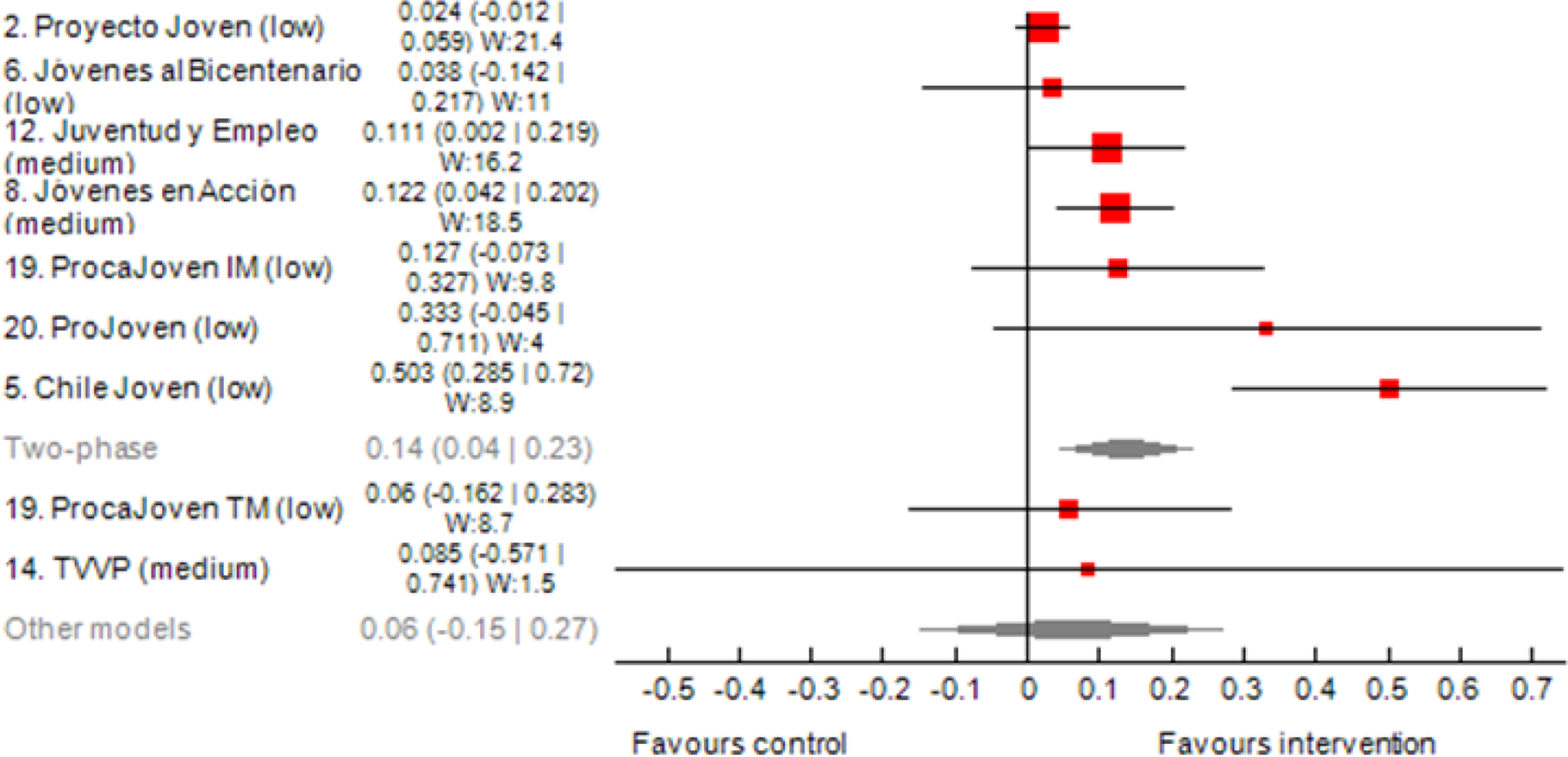
FOREST PLOT OF MEAN EFFECTS ON EARNINGS (BY PROGRAMME TYPE)
For two-phase TVET interventions, the individual effect sizes were meta-analysed to produce a weighted average effect size of g=0.14 (95% CI [0.04, 0.23]). For other TVET models, a positive pooled estimate of effect was also observed (g=0.06), but the confidence intervals do not exclude a negative effect (95% CI [-0.15, 0.27]). Although the treatment effect appears to be slightly larger for two-phase models of TVET than for other models, the observed differences in mean effects were not statistically significant (Qb = 0.397; p = 0.529).
5.3.1.2 Does participation in TVET have different effects on young people's earnings in the short- and medium-term?
Seven of the eight studies included in the meta-analysis for monthly earnings (see Figure 5.8) followed up participants once, after training had ended. The remaining study examined the impact of the intervention over time, measuring outcomes at 6, 12, and 18 months (Espinoza, 2010). Information about individual studies is presented in Appendix 8.9.
Separate meta-analyses were conducted for studies comprised of (i) short-term and (ii) medium-term follow-up periods. These meta-analyses were then entered into a sub-group analysis. The mean effect size and confidence intervals for each study are shown in the forest plot in Figure 5.11. Short-term treatment effects, g=0.22 (95% CI [-0.13, 0.58]), appeared to be greater than medium-term effects, g=0.14 (95% CI [0.05, 0.24]). However, the observed differences in mean effects were not statistically significant (Qb = 0.186; p = 0.666).
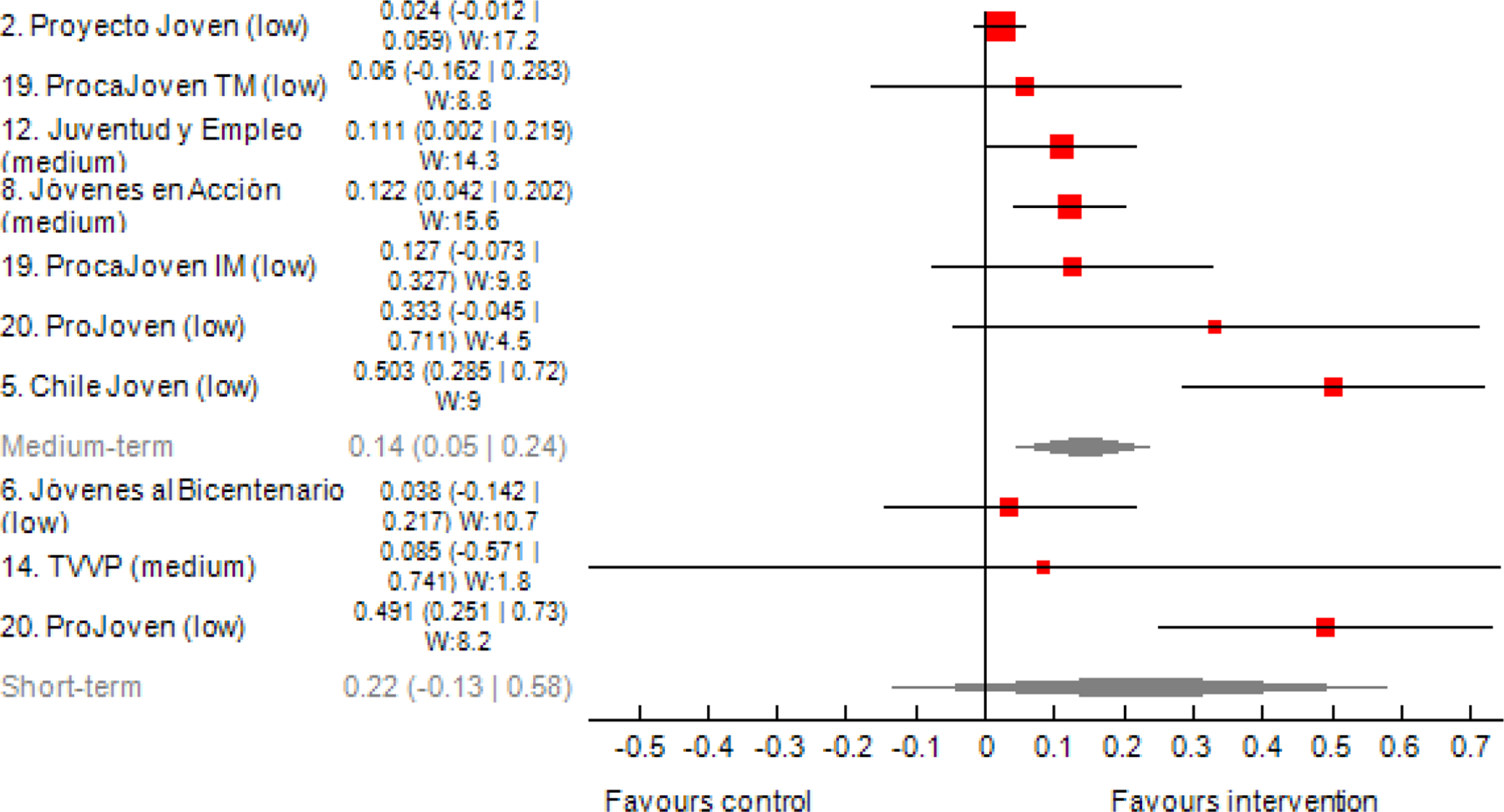
FOREST PLOT OF MEAN EFFECTS ON EARNINGS (BY LENGTH OF FOLLOW-UP)
5.3.1.3 Does participation in TVET have different earnings effects on different sub-groups of young people?
Several studies examined whether some groups of young people benefited more than others, in terms of post-training earnings. Sixteen studies disaggregated the earnings effects of TVET on young people by gender, and seven studies estimated additional sub-group impacts (see Appendix 8.12). Information about individual studies is presented in Appendix 8.9.
Of these 16 studies, 6 were amenable to meta-analysis. The studies of interventions nos. 8, 12, and 14 (Attanasio et al., 2011; Card et al., 2011; Hicks et al., 2011) were rated medium quality. The studies of interventions nos. 2, 19, 9, and 11 (Aedo & Nuñez, 2004; Ibarraran & Rosas-Shady, 2006; Medina & Nuñez, 2005) were rated low. The mean effect size and confidence intervals for each study are shown in the forest plot in Figure 5.12.
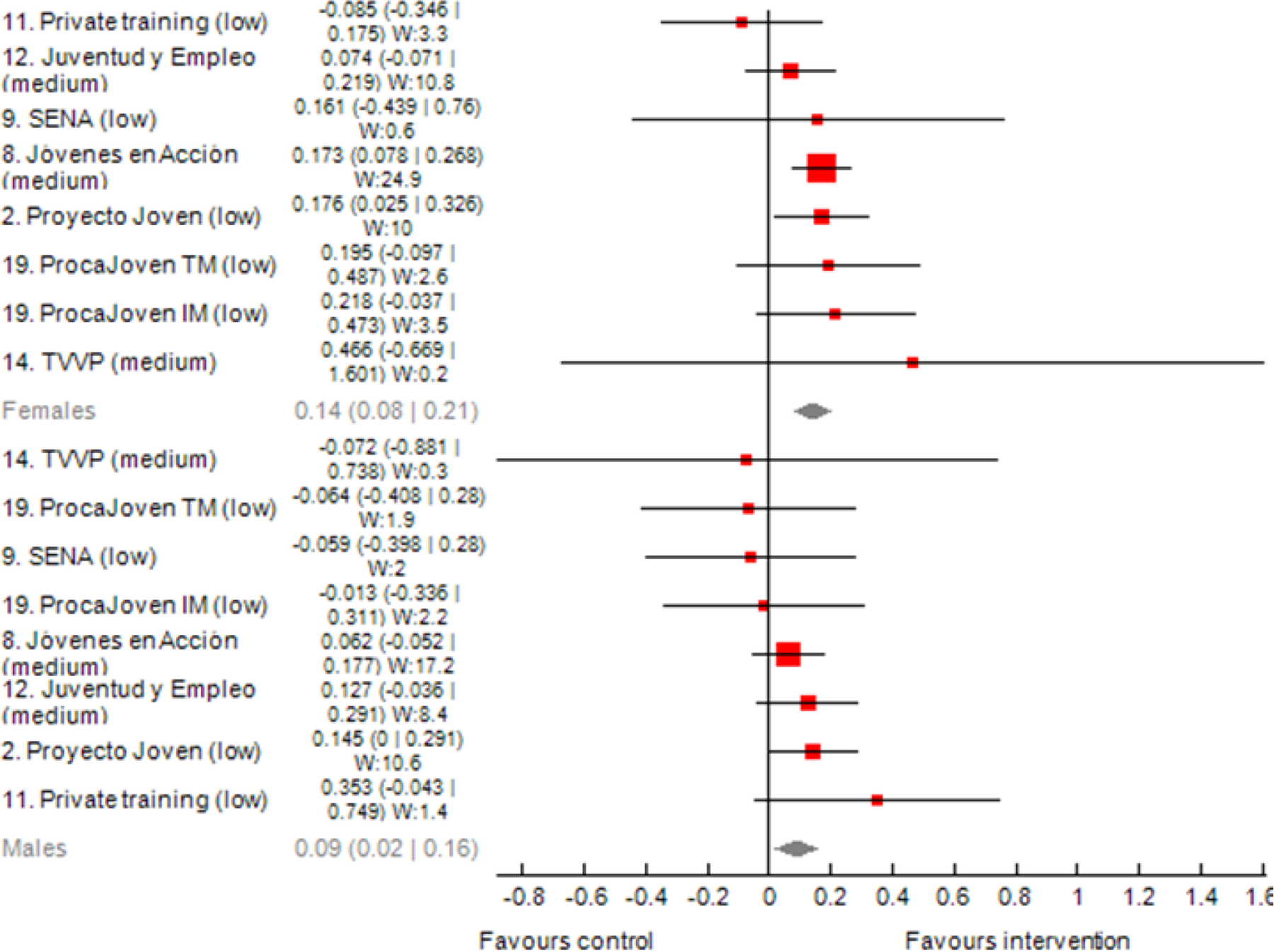
FOREST PLOT OF MEAN EFFECTS ON EARNINGS (BY GENDER)
For female youth, the individual effect sizes were meta-analysed to produce a weighted average effect size of g=0.14 (95% CI [0.08, 0.21]). For male youth, the pooled estimate of effect was also positive (g=0.09) and again the confidence intervals do not include zero (95% CI [0.02, 0.16]). However, the observed differences in mean effects were not statistically significant (Qb = 1.26; p = 0.262). When the sub-group analysis was re-run with only those studies rated medium, the differences remained insignificant (Qb = 1.01; p = 0.315).
The study of intervention no. 12 (Card et al., 2011) was rated medium quality. The studies of interventions nos. 18, 20, 2, 20, 19, and 20 (Delajara et al., 2006; Díaz & Jaramillo, 2006; Elías et al., 2004; Espinoza, 2010; Ibarraran & Rosas-Shady, 2006; Jaramillo et al., 2007) were rated low. Three of the four studies that explored regional variation in impact observed some differences between sub-groups (Card et al., 2011; Elías et al., 2004; Ibarraran & Rosas-Shady, 2006). Two of the three studies exploring treatment effect heterogeneity by level of education found larger positive effects for more educated workers, compared to the less educated (Card et al., 2011; Delajara et al., 2006). Two evaluations of the ProJoven programme disagreed on the influence of poverty level on the earnings returns to young people. Espinoza (2010) found that ProJoven yields additional returns for those trainees in the lowest household income per capita quartile. In contrast, Jaramillo et al. (2007) found the programme to be ‘equity enhancing…as the evidence indicates similar returns for participants along varying poverty lines’ (p. 43). One of the two studies exploring treatment effects by age found slightly higher point estimates among the youngest trainees in their samples (Díaz & Jaramillo, 2006), whereas the other study (Card et al., 2011) found the estimated impacts on monthly earnings to be fairly similar for younger and older workers. Finally, Espinoza (2010) found that ProJoven yields additional returns for those trainees with no work experience prior to training.
5.3.1.4 Does participation in TVET have different effects on young people's earnings according to the quality of the training?
Two studies examined the natural hypothesis that higher quality training will have a larger impact on participant outcomes (Card et al., 2011; Chong & Galdo, 2006). Card et al. (2011) reported that comparisons between treatment and control outcomes within each quality group ‘showed no evidence of a large or systematic quality effect’ (p. 290). 25 In contrast, Chong and Galdo (2006), who had a larger data set of trainee and training provider characteristics, found that young people attending high-quality training courses showed much higher impacts on monthly earnings than those attending low-quality courses.
5.3.2 Does participation in TVET have an effect on young people's self-employment earnings?
Two of the three studies that examined the impact of TVET on young people's earnings were amenable to meta-analysis. The studies of interventions nos. 8 and 14 (Attanasio et al., 2011; Hicks et al., 2011) were both rated medium quality. The mean effect size and confidence intervals for each study are shown in the forest plot in Figure 5.13.

FOREST PLOT OF MEAN EFFECTS ON SELF-EMPLOYMENT EARNINGS
The overall mean effect size (g=-0.025) suggests that, on average, young people who received a TVET intervention had lower self-employment earnings than those who did not, although this is a relatively imprecise estimate based on only two studies (95% CI [-0.11, 0.061]). The results of the statistical test for homogeneity was non-significant (Q = 0.206; df = 1; p = 0.65; I2 = 0%; tau2 = 0).
It was not possible to examine the variation in effect sizes (seen in Figure 5.13) by type of TVET or length of follow up due to an insufficient number of studies.
5.3.2.1 Does participation in TVET have different self-employment earnings effects on different sub-groups of young people?
Three studies examined whether the treatment effect on self-employment earnings varied across population groups. One study (Delajara et al., 2006) reported that, due to insufficient observations, many sub-groups could not be examined, and no clear pattern could be described. The remaining two studies examined gender differences only.
The studies of interventions nos. 8 and 14 (Attanasio et al., 2011; Hicks et al., 2011) were rated medium quality. The mean effect size and confidence intervals for each study are shown in the forest plot in Figure 5.14.
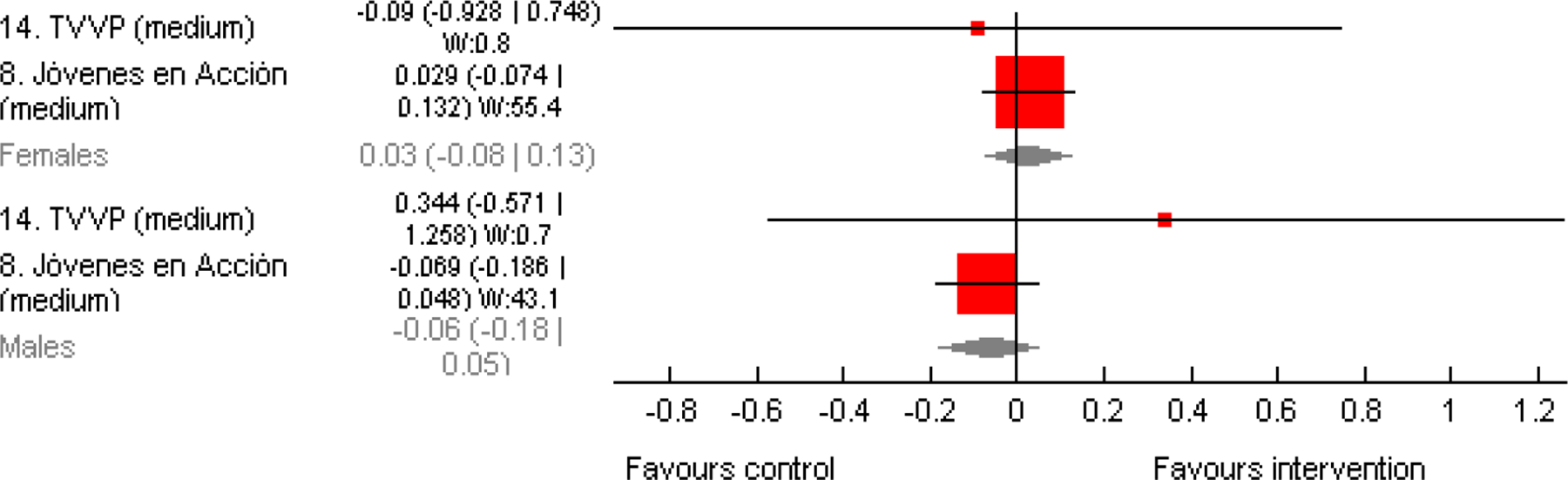
FOREST PLOT OF MEAN EFFECTS ON SELF-EMPLOYMENT EARNINGS (BY GENDER)
For female youth, the individual effect sizes were meta-analysed to produce a weighted average effect size of g=0.03 (95% CI [-0.08, 0.13]). For male youth, the pooled estimate of effect was negative (g=-0.06) although the confidence intervals cross zero (95% CI [-0.18, 0.05]). The observed differences in mean effects, however, were not statistically significant (Qb = 1.27; p = 0.259).
5.3.3 Does participation in TVET have an effect on young people's hourly wages?
Five studies measured changes in the hourly wage received by workers. The study of intervention no. 12 (Card et al., 2011) was rated medium quality. The study of interventions nos. 20, 19, 17, and 20 (Díaz & Jaramillo, 2006; Ibarraran & Rosas-Shady, 2006; López-Acevedo, 2003; Ñopo et al., 2007) were rated low. The findings of the five studies were generally consistent, with four studies observing that young people who had participated in TVET experienced higher hourly rates of pay than those who had not participated.
5.3.3.1 Does participation in TVET have different hourly wage effects on different sub-groups of young people?
Three of these five studies assessed whether TVET interventions have different hourly wage effects on different population sub-groups. Díaz and Jaramillo (2006) found higher programme effects for women. Ñopo et al. (2007) found that 12 months after training ended, males were benefiting more than females. However, at 6 and 18 months, gender differences in income per hour were minor. Ibarraran and Rosas-Shady (2006) reported that the positive effects they observed were relatively evenly distributed across the whole sample. Díaz and Jaramillo (2006) found that effects tended to be higher for 16-20 year old youths than for those aged 21-25 years.
5.4 HOURS WORKED
A third of all studies examined the impact of a TVET intervention on the number of weekly hours worked by young people, whilst a single study also measured this outcome amongst the self-employed (see Table 5.5).
HOURS WORKED
5.4.1 Does participation in TVET have an effect on the number of weekly hours worked in paid employment by young people?
The data from five studies allowed calculation of effect sizes. The studies of interventions nos. 8, 12, and 14 (Attanasio et al., 2011; Card et al., 2011; Hicks et al., 2011) were rated medium quality. The studies of interventions nos. 6 and 19 (by Acero et al., 2011; Ibarraran & Rosas-Shady, 2006) were rated low.
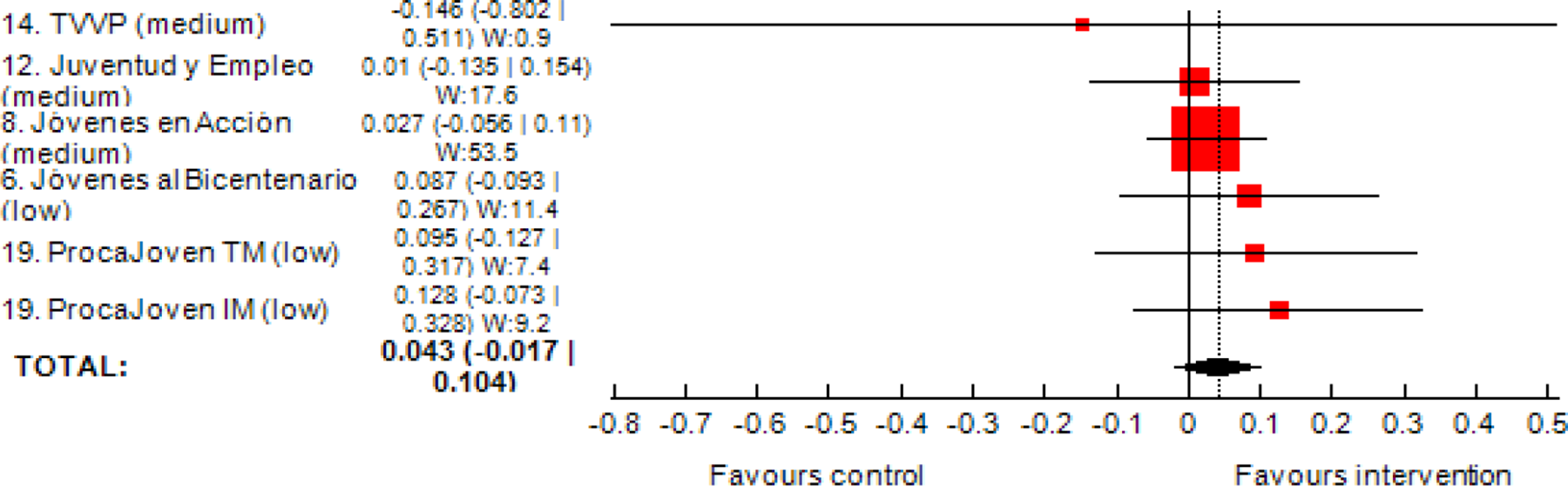
FOREST PLOT OF MEAN EFFECTS ON HOURS WORKED
The forest plot in Figure 5.15 shows the mean effect size and the confidence intervals for each study. The majority of individual studies show a positive effect on the number of weekly hours worked. When the studies were pooled, the effect size favours the intervention (g= 0.043). However, as the confidence interval crosses zero (95% CI [-0.017, 0.104]) the result does not exclude a possible negative effect. Although the results of the statistical tests for homogeneity (Q = 1.8; df = 5; p = 0.876; I2 = 0%; tau2 = 0) suggest that variability in effect sizes between studies was not larger than expected from sampling error, visual indicators suggest that there is a degree of heterogeneity between studies.
We first explored whether the pattern of variation seen in the meta-analysis could be explained by differences in study quality (see the forest plot in Figure 5.16). Although treatment effects for the low quality studies, g=0.1 (95% CI [-0.01, 0.22]), appear to slightly larger than for those rated medium, g=0.02 (95% CI [-0.05, 0.09]), the observed differences in mean effects were statistically insignificant (Qb = 1.41; p = 0.234).
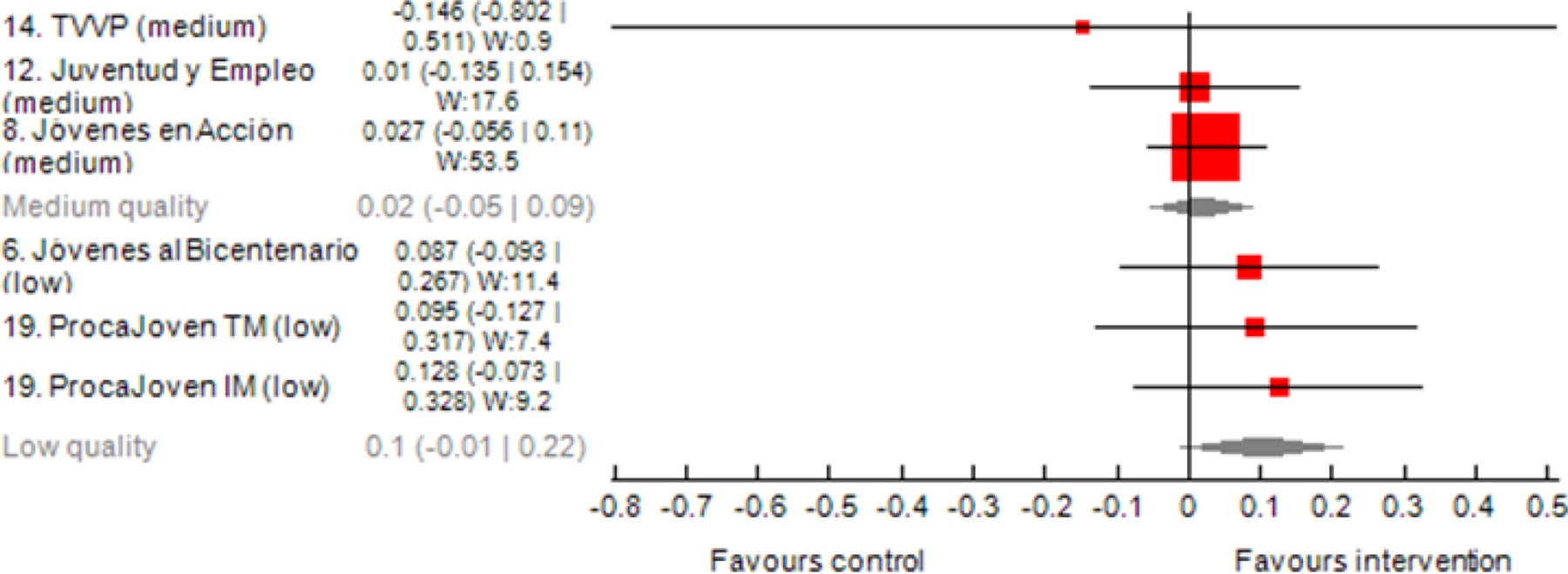
FOREST PLOT OF MEAN EFFECTS ON HOURS WORKED (BY STUDY QUALITY)
Note: The majority of the studies not included in the meta-analysis because effect sizes could not be calculated also found that the number of weekly hours worked by young people increased as a result of participating in TVET (see Appendix 8.20).
5.4.1.1 Does participation in different types of TVET have different effects on the weekly hours worked by young people?
The TVET interventions evaluated in the five studies included in the meta-analysis presented in Figure 5.15 comprised three distinct types (see Table 5.2). Separate meta-analyses were conducted for studies comprised of (i) two-phase TVET interventions and (ii) other TVET models. These meta-analyses were then entered into a sub-group analysis. The mean effect size and confidence intervals for each study are shown in the forest plot in Figure 5.17.
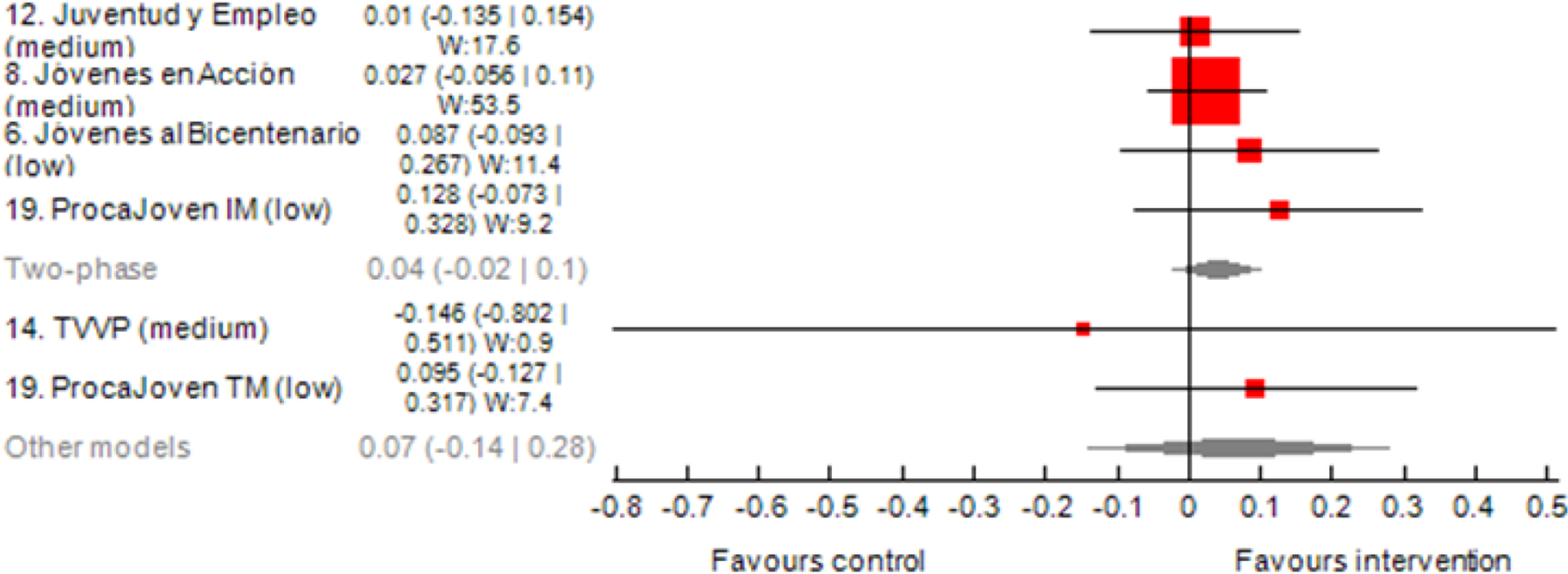
FOREST PLOT OF MEAN EFFECTS ON HOURS WORKED (BY PROGRAMME TYPE)
For two-phase TVET interventions, the individual effect sizes were meta-analysed to produce a weighted average effect size of g=0.04 (95% CI [-0.02, 0.1]). For other TVET models, a pooled estimate of effect of similar magnitude was observed (g=0.07), and again the confidence intervals do not exclude a negative effect (95% CI [-0.14, 0.28]). The observed differences in mean effects were not statistically significant (Qb = 0.0677; p = 0.795).
5.4.1.2 Does participation in TVET have different effects on the weekly hours worked by young people in the short- and medium-term?
All five studies included in the meta-analysis for weekly hours worked (see Figure 5.15) measured outcomes at a single point in time after training ended. Information about individual studies is presented in Appendix 8.9.
Separate meta-analyses were conducted for studies comprised of (i) short-term and (ii) medium-term follow-up periods. These meta-analyses were then entered into a sub-group analysis. The mean effect size and confidence intervals for each study are shown in the forest plot in Figure 5.18. Short-term treatment effects, g=0.07 (95% CI [-0.1, 0.24]), were very similar to medium-term effects, g=0.04 (95% CI [-0.03, 0.1]). The observed differences in mean effects were not statistically significant (Qb = 0.109; p = 0.741).
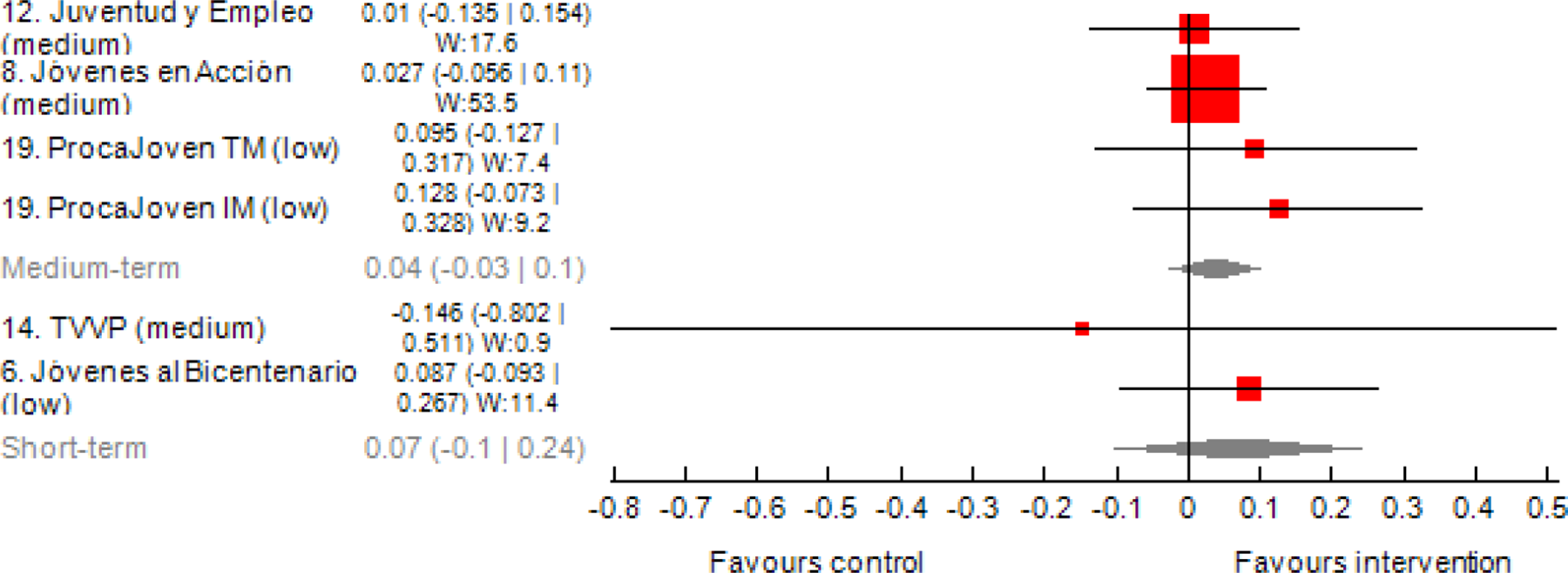
FOREST PLOT OF MEAN EFFECTS ON HOURS WORKED (BY LENGTH OF FOLLOW-UP)
5.4.1.3 Does participation in TVET have different weekly hours effects on different sub-groups of young people?
Several studies examined whether the impacts of TVET on weekly hours were the same for different types of trainee. Five studies disaggregated the effects on weekly hours by gender, and two studies explored a number of additional subgroup impacts (see Appendix 8.12). Information about individual studies is presented in Appendix 8.9.
Three of the five studies had data that allowed effect size calculations. The studies evaluating interventions nos. 8 and 14 were rated medium quality (Attanasio et al., 2011; Hicks et al., 2011). The study of intervention no. 19 was rated low (Ibarraran & Rosas-Shady, 2006). The mean effect size and confidence intervals for each study are shown in the forest plot in Figure 5.19.
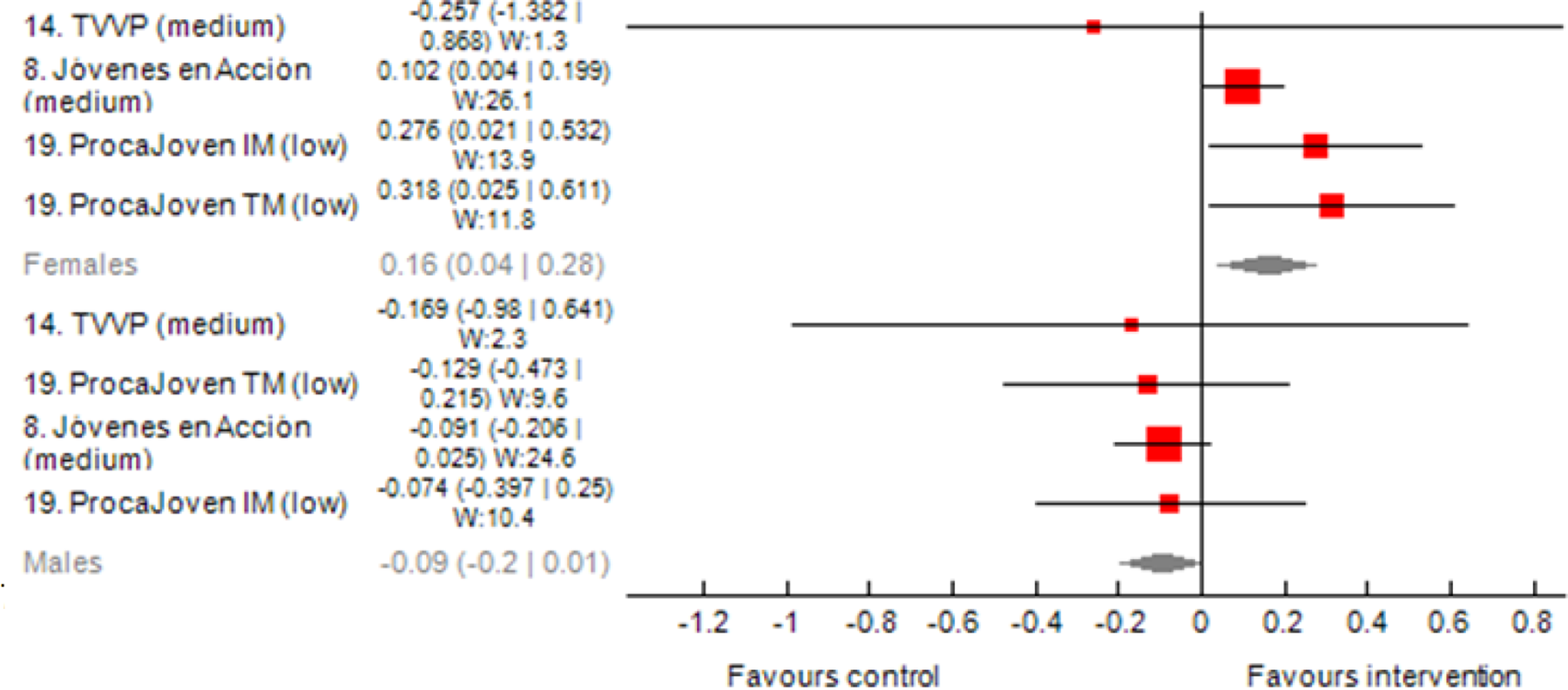
FOREST PLOT OF MEAN EFFECTS ON HOURS WORKED (BY GENDER)
For female youth, the individual effect sizes were meta-analysed to produce a weighted average effect size of g=0.16 (95% CI [0.04, 0.28]). For male youth, the pooled estimate of effect was negative (g=-0.09; 95% CI [-0.2, 0.01]). The observed differences in mean effects were statistically significant (Qb = 10.1; p = 0.00151). When the sub-group analysis was re-run with only those studies rated medium, the differences remained significant (Qb = 6.28; p = 0.0122).
Two studies estimated additional sub-group impacts of TVET on the number of weekly hours worked by young people. Both studies were rated low. When splitting the sample by age, Díaz & Jaramillo (2006) did not observe a clear difference in favour of either group (16-20 years or 21-25 years). Ibarraran & Rosas-Shady (2006) examined a number of different sub-groups and found effects relatively evenly distributed across the sample.
5.4.2 Does participation in TVET have an effect on the number of weekly hours worked in self-employment by young people?
One medium quality study (Hicks et al., 2011) examined the impact that training (intervention no. 14) had on the number of hours worked in self-employment. It found that young people in the treatment group worked fewer hours than their control counterparts. A similar pattern was observed for males and females in the sample.
5.5 OTHER OUTCOMES
5.5.1 Does participation in TVET encourage job searching amongst young people?
One study examined the impact of participation in TVET (following receipt of a training voucher) on the length of time spent job searching. It found that young people in the intervention group spent less time on job search compared to their control counterparts, where this gap was especially pronounced among men (Hicks et al., 2011).
5.5.2 Does participation in TVET lead to further additional training?
One study examined whether recipients of training went on to participate in further training activities (López-Acevedo, 2003). It found that participants of TVET interventions were more likely to participate in future training than control group individuals who had received no training.
5.6 PUBLICATION BIAS
One of the great problems with systematic reviews is that not all studies carried out are published. Combining only published studies, which are more likely to have statistically significant results, may lead to an over-optimistic conclusion. As only 10 of the 26 studies meeting the eligibility criteria for the review were included in the meta-analyses, we did not attempt to detect or exclude the existence of publication bias using statistical methods. Arguably, a more fruitful ‘assessment’ of publication bias can be achieved through a discussion about the strengths and limitations of our search.
We attempted to minimise the possibility of publication bias by conducting an extensive systematic search to identify both published and unpublished research literature. An initial electronic search of major and specialist databases was supplemented with hand searches of relevant websites, contacts with authors and other relevant stakeholders (such as government agencies), reference checking of included studies and relevant reviews, and forward citation tracking. Included studies were not limited to those published in English, and additional project time and financial resources were secured from the funder in order to allow the inclusion of four studies published in Spanish. Only a third of included studies were identified through the electronic search. The large number of unpublished technical reports in the sample (only 4 of the 26 included studies were published in academic journals) also attests to the effort to minimise the possibility of publication bias. However, although not limited to studies written in English, language bias was not fully avoided as the literature search did not involve searching non-English language databases and websites. Considering the number of TVET interventions from Latin America evaluated by the included studies, it is possible that the review could have benefited from Spanish-language sources of documents. There may be eligible studies that are accessible only through such sources. Furthermore, as highlighted in Chapter 3, four studies published in Spanish were not included in the review (although they all examined an intervention that has been evaluated many times and is included in the review). Finally, we did not specifically search databases of theses; although it is unclear how fruitful such as strategy would have been, given the review's focus on literature from low- and middle-income countries. Taken together, there are a number of suggestions that the evaluation literature relating to TVET in developing countries is hard to locate; nonetheless, the possibility remains that some studies (in addition to the four known Spanish papers) may have been missed.
6 Discussion
6.1 SUMMARY OF EVIDENCE
This review set out to examine the potential of technical and vocational education and training to improve the employment and employability of young people in developing countries. A comprehensive search for published and unpublished studies yielded 3 RCT studies and 23 quasi-experimental studies that met the inclusion criteria. The 26 studies included in the review evaluated 20 different interventions providing TVET opportunities to young people. Fourteen of the 20 interventions were located in Central/South American countries, with 3 situated in Asia, 1 in Africa, and 2 in Europe. Settings include 10 upper-middle income countries (Argentina, Bosnia and Herzegovina, Brazil, Chile, China, Colombia, Dominican Republic, Latvia, Mexico, Panama, and Peru); 2 lower-middle income countries (India and Bhutan); and 1 low-income country (Kenya). The most commonly measured outcomes were paid employment and monthly earnings. Studies examined gross employment only, with none measuring changes in net employment. Intermediate outcomes were examined in only two studies.
A summary of the evidence detailed in the previous chapter is presented next. Although all 26 studies were reviewed, and there is reference in Chapter 5 to some of the findings from the 16 studies for which we were unable to calculate effect sizes, the synthesis was weighted towards the meta-analytic investigations. Utilising more of the findings from the 16 studies, and incorporating them more comprehensively into the synthesis, requires additional resources. At this stage, it would be premature to say more than the majority of these 16 studies—based on an assessment of the observed ‘direction of effects’—appear to support the findings from the meta-analyses. The following summary of evidence, and the conclusions we draw about ‘what works,’ focuses solely on the results of the statistical analyses of the 10 studies. Our approach to summarising the evidence, which in turn forms the basis of identifying implications for policy and practice, drew on the interpretation framework presented in Appendix 8.21.
Employment
The overall mean effect of TVET on paid employment was positive and significant (g=0.134, 95% CI [0.024, 0.243]). However, significant heterogeneity was observed (Q = 23.8; df = 7; p = 0.00124; I2 = 70.6%; tau2 = 0.0153). Four variables were tested for moderating effects. Statistically significant differences in mean effects were observed between studies according to study quality (Qb = 6.49; p = 0.0108). Treatment effects for the low quality studies, g=0.25 (95% CI [0.12, 0.38]), were greater than for those studies rated medium quality, g=0.06 (95% CI [-0.01, 0.12]). No significant differences in mean effects were observed between studies according to type of TVET intervention (Qb = 1.43; p = 0.231), length of follow-up period (Qb = 0.273; p = 0.601), or gender (Qb = 2.1; p = 0.147). As there is evidence of a statistically significant relationship between study quality and effect size, it is reasonable to conclude that the overall mean effect may be inflated and that our conclusions about treatment effect on paid employment should be based only on those studies rated medium quality. The mean estimate for these studies is very small (g=0.06) and non-significant (95% CI [-0.01, 0.12]). Summary: Our interpretation is that there is only weak evidence that TVET interventions are, on average, effective (relative to no intervention) at increasing the probability of having paid employment for young people in LMICs. Furthermore, the observed effect was very small.
Formal employment
The overall mean effect of TVET on formal employment was positive and significant (g=0.199, 95% CI [0.055, 0.344]). However, significant heterogeneity was observed (Q = 11.1; df = 4; p = 0.0256; I2 = 63.9%; tau2 = 0.0131). One variable was tested for moderating effects. Statistically significant differences in mean effects were observed between studies according to study quality (Qb = 10.6; p = 0.00116). Treatment effects for the low quality studies, g=0.37 (95% CI [0.24, 0.5]), were greater than for those studies rated medium, g=0.12 (95% CI [0.05, 0.19]). As there is evidence of a statistically significant relationship between study quality and effect size, it is reasonable to conclude that the overall mean effect may be inflated and that our conclusions about treatment effect on formal employment should be based only on those studies rated medium quality. The mean estimate for these studies (g=0.12) is slightly smaller than for all studies in the analysis (g=0.199) but remains significant (95% CI [0.05, 0.19]). Summary: Our interpretation is that there is evidence that TVET interventions are, on average, effective (relative to no intervention) at increasing the probability of having a job in the formal sector for young people in LMICs.
Monthly earnings
The overall mean effect of TVET on earnings was positive and significant (g=0.127, 95% CI [0.043, 0.21]). However, significant heterogeneity was observed (Q = 25.5; df = 8; p = 0.00128; I2 = 68.6%; tau2 = 0.00815). Four variables were tested for moderating effects. No statistically significant differences in mean effects were observed between studies according to study quality (Qb = 0.204; p = 0.652), type of TVET intervention (Qb = 0.397; p = 0.529), length of follow-up period (Qb = 0.186; p = 0.666), or gender (Qb = 1.26; p = 0.262). As there is no evidence of a statistically significant relationship between study quality and effect size, it is reasonable to conclude that the overall mean effect is not inflated and that our conclusions about treatment effect on monthly earnings should be based on all studies in the analysis (g=0.127). Although there is no evidence of a statistically significant relationship between study quality and effect size, the larger mean for the low quality studies for this outcome is at least consistent with the findings for study quality for the other outcomes. Summary: Our interpretation is that there is evidence that TVET interventions are, on average, effective (relative to no intervention) at increasing the monthly earnings of young people in LMICs.
Self-employment earnings
The overall mean effect of TVET on self-employment earnings was negative and non-significant (g=-0.025, 95% CI [-0.11, 0.061]). No significant heterogeneity was observed (Q = 0.206; df = 1; p = 0.65; I2 = 0%; tau2 = 0). This analysis was based on two medium quality studies. One variable was tested for moderating effects. No significant differences in mean effects were observed between studies according to gender (Qb = 1.27; p = 0.259). Summary: Our interpretation is that there is only weak evidence that TVET interventions (relative to no intervention) decrease the monthly self-employment earnings of young people in LMICs. Furthermore, the observed effect was very small.
Weekly hours worked in paid employment
The overall mean effect of TVET on number of weekly hours worked was positive, but non-significant (g=0.043, 95% CI [-0.017, 0.104]). No significant heterogeneity was observed (Q = 1.8; df = 5; p = 0.876; I2 = 0%; tau2 = 0). Four variables were tested for moderating effects. No significant differences in mean effects were observed between studies according to study quality (Qb = 1.41; p = 0.234), type of TVET intervention (Qb = 0.0677; p = 0.795), or length of follow-up period (Qb = 0.109; p = 0.741). Statistically significant differences in mean effects were observed between studies according to gender (Qb = 10.1; p = 0.00151). Treatment effects for female youth were positive, g=0.16 (95% CI [0.04, 0.28]), while those for male youth were negative, g=-0.09 (95% CI [-0.2, 0.01]). When the analysis was re-run with only those studies rated medium, the differences remained significant. As there is no evidence of a statistically significant relationship between study quality and effect size, it is reasonable to conclude that the overall mean effect is not inflated and that our conclusions about treatment effect on weekly hours should be based on all studies in the analysis (g=0.043). Summary: Our interpretation is that there is only weak evidence that TVET interventions are, on average, effective at increasing the number of weekly hours worked by young people in LMICs. Furthermore, the observed effect was very small. The evidence suggests that female youth may benefit more than male youth.
6.2 LIMITATIONS
A key strength of this study is its application of systematic review principles to improve upon prior work. However, there are several limitations to the review that should be acknowledged. First, we could only calculate effect sizes for 10 of the 26 included studies. Thus, the meta-analysis of quantitative results includes less than half of the studies included in the review. If the studies for which it was possible to compute effect sizes are systematically different from those for which it was not, the pooled effect estimated may not be the effect of all the studies included in the review. Also, the exclusion of half of the studies may have affected the power of the meta-analysis, limiting the possibility of detecting significant programme effects. Second, although, as previously noted, we attempted to minimise publication bias by conducting an extensive literature search, it is possible that we did not identify all eligible studies. Unfortunately, the small number of studies for which effect size calculation was possible hampers any meaningful quantitative publication bias analysis, such as the Egger test, that would have enriched the discussion on the existence of publication bias in studies assessing TVET interventions. Third, the methods for calculating comparable effect sizes from studies using complex econometrics methods, as used in this review, are under-developed and require further research (for a complete discussion, see Becker & Wu, 2007; Duvendack, Hombrados, Palmer-Jones, & Waddington, 2012; Lipsey & Wilson, 2001). Finally, the meta-analyses in this review synthesised effect sizes from a wide range of methodological designs including experimental and quasi-experimental designs. Some of the methodological concerns associated with the lower quality of some quasi-experimental studies, such as those using propensity score matching, may mean the studies have yielded biased estimates of treatment effect. All conclusions from the current review are therefore sensitive to the possibility that the results from the meta-analysis may be over- or under-estimating the effects of TVET interventions on employment outcomes.
6.3 CONCLUSIONS
There is increasing international interest in TVET as a means of advancing sustainable development and addressing economic and social challenges. This review was undertaken to support donors, foundations, and other policy-level organisations and departments who are concerned about, and trying to take action and develop policy to improve, labour market outcomes for youth in LMICs. Unfortunately, the evidence base on which to base conclusions about the relative efficacy of TVET interventions has a number of limitations. First, a key finding of this review is the overall scarcity of robust evidence, as indicated by the relatively few studies that met the inclusion criteria. It would seem that only a very small proportion of the many TVET interventions currently in operation in developing countries around the world have been rigorously evaluated. In addition, the scarcity of well-executed RCTs, in particular, means that the body of evidence is not as robust as we would like when trying to answer a question about effectiveness. Second, the included studies cannot be generalised to the population of programmes in existence. For example, no eligible studies of apprenticeships for young people in LMICs were located in the search process, and the majority of programmes were set in Central/South America. Third, due to the lack of quantitative information reported in many of the included studies, the meta-analysis includes data from only 10 of the 26 studies that were reviewed. Finally, the observed heterogeneity of effect sizes was often statistically significant, indicating that different studies point to somewhat different conclusions.
TVET interventions included in the synthesis were found to demonstrate an overall positive effect on paid employment, formal employment, monthly earnings, and weekly hours worked. In contrast, the overall effect on self-employment earnings was found to be negative. The heterogeneous nature of the distributions warranted further exploration, from which two important points can be made. Firstly, attempts to explain the observed heterogeneity suggest that methods matter. The low quality studies have consistently larger mean effects than the medium quality studies. For paid employment, and formal employment, statistically significant differences in mean effects were observed between studies according to study quality, suggesting that the overall mean is inflated and that the treatment effects should be based on the medium quality studies only. Secondly, effects are generally small and difficult to detect. The mean effects for paid employment (medium quality studies only), self-employment earnings, and working hours are negligible, and statistically insignificant. In contrast, the mean effects for formal employment (medium quality studies only) and monthly earnings are larger (though still relatively small) and statistically significant. Overall, the existing evidence shows that TVET interventions have some promise, with the strength of the evidence being stronger for formal employment and monthly earnings than for the other outcomes measured.
With one exception, moderator analysis found no significant relationships between variables tested and effect size. For weekly hours, statistically significant differences in mean effects were observed between studies according to gender. Average treatment effects for female trainees were positive, while those for male trainees were negative, suggesting that, at least in terms of increasing the number of hours worked, TVET works better for young women and young men. The within-group mean effect for male youth, however, was not statistically significant. Different types of TVET produced similar effects on the various outcomes that were measured in the primary studies. Outcomes measured at different time-points after training ended also produced statistically similar effects. It would be premature to conclude, however, that there are not in fact real differences between different types of TVET intervention or that treatment effects do not diminish over time. Due to the relatively small number of studies in the meta-analysis and the heterogeneity between studies, we may not have had adequate statistical power to detect moderating effects of the variables tested in this review, especially since some categories only contained two or three studies. There may be other moderating variables which could account for the differences in effects between studies that we were unable to test in this review due to lack of data, such as participants' socio-economic status, duration of treatment, whether the intervention was theoretically informed, implementation fidelity, and so on.
The studies included in this systematic review represent the best empirical evidence currently available for the impact of TVET on youth employment outcomes. As the review improves upon prior work by statistically synthesising TVET intervention research, its findings strengthen the evidence base on which current policies and practices can draw. That being said, interpreting the evidence and drawing out the implications for policy and practice is nonetheless challenging. Although this review provides some evidence of the causal impact of TVET on certain labour market outcomes, several limitations of both the included studies and the review itself mean that drawing strong inferences from the results of the analyses is not recommended, and caution should be used when applying the findings of the review.
6.3.1 Implications for policy and practice
Overall, the findings from this review provide evidence that young people in LMICs gain some benefit from TVET interventions. Statistically, the effect size may be small, or even negligible, but even a small increase in the rate of paid employment can translate into thousands, if not tens or hundreds of thousands, of young people entering the labour market, where the programme is delivered on a large scale. Notwithstanding that the crucial issue will always be whether the net employment rate has increased, it is both important and worthwhile to continue to invest in TVET provision for youth in developing countries and encourage access. It would be premature, however, to recommend for, or against, the use of any of the interventions included in this review. Interventions that were classified as multi-component (i.e., two-phase sequential programmes combining classroom-based training with on-the-job practical experience) produced mean effects that were substantially similar to simpler interventions comprised of a single mode of TVET (e.g., technical education). Although multi-component programmes may be able to target several barriers to employment, such as low levels of vocational skills and lack of work experience, thereby increasing their likelihood of success, the potential benefits of more complex interventions may suffer where there are difficulties with implementation. In the absence, therefore, of evidence in support of one particular (possibly expensive) intervention, opting for the cheapest and/or most culturally acceptable models may be the best approach.
As the effects observed in this review are generally small and were difficult to detect, it is therefore of some importance that future programmes are evaluated rigorously and that policymakers think carefully about how to improve programmes to create larger effects on the outcomes. To build the evidence base further, many more of the TVET interventions currently in existence in developing countries need to be rigorously evaluated, and the results reported and disseminated efficiently. It is important that policymakers, donors, and other relevant stakeholders coordinate efforts to identify why such research is not being conducted and/or is not being disseminated in a way that can inform others. They should also lend their support, financial and otherwise, to the systematic design, implementation, and evaluation of the full range of TVET models in operation in LMICs, in accordance with clear hypotheses of change that make explicit assumptions about causal links, implementation, and contextual and external factors. Assessment of the evidence should be undertaken for each key hypothesis. Doing so is likely to aid understanding of how an intervention is making a difference (i.e., though which channels or mechanisms), how feasible it is to extrapolate it to other settings, and ultimately help improvement of TVET interventions for the benefit of young people in developing countries.
6.3.2 Implications for research
Given the relatively small number of studies that met the criteria for inclusion in this review, there is a clear need for additional research in this area. The methodological inconsistencies and weaknesses of the current evidence base, and specific knowledge gaps, suggest a number of future research priorities. Acting on these will require the various stakeholders engaged in TVET research taking a critical look at the barriers affecting research production and dissemination.
6.3.2.1 Evaluate other types of TVET
Two-phase vocational training interventions, consisting of a period of school-based instruction followed by on-the-job training where trainees gain work experience, were found to be over-represented by the studies included in this analysis. This therefore limits the scope of the synthesis and has implications for the conclusions of the review. Additional studies examining technical education, vocational education, and apprenticeships are needed, in order to allow an examination of the effectiveness of all the different types of TVET interventions in existence.
6.3.2.2 Adequately describe interventions
Most study authors did not adequately describe the intervention. Clear information about the specifics of interventions is necessary to aid attempts by reviewers at explaining any heterogeneity in effects that are observed. In addition, attempts to replicate the intervention will be hampered if adequate descriptions of intervention characteristics are not provided. It is recommended that authors report information for each of the intervention components on the following aspects: duration; frequency of attendance; curriculum; setting; class size; teaching methods; education/credentials of personnel delivering training; trainee accreditation; incentives offered; cost; and funding. It is also recommended that authors provide full details of the above, and also clearly state their involvement in the development and/or implementation of the intervention.
6.3.2.3 Test effects of different intervention components
Many of the interventions were comprised of multiple components. A few offered potential trainees a choice between different types of training (e.g., classroom-based vocational training or on-the-job internships) within the bounds of a single intervention. A very small number of included studies utilised an additional treatment group that received only part of the intervention (e.g., in the situation where some trainees had participated in only the first phase of a two-phase intervention). The vast majority, however, did not attempt to evaluate each of the components of the intervention. It is recommended that, wherever possible, authors evaluate each component separately.
6.3.2.4 Consistently measure and report study outcomes
To facilitate more meaningful comparisons across studies, as well as to allow for better transparency, it is recommended that future research defines, measures, and reports outcomes clearly and consistently. For example, authors should specify the minimum number of hours that someone had to work to meet the definition of ‘in employment,‘ distinguishing between part-time and full-time employment as appropriate. Studies need to look at other studies when they design their own, building on existing evidence in a more systematic way than at present.
6.3.2.5 Measure, report, and analyse all relevant variables
Deciding which TVET programmes to implement with limited resources requires an understanding not only of which interventions are effective, but for whom they are effective. Although many of the included studies provided some information about gender differences in impact, relatively few explored how the impact of TVET interventions on young women and men might then vary according to other populations characteristics, such as age, socio-economic status, and location. In addition, there were some key variables that were not measured and/or reported, such as whether the intervention was theoretically underpinned. If future reviews are to fully account for differences in effects between studies, and help us understand the different factors/mechanisms that contribute to the success or failure of one intervention over another, for different groups of young people, then this data should be collected and reported.
6.3.2.6 Measure long-term outcomes
It is important to measure long-term employment outcomes. Very few studies of the included studies measured outcomes over the course of a second follow-up period. It is recommended that studies follow up participants over several years to examine whether, and at what magnitude, TVET interventions can sustain employment effects over time.
6.3.2.7 Measure key intermediate outcomes
An additional gap in the literature relates to the tracking of intermediate outcomes. These are variables that could be directly affected by the intervention and that are a first step towards achieving the final outcomes. In the context of TVET interventions, these intermediate outcomes might include skills, contacts in the labour market, and motivation to search for a job. Understanding the impact of the intervention on these intermediate outcomes can aid understanding of how the programme is making a difference. It is recommended that future evaluations of TVET measure intermediate outcomes, according to the hypotheses in the theory of change underpinning the intervention. This will require future evaluations to consider more fully the overall logic of the intervention.
6.3.2.8 Measure net employment
A key question concerning TVET interventions is whether job creation is additional or not. The total absence of any studies in the review measuring net employment outcomes signals a missing aspect of analysis that is ideally needed in primary studies. Future research could explore whether this is possible to do with sufficiently powered cluster designs.
6.3.2.9 Report data needed to calculate effect size
We also found in this review that overall the reporting of the quantitative results of the included studies was very poor. Sixteen of the 26 studies that met the eligibility criteria for inclusion in this review did not provide adequate data to calculate effect sizes, and therefore could not be included in the meta-analyses. The basic statistical information necessary to compute comparable effect sizes that were most commonly not reported included (i) the standard deviation (pooled, treatment or control) for the outcome variable, (ii) sample sizes, and (iii) frequencies/probabilities of an event occurring in each of the groups (as opposed to the difference between the groups). It is recommended that authors provide this information for all outcomes measured, regardless of whether the results were statistically significant, or the results of other analyses were presented. Better reporting of statistical results in impact evaluations of TVET programmes are needed to make meta-analysis and synthesis studies more meaningful.
6.3.2.10 Report information needed for assessments of risk of bias and replication of study findings
Whilst the experimental technique of randomisation is considered the gold standard of evaluation techniques, not all programmes can be randomised. This is particularly the case in the field of economics. The use of matching techniques has a long and established tradition in the TVET literature. The majority of the studies included in this review used propensity score matching, with smaller numbers using an experimental design or regression techniques. Each study included in the review was subject to thorough assessment for potential sources of bias. However, we found that study reports often lacked important details that would allow us to confidently judge the appropriateness of reported analyses. Many studies were rated low overall, not because they were judged as having a high risk of bias, but because their overall risk of bias was unclear. Because researchers can use different analytical approaches (especially when using quasi-experimental techniques) it is important that methodological choices made in the process are clearly described in published work.
For randomised controlled trials, it is recommended that authors diligently adhere to the checklist items of the CONSORT (CONsolidated Standards of Reporting Trials) Statement, which is used is used worldwide to facilitate clarity, completeness, and transparency of reporting of RCTs. 26 So, for instance, baseline demographic data for each arm in a trial should be reported.
For matching-based studies, it is recommended that authors report full information about methodological choices regarding matching procedures/method by which the matched pairs were formed, methods for comparing the distribution of the covariates between the treated and untreated subjects, and methods for estimating treatment effects after matching on the propensity score. At a minimum, details should be provided on (a) the calliper widths used in the matching process, (b) all the variables included in the matching equation, (c) whether matching used data collected at baseline or endline, (d) the number of subjects that failed to match, the number of observations in the control group matched with observations in the treatment group (where matching with replacement was used), (e) the balance in measured variables between treated and untreated subjects in the matched sample, and (f) the results of Rosenbaum's sensitivity test.
For regression-based studies, it is recommended that authors report full details of the method of adjustment, all variables used in the regression analysis, Hausman's test, and specification tests (e.g., multicollinearity test).
Poor reporting practices have other important consequences in that researchers who try to replicate the findings of a published article may not be able to do so because critical information about analytical choices is missing.
6.3.2.11 Evaluate the application of quasi-experimental techniques
The publication of results based on propensity score methods has increased dramatically in recent years. The validity of estimations of effects based on propensity score methods lies among other conditions on the assumption that the study accounts for all the unobservable characteristics associated with participating in the programme; which is a non-testable condition. Thus, further studies using rigorous experimental designs to assess the effectiveness of TVET programmes are required to inform the design of these programmes. Since the use of experimental evaluations is not always feasible, it is also important that empirical methods for measuring, and ultimately reducing, the bias incurred by the use of quasi-experimental evaluation methods continue to be developed; see, for example, recent work by Costa Dias, Ichimura, and van den Berg (2012).
7 Acknowledgements
The authors would like to acknowledge the Australian Agency for International Development (AusAID) and the International Initiative for Impact Evaluation (3ie) for providing financial support for this study. Special thanks are due to Sandra Jo Wilson, editor of the Education Coordination Group (ECG), for her guidance throughout the project. The funding agency informed the scope and development of the review. The opinions expressed in this report are those of the authors and do not necessarily reflect those of the funding agency.
Footnotes
9 Appendices
1
Displacement effects: for example, where the setting up of new businesses has displaced less productive informal enterprises; substitution effects: for example, where a person who has received training obtains a job at the expense of other potential employees.
2
Where intervention is defined as: a policy, programme, or some other type of action that involves the intervention of a government, individual, group, or organisation in social affairs.
4
Where Y treatment, Y control, n treatment and n control are the outcome levels in the treatment and control groups and the sample sizes of the treatment and control groups; ATT is the average treatment effect on the treated; β is the coefficient of interest (i.e., yielding the impact of the intervention); and t is the t statistic of the regression coefficient or of the treatment effect.
7
In the case of matching-based studies, where the study reported the post-intervention treatment and control group outcomes for the matched samples of participants and non-participants, then these data were selected as the input data for computing the effect sizes. In the case of regression-based studies, where the unadjusted outcome data were available, then this was used to compute the effect sizes (since the effect size calculation methods are themselves an approximation, on balance this was felt to produce a more reliable estimate).
8
For matching, the use of the same data source for the participants and non-participants was also regarded as important, as this would help ensure similar covariate meaning and measurement.
9
Traditional matching estimators pair each participant with a single matched non-participant (Rosenbaum & Rubin, 1983), whereas more recently developed estimators pair participants with multiple non-participants and use weighted averaging to construct the matched outcome.
10
To some extent, the best method depends on the individual data set and where relevant this was also taken into consideration.
11
Local linear regression is a non-parametric regression technique that improves on the more traditional kernel regression estimator (Fan, 1992,  ). It differs from kernel regression in terms of weights.
12
In Kernel matching, all the individuals of the sample are used. In the estimation of treatment effects, more weight is assigned to those matches that are more similar.
13
In Nearest Neighbour matching, each individual in the treatment group is matched with the most similar individual or individuals in the control group. However, this process does not guarantee that the matched individuals are sufficiently comparable in terms of propensity scores if the samples do not overlap. The Nearest Neighbour matching can be improved by the use of a caliper, although this strategy may conduct to losses of observations from the treatment group. If a sufficiently small caliper is used, Nearest Neighbour approaches are preferred to stratification approaches.
14
The literature is not homogeneous on this point.
15
The study was judged as meeting the review selection criteria on the basis of detailed descriptions in previous literature reviews.
16
The four eligible non-English language studies that were not included in the review evaluated ProJoven, a Peruvian programme that is evaluated by a number of studies included in the review.
17
For example, many of the matching studies tested the robustness of the results to different matching algorithms.
18
It has been argued that combining propensity score matching and difference-in-differences can greatly reduce the bias found in other non-experimental evaluations (Heckman et al., 1997; Heckman et al., 1998; Smith & Todd, 2001), although, even with the use of these techniques, bias due to unobservables cannot be ruled out. suggests that failure to compare participants and controls at common values of matching variables is a greater source of bias than the problem of selection bias due to differences in unobservables.
19
ATT is the estimator computed in most non-experimental evaluations. ATE can also be defined as the weighted average of the effect on the treated and the effect on the untreated. In experimental designs (i.e., in ‘perfect’ RCTs) there is no distinction between ATE and ATT.
20
This is treated as a single intervention in this review.
21
Whilst some of these interventions may have entailed a number of different sub-components, they were not evaluated separately. Occasionally, authors provided results for more than one intervention site.
22
The Technical and Vocational Vouchers Program (TVVP) based in Kenya provided vocational education tuition vouchers, which in turn facilitated access to educational providers. This review focuses on the impact of the training that was received by recipients of the vouchers.
23
Training concentrated in ICT, handicrafts
24
Appendix 8.11 details the mean effect sizes for each study individually.
25
27
H: high risk of bias; L: low risk of bias; U: unclear risk of bias
28
29
Low risk of bias from confounding (women); unclear risk of bias from confounding (men)
30
Same rating regardless of method
31
Same rating regardless of method
32
For employment outcomes (low risk of bias for confounding)
33
For earnings outcomes (unclear risk of bias for confounding)
34
Only those studies where a sample of young people up to 25 years of age is split into sub-groups (e.g., 16-20 years and 21-25 years) are considered here. A number of other studies disaggregated results by age, but these considered slightly older adults and typically split their sample into groups aged <25 years and 25 years plus.
35
Same result, regardless of sub-sample
36
Same result, regardless of cohort: 1990-93; 1991-94; 1992-95; 1993-96; 1994-97
37
Overall household per capita income
38
Non-significant positive result for the initial four cohorts (1990-93; 1991-94; 1992-95; 1993-96), followed by a non-significant negative result for the final cohort (1994-97)
39
Same result, regardless of cohort: 1990-93; 1991-94; 1992-95; 1993-96; 1994-97
40
Hours spent in labour market work (defined in the study as paid employment, unpaid employment, vocational training)