






Abstract
This Campbell systematic review examines the effects of programmes on the economic self-sufficiency and well-being of resettled refugees. The review identified 23 relevant studies but none of these could be included in the analysis due weaknesses in study design.
No studies met the inclusion criteria of this review. Twenty-three studies were identified which were not included in the review because their design meant that the effects measured could not be clearly attributed to the programmes.
Synopsis/Abstract
OBJECTIVES
This systematic review sought to identify and evaluate all available high-quality evidence as to whether interventions affect the economic self-sufficiency and well-being of resettled refugees.
METHODS
We searched 18 electronic databases, examined relevant websites, and contacted researchers in an attempt to identify any relevant published or unpublished reports. No language restrictions were applied, and the search was completed in Sept 2013. Inclusion criteria were: (a) prospective, controlled methodology; (b) participants who were resettled refugees aged 18-64 at the time of the intervention; (c) intervention designed to increase the economic self-sufficiency and well-being of resettled refugees; and, (d) included at least one of the following outcomes: labour force participation rate; employment rate; use of cash assistance; income; job retention; or quality of life.
RESULTS
A total of 9,260 records were inspected, and 26 records summarising 23 unique studies were screened. No studies met the review's inclusion criteria.
CONCLUSIONS
The available evidence was insufficient to determine if programmes affect the economic self-sufficiency and well-being of resettled refugees as no studies met the review's inclusion criteria. More research with rigorous designs, such as prospective, controlled studies, is needed to determine which interventions affect the economic self-sufficiency and well-being of resettled refugees.
Executive Summary
BACKGROUND
Globally, 51.2 million individuals are forcibly displaced and approximately 11.7 million of these have crossed the border of their country of origin and are classified as refugees of concern by the United Nations High Commissioner for Refugees (UNHCR, 2014). A minority of these refugees are moved through resettlement programmes to a third country. In 2012, 26 different countries offered refugee resettlement, with the goals of improving economic self-sufficiency and well-being for those resettled refugees. There are a myriad of programmes that may act to improve the economic self-sufficiency and well-being of refugees, including employment training, education, and interventions delivered by mental health services.
OBJECTIVES
This systematic review sought to identify and evaluate all available evidence as to whether interventions designed to improve the economic self-sufficiency and well-being of resettled refugees affect participants' labour force participation rate, employment rate, use of cash assistance, income, job retention, and quality of life.
SEARCH STRATEGY
We searched 18 databases and the websites of relevant research, policy, and governmental organisations. We also contacted researchers in attempt to identify any relevant published or unpublished reports. Key search terms were (resettle* OR re-settle* OR refuge* OR force* ADJ *migrant* OR asylum* OR humanitar* ADJ entrant* OR humanitar* ADJ settle*) AND (economic OR job* OR employ* OR mone* OR work* OR labor OR labour OR well-being OR wellbeing OR well ADJ being OR quality NEAR life) AND (outcome* OR evaluat* OR effect* OR efficacy OR compar* OR experiment* OR trial OR control* OR random* OR study OR studies OR assessment OR impact* OR research*). We completed final searches in September 2013.
SELECTION CRITERIA
Studies were eligible for inclusion if they: (a) included a prospective, controlled methodology such as randomised controlled trial design, a quasi-randomised controlled trial design, or a nonrandomised controlled design which provided information on, and adjusted for, baseline comparability; (b) included participants who were refugees who had been served by a refugee resettlement entity and were between the ages of 18 and 64 at the time of the intervention; (c) evaluated an intervention designed to increase the economic self-sufficiency and well-being of resettled refugees compared to a control or comparison group; and, (d) included at least one primary or secondary outcome (labour force participation rate, employment rate, use of cash assistance, income, job retention, and quality of life).
DATA COLLECTION AND ANALYSIS
We inspected 8,264 records derived from the database search and 996 records derived from other sources. Initially, 26 records summarising 23 unique studies were screened. An additional 13 abstracts were also reviewed and one additional study was screened. The review authors independently examined the search results.
RESULTS
No studies met the review criteria. The data collection process appeared sensitive. Of the 9,273 records identified, 27 records (corresponding to 24 studies) were inspected in full text. We attempted to contact the authors of three studies that were potentially eligible for inclusion; two of these responded and their studies were excluded on the basis of the information they provided. Of the papers reviewed in full text, 21 records (18 studies) were excluded because they did not meet the methodology criteria, 5 records (7 studies) did not meet the population criteria, and 3 records (3 studies) did not meet the outcome criteria; one was excluded because the author did not respond. Several papers were excluded for more than one reason. Two papers were systematic reviews; all of the included studies from these were checked.
AUTHORS' CONCLUSIONS
This review indicated a need for further research on the economic self-sufficiency and well-being of resettled refugees. Such research needs to be sufficiently rigorous to indicate if and how interventions affect these outcomes. The authors recommend the use of randomised controlled trial designs, quasi-randomised controlled trial designs, or nonrandomised controlled trial designs that adjust for baseline comparability. The lack of knowledge about the effects of interventions on these outcomes is surprising given the long-term investments in programmes designed to assist resettled refugees, the number of refugees resettled, and the political importance of this subject.
For practitioners and policymakers, it is important to point out this review did not find any evidence for or against any intervention.
1 Background
Globally, 51.2 million people are forced migrants because of violence and persecution, and 11.7 million of these are classified as refugees of concern to the United Nations High Commissioner for Refugees, commonly called UNHCR: The UN Refugee Agency (UNHCR, 2014). Resettlement involves moving refugees to a third country as refugees often have particular needs (such as the need for physical safety) that cannot be met in the country where they initially sought protection (UNHCR, 2013). Despite the large number of refugees resettled and the continuation of resettlement programmes, testimonial and correlational evidence suggests outcomes are variable. This systematic review sought to identify and evaluate the available evidence as to whether interventions designed to improve the economic self-sufficiency and well-being of refugees are meeting those goals.
1.1 DESCRIPTION OF THE CONDITION
In each of the three largest resettlement countries by current volume – the United States (US), Canada, and Australia – successful economic adjustment has been a central goal of their refugee resettlement policy (Waxman, 2001). Furthermore, refugees often define economic outcomes, such as employment, as important to their own lives (Valtonen, 1998).
Despite this emphasis, resettlement programmes may have mixed outcomes. Australia admitted over a half million humanitarian entrants from 1939 to 2001, yet survey evidence suggests recent refugees from Bosnia, Afghanistan and Iraq have high unemployment rates relative to the general population (Waxman, 2001). The same study also found that prior financial status, employment and qualifications had no statistical correlation with employment outcomes (Waxman, 2001). Similarly, the United States has resettled over three million refugees since 1975 (US Department of State, 2o11; US Senate, Committee on Foreign Relations, 2010), and yet the US resettlement system is often described as ‘failing to meet the basic needs of the refugee populations they are currently asked to assist’ (US Senate, Committee on Foreign Relations, 2010, p.1). Economic hardship is further negatively correlated with refugee well-being. For Sudanese refugees in Canada, economic hardship has been associated with being two to four times more likely to experience mental distress (Simich, Hamilton, & Baya, 2006), and for Cambodian refugees in the United States, unemployment has been correlated with PTSD and major depression (Marshall et al, 2005).
The condition of resettled refugees is dynamic, as is the case with the refugee programmes and the populations the programmes serve.
Contemporary programmes have emerged as a result of more recent contexts, and this review therefore focused on studies undertaken or published since 1980, which can be characterised as something of a ‘watershed’ year for the following reasons. The legislation and structure of refugee resettlement in the United States, Australia, Canada, and Europe changed dramatically since the late 1970s. The United States, by far the largest resettlement country, passed the 1980 Refugee Act, which serves as the basis for the mandate and structure of its current programme. Australia's contemporary approach to refugees emerged in December 1979 when the Community Refugee Resettlement scheme came into force. This scheme included housing, social and employment support (Refugee Council of Australia, 2012). Canada's current refugee programme is based on the 1976 Immigration Act and further shaped by the 1982 entrenchment of the Canadian Charter of Rights and Freedoms in their Constitution, the 1997 Refugee Resettlement Model, and the 2002 Immigration and Refugee and Protection Act's incorporation of the 1951 Convention and 1967 Protocol into Canadian law (Casasola, 2001; Citizenship and Immigration Canada, 2011; Gauthier, 2010). European resettlement likewise changed dramatically after the 1970s, partly as a result of legal changes such as Germany's 1992 revision of their constitutional definition of ‘refugee’ (Hailbronner, 1994).
1.2 DESCRIPTION OF THE INTERVENTION
This review sought to examine any controlled intervention designed to increase the economic self-sufficiency and well-being of resettled refugees. This breadth of scope reflects the paucity of previous reviews on the effectiveness of interventions as well as on the diversity of approaches to promoting economic self-sufficiency and well-being. Such interventions typically last from three months to two years and may include services such as employment casework to discuss goals and expectations; mediation between employers and employees; translation and paperwork assistance; employment mentorship; and interview training. These interventions may be delivered by the resettled state, by for-profit organisations, or by non-profit organisations including secular and faith-based organisations.
The contexts of the interventions also vary. The number of resettlement countries has changed over the years, but in 2012, refugees left for 26 different resettlement countries. UNHCR reports that the following states currently have regular resettlement programmes: Argentina, Australia, Brazil, Canada, Chile, the Czech Republic, Denmark, Finland, France, Hungary, Iceland, Ireland, Japan, the Netherlands, New Zealand, Norway, Paraguay, Portugal, Romania, Spain, Sweden, the United Kingdom, the United States, and Uruguay (UNHCR, 2013). In any one country, there may be multiple providers and multiple interventions offered to improve the economic self-sufficiency and well-being of refugees.
1.3 HOW THE INTERVENTION MIGHT WORK
The hypothesised pathways for improving conditions for resettled refugees are not always specified in the literature. Broadly speaking, an intervention might target individual refugees, their surroundings, or the link between the two. For example, interventions may aim to work through targeting individuals through casework and employment skill development, or through targeting employment demands and matching refugees with available employment. Interventions may also work by attempting to change community attitudes towards refugees or through complex interventions targeting multiple goals at the level of both the individual and the community.
Social cognitive career theory (SCCT) is one of many frameworks that may be used to explain how economic interventions may work for refugees. SCCT focuses on the interactions between environmental and personal factors as the main linkages for careers (Yakushko, Backhaus, Watson, Ngaruiya, & Gonzalez, 2008). This idea implies that career counselling can improve outcomes for refugees by focusing on items such as ‘…knowledge about career options, process of obtaining and maintaining a job, cultural norms with regard to work, developing work-related cultural competencies, balancing work and education, and balancing work and family life‘ (Yakushko et al., 2008). Rather than narrowing on a paradigm of causal change such as SSCT, this review aimed to understand the impacts of interventions.
1.4 WHY IT IS IMPORTANT TO DO THIS REVIEW
Despite the importance of and attention to refugee economic self-sufficiency, a knowledge gap exists concerning outcomes from interventions designed to improve refugee economic self-sufficiency and well-being. For example, the US government offers numerous interventions, including the Office of Refugee Resettlement's four approaches to improving employment outcomes, but the government itself reports that ‘little is known about which approaches are most effective in improving the economic status of refugees‘ (United States Government Accountability Office, 2011, p. 20). To our knowledge, this is the first systematic review seeking to compile evidence about outcomes from interventions designed to improve the economic self-sufficiency and well-being of refugees.
2 Objectives
This systematic review sought to collect and synthesize evidence from prospective, controlled evaluations of interventions designed to improve economic outcomes for refugees. The review aimed to answer the following questions:
Do interventions designed to improve the economic self-sufficiency and well-being for refugees affect participants' labour force participation, employment, use of cash assistance, income, job retention, and quality of life? Do effects differ depending on programme content, programme provider, populations served, or the setting?
3 Methodology
3.1 CRITERIA FOR INCLUSION AND EXCLUSION OF STUDIES
3.1.1 Types of studies
Studies were required to use a prospective, controlled methodology: a randomised controlled trial (RCT) design; a quasi-randomised controlled trial design (QRCT, where participants are allocated by means which may not be expected to influence outcomes, such as alternating allocation, birth date, the date of the week or month, case number or alphabetical order); or a nonrandomised controlled design (i.e. quasi-experimental design). Nonrandomised controlled studies were required to provide information on baseline comparability of the cohorts and use statistical tools to adjust for baseline differences. For all included studies, participants needed to be prospectively assigned to study groups or a control group (i.e. alternative intervention or ‘services as usual‘), and studies needed to measure control group outcomes concurrently with intervention group outcomes.
Additionally, studies were required to have been conducted or published since 1980 (see Section 1.1).
3.1.2 Types of participants
The review included studies of individuals who meet the domestic legislative definition of a refugee for the country of the intervention and:
were formally assisted to resettle by the government (i.e. were resettled refugees but not asylum-seekers); had been served by a refugee resettlement entity; and, fell between the ages of 18 and 64 at the time of intervention.
If for any reason a study's sample did not fall completely within these parameters, we agreed to contact the author in order to obtain disaggregated data for each of the populations meeting the criteria of a, b, and c. If we had been unable to obtain disaggregated data, we planned to use sensitivity analyses based on studies with mixed populations.
Although abstracts or titles sometimes used the term ‘refugee’ to cover asylum-seekers, we were able to discern through the full article or learn from the author if the population was resettled refugees.
3.1.3 Types of interventions
Interventions were eligible if they were designed to increase the economic self-sufficiency and well-being of resettled refugees. There was no restriction on the type or the duration of the intervention. Such interventions could include employment casework, therapy sessions, or broad community support, for example.
3.1.4 Types of outcome measures
Studies were required to report at least one primary or secondary outcome.
3.1.4.1 Primary outcomes
The primary outcome was economic activity measured as employment rate or labour force participation rate.
The unemployment or employment rate is a measure of the number of people without or with jobs compared to those searching for jobs in a population of interest (e.g. adult refugees), whereas the labour force participation rate is a measure of the proportion of the population of interest (i.e. including those not actively looking for a job) participating in the labour force.
3.1.4.2 Secondary outcomes
Secondary outcomes included:
Level of cash assistance, as measured by the percentage or portion of the population accessing specialised refugee cash assistance or public cash assistance, Income, as measured by overall annual income, salary rate, or average hourly wage. Job retention. Quality of life, as measured by ‘generic indicators’ including scales such as the Euroqol, or the short-form SF-36 or SF-12 which measure individual functioning, family functioning, social support, or general health related quality of life (Jenkison & McGee, 1998). Measures needed to both make sense across different intervention evaluations and not be tied to specific clinical mental health diagnoses which were not the focus of this review. Disease-specific measures and patient-generated measures (such as the Patient-Generated Index of Quality of Life, and DSM mental health diagnoses) were outside the purview of this review.
We anticipated that secondary outcomes would be predominately measured by self-reports from the study participants and/or collected via records from governmental agencies or non-governmental organizations.
3.2 SEARCH METHODS FOR IDENTIFICATION OF STUDIES
We used bibliographic databases, targeted websites and personal communication in an attempt to identify relevant studies. No language restrictions were applied to potential studies identified through searches.
We began contacting relevant listservs and individuals on 14 May 2013, searched the websites on 19-21 June 2013, and searched the databases on 12-14 September 2013.
3.2.1 Search terms
The following key search terms were used:
Population: (resettle* OR re-settle* OR refuge* OR force* ADJ *migrant* OR asylum* OR humanitar* ADJ entrant* OR humanitar* ADJ settle*)
Intervention: AND (economic OR job* OR employ* OR mone* OR work* OR labor OR labour OR well-being OR wellbeing OR well ADJ being OR quality NEAR life)
Methods: AND (outcome* OR evaluat* OR effect* OR efficacy OR compar* OR experiment* OR trial OR control* OR random* OR study OR studies OR assessment OR impact* OR research*)
These terms were in line with other meta-analyses on refugees and the suggested terminology for limiting studies to those using quantitative methodology (Bollini, Pampallona, Wanner, & Kupelnick, 2009; Bronstein & Montgomery, 2011; Clark & Mytton, 2007; Fazel, Wheeler, & Danesh, 2005; Gagnon & Tuck, 2004; Lipsey & Wilson, 2001; Littell, Corcoran, & Pillai, 2008; Morton, 2011; Robjant, Hassan, & Katona, 2009). From the protocol, we added the terms ‘labor’ and ‘labour’ to cover interventions that may use terminology such as ‘labour market integration‘.
A full listing of how these search terms were used in each database is given in Appendix 8.1.
3.2.2 Databases
We searched the following databases and citation indices: Applied Social Sciences Index and Abstracts (ASSIA) Business Source Complete Cochrane Library CINAHL Conference Proceedings Citation Index – Social Science & Humanities (CPCI-SSH) Education Resources Information Center (ERIC) EconLit IDEAS International Bibliography of the Social Sciences (IBSS) OpenGrey PAIS International PolicyFile ProQuest Dissertation and Thesis: Full Text ProQuest Dissertations & Theses: UK & Ireland PsycINFO Social Care Online Social Science Citation Index SocIndex Sociological Abstracts
These databases were chosen based on existing advice on systematic reviews and reviews in the area (Greenhalgh, 2010; Hammerstrøm, Wade, & Jørgensen, 2010). Databases are constantly developing, however; we therefore updated this list when carrying out the searches to reflect the most up-to-date knowledge. Thus:
Business Source Complete replaced Business Source Elite to ensure a more sensitive search. Business Source Complete contained more active, peer-reviewed, business related journals than any other database currently available. We searched the Cochrane Library rather than only Cochrane Central in order to find the widest range of Cochrane studies and resources that may be relevant. We changed the title for the ISI Index to the Social Sciences and Humanities to its more commonly used Conference Proceedings Citation Index – Social Sciences & Humanities (CPCI-SSH). The ISI Web of Knowledge Social Science Citation Index was also searched as per the protocol. Sociological Abstracts was the new name for SocioFile. Dissertation Abstracts International was a print index for the ProQuest Dissertation and Theses Database, so we used the online database, using both ‘ProQuest Dissertation and Thesis: Full Text’ and ‘ProQuest Dissertations & Theses: UK & Ireland’ to have optimal geographical coverage.
3.2.3 Searching other resources
In attempt to capture unpublished reports, the above list includes some databases known to encompass grey literature: CPCI-SSH Conference Proceedings Citation Index, OpenGrey, PAIS International, PolicyFile, and Proquest dissertation and thesis.
Additionally, we hand searched the Journal of Refugee Studies for any relevant articles that may have been published since its inception (1988).
We also searched the following websites covering research and policy, and relevant governmental organisations:
Center for Migration and Refugee Studies, American University in Cairo: www.aucegypt.edu/gapp/cmrs
Centre for Refugee Research, University of New South Wales: www.crr.unsw.edu.au/
Centre for Refugee Studies, York University: http://crs.yorku.ca/
Centre for Research on Migration, Refugees and Belonging, University of East London: www.uel.ac.uk/cmrb
Department for Work and Pensions Social Research Branch: www.dwp.gov.uk/asd/asd5/index.html
Forced Migration Online Digital Library: www.forcedmigration.org/digital-library
(This website was browsed, but a search was not possible due to technical difficulties which persisted through this research.)
Manpower Demonstration Research Corporation: www.mdrc.org
Mathematica Policy Research: www.mathematica-mpr.com
National Centre for Social Research: www.natcen.ac.uk/natcen/pages/opemployment.html
National Institute for Social Work: www.nisw.org.uk/about.html
Norwegian Refugee Council, Evaluations: www.nrc.no/?aid=9160729
Office of Refugee Resettlement, U.S. Department of Health and Human Services, Administration for Children and Families: www.acf.hhs.gov/programs/orr/
Refugee Services, New Zealand: www.refugeeservices.org.nz
Refugee Studies Centre, Oxford University: www.rsc.ox.ac.uk
Urban Institute: www.urban.org
UNHCR: The UN Refugee Agency, Policy Development and Evaluation: http://www.unhcr.org/pages/4a1d28526.html
We also inspected the bibliographies of all studies reviewed in full text, and used personal contacts, listservs/discussion lists, Twitter, and Facebook groups in attempt to locate any relevant ongoing or unpublished studies.
3.2.4 Selection of studies
Records were screened and selected through a two-part process. Through each stage, the number of papers excluded and retrieved was noted in the flow diagram in the next section.
First, both review authors separately reviewed all titles and available abstracts obtained from the search. When there was any doubt about the relevance of the title or differences in opinion between the two review authors, the full text of the paper was obtained and reviewed.
Second, all studies retrieved were screened by the two review authors against the inclusion criteria using the screening guide (in the Appendices, Section 8.2).
If studies met inclusion criteria, we planned to use the data collection sheet for included studies (in the Appendices, Section 8.3) and the risk of bias sheet (Section 8.4), and plans for analysis (below). Evidence of effectiveness was to be examined only for studies meeting the screening criteria.
3.3 PLANS FOR ANALYSIS
If studies had met the inclusion criteria, the plans below would have been followed.
3.3.1 Data extraction
The review authors planned to independently extract and code studies in the data extraction sheet. The initial data extraction sheet included information on the context, study design, study sample, and outcomes. A separate risk of bias sheet can be found in the Appendices, Section 8.4 to assess and record the quality of included studies. The review authors planned to assess the appropriateness of the data extraction and would have determined if changes were necessary. Relevant primary investigators were to be contacted as necessary for missing or unclear information. Disagreement on extraction and coding would have been resolved through consulting an independent reviewer at the Centre for Evidence-Based Intervention at the University of Oxford or the Campbell Methods Group.
3.3.2 Risk of bias table
As previously stated, internal validity was ensured by including only studies with the following designs: prospective randomised controlled trials, quasi-randomised controlled trials, or nonrandomised controlled trials which adjust for baseline differences.
For included studies, additional risk of bias was planned to be assessed using both i) categories outlined in the Cochrane Handbook for Systematic Reviews of Interventions (Higgins & Green, 2011: Section 8.6) and ii) predetermined criteria previously published in two systematic reviews and modified to adapt to the parameters of this study as shown in appendix 8.4 (Morton, 2011; Zief, Lauver, & Maynard, 2006). Review authors planned to independently complete both of the risk of bias sheets. Relevant primary investigators were to be contacted to request any missing information. If there had been any dispute between the two review authors, an arbiter from the Centre for Evidence-Based Intervention at Oxford University or the Campbell Methods Group would have been consulted.
i) Using the data extraction form, review authors planned to independently assess each study for risk of bias on the following criteria as outlined by the Cochrane Handbook for Systematic Reviews of Interventions (Higgins & Green, 2011: Section 8.6):
Sequence generation (was the allocation sequence adequately generated?) Allocation concealment (was allocation adequately concealed?) Blinding of participants, personnel and outcome assessors (was knowledge of the allocated intervention adequately prevented during the study?) Incomplete outcome data (were incomplete outcome data adequately addressed?) Selective outcome reporting (were reports of the study free of suggestion of selective outcome reporting?) Other sources of bias (was the study apparently free of other problems that could put it at a high risk of bias?)
One example of ‘other sources of bias’ could have been including participants who have received employment services from more than one agency. This could lead to bias, as participants in this subgroup may be more likely to demonstrate an effect after having received a higher dosage of employment services.
For each domain, review authors planned to independently assign each included study to one of the following categories:
High risk of bias Low risk of bias Unclear or unknown bias
ii) Additionally, we planned to carry out a narrative assessment of bias based on the second risk of bias table. This table was adapted to this review to accommodate both randomised controlled trials and high-quality quasi-experimental designs. In particular, these criteria would have addressed how a study controls for baseline differences, reassignment, and attrition. Studies would have been considered to be of higher quality if they meet What Works Clearinghouse standards for overall and differential attrition (Mathematica Policy Research, Inc., 2011: 13-14), use statistical tools to adjust for all baseline differences that are statistically significant before the intervention, and use original assignment of intervention and other groups as the basis for analyses. These standards have been used in recent systematic reviews (Del Grosso, Kleinman, Esposito, Martin, & Paulsell, 2011; Mathematica Policy Research & Child Trends, 2012). This assessment of the risk of bias was not intended to be a ranked or quantitative exercise. Rather, the exercise was planned to facilitate discussion about the strengths and weaknesses of the research designs and their implementation for included studies.
3.3.3 Measures of treatment effect
Binary data
For dichotomous outcomes, such as employed or unemployed, we planned to report relative risks (i.e. risk ratios) (Higgins & Green, 2011: section 9.2.2).
Continuous data
In line with the systematic review for work programmes for welfare recipients (Smedslund et al., 2004), we planned to use the mean difference (i.e. weighted mean difference) for outcomes that are continuous variables, such as salary, and are reported on the same scale of measurement. For outcomes reported on different scales, we planned to use Hedges' g to report standardized mean differences (SMDs) (Higgins & Green, 2011: section 9.2.3). We planned to report the 95% confidence intervals for mean differences and standardized mean differences.
Synthesising binary and continuous data
Had both binary and continuous data been reported across studies, the review authors would have assessed and discussed whether it was logical and appropriate in the context of the study and wider field to convert the continuous data into dichotomous data. The cut-off point for the dichotomous data must be meaningful and reasonable. We planned to consult experts from the Campbell Methods Group and the Centre for Evidence-Based Intervention as necessary, and report synthesised data as appropriate.
3.3.4 Unit of analysis issues
Cluster-randomised trials
We anticipated that allocation to the intervention group would be at the individual level. In the event of clustering, for example on the community level, we anticipated that investigators would have controlled for a clustering effect in their results. We planned to contact authors for further information if that had been unclear. If the clustering effect was not controlled for, we would have requested individual participant data to calculate an estimate of the intra-cluster correlation coefficient (ICC), and, if that was not available, we planned to obtain external estimates of the ICC from similar studies. We planned to then enter these data into RevMan to analyse effect sizes and confidence intervals using the generic inverse variance method (Higgins & Green, 2011: 16.3.3).
Repeated observations on participants
One potential complication of a systematic review of studies in this area is that most studies could report multiple outcomes, and some could report the same outcome (e.g. salary) at multiple time points. The statistical methods outlined required that findings (e.g. standardized mean differences) come from unique samples.
In order to address this problem, all findings meeting the criteria of this review were to be coded, but for meta-analysis we planned to use the data from the longest follow-up that is based on the full sample (i.e. not affected by attrition) (Higgins & Green, 2011: Section 9.3.4). We planned to use the attrition guideline standards set by What Works
Clearinghouse, accounting for different levels of overall and differential attrition as well as the primary investigator's judgment about whether the source of attrition is at random or endogenous (Mathematica Policy Research, Inc., 2011: 13-14; Mathematica Policy Research & Child Trends, 2012).
3.3.5 Dealing with missing data
If a study had missing data, we would have contacted the primary author to request additional information. For trials reporting outcomes only for participants completing the trial, the primary author would be asked to provide additional information to permit intention-to-treat analyses. Studies in which participants were analysed as members of the groups to which they were originally assigned (intention-to-treat analysis), studies that included only those participants who were willing or able to provide data (available-case analysis), and studies that analysed participants who adhered to the study's design (per-protocol analysis) would have been analysed separately.
If obtaining missing data was not possible or investigators were unresponsive, we would have made assumptions regarding whether the data were ‘missing at random’ or ‘not missing at random’ and would have followed the recommendations of the Cochrane Handbook for Systematic Reviews of Interventions (Higgins & Green, 2011: Section 16.1.2). We anticipated that data that were not missing at random were likely to be missing for reasons related to the outcomes of the missing data. For example, if a participant agreed to take part in an employment services intervention, but was unhappy with not finding a job or the job found, the participant may have been unwilling to complete any follow-up interviews or questionnaires on his or her experience. In such a situation, where dichotomous data were missing, we planned to impute data with the assumption that the participants experienced the less favourable outcome. We also planned to explore the possibility that those missing experienced the positive outcome (found work) and impute data based on this assumption. We planned to conduct sensitivity analyses to examine the impact on the results of changes in the assumptions made about missing data.
If studies had missing summary data, such as missing standard deviations, we planned to derive these where possible, using calculations provided in the Cochrane Handbook for Systematic Reviews of Interventions (Higgins & Green, 2011: Section 16.1.3).
We planned to specify the methods used to address any missing data in the results tables. If imputation was not possible, we planned to outline the reasons for this in the text.
3.3.6 Assessment of heterogeneity
We planned to record any heterogeneity in terms of study demographics, setting, programme characteristics, and study quality both in a narrative format and in a table.
If meta-analysis had been used, statistical heterogeneity would have been reported both using a Q statistic and its p value, the I2 statistic, and by visual inspection of forest plots.
3.3.7 Assessment of reporting biases
Reporting bias could have been present both as a result of publication bias and because of selective reporting. Extensive searches were conducted to attempt to identify both published and unpublished studies. We planned to use funnel plots for information about possible publication bias if we found sufficient studies (e.g. at least ten studies, Higgins & Green, 2011: 10.4.1). However, asymmetric funnel plots are not necessarily caused by publication bias (and publication bias does not necessarily cause asymmetry in a funnel plot). If asymmetry had been present, we would have considered possible reasons for this.
We also planned to seek to identify any pre-published study protocols to check that all pre-specified items appear in the final reports. Additionally, review authors would have contacted researchers with regard to missing data and information, and all missing data and concerns about reporting biases would have been reported.
3.3.8 Subgroup analysis
We planned to subgroup results by:
gender of the participants (Beiser & Hou, 2003; Siraj, 2007); language proficiency level for the national language of the resettlement country at baseline (Mamgain & Collins 2003; Potocky-Tripodi, 2004); and, ethnic group of the participants (e.g. this may be split by countries of origin; Siraj, 2007).
If sufficient data had existed and comparison conditions had been similar, subgroup analyses in RevMan would have examined potential differential effects of interventions, dividing studies using meta-regression where appropriate (Higgins & Green, 2011: Section 9.6) according to: programme content grouped if there were clear delineations in approach, intensity, and content (e.g. mediation between employers/employees, employment mentorship, and language training) programme provider as defined as government provider, co-ethnic community provider, other non-profit provider, or a private provider; population served by: gender of the participants, language proficiency level for the national language of the resettlement country, and, ethnic group of the participants the setting by country (e.g. USA, Canada, and Australia)
In the event of sufficient studies and data for subgroup analyses, these analyses would have been accompanied by a discussion of their potential pitfalls. No conclusions from subgroup analyses would have been drawn and interpretation of relationships would have been cautious, as they are based on subdivision of studies and indirect comparisons.
3.3.9 Sensitivity analyses
We planned to perform sensitivity analysis to assess whether the findings of this review were robust with respect to the decisions made in the process of obtaining them. For example, sensitivity analyses may have been performed by excluding studies according to study quality issues (including those with low sample size and high risk of bias) and by separating studies by design (i.e. randomised controlled trials from quasi-experimental designs). For methodological quality, we planned to consider sensitivity analysis for each major component of the risk of bias checklists. Sensitivity analysis would further be used to examine the robustness of conclusions in relation to the quality of data (outcome measures based on different time intervals).
3.3.10 Data synthesis
Meta-analysis would have been used if appropriate. If sufficient studies were identified, we planned to analyse the effects of differing types of interventions, time points, and/or comparison conditions separately. Meta-analyses would have been conducted for each outcome construct separately, combining dichotomous and continuous outcomes as appropriate as discussed in ‘Section 7.5.1 Measures of Treatment Effect‘. The standard for study design was fairly strict to be included in this review, so we did not plan separate studies by study design, but study design would have been explored through sensitivity analyses if there had been sufficient studies.
3.3.11 Statistical procedures and conventions
A random effects model would have been assumed given the expected level of heterogeneity across studies. If there were sufficient studies, analyses would have been performed using RevMan5, SPSS, or STATA.
3.3.12 Narrative synthesis
We planned to use a narrative synthesis of the results to present information on the strength of the study design, risk of biases, population differences, context of the intervention, and context of the results. Depending on the quantity of papers that met the inclusion criteria, we had planned follow the three step suggestion of Petticrew and Roberts (2005): ‘(i) organizing the description of the studies into logical categories; (ii) analyzing the findings within each of the categories; and (iii) synthesizing the findings across all included studies’ (p.170). As planned, we discussed the nature of excluded studies in the appendix since no studies met the inclusion criteria.
3.3.13 Treatment of qualitative research
Qualitative data from any included studies was viewed as useful in contextualizing the results and determining the risk of bias, and would have been reported in the review if it had been available.
4 Results
4.1 RESULTS OF THE SEARCH AND STUDY SELECTION
Of the 9,260 records identified, 26 records corresponding to 23 unique studies were identified for full screening; 22 of these records corresponding to 19 unique studies were excluded after inspecting the full text. Two of the studies were systematic reviews, which led to a further 13 abstracts and one potentially new study being reviewed. Three primary investigators were contacted in an attempt to establish eligibility for their studies; two responded and their studies were excluded based on the information provided.
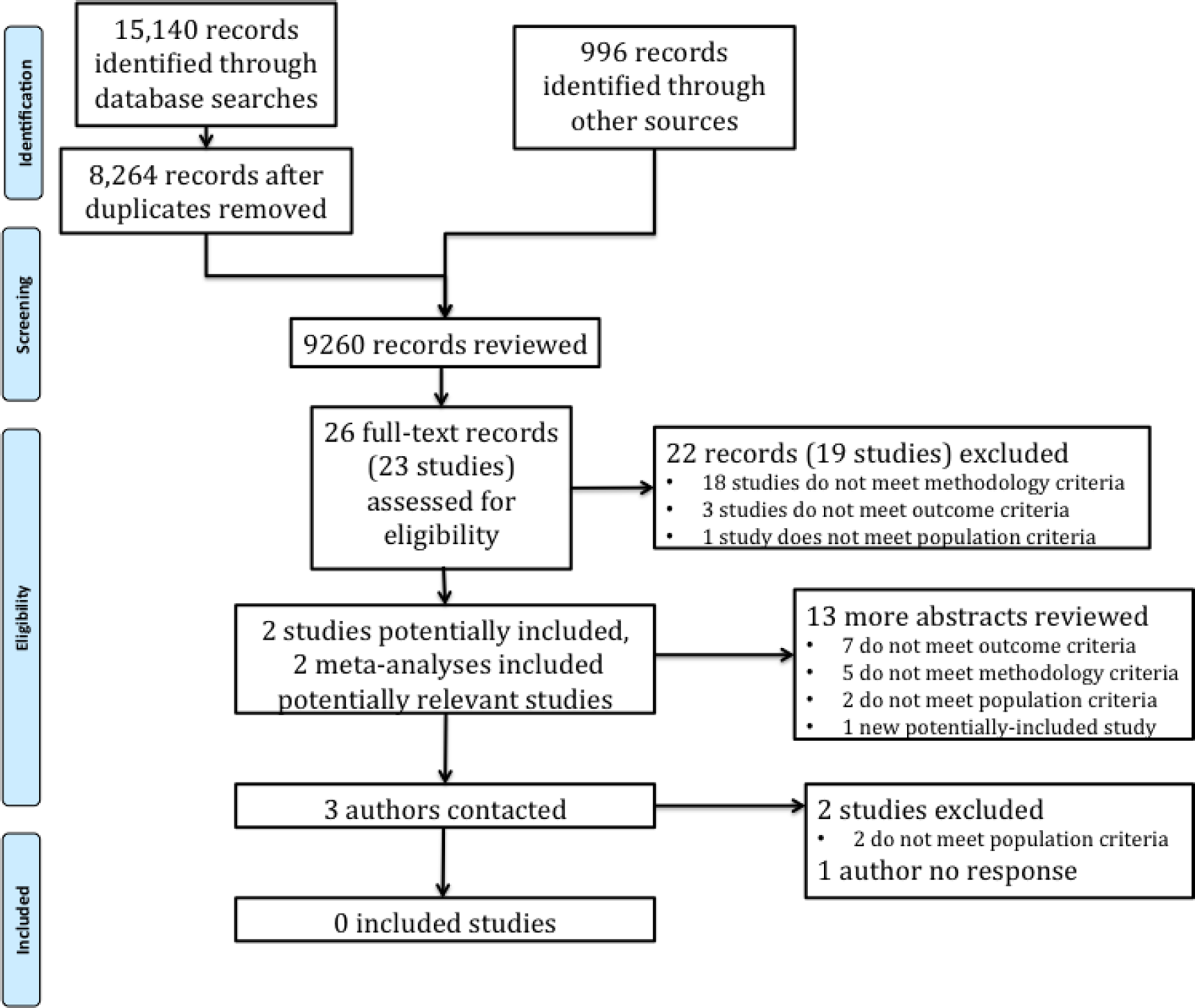
Flow chart for study selection
Of the 27 records (24 studies) reviewed in full text, 18 were excluded because they did not meet methodology criteria, 3 did not meet outcome criteria, 3 did not meet population criteria, and one author was nonresponsive. There were no disputes between the two review authors regarding the inclusion/exclusion of studies.
4.2 INCLUDED STUDIES
No studies met the inclusion criteria. Consequently, evidence of effectiveness could not be examined.
4.3 EXCLUDED STUDIES
Most of the citations were excluded on the basis of title and abstract. Section 8.4 provides details of reasons for exclusion of the 27 reviewed in full text.
4.4 ONGOING STUDIES
We were able to locate one potentially relevant ongoing study, dated September 2013-March 2016 and entitled ‘Optimising refugee resettlement in the UK: a comparative analysis‘. The study is led by Dr Michael Collyer, Prof Rupert Brown, Dr Linda Morrice, and Dr Linda Tip at the University of Sussex. It seeks to compare three locations in terms of integration outcomes for resettled refugees and find the key determinates of integration outcomes among resettled refugees, especially subjective well-being, self-efficacy, and perceived social acceptance (Sussex Centre for Migration Research, 2014).
5 Discussion
The questions in this systematic review – about 1) whether interventions designed to improve the economic self-sufficiency and well-being for resettled refugees affect participants' labour force participation, employment, use of cash assistance, income, job retention, and quality of life, and 2) whether effects differ depending on programme content, programme provider, populations served, or the setting – are of great importance. First, these questions are crucial to those who are forcibly displaced and to the millions who have been resettled over the past 30 years, beginning their life in a new country. Resettled refugees often prioritize outcomes such as employment as important in their own lives (Valtonen, 1998). Second, these questions are of upmost importance to the governments, non-governmental organisations, practitioners and communities who assist in refugee resettlement programmes. Refugee resettlement programmes are often long-standing with 26 countries having resettlement programmes with UNHCR as of 2012. The three largest resettlement countries have some form of economic self-sufficiency as central to their programmes, and the US currently invests of $1 billion per year in refugee resettlement programming.
No studies met the review's inclusion criteria. We reviewed 27 records, corresponding to 24 studies, and excluded all of them. The studies reviewed and excluded were limited in their ability to answer questions of causal effects with minimal potential for bias, and most were excluded for failing to meet methodology criteria. Many of the studies we excluded were carried out retrospectively or had a non-randomised design without a control or comparison group. The inclusion criteria were designed to isolate study designs that had potential to reveal not only if the refugees who receive the intervention improved their outcomes, but also if the improvement was caused by the intervention.
The absence of evidence found in this review is not evidence of absence of effects of these resettlement interventions (Montgomery et al, 2011; Schlosser & Sigafoos, 2009). Programmes may be improving outcomes or may even be causing harm, but it is not possible to conclude beyond the evidence.
This review was designed with clear questions and scientific rigor to minimize bias, as per the principles of the Cochrane Collaboration and the practice of systematic reviewers.
5.1 LIMITATIONS OF STUDIES
No studies were included in this review.
5.2 IMPLICATIONS FOR RESEARCH, PRACTIONERS AND POLICY
This review points to a clear need for future research using prospective, controlled designs (RCT or QED) to examine the effects of interventions on the economic self-sufficiency and well-being of resettled refugees. Other research designs may be insufficient; for example, retrospective studies and those with non-randomised designs without a control or comparison group make it difficult to isolate effects to the intervention rather than to other changes that happened during the time the study took place. Prospective, controlled designs have been used to determine the effects of employment, economic self-sufficiency and well-being interventions with other populations (Office of Planning Research and Evaluation, 2013). We believe that greater investment should be made in studies with this type of design, given the importance of this resettled refugee population and of economic self-sufficiency and well-being in policy.
Furthermore, several of the reports we excluded did not provide clear information on the population studied. Studies should specify whether the refugees in the sample arrived as asylum-seekers or through government resettlement, as this may affect their reception experience, including services they are entitled to receive, their ability to find employment, and their well-being.
For practitioners and policymakers, it is important to point out that this review did not find any evidence for or against interventions.
5.3 PLANS FOR UPDATING THE REVIEW
The authors aim to update the review within three years.
6 Acknowledgements
This systematic review was completed through the support of the Oxford Centre for Evidence-Based Intervention and the Campbell Collaboration. The lead reviewer was supported by the Rhodes Trust and Truman Foundation. We would like to thank Marie Hull for her assistance in obtaining one of the full papers and to all of the authors and researchers who responded to inquiries for their cooperation and assistance.
Footnotes
Appendices
1
Categories specified based on experience and literature. May be modified based on obvious splits for included studies. For use only if sufficient studies for meta-analysis.
2
This last measure is an endogenous subgroup, which would not be included in analyses. The population of those who find jobs may be influenced by the interventions (i.e. the populations may be different between the private-sector and standard services). Thus, the comparison of the number of days between the two groups would be looking at two subgroups that may not be equivalent due to the interventions.