






Abstract
This review synthesizes the evidence on the effectiveness of juvenile curfews in reducing criminal behavior and victimization among youth.
Included studies test the effect of an official state or local policy intended to restrict or otherwise penalize a juvenile's presence outside the home during certain times of day. This must have been a general preventive measure directed at all youth within a certain age range and not a sanction imposed on a specific youth.
Twelve quantitative evaluations of the effects of curfews on youth criminal behavior or victimization are included in the review.
Synopsis/Plain Language Summary
The evidence suggests that juvenile curfews do not reduce crime or victimization.
Curfews restrict youth below a certain – usually 17 or 18 – from public places during nighttime. For example, the Prince George's County, Maryland, curfew ordinance restricts youth younger than 17 from public places between 10 P.M. and 5 A.M. on weekdays and between midnight and 5 A.M. on weekends. Sanctions range from a fine that increases with each offense, community service, and restrictions on a youth's driver's license. Close to three quarters of US cities have curfews, which are also used in Iceland.
A juvenile curfew has common sense appeal: keep youth at home during the late night and early morning hours and you will prevent them from committing a crime or being a victim of a crime. In addition, the potential for fines or other sanctions deter youth from being out in a public place during curfew hours.
Juvenile curfews have received numerous legal challenges. The constitutional basis for infringing the rights of youth rests on the assumption that they reduce juvenile crime and victimization.
This review synthesizes the evidence on the effectiveness of juvenile curfews in reducing criminal behavior and victimization among youth.
What studies are included?
Included studies test the effect of an official state or local policy intended to restrict or otherwise penalize a juvenile's presence outside the home during certain times of day. This must have been a general preventive measure directed at all youth within a certain age range and not a sanction imposed on a specific youth.
Twelve quantitative evaluations of the effects of curfews on youth criminal behavior or victimization are included in the review.
Do curfews reduce crime and victimization?
The pattern of evidence suggests that juvenile curfews are ineffective at reducing crime and victimization. The average effect on juvenile crime during curfew hours was slightly positive - that is a slight increase in crime - and close to zero for crime during all hours. Both effects were not significant. Similarly, juvenile victimization also appeared unaffected by the imposition of a curfew ordinance.
However, all the studies in the review suffer from some limitations that make it difficult to draw firm conclusions. Nonetheless, the lack of any credible evidence in their favour suggests that any effect is likely to be small at best and that curfews are unlikely to be a meaningful solution to juvenile crime and disorder.
Other studies have suggested curfews may be ineffective as juvenile crime is concentrated in hours before and after school, and that under-resourced police forces focus on more urgent demands than enforcing curfews.
Contrary to popular belief, the evidence suggests that juvenile curfews do not produce the expected benefits. The study designs used in this research make it difficult to draw clear conclusions, so more research is needed to replicate the findings. However, many of the biases likely to occur in existing studies would make it more, rather than less, likely that we would conclude curfews are effective. For example, most of these studies were conducted during a time when crime was dropping throughout the United States. Therefore, our findings suggest that either curfews don't have any effect on crime, or the effect is too small to be identified in the research available.
The search for this review was updated in March 2014, and the review published in March 2016.
The Campbell Collaboration is an international, voluntary, non-profit research network that publishes systematic reviews. We summarise and evaluate the quality of evidence about programmes in social and behavioural sciences. Our aim is to help people make better choices and better policy decisions.
This summary was prepared by Howard White (Campbell Collaboration) and is based on the Campbell Systematic Review 2016:0X ‘Juvenile Curfew Effects on Criminal Behavior and Victimization: A Systematic Review’ by David B. Wilson, Charlotte Gill, Ajima Olaghere, and Dave McClure. Anne Mellbye (R-BUP) designed the summary, which was edited and produced by Tanya Kristiansen (Campbell Collaboration).
Executive Summary/Abstract
BACKGROUND
A juvenile curfew has a common sense appeal: keeping youth at home during the late night and early morning hours will prevent them from committing a crime or becoming a victim of a crime. This appeal has led to the popularity of curfews, at least within the United States and Iceland. However, prior reviews have questioned the effectiveness of curfews.
OBJECTIVES
The aim of this review was to synthesize the evidence on the effectiveness of juvenile curfews in reducing criminal behavior and victimization among youth.
SEARCH METHODS
The systematic search was conducted between January 20, 2014 and March 5, 2014. The search strategy yielded 7,349 titles and abstracts. The initial screening identified 100 of these as potentially relevant and in need of a full text review for study of eligibility. Fifteen documents representing 12 unique studies were found to be eligible and then coded.
SELECTION CRITERIA
To be eligible, a study must have tested the effect of an official state or local policy intended to restrict or otherwise penalize a juvenile's presence outside the home during certain times of day. This must have been a general preventive measure directed at all youth within a certain age range and not a sanction imposed on a specific youth. All quantitative research designs were eligible. An eligible study must have assessed the effect of a curfew on either juvenile criminal behavior or juvenile victimization. The manuscript, published or unpublished, must have been written in English and reported on data collected after 1959.
DATA COLLECTION AND ANALYSIS
The typical evaluation design of an eligible study was a variant on an interrupted time-series. To accommodate these designs, the effect size used in this synthesis was the percent change in the crime or victimization rate during the period of time with a curfew relative to a baseline period, adjusting for any overall linear time trend. The outcomes of interest included crime and victimization, which were categorized by time of day (curfew hours, non-curfew hours, or all hours) and offender or victim age (juvenile or adult). The effects during non-curfew hours and the effects for adults served as control outcomes; that is, outcomes that should be unaffected by a curfew.
RESULTS
The pattern of evidence suggests that juvenile curfews are ineffective at reducing crime and victimization. The mean effect size for juvenile crime during curfew hours was slightly positive (reflecting a slight increase in crime), whereas it was essentially zero for crime during all hours. Both effects were non-significant. Similarly, juvenile victimization also appeared unaffected by the imposition of a curfew ordinance.
AUTHORS' CONCLUSIONS
The evidence suggests that juvenile curfews are ineffective at reducing crime or victimization. This is not, however, a conclusive finding. The observational nature of the research designs creates potential sources of bias and, as such, the findings need additional replication. However, many of the most plausible biases should have increased the likelihood of finding an effect. In particular, most of the studies reviewed were conducted during a time period when crime was decreasing throughout the United States. Thus, it appears that juvenile curfews either have no effect on crime and victimization or the effect is too small to be reliably detected with the data available.
Linked article:
1 Background
On July 4, 2011, more than 80 youth were involved in a series of violent altercations in downtown Silver Spring, Maryland, USA. This community is in Montgomery County, Maryland, near the northern tip of Washington, DC. These youth were from several different gangs, according to police (Laris & Morse, 2011), and came to downtown Silver Spring from the adjoining jurisdictions of Washington, DC, and Prince George's County, Maryland, both of which have juvenile curfew ordinances. The altercations took place over a two-hour period and resulted in the stabbing of one participant. Calls for a juvenile curfew grew from this incident, along with another incident, a “flash mob” theft, that occurred elsewhere in the county later in the summer. This incident involved a large number of youth descending on a convenience store in the early hours of the morning and collectively shoplifting whatever they could carry (Jouvenal & Morse, 2011).
A Washington Post editorial argued for the proposed juvenile curfew but stated that, “contrary to the hyperbole that has marked Montgomery County's debate about setting a youth curfew, the proposal is neither a draconian infringement of teen rights nor a miraculous cure-all to juvenile crime. It is merely a common-sense approach that police believe would be a useful tool in protecting public safety” (Editorial, 2011). As the editorial implied, some individuals and groups strongly supported the curfew proposal whereas others strongly opposed it. Two of the authors of this systematic review attended a community event in Montgomery County where the proposed curfew bill was discussed and can attest to the conviction that some members of the public have regarding the common sense value of a curfew for reducing youth crime and the potential for victimization. Ultimately, however, the proposed curfew was not adopted.
The focus of this systematic review is to examine whether this common sense notion about the effectiveness of a juvenile curfew is supported by statistical evidence. As will be shown, the findings show no clear pattern of benefit for a juvenile curfew in terms of reducing crime or victimization.
1.1 OVERVIEW OF JUVENILE CURFEWS
Juvenile curfews encompass a variety of restricted activities and sanctions implemented with the intention of controlling delinquency and increasing public safety. Curfews are built upon the assumption that “restricting the hours when young people may be in public should limit their opportunities to commit crimes or become victims” (McDowall, 2000, p. 59). With this underlying logic, such policies can take a variety of forms, including variations in targeted age groups, hours of operation, exceptions to the policy, and sanctions for violations (e.g., Ford, 1994, p. 1679; Ruefle & Reynolds, 1995).
Typically, curfews are directed at all youth under the age of 18 and are enforced during the late evening through to the early morning hours, although it is also common for a curfew to be restricted only to those under 17. The hours of enforcement often differ between weekdays and weekends, or holidays. For example, the Prince George's County, Maryland, curfew ordinance restricts youth younger than 17 from public places between 10 P.M. and 5 A.M. on weekdays and between midnight and 5 A.M. on weekends. Exemptions are also common, such as for youth accompanied by a parent or guardian, youth returning home from a place of employment, and youth traveling to or from a religious event. Sanctions can range from a fine that increases with each offense, community service, and restrictions on a youth's driver's license. It would be atypical for a curfew offense to result in some form of detention, but such a sanction is often permissible under the law.
There are other forms of curfew ordinances that restrict certain activities rather than the general public movement of juveniles. An example is graduated driver licensing laws that prohibit youth aged 16 to 18 from driving at night or carrying more than a set number of passengers (Foss & Evenson, 1999; Hartling et al., 2004). Another variation is a curfew specific to an adjudicated juvenile and is part of her sentence or condition of probation.
For the most part, curfews that apply to all youth of a certain age are a United States phenomenon with a history dating back over one hundred years (see Adams, 2003 for a brief history). A survey conducted in 1994 showed that 77% of American cities with populations of 200,000 or greater had a juvenile curfew policy (Ruefle & Reynolds, 1995). Similarly, a 1995 survey showed that 73% of the 200 largest American cities reported having a curfew ordinance (Ruefle & Reynolds, 1996). A study by the U.S. Conference of Mayors (1997) showed that 70 percent of the mayors, or an appropriate representative, from 272 cities with a curfew believed that their policy was effective. Bannister et al. (2001) suggest that most jurisdictions that impose a curfew consider it to be effective at reducing juvenile delinquency. Curfew policies have also found support among the public, particularly residents of jurisdictions in which they are used. Nelson (as cited in Ruefle & Reynolds, 1996) found that 92 percent of 300 adult residents of Cincinnati, Ohio supported the city's curfew, and 72 percent reported that it made them feel safer. Fisher (as cited in Ruefle & Reynolds, 1996) also found majority support for a proposed curfew in Mobile, Alabama. Good (2006) reports that 96 percent of surveyed residents in cities with curfew policies viewed the laws as “very or somewhat effective for combating juvenile crime in their communities,” and 93 percent considered curfew enforcement a good use of police resources.
Iceland passed a Child Protection Act in 2002 that included a curfew that affects all children aged 16 or younger (Curfew, n.d.). In the United Kingdom, the Anti-social Behaviour Act of 2003 included a curfew element that allowed police officers to take youth under the age of 16 home if found unsupervised on the streets between 9 P.M. and 6 A.M. (Smithson & Flint, 2006). However, this element of the Act was ruled illegal by the High Court and was only in effect for a short period of time. Yet, curfew orders for individual juveniles adjudicated for a crime are used in Britain. In the 1990s, there was growing demand for juvenile curfews in Canada, but none has been implemented given that they would violate the rights of youths as defined by the Canadian Charter of Rights (Howe & Covell, 2001). We have been unable to identify any countries other than the United States and Iceland that have general juvenile curfews which apply to all youth of certain ages within a given jurisdiction (see also, Curfew, n.d.).
1.2 HOW CURFEWS MIGHT AFFECT CRIME
The logic supporting the effectiveness of juvenile curfews is simple: keep youth home during the late evening and early morning hours and you will prevent them from committing a crime and becoming a victim of a crime (Adams, 2003; Levesque, 2014; McDowall, 2000) . Reduced opportunity to commit crimes should translate into fewer crimes. Furthermore, the potential for fines or other sanctions is presumed to deter youth from being out in a public place during curfew hours. It is also argued that curfews provide police with a useful tool for managing youth in public places during the curfew hours. Finally, curfews may make it easier for parents to enforce a rule for when a youth must be home in the evening (Ruefle & Reynolds, 1995).
The soundness of the above logic has been questioned. An argument against the effectiveness of curfews is that most crimes by juveniles, particularly those against persons, are committed in the hours before and after school (Gottfredson & Soule, 2005). Thus, any possible effect on juvenile crime is constrained by the small proportion of juvenile crime occurring during curfew hours. Additionally, it is rare for curfew ordinances to be associated with increased law enforcement resources, reducing the likelihood of effective enforcement. Studies have shown that overstretched and under-resourced police departments may forego the enforcement of a curfew law in favor of focusing on more urgent demands (McDowall, 2000, p. 59; Bannister et al., 2001, p. 237; see also Reynolds et al., 2000; Watzman, 1994). Thus, having a curfew ordinance in place does not always translate into vigorous enforcement, further limiting any potential effect.
1.3 LEGAL CHALLENGES
Juvenile curfews have received numerous legal challenges. Bast and Reynolds (2003) present a detailed discussion of four legal cases brought against a curfew ordinance within the United States. Two of these curfew ordinances were upheld and two were struck down. A common basis for these challenges was that the curfew ordinance violated the civil rights of adolescents (most of whom are not adjudicated delinquents) by restricting their freedom of movement or other individual liberties (Ford, 1994, p. 1694; see also Bannister et al., 2001; Cole, 2003; Fried, 2001; Simpson & Simpson, 1993; Watzman, 1994; White, 1996) . As discussed above, attempts to institute juvenile curfews in the United Kingdom and Canada failed on the basis that they would violate the rights of youth. The U.S. Supreme Court has yet to review the constitutionality of juvenile curfews. Watzman (1994) argues, however, that the more exceptions for “acceptable activities” (for example, legitimate employment) a given policy provides, the more likely it is to survive a challenge on constitutional grounds.
Fried (2001) argued that an important legal consideration in the debate over the constitutionality of juvenile curfews is their effectiveness. The legal justification for restricting the rights of juveniles rests on the state's interest in protecting juveniles from victimization and in reducing juvenile crime. If juvenile curfews are found to be ineffective in furthering these interests, then legal challenges may become more successful within the U.S. context. However, as argued by Bast and Reynolds (2003), the certainty of the evidence on effectiveness needed for a legal justification is likely to be low, only needing to establish a reasonable expectation of positive benefits.
1.4 PRIOR REVIEWS
Prior reviews have questioned the effectiveness of curfews for preventing crime and victimization. The most comprehensive review was by Adams (2003; see also, 2007). He identified ten relevant studies that measured criminal offending or victimization using a research design that allowed for at least a pre-post comparison of outcomes. Most of these studies reported no change in crime rates as a result of the curfew ordinance. According to Adams, where changes were observed, they were just as likely to reflect an increase in crime as a decrease. He also noted that curfew enforcement rarely resulted in the detection of serious offenses. McDowall (2000) drew similar conclusions from an examination of six evaluations of curfew policies, stating that the body of research showed little to no preventive effect, with the most promising studies indicating no more than a modest crime reduction attributable to the curfew. McDowall noted that all of the research designs in these studies had substantial weaknesses.
1.5 CONTRIBUTION OF THIS REVIEW
Juvenile curfews affect a large percentage of juveniles within the United States and their use is based on the assumption that they reduce juvenile crime and victimization. The constitutional basis for infringing on the rights of youth also rests on this assumption. Prior reviews, such as that of Adams (2003), have questioned the effectiveness of juvenile curfews. This review will update prior reviews with newer studies and apply meta-analytic techniques to the evidence, something not done in prior reviews.
2 Objectives
The aim of this review was to synthesize the evidence on the effectiveness of juvenile curfews in reducing juvenile criminal behavior and juvenile victimization. The type of curfew of interest was a general, civilian curfew that affects all youth of a specified age within a given jurisdiction.
3 Methods
3.1 CHANGES TO METHODS FROM THE PROTOCOL
A few changes from the methods detailed in the protocol were necessary given the complexities of this review. However, these changes were consistent with the objectives of the review.
The eligibility criteria were modified in two ways. First, the text was edited to improve clarity and readability. Second, we relaxed the research design criteria to include simple pre-post studies, that is, studies with only a single crime rate estimate for both the pre- and post-curfew periods. Because these studies are at high risk of bias, they were kept separate in analyses and forest plots, and were not used in our overall assessment of the effects of juvenile curfews. The purpose of including these studies was to fully document all identifiable quantitative estimates of the effects of curfews on juvenile crime and victimization.
The protocol stated that effect sizes were to be coded as percent change in the crime rate, ideally adjusted for any time trend. The details of how these computations were to be carried out were not specified. The methods that were developed during the course of this review remain consistent with the goals of the protocol and are detailed in Section 3.4.2.
One item was added to the risk of bias assessment that addressed maturation bias, or change over time. Natural change over time confounded with the adoption of a curfew ordinance is an important potential source of bias. Studies with too few baseline time points given the type of data were judged as at high risk for this type of bias.
Finally, we dropped an item from the risk of bias assessment: the items addressing statistical concerns related to the appropriateness of the statistical analysis given the data. Because our synthesis of findings relied almost exclusively on descriptive data and not on inferential models provided by the authors of the included studies, this item was not informative in assessing the credibility of the effect sizes that were the basis of our review. Furthermore, we were unable to develop clear guidelines for assessing the appropriateness of the statistical models used across the eligible studies.
3.2 CRITERIA FOR CONSIDERING STUDIES FOR THIS REVIEW
3.2.1 Type of curfew ordinance evaluated
Eligible studies must have tested the effect of an official state or local policy intended to restrict or otherwise penalize a juvenile's presence outside the home during certain times of day. The curfew policy must have been a general preventive measure directed at all youth within a certain age range. Thus, we excluded studies that examined curfews imposed as part of a specific sentence or probation condition for an individual youth. The curfew ordinance must have been passed as a measure to improve public safety through the specific targeting of juvenile crime and delinquency; military or riot curfews directed at all citizens were excluded. Also excluded were ordinances that solely placed restrictions on youth driving. Curfew policies that included exemptions for certain types of legitimate activity, such as employment, were eligible, as most curfews have such exemptions.
3.2.2 Types of research designs
All quantitative evaluation designs were eligible. We expected that most studies of juvenile curfews would have been conducted at the macro- or aggregate-level (i.e., comparing crime and delinquency rates in jurisdictions where policies are imposed to rates in the same jurisdiction prior to the policy, or to comparable jurisdictions that do not impose a curfew). Such designs are often called ecological studies (Hingson, Howland, Koepsell, & Cummings, 2001). This expectation stemmed from the nature of the intervention. Curfews are imposed categorically on all juveniles living within a specific geographic area. As such, randomized controlled trials at the individual-level are not possible. Although randomized controlled trials at the jurisdiction (or geographic) level were eligible, we anticipated that these were highly unlikely to exist given the legal nature of curfews. Jurisdictions legally cannot agree to a study where a random process determined whether they would pass or not pass a juvenile curfew ordinance.
The strongest study design we expected to find was an interrupted time-series, including designs with multiple series across different cities (i.e., panel studies). For our purpose, an interrupted time series involves multiple measurements of the outcome both before and after the curfew ordinance went into effect. Interrupted time-series designs are often considered one of the stronger quasi-experimental designs (e.g., Shadish, Cook, and Campbell, 2002). The primary threat to internal validity for this design is a historical artifact - that is, some other change coinciding with the imposition of the curfew that might account for the change in crime rates. A variant on this is a study with multiple interrupted time-series with one or more series serving as a comparison, such as a community that did not implement a curfew. These have clear advantages over a simple single time-series in that broad-scale historical effects can be statistically controlled for given the staggered timing of the start of the curfew laws. These designs also account for regression to the mean (see Kline, 2012).
Micro-level studies at the individual level were eligible. For example, a study might compare youth living in various jurisdictions, some with and some without a curfew. Similarly, non-equivalent comparison group designs at the macro-level that contrast crime rates for communities with and without curfews were eligible.
A simple pre-post analysis at the macro-level is similar to an interrupted time-series, but lacks the necessary multiple pre- and post-measurement time points (i.e., they don't have a series of observations for each time period). These studies are at high risk of bias given that there is no assessment of the underlying trend in the crime rate (i.e., whether crime was already increasing or decreasing before the start of a curfew). These designs were eligible, but were kept separate in all analyses and figures and did not weigh into our overall assessment of the effectiveness of juvenile curfews. We included them to fully document the statistical evidence on this topic. For a study to be included in this synthesis, it must have been possible to compute an index of the effect of the curfew on crime or victimization.
3.2.3 Types of participants
Juvenile curfews do not have participants in the typical sense. To be eligible, the curfew ordinance must have applied to youth within a specified age range within a given jurisdiction.
3.2.4 Types of outcome measures
Eligible studies had to have measured and reported data on at least one of the two primary outcomes of interest: juvenile crime or juvenile victimization (where a youth is the victim of a crime). Outcome data may have been based on official records (arrests, charges, convictions, etc.) or self-reported measures. These outcomes may have reflected crime only during the curfew hours or crime at any time of day. For example, a study may have reported the total juvenile arrest rate by month with this rate reflecting both curfew and non-curfew hours combined. The logic of accepting the latter as a valid primary outcome is that curfews are intended to reduce juvenile offending overall, and not just displace crimes from the curfew to non-curfew hours. Similarly, victimization data might reflect victimization during curfew hours or victimization at any time of day.
The secondary outcomes examined in this review are better conceptualized as control outcomes. That is, outcomes that should be unaffected by a curfew ordinance. These include adult crime rates and juvenile crime rates during non-curfew hours. No other outcome measures were coded as part of this review.
3.2.5 Types of settings
Eligible studies could have been conducted in any country and published in any form. Given the linguistic limitations of the authors, only English language publications were eligible. We worked with our international contacts within the Campbell Collaboration to learn which countries were likely to have used and evaluated juvenile curfew ordinances so that we could target our searches appropriately. As discussed in the Background section of this review (Section 1), only the United States and Iceland have or currently make use of the type of curfews eligible for this review. We were unable to identify any Icelandic studies. Thus, the English language restriction is unlikely to have resulted in the exclusion of any study (i.e., we are not aware of any other eligible study reported in a language other than English).
We restricted this review to studies using data collected after 1959. The generalizability of any study conducted prior to 1960 to the present is questionable given the markedly different current social and legal context.
3.3 SEARCH METHODS FOR IDENTIFICATION OF STUDIES
The systematic search was conducted between January 20, 2014 and March 5, 2014. Two categories of keywords were developed for this search. The first category lists key terms and synonyms related to juvenile curfew policies. The second category addresses measured study outcomes, including terms such as crime, delinquency, arrest, etc. The intention of separating the terms in this manner was to include all the potentially relevant results while simultaneously excluding the large bodies of literature on parenting and adolescent development from non-criminological disciplines. These two sets of keywords were combined with the Boolean operator, “AND.”
1. Intervention of interest
CURFEW and (JUVENILE* or YOUNG* or YOUTH* or MINOR* or CHILD* or KID* or TEEN* or ADOLESCEN* or PUBESCENT*)
2. Outcomes of interest
CRIM* or DELINQUEN* or ARREST* or DETAIN* or DETENTION or “CALL* FOR SERVICE ” or OFFEND or ADJUDICAT* or STATUS or VICTIM* or SAFE* or FEAR* or DRUG* or ALCOHOL* or LOITER* or STEAL* or STOLE* or THEFT or JOYRIDE or JOY-RIDE or “JOY RIDE” or VANDAL* or GANG or VIOLEN* or ASSAULT or FIGHT*
The specific search string used was adjusted for each database. For example, searches were initially run using only the “intervention of interest” keywords. If the search yield returned was over 1,000, then the search was restricted using the “outcomes of interest” keywords. Furthermore, databases differ in terms of the sophistication of the searches that are possible and we took advantage of these differences.
The following electronic databases were searched: AIC – Australian Institute of Criminology; ASSIA – Applied Social Science Index and Abstracts; CINCH (the Australian Criminology Database) via Informit; Criminal Justice Abstracts; EconLit; First Search – Dissertation Abstracts; Google Scholar; HeinOnline; Jill Dando Institute of Crime Science (JDI) via OVID; NCJRS (National Criminal Justice Reference Service); Policy Archive; PolicyFile; Criminal Justice Periodicals (now ProQuest Criminal Justice); Dissertations & Theses: Full Text; Evidence-Based Resources from the Joanna Briggs Institute; PubMed; PsycINFO; Public Affairs Information Service; RAND Documents; Social Sciences Citation Index; Social Services Abstracts; Sociological Abstracts; Social Science Research Network (SSRN); Worldwide Political Science Abstracts.
The following organizational websites were searched for potential grey literature studies: Association of Chief Police Officers (ACPO); Association of Chief Police Officers of Scotland (ACPOS); Association of Police Authorities (APA); Australian Research Council Centre of Excellence in Policing and Security (CEPS); Canadian Police Research Centre; Her Majesty's Inspectorate of Constabulary (HMIC); Home Office (UK); Medline/Embase; Ministry of Justice (UK); National Council for Crime Prevention (Sweden); National Institute of Justice; Office of Juvenile Justice and Delinquency Prevention; Scottish Institute for Policing Research SIPR; U.S. state juvenile justice agencies and court services.
Section 13 provides detailed notes regarding the search of each of these databases and websites, including the keywords used and yield.
3.4 DATA COLLECTION AND ANALYSIS
3.4.1 Data extraction and management
In addition to extracting effect size data as described in the next section, we coded descriptive information about the location of the research, the nature of the curfew, and the methodological characteristics of the study (see ‘Coding Manual’ in Section 14). All descriptive study information was double-coded and the first author resolved any differences. The first author coded effect sizes and all of the data and computations relevant to each effect size are presented in Section 9. Double-coding of effect sizes was not feasible given the complexity of these computations. However, a second coder verified the accuracy of the data used in these computations. At the time of coding, the second coder was a doctoral candidate with over three years of experience in working with systematic reviews and data extraction.
3.4.2 Measure of Treatment Effect
The most common research design was a macro-level examination of crime or victimization counts over time. Typical effect sizes, such as the standardized mean difference and the odds ratio, cannot be computed from the data generated by these designs. However, it is possible to use percent change in the crime or victimization count as the effect size.
A simple comparison of the relative pre-and post-crime count (or rate) associated with a curfew may be confounded with an underlying upward or downward trend in crime. For example, most of the studies included in this review were conducted in the United States during the late 1990s or early 2000s. This time period coincides with what is often referred to as the “great crime drop,” during which almost all categories of crime decreased across the country. Because of this, it was desirable to have a measure of the effect of a curfew that accounted for this underlying trend.
Five basic design types were used across the eligible studies: (1) an interrupted time-series with 26 or more time points (months or years), some before and some after the curfew ordinance went into effect; (2) a short interrupted time-series with 4 to 6 time points (e.g., years), with only 2 or 3 time points before and after the start of the curfew ordinance; (3) a simple pre-post comparison of counts (or rates) for one year before and one year after the adoption of a curfew; (4) regression analysis of crime rates for multiple cities or counties across multiple years; and (5) an individual level logistic regression analysis of juveniles geo-coded into locations with and without a curfew. Each of these designs requires a different method of effect estimation. The first step was to estimate the difference in the logged rate or count, ideally adjusted for any time trend. These logged rate differences were then converted into a percent difference, as explained below.
For studies that used an interrupted time-series design, percent change was estimated using a negative binomial model on the crime or victimization counts over time. Although count data such as these can be estimated with a Poisson model, crime data are typically over-dispersed and, as such, more appropriately handled with a negative binomial model. Both Poisson and negative binomial regression models produce comparable coefficients, but the latter produces larger standard errors unless the data are not over-dispersed. Data were extracted from tables (if available) or figures, and inputted into the statistical software program ‘R‘. PlotDigitizer (see http://plotdigitizer.sourceforge.net) was used to extract data from figures. Data that reflected rates and not counts were converted into approximate counts using a constant population estimate before running the negative binomial model. This conversion does not affect the estimated effect, but does produce more accurate standard errors. The model estimated included a term for time (month or year) and a dummy code for whether the curfew policy was in effect (1=yes, 0=no). The coefficient for the curfew dummy reflects the difference in the log number of crimes for the post versus pre periods adjusting for any linear time trend.
The negative binomial model could not be used for short time-series (e.g., 4 to 6 time points) as there were insufficient data to estimate the over-dispersion parameter. However, these studies have sufficient data to estimate the curfew effect using a Poisson model. Given that the variance of the Poisson distribution equals the mean, a Poisson-based model can estimate the standard error of the coefficient even with only four data points, two prior to the curfew and two after the curfew. The standard errors from a Poisson model on these data are likely to be negatively biased (i.e., too small) given that these standard errors do not take into account any over-dispersion. Furthermore, the limited number of time points affects the precision of the estimate of the linear time trend. These potential biases with the estimates from these studies were considered when interpreting the results. As with the negative binomial, the coefficient for the curfew dummy variable reflected the difference in the log number of crimes for the post- versus pre-curfew period, adjusting for any linear time trend.
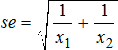
Studies that provided data on the rate or count of crimes or victimization for some period of time (usually one year) before and after the adoption of a juvenile curfew provided the weakest evidence on the effectiveness of the curfew. With such data it is not possible to estimate the underlying linear trend in the crime rate. Percent change, however, was computed as the difference in the two counts divided by the baseline value. We made use of the Poisson distribution for estimating the standard error. This made the assumption that these counts were Poisson distributed, as with the short time-series studies. The method used was adapted from Ng and Tang (2005). Assuming that the two time periods are equal (which they were in all cases), the standard error for the difference in the logged counts was computed as
The fourth design type used OLS regression to model the logged arrest rates for multiple cities over multiple years. Some or all of the selected cities experienced a change in curfew policy during the years examined. Because the dependent variable was logged, the regression coefficient for the curfew indicator variable is directly interpretable as the difference in the logged crime rates, post- versus pre-curfew, adjusted for the linear effect of year and any other covariates in the model. As such, the coefficient associated with the curfew was coded as the effect size. The standard error reported in the study for this coefficient was also used as the standard error used to compute the inverse variance weight. Note also that the percent change in rates is directly comparable to the percent change in counts, given that the former is simply the latter divided by a constant (the population).
Finally, a single study reported on a logistic regression model based on individual level data. This study produced an odds ratio as the estimate of the effect of a juvenile residing in a jurisdiction with a curfew, relative to a juvenile residing in a jurisdiction without a curfew. Converting an odds ratio into a percent change relative to a baserate requires knowing the baserate, which was not provided in this study. However, applying the same conversion that was used for the logged differences to the logged odds ratio produces a percent change in the odds relative to the baseline odds. This was done in this case to improve comparability across forest plots. The effect sizes from this study were not, however, combined with effect sizes from other studies.
Although different methods were used to compute the effect size across these different design types, the effects are comparable in that they all reflect percent change in crime counts or rates, with the exception of the logistic regression on individual data. The latter was treated separately in all analyses. Although the metric is the same across these different estimation methods, that is, percent change, the effect estimate do vary in their ability to isolate the curfew effect from other potential sources of change. As such, estimates that adjust for a linear time trend were handled separately from those that do not. The estimates based on multicity data over numerous years include covariates, such as population size. These covariates do not affect the metric of the effect size (it remains an index of percent change associated with the introduction of the curfew policy) but do remove potential sources of bias.
Meta-analyses were performed on the logged difference effect sizes generated by the above methods. However, the goal was to represent the effects as percent change. The standard equation for converting a logged difference in a count or rate into a percentage change is


3.4.3 Moderator analysis
We had proposed conducting moderator analyses that examined the pattern of evidence for different types of curfew policies, if possible. However, the number of studies with meaningfully different policies was too small to allow for any such analyses.
3.4.4 Assessment of risk of bias
The assessment of risk of bias in the study designs eligible for this study was challenging (see Hingson et al., 2001; Hartling et al., 2004). The typical quality assessment tools used in Cochrane and Campbell systematic reviews are designed for non-ecological studies that are implemented at the individual level or other units that can be assigned randomly to conditions (e.g., small geographic regions such as crime hot spots). The potential sources of bias that we were most concerned about across these studies and tried to assess were: Historical artifacts: anything that might be confounded with the intervention, such as other community or police initiatives directed at reducing crime. Measurement confounds: any changes in the way data were collected over time that might bias the findings, such as a changes in police recording practices. Selection bias: non-comparability of comparison communities at baseline, if relevant. Regression to the mean: selection of curfew locations or imposition of curfew ordinance based on a short-term spike in crime rates (e.g., a recent ‘crime wave‘). Outcome reporting bias: selected outcomes were reported in the study, meaning the study explicitly mentions having measured an outcome, such as juvenile crime rate during curfew hours, but does not provide results for the outcome that would allow for the computation of an effect size. Maturation bias: data inadequate to properly adjust for any underlying time trend (i.e., time period too short for the design used). A study was judged at risk for maturation bias if it used monthly data with fewer than 24 months both pre-curfew and post-curfew, or if it used yearly data with fewer than five pre-curfew years.
3.4.5 Unit of analysis issues
Multiple reports or manuscripts based on the same study or data were treated as a single entity. We selected the most complete reference as the primary document for coding. Other documents were used only if they provided unique information of relevance to this review. Section 7.1 lists all references used during the coding process. No meta-analytic synthesis included two effects from the same study sample.
3.4.6 Assessment of reporting biases
The number of effect sizes for each outcome of interest was too low for formal assessment of publication selection bias such as through the use of the Duval and Tweedie (2000) trim and fill method. However, we did search for and found unpublished studies.
3.4.7 Data synthesis
Random-effects inverse-variance weighted meta-analysis was used to synthesize effect sizes across studies. Analyses were performed on the difference in the logged counts or rates. The method-of-moments estimator of the random effects variance component,τ2, was used. Final results were converted into percent change, as discussed in Section 3.4.2. These analyses were performed using the metafor package in R, Version 1.9-5 (Viechtbauer, 2010). All R code used in the analyses and for producing the forest plots is presented in Section 12.
4 Results
4.1 DESCRIPTION OF STUDIES
4.1.1 Results of the systematic search
The search strategy yielded 7,349 references. Removal of duplicates reduced this to 6,499. A pre-eligibility screening of titles and abstracts identified 100 references potentially relevant to this review, including review articles or other pieces with relevant background information, such as legal discussions. Two coders examined these 100 documents in detail for eligibility. Fifteen documents representing 12 unique studies satisfied our eligibility criteria. As is often the case, several studies that were initially coded as eligible were later recoded as ineligible upon closer inspection. These studies and others that were near misses on eligibility are listed in Section 7.2.
Of the 85 references coded an ineligible, 42 were excluded as simply not relevant. That is, the publication did not examine any aspect of a juvenile curfew ordinance. Thirty studies were categorized as background articles, including review articles, editorials, or descriptions of curfew policies. Ten studies examined some aspect of a curfew other than its impact on juvenile crime or victimization, such as the differences in the characteristics of curfew violators versus non-violators or parental attitudes towards curfews. Finally, two were excluded because of insufficient information to compute an effect size and one had data collected prior to 1959.
4.1.2 Description of included studies
Tables 1 and 2 provide descriptive information on the included studies. As shown in Table 1, most of these studies were published in journal articles (9 of 12). Two were published as technical reports and one was a Master's thesis. The publication dates ranged from 1999 through to 2012; 10 of the 12 studies being published between 1999 and 2003, inclusively. All of these studies were conducted in the United States. These studies were based on data collected between 1980 and 2004, inclusively, with only two studies (Kline 2012 and McDowall et al. 2000) using data prior to 1990.
Study location, years data collected, and publication type
Curfew ordinance characteristics and study design information
Most of the studies examined a nocturnal curfew, as shown in Table 2, although two studies examined a daytime curfew during school hours. The age range affected by the curfew was typically 17 and under although a few only affected youth 16 and under or 15 and under. It is interesting to note that some curfew ordinances exclude children under the ages of 11 or 12. Presumably a curfew is unneeded for such young children given that police would intervene if they found an unaccompanied child less than 11 years of age out in public regardless of the existence of a curfew ordinance (at least within the United States).
Seven of the twelve studies used some form of interrupted time series design (see Table 2). These designs involved comparing the crime rate for some number of months or years prior to the curfew implementation to some number of months or years after the curfew implementation. These have been differentiated in Table 2 as either “ITS” or “Short ITS”. The latter are interrupted time-series designs with fewer than 10 total observational units (i.e., months or years). This distinction affected how effect sizes were estimated. The latter are also less able to effectively control for any time trend unrelated to the curfew.
It is worth noting that Cole (2003) used an ABAB interrupted time series design. This study used data from Washington, DC, where the curfew law was ruled unconstitutional after having been in effect for a period of 13 months. However, the ruling was later reversed and the curfew was reinstated a little over two years later. Taking advantage of this ‘turning on-and-off’ of the curfew, Cole compared the juvenile arrest rate across four time periods that alternated from a non-curfew period to a curfew period.
Two studies (Moscovitz et al., 2000; Rodabough & Young, 2002) collected short time-series type data, but collapsed the data such that there was only a single pre-curfew and post-curfew rate. Moscovitz and colleagues compared emergency medical services transportation of juveniles who were victims of an assault during a 3-month period in the year before a curfew went into effect with the same period after a curfew went into effect. Rodabough and Young compared juvenile arrest and victimization data for two one-year time periods: one year before the curfew was implemented and one year after the curfew was implemented. In Table 2, these two studies are categorized as pre-post designs.
Finally, three studies (Gius, 2011; Kline, 2012; McDowall et al., 2000) used a regression-based design. Gius (2011) used 1997 data from the National Longitudinal Survey of Youth (NLSY) that included the state and county of residence for each youth. This allowed for an examination of the effect of living in an area with a curfew based on self-reported criminal behavior of youth and, as such, reflects a cross-sectional analysis.
The Kline (2012) and McDowall et al. (2000) papers made use of city level data over several years (panel data). Essentially, these are multiple interrupted time-series analyzed in a single regression model. Kline (2012) analyzed a sample of 54 cities (with a 1990 population greater than 180,000 that began enforcing a curfew law during the years from 1980 through 2004. The regression models used logged arrest rates from the FBI's Uniform Crime Report (UCR). The regression model used an ‘event-study’ design to estimate the impact of curfew enactment. Kline (2012) claims that this model also accounts for any confounders related to a city enacting a curfew in response to an increase in arrests and any general time trends.
The McDowall et al. (2000) study used a similar design to Kline (2012). McDowall and colleagues included 11 years of FBI UCR arrest data for youths 17 and younger, and 19 years of homicide victimization data. Two sets of analyses were performed, one on 52 counties and the other on 12 city-counties. The former included counties where a change in the curfew law may have affected only a portion of the county. The latter included only the subset of cities or counties for which any change in a curfew law affected the entire city or county. We used only the latter as it is a more direct test of the effect of implementing a curfew, although the results for both sets of analyses lead to the same conclusion. As with the Kline (2012) study, McDowall et al. (2000) used the logged arrest rate as the dependent variable.
4.2 RISK OF BIAS IN INCLUDED STUDIES
All of the studies included in this synthesis are observational and therefore subject to risk of bias in terms of making a causal inference about the effects of a curfew. The risk of bias ratings are shown in Table 3. Arguably the four methodologically strongest studies were Cole (2003), Kline (2012), McDowall et al. (2000), and Roman and Moore (2003; also Gouvis, 2000). All used some variant of an interrupted time-series design of sufficient length to rule out many threats to their internal validity (see Shadish et al., 2002), such as a maturational effect. However, Cole (2003) was coded as at risk of regression to the mean, along with Fivella (200), Males and Macallair (1999), and Sutphen and Ford (2001) given a mention in their articles that the passage of the curfew ordinance was related to concern over high crime rates. This concern, however, may also be an issue for other studies, but was not mentioned by the authors.
Risk of Bias
The most serious issue across these studies was the possibility of a maturational bias, with seven of the twelve studies judged as at risk. This assessment was based on the inadequate number of data points over time. All three of the studies categorized as short interrupted time-series designs and both of the pre-post designs had too few baseline observations to adequately assess whether any decrease in crime associated with the start of the curfew was part of an existing change over time. In addition, two of the longer interrupted time-series designs were also judged as at risk of a maturation bias. These two studies (Fivella, 2000; Mazerolle et al., 1999) used monthly data and had only 26 and 23 months of data respectively, which was only one year before and one year after the start of the curfew. Only four studies were judged to have a time-series of sufficient length to adequately control for the potential bias: Cole (2003), Kline (2012), McDowall et al. (2000), and Roman et al. (2003). Cole (2003) and Roman et al. (2003) used monthly data with multiple years of baseline data, whereas Kline (2012) and McDowall et al. (2000) used yearly data across multiple cities.
None of the studies was assessed as being at risk of measurement confounding. Many made use of FBI UCR data that maintains consistency in how they are gathered over time. Furthermore, no studies made mention of concerns regarding the measure of crime or victimization.
A potential threat to the validity of these studies is that another intervention, incident, or policy change is confounded with the start of the curfew ordinance. This is difficult to assess and requires knowledge of local conditions. Three studies (Fivella, 2000; Kline, 2012; Males, 1999) make mention of a possible historical artifact, such as the start of midnight basketball programs. However, other studies may have similar problems, potentially without the awareness of the researchers.
For selection bias to be an issue there must be a comparison condition. Only the three regression-based studies are at risk for this threat (Gius, 2011; Kline, 2012; McDowall et al., 2000). Given the observational nature of all three of these studies, it is possible that the regression models omitted an important variable. However, the Kline (2012) and McDowall et al. (2000) studies included the baseline crime rates in the models, reducing the potential magnitude of any selection bias. For the Gius (2011) study, several characteristics of the juveniles were included in the model to adjust for risk of delinquency. Furthermore, in this study the juveniles do not self-select into curfew and non-curfew areas.
In our assessment, the three regression-based studies (Gius, 2011; Kline, 2012; McDowall et al, 2000), along with the interrupted time-series studies by Cole (2003) and Roman and Moore (2003), provided the strongest assessment of the effects of curfews. However, all studies in this synthesis are subject to at least some risk of bias.
4.3 SYNTHESIS OF RESULTS
Twenty-four effect sizes were computed across the 12 studies. These effects represent both criminal behavior and victimization. effects were coded for both juveniles and adults during curfew hours, non-curfew hours, and all hours. Where possible, effects were adjusted for a time trend. All coded effects are shown in Table 4 and mean effects are shown in Table 5.
All computed effect sizes
Random effects mean percent change and related statistics
Fivella (2000) dropped
4.3.1 Effect on crime
A primary purpose of a curfew is to reduce the number of crimes committed by juveniles. The pattern of evidence across these studies suggests that curfews do not accomplish this goal. The strongest evidence comes from the effects adjusted for a time trend for the outcomes of juvenile crime during curfew hours and during all hours (see Figures 1 and 2). Two studies provided effect sizes for the effects of curfews on juvenile crime during curfew hours. Both studies found a small increase in crime with an overall mean percent change of 9.5% (95% confidence interval of -9.1% to 24.9%, p = 0.292). This mean effect is not statistically significant and has a fairly large confidence interval. Eight studies provided estimates of the percent change in juvenile crime during all hours (curfew and non-curfew). The overall mean was very close to zero (0.5% change in juvenile arrests with a 95% confidence interval of -9.8% to 8.1%, p = 0.915) with five studies reporting small increases in crime, one a near zero effect, and two a decrease in crime. One of these effects (Fivella, 2000) was substantial, representing a 46% decrease in juvenile arrests across both curfew and non-curfew hours. This is a clear outlier. Given that a relatively small proportion of juvenile crime occurs during curfew hours, this large effect is only possible if crime dropped substantially during both curfew and non-curfew hours. Removing this effect from the meta-analysis, however, produces roughly the same result, although with substantially less heterogeneity (see Table 5).
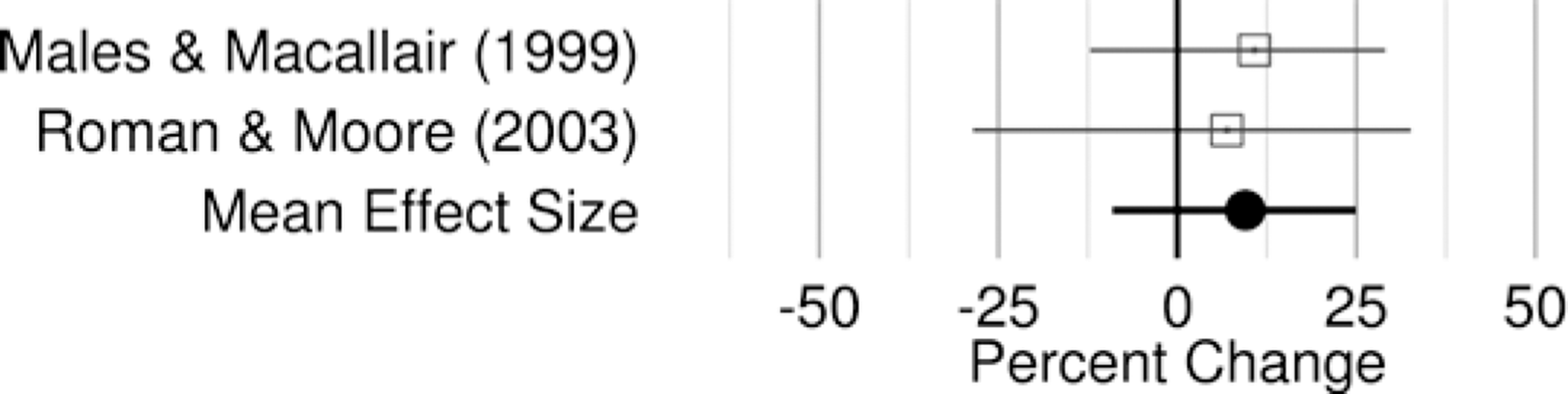
Juvenile crime during curfew hours – adjusted for time trend
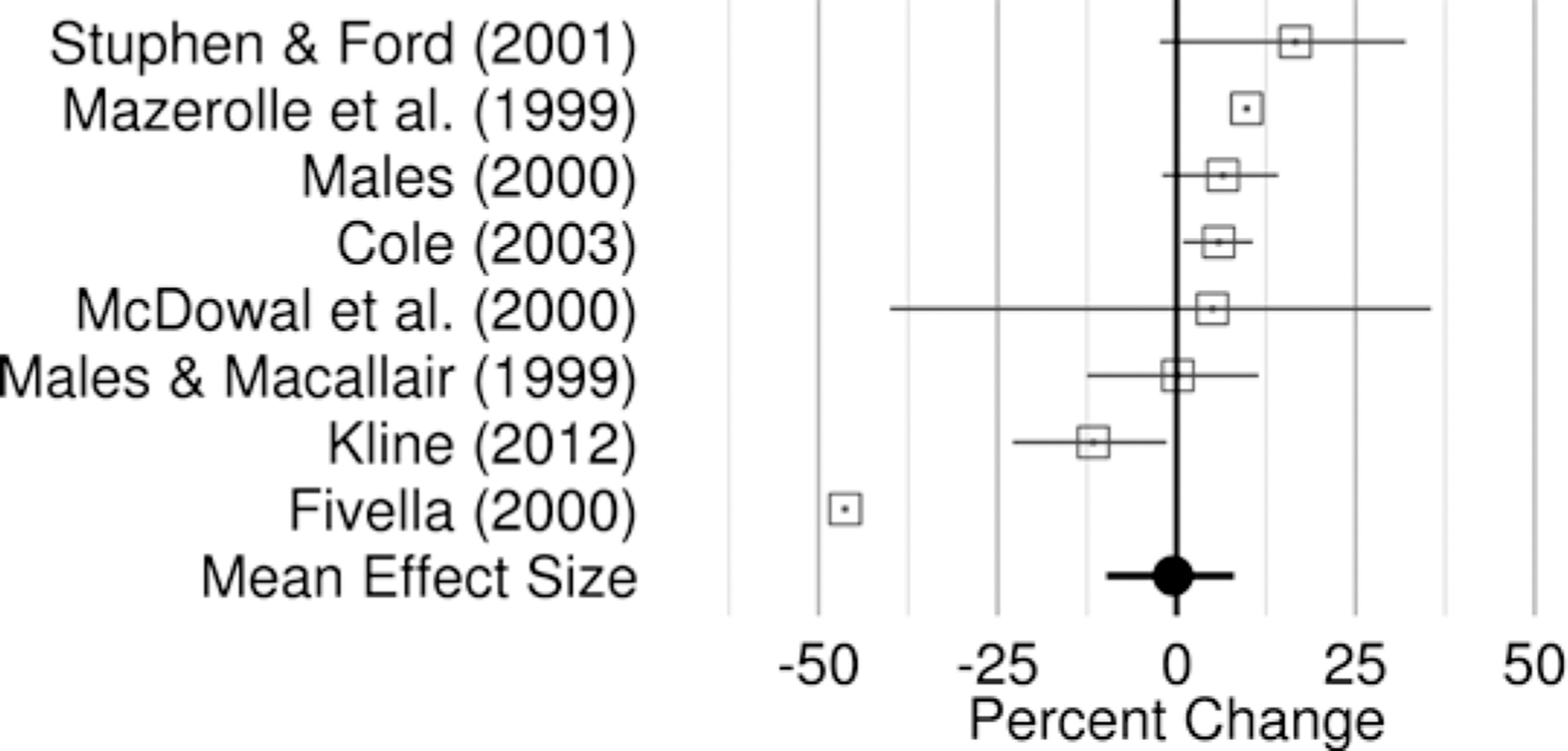
Juvenile crime during all hours – adjusted for time trend
The two effects from Gius (2011) are based on individual level data and, as such, could not meaningfully be combined with effects from other studies. The logged odds ratios were converted to percent change in odds to facilitate comparison with the other results. No mean effect size was computed given that these two effects are from the same study. Counter-intuitively, the effect for self-reported arrests was lower than the effect for self-reported criminal behavior (whether resulting in an arrest or not) (see Figure 3). It is not clear why a curfew ordinance would produce a decrease in arrests and not in criminal behavior more generally.
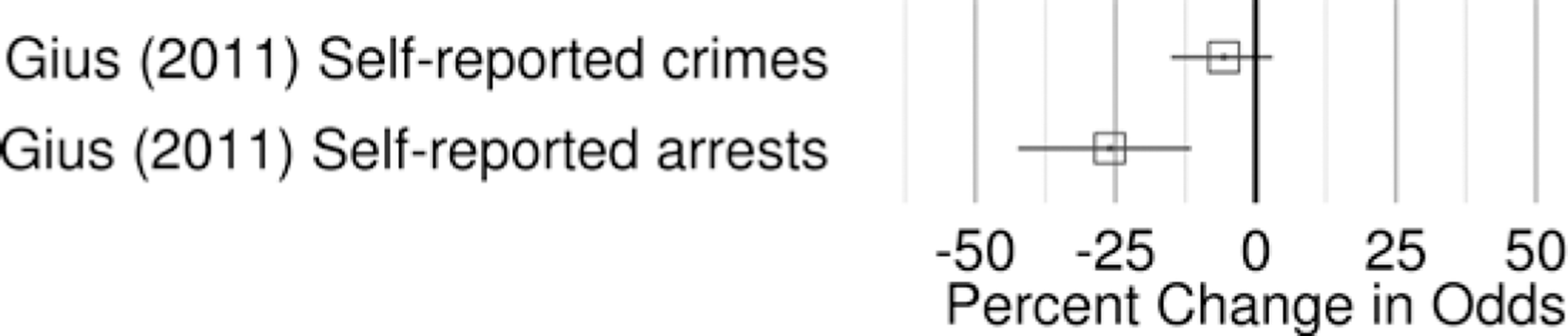
Juvenile crime during all hours – individual level data
Figure 4 provides a single estimate from Rodabough and Young (2002) for juvenile arrests during curfew hours. This effect, while in the desired direction and statistically significant, is based on simple pre-post data and does not account for any underlying crime drop over time. Thus, it is at a high risk of bias.
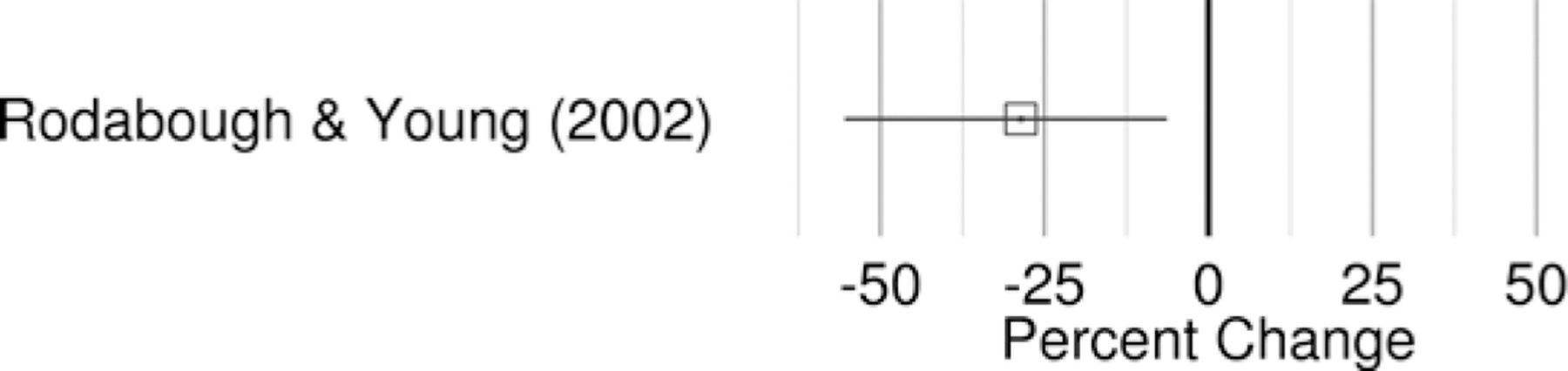
Juvenile crime during curfew hours – not adjusted for time trend
Two studies (Kline, 2012; Fivella, 2000) provided estimates of the effects of juvenile curfews on adult crime during all hours (curfew and non-curfew). These effects are a type of control outcome. There is no theoretical reason to expect a juvenile curfew to have an effect on adult rates of crime. Both of these effects are negative (a decrease in crime) with an overall mean percent change of -9% (see Figure 5, 95% confidence interval of -25.3% to 5.3%, p = 0.230). While this effect is not statistically significant, it represents a larger effect than any of the mean effects for juvenile crime rates.
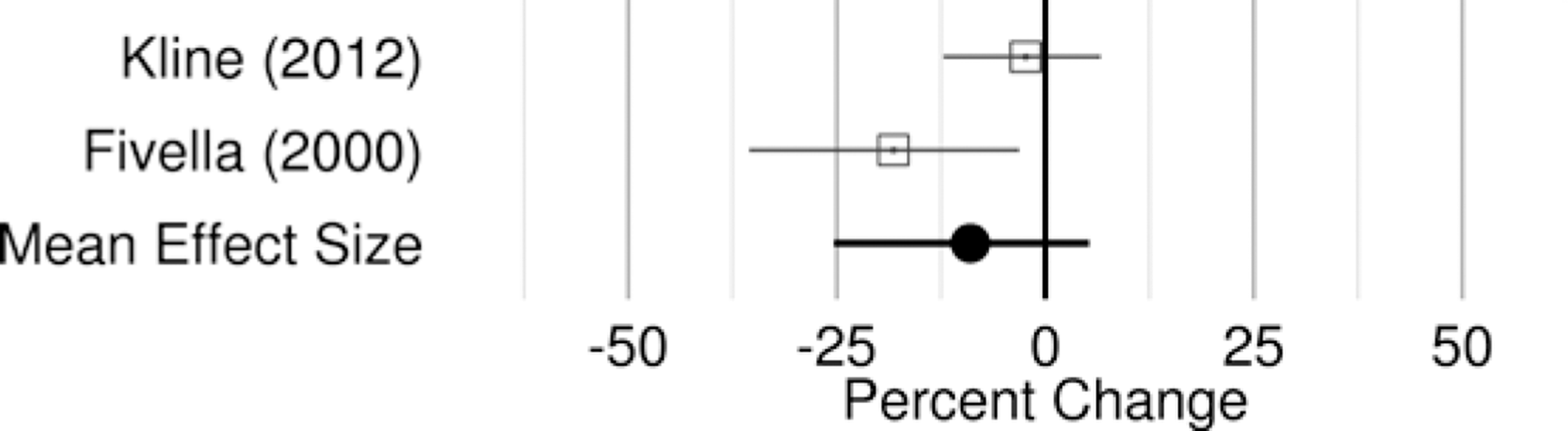
Adult crime during all hours – adjusted for time trend
Thus, any observed changes in juvenile crime of comparable magnitude might easily be the result of some process other than the curfew that is affecting all crime, whether committed by juveniles or adults.
4.3.2 Effects on victimization
Another goal of juvenile curfews is to reduce juvenile victimization. As with crime, the evidence does not support the effectiveness of curfews in accomplishing this. Figures 6 through 8 show these effects. Across these Figures there is no clear pattern of positive or negative change in victimization.
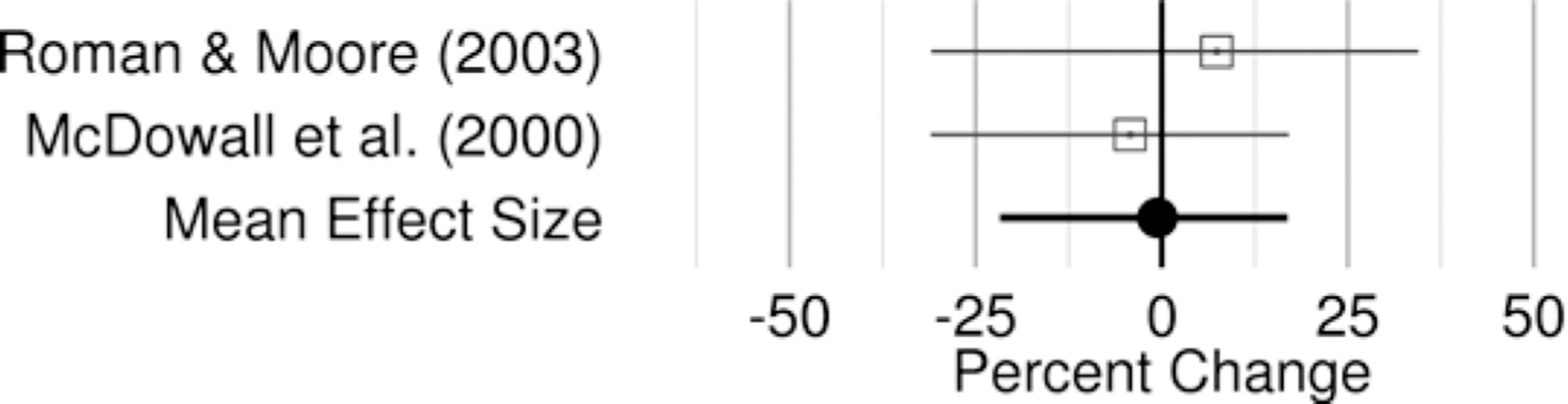
Juvenile victimization during all hours – adjusted for time trend
Figure 6 shows two effects and the mean effect for juvenile victimization during all hours adjusted for a time trend. One effect reflects a positive change and the other a small negative change. The mean effect is close to zero and not statistically significant (a 0.6% decrease in victimization with a 95% confidence interval of -21.7% to 16.9%, p = .953). These two studies provide the more credible estimates of curfew effects on victimization given that they are adjusted for any time trend.
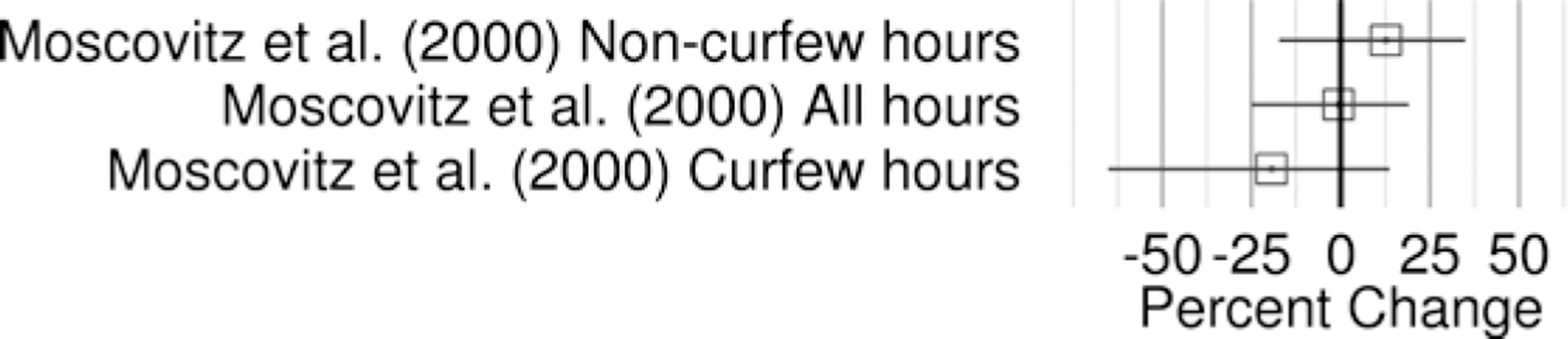
The effects shown in Figure 7 are from the two studies that used a simple pre-post design. Three effects are from Moscovitz et al. (2000), one for juvenile victimization during curfew hours, another for during non-curfew hours, and one for all hours. The Rodabough and Young (2002) study provided a single effect of juvenile victimization during all hours. Because three of these four effects are from the same study, a mean effect was not computed (this is also true for the effects shown in Figure 8). The pattern of effects in Figure 7 is consistent with the more credible effects shown in Figure 6.
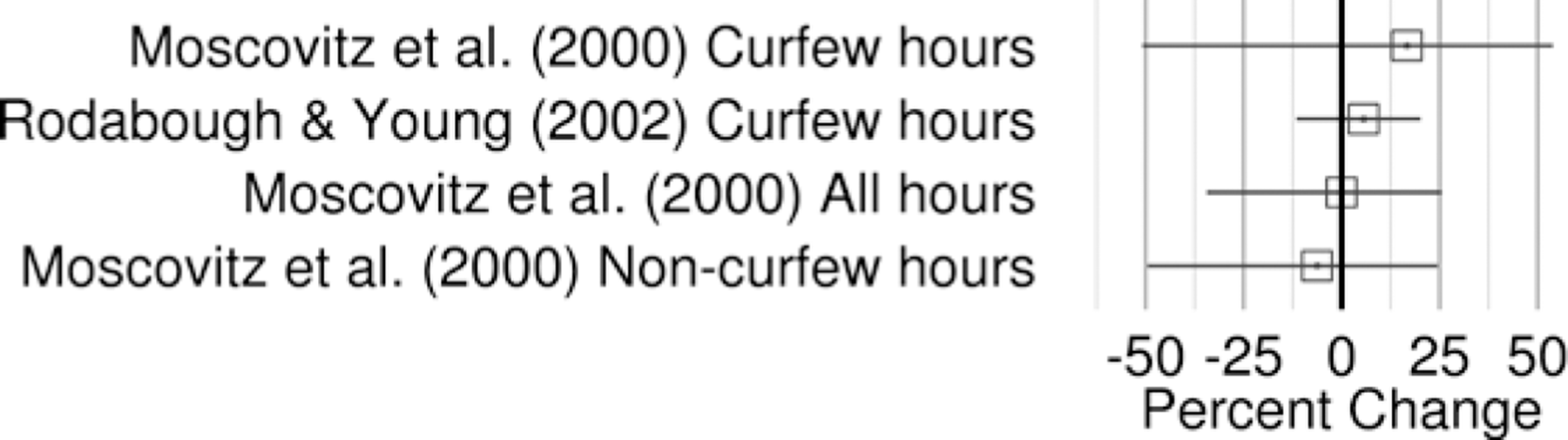
Juvenile victimization – not adjusted for time trend
Adult victimization – not adjusted for time trend
Finally, Figure 8 shows adult victimization effects. All three of these effects are from Moscovitz et al. (2000). We would not expect a juvenile curfew to have an effect on adult victimization. Thus, these effects help establish natural variation in victimization and are of comparable magnitude to the effects observed for juveniles, further supporting to the conclusion that curfews are ineffective at reducing victimization.
5 Discussion
5.1 SUMMARY OF MAIN RESULTS
The evidence across the 12 studies synthesized in this review suggests that a curfew reduces neither juvenile criminal behavior nor juvenile victimization. However, we caution that all the studies in the review suffer from some limitations that make it difficult to draw firm conclusions. Our finding of no effect may mean that juvenile curfews truly have no impact on crime, or that any impact they have is too small to be reliably detected given the statistical power of the studies, or that the findings are biased. Nonetheless, while we cannot firmly conclude that juvenile curfews have no effect on crime, the lack of any credible evidence in their favor suggests that any effect is likely to be small at best and that curfews are unlikely to be a meaningful solution to juvenile crime and disorder. Our findings are consistent with the conclusions of the prior review by Adams (2003) and the study by Reynolds et al. (2000), the latter an excluded study whose effect size we could not calculate, but was otherwise eligible for inclusion.
Many of the potential biases of concern across these studies should have increased the likelihood of finding an effect, such as the general downward trend in crime during the mid-1990s forward, the introduction of other police or community actions to reduce crime, or implementing a curfew following a recent “spike” in crime. The most likely of these is the general drop in crime during the mid-1990s forward given that only two studies included data prior to the early 1990s. Thus, many of these studies should have seen a drop in juvenile crime simply as a result of this underlying trend. Although It is possible for biases to mask beneficial effects, but this seems less likely in this research context.
The well-established finding that only a small percentage of juvenile offending occurs during curfew hours reinforces this conclusion. Even if a curfew eliminated juvenile crime during curfew hours, the effect on total juvenile crime would be small. However, even those studies that specifically examined juvenile crime during curfew hours failed to find a crime reduction effect attributable to a curfew.
Juvenile victimization also appears to be unaffected by a curfew. There was less evidence available for examining victimization, with effect sizes from two credible studies and two questionable ones. However, in the absence of a crime reduction effect, any effect on victimization seems unlikely. All of these studies were conducted in the United States and as such may not generalize to other countries where youth activity patterns in the evening hours may differ substantially.
5.2 QUALITY OF THE EVIDENCE
This literature has significant methodological weaknesses and is vulnerable to several potential threats to internal validity. The nature of the intervention does not allow for randomization, at least at the level of whether or not a jurisdiction has passed into law a juvenile curfew ordinance. It would be possible to experimentally manipulate different levels of curfew enforcement in ways similar to several randomized studies in the policing literature. However, that would address the question of enforcement and not the effect of the ordinance itself. It is the latter that was the focus of this review.
Most eligible studies used a variant on an interrupted time-series design. This can be a strong design in terms of internal validity if it has a sufficiently long series of observations both before and after the start of the intervention and if there are no competing interventions starting around the same time as the intervention of interest exist (see Shadish, et al. 2002). A long series of observations helps establish any long term upward or downward trend in the outcome, such as dropping crime rates, and also any seasonal variations that might be confounded with the intervention, such as an increase in crime during summer months. A long series also allows for an assessment of regression to the mean. In a time-series, this would appear as a sudden increase (or decrease) in the outcome of interest immediately prior to the start of the intervention and a return to baseline levels thereafter. In curfew evaluations, this might occur if a city passes a curfew ordinance in response to a recent ‘crime wave‘.
In assessing risk-of-bias, we judged all but two of the interrupted time-series designs as too short to adequately disentangle a time trend effect from a curfew effect. It is interesting to note, however, that this vulnerability should have biased the results in the direction of finding a beneficial crime reduction effect of a curfew, given that most of these studies were conducted during a period of consistently decreasing crime rates. Furthermore, the most credible and least credible designs produced roughly similar results. That is, we would have expected the most likely biases to produce crime reduction effects. This strengthens the likelihood that the findings reflect the absence of an effect of a curfew rather than methodological biases across the studies.
5.3 LIMITATIONS AND POTENTIAL BIASES IN THE REVIEW PROCESS
The method of estimating the percent change index that was used as the effect size for this synthesis failed to account for any autocorrelation in the data, which is the tendency of observations close in time to be more highly similar than those farther apart in time. The consequence is that the standard errors for the effect sizes were likely to be too small. The percent change index, however, is unaffected by this potential issue. Adjusting the standard errors for autocorrelation would have involved using an ARIMA model or the Newey-West estimator for robust standard errors. Only two of the twelve studies had data that would have allowed for ARIMA modelling and we are unaware of a Newey-West estimator for Poisson or negative binomial models. Further, assuming that these count data were normally distributed would have traded one problem for another. Also, a few of the studies, such as McDowall et al. (2000), found little evidence for autocorrelation in their data. The conclusions for this review, however, are unlikely to be affected by this statistical problem. Underestimating the size of the standard errors biases things in the direction of finding statistically significant effects, not the other way around. Considering that we did not find statistically significant effects, standard errors robust to autocorrelation would have also led to the overall conclusion that juvenile curfews are unlikely to be effective.
5.4 AGREEMENTS AND DISAGREEMENTS WITH OTHER STUDIES OR REVIEWS
Prior reviews of juvenile curfews have also concluded that they are not effective. For example, Reynolds et al. (2000) resolved that the imposition of a youth curfew has no bearing on victimization, juvenile victimization, and juvenile arrests. Furthermore, Adams (2003) concluded that, “overall, the weight of the scientific evidence, based on ten studies with weak to moderately rigorous designs, fails to support the argument that curfews reduce crime and criminal victimization” (p. 155). His review is the most comprehensive prior review in the literature and is widely cited by others as evidence that curfews are not effective. Our updated review of the evidence arrives at the same conclusion.
6 Authors' Conclusions
Juvenile curfews appeal to common sense notions of how to prevent crime and victimization. We experienced the strength of some individuals' belief in the effectiveness of a curfew at a community event in Montgomery County, Maryland, when the county was considering the adoption of a juvenile curfew. The empirical evidence, however, runs counter to common sense. Any effect of a curfew on crime, either positive or negative, is likely to be small at best.
6.1 IMPLICATIONS FOR PRACTICE AND POLICY
A majority of large cities within the United States have a juvenile curfew ordinance. The value of these ordinances is questionable. A policymaker in a jurisdiction without a curfew should not consider one as a solution to youth crime. A curfew may appeal to common sense, but is unlikely, given the evidence, to provide meaningful benefits. This conclusion, however, is restricted to the context of the United States. In many European countries, there are fewer cultural and legal barriers to teenage youth participating in a city's night life. This greater freedom of movement in the late night hours has unclear implications for effects of a curfew in such a context if one were to be implemented.
The evidence presented in this review also raises questions regarding the constitutionality of juvenile curfews within the United States. As discussed in the introduction to this systematic review, the imposition of curfews on the rights of an individual youth and his or her family, has been justified by states on the grounds that doing so protects youth and reduces youth crime. The lack of strong evidence to support this claim provides an avenue for legal challenges of existing curfew ordinances. However, the strength of the evidence presented here may be insufficient for a meaningful legal challenge.
6.2 IMPLICATIONS FOR RESEARCH
Additional high quality evaluations are needed. Although the pattern of evidence across these studies is fairly clear, only four of these twelve studies were judged to be methodologically credible. The remaining studies had clear methodological weaknesses. Future studies need to ensure that they have an adequately long series of data points to control for any underlying change in the crime rate unrelated to the start of a curfew. Furthermore, several of the existing studies could be improved through the application of more sophisticated statistical modelling and through obtaining additional pre and post data. Finally, any jurisdiction that repeals their curfew laws creates an opportunity for a ABA time-series design (control period, treatment period, control period) that can help establish any causal connection between a curfew and juvenile criminal behavior and victimization.
Footnotes
8 Information about This Review
11 R Code for Computation of Effect Sizes
The calculations for all of the effect sizes were done using the statistical/mathematical program R. There is a subset for each study indexed by a reference identifier and by the author(s) and year. The goal was to compute an index of effect that would be comparable across studies and suitable for meta-analysis (i.e., it needed to have a standard error). As discussed in the methods section, this was accomplished in most cases by fitting a negative binomial or Poisson regression model that regressed the crime count on a time indicator (typically months or years) and a dummy variable indicating whether the curfew policy was or was not in effect. Poisson regression was used only when too few data points were available to estimate the over-dispersion parameter, that is, when there were only 2 pre curfew and 2 post curfew observations.
12 R Code for Analyses and Forest Plots
13 Search Notes
Notes
14 Coding Manual
A FileMakerPro database was created based on the coding manual below. Coding was done directly into FileMakerPro.
Use one study level code sheet for each study. If multiple documents report on the results from the same study, identify one document as primary and use its document ID as the StudyID below. Record document IDs for the related documents in the CrossRef# fields.
1. Study (document) identifier [studyid] __________
2. Cross reference document identifier [crossref1] __________
3. Cross reference document identifier [crossref2] __________
4. Cross reference document identifier [crossref3] __________
5. Coder's initials [scoder] __________
6. Date coded ___-__-__
7. Author and Year [author] ____________________
8. Funder (e.g., NIJ) [funder] ____________________
9. Geographical location of study [slocale] ____________________
10. Geography (1=single site; 2=multiple sites; 9=cannot tell) [A study evaluating the effects of a curfew in a single city, county, or country would be coded as “1”, whereas a study examining multiple non-contiguous cities or counties would be coded as “2”.]
[sites] __________
11. Country [country] ____________________
12. Date range for data collection [startdate] ___-__-__
[donedate] ___-__-__
13. Publication Type (primary document if multiple used) [pubtype] __________
1. Book 2. Book Chapter
3. Journal (peer reviewed) 4. Federal Gov't Report
5. State/Local Gov't Report 6. Dissertation/Thesis
7. Unpublished (tech report, conference paper)
14. Description of policy_________________________________________
_________________________________________________________
_________________________________________________________
15. Curfew type [curfewtype] _____ Nocturnal (i.e., nighttime) School hours
For the next four items, use military time (e.g., 1830 for 6:30, 0:00 for midnight, etc.). If missing, code as 9999. If not applicable, code as 8888. Not applicable would be suitable for a study evaluating multiple jurisdictions with different start and stop times.
16. Weekday curfew begins [curfewstart1] _____
17. Weekday curfew ends [curfewend1] _____
18. Weekend curfew begins [curfewstart2] _____
19. Weekend curfew ends [curfewend2] _____
18. Youngest age affected by this curfew [curfewage1] _____
19. Oldest age affected by this curfew [curfewage2] _____
20. Level at which curfew implemented [curfewsize] _____ Neighborhood City County Metropolitan area State Country
21. Number distinct jurisdictions included in curfew (this reflects the entities on which data was collected) [curfewn] _____
22. Nature of geographic areas [areatype] _____ Urban Rural Surburban Metropolitan (urban/suburban) Other mixed
24. Noted implementation problems __________
25. Study included comparison area(s) (i.e., areas that didn't have a curfew at any point during the study) (0 = no; 1 = yes) [compgrp] _____
26. Study used an historical comparison within the same area that implemented a curfew (i.e., baseline data for a jurisdiction that implemented a curfew) (0 = no; 1 = yes)
[comptime] _____
27. Nature of comparison geographic areas (8 if “no” to item 25) [compsize] _____ Neighborhood City County Metropolitan area State Country
28. Number of comparison areas (this reflects the entities on which data was collected)
[compn] _____
29. Nature of geographic areas [areatypec] _____ Urban Rural Surburban Metropolitan (urban/suburban) Other mixed
30. Design Type [designtype] _____ Interrupted time-series (single series) Interrupted time-series (multiple treatment series) Interrupted time-series (with comparison series) Interrupted time-series (single series, ABAB design) Individual level data (non-equivalent comparison design) Pre-post rates (one reate per; one reate post) Randomized controlled trial (true experiment)
Notes: Items 1-4 are for times-series with multiple crime counts or rates prior to the start of a curfew ordinance and multiple crime counts or rates after the start of a curfew ordinance. The counts or rates may be for weeks, months, or years. 6 is similar to a time-series but is with only 1 data points before and after the start of the curfew. 5 is for studies of individual level data on juveniles with youth living in different jurisdictions. 7 is for studies with multiple geographic areas with crime rates measured both before and after the curfew policy and data are analyzed in a single model, such as an OLS regression.
31. Unit of analysis (this reflects the unit-of-analysis for the data used in computing effect sizes) [uoa] _____ Week Month Year Year by City Individual (juvenile)
32. Number of units (9999 if not reported) [numunits] _____
33. Analysis type [analysistype] _____ OLS regression ARIMA Other regression Simple comparison of rates Other
34. Analysis adjusted for covraites (other than baseline measure of outcome) (9999 if not reported; 8888 if varying intervals) [interval] _____
35. Baseline characteristics measures _____________________
36. Analysis type [analysisyype] _____ OLS regression ARIMA Other regression Simple comparison of rates Other
37. Analysis adjusted for covariates (1=yes; 0=no) [covariates] _____
38. Any noted or apparent historical artifacts (1=yes; 0=no) [histart] _____
39. Measurement confounds (change in measure over time) (1=yes; 0=no) [measart] _____
40. Selection of curfew area based on high baseline crime rate (1=yes; 0=no; 8=n/a)
[selart] _____
41. Appropriate statistical analysis for design (1=yes; 0=no) (1=yes; 0=no; 8=n/a)
[statapp] _____
42. Time series too short (fewer than 50 time points total) (1=yes; 0=no; 8=n/a)
[tooshort] _____
43. Cannot determine crime trend over time (e.g., one pre and one post measurement)
(1=yes; 0=no; 8=n/a) [notimecntrl] _____
44. Non-trivial baseline differences (statistically significant baseline differences or baseline differences that are potentially substantively meaningful – i.e., d > .10)
(1=yes; 0=no) [basediff] _____
45. Statistical analysis failed to adjust for measured baseline differences (1=yes; 0=no)
[noadjust] _____
Use one effect size level coding sheet per effect size. A study may have multiple effect sizes.
Number these sequentially using the ESID field.
1. Study (document) identifier [studyid] _____
2. Effect identifier [esid] _____
3. Coder's initials [ecoder] _____
4. Date coded [edate] ___-__-__
5. Label for outcome__________________________________[dvlabel]
6. Outcome type [dvtype]_____ Juvenile arrests Juvenile crimes Juvenile victimization Adult arrests Adult victimization
7. Is this a measure of crime? (0 = no; 1 = yes) [dvcrime] ____
8. Source of data [datasrc] _____ Official record Self-report (juvenile self-report of crime) Citizen report
9. Population on which outcome is measured [sample] _____ Juveniles Adults
9. Unit-of-analysis [uoa] _____ Week Month Year Year by City Individual (juvenile)
10. Number of units [n] _____
All computations were done in R. See appendix XX for complete documentation on each computation.
11. Method of estimating effect size [model] _____ Negative binomial Poisson Logistic regression OLS regression (logged outcome) OLS regression 6. Logged relative rate
12. Effect size model adjusted effect for linear time trend. (0 = no; 1 = yes) [adj4time] _____
13. Effect size [es] _____
14. Effect size variance [v] _____
15. Effect size standard error [se] _____
16. Page number for effect size data [es_page] _____
17. Effect size notes [esnotes]_____
________________________________________________________________________
________________________________________________________________________
________________________________________________________________________