






Abstract
This Campbell systematic review examines the impact of youth employment interventions on the labour market outcomes of young people and business performance. The review summarises findings from 113 reports of 107 interventions in 31 countries.
Included studies had to: (1) evaluate an active labour market programme (ALMP) which was designed for - or targeted primarily - young women and men aged between 15 and 35; (2) have an experimental and quasi-experimental design; and (3) report at least one eligible outcome variable measuring employment, earnings, or business performance.
The evidence base covers 107 interventions in 31 countries, including 55 using skills training, 15 with entrepreneurship promotion, ten using employment services and 21 using subsidized employment.
Overall, youth employment interventions increase the employment and earnings of those youth who participate in them. But the effect is small with a lot of variation between programmes. There are significant effects for entrepreneurship promotion and skills training, but not for employment services and subsidised employment.
Impacts on earnings were also positive but small and highly variable across programmes. Entrepreneurship promotion and skills training were effective in increasing earnings, while effects of employment services and subsidised employment were negligible or statistically insignificant. There is limited evidence of the effects of youth employment programmes on business performance outcomes, and the effect size was not statistically significant.
In addition to the variation in impact across different types of programmes, some variation can be explained by country context, intervention design, and profile and characteristics of programme beneficiaries. The impacts of ALMPs are greater in magnitude in low- or middle-income countries than in high-income countries. Programmes targeting the most disadvantaged youth were associated with bigger programme effects, particularly for earnings outcomes, and effects were slightly larger for women than for men.
Plain language summary
Active labour market programmes for youth increase employment and earnings. Effects vary between programmes and context
The evidence suggests that investing in youth through active labour market measures, such as offering skills training and entrepreneurship promotion, may pay off with higher earnings.
The review in brief
Youth are disproportionately victims of unemployment and low-quality jobs. Active labour market programmes increase earnings and employment. But the effects vary greatly between programmes’ type, design and context.
What is this review about?
Youth unemployment is much greater than the average unemployment rate for adults, in some cases over three times as high. Today, over 73 million young people are unemployed worldwide. Moreover, two out of five young people in the labour force are either working but poor or are unemployed. The youth employment challenge is not only about job creation, but especially about enhancing the quality of jobs for youth.
This systematic review assesses the impact of youth employment interventions on the labour market outcomes of young people. The included interventions are training and skills development, entrepreneurship promotion, employment services and subsidized employment. Outcomes of interest include employment, earnings and business performance outcomes.
What is the aim of this review?
This Campbell systematic review examines the impact of youth employment interventions on the labour market outcomes of young people and business performance. The review summarises findings from 113 reports of 107 interventions in 31 countries.
What are the main findings of this review?
Included studies had to: (1) evaluate an active labour market programme (ALMP) which was designed for – or targeted primarily – young women and men aged between 15 and 35; (2) have an experimental and quasi-experimental design; and (3) report at least one eligible outcome variable measuring employment, earnings, or business performance.
The evidence base covers 107 interventions in 31 countries, including 55 using skills training, 15 with entrepreneurship promotion, ten using employment services and 21 using subsidized employment.
Overall, youth employment interventions increase the employment and earnings of those youth who participate in them. But the effect is small with a lot of variation between programmes. There are significant effects for entrepreneurship promotion and skills training, but not for employment services and subsidised employment.
Impacts on earnings were also positive but small and highly variable across programmes. Entrepreneurship promotion and skills training were effective in increasing earnings, while effects of employment services and subsidised employment were negligible or statistically insignificant. There is limited evidence of the effects of youth employment programmes on business performance outcomes, and the effect size was not statistically significant.
In addition to the variation in impact across different types of programmes, some variation can be explained by country context, intervention design, and profile and characteristics of programme beneficiaries. The impacts of ALMPs are greater in magnitude in low- or middle-income countries than in high-income countries. Programmes targeting the most disadvantaged youth were associated with bigger programme effects, particularly for earnings outcomes, and effects were slightly larger for women than for men.
What do the findings of this review mean?
The evidence suggests that investing in youth through active labour market measures may pay off. Skills training and entrepreneurship promotion interventions appear to yield positive results on average. So, there are potential benefits from combining supply- and demand-side interventions to support youth in the labour market.
The evidence indicates the need for careful design of youth employment interventions. The “how” seems to be more important than the “what” and, in this regard, targeting disadvantaged youth may act as a key factor for success.
There is a need to strengthen the evidence base with more studies of promising programmes, especially in sub-Saharan Africa. Further research should investigate intermediate outcomes and soft skills, and should collect cost data.
How up-to-date is this review?
The review authors searched for studies published up to January 2015. This Campbell systematic review was published in November 2017.
Abstract
Background – Today's labour market is a challenging arena for young people. Over 73 million youth are currently unemployed and many more are affected by vulnerable employment and working poverty. Youth remain highly susceptible to changing patterns in the world of work and experience slow and difficult transitions to stable jobs. What works to support them in the labour market? This is one of the most common and pressing questions posed by policymakers and practitioners today.
Methods – This systematic review addresses this question by synthesizing empirical evidence on the labour market outcomes of active labour market programmes (ALMPs) targeting youth worldwide. Eligible interventions comprised skills training such as technical and business skills, entrepreneurship promotion providing access to finance, employment services providing job-placement and job-search assistance, and subsized employment providing wage subsidies or public employment. Outcomes of interest included employment, earnings and business performance. Eligible studies included counterfactual-based impact evaluations conducted in low-, middle- or high-income countries. A comprehensive systematic search for relevant evidence across more than 70 sources, using search terms in English, French, German, Portuguese and Spanish, identified over 30,000 records that were screened. The search process was completed in January 2015. For the selected studies that met the review's inclusion criteria, data were coded and effect sizes calculated. The analysis explores the interventions’ overall effectiveness and the roles that context, evaluation and programme design and implementation play in moderating impact.
Results – A total of 113 eligible impact evaluations were identified, encompassing a unique set of evaluation methods, interventions and geographical coverage. Meta-analysis methods were employed to synthesize the evidence, based on 2,259 imputed effect sizes. Overall, empirical results indicated positive effects of entrepreneurship promotion and skills training on employment and earnings. Effects of employment services and subsidised employment were generally small and non-significant. We estimated bigger programme effects in low- and middle-income countries than in high-income countries, and in programmes targeting disadvantaged youth.
Implications – Active measures to support the (re) integration of young women and men into the labour market may succeed in enhancing employment and earnings outcomes and have potential to increase human capital and employment prospects in the long-term. The evidence suggested that programmes targeting disadvantaged youth are particularly effective. Entrepreneurship promotion and skills training programmes appear to be a particularly promising intervention for improving employment, earnings and business performance, but the evidence base is still relatively small. More rigorous impact evidence is needed for particular employment programmes more generally, including employment services, subsidised employment and entrepreneurship promotion.
Executive summary
Background
The youth of today represent a vast potential for inclusive growth and development. If youth are given the opportunity to build appropriate skills and access decent employment, they can help to accelerate progress on the 2030 Agenda for Sustainable Development and engage in meaningful work that benefits them, their families and society as a whole.
Unfortunately, decent jobs are not a feasible prospect for all young women and men. Today, over 73 million young people are unemployed worldwide. Youth unemployment stands at a much higher level than the average unemployment rate for adults, in some cases over three times as high. Moreover, two out of five young people in the labour force are either working but poor or unemployed. The youth employment challenge is therefore not only about job creation, but also – and especially – about enhancing the quality of jobs for youth.
Youth's gloomy prospects in the labour market embody a massive waste of potential and a threat to social cohesion. Understanding what works to improve their labour market outcomes is therefore of paramount importance and a development priority for all countries and regions.
Objectives
The aim of this systematic review was to investigate the impact of youth employment interventions on the labour market outcomes of young people. The interventions under review comprised training and skills development, entrepreneurship promotion, employment services and subsidized employment. Outcomes of interest included employment, earnings and business performance outcomes.
Search Methods
The review relied on a comprehensive systematic search across more than 70 sources, including literature databases and a large number of websites, which allowed the identification of both published and unpublished studies . The search process included both a primary search (i.e., searching of a wide range of general and specialized databases) and a complementary search (i.e., hand-searching of relevant websites, searching of dissertations, theses and grey literature databases, citation tracking, screening of reference lists and contacting authors and experts). The in-depth complementary search allowed the identification of several unpublished studies. The process included search terms in English, French, German, Portuguese and Spanish. The search process was completed in January 2015.
Selection Criteria
Eligible studies are those that:
evaluated an active labour market programme (ALMP) that included at least one of the following categories of interventions: training and skills development (such as technical and non-technical skills), entrepreneurship promotion (providing access to capital, from financing to entrepreneurial skills that would enhance human capital), employment services (providing job-placement and job-search assistance, among other services) and/or subsidized employment (providing wage subsidies or public employment programmes);
investigated programmes that were designed for – or targeted primarily – young women and men aged between 15 and 35;
reflected completed experimental and quasi-experimental evaluations measuring impacts on eligible labour market outcomes; and
reported at least one eligible outcome variable measuring employment (e.g., probability of employment, hours worked, duration in unemployment), earnings (e.g., reported earnings, wages, consumption) or business performance (e.g., profits, sales).
In addition to the above inclusion criteria, the review focused on studies with a publication date between 1990 and 2014. No language restrictions were applied.
Data Collection and Analysis
A coding tool and manual were developed in order to guide a harmonised data extraction process. Treatment effect estimates were coded across all studies that met the inclusion criteria, along with other parameters and intervention characteristics deemed relevant for the analysis. Additional, non-reported information was retrieved from authors of the primary studies, supporting the computation of standardized mean differences (SMDs) effect sizes. The SMDs captured the relative magnitude of the treatment effect in a dimensionless way, which was therefore comparable across outcomes and studies. Effect sizes were summarized within and across reports to one effect size per outcome for each study.
Random-effects meta-analysis methods were employed to synthesize and compare effect sizes reported in the primary studies. Subsequently, multivariate meta-regression models were estimated and information about intervention-level, study-level and country-level characteristics were included to assess factors associated with the magnitude of reported effect size estimates.
Results
The primary and complementary searches identified 32,117 records, of which a total of 1,141 records were selected for full text screening. The subsequent selection process led to a sample of 113 reports, which were considered to be of adequate content and methodological rigour for inclusion in the meta-analysis.
The 113 reports represented 107 interventions. The evidence base spanned 31 countries and covered 55 skills training interventions, 15 entrepreneurship promotion interventions, ten employment services interventions and 21 subsidized employment interventions. There were six interventions for which no clear main category of intervention could be established. A large share of the evidence derived from recent publications, with nearly half of the sample produced after 2010. Evaluation designs varied, with 47 per cent of reports relying on experimental designs, 10 per cent on natural experiments and 44 per cent on quasi-experimental evaluations. Many of the most recent studies were experimental evaluations of interventions implemented in low- and middle-income countries, Not ably from Africa and Latin America and the Caribbean.
Intervention characteristics and research designs differed significantly between evaluations implemented in high-income and low- or middle-income countries. A large proportion of the evidence from high-income countries derived from quasi-experimental studies of national programmes, implemented in collaboration with government organizations. In contrast, the evidence from low- and middle-income countries was predominantly based on experimental impact evaluations of rather small-scale, targeted interventions, which were often implemented by Non-governmental Organizations (NGOs) or international organizations.
The comprehensive systematic search led to the identification and coding of a total of 3,629 treatment effect estimates. These estimates, along with further information reported and/or retrieved from authors of the primary studies and imputation of missing information, allowed the computation of 2,259 SMDs.
The following are some of the key results from the meta-analysis of SMD effect sizes. These findings appear robust to the different study designs employed, as similar results were found for a restricted sample of the most rigorous designs (experimental impact evaluations). However, there was also statistical evidence for small study effects for all outcomes, suggesting the presence of publication bias in the literature. Youth employment interventions may lead to positive outcomes, increasing employment and earnings of participating youth. The positive effect on Impacts on Evidence of youth employment programme effects on The high degree of inconsistency across interventions suggested The underlying evidence base varies by country income level. Results suggest impacts of ALMPs are greater in magnitude in low- or middle-income countries than in high-income countries. In In Programmes targeting the most Looking at differences in effects by The systematic review captured information about the type of skills delivered to young people and found no particular connection between soft skills and better labour market outcomes. Similarly, there was no systematic evidence about the role of public, private or civil entities in the implementation of a youth employment programme.
Conclusions
The extent and urgency of the youth employment challenge and the level of global attention currently being given to this topic calls for more and better evidence-based action. Accordingly, this systematic review sought to examine the empirical evidence in order to understand what drives the success (or failure) of youth employment interventions. Investments in youth employment will continue, and even increase, as countries embark on the implementation of the 2030 Agenda for Sustainable Development; therefore, this review focused on identifying “what works” and, as far as possible, “how”.
This systematic review builds on a growing base of studies measuring the impact of youth employment interventions and offers a rigorous synthesis and overall balance of empirical evidence taking into account the quality of the underlying research. The review is systematic through a clearly defined and transparent inclusion and exclusion criteria, an objective and extensive search, a punctual data extraction process, a standardized statistical testing and analysis, and a thorough reporting of findings. These elements and underlying methods and tools were laid out and reviewed in the protocol (Kluve et al., 2014).
The evidence suggests that investing in youth through active labour market measures may pay off. The evidence also shows a significant impact gap across country income levels. Being unemployed or unskilled in a high-income country – where labour demand is skill intensive – puts youth at a distinct disadvantage in comparison to a cohort that is, on average, well educated. While ALMPs in high-income countries can integrate disadvantaged young people into the labour market, they are not able to fully compensate for a lack of skills or other areas where youth failed to gain sufficient benefit from the education system. On the other hand, in lower income countries, with large cohorts of disadvantaged youth, marginal investments in skills and employment opportunities are likely to lead to larger changes in outcomes. Youth-targeted ALMPs in low- and middle-income countries do lead to impacts on both employment and earnings outcomes. Specifically, skills training and entrepreneurship promotion interventions appear to yield positive results on average. This is an important finding, which points to the potential benefits of combining supply- and demand-side interventions to support youth in the labour market.
The evidence also calls for careful design of youth employment interventions. The “how” seems to be more important than the “what” and, in this regard, targeting disadvantaged youth may act as key factors of success.
The findings from this review need to be discussed vis-à-vis the local and national context and should be complemented by a long-term and holistic commitment towards youth development.
Achieving an understanding of the “how” element is not an easy task. Although the systematic review excluded studies that only reported relative effects, it is also the case that, frequently, impact evaluations do not assess relative effectiveness. Even more often, reports and papers fail to describe the underlying theory of change and observed transmission mechanisms behind an intervention. In some other cases, there is limited information about the characteristics of programme participants in the evaluation sample and their comparison group. Much remains to be done to improve reporting standards and advocate for more and better evidence examining the impact of youth employment interventions. The quality of the primary studies determines the quality of the systematic review and any subsequent synthesis of the evidence.
The review supported the identification of important evidence gaps: It is important to note that despite the large and significant magnitude of effect of entrepreneurship promotion interventions in low- and middle-income countries, the evidence base is still limited and exhibits high variance, calling for more primary studies on this promising intervention type. Similarly, more and better evidence is needed on employment services, wage subsidies and public employment programmes for youth, particularly in low- and middle-income countries. While the review highlighted a growing evaluation evidence from youth employment programmes implemented in Sub-Saharan Africa, it also reported very limited information from the Middle East and North Africa, South Asia and East Asia and the Pacific. These are regions were more targeted action to expand the evidence base should be considered. Similarly, more research is needed on intermediate outcomes in primary studies and evidence synthesis work. This is linked to the importance of improving research-reporting standards and expanding the scope of outcomes of interest in order to better synthesize evidence about how interventions affect knowledge, skills, attitudes, and behaviours. More and better information on these intermediate outcomes will improve overall understanding about the causality and pathways of change between the intervention and the final outcomes. Soft skills are highly demanded by employers today. Their role in generating better outcomes is yet to be corroborated and more inquiry is required to understand their role in the causal chain as well as their interaction with more technical skills sets. Lastly, future primary studies and evidence syntheses should engage with cost information. The applicability of the evidence hinges not only on its internal and external validity but also on its feasibility. More information is needed on programme costs as well as systematic comparisons against programme effects. What may look highly effective may in fact be too expensive to replicate or scale up.
Background
1.1 THE RESEARCH PROBLEM: WHY YOUTH EMPLOYMENT?
The economic crisis brought about a swift reversal of the gradual declining trend in global youth unemployment rates observed between 2002 and 2007. The rapid increase in youth unemployment between 2007 and 2010 led to youth's discouragement and withdrawal in significant numbers from the labour force. It is estimated that nearly 6.4 million youth worldwide moved into inactivity in response to the crisis while many others continue to work yet live in poverty (ILO, 2012).
The youth employment crisis has become a stubbornly persistent reality in all regions and in nearly every country. Of the estimated 200 million unemployed people today, about 37 per cent – more than 73 million – are between the ages of 15 and 24. This translates into a global youth unemployment rate that has settled at 13.0 per cent during the period 2012 to 2014. While it is expected to remain relatively constant in the near future, this rate is still well above its pre-crisis level of 11.7 per cent (see Figure 1).
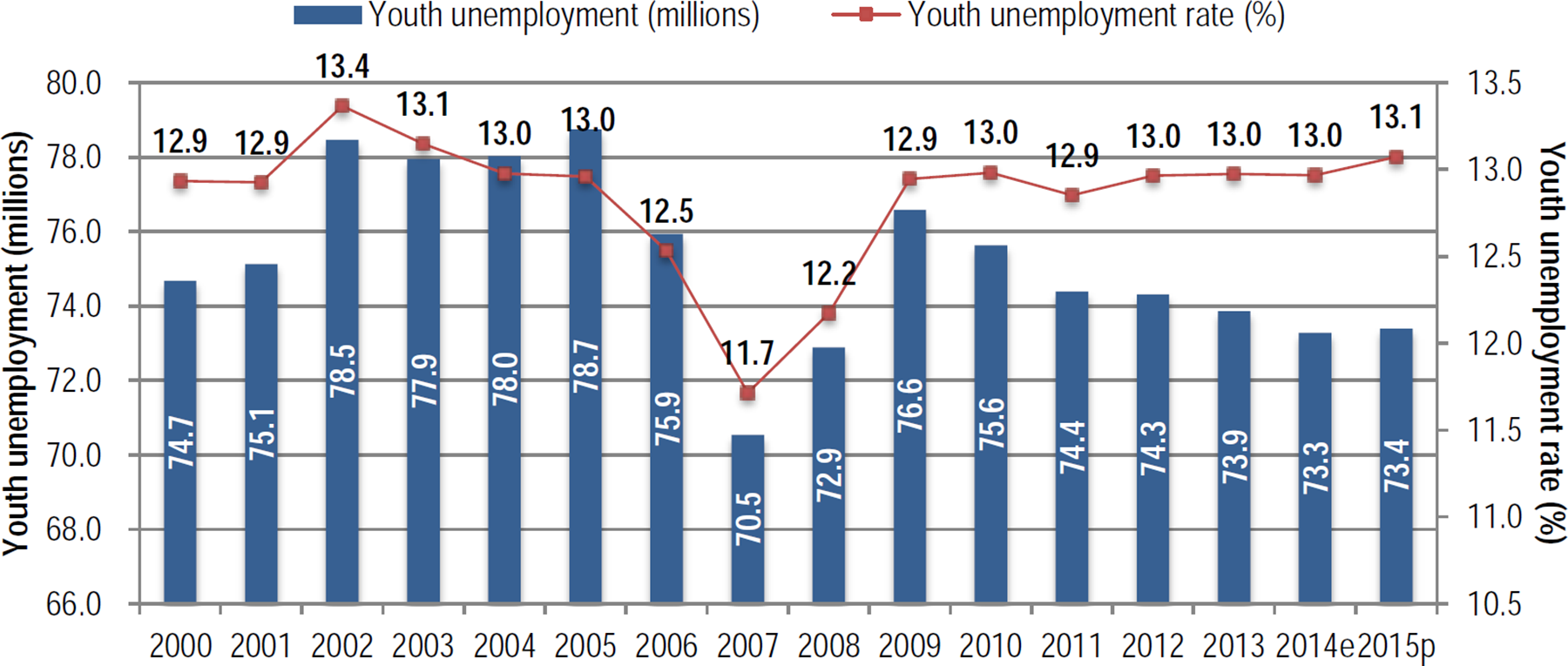
Global youth unemployment and unemployment rate, 2000–2015p
According to the 2015 Global Employment Trends for Youth report of the International Labour Organization, youth remain overrepresented among the unemployed and shaken by the changing patterns in the labour market. Two-fifths (42.6 per cent) of the global youth labour force were reported as being unemployed or in working poverty in 2013. Regional youth unemployment trends remain fairly mixed. Most Not ably, the youth unemployment rates in the Middle East and North Africa (MENA) continue to be the highest worldwide, at 28.2 and 30.5 per cent for 2014, respectively. These figures stand out in comparison to other regions where the unemployment rate ranges from 10 to 20 per cent. In spite of the important achievements in boosting access to education and levels of educational attainment in the MENA region, today more than one in four active youth do not have a job (ILO, 2015a).
After being hit hard by the economic crisis, youth unemployment levels in Developed Economies and the European Union have seen some recent regional improvements, with the youth unemployment rate decreasing from 18.0 to 16.6 per cent, between 2012 and 2014. However, these improvements mask some difficult macroeconomic dynamics in certain countries, which are currently being further aggravated by conflict-driven migration. Six countries stand out in this respect, with unemployment rates of over 30 per cent, namely Croatia, Cyprus, Greece, Italy, Portugal and Spain.
Asian regions and sub-Saharan Africa continue to present relatively low unemployment rates among youth, although these statistics are all too often a reflection of the fact that youth cannot afford not to work and, as a matter of necessity, engage in poor quality and insecure jobs.
The challenge is not trivial since the “demographic dividend” can become a source of instability if young people around the world continue to face disappointing prospects in their job search. Unemployment depreciates human capital and has a significant negative influence on health, happiness, crime levels and socio-political stability (Bell and Blanchflower, 2009). Failing to address unemployment and underemployment among youth may contribute to the loss of human capital and an increase in social discontent.
Addressing the youth employment challenge continues to rank high in both international and local development priorities. The 2030 Agenda for Sustainable Development has placed the importance and urgency of achieving full and productive employment and decent work for all squarely at the centre of the new development vision, with youth explicitly identified as a key target group (Box 1).
It is therefore crucial to gather evidence to support the implementation of the 2030 Agenda. Yet very few rigorous overview and cross-country studies review and analyse the impact of youth employment programmes and what determines their success in different contexts. Even though the number of single-programme evaluations providing rigorous evidence on the effectiveness of active labour market programmes (ALMPs) has increased over the past decade, many fundamental questions remain unaddressed – particularly regarding the key issues: Which programmes work for a given target group, and under what circumstances? What are the crucial design features necessary for youth employment programmes to be effective?
Box 1: Youth employment and the 2030 Agenda for Sustainable Development
Sustainable Development Goal 8 and a series of as pirational targets recognize today's employment challenge and open pathways for specific action on youth employment.
Key youth employment related targets in the 2030 Agenda: 4.4: “By 2030, substantially increase the number of youth and adults who have relevant skills, including technical and vocational skills, for employment, decent jobs and entrepreneurship”; 8.3: “Promote development-oriented policies that support productive activities, decent job creation, entrepreneurship, creativity and innovation, and encourage the formalization and growth of micro-, small- and medium-sized enterprises, including through access to financial services”; 8.5: “By 2030, achieve full and productive employment and decent work for all women and men, including for young people and persons with disabilities, and equal pay for work of equal value”; 8.6: “By 2020, substantially reduce the proportion of youth not in employment, education or training”; 8.b: “By 2020, develop and operationalize a global strategy for youth employment and implement the Global Jobs Pact of the International Labour Organization”; and 9.3: “Increase the access of small-scale industrial and other enterprises, in particular in developing countries, to financial services, including affordable credit, and their integration into value chains and markets”.
Source: https://sustainabledevelopment.un.org/sdgs [18 Feb. 2016].
1.2 THE INTERVENTION: ALMPS FOR YOUTH
In support of more and better programmes and policies for the promotion of youth employment, this systematic review examines labour market interventions that fall into the category of ALMPs, which are further defined as
all social expenditure (other than education) which is aimed at the improvement of the beneficiaries’ prospect of finding gainful employment or to otherwise increase their earnings capacity. This category includes spending on public employment services and administration, labour market training, special programmes for youth when in transition from school to work, labour market programmes to provide or promote employment for unemployed and other persons (excluding young and disabled persons) and special programmes for the disabled (OECD, 2013).
ALMPs require active participation in programmes that enhance labour market integration, a requirement which differentiates them from other labour market – and social protection – policies, such as unemployment insurance schemes and non-conditional transfers. In the case of ALMPs, the economic rationale relies on market clearing (i.e., achieving a match between labour demand and supply) and market efficiency (for instance, through job-search assistance, provision of labour market information and pre-screening of programme applicants). ALMPs can also enhance labour supply by providing training, foster labour demand through labour-intensive public employment programmes, entrepreneurship and self-employment measures, or alter the structure of demand by offering employment subsidies (Auer et al., 2008).
ALMPs considered in the systematic review are clustered in the following typology of interventions:
Although the focus of ALMPs tends to be on economic relevance, they can have important social and political dimensions (Betcherman, Dar & Olivas, 2004). ALMPs can foster the social inclusion of disadvantaged groups while signalling a willingness on the part of politicians to engage with their specific problems.
1.3 HOW THE ALMPS ARE SUPPOSED TO WORK
This section offers some theoretical underpinning to the ways in which the interventions included in this systematic review may improve the labour market outcomes of youth. The underlying assumption of programmes is that participation in ALMPs will ultimately improve the employment and earnings outcomes of participants, as well as the performance of those businesses that programme participants start or already own.
Exposure to ALMPs is expected to create a spillover effect among non-participants, as well as general equilibrium effects throughout the economy. While some of these spillovers may positively affect overall employment outcomes, in certain cases ALMPs can have a negative impact on the performance of non-participants. For example, there is evidence that wage subsidy programmes can lead to substitution effects (with subsidized workers replacing non-subsidized workers) and windfall effects (when part of the subsidies go to workers who would have been hired in any case), thereby decreasing the overall employment impact of the programme. To address this issue, increased attention must be given to programme design features such as the establishment of conditionalities for employers (Almeida, Orr & Robalino, 2014).
This section summarizes the theories of change behind ALMPs for youth, aiming to map out the relationship between: (i) the resources that are invested (“Inputs”); (ii) the intervention that takes place, including the different activities that may be part of the intervention (“Activities”); (iii) the individual-level competencies and constraints (such as knowledge, attitudes and behaviours) which are directly affected by the intervention (“Outputs”); and, finally, (iv) the individual labour market outcomes that can be measured as part of an impact evaluation study (“Outcomes”). Key assumptions are also made to determine whether any given event in the sequence actually yields the expected changes in labour market outcomes. Once the theories of change are clear, the systematic review examines whether the evidence supports the expected causality and impact across the selected intervention types, namely: training and skills development, entrepreneurship promotion, employment services and subsidized employment.
Building on existing literature, operational manuals and programme information, this section describes each intervention and its underlying theory of change. Even though labour market programmes often combine interventions from different categories, the results chains for each category have been separated to provide further transparency in the assumptions and support the interpretation of results to reveal potential causal mechanisms.
In the interests of a well-defined intervention description, those activities and outputs that are not strictly linked to labour market effects have been omitted. Similarly, a narrow focus has been adopted on individual-level labour market outcomes, leaving aside other potential side-effects, such as increased psychosocial well-being. For simplicity, higher level or “longer term” outcomes – such as poverty reduction, economic growth or democratization – are not explicitly shown in the chain of effects, nor are potential general equilibrium effects that may reduce the macroeconomic effectiveness of an intervention. Nonetheless, most of the programmes under scrutiny have broader macroeconomic effects, which will play an important role when scaling up or replicating the programme. In fact, some of the interventions may explicitly target higher-level (economy-wide) macroeconomic outcomes, such as social protection aspects (e.g., public employment programmes may be designed to smooth consumption during recessions or crises).
1.3.1 Training and skills development
Education and skills are considered a core factor in determining young people's opportunities in the labour market (Biavaschi et al., 2012). Skills training programmes are therefore the most widely used labour market intervention for young people worldwide and are increasingly delivered as a complement to other labour market measures (Betcherman, Godfrey, Puerto, Rother & Stavreska, 2007; Fares & Puerto, 2009). Training and skills development comprises programmes outside the formal education system that offer skills training to young people in order to improve their employability and facilitate their transition into the labour market. 1 The objective of skills training programmes is to develop the employment-relevant skills of jobseekers. Broadly speaking, these skills refer to a set of job-specific technical skills, but also include non-technical soft skills, such as self-management, teamwork and communication. Increasingly, employers across the world are placing higher value on these non-technical skills than on technical competencies (Manpower Group, 2013; Cunningham, Sanchez-Puerta & Wuermli, 2010; Youth Employment Network & International Youth Foundation, 2009).
This analysis classifies training programmes according to the skill set which they target (Table 1): First, training programmes that address a lack of trade- or job-specific technical skills demanded by employers. Such skills range from manual skills to computer literacy. Technical skills training programmes often include an on-the-job training component in order to increase practical work experience (i.e., by placing participants in internships, workplace training or apprenticeship schemes). Second, business skills training, which is often provided as an element of programmes that aim to increase entrepreneurial activities among youth. Such entrepreneurial training programmes cover a wide variety of factors that are believed to determine business success (ranging from financial skills to problem-solving skills). Third, literacy and numeracy programmes, which are designed to teach basic skills or cognitive abilities to youth who had not acquired them by the time they left school (sometimes called “second-chance programmes”). Finally, programmes that improve non-technical skills, such as behavioural skills, life skills or soft skills of jobseekers.
Training and skills development interventions: Results chain
Technical training programmes are popular in development cooperation because many developing countries experience a skills mismatch between their labour force and emerging segments of their economies. However, pure training programmes have not proven to be particularly successful in many contexts (Betcherman et al., 2004). Therefore, most recent programmes tend to combine skills training with other types of interventions; for example, on-the-job training or employment services (Cunningham et al., 2010; Fares & Puerto, 2009). An example of a skills training programme is provided in Box 2.
A number of conditions determine whether skills training programmes are successful in bringing additional youth into work – most Not ably, correlation between the skills offered by a training programme and those demanded by the market. To this end, some programmes introduce a market-based (or bottom-up) approach in programme design. The application of this approach enables training curricula and programme components to respond much more effectively to the needs of employers (in both private and public sectors) and communities in a demand-driven fashion.
Furthermore, the success of all these interventions relies on the assumption that the (correct) target group participates in the training and that the training is appropriate and conducted in a way that actually augments the skill sets that are relevant to the labour market. Finally, a crucial element may be the award of a legitimate certificate on successful completion of a programme to prove the acquisition of increased knowledge and skills to potential employers in the job market.
Box 2: Training and skills development: Juventud y Empleo in the Dominican Republic
The Youth and Employment Programme, Juventud y Empleo (JE), in the Dominican Republic represents an innovative model of an ALMP to improve employability and human capital of young people between the ages of 16 and 29 who did not complete high school. The programme provided young people with vocational training (150 hours) and basic or life skills training (75 hours) combined with internships in private sector firms (240 hours). The programme was managed by the Ministry of Labour in cooperation with the National Institute of Technical and Vocational Training (Instituto Nacional de Formación Técnico Profesional) and with financial support from the Inter-American Development Bank. Training services were provided by private training institutions.
The programme came into operation in 2001 and was the first job-training programme in Latin America and the Caribbean to incorporate a randomized evaluation component in the project design. The first impact evaluation showed limited impacts on employment and wages, which led to changes in the programme to focus on working more closely with the private sector and providing a stronger life skills component. Further evaluation results showed that the programme had a positive impact on job formality for men and a positive effect on monthly earnings among those who were employed. In addition, the programme was effective in reducing teenage pregnancy and showed a positive impact in various measures of non-cognitive skills.
Sources: based on information available at:www.youth-employment-inventory.org [12 Oct. 2014]; Card, Ibarrarán, Regalia, Rosas-Shady and Soares, 2011; Ibarrarán, Ripani, Taboada, Villa and García, 2014.
1.3.2 Entrepreneurship promotion
Innovative entrepreneurial activities can promote job-rich growth and accelerate economic diversification paths through productivity and competitiveness. Entrepreneurship returns to economic development are maximized within business environments that are amenable to innovation and creativity and provide appropriate regulations, access to infrastructure services and finance (ILO, 2015b). However, entrepreneurship also carries substantial risks of failure and has the potential to contribute to job losses if increased productivity and competition leads to layoffs in existing enterprises (Kritikos, 2014).
Entrepreneurs are important income providers and job creators. They benefit booming economies by challenging existing enterprises to innovate and compete in order to keep up with rapidly changing technologies and global markets. They also benefit economies that are suffering from slow job growth or stagnation by boosting labour demand, developing innovative goods and services and stimulating competition.
Depending on the context, entrepreneurs can be driven by choice or by necessity. Entrepreneurs by choice select entrepreneurship over other employment options in order to increase their income or become more independent. Entrepreneurs by necessity, also known as subsistence entrepreneurs, face a market situation with insufficient labour demand and therefore lack formal employment opportunities, exposing their entrepreneurial ventures to the low productivity and precarious working conditions that prevail in the informal economy.
The enterprise size and its corresponding ability to grow and to create jobs also help to identify the rare “transformation entrepreneurs” or “gazelles”. These are the few entrepreneurs whose enterprises grow to become larger enterprises and generate most of the new jobs. Their high-growth enterprises create jobs and income for others, beyond the scope of an individual's subsistence needs (Cho, Robalino & Watson, 2014). In contrast, the enterprises of subsistence entrepreneurs usually do not grow, but provide income and employment for the owner of the micro-enterprise and their immediate family.
Entrepreneurship promotion programmes considered for this systematic review aim to lower the barriers and costs associated with young unemployed and underemployed people planning to establish or maintain a business. Since the scope of formal wage employment is often limited in developing countries, increasing (formal) self-employment among the labour force is considered an important anti-poverty strategy (Gindling & Newhouse, 2012). Because self-employed and small-scale entrepreneurs often face numerous internal and external constraints, a multitude of measures exist to support the process.
Access to capital is often a primary constraint for young entrepreneurs. Schoof (2006) identifies a number of constraints to accessing start-up finance. These range from inadequate personal savings and resources to a lack of securities and credibility, insufficient business experience and skills, strict credit-scoring methodologies and regulations, among others. Accordingly, many entrepreneurship programmes address the lack of access to (affordable) finance faced by young entrepreneurs. The review team disaggregated such programmes into three types: Those providing or facilitating access to credit (including microfinance programmes) Those providing start-up grants Those fostering microfranchising mechanisms.
ALMPs that facilitate access to finance often provide technical training and advice and support setting up partnerships and capacity-building schemes with (and for) microfinance institutions (MFIs) and banks.
In addition to access to finance, some programmes offer training on business and management skills as well as business advisory services and mentoring for soon-to-be or already self-employed youth. Finally, some interventions aim to reduce the barriers to business creation by assisting prospective entrepreneurs to enter established markets or existing value chains. The abovementioned interventions and their results chain are shown in Table 2. Some skills training programmes (as described in Section 1.3.1 above) incorporate features of entrepreneurship training and specific skills relevant for starting or maintaining a business.
Many entrepreneurship programmes take a multi-component approach; for example, combining access to credit with business skills training or the provision of post-programme consultation (i.e., mentoring and coaching).
Primarily, entrepreneurship programmes increase employment through their direct effect on the soon-to-be self-employed participant. The assumption is that beneficiaries actually plan to set up a new business after receiving credit and/or training (i.e., that targeted and trained individuals have been appropriately selected for the programme) and that they would not have done so without the intervention.
In order to generate additional jobs, entrepreneurship programmes have to assume that the intervention leads to either (i) increased marginal productivity of the input labour or (ii) increased output and profits resulting in additional investments and labour demand. To achieve this end, the training must suit the context and knowledge of the participants. Beneficiaries then have to apply the training or credit to their business and thereby increase performance and competitiveness. 3 Whether or not an entrepreneur will finally hire additional workers may also depend on the macroeconomic and labour market environment.
Entrepreneurship interventions: Results chain
Box 3 describes the programme Start and Improve Your Business (SIYB), a widely used and adapted entrepreneurship training package designed by the International Labour Organization (ILO) and tailored for youth.
Box 3: Entrepreneurship promotion: Start and Improve Your Business
The Start and Improve Your Business (SIYB) programme is a management-training programme with a focus on starting and improving small businesses as a strategy for creating more and better employment in developing and transitional economies. The SIYB programme is a system of interrelated training packages and supporting materials for small-scale entrepreneurs. The programme is designed by the ILO and implemented with support from certified trainers in partner institutions in more than 100 countries with an estimated outreach of 6 million trainees. Initially developed in the 1980s, it has now been translated into more than 40 languages. The Start Your Business (SYB) package provides a five-day training course for potential entrepreneurs with concrete and feasible business ideas and proposes a follow-up programme including counselling sessions. SYB assists participants to develop a business plan with a marketing strategy, a staffing plan and a cost plan.
The 2011 SIYB Global Tracer Study found that in new businesses started after the training, on average, three jobs were generated. In Uganda, a randomized control trial (Fiala, 2014) providing mainly young business owners with loans, cash grants and the SYB training module or a combination of these components showed that, six and nine months after the interventions, men with access to loans with business skills training reported 54 per cent greater profits.
Sources: based on information available at: www.ilo.org/siyb [19 Feb. 2016]; van Lieshout, Sievers & Aliyev, 2012; Fiala, 2014; Majurin, 2014.
1.3.3 Employment services
Employment services programmes are generally based on the (matching and) intermediation approach to active labour market policy. Interventions within employment services are shown in Table 3. Job-placement programmes acknowledge the existence of information asymmetries and, particularly, incompleteness of information in the labour market. Hence, these programmes aim to improve the job-matching process by providing information and support to both sides of the labour market. On the one hand, they inform young jobseekers about suitable job opportunities (a service which is of particular relevance to youth who have only recently entered the labour market and are experiencing difficulties in marketing themselves or lack the knowledge, information and networks to find job openings). On the other hand, they provide information to potential employers about unemployed youth. The underlying idea is to facilitate the matching of employment opportunities with jobseekers while reducing the costs and risks to employers connected with recruiting young people.
Employment services interventions: Results chain
The second type of intervention, job-search assistance services, includes job-search training, educational or career guidance, counselling and monitoring programmes. Such programmes primarily target disadvantaged or demotivated youth who are disconnected from the labour market. Their primary aim is to improve the intensity, motivation and effectiveness of participants’ job-searches.
Mentoring programmes are also provided to youth who are not currently unemployed but are in education or have just entered the labour market (post-placement support). Accordingly, in some circumstances, mentors encourage mentees to stay in education or in on-the-job training. In many countries, employment agencies adopt a case-management approach (identifying barriers to employment, designing individual action plans, referring jobseekers to appropriate interventions and monitoring job-search activity), which has been argued to be the most effective method of providing these services (Walther & Pohl, 2005).
While in some countries public employment agencies continue to be the main providers of employment services, other countries have moved into subcontracting, opening an important role for private employment agencies to address mismatches and information failures in the labour market. Box 4 illustrates a subcontracting model applied by a French public employment agency to facilitate counselling and job-placement for educated youth.
Box 4: Employment services: Counselling and job placement for young graduate jobseekers in France
In France, the government agency Pôle Emploi matches jobseekers with potential employers and provides benefits and job counselling to the unemployed. In 2007, the French Government decided to experiment with subcontracting employment services for young graduates who had been unemployed for at least six months to private providers. The jobseeker assistance programme aimed to help jobseekers find work and to support the former jobseeker in retaining that job or finding a new job. For the first six months of the programme, the private employment agency counselled the jobseeker and helped to find a job with a contract duration of at least six months. During the first six months of employment, the client continued to be supported and advised by the agency.
A randomized experiment measured the direct and indirect (displacement) impacts of job-placement assistance on the labour market outcomes of young people. The evaluation found that the reinforced counselling programme had a positive impact on the employment status of young jobseekers eight months after assignment to the treatment group, compared to untreated jobseekers. However, these positive effects appeared to have come partly at the expense of eligible workers who did not benefit from the programme, particularly in labour markets where they were competing mainly with other educated workers and in weak labour markets.
Sources: based on information available at: www.youth-employment-inventory.org [19 Feb. 2016]; Crépon, Duflo, Gurgand, Rathelot and Zamora, 2013.
There are indications that involvement in employment services (and in ALMPs in general) has a stigmatizing effect on participants (Boone & van Ours, 2004; Kluve, Lehmann & Schmidt, 1999). Addressing this adverse effect is a prior condition for successful implementation. To this end, job-placement and job-search assistance programmes are often connected to financial incentives for jobseekers and/or employers. For example, such schemes may involve the imposition of sanctions on the unemployed for failure to comply with the terms of the intervention. Similarly, marketing of unemployed youth may be combined with the offer of short-term subsidies to employers.
1.3.4 Subsidized employment
Insufficient labour demand is one of the main constraints faced by young job market entrants – particularly in developing economies. Subsidized employment interventions comprise two main areas: wage subsidies and labour-intensive public employment programmes (Table 4), both of which are designed to increase the job and training opportunities available to unemployed youth. The main aim of both types of intervention is to ensure that individuals who do not find a job on the regular labour market remain integrated and connected to economic and social life. To that end, such programmes offer short-term interventions but primarily work towards longer-term labour market impacts.
Wage subsidies are transfers to employers or employees in order to fully or partially cover eligible individuals’ wage or non-wage employment costs. Most often, the measures aim to incentivize employers to hire members of a specific target group. Wage subsidies come in numerous forms and can be offered through various mechanisms, ranging from direct transfers to firms or workers to reductions in social security contributions or payroll taxes or tax credits.
Employer-side subsidies reduce the financial costs or risks associated with not knowing the productivity of the person to be employed. As with employment services, this is a scheme which is particularly relevant to youth entering the labour market for the first time, and whose (perceived) marginal productivity may be below market wages. Employer-side subsidies may also serve to lower the costs to employers of providing on-the-job youth training. Such training subsidies offer the possibility of expanding the number of work-based training places for disadvantaged young people.
Employee-side subsidies promote labour supply through increasing the returns from employment and hence increasing incentives to seek and retain employment. While it is believed that employer-side subsidies may also encourage more active job-search (because youths believe they will be able to find work), providing employee-side earning supplements may permit more effective targeting of specific socio-demographic groups. Furthermore, whereas employer-side subsidies tackle a lack of labour demand, employee-side subsidies may be more appropriate in countries that face labour supply constraints, for example due to reservation wages.
Subsidized employment interventions: Results chain
It is important to acknowledge the limited use and evidence of wage subsidies in developing countries. Almeida et al. (2014) detail the results of experimental and quasi-experimental impact evaluations around the world. Most evidence comes from the United States with rather mixed results concerning the effectiveness of wage subsidies as tools for fostering job creation.
Evidence on the impact of youth-targeted wage subsidies in developing countries is limited and results are mixed. Evaluations looking into wage subsidies in Jordan (Groh, Krishnan, McKenzie & Vishwanath, 2012) and South Africa (Levinsohn, Rankin, Roberts & Schoer, 2014) show positive though rather short-lived effects and a narrow participation from firms. Details of the Jordan New Opportunities for Women pilot are shown in Box 5: Subsidized employment: Jordan New Opportunities for Women (Jordan NOW). A recent review of wage subsidies for youth argues that, if well targeted, the interventions can be effective in improving employment outcomes of disadvantaged youth (Bördős, Csillag & Scharle, 2016).
Box 5: Subsidized employment: Jordan New Opportunities for Women (Jordan NOW)
The Jordan New Opportunities for Women (Jordan NOW) pilot aims to increase employment of female community college graduates in Jordan by offering wage subsidies and training to graduating students. Groh, Krishnan, McKenzie and Vishwanath (2012) examined the impact of the pilot in a randomized experiment. Female graduating students were randomly allocated into four groups: a treatment group which received a job voucher; a treatment group which was invited to attend an employability skills training course designed to provide key soft skills demanded by employers; a treatment group which received both the voucher and the training; and a comparison group.
The pilot targeted young female graduates who could take the job voucher to a firm while searching for jobs. The job voucher paid the employer an amount equal to the mandatory minimum monthly wage of 150 JD (US$210) per month for a maximum of six months within an 11-month period, if they hired the worker, thereby acting as a wage subsidy.
The analysis finds that the job voucher led to an increase in employment in the short term, but that most of this employment was not in the formal sector, and the average effect was much smaller and no longer statistically significant four months after the voucher period had ended. The voucher does appear to have had persistent impacts outside the capital, where it almost doubled the employment rate of graduates. However, the analysis suggests that employment gains may have resulted from displacement effects.
Source: Groh, Krishnan, McKenzie and Vishwanath, 2012. Note: The description above focuses on the wage subsidy intervention of the pilot.
The second type of labour market intervention analysed in this category is labour-intensive public employment programmes, also known as public works. These programmes are commonly used to increase aggregate demand for labour in contexts where markets are unable to create productive employment on the required scale. In addition to their ability to create direct jobs, public employment programmes also generate income and deliver public assets and services. Despite the strong association of these programmes with infrastructure and construction works, they can be quite versatile, with works and projects in the social sector, environmental services and multi-sectoral, community-driven programmes (Lieuw-Kie-Song, Philip, Tsukamoto & Van Imschoot, 2010; Lieuw-Kie-Song, Puerto & Tsukamoto, forthcoming).
In this type of intervention, basic social income recipients are recruited for public jobs and receive a small earning supplement to their unemployment assistance. Programmes usually target unskilled, disadvantaged or long-term unemployed workers with the aim of keeping them in contact with the labour market and mitigating the depreciation of human capital during periods of unemployment.
While public employment programmes have often been recommended as a measure in times of crises (such as seasonal shocks or economic recession), 7 they are increasingly used as a regular component of wider employment policies (Lieuw-Kie-Song et al., 2010). In addition, they have become popular as a mechanism for addressing youth unemployment (Grosh, del Ninno, Tesliuc & Ouerghi, 2008), serving both as an introduction to the world of employment and as a tool to maintain social integration. This is particularly relevant for youth service programmes, in which youth can “play an active role in community and national development while learning new skills, increasing their employability, and contributing to their overall personal development” (Cunningham, McGinnis, Verdú, Tesliuc & Verner, 2008).
Most wage subsidies and public employment programmes are designed to support employment only in the short or medium term. A positive effect on final outcomes is only attainable if the work experience and training received during the period of subsidized work also improves the longer-term employment prospects of participants. For this reason, (i) wage subsidies are often granted to firms that agree to provide additional training to subsidized employees (i.e., in connection with apprenticeship schemes) 8 and (ii) public employment programmes are often paired with exit strategies, such as skills training or entrepreneurship.
1.4 WHY THE REVIEW IS NEEDED
Policymakers and practitioners are seeking answers to the youth employment challenge; looking for ideas and guidance on what works best and why, in order to improve the labour market conditions of young people. Their objectives require a solid evidence base. During the 2012 International Labour Conference, governments and social partners recognized the need for more rigorous evaluation of youth employment interventions in order to review their effectiveness and, in particular, asked the International Labour Office to strengthen the evidence base on youth entrepreneurship interventions (ILO, 2012). Similar requests for information, technical and financial assistance are often made to the World Bank by client countries. Donors, NGOs and employment practitioners in general are also intent on identifying success factors to support youth.
Youth employment interventions, such as entrepreneurship promotion, training and skills development, employment services, mentoring and subsidized employment are considered common measures to improve youth labour market outcomes. Even though the number of studies contributing to rigorous evidence on the effectiveness of ALMPs has increased over the past decade, many fundamental questions remain unanswered, particularly with regard to context, programme type, design features and target groups.
The role of context: Evidence on youth employment programmes is most common among developed countries and is particularly scarce in Africa, the Middle East and North Africa, Asia and sub-Saharan Africa. While contextual variables, such as levels of income and development, seem to play a role in shaping the probability of positive outcomes from youth ALMPs (Betcherman et al., 2007) more information is needed to understand how similar intervention models may affect youth differently in developed as opposed to developing contexts. Moreover, further evidence is required on the interventions and design features that are better suited to rural than to urban contexts, informal rather than formal settings, and in post-conflict and fragile-state environments.
The question of programme focus: The majority of evaluations focus on the area of training and skills development, while evidence on other types of youth employment interventions, such as subsidized employment, employment services and entrepreneurship promotion, is relatively scarce. There is a significant knowledge gap regarding the effectiveness of combining different types of programme; for example, bundling up skills training, job-search assistance and mentoring.
The efficacy of various design features: Little is known about the effectiveness of programme alternatives. There are several areas where policy choices can make a significant difference: design of the interventions; targeting mechanisms; length of exposure to the interventions; pedagogy; governance, management and administration; delivery channel (public, private, partnerships); delivery setting (classroom, on-the-job); and contracting, auditing and payment systems to providers of services. More evidence needs to be gathered on these design aspects.
The range of beneficiaries: More evidence is needed to provide clarity on how different types of programmes affect individuals differently by age cohort, gender, level of education, ethnicity and socio-economic background.
Focusing on youth employment and understanding what works in terms of improving the labour market outcomes of youth is therefore of significant practical relevance. With the aim of impacting policymaking and programming with informed recommendations, this systematic review takes stock of the available evidence and examines changes in labour market outcomes prompted by labour market interventions for youth.
Assessing the impact of ALMPs has been a major focus of social welfare policies for decades, particularly in developed economies. It has also become a regular feature of recent public programmes in developing and transitional economies, given the increased budget constraints and need for policy decisions that are based on rigorous evidence of programme benefits and losses.
Such assessments have been regularly undertaken through social experiments that allow the estimation of programme impact by comparing observed changes in outcomes against what would have happened in the absence of a programme. In these experiments, random assignment is used to allocate the intervention among members of an eligible population. Differences in outcomes between the programme participants and their comparison group counterparts can be attributed solely to the programme since, according to the design parameters, there should be no correlation between participant characteristics and the outcome (3ie, 2013). 9
Experimental evaluation evidence is growing in the field of youth employment. Most available evidence relies on quasi- or non-experimental methods. The Youth Employment Inventory (YEI) 10 , an online global repository of information on labour market programmes for youth, offers records of impact evaluation studies of youth employment interventions worldwide. While rigour varies between studies, there is a clearly observed transition towards randomized experiments and stylized methods of evaluating impact.
This systematic review examined experimental and quasi-experimental evaluations of ALMPs that target youth. It looked at the available evidence in order to fill the knowledge gap on the impact and effectiveness of these interventions in a systematic and rigorous manner. Section 3 provides further information on the methodology adopted for the review's analysis.
Other reviews have looked at impact evaluations of youth employment programmes from different angles and at varied levels of depth. Table 5 presents the available evidence on completed reviews, identifying key differences between them and this review and summarizing its added value.
While some previous studies synthesize the evidence-base on the effectiveness of ALMPs (e.g., Card, Kluve & Weber, 2010 and 2015), very few reviews specifically focus on programmes and outcomes for youth. The most relevant review of labour market interventions for youth to date, Betcherman et al. (2007), has served as the basis for technical assistance and policy advice worldwide. Since then, a vast amount of research has been published, using experimental or quasi-experimental methods to determine the impact of new and innovative employment programmes. While some recent reviews cover this new evidence, these do not synthesize the existing empirical evidence using empirical methods such as meta-analysis (J-PAL 2013) or they only look at (potentially selective) subsets of the available evidence (IEG, 2012; Eichhorst & Rinne 2015). Other studies only include specific types of intervention or outcomes (Tripney et al., 2013; Grimm & Paffhausen, 2015; Piza et al., 2016; Valerio et al., 2014), with the implication that some of the evaluations included in these studies were also included in this systematic review.
To the best of the review team's knowledge, this is the first systematic review of the impact of employment interventions on youth labour market outcomes to collate global evidence from youth ALMPs, examine employment, income and business performance outcomes and identify study effect sizes through a rigorous meta-analysis.
Existing reviews
2 Objectives
This systematic review aims to provide policymakers and practitioners with evidence-based recommendations on what works to effectively support youth in the labour market by summarizing and integrating empirical research to investigate the impact of labour market interventions on labour market outcomes of young people. The review also examined whether the evidence supports the underlying assumptions about what active labour market policies (ALMPs) for youth are designed to achieve.
The following research questions framed the analysis to establish what constitutes effective measures, which will ultimately help decision-makers in the allocation of their resources and determining their investment level and portfolio on youth employment: What is the impact of youth employment interventions on labour market outcomes of youth? In particular, the review investigates skills training, entrepreneurship promotion, employment services and subsidized employment interventions. Which of these interventions are the most effective on average?
By synthesizing the evidence on the relative effectiveness of different labour market interventions for youth, this systematic review has contributed to closing the knowledge gap in this field, which will have a real impact on the 73 million young men and women who are currently actively looking for a job.
3 Methods
3.1 TITLE REGISTRATION AND PROTOCOL OF THE SYSTEMATIC REVIEW
The title registration for this systematic review was published in The Campbell Collaboration Library of Systematic Reviews on 1 November 2013. The protocol of this review (Kluve et al., 2014) was published on 3 November 2014. 11
3.2 INCLUSION CRITERIA
This systematic review focused on studies that investigated the impact of interventions on labour market outcomes of young people. The selection of studies was based on the following inclusion criteria (also outlined by the screening questionnaire presented in Section 9.6.2 of the Appendix).
3.2.1 Population and context
The review was global in coverage and considered interventions from all countries, regardless of their level of development. Studies investigated active labour market policies (ALMPs) that were designed for – or targeted primarily – young women and men aged 15 to 35, in consideration of varying national definitions of youth.
3.2.2 Intervention
The ALMPs examined in the study (i) targeted the unemployed or those with low levels of skills or limited work experience or who were generally disadvantaged in the labour market and (ii) aimed to promote employment and/or earnings/wage growth among the target population, rather than simply providing income support (Heckman et al., 1999). Eligible studies evaluated an ALMP that provided at least one of the following categories of intervention (also shown in Section 1.3): training and skills development, entrepreneurship promotion, employment services and/or subsidized employment. An overview of the categories of intervention is presented in Table 6.
Youth employment programme interventions
As discussed in more detail in the protocol (Kluve et al., 2014), this review made an important distinction between programmes, interventions and components of an intervention: A youth employment programme was considered to be a single entity that might consist of one or several interventions. In addition, each of these interventions could have different components: It was possible to find a comprehensive intervention that offered, for instance, both skills training and employment services (to the same participant). Some examples of such multi-component interventions included the Job Corps programme in the United States, the Economic Empowerment for Adolescent Girls programme in Liberia, the Projoven programme in Peru and the Employment Fund in Nepal.
Interventions were therefore specific tracks or sub-programmes of an overall programme that were offered to different samples of participants. They were defined based on their characteristics, such as the category of intervention or the population targeted. For example, if a programme had a training track and an employment services track and participants took one or the other, they were considered to be two interventions within the same programme. Note that, according to this definition of track, it was assumed that each intervention within a programme had separate groups of participants which did not overlap. In order to provide evidence on which interventions and combinations were shown to work best, these different types were evaluated separately in the meta-analysis in the empirical Section 4.3 on Synthesis of results.
Additional consideration was given to identifying primary intervention types among multi-component designs. The review defined “main category of intervention” as the largest and predominant intervention type within a programme. If several intervention types were equally distributed across the target population (i.e., an individual was exposed to more than one intervention type with the same level of intensity), the main category of intervention was classified as unspecified.
3.2.3 Comparison
The systematic review included studies that measured change in at least one outcome of interest among intervention participants and relative to non-intervention participants based on a counterfactual analysis. Eligible comparison groups (counterfactual) included those which received no intervention or were due to receive the intervention in a pipeline or waitlist study. Note that the comparison group of some studies might have been exposed to interventions other than the evaluated intervention. The review excluded studies that only measured the relative effects of two alternate interventions, without reference to a non-intervention comparator.
3.2.4 Outcomes
Eligible studies reported at least one selected outcome variable measuring the following primary outcomes of interest presented in Table 7: Employment outcomes, earnings outcomes and business performance outcomes. The review also captured outcomes which were measured conditional on other outcomes.
Outcome categories
3.2.5 Study designs
The review focused on completed experimental and quasi-experimental evaluations and considered the following research design categories and impact evaluation methods to estimate quantitatively the causal effect of the intervention on the outcome it intended to influence: (i) randomized experiments, (ii) methods for causal inference under unconfoundedness (classical regression methods, statistical matching, propensity score matching) and (iii) selection on unobservables (instrumental variables, regression discontinuity design, difference-in-differences).
Randomized experiments: The most straightforward case for analysis occurred when
Methods for causal inference under unconfoundedness: In this case, researchers analysed data from non-experimental (also called “observational”) studies. Non-experimental data generally created challenges in estimating causal effects but, in one important special case, variously referred to as unconfoundedness, exogeneity, ignorability or selection on observables, questions regarding identification and estimation of the policy effects were fairly well understood (Imbens & Wooldridge, 2009). All these labels referred to some variant of the assumption that adjusting treatment and comparison groups for differences in observed covariates
Selection on unobservables: Without unconfoundedness, there is no general approach to estimating treatment effects, although various methods have been proposed for special cases (see Imbens & Wooldridge, 2009) and three of them were important for this systematic review. One such method is the
3.2.6 Other inclusion criteria
The form of publication of eligible studies included peer-reviewed journal, working paper, mimeo, book, policy or position paper, evaluation or technical report and dissertation or thesis. Eligible studies could be published in any language. The date of publication or reporting of the study had to fall between 1990 and 2014.
3.3 SEARCH METHODS
The search for relevant literature was based on a variety of sources in order to ensure that published and unpublished studies (“grey literature”) relevant to the research question were included in the search process. The search process included (i) a primary search – searching of a wide range of general and specialized databases – and (ii) a complementary search – hand-searching of relevant websites, searching of dissertations, theses and grey literature databases, citation tracking, screening of reference lists and contacting authors and experts. The search included search terms in English, Spanish, French, German and Portuguese, but no language restrictions were applied in the selection process. Country restrictions were not applied to the search and selection process. The search and selection process was restricted to the period 1990 to 2014 with regard to date of publication or reporting of the study. Searches were carried out by six researchers, who worked in pairs, cross-checked included and excluded studies, and resolved discrepancies collaboratively. Detailed information about the search methods can be found in the protocol of the systematic review (Kluve et al., 2014).
3.3.1 Scoping search
Prior to implementing the primary and complementary search, the review team conducted a scoping search of potentially relevant sources to determine their relevance and to develop customized search strategies which would yield relevant results. The scoping search entailed an iterative process of testing and documenting several search strategies and identifying one or more preferred search strategies and search strings for each source in order to yield a comprehensive and precise set of potentially relevant results. The relevance of sources was determined by screening the results obtained from implementing each customized search strategy.
Based on a review of preferred search strategies and the results obtained during the scoping search, selected databases and websites were not included in the final search strategy if the review team did not have access to the source (e.g., SocIndex), the results obtained from the source were of low relevance (e.g., African Economic Outlook) or the source was covered by another source (e.g., ILO working papers are included in Labordoc). The final primary and complementary search strategy covered more than 70 sources, which included general databases, specialized databases, institutional websites, conference websites, dissertations and theses databases and grey literature databases. Section 9.6.1 in the Appendix presents the list of sources included in the final primary and complementary search.
3.3.2 Primary search
The primary search included 11 general databases and 12 databases that specialize in literature relevant to development economics and labour market issues. The search terms used for the primary search were based on the inclusion criteria and tried to strike a balance between sensitivity (e.g., finding all available articles in a topic area) and specificity (e.g., finding only relevant articles). For electronic databases with advanced search functions, the preferred search was based on a search of exposure, outcome and subject terms using Boolean operators in title and abstract from 2000 onwards. Highly relevant databases, such as EconLit, were searched for studies published since 1990 in order to include potentially relevant studies between 1990 and 2000. The search terms for electronic databases and examples for RePEc/IDEAS, EconLit and ERIC are presented in Sections 9.6.3 and 9.6.4 of the Appendix. The search strategy was modified according to the specifications of each database. Wherever possible, synonyms as well as wildcards and truncation symbols were applied as appropriate. The use of synonyms also accounted for British or American English spelling. To account for terminology differences across disciplines, database thesauri were consulted to ensure that all appropriate synonyms were included. Where available, the team also relied on the database's index terms and/or free-text terms. For databases or websites with basic search functions, the review team adjusted the search terms to accommodate the limited functionality of search functions and adapted these customized search strategies to relevant keyword searches and/or topic/theme searches based on the test results of keyword combinations of search terms. The search of electronic databases was completed in February 2014. From November 2014 to January 2015, the review team contacted experts and authors of included studies, screened reference lists of included studies and conducted citation tracking in order to identify additional studies. The search dates for each source used during the primary and complementary search process are presented in Section 9.6.1 in the Appendix.
3.3.3 Complementary search
The primary search was complemented by hand-searching and screening of 35 websites, such as institutional and conference websites, five dissertation, thesis and grey literature databases, nine other reviews and meta-analyses and literature snowballing as well as contacting experts and relevant institutions. The hand-searching strategy was customized for each relevant institutional website. Search terms were used for websites that included a search facility. Otherwise, relevant sections (for example, “documents” or “publications”) were searched. Websites of conferences that were deemed relevant to the research question were searched for potentially relevant studies. To include potentially relevant dissertations and theses that were not indexed in bibliographic databases, the review team searched national and international dissertation and thesis databases. The review team also conducted citation tracking and screened reference lists of included studies and relevant existing reviews and meta-analyses to identify further studies for inclusion. The review team contacted authors of previous reviews and included studies, as well as experts and individuals coordinating youth employment related topics in relevant institutions, to ask whether they knew of any studies that might be applicable in addition to the studies that were included after the full text review of full reports. Ongoing and unpublished studies within the grey literature were identified through the screening and hand-searching of relevant websites/gateways and conference websites, citation tracking and contacting experts and relevant institutions. In addition, a keyword search was undertaken for the grey literature databases.
3.4 DATA COLLECTION AND ANALYSIS
3.4.1 Data extraction
Relevant information from included studies was systematically extracted using a coding tool and coding manual. The coding tool, which is presented in Section 9.7 of the Appendix, included information about variables related to study methods, the characteristics of the intervention and its implementation, the characteristics of the subject samples of analysis, the outcome variables and statistical findings, and contextual features.
At effect size level, the coding tool captured sub-group analysis of employment, earnings and business performance outcomes and estimated treatment effects by age cohorts, gender, educational level, income level and location, among other dimensions. Types of outcomes were further disaggregated by occupation category (dependent vs. self-employment), status of occupation (formal vs. informal) and conditional on other outcomes. To describe the data and empirical methods, the coding tool included information about the research design, statistical methodology, type of significance test, type and method of measurement, date of data measurement and data source. The coding tool also captured the form and year of publication.
For each category of intervention (i.e., skills training, entrepreneurship promotion, employment services and subsidized employment), the coding tool extracted information about the type of intervention, targeting and delivery mechanism, payment system and provider, duration of specific interventions, selection of participants and conditionality of eligibility. General programme characteristics recorded details of the target group by age, gender, educational level, income level, location and employment status as well as the type of organizations involved in designing, financing and implementing the programme. The coding tool kept a record of region, country, scale and average duration of the programme. In addition to any awareness-raising efforts and gender considerations integrated into programme design and implementation, it also captured the incentives, monitoring mechanisms and sanctions for non-compliance connected with the programme. 12
A separate section of the coding tool was used to record information when the study reported intermediary outcomes or outcomes other than the ones considered in this review. This section also captured additional sub-group analyses, relative treatment effects, general equilibrium effects, costs of the programme or cost-benefit analysis, as well as any implementation problems or empirical identification problems described by the author.
Box 6: Understanding effect sizes
Effect size is a generic term used to describe the estimated treatment effect for a study. This treatment effect is the observed relationship between an intervention and an outcome. In order to compare effect sizes across studies and outcome constructs, this systematic review used a meta-analysis to synthesize the data extracted from primary studies.
The SMD was used as a summary statistic in meta-analysis to combine results from studies which used different ways of measuring the same outcome (e.g., income). The SMD is a dimensionless measure of the relative magnitude of the treatment effect, which allowed estimated treatment effects to be compareda cross studies and different outcome constructs. The direction and magnitude of the effect of the intervention on reported outcomes of interest were essential data elements in assessing the effectiveness of active labour market programmes for youth.
For the analysis in this systematic review, estimated treatment effects were extracted from the primary studies and SMDs were computed. An SMD of zero indicates that the intervention, on average, resulted in an equivalent effect for the treatment group and the (comparison) group which did not receive the treatment; whereas an SMD greater than zero indicates the degree to which, on average, the treatment group had a better outcome.
Source: Authors, adapted from Cochrane handbook for systematic reviews of interventions (Version 5.1.0). Available athttp://handbook.cochrane.org/ [24 Mar. 2016] and Glossary of Cochrane terms at http://community-archive.cochrane.org/glossary [24 Mar. 2016].
A coding manual provided detailed instructions for coders in order to ensure consistency in extracting and interpreting relevant information, in particular with regard to the selection of appropriate treatment effect estimates. Guidelines were provided to identify the treatment effect estimates with the lowest risk of bias when studies reported multiple estimates for the same types of outcomes. Coders selected the preferred method of estimating the effect and their choices were verified by a second reviewer. For example, estimates based on experimental designs were considered to provide the lowest risk of bias followed by natural experiments and quasi-experimental designs. Other considerations outlined in the manual to mitigate the effects of potential bias included the use of covariates, the type of data used and the statistical methodology applied for the estimation.
Information extracted from included studies was discussed with a second reviewer and coding decisions involving assumptions were documented by each researcher. Further information about the selection of studies and data extraction can be found in the protocol of the systematic review (Kluve et al., 2014).
3.4.2 Standardizing effect size estimates
To compare estimated treatment effects across studies, the standardized mean difference (SMD) was computed for both continuous outcome variables (e.g., income) and dichotomous outcome variables (e.g., employment probability) reported in the primary studies. In addition, researchers computed a binary variable holding the value of one if a treatment effect was positive and statistically significant (PSS). This report focuses on the SMD-based findings. The analysis of PSS indicators can be found at Kluve et al. (2016).
The SMD captured the relative magnitude of the treatment effect in a way that is dimensionless and hence comparable across outcomes and studies. It was the ratio of the treatment effect for a specific outcome relative to the standard deviation of that outcome within the evaluation sample used to estimate the treatment effect. Most studies reported either matching- or regression-based estimates of the treatment effect (even for RCT-based designs). 13 Hence, SMDs in most cases were computed using the formulae given by Waddington et al. (2004, p. 372f), namely:
For studies using parallel group or matching-based strategies Hedges’ g and its standard error SEg were computed as
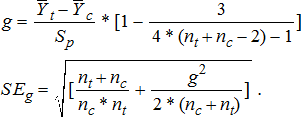
Where 


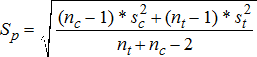
With St and Sc as the standard deviation in the treatment and comparison group respectively (Hedges’ approach). If either the comparison or treatment group's standard deviation was not reported, the standard deviation of the total sample ST or the comparison group standard deviation was used to compute g . In the case of dichotomous outcome variables, the St and Sc were computed based on the number of observations and the proportion in the respective group, if available.
For partial effect sizes estimated using multivariate analysis, g and its standard error were estimated based on formula described in Keef and Roberts (2004):

Where 

There are two approaches for the calculation of the pooled standard deviation from regression-based studies. In Hedges’ approach, 


If information for calculating SEg was not available, it was approximated by

where t is the t-value associated with a t-test on the treatment effect of a regression.
If none of the values for Sp , ST or Sc could be obtained from the report (or by contacting the authors), the standard deviation of the outcome variable was approximated using the formula from Borenstein, Cooper, Hedges and Valentine (2009)
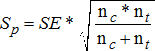
where SE is the standard error of a means test (e.g., regression coefficient). Since this formula is technically only correct for bivariate effect sizes, a sensitivity analysis was performed on the sample without these imputations.
For some studies, the review team transformed reported effect size statistics (often t, F, p or z-values) prior to calculating effect sizes following the procedures suggested in Lipsey and Wilson (2001).
Prior to synthesizing computed effect sizes, checks were made for outliers which could have been a result of erroneous coding or misleading assumption in the computation of SMD. In cases where SMDs or their standard errors seemed implausibly large, the original reports were revisited to check whether these were in accordance with the findings stated by the authors. In cases where the effect sizes where correctly coded and computed but still appeared implausible, the authors were contacted for clarification. As it was not possible to solve all outlier issues following this approach, the data from remaining outliers was censored, initially by winsorizing the data and then finally by dropping any remaining outliers. Winsorizing is a method of censoring data by limiting extreme values in the statistical data to reduce the effect of possibly spurious outliers. Winsorizing refers to a method where all outliers are set to a specific percentile. In this case, the top 1 per cent and bottom 1 per cent of observations were set to the value of the 1st and 99th percentile, respectively. The robustness of the results was tested with respect to the level of winsorizing and the cut-off ranges for trimming outliers.
3.4.3 Unit of analysis issues
Originally, it had been planned to correct the standard errors for a possible unit of analysis error by adjusting the standard errors () according to the formula suggested in Higgins and Green (2011, p. 502ff). A unit of analysis error typically arises if the study conducts analysis and programme placement at different levels and the analysis does not adequately account for this clustering (e.g., by using cluster robust standard errors or variance components analysis). In such cases, the analysis would yield narrower confidence intervals than the true confidence intervals, increasing the risk of Type-I error. This can be a problem in cluster randomized trials or in quasi-experimental studies in which treatment allocation is clustered. However, no studies were identified where there was a suspicion that the unit of analysis was not adequately addressed in the statistical analysis.
3.4.4 Dealing with missing data
In several instances, primary reports did not supply sufficient information to compute standardized effect sizes from reported treatment effect estimates. Most often, post-intervention mean and/or standard deviation of the outcome variable could not be obtained. The frequency with which missing information was encountered indicates that better reporting standards are required for impact evaluations studies.
As a first step, authors of included papers were contacted to provide missing information and to clarify discrepancies. This was an important and time-consuming measure, carried out via standardized letters and missing information forms, into which authors or research assistants could easily insert the results and data requested. 15
Initially, the review team reached out to the authors of 100 included reports (note that this number represents almost the entire sample of included reports in the systematic review), requesting additional information to facilitate the computation of the effect sizes or to achieve clarity on the quantitative results or interventions details. 16 In the event that an author did not reply, the same request was sent two more times. In total, the authors of 34 papers replied, while no response was received from the authors of 63 reports. In the remaining cases, no valid, up-to-date email addresses could be found for the authors.
In several instances, information was missing about, for instance, standard deviations, sample sizes or average outcomes in the comparison group follow-up data collection. In these cases, the missing data were imputed from available information based on specific assumptions. For instance, when the overall sample size was provided but not the sample sizes for the treatment and comparison groups separately, an assumption of equal sample sizes was made (splitting the overall sample size in half). The same assumption was applied in cases in which only the treatment or comparison group sample size was reported. Results from a meta-analysis were reported based on the more conservative sample (without imputing missing information) as part of the sensitivity analysis.
In cases where the information necessary to compute an effect size (e.g., sample size, mean outcomes and/or standard deviation) could not be derived from the available information, the effect size was excluded from the analysis. 17
3.4.5 Dealing with dependent effect sizes
In a meta-analysis, the unit of analysis is the study. Section 3.2.2 clarified that a single programme could include more than one intervention, which was regarded as the review's primary unit of interest (instead of the overall impact of one programme, the team was interested in the impact of each specific intervention). Each intervention may have been evaluated by more than one study (e.g., evaluation), each of which may have been published in multiple reports (e.g., working papers, technical reports or journal publications). Two reports were treated as part of the same study if they were based on the same data and hence could not be treated as independent, even if they were written by different authors. Therefore, an intervention population (all participants) might be different from the study population (all in one data set), which might itself differ from the sample population for a specific treatment effect estimate on a specific outcome construct.
Estimated treatment effects may be regarded as independent from each other when the underlying data were derived from different sample populations. To maintain the independence assumption, it was important that only one effect size per outcome construct and study was included in the analysis (Borenstein, Hedges, Higgins and Rothstein, 2009). However, each report might present different treatment effect estimates for the same outcome construct and the same sample population – for example for different sub-group analyses or employing different statistical methods. This implied that different estimates within each study (sometimes across reports) had to be combined into one effect size per sub-group.
Creating effect size aggregates and summary effect sizes (e.g., at the intervention or study level or across different sub-groups as part of the moderator analysis) required careful estimation to avoid the situation where a single group of participants influenced the summary effect size disproportionately. For example, a treatment effect might be reported in a study for the entire (pooled) sample and subsequently reported for sub-groups of the same sample, such as males and females. 18 The median number of treatment effect estimates per study in the sample was 12, with some reports providing more than 100 estimates. In such instances, a multitude of treatment effects could be reported for the same group where there was no a priori reason to give preference to one measure over another.
In these scenarios it was possible to mitigate the disproportionate influence on the aggregate effect sizes by applying the following steps. First, by identifying a set of effect sizes that were derived from the same independent group of participants and then, where applicable, selecting the effect sizes for this group where it was possible to establish a preference. (For example, keeping only pooled estimates and discarding sub-group estimates except when needed in the analysis.) By dropping some of the effect sizes derived from the sample this redundancy was removed from the analysis as far as possible. 19 This method provided a better approach to the data than averaging effect sizes across all overlapping sub-groups. 20
Second, in cases where multiple effect sizes were reported for each independent group without clear justification for dropping some rather than others (e.g., the where same outcomes were reported at several points in time for the same group), the aggregate (“synthetic”) effect sizes were estimated for each independent group. Based on the method for combining effect sizes from the same independent population suggested by Borenstein, Hedges, Higgins and Rothstein (2009), the approach was as follows: Let gij and SEij be the ith effect size, where i = (1,...,m), and its standard error, respectively, for the sample population identified by j. To arrive at a single combined (aggregate) effect size for group j the team took the simple average:

and the standard error of g i given by
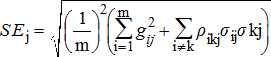
where ρijk is the correlation coefficient between g ij and g kj in study j. 21
Hence, the independent group aggregates were assembled at the relevant unit of analysis, such as at the intervention or study level (depending on the assumed correlation addressed in the procedure). Then the random-effects meta-analysis was applied to the aggregated data and estimated summary effect sizes.
3.4.6 Synthesis methods
Summary effect sizes are provided for the three outcome categories: (1) employment outcomes, (2) earnings outcomes and (3) business performance outcomes. The summary effect sizes were estimated via a random-effects meta-analysis based on the intervention-outcome level aggregates using the –metan– command in Stata. 22 Random-effects meta-analysis is recommended in settings which present significant contextual heterogeneity in terms of study population, intervention and implementation. To account for differences in individual studies’ sample sizes, effect sizes were averaged across studies by using inverse-variance weighting of the individual effect sizes. This weighting resulted in the individual effect sizes from studies with larger sample size being given more weight in the combined effect size. The summary effect sizes generated in this manner are presented alongside the 95 per cent confidence intervals in forest plots (Section 4.3). In addition to the aggregate effect size, these forest plots display the weight each intervention carries towards the summary effect size.
Heterogeneity tests were used to examine whether the variation in effect size estimates within outcome categories was larger than expected from sampling error alone (Deeks, Altman & Bradburn, 2001). To test for heterogeneity, the team employed I2 statistics and Q-statistics. These statistics tested whether the percentage of variability in effect estimates was estimated due to heterogeneity rather than by chance. A significant Q (p-value <0.05) and an I2 value of at least 50 per cent were considered to be indicators of heterogeneity.
3.4.7 Moderator analysis
Moderator analyses were performed when there was evidence of heterogeneity. The analyses tested hypotheses about whether variation in the (average) effect sizes reported in studies was associated with differences in study, participant and intervention characteristics (moderators). These moderator analyses also served as a test for correlations of effect size magnitude with specific characteristics of interventions and population groups. They therefore formed the basis for the answers to the research questions regarding factors of intervention effectiveness.
In a first step, a univariate approach was implemented, analogous to an analysis of variance (ANOVA) analysis, again via a random-effects meta-analysis based on the intervention-outcome level aggregates. Specifically, the review team investigated heterogeneity within outcome categories by (i) main intervention category, (ii) country income level, (iii) gender, (iv) participant income status and (v) time elapsed after programme completion. Results from these models are presented in the form of forest plots in Section 4.3.3.
Ideally, moderator analysis should be conducted with a minimum of ten studies for each individual moderator variable (Borenstein, Hedges, Higgins & Rothstein, 2009). A decision was made to present forest plots for sub-groups (e.g., intervention types) that had at least four individual interventions. The number of effect size estimates and individual interventions for each sub-group are displayed in the respective forest plots to provide the reader with an indication of the size of the evidence base.
A large array of study-level, intervention-level and contextual variables were identified and coded which it was assumed could be correlated with the reported effect size. The code description in Section 9.7 in the Appendix provides an overview of all variables that are included in the multivariate meta-regression. In addition to these, tests were conducted for the influence of various other moderator variables but the decision was made to exclude any that were deemed non-significant.
3.4.8 Supporting interpretation of effect sizes: The percentage change
In addition to the SMD, the review team computed the simple percentage change of the intervention over the control group mean as a more intuitive indicator of the intervention's impact. The percentage change was calculated by dividing the raw effect size (i.e., the mean difference between treatment and comparison group) by the mean value of the outcome variable for the comparison group. As a consequence, the percentage change indicates the direction of change for the treatment groups, with negative values meaning that the treatment group's outcome was lower than the comparison group's. This percentage change was then averaged by independent effect size group (i.e., by a grouped combination of intervention and study level). Subsequently, the team weighted the group-wise percentage changes using the inverse-variance weights (as throughout the analysis) and computed the final percentage changes. The computation of average percentage changes, however, comes with some caveats (cf. Lipsey et al. 2012) and in some cases the reported average percentage changes are at odds with the average SMDs computed across the same sample of (independent) effect sizes. For this reason, we do not emphasize the findings based on percentage changes but rather see it as a complement to reported SMDs, which are the main focus of our analysis.
3.4.9 Sensitivity analysis
A range of sensitivity checks were conducted to test the robustness of the results. Sensitivity analysis was carried out by restricting the meta-analysis to a subset of all studies included in the original meta-analysis. First, following guidance from the Campbell Collaboration (2014, p. 9), an examination was carried out to establish whether findings were influenced by the rigour of the evidence. Specifically, the team tested heterogeneity across study design (randomized vs. quasi-experimental) and publication status (published vs. unpublished studies). Second, the sensitivity of the results was tested with regard to the assumptions made for computing the SMD effect size in the presence of missing information. Third, the team tested the validity of the method of dealing with statistical outliers (dropping observations vs. winsorizing the data).
3.4.10 Risk of bias and study design assessment
During the research and coding process, the team found that impact studies often lacked important details that would allow a confident appraisal of the plausibility of the identifying assumptions on which the empirical analyses were based. This lack of detailed reporting in many publications limited the extent to which a full risk of bias assessment, for example, based on Waddington and Hombrados (2012), was possible. As a consequence, an alternative framework was adopted (proposed in Duvendack, Palmer-Jones, Copestake, Hooper, Loke & Rao (2011) and Duvendack, Hombrados, Palmer-Jones & Waddington (2012)) in order to assess the statistical rigour of primary studies. This approach combined an assessment of both research design and the method of statistical analysis. It did not incorporate detailed assessment of aspects of bias usually recommended in systematic reviews (see e.g. Higgins and Green, 2011) such as allocation method, confounding, selection bias (including attrition), performance bias, biases in outcomes data collection, and bias in analysis and reporting. In addition to the original approach, the assessment was further disaggregated by the statistical method (DiD, statistical matching, etc.) used for addressing potential confounders of the original research design (randomized experiment, natural experiment, etc.). By placing RCTs at one end of the spectrum and cross-section designs at the other, the tool aimed to reflect the potential capacity of different empirical identification strategies to control for possible confounding. 23 In addition to the sensitivity analysis, the team therefore tested whether different research designs and empirical approaches yielded different effect sizes on average.
3.4.11 Assessment of reporting bias
Publication bias or “file drawer effects” refers to the underreporting of studies which establish a non-significant, negative or mixed evaluation finding (Franco, Malhotra & Simonovits, 2014). The review team assessed the danger of publication bias in the sample of included studies by several means. First, by testing the influence of study design and publication status as part of the sensitivity analysis. Second, by performing standard tests for publication bias: plotting the effect size against standard errors (funnel plots) using the –metafunnel– and –metacum– commands in Stata. Moreover, the team also implemented Egger, Davey Smith, Schneider and Minder's (1997) meta-regression test using the –metabias– command in Stata. The idea underlying the small-sample assessment to detect publication bias is that “researchers who have small samples and low precision will be forced to search more intensely across model specifications, data, and econometric techniques until they find larger estimates” hence “such considerations suggest that the magnitude of the reported estimate will depend on its standard error” (Doucouliagos & Stanley, 2012).
Tests were also made to establish whether there were observable differences in reported effect sizes between peer-reviewed and unpublished studies. For example, it was possible that estimates reported in journal articles might be more likely to be positive and significant (Stanley, 2013).
3.5 DEVIATIONS FROM THE PROTOCOL
The protocol of the systematic review was published in November 2014 and was followed by the implementation of the search and selection process outlined in the protocol. The primary and complementary search process benefitted from the extensive scoping search and development of tailored search strategies for each source prior to the publication of the protocol, allowing the review team to follow the planned search process closely. The main search in electronic databases was completed in February 2014. The systematic search resulted in a high number of studies to be screened, classified and coded in 2014. While the selection and data extraction process was ongoing, the review team decided to consider additional sources that were made available in 2014 (e.g., studies presented at the Doha Evidence Symposium in March 2014). Following the selection and data extraction process, the review team contacted experts and authors of included studies, screened reference lists of included studies and conducted citation tracking in order to identify additional studies from November 2014 to January 2015.
During the process of data collection and synthesis, the team made changes to the coding tool and empirical methodology which represent deviations from the protocol published by the Campbell Collaboration Group (Kluve et al., 2014). In addition to the variables proposed in the protocol, three additional intervention-level variables were coded. The variables relate to the design of the intervention and were deemed relevant and a priori strongly correlated to reported effect sizes: Participant profiling for services provided: The variable captured whether the intervention (i) identified individual factors or characteristics that implied a risk in the labour market and (ii) relied on such information to assign youth to specific services. Examples include caseworker discretion, screening or specific eligibility rules. Incentives to participants: Capture whether participants received payments conditional on (monitored) programme participation or success. This also included participants’ eligibility to welfare or unemployment benefits. Incentives to service providers: This variable captured whether payments (or bonuses) to the implementing agency were conditional on outcomes of intervention participants. The protocol had proposed to review specific cases were evaluations measured general equilibrium or spillover effects. However, the frequency of such analyses and measures was low. The review team focused on studies looking into partial equilibrium effects on programme participants. Given its relevance in policymaking, the protocol had proposed the coding and analysis of Intention-to-Treat (ITT) estimates. The plan was to approximate ITT estimates from studies which reported only Average Treatment Effect on the Treated (ATET) estimates, using the formula suggested in Bloom (2006). However, of those studies estimating the ATET, very few reported the share of individuals who were originally assigned to the treatment group but did not take up treatment (i.e., non-compliers, defiers or no-shows). The approximation proved to be especially difficult for quasi-experimental studies, as the distinction between ITT and ATET estimates was not always clear. Instead of converting treatment effect estimates, the team decided to test differences between ITT and ATET estimates as part of the sensitivity analysis. A decision was taken during the analysis stage to present findings for intervention sub-groups that had at least four individual interventions only. Intervention sub-groups with fewer than four interventions are not reported in the main text. However, all forest plots containing sub-group analyses by intervention type are presented in Appendix 10.1.
4 Results
4.1 DESCRIPTION OF STUDIES AND INTERVENTIONS
4.1.1 Search results and selection of studies
The primary and complementary search identified 32,117 records, based on a search of over 70 sources, including 12 specialized databases, 11 general databases, 35 websites, such as institutional and conference websites, five dissertation, thesis and grey literature databases, and nine other reviews and meta-analyses. The search in electronic databases was completed in February 2014. From November 2014 to January 2015, the review team contacted experts and authors of included studies, screened reference lists of included studies and conducted citation tracking in order to identify additional studies. The list of included sources as well as the search dates for each source used during the primary and complementary search process are presented in Section 9.6.1 in the Appendix. After removing duplicates in the reference management software EndNote, screening of 28,375 records by title and abstract was carried out by individual reviewers, applying the inclusion criteria of the screening questionnaire (see Section 9.6.2 of the Appendix). A total of 1,141 records were identified for full text screening.
In order to minimize bias, included and excluded results were cross-checked by a second researcher and discrepancies were resolved by both researchers. This systematic screening process led to the identification of 86 reports which were considered to be of adequate content and methodological rigour to inform the systematic review. The main reasons for excluding reports at full-text stage were the following criteria: study design, target group, intervention. In addition, several reports were excluded because a more recent or updated version of the same report was available, the report only focused on relative effects, the impact evaluation study was ongoing or the report did not examine any of the outcomes of interest considered in this review. Examples of excluded reports and the reasons for excluding them are presented in Section 7.2. 24
After extracting data from the preliminary set of 86 included reports, the review team screened 6,782 additional records that were identified through reference lists and citation tracking of included studies, hand searching of key journals in which a large number of included studies were found and contacting authors and experts. This search process led to the selection of 27 additional reports. Overall, this comprehensive search and selection process identified 113 reports which were considered eligible for inclusion in this review. The search and screening process is illustrated in Figure 2.
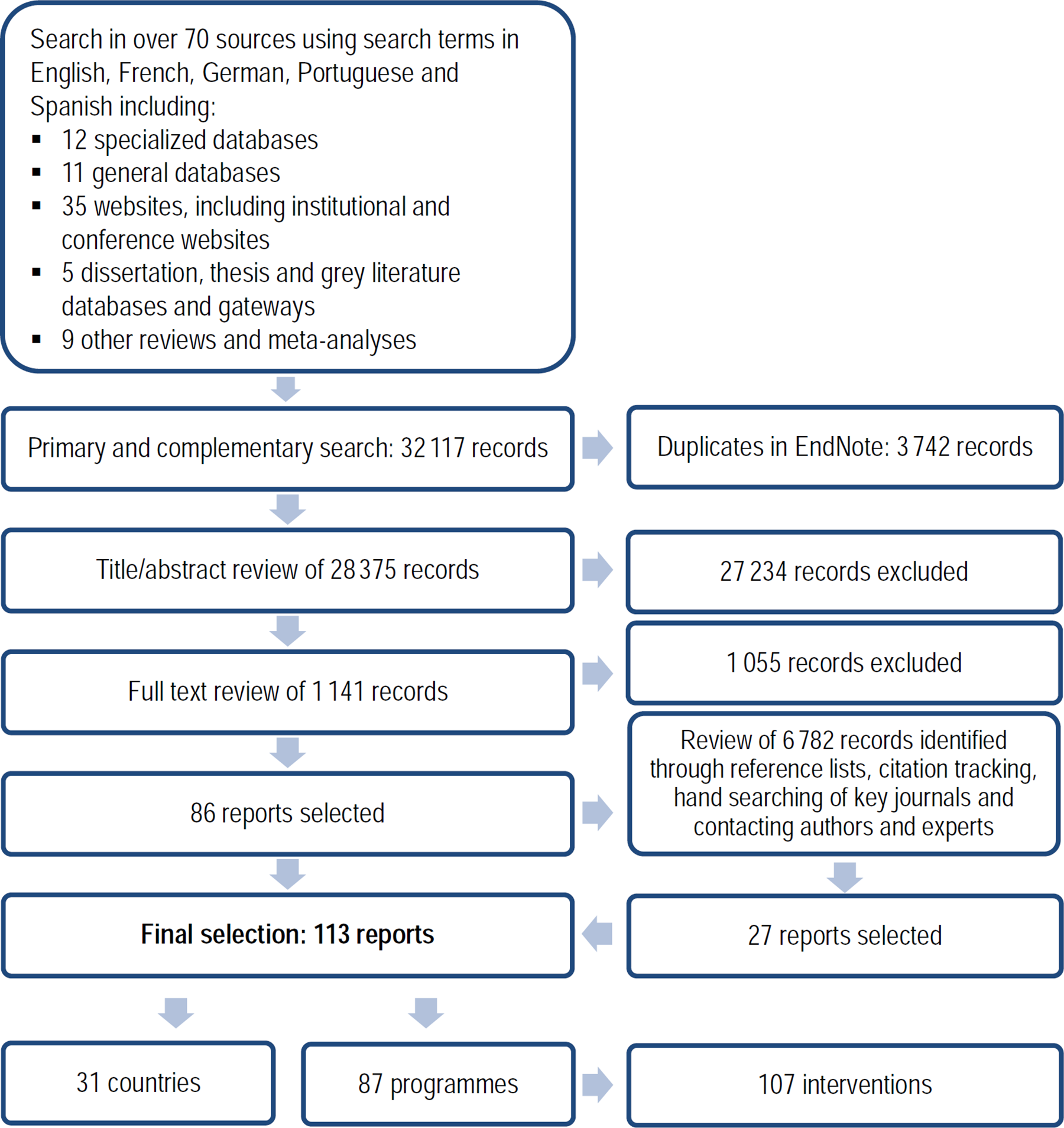
Search results
4.1.2 Characteristics of included reports
The systematic screening process led to the identification of 113 reports that met all criteria for inclusion (Section 3.2). 25 As shown in Table 8, panel A, more than half of the impact evaluations of youth employment interventions were conducted in high-income countries where there is an established practice of results measurement, particularly with regard to government employment measures. The large share of reports from high-income countries in this systematic review (65 out of 113 reports representing eleven of the 31 countries in the sample) is an important feature that justifiably suggests that some caution should be exercised when interpreting the results in global terms.
Characteristics of included reports
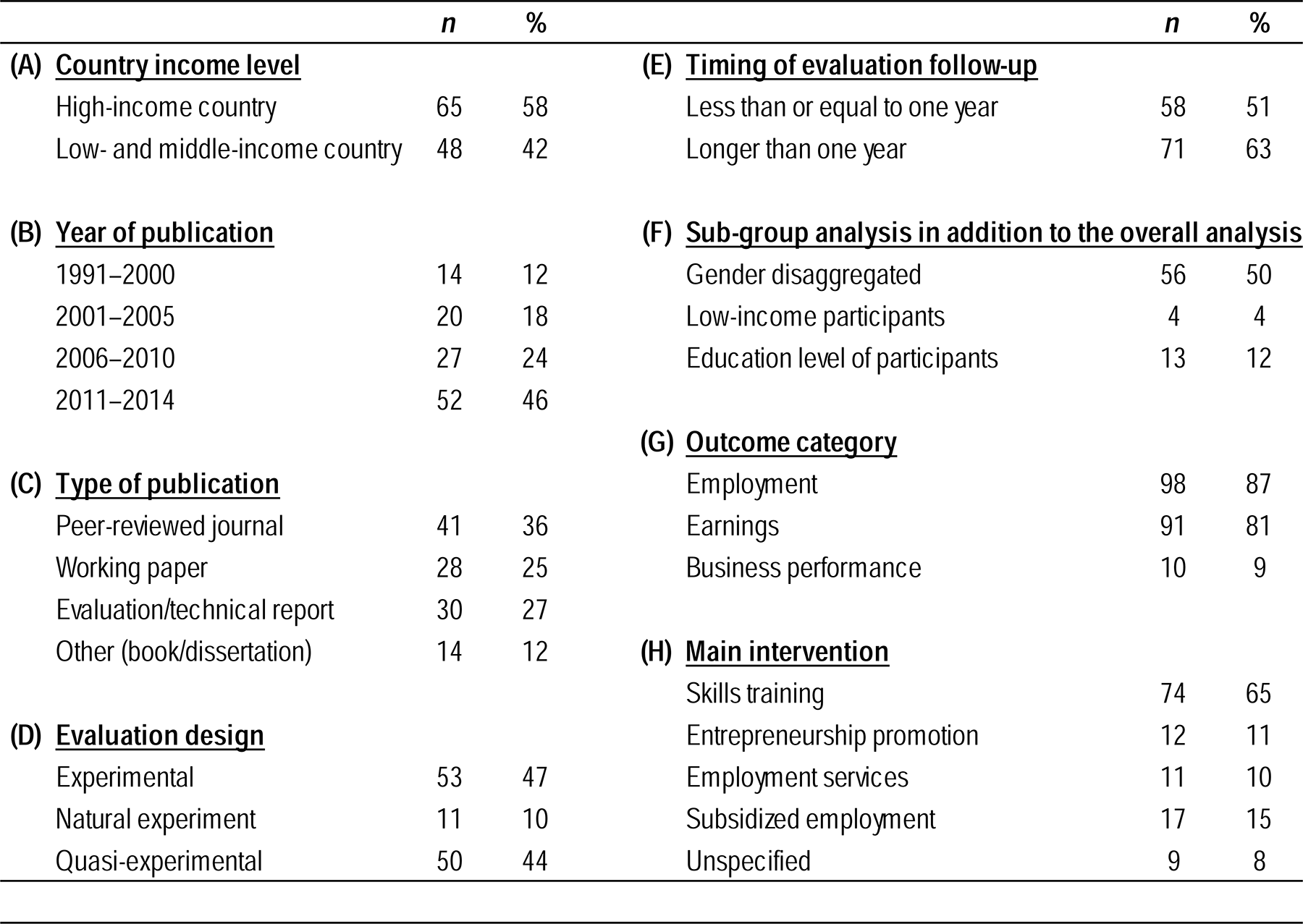
Note: n = 113. Reports may not be exclusive across the different typologies in this table, e.g., one study may estimate multiple outcomes or examine more than one intervention type.
The number of reports assessing the impact of youth employment interventions has increased steadily over the past few years (panel B), with nearly half of the sample published after 2010 and 21 reports published in 2014 alone. 26 Interestingly, this surge in evaluation has benefitted developing countries by providing a greater quantity of better quality evidence about what works to support youth in the labour market. There were 48 reports of interventions implemented in low- and middle-income countries, with a particular prevalence of impact evaluations in Latin America and the Caribbean.
The search process identified a variety of publications from the grey literature (panel C). Only around one-third of the reports come from peer-reviewed journals, with the remainder split between working papers, technical reports from implementing organizations and others, such as books or dissertations. Most of the reports published in 2014 were working papers, identified through the complementary search process.
While the review focused on counterfactual impact evaluations, the search process uncovered a large variety of different evaluation designs, namely experimental designs, natural experiments and quasi-experimental designs (as discussed in Section 3.2.5). In contrast to other systematic reviews, this review contained a significant share of randomized experiments (53 reports, as shown in Table 8, panel D). Many of the results from these randomized control trials (RCTs) have been published recently (66 per cent after 2010) and hence were not included in previous reviews. Figure 3 shows the recent surge in rigorous evidence. Prior to 2011 most RCTs in the sample were conducted in high-income countries (Figure 4), while the past five years have seen a remarkable increase in RCTs in developing countries. Most Not ably, in 2014, 12 out of 15 RCTs included in this review were from low- and middle-income countries; seven of them evaluating youth employment programmes in Africa (Box 7).
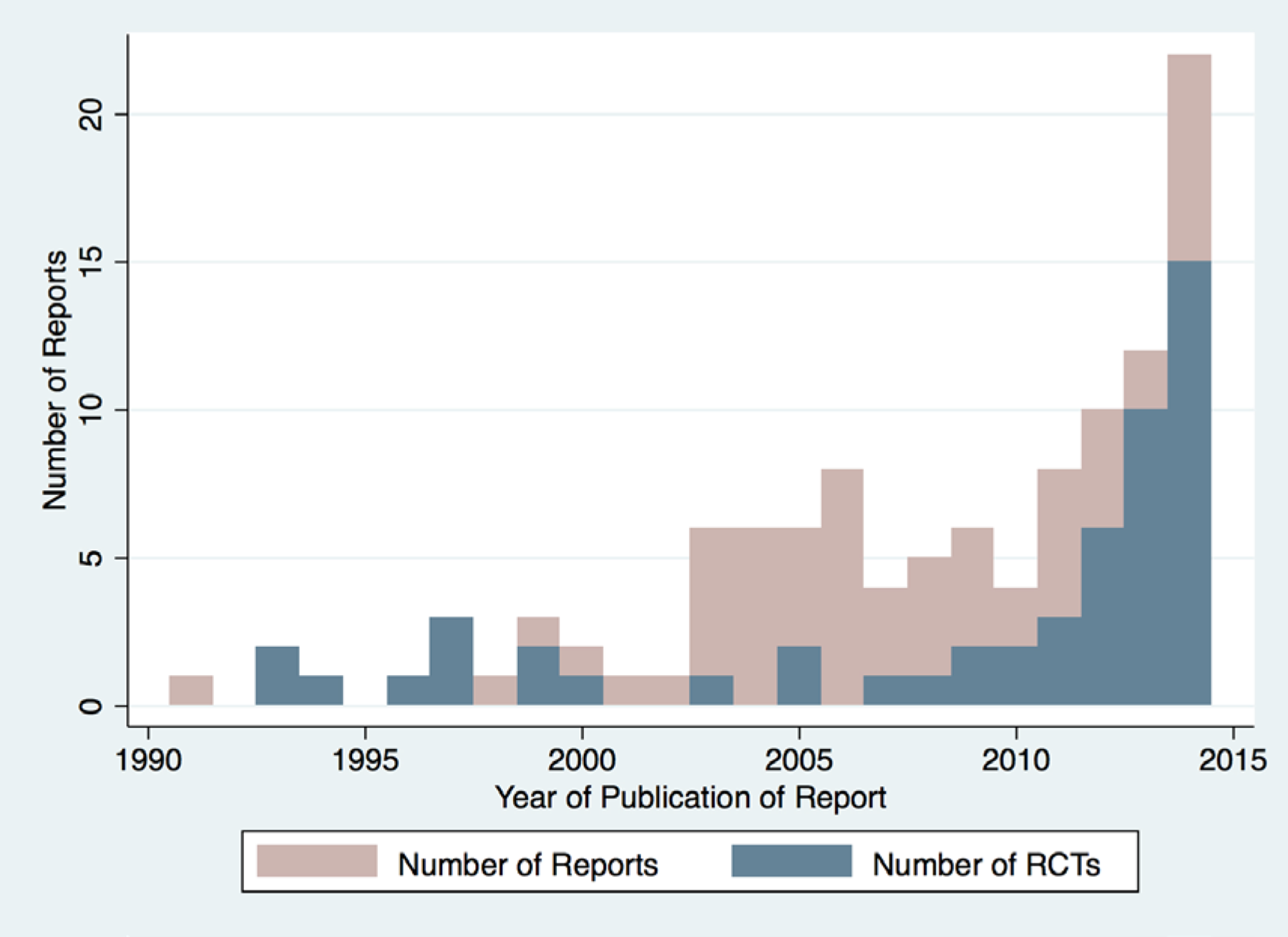
Total number of reports and reports relying on RCTs by year of publication
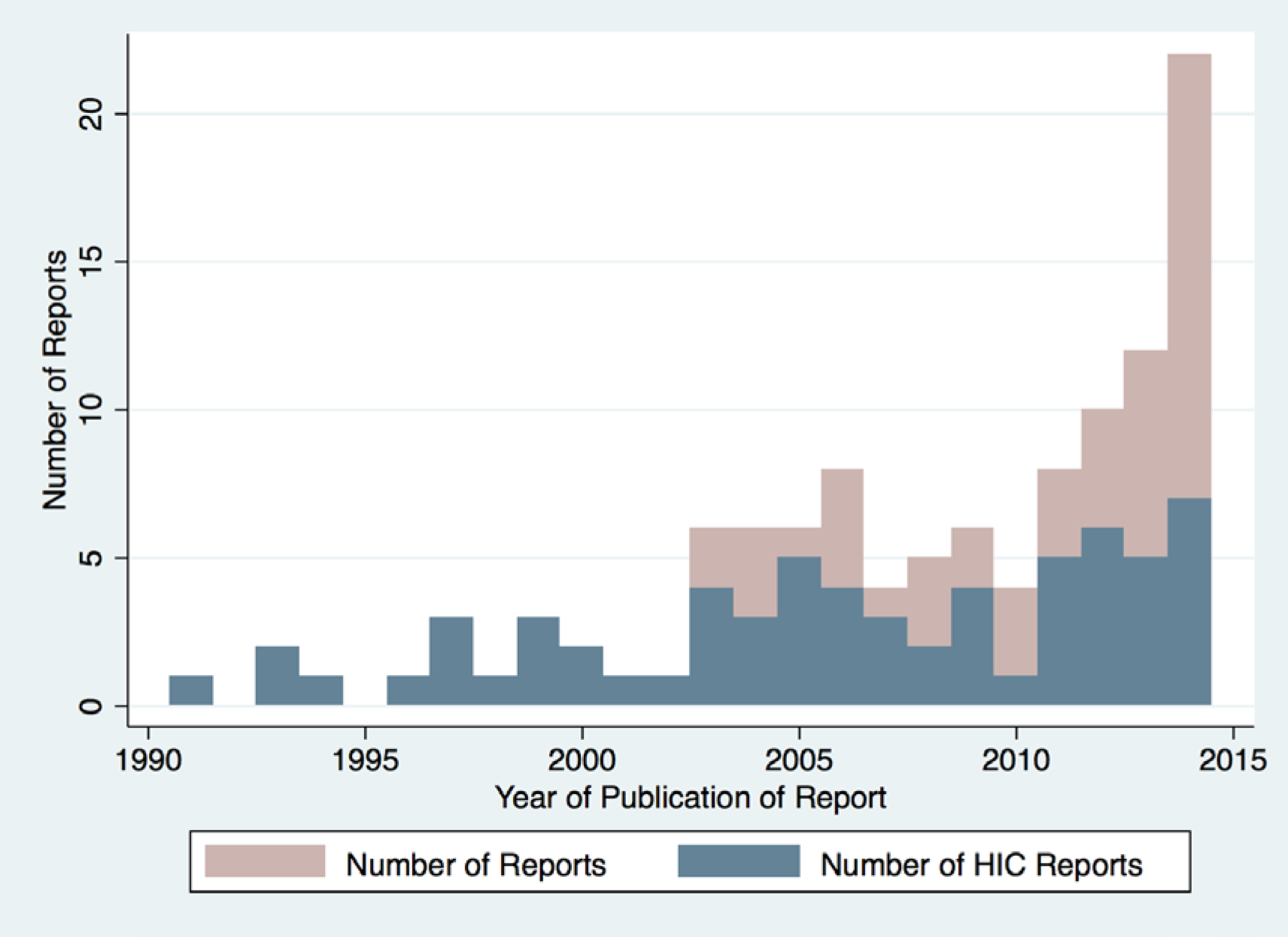
Total number of reports and reports from high-income countries (HICs) by year of publication
Quasi-experimental designs, such as panel and cross-sectional evaluations were the second most common study design (50 reports), frequently relying on propensity score matching (PSM) and difference-in-difference (DiD) for causal inference under unconfoundedness. Quasi-experimental designs have been more widely employed over the past decade, with approximately 40 reports published after 2004 in Latin America and the Caribbean and in OECD countries. Finally, the review included 11 natural experiments, all of which were implemented in high-income and upper middle-income countries between 2004 and 2014.
In relation to the evaluation features, 39 reports provided impact estimates at multiple time points. In addition, 71 reports measured changes in outcomes of interest over 12 months after treatment exposure (panel E). These longer term effects were estimated primarily across skills training interventions. Few studies provided a sub-group analysis in addition to the overall analysis (panel F). In particular, only half of the reports in the sample provided separate results for males and females (excluding those that evaluated gender-targeted programmes). Very few reports in the sample provided separate treatment effects for disadvantaged, low-income or low-educated youth.
Table 8 also provides an overview of the types of outcomes measured across the included reports (panel G). Three-quarters of the reports in the sample reported results for more than one type of outcome. Employment and earnings outcomes were extensively reported. Employment probability was by far the most commonly measured and reported outcome within the set of reports. More than 88 reports provided an estimate of the programme impact on employment probability. Another 35 reports estimated the effect of an intervention on hours worked.
Box 7: Studies of youth employment interventions in Africa
This review included 13 reports of impact evaluations carried out in African countries. None of these 13 reports predated 2010. Most (nine studies) were published in working papers with only two reports published in peer-reviewed journals (by January 2015). With only one exception, all quantitative results came from RCTs, which often reported the intention-to-treat estimator as well as the effect of the intervention on the average participants who completed the programme – this was due to compliance problems which are common across evaluated interventions in the region.
Only six reports measured changes in outcomes of interest over a year after the young person‘s exposure to the intervention. This s an important aspect, as labour market impacts often materialize only over the long term.
Studies focused mainly on assessing changes in employment (13 reports) and earnings outcomes (12 reports), and to a lesser extent on understanding changes in business performance, survival or expansion (six reports). A sizable number of entrepreneurship promotion interventions were implemented in Africa and included in the review (eight out of 17).
Source: Based on a background report on African studies (Pasali, 2015).
Table 8 also displays the limited number of reports (ten out of 113) measuring changes in business performance outcomes. Nine of these related to RCTs. They were most commonly found among interventions aiming to promote entrepreneurship among young people.
4.1.3 Characteristics of evaluated interventions
As shown in Figure 2, the search process led to 113 reports that assessed impacts of 87 youth employment programmes. The review drew a key conceptual distinction between programmes, interventions and components (Section 3.2.2). Youth employment programmes can consist of one or more interventions. These are exclusive tracks offered to discrete samples of participants. For example, in the New Deal for Young People programme, implemented in the United Kingdom and described in Box 8, youth had to choose one of four different tracks, namely, (i) education or training; (ii) a job with a voluntary sector employer; (iii) a job on the environmental task force; or (iv) employment in a wage subsidy programme.
Interventions, on the other hand, have one or several components, which were classified as skills training, entrepreneurship promotion, employment services or subsidized employment measures.
Table 9 provides an overview of the 107 interventions in the review. Main category (panel A) refers to the interventions where it was possible to identify a primary component. In line with previous reviews (Kluve, 2010; Betcherman et al., 2007), skills training proved to be the most common type of main intervention category, followed by subsidized employment, entrepreneurship promotion and employment services.
Characteristics of included interventions
Note: n = 107.
There were six interventions for which no main category of intervention could be identified, and these were therefore classified as unspecified. Their components were bundled in such a way that made it impossible to identify one type of intervention as being predominant over the others. They were truly multi-dimensional in nature and formed part of the following programmes: Active labour market programme for disadvantaged youth in Germany (study by Ehlert, Kluve & Schaffner, 2012); the National Guard Youth Challenge Programme in the United States (study by Millenky, Bloom, Muller-Ravett & Broadus, 2011); the New Chance Programme in the United States (studies by Chang, Huston, Crosby & Gennetian, 2007 and Quint, Bos & Polit, 1997); the New Deal for Young People in the United Kingdom (studies by Blundell et al., 2004, De Giorgi, 2005 and Wilkinson, 2003); the Teenage Parent Demonstration in the United States (study by Maynard, Nicholson & Rangarajan, 1993); and the Youth Opportunity Grant Initiative in the United States (study by Jackson et al., 2007). Details of the New Deal for Young People in the United Kingdom are presented in Box 8.
Box 8: New Deal for Young People (NDYP) in the United Kingdom
The New Deal for Young People (NDYP) was introduced in the United Kingdom in 1998 and aimed to help the young unemployed into work and to increase their employability by combining different types of interventions, especially job-search assistance and subsidized employment. Participation was mandatory for all people aged 18–24 who had claimed unemployment benefit (Jobseeker's Allowance) for a period of six months or more. Participants entered a “gateway” period of intensive job-search under the supervision of a personal adviser, intended to last no longer than four months. Those who were still receiving the Jobseeker's Allowance at the end of the gateway period were obliged to take one of four options: (i) entry into full-time education or training for those without basic qualifications; (ii) a job with a voluntary sector employer; (iii) a job on the environmental task force; (iv) employment in a wage subsidy programme. In addition, under the terms of the scheme, employers were obliged to offer education or training on at least one day per week.
Evaluations showed that the programme appeared to have generated an increase in the probability of young men (who had been unemployed for six months) finding a job within the next four months (Blundell, Costa Dias, Meghir & Van Reenen, 2004) and suggested that a period of subsidized employment was a more effective means of exiting unemployment and securing unsubsidized employment than the other options available under NDYP (Dorsett, 2006).
Sources: based on information available at: www.youth-employment-inventory.org [20 Feb. 2016].
While the remaining interventions had one main component to address the labour market constraints of youth, more than one-third extended the intervention's scope with one or more additional measures. As panel B shows, some 64 per cent of interventions in the review incorporated a skills training component; but almost half of these combined skills training with some other measure. The most common combination was skills training and employment services, observed in 27 interventions.
Entrepreneurship promotion interventions that focused on youth were comparatively scarce. Entrepreneurship-related components were only reported in 17 interventions, and these components often seemed to be delivered in a way that was disconnected from other active labour market measures. It is important to highlight that the results chain for entrepreneurship promotion (Table 2) already incorporates the delivery of training services in relation to entrepreneurial and business development and management skills, avoiding potential overlaps between skills training and entrepreneurship promotion categories. 27
As discussed above, the majority of the reports included in this review assessed impacts of youth employment programmes implemented in high-income countries, which translated into a sample of 60 interventions (panel D). There were 56 interventions (52 per cent) from OECD countries alone (panel E), a proportion comparable to those seen in previous reviews (e.g., Card et al., 2010 and 2015; Betcherman et al., 2007).
The second largest share of impact evaluations stemmed from interventions in Latin America and the Caribbean, where many countries have experimented with active labour market policies (ALMPs) since the early 1990s – particularly through quasi-experimental designs embedded in the Jóvenes Programmes, a series of skills training interventions implemented throughout the region 28 (see Box 2 for an example).
The review captured 17 interventions evaluated in Africa (15 in sub-Saharan Africa and two in North Africa, panel E), all of which were covered in recent impact evaluations published after 2011. In contrast, there was a relatively small number of evaluated interventions from other developing and emerging regions: Four in Europe and Central Asia, South Asia and the Middle East, respectively. There was no evidence from interventions implemented in East Asia and the Pacific.
With regard to scale (panel F), most interventions had a national coverage. In 30 cases the evaluations examined localized interventions implemented as pilots. The disaggregation across urban and rural areas demonstrated a significant lack of evidence about what works to support rural youth. The review's sample included only six evaluated interventions in rural areas, 33 in urban areas, and 62 interventions at a national scale with (imputed) coverage at both urban and rural level.
A close examination of programme targeting (panel G) led to the identification of 16 interventions (15 per cent) designed to serve only young women, 48 interventions (45 per cent) targeting youth who were unemployed prior to joining the intervention and 45 (42 per cent) that focused exclusively on low-income and disadvantaged youth.
Public and private sector actors were the most common implementing entities. Their implementing role was more prevalent among high-income countries, while evaluated interventions with an implementation role for non-governmental organizations (NGOs) and non-profit organizations tended to be more common in low-income countries.
Detailed descriptions of the intervention features and overall treatment effects are presented in the Appendix in Sections 9.1 to 9.5.
4.2 ASSESSMENT OF INCLUDED STUDY DESIGNS
Impact studies often lacked important details that would allow a confident assessment of the plausibility of the identifying assumptions on which the empirical analyses were based. In order to assess the rigour of the designs in the included primary studies, the review team used the framework proposed in Duvendack et al. (2011, 2012). The approach combined an assessment of both the research design and the method of statistical analysis leading to an implicit hierarchy of study designs, with RCTs as the most rigorous design and cross-section designs at the bottom. Given the study design, the rigour of the statistical analysis was also a function of the statistical methods, ranging from more advanced methods, such as DiD, PSM, instrumental variables (IV), or regression discontinuity designs (RDD), to multivariate regressions and simple (means) tabulations.
Table 10 shows the classification of evaluation reports that were included in the systematic review. Almost half of the reports (67 reports or 47 per cent of cases, see Table 8) were conducted as RCTs, meaning that the studies are assessed to be potentially high quality. Figures in
Table 10 count the number of cases when a particular report relied on a particular statistical method. It was possible, for example, for the same RCT to rely on more than one method, which explains why the total number of RCTs in
Table 10 surpasses that reported in Table 8.
Number of reports for study design assessment
Notes: Based on Duvendack et al. (2012). One research design could rely on more than one statistical method of analysis. “Other” includes 11 cases (nine reports) that could not be readily classified within the other statistical methods of analysis. They comprised non-parametric statistical approaches (three reports), a combination of matching and IV (two reports) and principal stratification approaches (two reports). Given that these are rather sophisticated methods (more than a simple tabulation of means), their occurrence with RCTs or natural experiments was considered of potential high quality.
A further 11 per cent of reports (12 cases reported in Table 10) were based on natural experiments, combined with sophisticated statistical methods that went beyond simple tabulation of means. Accordingly, these studies can also be categorized as potentially of high quality.
There were a total of 60 reports with pipeline, only panel or only cross-section designs (Table 8, under quasi-experimental designs). In 46 cases they used and/or combined DiD, PSM, IV or RDD methods, associated with a high to medium quality evidence. There were only 12 instances (11 per cent) of low statistical rigour, when the above-mentioned designs relied on multivariate analysis or tabulation methods. There was only one unclassified report that combined panel and multivariate analysis.
In summary, the analysis showed that the included reports generally used rigorous designs, with almost 48 per cent of cases presenting potentially high quality evidence, 42 per cent high–medium quality evidence, and only 9 per cent with potentially low quality evidence (Figure 5). This finding somewhat alleviated concerns of prevalent biases to the internal validity of included reports. However, it was clear that the design approach could only provide a first approximation of potential factors affecting the internal validity of empirical research designs, which should include examination of methods of treatment assignment, confounding, selection bias (including attrition), performance biases, biases in outcomes data collection, and biases in reporting (see e.g. Higgins and Green, 2011). Section 4.3.4 conducts sensitivity analysis by testing whether studies classified as having potentially low level of statistical and analytical rigour contained statistically significant different effect sizes in comparison to studies that used potentially more rigorous methods.
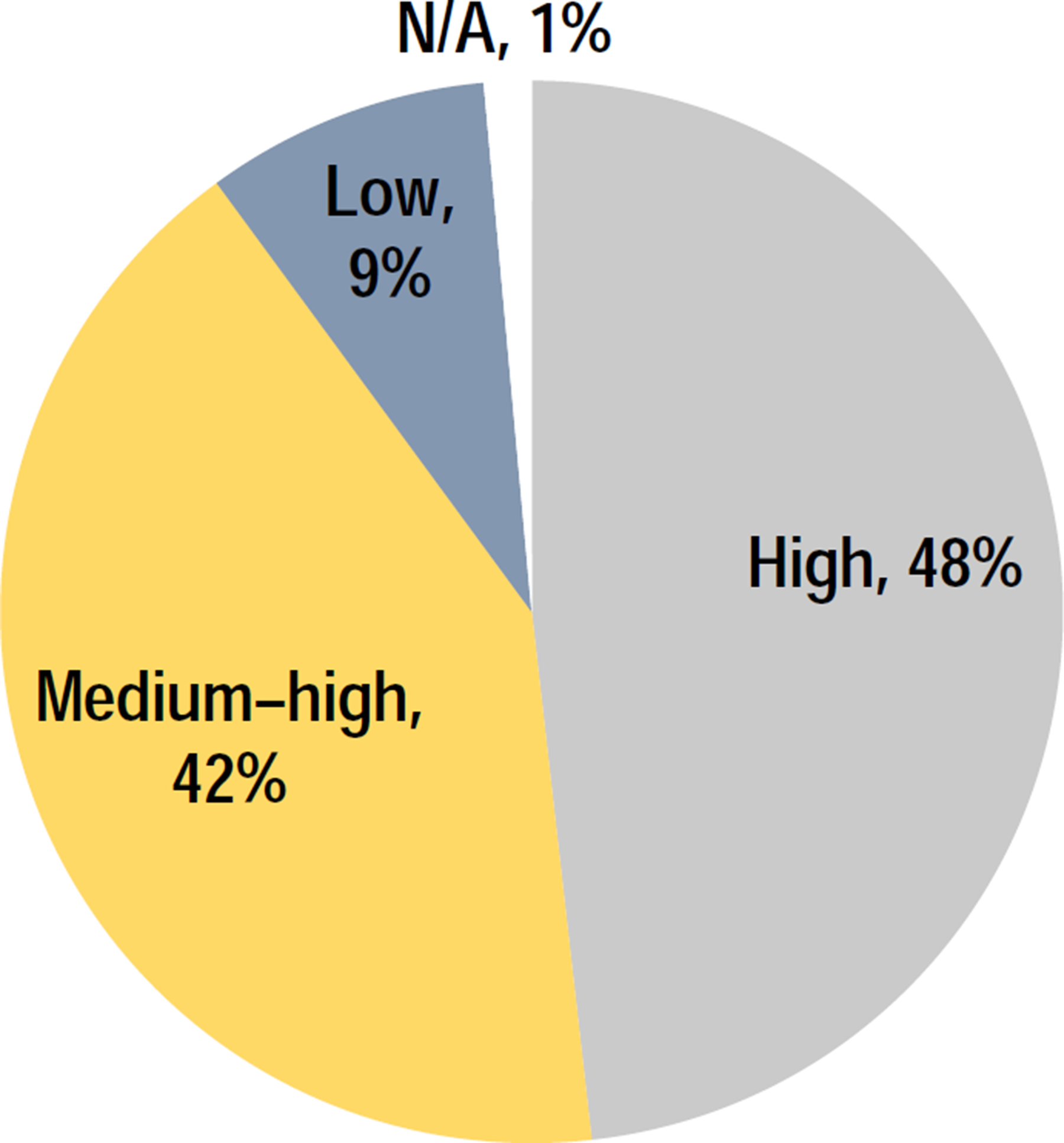
Share of included reports by study design rigour
4.3 SYNTHESIS OF RESULTS
4.3.1 Descriptive analysis of effect size estimates
To synthesize the results of the 113 empirical reports of youth employment interventions, the review relied on the reported treatment effect as a measure of impact. The search and screening process led to the identification and coding of 3,629 treatment effects. Based on the reported (or acquired) information, it was possible to compute the direction and statistical significance for 3,105 treatment effect estimates. The computation of standardized mean difference (SMD) required further information (the minimum requirement being the number of observations in treatment and/or comparison groups). Even after using the methods of imputing missing information described above (Section 3.4.4), it was only possible to compute the SMD from 2,259 reported treatment effect estimates, as shown in the third column of Table 11.
Sample size of treatment effect estimates
It was possible to compute a substantially higher number of effect sizes due to efforts to acquire missing information from authors. There were 121 independent samples to account for dependencies within studies due to overlap of the study population across effect estimates, as described in Section 3.4.5 Dealing with dependent effect sizes.
4.3.2 Univariate random-effects meta-analysis
The following sections discuss results from the univariate meta-analysis approach to explore the differences in average effect size estimates across interventions in the sample. The analysis built on forest plots, which are commonly used to graphically describe the results of a meta-analysis. Forest plots are based on an inverse-variance weighted least squares random-effects meta-analysis model (see Box 9).
Box 9: Reading a forest plot
This review presents effect size estimates and confidence intervals for the respective outcomes of interest of an intervention. This information is displayed in forest plots, which can be read as follows: Each sub-group (for summary plots) or intervention (for full plots) is represented by one line in the plot. The SMD is reported under effect size (ES), along with its corresponding confidence interval. The same information is represented graphically through the diamonds. An SMD greater than zero indicates that, on average, the treatment group had a better outcome than the (comparison) group, which did not receive the treatment. This is considered a positive effect. The vertical, unbroken line represents no effect from the interventions on the outcomes of interest. The edges of the diamonds represent the confidence interval (CI). For instance, in the summary forest plots shown below, the size of the diamonds represents the confidence interval per sub-group analysed in the respective plot. The weight is the inverse of the variance of that particular sub-group or intervention. It shows the contribution or strength that each particular sub-group (for summary plots) or intervention (for full plots) gives to the overall summary effect size. The overall effect estimate is reported at the bottom of the plot. The SMD value is further marked by a vertical dotted line, making it easier to compare where sub-group SMDs fall in relation to the overall SMD. The level of heterogeneity is captured in the I2 statistic. Notes below each aggregate forest plot provide the number of SMDs and the number of independent studies that form the basis for each computed summary SMD.
To improve the readability of this report, only “summary” forest plots are included in the main text. These provide the summary estimate for each sub-group in the respective analysis and, where appropriate, the respective overall summary SMD. 29
Fifteen “disaggregated” forest plots, with study-level SMDs for each outcome category and main intervention category, are provided in the Appendix. 30 Results presented in these forest plots were based on the sample using all imputations available and winsorizing the top 1 per cent of statistical outliers. Results from the restricted sample and/or obtained under different assumptions regarding outliers are presented as part of the sensitivity analysis in Section 3.4.9.
Figure 6 and Table 12 present the overall summary effect sizes for each selected outcome category of interest – namely, employment outcomes, earnings or income outcomes and business performance outcomes. 31 The total sample size is calculated by aggregating the number of observations coded from individual studies, while avoiding double-counting of effect sizes measured for the same sample of participants. The aggregate sample sizes throughout the report are often strikingly large. The reason is a number of quasi-experimental impact evaluations based on administrative data. One example is the paper by Webb et al. (2014), who study a targeted employment subsidy using Canada's Labour Force Survey (LFS) and hence reach a sample size of more than 480,000 individuals. Note that an individual study may have contributed to multiple outcome categories and hence the individual sub-groups may not be independent (in other words, the same sample of participants may have provided an estimate for earnings and employment outcomes, in which case the two estimates are not independent. In addition, employment, earnings and business performance are different constructs. Consequently, an overall effect size is not reported.
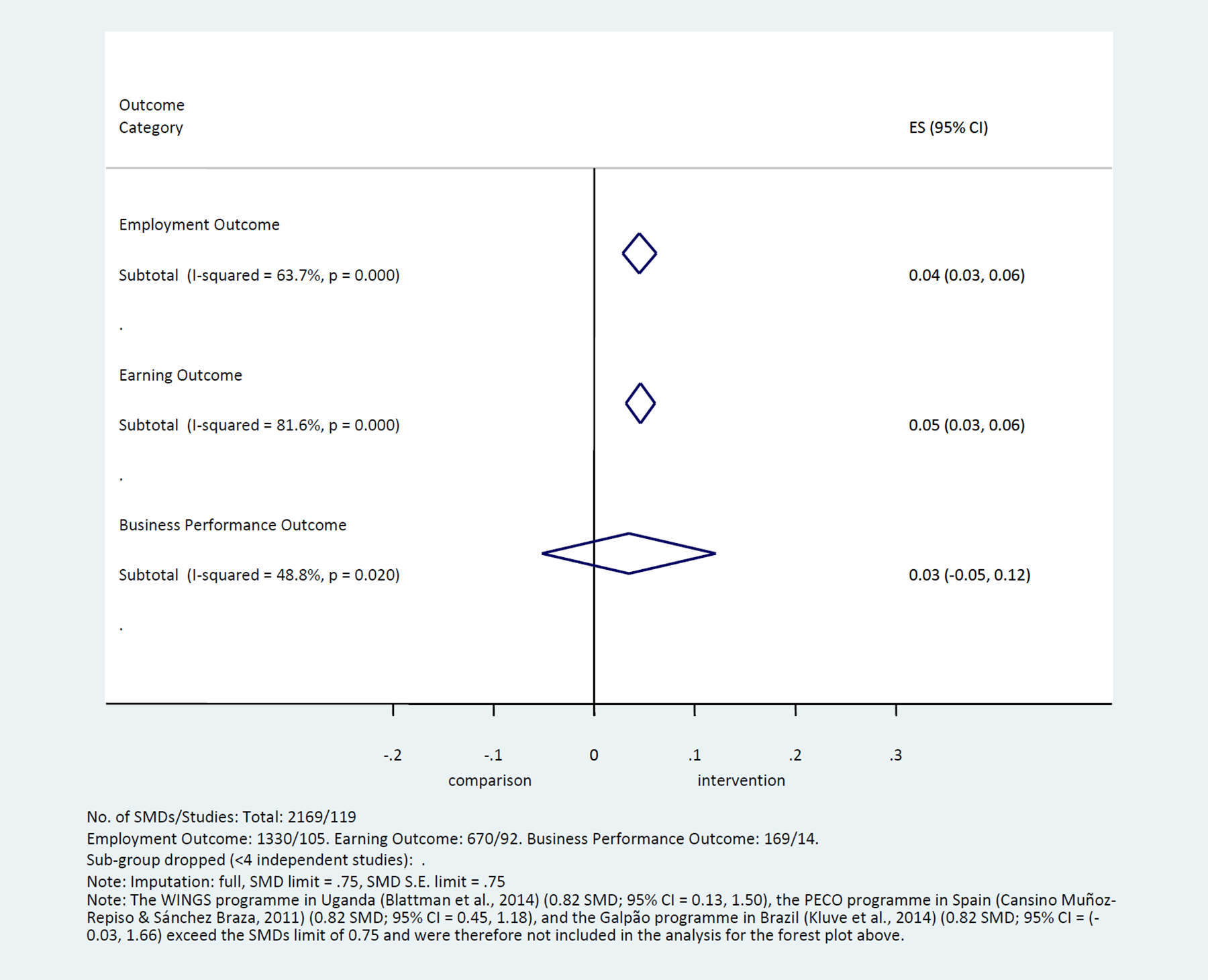
Summary forest plot of all outcomes (full sample) by outcome category
Summary of results by outcome category
Employment and earnings outcomes were the largest contributors to the overall meta-analysis: 105 of 119 independent studies estimated an employment outcome and 92 estimated an earnings outcome. 32 The overall effect on earnings outcomes across all intervention categories was 0.05 SMDs (CI = 0.03, 0.06; I2 = 82 per cent; number of interventions = 92) and statistically significant at the 5 per cent level. The summary effect on employment outcomes was similar and also statistically significant (0.04 SMD; CI = 0.03, 0.06; I2 = 64 per cent; number of interventions = 105). Only impact estimates from studies that measured business performance outcomes exhibited a relatively large confidence interval and the summary effect was not statistically significant (0.03 SMD; CI = -0.05, 0.12; I2 = 49 per cent; number of interventions = 14).
At the same time, the plot also exposed high heterogeneity (represented by the I2 statistic) within each outcome category, suggesting that a large share of the variation in effect sizes is explained by inter-study heterogeneity. Earnings outcomes displayed the highest I2 value at 82 per cent, suggesting that more than three-quarters of the variation in the effect sizes is not by chance and rather due to heterogeneity between interventions.
In order to explore the factors driving such differences, the remainder of the report explored the effect sizes within each outcome category through moderator and sensitivity analyses. Since the number of independent studies that measured specific outcomes for certain moderators was small for some moderators, the review team only assessed those outcomes where at least four interventions were obtained.
4.3.3 Univariate moderator analysis
As a first step, the team tested whether summarizing effect sizes within the three outcome categories presented a viable procedure or whether significant heterogeneity was already detectable across outcome constructs in each outcome category. Following this, tests for heterogeneity were carried out by investigating the influence of several factors as part of the moderator analysis: (i) main intervention type; (ii) country income level; (iii) time after exposure to treatment; (iv) study-level summaries of participant characteristics, including gender and participant's income status; (v) programme characteristics, including scale of the programme and implementing organization. The moderator analyses generally provided results that were stratified by main category of intervention in order to avoid “comparing the incomparable”.
4.3.3.1 Outcome measure
To factor in the diverse nature of each outcome, the team assessed the effect size of each outcome measured separately by outcome category (see Figure 7, Figure 8 and The significantly smaller sample of effect sizes for business performance outcomes presented greater variability, with overall negative effects on profits (-0.02 SMD; CI = -0.09, 0.o5; I2 = 0 per cent; number of interventions = 7) and sales (-0.06 SMD; CI = -0.16, 0.04; I2 = 0 per cent; number of interventions = 5) and a large effect among capital and investment reported outcomes (0.15 SMD, CI = 0.05, 0.26; I2 = 0 per cent; number of interventions = 6).
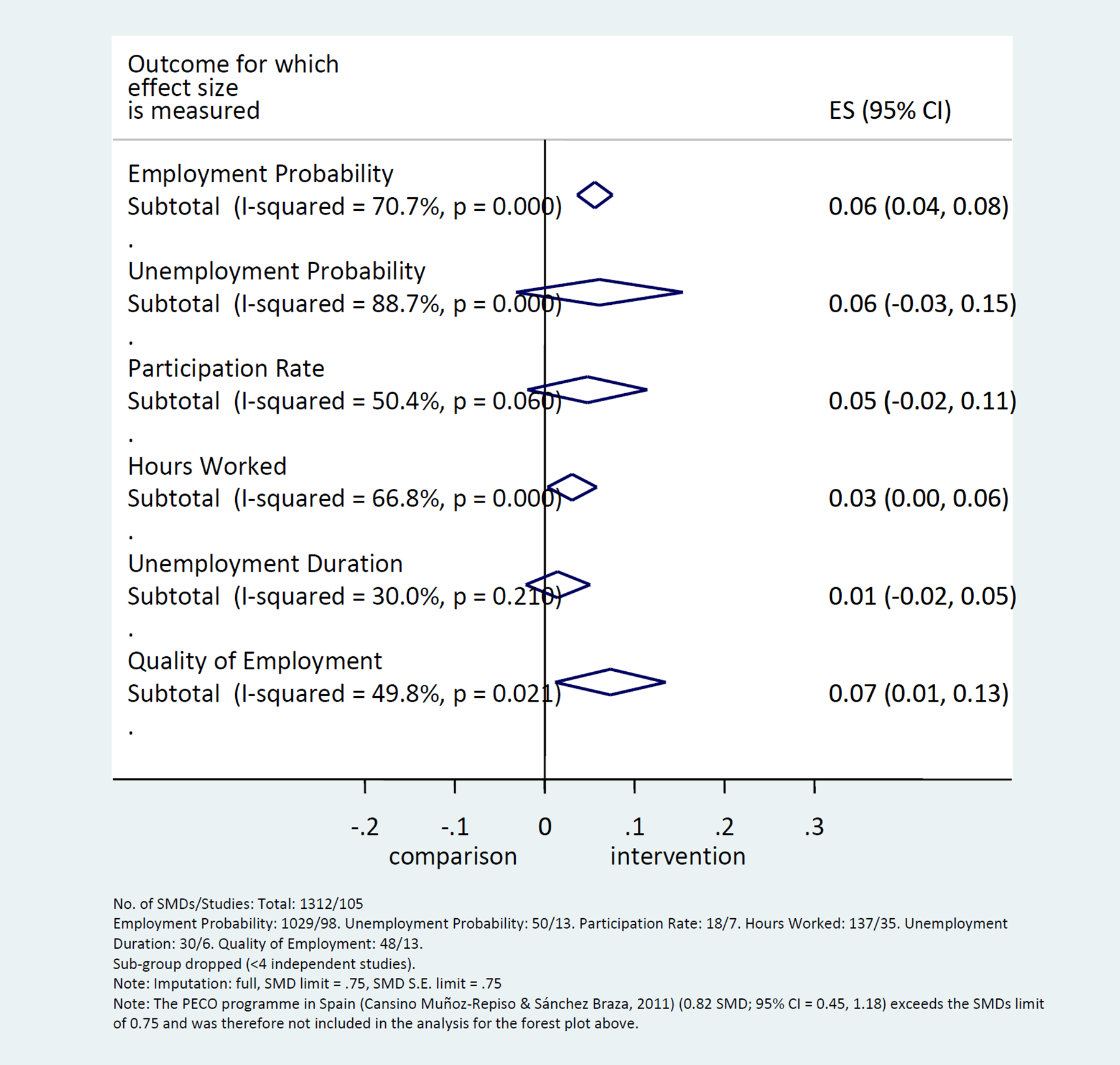
Summary forest plot of employment outcomes (full sample) by outcome measure
Additional parameters are reported in Table 14 and Table 15.
While there was heterogeneity across the different outcome measures within each outcome category, this was not statistically significant based on the random-effects meta-analysis model within each outcome category (the 95 per cent confidence interval of the sub-group average included the overall mean represented by the dotted red line), except for the case of unemployment duration and capital and investment measures). Based on these results, the team was confident that it was viable to pool results across outcome measures in the subsequent analysis.
Figure 9). Employment probability represented the largest share of effect sizes and carried the greatest weight across employment measures, with an SMD of 0.06 (CI = 0.04, 0.08; I2 = 71 per cent; number of interventions = 98) followed by hours worked, with an effect size of 0.03 SMD (CI = 0.00, 0.06; I2 = 67 per cent; number of interventions = 35). See as well Table 13 for further details.
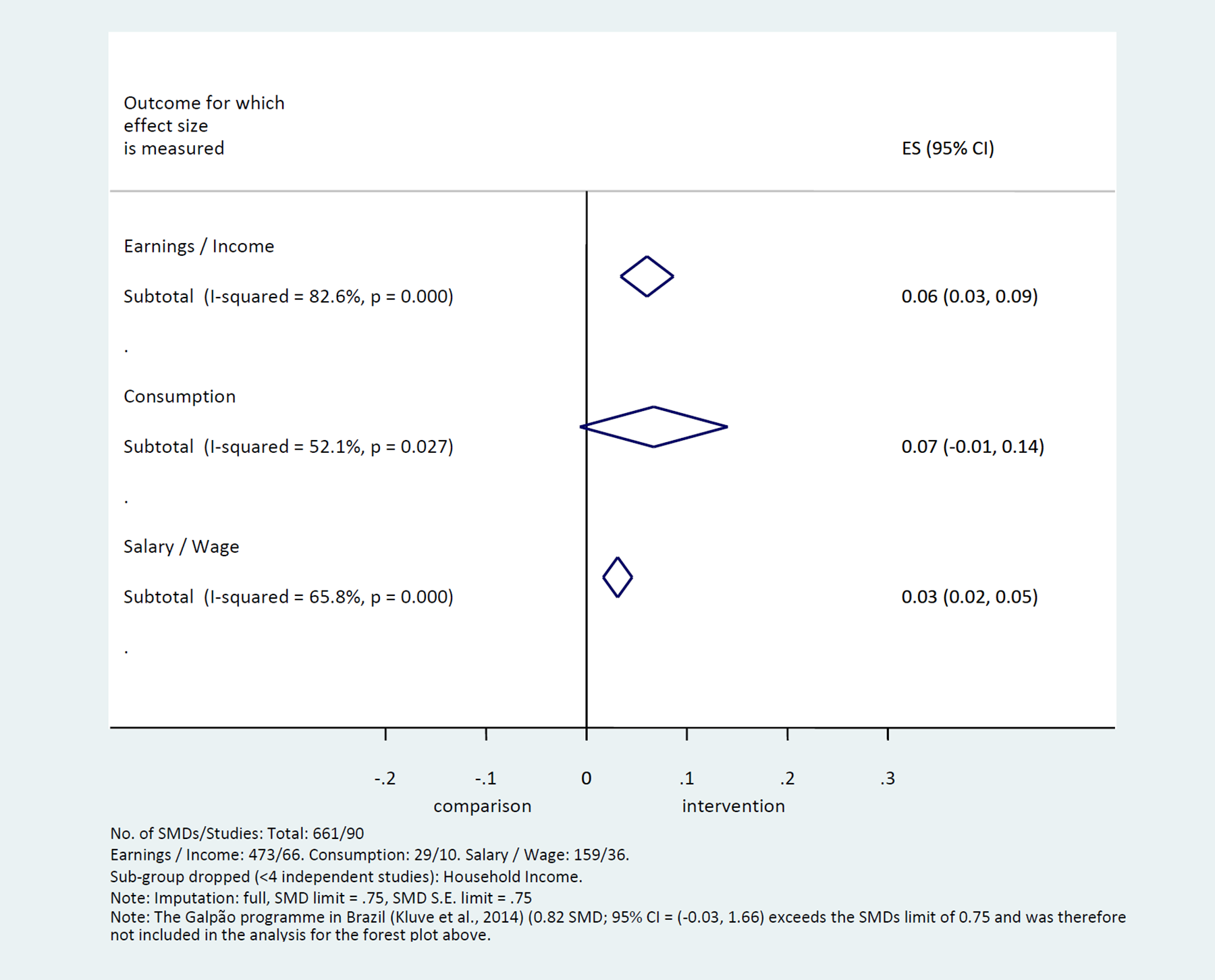
Summary forest plot of earnings outcomes (full sample) by outcome measure
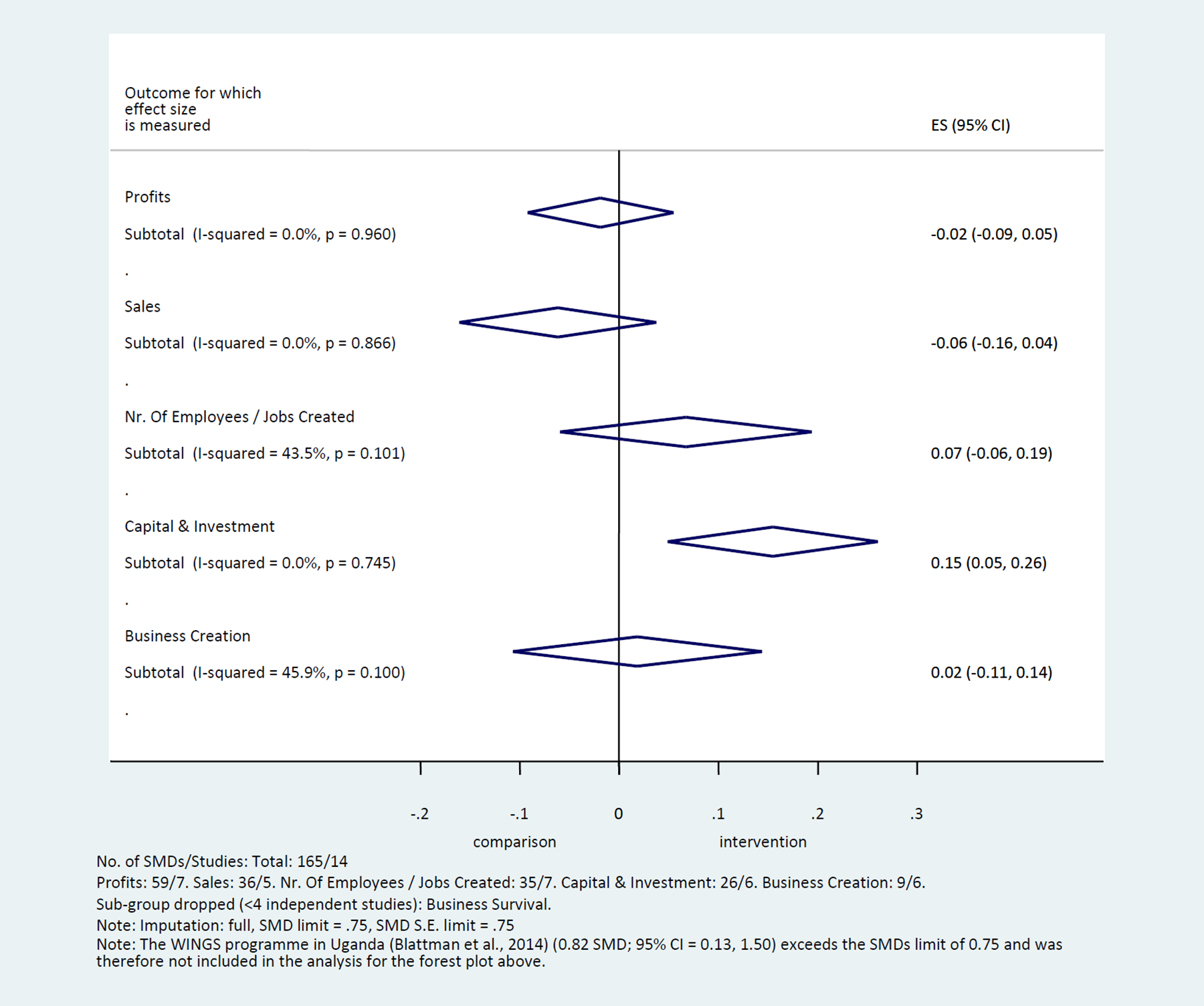
Summary forest plot of business performance outcomes (full sample) by outcome measure
Summary of results for measures within employment outcomes
Within earnings-related outcomes, wages and reported earnings drove the overall effect size, with individual effect sizes of 0.03 SMD (CI = 0.02, 0.05; I2 = 66 per cent; number of interventions = 36) and 0.06 SMD (CI = 0.03, 0.09; I2 = 83 per cent; number of interventions = 66), respectively.
The significantly smaller sample of effect sizes for business performance outcomes presented greater variability, with overall negative effects on profits (-0.02 SMD; CI = -0.09, 0.o5; I2 = 0 per cent; number of interventions = 7) and sales (-0.06 SMD; CI = -0.16, 0.04; I2 = 0 per cent; number of interventions = 5) and a large effect among capital and investment reported outcomes (0.15 SMD, CI = 0.05, 0.26; I2 = 0 per cent; number of interventions = 6).
Additional parameters are reported in Table 14 and Table 15.
Summary of results for measures within earnings outcomes
Summary of results for measures within business performance outcomes
While there was heterogeneity across the different outcome measures within each outcome category, this was not statistically significant based on the random-effects meta-analysis model within each outcome category (the 95 per cent confidence interval of the sub-group average included the overall mean represented by the dotted red line), except for the case of unemployment duration and capital and investment measures). Based on these results, the team was confident that it was viable to pool results across outcome measures in the subsequent analysis.
4.3.3.2 Main category of intervention
After restricting the analysis to cases where
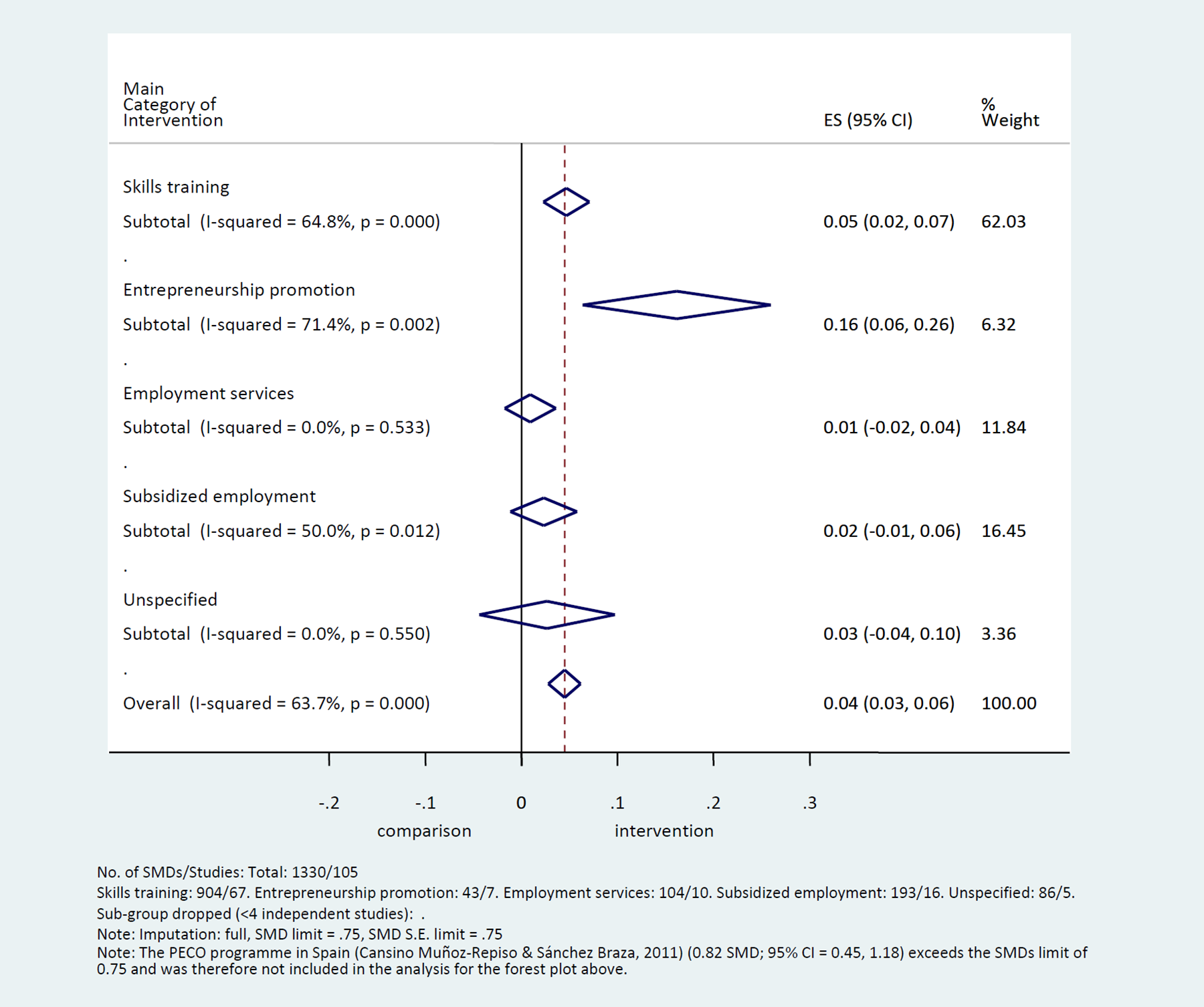
Summary forest plot of employment outcomes (full sample) by main category of intervention
Summary of results for employment outcomes by main category of intervention
Interventions providing mainly employment services to youth were the least successful (0.01 SMD; CI = -0.02, 0.04; I2 = 0 per cent; number of interventions = 10). In agreement with the descriptive analysis of interventions, interventions with skills training as the main category had the greatest weight within the overall employment-related effect size. In most cases, confidence intervals overlapped with the overall mean SMD, suggesting that there were no significant differences in average effect size across types of interventions. The I2 tests, however, reported statistically significant heterogeneity within the sub-groups for skills training, entrepreneurship promotion and subsidized employment interventions.
There was no evidence of heterogeneity across cases where it was not possible to identify a main category of intervention (i.e., in the unspecified category). Such cases reported an SMD of 0.03 (C I= -0.04, 0.10; I2 = 0%; number of interventions = 5) on employment outcomes. The category was dropped from the earnings outcome analysis due to insufficient sample size.
Qualitatively, the results of effect sizes from
The computed effect sizes (displayed in Figure 11) suggested that skills training (0.07 SMD; CI = 0.05, 0.08; I2 = 86 per cent; number of interventions = 60) and entrepreneurship interventions (0.09 SMD; CI = 0.01, 0.18; I2 = 64 per cent; number of interventions = 12) positively and consistently impacted both the employment and earnings prospects of young people, while evidence from other intervention types showed rather lower impacts on both outcome categories. However, significant heterogeneity was detected within all categories of intervention except for employment services (0.01 SMD; CI = 0.00, 0.02; I2 = 0 per cent; number of interventions = 8). See Table 17 for further information on the results and parameters.
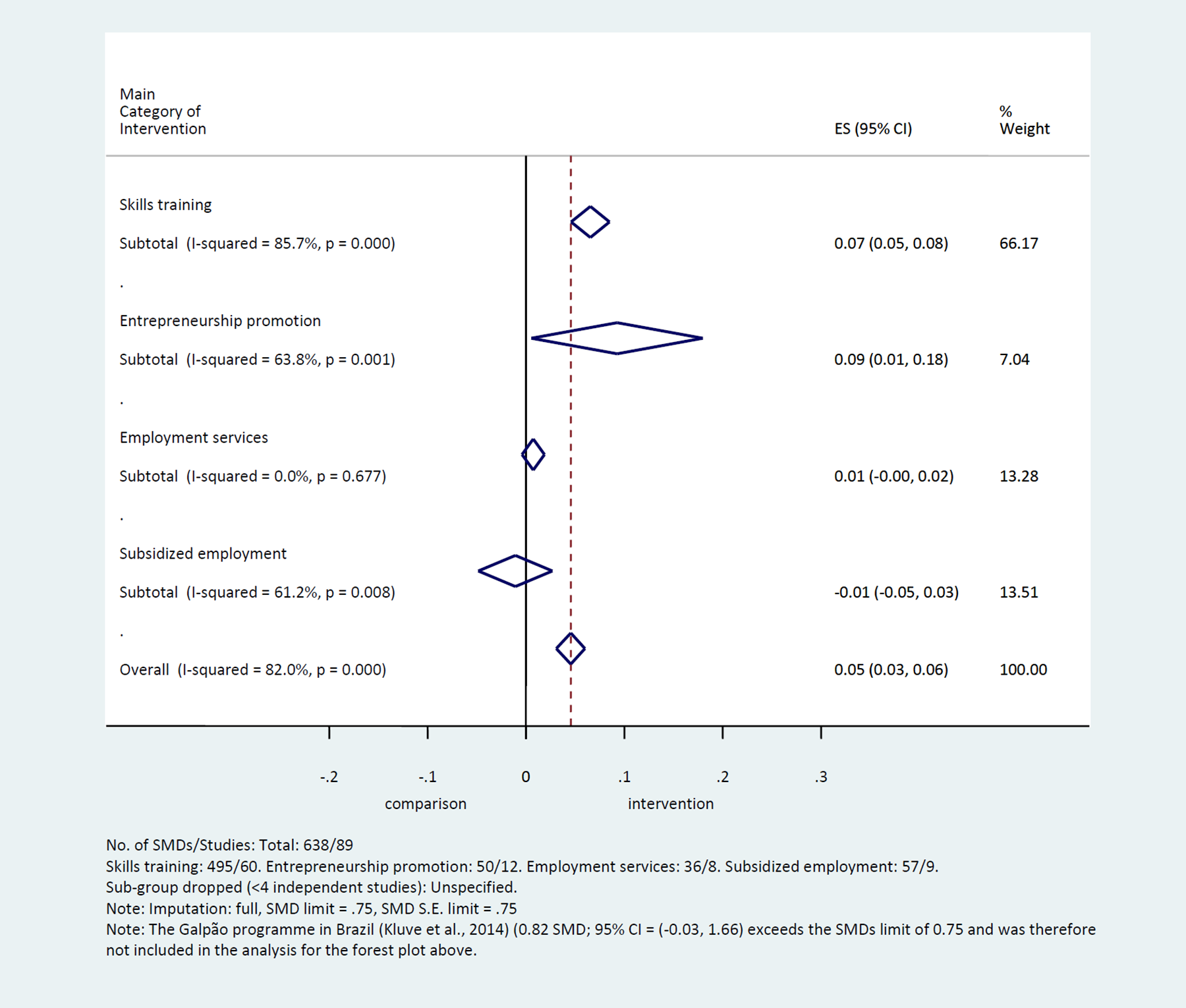
Summary forest plot of earnings outcomes (full sample) by main category of intervention
Summary of results for earnings outcomes by main category of intervention
The summary forest plot for
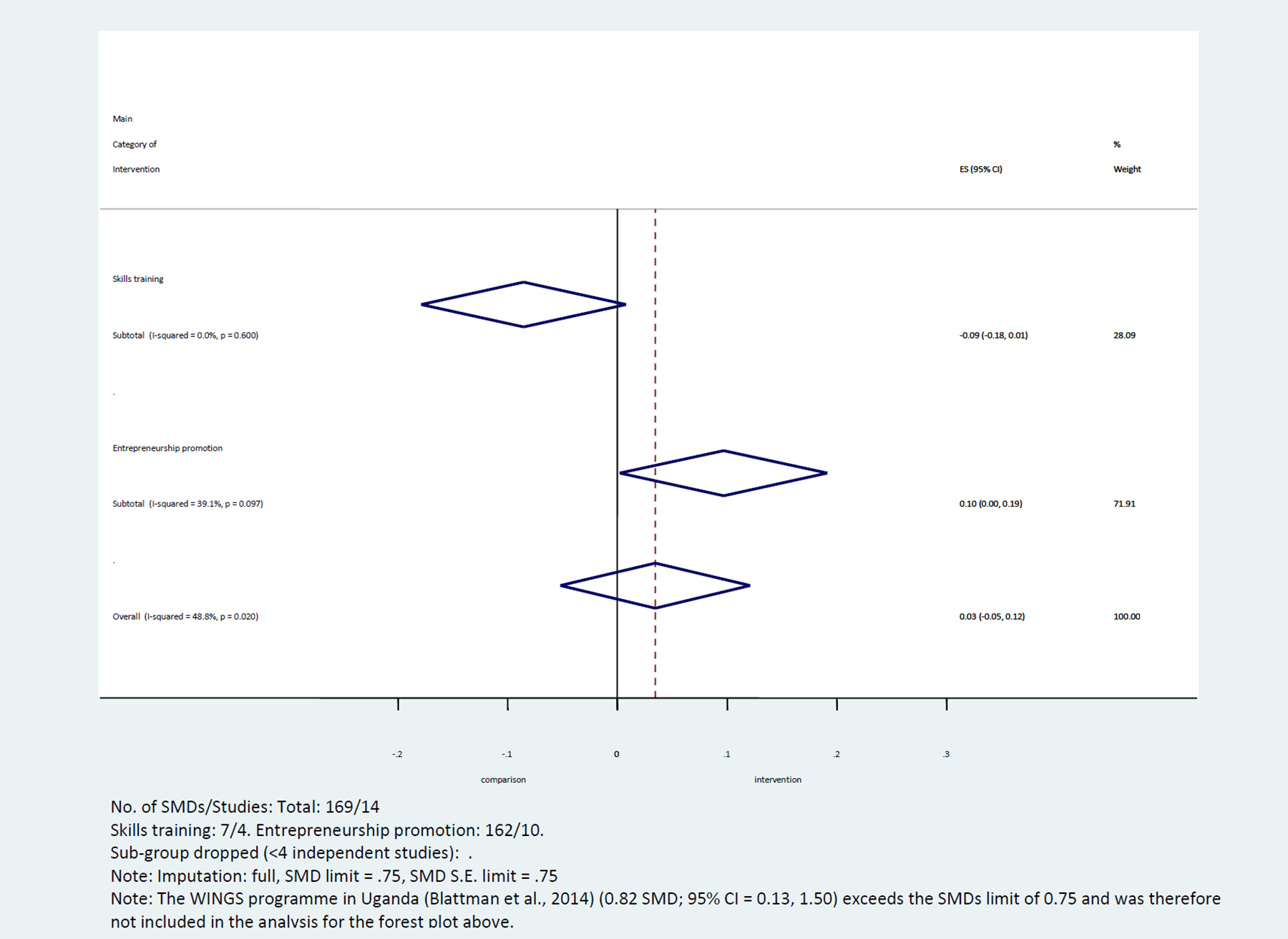
Summary forest plot of business performance outcomes (full sample) by main category of intervention
Summary of results for business performance outcomes by main category of intervention
Notes: The table does not show report on all categories of intervention as related studies did not measure changes in business performance outcomes.
4.3.3.3 Country income level
This section explores differential impacts across country income levels. The analysis recognized (i) the differences in labour market barriers facing youth in the context of different country income levels (Robalino, Margolis, Rother, Newhouse & Lundberg, 2013); (ii) the role of context on the ability of youth employment interventions to shape labour market outcomes of youth (Betcherman et al., 2007); and (iii) the intrinsic and differentiated characteristics of labour markets and institutions across middle- and low-income countries in comparison to high-income countries (Fields, 2011; Cho, Margolis, Newhouse & Robalino, 2012).
The analysis capitalized on the sizable number of studies under each country income group. There were 65 and 48 reports of interventions implemented in high-income countries and low- and middle-income countries, respectively.
Interventions in high-income countries were typically national programmes, implemented and designed by government agencies. Evidence from local or pilot interventions was scarce (only 15 per cent of the total sample). In low- and middle-income countries, more than 40 per cent of the evidence was generated from small-scale local programmes. These programmes often targeted specific groups, such as young women. While only 5 per cent of interventions in high-income countries targeted young women, they were the focus of 27 per cent of the interventions evaluated in low-income countries.
Evaluated interventions also varied across country income levels. 33 While, in high-income countries, evaluations of employment services, subsidized employment and skills training were common, only a negligible number of entrepreneurship promotion interventions were evaluated. In contrast, both entrepreneurship and skills training interventions were relatively frequently reported in countries outside the high-income economies, but there were few cases of evaluated interventions providing mainly employment services or subsidized employment interventions.
Research designs also varied across country income groups. A significant proportion (>50 per cent) of the recent evidence from middle- and low-income countries had been generated from relatively small-scale experimental evaluation designs. In contrast, quasi-experimental approaches using administrative data made up a large share (60 per cent) of the studies from high-income countries.
The review team also observed that many of the interventions in high-income countries were designed and implemented with the participation of government agencies. However, in some cases other stakeholders were involved, in particular the private sector (for example, in the form of private firms providing training or employment services).
Summary forest plots are provided for high-income and low- and middle-income countries.
34
Effect sizes reported on both employment and earnings outcomes were generally higher among low- and middle-income countries (see Skills
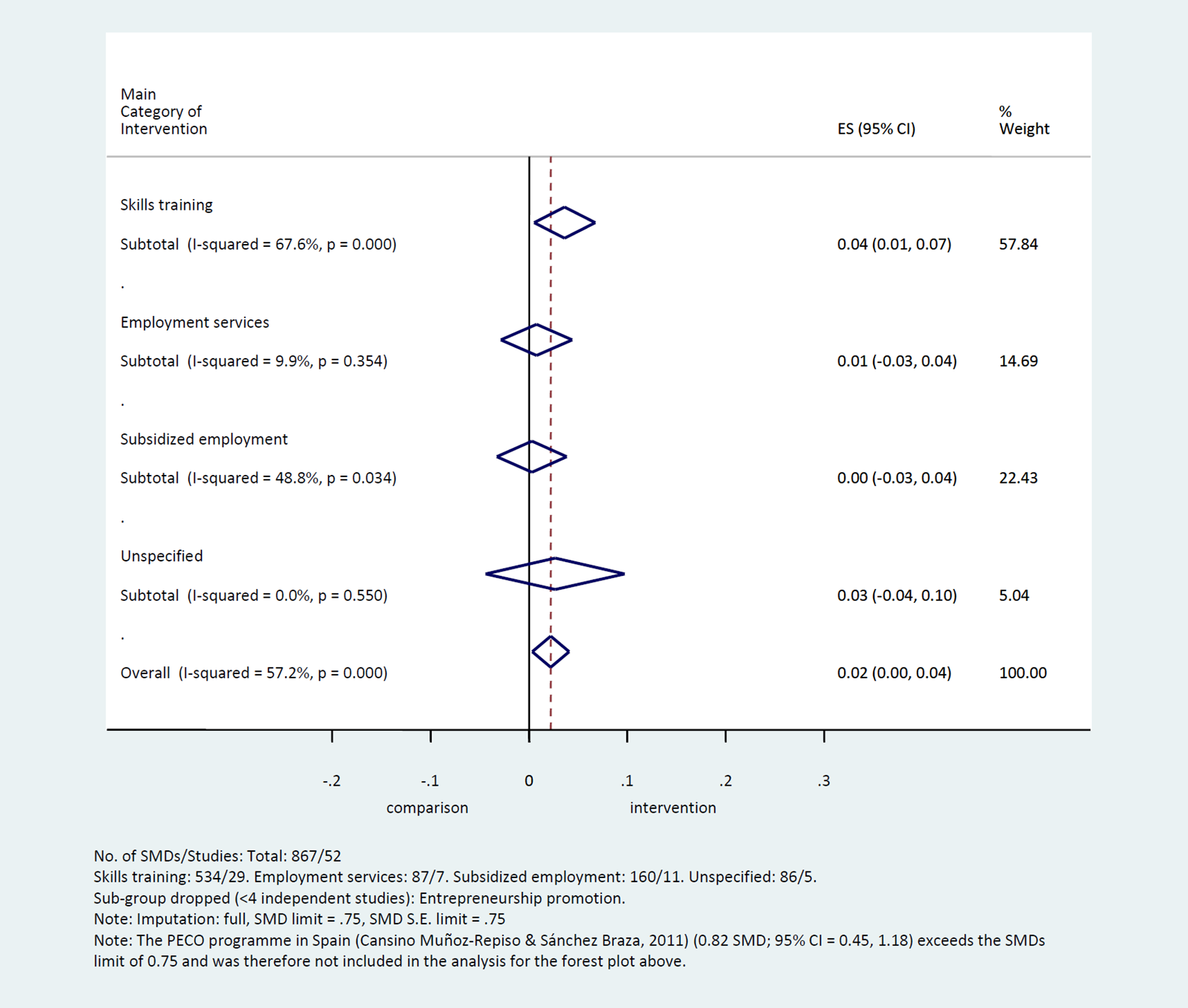
Summary forest plot of employment outcomes by main category of intervention for high-income countries
While
Evidence from subsidized employment interventions in low- and middle-income countries was rather limited but still presented positive impacts (on average) and non-heterogeneity within the sub-group for both outcome types. For high-income countries, the interpretation of the findings was less encouraging, as the studies reported no impact on employment and negative impacts on earnings.
Employment services interventions held an important position in terms of the effect of youth-targeted ALMPs in high-income countries. While their impact on
In conclusion, observing both outcome categories, the team ruled out statistically significant differences between intervention types for both high-income and low- and middle-income countries.
Figure 14, Table 20, Figure 16, and Table 22) with overall effect sizes of 0.08 SMD (CI = 0.04, 0.11; I2 = 64 per cent; number of interventions = 48) and 0.12 SMD (CI = 0.08, 0.15; I2 = 86 per cent; number of interventions = 53) for each outcome, respectively.
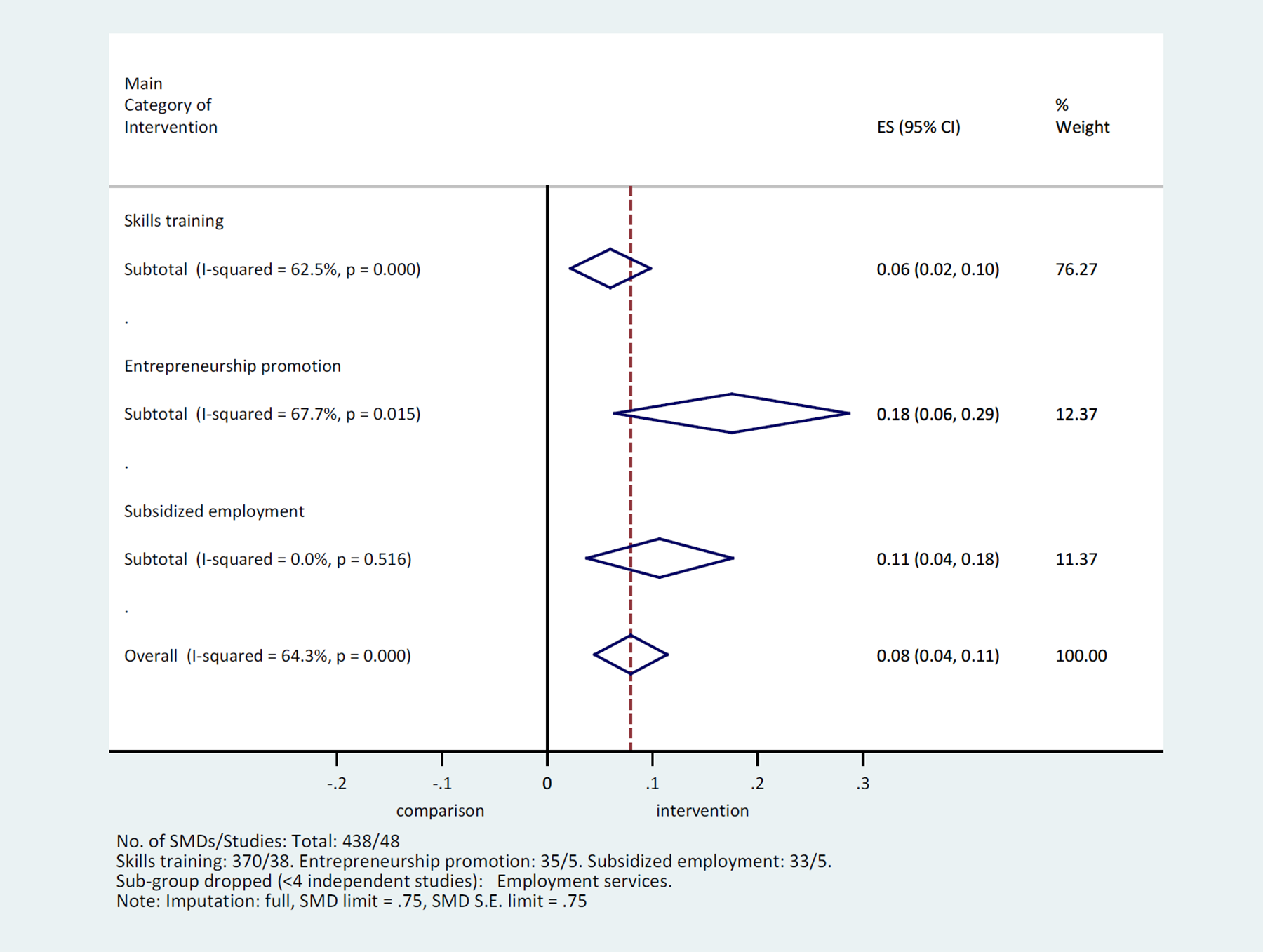
Summary forest plot of employment outcomes by main category of intervention for low- and middle-income countries
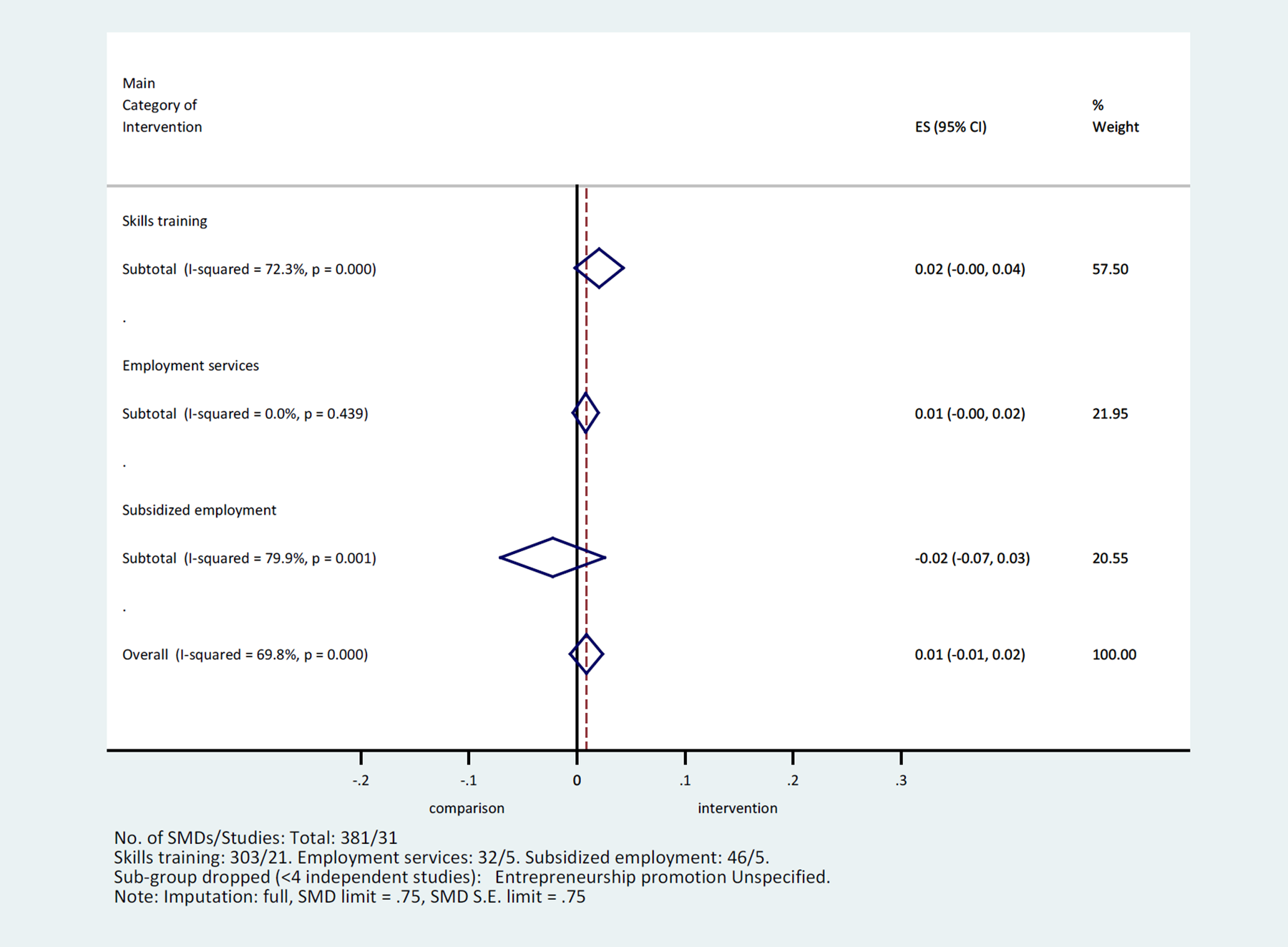
Summary forest plot of earnings outcomes by main category of intervention for high-income countries
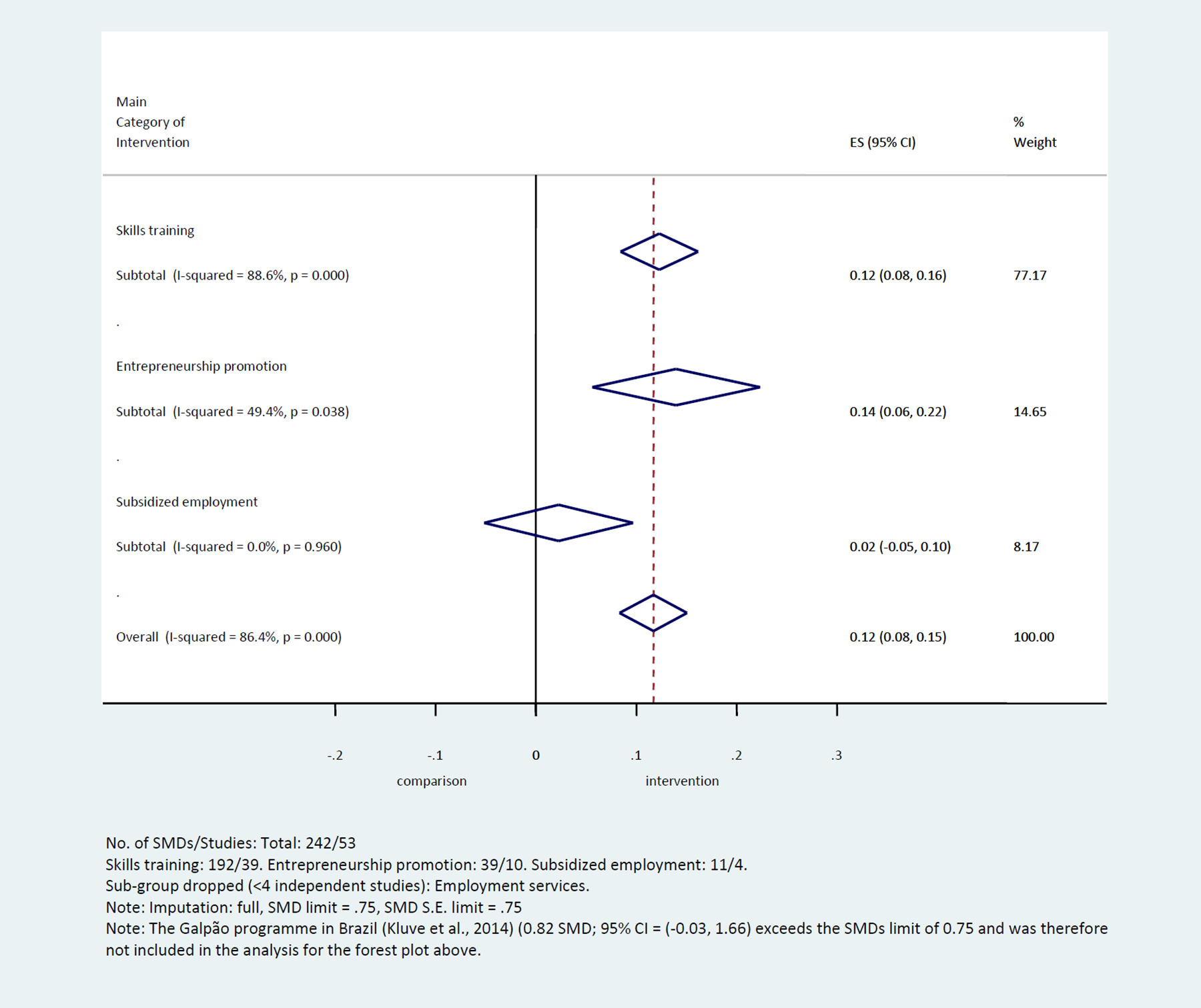
Summary forest plot of earnings outcomes by main category of intervention for low- and middle-income countries
Summary of results on employment outcomes across main categories of intervention in high-income countries
In comparison, reported effect sizes for high-income countries’ employment and earnings outcomes were 0.02 SMD (CI = 0.00, 0.04; I2 = 57 per cent; number of interventions = 52) and 0.01 SMD (CI = -0.01, 0.02; I2 = 70 per cent; number of interventions = 31), respectively. This suggested that active labour market measures had a greater impact among youth in developing countries compared to youth in advanced economies. The result coincided with Betcherman et al. (2007), which demonstrated that the probability that a programme has a positive impact on labour market outcomes declines as the country's income level rises.
While the effect size displayed wide variance, entrepreneurship promotion interventions offered positive prospects for stimulating the labour market outcomes of youth in the developing world. The limited number of effect sizes from entrepreneurship interventions in high-income countries caused the category to drop out of the analysis.
Evidence from
In conclusion, observing both outcome categories, the team ruled out statistically significant differences between intervention types for both high-income and low- and middle-income countries.
Summary of results on employment outcomes across main categories of intervention in low- and middle-income countries
Summary of results on earnings outcomes across main categories of intervention in high-income countries
Summary of results on earnings outcomes across main categories of intervention in low- and middle-income countries
4.3.3.4 Duration after treatment
Not all research studies reported information on the time lag between exposure to treatment and measurement of changes in outcomes. After imputations, only 72 per cent of the SMDs could be classified according to study timing after treatment into short- (data collected less than 12 months after the end of the treatment), medium- (12–24 months) and long-term studies (more than 24 months). Longer term outcomes were most common in evaluations from high-income country.
In the restricted sample, the overall effect size of employment and earnings outcomes was roughly the same (employment outcomes: 0.04 SMD; CI = 0.02, 0.06; I2 = 66 per cent; number of interventions = 85; earnings outcomes: 0.05 SMD; CI = 0.04, 0.07; I2 = 81 per cent; number of interventions = 79).
In both cases, short- and medium-term studies had a similar weight on the overall effect size of the entire meta-analysis (around 45 per cent and 35 per cent, respectively). While there was unaccounted heterogeneity within the different duration terms, it appeared that effect size estimates from longer term evaluations (>1 year) were relatively larger than shorter and medium term estimates in the case of studies measuring employment outcomes. As displayed in Figure 17 and Table 23, effect sizes for medium and long term were 0.05 SMD (CI = 0.03, 0.07; I2 = 51 per cent; number of interventions = 43) and 0.06 SMD (CI = 0.02, 0.09; I2 = 64 per cent; number of interventions = 21), respectively. This suggested a certain time lag before outcomes materialize.
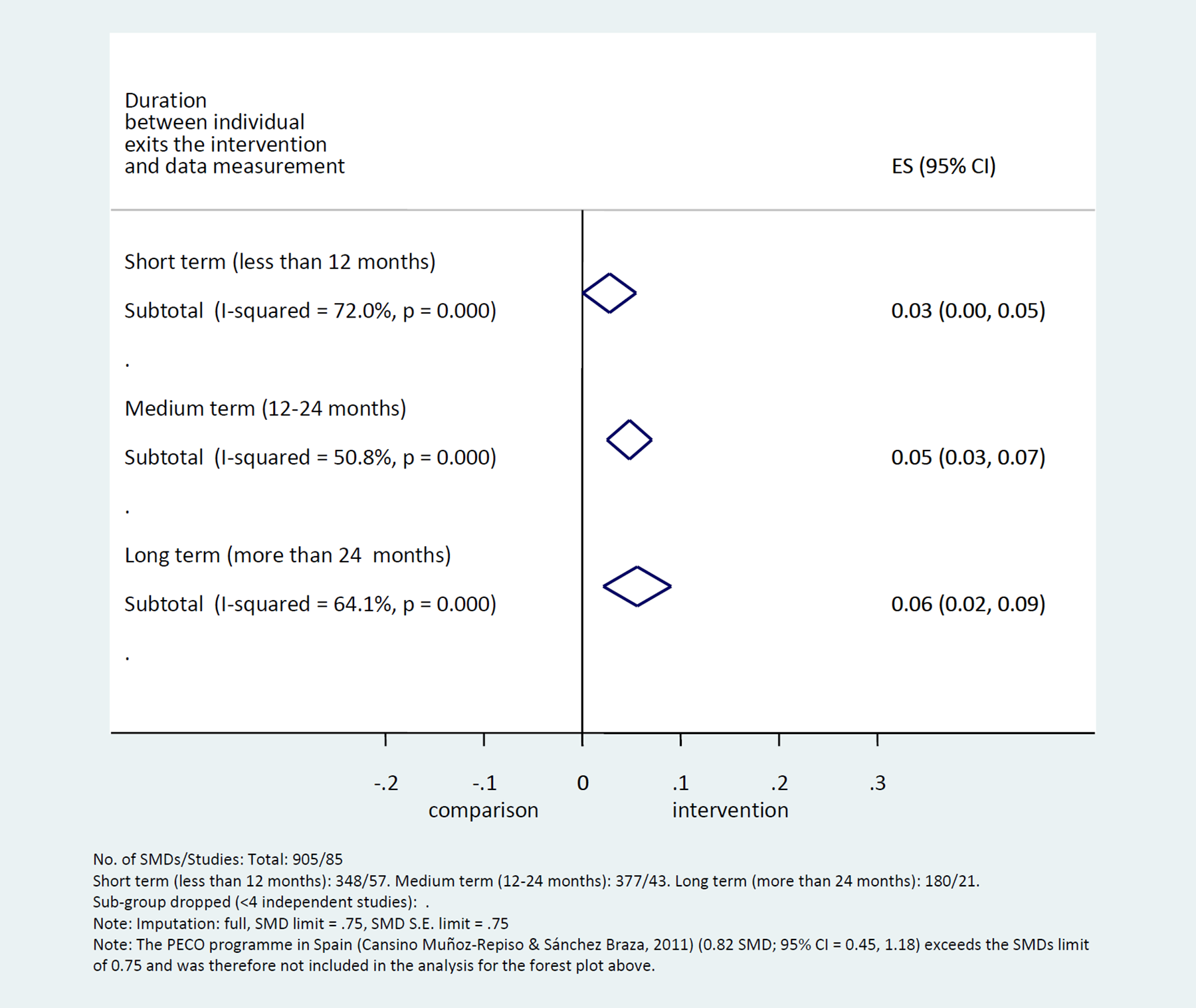
Summary forest plot of employment outcomes by duration of period between individual exiting the intervention and data measurement (short, medium and long term)
Summary of results on employment outcomes by duration
Earnings outcomes showed a reversed pattern. Figure 18 (Table 24) shows impacts that decrease as duration between exposure to treatment and measurement increases. Medium- and long-term effect sizes were 0.06 SMD (CI = 0.03, 0.09; I2 = 67 per cent; number of interventions = 38) and 0.05 SMD (CI = 0.02, 0.09; I2 = 80 per cent; number of interventions = 20), respectively. While the effect size for short-term duration was 0.07 SMD (CI = 0.04, 0.1; I2 = 84 per cent; number of interventions = 54).
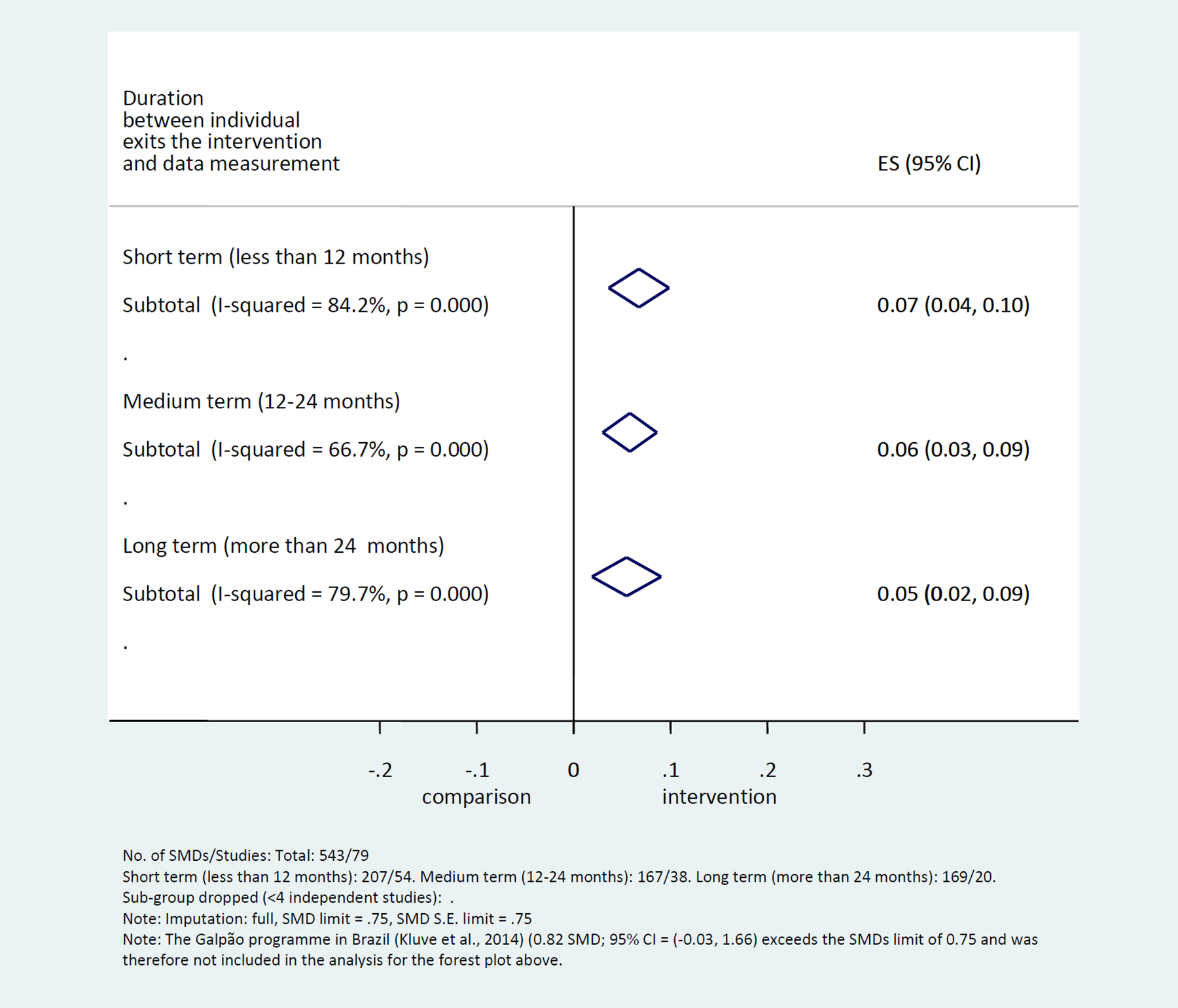
Summary forest plot of earnings outcomes by duration of period between individual exiting the intervention and data measurement (short, medium and long term)
Summary of results on earnings outcome by duration
At the same time, for both outcome types, the confidence intervals for each sub-group fell within the mean overall SMD and, hence, differences were not statistically significant. As the team suspected that other study-level characteristics might have confounded the analysis, this question was explored in more detail through multivariate meta-regression (Kluve et al., 2016).
4.3.3.5 Gender
The analysis by gender relied on whether an effect size was reported for female or male participants only. Pooled results (meaning those estimated on data that could not be disaggregated by gender) did not form part of this sub-group analysis.
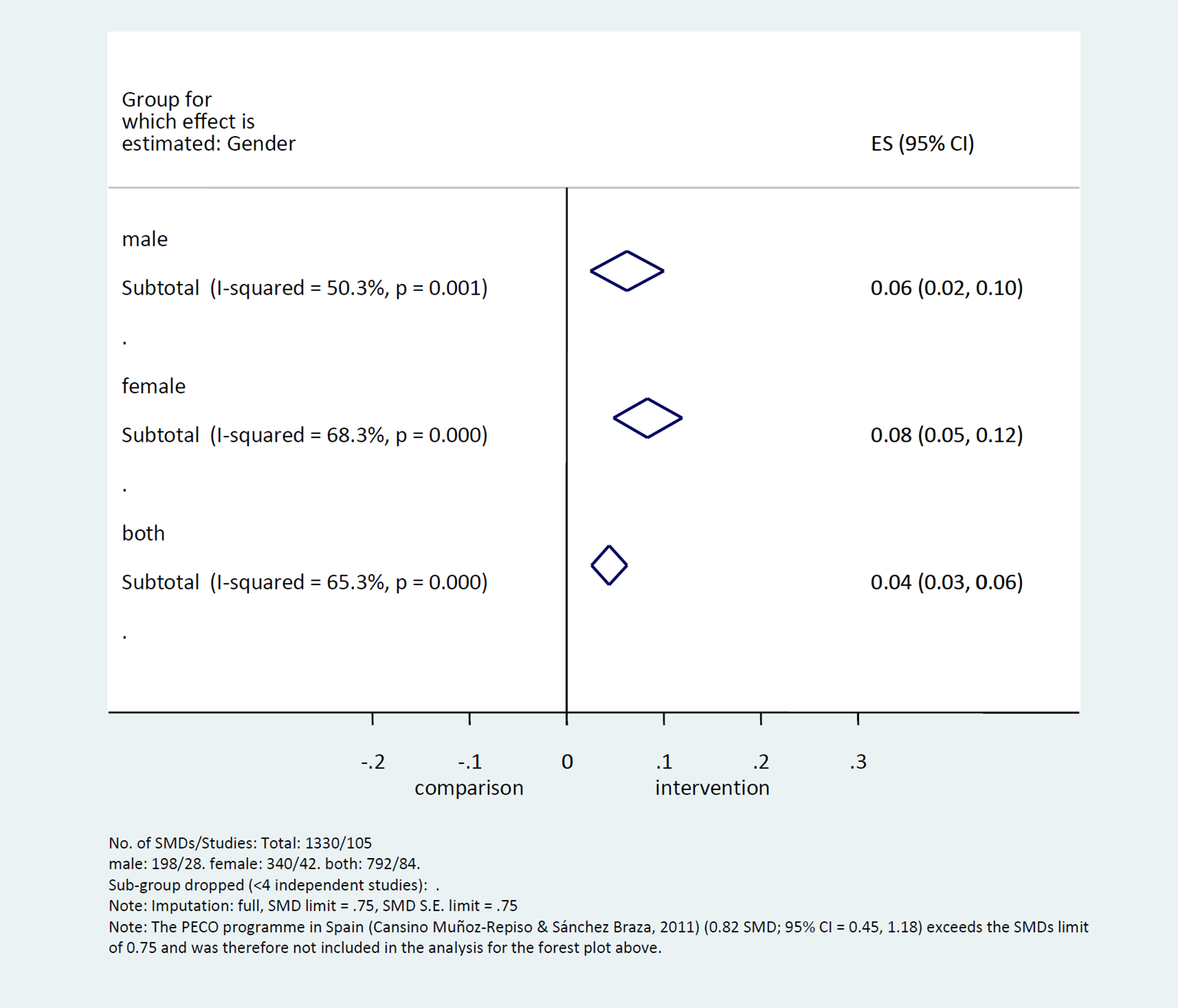
Summary forest plot of employment outcomes (full sample) by gender
A large body of literature focuses on differences in the effectiveness of labour market interventions by gender. These differences were reflected in the interventions and studies in the sample. There were 39 interventions that reported male-only outcomes, of which more than half were located in high-income countries. Conversely, of the 54 interventions reporting outcomes separately for females, only 44 per cent were in high-income economies. More than one-quarter of these 54 interventions (15) specifically targeted only female participants (the vast majority of which (12) were located in low- and middle-income countries). In contrast, many other intervention characteristics were distributed relatively evenly between interventions that reported male-only and/or female-only estimates, in particular the main category of the intervention, age, education and income status of the target population, or programme implementers.
Summary forest plots showed greater effect sizes for young women compared to young men across employment and earnings outcomes. This suggested that interventions which specifically measured changes in outcomes by gender tended to have higher returns for women.
Summary of results on employment outcomes reported by a specific gender or both
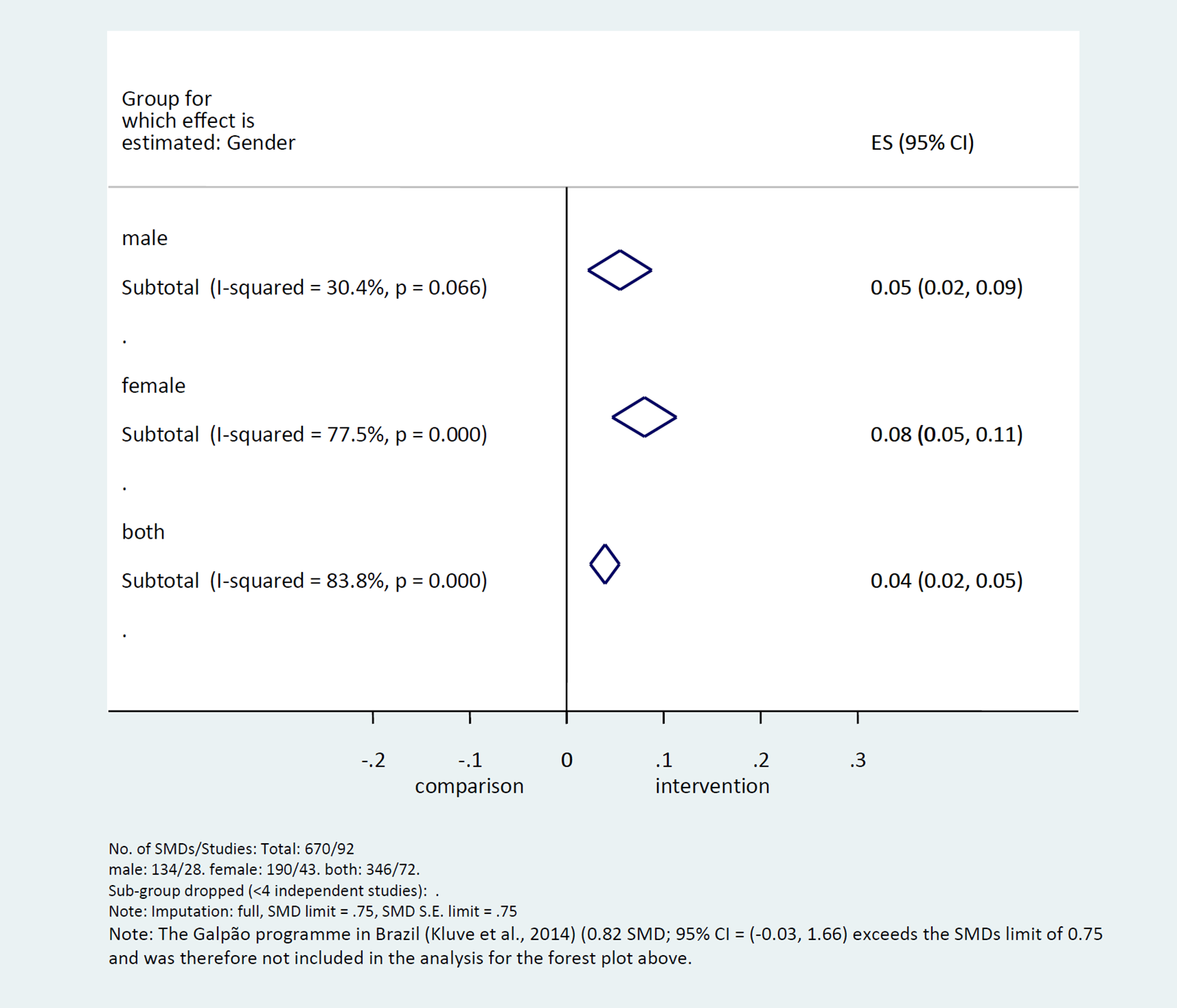
Summary forest plot of earnings outcomes (full sample) by gender
Summary of results on earnings outcomes reported by a specific gender or both
4.3.3.6 Participant income status
This subsection looks at differential effects by participant sub-group, focusing on low-income/disadvantaged/at risk/vulnerable youth. Estimates for this sub-group (labelled “disadvantaged youth” for ease of reference) existed for almost half of the interventions (47 per cent) or more than half of the programmes (51 per cent), equally distributed across gender. The share of interventions containing separate estimates for the disadvantaged youth sub-group was considerably higher in low- and middle-income countries (57 per cent) than in high-income countries (38 per cent).
Figure 21 (Table 27) and Figure 22 (Table 28) display the results on employment and earnings outcomes respectively by participant income status. It appears that interventions had a greater impact on earnings outcomes of disadvantaged youth (0.12 SMD; CI = 0.08, 0.16; I2 = 81 per cent; number of interventions = 53) compared to non-disadvantaged youth (0.02 SMD; CI = 0, 0.03; I2 = 73 per cent; number of interventions = 37). Results on earnings for disadvantaged youth were larger than results across employment outcomes in the same target group (0.05 SMD; CI = 0.02, 0.08; I2 = 66 per cent; number of interventions = 57).
Across intervention types, entrepreneurship promotion increased employment and earnings impacts among disadvantaged youth. Computed SMDs were large in magnitude and variance. Total overall effect size was larger for earnings outcomes (0.13 SMD; CI = 0.09, 0.18; I2 = 82 per cent; number of interventions = 48) than for employment outcomes (0.06 SMD; CI = 0.02, 0.09; I2 = 66 per cent; number of interventions = 54). These results contrasted quite sharply with the analyses of interventions which did not specifically target disadvantaged youth. For that sub-group, overall effect sizes were substantially smaller (employment outcomes: 0.03 SMD; CI = 0.01, 0.06; I2 = 56 per cent; number of interventions = 40; earnings outcomes: 0.02 SMD; CI = 0.00, 0.03; I2 = 73 per cent; number of interventions = 37) with skills training yielding the highest effects.
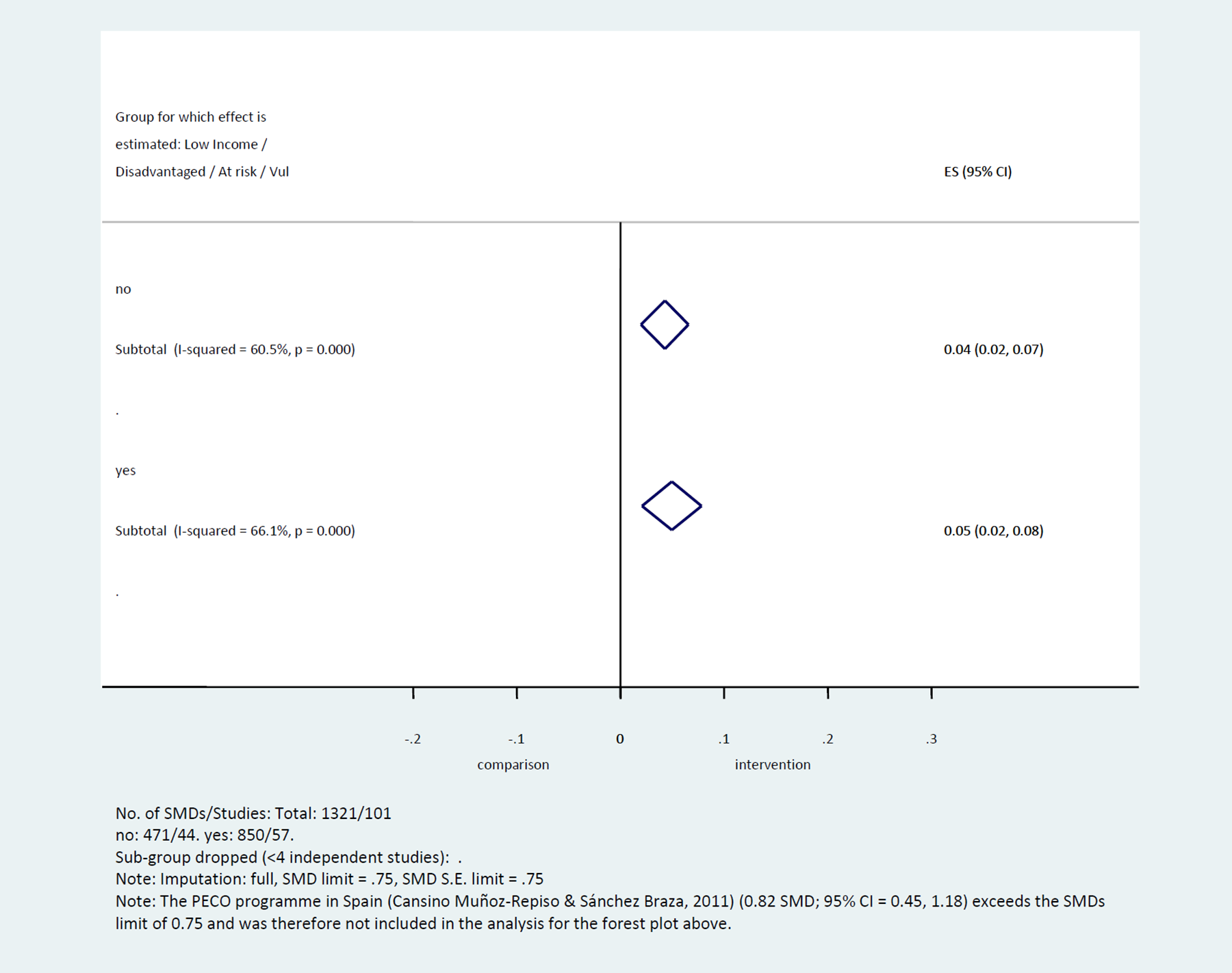
Summary forest plot of employment outcomes by participant income group (where yes is low-income, disadvantaged, at risk or vulnerable youth)
Summary of results on employment outcomes by participant income group (where yes is low-income, disadvantaged, at risk or vulnerable youth)
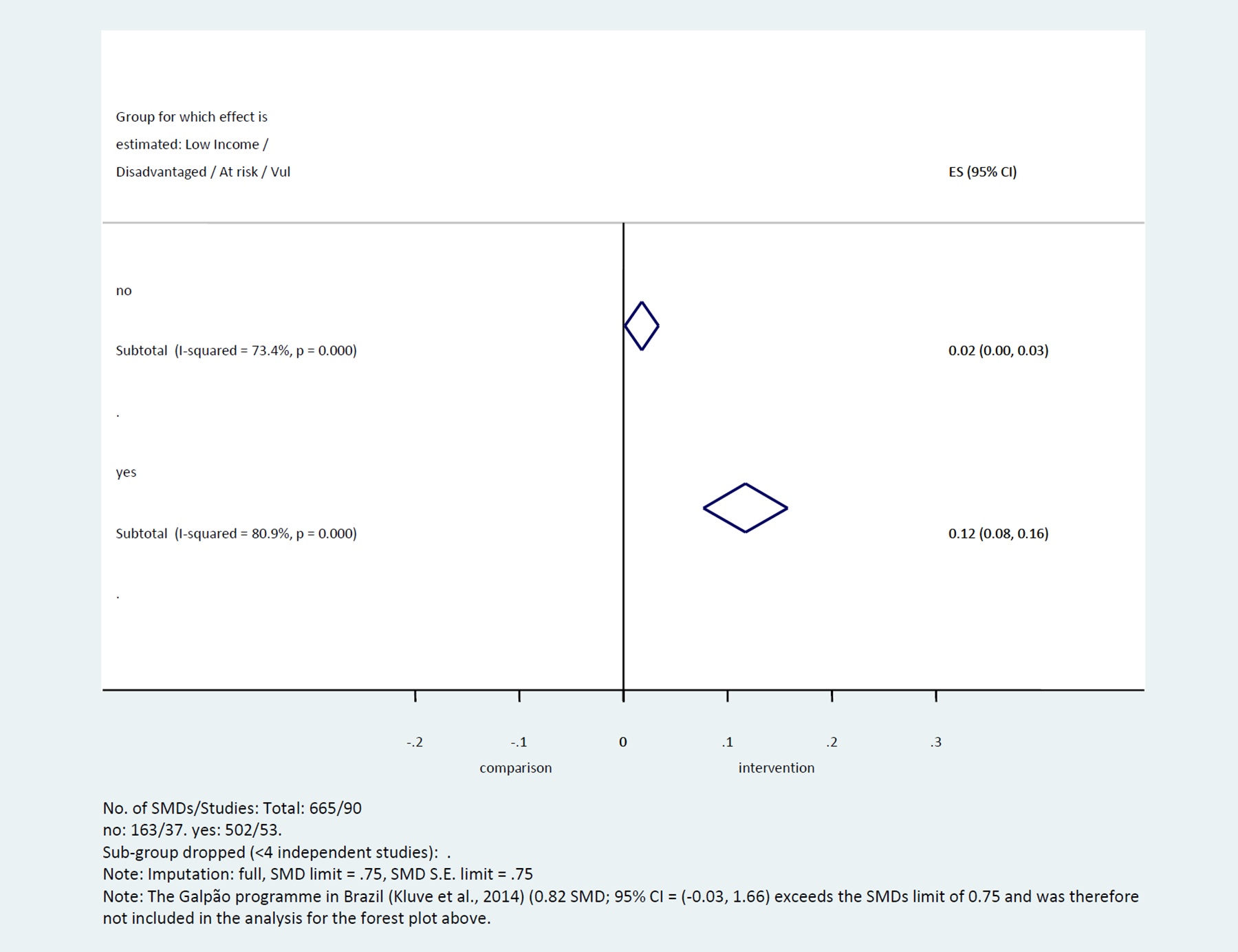
Summary forest plot of earnings outcomes by participant income group (where yes is low-income, disadvantaged, at risk or vulnerable youth)
Summary of results on earnings outcomes by participant income group (where yes is low-income, disadvantaged, at risk or vulnerable youth)
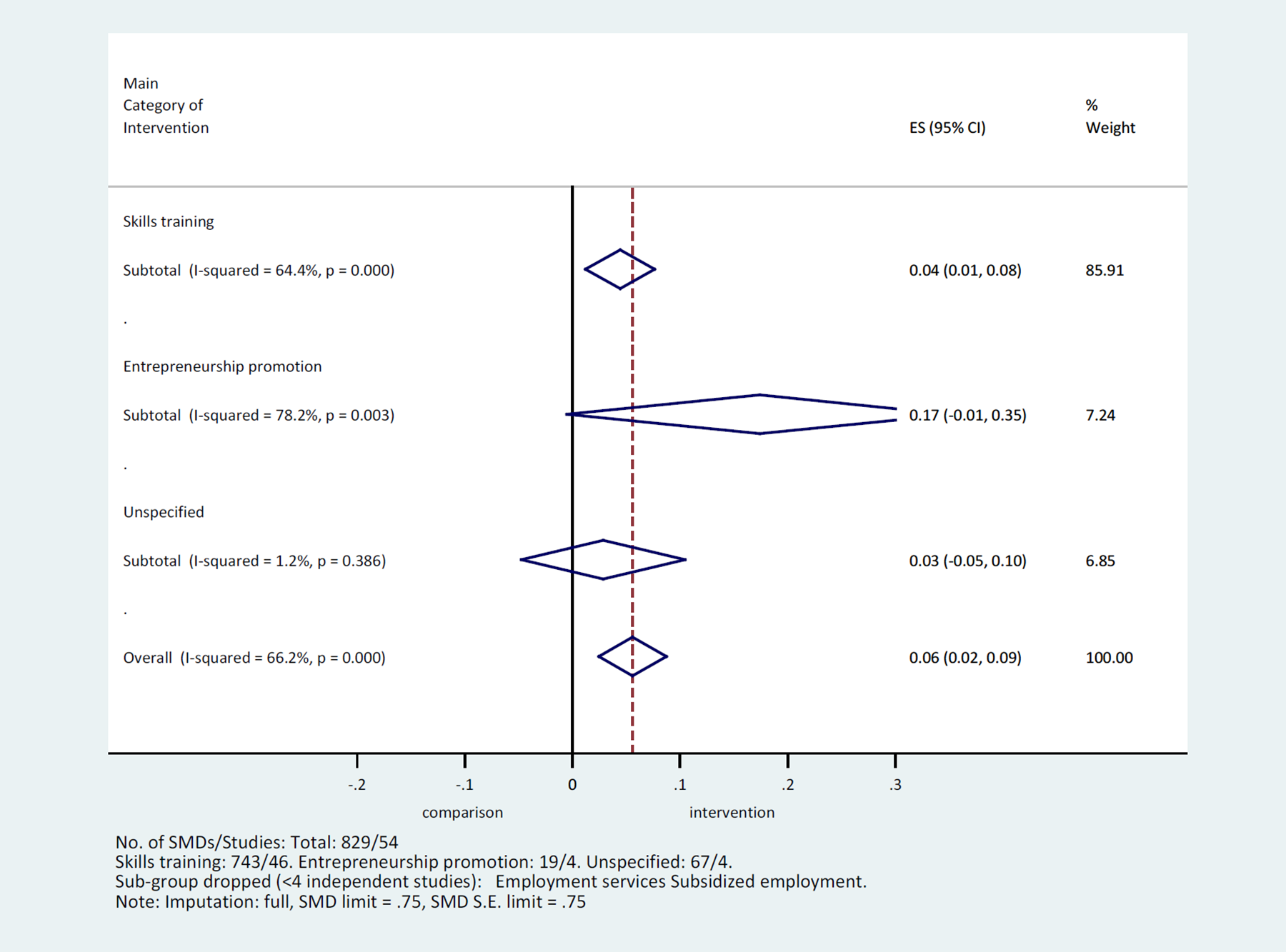
Summary forest plot of employment outcomes by main category of intervention for low-income and disadvantaged participants
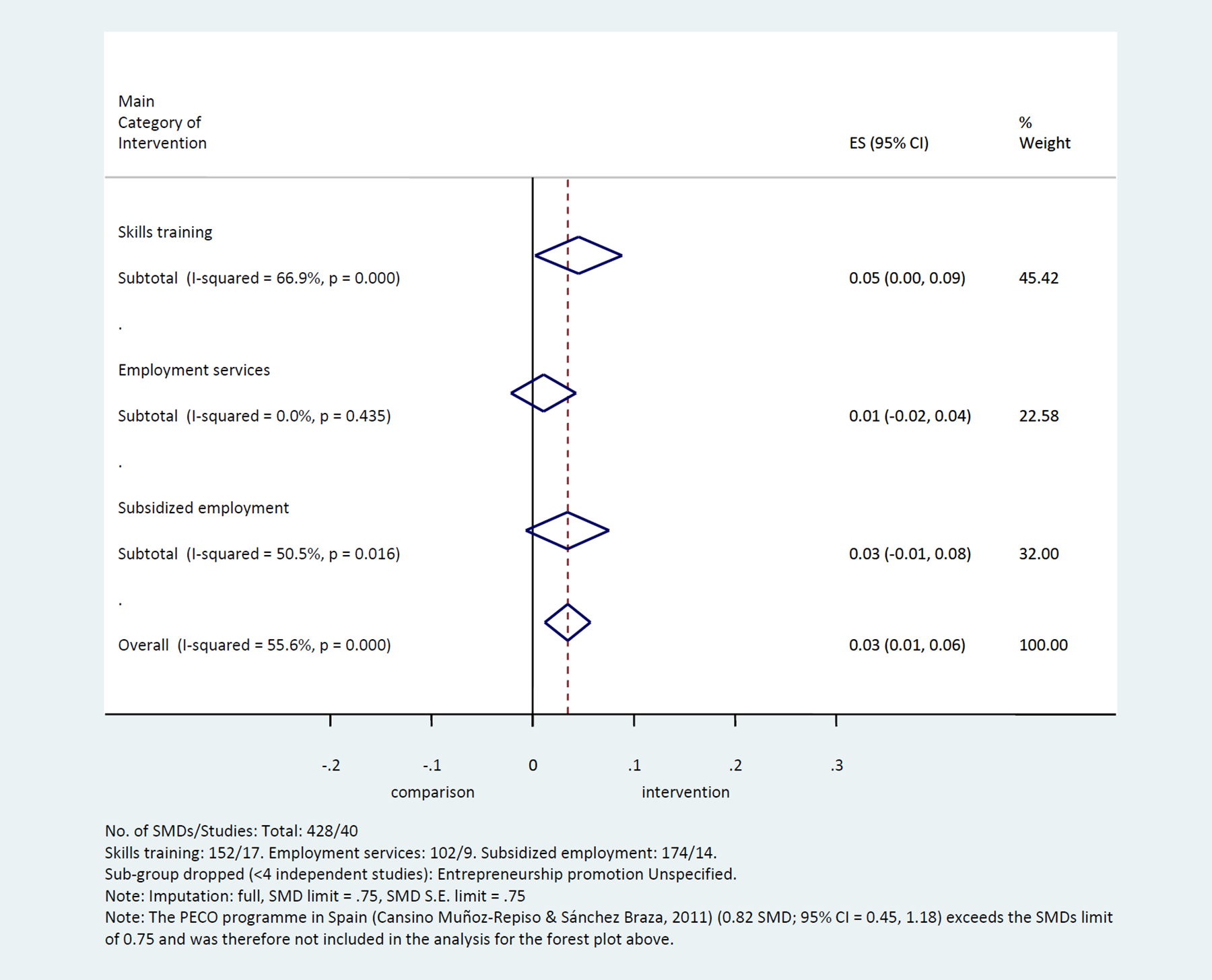
Summary forest plot of employment outcomes by main category of intervention for non-low-income/non-disadvantaged participants
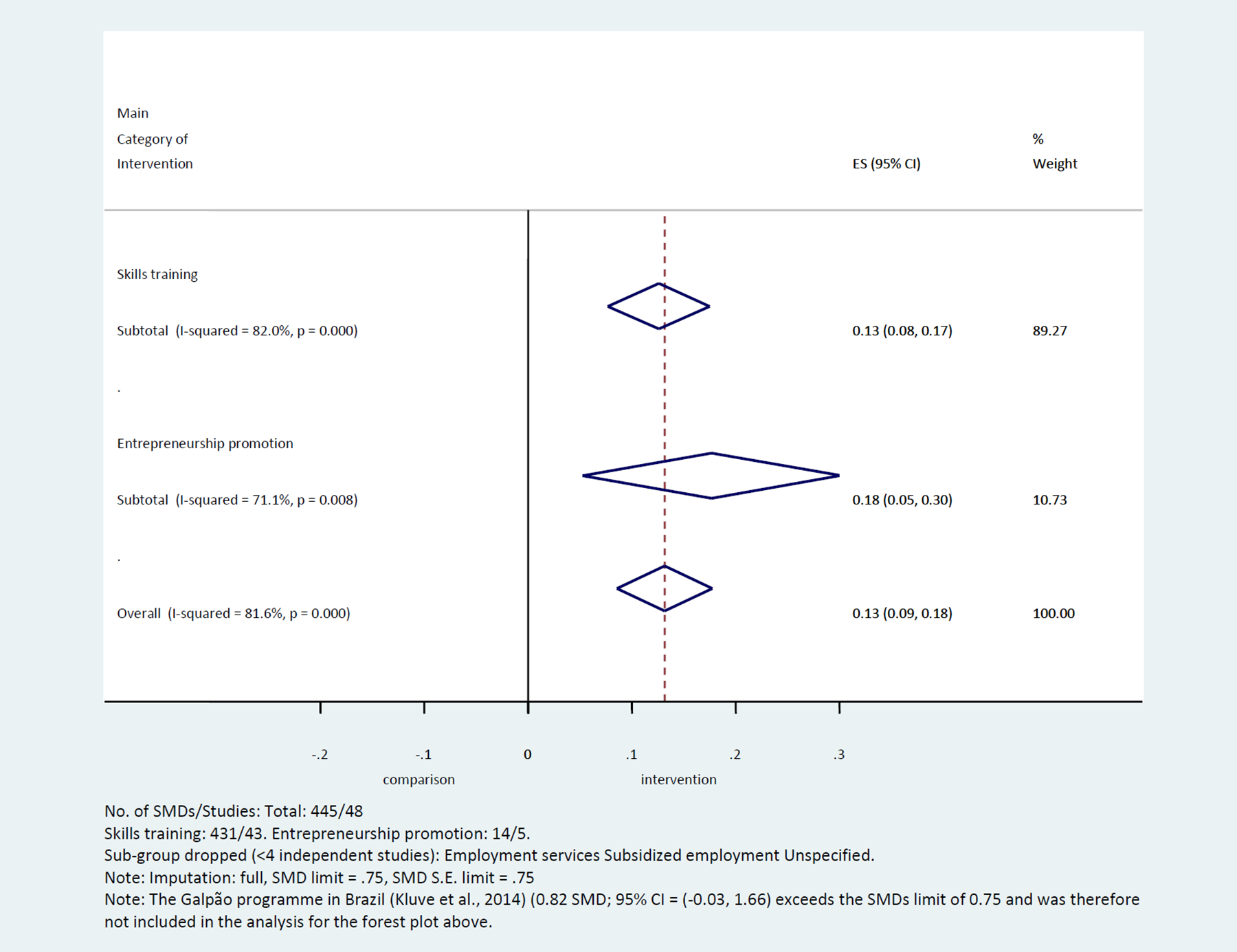
Summary forest plot of earnings outcomes by main category of intervention for low-income/disadvantaged participants
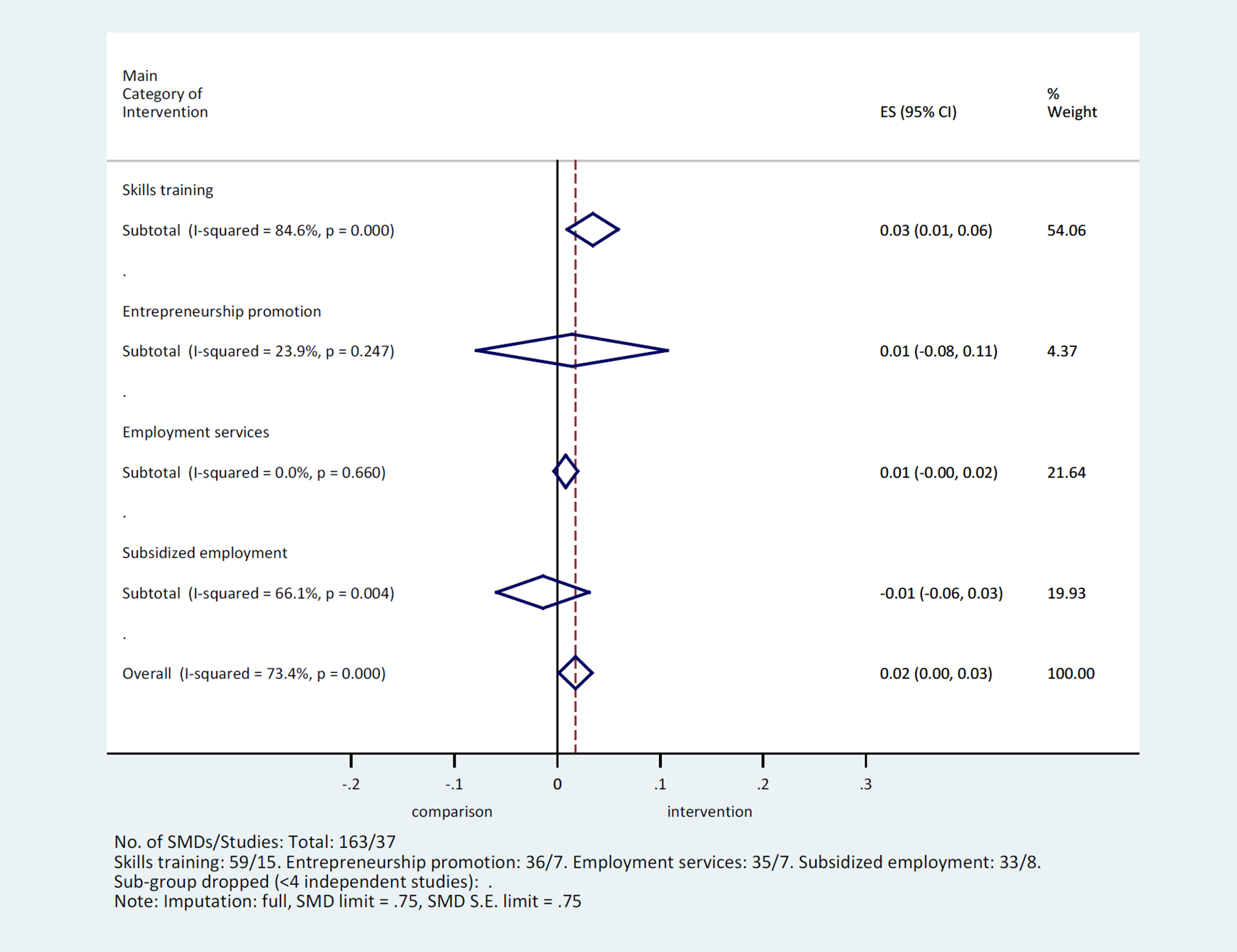
Summary forest plot of income outcomes by main category of intervention for non-low-income/non-disadvantaged participants
Summary of results on employment outcomes by participant income group (low-income participants includes also disadvantaged, at risk or vulnerable youth)
Notes: Entrepreneurship promotion, employment services, subsidized employment and unspecified categories were dropped from the analysis for the group of low-income participants due to the small number of independent studies. Entrepreneurship promotion and unspecified categories were dropped from the analysis for the group of non-low-income participants due to the small number of independent studies.
Summary of results on earnings outcomes by participant income group (low-income participants includes also disadvantaged, at risk or vulnerable youth)
Notes: Employment services, subsidized employment and unspecified categories were dropped from the analysis for the group of low-income participants due to the small number of independent studies. The unspecified category was dropped from the analysis for the group of non-low-income participants due to the small number of independent studies.
4.3.3.7 Programme characteristics
This section analyses the presence of effect size heterogeneity across studies that evaluated programmes on a different scale or implemented by different actors. In the sample these two characteristics did not differ for interventions within the same programme, they were therefore referred to as programme-level characteristics.
The review team coded the scale of the programme using four categories, which generally referred to the level on which the programme was implemented, namely: National level, which comprised programmes that were implemented across several regions in a country. Regional level, referring to programmes that had clear geographical targeting on selected administrative regions. Local level, when multiple areas in the entire country were selected (e.g., cities). Pilot level, capturing programmes that were implemented as a trial, with relative low scope and the expectation of future scale-up.
Note that the variable was coded on the intervention rather than the study (sample) level: That is, the classification did not reflect whether the evaluation was conducted for a sub-sample of the entire programme, but rather the main objective was to test the difference between (small-scale) local or pilot programmes and national-level policies.
Results are presented in Figure 27 (Table 31) and Figure 28 (Table 32). Studies of national-level programmes generally reported somewhat smaller effect sizes for both earnings (0.03 SMD; CI = 0.02, 0.05; I2 = 76 per cent; number of interventions = 47) and employment outcomes (0.03 SMD; CI = 0.01, 0.05; I2 = 59 per cent; number of interventions = 55). However, the difference in terms of smaller scale programmes is not statistically significant. In addition, there was large unexplained heterogeneity within all sub-groups except the sample of pilot programmes.
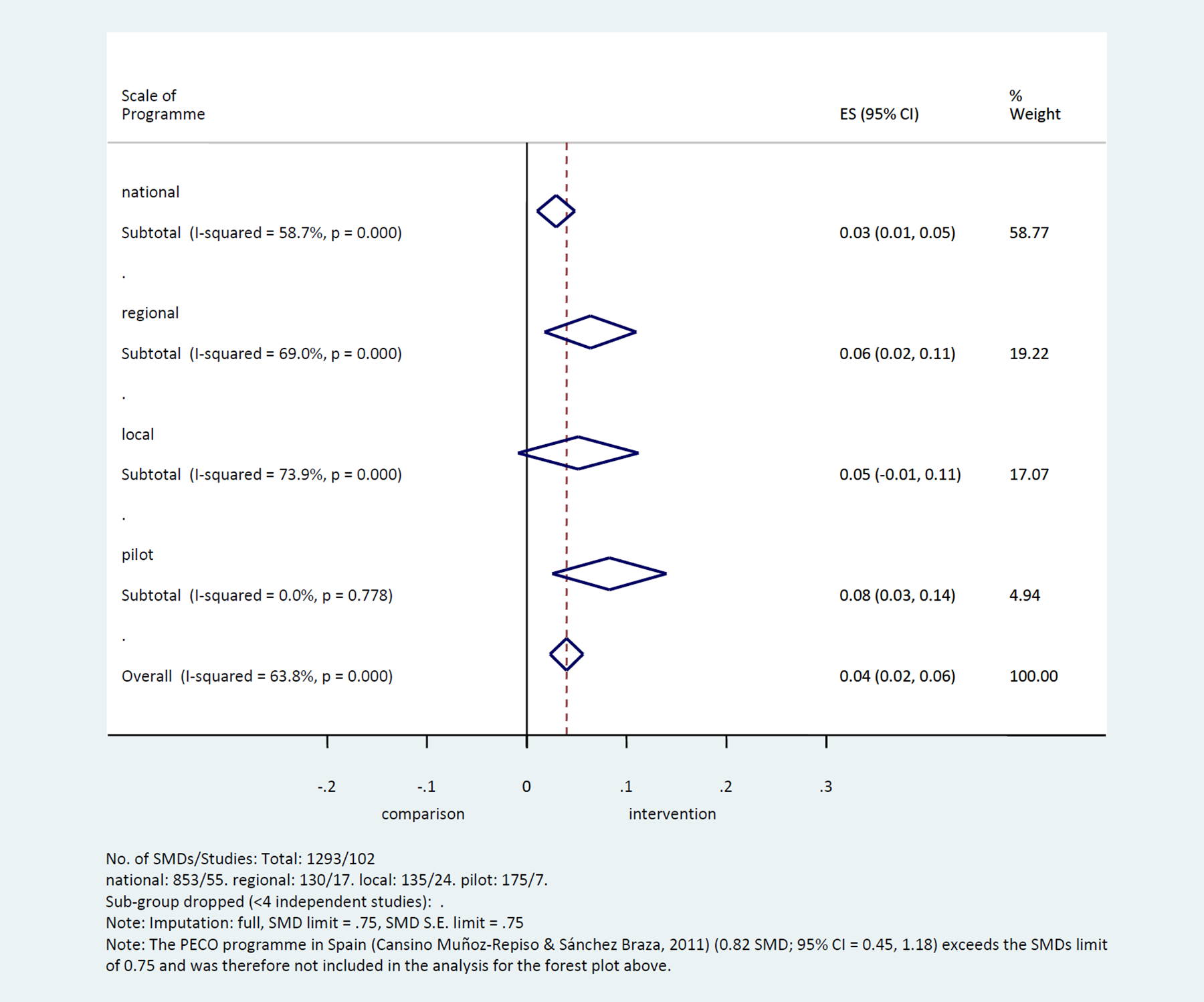
Summary forest plot of employment outcomes by scale of the programme
Summary of results on employment outcomes by scale of the programme
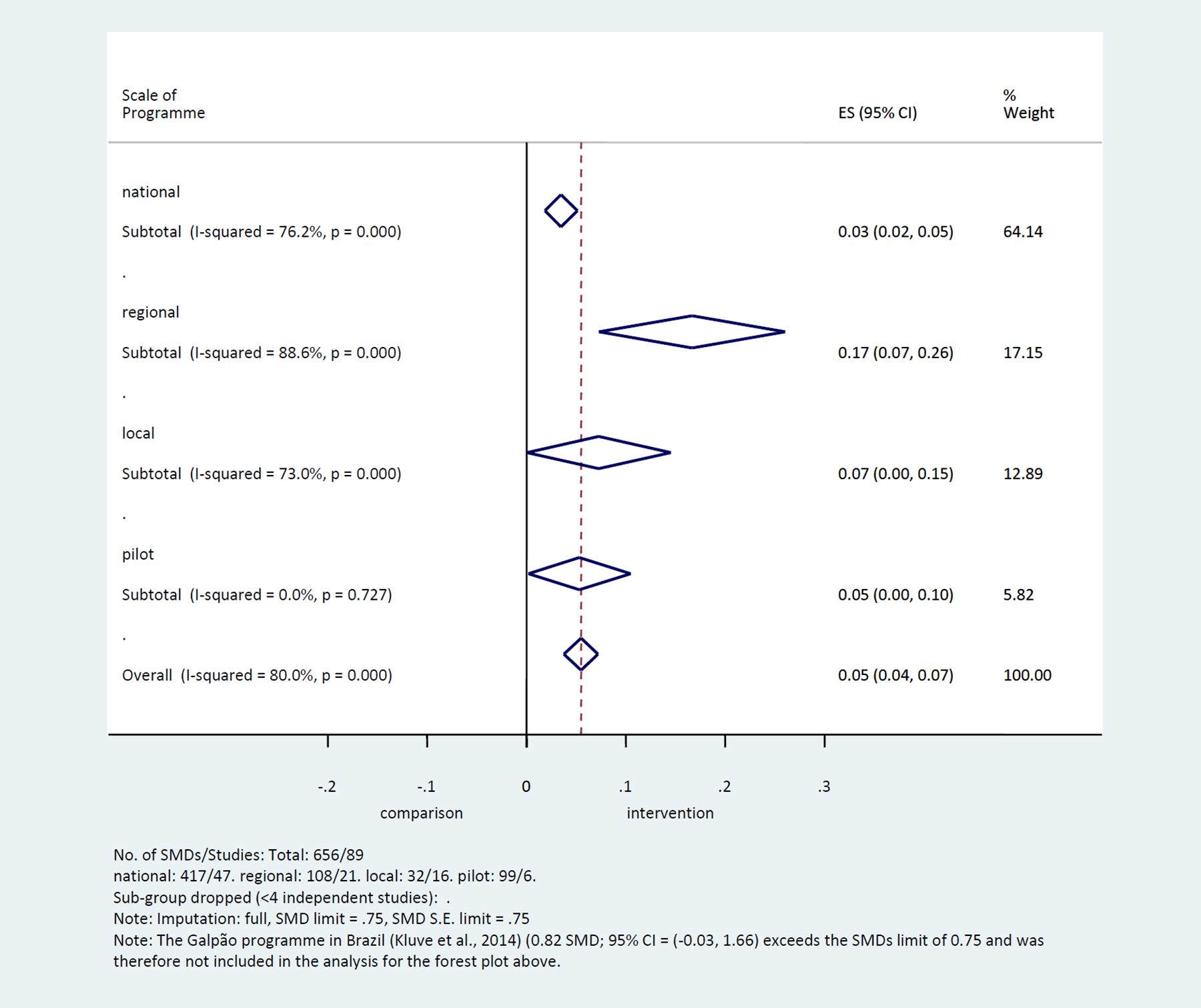
Summary forest plot of earnings outcomes by scale of the programme
Summary of results on earnings outcomes by scale of the programme
Figure 29 (and Table 33) and Figure 30 (and Table 34) provide summary SMDs for studies that analysed programmes implemented by different agencies. Implementers were categorized into public institutions, i.e., governments or multilateral organizations, and private entities, which were private sector firms or NGOs. In the analysis, the review team looked at the differential impact of programmes implemented by (i) governments and/or multilaterals, (ii) private sector firms and/or NGOs, or (iii) a combination of public and private sector (i.e., governments and/or multilaterals combined with private sector firms and/or NGOs). Any programmes that were not classified according to these three groups were called “other”; for example, when the implementing agency remained unknown to the reviewers.
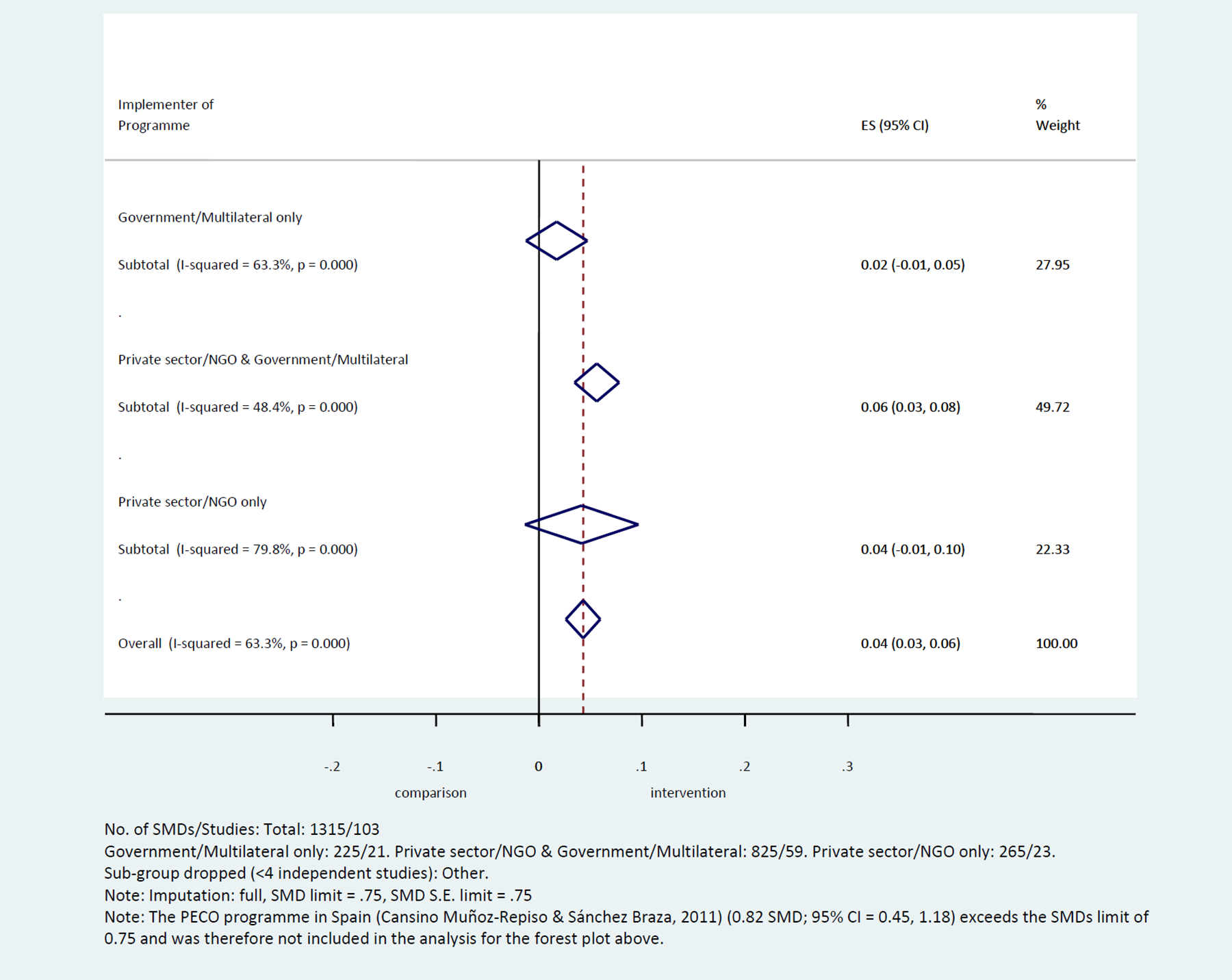
Summary forest plot of employment outcomes by implementer
The team found that, for employment and earnings outcomes, a combination of public and private sector implementation led to the highest SMDs of around 0.06 (CI = 0.03, 0.08; I2 = 48 per cent; number of interventions = 59) (employment) or 0.07 (CI = 0.05, 0.09; I2 = 81 per cent; number of interventions = 57) (income) and significantly different from zero.
Private sector only implemented programmes (i.e., implemented by private sector firms and/or NGOs) led to moderate gains for both employment and income of around 0.04 SMDs (CI = -0.01, 0.10; I2 = 80 per cent; number of interventions = 23) (employment) or 0.05 (CI = 0.00, 0.10; I2 = 75 per cent; number of interventions = 21) (earnings) and with the summary SMD barely reaching significance at the 5 per cent level.
Summary of results on employment outcomes by implementer
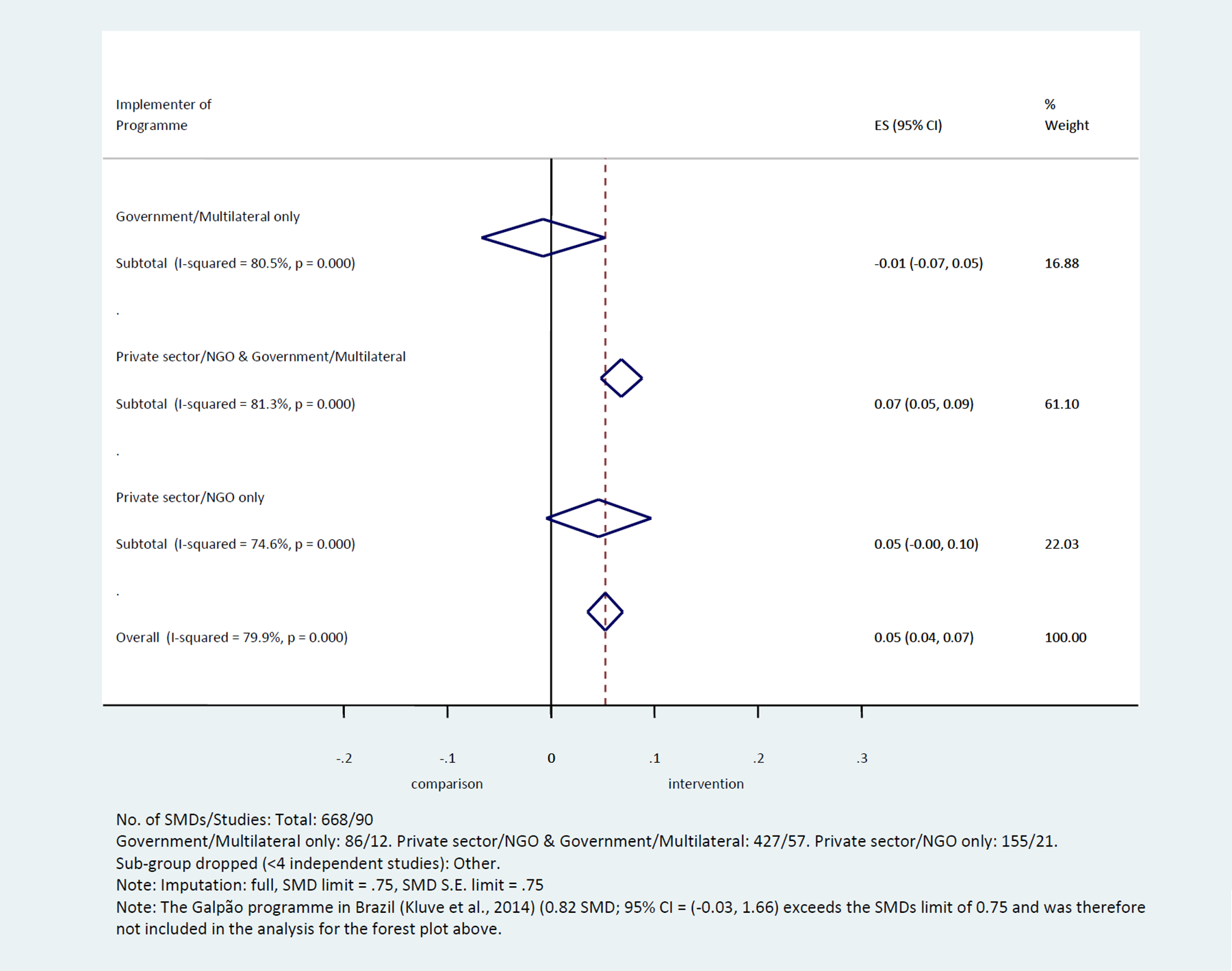
Summary forest plot of earnings outcomes by implementer
The summary SMD of studies of public sector only implemented programmes (i.e., government and/or multilateral agency as implementers) was statistically insignificant for both employment and earnings outcomes.
However, as it was possible that the analysis could have been confounded with other intervention- or study-level characteristics that were correlated with programme scale (e.g., country income level), this difference was explored in more detail as part of the multivariate meta-analysis depicted in Kluve et al. (2016).
Summary of results on earnings outcomes by implementer
4.3.4 Sensitivity analysis
In this section, the robustness of the results are tested. For the sake of brevity, this section discusses the sensitivity of the results from the overall synthesis of the evidence (pooled sample) and the moderator analysis by main intervention category. Hence, the robustness of each moderator analysis is not discussed, as these generally reflected findings in the pooled sample.
The following section focuses on three types of decisions which may have affected the overall results: First, different assumptions in computing (or imputing) effect sizes are tested. Second, the robustness of some of the decisions in the data synthesis (e.g., regarding outliers) is checked. Third, the question of whether the variance in effect sizes might be caused by factors related to the applied evaluation design (i.e., study type, risk of bias) is investigated.
For the univariate analysis, the respective summary forest plots are again included in the main text while, for this section, forest plots showing each intervention SMD separately have not been appended. 35
In addition to the sensitivity analysis discussed in this section, the review team performed various other checks on the analysis (e.g., using Cohen's d instead of Hedges’ g; testing for differences between Intention-to-Treat (ITT) and Average Treatment Effect on the Treated (ATT) estimates; additional methods of data imputation). Since none of these checks significantly altered the main results, they are not discussed in detail.
4.3.4.1 Imputation of missing information
As discussed in Section 3.4.4, in some cases it was necessary to impute information and make assumptions in order to compute SMDs for specific studies. First, the review team had to make certain assumptions regarding the sample size of the treatment and/or comparison group if either of these was not reported. Second, the team approximated SMDs using the formula provided by Borenstein, Cooper, Hedges and Valentine (2009) to approximate SMDs where information on the pooled standard deviation could not be obtained otherwise.
This section compares results using the entire sample of studies (including all imputed values) with a restricted sample excluding all studies where SMDs (or their standard error) could not be computed without these assumptions. 36
Figure 31 replicates the forest plot displayed in Figure 6, displaying the summary SMDs by outcome category. Not imputing any missing information reduced the overall sample from 2,169 SMDs and 119 studies by almost half, to 1,116 SMDs (82 studies). The average SMD for employment outcomes increased, though the increase was not statistically significant. At the same time, the summary effect size (i.e., SMDs) for earnings outcomes was significantly reduced to 0.01; leading to an (insignificant) reduction in the overall SMD of youth employment interventions across outcomes.
Figure 32, Figure 33 and Despite reducing the sample size significantly, the basic results regarding the effectiveness of different intervention types held in the smaller sample. In fact, results and average effect sizes for employment and business performance outcomes were very similar to the main results that included all imputed values. Only in the case of earnings/income outcomes, was the average impact of skills training significantly reduced (the confidence intervals for skills training in the upper and lower panel did not overlap). Also, the precision of the estimate for entrepreneurship promotion intervention was somewhat reduced (i.e., had a larger confidence interval).
Figure 34 replicate the forest plots in the moderator analysis by main intervention category (Section 4.3.3.2) in the limited non-imputation sample. The sample size dropped from 1,312 effect sizes (105 studies) to 682 effect sizes (69 studies) for employment outcomes and from 661 effect sizes (90 studies) to 279 effect sizes (4 studies) for earnings outcomes. The number of business performance outcomes was reduced to 153 effect sizes (11 studies).
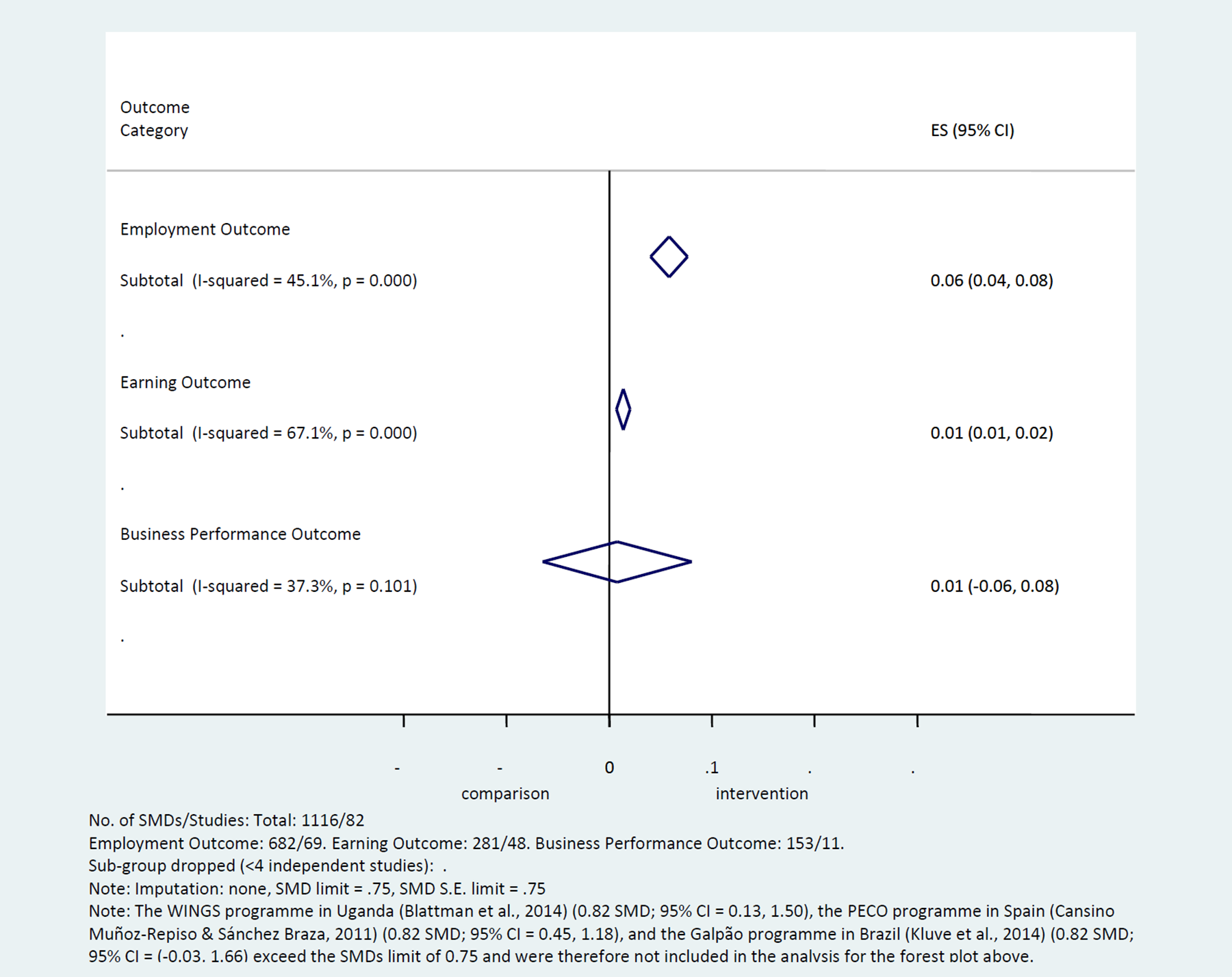
Forest plot of all outcomes by outcome category without imputations
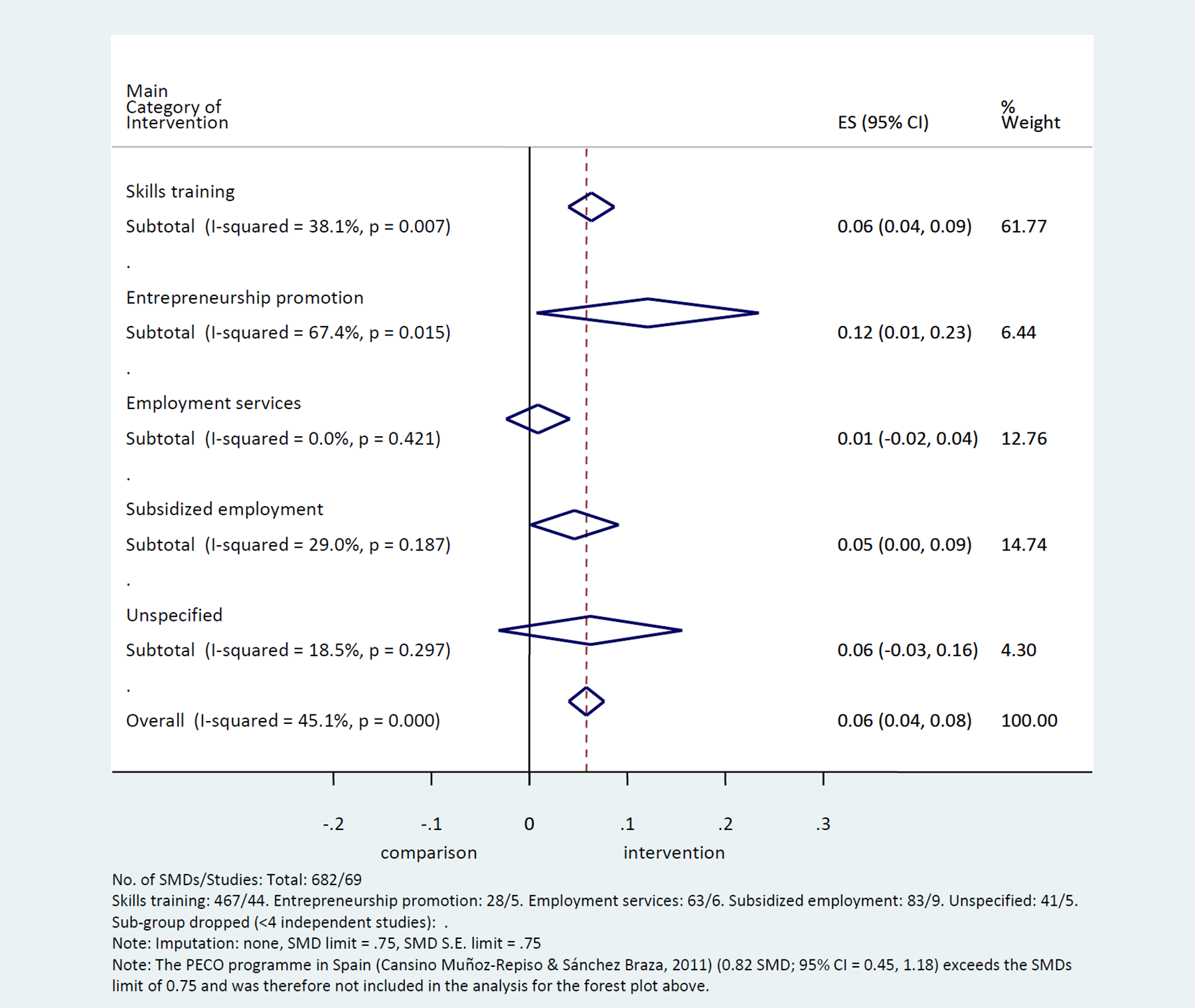
Summary forest plot of employment outcomes by main category of intervention without imputations
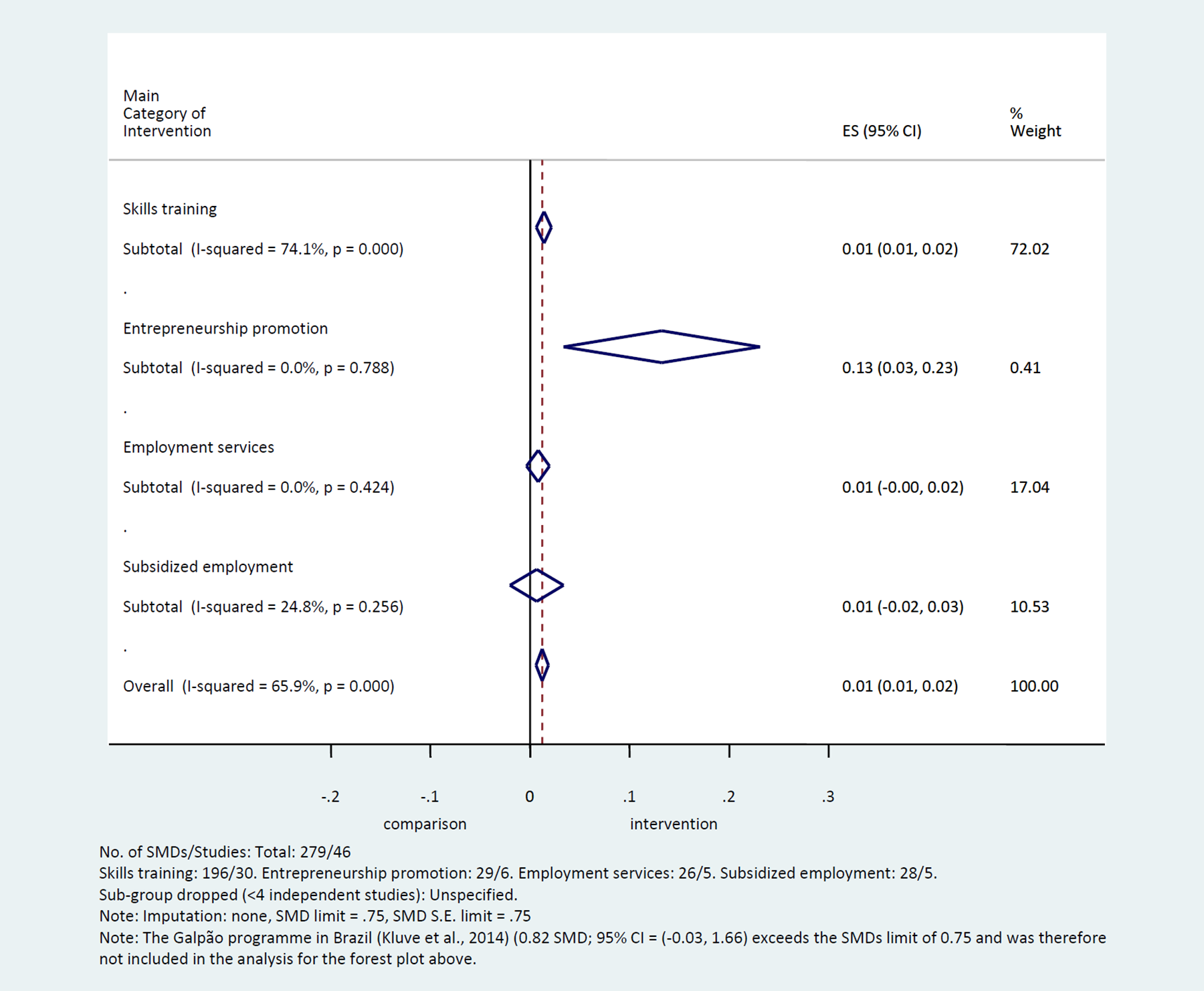
Summary forest plot of earnings outcomes by main category of intervention without imputations
Despite reducing the sample size significantly, the basic results regarding the effectiveness of different intervention types held in the smaller sample. In fact, results and average effect sizes for employment and business performance outcomes were very similar to the main results that included all imputed values. Only in the case of earnings/income outcomes, was the average impact of skills training significantly reduced (the confidence intervals for skills training in the upper and lower panel did not overlap). Also, the precision of the estimate for entrepreneurship promotion intervention was somewhat reduced (i.e., had a larger confidence interval).
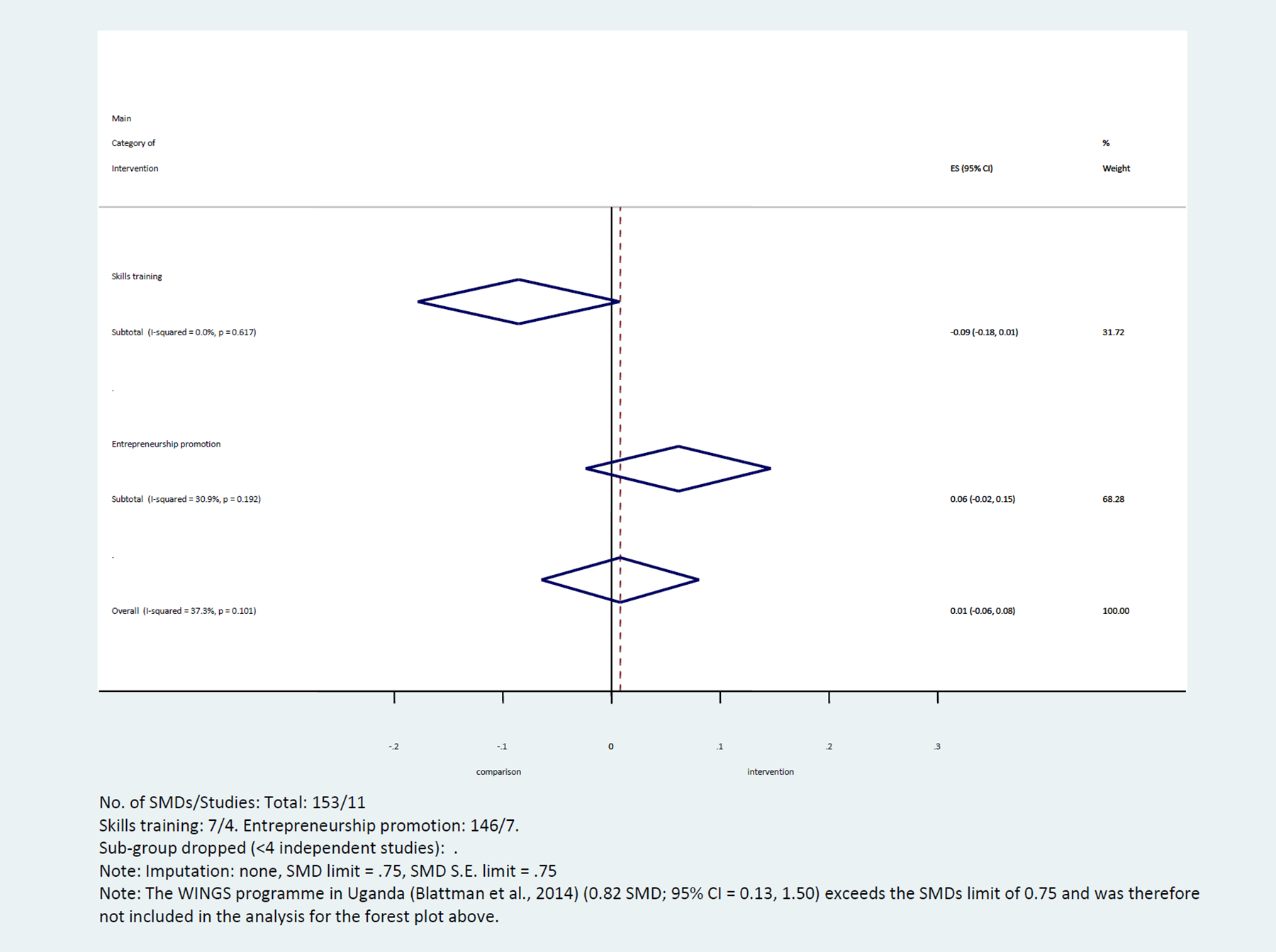
Summary forest plot of business performance outcomes by main category of intervention without imputations
4.3.4.2 Assumptions in the analysis
In the main meta-analysis, the team applied a procedure to remove implausibly large or influential estimates (cf. Section 3.4.2). Although meta-analysts would not want to erroneously exclude relevant estimates, balance demands that no single estimate, especially one among hundreds, should determine how an entire research literature is viewed or understood (Stanley & Doucouliagos, 2015).
As described in the respective sections, the team first winsorized the highest and lowest 1 per cent of coded SMD effect sizes estimates. Generally, this affected the (unweighted) mean SMD and its standard deviation only marginally. Subsequently any observations with an SMD or an SMD standard error of more than 0.75 were dropped. In the full sample, roughly 30 SMDs from 4 studies were excluded; most of these stemming from sub-group analysis and therefore all but one study was retained in the sample. This section tests whether the results are robust against these assumptions. The full results for all tests in the report are not displayed but those that appeared to be of major importance are highlighted. For example, the team also tested whether winsorizing at the 5 per cent level (instead of 1 per cent) altered the results, but could not find any definitive evidence and therefore this issue is not discussed.
The upper panel of Figure 35, Figure 36 and Figure 37 again replicates the results of the main moderator analysis regarding the main category of intervention but this time without winsorizing the data and only dropping outliers with an SMD or standard error above three (effectively not dropping any observations).
In fact, since very few observations were dropped, the results changed marginally and even confidence intervals did not increase as much as one might have expected. Correspondingly, the team found that results from the meta-regression model were not affected by the decisions to censor the specified data and so this robustness check is not discussed further in the current report.
Tests were also conducted on whether the results were robust to the level of aggregation of effect sizes before synthesizing results based on the random-effects meta-analysis. Specifically, the team checked whether aggregating effect size across all studies of one intervention, rather than only aggregating studies using the same data set, made a difference. The latter increased the number of observations in the full analysis (based on all outcome variables) from 100 interventions to 120 individual studies. Similarly, the reviewers tested whether the level of cluster in the meta-regression model significantly affected results but found no evidence that the level of first-step aggregation or cluster significantly altered results.
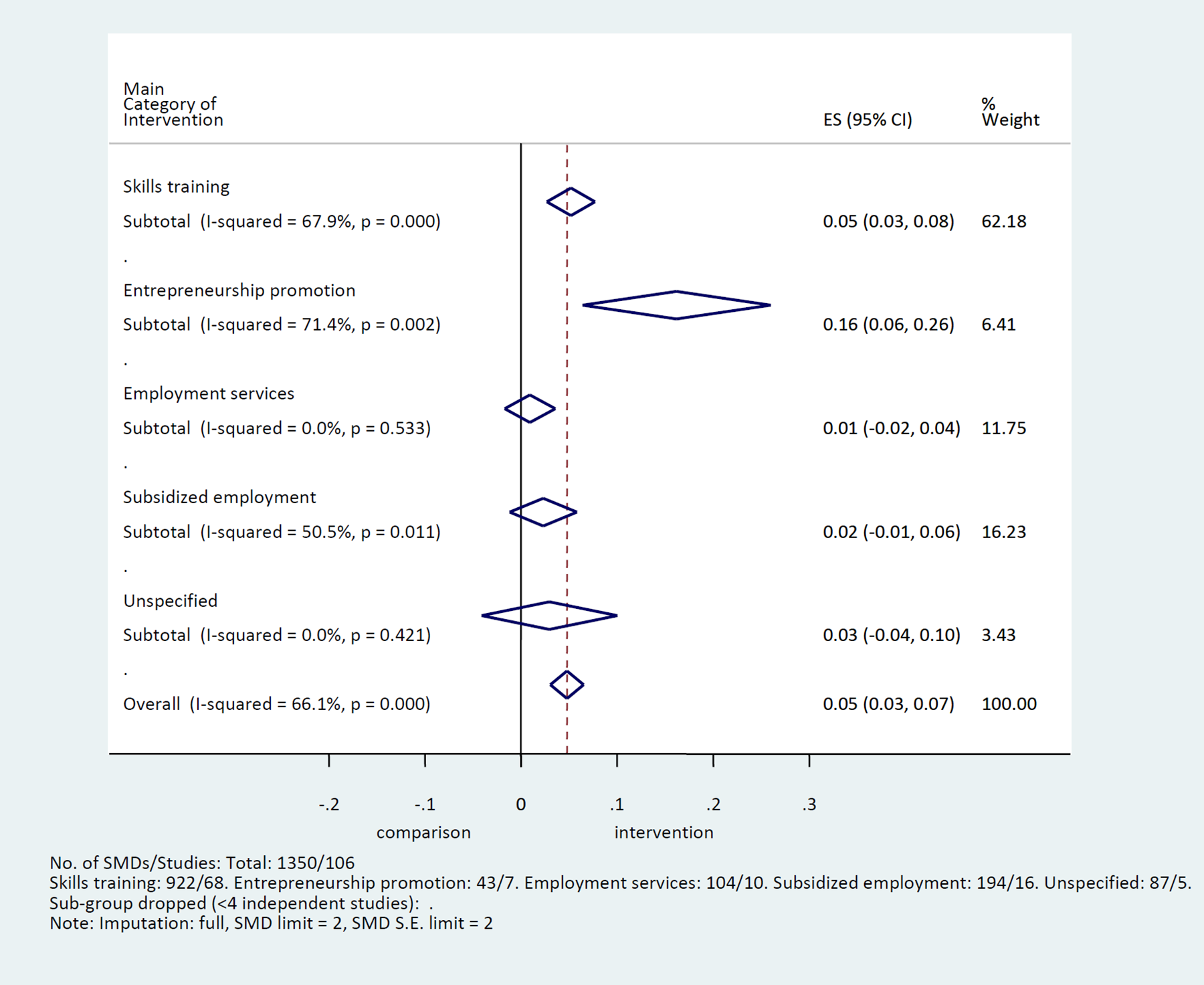
Robustness check: Summary forest plot of employment outcomes by main category of intervention, including outliers
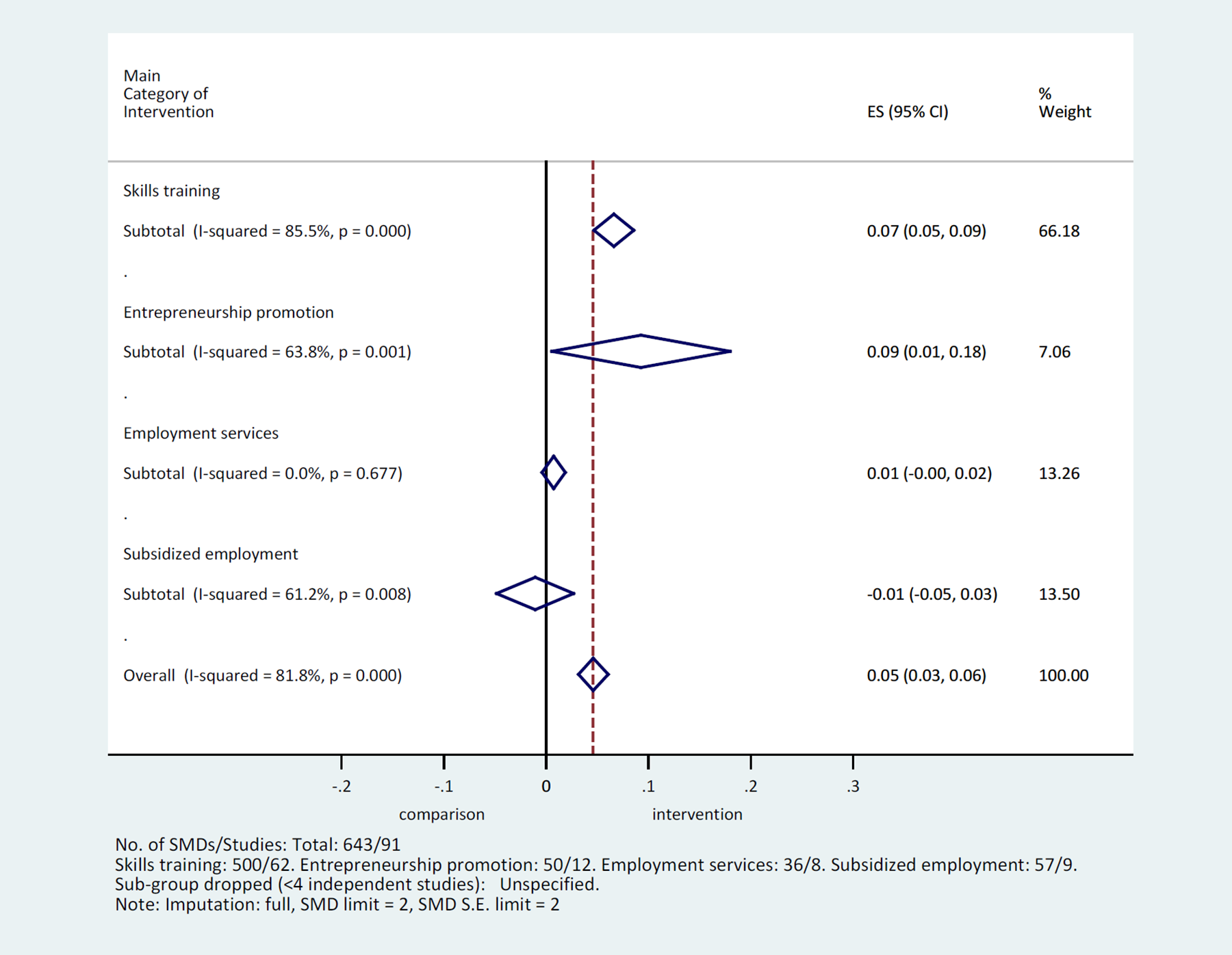
Robustness check: Summary forest plot of earnings outcomes by main category of intervention, including outliers
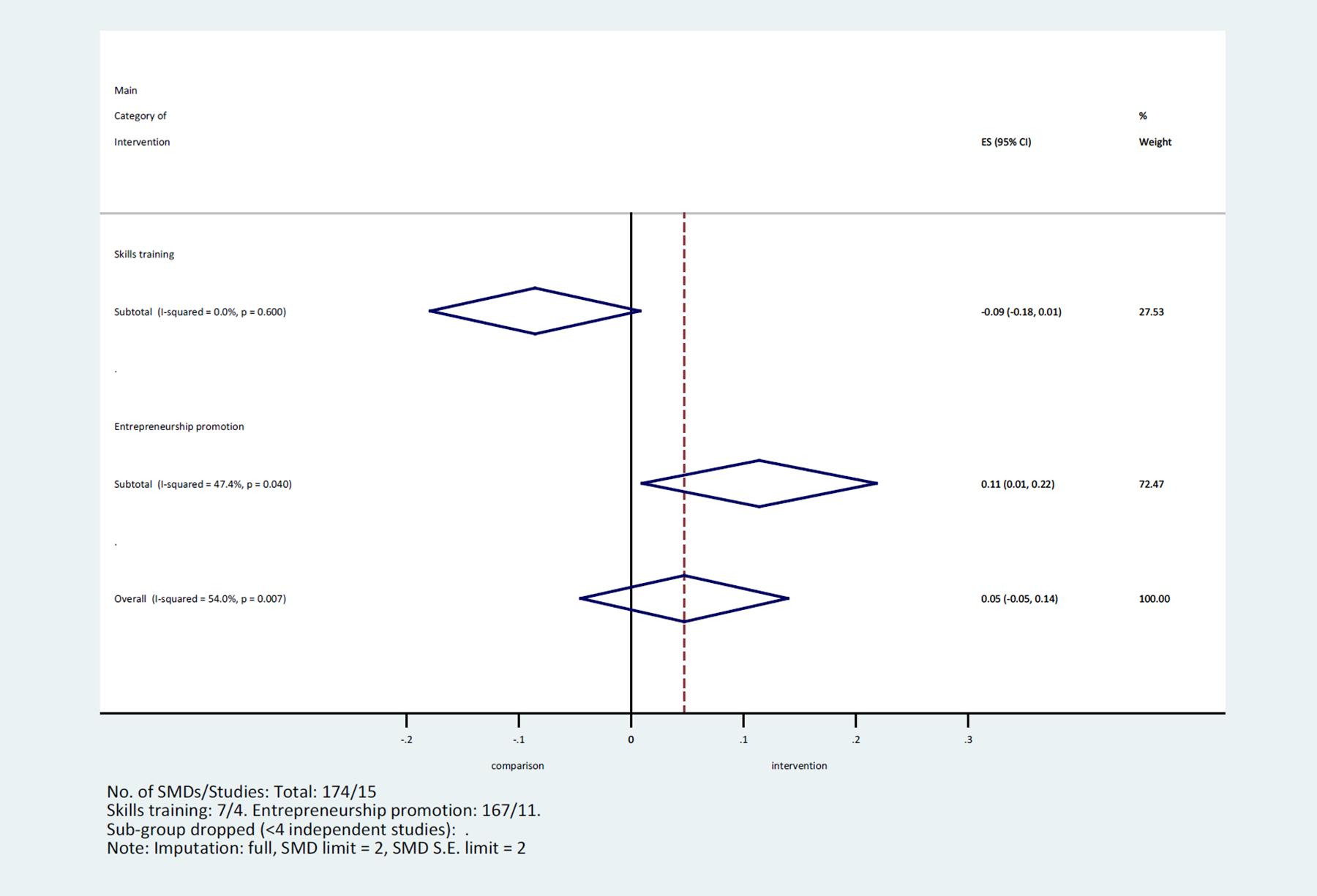
Robustness check: Summary forest plot of business performance outcomes by main category of intervention, including outliers
In summary, the team tested the robustness of the results towards different decisions made in the process of compiling and analysing the data, such as the imputation of missing information or the handling of statistical outliers. Since all the sensitivity analysis yielded similar results to the main analysis, the team can be quite confident that the findings reported in sections 4.3.2 to 4.3.4 were not influenced by the method of analysis.
4.3.4.3 Research design
This section tests whether the results depended on the applied evaluation design. In the combined meta-analysis, studies of randomized control trials and quasi-experimental evaluation approaches were pooled but more rigorous evaluation designs might have systematically yielded different effect sizes than less robust evaluation designs.
Figure 38 and Figure 39 provide a moderator analysis by research design for both employment and earnings outcomes. In contrast to expectations, experimental studies actually produced larger effect sizes in both cases, but the difference between experimental and quasi-experimental was not statistically significant at the 5 per cent level in either case. Based on the one-way random effects ANOVA model, the team was able to rule out a systematic difference on average between effect sizes generated from experimental and quasi-experimental studies.
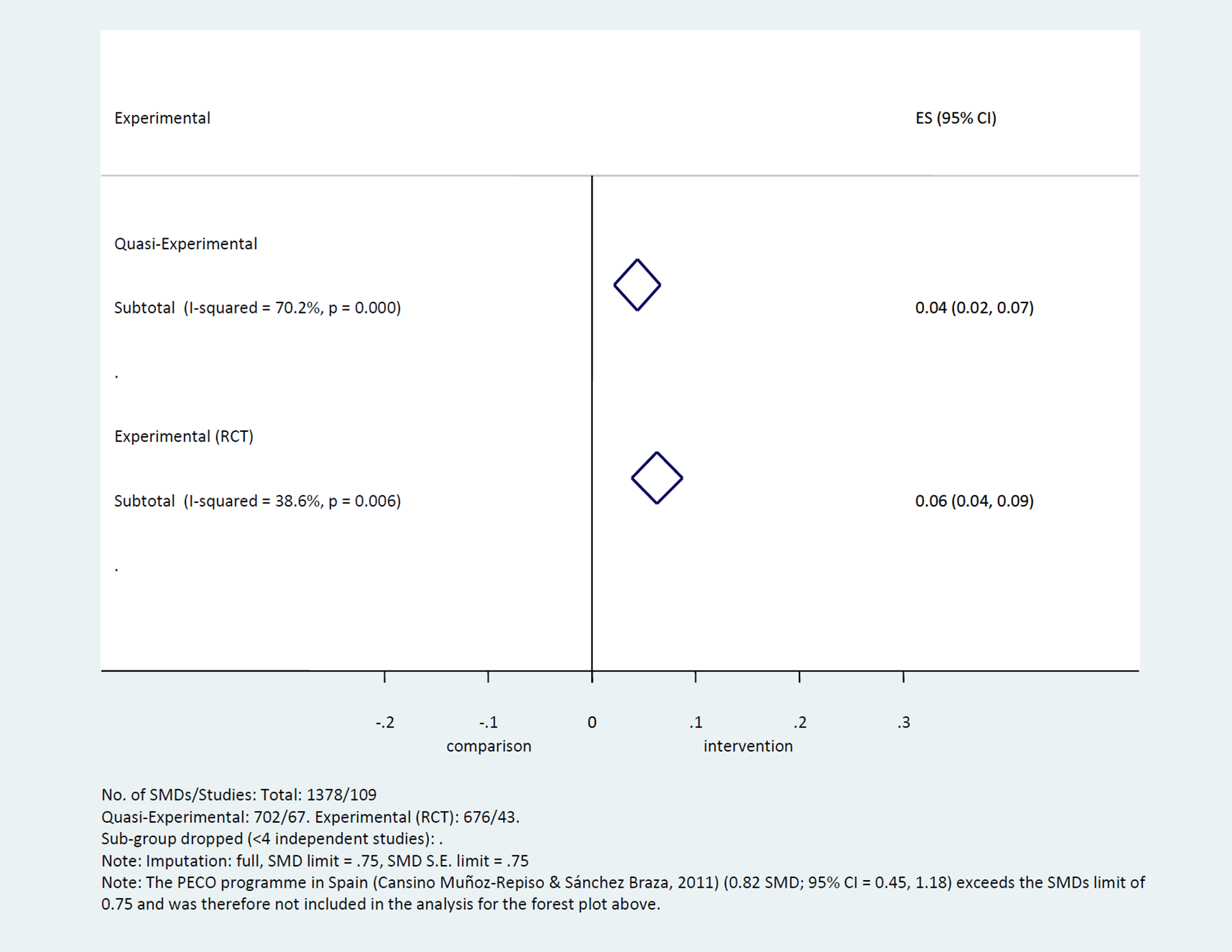
Summary forest plot of employment outcomes by research design
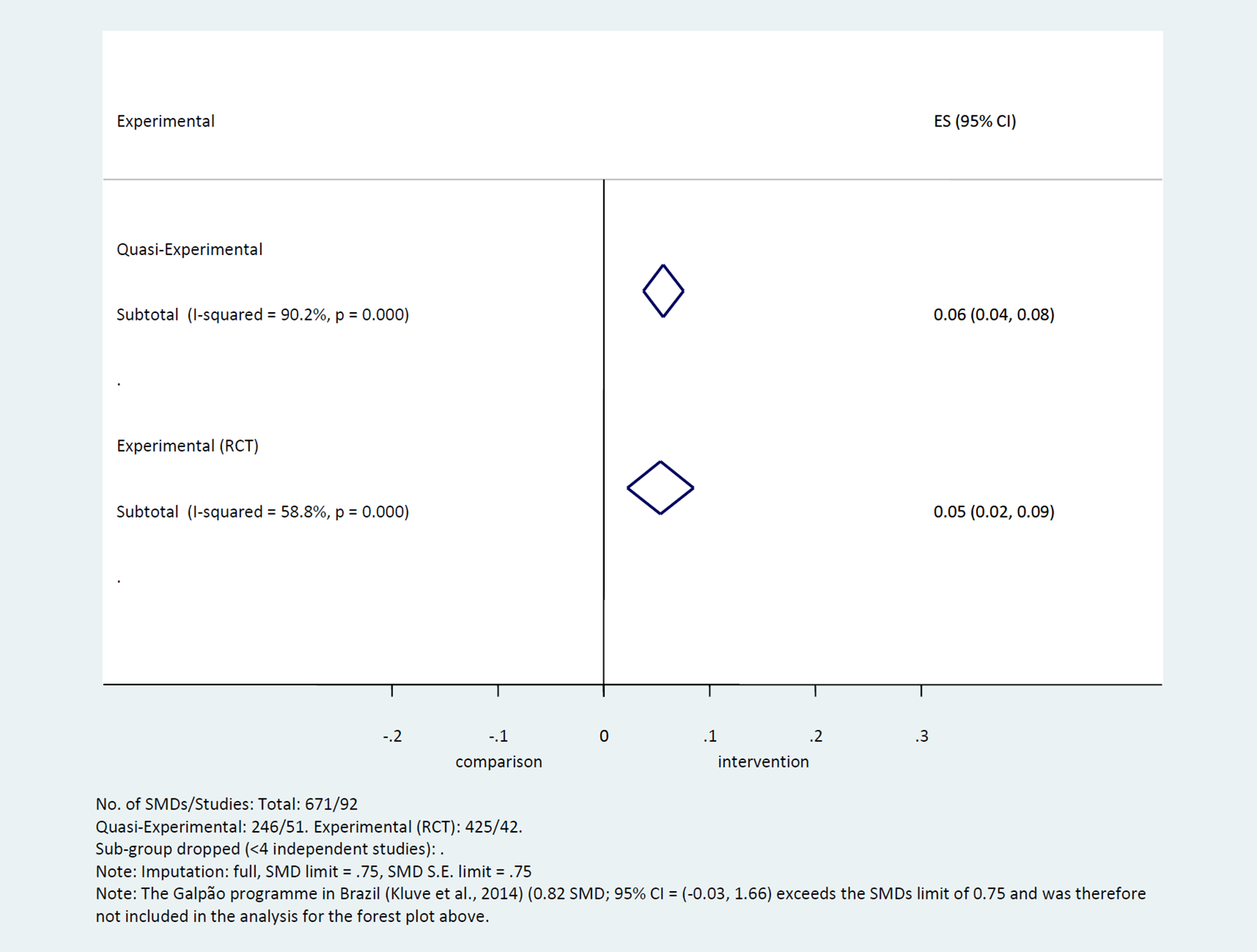
Summary forest plot of earnings outcomes by research design
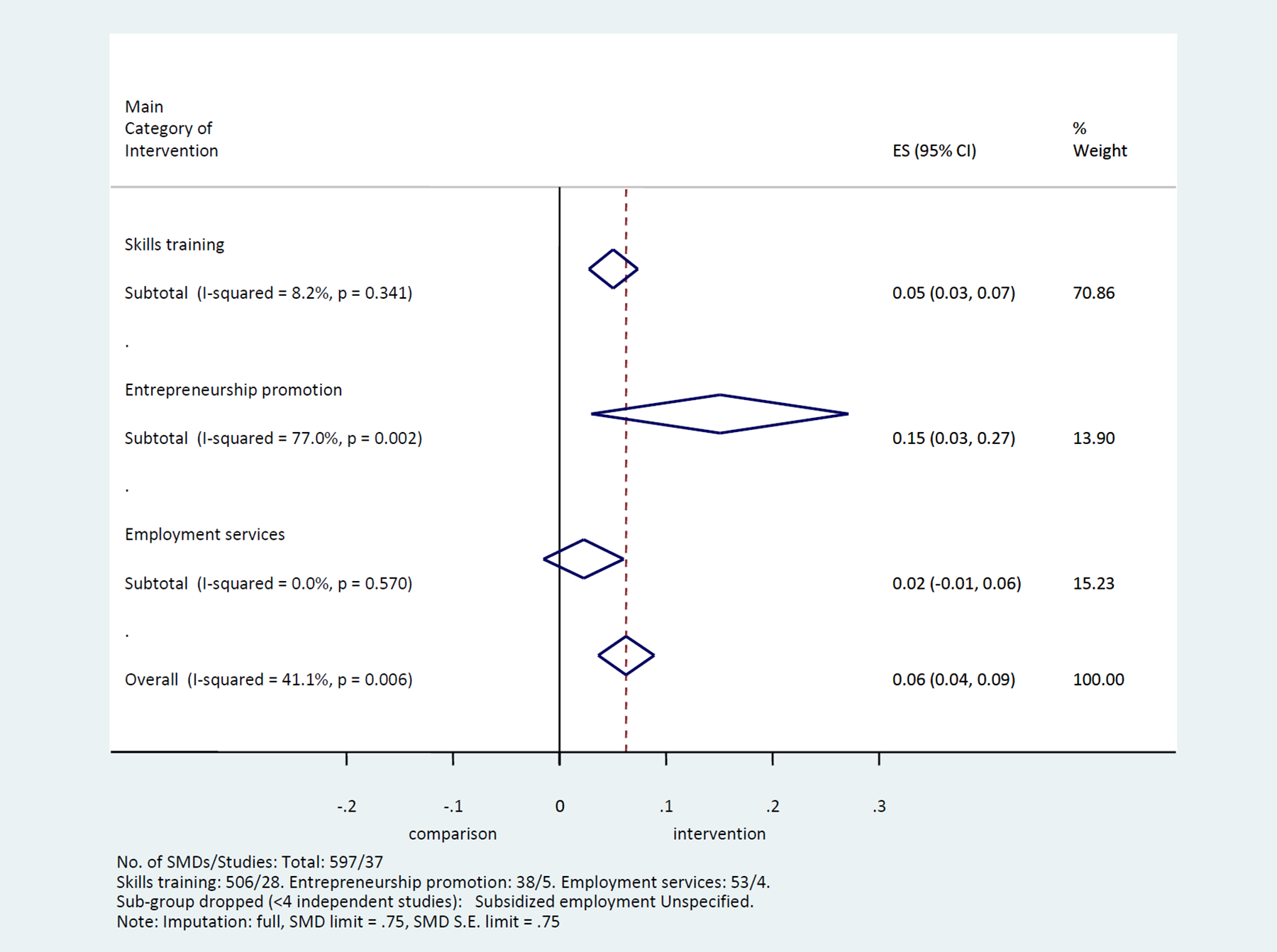
Summary forest plot of employment outcomes by main category of intervention for experiments
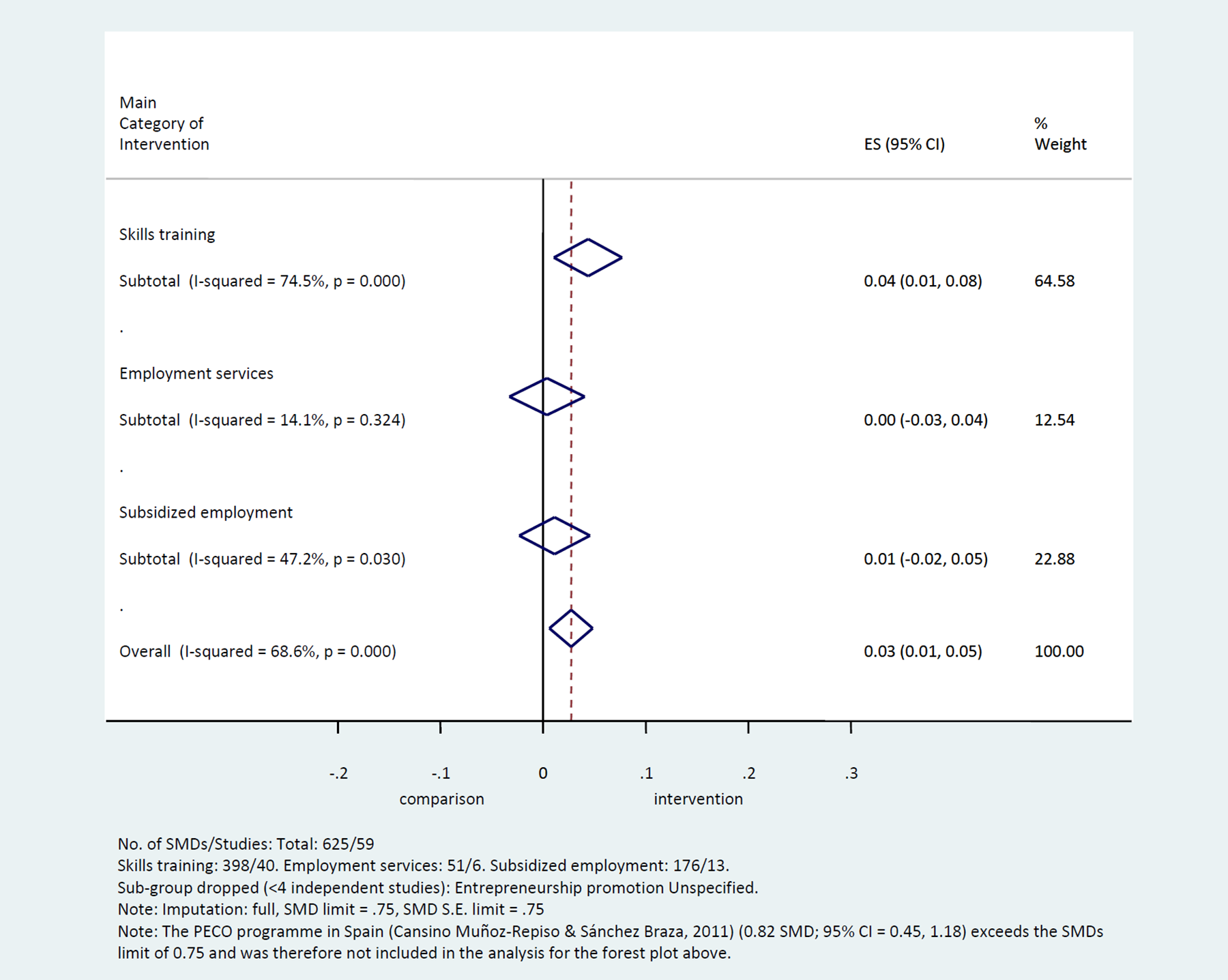
Summary forest plot of employment outcomes by main category of intervention for quasi-experiments
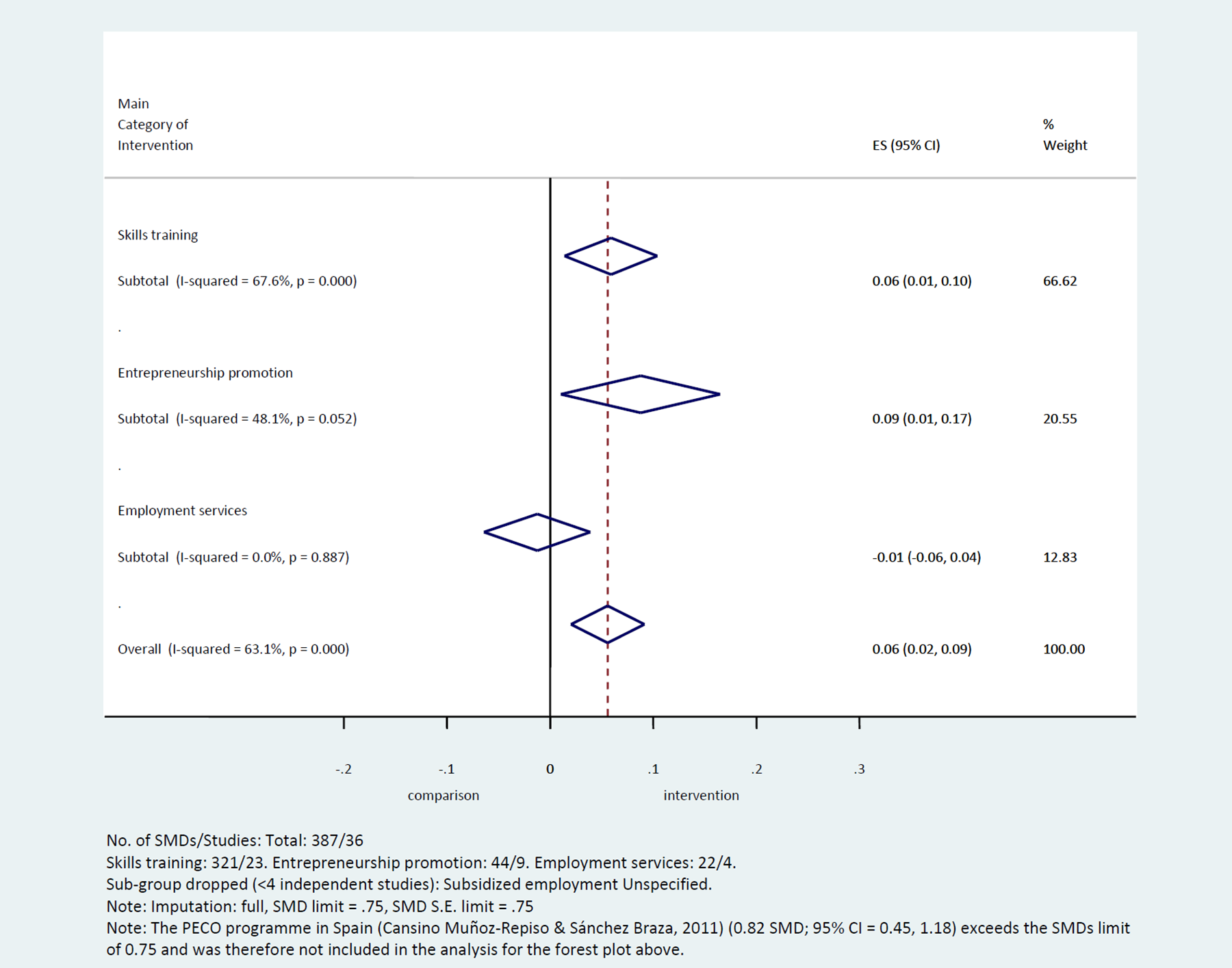
Summary forest plot of earnings outcomes by main category of intervention for experiments
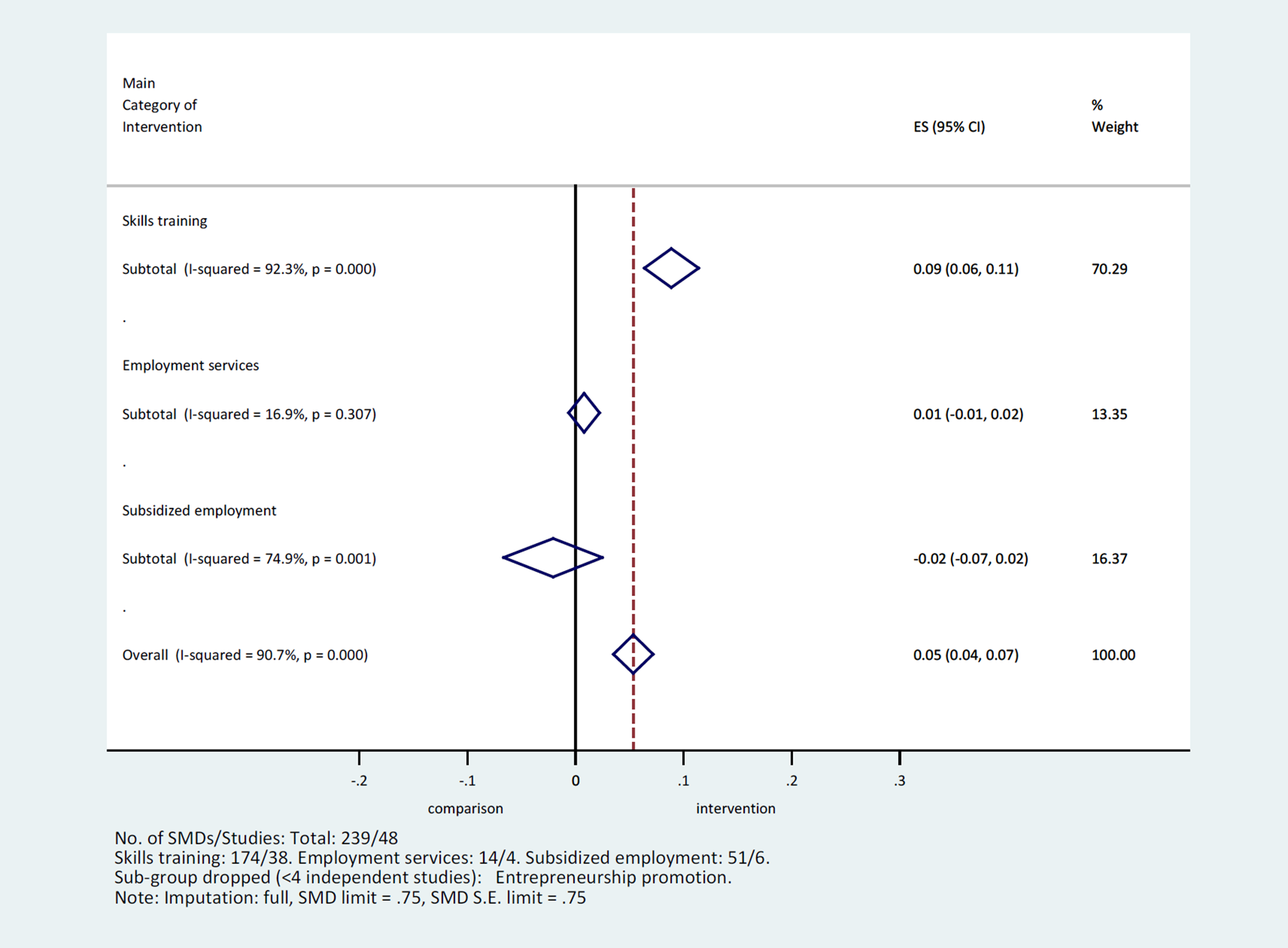
Summary forest plot of income outcomes by main category of intervention for quasi-experiments
However, this may differ according to the category of intervention. It is, for example, plausible that a particular intervention type consistently displays higher results when evaluated through experimental studies than through quasi-experimental ones. Therefore, the team tested whether the basic results on the effectiveness of different intervention types held when considering only evidence from experimental studies, which was arguably more reliable than quasi-experimental results. In a first descriptive step, Figure 40, Figure 41, Figure 42 and Figure 43 replicate the moderator analysis by main category of intervention for employment and earnings outcomes separately for experimental and quasi-experimental studies.
The evidence for entrepreneurship interventions was entirely based on empirical research and, hence, the review's results pertain. In contrast, all studies of subsidized employment interventions were derived from quasi-experimental approaches. To some degree, this correlation between intervention type and research design may have confounded the analysis. The spectrum of research designs employed for evaluating skills training interventions was more mixed. But regardless of evaluation design, skills training interventions appear to have been the most successful intervention type, along with entrepreneurship programmes. (The difference in SMDs between entrepreneurship and skills training interventions was still not statistically significant.) Unfortunately, studies of interventions classified as unspecified were dropped from the analysis, since fewer than four interventions were found which could have been classed as falling within either sub-group (experimental vs. quasi-experimental).
As with all univariate analysis, one issue was that the difference between experimental and quasi-experimental studies observed in forest plots might also have been driven by other factors (such as the fact that the majority of experiments were conducted in low- and middle-income countries, generally yielding larger effect sizes). Based on the univariate analysis, it is not possible to state with certainty that the aggregate effect size was actually downward biased by including evidence from quasi-experimental studies.
The meta-analysis results appeared robust to the type of evaluation design and the main findings were corroborated by rigorous evidence from experimental studies.
4.3.5 Analysis of small-sample bias and publication bias
This section uses funnel plots and Egger's tests to check whether there was any indication of publication bias in the sample of studies. Figure 44 and Figure 45 present funnel plots for the entire sample (including all outcomes and all sub-groups). The figure displays plots of the effect size (SMD) on the horizontal axis and the standard error of the effect size (SE SMD) on the vertical axis. In Figure 44, effect sizes are aggregated at the study level, and each dot represents an individual study. In Figure 45, the data is entirely disaggregated, meaning that each dot represents one effect size estimate. The solid line crosses the horizontal axis at the overall average fixed effect estimate.
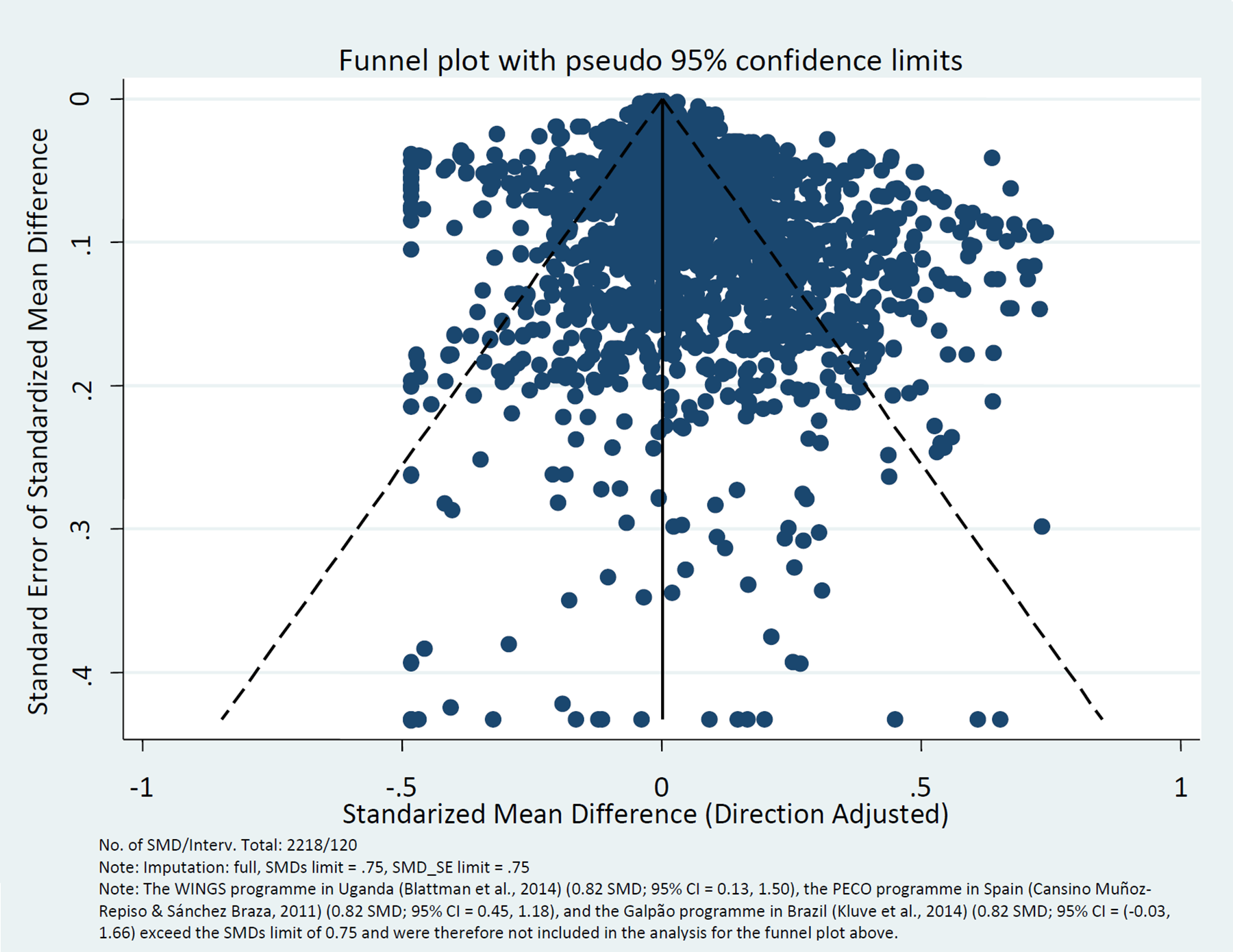
Funnel plot of all outcomes and sub-groups, aggregated at study level
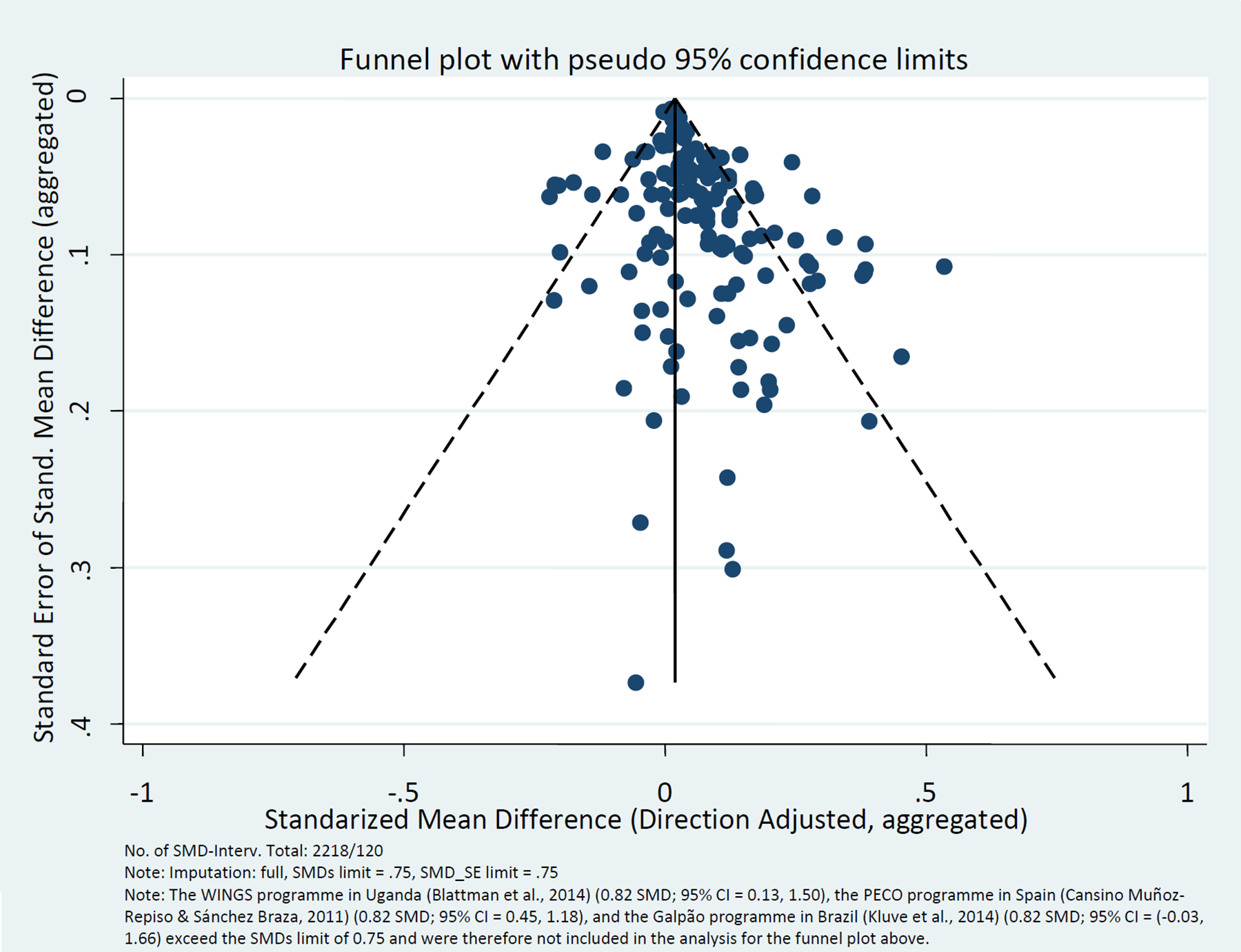
Funnel plot of all outcomes and sub-groups, disaggregated (on effect size estimate level)
Although most of the dots (studies) are spread around the solid line and within the triangular area (indicating the 95 per cent confidence interval), a degree of tendency towards the right is observable. These represent studies that reported positive effects (with a medium level of precision, as measured by the standard error). This slight asymmetry may be an indicator of publication bias.
Results presented in Table 35 from Egger's test for publication bias confirmed the visual indication: The coefficient of the variable bias was positive and statistically significant at the 5 per cent level.
Egger's test for small-sample bias
Note: *, ** and *** denote statistical significance at 10 per cent, 5 per cent and 1 per cent level of significance respectively.
As in the previous sections, the analysis is further disaggregated by outcome categories. Figure 61, Figure 62 and Figure 63 in Section 10.2 of the Appendix show funnel plots (aggregated at the study level) for the three outcome variables separately. 37 As can be seen from these figures, effect sizes of earnings and income outcomes appeared most strongly skewed to the right. This was also confirmed when performing Egger's test for each outcome category separately. For business performance outcomes, Egger's test was not significant at the 5 per cent level.
This potential publication bias was accounted for in the multivariate meta-regression model using the procedure described in Doucouliagos and Stanley's study in 2009: The authors argued that including the standard error of the SMD in the random-effect model would account for the potential effect of publication bias and the resulting coefficient estimate would provide an indication of the magnitude (and significance) of the effect. Following this approach, the team found a clear indication of selection for statistically positive results. The point estimate was consistently positive and statistically significant. In addition, the summary effect estimate (represented by the constant) in the model, which pools all outcomes, turned non-significant when accounting for publication bias using this approach. This seemed to be largely driven by the negative (insignificant) results on business performance outcomes, while the summary effect on employment and earnings was still significant even accounting for publication bias.
In addition to the above test for publication bias, the team also tested whether reported effect sizes differed between peer-reviewed articles, working papers (some of which were unpublished at the time of publication search), evaluation reports/technical reports and other types of reports (such as books and dissertations). No statistically significant differences in average effect sizes by publication status were found, as can be seen by the forest plot shown in Figure 46. These results held when the analysis was disaggregated by intervention type or outcome category (not reported). Similarly, the dummy for publication status (peer-reviewed) in the multivariate results did not provide a clear picture.
Funnel plots and Egger's test indicated some publication bias towards studies showing positive effects of youth employment interventions on labour market outcomes. Using the procedure proposed in Doucouliagos and Stanley (2009), the reviewers accounted for publication bias in the multivariate meta-regression model. While the overall effect was significantly reduced, youth employment interventions still showed a significant positive effect on employment and earnings outcomes. Nonetheless, the team concluded that the summary effect size of youth employment outcomes probably represented an upper bound for the true impact of these interventions. At the same time, no correlation of reported effect sizes with publication status was detected.
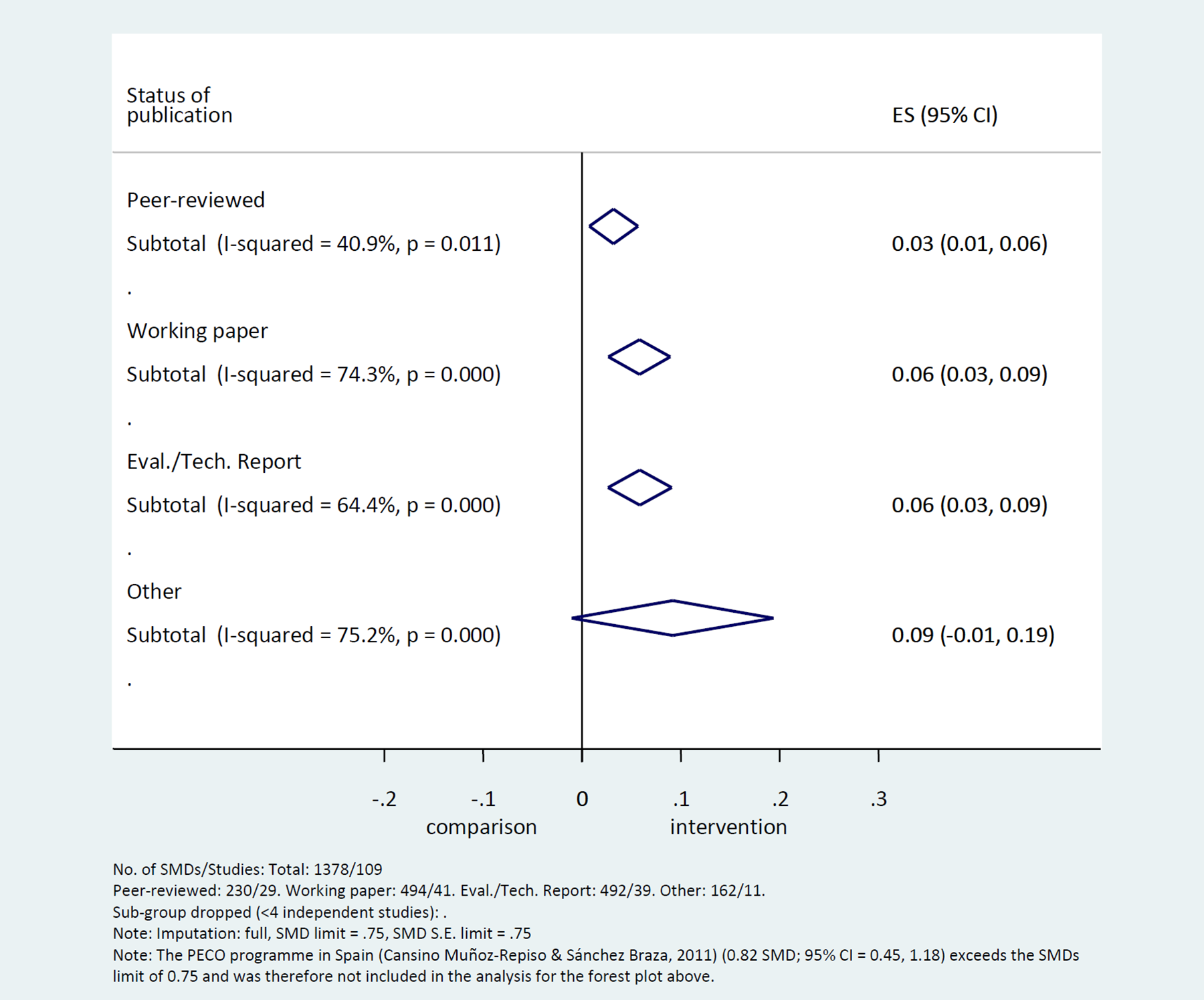
Summary forest plot of employment outcomes by publication status
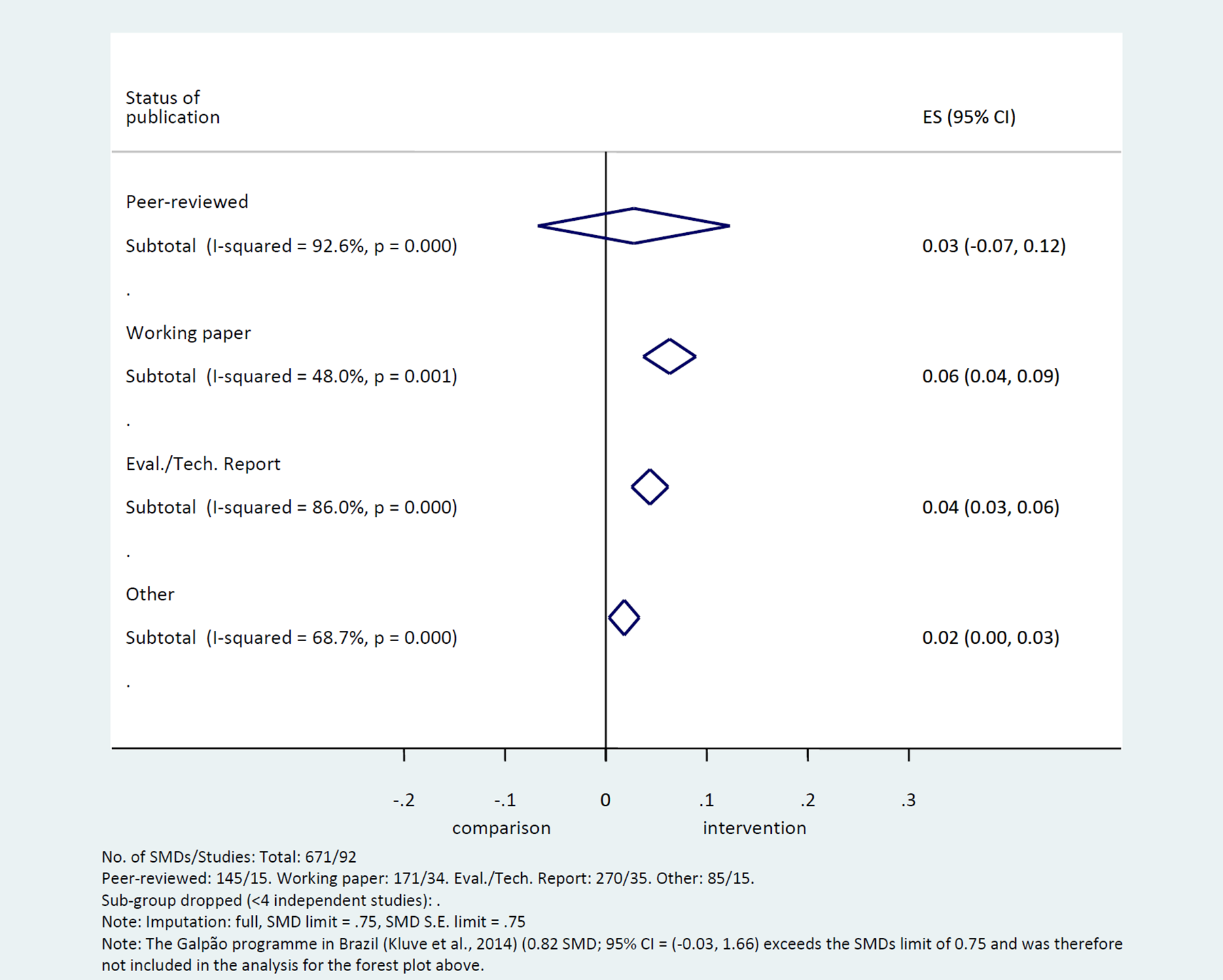
Summary forest plot of earnings outcomes by publication status
5 Discussion
5.1 SUMMARY OF MAIN RESULTS
Table 36 displays the main results of the systematic review and meta-analysis.
Summary meta-analysis findings
To support informed decision making, the systematic review examined the existing evidence on the effectiveness of interventions that aimed to improve the labour market outcomes of youth. The review relied on a structured and comprehensive search that allowed the identification and assessment of all relevant impact evaluation studies carried out worldwide between 1990 and 2014 across the following intervention types:
The key labour market outcomes considered were the post-treatment measures of employment, earnings, and business performance.
In the process of understanding what works, the review also focused on the way in which interventions work, relying on prior theories of change for the selected intervention types as well as on observed programme characteristics reported in the studies.
5.2 UNPACKING THE CAUSAL CHAIN ACROSS YOUTH EMPLOYMENT INTERVENTIONS
Section 1.3 proposed a series of causal chains connecting youth-targeted ALMPs to expected outputs such as direct job creation or changes in skills, knowledge, attitudes, or behaviours, and ultimately linking programme delivery to projected labour market outcomes as well as other closely correlated outcomes such as accumulation of human capital.
Some of these anticipated connections were confirmed by the results of the systematic review, shedding light on the impacts of skills training, entrepreneurship, employment services and subsidized employment on labour market outcomes of youth.
This section re-examines the proposed result chains, reflecting on the transmission channels that lead from activities to outcomes. It relies on the findings from the meta-analysis and digs deeper into the individual studies, unpacking features of programme design and implementation that triggered success in the achievement of intermediate and final outcomes.
5.2.1 Skills training programmes
Education and training are key determinants of success in the labour market and strong predictors of non-vulnerable jobs among youth (Sparreboom & Staneva, 2014). While time spent on education and training certainly pays off, returns are far more likely to be realized if there are strong, explicit links between education and training policies and the world of work.
Youth training programmes seek to develop skills that enhance human capital and lead to long-term gains in employment. A simplified results chain depicted in Table 37 draws a road map of how exposure to a training programme and the skills acquired through it can lead to improvements in employment, earnings and business performance. The causal hypothesis relies on a series of assumptions and the achievement of some intermediate results, such as positive changes in knowledge, skills, attitudes and behaviours, which are expected to occur in the short term and lead to changes in labour market outcomes such as the probability of employment after programme participation.
The road map is complex, as there are a number of parameters to consider in the design and delivery of training, including (i) the curriculum; (ii) the skills or combination of skills embedded in the curriculum (technical, soft); (iii) training provider's experience and quality; (iv) participation of employers (as well as workers’ associations) in programme design and implementation; (v) the setting (in-classroom, on-the-job, mixed); (vi) financial and non-financial incentives for participation of both youth and employers; (vii) targeting mechanisms; (viii) mechanisms for the selection of training providers; (ix) monitoring and reporting; (x) alignment with other ALMPs.
Simplified results chain for interventions offering skills training
Skills training interventions are the most widely used youth employment intervention worldwide and are increasingly combined with other measures to boost employability (Betcherman et al., 2007; Fares & Puerto, 2009). A total of 55 out of the 107 evaluated interventions (51 per cent, as shown in
Table 9) examined by this review fell within the main category of skills training interventions, with 53 per cent of these being conducted in high-income countries, 35 per cent in middle-income countries and 13 per cent in low-income countries. 39
On average, skills training interventions improved employment outcomes among young women and men by 0.05 SMDs (CI = 0.02, 0.07; I2 = 65 per cent; number of interventions = 67) and also led to higher earnings (0.07 SMDs; CI = 0.05, 0.08; I2 = 86 per cent; number of interventions = 60). Some key results emerged from the meta-review:
Main results from skills training interventions
Notes: HICs: High-income countries, LMIC: Low- and middle-income countries.
The multifaceted nature and evolution of skills training interventions was also observed in the evidence from single studies:
The combination of skills training and entrepreneurship promotion (and potentially further intervention types) was particularly prevalent in low- and middle-income countries, emphasizing youth's scant opportunities in (formal) employment and the limited ability of public and private sectors to absorb the growing youth labour force. Some examples of evaluated interventions that consisted, at a minimum, of a skills training and an entrepreneurship intervention component included the Employment and Livelihood for Adolescents (ELA) in Uganda, the Economic Empowerment of Adolescent Girls (EPAG) Programme in Liberia and the Livelihoods Training for Adolescent Living Programme in India.
The meta-regression results did not suggest a significant correlation of the inclusion of a soft skills component with larger effect size estimates. In fact, when restricting the sample to high-income countries, the availability of soft skills in the programme curriculum was correlated with lower employment effects, particularly among the younger cohort. An example from a high-income country is the JOBSTART programme from the United States. The programme applied an intensive exposure model that combined basic education, occupational skills training, training-related support services and jobs development and placement assistance – which included work-readiness, life and communication skills – for school dropouts and economically disadvantaged youth. While there is no disaggregation of impacts by skills set delivered, the evaluation showed overall meagre impacts on employment outcomes (Cave, Bos, Doolittle & Toussaint, 1993). Evidence from single studies in low-income countries offered more promising results. The combination of life and vocational skills provided to adolescent girls by the ELA Programme in Uganda led to large and significant changes in behaviours and an increased probability of employment and self-employment (Bandiera, Buehren, Burgess, Goldstein, Gulesci, Rasul & Sulaiman, 2014). These mixed results called for further investigation about the role of soft skills in the causal chain from intervention to final outcomes.
The Jóvenes Programmes in Latin America and the Caribbean were well-represented in this systematic review, with (often several) impact evaluation studies for programmes implemented in Argentina, Chile, Colombia, Dominican Republic, Panama and Peru. The model, piloted in the 1990s, combined in-classroom and on-the-job training in a demand-driven fashion. On the one hand, the design of the programme ensured private sector involvement in the definition of training content, securing the correspondence between the skills taught and those demanded by the productive sector. On the other hand, implementation was demand driven through stringent, competitive bidding processes for the selection of training providers, and incentive payment schemes were based on trainees’ outcomes. The first and most successful of the Jóvenes Programmes in terms of impact on employment was Chile Jóven, with an effect size for employment outcomes of 0.35 SMD (CI = 0.13, 0.58) and for income outcomes of 0.23 SMD (measured with less precision, CI = -0.16, 0.60). The employment effect sizes of other Jóvenes Programmes were lower but still positive and close to the sample mean for skills training interventions (which was SMD 0.05; CI = 0.02, 0.07).
It is important to note that, while it was not possible for the systematic review to assess treatment effects on intermediate outcomes, such as knowledge, skills acquisition, attitudes and behaviours, some single studies did find (i) positive impacts of youth employment programmes on educational outcomes (in the United States) and (ii) noticeable changes in behaviours, expectations and non-cognitive skills (in Dominican Republic).
In conclusion, Table 39 provides an evidence check against the expected outcomes for skills training interventions outlined in the results chain.
Evidence checks for skills training interventions
5.2.2 Entrepreneurship promotion interventions
Entrepreneurship promotion interventions are designed to address the individual and external constraints that young people encounter in starting or growing a business by providing entrepreneurial skills and facilitating access to capital for self-employment – including physical, financial and social capital.
The systematic review examined 15 entrepreneurship interventions that offered mainly business skills training, business advisory services and/or access to credit or grants.
Table 40 presents a simplified version of the results chain in Section 1.3.2 to outline the outcomes expected from entrepreneurship interventions, including (i) employment outcomes such as increased probability of employment, (ii) earnings outcomes and (iii) business performance outcomes, such as increased sales.
Simplified results chain for entrepreneurship promotion
Some important results emerged from the analysis and review of single studies:
The evaluation of the Partner Microcredit Foundation Experiment, a business and financial literacy programmes in Bosnia and Herzegovina, highlighted the fact that the programme led to improvements in business practices and entrepreneurial impetus, but did not directly translate into improved chances of business survival. In Peru, three entrepreneurship interventions addressing the need for a multi-component approach through business training, business advisory services and access to finance, also improved business performance outcomes of low-income youth and youth living in rural areas. The programmes Calificación de Jóvenes Creadores de Microempresas, Formación de Líderes Empresariales, and Formación Empresarial de la Juventud relied on business plan competitions to determine eligibility for programme participation or start-up funding.
Main results from entrepreneurship interventions
Note: (i) HICs: High-income countries, LMIC: Low- and middle-income countries; (ii) Results for employment, earnings and business performance outcomes of entrepreneurship interventions in HICs were dropped from the analysis due to an insufficient number of observations.
In conclusion, Table 42 provides an evidence check against the expected outcomes for entrepreneurship promotion interventions outlined in the results chain.
Evidence checks for entrepreneurship promotion interventions
5.2.3 Employment services
Employment services generally comprise interventions focusing on labour intermediation, i.e. programmes optimizing the process that matches jobseekers with vacancies. They deliver job counselling, job-search assistance and/or mentoring services for (re) activation purposes, which are often complemented by job placements and technical or financial assistance. The basic idea behind providing employment services to youth is that young workers have difficulty signalling their skills and credentials and/or lack the networks or knowledge to effectively search for vacancies and connect with employers. Hence, these programmes often focus on improving job-seeking skills and the efficiency of the matching process (Table 43).
Simplified results chain for employment services
The review identified a sample of ten employment services interventions, a majority of which combined job counselling, job-search assistance and mentoring services. In fewer cases, the interventions provided job-placement services and/or financial assistance. The only intervention that focused solely on financial assistance for job search was a subsidized transportation experiment in Ethiopia (Franklin, 2014). Interventions were typically of short duration (three months on average) and their intensity ranged from one-off afternoon visits to job information centres for secondary students in Germany to 12 months in the Counselling and Job Placement for Young Graduate Job Seekers programme in France. Importantly, the review highlighted the increasing reliance on employment services as supplementary measures within other ALMPs, mainly training and wage subsidies.
Most evaluations took place in high-income countries (Finland, France, Germany, Portugal and the United States) where they were typically implemented by public employment agencies and operated on a national scale. In developing countries, evaluated interventions were implemented in Ethiopia, India and Jordan. They were characterized by their small scale or pilot nature and the common aim to reduce job-search costs for jobseekers, either via job screening and matching, recruiting services or transport subsidies.
On average, employment services interventions provided moderate gains in employment outcomes among young women and men by 0.01 SMDs (CI = -0.02, 0.04; I2 = 0 per cent; number of interventions = 10) and also led to moderate higher earnings (0.01 SMDs; CI = 0, 0.02; I2 = 0 per cent; number of interventions = 8).
The evidence pointed to several key patterns:
Table 44). An examination of the individual studies in Jordan (Groh, McKenzie, Shammout & Vishwanath, 2014), India (Jensen, 2012) and Ethiopia (Franklin, 2014) showed rather positive impacts on employment outcomes of young participants.
Main results from employment services
Notes: (i) HICs: High-income countries, LMIC: Low- and middle-income countries; (ii) Results for employment, earnings and business performance outcomes of entrepreneurship interventions in HICs were dropped from the analysis due to an insufficient number of observations.
In conclusion, Table 45 provides an evidence check against the expected outcomes for employment services outlined in the results chain.
Evidence checks for employment services
5.2.4 Subsidized employment interventions
Overall, subsidized employment interventions reported larger effects on employment outcomes (0.02 SMDs; CI = -0.01, 0.06; I2 = 50 per cent; number of interventions = 105) than on earnings (-0.01 SMDs; CI = -0.05, 0.03; I2 = 61 per cent; number of interventions = 89). They also appeared less successful in higher income countries (Table 46). Before delving further into these findings, the analysis below differentiates between results and evidence from interventions delivering wage subsidies as opposed to public employment programmes – two subsidized employment measures with very distinct characteristics in design and implementation.
Main results from subsidized employment interventions
Notes: HICs: High-income countries, LMIC: Low- and middle-income countries
5.2.4.1 Wage subsidy interventions
Low levels of skills, limited or no work experience, signalling barriers, or economic crises and downturns all hamper labour demand for youth. Employers may have limited scope for hiring or suspect that youth come to the market with low productivity levels – lower than the market wage for a given job. To compensate for possible low productivity and to incentivize hiring (and training) of young people, wage subsidy programmes offer a risk discount to employers that offsets certain wage and non-wage costs.
Table 47 (a shortened version of Table 4) lists (i) more and better employment outcomes (from increased probability of employment to higher job quality and more efficient job searches), (ii) higher earnings, and (iii) long-term effects on youth's human capital and employability among the expected outcomes of wage subsidy programmes.
Simplified results chain for interventions offering wage subsidies
The systematic review included 17 studies in which wage subsidies featured as the main category of intervention. Most of the evidence (12 out of 17 studies) came from high-income countries; namely, Australia, Canada, Chile, France, Germany, Sweden and the United States. Evaluations from middle-income countries (registered in five studies) assessed impacts of programmes implemented in Jordan, South Africa, Tunisia and Turkey
40
. The evidence distribution was important as there was noticeable heterogeneity in the results across country income types. Two key messages stemmed from the results:
Main results from wage subsidy interventions
Notes: HICs: High-income countries, LMIC: Low- and middle-income countries
To explain these effects, the review pointed to the role of design features in determining programme effectiveness; echoing similar claims by Neumark and Grijalva (2013), Almeida et al. (2014) and Bördős et al. (2016). Kluve et al. (2016) show that once design features such as participant profiling, supervision, and incentives were accounted for, subsidized employment interventions, heavily influenced by the wage subsidy programmes in the sample, appeared to be more successful than skills training interventions.
The design of wage subsidy programmes implied numerous decisions on: (i) targeting – general subsidies vs. hiring subsidies or the decision to focus on specific target groups; (ii) the payment vehicle – direct payment, reduction in payroll taxes or social security contributions; (iii) the payee – employer or employee; (iv) the size of the subsidy and basis for its computation; (v) the duration of the subsidy or of the intervention as a whole; (vi) the offer – a job, a job with training or a job with training and other services; (vii) conditionalities, reporting requirements and programme monitoring.
While there was no clear evidence on relative effectiveness across design options, some messages from single studies were apparent:
In contrast, conditionalities that were compensated with relatively high subsidies seemed to cover the employer's opportunity cost adequately and enhance their participation. The national German programme JUMP offered direct payments to employers of 40 per cent of the wage value on the hiring of unemployed youth with secondary education. The relatively generous subsidy was paired with strict conditions for no early dismissal and a guaranteed period of post-subsidy employment, equivalent in duration to half the subsidized period. An impact evaluation of the programme showed positive impacts on the probability of employment in the short and long terms, with higher effects among the more skilled youth and in regions with relatively low labour demand (Caliendo, Künn & Schmidl, 2011). The lack of internal mechanisms at the firm level and of adequate information decreases incentives for the subsidies. A controlled experiment that provided employment vouchers to unemployed young South Africans in order to reduce the wage costs for employing firms yielded an average SMD for employment outcomes of 0.13 (CI = 0.01, 0.26). The evaluation study reported a positive probability of wage employment that reduced slightly over the longer term. However, the experiment suffered from a low take-up of the employment vouchers by eligible employers, which seemed to be partially correlated with the administrative burden of claiming the subsidy (firms did not have internal processes in place to deal with this aspect) and the perception by employers that the vouchers were not legitimate (Levinsohn et al., 2014).
In general, single studies hardly account for deadweight, substitution or displacement effects. This is a significant drawback that restricts the interpretation and applicability of evaluation findings (Almeida et al. 2014).
In conclusion, Table 49 provides an evidence check against the expected outcomes for wage subsidy interventions outlined in the results chain.
Evidence checks for wage subsidy interventions
5.2.4.2 Public employment interventions
Public employment programmes seek to stimulate labour demand in contexts where markets are unable to create productive employment on the required scale. In the context of youth, public employment programmes can facilitate first-time jobseekers’ entry into the labour market and keep unskilled or disadvantaged youth connected to the labour market, thus mitigating skills depreciation or the negative, scarring effects of long-term unemployment.
The multi-dimensional nature of the included programmes offered scope for multiple objectives. Their connection to social protection policies also allowed the formulation of expected outcomes beyond those related to the labour market, such as consumption smoothing.
Table 50 (a shortened version of Table 4), however, focuses on a list of labour market-related outcomes that included (i) more and better employment measures (probability of employment, hours worked, job quality), (ii) higher earnings and (iii) human capital accumulation (when the programme led to skills formation).
Simplified results chain for interventions offering public employment programmes
Public employment programmes are complex, entailing a number of design and implementation parameters, from the selection of works and services to targeting mechanisms, wage setting, determination of benefits, work conditions and labour intensity, incentives for participation and monitoring and reporting requirements.
The evidence to support the proposed theory of change was unfortunately very sparse. During the search period, the systematic review was able to identify only two studies with public employment programmes as their main category that complied with the review's inclusion criteria. Both studies reported zero to negative treatment effects on the probability of employment after programme participation, suggesting that
Caliendo et al. (2011) assessed the impact of the German Job Creation Schemes Programme, which provided unemployed youth with secondary education with the opportunity to work in infrastructure or social projects for a maximum of 12 months. The study found negative impacts on employment probability of young participants both in the short and long term.
Brodaty (2007) examined the French programme Travaux d'Utilité Collective (TUC), a social development and community public works project for unemployed youth. The job duration varied from three to 24 months, with contributions by both Government and employers. The study found no significant changes in employment probability compared to youth in the comparison group.
The effect sizes of these two studies fell below the overall effect size for subsidized employment interventions and also in relation to wage subsidy programmes.
Furthermore, one of the four arms during the “option” stage of the above-mentioned UK New Deal for Young People programme acted as a public employment programme. The environmental services track within the programme provided jobs for youth in housing projects, forest and park management, and reclamation of derelict or waste land. Evaluations of the New Deal showed that this particular component had limited to no impact on post-programme employment, particularly in comparison to wage subsidies, which provided a more effective means of exiting unemployment and securing unsubsidized employment (Dorsett, 2006). Similar results were found by Card et al. (2010 and 2015), where evidence that was not specifically focused on youth showed public employment programmes to be generally less successful than other types of ALMPs.
The meagre evidence on youth-targeted public employment programmes limited the discussion about what works or which design features matter most. This finding calls for further impact research on this type of intervention, particularly in low- and middle-income contexts where programme exposure may have diverse effects on youth and their families.
The search window of the systematic review missed the recording of a recent impact evaluation of a public employment programme implemented in Côte d'Ivoire by Premand, Marguerie, Crépon and Bertrand (2015). The evaluation of the Emergency Youth Employment and Skills Development project, established in 2012 to support the economic recovery following the post-electoral crisis, showed large short-term positive impacts on probability of employment and hours worked in wage occupations and positive impacts on earnings while youth were still participating in the programme, in contrast to the comparison group. While results for long-term effects are not yet available, the promising short-term results support the call for more and better evidence-gathering in developing economies.
5.3 AGREEMENTS AND DISAGREEMENTS WITH OTHER STUDIES OR REVIEWS
The effort to undertake this systematic review was initially motivated (see Section 1.4) by the statement that new evidence was needed to support decision-making on youth employment. Specifically, similar systematic reviews and studies either required urgent updating (Betcherman et al., 2007) or simply posed related, yet distinct, research questions (e.g., Card et al., 2010, 2015; Tripney et al., 2013; Grimm & Paffhausen, 2015; Filges et al., 2015).
The findings presented in the previous section are aligned with that motivation: the results of the empirical analysis are generally congruent with previous and related literature, but they (i) add much more depth given the rigour of the analysis and the comprehensive nature of the data, (ii) complement and carve out much more clearly the patterns indicated by previous studies, and (iii) add genuinely novel insights. So, in essence, the current study found few points of variance with related studies, but agreed on major lines, strengthening the existing knowledge base and identifying many new, detailed aspects:
A
5.4 COMPLETENESS AND APPLICABILITY OF EVIDENCE
The evidence base on youth employment is growing and improving. While better study designs should lead to lower risks of bias, limitations in the evidence still shed only partial light on what works.
Box 10 below describes a study of a wage subsidy programme in Tunisia that examined partial equilibrium effects. Accordingly, in the absence of systematic considerations of the general or partial equilibrium effects, the review's findings necessarily exhibit a degree of incompleteness and questionable external validity.
Box 10: Partial equilibrium effects: Entrepreneurship training and self-employment among university graduates in Tunisia
In Tunisia, an entrepreneurship track was introduced into the applied undergraduate (licence appliquée) curriculum in 2009. University students enrolled in the last year of their licence appliquée were invited to apply to the entrepreneurship track, which provided students with: (i) entrepreneurship courses organized by the public employment office; (ii) external private sector coaches in an industry relevant to the student's business idea; and (iii) supervision from university professors in development and finalization of the business plan. The entrepreneurship track offered students the opportunity to graduate by writing a business plan instead of a traditional undergraduate thesis. On graduation, participants were invited to submit their business plans to a competition and the competition winners became eligible to receive seed capital to establish their business.
A randomized trial aimed to identify the impact of the entrepreneurship track on beneficiaries’ labour market outcomes. The study showed that the entrepreneurship track significantly increased the rate of self-employment among university graduates approximately one year after graduation, but that the effects were small in absolute terms. The employment rate among beneficiaries remained unchanged, which in partial equilibrium indicates a substitution from wage employment to self-employment. However, Almeida et al. (2012) note that the shift from wage employment into self-employment may free up job opportunities for non-participants, therefore potentially leading to higher employment overall in general equilibrium. The study design did not allow such potential general equilibrium effects to be identified.
Sources: based on information available at: www.youth-employment-inventory.org [22 Feb. 2016]; Almeida, Barouni, Brodmann, Grun and Premand, 2012.
5.5 QUALITY OF THE EVIDENCE
This systematic review did not undertake a full risk of bias assessment as recommended in the systematic review methodology literature. However, it relied on a framework by Duvendack et al. (2012) to assess the analytical and statistical rigour of the included studies based on the studies’ design and statistical methodology. This framework makes some assessment of study design and confounding, but excludes other domains of bias such as performance bias, selection bias (including attrition) and biases in outcomes data collection. A future update of this systematic review would need to take these factors into account.
5.6 LIMITATIONS AND POTENTIAL BIASES IN THE REVIEW PROCESS
The review relied on evidence from indirect comparisons of programmes in different contexts. It excluded studies which only examined the relative effects of two or more interventions, limiting the extent to which review question 2, namely “Which of these interventions are the most effective on average?”, could be answered using direct comparisons of programmes in the same context. In addition, the review did not assess net outcomes resulting from the included interventions, such as whether employment creation of ALMP participants displaced non-participants thereby decreasing the overall employment impact of the programme. The summary effect size of youth employment outcomes may therefore represent an upper bound for the true impact of these interventions.
The review team made an extensive effort to collect missing information by contacting authors using a standardized template to solicit the data required for inclusion of the study. In addition, the team employed several methods to impute missing information where possible and extensively tested the adequacy of these procedures. This allowed effect sizes for a large share of the included studies to be computed. However, the main empirical analysis was based on 2,259 of the 3,629 coded treatment effect estimates, for which it was possible to compute the SMD. While this sample is much larger than in most other systematic reviews, it remains difficult to assess the degree to which missing information may impact the empirical findings (i.e., whether reporting quality is correlated with effect size magnitudes).
Relatedly, it was not possible to conduct a detailed assessment of the risk of bias in included studies. The main reason was that most reports did not provide the information needed to objectively code the information required. This is irrespective of the publication status and study design: Many experimental impact evaluations do not provide basic information on the randomization approach (allocation method and concealment from participants) or the participant flow through the study. For quasi-experimental studies, there are yet no common standards for reporting and analyzing bias that unifies various econometric approaches. It is therefore very difficult to objectively assess bias in studies without contacting original authors, who may not be inclined to respond to such queries. We therefore chose to adopt the approach to classification based mainly on study design.
Echoing other reviews in the social sciences (e.g., Tripney et al., 2013), the review found that the methods for calculating comparable effect sizes from studies using more complex multivariate econometric methods are underdeveloped and require further research. However, the review benefitted from the experience of the principal investigators and was carried out with frequent guidance from the Methods Coordinating Group of the Campbell Collaboration.
Finally, the search and selection of studies focused specifically on quantitative impact evaluations using a rigorous (quasi-) experimental design. While the team believes that this is a strength of the review, the method may have disregarded important findings from studies that were rather more qualitative in nature or did not attempt to provide causal effect estimates.
6 Conclusions
6.1 IMPLICATIONS FOR POLICY AND PRACTICE
The extent and urgency of the youth employment challenge and the level of global attention currently being given to this topic calls for more and better evidence-based action. Accordingly, this systematic review sought to examine the empirical evidence in order to understand what drives the success (or failure) of youth employment interventions. Investments in youth employment will continue, and even increase, as countries embark on the implementation of the 2030 Agenda for Sustainable Development; therefore, this review focused on identifying “what works” and, as far as possible, “how”.
This systematic review builds on a growing base of studies measuring the impact of youth employment interventions and offers a rigorous synthesis and overall balance of empirical evidence taking into account the quality of the underlying research. The review is systematic through a clearly defined and transparent inclusion and exclusion criteria, an objective and extensive search, a punctual data extraction process, a standardized statistical testing and analysis, and a thorough reporting of findings. These elements and underlying methods and tools were laid out and reviewed in the protocol (Kluve et al. 2014).
The evidence suggests that investing in youth through active labour market measures may pay off. The evidence also shows a significant impact gap across country income levels. Being unemployed or unskilled in a high-income country – where labour demand is skill intensive – puts youth at a distinct disadvantage in comparison to a cohort that is, on average, well educated. While ALMPs in high-income countries can integrate disadvantaged young people into the labour market, they are not able to fully compensate for a lack of skills or other areas where youth failed to gain sufficient benefit from the education system. On the other hand, in lower income countries, with large cohorts of disadvantaged youth, marginal investments in skills and employment opportunities are likely to lead to larger changes in outcomes. Youth-targeted ALMPs in low- and middle-income countries do lead to impacts on both employment and earnings outcomes. Specifically, skills training and entrepreneurship promotion interventions appear to yield positive results on average. This is an important finding, which points to the potential benefits of combining supply- and demand-side interventions to support youth in the labour market.
The evidence also calls for careful design of youth employment interventions. The “how” seems to be more important than the “what” and, in this regard, targeting disadvantaged youth as well as providing incentives for participation of youth, appropriate profiling mechanisms and schemes to motivate service providers to perform effectively may act as key factors of success.
The latter emphasises the ability of specific design features within employment interventions to affect individual behaviours – in this case among both young people and service providers. It also implies – and calls for – sensible interpretation of the results. The findings from this review need to be discussed vis-à-vis the local and national context and should be complemented by a long-term and holistic commitment towards youth development.
Achieving an understanding of the “how” element is not an easy task. Although the systematic review excluded studies which only reported relative effects, it is also the case that, frequently, impact evaluations do not assess relative effectiveness. Even more often, reports and papers fail to describe the underlying theory of change and observed transmission mechanisms behind an intervention. In some other cases, there is limited information about the characteristics of programme participants in the evaluation sample and their comparison group. Much remains to be done to improve reporting standards and advocate for more and better evidence examining the impact of youth employment interventions. The quality of the primary studies determines the quality of the systematic review and any subsequent synthesis of the evidence.
6.2 IMPLICATIONS FOR RESEARCH
Counterfactual studies examining youth employment interventions are comparatively well designed, with an increasing share of experimental evaluations conducted in recent years. While this assessment of the study design could only provide a partial picture, the analysis showed a relatively high overall level of rigour of included studies: Only 9 per cent of studies were judged to have a low level of rigour, based on their research design and empirical methodology. However, evidence for small study effects suggested publication bias was present, based on the sample of included studies.
A number of issues which placed limitations on this review could be mitigated with additional or improved primary research on youth employment interventions. Existing research is spread unevenly across the globe. While the evidence gathered was global in nature, capturing 31 countries and all regions of the world, slightly more than half of the evidence derived from interventions in high-income countries. While it was possible to include a number of recent experimental studies from middle- and low-income countries – Not ably sub-Saharan Africa and Latin America and the Caribbean – there was a distinct lack of evidence from Asia, Central Europe, the Pacific, the Middle East and North Africa. Furthermore, the evaluations of youth employment interventions in low- and middle-income countries were concentrated on rather small-scale, NGO-implemented interventions and there was a lack of evidence for larger, nationwide governmental programmes. A Not able observation regarding the quality of impact assessment reports is that too few studies provided evidence about heterogeneous treatment effects for different sub-groups of the interventions, such as female or low-income youth. Similarly, as significant differences in effect size magnitude by length of time since programme exit were observed, it is clear that more research is needed to (re-) assess the effectiveness of youth employment interventions in the long run. More evidence and comparative analyses are needed to assess relative effectiveness across intervention components and between intervention types. The review team believes that the practitioners would greatly benefit from more evidence of interventions with multiple treatment arms which compare the effectiveness of combining different intervention design features. To gain a better understanding of the employment effects on young people, it is important to further observe their transitions from the informal economy to the formal economy. The extent of informality among youth calls for further research into successful approaches to facilitate an effective transition into formal sector jobs and formalized businesses. Authors of primary studies should report all information required to calculate effect sizes across different outcome measures in a more detailed, complete, or standardized way. This relates, in particular, to the follow-up mean of the outcome variable in the control group, as well as pooled (or comparison group) standard deviations. Only 13 of the 113 reports in the initial sample provided all the information needed to compute standardized mean differences without having to contact the authors or, in a second step, impute the missing information. For another 13 reports (representing seven interventions), it was not possible to compute SMDs even after taking these steps and their findings therefore could not be included in the effect-size based quantitative meta-analysis. Frequently, it would also be welcome if authors provided more detail on reporting their study design and empirical identification strategy as well as occurrence and potential causes of attrition. Based on the reported details, it was often difficult to judge the internal validity (or risk of bias) of studies due to a lack of reported information about potential biases, such as attrition, selection or mismeasurement. Finally, the review originally set out to compare the cost-effectiveness of different intervention types. This was not possible as very few studies indicated the cost of implementation in published reports. Much remains to be done to improve the research and reporting standards and generate more and better evidence about the impact of youth employment interventions.
Footnotes
7 References
8 Information about this review
9 Tables for the Appendix
10 Figures for the Appendix
1
The review excluded studies of formal training programmes, such as evaluations of dual systems in Austria, Germany and Switzerland.
3
It is important to note that the theory of change analysis does not provide details on potential general equilibrium effects, such as substitution.
4
Targeting is critical to avoid misuse of subsidized employment programmes.
5
Programmes may create a stigmatizing effect on participants, particularly the most highly educated. In France, participation in the workfare programme carried a stigma that hindered participants in their transition to better and more durable jobs (Bonnal, Fougere & Sérandon, 1997; Brodaty, Crépon & Fougère, 2000). Adequate programme marketing and publicizing is important to address stigma issues.
6
Programmes may create higher dependency among participants, hindering the transition into unsubsidized employment. Evidence from public works programmes in Poland indicates that the effect of the programmes on reemployment gradually diminishes after the fifteenth month of registering as unemployed (O'Leary, 1998). Addressing this concern, Galasso, Ravallion and Salvia (2001) conducted a randomized experiment that aimed to provide comprehensive services to workfare participants in Argentina in order to promote their transition out of welfare. The experiment, called Proempleo, offered wage subsidies and specialized training to programme participants and reported positive cost-effective impacts on their employment prospects.
7
The programmes? potential to yield stabilization benefits is higher when they are implemented at the right time. Some programmes - particularly in South Asia - are implemented seasonally to ensure that employment is available during the agricultural slack seasons. Others, such as Argentina?s Trabajar Program, are implemented during sharp economic crises as a means of increasing the incomes of poor families and those badly affected by recessions.
8
The ability to retain work following the expiration of the wage subsidy period also serves as a signal of the acquisition of certain work-related behavioural skills to potential future employers.
9
In a review of evaluation methods used in ALMPs, Heckman, La Londe and Smith (1999) identified a number of methodological lessons, ranging from recognition of the multiplicity of parameters and heterogeneous impacts intrinsic to ALMPs to the need for appropriate comparison groups and the importance of addressing selection bias. Experimental evaluations can effectively learn from these lessons by providing a framework that relies on credible comparison groups and minimizes selection bias.
12
To minimize the number of missing values in programme-related variables considered relevant for the analysis, additional information was gathered from sources beyond the study (which is the core unit of analysis), including project reports and project websites. The variables coded from these sources were: monitoring mechanisms, participant profiling, incentives to participants (for programme participation and/or performance), and incentives to service providers (payments conditional on outcomes of programme participants), and are presented in  of the Appendix.
13
This is in line with experiences documented by previous systematic reviews in related fields, such as Baird, Ferreira, ?zler and Woolcock (2013) or .
14
For studies with large n, c(v) was considered equal to 1.
15
In order to increase response rates, however, the review team did not ask authors for missing information on intervention characteristics.
16
The difference between the total number of included studies and the total number of missing responses is mainly due to studies for which no additional information was required.
17
In some cases, the required information could be obtained for the overall sample, but not for specific sub-group analysis. In those cases only the specific effect size was included but not the entire study.
18
No studies were encountered in the sample which assessed different treatments using the same group of individuals as the comparison group (multi-arm studies with pooled comparison).
19
Here, redundancy indicates providing additional information about a group that is not needed for the desired level of aggregation. For example, if the goal is to create programme aggregates for all participants, then male and female sub-group estimates may be dropped. On the other hand, if the goal is to create an aggregate for females for each programme, then pooled estimates would be dropped.
20
For the purpose of brevity the guidelines used to drop effect sizes within each group are not included here. This information is available upon request.
21
The first best option is to attempt to estimate from the data. However, in cases where there was an insufficient number of observations, then some assumption about had to be be made. Assuming that is likely to overestimate precision, and assuming that is likely to underestimate precision, the more conservative assumption was adopted, that
22
23
As the authors emphasize, this framework should not be taken to endorse a universal ‘hierarchy of methods’ but rather as providing an objective and efficient framework for assessing the potential risk of bias in randomized and quasi-randomized studies.
24
The numbers of studies excluded according to each criteria can be obtained from the authors upon request.
25
26
In contrast, the 2007 synthesis of the Youth Employment Inventory reported 73 studies with a counterfactual-based impact evaluation of youth employment programmes implemented between 1950 and 2006 (Betcherman et al., 2007). Not ably, most impact evaluations recorded in the inventory and implemented prior to 1990 took place in high-income countries (mainly the United Kingdom and the United States).
27
While both skills training and entrepreneurship promotion interventions comprised training activities and skills development goals, they were differentiated by their overall objective and, often, different target groups.
28
An interesting learning curve in evaluation methods in Latin America and the Caribbean is shown in Figure 48, in of the Appendix.
29
The overall summary SMD is not displayed in cases where a single study may provide estimates for multiple categories in the sub-group analysis, as may be the case for different outcome measures or gender, for example.
30
Disaggregated forest plots for each moderator analysis in the following sub-sections can be obtained from the authors on request.
31
See the corresponding full forest plot in Appendix Section 10.1, .
33
Results did not necessarily reflect the intervention types which were predominately implemented as these may not have been evaluated.
34
Due to limited data availability, the analysis did not differentiate between impacts in low- and middle-income countries.
35
The full results are available from the authors upon request.
36
In addition, the team performed a within-study check by comparing SMDs computed using the Borenstein, Hedges, formula to alternative methods of computation for studies where sufficient data was available. Since effect sizes were very similar under various computation methods, that the Borenstein formula appeared to deliver an adequate approximation of the true SMD in other studies as well.
37
Note that some dots are not reflected in the overall forest plots for all outcome variables since effect sizes were aggregated across outcome categories within studies before plotting them.
39
Figures do not total 100 per cent due to rounding.
40
There is no evidence from low-income countries. In fact, all middle-income countries in this group are classified as uppermiddle-income. (Source: World Bank Country and Lending Groups 2016.)
41
Further information about excluded reports is available from the authors on request.
42
Note: three programmes appear in more than one of the following tables, due to the fact that they are composed of multiple interventions, each with a different main intervention type. These programmes are (1) Jordan New Opportunities for Women (Jordan NOW), in Jordan, which is composed of both skills training and subsidized employment interventions; (2) Economic Empowerment of Adolescent Girls (EPAG) in Liberia, which features both a skills training and an entrepreneurship promotion intervention; and (3) School-to-Work Opportunities Act (STWOA), in the United States, which provides interventions in skills training, employment services and subsidized employment.
43
In the following tables, abbreviations will be used: ATE: average treatment effect; diff-in-diff: difference-in-differences; IPW: inverse probability weighting; IV: instrumental variables; RCT: randomized control trial.
44
The signs for the overall treatment effects (+/-/0) in the following tables refer exclusively to the sign of average standardised mean differences (SMDs) as identified by the analysis. Outcomes marked with an asterisk are imputed based on average positive and statistically significant (PSS) estimates and average t-statistic (tstat), when it was not possible to compute SMDs given the information provided in the studies. When neither SMDs nor PSS were obtainable from the studies, outcomes are marked with the symbol ?.
45
Based on Table 1 of Leroy, Gadsden & Guijarro (2012).
46
However, we found that the number of results increases in a disproportional way. For example, the advanced search string for ABI/INFORM Global yielded 2,906 results without the term ?student*?, but 4,419 results with the term ?student*?. Therefore, we decided to exclude the term ?student*? from all advanced search strings using Boolean operators since it seemed to capture too many irrelevant, purely education-related results.
47
To ensure inclusion of papers which do not specifically report their research design in the title or abstract, the search excluded methodology terms. However, impact filters were useful for sources such as OpenDOAR, which displayed only a limited number of results in the scoping search. The selection of impact terms was based on the 3ie Register of Impact Evaluation Published Studies (RIEPS) Protocol (Mishra & Cameron, 2013).