





Abstract
In March 2010, the American Journal of Occupational Therapy (AJOT) transitioned to online submission and publication, marking a new stage in the journal’s evolution characterized by greater accessibility and heightened recognition. Although launching AJOT into the virtual world and the Information Age offers far-reaching opportunities for growth and advancement, the profession must continue to strengthen the quality and utility of its literature to meet higher standards. In this editorial, I highlight some of the journal’s achievements in the past year and outline steps needed to promote the profession’s continued growth.
Sharon A. Gutman, PhD, OTR

Manuscript submissions have continued to climb over the past several years, reaching 239 in 2009 (for publication in the 2010 volume). With online submission and publication, submissions are predicted to continue to increase. Of the 239 manuscripts submitted in 2009, 74 (30.96%) were accepted, 157 (65.69%) were rejected, and 8 (3.35%) are still pending. The average number of days from submission to acceptance was 90.8. The total number of articles published in 2010 was 92, of which 82 were research studies.
Breakdown of 2010 Research Articles
A continued goal of the journal has been to increase the number of intervention effectiveness studies published. Of the 82 research studies published in 2010, 25 (30.48%) were categorized as effectiveness studies; 23 (28.05%), as instrument development and testing studies; 17 (20.73%), as basic research studies (describing clinical phenomena); and 10 (12.19%), as efficiency studies (addressing matters such as patient satisfaction and adherence, cost and time efficiency, and safety). Four (4.88%) addressed the link between occupation, participation, and health, and 3 (3.67%) addressed topical or professional issues (Figure 1). Considered as a group, the 2010 AJOT articles represent a more balanced presentation of the profession’s most important research agendas—examining the effects of intervention; establishing the psychometric properties of occupational therapy instruments; examining client satisfaction, adherence, and intervention cost and time efficiency; and exploring the characteristics of unique clinical phenomena (such as sensory modulation and processing disorders and the impact of aging on driving safety).
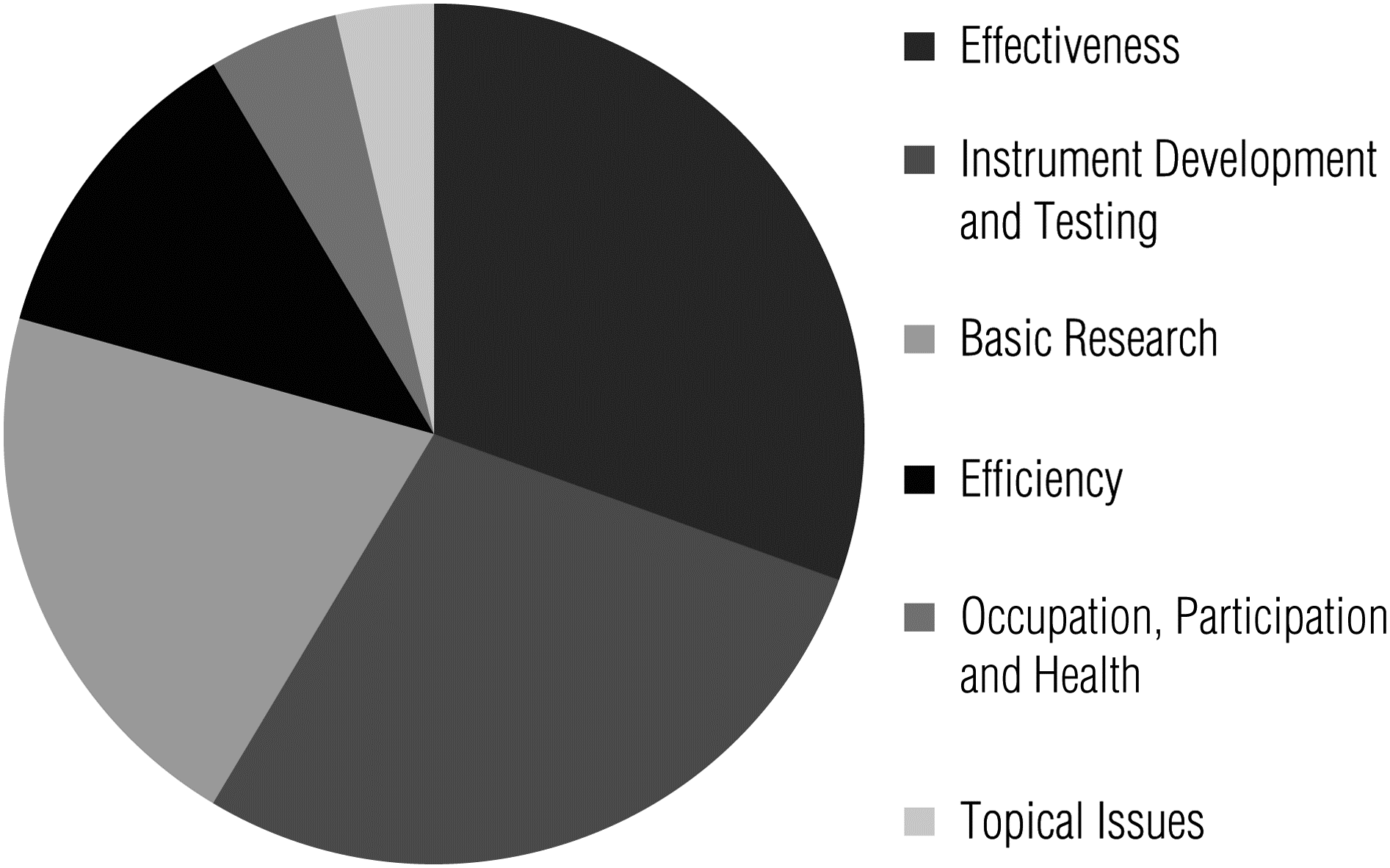
Breakdown of 2010 research articles by research category.
Levels of Evidence
It is noteworthy that the largest category of research studies published in 2010 was that of intervention effectiveness. Of the 25 published intervention studies, 12 (48%) were considered Level I evidence, 3 (12%) were Level II evidence, 1 (4%) was Level III evidence, 5 (20%) were Level IV evidence, and 4 (16%) were Level V evidence in accordance with the AOTA Levels of Evidence hierarchy (Lieberman & Scheer, 2002). Almost half of the 2010 effectiveness studies were considered Level I evidence—8 were systematic reviews, and 4 were small randomized controlled studies.
Note that although the profession appears to be heeding the call to produce more effectiveness studies, most of the 2010 Level I studies were systematic reviews that compiled research examining interventions within the domain of occupational therapy but carried out by competing professions such as physical therapy, nursing, and speech pathology. We must begin to produce research demonstrating the effectiveness of occupational therapy practices if occupational therapy is to remain a viable and reimbursable health care service that the larger society perceives as needed and valued.
Practice Area
Over the past several years, the practice areas in which most research continues to be carried out are (1) rehabilitation, disability, and participation and (2) children and youth (Brown, 2010; Case-Smith & Powell, 2008; Gillen, 2010; Gutman, 2009; Mallinson & Fischer, 2010). The 82 2010 research articles followed this pattern, with 31 (37.80%) categorized as rehabilitation, disability, and participation and 26 (31.71%) categorized as children and youth (Figure 2). It is noteworthy that 19 studies (23.17%) addressed productive aging, a practice area that is markedly increasing as the country ages and the Baby Boomer generation seeks ways to maintain independence and community participation into later life. As highlighted in editorials over the past 2 yr, increased research must be carried out in the areas of mental health (2 [2.44%] published articles in 2010), health and wellness (1 [1.22%] published article), and work and industry (0 articles).
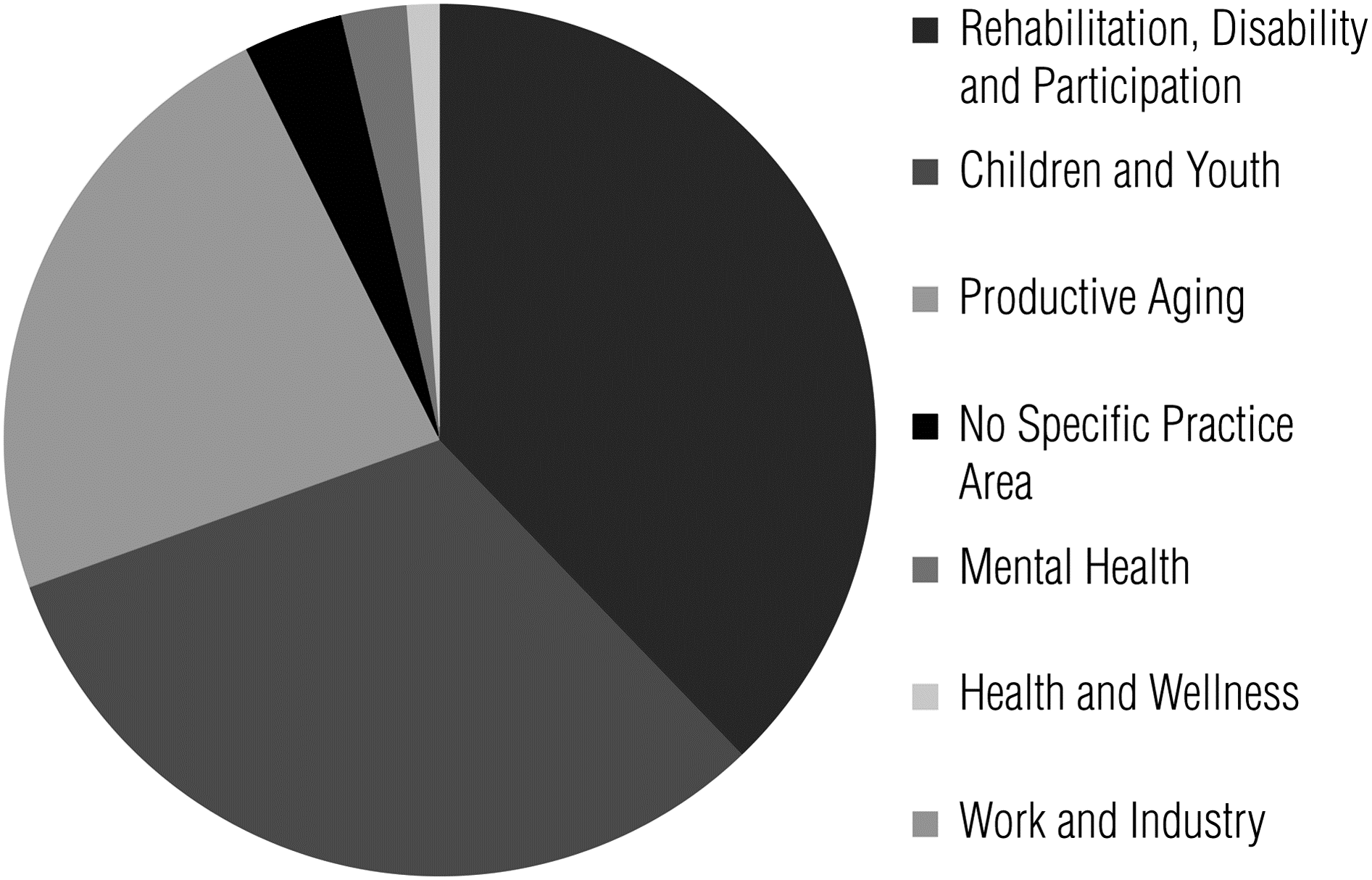
Breakdown of 2010 research articles by practice area.
Table 1 lists the research category, level of evidence, and practice area for each study.
2010 Research Articles by Research Category
Note. N = 82 studies.
Funding Sources
One indicator of the larger scientific community’s endorsement and respect for occupational therapy research is the ability to receive funding. Thirty-seven (45.12%) of the 82 research articles published in 2010 received some form of funding. Six (16.22%) of those articles received National Institutes of Health funding, 2 (5.41%) articles received National Institute on Disability and Rehabilitation Research funding, 4 (10.81%) articles received funding from a U.S. foundation, 4 (10.81%) articles were supported by U.S. internal facility funding from a university or clinical site, and 1 (2.70%) article received funding from a U.S. state agency. Most articles (20, or 54.05%) receiving funding were international studies supported by some form of international funding source.
Research Scholars’ Initiative
The Research Scholars’ Initiative is a new program intended to facilitate the generation of outcome studies that provide support for the effectiveness of occupational therapy services (Gutman, 2010). In 2010, six intervention effectiveness articles were published as part of the Research Scholars Initiative, addressing the following topics: (1) the effects of assistive technology in the school setting (Watson, Ito, Smith, & Andersen, 2010), (2) the effectiveness of a recovery program for women with breast cancer–related lymphedema (McClure, McClure, Day, & Brufsky, 2010), (3) the effects of a tailored activity-pacing intervention for adults with osteoarthritis-related pain and fatigue (Murphy, Lyden, Smith, Dong, & Koliba 2010), (4) a comparison of three postoperative treatment protocols for extensor tendon repair in the hand (Hall, Lee, Page, Rosenwax, & Lee, 2010), (5) the effects of constraint-induced movement therapy for adults with upper-extremity dysfunction after stroke (Hayner, Gibson, & Giles, 2010), and (6) a 5-yr retrospective study of occupational therapy outcomes for patients with multiple sclerosis (Maitra, Hall, et al., 2010). This research has undoubtedly contributed to the increased number of effectiveness studies published in 2010 and to the body of quality research needed to maintain the profession’s viability as a valued and reimbursable health care service.
Impact Factor
The journal’s last calculated impact factor was in 2010 and reflected the number of citations for articles published in 2008 and 2009 (Thomson Reuters, 2010). AJOT’s 2010 2-yr impact factor (IF) score was 1.419; its 5-yr IF was 1.408. Although these figures are the journal’s highest in the past 10 yr, they are not on par with competing rehabilitation journals, which have 2-yr IF scores >2.0. The journal’s continued goal will be to monitor and increase the IF until it is at least on par with competing journals in related professions (e.g., physical therapy, speech pathology, nursing, social work).
Future Challenges
Although 2010 was a banner year for AJOT, we must maintain the momentum of the past year and use it to meet current challenges threatening the profession’s viability.
Foremost, we must continue pressing for the generation of intervention effectiveness studies that demonstrate support for occupational therapy services in our major practice areas (e.g., rehabilitation and pediatrics), newly emerging and nontraditional practice areas (e.g., driving reevaluation and rehabilitation), and practice areas in which we have lost our past value (e.g., mental health). In addition to the promotion of intervention studies, AJOT will seek to present a balanced representation of research priorities (i.e., effectiveness studies, instrument development and testing, intervention efficiency and patient satisfaction, basic research) in each issue.
We must also strive to produce studies at higher levels of evidence and rigor. As the profession advances developmentally, the journal will decrease the amount of Level IV and Level V research and prioritize studies using control, randomization, standardized assessments, and larger sample sizes.
Increased research must be generated in the practice areas of mental health, productive aging, work and industry, and health and wellness—areas receiving little research attention in the past 5–10 yr (Gutman, 2009). To promote this needed research, the journal will publish three special issues in the next 2 yr addressing the effectiveness of occupational therapy services for clients with work-related injuries, patients with Alzheimer’s disease, and clients with psychiatric disabilities.
Finally, the Editorial Board will continue to monitor the journal’s 2- and 5-yr IF scores. The move to online publication and the greater accessibility that it will afford will positively influence the IF. So, too, will prioritizing the publication of meta-analyses, systematic reviews, and randomized controlled trials that allow practitioners to form a consensus about best practice.
If occupational therapy researchers commit to these efforts, they will create the opportunity to demonstrate that our profession uniquely helps people of all ages to regain or newly learn the skills necessary to participate in desired family and community roles and the daily activities that support those roles despite disability, injury, or disease. We have the opportunity to empirically demonstrate that occupational therapy services are evidence based, of high value to society, and unlike the services of any other profession. But we must recognize that the profession’s future depends on our actions today and commit to a united strategic effort in accordance with the Centennial Vision (AOTA, 2007) and the joint American Occupational Therapy Association and American Occupational Therapy Foundation Research Agenda (AOTA & AOTF, 2010).