





Abstract
The executive function (EF) deficits of children with attention deficit hyperactivity disorder (ADHD) hinder their performance of complex daily functions. Despite the existing evidence-based pharmacological interventions for ADHD symptoms, no intervention has yet been found that deals directly with EFs in daily tasks. Fourteen children and their parents participated in the Cognitive–Functional (Cog–Fun) program in occupational therapy, which is tailored to the executive dysfunction of ADHD and focuses on enabling cognitive strategies for occupational performance. The study included initial assessment of EFs (Behavior Rating Inventory of Executive Functions; Tower of LondonDX), occupational performance (Canadian Occupational Performance Measure), 10 sessions of Cog–Fun intervention with each child–parent dyad, and postintervention and 3-month follow-up assessments. We found significant improvements with medium to large effects on outcome measures after intervention, and most effects were maintained at follow-up. The findings warrant controlled studies examining the effectiveness of this intervention for children with ADHD.
Keywords
Attention deficit hyperactivity disorder (ADHD) is a neurobiological disorder that affects the emotions, behavior, and cognitive state of 4%–7% of children worldwide (Spencer, Biederman, & Mick, 2007). Symptoms include inattention, impulsivity, and hyperactivity, and they often persist into adulthood. The long-term emotional, social, educational, and occupational implications of ADHD are profound and well documented (Cermak, 2005).
Executive functions (EFs) consist of higher order cognitive abilities, including working memory, planning, and emotional regulation (Barkley, 2004), which are crucial for complex and dynamic activities of daily living (ADLs; Katz & Hartman-Maeir, 2005). Executive dysfunction is a main deficit in ADHD; therefore, people with ADHD are at risk for significant limitations in occupational functioning (Brown, 2009).
Medications such as methylphenidate are widely used with children with ADHD, and they have been shown to be effective in reducing symptoms and increasing academic productivity (Biederman et al., 2004). However, residual executive dysfunction has been found in medicated children (Safren, 2006). In addition, a percentage of children with ADHD do not respond to pharmacological intervention (O’Connell, Bellgrove, Dockree, & Robertson, 2006).
We designed a cognitive–functional intervention program (Cog–Fun) targeting EF in occupation to improve attainment of occupational goals. This ecological intervention has a protocol tailored to the unique executive dysfunction of children with ADHD. The Cog–Fun program focuses on acquisition and transfer of cognitive strategies to enable occupational performance in the child’s natural environments. It is based on the theoretical foundations of the Dynamic Interactional Approach (DIA; Toglia, 2005) and similar applications of strategy-based learning for people with cognitive impairments.
Toglia’s (2005) DIA for cognitive rehabilitation highlights the dynamic interaction among person, task, and environment regarding problems in occupational performance. Intervention includes imparting strategies that are practiced and transferred to different activities and situations—emphasizing metacognitive strategies of self-monitoring and self-evaluation—to establish or restore balance in occupational functioning (Josman, 2005). Although this approach has not been applied to children with ADHD, it has been applied to children and adults with head injury who experience similar symptoms (Cermak, 2005).
An intervention for adolescents with ADHD designed by Ylvisaker and DeBonis (2000) used a global executive strategy to enable positive changes in everyday routines by 5 middle school students and their parents. Qualitative findings demonstrated the adolescents’ improved self-regulated behavior at home.
The Cognitive Orientation to Daily Occupational Performance (CO–OP; Polatajko & Mandich, 2004) intervention approach emphasizes metacognitive strategies in an occupational context to guide the motor performance of children with developmental coordination disorder (DCD). Polatajko and Mandich (2004) presented a case study of a child with ADHD using CO–OP. The child, his parents, and his teacher noted improvement in attaining his set goals, as measured by the Canadian Occupational Performance Measure (COPM; Law, Baptiste, et al., 2005). Although the evidence for CO–OP’s effectiveness with children with DCD is ample (Polatajko & Mandich, 2005; Taylor, Fayed, & Mandich, 2007), aside from this single case study, no evidence exists for its effectiveness with children with ADHD. Little is written in the occupational therapy literature about cognitive approaches to treating children with ADHD (Cermak, 2005).
The aim of this study was to examine the effectiveness of the Cog–Fun intervention in helping children with ADHD achieve occupational goals, improve EFs in daily life, and improve self-efficacy.
Method
Research Design
The study was an uncontrolled, one-group, preintervention–postintervention pilot investigation to explore the effects of the Cog–Fun program on children with ADHD. We used convenience sampling of children diagnosed in a community ADHD clinic. Ethical approval was obtained from the Helsinki Ethics Committee of Geha Hospital. Parents provided informed consent, and children provided assent.
Instruments
Behavioral Rating Inventory of Executive Function.
The Behavioral Rating Inventory of Executive Function (BRIEF; Gioia, Isquith, Guy, & Kenworthy, 2000a) is an 86-item ecological rating scale (parent, teacher) designed to reflect the neuropsychological constructs of EF in everyday situations for children ages 5–18. It comprises eight scales, two indexes, and a Global Executive Composite. The Behavioral Regulation Index includes the Inhibit, Shift, and Emotional Control scales, and the Metacognitive Index includes the Initiate, Working Memory, Plan–Organize, Organization of Materials, and Monitor scales. Raw scores are transformed into t scores; children scoring ≥65 are considered clinically impaired. Internal consistency, test–retest reliability (rs = .72–.84 for the Parent Form over 3 wk), and discriminant validity, including the Hebrew version, have been established for people with ADHD (Gioia, Isquith, Guy, & Kenworthy, 2000b; Linder, Kroyzer, Maeir, Wertman-Elad, & Pollak, 2010; McCandless & O’Laughlin, 2007).
Tower of London–Drexel University.
The 2nd edition of the Tower of London–Drexel University (TOLDX; Culbertson & Zillmer, 2005) is a neuropsychological assessment of EF that identifies impairments in planning. Standard scores are generated for number of moves, problem-solving time, and rule violations. Test–retest reliability (r = .80 for Total Moves over 20 days), criterion validity, and construct validity of the TOLDX have been established for children with ADHD (Culbertson & Zillmer, 1998a, 1998b).
Canadian Occupational Performance Measure.
The COPM is a semistructured, individualized, client-centered instrument designed for occupational therapists to help clients identify problems and detect change in the performance of daily occupations. It is a well-validated, reliable (test–retest reliability = .80 for Performance over 1–2 wk), valid, standardized instrument (Law, Baptiste, et al., 2005). Law, Majenemer, et al. (2005) used the COPM to measure occupational performance outcomes before and after an occupational therapy home care program for children, including children with ADHD. In this study, we considered the child’s COPM rating a measure of self-efficacy (Reid, 2002).
Participants
Seventeen children were referred to the first author (Hahn-Markowitz) by the research coordinator of a community ADHD clinic. To be included, children had to be ages 7–8 and diagnosed with ADHD (all three subtypes) by a senior psychiatrist (Iris Manor) on the basis of the criteria in the Diagnostic and Statistical Manual of Mental Disorders (4th ed., text revision; American Psychiatric Association, 2000); have reported difficulties in occupational performance; and attend school in a regular educational environment. Exclusion criteria were other psychiatric or neurological disorders and an estimated IQ <80.
Procedure
Children were referred from the ADHD community clinic in which the study took place. The program was explained to parents by telephone, and they and the children signed a consent form at assessment. Three assessed children did not continue to intervention because they did not generate or agree to an occupational goal to work toward. A certified psychologist administered four subtests of the Wechsler Intelligence Scales for Children–Revised (Wechsler, 1995) to estimate IQ. The performance measures were administered by an experienced occupational therapist who also carried out the intervention with each child–parent dyad. All measures were readministered after intervention by the same occupational therapist and again at a 3-mo follow-up visit.
Cog–Fun Intervention
The Cog–Fun intervention is theoretically driven and addresses deficient goal-oriented processes in children with ADHD. It supports participation through the learning of specific executive strategies (Stop, Plan, Review) in a context of achieving occupational goals that target self-regulation, working memory, and planning. By definition, the goals are meaningful to the child and harness motivational and cognitive resources toward goal-oriented behavior (Figure 1).
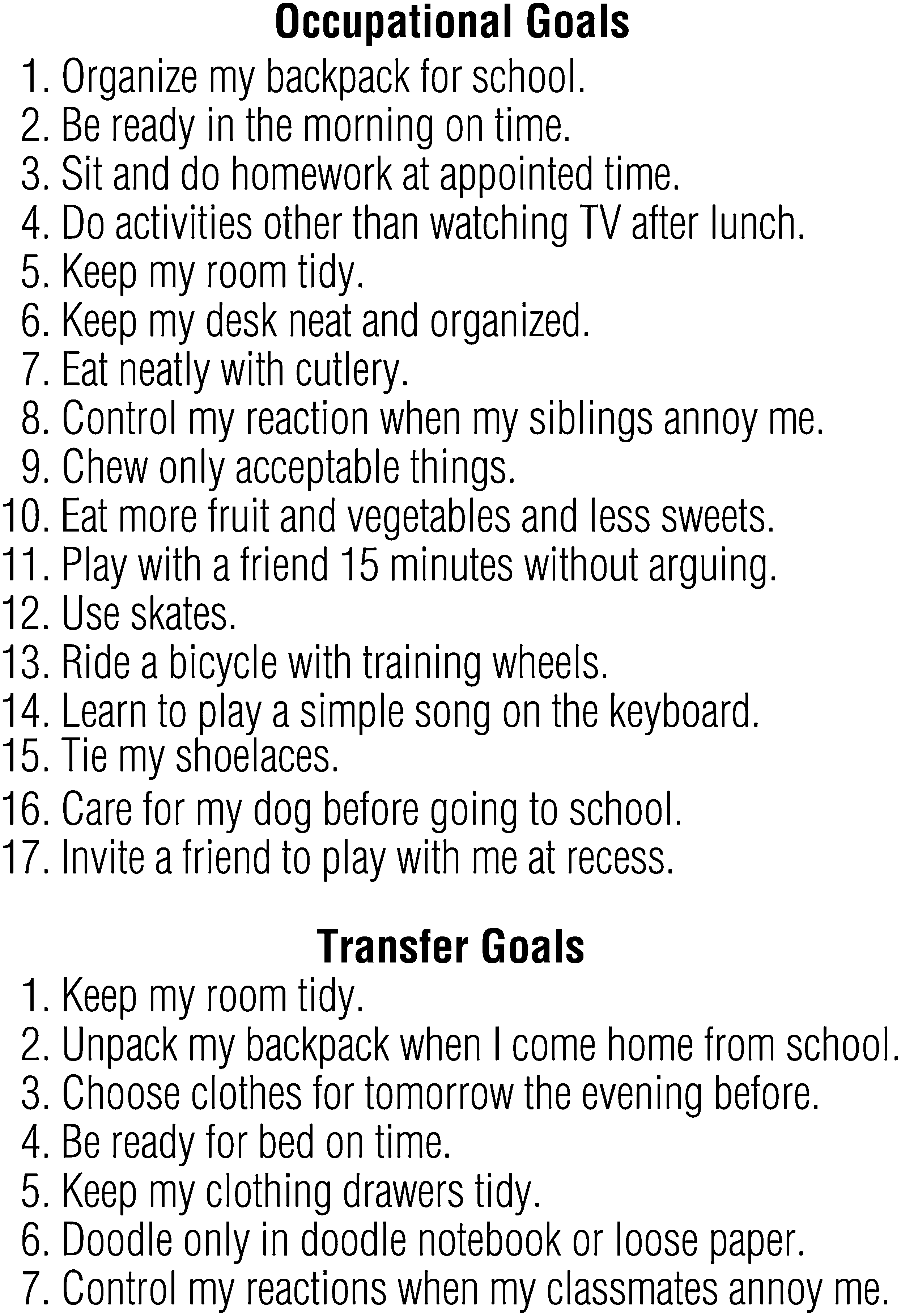
Occupational goals chosen by children.
The program involved ten 1-hr weekly sessions and transfer work facilitated by the parents at home. Each child–parent dyad chose one occupational goal to work toward at home, at school, or in the schoolyard. Goals were identified by interviewing each child to complete an activity log of a typical day. Half of the dyads chose a transfer goal as well. The others could not generate a transfer goal and did not agree with the goal suggested by the occupational therapist. Upon goal attainment, another goal was chosen (up to a total of three goals).
Task-specific strategies for goal definition, inhibition, planning, and review were used to achieve specific occupational goals (e.g., verbalize goal [“What do I want to achieve?”]; walk away from provocative sibling; pull chair close to table so that food will not spill; mark checklist of items needed in schoolbag). Strategy learning was reinforced at home with two external executive supports. A timer helped each child stop and focus on thinking about the goal once a day, and a daily planner helped the child plan and monitor goal achievement (Dawson & Guare, 2004; O’Connell et al., 2006). We also used games and activities that challenge executive components (e.g., Simon Says, card games, planning a party) in the acquisition and practice of executive strategies (Table 1).
Cognitive–Functional Treatment Protocol
Note. COPM = Canadian Occupational Performance Measure.
Parental support is provided at the end of Sessions 5–10 as well.
One parent attended each session to learn about the intervention, to observe his or her child in an enabling therapeutic relationship, and to reinforce positive strategy implementation at home. The occupational therapist provided parents with information about environmental modification to facilitate occupation (i.e., lowering shelves) and about positive, specific feedback. Parents tracked their child’s transfer of strategy use at home in a Parent’s Notebook. They received a weekly phone call from the occupational therapist to report progress or problems, ask questions, and receive support as needed.
Data Collection
The first author (Hahn-Markowitz) administered the TOLDX to the children before and after intervention and at follow-up. She also completed the children’s COPM and interviewed participants after each goal was agreed on, at the end of the intervention, and at follow-up. Parents completed the COPM and BRIEF independently at all assessment points. The BRIEF was delivered to the teachers for completion at all assessment points and returned to the occupational therapist.
Data Analysis
We analyzed the data with nonparametric statistics (Wilcoxon signed-ranks tests) using SPSS Version 16 (SPSS, Inc., Chicago). We computed effect size using Hedge’s g because of the small sample size (Lion, 2008).
Results
The sample included 14 children ages 7 yr, 0 mo, to 8 yr, 8 mo (mean [M] = 7 yr, 5 mo; standard deviation [SD] = 4.18); the male:female ratio was 9:5. Nine children (64%) were diagnosed with combined-type ADHD, and 5 children (36%) were diagnosed with inattentive type ADHD, in accordance with the prevalence reported in the literature (Solanto et al., 2007). Four of the 14 treated children were medicated for ≥6 mo before participation in this study and continued this intervention throughout follow-up. One child began medication after postintervention assessment and therefore was not followed up. Mother’s education ranged from 12 to 25 yr (M = 15.14, SD = 3.82). Four fathers and 10 mothers participated in the program (Table 2). Results on all outcome measures are shown in Table 3.
Participant Sample (N = 14)
Note. ADHD = attention deficit hyperactivity disorder.
Outcome Measures Before and After Treatment (N = 14)
Note. BRI = Behavioral Regulation Index; BRIEF = Behavior Rating Inventory of Executive Functions; COPM = Canadian Occupational Performance Measure; GEC = Global Executive Composite; M = mean; MI = Metacognitive Index; SD = standard deviation; TOLDX = Tower of London–Drexel University.
BRIEF
Analysis of the changes on the Parent BRIEF revealed statistically significant improvements after intervention in the mean Global Executive Composite and on both the indices and four of the eight scales. The largest effect size was found for the Plan–Organize scale. The frequencies of individual BRIEF Global Executive Composite Parent profiles revealed that after intervention, the scores improved (decreased) for 12 children. At follow-up, improvements on the indexes and Global Executive Composite were maintained.
Teachers of 13 children completed the BRIEF before intervention, and teachers of 10 children completed it after intervention. Examination of the results revealed a similar trend: Effect sizes were slightly smaller than on the Parent BRIEF. Teacher BRIEF results were slightly worse at follow-up than at postintervention.
TOLDX
TOLDX scores showed statistically significant improvement after intervention. The means of the raw scores showed a decrease (improvement) by 14.69 total moves (p = .018); 1 rule violation (p = .012); and 180 s in total time (p = .012), with predominantly large effect sizes. Scores were slightly worse at follow-up than at postintervention, other than total time.
Canadian Occupational Performance Measure
Parents’ Ratings of Their Children’s Performance.
The parents’ ratings of their children’s performance of goals and transfer goals after intervention reflected statistically significant improvements (mean difference score = 4.1 points, p = .001, and 3.86 points, p = .017, respectively) with a large effect size. At follow-up, 5 parents reported further improvement in their child’s performance of goals, 2 parents reported that their child maintained the performance level achieved at postintervention, and 5 parents reported a decrease of an average of 1.33 points in their child’s performance level from postintervention.
Children’s Ratings on the COPM.
We found a statistically significant improvement in the means of the children’s ratings on the COPM goals and transfer goals after intervention (ps = .001 and .014, respectively). Average self-scoring on goal performance decreased slightly from postintervention to follow-up.
Intervention Fidelity
The occupational therapist who carried out the program kept a log of all sessions to support fidelity of intervention and to obtain qualitative information, which was checked by investigator Adina Maeir.
Discussion
We examined the effectiveness of a cognitive–functional intervention to improve the EF of children with ADHD. The aim was to examine whether children would acquire executive skills and improve their performance on meaningful occupations that were targeted, as well as occupations not directly targeted, in intervention (i.e., transfer of EFs). Assessments were chosen to reflect EF and occupational components of the intervention. Findings showed significant improvement on the outcome measures, and many of the gains were maintained at follow-up.
The significant improvements with medium to large effect sizes found on the BRIEF parent and teacher reports are encouraging, suggesting a possible intervention effect on EF in daily life. The teachers reported better EF in school than the parents reported for home, concurring with the findings of Drechsler et al. (2007), who used the BRIEF when evaluating neurofeedback training for children with ADHD. Several explanations are possible for the discrepancy between parent and teacher reports on children’s EF. The fact that some children were on medication while in school (Jarratt et al., 2005) and that the classroom environment is structured (Mares, McLuckie, Schwartz, & Saini, 2007) may account for teachers' witnessing more organized and controlled behavior than parents witnessed at home. In other studies, teachers reported higher (worse) BRIEF scores than parents (Jarratt et al., 2005; McCandless & O’Laughlin, 2007; Mares et al., 2007). Differences between informants may be the result of cross-situational discrepancies in expectations and perceptions. Future studies should examine the source of these differences with the aid of an independent informant who would observe the child in both environments (Mares et al., 2007).
On the TOLDX, the children completed the tasks in less time, with fewer moves and fewer rule violations, after intervention, with medium to large effects. This finding could reflect more efficient strategic planning, similar to that reported on the BRIEF. The established test–retest reliability supports this interpretation and reduces the likelihood of a practice effect. These results are unlike those of Yang, Chung, Chen, and Chen (2004), who compared 6- to 12-yr-old Taiwanese children with ADHD before and after receiving methylphenidate twice daily for 16 wk and found no improvement on the TOLDX. This comparison may represent an advantage for cognitive–functional intervention on planning abilities. An exhaustive literature search did not generate articles on nonpharmacological studies using the TOLDX as an outcome measure; therefore, this premise could not be further explored.
We found a strong positive change in the parents’ and children’s rating of occupational performance on trained and untrained goals, as reflected in the COPM preintervention–postintervention scores. Previous studies have shown that a change of ≥2 points on the COPM is considered a moderate to large change and a clinically important difference as judged by clients and their families (Phipps & Richardson, 2007). According to Toglia (2005), multitask activities in a variety of settings should be included in therapy to facilitate the acquisition and transfer of strategies in a multitude of contexts. In this study, the transfer goals chosen were not addressed directly in the therapeutic process. The improved COPM scores on the transfer goals could reflect the success of the program in facilitating transfer of strategy use.
Despite this study’s positive results, caution is needed in accounting for the effect of potential human bias on the part of respondents on rating scales (Draper, 2002). The actual size of effects will need to be determined in further controlled, blinded studies.
Mechanisms of Change in Intervention
The positive results of this study raise questions as to what contributed to change. Notwithstanding the possibility of bias, we hypothesized that the strategies acquired in intervention would play a significant role in improved performance on outcome measures. This hypothesis is based on findings of previous studies in which metacognitive strategy training was used and beneficial for children with ADHD.
Thompson and Thompson (1998) taught children with ADHD metacognitive strategies related to academic tasks. Symptoms lessened after intervention, and academic performance improved. The results of a study to determine the effectiveness of the CO–OP approach with children with DCD (Taylor et al., 2007) supported metacognitive strategy training; however, the CO–OP approach was not studied among children with ADHD. This study supports a metacognitive approach for children with ADHD, with positive results found for occupational performance measures.
The positive atmosphere in the clinic may have contributed to enhanced motivation, which, in turn, may have influenced a change in performance (Ylvisaker & DeBonis, 2000). In the Model of Human Occupation, Kielhofner (1995) asserted that volition is a key factor in determining a person’s level of participation in an occupation because it guides one’s choice of occupational behavior on the basis of level of enjoyment and degree of engagement. The results of this study are in line with the preceding findings and reinforce the importance of the role of harnessing motivation. We did not specifically measure motivation as an outcome; however, it may have been an important element of the program’s success. Future studies should measure motivation.
Another intervention component central to this study was the participation of a parent in all sessions and the parent’s role in facilitating change. In the family-centered approach, occupational therapists work with parents to empower and enable them in the intervention process (Chu & Reynolds, 2007; Law et al., 2007). We did not specifically measure the parents’ participation in this study; however, future studies should examine parents’ level of awareness, knowledge of the intervention process, role in facilitating transfer of strategy use at home, and degree of support they offered to their children, as mediating factors.
We hypothesize that that the combination of the children’s metacognitive skills training (with adaptations for ADHD), the clinical setting that fostered motivated engagement in therapy, and the parental role contributed to the positive outcomes. Regarding the findings at follow-up, the scores on most measures demonstrate that intervention gains were maintained, yet did not continue to improve, suggesting that children and parents may benefit from periodic booster sessions.
Which Children Benefited Most From the Intervention?
The therapist observed several trends. One common denominator among the children with the greatest gains was having a mother who was actively supportive of her child and worked with him or her at home, communicated with the therapist, and was consistent in coming to weekly sessions. In addition, qualitative information from the therapist’s log revealed that children who showed large improvements may be characterized by a high level of motivation. These observations are anecdotal and could not be examined statistically; however, they form the basis for further questions regarding the characteristics of participants who may benefit most from this program. We did not observe different intervention outcomes for children with different subtypes of ADHD.
Factors that may have influenced a lack of improvement among other children include emotional problems, family problems, lower IQ, inconsistent attendance at sessions, and parents’ inadequate understanding of their role and assuming it, which may have led to inadequate parental support while working toward goals at home. In addition, the therapist was less successful in enlisting fathers who attended sessions with their child to communicate what took place with their spouses and to support their child in managing his or her goals on a daily basis than in enlisting mothers.
Limitations of the Study
The lack of a control group may have contributed to a placebo effect; change may have resulted from factors other than intervention. The study sample was small, and participants were referred from one center and may not represent the general population. In addition, the occupational therapist administered the assessment measures. Despite her qualifications, she could have been biased. Future studies should use a larger controlled and randomized sample with sufficient representation of ADHD subtypes and medication use.
Conclusion
This pilot intervention study demonstrated improvements in EFs and occupational performance in children who received cognitive–functional occupational therapy with their parents present. The positive mechanism underlying these effects may be related to the provision of cognitive and motivational tools for performing complex daily occupations that require EF. If similar findings can be further shown in randomized, controlled studies, then this intervention may be a feasible, ecological, and economic complement to pharmacological intervention with children with ADHD.
Footnotes
Acknowledgments
We thank the families who took part in this study and Shlomit Rozen for her assistance in enlisting their participation. We also thank Aviva Yochman for her helpful comments after reading the manuscript. This study was supported by Grant 3–00000–5472 from the Chief Scientist’s Office of the Ministry of Health, Israel.