





Abstract
Keywords
Handwriting is an essential life skill required of children in school; however, 10%–34% of school-age children fail to master handwriting (Smits-Engelsman, Niemeijer, & van Galen, 2001). In particular, proficient handwriting is necessary for completion of academic activities such as note taking, assignments, and exams (Amundson & Schneck, 2010). Handwriting difficulties can profoundly influence children’s development and negatively affect their academic performance and, in turn, may be detrimental to self-esteem, personal relationships, and the child’s and others’ perceptions of a child’s abilities (Graham & Weintraub, 1996).
Teachers are typically responsible for providing handwriting instruction. When a teacher determines that a student is having problems producing legible writing, he or she often consults an occupational therapist (Feder, Majnemer, Bourbonnais, Blayney, & Morin, 2007). In fact, handwriting difficulties are the most common reason for referrals to occupational therapy in school-age children (Feder, Majnemer, & Synnes, 2000; Ratzon, Efraim, & Bart, 2007). Handwriting difficulty without neurological or intellectual disabilities is often termed dysgraphia and typically includes poor legibility and reduced speed of writing (Feder et al., 2007; Maeland, 1992).
Grasp Patterns
In a 2008 survey, 41% of 169 teachers identified “incorrect” pencil grasp as a common handwriting difficulty (Graham et al., 2008). Occupational therapists addressing handwriting difficulties often suggest, as a solution, adoption of the dynamic tripod grasp (Rigby & Schwellnus, 1999). Various grasp taxonomies have been proposed (Dennis & Swinth, 2001; Schneck & Henderson, 1990; Selin, 2003; Tseng, 1998).
Generally, a grasp is labeled according to the nature of the finger or palm contact with the pencil and the movement of the pencil. Over the course of child development, a number of grasp patterns emerge. Young children initially use primitive grasps (Tseng, 1998), in which the fingers are not in opposition to one another and the whole forearm produces pencil movement (Saida & Miyashita, 1979). Transitional grasps emerge next, including the cross-thumb, four-fingered, and static tripod grasps, in which the wrist serves as the main source of pencil movement (Tseng, 1998). These first two categories of grasp patterns are often referred to as immature or static grasps. Eventually, mature grasp patterns develop (Dennis & Swinth, 2001; Koziatek & Powell, 2003) in which the flexion, extension, and lateral movement of either three or four fingers control pencil movement (Long, Conrad, Hall, & Furler, 1970). Four grasp patterns (Figure 1) have been identified as mature and appropriate for functional writing:
Dynamic tripod (DT): The DT grasp is the most commonly recommended pencil grasp for handwriting (Schneck & Henderson, 1990). This grasp involves the thumb, index, and middle fingers functioning as a tripod (Benbow, Hanft, Marsh, & Royeen, 1992). The DT grasp allows for small, well-coordinated movements of the fingers originating from the interphalangeal joints and muscles of the hand and forearm (Elliott & Connolly, 1984; Trombly & Cole, 1979). This grasp develops between ages 4 and 6 (Schneck & Henderson, 1990) and continues to be refined up to age 14 (Ziviani, 1983).
Lateral (thumb) tripod (LT): The LT grasp is the second most common grasp pattern described in the literature (Schneck & Henderson, 1990). In this grasp, the thumb is adducted against the lateral aspect of the index finger and often crosses over the top of the writing utensil. By nature of its position, the thumb is not involved with the distal movement of the pencil, but rather the index and middle fingers initiate movement.
Dynamic quadrupod (DQ): The DQ grasp is very similar to the DT grasp but involves the thumb and three fingers. Benbow (1987) found it to be a common grasp pattern in second-grade children. The same distal manipulation of the pencil occurs with this grasp.
Lateral (thumb) quadrupod (LQ): The LQ grasp, identified by Dennis and Swinth (2001), is similar to the LT except that four fingers contact the writing implement, with the index, middle, and ring fingers initiating the pencil movement.
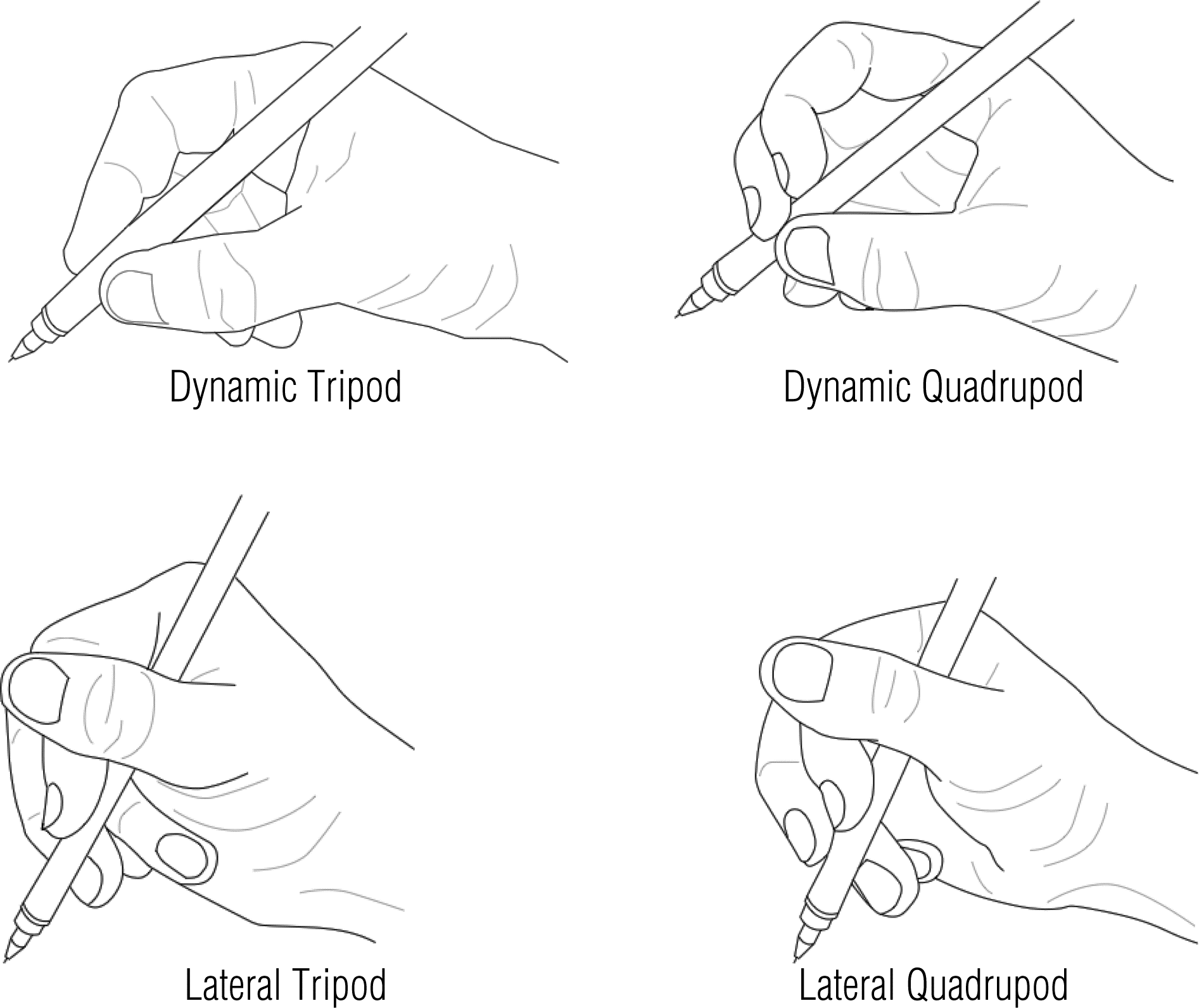
Four mature grasp patterns: Dynamic tripod, dynamic quadrupod, lateral tripod, and lateral quadrupod.
With all the mature pencil grasp patterns, movement of the pencil is produced by the intrinsic muscles of the hand. In contrast, immature grasps invoke the extrinsic muscles of the arm, leaving the fingers in a static posture (Elliott & Connolly, 1984). Thus, the nomenclature of the lateral grasps should technically also be prefaced with the word dynamic.
Grasp and Functional Writing
A 2008 survey of teachers found that 4 out of 5 teachers taught students that the correct way to hold a pencil was the DT (Graham et al., 2008). However, Koziatek and Powell (2003) found that the grasps of fourth-grade students were well distributed among the four mature grasp patterns. Although many studies have described pencil grasp development, only a handful have specifically investigated the impact of pencil grasp on handwriting quality, particularly the speed of writing and the legibility of the written product. The findings reported in these studies do not support the belief that the dynamic tripod grasp is essential for functional writing (Dennis & Swinth, 2001; Koziatek & Powell, 2003; Sassoon et al., 1986; Ziviani & Elkins, 1986). For example, Sassoon et al. (1986) and Ziviani and Elkins (1986) described grasps as either DT or modified tripod, and they reported that the latter was not linked to poor speed and legibility of written output. Dennis and Swinth (2001) corroborated this finding and classified grasps as either DT or “atypical,” where atypical referred to all other grasps observed. Finally, when considering all the different grasp patterns, Koziatek and Powell (2003) also found that quality handwriting was not exclusive to the dynamic tripod grasp.
All of these studies categorized grasp patterns on the basis of a single static photograph or a series of photographs, so the investigators were unable to capture or investigate the dynamic nature of the grasp patterns. A study found that approximately one-quarter of university students reported using more than one grasp during writing (Stevens, 2008). Similarly, the use of multiple grasp patterns has been noted in children (Parush, Pindak, Hanh-Markowitz, & Mazor-Karsenty, 1998). Therefore, it may be advisable to videotape writing sessions to capture and retrospectively identify any changes in grasp patterns that occur. Only one study used a standardized handwriting assessment to judge the speed and legibility of students’ work, precluding straightforward comparison among studies.
Given that no consensus exists in the literature about the impact of pencil grasp on handwriting proficiency (Rosenblum, Dvorkin, & Weiss, 2006), it is essential to confirm whether the DT grasp is indeed associated with better quality and speed of writing. To address this question, we investigated the effect of grasp pattern on handwriting quality using video records for grasp identification and a standard handwriting assessment for measurement of speed and legibility.
Method
Participants
A volunteer sample of 120 Grade 4 students was recruited from four schools within a metropolitan school board. All schools were situated in middle- to upper-middle-class neighborhoods according to household income for the catchment area of each school (City of Toronto, n.d.). We received ethical approval from both the school board and the associated university research ethics board to conduct the study. We obtained written parental consent, and each child assented to the study. Grade 4 students were selected because handwriting is generally considered to be well developed by this age (Berninger, Fuller, & Whitaker, 1996). Data collection took place in the spring for most of the students; however, to achieve the desired sample size, the study was extended, and a small group from a new cohort of fourth-grade students was assessed in the fall of the next school year.
Instruments
Students performed the writing task on an electronically inking and digitizing tablet (Cintiq 12WX, Wacom Technology Corporation, Vancouver, WA). We video recorded the sessions in digital form (Handycam DCR–SR45, Sony, New York). The children used an instrumented pen to write on the tablet. The barrel of the pen was 0.43 in. (11 mm) in diameter, which is comparable to a primary school pencil. The pen tip provided high friction on the tablet surface to simulate writing on paper. The instrumented pen was used as part of a larger study investigating grip forces while writing.
To evaluate handwriting quality, we used the Children’s Handwriting Evaluation Scale (CHES; Phelps & Stempel, 1987). The manuscript (printing) version (CHES–M) is used for children in Grades 1 and 2 and the cursive (CHES) version is used for children beyond Grade 2. The CHES–M consists of two sentences of printing, whereas the CHES is longer, with five sentences. Both versions evaluate handwriting speed and legibility and exhibit excellent psychometric properties (intrarater reliability, .82; interrater reliability, .95; Phelps & Stempel, 1987). The CHES can be administered to Grade 4 students in 2 min. The quality of writing is determined by a speed score (letters per minute) and scores on quality criteria. A student can be identified as needing remediation on the basis of the rate and quality scores, individually or in combination.
Although cursive is the expected style of writing in fourth grade in North American schools (Graham, Weintraub, & Berninger, 1998; Ontario Ministry of Education, Curriculum Assessment Policy Branch, 2006), the students all requested to write in manuscript. The students all had had some exposure to cursive, but they reported feeling more comfortable with manuscript. As a result, the legibility criteria for cursive writing were not applicable. To judge the legibility of the samples, we applied the CHES–M legibility criteria. Ten criteria are scored for each sample, so we calculated a raw score out of 100. A quality score of 80–100 indicates good legibility, a score of 50–79 indicates satisfactory legibility, and a score of 49 and below indicates poor legibility.
Because the age of our sample was older than that targeted by the CHES–M, and because the amount of writing was doubled, we did not use the usual CHES–M cutoff. Rather, we plotted the quality scores and located the 15th percentile, yielding a corresponding cutoff score of 30 (Graham, Struck, Santoro, & Berninger, 2006). This cutoff was lower than the CHES–M threshold because of the doubled opportunity to make errors given the greater volume of text and because of the expected developmental increase in writing speed. We counted the number of letters written in each sample and divided by 2 to get a value of letters per minute (LPM). Because the age of the sample was higher than that for the CHES–M sample, we considered only raw scores.
The teachers completed the Handwriting Proficiency Screening Questionnaire (HPSQ; Rosenblum, 2008) as a confirmation of the presence of handwriting difficulties. The HPSQ is a 10-item multiple-choice questionnaire for teachers designed to identify students with handwriting difficulties among school-age children. This questionnaire has good reliability (test–retest, .84; interrater, .92) and validity. A score of 14 or greater is indicative of dysgraphia.
Procedure
Participants completed the CHES in a quiet room in their own school during regular school hours. The primary author (Schwellnus), who is an experienced occupational therapist, completed all assessments. Children sat comfortably on a height-adjustable chair pulled up to a standard school table. Children’s feet were supported on the floor or on the lower platform of the chair and trunk movements were permitted as needed by the children (Parush et al., 1998). Each child first practiced writing his or her name and a sentence or two of creative writing on the tablet for 1 min. Children then completed the CHES writing task. During the assessment, the primary author classified the children’s grasp patterns as either one of the four mature grasp patterns or as an immature grasp pattern, termed other. The primary author also recorded whether the children switched grasp patterns during the protocol. A second rater later verified the grasp patterns documented during the assessment via review of the session video.
Data Handling and Analysis
Writing samples were anonymized, and two independent, experienced raters (one of them Schwellnus) scored handwriting speed and legibility. Intrarater reliability of .81 for Schwellnus and interrater reliability of .93 were achieved. Schwellnus and a second independent rater reviewed the videos. Interrater reliability for grasp classification was .82, and intrarater reliability for Schwellnus was .80.
Data analysis was conducted using Matlab 7.9.0 (MathWorks, Natick, MA) and Statistical Analysis Software 9.2 (SAS, Cary, NC). We computed descriptive statistics on the distribution of grasp patterns. To examine the effect of grasp pattern on speed and legibility, we used multiple linear regression (MLR) analysis as described by Armitage, Berry, and Matthews (2008). This method extends analysis of variance to models with continuous variables. Legibility and speed were the dependent variables, and grasp was the independent variable. We controlled for gender, handedness, school, teacher, and time of assessment (spring or fall) in the model. A secondary analysis using chi-square was conducted to examine the relationship of school, gender, handedness, teacher, and time of assessment on grasp pattern and legibility and speed. Pearson’s correlation coefficient was used to test the association between CHES quality and HPSQ scores.
Results
Sample Characteristics
The mean age of the participants was 9 yr, 11 mo (± 4.3 mo), and the sample was almost equally divided between boys (n = 59) and girls (n = 61; Table 1). Left-handed children formed 7.5% (n = 9) of the sample.
Participant Characteristics (N = 120)
Handwriting Quality and Speed
According to the criteria for manuscript letters, 19% (n = 23) of the sample scored 30 or below (poor range) and were categorized as dysgraphic. Writing speeds ranged from 30.0 to 82.5 LPM. The HPSQ scores indicated that 37.5% (n = 45) of the sample was dysgraphic when the recommended cutoff of 14 was used, and only a low correlation existed between CHES quality and HPSQ scores (Pearson r = .31).
Distribution of Grasp Patterns
The dynamic tripod grasp was the highest frequency grasp pattern in the sample (n = 27, 22.5%), but the lateral quadrupod grasp frequency was nearly identical (n = 26, 21.7%). The relationship between grasp pattern and gender was significant, χ2(6, N = 120) = 14.15, p = .03, as shown in Figure 2. Specifically, the distribution of lateral and dynamic grasp patterns was different between boys and girls, with the lateral grasp patterns more strongly represented in girls, χ2(1, N = 120) = 10.40, p = .0013. Of the boys, 68% (n = 40) had a dynamic grasp pattern, and 54% (n = 33) of the girls had a lateral grasp pattern. The video analysis of grasps showed that 24 (20.0%) participants switched grasp pattern during the writing; 12 (10.0%) switched between the dynamic tripod and lateral tripod, and 12 (10.0%) switched between the dynamic quadrupod and the lateral quadrupod. Because the participants who switched grasp did not have a consistent pattern, we assigned them their own category. Three participants used grasps that were immature and consisted of a combination of a four-fingered grasp and an interdigital grasp (Tseng, 1998). These three grasps were termed other. All grasp patterns were included in the ensuing analysis.
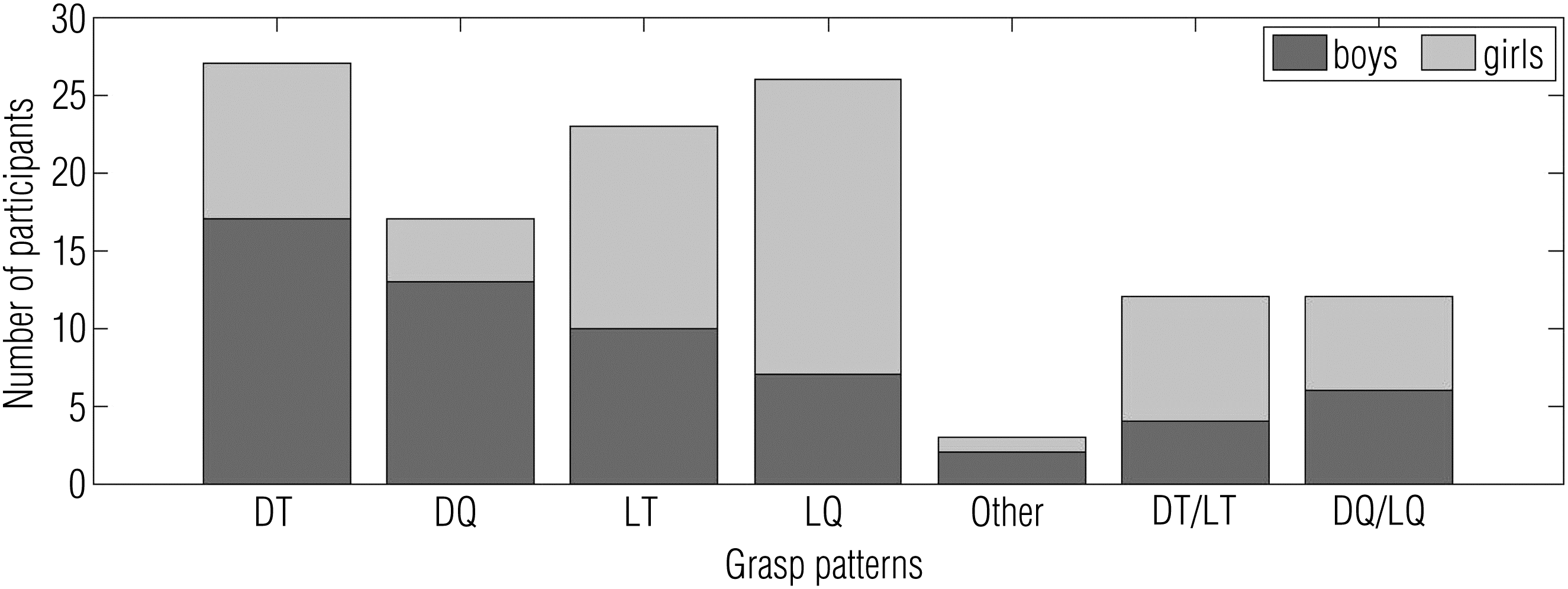
Grasp pattern distribution (DT = dynamic tripod; DQ = dynamic quadrupod; LT = lateral tripod; LQ = lateral quadrupod; other = immature grasps). The last two columns represent a switch between grasps.
Effect of Grasp Pattern on Speed and Legibility
The MLR analysis revealed no effect of grasp pattern on either legibility, F(6, 103) = 0.95, p = .466, or speed, F (6, 103) = 0.54, p = .773. Figure 3 shows the distribution of grasp patterns by proficient and dysgraphic participants. All 3 of the participants who had grasp patterns in the other category had dysgraphic writing. In addition, we found no difference in the number of boys or girls who switched their grasp pattern, χ2(1, N = 24) = 1.009, p = .32.
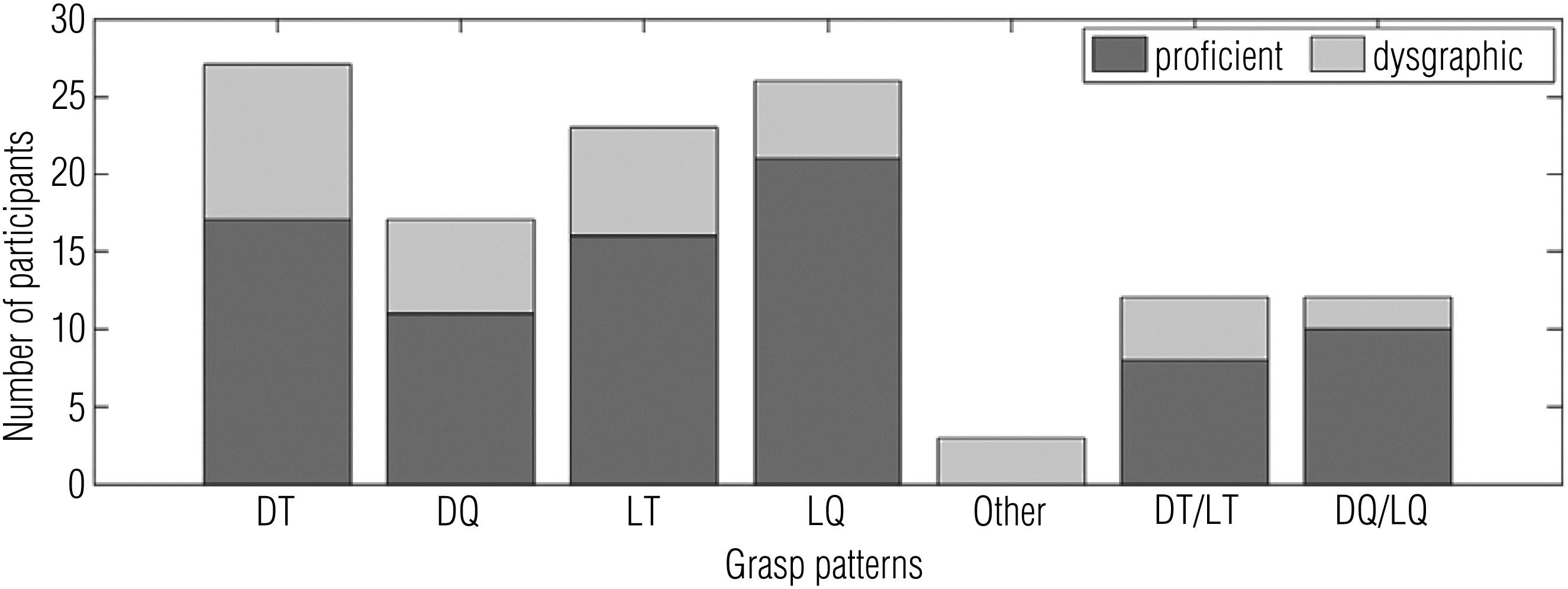
Grasp patterns of proficient and dysgraphic writers (DT = dynamic tripod; DQ = dynamic quadrupod; LT = lateral tripod; LQ = lateral quadrupod). The last two columns represent a switch between grasps.
Effects of Gender, Handedness, and Time of Assessment on Speed and Legibility
The MLR results indicated that gender was significantly related to speed, F(6, 103) = 8.36, p = .005, but not to legibility, F(1, 103) = 3.57, p = .06. In particular, girls wrote faster than boys (girls, 57.7 LPM; boys, 49.7 LPM), but girls and boys had similar legibility scores (girls, 58.5; boys, 49.2). No significant relationship was evident between grasp pattern and handedness, χ2(6, N = 120) = 7.34, p = .29; school, χ2(18, N = 120) = 25.65, p = .11; or teacher, χ2(42, N = 120) = 55.01, p = .12.
The time of assessment was significantly related to writing speed, F(1, 103) = 7.73, p = .007, with the children assessed in the spring writing faster than those assessed in the fall (spring, 55.0 LPM; fall, 45.8 LPM). No significant relationship between legibility and time of assessment was found, however, F(1, 103) = 0.94, p = .33.
Discussion
Occurrence of Multiple Grasp Patterns
Previous studies have identified four mature grasp patterns commonly used for writing. No consensus exists in the literature, however, about the prevalence of these grasp patterns. For example, the prevalence of the DT grasp has been reported as 67% (Summers & Catarro, 2003), 50% (Dennis & Swinth, 2001), and 33% (Koziatek & Powell, 2003). In the current study, each of the four grasp patterns occurred with nontrivial frequency in the sample of school-age children. The variation in the reported prevalence of the four common grasp patterns might be explained by differences in teaching practices over time and changes in emphasis in school curricula. Currently, less emphasis is placed on teaching handwriting in schools in North America (Graham et al., 2008).
Twenty percent of the sample switched their grasp pattern during the course of the 2-min handwriting assessment; this did not, however, seem to affect the legibility or speed of the writing. This finding is corroborated by a study of university students in which 28% of the sample self-reported using more than one grasp pattern during a longer writing task (Summers & Catarro, 2003). Nonetheless, the alternating grasp phenomenon has not been reported in children. With a longer writing sample, switching grasps may be a strategy to cope with pain or discomfort during writing. In particular, the students in the current study switched between a dynamic and a lateral grasp pattern, regardless of the number of fingers on the pencil. The thumb switched from a position of opposition to a position of adduction across the top of the pencil (Summers, 2001). This switch may be a compensation strategy for fatigue in the hypothenar muscles (opponens pollicis and abductor pollicis brevis) that serve to maintain thumb opposition.
Effect of Grasp Pattern on Handwriting Quality
Although we found a relationship between grasp and variables such as gender and time of assessment, we found no relationship between grasp and handwriting legibility or speed, corroborating previous reports in children (Dennis & Swinth, 2001; Koziatek & Powell, 2003; Sassoon et al., 1986; Ziviani & Elkins, 1986). The thumb is opposed to the index finger in the DT and DQ grasps, whereas the thumb is adducted to or crossed over the top of the index finger in the LT and LQ grasps. This difference in thumb position did not appear to influence the speed or legibility of the written product. These results add to the mounting body of evidence that functional writing in children can be achieved with grasps other than the DT (Koziatek & Powell, 2003; Sassoon et al., 1986).
Legibility.
Our finding that 19% of children in the current study had poor legibility falls within the 10%–34% prevalence range reported in the literature (Karlsdottir & Stefansson, 2002; Smits-Engelsman et al., 2001) but exceeds a recent estimate that 6% of students in Grade 3 have persisting dysgraphia (Overvelde & Hulstijn, 2011). The heightened level of writing difficulties in the current study could be the result of a selection bias; the study might have been more appealing to parents of children suspected of having writing difficulties, and therefore these children were more strongly represented in the sample. The reduced friction of writing on a tablet compared with pencil on paper may also be partially responsible (Chau, Ji, Tam, & Schwellnus, 2006). Writing on a tablet with a stylus, however, is likely becoming a familiar task to children with the proliferation of stylus-enabled handheld devices, such as portable gaming systems.
The lack of correlation between the HPSQ and CHES scores may be attributable in part to the language used in the HPSQ; some of the questions included double negatives, which the teachers may have misinterpreted. It is also possible that the HPSQ cutoff we borrowed from the literature needs to be tailored to the collected data.
Speed.
Our results suggest that gender significantly affects speed of handwriting; girls wrote faster than boys. Nonetheless, the gender difference in letters per minute was quite small and may not translate into functionally different speeds during activities at school. The average printing speed was higher (spring, 55.0 LPM; fall, 45.8 LPM) than those published for similarly aged children writing in cursive (Koziatek & Powell, 2003; Phelps & Stemple, 1987) but slower than speeds achieved by the Grade 4 writers in a study by Graham, Berninger, Weintraub, and Schafer (1998). In the latter study, however, students were asked to write as quickly as possible. Moreover, children in the current study elected to use manuscript rather than cursive. Cursive writing is traditionally introduced in Grade 3 (Ontario Ministry of Education, Curriculum Assessment Policy Branch, 2006), and students may still be more proficient with printing by Grade 4. Graham, Weintraub, and Berninger (1998) found that children in the United States who used either manuscript or a mix of manuscript and cursive wrote faster than those using cursive alone, although their sample included children in Grades 4–9, so it is difficult to compare their findings directly with those of the current study. The finding that students assessed in the spring (concluding Grade 4) wrote faster than the students assessed in the fall (beginning Grade 4) is consistent with the fact that spring students have 6 mo of extra writing exposure (Tseng & Chow, 2000).
Although there were proficient and dysgraphic writers in each grasp category, the 3 participants in the other grasp category were all dysgraphic writers. All 3 had poor legibility scores, and 2 had writing speeds below the average speed of the entire group. The positioning of the fingers in these grasps precluded fine distal movements of the fingers. Thus, letter formation was achieved via wrist movements. This observation resonates with the literature on the static tripod, a grasp that relies heavily on the forearm and shoulder muscles to form letters (Long et al., 1970; Rosenbloom & Horton, 1971). Although this sample was too small for statistical analysis, future comparisons of writing speed and legibility between mature and dynamic grasp patterns and immature and static grasp patterns are warranted.
Limitations
The children chose to print rather than write in cursive. Given that no assessments exist for evaluating manuscript writing in the advanced grades (Feder & Majnemer, 2003), we scored legibility using the CHES–M criteria and calculated speed in letters per minute. Although we used a percentile cutoff (Graham et al., 2006) to facilitate interpretation of legibility scores, we could not use the norm-referenced rate scores because the chronological age of our sample exceeded the CHES–M prescriptions; writing speed is known to increase as children age and progress through school (Graham, Weintraub, & Berninger, 1998). A number of teachers indicated that they did not require assignments in Grade 4 to be written in cursive, so existing assessments may need to be adapted to suit the changing teaching practice.
Our sample was larger than that of many previous grasp comparison studies, had an equal representation of boys and girls, and contained the expected proportion of left-handed students. Nonetheless, our sample was a volunteer one and thus may not have been representative of the general population of Grade 4 students. The schools were situated in middle- and upper-middle-class neighborhoods and likely did not represent all schools within the board.
Finally, 20% of our sample alternated grasp patterns during the task, a phenomenon previously observed in adults but one that has never been quantitatively characterized. Future studies of the biomechanics of alternating grasps would shed more light on the functional equivalence of the different grasp patterns.
Conclusion
This study presented evidence of multiple functional grasp patterns for writing in a cohort of Grade 4 children. No differences were found in speed or legibility among the four mature grasp patterns. The increased legibility and speed reported for girls, who as a group used predominantly lateral grasp patterns, further suggests that a variety of grasps may facilitate the finger movements necessary to produce legible letters at functional speeds. In light of our results, occupational therapy practitioners and educators may reconsider the need for changing a child’s pencil grasp when the child has adopted one of the four mature grasp patterns.
Implications for Occupational Therapy Practice
The results of this study have the following implications for occupational therapy practice:
Dynamic and later tripod and quadrupod pencil grasp patterns produced writing with similar speed and legibility and are suggested to be equally functional for writing at Grade 4.
Girls used more lateral grasps than boys but still wrote faster and more legibly than boys.
Therapists should reconsider the need for changing pencil grasp pattern if child has adopted dynamic or lateral quadrupod or later tripod pencil grasps.
Footnotes
Acknowledgments
The authors thank A. Dupuis and S. Klejman for their assistance with statistical analysis; the staff, students, and parents who participated in the research project; and C. Tam. Graphic diagrams were created by Alex O. Posatskiy. Funding for this project was provided by the Home Care Research Doctoral Training Award, National Grants Program, SickKids Foundation; by the Canada Research Chairs Program; by the Natural Sciences and Engineering Research Council of Canada; by the Graduate Department of Rehabilitation Science; by the University of Toronto; and by the Children’s Rehabilitation Research Network.