





Abstract
Keywords
People experience stress when demands exceed resources (Cohen, Kamarck, & Mermelstein, 1983). Hospitalization of a newborn infant in the neonatal intensive care unit (NICU) is a stressor that exceeds most new parents’ resources and profoundly affects daily functioning. Parents with an infant in the NICU can develop acute stress disorder, which may eventually lead to symptoms associated with posttraumatic stress disorder (Shaw et al., 2006, 2009; Vanderbilt, Bushley, Young, & Frank, 2009). Even 3 yr after having a child in the NICU, mothers vividly recall memories of the stress associated with the NICU experience (Wereszczak, Miles, & Holditch-Davis, 1997).
Several programs have addressed parent stress and anxiety related to newborn hospitalization (Browne & Talmi, 2005; Melnyk et al., 2006), yet the diversity of parent needs in the NICU makes providing support services challenging (Hurst, 2006; Sargent, 2009). Few studies have investigated the effect of very brief interventions for parents during infant hospitalization or explored parents’ experience of these interventions in the moment.
Nontraditional approaches to stress and anxiety reduction have been explored in medical settings, including art-making interventions (Sandmire, Gorham, Rankin, & Grimm, 2012), writing or journaling (Barry & Singer, 2001; Carley, 2012; Macnab, Beckett, Park, & Sheckter, 1998), and photography (Huckabay, 1987; Primeau & Recht, 1994). The therapeutic use of expressive arts by occupational therapists has a long history and is linked to creativity, which is fundamental to the practice of occupational therapy (Schmid, 2004). Moreover, a recent study suggests that artistic tasks yield greater stress reduction than do matched, nonartistic tasks (Abbott, Shanahan, & Neufeld, 2013).
The occupations of art making, photography, and writing are blended in creating scrapbooks, a popular craft activity. Reports of therapeutic scrapbooking involve both children (Lowenstein, 1995; Romero, 1986; Williams & Lent, 2008) and adults (Kohut, 2011). Most reports of scrapbooking in the NICU have described both traditional media (Beach, 2008; Schwarz, Fatzinger, & Meier, 2004; Walby, 2004) and digital scrapbooks (Subhani, 2013; Subhani & Kanwal, 2012).
Dickerson (2000) described scrapbooking as an example of an occupation that allows the individual to experience absolute absorption and focus, also referred to as flow (Csikszentmihalyi, 1990), that involves both concentration and intense enjoyment. In addition, for some people, scrapbooking simultaneously provides an opportunity to participate in a meaningful occupation (Dickerson, 2000). The power of occupation during stressful times has also been described as a “bridge to health” (McColl, 2002, p. 350) through a number of avenues, including diversion from negative aspects of the situation, reinforcement of normal daily habits, and a sense of mastery and “control over our circumstances” (McColl, 2002, p. 351).
Our overarching research question was, Does participation in an art-based occupation group reduce parent stress in the NICU? Stress and stress perception have been conceptualized and measured in a number of ways. Although the constructs of stress and anxiety are not synonymous, they have a complex interrelationship whereby increased stress may contribute to anxiety, depression, or both (Gennaro & Hennessy, 2003). For the purposes of this study, we operationalized stress reduction as decreased anxiety, as measured by the State–Trait Anxiety Inventory (STAI; Spielberger, 1983). We hypothesized that parents who participated in an art-based occupation group using scrapbooking would demonstrate reduced state anxiety, as indicated by comparing pre- and postactivity STAI scores.
Second, we also wanted to understand the parents’ experience of participating in the art-based group activity. Because we anticipated that the meaning of group participation would extend beyond that which we could quantify with the limited construct of anxiety, we included a brief, semifocused interview after the final administration of the STAI.
Method
Research Design
Our questions included both qualitative and quantitative aspects of this topic; therefore, we studied a single group in a pretest–posttest design with a postactivity interview. The institutional review board (IRB) at the University of Oklahoma Health Sciences Center (OUHSC) approved the study. All participants provided written consent.
Participants
The study setting, the OUHSC NICU, is a Level 3 NICU with approximately 1,200 admissions annually. All NICU family members were eligible to participate in the scrapbook group activity. Either parent (mother or father), age 18–45 yr, was allowed to participate in the research component of the activity; parent age was the only exclusion criterion.
Measures
State–Trait Anxiety Inventory.
The STAI (Spielberger, 1983) is one of the most widely used self-report measures of anxiety (Gunning et al., 2010). For example, Barnes, Harp, and Jung (2002) investigated reliability of the STAI and found 816 research articles published between 1990 and 2000 that used the STAI. The 10-min paper-and-pencil measure differentiates between state anxiety, described as situationally induced feelings “in the moment,” and trait anxiety, which represents relatively stable and long-term levels of anxiety (Schiaffino, 2003).
The STAI’s State and Trait scales (Form Y) are internally consistent (Cronbach’s α > .90) when tested on groups similar in age to those studied here, including military recruits and working adults. Moreover, the State scale of the STAI has been determined to be sensitive to brief fluctuations in anxiety (Novy, Nelson, Goodwin & Rowzee, 1993). Spielberger (1983) reported that a sample of 451 female working adults, aged 19–69 yr, demonstrated a mean state anxiety score of 35.2 (SD = 10.6). Mean state anxiety score for women aged 19–39 yr was 36.2 (SD = 11.0). Spielberger (1983) reported mean trait anxiety scores of 34.8 (SD = 9.2) for all women and 36.2 (SD = 9.5) for women aged 19–39 yr.
Postactivity Interview.
We also applied a qualitative approach, phenomenology, to pool and analyze experiences reported by participants. A phenomenological approach allows the investigator to distill the essence of the experience by coding and categorizing data to identify themes (Moustakas, 1994). Following the postactivity administration of the STAI, the principal investigator (PI), Laurie Mouradian, interviewed parents to elicit their experience of the group. The interview included warm-up questions, experience-clarifying questions, and closing questions. The interviewer used open-ended probes to clarify incomplete or ambiguous responses.
Intervention Procedure and Data Collection
Data were collected over a 5-mo period during weekly scheduled 2-hr sessions. The PI, an experienced occupational therapist and art therapist, developed, coordinated, and participated in all aspects of the study. She led the group every week, recruited families, administered the STAI, and conducted the interviews. Team members from the Oklahoma Infant Transition Program (OITP) assisted in the weekly group on a rotating basis; they included licensed social workers, a registered nurse, and paraprofessional team members who were paid family advocates.
If both parents attended the group, we asked them to decide who would fill out the questionnaire. Each parent who participated received a retail store gift card of $10. Parents could attend unlimited sessions, but they were recruited for the research only once, and study recruitment occurred only the first time they attended.
The group was nondirective and open ended. Flyers describing the time, location, and description of the activity and inviting parents to attend were posted regularly in the NICU and left at each bedside to let parents know about the activity. Come-and-go sessions were held in the NICU Education Room, a multipurpose room adjacent to the family lounge and close to the infant care rooms.
When parents arrived to participate in the group, the PI described the optional research component and determined age eligibility. Those who were interested in the study and met the age requirements reviewed and signed a consent form. The group leader administered the preactivity STAI, providing limited instructions in accordance with the test’s standardized procedure. Parents completed the form privately and placed it into a folder that the group leader then stored in a closed bin for confidentiality.
After parents completed the initial STAI, we reviewed the art supplies available and showed them a notebook of sample scrapbook pages. Additional samples were also posted on the walls. The PI and OITP team members were present throughout the session to assist with the supplies and equipment and to provide nondirective suggestions and support at parent request. Parents could stay for any length of time they chose. Once a parent indicated that he or she was finished, the PI gave the parent a blank postactivity STAI, which the parent completed in private and then returned to the group leader for confidential storage. The PI saw neither the pre- nor the postactivity data before the interview. She and the parents left the room to conduct a brief and private, semistructured closing interview, which was audiotaped with parents’ permission. At the close of the interview, participants received the retail store gift card.
Data Analysis
The PI participated in all aspects of the analysis. One of the authors (David M. Thompson), who is a biostatistician and experienced physical therapist, guided the PI and performed the quantitative data analysis regarding the STAI findings. Another author (Beth W. DeGrace), an experienced occupational therapist with training in qualitative research, directed qualitative data collection and analysis. A paid graduate student assistant participated with authors DeGrace and Mouradian in portions of the qualitative data analysis. All three coauthors participated in synthesis and interpretation of the findings.
Demographic information was obtained in the parent interview and from the medical record. To understand whether the group participants were representative of parents in that NICU, we compared the demographic characteristics of study participants with those of the NICU’s deidentified database for 2008 by using t tests and exact χ2 tests.
Power analysis indicated that a sample of 29 parents would provide 90% power and that a sample of 23 parents would provide 80% power for a paired t test to detect a 5-point difference between pre- and postactivity levels of anxiety (α = .05, for a two-sided hypothesis). The study ultimately had power to detect small differences, because we decided to enroll 45 parents to ensure that 40 would complete both the pre- and postactivity assessments.
The two repeated administrations of the STAI were compared in a mixed model that generated estimates and confidence intervals on the score’s change. The root-mean-square error calculated in the mixed model estimates the standard error of measurement (SEM), which was then used to calculate the standardized differences (D):

By dividing each participant’s change in state scores during the intervention by the standardized difference, we obtained the Reliable Change Index (RCI). Although the RCI is not truly a measure of clinical significance, it provides a stringent assessment of whether the observed change in state or trait score is beyond a range that could be attributed to measurement variability (Jacobson, Roberts, Berns, & McGlinchey, 1999; Matthey, 2004). A criterion for the RCI of 1.96 establishes an α for significance of approximately .05. Therefore, a change in state scores was considered meaningful if its RCI exceeded 1.96.
We handled qualitative data according to standard phenomenological analysis procedures (Polkinghorne, 1989). Prior to transcription of the interviews, authors Mouradian and DeGrace met to discuss the plan for analysis. To make conscious our perceptions regarding the phenomenon being studied, the analysis included journaling and self-reflection by the authors regarding their thoughts about being a parent with an infant in the NICU and what the group participation experience would be like (Moustakas, 1994).
The graduate student research assistant uploaded the transcribed interviews into a Microsoft Word (Microsoft Corporation, Redmond, WA) document. During transcription of the interviews, all participants were de-identified to ensure confidentiality. Two of the coauthors (Mouradian and DeGrace) and the graduate student read the transcripts several times, highlighting statements that exemplified the experience of scrapbooking and looking for statements that demonstrated emotion or feelings. Mouradian, DeGrace, and the graduate assistant then met as a group to compare and contrast statements, and they ultimately identified 14 salient categories of statements.
Each team member independently completed a chart that listed the 14 categories and provided columns to note important related statements and to document ideas and possible themes. We compared and contrasted the charts to reach consensus on the smallest number of salient categories that sufficiently described parents’ statements. Categories associated with multiple essential statements were retained, whereas categories with few statements were combined with other categories or eliminated. Mouradian and DeGrace reread the narratives and listened to the audiotapes again to enter into the content of the actual narratives to ensure that the meaning of the essential statements was not reduced out of context.
The salient categories that remained, along with their associated essential statements, were reread and clustered. We discussed and interpreted the meanings hidden in the various contexts of the phenomenon as present in the original descriptions. This process resulted in creation of the final core themes of the parents’ experience and a description of the phenomenon under study. We attached thematic labels to the core themes of the experience. For triangulation and rigor, we asked an experienced mental health clinician who works with adults, yet is outside of the research team, to review our data. She provided the research team with her perspective regarding the clarity of analysis and the themes we distilled. Her interpretation of certain essential statements complemented our findings.
Results
For each group session, we enrolled 3 to 4 parents for a total of 45 parents. Forty of the 45 parents completed both the pre- and postactivity STAI. Although many couples agreed to participate in the study, for all but one couple, the mother filled out the pre- and postactivity STAI and was interviewed; for one couple, the father completed the STAI and the interview.
Demographic Data
Study participants were representative of the general OUHSC NICU parents on the issues of insurance used, maternal mean age, and infant gender. The infants of parents in the study were born 2.7 wk younger than the general population of infants in the OUHSC NICU, and participants were more likely than those in the general NICU population to be first-time parents (Table 1). Parents who participated in the study represented a range of ethnic and racial backgrounds: 65% White, 17.5% African-American, 10% Native American, 5% Hispanic, and 2.5% (1 person) mixed race (White and African-American). Fifty-six percent of participants were unemployed at the time of the infant hospitalization. By maternal report, 52.5% had graduated from high school, and 47.5% had either partial college or were college graduates. The infants’ mean age on the day of parent participation was 28 days (median age = 19 days; range = 4–124 days), and 75% of the infants were 37 days old or less.
Demographic Data Comparisons
Note. CI = confidence interval; OUHSC NICU = University of Oklahoma Health Sciences Center neonatal intensive care unit; SD = standard deviation.
Data are missing for 152 of the 1,151 mothers in the general NICU group. b p values are from exact χ2 tests that compared percentages between groups. c p values and CIs are from two-sample t tests.
STAI State and Trait Scores
The pre- and postactivity STAI scores were correlated for state anxiety (r = .69, p < .0001) and for trait anxiety (r = .87, p < .0001). Parents who participated in the scrapbooking support group demonstrated a reduction in state anxiety from a mean preactivity level of 40.4 to a mean postactivity level of 27.7 (Figure 1). This mean within-subject reduction of 12.7 points was significant (n = 40; SD = 11.8; 95% CI on difference estimated from mixed model: 8.9, 16.4; p < .0001). The SEM for state anxiety, calculated in the mixed model, was 8.4 points, and the variable’s corresponding standardized difference was 11.9 state points. A participant’s change in state scores was considered meaningful if the RCI exceeded 1.96, a value that corresponded to about 16.5 state points. Ten of the 40 participants (25%) demonstrated meaningful reductions in state scores.
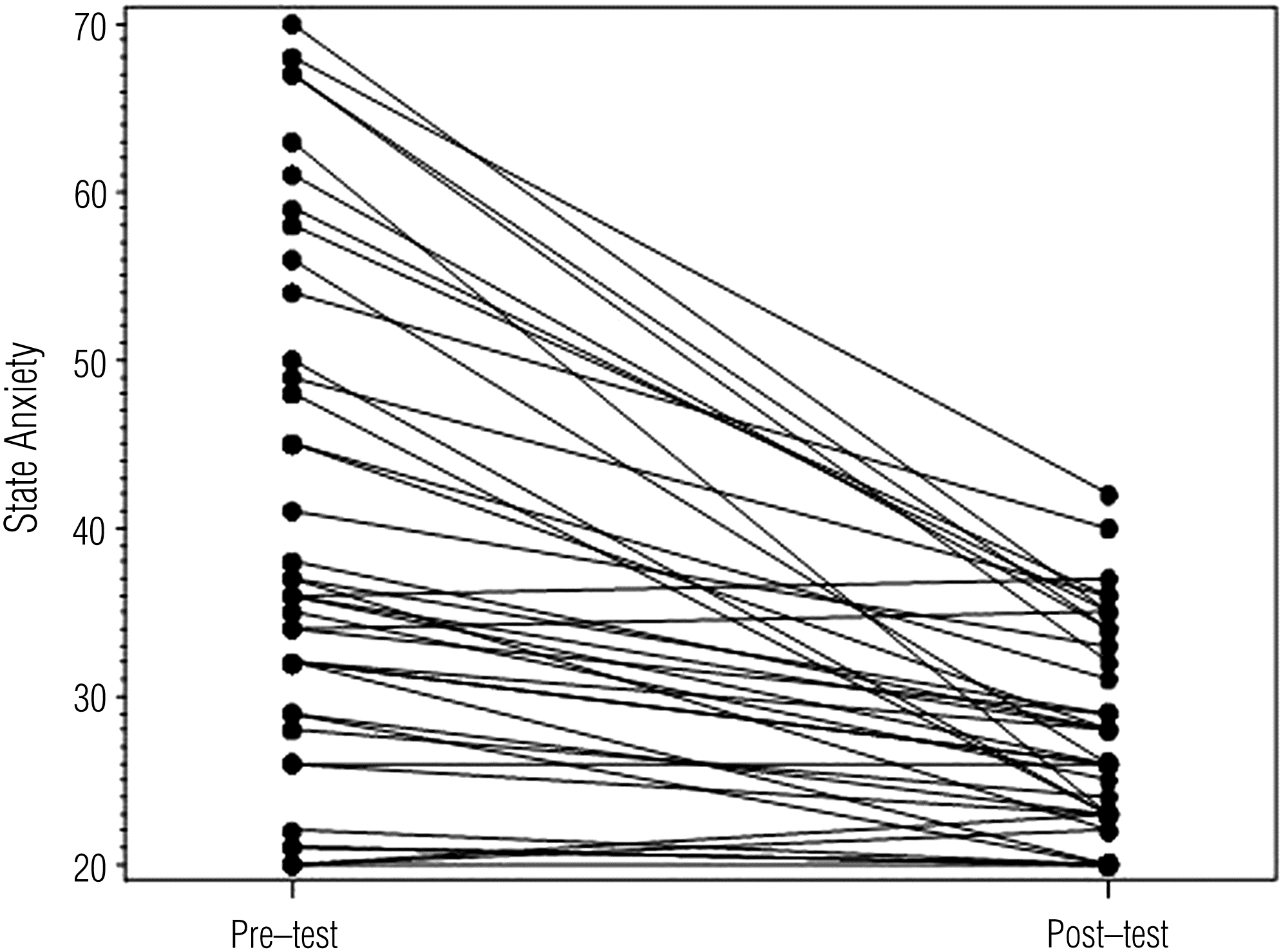
Change in state anxiety scores from pre- to postactivity.
Trait anxiety declined from 37.4 to 34.8, a mean of 2.6 points (n = 40; SD = 5.2; 95% CI on difference estimated from mixed model: 0.9, 4.2; p = .0036; Figure 2). This small difference in trait anxiety was statistically significant largely because of the trait heterogeneity among the 40 participants that is evident in Figure 2. The SEM for trait anxiety scores was 3.7 points, and the variable’s corresponding standardized difference was 5.2 trait points. A change in trait scores was meaningful if its RCI exceeded 1.96, a value that corresponded to about 10.2 trait points. Only 2 of the 40 participants (5%) demonstrated meaningful reductions in trait scores.
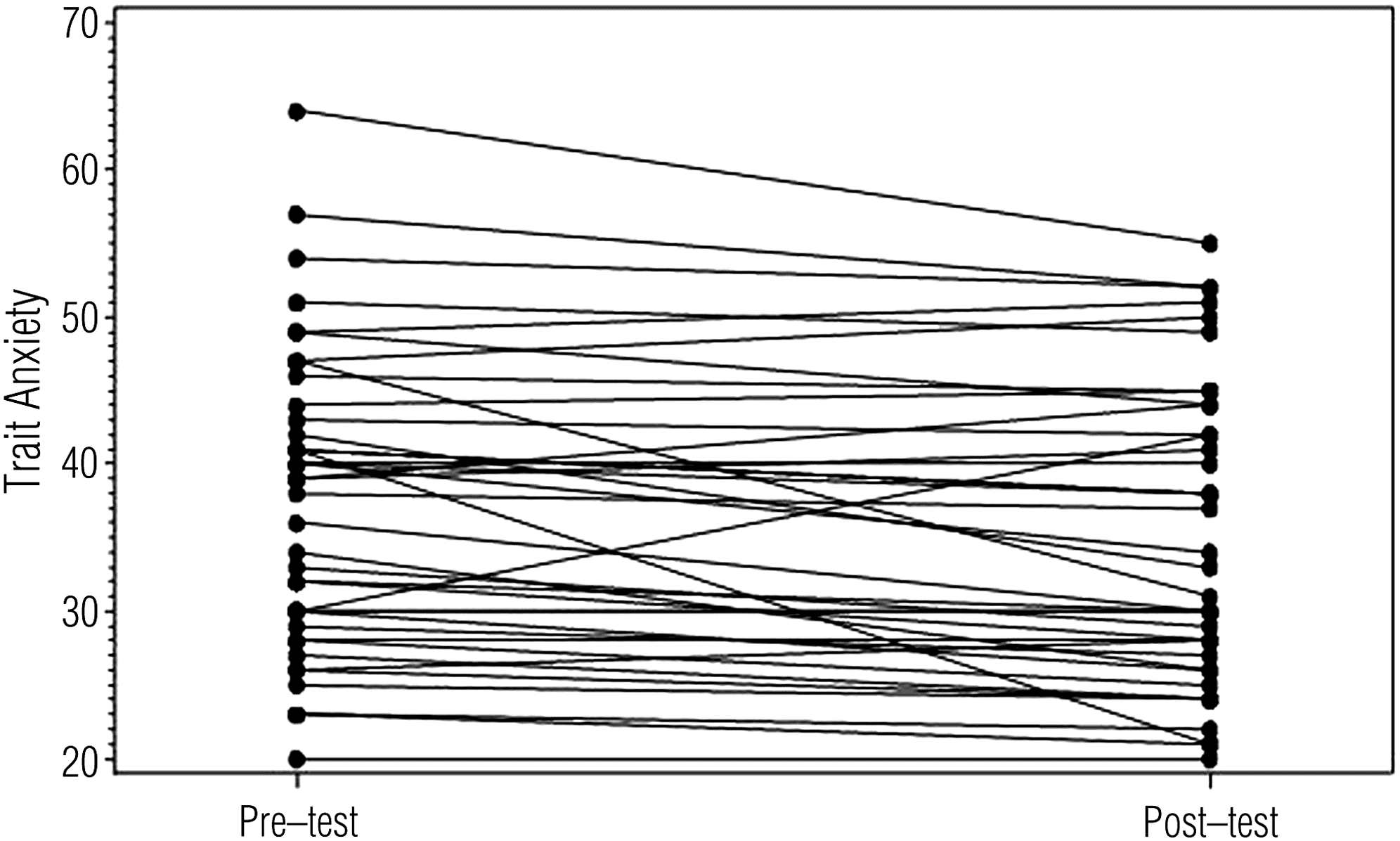
Change in trait anxiety scores from pre- to postactivity.
Qualitative Findings
After categorizing parents’ statements, qualitative data analysis continued by clustering and organizing the categories and by identifying themes. Table 2 lists the five categories we identified, the theme generated for each category, and selected statements from parents that illustrate each category and its theme. The qualitative analysis suggests that parents found participation in the group activity to be a distraction from their worries because it calmed them and allowed them to relax. They described participation to be fun and as giving them hope for a future beyond the NICU. Finally, the activity connected parents with parents in similar situations, reduced their isolation, and offered parents an opportunity to receive support.
Qualitative Findings Summary Table
Discussion
The results validated the primary hypothesis. Parents who participated in an art-based occupation group using scrapbooking demonstrated reduced anxiety, and these clinically significant reductions in state anxiety were substantiated and expanded by qualitative analyses of parent interviews.
State anxiety scores greater than 40 have been described as representing moderate stress (Britton, 2005). Our sample had a pretest mean state anxiety score of 40.5 and mean trait anxiety score of 37.4. Spielberger (1983) also described that the measurement of state anxiety is more sensitive to environmental stresses than trait anxiety, and we found that to be the case for parents experiencing the hospitalization of their newborn infant. The postactivity mean reduction in state anxiety of 12.7 points was significant and larger than we anticipated. The literature suggests that a reduction of this magnitude is clinically meaningful (Fisher & Durham, 1999). The RCI, a stringent assessment of clinically significant change, showed that 25% of parents demonstrated a meaningful decline in state anxiety.
We were initially concerned that this activity would appeal only to parents with the financial resources to purchase art or scrapbooking supplies. However, we used the percentage of participants receiving Medicaid as a proxy for socioeconomic status and found study participants’ economic status to be representative of the general OUHSC NICU population. Participants were more likely than parents of the general NICU population to be first-time parents and, therefore, may have had higher anxiety than experienced parents. However, because they did not have other child care responsibilities, they may have been more available to participate in the group. Finally, infants’ average age of 28 days suggested that many families were past the initial birth crisis and had already been in the NICU for longer than the average length of stay, which in 2008 was 22 days. The data are congruent with our clinical observation that this group attracted parents with babies who had been hospitalized for long periods.
In addition to our primary aim of reducing parent stress and anxiety, we had other clinical goals grounded in our commitment to family-centered care in the NICU, which the interviews suggest were also fulfilled. Because mothers with good social support are more responsive to their preterm infants (Amankwaa, Pickler, & Boonmee, 2007), one of our clinical objectives was to offer parents an opportunity to meet and receive social support from other parents. Providing the opportunity for a less experienced parent to receive support from a veteran parent has been identified as a powerful element in any parent group (Preyde & Ardal, 2003). As we hoped, parents described the group as an opportunity to receive parent-to-parent support, share with other parents, and reduce their sense of isolation.
Although traditional parent support groups have not been well attended (Smith, Gabard, Dale, & Drucker, 1994) a successful therapeutic scrapbooking group for parents of pediatric oncology patients has been described. McCarthy and Sebaugh (2011) speculated that parents viewed a scrapbooking group as a “normal” activity that reduced isolation and promoted coping without carrying the negative associations of a formal support group. Moreover, they proposed that scrapbooking promoted meaning-making as parents literally told their story through the scrapbook pages. A similar theme that emerged from our interviews was that the activity gave parents an opportunity to do something meaningful for their baby that also helped them focus on a hopeful future. Perhaps the process of this art-based occupation offers an opportunity for parents to adopt a more positive cognitive perspective as they tell their own story for the future.
Another of our clinical goals was to offer parents an activity that may help them cope with the NICU experience. From the parent’s perspective, participation in the art-based occupation group was relaxing and provided an element of distraction while reducing boredom. The benefits of periods of diversion from both boredom and stress, which are paradoxically characteristic of long hours on the NICU, have been described in other populations (Friedland, 1988; Radziewicz & Schneider, 1992). Diversion and distraction have been proposed as important and legitimate, although undervalued, forms of coping with stress (Friedland, 1988; Phelps, Bennett, Iredale, Anstey, & Gray, 2006; Radziewicz & Schneider, 1992). These findings substantiate the concept, familiar to occupational therapists, that participation in meaningful occupation supports coping.
Limitations
IRB regulations permitted us to recruit only parents who were at least 18 yr old. Consequently, we can generalize our findings only to adults age 18 or older who have an infant in the OUHSC NICU.
The study’s lack of a comparison group leaves open the possibility that placebo or other effects contributed to the short-term reduction in anxiety that we observed. In this regard, the significant but smaller reduction measured on the Trait Anxiety scale, which is thought to reflect more stable or long-term changes in anxiety, may reflect a background change in anxiety that is not attributable to the activity. We cannot be sure what aspect of the art-based occupation group is responsible for the measured reduction in anxiety. Many variables could have contributed to this result, including the specific activity, the group environment, or the support provided by the presence of other parents.
The use of a self-report tool also introduces study limitations. Moreover, the interviewer (Mouradian) administered the STAI and facilitated the group and therefore may have introduced a degree of potential bias. For example, participants’ responses, especially during the interview, may have been influenced by a desire to please the facilitator. The potential for bias was mediated by limiting recruitment to first-time group attendees with whom the investigators had no established relationship. Finally, we cannot know the length of time that state anxiety was reduced and, therefore, cannot predict potential long-term benefits.
Future Research
Future research could clarify those aspects of group participation that are essential to producing the benefits described and explore ways to enhance them. Because each NICU is a unique culture, replication of the study in other units could help generalize the benefits of this intervention. True randomized controlled trials comparing this with another activity with similar opportunities for staff interaction and parent-to-parent support would begin to parse out some of the potential confounding variables. Finally, future studies could explore possible longitudinal benefits as well as the effect of repeated participation in this type of occupation-based group.
Implications for Occupational Therapy Practice
Implications of this study that are specific to occupational therapy practice are as follows:
Involvement in an art-based occupation group using scrapbooking as an activity produced clinically significant reductions in parents’ state anxiety levels in the NICU.
Parent interviews indicated that the meaning of participation extended beyond the construct of anxiety reduction to include meaningful engagement, hope for the future, and a reduction in their sense of isolation.
These data justify the use of a creative, art-based group activity in an intensive medical setting and provide evidence for a family-centered intervention that involves parents in a meaningful occupation.
Conclusion
A parent group centered on an art-based occupation—namely, scrapbooking—effectively reduced parent anxiety at the time of participation. Parent interviews suggested that this group activity provided social support and an opportunity for relaxation. The opportunity to engage in a meaningful occupation distracted parents from their worries and allowed them to have hope for the future. Both qualitative and quantitative data suggest that this family-centered approach is a useful stress-reduction measure for parents with an infant in the NICU.
Footnotes
Acknowledgments
The OITP is funded by the Oklahoma Department of Human Services. This project was supported by a grant from the Neonatology Section, Department of Pediatrics, OUHSC. We thank Marilyn Escobedo and Roger Sheldon for their support and Raelyn Teeter for help with data management. We also thank April Courouleau, Kathleen Gray, Paige Mills, Wanda Felty, and Bunny Hutson for help with the group. Laurie Mouradian thanks Joan Phillips for encouragement and feedback on an early version of this project. Aspects of the project have been presented at the Annual Newborn Individualized Developmental Care and Assessment Program Trainers Meeting, the American Art Therapy Association Annual Conference, the Society for Arts in Healthcare Annual International Conference, and the Pediatric Academic Societies Conference.