





Abstract
Sensory processing differences in preschool-age children with autism spectrum disorder (ASD) affect their engagement in everyday activities, thereby influencing opportunities to practice and develop skills such as social communication and adaptive behavior. The purpose of this study was to investigate the extent to which specific sensory processing patterns relate to aspects of development (i.e., adaptive behavior, expressive and receptive language, fine and gross motor skills, social behavior) in a sample of preschool-age children with ASD (N = 400). A retrospective chart review was used to gather clinical data. Results suggest that sensory processing patterns differentially affect children’s developmental skills and adaptive behavior. Certain sensory processing patterns predicted children’s development of language, motor, and adaptive skills. These findings have clear implications for occupational therapy practice with young children with ASD. Practitioners should consider how sensory processing in ASD both supports and limits children’s ability to engage in social communication and learning opportunities.
Keywords
Research suggests that children with autism spectrum disorder (ASD) respond to sensory experiences differently from peers with or without disabilities. These differences in sensory responding are well documented in clinical literature by direct observation (Adrien et al., 1992, 1993; Adrien, Ornitz, Barthelemy, Sauvage, & Lelord, 1987), parent report (Baranek, David, Poe, Stone, & Watson, 2006; Ben-Sasson et al., 2009; Ermer & Dunn, 1998; Kern et al., 2006; Kientz & Dunn, 1997; Leekam, Nieto, Libby, Wing, & Gould, 2007; O’Donnell, Deitz, Kartin, Nalty, & Dawson, 2012; Watling, Deitz, & White, 2001; Tomchek & Dunn, 2007), and first-person accounts of living with autism (Cesaroni & Garber, 1991; Grandin, 1995; Minshew & Hobson, 2008). The initial appearance of these sensory processing differences often predates diagnosis (Adrien et al., 1993; Baranek, 1999; Dahlgren & Gillberg, 1989; Lord, 1995) and has been associated with later behavioral presentations of adaptive behavior (e.g., Lane, Young, Baker, & Angley, 2010) and other developmental domains such as social communication (e.g., Watson et al., 2011). Although sensory processing differences are highly prevalent and early indicators of an eventual diagnosis of ASD, studies on the associations between specific sensory processing characteristics and developmental functioning in early childhood present variable findings. Therefore, this study focused on the extent to which specific sensory processing patterns contribute to aspects of developmental function (i.e., social communication, adaptive functioning) that influence diagnostic consideration and participation in preschool-age children with ASD. If we can uncover how early behavioral presentations of sensory differences are associated with particular aspects of development, intervention approaches may be tailored to meet the needs of preschool children with ASD.
Investigations have explored differences in patterns of sensory responding using established Sensory Profile (SP; Dunn, 1999, 2006, 2014) factor summary scoring that is based on performance of typically developing children. Ermer and Dunn (1998) used discriminant analysis to differentiate children with disabilities (ASD and attention deficit hyperactivity disorder [ADHD]) from those without disabilities and also to differentiate the two groups with disabilities from each other. Specifically, children with autism or pervasive developmental disorder (PDD) displayed a low incidence of seeking and a high incidence of SP Oral Sensitivity, Inattention/Distractibility, and Fine Motor/Perceptual factors compared with children with ADHD. Further, Watling et al. (2001) compared sensory processing behaviors of children aged 3–6 yr with and without ASD. Sensory processing of children with ASD was significantly different from that of controls on 8 of 10 SP factors (Sensory Seeking, Emotionally Reactive, Low Endurance/Tone, Oral Sensitivity, Inattention/Distractibility, Poor Registration, Fine Motor/Perceptual, and Other).
Baranek and colleagues (2007), using the Sensory Experiences Questionnaire (Baranek et al., 2006), found that mental age was inversely related to sensory seeking, hyperresponsiveness, and hyporesponsiveness across five diagnostic groups (i.e., ASD, PDD, developmental delay [DD]/intellectual disability, other DD, typical) in children ages 5–80 mo. Notably, the group with ASD yielded a higher rate of symptoms than other groups and demonstrated a distinct pattern of hyporesponsiveness in both social and nonsocial contexts. A similar study (Leekam et al., 2007) compared sensory responding of children ages 34–140 mo across four diagnostic groups (ASD, DD, language impairment, typical). The ASD group again showed a higher rate of sensory differences across multiple domains, though the symptoms changed with age and IQ, leading the authors to conclude it was difficult to draw conclusions given the variability in presentation. Additional analysis by Joosten and Bundy (2010) compared children with ASD and intellectual disability with those with intellectual disability alone and found differences between the groups on sensitivity and avoiding factors.
In a different approach to understanding sensory processing patterns, others have used subtyping analysis in an attempt to capture the variability in sensory processing patterns as related to developmental domains in ASD. The intent was to group participants on the basis of performance on a set of variables. Recent cluster analysis (Lane et al., 2010) using the Short Sensory Profile (SSP; McIntosh, Miller, & Shyu, 1999) with 54 children with ASD ages 2–10 yr found three subtypes: Sensory-Based Inattentive Seeking, Sensory Modulation With Movement Sensitivity, and Sensory Modulation With Taste/Smell Sensitivity.
Follow-up replication with a separate sample of 29 children with ASD confirmed these subtypes and identified further details about the groups (Lane, Dennis, & Geraghty, 2011). Children with a primary pattern of sensory-based inattention were further described as sensory seekers or nonseekers. Children with a primary pattern of vestibular and proprioceptive dysfunction were also differentiated on movement and tactile sensitivity. A recent study (Lane, Molloy, & Bishop, 2014) replicated and further refined their previously identified clusters by identifying sensory adaptive, taste- and smell-sensitive, postural inattentive, and generalized sensory difference clusters. Similarly, Ausderau and colleagues (2014), using the Sensory Experiences Questionnaire (version 3.0; Baranek, 2009), found four sensory subtypes (Mild, Sensitive–Distressed, Attenuated–Preoccupied, and Extreme–Mixed), which differed by age and autism severity.
Patterns of sensory processing and responding have been theorized to contribute to a person’s ability to participate successfully in daily routines (Dunn, 2007). Recognition of a person’s sensory patterns allows environments and experiences to be tailored to meet sensory processing needs to facilitate opportunities for successful participation in everyday life. Likewise, adaptive living skills allow a person to use developmental capabilities (e.g., cognitive, language, motor, social) to function within everyday routines and contexts. Adaptive living skills contribute strongly to the ability of a person with ASD to function successfully and independently in the world (Liss et al., 2001; Paul, Loomis, & Chawarska, 2014; Saulnier & Klin, 2007).
Research on the extent to which sensory processing is related to overall development and adaptive functioning in ASD has been emerging. Baker, Lane, Angley, and Young (2008) reported significant moderate positive correlations between maladaptive and emotional and behavioral problems and the SSP factors of Underresponsive/Seeks Sensation, Auditory Filtering, and Low Energy/Weak. Significant associations have also been found between sensory processing difficulties and levels of problem behavior, including irritability, lethargy, hyperactivity, inappropriate speech, and stereotypic behavior (O’Donnell et al., 2012). Ben-Sasson et al. (2008) used cluster analysis to group 170 toddlers with ASD ages 18–33 mo by sensory category and social factors, yielding three clusters: low frequency, mixed frequency, and high frequency of sensory behaviors. High under- or overresponsivity clusters were related to more negative emotions, anxiety, and depressive symptoms than were low under- or overresponsivity. Similarly, Pfeiffer, Kinnealey, Reed, and Herzberg (2005) found a positive relationship between sensory defensiveness and anxiety in persons with Asperger syndrome; older study participants displayed symptoms of depression and hyposensitivity and younger participants had symptoms of depression and hypersensitivity. As sensory hyper- and hyposensitivity increased, community use and social skill decreased.
Sensory avoiding has been found to negatively affect daily living skills (Jasmin et al., 2009) and activity participation (Little, Sideris, Ausderau, & Baranek, 2014) in people with ASD. Moreover, Ashburner, Ziviani, and Rodger (2008) found that sensory processing scores on the SSP (Tactile Sensitivity, Auditory Filtering, and Underresponsive/Seeks Sensation) were negatively associated with academic, behavioral, and emotional performance. Liss, Saulnier, Fein, and Kinsbourne (2006) also used cluster analysis to examine relationships between function and sensory processing. Sensory overresponsivity was associated with perseverative behavior and interests, overfocused attention, and exceptional memory. The underresponsivity cluster was associated with lower adaptive functioning, communication impairments, and deficits in social skill. In contrast, other studies (Rogers, Hepburn, & Wehner, 2003; Wiggins, Robins, Bakeman, & Adamson, 2009) have not found associations between sensory processing and social or communication scores on the Autism Diagnostic Observation Schedule (ADOS; Lord, Rutter, DiLavore, & Risi, 1999).
These studies have clear variability regarding measurement of sensory processing and the developmental variables of interest (e.g., adaptive behavior versus social communication). Such variability in findings results in a lack of understanding regarding how specific sensory processing patterns contribute to aspects of development in preschool-age children with ASD. Therefore, this study addressed two research questions: (1) To what extent do sensory processing patterns contribute to specific developmental domains (i.e., adaptive behavior, social interaction, receptive and expressive language, and gross and fine motor) in young children with ASD and (2) to what extent do children with varying adaptive behavior scores differ on sensory processing scores?
Method
Procedures
We conducted a retrospective chart review of clinical data on children diagnosed with ASD at a university-based tertiary diagnostic center with a statewide catchment area. Sixty percent of children accessing services at the center have traditionally been from urban areas, with the remaining being from rural areas. Children referred for evaluation received a standard and comprehensive medical, psychological, speech and language, and occupational therapy interdisciplinary team evaluation, consistent with ASD diagnostic practice standards (Filipek et al., 1999, 2000; Johnson & Myers, 2007; Volkmar, Cook, Pomeroy, Realmuto, & Tanguay, 1999). Inclusion criteria mandated that participants were between the ages of 3 yr and 6 yr, 11 mo, and met criteria for ASD on at least one of the following: Autism Diagnostic Interview–Revised (Lord, Rutter, & Le Couteur, 1994), ADOS, or Diagnostic and Statistical Manual of Mental Disorders (4th ed., text rev; DSM–IV–TR ) criteria (American Psychiatric Association [APA], 2000). We included participants who had complete adaptive, social, communication, motor, and sensory processing data from specific measures derived from the evaluation process.
We originally identified 769 potential participants using a query of scheduling and billing software. Chart review began with children evaluated most recently and worked back. A total of 471 charts were reviewed to secure the 400 complete records using selected measures. Exclusion most often related to use of another instrument than those selected for inclusion or a lack of replication in cases in which testing had previously been performed by another provider. The first author (Tomchek) completed reviews using IBM SPSS Statistics (Version 18; IBM Corp., Armonk, NY). To examine the extent of rating bias or error, a psychology doctoral student coded a subset of 25 charts to establish interrater reliability. Coefficients ranged from .99 for adaptive and social variables to 1.0 for both motor and language variables.
Participants
Participant age and developmental performance scores are summarized in Table 1 (n = 400). DSM–IV–TR (APA, 2000) criteria were used for diagnosis; consequently, the majority of children were diagnosed with autistic disorder (n = 322, 80.5%), and a smaller number with PDD–not otherwise specified (PDD–NOS; n = 67, 16.8%) and Asperger disorder (n = 11, 2.8%). Developmental performance varied for each variable, consistent with diagnostic criteria; that is, the Asperger disorder group achieved at a higher level than either the PDD–NOS or the autism groups.
Participant Age and Developmental Performance Scores by Diagnosis
Note. M = mean; PDD–NOS = pervasive developmental disorder–not otherwise specified; SD = standard deviation.
Values reflect standard score or developmental quotient with a mean of 100. Developmental quotients were calculated using the equation developmental age/chronological age × 100.
Measures
The SSP, a 38-item caregiver-report instrument, was used to measure sensory processing. Items are scored on a Likert scale ranging from 1 (always) to 5 (never). The seven domains of the SSP were based on factor analysis with the normative sample of typically developing children (Dunn, 1999). However, a recent factor analysis of the SSP using the current sample of children with ASD demonstrated a slightly different factor structure than that of typically developing children and was used in the current analysis. These factors include Low Energy/Weak, Tactile/Movement Sensitivity, Taste/Smell Sensitivity, Auditory/Visual Sensitivity, Sensory Seeking/Distractibility, and Hyporesponsivity (Tomchek, Huebner, & Dunn, 2014). As noted in Figure 1, the Tactile/Movement Sensitivity items of the SSP were merged to form a single factor. Auditory Filtering from the SSP was spread across three factors describing auditory and visual sensitivity, distractibility, and sensory hyporesponsivity. Underresponsive/Seeks Sensation items from the SSP were separated into two factors (Sensory Seeking/Distractibility and Hyporesponsivity).
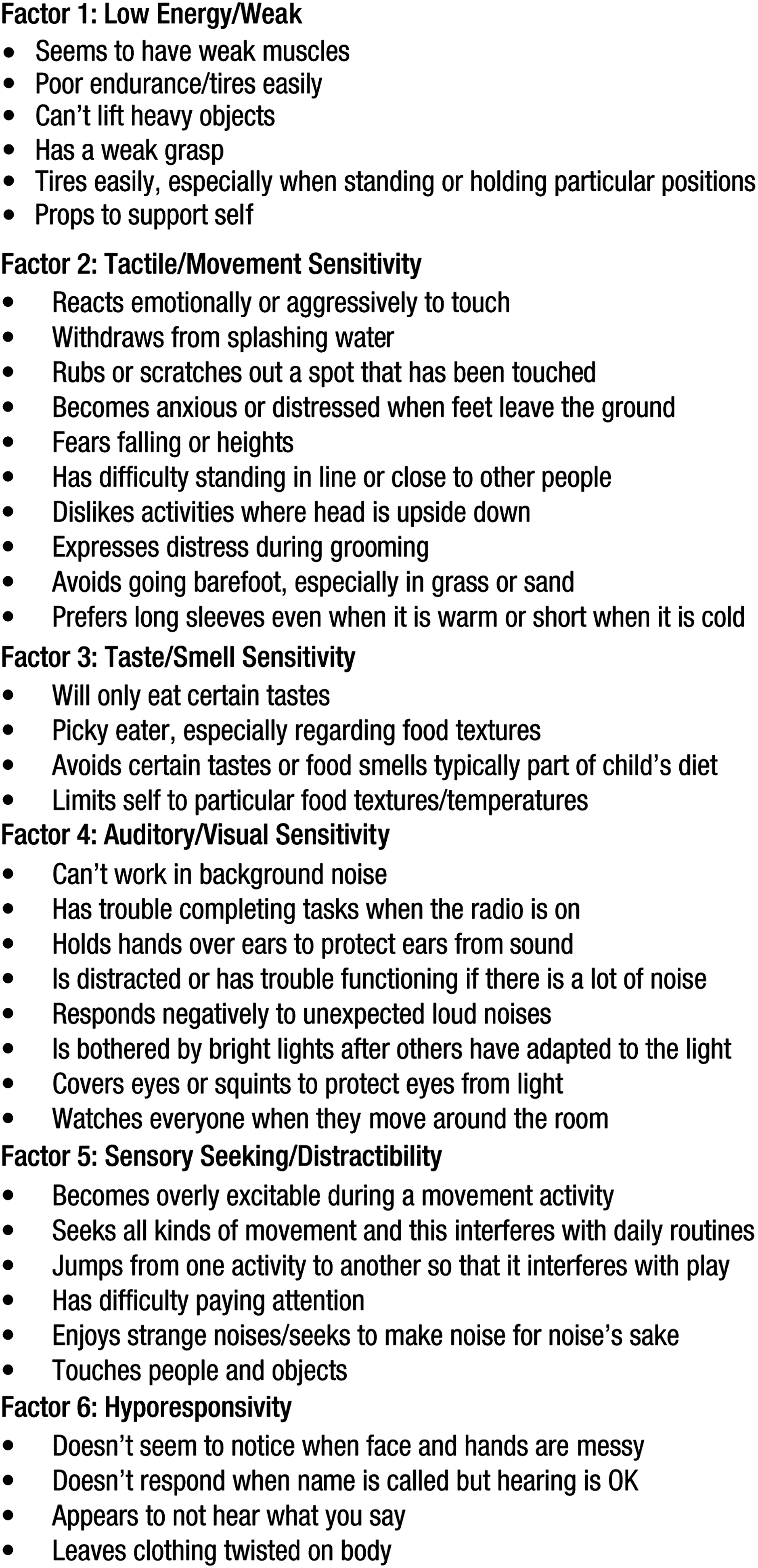
Factor structure of Short Sensory Profile items for children with autism spectrum disorder.
Because the current study used a retrospective chart review approach, we used scores from various measures of adaptive behavior, social behavior, receptive and expressive language, and gross and fine motor skills that were used in the evaluation process (Supplemental Table 1, available online at http://otjournal.net; navigate to this article, and click on “Supplemental”). When possible, we used standard scores. Given the inherent difficulties with utilizing standardized instruments with children with ASD, we occasionally selected criterion-referenced instruments to capture developmental ages and converted them to a developmental quotient. This practice is common in the autism literature (see Bibby, Eikeseth, Martin, Mudford, & Reeves, 2001; Lord & Schopler, 1989; Rogers et al., 2003; Stone, Ousley, Yoder, Hogan, & Hepburn, 1997).
Data Analysis
Data were analyzed using IBM SPSS Statistics (Version 18). To address our first research question, we used multivariate regression to determine the contribution of sensory processing scores on specific aspects of development. Specifically, we tested a model with sensory processing scores (Low Energy/Weak, Tactile/Movement Sensitivity, Taste/Smell Sensitivity, Auditory/Visual Sensitivity, Sensory Seeking/Distractibility, and Hyporesponsivity) as independent variables and developmental domain scores (adaptive behavior, social behavior, receptive and expressive language, gross and fine motor skills) as dependent variables.
Because the adaptive functioning instruments used in the current study account for and scores are confounded by motor and language skills, we tested the impact of sensory processing scores on adaptive functioning in a separate model. Therefore, to address our second question, we used multivariate analyses of variance (MANOVAs) to determine whether differences in sensory processing varied by adaptive functioning level. To investigate differences by functioning level, we classified participants into three groups of functioning: high (adaptive quotient >80), moderate (adaptive quotient 60–79), or low (adaptive quotient <60). We used Tukey’s follow-up comparisons to determine the extent to which each adaptive functioning group (i.e., low, moderate, or high) differed on sensory processing scores.
Results
Sensory Processing and Developmental Domains
Results of the multivariate regression analysis showed that sensory processing scores differentially predicted developmental domains (see Table 2). Notably, Low Energy/Weak, Tactile/Movement Sensitivity, Taste/Smell Sensitivity, Auditory/Visual Sensitivity, and Hyporesponsivity scores significantly contributed to receptive and expressive language scores (all ps < .05). Similarly, these scores contributed to receptive language with the addition of Sensory Seeking/Distractibility (p < .05). The only significant contribution to social behavior and gross and fine motor skills scores was Sensory Seeking/Distractibility (p < .05).
Sensory Processing Pattern Contributions to Developmental Measures
Note. SE = standard error.
p < .05. **p < .001.
Differences by Level of Adaptive Functioning
To investigate differences in the sensory processing pattern scores by adaptive functioning level, we grouped participants as follows: high adaptive behavior (adaptive quotient >80; n = 47), moderate adaptive behavior (adaptive quotient 60–79; n = 115), or low adaptive behavior (adaptive quotient <60; n = 238). The homogeneity of variance assumption was met on the basis of Box’s test of equality of covariance matrices that yielded a value of 50.28, F(42, 62,393) = 1.16, p = .226. A significant multivariate effect was found, Hotelling's trace = 0.109, F(12, 782) = 4.09, p < .001 (Table 3). Tukey’s post hoc comparisons showed that the low versus high groups differed on Tactile/Movement Sensitivity and Hyporesponsivity (p < .05), whereas all three groups differed on Taste/Smell Sensitivity and Sensory Seeking/Distractibility (p < .001).
Sensory Processing Pattern Differences by Adaptive Behavior Group
Note. Lower sensory scores indicate more frequently occurring behaviors. SD = standard deviation.
Tukey’s post hoc comparison showed that the low versus high groups differed on Tactile/Movement Sensitivity and Hyporesponsivity (p < .05).
Tukey’s post hoc comparison showed differences between all three groups on Taste/Smell Sensitivity and Sensory Seeking/Distractibility (p < .001).
Discussion
To date, studies investigating the variable developmental presentation in people with ASD by subtyping have focused on cognitive and language variables and comorbid medical and genetic conditions (see Ousley & Cermak, 2014, for a review). In these studies, the impact of diminished cognitive capacity on function and information processing has been a hallmark. Studies of the contributions of sensory processing to developmental domains in ASD represent a newer line of investigation. These studies have previously used the SSP factor structure based on typically developing children to explore associations with specific developmental variables.
The primary goal of this study was to supplement previous work in a more comprehensive way to establish the extent to which sensory processing factors, as derived from a sample with ASD, predicted aspects of developmental performance and adaptive behavior in preschool-age children with ASD. Novel findings from this study suggest that sensory processing factors differentially contribute to developmental domains, with the greatest contribution to receptive and expressive language. Moreover, specific sensory processing patterns differed among the adaptive behavior groups.
Our findings suggest that sensory processing patterns are strongly related to preschool-age children’s receptive and expressive language abilities. Specifically, we found that children with high scores (i.e., fewer differences) in Low Energy/Weak and Auditory/Visual Sensitivity showed increased receptive and expressive language skills. Children who are less sedentary and less sensitive to the auditory and visual elements of their contexts may be more likely to focus during experiences that provide them with opportunities to practice language. Conversely, children who showed more differences in Hyporesponsivity and Taste/Smell Sensitivity demonstrated decreased language skills. These children may be missing opportunities for language. Interestingly, Sensory Seeking/Distractibility significantly contributed to receptive, not expressive, language skills. Children who are engaged in sensory seeking, such as increased movement activities or a focus on specific sensory elements in their environments, may be missing language input from caregivers and peers.
The current study’s findings are supported by those of Watson and colleagues (2011), which showed that hyporesponsivity was associated with language limitations in children with ASD and that sensory sensitivities contributed, albeit not significantly, to better language skills. Differences in language performance are a core feature of ASD (DSM–5; APA, 2013), and sustained attention is required to participate in activities, learn, and engage in reciprocal interaction socially and with language. Children’s sensory processing patterns affect a child’s ability to sustain active engagement in activities that provide social communication opportunities. Therefore, the current findings present strong implications for sensory processing interventions to be an integral component of interventions that promote engagement activities that develop communication skills in children with ASD.
In this sample of preschool-age children with ASD, the sole sensory processing contributor to social behavior and fine and gross motor skills was Sensory Seeking/Distractibility. Children who are engaged in movement activities or intensely interested in sensory aspects of their environment may be missing social opportunities. Moreover, distractibility in children may prevent them from engagement in fine and gross motor activities. Because many occupational therapy interventions that focus on fine motor skills include sensory considerations, a particular focus on sensory seeking and distractibility for children with ASD may be necessary in implementing such interventions.
Significant differences in sensory processing patterns were found between adaptive behavior groups. These differences are often highlighted when children are participating in daily routines. In particular, the low adaptive behavior group showed more tactile and movement sensitivity and sensory-seeking behaviors than the high adaptive behavior group. Moreover, each adaptive group differed on taste and smell sensitivity and sensory seeking, with increased sensory behaviors contributing to decreased adaptive skill across groups.
Our findings are partially supported by previous research on the associations between sensory processing and adaptive behavior in ASD. Rogers and colleagues (2003) analyzed the predictive value of sensory responsivity on adaptive skill. In their study, the developmental level of the participants accounted for the most variability in adaptive behavior, with the sensory responsivity accounting for only 4% of the variance in adaptive functioning. Specific to academic performance investigated in another study, the SSP Under responsive/Seeks Sensation and Auditory Filtering scores explained 47% of the variance in teacher report of school functioning, whereas estimated intelligence was not a significant predictor of academic performance (Ashburner et al., 2008). Lane and colleagues (2010) found that increased sensory behaviors were associated with maladaptive behaviors in ASD, although sensory processing did not significantly contribute to specific adaptive behaviors. The current study’s finding regarding taste and smell sensitivity and adaptive behavior is supported by previous research focused on feeding differences affecting mealtime routines in families with a child with ASD (Jasmin et al., 2009; Nadon, Feldman, Dunn, & Gisel, 2011).
Limitations and Future Directions
Study limitations relate to the unique diagnostic aspects of ASD and provide direction for future investigation. Developmental testing is a social communication process, and optimal performance thus in part depends on what are the weakest skills for people with ASD, which affects the validity of developmental measures. As a result, criterion-referenced instruments yielding developmental ages are often used in lieu of standardized instruments or parent-report measures. Both were used in this study. Although parent-report measures and developmental quotients are commonly used in the autism literature (see Bibby et al., 2001; Lord & Schopler, 1989; Rogers et al., 2003; Stone et al., 1997), they introduce an unknown amount of bias that could either inflate or diminish true performance.
Also related to measurement with retrospective analysis is the exclusion of incomplete charts. Inclusion of excluded participants may have changed the final composition of the sample. Moreover, interpretation of the study findings was somewhat limited by the lack of a comparison group of children with developmental difficulties. Use of a comparison group would have allowed for testing the effects of coexisting developmental deficits (e.g., language delay) on patterns of sensory processing. Replication of study findings will require confirmatory factor analysis in another group of children with ASD and with groups of children with other disabilities to establish whether the sensory patterns used in this study are specific to children with ASD or whether they are consistent with samples of children with other developmental disabilities.
Further investigation into the relationship between these patterns and the developmental and behavioral presentation of people with ASD is warranted. This line of investigation will ultimately allow for a clearer understanding of the contributions of sensory processing to the variable presentation of people with ASD and will have implications for early diagnosis and intervention.
Implications for Occupational Therapy Practice
We found specific and differential associations between sensory processing patterns and developmental domains, particularly with regard to adaptive behavior and language. Certain sensory behaviors positively predicted expressive and receptive language (i.e., auditory and visual sensitivity and low energy and weak), whereas others inversely predicted children’s language skills (i.e., hyporesponsivity and taste and smell sensitivity). The findings of this study have the following implications for intervention programs involving people with ASD:
Occupational therapy can play an important role to support engagement in social communication opportunities.
Collaborative interprofessional practice between occupational therapy practitioners and speech–language pathologists may yield optimal treatment outcomes.
Findings from this study demonstrate that strong relationships exist between sensory patterns and measures of developmental performance.
Sensory processing differences affect children’s ability to sustain engagement in occupations when participating in daily life.
Recognizing sensory pattern contributions as a vital component of the environment reduces the emphasis on skill development and guides parents, teachers, and practitioners to create effective context-specific supports that can improve child participation in daily routines.
Conclusion
The primary goal of this study was to supplement previous work by developing a more comprehensive way to establish how sensory processing factors predicted developmental performance and adaptive behavior in a sample of preschool-age children with ASD. Study findings suggest that sensory processing factors differentially contribute to developmental domains, with the greatest contribution to receptive and expressive language. Sensory processing patterns also differed by level of adaptive behavior. Occupational therapy practitioners should therefore consider how sensory processing in young children with ASD both supports and limits children’s ability to engage in social communication and learning opportunities. Practitioners should create effective context-specific interventions to improve child participation in daily routines.
Supplemental Materials
Supplementary material for Sensory Pattern Contributions to Developmental Performance in Children With Autism Spectrum Disorder
Supplementary material, sj-pdf-1-aot-10.5014_ajot.2015.018044.pdf for Sensory Pattern Contributions to Developmental Performance in Children With Autism Spectrum Disorder by Scott D. Tomchek, Lauren M. Little and Winnie Dunn in The American Journal of Occupational Therapy
Supplementary material for Sensory Pattern Contributions to Developmental Performance in Children With Autism Spectrum Disorder
Supplementary material, sj-pdf-2-aot-10.5014_ajot.2015.018044.pdf for Sensory Pattern Contributions to Developmental Performance in Children With Autism Spectrum Disorder by Scott D. Tomchek, Lauren M. Little and Winnie Dunn in The American Journal of Occupational Therapy
References
Supplementary Material
Please find the following supplemental material available below.
For Open Access articles published under a Creative Commons License, all supplemental material carries the same license as the article it is associated with.
For non-Open Access articles published, all supplemental material carries a non-exclusive license, and permission requests for re-use of supplemental material or any part of supplemental material shall be sent directly to the copyright owner as specified in the copyright notice associated with the article.
