





Abstract
The purpose of this national survey was to explore perceptions of professional reward among occupational therapist (OT) and occupational therapy assistant (OTA) academic fieldwork coordinators (AFWCs). Agreement was found in ranking the value of six role factors: (1) fieldwork data management, (2) fieldwork site management, (3) fieldwork teaching and consultation, (4) departmental and institutional compliance, (5) scholarship and accreditation, and (6) laying groundwork for students in fieldwork. Both levels of AFWC indicated teaching and consultation had the highest value and data management the least. OT AFWCs placed significantly higher value on publishing articles and lower value on educating fieldwork educators about role delineation than OTA AFWCs. Five themes emerged regarding professional reward: (1) intrinsic reward, (2) collaboration, (3) development of the profession, (4) feeling appreciated, and (5) student success. AFWCs value activities involving personal interaction, promoting professional development, and facilitating student success. Results have implications for AFWC collaboration, workload distribution, and scholarship.
Student clinical education rotations in allied health are the primary focus of specialized faculty appointments. Various titles are used to designate these academic faculty, including director of clinical education; academic coordinator for clinical education; and, in occupational therapy, academic fieldwork coordinator (AFWC). The role of AFWC is complex and challenging, representing myriad tasks requiring shifting focus from the immediate to the long-term perspective (Stutz-Tanenbaum, Hanson, Koski, & Greene, 2015). This study explores AFWCs’ perceptions of professional reward associated with role tasks as well as differences in task valuation between occupational therapist (OT) and occupational therapy assistant (OTA) AFWCs.
Fieldwork coordinators across health care professions appear to have limited longevity in the position, possibly related to job satisfaction (Coates, Gill, & Jordan, 2005; Lyter, 2012; Snyder et al., 2010). White’s (2000) survey of health administration faculty concluded that satisfaction with the role and meaningfulness of work served as motivators for meeting professional challenges in the academic environment. The role played by satisfaction in position longevity among general academic faculty suggests that exploration of the meaningfulness of role tasks among AFWCs might increase understanding of position longevity for these coordinators. Gappa, Austin, and Trice (2007) developed a framework of factors affecting job satisfaction for academic faculty, including respect in employment equity, academic freedom and autonomy, flexibility, professional growth, and collegiality. Similarly, Reed (2006) explored job satisfaction among physician assistant faculty and found that a positive working environment and faculty development and mentorship programs for junior faculty resulted in higher confidence and career satisfaction, positively influencing retention.
Perception of satisfaction in the AFWC role appears to be complex, evolving from feelings about tasks of the job, departmental support, administrative assistant support, and time for the position (Gappa et al., 2007; Reed, 2006; White, 2000). From a management perspective, principles of expectancy theory are relevant, notably the coordinators’ perspectives that their efforts, time, and supports will lead to better outcomes. Expectancy theory describes critical links among workers’ motivation, effort, and anticipated reward, with the expected outcome influencing job performance. Having the “appropriate skills for performing the job, availability of right resources, availability of crucial information and getting the required support for completing the job” can influence performance and thus satisfaction (Management Study Guide, 2016). Snyder et al. (2010) explored physician assistant clinical coordinators’ perceptions of enjoyment and found that 27% of them identified visiting established clinical sites and teaching as the most enjoyable tasks. These clinical coordinators found satisfaction when they were able to help others be successful in their work, and they identified the least enjoyable tasks as cultivating new sites and negotiating contracts. Buccieri and Brown (2006) reported that opportunities for teaching were extremely important to the satisfaction of clinical education directors in physical therapy.
Salzman (2009) discovered that successful physical therapy directors of clinical education desired a match between their work tasks and their interests, abilities, and skills. Positive influences on satisfaction included problem solving unexpected events, networking with colleagues, working in supportive environments, and participating in reflective practice. Satisfaction with the administrative elements of the job was reported as low, although enjoyment was derived from designing the clinical coursework and learning experiences for students. However, the qualifications and responsibilities inherent in the position of physical therapy director of clinical education may limit career advancement because the academic establishment does not reward typical clinical education tasks as scholarly endeavors (Sabus, 2010).
Published research exploring and characterizing the OT AFWC role is lacking in the allied health literature. In an initial study of OT AFWCs, Stutz-Tanenbaum and coauthors (2015) described demographic characteristics and tasks of the role. The current study goes further to explore the degree to which role tasks are professionally rewarding at both OT and OTA levels.
Method
Participants
At the time of survey distribution, the United States had 336 accredited occupational therapist (n = 159) and OTA (n = 177) academic programs. Participants were recruited through one method only, using the American Occupational Therapy Association (AOTA) AFWC email discussion list. This list was dedicated to networking and resource sharing for the 245 (73% of accredited programs) U.S. subscribers during the survey request (V. Njoroge, personal communication, March 5, 2012). The overall response rate to the survey was 52% of subscribers (n = 128), with 63% (n = 80) OT and 37% (n = 48) OTA program AFWCs. These participants represented 38% of all U.S. accredited programs (50% of OT and 27% of OTA programs). University human subjects’ committee approval was granted at each author’s institution, and participants provided informed consent. The study is an extension of previous work describing the AFWC role tasks (Stutz-Tanenbaum et al., 2015).
Instrumentation and Procedures
An online survey was developed by three of the authors (Stutz-Tanenbaum, Hanson, and Koski); it was based on their combined 60-yr AFWC experience at three different occupational therapy academic programs and a review of AOTA official documents outlining the AFWC role (Accreditation Council for Occupational Therapy Education, 2012; AOTA, 2009). After the initial development of categories and tasks, 9 AFWCs identified as experts in the role reviewed a pilot survey to establish expert validity. Experts were selected who had more than 5 yr of experience as AFWCs, held positions of leadership in the AOTA, and were known by the authors. The survey was revised accordingly, yielding a 26-item instrument that was sent to AFWC email discussion list subscribers using an online SurveyMonkey format (SurveyMonkey, Portland, OR). The survey was open from November 2011 to February 2012. Participants, who were employed as either AFWCs in OT or OTA programs, were asked to rate the level of professional reward for each AFWC task item using a 5-point Likert scale (high score = 5). See Supplemental Appendix A, available online at http://otjournal.net (navigate to this article, and click on “Supplemental”), for an abbreviated survey.
Data Analysis
Principal-components factor analysis using IBM SPSS Statistics (Version 22; IBM Corp., Armonk, NY) verified the fit of the 26-role valuation items into six factors. The sample size was considered adequate according to the ratio-of-2 rule, which states that the number of participants should be at least twice that of the number of items in the survey (Kline, 1979).
As a preliminary step in factor analysis, the Kaiser–Meyer–Olkin Measure of sampling adequacy (KMO) and Bartlett’s Test of Sphericity were performed to ensure that the data were appropriate for a factor analysis limited to six factors. The KMO is considered acceptable when the value is greater than 0.6 (Kaiser, 1970, 1974). Bartlett’s Test of Sphericity tests the strength of the relationships between variables and should reach a significant level (i.e., p ≤ .05). Results of these preliminary tests (KMO: 0.681; Bartlett’s: p ≤ .001) indicated that it was appropriate to proceed with the factor analysis.
Principal -components analysis using varimax rotation minimized the number of variables with high loadings on each factor, thereby presenting a clearer factor structure. A value of 0.40 or greater was considered significant for items loading into a factor (Portney & Watkins, 2015), and only factors displaying an eigenvalue greater than 1.00 contributed to the interpretation. The six-factor structure accounted for 63.98% of the total variance. Three individual survey items with low response rates were not included in the factor analysis but were considered as separate items in other analyses reported.
The value of items was compared between both types of AFWC, based on the factors and the three individual survey items, using independent-groups t tests adjusted for multiple comparisons using Bonferroni’s correction (Dunn, 1961). After correction, the modified significance level in these comparisons was set at α = .0125. Finally, Pearson product–moment correlations were used to examine relationships between various important demographic variables (e.g., number of Fieldwork II students placed per year and weekly availability of administrative support).
Cronbach’s α was used as a test of internal consistency of the 26 survey items within the six factors. This statistic indicated high internal consistency, yielding a value of r = .882 based on n = 82 for OT and OTA AFWCs combined. The number of participants included in this analysis was less than the reported survey response rate as a result of pairwise deletion of missing data, because not all participants provided a value ranking for all survey items.
Survey comments in response to open-ended questions were analyzed first through coding the data into small categories of information and assigning a level to the code and then classifying the information into categories. Themes emerged as broad units of information consisting of several codes, and similar categories were aggregated to form a common idea (Creswell, 2013). After separately reading responses to open-ended items, two authors (Stutz-Tanenbaum and Greene) analyzed the data separately and then compared coding, categories, and themes to reconcile similarities and differences between thematic groups. Thematic development of responses was supported and presented through representative participant quotes.
Results
Results of this study build on a previous study by Stutz-Tanenbaum et al. (2015) that described the scope and complexity of the AFWC role. Participants’ ratings of professional reward as gathered in the previous study were factor analyzed yielding six primary role factors: (1) fieldwork data management, (2) fieldwork site management, (3) fieldwork teaching and consultation, (4) departmental and institutional compliance, (5) scholarship and accreditation, and (6) laying groundwork for students in fieldwork (Table 1). As an extension of this earlier work that described various clusters of activity characteristics of the AFWC role, this current work establishes role valuation for OT and OTA AFWCs.
Academic Fieldwork Coordinator Role Factors and Average Item Factor Loading
Note. SD = standard deviation.
A value of 0.40 or greater was considered significant for items loading into a factor (Portney & Watkins, 2015).
The valuation scores of the items within each of the six role factors yielded the following averages: fieldwork data management was lowest in value, with averages of 2.27 for OT and 2.65 for OTA AFWCs (Table 2). Fieldwork teaching and consultation exhibited the highest averages, that is, 4.49 for OT and 4.53 for OTA AFWCs. The most-to-least value ranking of role factors was nearly identical between the two AFWC levels, with one reversal in the middle of the rankings: OT AFWCs listed departmental and institutional compliance above fieldwork site management, whereas OTA AFWCs reversed this order.
Role Valuation Scores by Role Factor: Occupational Therapist (n = 80) and Occupational Therapy Assistant (n = 48) Academic Fieldwork Coordinator
Note. AFWC = academic fieldwork coordinator; M = mean; OT = occupational therapist; OTA = occupational therapy assistant; SD = standard deviation.
AFWC role valuation comparisons yielded significant differences in the items of written publications and inform fieldwork educators about OT and OTA role delineation (Figure 1). On the item written publications, a significantly higher value was reported by OT AFWCs (mean [M] = 4.32, standard deviation [SD] = 0.87) compared with OTA AFWCs (M = 3.42, SD = 1.17; p < .01). On the item inform fieldwork educators about OT and OTA role delineation, a significantly higher value was reported by OTA AFWCs (M = 4.15, SD = 0.68) compared with OT AFWCs (M = 3.5, SD = 0.83; p < .001). In addition, on the item conduct or assist in research projects, a higher value was reported by OT AFWCs (M = 4.2, SD = 0.83) compared with OTA AFWCs (M = 3.84, SD = 0.68), although this difference was not significant (Figure 1).
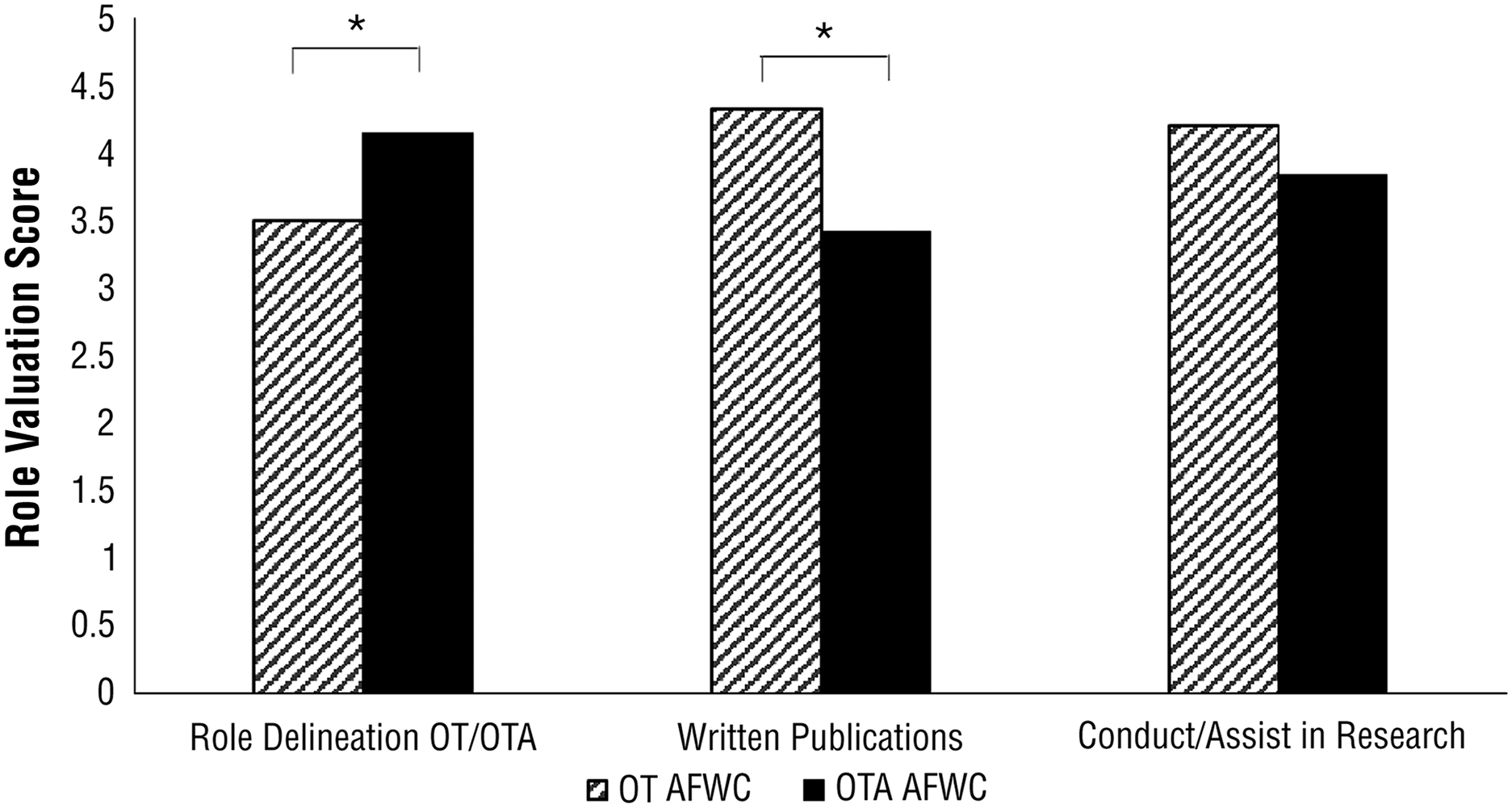
Comparison between occupational therapist and occupational therapy assistant AFWCs: Valuation of teaching role delineation, involvement in written publications, and conducting or assisting in research.
Regarding the relationships among variables, the number of fieldwork placements has a strong relationship with having administrative support (r = .494; Table 3). Considering the variance explained by this pairing, administrative support accounts for 24.4% of factors associated with increased Level II fieldwork placements. In addition, administrative support is associated to a limited extent with hours worked per week as an AFWC (r = .404).
Significant Correlations Between Academic Fieldwork Coordinator Performance and Administrative Support
Note. AFWC = academic fieldwork coordinator.
Administrative support accounts for 24.4% of factors associated with increased Fieldwork II placements.
Hours worked per week as an AFWC accounts for 16.3% of the factors related to obtaining administrative support.
In the responses to the open-ended question, “Overall, what factors influence whether a task is professionally rewarding to you?” participants’ written comments illustrated five themes: (1) intrinsic reward, (2) collaboration, (3) development of the profession, (4) feeling appreciated, and (5) student success. Intrinsic reward refers to gaining personal or professional satisfaction, or both, from being an AFWC. One OT AFWC described intrinsic reward as “if the task allows me to bring in and further develop myself professionally and personally to apply myself and challenge myself as a professional.” Another OT AFWC contrasted tasks as “interesting learning experience versus mundane paperwork.” An OTA AFWC described gratification in the role pertaining to “how much skill/expertise I must use to be successful, setting a target and meeting it, [and doing] something I would do on my own free time anyway [that] I find . . . rewarding.”
The theme of collaboration addressed the relationships and communication with students, fieldwork educators, and faculty: One OT AFWC stated, “Self-satisfaction from personal contact is most rewarding whether it be another AFWC, student, faculty, or fieldwork educator.” Regarding the theme of development of the profession, AFWCs cultivate placements in emerging practice settings, thus, according to one OT AFWC, making an “impact on the profession.”
One OT AFWC described wanting to be “valued for my expertise and knowledge about fieldwork issues,” thus supporting the theme feeling appreciated. AFWCs commented that appreciation came from students and “various constituents,” according to one OT AFWC, through “lovely notes about how great our students are,” as stated by another.
Making a difference through student success in fieldwork was a common theme throughout. The following quotes are representative: “The major factor is the direct relationship between the task and success of students” (an OT AFWC) and “I love helping students succeed and collaborating with sites on student success” (emphasis in original; an OTA AFWC).
Discussion
This study explored the degree to which the tasks of AFWCs are professionally rewarding and factors contributing to perceptions of professional reward. It also compared OT and OTA AFWCs’ most and least valued roles among the six role factors.
Commonalities in perception of professional reward were noted across all AFWC role valuation rankings. High perceptions of professional reward for fieldwork teaching and consultation may be associated with the significant value that participants place on helping students succeed during fieldwork (Salzman, 2009). Moreover, this rating may also be influenced by recognition given by peers for proficiency and knowledge in this area, a finding corroborated by Sabus (2010) as well as the thematic analysis. AFWCs value making an impact on student learning and on the profession, which concurs with Salzman’s (2009) finding of the importance of opportunities to network with academic colleagues and problem solve among physical therapy directors of clinical education. Lower valuing of fieldwork data management may be related to limited collaboration or personal contact and less direct impact on student performance during fieldwork. It may also be the result of the routine nature of data management tasks such as tracking student prerequisites. Professional respect appears to play a key role in influencing the themes of intrinsic reward and development of the profession. This finding relates to management theories that indicate that professional work satisfaction can be linked to opportunities for professional networking, acknowledgment of achievements, and supportive work environments leading to greater productivity (Olum, 2004).
Differences in perceptions of professional reward in scholarship activities between OT and OTA AFWCs may reflect differing educational backgrounds, institutional priorities, and time availability, all of which seem to favor the OT AFWC. This finding is substantiated by a national faculty workforce study of occupational therapy education revealing that a majority of OT faculty members surveyed had published articles or chapters, or both, in the past 5 yr compared with a majority of OTA faculty members surveyed who had not published (AOTA, 2010). The workforce survey reported that the scholarship workload distribution for occupational therapy program faculty was 16%, compared with 4% for OTA program faculty. In addition, because scholarship is not usually recognized during the evaluation and promotion process at the OTA level, these AFWCs may be less likely to pursue written publication or participate in research activities. However, a high percentage of both levels of AFWC reported an inability to accomplish assigned work within a 40-hr period (Stutz-Tanenbaum et al., 2015). Therefore, general time constraints and a low priority for applied scholarship, compared with other AFWC tasks, likely contribute to the dearth of research publications in the area of fieldwork education (Roberts, Hooper, Wood, & King, 2015).
The moderately strong correlation and variance between administrative assistant support and Fieldwork II placements suggest that strong administrative assistant support should be considered a contributor to fieldwork placement recruitment. In addition, administrative assistant support to accomplish routine tasks may free up AFWC time for valued activities related to teaching and scholarship, leading to greater job satisfaction.
Compared with their OT colleagues, OTA AFWCs reported a significantly higher perception of professional reward for clarifying OT and OTA role delineation. OTA AFWCs likely need to refer to role delineation more often when recruiting fieldwork educators given that the majority of students are supervised by OTs (Roberts, 2014). This finding raises a question about whether OT AFWCs give similar attention to preparation of fieldwork educators regarding role delineation. Without this understanding, there is a risk of failure to ground OTA students firmly in their role. This important function could be accomplished more effectively when shared between both levels of academic programs.
Finally, it is clear that there are more similarities than differences between OT and OTA AFWCs in role valuation. This result may be reflective of shared interests and goals for fieldwork education. For both levels of AFWC, motivation and dedication are compelled by the value placed in the work done, as expressed by one OTA AFWC: “I have been an AFWC for 15 years. And the day I don’t think this job is professionally rewarding or challenging, then I will change positions.”
Limitations
Generalizing the findings of this study should be done with caution because of the survey’s low response rate among OTA AFWCs. Moreover, not all AFWCs participate in the AFWC email discussion list, and although the differences between those who do and do not participate in the listserv are unknown, we surmise that several differences exist relevant to this research. Regarding qualitative findings, data were limited because not every participant responded to the open-ended questions. In addition, not all factors that influence professional reward were identified; therefore, further investigation of this area is warranted.
Future Research
Research is needed to explore supports and barriers to AFWC scholarship when AFWCs with faculty appointments are expected to conduct research and publish. Further study is needed on how OT and OTA role delineation is addressed with fieldwork students by fieldwork educators because the importance of communicating this difference from school to clinic is not similarly valued by OT and OTA AFWCs. Additional study of the lived experience of AFWCs is needed to better understand salient issues and perspectives important to those who are living out the role. Lastly, more research is needed to explore the potential connections between management expectancy theory and AFWC perceptions of administrative support to get the job done and between this theory and the themes of feeling appreciated, student success, collaboration, and development of the profession in relation to AFWC productivity and role valuation.
Implications for Occupational Therapy Practice
This study has the following implications for occupational therapy practice:
Similarity in perceptions of professional reward for both levels of AFWC suggests that initiatives for role support and implementation can be applied across program levels. For example, joint training of AFWCs in valued educational activities could support collaboration between OT and OTA AFWCs in the education of fieldwork educators.
Differences in perceptions of professional reward between the two levels of AFWC regarding role delineation raise questions about the degree to which role delineation is currently being addressed. A shared emphasis on role delineation across OT and OTA programs could lead to a broader and more informed supervisory pool, reflecting a better understanding of role delineation and student preparation for their respective roles among fieldwork educators.
Streamlining AFWC role tasks to emphasize those with greater professional reward, such as teaching and consultation, might be possible with greater administrative assistant support. Conversely, administrative support for lower valued tasks, such as fieldwork data management, should be commonly provided and may be more cost-effective than having those tasks performed by an AFWC.
Conclusion
Results identify common perceptions of professional reward in both levels of AFWC. There is concurrence in the ranking of professional reward with six AFWC role factors. Both levels of AFWC found highest value in teaching and consultation and least in data management. Compared with OTA AFWCs, OT AFWCs indicated a significantly higher value for publishing articles and a lower value for educating fieldwork educators about role delineation. Five themes elucidate perceptions of professional reward and reveal insights into the AFWC role. Recommendations for AFWC workload distribution, collaboration, scholarship, and further study are offered.
Supplemental Material
Supplementary material for Professional Reward in the Academic Fieldwork Coordinator Role
Supplementary material, sj-pdf-1-aot-10.5014_ajot.2017.022046.pdf for Professional Reward in the Academic Fieldwork Coordinator Role by Patricia Stutz-Tanenbaum, David Greene, Debra J. Hanson and Jeanette Koski in The American Journal of Occupational Therapy
Footnotes
Acknowledgments
We acknowledge the contribution of the pilot survey reviewers who assisted with refinement of the survey and of the OT and OTA AFWC survey participants whose commitment to the role has been instrumental in describing professional reward.
References
Supplementary Material
Please find the following supplemental material available below.
For Open Access articles published under a Creative Commons License, all supplemental material carries the same license as the article it is associated with.
For non-Open Access articles published, all supplemental material carries a non-exclusive license, and permission requests for re-use of supplemental material or any part of supplemental material shall be sent directly to the copyright owner as specified in the copyright notice associated with the article.
