





Abstract
Addiction is a complex and multidetermined behavioral phenomenon that involves genetic, epigenetic, developmental, educational, psychological, environmental, and cultural elements. It is characterized by the establishment of habits or repetitive behaviors that bypass behavior oversight mechanisms because of their short-term pleasant effects, despite negative consequences (Volkow & Baler, 2014). Addiction is explained as the establishment of habits involving brain circuits (Newlin & Strubler, 2007). The disease model of addiction has been strongly criticized, and its principles have been discredited in favor of environmental elements. Addictive behavior is understood, more or less accurately, as a means of facing life’s difficulties that reflects a condition of the person in relation to a particular environment. People can recover from an addictive disorder by learning to more properly manage their difficulties, and their environment can be modified to promote the full integration of the individual into that environment (Hall, Carter, & Forlini, 2015; Levy, 2013; Satel & Lilienfeld, 2014).
The combination of knowledge, techniques, and concepts of the importance of human occupation and its relation to health leads us to conclude that there is currently, beyond the therapeutic aspects, an occupational science—that is, a joining of knowledge and research—that allows professionals to think and express themselves in occupational terms, regardless of occupational therapy concept (Yerxa, 1990). The core goal of occupational science is the consideration of the person as an occupational being; it is the systematic study of humans as occupational beings, including their need and ability to adapt and get involved and to structure their occupations to shape their lives. Therefore, the objectives of occupational science are to generate a systematic basis for describing and understanding people’s participation in occupations and to provide basic knowledge to support occupational therapy practice (Wilcock, 2001).
One area of interest of this new occupational science is the study of habits as learned and automated elements of human occupation that make sense in a given ecoculturally specific context, merging in a dialectical relationship and related to personal significance, identity, competence, satisfaction, and self-expression. Occupational science investigates and summarizes the interdisciplinary knowledge about habits, including the identification of the environmental conditions that improve occupation and environmental potential; the contribution of habits to health or to its deterioration; the identification of strengths, abilities, and personal interests; and people’s recovery when they experience a decline and reconstruct themselves by changing their habits (Yerxa, 2002).
Addiction is a personal problem and a public health problem. It affects a person’s occupational history and the people who live in his or her environment, and it changes the person’s role and affects performance of activities of daily living (ADLs). Therefore, addiction can be studied by using an occupational approach. Some authors have even suggested that addiction is an occupation in itself and should be studied as such (Sackman, Sackman, & DeAngelis, 1978). For many years, there have been attempts to study the contributions of occupational therapy to the treatment of addiction and its effects (Hossack, 1952; Welsh, 1959), but occupational therapy still plays a secondary role to more prominent disciplines; in many instances, it is relegated to the role of entertainer—to keeping people with addiction busy rather than using occupation as the means and aim of the intervention according to scientific principles (Rojo-Mota, 2008). Nevertheless, the scientific basis for occupational therapy must come from theoretical proposals, the definition of professional roles, and scientific research.
The aim of the current study was to conduct a systematic review of the aspects linking theoretical models, professional practice, and research findings to the understanding of addiction and treatment provided by occupational therapy. The review aims to answer three basic questions:
Does occupational therapy have its own theoretical and conceptual framework to explain addictive phenomena?
Does it have intervention protocols focused on achieving strictly occupational objectives?
Does it provide data on the implementation of its techniques in treating people with addiction?
Method
Following Preferred Reporting Items for Systematic Reviews and Meta-Analyses guidelines (Moher, Liberati, Tetzlaff, & Altman, 2009), searches were performed in the following main international databases:
PubMed, with the MeSH terms “occupational therapy” AND “addiction,” “substance addiction,” “substance-related disorders,” “substance abuse,” “drug dependence,” “drug abuse,” “alcoholism,” and “alcohol abuse”
Academic Search Premier, CINAHL, and ERIC, with the terms “occupational therapy” AND “addiction,” “drug dependence,” “alcoholism,” and “addictive behaviors”
OTseeker, with the descriptors “[Any Field] like ‘occupational therapy’ AND [Any Field] like ‘substance abuse’ OR [Any Field] like ‘addiction.’”
A supplementary search was also performed in Google Scholar (allintitle: “addictive” “occupational”; allintitle: “addiction” “occupational”; allintitle: “substance abuse” “occupational therapy”).
The search was limited to 1970–July 2015. The time range (45 yr) for inclusion was extensive so as to provide a broad perspective. The inclusion criteria for article selection needed to be wide to provide an overview of the relationship between occupational therapy and the understanding of addiction: articles from scientific journals, book chapters, or any other similar report written in English. Publications that provide conceptual issues, professional roles, or results of qualitative or quantitative research (in which occupational therapy occupies a central place in the understanding of and therapeutic approach to addictive behaviors) were included. The records selected addressed theoretical approaches, intervention models, and professional roles or were qualitative or quantitative studies in which occupational therapy had a central role. We used Critical Appraisal Skills Programme UK (2017) criteria for article selection. To determine the level of evidence, we used Centre for Evidence-Based Medicine (2009) criteria.
Results
Figure 1 shows the details of the article search and selection. We retrieved 16 theoretical studies and professional role studies, 8 qualitative studies, and 14 quantitative studies. Most of the 237 discarded articles had an element related to occupational therapy, but either this discipline was not central to the article or the study’s theoretical or empirical objectives did not correspond to occupational therapy’s concepts and methods. Tables 1, 2, and 3 describe the articles selected for the theoretical proposal and professional role studies, qualitative studies, and quantitative studies.
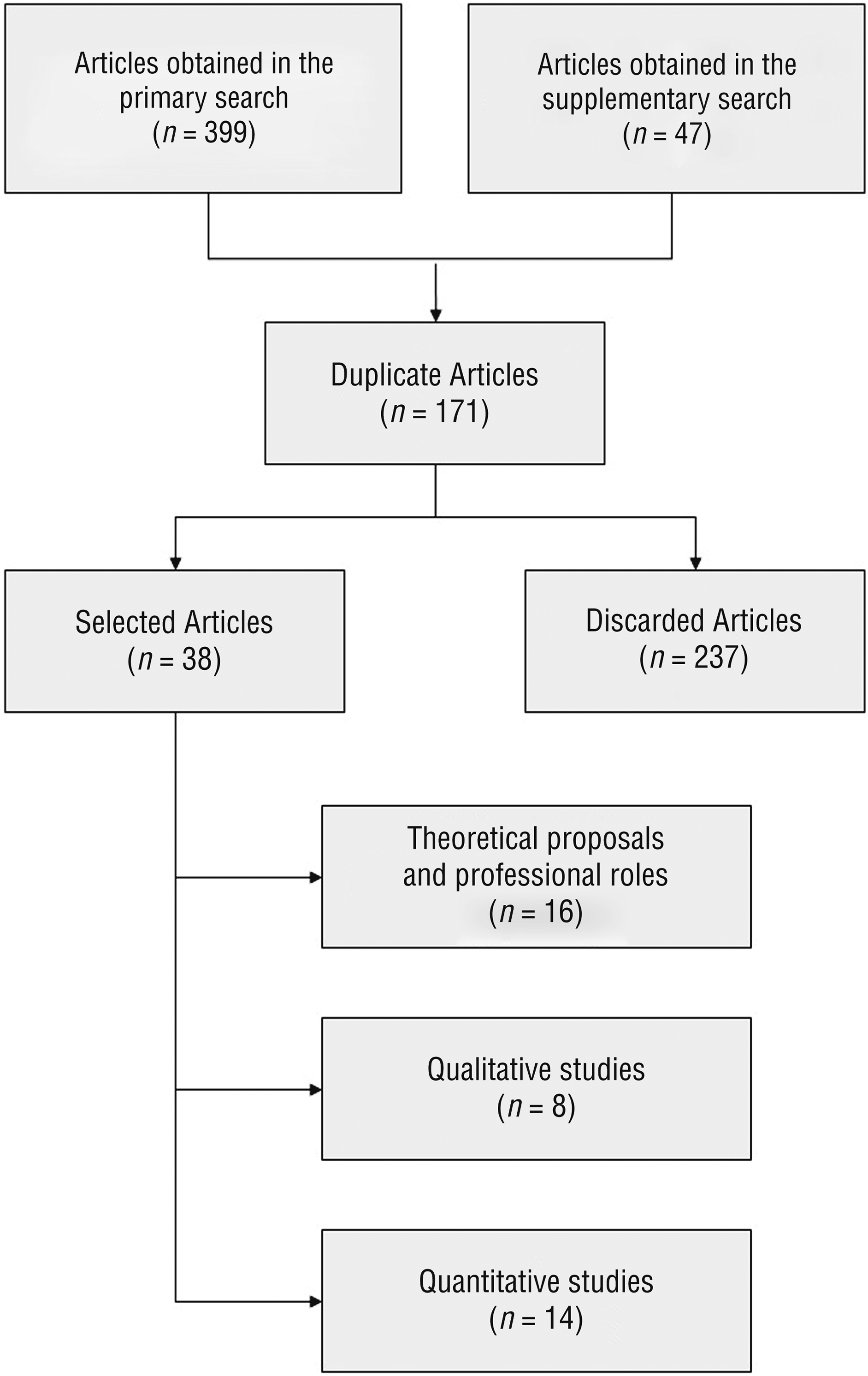
Process of review and selection of articles.
Theoretical Proposals and Professional Roles in the Systematic Review of Occupational Therapy in the Treatment of Addiction
Qualitative Studies Included in the Systematic Review of Occupational Therapy in the Treatment of Addiction
Note. CASP = Critical Appraisal Skills Programme (CASP criteria range from 0 to 10).
Quantitative Studies Included in the Systematic Review of Occupational Therapy in the Treatment of Addiction
Note. — = study was not evaluable; ADO = self-assessment of occupational performance; AMPS = Assessment of Motor and Process Skills; CASP = Critical Appraisal Skills Programme (CASP criteria range from 0 to 10); HT = horticultural therapy; LHQ = Lifestyle History Questionnaire; OT = occupational therapy.
Discussion
Our first conclusion is that occupational therapy’s contribution to the understanding and treatment of addictive behaviors is poor. Earlier studies have indicated that occupational therapy services in psychiatric settings have two main objectives: therapeutic and diagnostic. In both cases, these concepts refer to the psychiatric intervention, not to occupational activity itself (Welsh, 1959). In addition, Welsh (1959) referred to an attempted clinical alcoholism treatment trial in the scope of occupational therapy. However, Welsh referred not to a specific protocol but to a project from which he drew on material scattered throughout the source cited (Hossack, 1952). There is no evidence that this project was ever carried out. In any case, these references support the existence of occupational therapy services in treating people with addiction since the middle of the 20th century.
Therefore, as in other clinical settings, occupational therapy has separated from the preeminent disciplines and developed its own framework, which is used in the treatment of addiction. The articles published in the 1980s refer, in the vast majority of cases, to roles framed by psychiatric services, with occupational therapy as a secondary and complementary activity. The paradigm of alcoholism as a mental illness and the understanding of alcoholism from a psychoanalytic perspective are predominant in the field of psychiatry, in which occupational therapy has provided complementary actions, such as training in handling money (Kunz, 1988). Articles that tackle alcohol addiction from a biopsychosocial perspective and apply occupational therapy concepts appeared only at the end of the 1980s (Van Deusen, 1989). The first attempt to provide a theoretical framework of addiction from a strictly occupational perspective appeared in 2003 (Helbig & McKay, 2003).
Authors such as Helbig and McKay (2003) considered addiction a complex activity that alters the person’s occupational sphere. Other authors have studied addiction as an occupation itself, to the extent that it can give meaning to life; act as an important determinant of health, well-being, and justice; organize behavior; develop and change over a lifetime; shape and be shaped by environments; and have therapeutic potential (Haltiwanger, Lazzarini, & Nazeran, 2007). In both theoretical approaches, addiction is, in essence, an occupation that is strongly influenced by environmental elements, exceeding biological or psychological approaches that give a central role to factors specific to the individual. Surprisingly, no studies have been derived from these theoretical approaches, except for 1 qualitative study that explored addiction as occupation and its potential utility in implementing occupational therapy interventions for substance-related and addictive disorders (Wasmuth, Crabtree, & Scott, 2014). However, a recent article’s inquiry into the concepts relevant to occupational therapy suggests the need to validate and adapt the occupational assessment tools available in this particular clinical setting and design the occupational therapy framework in a specific way (Crouch & Wegner, 2014).
Regarding occupational therapy, few studies have focused on the field of addiction. Just 8 qualitative studies focused on specific issues, such as ethnic differences, homelessness, addicted fathers and mothers, and gender differences, and the number of quantitative studies focusing on occupational therapy in comprehensive treatment programs is not much greater. To conduct studies, validated measures to estimate variables characteristic of occupational therapy are required. Although many validated occupational therapy instruments exist for other clinical settings (Asher, 2007), few have been used with people with addictions. The psychometric properties of these measures have rarely been explored, and in any case, they have replicated the few results available.
All the studies included in this review had a low level of evidence. They were limited to case series and provide little of relevance; they used small or incidental samples and no control groups; and they did not randomize participants, which does not allow generalization of the findings. The only study that provided a better level of evidence is a systematic review of effective treatments for addictive behaviors (Stoffel & Moyers, 2004), which included only self-help and psychological studies. The authors stated that occupational therapy studies that examine the efficacy and effectiveness of interventions for people with substance use disorders were lacking. The only controlled clinical trial (Detweiler et al., 2015) had severe deficiencies in its methodology, which make its results questionable. Its main conclusion was that occupational therapy researchers need to examine interactions among person, environment, and occupation to understand some of the complex aspects of prevention and recovery that are ignored in the current literature.
Certainly, occupational therapy has developed a wide range of instruments for populations with impairments in occupational performance resulting from brain injury, psychomotor disorders, environmental factors, mental health, and so forth, many of which seem potentially applicable to occupational assessment and diagnosis of people in recovery from addiction. A critical requirement of such measures is the determination of their psychometric properties, construct validity, and diagnostic validity in a population with distinct characteristics, such as the population with addictive behaviors. Some of the interventions that must be measured to quantify the impact on addiction recovery, beyond the mere achievement and maintenance of abstinence, are rehabilitation of brain function, alternative roles to addiction, performance improvement, enrichment of the environment, empowerment of the person, and, ultimately, use of the therapeutic process as a means and as a goal (Haltiwanger et al., 2007).
This systematic review was intended to answer three questions. The answer to the first question is clear: Occupational therapy has models that are able to explain addiction from the occupational perspective, without requiring concepts and models from other disciplines. The answers to the other two questions are not so optimistic. These theoretical models have not yet been translated into proposals for occupational intervention whose results could be measured and translated into controlled clinical trials. Only recently have we found proposals that represent the start of an occupational intervention that is capable of generating effectiveness studies in coming years (Crouch & Wegner, 2014).
Limitations of this systematic review include the article selection process. The main inclusion criterion was the centrality of occupational therapy in conceptual or professional proposals or qualitative or quantitative research studies. The concept of centrality is ambiguous and can lead to biases in its application. If the inclusion criteria had been more flexible, we could have included more studies, but we considered the inclusion criteria necessary to investigate the role of occupational therapy in the problem treated. Therefore, we omitted articles that applied explanatory models and interventions from other disciplines (psychology and psychiatry) and offered only a tangential view of the role of the occupational therapist.
Implications for Occupational Therapy Practice
The results of this study have the following implications for occupational therapy practice:
Even though occupational therapy has intervened in the clinical field of addiction for more than 70 yr, its scientific production has been poor; few studies have been conducted, all with low levels of evidence.
In the past decade, occupational therapy researchers have proposed models of addiction that attempt to explain how addiction affects a person’s occupational life and that consider addiction itself to be an occupation. Despite having a conceptual framework and theoretical models, few studies have evaluated occupational therapy treatment of people with addiction.
A critical deficiency is the absence of validation studies of assessment tools for people with substance abuse or behavioral addictions. In the absence of specialized occupational therapy instruments, it is difficult to design rigorous studies to provide scientific evidence on the effectiveness of occupational interventions.
Occupational therapy practitioners must address the challenge of finding evidence of their usefulness in the field of addictions, as they have done in many other clinical settings, and as corresponds to their methodological reference, occupational science.
Conclusion
Despite the fact that occupational therapy has been involved in the treatment of people with substance addiction and, more recently, with behavioral addictions for more than half a century, the volume of research published is poor. As a start, models exist to guide research that is based on concepts and objectives strictly from occupational therapy, without overlapping with other clinical disciplines. An urgent need exists to validate instruments that measure occupational variables in populations with addiction as a prerequisite for the design of quality research projects. Occupational therapy, as an independent scientific discipline, must prove this state through the development and publication of studies that explore the benefits of interventions for ADL performance.
Footnotes
*
Indicates studies that were included in the systematic review.
Note. Each issue of the 2017 volume of the American Journal of Occupational Therapy features a special Centennial Topics section containing several articles related to a specific theme; for this issue, the theme is occupational therapy’s role in mental health. The goal is to help occupational therapy professionals take stock of how far the profession has come and spark interest in the many exciting paths for the future. For more information, see the editorial in the January/February issue,  .
.