





Abstract
The United States is experiencing a shift in age demographics: The number of adults older than age 65 will grow from 13% to 20% of the population by 2030 (Centers for Disease Control and Prevention & Merck Company Foundation, 2007). The majority of this population will live with chronic disease (Centers for Medicare and Medicaid Services, 2011). Older adults are the greatest consumers of prescription medications, with more than 40% taking at least five medications each week and 20% taking 10 or more to cure or manage acute and chronic disease, extend life expectancy, and improve quality of life (Gellad, Grenard, & Marcum, 2011; Kaufman, Kelly, Rosenberg, Anderson, & Mitchell, 2002; Unni, Shiyanbola, & Farris, 2013; Wilson, Hunter, Florio, & Langberg, 1996; World Health Organization, 2003). When followed correctly, medication regimens have the potential to be one of the most effective and affordable ways to manage health and prevent disease (Wilson et al., 1996). Unfortunately, nonadherence to such routines is common among older adults; only about 50% take medications as prescribed (World Health Organization, 2003). Nonadherence results in serious, preventable health consequences such as falls; adverse drug reactions; depression; unnecessary health costs, including hospitalizations; confusion; fractures; and death (Fick et al., 2003).
Medication-taking behavior is complex, individualized, and multifaceted (Brown & Bussell, 2011). With increased age, adherence to a medication routine becomes one of the most complex instrumental activities of daily living (IADLs) because of multiple, but modifiable, barriers (Carlson, Fried, Xue, Tekwe, & Brandt, 2005; Osterberg & Blaschke, 2005). Factors that can lead to reduced adherence include age-related loss of cognitive and functional abilities, miscommunication, health illiteracy, complex medication regimens, poor patient–prescriber relationships, high costs, and a lack of transportation and social supports (Gellad et al., 2011). Determining the specific barriers to medication adherence can improve it; however, medication management problems often go unrecognized (Farris & Phillips, 2008).
Developing a greater understanding of barriers to medication adherence can be achieved through systematic and standardized measurement (Farris & Phillips, 2008; Hawkshead & Krousel-Wood, 2007). At present, no published instruments or gold standard methods with sufficient validity and reliability have been recommended for widespread use (Elliott & Marriott, 2009, 2010; Farris & Phillips, 2008; Vik, Maxwell, & Hogan, 2004). Instruments often have a narrow focus on barriers specific to a particular condition, such as diabetes or heart disease (Cutler & Everett, 2010). Studies frequently claim adequate content validity of instruments but rarely specify the actual methods of achieving strong validity (DeVon et al., 2007). Assessment of older adults’ medication management exclusively in traditional outpatient or inpatient clinical settings can be problematic. Nearly half of older adults fail to report, or deliberately omit, medication information during physician evaluations (Yang, Tomlinson, & Naglie, 2001); moreover, people who do not adhere to medication routines may not seek appropriate health care services (Haltiwanger, 2012).
A validated medication management assessment for the home is needed to evaluate older adults at risk for nonadherence and to determine appropriate levels of support for continued independence (Farris & Phillips, 2008). In-home, structured, performance-based assessments are ideal for uncovering barriers to medication management that would otherwise go undetected in standard clinical examinations (Applegate, Blass, & Williams, 1990; Yang et al., 2001). The home setting allows for more authentic evaluation because it is where medication management is most likely to take place. Moreover, actual medications can be used instead of relying on simulated medication management tasks (Farris & Phillips, 2008).
Occupational Therapy and Medication Management
Intervention for the IADL of medication management is frequently cited in the literature as a common reason for occupational therapy in the home setting (American Occupational Therapy Association, 2014; Craig, 2012; Sanders & Van Oss, 2013; Touchard & Berthelot, 1999); however, only a limited amount of research has supported the efficacy of occupational therapy in improving medication management (Radomski, 2011). Recent preliminary studies of occupational therapy and medication management are limited by reliance on self-report data collection methods (Radomski, 2011; Sanders & Van Oss, 2013; Touchard & Berthelot, 1999). Occupational therapists have unique training and expertise to assess the holistic task demands of medication management: cognition, perception, motor, environment, social support, and technological factors (Radomski, 2011; Touchard & Berthelot, 1999). Unfortunately, occupational therapy practitioners report assessing medication management less frequently than other common IADLs, such as meal preparation, driving, and shopping (Fricke & Unsworth, 1998).
Purpose
The purpose of this study was to develop a novel, performance-based medication adherence assessment, the In-Home Medication Management Performance Evaluation (HOME–Rx). The HOME–Rx is intended for use by home health occupational therapists to assess an older adult’s ability to manage medication routines in the home and to identify at-risk behaviors.
Method
Design
To develop and assess the initial psychometric properties of the HOME–Rx, we used qualitative and quantitative methods following a multistep content validity index (CVI) process (Lynn, 1986). The first step of the CVI process, the development phase, was completed by the study team. Next, content experts in medication management provided qualitative and quantitative judgment of the new instrument’s content validity. Finally, older adults, representative of the assessment target population, provided qualitative feedback through a semistructured interview. The results from the CVI process were compiled and informed minor instrument revisions. A standardized protocol for instrument administration was developed to further ensure reproducibility of future assessment results (Elliott & Marriott, 2010). The study received approval from the institutional review board at Washington University in St. Louis, Missouri.
Instrument Description and Development
The HOME–Rx is a performance-based tool designed to identify functional barriers to medication management for community-dwelling older adults. Its purpose is to identify common and specific barriers to independence in medication management for older adults living independently in the community. Key components from the medication management literature describing barriers to medication adherence were compiled, and the HOME–Rx draft was completed using open- and closed-ended question formats. The occupational therapist authors (Somerville, Keglovits, Hu, and Stark) of the assessment determined that the HOME–Rx had high face validity to capture the complex construct of medication management.
The HOME–Rx has three sections: (1) Medication Management Interview, (2) Medication Management Assessment, and (3) Medication List. The Medication Management Interview includes 19 questions that assess an older adult’s knowledge of his or her medication management routine. The Medication Management Assessment includes 17 performance-based medication management tasks that are completed using the older adult’s medications. Finally, the Medication List includes 10 information points for each medication that the older adult is taking.
Content Expert Quantitative and Qualitative Judgment
Content expert participants (n = 7) with relevant experience in medication management and geriatric populations and clinical expertise were recruited nationally to determine the content validity of the HOME–Rx using convenience sampling methods (Table 1). A minimum sample size of 5–10 content experts was set a priori for the CVI process to provide a sufficient level of control for inflation of agreement on instrument items (Lynn, 1986). Experts were included if they were English speaking and had a minimum of 5 yr clinical, research, or professional experience in geriatrics, medication management, pharmacy, nursing, home health, geriatric rehabilitation, public health, social work, community health, aging in place, productive aging research, or rehabilitation and medical academia. Content experts with direct involvement in the initial creation of the HOME–Rx were excluded.
Participant Demographics
Note. M = mean; SD = standard deviation.
Content experts who met the above criteria and agreed to participate received a copy of the HOME–Rx, a qualitative questionnaire, and an item score sheet. The experts were asked to evaluate the instrument and determine how relevant it was to the content domain of medication management. The content experts evaluated the instrument (scale-level CVI [S–CVI]) and rated individual items (item-level CVI [I–CVI]) using a 4-point ordinal scale (1 = not relevant, 2 = somewhat relevant but needs major revision, 3 = relevant but needs minor alteration, 4 = very relevant and succinct). For each item, the content expert was also given space to write suggestions for item improvement. Open-ended questions were also asked for further item improvement and evaluation (Figure 1).
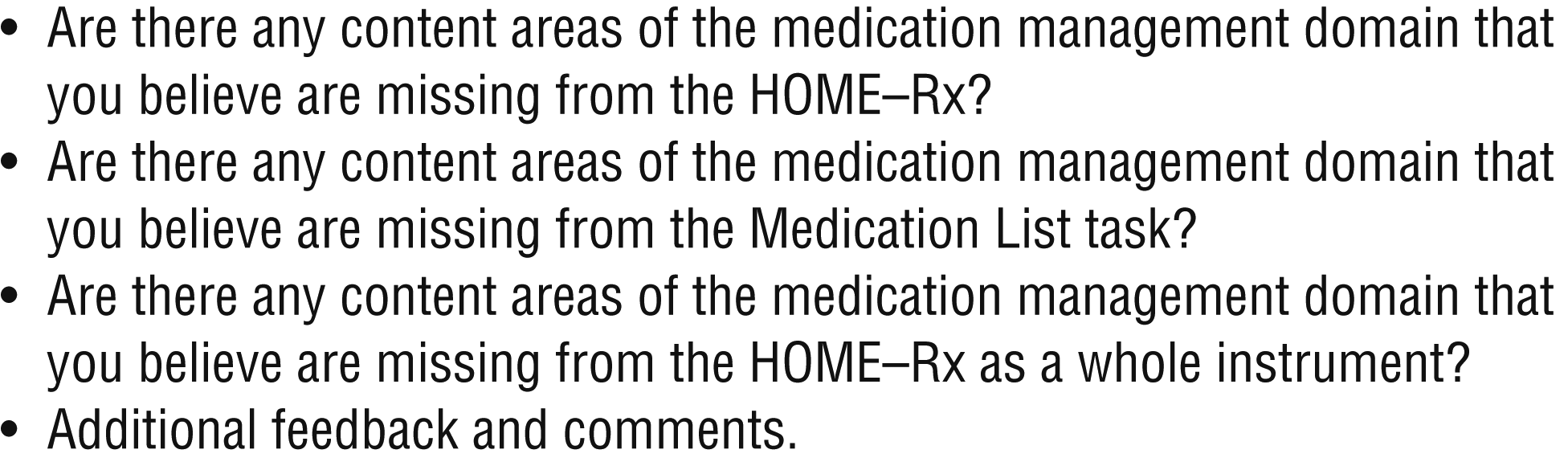
Open-ended content validity index questions for content experts.
Target Population Qualitative Review
After revisions were made to the instrument on the basis of the content expert review, community-dwelling older adults who represent the HOME–Rx’s target population (n = 5) were recruited (Benson & Clark, 1982). Older adult participants were included if they spoke English, lived in the community, were age 65 yr or older, and took three or more daily medications.
After obtaining participant consent, a member of the research team administered the HOME–Rx in the home of each older adult participant. Participants then took part in a semistructured interview about the HOME–Rx (Figure 2). They were asked to judge the clarity of the items and make recommendations relevant to overall instrument quality. Field notes were used to record the results of the interview.
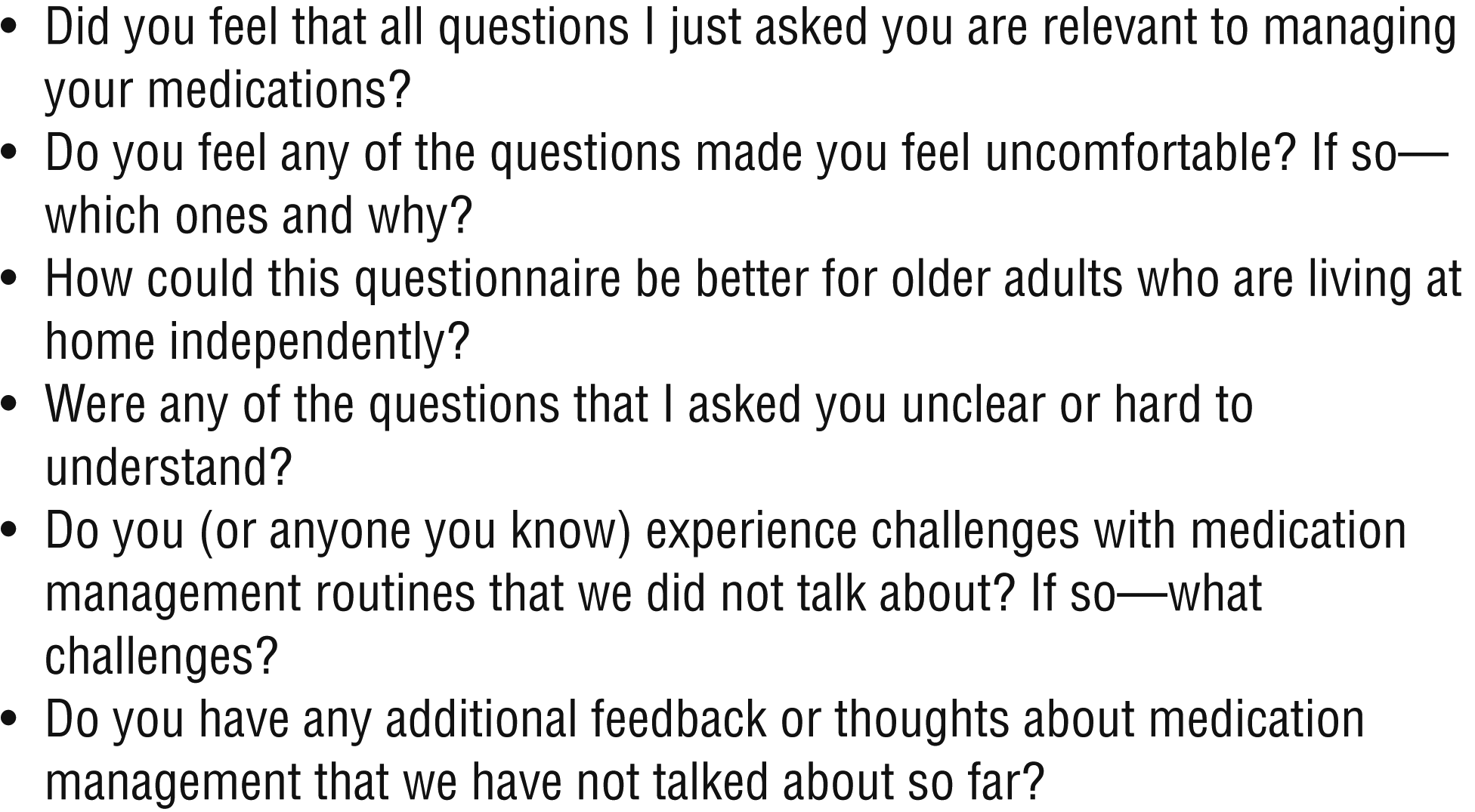
Semistructured interview questions for older adults.
Data Analysis
Each item’s agreement scores were calculated by determining the proportion of items rated as 3 (relevant but needs minor alteration) or 4 (very relevant and succinct) on the CVI scale by all participants (Waltz & Bausell, 1981). The following formula was used:


A minimum I–CVI score of .80 was considered acceptable for inclusion in the HOME–Rx (I–CVI = 1.00 indicates total agreement). An S–CVI score of .90 for the entire assessment was considered an acceptable level of agreement. Items that did not meet the minimum calculation were eliminated or further revised per the qualitative feedback from content experts and older adults (Lynn, 1986).
Semistructured interview data from older adult participants were audio taped and transcribed verbatim. Notes from the interviews were then reviewed by the research team members for trends in responses to inform necessary revisions to the HOME–Rx. All qualitative feedback was reviewed, and revisions were made on the basis of the feedback from content experts and older adults. The research team reviewed all edits until a total consensus was reached.
Results
Content Validity Index
Content Experts.
Content experts (n = 7) were in agreement that the overall HOME–Rx instrument was valid for measuring older adult medication management (S–CVI = .95). Content experts also ranked 57 individual instrument items using the standardized 4-point ordinal scale. Fifty-two (91%) of the items on the instrument received acceptable I–CVI agreement scores and were considered content valid. The I–CVI scores ranged from .6 to 1.0. A total of 6 items were deleted because of CVI scores <.80, indicating low agreement. Table 2 summarizes the CVI scores assigned to the HOME–Rx by assessment category. Minor edits, such as order of questions and language usage, were made to 29 of the items on the basis of qualitative feedback provided by the experts and older adults.
Content Validity Index Quantitative Scoring Results
Note. N represents the count of scored items per category. CVI = content validity index; HOME–Rx = In-Home Medication Management Performance Evaluation; I–CVI = item-level CVI; S–CVI = scale-level CVI.
Older Adults.
Older adult participants (n = 5) unanimously reported that the HOME–Rx was relevant, acceptable, and easy to understand. During the semistructured interviews, participants indicated the importance of assessing the cost of medications, the time of day one is supposed to take medications, difficulty manipulating containers (e.g., eye drop bottles, blister packs, pain patches), and the challenges in obtaining refills. Three participants also emphasized the impact of lack of physical transportation as a barrier to getting medication refills. Older adult participants stated that having information such as the prescription number and doctor or pharmacy contact numbers on a medication list would be of high utility. Additional feedback on the HOME–Rx included formatting changes such as making the font larger and easier to read, including a higher number of open-ended questions, and modifying the order of information collected on the medication list so that it would have greater meaning and utility to an older adult user (i.e., prioritizing relevant columns, such as prescribing physician and dispensing pharmacy). Four of the older adult participants stated that the HOME–Rx assessment could be a useful tool to start comprehensive conversations regarding medication management in the home.
HOME–Rx Item Revisions
Content expert participants (n = 7) and older adult participants (n = 5) provided more than 100 unique qualitative feedback comments across all questions. On the basis of this feedback, we determined that 29 HOME–Rx questions warranted minor revisions. For example, feedback provided for the question “Has a medical professional formally reviewed your current list of medications in the past 6 mo?” included recommendations for revisions regarding language (“Change to ‘health professional’ to be more inclusive”). Another context expert commented, “I would suggest defining medical professional (such as physician, nurse, pharmacist, etc.) [italics added].” The final question was worded “Has a health professional formally reviewed your current list of medications in the past 6 months?” On the basis of feedback provided by the older adult participants, four additional sections were added to the medication list: (1) prescription number, (2) time of day, (3) doctor phone and fax numbers, and (4) emergency contact information.
Discussion
The HOME–Rx is a new instrument to assess older adults’ medication management in the home. The tool has strong content validity across the instrument and individual items, as determined by the CVI process. The HOME–Rx accurately represents the theoretical domain (medication management) and is without irrelevant factors (Benson & Clark, 1982).
Content experts and older adults were in general agreement with regard to instrument feedback; however, the older adults provided additional valuable insight into medication management that was not captured by the content expert review. Older adults stressed that having reliable transportation to obtain medication in a reasonable and timely manner was of utmost importance and that in-home assessment is critical to successful medication adherence. In contrast, the content experts did not rate the questions about transportation as highly important, and some even stated that it would be an “irrelevant” factor. These types of discrepancies in understanding barriers to medication management may contribute to why needs are not always met in the older adult–prescriber relationship. The HOME–Rx is a comprehensive assessment that can uncover barriers that may be overlooked in traditional clinic settings.
It is urgent to find solutions to low medication adherence given the rapidly growing population of adults older than age 65. This age group has a longer life expectancy and increased medication consumption and is at high risk for medication-related adverse complications. Without a system in place to address the factors and causes of medication adherence, advances in biomedical technology and medication treatments will never reach their full therapeutic potential (World Health Organization, 2003). Moreover, a proactive focus on health throughout the lifetime and a coordinated multidisciplinary effort are necessary for progress in managing problems with medication adherence (World Health Organization, 2003). We believe that the HOME–Rx is a step toward this goal by helping to identify performance barriers of medication management and guide interventions to improve older adults’ medication adherence. Results from the HOME–Rx will guide clinical occupational therapy interventions to address specific identified performance barriers to independence in medication management.
Limitations
A limitation of this study is that the CVI is an indicator of interrater agreement that simply expresses the proportion of agreement, and agreement can be inflated by chance factors (Polit & Beck, 2006). To minimize this, we recruited seven content experts to control for chance agreement and used a structured procedure to evaluate agreement scores. The absence in practice of a true gold standard for functional capacity to manage medication is a limitation that we could not avoid (Elliott & Marriott, 2009, 2010; Farris & Phillips, 2008; Vik et al., 2004). Another limitation of the study is the lack of racial and ethnic diversity in the older adult pilot sample; demographic characteristics (i.e., ethnicity) may influence medication management and should be taken into consideration when evaluating the HOME–Rx’s validity.
In clinical settings, a performance-based assessment of the HOME–Rx could be problematic because of the time and cost associated with administration, but scholars have argued that direct observation of performance is the most objective measure of IADL function for older adults (e.g., Hilton, Fricke, & Unsworth, 2001). The HOME–Rx uses direct observation and self-report to assess medication management. Moreover, the cost of institutionalization or hospitalization as a result of a medication nonadherence event is likely to be greater than the cost of in-home assessment methods. We anticipate that HOME–Rx administration time will be approximately 30–45 min depending on the quantity and complexity of medications that an older adult takes. Clinicians could select the HOME–Rx when an in-depth assessment of an older adult’s medication management is needed.
Future Directions
The criterion-related validity and reliability of the Home–Rx have yet to be established. A pilot study of the HOME–Rx will be conducted in homes of older adults in the St. Louis area to establish its interrater reliability and a scoring metric for the domains of the assessment. The results from the HOME–Rx assessment will be correlated with an existing medication management screen and battery of assessments to further establish its validity (Robnett, Dionne, Jacques, Lachance, & Mailhot, 2007). In addition, future studies should address the validity of the HOME–Rx in diverse populations.
Using an older adult’s actual medications as part of the HOME–Rx instrument may be considered a disadvantage because it relies on the fact that an individual’s medications will readily available, and it is possible that some older adults will be reluctant to share all the medications they are taking (Elliott & Marriott, 2009). However, this method allows for greater testing authenticity and the ability to test meaningful medication knowledge, and thus it is a preferred method for the home setting (Farris & Phillips, 2008). Although instruments that use simulated medications can allow for higher levels of testing standardization, they are more appropriate for the clinic or hospital setting. Documentation of a standardized HOME–Rx administration protocol will further ensure reproducibility of future assessment results (Elliott & Marriott, 2010).
Implications for Occupational Therapy Practice
This study has the following implications for occupational therapy practice:
The HOME–Rx had strong content validity scores. It could be a relevant and valid instrument that occupational therapists can use in the home to assess performance barriers to medication adherence among older adults.
The CVI process is a standardized and easy-to-follow method for confirming content validity metrics for assessments, and it should be considered for future use when establishing the initial psychometric properties of assessments.
Footnotes
Acknowledgment
We thank the content experts and older adult participants for their time and invaluable feedback in the development of the HOME–Rx.