





Abstract
Occupational therapy was formed to enhance lives through occupation; nevertheless, the concept of occupation has had a complicated history within the annals of the profession. By definition, occupation means “all the things people want, need, or have to do, whether of physical, mental, social, sexual, political, or spiritual nature and is inclusive of sleep and rest. It refers to all aspects of actual human doing, being, becoming, and belonging” (Wilcock & Townsend, 2014, p. 542). Historically, though, the uses and meanings of the concept have waxed and waned within the lexicon of the profession (Bauerschmidt & Nelson, 2011).
Initially, having exhibited potential to invoke adaptive responses leading to mental and physical health, the idea of occupation was prominent and touted as the reason to establish a new profession and educational programs (Gordon, 2009). Subsequently, occupation became intertwined with other concepts, such as that of purposeful and meaningful activity. Some scholars argued that occupation was for a time further displaced by medical concepts emphasizing mechanisms of body and mind (Presseller, 1984). More recently, occupation regained prominence as a central concept, resulting in theories and models of occupation as well as the inception and growth of occupational science. Scientists have elaborated on the occupational nature of humans, conditions that support and inhibit participation, meaning, and other subjective experiences of doing (e.g., Pierce, 2014; Whiteford & Hocking, 2012). In addition, researchers have explored and elaborated on the process, efficacy, and outcomes of occupation-based practice (Clark et al., 2012; Fisher, 2013; Price & Miner, 2007).
The fluctuations of occupation as the profession’s central concept have been reflected in education. In what has been called the reductionistic period between the 1930s and 1970s, occupational therapy educational standards required increased biomedical content and less occupation content (Presseller, 1984). In recent decades, as the concept regained prominence, accreditation standards again required content related to occupation. Moreover, occupation has been referred to as a threshold concept for education (Fortune & Kennedy-Jones, 2014). Threshold concepts are unique to and bounded within a discipline; they are challenging to grasp, but once understood, they transform students’ views and interpretations (Meyer & Land, 2003). Hooper et al. (2015) called for placing occupation in the center of curricula to “enrich new occupational therapy practitioners’ ability to grasp the purpose of the profession and reason clinically in complex practice environments” (p. 1). In sum, the waning and restored prominence of occupation in practice is, historically, tied to education.
As a core concept, a deep understanding of occupation is crucial to its use as a therapeutic tool. That is, understanding humans’ occupational nature; the dynamics of being occupied; and how occupation feeds and nurtures identity, provides meaning and, ultimately, shapes one’s health and life quality is pivotal to occupation’s utility in therapy. Differentiating meaningful occupations from preparatory and purposeful activities is also key to effective practice (Fisher, 2013). Thus, it behooves researchers to examine education as the key mechanism for conveying these understandings to future practitioners.
The findings presented here were part of a larger study that broadly examined how occupation was addressed in occupational therapy curricula across the United States. This article presents findings related to one research question: How was occupation addressed at the instructional level; that is, what classroom processes, methods, and materials were used, and what key messages were conveyed about occupation? Other research questions explored how occupation was addressed at the curriculum level, that is, what infrastructures such as the program mission, philosophy, and whole-program approaches were used; what topics were taught in relation to occupation; how was knowledge about occupation assessed; and what challenges to addressing occupation in education arose.
Method
Design and Sampling
Basic or generic qualitative methodology guided the study (Percy, Kostere, & Kostere, 2015). Occupational therapist and occupational therapy assistant programs across the United States were stratified by both geographical region and institution type using the Carnegie Classification of Institutions of Higher Education (2016; see http://carnegieclassifications.iu.edu) to ensure broad representation of education programs. Aligned with the research questions, sampling categories were not designed as variables for comparative analyses. Computer-generated random sampling from each group created the list of participants who received email invitations. The study’s protocol initially called for 30 programs, 15 from each level of professional education, or 10% of all programs accredited by the Accreditation Council of Occupational Therapy Education (ACOTE®) in 2010. Thirty programs were targeted to keep the large-scale study feasible and because this number was in the range typical for qualitative data to reach saturation (Creswell, 2013). Ultimately, 25 programs, also referred to herein as participants, from separate universities and colleges were included. Although not sampled for this factor directly, all participants described occupation as a central focus of the profession and education. Characteristics of the programs are summarized in Table 1.
Characteristics of Participating Programs (N = 25)
Data Collection
All programs were asked to describe how they addressed occupation and to provide illustrative classroom videos and artifacts such as syllabi or assignments. To capture how programs addressed occupation from their own vantage point, no a priori definition of occupation was provided. After piloting the interview guide with 3 programs that did not participate in the study, three authors (Sheama Krishnagiri, Barb Hooper, Pollie Price) conducted in-depth, semistructured telephone interviews with one to four key informants who had direct knowledge of the curriculum at each of the 25 participating programs. Interviews lasted 60–90 min. Interviewers were not assigned to a program if they were familiar with its curriculum. Two interviewees were known professionally, however, by one interviewer; in these cases, the professional relationship seemed to support rich dialogue about curricular issues.
Sixteen programs submitted video recordings of an instructional session. Participants who did not submit videos stated lack of time or no current class session in which occupation was taught. A total of 243 artifacts, including syllabi, assignment or activity instructions, lectures, grading rubrics, and samples of student work, were collected from all but 1 program. Interviews were recorded and transcribed verbatim by an external transcriptionist.
Data Analysis
Generic qualitative analyses using both inductive and deductive methods were used (Percy et al., 2015). Inductive analysis was used for interview data, which served as the foundation for deductive analysis of the remaining data. The interview data were analyzed using the constant comparative method (Creswell, 2013) with the assistance of Atlas.ti computer software (Version 6.2, Scientific Software Development, Berlin, Germany). Working in pairs, six researchers independently coded each interview before discussing and agreeing on code assignment. The research team met biweekly to discuss, develop, and define the codes further and create a code book for analysis (MacQueen, McLellan, Kay, & Milstein, 1998).
The code tree branches emerged as these start codes: occupation addressed, occupation not addressed, content, curriculum design, facets of occupation, contextual influences, instructional processes, outcome expectations and measures, and resources. Start codes were particularized through subcodes. Codes and subcodes were collapsed into categories. Relationships among categories were examined to develop explanatory themes of what the data revealed about how occupation was addressed. Use of multiple researchers in this cascading analytical process increased the credibility of the findings and ensured reflexivity (Creswell, 2013).
Artifact data were coded deductively using the code book, although codes were reviewed and refined per the nuances found in the artifacts. Additional codes unique to the artifacts were also developed. Codes and themes from the interviews and artifacts were used to deductively analyze video data using a 10-min segment as the unit of analysis (Derry et al., 2010). Some codes unique to video data emerged. Triangulation and authenticity were established by reapplying categories and themes to select interview, artifact, and video data to examine goodness of fit and by having a nonteam member conduct an audit on a subset of data from 8 programs using the same analytical methods. Because of the breadth of data from each program, the study did not include member checks (Angen, 2000).
Results
Educators described numerous, highly creative instructional methods to teach the concept of occupation. These methods ranged from didactic to experiential. At the didactic end, participants described using interactive lectures to discuss definitions of occupation or the history of occupational therapy, among others. At the experiential end, participants engaged students in observations, role plays, case studies, interviewing people to create occupational profiles, service learning, and learning novel occupations and reflecting on the process.
It was clear that participants in this study were dedicated to occupation as a central focus of the profession. However, that focus varied in how explicitly it manifested in content and instructional design, ranging from being explicit to remaining implicit in instruction. This continuum of explicit to implicit had five categories, or what we termed stops, that were used to organize the study’s findings (Figure 1).
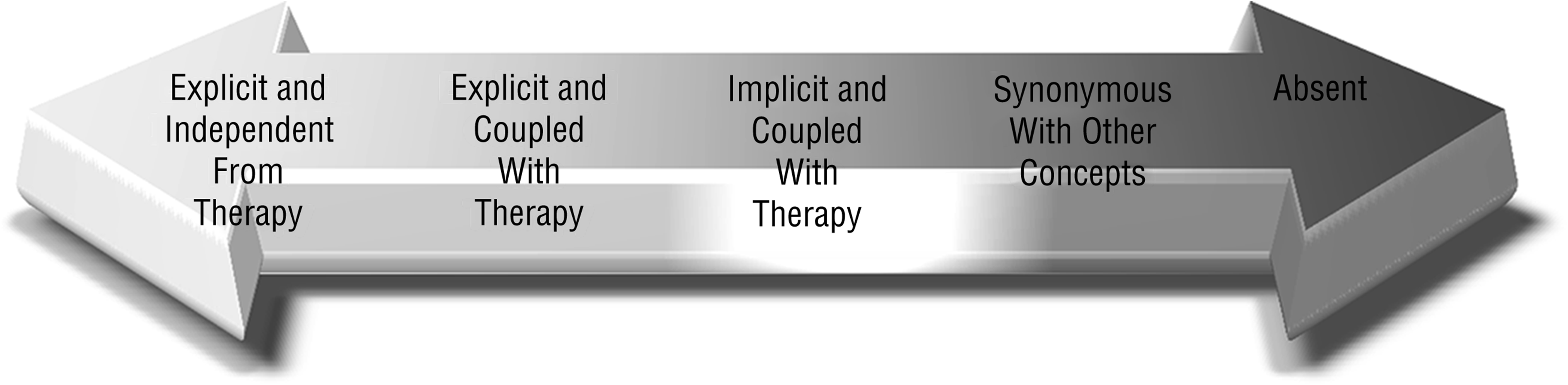
Continuum of occupation explicitness in instructional strategies of occupational therapy programs.
At the first stop, when taught explicitly, occupation was addressed overtly in instructional activities as a perspective or way of seeing, focusing on understanding occupation as a concept unto itself apart from therapy. At the second stop, occupation was explicit and presented as a tool for practice by which students were to help clients achieve health, well-being, and rehabilitation. At the third stop, occupation was coupled with therapy as a tool for practice but was implicit. For example, one-handed dressing techniques were taught to help people who have one functional limb. From this point, occupation remained implicit, or what we termed jumped over; in these programs, activities of daily living were not explicitly linked to occupation, or it was assumed that students had already made that connection. At the fourth stop, other concepts, tools, and theoretical ideas within occupational therapy were taught as though they were equivalent to occupation, thereby addressing occupation implicitly. For example, sometimes activity and occupational analysis were taught as though they were interchangeable with occupation. Finally, at the far end of the continuum, occupation was absent.
Instances of all five stops were noted in all data from all programs. For example, occupation was often explicit and even powerful in the verbal description of assignments and courses, but it was sometimes implicit in the associated class videos or materials used by students. Thus, a single assignment, class session, or course could range the full continuum. Details about the five stops are discussed next.
Occupation Was Explicit and Independent From Therapy
When explicit, occupation was focused on directly as a concept unto itself in learning activities. Instruction highlighted one or more of the following ideas regarding occupation: occupation gives meaning to life, humans possess an occupational nature, occupation shapes and is shaped by culture, occupation changes over time, occupation supports development, occupation is environmentally situated, and occupation is the mechanism for participation. Correspondingly, syllabi and other artifacts reflected this emphasis.
The dimensions and definitions of occupation were often taught early in the curriculum. Experiential activities created opportunities for students to learn about their own and others’ occupational lives. For example, one instructor chose to include fewer crafts in the activity analysis course so that one craft continued over several weeks, allowing students to complete larger projects, providing experiences of occupation. The students were now
. . . teaching themselves new stitches, and making hats for all of their friends. It’s really been interesting just thinking . . . how our approach has changed and the students’ response to it has also changed. And then that gives you the opportunity to talk about how meaningful it became to them as a task that was new to them that they added to their repertoire, . . . but almost all of them really gain . . . a sense of satisfaction and it’s the perfect vessel then for talking about that concept of the satisfaction that comes from making a real product. . . .
In another program, students attended a county art festival:
They have all sorts of artwork with all sorts of media. There’s some artist that’s created sculptures with matches. Another artist has created sculptures with old silverware. . . . Then, they also have . . . a little short biography of the artist. A lot of them are local artists, actually, that you see how the person’s life circumstance has created an environment for this person to do this particular kind of art. Some of the artists had mental illness. . . . They’ll talk a little bit about how this person was able to do whatever through engaging in this artwork, so I think that that has made an impact on the students.
In both examples, after their experiences, students discussed the meaning of occupation, how available resources in the environment shaped opportunities for engagement, the confluence of culture and occupation, and other parameters. Neither program linked these particular experiences directly to therapy because the point was to understand the nature of occupation.
Occupation Was Explicit and Coupled With Therapy
Next along the continuum were instructional methods that emphasized occupation as a way of seeing, but instead of directly teaching the concept, the nature of occupation was conveyed through experiences related to occupation-based practice. For example, in one program, students engaged with children who received services at the university clinic:
[T]he kids come here, in a building with a lot of space, and they break up the kids into groups, and [students] try to do a lot of occupation-based treatment. And of course in the beginning, everyone is trying to find balls and all the sensory stuff. And it’s like, well, there’s a lot of other things you can do with the kids besides sensory things. Why is the child doing what they’re doing, and what could we do in terms of occupation-based treatment . . . ?
The pedagogy involved here led the students to consider that occupation can be used as a meaningful therapeutic intervention. The students had to link what they observed the children do to the children’s needs in the larger context of their life. The concept of occupation in all its complexity may or may not have been directly addressed, but it was being communicated through its use in practice. Evidence of this explicit connection to occupation through practice was also found in the artifact data for these types of assignments.
Occupation Was Implicit and Coupled With Therapy
In the middle of the continuum was a large group of instructional activities in which the term occupation was used interchangeably with the terms function and purposeful activity. Instruction portrayed occupation as something that was used to remediate performance skills and client factors such as balance, upper-extremity function, or standing tolerance. For example, one instructor described how she helped students make the connection between interventions and a client’s level of function:
I just did a lesson on strength testing and range of motion and goniometry . . . and help [the students] make connections between how do you come up with interventions when somebody has a certain level of strength? Think about what purposeful occupations or tasks are important for [clients] to be able to complete, like, do they need to have resistance in order to hang clothes on the clothesline? Do they have to be able to move against resistance and things like that? We started making those connections. . . .
In addition, from the language that was used, it was difficult to know whether the students made distinctions between the terms occupation and purposeful activities unless the instructor made it explicit. When asked about the students’ understanding, informants were sometimes doubtful that explicit links were being made:
I think that what’s happening is that we, the faculty, are so—what is the word I’m looking for?—ensconced is the only thing that I can come up with right now. . . . it’s such a natural thought to us that I don’t know that we are clearly articulating it well enough. When I take a step back and I look at the whole curriculum and the different classes and what we do, I think that there might be a disconnect between our thought process and what we are actually saying because in the first semester course it is very clearly articulated, but in the subsequent semesters, I don’t know that (and some of my other faculty could correct me on this) . . . we are actually making it very concrete and on the table that this is occupation-based intervention. I don’t know that we spend enough time in that area.
Moreover, instructional activities in this middle stop intermingled occupation with therapeutic skills such as transfer training or activities of daily living. In other words, instructors described teaching adaptive strategies for improving function or using purposeful activities as though they were the same as teaching the concept of occupation. One instructor, when asked to give an example of teaching occupation, stated
. . . they have an accessibility assignment where they have to go out into the community, like a grocery store, and they have to measure doorways and ramps and curb cuts and things like that and then report about how that accessibility enables community mobility and what if they in the perfect world could change something, what would they change and how would they change it for access in the community.
This example highlights students practicing skills to enable clients’ access to communities. What is not described is whether instructors also linked these skills to occupation, that is, the client as an occupational being, the meaning of accessing the community, or how access relates to identity, among other links.
At times, occupation was distinguished as on a continuum with preparatory methods; preparatory methods were precursors to doing meaningful activities. However, in some examples, the discussion about how to move from preparatory activities to occupation fell short. In one program, as students discussed interventions observed in Level I fieldwork, the instructor stated that
[W]e keep persevering and saying, “No, let’s remember what are the core elements of occupational therapy.” And so I would say that that is where we would start, and then, like that onion, building those other components. They definitely do learn how to do modalities and all of those components, but it’s not the modality for the sake of a modality. Why are you doing this? What kind of function are you going to get after this? What is the person going to be able to engage in after having this modality applied that they couldn’t do before?
Although instructors designed instructional activities and content intending to address occupation, the descriptions often stopped with remediating function through purposeful activities and applying therapeutic skills, thus falling short of addressing the concept of occupation unless instructors made these linkages explicit. In essence, the concept of occupation may have inadvertently been “jumped over” at times. This was also evident in video data that highlighted teaching therapeutic skills or remediation of function without explicit connections to occupation. In several syllabi, it was unclear how readings and topics featuring related concepts were being related to occupation.
Occupation Was Synonymous With Other Concepts
Further along the continuum, data indicated that in teaching activity analysis, the Occupational Therapy Practice Framework: Domain and Process (3rd ed.; American Occupational Therapy Association [AOTA], 2014) concepts of occupation, client-centered practice, and occupational therapy process were considered equivalent to the concept of occupation. When asked to provide an example of teaching occupation, several informants stated something similar to this educator:
The [Framework] is a focus of our discussion throughout that class. We take a case study, and the reason that we take one case study is so that we can keep revisiting that particular case study throughout subsequent classes and use that case study as a means of building our understanding on it. And so we start identifying aspects of that case study . . . that we would see in the [Framework].
Examples provided by multiple informants indicated that they perceived the teaching of Framework (AOTA, 2014) concepts in occupational therapy as being synonymous with teaching the concept of occupation. Triangulation of interview, video, and artifact data within the programs further solidified that, at this level of the continuum, few explicit links were being made to connect these Framework concepts to occupation. In these instances, similar to the previous stop on the continuum, the concept of occupation was jumped over.
Occupation Was Absent
At the final stop, in a few programs, the concept of occupation was absent. Occupation was not mentioned in descriptions of teaching or present in the artifacts or video data, nor was the concept described synonymously with other concepts when informants used terminology such as client centered, activities of daily living, or meaning. For example, in describing one curriculum, an informant stated
The second semester, they go on to neuroanatomy, so they see how the body reacts to drugs and some of that affecting function as well as . . . ability to get along in life. That course is timed with kinesiology, the study of movement, and we’re looking at people being able to compensate for muscles that are damaged, things that they have acquired, so that they can move on. So, we’re looking at each semester building on the other. Then, they’ll go into the summer semester, where we address the use of adaptive equipment and also politics.
The interview, artifact, and video data from this program indicate a use of the word occupation in the introductory course only; it did not show up in data after that point.
Discussion
As has been the case in occupational therapy historically, the theoretical development of ideas and concepts within and outside the profession reciprocally influence education. This article illustrates that the concept of occupation and its many dimensions are important in occupational therapy education. Most programs described teaching occupation along with its many connected concepts, at least in introductory courses, thus signifying value for the concept. The range of instructional methods used to convey occupation indicated the effort educators exerted to infuse occupation into learning. Yet, findings also depicted variation in how explicitly occupation was taught in spite of the attention, value, and creativity invested to make it visible to students. Moreover, data from the same program or course or even assignment often had elements in which occupation was explicit, such as verbal descriptions, and elements in which occupation was implicit, such as the written description of an assignment.
Explaining why occupation may at times be implicit and at others absent in curricula can help create strategies to move instruction toward the explicit end of the continuum. One explanation may be a disparity in levels of knowledge about occupation, thereby affecting how it is translated into learning experiences. Perhaps the explicit end of the continuum reflects deep knowledge of the concept as a basis for making it explicit. Conversely, perhaps the intermingling of occupation with other terms such as function and purposeful activity, as well as Framework (AOTA, 2014) concepts, reflects uncertainty about occupation and how these concepts relate.
Wilcock (2005) claimed a decade ago that such a confusion existed and that, to teach occupation explicitly, clarity is needed about how it relates to other concepts such as activities of daily living and meaning. Hooper et al. (2015) argued that it is easy to assume that teaching topics such as the Framework (AOTA, 2014) equates to teaching occupation and called for deeper attention to the concept of occupation and the occupational nature of humans as well as clearer connections between occupation and other important concepts and tools in the profession. Deeper understandings and clearer connections will strengthen teaching occupation explicitly.
Another explanation for the disparity in how explicitly occupation is addressed could be that educators have adopted occupation as an important concept in the curriculum, as Yerxa (1998) suggested. Therefore, occupation as a content area for everyday teaching can then become taken for granted and thus not be fully explicated through course content and materials, limiting how thoroughly it is expressed. This problem was evident throughout the data as informants expressed the importance of the concept but in the materials they provided occupation was not as explicit as described; it was jumped over or subsumed.
Another possibility is that educators have a grasp of occupation, and have created innovative instructional methods such as community-based learning, but a gap exists between knowledge of content and knowledge of creating learning processes. Consequently, the learning processes do not convey the content as fully as intended. Although this gap has not been articulated in occupational therapy, it has been discussed in education. Synthesis of educators’ pedagogical knowledge (knowledge about designing learning experiences) and their content knowledge is called pedagogical content knowledge (PCK) and is central to teaching (Zepke, 2013). Educators use PCK to formulate and represent content in a manner that is comprehensible and explicit to learners (Loughran, Berry, & Mulhall, 2012). Research indicates that the development of PCK among educators is a complex process specific to the context, profession, and educator (Van Driel & Berry, 2012). If this gap is indeed a contributing factor to the lack of explicitly teaching occupation, then strengthening PCK in occupational therapy education may be one means to ensure that occupation is taught explicitly.
Finally, the role of accreditation standards may be a contributing factor. Accreditation standards begin with a requirement to teach occupation as a basic tenet of the profession, and then they move to numerous required content areas such as standardized assessments, transfers, community mobility, documentation, and the consultative process (ACOTE, 2011). It seems plausible that educators might follow a similar structure within teaching: teach the basics about occupation then move to specific content areas that, depending on how they are taught, can obscure occupation. Accreditation requires that educators report on learning processes related to specific content, not on the connections of such content to the basic tenet of occupation, so it makes sense that occupation could lose its centrality.
The challenge of translating a concept, such as occupation, into pedagogies through which the concept is explicitly conveyed is not unique to occupational therapy. Meyer, Land, and Baillie (2010) described research showing how experts within several disciplines struggle to teach threshold concepts in such a way that they become conceptual gateways for students. Students struggle most with these threshold concepts; however, once they understand and move through this conceptual gateway, they can transform their perspectives into the discipline’s perspective, allowing ideas formerly not perceived to come into view. Fortune and Kennedy-Jones (2014) described occupation as a concept that is so fundamental in transforming the way a person looks at the world that it might be appropriately termed a threshold concept.
Implications for Occupational Therapy Education
Our finding suggest that instructional processes used to convey occupation to students can be evaluated for and strengthened in how explicitly they convey occupation. To accomplish this goal, educators can take the following steps:
Design faculty development initiatives to regularly update knowledge about occupation and about PCK.
Evaluate learning activities for both the intention to address occupation and the actual presence of occupation in the learning processes and materials. The continuum evident in this study can serve as a reference point for instructors to self-assess their instructional methods and materials.
Modify learning experiences and materials to make occupation explicit in each course, class, and learning activity. Ask students to connect occupation to other concepts being taught. Assess how well students make the connections.
Whether implementing these or other methods, the intent is to raise awareness of how the concept of occupation is taught and to increase congruence between intentions for teaching occupation and its presence in the learning processes and materials of occupational therapist and occupational therapy assistant programs.
Limitations and Future Research
The research team did not receive videos and artifacts from all programs, which might have influenced the findings. Although this article identifies a continuum along which occupation was addressed in teaching, the dynamics of the continuum remain unclear, such as the role of accreditation. Further research is needed to better understand connections and disconnections between educators’ intentions and teaching practices. Understanding these dynamics is critical if, as participants in this study said, “Teaching occupation is why we’re here.” Gathering data on students’ experiences would help describe how effectively instructional methods convey occupation. Focus groups or individual interviews with other faculty members may have provided richer information regarding each program. These limitations provide direction for future research on how occupation is addressed in curricula.
Conclusion
Participants in this study expressed a desire to convey occupation as the central idea of occupational therapy, reflecting the value of this concept in the profession. Yet, even with such devotion, occupation was still elusive in some of their language, materials, and methods of instruction. The elusiveness of the concept was illustrated through a continuum of how explicitly it was taught. Occupation was implicit on the continuum when it was intermingled with important but not necessarily synonymous concepts such as functional levels or activities of daily living or Framework (AOTA, 2014) concepts. Thus, more clearly elaborating how these concepts and tools relate to occupation can help students better understand occupation. Additionally, the finding that occupation was taught on an explicit-to-absent continuum raised questions about the state of PCK in occupational therapy. In other words, because many educators are trained as therapists and not as educators and because occupation is sometimes taught more implicitly than educators’ expressed intentions, a gap may exist in translating the concept of occupation into instructional processes that optimally engage students with that concept.
Finally, the finding of a continuum raised questions about the disparity of knowledge about occupation; that is, could the intermingling of occupation with other important concepts represent a need for deeper knowledge of occupation itself? The continuum can serve as a self-assessment tool for educators, prompting reflection on how explicitly occupation is designed into discussions, reflective journaling, lectures, community experiences, and other instructional processes. Occupation is the core subject of the profession, so it is critical that educators and researchers continue to understand the dynamics behind how occupation is conveyed to the next generation of practitioners, what works in conveying it in such a way that practice evolves, and what educational interventions effectively prepare the emerging generation of new educators into whose hands the concept of occupation is now being passed.
Footnotes
Acknowledgments
We thank Ruth Zemke for her thoughtful review of the manuscript and William Roberts from Colorado State University for his insights as a peer debriefer for data analysis. We also acknowledge the humor, intellect, and valuable insights of the late Maralynne Mitcham, who graced our team for too short a time. This study was supported by a collaborative initiative of the Society for the Study of Occupation: USA and the American Occupational Therapy Foundation. Findings have been presented in part at the 1st joint Congress of the Council of Occupational Therapists for European Countries and the European Network of Occupational Therapy in Higher Education in Galway, Ireland; the 2015 AOTA/OT Centralized Application Service Educational Summit, Denver, CO; the 2015 Annual American Occupational Therapy Conference & Expo, Nashville, TN; the 2014 Joint International Conference in Occupational Science, Minneapolis; and the 16th International Congress of the World Federation of Occupational Therapists, Yokohama, Japan.