





Abstract
We explored students’ views of the value of frames of reference (FoR) as they progressed through the didactic portion of an occupational therapy program. Thirty-four occupational therapy students were provided with a definition of FoR and asked to provide overall thoughts and impressions about FoR and their value 4 times over a period of 15 mo. Data were analyzed using phenomenological traditions, including open coding and analysis of themes. Throughout the program, students’ understanding of how to use FoR evolved as they learned to implement them in practice. Opinions of the use of FoR seemed to be influenced by the students’ perceptions of the use of FoR by their Level I fieldwork supervisors. Themes from the narrative data are described and their implications discussed.
Theory has been defined as “a set of interrelated concepts used to describe, explain, or predict phenomena” (Accreditation Council for Occupational Therapy Education® [ACOTE®], 2012, p. S44). Theory is the foundation for making sound evaluation and intervention decisions, and it grounds the occupational therapy profession in evidence-based practice, distinguishing occupational therapy practitioners as professionals rather than technicians (Ikiugu & Smallfield, 2011). In essence, theory is what shapes the profession and has guided its progression for decades. In occupational therapy, broad theories, often referred to as models of practice (MoP), define aspects of occupation and their interrelationships and describe the domain of the profession (ACOTE, 2012; Cole & Tufano, 2008). Frames of reference (FoR) further customize theory and were developed to address specific disability areas and impairments that create barriers to occupational performance (Cole & Tufano, 2008). In brief, FoR create outlines for assessment and intervention to address client strengths and weaknesses and relate them to occupational performance (Kramer & Hinojosa, 2010). The terms theory, models of practice, and frames of reference have not always been clearly distinguished or consistently defined in the field of occupational therapy (Cole & Tufano, 2008). This study focused on students’ perceptions of FoR, that is, specific sets of principles and guidelines linking theory to practice.
To effectively use FoR to guide assessment and intervention, occupational therapy practitioners must have a deep understanding and appreciation of them; however, FoR are often thought of as complex, difficult to understand, and impractical (Kramer & Hinojosa, 2010). Clinicians may find it challenging to use FoR to guide practice. Research has revealed a gap in clinicians’ understanding of how to effectively use FoR to support their choices of assessments and interventions (Cole & Tufano, 2008; Elliott, Velde, & Wittman, 2002). Reasons for this gap may be occupational therapy practitioners’ perception that a theoretically based FoR does not adequately address all of clients’ occupational needs or a practitioner’s belief that he or she is “eclectic” and combines several FoR (Ikiugu & Smallfield, 2011; Kramer & Hinojosa, 2010). According to Cole and Tufano (2008), occupational therapy practitioners want assessment tools, techniques that work, and intervention strategies for solving problems; however, an inability to effectively use FoR could compromise the foundation of occupational therapy and the growth of the profession (Elliott et al., 2002; Forsyth, Mann, & Kielhofner, 2005).
Occupational therapy practitioners’ lack of appreciation for FoR could further the idea that theory is not important by influencing the value that students place on using FoR when they begin their fieldwork journeys (Towns & Ashby, 2014). Social cognitive theory predicts that students who observe fieldwork supervisors’ devaluation of FoR will be likely to imitate these models (Snowman, McCown, & Biehler, 2009). As a consequence, a student’s ability to develop a strong understanding of the link between theory and practice will be influenced by the importance both academic and fieldwork educators place on using FoR (Towns & Ashby, 2014).
On the basis of student self-assessments, Scaffa and Smith (2004) concluded that 24 wk of Level II fieldwork led to improved understanding of the use of theory and FoR to comprehend a client’s problems, propose solutions, and understand intervention strategies. These gains may depend on mutual valuing of theory and FoR by students and fieldwork supervisors, however. Research has shown that Level II fieldwork educators’ implicit and explicit messages about the importance of theory, MoP, and FoR in clinical practice have a strong influence on students’ views of the need to link theory to practice. For example, students whose fieldwork supervisors applied theory to practice stated that they were more capable of relating theory to case studies and practice during fieldwork (Towns & Ashby, 2014). Banks, Bell, and Smits (2000) found that students in Level II fieldwork settings in which supervisors incorporated discussion and reflection on theory, MoP, and FoR into learning experiences developed stronger skills and greater confidence in applying theory-related knowledge to practice than students whose supervisors did not explicitly require the use of theory, MoP, and FoR to guide practice.
Similarly, in their report of an occupational therapy education program evaluation, Hodgetts and colleagues (2007) found evidence of the influence of fieldwork supervisors on students’ views of the importance of theory. Students whose Level II fieldwork experiences included little discussion of theory expressed dissatisfaction about the time spent studying theory in the classroom and commented on the need for more concrete information rather than theoretical knowledge. Hanson (2015) interviewed occupational therapy students about Level II fieldwork and reported that some fieldwork educators had difficulty describing the theory, MoP, and FoR they used, leaving students confused about how to apply them to practice. Students who were able to discuss practical applications of theory, MoP, and FoR with their fieldwork educators reported that they had more respect for and increased confidence in their ability to use them in future practice. As predicted by social cognitive theory, the change in setting from the classroom to fieldwork and devaluation of FoR on the part of the fieldwork supervisor appear to alter students’ perspectives of theory, MoP, and FoR (Snowman et al., 2009).
These studies suggest that Level II fieldwork experiences influence students’ views of theory, MoP, and FoR, but they do not provide insight into students’ perspectives before Level II experiences. Moreover, no longitudinal studies have examined changes in students’ views over time and whether this influence can be detected during Level I fieldwork, when exposure to the practice setting is more limited in duration. Because FoR are designed to link theory to practice, it is possible that students may recognize their value more readily than they recognize the value of broader theories and MoP. However, even during Level I fieldwork the changing social context of learning and exposure to the real world of occupational therapy practice may lead students to ignore classroom examples and instead model their supervisor’s approach to applying FoR in practice.
Understanding how students view the use of FoR and how these views change over time will inform educators as they seek to prepare students who make sound practice decisions grounded in a firm foundation of FoR and theory. Fieldwork educators may also gain a greater understanding of the vital role they play in supporting theory-based practice. This understanding could motivate supervisors to reflect on their own practical application of FoR and to discuss this application with students during fieldwork.
The purpose of this longitudinal study was to explore students’ views of FoR as they progressed through the didactic portion of an occupational therapy program and participated in Level I fieldwork. The existing research has tended to focus on how students learn and apply theory, MoP, and FoR throughout coursework and Level II fieldwork. This study was designed to address the following question: How do occupational therapy students’ perspectives of the value of FoR change over the course of the didactic portion of an occupational therapy program?
Method
Ethics approval for this longitudinal study was secured through the University of Tennessee Health Science Center’s institutional review board. The study included one cohort of students enrolled in an occupational therapy program in the southern United States and used phenomenological traditions for coding and analyzing data.
Participants
An entire cohort consisting of 36 master of occupational therapy students, 3 men and 33 women, participated in the study during orientation. Two students subsequently withdrew from the program; the remaining 34 students (3 men, 31 women) completed the study. The 34 participants had a mean age of 23.1 yr (range = 21–36) at the beginning of the study and 24.1 yr (range = 22–37) at the end. Thirty-one participants were White; 3 were African-American.
Data Collection
Students were first provided with a definition of FoR that was based on Kramer and Hinojosa (2010), as follows: “Frames of reference are based on one or more theories. Based on this information, they outline guidelines that occupational therapists use when assessing and providing intervention.” This definition and the following written question were provided to the students four times: “Describe your overall thoughts and impressions regarding FoR and their value in occupational therapy. There are no right or wrong answers. All substantive, professionally stated, and honest answers are welcome, regardless of whether the views are positive or negative.” This information was collected over 15 mo: during orientation and at the end of each of three courses that introduced FoR with a focus on pediatrics (after 5 mo in the program), adults (after 8 mo in the program), and geriatrics (after 15 mo in the program). The FoR emphasized in each course are presented in Table 1, although these FoR and additional theory and MoP were presented throughout the curriculum. Students anonymously provided written, paper-and-pencil narrative responses during orientation week. All subsequent data were collected before Level II fieldwork but after coursework that included three 2-wk periods of Level I fieldwork. Students were granted extra credit at the end of each course for voluntarily answering, which prohibited anonymous data collection; however, the students granted permission to allow their responses to be used for research purposes. After credit was awarded, responses were deidentified, transcribed, and aggregated for data analysis.
Frames of Reference Emphasized in Each Course
Note. Names of frames of reference are based on Kramer and Hinojosa (2010) and Cole and Tufano (2008).
Data Analysis
After data deidentification and transcription, we analyzed the data individually, using open coding and analysis of themes and reading the written data multiple times (DePoy & Gitlin, 2016; Greenhalgh & Taylor, 1997; Stake, 1995). The second author (Mitchell) used word processing software to organize segments of data under headings that represented meaningful categories or codes describing students’ explanations of their perspectives of the value of FoR; the first author (Nash) used color coding to sort and organize the data into common and reoccurring patterns. Some segments of data were included under more than one category. Coded data with similar meanings were grouped into themes on the basis of common characteristics. At each data collection point, new data were classified into categories separately from the previous data.
After the individual analyses, we discussed our codes and themes and mutually agreed on the final themes and subthemes for reporting. Differences in the identified themes and subthemes were subtle and minor. When data collection and analyses of the separate sets of data were completed, comparisons across time were made by rereading the transcripts and comparing and contrasting the codes and themes. Member checking was also conducted to verify accuracy and credibility of the analysis. A visual map was created (Figure 1) to further analyze the data, allow for emergence of the final themes, and represent changes in student perspectives over time. The final step in the analysis included consideration of how the identified themes fit with social cognitive theory.
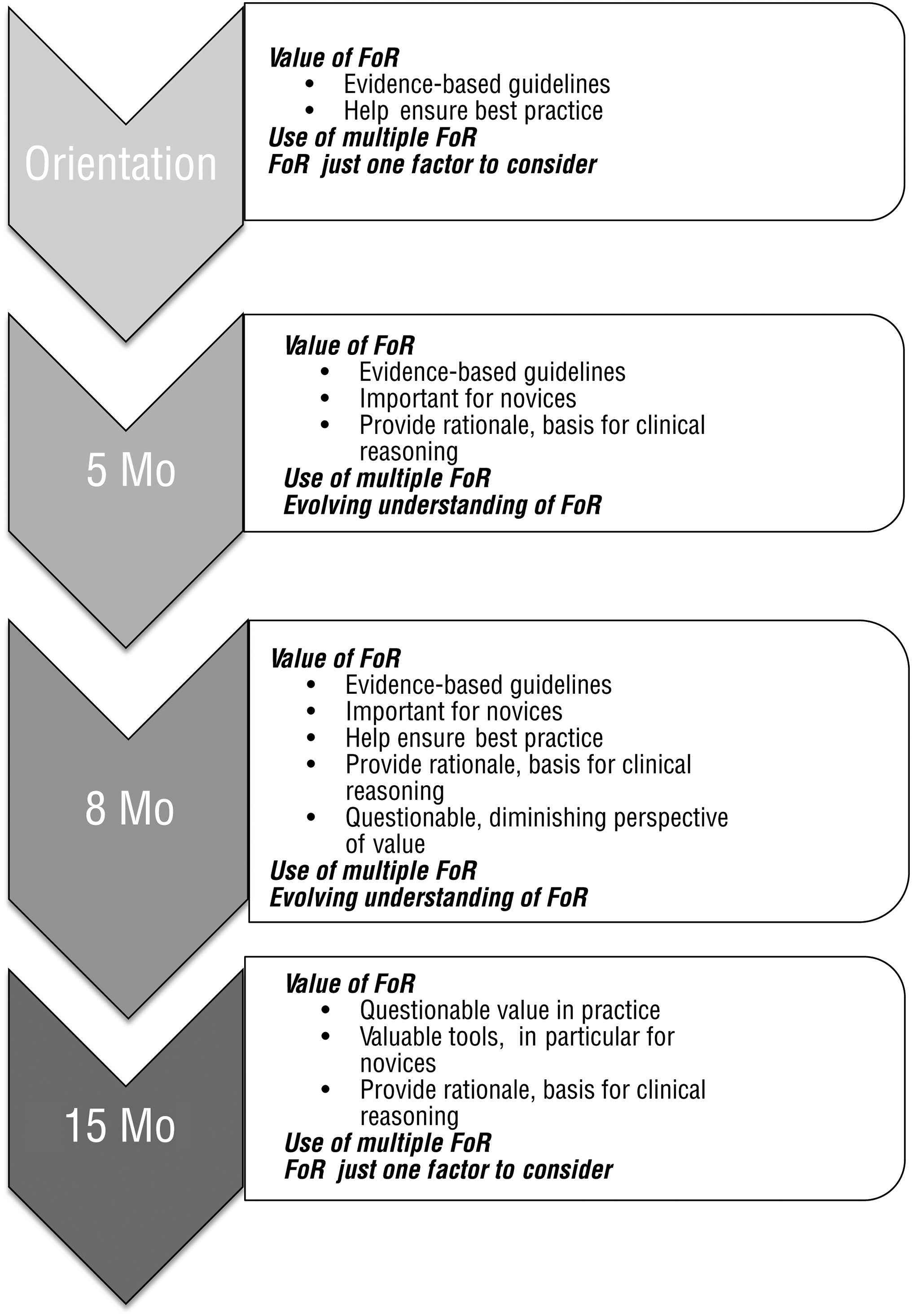
Themes (indicated by italicized text) and subthemes over time in program.
The rigor of the analysis was enhanced by our coding and analyzing themes independently, allowing for multiple perspectives on the data. Collecting data from all members of the cohort allowed for multiple perspectives on FoR. Themes were defined according to the participants’ personal statements and views of FoR, then reviewed for consistency with social cognitive theory. Member checking was used to verify the analysis.
Results
Two major recurring themes emerged from the data, with similarities and differences in subthemes over time: value of FoR and use of multiple FoR. Two additional major themes were apparent in the data at specific times after entry into the program: evolving understanding of FoR (at 5 and 8 mo postentry) and FoR as just one factor to consider in intervention (at orientation and 15 mo postentry). Each theme and subtheme, with sample verbatim quotes, is presented in Table 2. Figure 1 illustrates changes over time.
Common Themes and Subthemes
Note.
Theme 1: Value of Frames of Reference
A common theme that emerged at each time point was the value of FoR. Students acknowledged the value of FoR and expressed various perspectives on how FoR are valuable. From orientation through 8 mo postentry, subthemes describing FoR as evidence- or research-based guidelines were apparent. At 5, 8, and 15 mo postentry, students’ perceptions of the value of FoR included the idea that FoR are particularly valuable for novice therapists. Other subthemes related to the value of FoR included their importance for best practice (at orientation and 8 mo postentry) and their contributions as foundations for clinical reasoning and practice (at 5, 8, and 15 mo postentry). At 8 and 15 mo postentry, however, students began to question the value of FoR in practice (see Table 2).
Theme 2: Use of Multiple Frames of Reference
Another common theme across all four time points was the idea of using multiple FoR, although the rationale for using multiple FoR differed at orientation; for example, at orientation students discussed the need for multiple FoR to provide various options for treatment. At 5 mo postentry and beyond, students emphasized the concept of combining and integrating FoR to provide holistic intervention that would meet the client’s needs (see Table 2).
Theme 3: Evolving Understanding of Frames of Reference
At 5 and 8 mo postentry, students’ evolving understanding of FoR was a prominent theme. After practicing implementation in the classroom, they developed a deeper understanding of how to use FoR in practice. Students began to perceive FoR as evidence-based guidelines for evaluation and intervention that are particularly useful as a starting point for novices and for facilitating consistency in practice (see Table 2).
Theme 4: Frames of Reference as Just One Factor in Intervention
Although students acknowledged the importance of FoR in practice, they also recognized limitations. At orientation, they commented on the need to consider experience in addition to FoR when making intervention decisions. At 15 mo postentry, students recognized the need to consider multiple variables when making intervention decisions, with FoR being one of those (see Table 2).
Discussion
Despite similar statements about the value of FoR, students’ views of their value shifted and even diminished over time. Evolution of the students’ appreciation of FoR may be attributed, in part, to their basic understanding of the concept. One student’s honesty at orientation depicts a lack of understanding: “I’m not entirely positive of the meaning of FoR, but from what I can understand they seem to be the information that supports and qualifies the techniques and practice that occupational therapists use.” Throughout their didactic work, the students’ opinions transformed as they developed a greater sense of how FoR serve as a foundation for the profession and provide a basis for research related to practice. One student wrote, “Frames of reference have guided the progression of occupational therapy while also allowing for further improvement in the foundation of research and theories.” Some students seemed to overstate the research evidence supporting FoR and their ability to ensure best practice; for example, “Frames of references [sic] are a template for the therapist to use that has been proven to be effective in treating the patient that falls under that particular FoR.”
The value students placed on FoR seemed to be influenced by exposure to both classroom and fieldwork experiences. One student stated, “Doing case studies and coming up with treatment plans has really helped with being able to apply frames of reference to our treatment planning.” This statement is consistent with studies that have shown the effectiveness of various classroom methods for improving students’ abilities to effectively apply FoR (Ikiugu & Rosso, 2003; Ikiugu & Smallfield, 2001). As explained by social cognitive theory and illustrated by this student’s comment, classroom assignments can influence students’ opinions about using FoR. Students’ views of the need for multiple FoR also changed with exposure to the occupational therapy program. At orientation, students believed the use of multiple FoR was necessary to expand treatment options, whereas those who had spent 5 or more mo in the program recognized that therapists may combine multiple FoR to provide holistic intervention.
As predicted by social cognitive theory, students in this study who perceived that their fieldwork educator did not use FoR tended to mirror the attitude that FoR may not serve a purpose in clinical practice. Students commented, “I have not seen the use of FoR in the clinic. I believe they have a use in [occupational therapy], but they are not used in practice daily” and “I do not believe they are as beneficial in the clinic. None of my fieldwork educators have said they utilize the frames of reference in practice.” Whether the fieldwork educator neglected to use FoR in practice or whether he or she was simply unable to articulate how they were being applied, the failure to communicate the use of FoR in practice appeared to have a negative influence on students’ perceptions of the value of FoR. Just as Towns and Ashby (2014) found that students may develop a strong understanding of theory-based practice through the influence of their Level II fieldwork educators, the current study suggests that fieldwork supervisors can also have a negative impact on students’ perspectives of the value of FoR. Although students continued to affirm the value of FoR for novices and new learners, by 15 mo postentry students tended to devalue them.
Study Limitations
Limitations of this study include the fact that it was conducted with a small convenience sample in one occupational therapy program in one region of the United States. Studies using self-report methodology may also be susceptible to response bias; however, student responses appeared to be honest and included negative as well as positive viewpoints. Changes in students’ perspectives over time could have resulted from a variety of factors other than classroom and fieldwork experiences; however, it seems logical to conclude that these experiences had an impact on students’ views.
Inclusion of focus groups or interviews would have strengthened the trustworthiness of the data; however, several strategies were used to ensure its trustworthiness, including member checking and separate analysis of the data by each author. Data sources were also triangulated because all but 2 of the potential participants took part in the study at all four time points.
Implications for Occupational Therapy Education and Practice
This study has several implications for occupational therapy education and practice:
Occupational therapy instructors can influence students’ appreciation of the relevance of FoR by designing specific classroom activities and assignments to emphasize the value of their application in intervention.
Level I fieldwork supervisors can bolster or diminish students’ perceptions of the value of FoR through communication and modeling during students’ occupational therapy practice experiences.
Incorporating FoR assignments during Level I fieldwork could serve as a springboard for dialogue that enhances learning for both the student and the fieldwork educator.
Academic educators could bridge the gap in occupational therapy practitioners’ understanding of FoR by educating fieldwork instructors about FoR themselves and about their roles as models for valuing and applying FoR in practice (Cole & Tufano, 2008; Elliott et al., 2002; Towns & Ashby, 2014).
Conclusion
The growth of the occupational therapy profession is in the hands of future practitioners. Preparation of occupational therapy professionals who understand and are able to articulate the application of theory, MoP, and FoR to practice can facilitate the growth and development of the profession and contribute to the accomplishment of the American Occupational Therapy Association’s (2017) Vision 2025. Having a solid foundation and clear understanding of theory, MoP, and FoR will enhance client success and generate new research and evidence to support occupational therapy interventions.