





Abstract
In psychiatric settings, occupational therapists commonly use sensory strategies and interventions; however, a paucity of research supports the clinical efficacy of these approaches. The majority of research in this area has focused on implementing sensory rooms in psychiatric units to reduce seclusion and restraint. The aforementioned studies are typically limited by small sample sizes and are consequently underpowered to generate generalizable findings. Despite the absence of rigorous research on the topic, sensory approaches constitute a promising avenue for enhancing the occupational participation of adults with mental illness.
Expanding research on sensory approaches in mental health care should be a high priority to support the use of sensory interventions and enhance occupational therapy’s credibility as an evidence-based profession. This expansion should include research to understand the association among mental illness, sensory processing, and occupational engagement. Without study of these fundamental relationships, clinical interventions targeting sensory processing will be prematurely founded on theoretical assumptions, not grounded in scientific understanding. Basic evidence explicating the relationship of sensory processing and mental illness to occupational performance is essential to identify useful intervention targets that do not rely on assumed change mechanisms. Moreover, such evidence is instrumental in legitimizing and cementing the profession’s fundamental role in psychiatric care. Across disciplines, studies have only begun to elucidate the complex association between mental illness and sensory processing. To date, most studies have originated from outside occupational therapy and have used a reductionist view of sensory deficits among populations with specific diagnoses (e.g., auditory processing deficits among people with schizophrenia).
The purpose of this article is to provide a scoping review of the literature on the relationship between sensory processing and mental illness to identify research gaps that should be filled to support occupational therapy practice in mental health. Our overall objective is to move the profession forward in establishing a rigorous scientific knowledge base that informs the development and testing of evidence-based interventions. Because comprehensive reviews in occupational therapy on this broad research area were absent, we elected to conduct a scoping review instead of a systematic review. Scoping reviews are useful for mapping research, summarizing and disseminating findings, and identifying gaps in the evidence base (Arksey & O’Malley, 2005). Scoping reviews are limited because the quality of evidence is not formally assessed; however, they allow reviewers to incorporate a broader range of studies than systematic reviews, which are typically limited to randomized controlled studies (Arksey & O’Malley, 2005).
Method
For this review, we adopted Arksey and O’Malley’s (2005) methodological framework. Our research question was, What is known from the existing literature about the relationship between sensory processing and mental illness in adults? To answer this question, in April 2016 we searched PubMed, CINAHL Plus, PsycINFO, OTseeker, and the Cochrane Library using the terms sensory and mental health. Our rationale for selecting these terms was predicated on the assumption that they were broad and would generate more abstracts than a targeted search using sensory processing and mental illness. We excluded research on animals, children, older adults, chronic pain, somatoform disorders, autism spectrum disorder, people who are deaf or blind, and literature from non–peer-reviewed journals.
Our search strategy (Figure 1) initially generated 4,390 abstracts. We excluded 4,189 abstracts after applying the exclusion criteria and screening for duplicates and relevance to the research question. We accessed the full text of the remaining 201 studies and screened those articles using the aforementioned selection process. After omitting an additional 52 studies, our search process yielded 149 studies that were included in this review (Table 1). We assessed each article to identify its research question, method, and findings. Using Atlas.ti qualitative analysis software (Version 6.2; Scientific Software Development, Berlin, Germany), we coded each citation by topic, methodology, and target population (e.g., sensory gating – P50 – EEG – schizophrenia – negative symptoms). This process yielded 127 distinct codes, which were subsequently grouped into broader categories (e.g., sensory processing – neuro) to facilitate mapping the research.
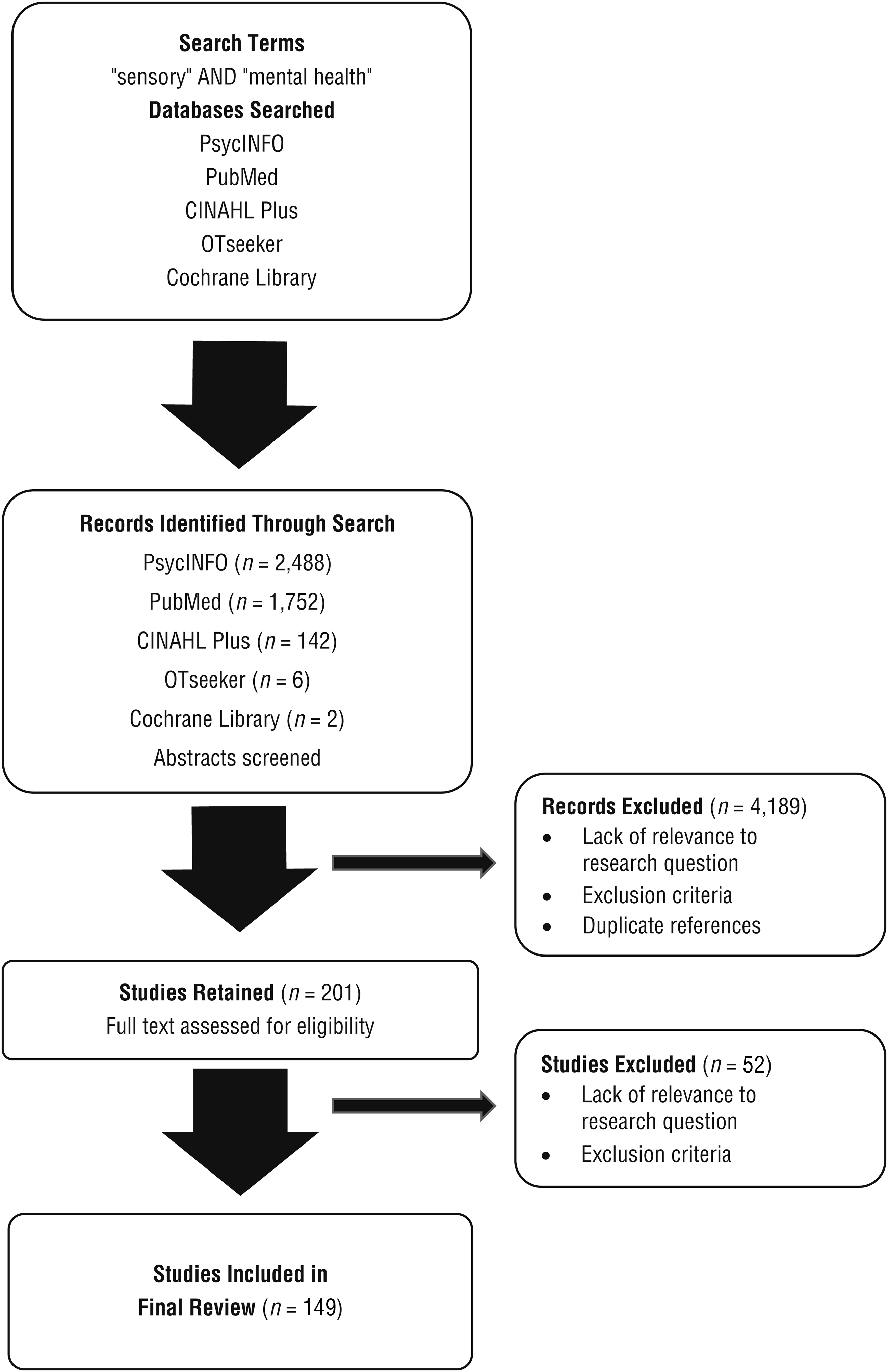
Search strategy and selection process for review.
Studies Included in the Scoping Review
Note. ADHD = attention deficit hyperactivity disorder; MMN = mismatch negativity; N/A = not applicable; NOSIE–30 = Nurses' Observation Scale for Inpatient Evaluation; OCD = obsessive–compulsive disorder; PPI = prepulse inhibition; PTSD = posttraumatic stress disorder.
Basic Research on Sensory Deficits in Mental Illness
Among the abstracts reviewed, the greatest proportion of studies (n = 73) occurred in neuroscience, where researchers predominantly use electroencephalography and MRI to study sensory processing deficits as traits of mental illness. The majority of these studies focused on schizophrenia spectrum disorders, with fewer addressing sensory deficits in depression, bipolar disorder, posttraumatic stress disorder (PTSD), obsessive–compulsive disorder (OCD), Tourette’s syndrome, and attention deficit hyperactivity disorder. This body of work has unequivocally established that adults with mental illness experience atypical neural responses in sensory gating and mismatch negativity (MMN), as well as abnormal physiological densities in neural cortices associated with sensory processing.
Auditory Processing.
Among the literature reviewed, studies in neuroscience have primarily explored aberrant sensory gating of auditory stimuli as measured by P50 event-related potentials and prepulse inhibition of the acoustic startle response. The P50 event-related potential is the brain’s electrophysiological response to a repeated stimulus that allows a person to habituate to that stimulus and remain vigilant for novel stimuli (Javitt & Freedman, 2015). Healthy people typically demonstrate an 80%–90% reduction in the amplitude of the P50 response to a redundant stimulus, whereas people with schizophrenia demonstrate only a 10%–20% reduction (Wan, Friedman, Boutros, & Crawford, 2008). Sensory gating enables a person to filter out irrelevant stimuli and focus on meaningful information in a stimulus-rich environment. Accordingly, deficits in sensory gating suggest an inability to filter out extraneous information. These findings have been replicated in people with first-episode psychosis who are antipsychotic-naive, thereby demonstrating that the deficit is a trait of the illness and not a result of pharmacological treatment (Hong et al., 2009). Although the majority of research in this area has focused on people with schizophrenia, studies have detected similar deficits in people with bipolar disorder and OCD (Cabranes, Ancín, Santos, Sánchez-Morla, García-Jiménez, Rodríguez-Moya, et al. 2013; Hashimoto et al., 2008). The functional implications of sensory gating deficits are significant; however, there is a gap in the literature exploring the impact of this deficit on occupational performance.
Another vein of research has confirmed deficits in MMN in adults with schizophrenia (Umbricht & Krljes, 2005). Mismatch negativity is a neural electrophysiological response that occurs when the brain recognizes an acoustic irregularity within a predictable pattern of stimuli. Atypical MMN increases the likelihood that people will miss information in sensory-rich environments (Javitt & Freedman, 2015). Studies have also shown that atypical MMN is related to deficits in affective prosody (Jahshan, Wynn, & Green, 2013), the ability to recognize emotion auditorily. Other studies have linked deficits in tone recognition to difficulties with emotion identification (Gold et al., 2012; Leitman et al., 2010). In people with bipolar disorder, basic auditory deficits have also been linked to impairments in emotion recognition (Zenisek et al., 2015). Navigating sensory-rich environments and identifying others’ emotions are important requisites for social participation; however, our review did not find research relating the aforementioned sensory deficits to participation in social occupations. Moreover, we did not find research studying clinical applications of this knowledge to occupational therapy interventions.
Visual Processing.
Research has demonstrated that adults with schizophrenia experience widespread disruption in neural activity at all stages of visual processing, from early sensory processing to higher order associations (Braus, Weber-Fahr, Tost, Ruf, & Henn, 2002; Jahshan et al., 2013). This population exhibits diminished neural responses to low-frequency visual targets (Martínez et al., 2012) and tends to have a dimmer perception of the world as a result of deficits in perceiving contrast (Kantrowitz, Butler, Schecter, Silipo, & Javitt, 2009). People with schizophrenia experience difficulty tracking slow-moving objects and exhibit rapid eye movement (i.e., saccades) as they repeatedly lose objects and attempt to catch up (Tien, Ross, Pearlson, & Strauss, 1996). Studies have also discovered that this population demonstrates atypical scanning patterns during free-viewing tests and deficits in maintaining a steady gaze on unmoving targets during fixation tasks (Benson et al., 2012).
Visual deficits are present in other mental illnesses as well. People with bipolar disorder experience disruptions at the latest stage of visual processing, which involves higher order functions of attention (Jahshan et al., 2013). In depression, visual and auditory sensory experiences frequently accompany depressive thoughts (Moritz et al., 2014), and visual attention is biased toward negative stimuli and away from positive stimuli (Victor et al., 2012). In adults with PTSD, studies have shown substantial cortical alterations in areas involved in visual object processing (Mueller-Pfeiffer et al., 2013). Despite the prevalence of visual deficits in mental illness, our review did not find any clinical applications of this research in the occupational therapy literature.
Other Sensory Deficits.
Fewer studies explored other forms of sensory dysfunction in mental illness. For instance, deficits in smell identification exist, particularly in schizophrenia; however, results are inconclusive regarding whether those deficits are trait markers of mental illness (Gill et al., 2014). Researchers have also found a potential link between proprioception deficits and disorders of self-awareness (Arnfred, Raballo, Morup, & Parnas, 2015). However, the scarcity of studies in these areas makes it difficult to draw broad conclusions regarding the prevalence of these deficits and their functional implications.
General Sensory Processing.
Our review found few occupational therapy studies that explored the impact of sensory processing deficits on occupational performance. Occupational therapists often embrace a holistic understanding of sensory processing and its impact on the lived experience instead of parsing out specific senses using a reductionist perspective. For instance, using the Adolescent/Adult Sensory Profile, Rieke and Anderson (2009) found that adults with OCD scored higher on low registration, sensory sensitivity, and sensation avoiding and lower on sensation seeking, but their study did not explore how these different processing patterns affect occupational performance. Brown, Cromwell, Filion, Dunn, and Tollefson (2002) found that people with schizophrenia have higher scores on sensation avoiding and low registration and lower scores on sensation seeking. Participants with bipolar disorder also scored significantly higher on sensation avoiding. Similar to findings from many neuroscientific studies on sensory gating, Brown et al. concluded that sensory deficits cause people to miss information and to avoid environments with particular sensory qualities. Similarly, Engel-Yeger et al. (2016) found that adults with major affective disorders were twice as likely to experience atypical sensory sensitivity, sensation avoiding, and low registration and 5 times more likely to experience lower sensation seeking than typical adults. We found no studies that explored clinical applications of these findings.
Impact of Basic Research.
Neuroscientists have made valuable contributions to understanding the most fundamental physiological processes of abnormal sensory function, and this knowledge has been useful in the development of pharmacological interventions. The occupational therapy research cited earlier is advantageous in understanding basic behavioral responses to sensory experiences (e.g., avoidance, seeking), but we discovered no research applying these findings to enhance understanding of occupational performance or to develop occupational therapy interventions. Researchers have suggested that deficits in sensory processing contribute to higher order cognitive deficits, such as difficulty concentrating or regulating oneself in environments that are rich with competing sensory stimuli (Wexler, Ikezawa, & Corbera, 2014). Accordingly, remedial interventions targeting sensory processing skills may contribute to cognitive gains and improved occupational performance. Support for remedial interventions that adopt a bottom-up approach to target sensory processing has increased (Jahshan et al., 2013; Moritz et al., 2014). Although this is a promising avenue for occupational therapy in mental health care, our review found no literature on the implications of sensory deficits in relation to real-world occupational performance.
Research on Functional Deficits and Sensory Dysfunction
Despite the prevalence of sensory deficits in adults with mental illness, limited research has explicitly investigated their impact on function. This is particularly problematic for occupational therapy, which espouses evidence-based approaches yet lacks sufficient evidence to support sensory approaches in psychiatry. Studies in psychiatry, neuroscience, and occupational therapy have only begun to explore the implications of sensory deficits for function, albeit not on occupational performance.
Auditory Function.
Research has linked MMN deficits to lower scores on global function (i.e., Global Assessment of Functioning scale [American Psychiatric Association, 2002]) and level of independence in community living (Light & Braff, 2005). However, studies have not sufficiently explored how MMN affects occupational performance in sensory-rich environments in which various competing auditory stimuli must be modulated. Assessing the impact of MMN deficits on occupational performance is difficult because functional assessments are typically administered in sterile sensory environments that do not replicate the cacophony of real-world situations.
The ability to modulate competing stimuli and accurately identify a speaker’s tone is an integral aspect of social cognition (Green, Olivier, Crawley, Penn, & Silverstein, 2005), an essential skill for successful social participation. Accordingly, auditory deficits in emotion recognition have an impact on measures of social cognition (de Jong, de Gelder, & Hodiamont, 2013) and, presumably, on social functioning. For instance, early auditory deficits in schizophrenia have been linked to impairments in theory of mind and difficulty with perceiving sarcasm (Kantrowitz, Hoptman, Leitman, Silipo, & Javitt, 2014). Our review did not find research studying the link between deficits in tone recognition and participation in social occupations.
Visual Function.
Visual processing deficits have been associated with broad functional outcomes (Brittain, Ffytche, McKendrick, & Surguladze, 2010), but studies have not explored their impact on occupational performance. Research has found that adults with schizophrenia demonstrate functional single-word reading but experience significant deficits when reading paragraphs from real-world materials (Revheim et al., 2006). Kantrowitz et al. (2009) also suggested that this population experiences impairment in discerning nuanced information during complex task performance as a result of deficits in detecting visual contrast. The aforementioned deficits should be considered in designing interventions that use reading materials, but our review found no research on the implementation of such considerations in occupational therapy practice.
Sensory Modulation and Function.
In occupational therapy, few researchers have begun to study the impact of sensory deficits on the occupational participation of adults with mental illness. Lipskaya-Velikovsky, Bar-Shalita, and Bart (2015) found that adults with schizophrenia experience sensory modulation dysfunction, underresponsiveness, low satisfaction with activity performance, and low frequency of activity participation. However, their analyses did not find a significant correlation between sensory modulation and participation measures. Contrarily, Pfeiffer, Brusilovskiy, Bauer, and Salzer (2014) found a significant relationship between low levels of participation and high levels of low registration and sensory sensitivity on the Sensory Profile. Likewise, Good, Stanger, and McNulty (2012) suggested that participants’ (N = 5) high scores on low registration were associated with low motivation to cook, low scores on sensation seeking were associated with a lack of leisure activities, and high scores on sensation avoiding were associated with extended periods of staying in bed or avoiding treatment. Conflicting results and small sample sizes in this area expose a significant need for further occupational therapy research.
Social Participation.
The literature has revealed that adults with mental illness experience sensory deficits that potentially confound their ability to participate in meaningful social occupations. However, few studies have specifically targeted social functioning in relation to sensory processing. Engel-Yeger, Palgy-Levin, and Lev-Wiesel (2015) found that, in occupational therapy, sensory processing difficulties may impede adults with PTSD in forming intimate relationships. Stols, van Heerden, van Jaarsveld, and Nel (2013) found that atypical sensory processing patterns are related to how adults respond to anger situations or interpersonal conflict; high low registration was associated with aggression, and high sensation avoiding was associated with anger suppression. Further research is needed to untangle the potentially significant impact of sensory deficits on social occupational participation of adults with mental illness.
Sensory-Based Interventions in Psychiatry
Although research exploring sensory deficits in mental illness is burgeoning, research on sensory interventions has not progressed as quickly. In our review, few studies (n = 4) outside of occupational therapy focused on nonpharmacological treatments to address sensory deficits. In psychiatry, research from Fisher, Holland, Merzenich, and Vinogradov (2009) suggested that intensive auditory training using computer exercises can yield improved verbal cognitive processes related to psychosocial functioning. In a case study, Henriksen et al. (2014) suggested that providing blue-light–blocking glasses to a patient with bipolar disorder led to a rapid improvement in symptoms and sleep hygiene. In psychology, Popov et al. (2011) found that using cognitive training with a focus on sensory experiences can normalize auditory sensory gating processes. These studies suggest that complex neurosensory processes can be modified through nonpharmacological intervention.
Sensory Rooms.
In occupational therapy, research has primarily supported the efficacy of deploying sensory rooms in inpatient psychiatric settings to reduce seclusion and restraint and manage aggression (Novak, Scanlan, McCaul, MacDonald, & Clarke, 2012; Sutton, Wilson, Van Kessel, & Vanderpyl, 2013). However, these are pilot studies with small sample sizes, which limits their generalizability. An increasing number of studies have postulated the efficacy of sensory rooms, but randomized controlled trials are needed to strengthen the evidence base. Despite the absence of definitive rigorous evidence, there is growing consensus regarding the importance of harnessing the sensory environment to support patients’ occupational engagement and to mitigate the occurrence of negative mental states (Champagne & Stromberg, 2004).
Sensory Integration and Sensory Modulation.
A limited number of studies explored the use of sensory integration (SI) treatment with adults with mental illness. Blakeney, Strickland, and Wilkinson (1983) studied the effects of a 6-wk SI program with 14 adults with schizophrenia but found no statistically significant improvements in outcome measures. Contrarily, Kaiser, Gillette, and Spinazzola (2010) found that SI treatment with patients with PTSD generated significant improvement. In addition, Moore and Henry (2002) found that the Wilbarger protocol had a positive impact on sensory defensiveness for three women with a history of self-injurious behavior. The scarcity of studies in this area prevents reliable conclusions regarding the efficacy of SI for adults with mental illness.
Sensory modulation programs, which promote sensory awareness and client centeredness, are increasingly used by occupational therapists in psychiatry. In a pilot study, Gardner (2016) implemented a program that introduced patients to the concept of sensory modulation and provided specific sensory strategies to address levels of arousal. Participants reported decreased arousal when using the learned sensory strategies and identified the treatment as valuable to their recovery. Similarly, Champagne (2011) found that a sensory modulation program generated positive improvement in occupational engagement and work performance in a single case study. However, among the few studies that tested the efficacy of sensory modulation programs, insufficient information was provided regarding the intervention protocol to facilitate replication of the studies or to guide therapists in implementing the programs. More research is needed to test sensory modulation programs and to apply current understandings of sensory deficits in neuroscience to occupational therapy.
Limitations
By limiting this review to research on adults with mental illness, we omitted research with healthy populations, which can elucidate the association between sensory processing and mental health (see Bailliard, 2015; Liss, Timmel, Baxley, & Killingsworth, 2005). Another limitation was the criterion requiring articles to be peer reviewed. Although this significantly enhanced the rigor of the research included in the review, it excluded numerous studies in this research area. For instance, several articles in OT Practice and Special Interest Section Quarterlies have addressed sensory approaches in adult psychiatry.
Implications for Occupational Therapy Practitioners and Researchers
The findings from this scoping review have the following implications for occupational therapy practice and research:
Adults with mental illness experience atypical neurophysiological responses to auditory and visual sensory stimuli (e.g., sensory gating, MMN).
Atypical sensory processing in adults with mental illness is associated with deficits in emotional prosody (i.e., recognition of emotion through tone), thereby affecting social cognition and social participation.
Impaired sensory processing can affect cognitive performance, including task attention and self-regulation.
Adults with schizophrenia have basic visual deficits (e.g., detecting contrast, maintaining a steady gaze on a fixed target, or tracking a slow-moving target; abnormal scanning patterns) and deficits in reading ability. Clinicians should incorporate visual supports and adapt materials to address these functional challenges.
Research has suggested that remedial interventions targeting sensory processing skills may contribute to cognitive gains and improved occupational performance.
The prevalence of sensory deficits in adults with mental illness and the importance of sensory processing in occupational performance suggest that occupational therapy should expand research on this phenomenon to develop more tailored interventions.
Evidence that supports the efficacy of sensory rooms in inpatient settings to reduce the incidence of seclusion and restraint is increasing.
The sensory qualities of the physical environment can be adapted to promote the occupational engagement of adults with mental illness.
There is a gap in the literature testing the efficacy of current sensory-based approaches in occupational therapy psychiatry.
Conclusion
Research has demonstrated that people with mental illness experience atypical sensory processing in basic neural processes. Further research into the sensory and perceptual domains of mental illness is a promising avenue to enhance understanding of pathophysiology (Kaufmann et al., 2015) and inform the development of novel interventions. However, few studies have explored sensory processing deficits in relation to functional outcomes (Brittain et al., 2010; de Jong et al., 2013). There is a gap in the literature exploring how sensory processing issues affect the lived experience and occupational performance of adults with mental illness. There is also a gap in the literature evaluating the efficacy of sensory approaches used by occupational therapy in psychiatry. Research filling these gaps would inform the use of sensory approaches to improve functional independence, social participation, and community integration. It would also help build the evidence base of occupational therapy and enhance the profession’s credibility and impact in mental health care.
Footnotes
*
Indicates studies that were included in the scoping review.
Note. Each issue of the 2017 volume of the American Journal of Occupational Therapy features a special Centennial Topics section containing several articles related to a specific theme; for this issue, the theme is occupational therapy’s role in mental health. The goal is to help occupational therapy professionals take stock of how far the profession has come and spark interest in the many exciting paths for the future. For more information, see the editorial in the January/February issue,  .
.