





Abstract
Although employment is known to have positive effects on psychosocial functioning and social integration (Tsang & Chen, 2007; Warner, 1985; Wilkinson & Marmot, 2003), most of the 7.8 million persons with schizophrenia in China are unemployed because of social disadvantages (Fung, Tsang, Corrigan, Lam, & Cheung, 2007; Social Exclusion Unit, 2004; Stefan, 2002; Xinhua News Agency, 2007).
Vocational rehabilitation for people with schizophrenia is a core intervention in occupational therapy (College of Occupational Therapists, 2009), but its implementation is lagging in mainland China because of the lack of rehabilitation professionals such as occupational therapists (Li, Tsui, & Yuan, 2014). Our research team in Hong Kong explored and developed evidence-based occupational therapy interventions resulting in the development of integrated supported employment (ISE; Tsang, Chan, Wong, & Liberman, 2009). ISE integrates individual placement and support (IPS; Drake & Becker, 1996) and work-related social skills training (WSST; Tsang & Pearson, 2001) to augment the vocational outcomes of supported employment by providing training in workplace social skills (Crowther, Marshall, Bond, & Huxley, 2001).
The employment rate of people who participate in traditional vocational rehabilitation (TVR) is below 20% (Bellamy, Rhodes, & Albin, 1986). Participants in TVR undergo lengthy prevocational training before seeking open employment. For participants in IPS, the employment rate is higher (about 50%) than for TVR participants but remains suboptimal (Drake & Becker, 1996; Drake et al., 1999). IPS includes job development and placement, ongoing work support, and coordination of vocational services with multidisciplinary teams (Drake et al., 1999). With the addition of WSST to IPS, the ISE protocol yields the highest employment rate and job tenure (Tsang et al., 2009).
A 10-session WSST program (Tsang & Pearson, 2001) incorporated into IPS was found to equip participants with job interview, basic conversation, and social survival skills for effective communication and to promote cooperative working relationships with supervisors, colleagues, and customers to further enhance competence in job seeking and maintenance (Tsang, 2003). This WSST program is based on a framework with a three-tiered approach covering basic skills, core skills, and outcomes after acquisition of these skills (Tsang & Pearson, 1996). Ongoing follow-up support is provided to ensure generalization of social skills to assist participants in developing, maintaining, and improving interpersonal competence. For example, when a participant has difficulties dealing with a supervisor, a case worker analyzes the situation, reviews the social skills learned, and devises strategies for further improvement.
The participants valued this continuous input (Yu et al., 2016). A randomized controlled trial (RCT; Tsang et al., 2009) showed a significantly higher employment rate (78.8%) and longer maintenance rate (23.84 wk) in the participants who received ISE than in those who received IPS alone (Tsang et al., 2009). Employment was defined as a full-time or part-time job in the free job market, and maintenance referred to continuous work at least 20 hr/wk for 2 mo or more (Mak, Tsang, & Cheung, 2006).
To demonstrate the program’s effectiveness in mainland China, we initiated the ISE program in Wuxi, an economically developed city. Two pilot studies there indicated the positive effects of ISE compared with IPS (Li, Yuan, Xu, Zeng, & Zhang, 2013; Lu, Yu, Li, & Tsang, 2015). Despite these publications, further research has been lacking over the past few years. In this article we report on a full-scale RCT in Wuxi investigating the effectiveness of ISE compared with IPS and TVR. We hypothesized that ISE including WSST would outperform IPS and TVR in terms of employment rate and job tenure and important psychological outcomes such as psychiatric status, self-efficacy, and social functioning as measured by validated tools. A secondary objective was to determine whether the vocational interventions originally developed in Hong Kong could be effectively applied on the mainland.
Method
Participants
Between 2013 and 2015, 162 participants were recruited from Wuxi Mental Health Center, which is a modern psychiatric hospital providing clinical services and rehabilitation interventions (Nanjing Medical University, 2013). Inclusion criteria were as follows: (1) age 18 yr or older; (2) diagnosis of schizophrenia for at least 2 yr; (3) unemployed status; (4) willingness to give informed consent; (5) no obvious cognitive, learning, or neurological impairment as reflected in minimum scores on the Mini-Mental State Examination (MMSE; Folstein, Folstein, & McHugh, 1975); (6) completion of primary school education; and (7) a desire to work. Anyone with a score lower than 18 on the 30-item MMSE (Chiu, Lee, Chung, & Kwong, 1994) was excluded.
The recruited participants were assigned to the ISE, IPS, or TVR condition using the concealed randomization feature in IBM SPSS Statistics (IBM Corp., Armonk, NY). The diagnosis of the participants was verified by the Chinese version of the Structural Clinical Interview (So, Kam, Leung, Pang, & Lam, 2003) for the Diagnostic and Statistical Manual of Mental Disorders (4th ed., text rev.; American Psychiatric Association, 2000). Individual written informed consent was obtained after institutional review board approval. Participant demographic data are summarized in Table 1.
Participant Demographic Characteristics
Note. df = degree of freedom; IPS = individual placement and support; ISE = integrated supported employment; M = mean; SD = standard deviation; TVR = traditional vocational rehabilitation.
Measures
The Employment Outcome Checklist was used to assess participants’ employment outcomes, including number of job interviews attended, number of jobs obtained, number of hours per week worked, and salary received from each job (Tsang & Pearson, 2001). The Chinese Job Termination Checklist (Becker et al., 1998) was used to collect information on participants’ job terminations (Mak et al., 2006).
The Brief Psychiatric Rating Scale (BPRS; Overall & Gorham, 1962) was used to assess the participants’ psychiatric status, including positive and negative symptoms associated with a schizophrenia diagnosis, on a scale ranging from 1 (not present) to 7 (extremely severe). The Chinese General Self-Efficacy Scale (CGSS; Chiu & Tsang, 2004) was used to assess optimistic self-beliefs of the participants about ability to cope with a variety of difficult demands in life on a scale from 1 (not at all true) to 4 (exactly true). The Global Assessment of Functioning (GAF; American Psychiatric Association, 2013) was used to assess level of psychosocial functioning on a scale of 1 (severely impaired) to 100 (extremely high functioning). The Personal Wellbeing Index (PWI; International Wellbeing Group, 2006) was used to measure the subjective dimension of quality of life on a scale ranging from 0 (completely dissatisfied) to 10 (completely satisfied).
Intervention Protocols
Individual Placement and Support.
The research team closely adhered to the eight implementation principles of the IPS program (Drake & Becker, 1996). The program included job development and placement, ongoing work support, coordination of vocational services with multidisciplinary teams, indefinite services, and job choices by participants (Drake et al., 1999).
Integrated Supported Employment.
The ISE program was an evidence-based vocational rehabilitation intervention for people with schizophrenia that integrated IPS and WSST (Figure 1). WSST was added to IPS to further enhance the vocational outcomes in a particular job tenure (Tsang, 2003).
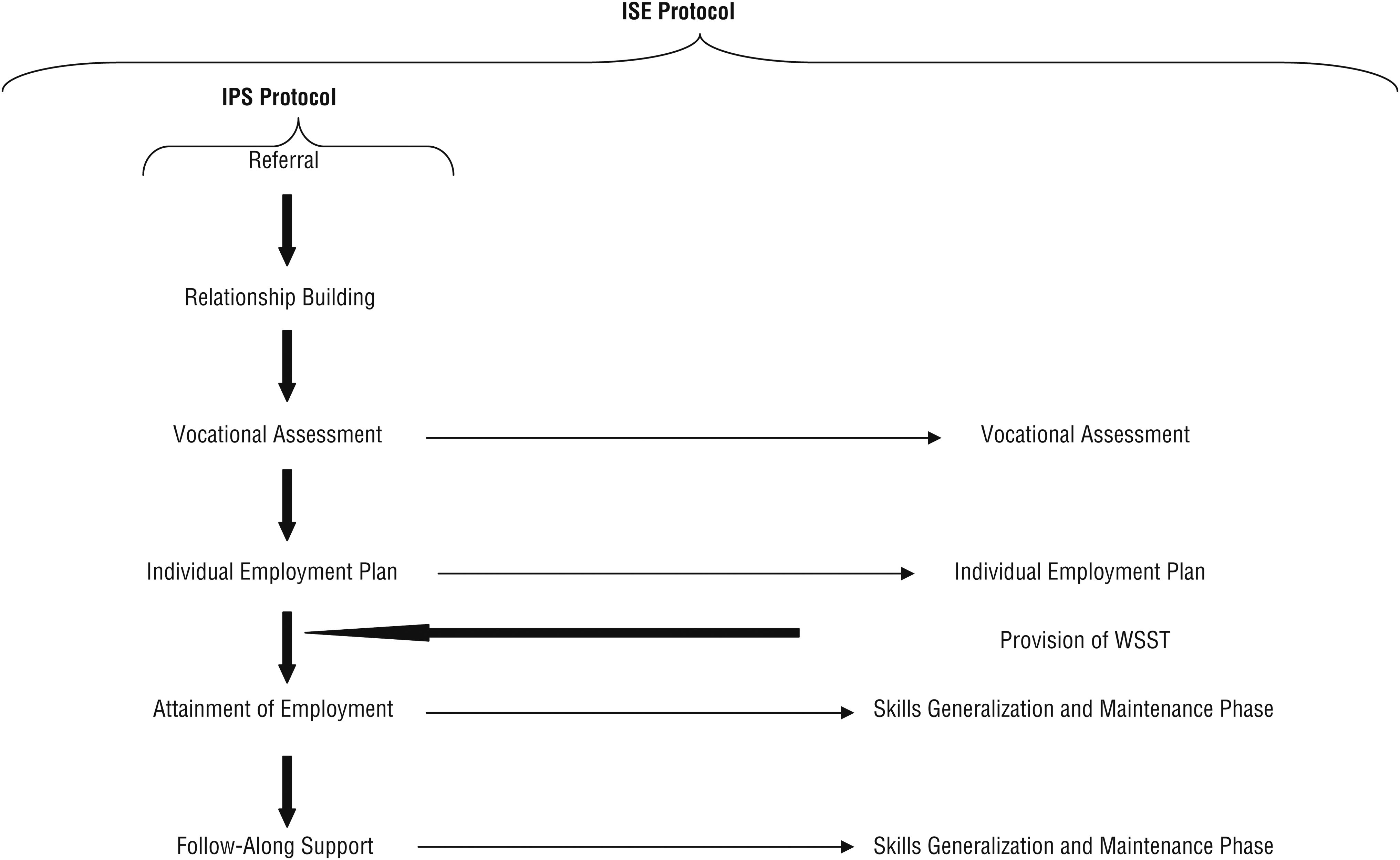
Protocols of IPS and ISE.
The ISE participants joined the 10-session WSST program (Tsang & Pearson, 2001) during the first 3 mo after admission to the study and before the stage of obtaining employment to enhance their competencies in seeking and maintaining employment. Follow-up support was provided to assist participants in developing, maintaining, and improving cooperative relationships with supervisors, coworkers, and customers. Details of the ISE protocol may be found in an earlier publication (Tsang et al., 2009).
The carefully designed, manualized WSST program was used to help participants enhance their social competence in job seeking and maintenance. After gaining employment, whenever they faced interpersonal problems, their case workers reviewed with them the social skills they had learned and helped them set behavioral goals for further improvement in the near future. In addition, a problem-solving approach was adopted to help participants generalize the social skills to their workplace. The effectiveness of these interventions was supported by a qualitative study (Yu et al., 2016).
Traditional Vocational Rehabilitation.
The TVR participants received traditional services including comprehensive vocational assessment (e.g., work interest exploration), situational assessment using the Workshop Behavior Checklist (Tsang & Chiu, 2000), and prevocational training to equip the participants with specific work skills and work habits for later upgrading to competitive employment.
Employment Specialists and Quality Assurance
Three psychiatric nurses served in the role of Employment Specialist (ES) to carry out the ISE or IPS protocol, with the ES-to-participant ratio at 1:27. An ES is a professional who supports consumers to overcome obstacles in seeking jobs. The participants were allocated to the ESs on the basis of administrative convenience. Approximately the same numbers of participants in the IPS and ISE groups were assigned to ESs to minimize the effects of differential personal, enthusiasm, and commitment levels because the participants were not blinded to their condition. Quality for the IPS and ISE protocols was ensured through training of the ESs, regular multidisciplinary meetings, and use of a 15-item fidelity scale (Bond et al., 2002). Aspects of quality included staffing (3 items), organization (3 items), and services (9 items). Each item was assessed on a 5-point Likert scale ranging from 1 (not implemented) to 5 (fully implemented). The scale had a total score range of 15 to 75. In this study, adherence scores for the IPS ranged from 65 to 68 (87%–91%) and for the ISE from 64 to 67 (85%–89%). Services for the TVR group were provided by staff members (including an occupational therapist and nurses) of the mental health center providing sheltered vocational training (Tsang et al., 2009).
Data Collection and Analysis
The length of the interventions for all groups was 15 mo. An independent, trained, and blinded assessor with an occupational therapy background conducted assessments at admission (baseline); at completion of the 3-mo program; and at 7-, 11-, and 15-mo follow-up.
Baseline scores and demographic variables were compared using mixed analysis of variance (ANOVA) or χ2. Mixed ANOVA with post hoc analysis was used to identify differences among the three groups at baseline and different stages of the study. Competitive employment referred to work at a full-time or part-time job in the free job market to which anyone could apply, and the salary was based on the market value and paid directly by the employers (Mak et al., 2006). Those who had continuously held competitive employment at least 20 hr/wk for 2 mo or longer were considered employed. The cumulative employment rate at different follow-up periods was also reported. The longest job duration sustained by each participant during the study was considered the job tenure. In the study, 3 mo were used to prepare participants for job readiness. Consequently, assessments at the 7th month after joining the program were operationally adopted as the baseline for the vocational outcomes including employment rate, job tenure, number of job terminations, and salary.
The participants (n = 162) were subject to intent-to-treat analyses on employment rate. Similarly, for those with all assessments completed, analyses of other employment outcomes were also conducted. The drop-out cases were also included. We used χ2 to analyze the employment rates of the three groups at different intervals. Employment information at the 7th, 11th, and 15th months was used to calculate the number of terminations. In all post hoc comparisons, an α value of .05 with Bonferroni adjustment was used.
Results
Demographics
There were no statistically significant differences among the three groups in gender, χ2(2) = 0.36, p = .84; educational level, χ2(6) = 6.01, p = .42; employment history, χ2(2) = 0.65, p = .72; or age, F (2, 160) = 1.79, p = .21. For example, the mean ages of ISE, IPS, and TVR participants were 32.26, 34.70, and 31.48 yr old, respectively, and the proportions of those with work experience were 53.7%, 55.6%, and 61.1%, respectively.
Employment Rates
At 15-mo follow-up, 34 (63.0%) of ISE participants had obtained competitive employment, compared with 27 (50.0%) of IPS and 18 (33.3%) of TVR participants. The employment rate of the ISE group was significantly higher than that of the TVR group (p = .002), and significantly more participants in the ISE group were employed than in the IPS group (p = .002).
Job Tenure
A Group × Time interaction effect showed overall significant differences among the three groups (p = .002). In post hoc comparison, the ISE group had a longer average job tenure (29.56 wk) than the TVR group (9.91 wk) and the IPS group (25.47 wk) at 15-mo follow-up (p = .002).
Assessment Scores
A Group × Time interaction effect showed overall significant differences among the three groups in scores on the BPRS, F = 6.63, p = .00; CGSS, F = 2.78, p = .01; GAF, F = 2.06, p = .04; and PWI, F = 11.88, p = .00 (df = 2 for all F values). The ISE group had significantly higher scores on the BPRS, the GAF, and the PWI, but not the CGSS, than the IPS and TVR groups. Table 2 summarizes the data.
Follow-Up Assessment Results, by Group
Note. ANOVA = analysis of variance; BPRS = Brief Psychiatric Rating Scale; CGSS = Chinese General Self-Efficacy Scale; GAF = Global Assessment of Functioning; IPS = individual placement and support; ISE = integrated supported employment; M = mean; PWI = Personal Wellbeing Index; SD = standard deviation; TVR = traditional vocational rehabilitation.
Job Termination
At 15-mo follow-up, a significant difference (p = .00) was found in average number of unwanted job terminations per participant. The ISE group experienced an average of 1.94 unwanted terminations and the IPS group an average of 2.44 terminations.
Discussion
Our main hypothesis, that the ISE group would outperform the other groups in both vocational and nonvocational outcomes, is supported. For vocational outcomes, a significantly higher employment rate and longer job tenure were found in ISE participants compared with IPS and TVR participants. These figures support both previous international findings (Drake & Becker, 1996; Drake et al., 1999) that IPS outperforms conventional approaches to vocational rehabilitation and findings from Hong Kong (Tsang et al., 2009) that ISE outperforms both IPS and TVR. This study provides evidence on the application of IPS in mainland China as the prototype and justifies that adding WSST to IPS in both Hong Kong and Wuxi augments employment outcomes. Although the IPS participants received follow-up services similar to those of the ISE group, the IPS intervention did not focus on behavioral rehearsal of social skills that are necessary for handling the interpersonal conflicts participants encounter in their workplace; this constitutes the main difference between the IPS and ISE protocols.
Fewer job terminations among ISE participants may be explained from a cultural perspective. Employers in Chinese societies are very concerned with their employees’ interpersonal competence and solidarity (Tsang et al., 2007). Because many problems leading to job termination are related to interpersonal difficulties (Becker et al., 1998), it is reasonable to suggest that the finding of significantly fewer job terminations in the ISE participants compared with the IPS participants was related to the WSST component of the ISE protocol.
For nonvocational outcomes, the ISE participants had significantly better improvement than the other participants in psychiatric symptoms, social functioning, and well-being. In general, people with schizophrenia are not motivated to initiate or sustain engagement in tasks needed in their occupational role (American Psychiatric Association, 2000). ISE alleviated this dysfunction by having the employment specialists encourage and support the participants to maintain their worker role through overcoming obstacles in the job seeking and maintenance processes.
Generalization of WSST skills into the real work environment was effective in promoting participants’ job sustainability, which in turn improved their social functioning. Through continuously reviewing their social competence, the participants became more aware of what worked and what did not work in the vocational rehabilitation process (Glover, 2007). This understanding may then have helped them develop better insight into how to sharpen their strategies to maintain their worker roles, which in turn further improved their social functioning (Erol, Delibas, Bora, & Mete, 2015). The enhancement of participants’ employment rate and job maintenance prepared them to reengage in a meaningful life role (Li et al., 2013), which may in turn have contributed to their psychological well-being.
Despite the encouraging results, this study has limitations. The participants were recruited by convenience sampling, which may pose problems with regard to generalizing the results. Potential bias may have existed among employment specialists because of the effect of allegiance (King, 2006; Luborsky et al., 1999); they may have favored the ISE participants. Nonetheless, this bias was countered by the equivalent fidelity ratings in delivering IPS services.
Implications for Occupational Therapy Practice
This is the first RCT that provides compelling evidence supporting ISE as an evidence-based occupational therapy intervention for people with schizophrenia in China. Additional RCTs should be performed in different countries to consolidate the evidence, and additional qualitative studies should be conducted to explore the views of stakeholders including participants, caregivers, and health care professionals on the usefulness of this occupational therapy intervention. The following practice implications are highlighted:
A shift from a “train then place” model to a “place then train” paradigm in IPS and ISE is needed in psychiatric rehabilitation services in the mainland.
Work-related social skills training can augment the vocational and nonvocational outcomes of IPS.
Professional training by occupational therapy experts should be offered to facilitate the implementation of the ISE protocol by psychiatric rehabilitation teams.
Conclusion
This study suggests that mainland China needs to adopt ISE with more focus on WSST to augment the vocational and nonvocational outcomes of IPS in Chinese communities. The ISE protocol is likely to be applicable to mainland cities with a well-developed, market-driven economy, provided that appropriate professional training—for example, by occupational therapists—is available. With the enhancement of vocational and nonvocational outcomes through ISE, the social functioning of people with schizophrenia can be improved, consistent with the core philosophy and practice of psychosocial rehabilitation in occupational therapy (Wang, Zhang, Tsui, & Li, 2015).
This study further highlights the crucial and unique role of occupational therapists in the development and provision of innovative and evidence-based vocational rehabilitation models in China. This first RCT provides compelling evidence for applying ISE on the mainland. It is expected that the quality of life of people with schizophrenia can be enhanced through securing employment and achieving social inclusion. To optimize the benefits to this clientele, leaders in occupational therapy departments should explore the feasibility of launching this evidence-based ISE intervention in clinical practice.
Footnotes
Acknowledgment
Note. Each issue of the 2017 volume of the American Journal of Occupational Therapy features a special Centennial Topics section containing several articles related to a specific theme; this issue highlights occupational therapy’s role internationally. The goal is to help occupational therapy professionals take stock of how far the profession has come and spark interest in the many exciting paths for the future. For more information, see the editorial in the January/February issue,  .
.