





Abstract
According to the Individuals With Disabilities Education Improvement Act of 2004 (IDEA; Pub. L. 108–446), students requiring special education services undergo two major periods of transition: birth to early childhood and adolescence to adulthood. In the United States, children from birth to age 3 yr are entitled to receive early intervention services under IDEA Part C (Myers, Case-Smith, & Carson, 2015). From age 3 to 21 yr, children, youth, and young adults with disabilities are entitled to receive special education services from the public schools under IDEA Part B (Bazyk & Cahill, 2015). These policies mandate individualized supports and services to address developmental, academic, and social challenges encountered by qualifying students throughout the school day.
Trained as client-centered, occupation-based professionals, occupational therapy practitioners may serve as valued members of the special education team by assisting students to actively participate in the academic process. As experts in task analysis, occupational therapy practitioners are particularly skilled at helping children with disabilities adapt to their roles as students. Evidence supports that children between the ages of 0 and 13 yr are the primary recipients of school-based occupational therapy services, with occupational therapy services listed as one of the most common services received by elementary school students with intellectual disabilities (Wehman, 2013; Wei, Wagner, Christiano, Shattuck, & Yu, 2014). Occupational therapy services are provided directly, through consultation, and by using telehealth technologies, which may occur in classroom, clinical, and community-based settings.
The IDEA requires that planning for the transition to life after school begin by age 16 yr and is tailored to individual needs (Jackson, 2007). This process of planning and preparation is commonly referred to as the transition to adulthood. Within the public schools, students, teachers, parents, and other key stakeholders (e.g., job coaches, vocational counselors, mentors) work together as a transition team to develop a plan for a student’s active participation and achievement in academic and community environments (Bazyk & Cahill, 2015; Cleary, Persch, & Spencer, 2015). Related service providers (e.g., occupational and physical therapy practitioners) may also participate on the transition team when these services are included on a student’s individualized education program (IEP). The student’s abilities, aspirations, and plans for life after graduation are relevant topics for the transition team, and a student’s participation in this process is known to be a strong predictor of postsecondary success (McConnell et al., 2013).
Broadly defined, a student’s transition to postsecondary education, employment, and community settings is considered a marker of success. It follows, then, that transition services should target maximizing independence and successful participation in these areas (Spencer, Emery, & Schneck, 2003). In general, students with disabilities are less likely to be enrolled in postsecondary education (60%), currently employed for pay (60%), and engaged in community activities (19%) when compared with their peers without disabilities in the years immediately after the transition to adulthood (Wehman, 2013). These outcomes are troubling because they are strongly linked to socioeconomic security (Butterworth et al., 2013), health (Ipsen, 2006), and quality of life (Kober & Eggleton, 2005); moreover, most secondary services do not meet the needs of those in transition by resulting in positive outcomes (Newman et al., 2011; Wehman, 2013).
Education, employment, and community participation are important occupations for youth and young adults engaged in the transition process, and occupational therapy practitioners are trained in maximizing independence in these areas (Cleary et al., 2015; Gerney, 2015). Including occupational therapy in the transition process has many potential benefits (Michaels & Orentlicher, 2004). For example, occupational therapists may (1) facilitate a student’s involvement in early, paid work experience; (2) help the student prepare for IEP meetings; (3) give instruction in social competence and daily living skills; (4) provide consultation on assistive technology needs; and (5) participate in interdisciplinary and interagency teaming (Cleary et al., 2015). Occupational therapy practitioners may also contribute to the transition process by providing assessments of, and training in, a variety of work, leisure, and daily occupations (Cleary et al., 2015).
Despite the potential benefits of including occupational therapy practitioners in the transition process, practice in this area is limited. In 2005, Kardos and White identified low numbers of occupational therapy practitioners who dedicate time to transition-age youth, and there is little evidence that this trend is changing at a national level. Additional research and resources are required to strengthen the base of practice in this important area. Toward this end, our aims in the current study were to (1) identify the characteristics of people with disabilities receiving occupational therapy services across the nation during their transition to adulthood and (2) determine factors associated with positive transition outcomes for these people. Description of the population of transition-age youth who receive occupational therapy services may enable occupational therapy practitioners to monitor trends in practice and to advocate for services. Similarly, identifying the factors that are predictive of postsecondary success may afford practitioners working with this population with new knowledge to support their practice and enhance the likelihood of positive postsecondary outcomes for students.
Method
Study Design
This study is a secondary analysis of data arising from the National Longitudinal Transition Study–2 (NLTS2; see National Center for Special Education Research [NCSER], n.d.-b). The NLTS2 was funded by the U.S. Department of Education, NCSER, Institute of Education Sciences in an effort to identify and describe the characteristics, experiences, and postsecondary outcomes of youth and young adults with disabilities. SRI International conducted the study. The NLTS2 dataset provides a unique opportunity to conduct analyses that may inform our research aims; specifically, it contains descriptive information regarding students who receive occupational therapy and their postsecondary outcomes.
Sampling Method and Data Collection
The NLTS2 sampling procedure involved a multistep process to recruit a nationally representative sample of youth receiving special education services when the study began in 2000. Local education agencies were randomly selected, recruited to participate, and asked to provide data on students receiving special education services. Students, ages 13–16 yr at enrollment, were then followed longitudinally for up to 10 yr in a series of five data collection waves. Further details regarding the NLTS2 research plan, sampling method, and data collection processes can be accessed online at the study website (http://www.nlts2.org/).
This secondary analysis of the NLTS2 data focuses specifically on Wave 4 (W4) data. Conducted between 2006 and 2007, W4 includes data on 5,580 youth and young adults with disabilities. The decision to use W4 data was based on several factors. First, in comparison with the other waves, W4 provides the most data. In total, the W4 dataset includes more than 4,300 variables of interest for each of the 5,580 participants. Second, W4 data include responses from both parents and youth surveys and interviews, which affords the opportunity to check responses for consistency. Third, because it is the fourth point of data collection, W4 includes extensive outcome data for youth and young adults with disabilities up to 6 yr after high school.
Data Analysis
Young adults who received occupational therapy services from public schools during their transition, as defined by an affirmative report of receiving occupational therapy services from the public schools within the past 12 mo, were identified with NLTS2 W4 data through a process of descriptive statistical evaluation, data cleaning, and sorting. To address the first aim, we generated descriptive statistics of these students, including demographic characteristics, disability classifications, and indicators of functional abilities, specifically defined by how well the youth used their arms and hands for fine and gross motor tasks. These youth and young adults were students who had recently transitioned to postsecondary life.
To address the second aim, we examined the relationships among key student characteristics (i.e., functional ability, comprehension, health) and students' postsecondary transition outcomes (i.e., education, employment, community participation). Specifically, variables were purposefully selected, and significant findings are presented here. Binary logistic regression was used to develop models for dichotomous (i.e., ordinal-level) response variables, and simple linear regression was used to develop models for continuous (i.e., ratio) response variables. Descriptive, nonparametric, and parametric analyses were conducted with IBM SPSS Statistics (Version 19; IBM Corp., Armonk, NY), JMP (Version 10; SAS Institute, Cary, NC), and Minitab 16 (Minitab Inc., State College, PA) statistical software. All presentations of sample sizes in this article have been rounded to the nearest 10 in accordance with Institute of Education Sciences data security guidelines.
Results
Characteristics of Students Receiving Occupational Therapy Services: Descriptive Data
The NLTS2 W4 dataset includes 5,580 participants. Of these participants, 420 students (7.5%) reported receiving occupational therapy services from the school district within the past 12 mo. Most of these students were male (66.8%) and White (62.3%). On average, students were age 20.3 yr (standard deviation [SD] = 0.94). Autism (29.1%), cerebral palsy (14.1%), and mental retardation (i.e., intellectual disability; 11%) were the most commonly reported disability classifications. Approximately 74% of youth and young adults with disabilities were reported to have at least a little trouble understanding (i.e., comprehending) what other people say. More than half (56.1%) reported normal use of arms and hands for fine or gross motor skills. Students’ general health status ranged from excellent (25.8%) to poor (1.9%). Detailed gender, race, and disability classification data are presented in Table 1.
Characteristics of Youth and Young Adults Receiving Occupational Therapy Services in Transition
Per Institute of Education Sciences data security guidelines, all unweighted sample sizes have been rounded to the nearest 10.
Other diagnoses refer to Down syndrome, developmental delay, spina bifida, traumatic brain injury, dyslexia, and so forth.
Education Outcomes
The postsecondary transition outcomes (i.e., education, employment, community participation) of students who received occupational therapy services from the school district within the past 12 mo were examined with binary logistic and simple linear regression models. Key NLTS2 W4 variables are presented in Table 2, and results are presented in Table 3. First, a significant relationship was identified between functional ability (i.e., how well the youth used their arms and hands for fine and gross motor tasks) and education outcomes (i.e., youth had taken classes at a 2-yr college). Functional ability was categorized with a 4-point ordinal scale: 1 = normal usage, 2 = have a little trouble using one or both, 3 = have a lot of trouble using one or both, and 4 = have no use at all of one or both. The average youth had relatively little trouble using his or her arms and hands for fine and gross motor tasks (mean [M] = 1.57, SD = 0.93). These data were highly skewed (i.e., asymmetrical; 1.55) and kurtotic (i.e., peaked; 1.38). Enrollment was coded dichotomously with 0 = no and 1 = yes. Of these youth, a minority (20%) had taken classes at a 2-yr college. A binary logistic model was applied to the data to examine this relationship, with functional ability as the predictor variable and enrollment as the response variable. The results showed that
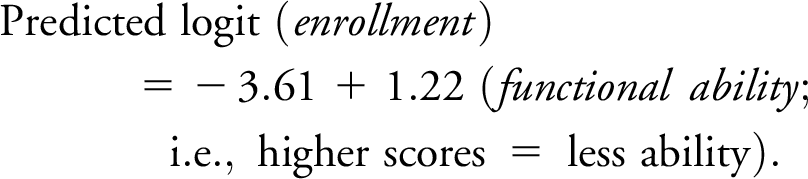
According to this model, the log odds of a youth’s enrollment is inversely related to his or her functional ability level of difficulty (p < .05). The odds ratio is 3.41, indicating that for every ordinal response increase in functional ability difficulties (i.e., lesser abilities), the youth is 3.41 times more likely to enroll in classes at a 2-yr college. According to the odds ratio, a decline in a youth’s functional abilities increases the likelihood that he or she will enroll in classes at a 2-yr college. Goodness-of-fit was analyzed with a Hosmer–Lemeshow (H-L) test, yielding χ2(2) = 1.06, p > .05, confirming good model fit.
Characteristics of NLTS2 Variables
Note. From National Center for Special Education Research (n.d.-a). NLTS2 = National Longitudinal Transition Study–2.
Associational Analyses
Note. eβ = odds ratio; N/A = not applicable; SE = standard error.
p < .05. **p < .01.
Employment Outcomes
Verbal comprehension (i.e., how well the youth understands what people say) was significantly related to employment outcomes (i.e., work experience). Work experience was the number of paid jobs the youth had in the past 2 yr or since leaving high school. The average youth had at least one job (M = 1.67, SD = 1.56). These data were highly skewed (1.19) and kurtotic (0.60). Verbal comprehension was categorized with a 4-point ordinal scale: 1 = has no trouble understanding, 2 = has a little trouble understanding, 3 = has a lot of trouble understanding, and 4 = does not understand at all. The average youth had little trouble understanding what other people say (M = 1.67, SD = 0.50). The data were slightly skewed (−0.81) and kurtotic (−1.65). Given the continuous nature of the response variable—work experience—simple linear regression was conducted to examine this relationship. The relationship is reflected in the following simple linear regression equation:

This equation reflects a strong positive association, F(1, 10) = 12.94, p = .005, with an R 2 = .56, such that, for every level of increase in verbal comprehension difficulty, youth exhibited roughly two fewer paid jobs. Because of the skew of the data and the low correlation coefficient, the linear regression is not an accurate representation, especially at higher levels of verbal comprehension difficulty.
Community Participation Outcomes
A significant relationship was found between general health (health status) and level of community participation. The general health of the youth was categorized with a 5-point ordinal scale: 1 = excellent health, 2 = very good health, 3 = good health, and 4 = poor health. The average youth had very good health (M = 2.17, SD = 0.94). These data are slightly skewed (0.54) and kurtotic (−0.10). Participation in community activities was coded dichotomously with 0 = no, and 1 = yes. Of these youth, a minority (45%) had participated in community activities. The predictor is the youth’s health status, and the response variable is his or her participation in community activities. A binary logistic model was applied, and results showed that

According to this model, the log odds of a youth’s participation in community activities is directly related to his or her health (p < .05). The odds ratio for participation in community activities was 0.58, indicating that for every ordinal response improvement in health status, the youth is 0.58 times more likely to participate in these activities. Goodness-of-fit was analyzed with an H-L test, yielding χ2(1) = 3.55, p > .05, confirming that the model fit the data.
Finally, functional abilities (i.e., how well the youth use their arms and hands for fine and gross motor tasks) were significantly related to involvement in community volunteer activities (i.e., community service). Community service was coded dichotomously with 0 = no, and 1 = yes. Of these youth, a majority (56%) had engaged in community service. A binary logistic model was applied with functional ability as the predictor variable and engagement in community service as the response variable. The results showed that

According to this model, the log odds of a youth’s engagement in community service is directly related to his or her functional ability level of difficulty (p < .05). The odds ratio for community service is 0.58, indicating that for every ordinal response decline in functional ability difficulty (i.e., greater abilities), the youth is 0.58 times more likely to engage in community service. Goodness-of-fit was analyzed with an H-L test, yielding χ2(1) = 3.13, p > .05, confirming that the model fit the data.
Discussion
This study provides the first published description of youth and young adults with disabilities who receive occupational therapy services during the transition to adulthood. It confirms that occupational therapy practitioners are actively involved in the transition process, although in a limited capacity. Such characterization may enable practitioners to draw comparisons with their own caseloads and advocate for an increased role in transition planning.
Occupational Therapy Services During Transition to Adulthood
Descriptive analyses confirmed that few (7.5%) students with disabilities receive occupational therapy services during the transition years. This figure is important because it is the first published estimate of occupational therapy’s participation among all IEP eligible students in transition to adulthood. Previous estimates of occupational therapy’s involvement have lacked this perspective. For example, Inge’s (1995) unpublished dissertation indicated that 38% of occupational therapists had at least one student of transition age on their caseload. Similarly, Kardos and White (2005) found that approximately half of therapists’ caseloads included youth of transition age. Both of these perspectives come from the viewpoint of the therapist and are misleading for that reason. Our data, which reflect students, reveal that overall utilization of occupational therapy services during the transition to adulthood is remarkably low. Possible explanations for low utilization include role confusion and limited funding (Cleary et al., 2015; Kardos & White, 2005).
Further data analyses provided insight into student demographic characteristics and functional abilities. Most students (74%) who received occupational therapy services during transition reported having at least a little difficulty with verbal comprehension. Similarly, 44% of students reported having at least a little difficulty using their arms and hands for fine and gross motor tasks. Finally, only 25% of students rated their health as excellent. Taken together, these data seem to indicate that recipients of occupational therapy services during transition experience at least moderate levels of disability. However, experience tells us that a wide range of students benefit from occupational therapy services (Case-Smith & O’Brien, 2015). Ensuring occupational therapy services are available to all eligible students remains an opportunity for practitioners.
Occupational Therapy Factors Associated With Postsecondary Success
Regression analyses revealed that youth functional abilities were inversely related to enrollment at a 2-yr college. This relationship seems counterintuitive. However, it may be that youth with higher levels of independence choose to pursue competitive employment or education at 4-yr institutions rather than enroll in classes at 2-yr colleges. Further research will be required to elucidate this finding. This research also demonstrates that youth with no trouble understanding what other people say are more likely to be employed in paid jobs. This finding is to be expected and is consistent with other analyses from this dataset that evaluate the postsecondary employment of people with disabilities (Carter, Austin, & Trainor, 2012). Communication skills are an important employment skill because many jobs require appropriate interactions with employers, supervisors, customers, and coworkers. These data suggest that occupational therapy practitioners may contribute to transition teams by providing evidence-based interventions designed to improve upper extremity function, self-care skills, and social skills. Connecting these interventions to relevant postsecondary education and employment goals may help to improve outcomes (Bjornson, Kobayashi, Zhou, & Walker, 2011).
Two binary logistic regression models indicated that youths' level of community participation and community service was significantly related to health status and functional abilities. This finding is important because participation in community-based activities is a strong predictor of successful transition outcomes (Newman et al., 2011). As such, both overall health and functional abilities should be viewed as therapeutic targets.
Transition Policies and Opportunities to Expand Occupational Therapy’s Impact
Occupational therapy’s role in supporting students in transition is neither new nor well established. The original IDEA (1990; Pub. L. 101–476) included a mandate to initiate transition planning by age 16, and the 2004 reauthorization included new definitions and requirements for transition goals and services. However, change does not happen overnight, and recent research (Erickson, Noonan, Brussow, & Giplin, 2014) has demonstrated that compliance (82%) with secondary transition mandates is not yet universal. Moreover, legislative and legal action has continued to reshape this area of practice in the past few years. For example, the Workforce Innovation and Opportunity Act of 2014 (Pub. L. 113–128) is designed to “help job seekers access employment, education, training, and support services to succeed in the labor market and to match employers with the skilled workers they need to compete in the global economy.” The Workforce Innovation and Opportunity Act specifies that at least 15% of each state’s Title I Vocational Rehabilitation funds must be used for preemployment transition services. Required preemployment transition services include (1) job exploration counseling, (2) work-based learning experiences, (3) counseling on postsecondary education opportunities, (4) workplace readiness training, and (5) instruction in self-advocacy. Secondary students with IEPs qualify for support via this mechanism.
Similarly, a 2014 consent decree between the U.S. Department of Justice and the State of Rhode Island reinforces the rights of people with disabilities to receive employment and day services in integrated community settings (U.S. Department of Justice, 2014). The implication of this agreement is that all states must begin to transition people with disabilities from segregated settings (e.g., sheltered workshops, facility-based programs) to the broader community. Taken together, these factors reinforce the need for a broad range of transition services. Given the profession’s focus on occupational performance, occupational therapy practitioners are trained to help meet this need by facilitating meaningful participation.
Study Limitations
Because of the nature of this secondary analysis, we did not have control over the data collection process used in the NLTS2 study. The NLTS2 was conducted under the supervision of trained and experienced educational researchers. There was extensive standardization of data collection procedures to ensure that the data were of the highest quality possible. Potential data pitfalls include missing data, miscoded data, and compounding of survey error. The NLTS2 group has published two reports that detail their analysis of potential biases related to differences in response rates (Javitz & Wagner, 2003, 2005). We relied on these published documents to guide data analyses. Because we specifically focused on the transition period, (1) the sample size was inherently small because of exclusion of data collected for students who reported not receiving occupational therapy services within the past 12 mo, and (2) the study was limited to examining postsecondary outcomes within a 12-mo timeframe after high school graduation. The generalizability of these findings is also limited because associational analyses do not allow for examination of causal relationships. Specifically, in the current analyses, we do not consider the potential impact of occupational therapy or other services on postsecondary outcomes.
Implications for Occupational Therapy Practice
The significant employment and community engagement outcomes presented in this research study support the role of occupational therapy practitioners in transition planning for youth and young adults with disabilities. The findings of this study have the following implications for the field of occupational therapy:
Occupational therapy practitioners should use and develop evidence-based interventions that target functional abilities, comprehension, and health among transition-age youth with disabilities.
Interventions that improve functional abilities and improve health may facilitate positive postsecondary outcomes for youth and young adults with disabilities.
Given the potential benefits of such interventions and the expertise of occupational therapy practitioners in maximizing successful participation, there is a need to increase the involvement of occupational therapy practitioners in supporting the transition to adulthood.
Although these analyses suggested that recipients of occupational therapy during transition experience at least moderate impairment, there remains a need for practitioners to more broadly serve youth and young adults with disabilities.
Occupational therapy practitioners have the opportunity to use these research findings to advocate for their role in transition as an emerging area of practice.
Conclusion
In this study, we identified the characteristics of people with disabilities receiving occupational therapy services during their transition to adulthood and determined factors associated with a successful postsecondary transition. Using descriptive analyses, we categorized important disability classification and demographic information. We explored education, employment, and community participation outcomes and identified factors that contribute to more positive transition outcomes among youth who received occupational therapy services. These findings suggest that there are opportunities for occupational therapy practitioners to increase their role in supporting the transition to adulthood. Specifically, occupational therapy practitioners may enhance outcomes by providing evidence-based interventions that increase functional abilities and health status, which may facilitate positive postsecondary outcomes.
Footnotes
Acknowledgments
The data used in this study were acquired through a data-use agreement with the Institute for Education Sciences. The research in this article was presented at three conferences before manuscript submission: (1) the 94th American Occupational Therapy Association Annual Conference & Expo, Baltimore, Maryland (April 2014); (2) the Hite Family Symposium, Columbus, Ohio (April 2014); and (3) the Ohio Occupational Therapy Association annual conference, Columbus, Ohio (September 2015).
Note. Each issue of the 2017 volume of the American Journal of Occupational Therapy features a special Centennial Topics section containing several articles related to a specific theme; for this issue, the theme is occupational therapy’s role in youth-to-adult transition. The goal is to help occupational therapy professionals take stock of how far the profession has come and spark interest in the many exciting paths for the future. For more information, see the editorial in the January/February issue,  .
.