





Abstract
Neuroplasticity and motor learning are promoted with repetitive movement, appropriate challenge, and performance feedback. ARMStrokes, a smartphone application, incorporates these qualities to support motor recovery. Engaging exercises are easily accessible for improved compliance. In a multiple-case, mixed-methods pilot study, the potential of this technology for stroke motor recovery was examined. Exercises calibrated to the participant’s skill level targeted forearm, elbow, and shoulder motions for a 6-wk protocol. Visual, auditory, and vibration feedback promoted self-assessment. Pre- and posttest data from 6 chronic stroke survivors who used the app in different ways (i.e., to measure active or passive motion, to track endurance) demonstrated improvements in accuracy of movements, fatigue, range of motion, and performance of daily activities. Statistically significant changes were not obtained with this pilot study. Further study on the efficacy of this technology is supported.
Advancements in technology and research support the role of neuroplasticity in stroke motor recovery and provide opportunities for stroke survivors to perform goal-directed movement repetitively, with appropriate challenge, and to receive feedback on their performance to promote motor learning (Arya, Pandian, Verma, & Garg, 2011) through game devices, such as the Nintendo Wii (Saposnik et al., 2010). These devices are costly, limiting access to their motor learning benefits. Additionally, stroke survivors are typically provided with home exercise programs (HEPs) to extend therapy interventions, often with poor compliance because of decreased motivation, lack of perceived benefit, or poor self-efficacy (Chen, Neufeld, Feely, & Skinner, 1999). ARMStrokes (Towson University, Towson, MD) is a mobile application (app) developed to support upper-extremity motor recovery in stroke, making the exercises engaging, cost-effective, and easily accessible to increase compliance, optimize motor function and, ultimately, increase participation in daily activities.
Purpose
Interventions and HEPs for stroke motor recovery must be engaging and easy to use, requiring minimum equipment or other supports to access critical factors for motor recovery (e.g., repetition and challenge). The purpose of this pilot study was to investigate the utility of a mobile app to improve motor control for stroke survivors by examining changes in motor ability and participation.
Background
Neuroplasticity and Motor Training
Stroke motor recovery continues beyond the acute stage through neuroplasticity, which is “the capacity of the nervous system for adaptation or regeneration after trauma” (“Neuroplasticity,” 2009), and specific training techniques (Forrester, Wheaton, & Luft, 2008). Research supports focusing on neuroplasticity in the rehabilitation of motor impairments after stroke (Arya et al., 2011). Neuroplasticity requires cortical changes resulting from motor learning strategies that emphasize repetition, are goal directed and task specific, and offer the appropriate challenge and intensity promoting the creation of new motor pathways (Daly & Ruff, 2007).
Movement-based rehabilitation methods promote motor learning by relying on neuroplasticity to produce a permanent change and to support participation in daily activities. Two examples are constraint-induced movement therapy (CIMT) and robotics-assisted training. CIMT forces use of the affected limb by preventing use of the unaffected limb (Taub et al., 2006) for a specified time using the principles of repetition, intensity, and goal direction. The ARMStrokes app also focuses on forced movement of the affected limb through one-handed use of the phone for the exercises.
In robotics-assisted training, the stroke survivor uses the affected limb with assistance of a mechanical device (e.g., exoskeleton) for goal-directed games targeting certain repetitive movements. Robot assistance is calibrated for the appropriate amount of challenge, stimulating effort and promoting self-efficacy (Fasoli, Krebs, & Hogan, 2004). Access to robotics-assisted systems can be limited, costly, and often prohibitive as part of a HEP. ARMStrokes provides attributes similar to both CIMT and robotics-assisted training in its focus on forced use, repetition, and calibration, but in a more accessible and less costly manner.
Home Exercise Program Compliance
Compliance with HEPs affects outcomes of therapies that rely on the client to perform exercises at home to obtain optimal results. Simek et al. (2015) found that Australian older adults complied with HEPs that matched established exercise and lifestyle routines, were perceived as effective, and promoted autonomy. Motivation plays a role in adherence to a HEP specific for stroke survivors (Jurkiewicz, Marzolini, & Oh, 2011). Engaging HEPs providing feedback and support by care providers can improve compliance (Palazzo et al., 2016). These neuroplasticity and compliance concepts were incorporated in the design of ARMStrokes.
ARMStrokes Mobile Application
ARMStrokes is used with any smartphone, and a secure server and website enable transmission of confidential health information with personalized login access. Eight exercises for the upper extremity use phone sensors (i.e., accelerometer, gyroscope) to detect shoulder, elbow, and forearm movements. Adapted straps help those unable to hold the phone in the hand. Exercises are calibrated to the range of motion (ROM) and movement ability of each user. Interface options (e.g., adding video and written instructions) increase accessibility.
The number of repetitions for each exercise within 30-s sessions is tracked and motivates the user to complete more repetitions each time. The character for each game performs a specific action (Figure 1) along with auditory and vibration feedback when movement is performed correctly, making the action goal directed. A target movement level is established that sets the appropriate challenge for the user. The time intensity of the exercises is indicated by the number of sessions to be completed on a daily basis. Immediate feedback is provided through wave patterns displayed on the phone indicating the number of correct movements and quality of the movement. Stroke survivors are supported virtually by therapists and caregivers who can monitor performance from the secure website and offer encouragement.
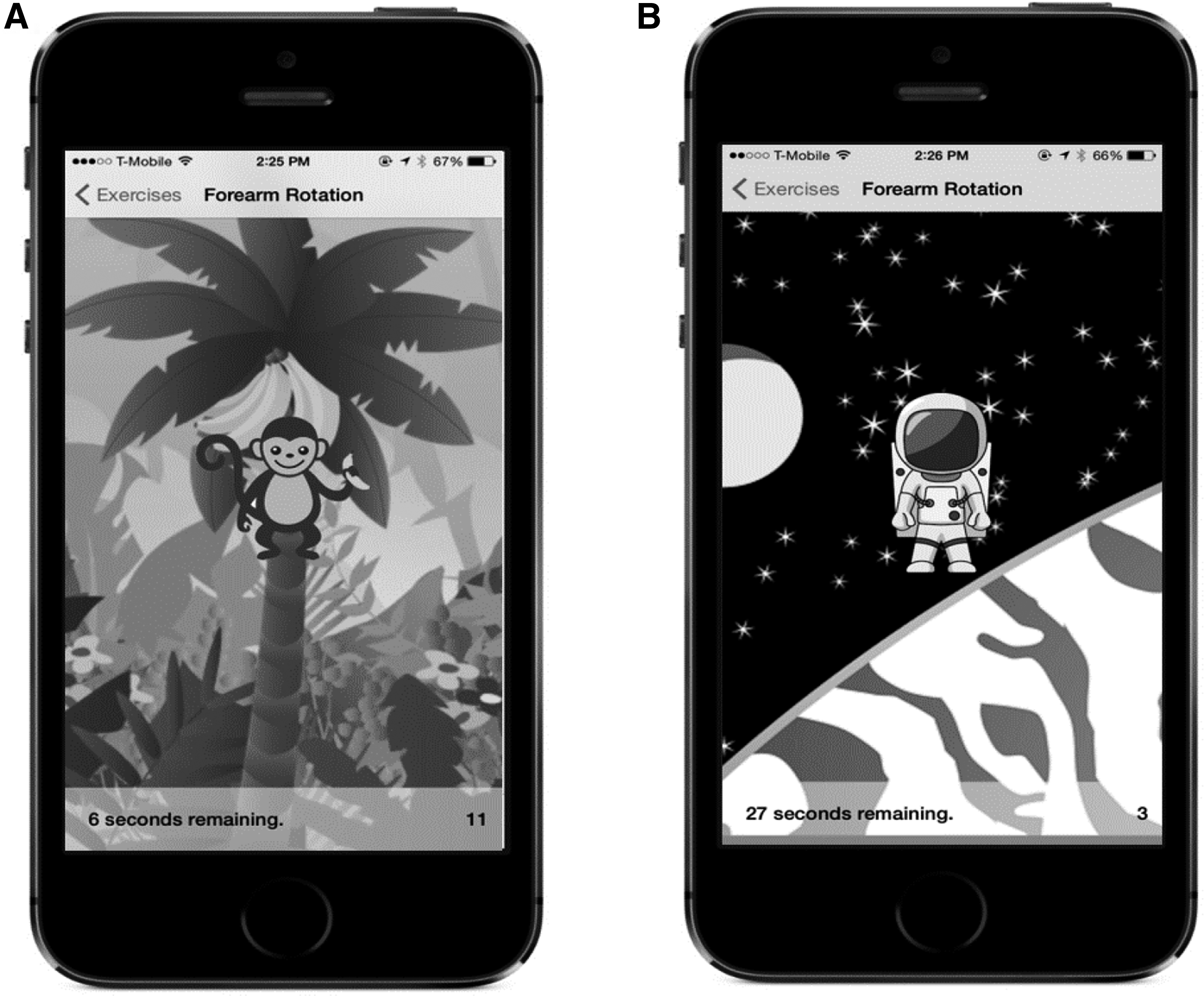
Screenshots of (A) Climbing Monkey game and (B) Astronaut game.
The portability of the app maximizes compliance with the HEP in multiple locations, allowing easy integration of the app in daily routines. Access to data from the website by the user and caregiver promotes autonomy in monitoring performance. These motivating factors are hypothesized as supporting the potential efficacy of this alternative to stroke motor recovery.
Method
A mixed-methods, multiple case study design was used to examine the potential of this technology for stroke motor recovery. Data were collected from pre- and posttest assessments of stroke survivors during a 6-wk protocol. Multiple cases enabled objective and qualitative examination of the various ways that the app could be used to address stroke motor recovery by survivors with a range of fatigue and movement ability. Each case highlighted its own set of user perceptions and use patterns.
Stroke survivors with an onset of 1 yr or less and chronic stroke survivors were targeted for recruitment from a collaborating rehabilitation facility and stroke support groups. Participants were required to own and use a smartphone, to be able to use their phone and app independently, and to have access to the Internet. The 6 stroke survivor participants in the sample (Table 1) used the app in different ways: to measure active motion, to measure passive motion through self-ROM exercise, or to track endurance.
Demographics and Results
Note. For fatigue score, a lower score indicates less fatigue; for fatigue overall, a lower score indicates more fatigue. ADLs = activities of daily living; ARAT = Action Research Arm Test (higher score = better coordination); CAHAI = Chedoke Arm and Hand Activity Inventory (higher score = better performance); CVA = cerebrovascular accident; good+ = full ROM against gravity, almost full resistance; good = full ROM against gravity, moderate resistance; good– = full ROM against gravity, mild resistance; PROM = passive range of motion; ROM = range of motion.
Instruments
Several instruments were used to collect data from participants. In addition to demographic data, an occupational profile was compiled to identify activities to target for improvement. Objective measures were the Action Research Arm Test (ARAT; Lyle, 1981), the Chedoke Arm and Hand Activity Inventory (CAHAI; Barreca, Stratford, Masters, Lambert, & Griffiths, 2006), Boston University’s Activity Measure—Post Acute Care (AM–PAC) Short Form (Jette, Haley, Coster, & Ni, 2013) for the daily activities domain, goniometry, the Modified Ashworth Scale (Gregson et al., 1999), and manual muscle tests.
The ARAT was selected for its psychometric properties and ability to provide data related to gross and fine motor coordination (Yozbatiran, Der-Yeghiaian, & Cramer, 2008). This instrument demonstrates strong reliability (Cronbach’s α = .95–.99) across all subscales (i.e., Grasp, Grip, Pinch, Gross Movement). Construct validity is high compared with results from the Fugl–Meyer Assessment (r = .94; Yozbatiran et al., 2008).
The CAHAI, Version 9, is an occupation-based test of performance in components of activities of daily living (ADLs). Test–retest reliability (Cronbach’s α = .97) and construct validity of this assessment when compared with the ARAT (r = .93) are excellent (Barreca et al., 2006). Both arms and hands are required to complete tasks such as pouring a glass of water or buttoning up a shirt.
We obtained permission to use the AM–PAC Short Form and used it to assess the amount of help needed to perform ADLs and instrumental activities of daily living. The AM–PAC Short Form has high internal consistency (Cronbach’s α = .92–.94; Jette et al., 2013) and is comparable with the FIM in its sensitivity to detect changes in function (McDowell & Newell, 1996).
ROM (goniometry), muscle tone, and strength tests provided additional objective information for analysis and were administered by the same therapist during pre- and posttesting to improve reliability. Active range of motion (AROM) was measured for participants with active movement in the extremity. Passive range of motion (PROM) was measured for those without active movement who were going to use the app for self-ROM exercise.
A general fatigue scale was administered to participants who reported increased fatigue since the stroke. This scale is an adapted version combining aspects from the Fatigue Severity Scale (Krupp, LaRocca, Muir-Nash, & Steinberg, 1989) and the Fatigue Assessment Scale (Michielsen, De Vries, & Van Heck, 2003). The adapted instrument contains 10 items using a 5-point Likert-type scale, for a total possible score of 50, and one overall rating of fatigue using a 10-point scale. Reliability or validity has not been established for this adapted format. At Wk 3 and Wk 6, participants completed a 12-item questionnaire providing feedback regarding the use of the app (e.g., ease of use, helpfulness, navigation) through agreement scales and open-ended questions.
Procedure
After informed consent, pretesting, and app installation, an occupational therapist (one of the researchers or a therapist in the clinic) selected up to eight exercises and calibrated them to the participant’s performance level for target movement goals, time, and intensity on the basis of test results. The researchers (authors Lawson, Tang, and Feng) ensured that the participants understood all aspects of engaging with the app and website through a digital literacy assessment. The researchers and clinic therapists monitored participant use of the app from the secure website and contacted participants who demonstrated limited use of the app to address any issues. At Wk 3, participants were seen for adjustments. The questionnaire and open-ended questions were administered at Wk 3 and Wk 6 along with posttests at the end of the 6-wk protocol.
Data Analysis and Results
Data were not aggregated across participants because of the study design; however, observed changes in pre- and posttests were noted (Table 1). Improvements were observed in accuracy of movements as indicated by the percentage increase in the number of movements detected by the app (Table 1, last row), decreased fatigue, and increased PROM and AROM. Participants reported improved ability to perform daily activities, motivation to use the app as part of their home exercises, and ease with using the app. Statistically significant changes were not obtained because of the nature of the sample and goals for the study.
Discussion
Development of ARMStrokes was a recursive process, with unanticipated uses of the app appearing with each new user. The adaptability of the app to meet individual needs of varying levels of stroke severity is encouraging, as is the excitement demonstrated by participants when using the app. Improvements in occupational performance warrant further study to distinguish naturally occurring improvement from improvement as a result of using the app. Improved accuracy in performing the exercises can be viewed as evidence of motor learning.
Despite the support provided through the online monitoring and 3-wk check, compliance was an issue; some participants needed reminders as evidenced by the interruptions in use observed from the website. Participants completed their exercises within the context of other habits and routines, with some participants designating a specific time to do the exercises (e.g., “when I watch the news in the morning,” “whenever it was convenient to pull out the phone”).
Limitations
Several limitations and confounding factors exist for this pilot study. It is not clear whether improvements were due to app use or another HEP prescribed by therapists for participants who simultaneously were in active therapy programs. Improvements could be attributable to substituting the unaffected limb for the exercises; however, these substitutions were easily detected from an inspection of the wave pattern produced. Participants with limited movement and no hand function had difficulty effectively using the app with the adapted strap. Finally, the functionality of the app changed depending on the model of the phone (e.g., sensitivity or availability of sensors to consistently capture movements) and interrupted participation.
Conclusion
The utility of this form of motor training is promising in its potential to meet the parameters of motor learning, promote neuroplasticity, and be engaging and easily accessible to multiple populations, such as those in underserved areas. Occupational therapists can use therapeutic exercise through the app and can devote valuable face-to-face time to other types of living skills training. Plans for future research include refining app properties and data collection instruments and recruiting a larger sample across multiple groups of stroke survivors with an extended protocol to view changes at multiple points over time. An experimental study is planned to compare a control group of non–app users with app users.
Footnotes
Acknowledgments
We acknowledge the Aetna Foundation and Towson University for their support and Jin Guo for her participation in the study.