





Abstract
This case report provides an overview of the psychometric properties and clinical utility of the My Vocational Situation (MVS) instrument. The accompanying hypothetical case description illustrates how clinicians could use the MVS to evaluate vocational preferences and outcomes and how the MVS can be used to inform treatment planning and rehabilitation decision making. The information contained in this report is intended to familiarize clinicians with the administration and scoring of the MVS, the psychometric information necessary to interpret results obtained from the MVS, and how the results could be used to provide comprehensive, patient-centered care. It is important to note that the information provided represents only a sample of the available research literature on the MVS.
Case Description
Brandon Stover is a 32-yr-old man previously employed as a construction worker certified in heavy machinery. He is a high school graduate and lives with his wife and two children (a 3-yr-old and an 18-mo-old) in a ranch home with a work room in the basement.
Medical diagnosis: Injured in a car accident; sustained a spinal cord injury (SCI) at C4–C5
Primary problem: Tetraplegia; Unable to return to previous job
Relevant secondary problems: Immobility
Level of care: Day rehabilitation
Patient-Specific Considerations
Skin: No history of pressure sores
Wheelchair: Power wheelchair ordered with recline and tilt settings and air cushion for pressure distribution
Transfers: Requires help with slide board transfers; wife uses a mechanical lift because of her small stature
Bowel and bladder: Successfully learned a bowel and bladder program that requires the assistance of his wife
Feeding: Feeds independently using an adaptive splint and setup or by wrapping the fork in his fingers; unstable when drinking out of a glass or cup without a long straw
Dressing: Can get a t-shirt over his head but needs help pulling it down; dependent in putting pants on; learning how to do buttons using a button hook but prefers a pullover at this time
Phone use: Unable to access his smartphone or iPad; wants to learn adaptations for these devices
Computer use: Learning how to use adaptive splints and Dragon dictation software for direct access to the computer; before the accident used a computer at home for email and surfing the Internet
Balance: Falls forward if he tries to reach in front of him; requires help to get back into his wheelchair
Hand use: No movement in his wrists or hands; has good elbow flexion but no elbow extension; able to bring hands to his mouth
Smoking and drinking: Quit smoking during rehabilitation; light beer drinker on weekends.
Home and Social Life
Mr. Stover has a strong support group both at the hospital and since coming home. His past coworkers are making his ranch home accessible with a ramp and wider doors. His brother and sister-in-law, to whom Mr. Stover and his wife are very close, live a mile away and have a daughter the same age as theirs. Mr. Stover’s closest friends went to high school with him and still live in the area, but since the accident he has not gone to the bar that they often frequent. He is an avid Chicago Bears and Blackhawks fan.
Occupational History
Before his SCI, Mr. Stover worked as a heavy machine operator for a commercial construction company. He had to perform heavy lifting, mechanical repair and heavy machinery maintenance, and vehicle operation with joystick and pedal controls. Many of the heavy machines are accessible only by climbing a steep ladder and using a safety grab bar to reach the vehicle cabin. Mr. Stover also filled the role of heavy machine operations manager, in which he was responsible for ensuring ongoing safety checks and maintenance of all machinery equipment; coordinating the use of heavy machinery, including bulldozers, cranes, front-end loaders, and dump trucks, between construction sites; and training new personnel in the operation of all heavy machinery.
Mr. Stover’s role as a heavy machine operations manager required him to access the machinery undercarriage and engine compartment to conduct inspections of all mechanical systems and complete scheduled maintenance. His training responsibilities included demonstrating heavy machine operation, evaluating trainee performance, and overseeing trainee work on site. Mr. Stover was well suited to his occupation and enjoyed the mechanical maintenance aspects of his work. He has always enjoyed working outdoors, challenging himself with physical activities, and being part of an orchestrated construction crew.
Equipment Needed
Mr. Stover can leave the house for doctors’ appointments and day rehabilitation only when he is picked up by a MediCar or the rehabilitation van, or he has to reserve an accessible car that can accommodate only a manual wheelchair because he currently owns a small sedan. Thus, he would benefit from an accessible van.
Assessment Type Needed
Mr. Stover’s change in functional status and inability to return to his job as a construction worker have prompted him to consider a career change. As such, a comprehensive vocational assessment is recommended to evaluate for alternative occupational interests and career goals, knowledge gaps related to potential vocational opportunities, and concerns about changing careers.
Justification for Use of the My Vocational Situation Instrument
The MVS instrument (Holland, Daiger, & Power, 1980) was selected to assess Mr. Stover’s occupational aspirations and to inform his decision making throughout the career-change process. The MVS instrument has been validated for use in SCI (Crisp, 1992) and mixed-etiology disability populations (Yanchak, Lease, & Strauser, 2005) and has demonstrated poor to excellent internal consistency. In addition, the Vocational Identity subscale of the MVS has demonstrated adequate predictive validity among adults for predicting job satisfaction (Carson & Mowsesian, 1993), and it has been shown to have adequate test–retest reliability among college students over 3–5 mo (Lucas, Gysbers, Buescher, & Heppner, 1988).
Figure 1 describes the psychometric properties of the MVS. The Barriers subscale has demonstrated poor test–retest reliability among undeclared college students (Lucas et al., 1988). The long delay between administrations (3–5 mo) likely contributed to the subscale’s instability. In addition, its poor test–retest reliability may be related to the sample of college students, who had not yet declared an area of study at the time of the first administration. Additional psychometric validation with SCI populations to examine the temporal stability of the Barriers subscale is needed.
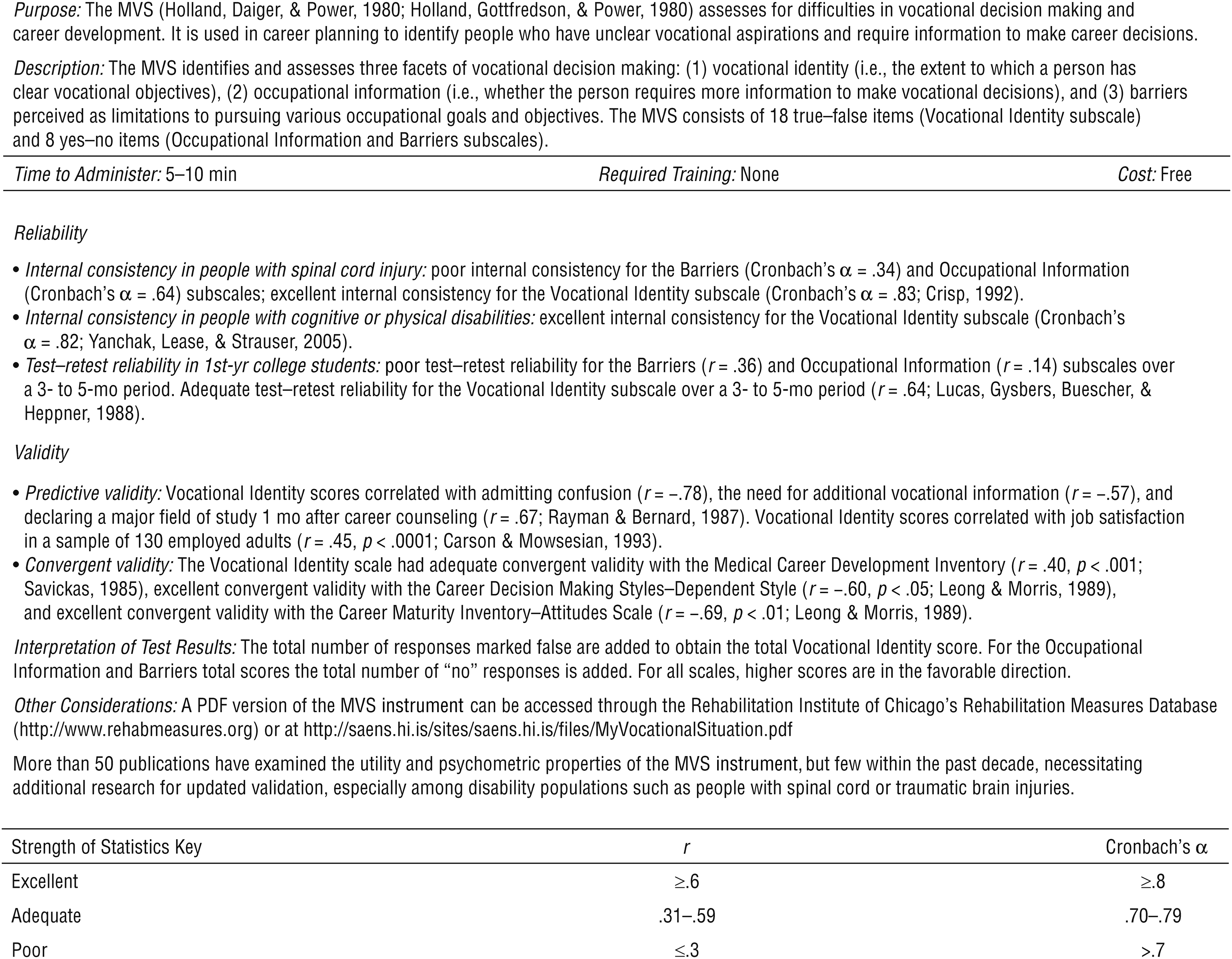
Description and psychometrics of the My Vocational Situation (MVS) instrument.
Clinical Application of the My Vocational Situation Instrument
A vocational rehabilitation counselor (VRC) administered the MVS 8 mo after Mr. Stover’s SCI (Table 1). The initial Vocational Identity score of 4 points (out of 18) suggested that Mr. Stover had unclear vocational objectives and difficulty identifying occupational interests after his SCI. He felt he had inadequate information about potential career choices, how to find employment of interest, and how to obtain the necessary education. He perceived barriers to pursuing alternative career paths and lacked confidence in a successful transition to a new occupation. The VRC suggested that he attend a vocational seminar for people living with physical disabilities that was designed to provide information about resources for career selection, vocational rehabilitation and career counseling, and educational accommodations. Mr. Stover also attended a job fair that exposed him to a variety of career opportunities and provided him with career-specific information.
Mr. Stover’s Results on the My Vocational Situation Instrument
The VRC then administered the MVS a second time. The Vocational Identity scale score of 12 points suggests that Mr. Stover had clearer vocational interests and was better able to identify goals for future career prospects. He identified four potential careers and felt more confident in choosing a new career. His Occupational Information score, which increased from 1 to 3, indicates that he felt he received important information about the educational requirements for his career interests, locating jobs in his potential fields, and career opportunities. Mr. Stover’s Barriers score indicates that although he still has concerns about paying for any additional education required, he feels more confident in his ability to successfully transition to a new job and perceives fewer barriers to successfully beginning a new career.
Implications for Occupational Therapy Practice
The MVS instrument can be used by occupational therapists working with people interested in the occupation of work.
The need for activities of daily living and community living skills intervention may become evident, because the person is going into a new environment that may require other skills, such as self-feeding.
The occupational therapist may need to address work accessibility issues for vocational interests, such as assessing skills and suggesting accommodations for required education and actual job tasks (e.g., note taking, computer use, test taking, using a textbook, scheduling, task prioritization and completion, and other work-related skills).
Driving skills may be a new objective for the person when work is a goal.