





Abstract
Safety is an issue for older adults with dementia because they are at risk for various incidents. Intelligent assistive technology (IAT) may mitigate risks while promoting independence and reducing the impact on the caregiver of supporting a relative with dementia. The aim of this scoping review was to describe IATs and to identify factors to consider when selecting one. A systematic search was performed of the scientific and gray literature published between 2000 and 2015. A total of 31 sources were included. Four types of IATs were identified as addressing safety issues in dementia: monitoring technologies, tracking and tagging technologies, smart homes, and cognitive orthoses. Characteristics of the device and ethical considerations emerged as key factors to consider when selecting one. IATs yield promising results but pose various challenges, such as adapting to the evolution of dementia. Further research on their actual impact is needed.
In the coming decades, an increasing number of older adults will be living with dementia. The number of people age 65 yr and older with a diagnosis of Alzheimer’s disease or other forms of dementia in the United States was estimated to be 5.2 million in 2016, and it is expected to nearly triple by 2050 (Hebert, Weuve, Scherr, & Evans, 2013). Because many older adults choose to age at home, a large proportion of people with dementia are living in the community despite increasing disabilities, generally with help from family members and health professionals (Gould et al., 2015). Safety may become an issue, especially in the moderate and severe stages of dementia, which involve memory and executive function impairments (McGuinness, Barrett, Craig, Lawson, & Passmore, 2010), gait and balance problems (Allan, Ballard, Burn, & Kenny, 2005), and poor awareness of danger (Starkstein, Jorge, Mizrahi, Adrian, & Robinson, 2007).
Although limited information about the frequency of safety incidents for people with dementia is available, people with dementia may be exposed to higher risk of incidents (e.g., self-neglect, falls, wandering; Tierney et al., 2001, 2004) with increased morbidity and mortality compared with older adults without dementia (Douglas, Letts, & Richardson, 2011). Safety issues also contribute to the large impact for caregivers of supporting a relative with dementia (Papastavrou, Kalokerinou, Papacostas, Tsangari, & Sourtzi, 2007; Walker, Livingston, Cooper, Katona, & Kitchen, 2006). Consequently, modifications to the environment and occupations are often made by family caregivers to improve safety and reduce their stress (e.g., remove sharp knives, limit use of the oven, prevent exiting; Walker et al., 2006), but these modifications may restrict their relative’s autonomy. Managing risks and balancing risk reduction with encouraging an active lifestyle are major challenges for caregivers and professionals (Clarke, Wilkinson, Keady, & Gibb, 2011; Rosenberg, Kottorp, & Nygård, 2012).
Intelligent assistive technology (IAT) may mitigate safety risks and reduce the impact on caregivers while enhancing participation in meaningful occupations for the person with dementia. For example, tracking devices that use the global positioning system (GPS) may allow a person with dementia to pursue a significant activity with a sense of security (e.g., taking a walk) and help the caregiver find the person if he or she gets lost (White, Montgomery, & McShane, 2010). Monitoring technologies, such as intelligent ovens, may reduce cooking-associated incidents while enabling the person with dementia to continue participating in cooking activities (Cheek, Nikpour, & Nowlin, 2005). Technologies for safety are especially welcomed by caregivers (Rosenberg et al., 2012). Considering the promising results of these technologies, more researchers have examined IATs that can be used in dementia care. Development of IATs within a research context and their implementation with a small sample of people with dementia have been described in various studies (Meiland et al., 2012; Mihailidis, Carmichael, & Boger, 2004; Rowe, Lane, & Phipps, 2007). In addition, Bharucha et al. (2009) reviewed all technologies with potential applications to dementia care.
Although Bharucha et al. (2009) included many technologies, some have since been abandoned, and only a few have been tested with people living with dementia. Consequently, to our knowledge, little is known about the extent to which IATs are currently used to address safety issues while promoting participation among the population of people with dementia. Moreover, none of the studies reviewed (Bharucha et al., 2009; Carswell et al., 2009; Landau & Werner, 2012) identified which factors to consider when selecting appropriate and adapted IATs. Therefore, in this study, we aimed to synthesize current knowledge in the existing literature on (1) types and characteristics of IATs used to address safety issues in dementia while enhancing participation in meaningful activities, including advantages and disadvantages pertaining to their use, and (2) factors to consider in the choice of IATs with this population.
Method
A scoping review was performed according to the five stages developed by Arksey and O’Malley (2005) and refined by Levac, Colquhoun, and O’Brien (2010). Scoping reviews provide an opportunity to examine the breadth and depth of actual knowledge on a relatively new subject, such as use of IATs in dementia care; determine the feasibility of conducting a systematic review; and identify knowledge needs to be met by future primary research (Arksey & O’Malley, 2005). Scoping reviews differ from other reviews in that they are not used to assess study quality (Arksey & O’Malley, 2005; Levac et al., 2010). However, this method offers a general overview of the literature by including a wide variety of study designs and gray literature, unlike systematic reviews. Scoping reviews also use a structured approach, which ensures consistency (McKinstry, Brown, & Gustafsson, 2014).
Stage 1 is used to identify the research question. In this study, we aimed to answer the following questions:
What types and characteristics of IATs described in the literature might address safety issues while enhancing the participation of older adults with dementia in meaningful occupations? What are the advantages and disadvantages of using those IATs?
What are the key factors to consider when selecting IATs in dementia care?
Stage 2 involves identifying relevant studies. Initially focusing on innovative practices in dementia care, the research strategy was first developed in collaboration with an experienced librarian to cover all assessments and interventions used to address safety issues in dementia (see Supplemental Appendix A, available with this article online at https://otjournal.net, for key words). Scientific literature (2000–2015) was searched in four databases (MEDLINE, AgeLine, Cumulative Index to Nursing and Allied Health Literature [CINAHL], and Scopus). Sources were included in this review only if they described IATs, the IATs described addressed safety issues, and they focused on the activities of older adults (65 yr and older) with dementia living in the community (e.g., own home, seniors’ apartment complex). The same key words and inclusion criteria were used for the gray literature search on the Internet (first 10 pages on Google Scholar, library of the University Geriatrics Institute of Montreal). There were no restrictions on the type of reference (e.g., research studies of any design, memoirs, government publications).
According to the Assistive Technology Act of 2004 (Pub. L. 108–364), assistive technology refers to “any item, piece of equipment, or product system, whether acquired commercially, modified or customized, that is used to maintain, increase, or improve the functional capabilities of individuals with disabilities.” More specifically, IATs must require the use of electric power, and they need to be installed and calibrated to be used. For the scoping review on innovative practices in dementia care, 520 sources (227 from MEDLINE, 90 from AgeLine, 142 from CINAHL, and 61 from Scopus) were retrieved. Screening was completed independently by two members of the research team (Gagnon-Roy and Stocco), and disagreements were discussed with a third member (Provencher). After screening by title and abstract, 37 sources met the criteria outlined earlier and were included for full-text review (Figure 1).
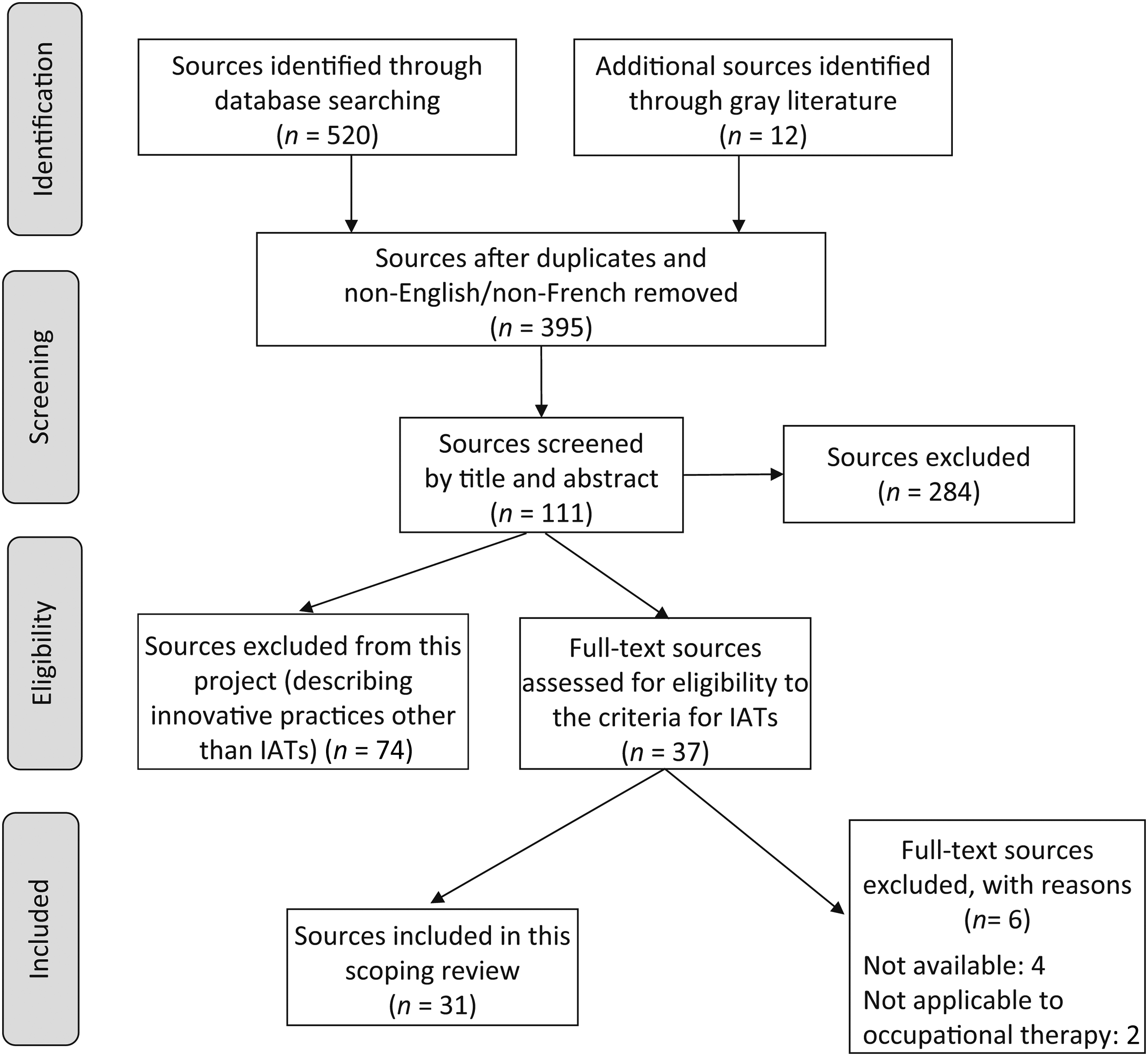
Flowchart of sources screened and included in the scoping review.
Stages 3 and 4 are iterative and encompass study selection and data charting. Sources selected were analyzed by two of the authors (Gagnon-Roy and Stocco) to identify relevant sources according to the inclusion criteria and extract pertinent data from the documents identified. A data charting form was developed by the first author and validated by two members of the research team (Provencher and Stocco). The form included data about types and descriptions of IATs used to address safety issues in dementia, advantages and disadvantages of IATs, factors to consider when selecting an IAT, and the type of source (e.g., expert opinion, descriptive study). Using the data charting form, two of the authors (Gagnon-Roy and Stocco) reviewed four sources to discuss disagreements on data extraction. After interrater agreement was reached, the remaining documents (n = 33) were analyzed separately by the same two authors. After data charting and according to the inclusion criteria, data from 31 documents were included for complete analysis.
Stage 5 involves the data analysis. Thematic analysis (Paillé & Mucchielli, 2008) was performed to determine the types and characteristics of IATs used to address safety issues in dementia while promoting participation in meaningful activities and to identify their advantages and disadvantages as well as factors to consider when selecting one. Frequency analysis was used to complete the analysis and to identify the number of sources describing each type of IAT and pertaining to each type of source included.
Results
A total of 31 sources were included in this scoping review: 8 reviews, 4 empirical studies, 10 descriptive studies, 7 author opinions, and 2 documents from gray literature. From these sources, four types of IAT were identified (Table 1): monitoring technologies (n = 18), tracking and tagging technologies (n = 10), smart homes (n = 7), and cognitive orthoses (n = 7). Smart homes were not included in monitoring technologies because they included various types of technology in the home environment. Technologies included in smart homes were not always described in the literature. The characteristics of the IATs, as well as their advantages and disadvantages, are summarized in Table 2.
Types of IATs Identified With Supporting References
Note. — = not applicable; GPS = global positioning system; IAT = intelligent assistive technology; PwD = person with dementia.
Description of Four Types of IAT Used to Address Safety Issues in Dementia
Note. GPS = global positioning system; IAT = intelligent assistive technology; PwD = person with dementia.
Three main advantages were identified. First, IATs may detect at-risk behaviors (e.g., falls, wandering, forgetting medication, change in habits) and alert the adult with dementia or a family member (Carswell et al., 2009; Cheek et al., 2005; Nijhof, van Gemert-Pijnen, Woolrych, & Sixsmith, 2013; Pietsch, 2006; Price, 2007; Rowe et al., 2007; Sorell & Draper, 2012; van Hoof, Kort, Rutten, & Duijnstee, 2011). Second, a decrease in caregiver stress was reported when IATs were used (Chou et al., 2012; Nijhof et al., 2013; Olsson, Engström, Lampic, & Skovdahl, 2013; Pietsch, 2006; Pilotto et al., 2011; Smith, Lunde, Hathaway, & Vickers, 2007; White et al., 2010). Finally, many studies reported improved participation in activities such as walking in the community (Olsson, Engström, Skovdahl, & Lampic, 2012; Pilotto et al., 2011; Rigaud et al., 2011). However, few researchers explored the impact of assistive technology on incidents, and none systematically documented the number of incidents avoided.
Nonetheless, the sources reviewed exposed two main disadvantages related to assistive technologies. The first involved technical problems, such as power cuts and inaccurate information (Chou et al., 2012; Kang et al., 2010; van Hoof et al., 2011; White et al., 2010). Second, they may be ethically controversial, because private information may need to be transmitted to ensure safety at home (Landau & Werner, 2012; Plastow, 2006; Welsh, Hassiotis, O’Mahoney, & Deahl, 2003; Zwijsen, Niemeijer, & Hertogh, 2011).
Finally, in the sources included in this scoping review, the researchers reported six key factors associated with the choice of IATs. These factors relate to the people with dementia and their environment as well as the activities they undertake (Table 3). The three most often reported key factors related to the device itself (e.g., robustness, ease of use), ethical considerations (e.g., invasion of privacy and surveillance of older adults with dementia), and the person (e.g., level of dementia, interest in and comfort with IATs).
Key Factors to Consider When Selecting an IAT
Note. IAT = intelligent assistive technology; PwD = person with dementia.
Discussion
In this scoping review, we aimed to complete the review of Bharucha et al. (2009) by exploring scientific and gray literature to identify the characteristics of IATs reported in the literature as being used to address safety issues in dementia while optimizing participation in meaningful activities and to pinpoint key factors to consider when selecting one. Four types of IATs were identified: monitoring technologies, tracking and tagging technologies, smart homes, and cognitive orthoses. The advantages reported in this scoping study are congruent with studies describing the potential, positive impacts of IATs used in innovative practices in dementia care (Bharucha et al., 2009; Carswell et al., 2009; Riikonen, Mäkelä, & Perälä, 2010). However, even if many IATs were specifically developed to address safety issues in dementia, none measured a reduction in the number of incidents. Caregivers reported reduced anxiety concerning potential risks of spouses with dementia getting lost when using a passive positioning alarm, but no incidents were reported as being avoided during the study (Olsson et al., 2013). Avoidance of other incidents, such as burns, were not discussed by people with dementia and caregivers as possible outcomes of using IATs. Consequently, although IATs are becoming increasingly popular in dementia care, further studies are still needed to determine whether IATs are effective and to evaluate their impact on incidents avoided, especially considering the increased participation in daily activities.
On the basis of our study, the person (abilities, ethical considerations), the environment (e.g., health care, caregiver), and occupations (incidents to avoid, activities enhanced) emerged as key factors to consider when selecting IATs in dementia care, led by aspects of the device and ethical considerations. These results support the importance of including environmental factors in the choice of assistive technology because physical (static and dynamic) characteristics of the home environment (e.g., room layout and furniture, presence of pets), availability of caregivers, and caregiver skills with technology vary (Olsson et al., 2012; van Hoof et al., 2011). Personal factors, such as cognitive, physical, and emotional capacities, may also have an impact on the acceptability of assistive technologies (van Hoof et al., 2011). Consequently, when considering IATs, a thorough evaluation of the person living with dementia, the person’s environment, and the person’s occupations is needed.
The importance of ethical considerations in this review is congruent with studies in which researchers explored the ethical aspects of using IATs with older adults, particularly those with cognitive decline (Landau & Werner, 2012; Zwijsen et al., 2011). Getting informed consent with this population is especially problematic because it requires an appreciation of all the potential impacts (e.g., surveillance, reduction of freedom), which older adults with dementia may not be able to do (Warner, McCarney, Griffin, Hill, & Fisher, 2008). Considering the transmission of private information and evolution of the condition, informed consent should be sought in the early stages of dementia while the older adult is still able to completely grasp the situation. Assent and participation of the person with dementia should also be obtained throughout the process (Black, Rabins, Sugarman, & Karlawish, 2010). Participatory research should be prioritized to optimize acceptability and obtain the best fit with the needs of people with dementia (Lindsay et al., 2012).
According to our results, using IATs may reduce for family members the impact of supporting a relative with dementia. However, improper use may increase the impact because IATs may generate anxiety in people with dementia (e.g., unknown sounds, flashing lights; Riikonen et al., 2010; van Hoof & Kort, 2009). Use of IATs may also increase at-risk behaviors in older adults with dementia (Kuhne, Bedin, & Chappuis, 2015). In fact, because IATs allow them to engage in various occupations such as walks in the community, older adults may encounter new risks they would not have otherwise. Moreover, IATs may have technical issues (e.g., low battery), which may put people at risk when relying on them (White et al., 2010). Finally, because the risk of incidents and need for assistance for optimizing participation increase with the evolution of dementia, it might be difficult for IATs to adapt to these changes, and frequent reassessments and modifications may be required. On the basis of the person, environment, occupation model, if an IAT (physical environment) is unable to respond properly to evolving needs, assistance will have to be provided by caregivers (human environment). Consequently, further research should focus on how to improve the flexibility of IATs to ensure the “just-right” fit over the years while enhancing greater participation and independence in meaningful activities.
This scoping review provides an accurate and rigorous overview of current knowledge concerning IATs used to address safety issues in dementia. Specifically, in this study, we meticulously followed each step in scoping reviews and explored a variety of sources to ensure that the most relevant documents were included. Covalidation of data charting and analyses also ensured that the interpretation of the findings was valid. However, despite an extensive search, some relevant documents may have been missed (e.g., documents published before 2000, non-English articles). Moreover, the quality of the publications included in this review was not critically appraised because this criterion is not one of the objectives of scoping reviews. Nonetheless, we are confident that the current study provides a clear picture of current knowledge and is a good starting point to orient future research.
Implications for Occupational Therapy Practice
The findings of this study have the following implications for occupational therapy practice:
IATs yield promising results to promote greater and longer independence at home while enhancing participation in meaningful activities because they may detect behaviors compromising safety (e.g., falls, forgetting medication, changes in habits) and alert the person with dementia or a family member to the risk.
Clinicians should consider all relevant factors related to the person, the environment, and the person’s occupations when selecting assistive technologies.
Further research involving clinicians, people with dementia, and their caregivers is needed throughout the process to adapt IATs to the evolution of dementia.
Conclusion
In this scoping review, we identified four types of IATs that may address safety issues in people with dementia (monitoring technologies, tracking and tagging technologies, smart homes, and cognitive orthoses) and factors to consider when selecting an IAT with this population. Although IATs are becoming increasingly popular, few have been developed and scientifically trialed with people living with dementia, and no studies documented a reduction in incidents. Factors related to the device and ethical considerations emerged as key factors to consider when selecting an IAT. Considering the cognitive and functional decline of older adults with dementia, further research is needed to demonstrate the applicability of IATs in dementia, improve their flexibility throughout the evolution of dementia, and facilitate access to these technologies to maximize participation in meaningful activities. Studies in collaboration with clinicians, including those working in the community, and involving people with dementia in the process should be prioritized.
Supplemental Material
Supplementary material for Assistive Technology Addressing Safety Issues in Dementia: A Scoping Review
Supplementary material, sj-pdf-1-aot-10.5014_ajot.2017.025817.pdf for Assistive Technology Addressing Safety Issues in Dementia: A Scoping Review by Mireille Gagnon-Roy, Annick Bourget, Stéphanie Stocco, Annie-Claude Lemieux Courchesne, Nicolas Kuhne and Véronique Provencher in The American Journal of Occupational Therapy
Footnotes
Acknowledgments
We thank librarian Kathy Rose for her contribution to the development of the research strategy. We also thank Valerie Harvey for the original idea and Bernadette Wilson for the English revision. This study was supported by the Faculty of Medicine and Health Sciences, University of Sherbrooke (Grant UBR–706230).
*
Indicates studies that were included in the scoping review.
References
Supplementary Material
Please find the following supplemental material available below.
For Open Access articles published under a Creative Commons License, all supplemental material carries the same license as the article it is associated with.
For non-Open Access articles published, all supplemental material carries a non-exclusive license, and permission requests for re-use of supplemental material or any part of supplemental material shall be sent directly to the copyright owner as specified in the copyright notice associated with the article.
