





Abstract
Online technologies facilitate connections between students around the world, but their impact on occupational science and occupational therapy students’ critical consciousness about culture is underexplored. In this article we present research on five groups of occupational science and occupational therapy students across two cohorts at one Midwestern university. We used a pretest–posttest group design and the Multicultural Experiences Questionnaire to investigate the potential influence of students’ exposure to international educational interactions on their multicultural experiences and desires. Of 157 students surveyed, those who experienced the greatest number of international educational interactions demonstrated statistically significant increases in their desire to become acquainted with other people of different backgrounds and to explore their own prejudices and biases. Given the transformative potential of international educational interactions, future research must assess the ways in which such interactions affect critical cultural consciousness apart from other educational content and design.
Cultural competence is considered an essential component of occupational therapy practice because of the increasing likelihood that clients and practitioners will have different backgrounds (Iwama, 2007; Suarez-Balcazar et al., 2009). Cultural competence is an ongoing process of recognizing, appreciating, and respecting difference (Campinha-Bacote, 1999) and developing understandings about the self and others so that one can interpret and react to varying cultural behaviors in a respectful manner (Black & Wells, 2007). Awareness, knowledge, interactional skills, and sensitivity are components of cultural competence, and client empowerment, client satisfaction, and improved client health are thought to be outcomes of culturally competent practice (Smith, 1998).
Although students and scholars agree on the importance of developing cultural competence (Murden et al., 2008; Velde & Wittman, 2001), the notion of competence is problematic because it implies that cultural experiences (1) are homogeneous (Hammell, 2013) and (2) can be learned by practitioners who become proficient in interacting with others (Kumagai & Lypson, 2009). Given these critiques, scholars have suggested that health professionals must do more than develop skills, knowledge, and attitudes about nondominant cultural groups: They need a basis for redressing inequities and injustices premised on difference and cultural imperialism (Hammell, 2013; Kumagai & Lypson, 2009).
Several alternative concepts for cultural competence avoid overemphasizing objective cultural differences. Cultural sensitivity refers to an ongoing process of “employing one’s knowledge, consideration, understanding, respect, and tailoring after realizing awareness of self and others and encountering a diverse group or individual” (Foronda, 2008, p. 210). Cultural humility entails a “lifelong commitment” (Isaacson, 2014, p. 252) to “a process of openness, self-awareness, being egoless, and incorporating self-reflection and critique after willingly interacting with diverse individuals” (Foronda, Baptiste, Reinholdt, & Ousman, 2016, p. 213). Cultural humility paves the way for cultural safety (Hammell, 2013), which includes attributes of biculturalism; critical self-reflection; respect for rights, dignity, and recognition; and recipients’ determination of the safety of care (Bozorgzad, Negarendeh, Raiesifar, & Poortaghi, 2016).
Whereas cultural competence is biased toward health professionals’ efforts to understand others, cultural safety aims to reveal the power relationships that shape health care practices (Gerlach, 2012). Educators must be aware of conceptual discussions about cultural competence, sensitivity, humility, and safety, especially because cultural competence remains the de facto term in U.S. occupational therapy education. However, if educators frame cultural competence as a “type of thinking and knowing—a critical consciousness—of self, others, and the world” that “involves a reflective awareness of the differences in power and privilege and the inequities that are embedded in social relationships” (Kumagai & Lypson, 2009, p. 783), they can address the ideals of sensitivity, humility, and safety.
Multicultural education in U.S. occupational therapy programs occurs through case study, reading, immersion experiences, self-directed research and reflection, and guest lectures (Brown, Muñoz, & Powell, 2011; Suarez-Balcazar et al., 2009). Students who have experienced multicultural education report mixed but generally positive results in deepening understandings of themselves, their own culture, and others’ cultures (Forwell, Whiteford, & Dyck, 2001; Humbert, Burket, Deveney, & Kennedy, 2012). Isolated lectures or discussions are generally less effective for developing cultural competence and critical consciousness than sustained experiences involving direct contact with diverse groups (Brown et al., 2011; Kumagai & Lypson, 2009). Although some occupational therapy programs use fieldwork, travel abroad, and “visits to culturally diverse settings” to facilitate multicultural education (Brown et al., 2011, p. 185; Ilott, Kottorp, la Cour, van Nes, Jonsson, & Sadlo, 2013), such approaches are uncommon as a result of the challenges of fitting them within existing program costs and timelines (Kinsella, Bossers, & Ferreira, 2008).
Given these challenges, it is surprising that free or low-cost online technologies have only recently begun to be explored as vehicles for multicultural education. Sood et al. (2014) found that participating in asynchronous discussions linked to online didactic modules increased U.S. and Indian occupational therapy students’ cultural competence. Asher, Estes, and Hill (2014) found that synchronous video discussions about a patient case provided exciting experiential learning for U.S. and Indian occupational therapy students. Finally, Aldrich and Johansson (2015) found that U.S. and Swedish occupational science and occupational therapy students perceived a series of synchronous topically focused video discussions as positive cross-cultural learning experiences.
Background
Given the potential of online technologies to facilitate international interactions that increase cultural competence, in this study we investigated whether the number of opportunities for international interactions in a curriculum was related to students’ critical consciousness. We began our study after initiating international interactions in separate undergraduate courses at a private Midwestern university (Saint Louis University) that emphasizes global engagement and instruction (Grajo & Aldrich, 2016). The university houses three occupation-focused programs: (1) bachelor of science in occupational science (BSOS), (2) master of occupational therapy (MOT), and (3) postprofessional doctor of occupational therapy (OTD). Most MOT students complete the BSOS degree; students enrolled solely in the MOT program—10%–20% of any MOT cohort—do not experience the international interactions because they received undergraduate degrees elsewhere.
This study focused on international interactions in two BSOS courses. Starting in 2013, students in Course A began collaborating with Swedish undergraduate occupational therapy students, and in 2016 the collaborative partner was switched to South African undergraduate occupational therapy students. The collaboration aimed to help students understand the global concerns of occupational therapy and ways to interact with international peers who would become professional colleagues. Course learning objectives related to students’ appraisal of their own and others’ beliefs, values, and biases as well as to how social and political factors differentially shape occupational engagement for various societal groups (Aldrich, 2015). Four to six topically focused large-group synchronous discussions and presentations conducted by means of videoconferencing constituted the interactions. Assignments included written reflections (Swedish interactions) and group presentations (South African interactions).
Starting in 2014, students in Course B began collaborating with Filipino undergraduate occupational therapy students to critically reflect on and examine their own culture and develop a deeper appreciation of, sensitivity to, and respect for similar or different ideas about occupation, participation, and culture. The collaboration aimed to fulfill a learning objective related to understanding cultural competence and its importance in the study of human occupation. Through two iterations of the collaboration, U.S.–Filipino interactions involved one to two synchronous and four to six asynchronous small-group discussions using social media and email as well as live videoconference lectures. Assignments included context analysis and reflection papers.
Method
Outcome Measure
We used the Multicultural Experiences Questionnaire (MEQ; Narvaez, Endicott, & Hill, 2009) to assess students’ openness to, awareness of, and willingness to have interactions with diverse groups. Avoiding the problematic origin in majority cultures that defines many cultural competence measures (Kumaş-Tan, Beagan, Loppie, MacLeod, & Frank, 2007), the 17-item MEQ defines culture in relation to ethnicity; sex; religious, political, and sexual orientation; and citizenship status.
The MEQ’s two main subscales (Items 1–15) assess the multicultural experiences students have had (the Multicultural Experiences [ME] subscale) and want to have (the Multicultural Desire [MD] subscale). The ME subscale has a scoring range of 13–38, and the MD subscale has a scoring range of 6–32. Two other subscales address students’ perception of discrimination against specific cultural groups and students’ attitudes toward those groups, rated from 1 (no discrimination/very negative) to 5 (lots of discrimination/very positive). Higher MEQ scores are related to more open-mindedness and a greater likelihood of perceiving discrimination as a social issue (Narvaez & Hill, 2010).
The MEQ provides a valid way to assess the impact of diversity-oriented courses on students’ desire for multicultural experiences (You & Matteo, 2013). Two studies with a combined sample of 220 students (Narvaez & Hill, 2010) revealed strong internal consistency (α = .80) for the MEQ and a unidimensional construct (single factor) for test items in a factor analysis (Narvaez & Hill, 2010, p. 49).
Participants
We recruited two cohorts of BSOS and MOT students for this study. All BSOS students had experienced at least one international interaction through the courses described above, and approximately 60% of BSOS students had studied abroad before taking those courses. The MOT students had not experienced the courses or interactions, and we had no information about their study-abroad experiences. Although we did not specifically collect demographic data, most participants were female, White, and in their early to mid-20s. Participants consented to have their MEQ responses included in this study by acknowledging an emailed recruitment statement.
Design and Data Collection
We used a quantitative pretest–posttest group with control design (Stein, Rice, & Cutler, 2013) to assess within-group changes in MEQ scores relative to number of international interactions. We focused on analyzing within-group differences because each group of students had different degrees of intervention, as shown in Figure 1 (some had one interaction, some had two, and some had none). In addition, MEQ administration did not occur at the same time across groups, which would have confounded the quasi-experimental design. As shown in Figure 2, we administered the MEQ to all Cohort 1 groups in the first and final weeks of the second semester of an academic year (two time points); for Cohort 1, Group 1, the international interaction occurred between Time 1 (T1) and Time 2 (T2), and for Cohort 1, Group 2, one interaction occurred in the semester before TI and one interaction occurred between TI and T2. For Cohort 2, Group 1, we also administered the MEQ in the first week of the first semester (three time points); that group had international interactions between T1 and T2 and between T2 and Time 3 (T3).
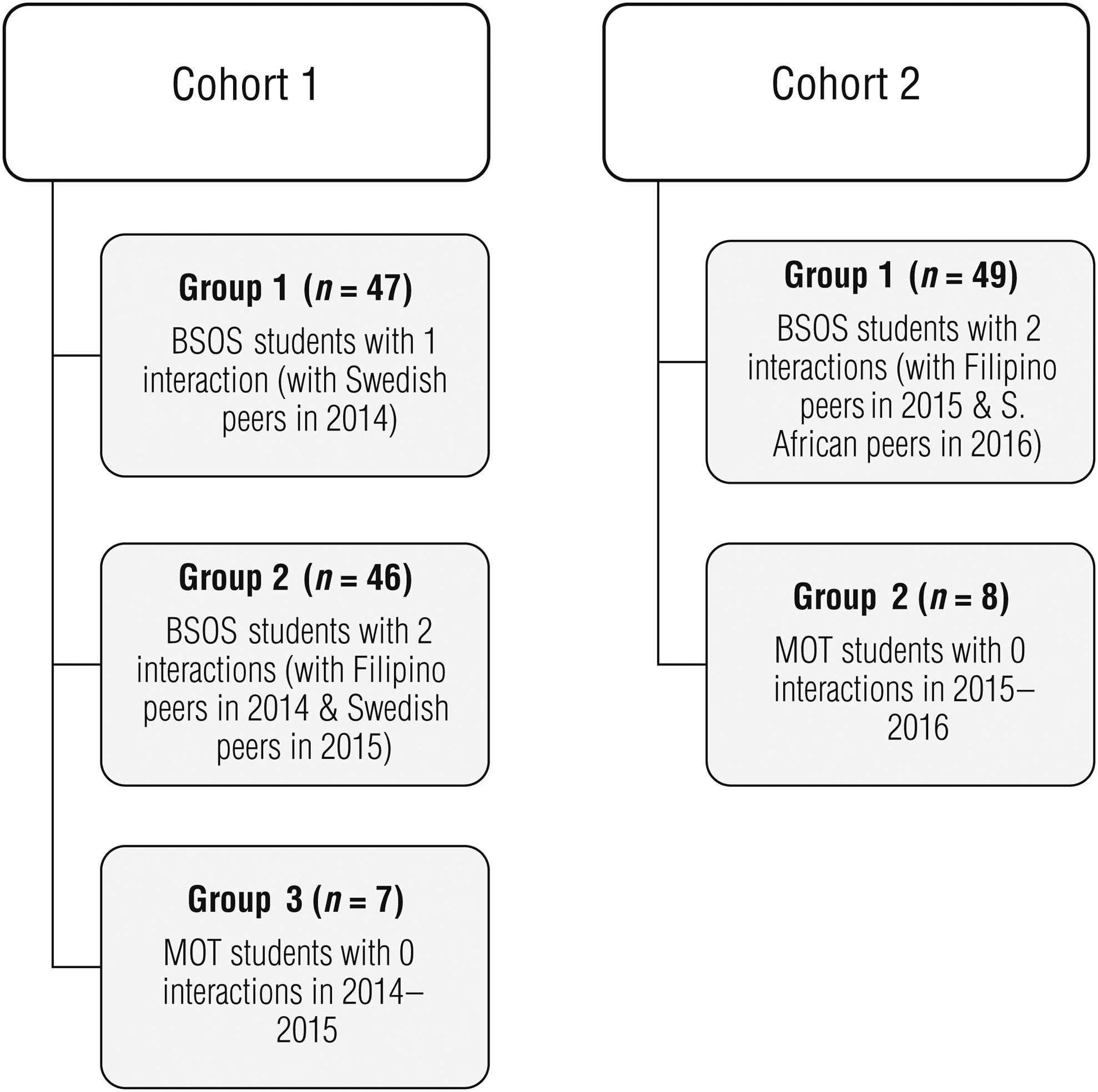
Description of cohorts of participants.
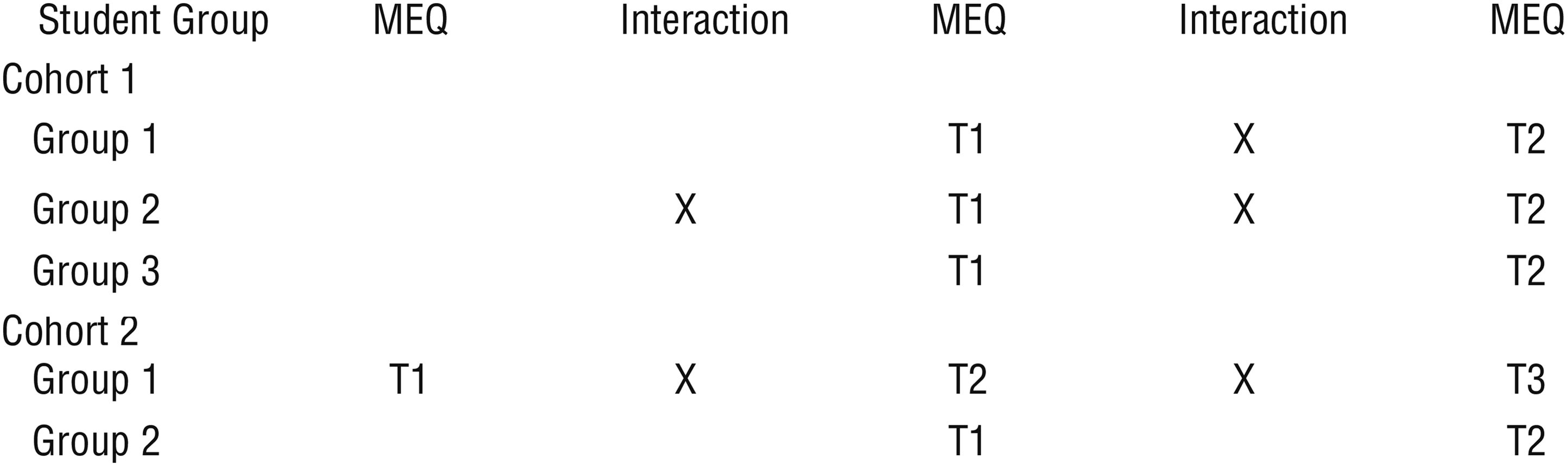
Study design.
In addition to composite ME and MD scores, we also chose to analyze specific ME and MD items corresponding to learning objectives associated with our international interactions and courses. Relative to students’ understanding of contexts and their own beliefs and values, we analyzed four ME items that asked about (1) wanting to travel out of the country, (2) having friends from different cultural backgrounds, (3) taking courses in intercultural communication, and (4) having lived in a community of a different culture. Relative to students’ understandings of their own and others’ perspectives, values, and beliefs, we analyzed five MD items that addressed whether students (1) wanted to have friends from different cultures; (2) went out of their way to understand other viewpoints; (3) got to know people from cultures that differed from their own; (4) pushed themselves to explore prejudices and biases; and (5) felt discomfort when discussing discrimination, racism, and oppression. At the end of each academic year, a research assistant entered deidentified MEQ responses into a spreadsheet that was exported to IBM SPSS Statistics (Version 23; IBM Corporation, Armonk, NY).
Data Analysis
Because of the small sample sizes within groups and the nonnormal distribution of responses, we used the nonparametric Friedman’s two-way analysis of variance and, for comparison, the Wilcoxon signed-rank test to analyze differences in median responses of each group across time periods. For Cohort 1, our analysis excluded students who skipped entire sections of the MEQ. For Cohort 2, which had fewer missing responses but did show data missing across different test items, we removed missing data from specific item analyses but did not delete entire student responses; accordingly, our analysis had small variations in participant numbers across the three time points, and we report the average number of participants (n = 49) across the time points for Cohort 2, Group 1. Saint Louis University’s institutional review board approved all procedures for this study.
Results
Change Across Time for Multicultural Experiences and Multicultural Desire
Cohort 1.
We found a significant difference in composite ME scores for Group 1 (p = .000) and Group 2 (p = .000) but no significant change for Group 3. We also found a significant difference in composite MD scores of Group 2 (p = .000) but no significant change for Groups 1 and 3. Details for this cohort and Cohort 2 are given in Table 1.
Change Across Time in Multicultural Experiences and Multicultural Desire Subscale Scores
Note. Mdn = median (reported because nonparametric tests were used), SD = standard deviation; T1= Time 1; T2 = Time 2; T3 = Time 3.
Range = 13–38.
Range = 6–32.
p < .001 using a Wilcoxon signed-rank test and Friedman’s two-way analysis of variance (ANOVA) when comparing T1 vs. T2. **p < .001 using a Wilcoxon signed-rank test and Friedman’s two-way ANOVA when comparing T1 vs. T3. ***p < .001 using a Wilcoxon signed-rank test and Friedman’s two-way ANOVA when comparing T2 vs. T3.
Cohort 2.
We found a significant difference in Group 1’s composite ME scores when comparing T1 and T3 (p = .005) and T2 and T3 (p = .000), but we found no significant difference between T1 and T2. There was no significant difference in Group 2’s ME scores. For composite MD scores we found a significant difference between T1 and T3 (p = .042) and T2 and T3 (p = .001) for Group 1 but no difference between T1 and T2. There was no significant difference for Group 2.
Change Across Time for Specific Multicultural Experiences and Multicultural Desire Items
Multicultural Experiences Items for Cohort 1.
Group 1 showed a significant increase in making friends from different backgrounds (p = .011) and a significant decrease in having courses in intercultural communication (p = .000) and living in a community of a different culture (p = .000). No significant difference was found in experiences traveling abroad. Group 2 reported significant changes in having courses in intercultural communication (p = .000) and living in a community of a different culture (p = .008) but no significant difference in experiences traveling abroad or making friends from different backgrounds. Group 3 reported no statistically significant changes for any of the four ME items. These and other ME and MD results are presented in Table 2.
Change Across Time in Multicultural Experiences and Multicultural Desire Test Items
Note. — = not applicable; MD = Multicultural Desire; Mdn = median (reported because nonparametric tests were used); ME = Multicultural Experiences; SD = standard deviation; T1 = Time 1; T2 = Time 2; T3 = Time 3.
p < .05 using a Wilcoxon signed-rank test and Friedman’s two-way analysis of variance (ANOVA) when comparing T1 vs. T2. **p < .001 using a Wilcoxon signed-rank test and Friedman’s two-way ANOVA when comparing T1 vs. T3. ***p < .001 using a Wilcoxon signed-rank test and Friedman’s two-way ANOVA when comparing T1 vs. T3. ****p < .05 using a Wilcoxon signed-rank test and Friedman’s two-way ANOVA when comparing T2 vs. T3.
Multicultural Experiences Items for Cohort 2.
Group 1 reported a significant change in having courses in intercultural communication at T1 versus T3 (p = .000) but no significant changes in the other three ME items. Group 2 did not report significant changes for any of the four ME items.
Multicultural Desire Items for Cohort 1.
Students from Group 1 reported high to very high desire to have friends from other cultures, going out of their way to understand other people’s viewpoints, wanting to get to know people who are different from them, and pushing themselves to explore prejudices and biases. Group 1 also reported low discomfort discussing discrimination, racism, and oppression. No significant changes were noted between T1 and T2. Group 2’s scores were similar to Group 1’s relative to the five specific MD items; however, a significant change in scores was noted for Group 2 in relation to wanting to go out of their way to understand other people’s viewpoints (p = .000) and wanting to push themselves to explore prejudices and biases (p = .000). Group 3 displayed scores similar to those of Groups 1 and 2 on the first four MD items but reported slightly higher discomfort talking about racism, discrimination, and oppression. No significant difference was found for Group 3.
Multicultural Desire Items for Cohort 2.
Group 1 reported high to very high desire to have friends from other cultures, going out of their way to understand other people’s viewpoints, wanting to get to know people different from them, and pushing themselves to explore prejudices and biases. A significant difference was found in their desire to get to know people who are different from them (p = .024) and wanting to push themselves to explore prejudices and biases (p = .000) from T1 to T3 and from T2 to T3. Group 1 initially reported an average level of discomfort discussing discrimination, racism, and oppression at T1, but their discomfort had lessened significantly (p = .050) at T2 and was sustained at T3. Group 2 reported high to very high desire to have friends from other cultures, going out of their way to understand other people’s viewpoints, wanting to get to know people different from them, and pushing themselves to explore prejudices and biases. Group 2 also reported midrange discomfort discussing racism, discrimination, and oppression. There was no significant change for Group 2’s five MD items.
Change Across Time for Perceived Discrimination and Feelings Toward Different Ethnicities
Perceived Discrimination for Cohort 1.
All participants in Cohort 1 reported perceiving average discrimination against Native Americans, Asians, and South Asians; low discrimination against Whites; and high to very high discrimination against Hispanics/Latinos and Blacks. There were no reported changes in perception of discrimination across the two time periods. Details are reported in Table 3.
Change Across Time in MEQ Items Discussing Perceptions and Feelings Toward People of Different Ethnicities
Note. — = not applicable; Mdn = median (reported because nonparametric tests were used); MEQ = Multicultural Experiences Questionnaire; SD = standard deviation.
p < .05 using Friedman’s two-way analysis of variance (ANOVA) when comparing Time 1 vs. Time 2. **p < .05 using the Wilcoxon signed-rank test and Friedman’s two-way ANOVA when comparing Time 1 vs. Time 3.
Perceived Discrimination for Cohort 2.
All participants in Cohort 2 reported perceiving average discrimination against Native Americans, Asians, and South Asians; low to average discrimination against Whites; and high to very high discrimination against Hispanics/Latinos and Blacks. However, Group 1 reported a significantly higher perception of discrimination against Blacks at T3 than at T1 (p = .014). Although Group 1 demonstrated no change in median score for perceived discrimination against Asians and South Asians at T1 versus T3, there was a statistically significant (ps = .041 and .037) increase in the standard deviation, possibly indicating a greater spread of scores relative to those two ethnic groups.
Feelings Toward Different Ethnicities for Cohort 1.
Students from all groups reported positive to very positive feelings toward people of different ethnicities. However, Group 2 reported slightly more positive feelings toward Hispanics/Latinos (p = .033) and Blacks (p = .008) at T2 than at T1.
Feelings Toward Different Ethnicities for Cohort 2.
All students reported positive to very positive feelings toward people of different ethnicities. A comparison of T1 and T3 revealed no significant differences in perception for Group 1. We noted, however, that Group 2 reported significantly less positive feelings toward Native Americans (p = .046), Hispanics/Latinos (p = .025), Whites (p = .025), Asians (p = .046), and South Asians (p = .046) at T1 than at T2. There was also a nonsignificant slight decrease in positive feelings toward Blacks for Group 2.
Discussion
The results suggest that students with more opportunities for international educational interactions were more likely to report significant changes in selected dimensions of multicultural desire. MOT students from both cohorts experienced no international educational interactions and did not report statistically significant changes on either of the MEQ subscales, whereas BSOS groups from both cohorts did report significant changes across some of the selected dimensions. These differences persisted despite both cohorts demonstrating relatively similar perceptions of discrimination and feelings toward people of other ethnicities. Within the BSOS groups, having more than one interaction appeared to be associated with significant changes in selected dimensions at the final time point but not at an intermediate time point (T2 for Cohort 2, Group 1); thus, there may be a threshold effect whereby a specific depth or duration is necessary to see changes. These results support others’ findings (Brown et al., 2011; Forwell et al., 2001; Humbert et al., 2012; Kumagai & Lypson, 2009) about the benefits of direct interactions with diverse groups.
Changes within selected dimensions can be interpreted in several ways. First, decreases in ratings from T1 to T2 on select ME and MD items may suggest that students had different parameters for evaluating their past intercultural experiences and current contexts after experiencing the course-based international interactions. Second, although we did not frame our courses as ones that addressed intercultural communication, BSOS students may have interpreted or experienced the courses as such, thus explaining ratings differences over time for that item. In terms of multicultural desire, students who did not experience any international interactions generally reported greater discomfort discussing discrimination, racism, and oppression, but both BSOS and MOT students reported a desire to explore their own biases and prejudices.
Saint Louis University’s focus on social justice, coupled with the prevalence of regional conversations about race, may help explain these results. St. Louis, Missouri, where the university is located, is characterized by institutionalized segregation that overwhelmingly affects Black residents (Aldrich, White, & Conners, 2016). Given this context, students have multiple opportunities outside their courses to discuss issues related to racism, discrimination, and oppression; however, students with undergraduate degrees from elsewhere may have had less exposure to these conversations. Thus, both BSOS and MOT students may express a desire to explore their own prejudices and biases, but BSOS students may have more time for such exploration and thus develop decreased discomfort discussing discrimination, racism, and oppression.
Unlike Sood et al. (2014), we cannot make claims about the effect of our courses’ international interactions on students’ cultural competence. However, our results seem to demonstrate that international educational interactions increase students’ desire to learn about themselves and others and explore difficult topics related to cultural difference and power. Asynchronous and synchronous international educational interactions may thus be useful ways of helping students develop critical consciousness (Kumagai & Lypson, 2009). This preliminary attempt to assess the relationship of international educational interactions and critical consciousness is also limited in its ability to make comparative claims. Although MOT student groups provided comparison within each cohort, there were no natural comparisons within groups. Exposure to other aspects of the BSOS curriculum—such as different courses, required readings, and reflective assignments—could also explain variations between BSOS and MOT students’ responses. Finally, our reliance on a single measure without triangulating our findings limits the claims we can make in this analysis.
These limitations notwithstanding, the transformative potential of global connections in occupational science and occupational therapy education (Suarez-Balcazar, Witchger Hansen, & Muñoz, 2015) must be explored as the world becomes more interconnected. Occupational science and occupational therapy educators must explore not only how to develop and maintain partnerships for international educational interactions (Tupe, Kern, Salvant, & Talero, 2015; Witchger Hansen, 2015) but also how factors across a curriculum may create a gestalt that facilitates transformations in occupational science and occupational therapy students. Researchers should also examine programs in which global connections are not as explicitly promoted at departmental or university levels as they were in this study’s context. Future research must also triangulate data to develop fuller understandings of changes in students’ critical consciousness.
Implications for Occupational Science and Occupational Therapy Education
The results of our study offer the following implications for occupational science and occupational therapy education:
More opportunities need to be provided for direct multicultural exposure in occupational science and occupational therapy education.
Additional research is needed to understand how occupational science and occupational therapy courses address cultural competence, cultural sensitivity, cultural humility, and cultural safety and how a focus on critical cultural consciousness might unify those efforts.
Development and use of appropriate and validated measures are required to understand the impact of teaching and learning experiences on critical cultural consciousness.
Conclusion
As technologies continue to expand possibilities for multicultural elements of occupational science and occupational therapy education, educators can develop new ways of encouraging and shaping students’ critical consciousness. The findings of this pilot study suggest that repeated synchronous interactions with diverse cultural groups can influence students’ multicultural desires and provide grounding for transformative learning experiences.
Footnotes
Acknowledgments
The students in the courses described in this article helped make our international educational collaborations rich experiences, and we appreciate the students’ willingness to participate in this study. We also appreciate our international colleagues’ enthusiastic partnership as cocreators and co-facilitators of these interactions.