





Abstract
Baby Boomers are delaying retirement for the financial, social, and health care benefits of work. By 2022, an estimated 25.6% of the U.S. labor force will consist of older workers (Bureau of Labor Statistics, 2014). Employers value older workers for the commitment, skill, cooperation, and tacit knowledge they bring to the workplace (DeLong, 2004; Pitt-Catsouphes & Matz-Costa, 2009). Although older professional workers maintain the cognitive skills necessary to work into retirement years, workers in manufacturing are challenged by age-related changes—the physical, sensory, and neuropsychological declines—that affect physical job tasks (Sweet & Pitt-Catsouphes, 2010). The manufacturing sector depends on manual labor and machinery operation to make goods; thus, workers’ cognitive and physical skills are critical to safe and efficient work. Because the mean age of manufacturing workers is higher than that of workers in other industrial sectors (Bureau of Labor Statistics, 2014), age-related issues are at the forefront of labor discussions.
U.S. legislation provides limited protection for older workers under the Age Discrimination in Employment Act of 1967 (Pub. L. 90-202) and the Americans With Disabilities Act (ADA) of 1990 (Pub. L. 101-336). Under the ADA, aging is not considered a disability; thus, the ADA does not provide accommodations for common age-related changes unless such changes result in an impairment that substantially limits at least one major life activity. More recently, the ADA Amendments Act of 2008 (ADAAA; Pub. L. 110-325) broadened the definitions of disability and major life activity to increase workers’ access to accommodations. Major life activity now includes both functional tasks (e.g., walking, lifting) and bodily functions (e.g., sleep, endocrine, cardiovascular). However, ADAAA accommodations are considered to be underused by older workers and are not well understood by businesses (Bjelland et al., 2010).
Despite broadened legislation, U.S. support for older workers lags behind that of European countries, whose policymakers have long endorsed the workplace concepts of “age management” and “workability” in efforts to retain older workers. Workability refers to coordinated workplace efforts to enhance all aspects of work life, worker health, and individual resources to promote productivity and longevity in the workplace (Tuomi, Huuhtanen, Nykyri, & Ilmarinen, 2001). In the United States, interest in age-friendly workplaces is gaining momentum, as evidenced by the newly developed National Center for Productive Aging in the Workplace, sponsored by the Total Worker Health (TWH) program (National Institute of Occupational Safety and Health, 2015).
Older Workers and Physically Demanding Work
Older Workers and High Physical Work Demands
Baby Boomers have better musculoskeletal health than previous generations (Cote et al., 2014). Nevertheless, the physical demands of manufacturing challenge older workers, particularly those who have spent decades in manufacturing work (Sweet & Pitt-Catsouphes, 2010). According to an Occupational Information Network (O*NET) analysis, physically demanding jobs are those in which considerable time is spent in activities such as standing, walking, running, or handling or moving objects (Rho, 2010). Highly physically demanding jobs also involve strength, quick reaction time, balance, and working in awkward postures (e.g., twisting, crouching). Although older adults typically retain cognitive skills into their 70s, they lose about 30% of their physical strength and endurance by age 60 (1%/yr after age 30), a process placing them at risk for performance declines (Wegman & McGee, 2004). In 2009, about 6.5 million older workers in the United States, or 35% of the workforce age 58 and older, were considered to have physically demanding jobs (Rho, 2010).
Studies have suggested that jobs with high physical demands accelerate musculoskeletal changes and increase the risk for the development of a musculoskeletal disorder. In a longitudinal study of 129 workers, Savinainen, Nygård, and Ilmarinen (2004) found that workers who perceived the highest physical demands throughout their careers showed the greatest decline in physical capacity over a 16-yr period. Fan et al. (2014) found that older workers with high ergonomic exposure had 4 times the risk of developing lateral epicondylitis than younger workers. Leinonen et al. (2011), in a longitudinal study of 2,800 workers, found that blue-collar workers with high physical demands, low support, and poor working conditions experienced 3 times the work-related disability of white-collar workers. Given that most adults older than age 65 yr take three or more medications to treat age-related or chronic conditions, medication management at work is a further consideration (National Center for Health Statistics, 2011). Although older workers meet job demands, the extent to which physical demands stress the upper limits of older workers’ capacities is not clear.
Older Workers and Adaptation to Work
Despite the trend toward increased labor force participation, only a limited number of studies have addressed task-level adaptations used by older workers. Adaptation refers to the individual process of adjusting one’s work methods to meet job demands. In two case studies, Sanders and McCready (2010) discovered that older custodians decreased loads, paced themselves, altered body mechanics, and enlisted coworkers’ assistance to meet job demands. Ng and Law (2014) interviewed 32 older workers in a variety of workplaces and found that manufacturing workers limited involvement in leisure activities, used knowledge gained in past work experiences to minimize physical demands, and relied on coworkers’ assistance to maintain energy for work. Leijten et al. (2013) interviewed 26 older workers in poor health and uncovered their strategies of balancing organizational resources (work tasks, hours, or equipment) with personal resources (relationships and personal work style).
Collectively, these studies indicate that older workers are initiating worksite adaptations themselves, by using task modification, coworker support, and personal resources. However, the daily adaptations and natural interventions used by workers need to be better understood (Härmä, 2011). This information can guide individual and systemwide strategies to support workers as they age. The purpose of this study was to understand (1) interactions between age-related changes and tasks, (2) individual adaptations and environmental modifications, and (3) organizational contexts that promoted work performance in a sample of older manufacturing workers.
Method
Research Design
A mixed-methods, multiple-case study design was used to examine the complexity of older workers’ adaptation to age-related changes. The multiple-case study design enabled an examination of the relationship between individual workers and organizational contexts and patterns of age-related changes and adaptations across multiple individuals (Stake, 2006).
Participants
Two companies with fewer than 300 employees from the manufacturing sector were approached on the basis of their similarity in location, industry, and size. Ten individuals from these predominantly male companies were purposefully sampled to represent diverse ages and ethnicities. The inclusion criteria were as follows: older than age 50 yr, fluent in English, performing manual work, and not receiving job accommodations. The targeted workers represented the intended range of diversity with the exception that no women were included. Two older women who were initially recruited did not meet the English-speaking inclusion criterion. All workers provided informed consent before participating in the study. Procedures were approved by the Quinnipiac University Human Subjects Committee.
Instruments
Both quantitative and qualitative instruments were used to gather the breadth of data needed to understand age-related changes and organizational perspectives regarding older workers.
Organizational Interview.
A structured interview focused on the company’s mission, organizational structure, productivity standards, workday schedule, management–worker relationships, and human resource policies in relation to older worker health.
Job Content Questionnaire.
The Job Content Questionnaire (JCQ; Karasek et al., 1998) gathered workers’ perceptions of the psychosocial work environment relative to opportunities for control over their jobs (decision authority, skill discretion) and social support (supervisor, coworker). This information was important in understanding the organizational context that supported individual task adaptations. The questionnaire was scored on a scale ranging from 1 (strongly disagree) to 4 (strongly agree) for each item. The subscales used in this study demonstrated strong reliability in a previous study of older workers: Decision Authority (.74), Skill Discretion (.71), Coworker Support (.75), and Supervisor Support (.84; Sanders & McCready, 2009).
Health and Productivity Questionnaire.
The Health and Productivity Questionnaire (HPQ; Kessler et al., 2003) is a self-report measure that addresses the presence of health conditions and perceptions of current work productivity compared with past performance. Use of this instrument was important to understand the personal context and meaning of work to the older workers. The HPQ is scored on a scale ranging from 0 (worst performance) to 10 (top performance).
Age-Related Changes Affecting Work.
A semistructured interview probed older workers about changes in the following bodily systems and the impact of these changes on job tasks: musculoskeletal (strength, joint motion), sensory (vision, hearing, temperature, sensation, vibration), neuromuscular (balance, reaction time), cardiovascular (endurance, circulation), neuropsychological (emotion, depression, memory, cognition), skin, and genitourinary systems. The interview was developed for the purposes of this study from expert input by the author, an ergonomist, a gerontologist, and an industrial hygienist and through a review of the literature (Wegman & McGee, 2004).
Task Analysis and Behavioral Observations.
The task analysis identified workers’ job tasks, equipment used, physical demands (standing, walking, carrying, lifting, postures, repetition), and work environment (lighting, noise, temperature). Observations included worker behaviors that indicated effort or discomfort while performing specific tasks and the accompanying individual adaptations or environmental modifications (equipment or tools) used. Participants’ job tasks were observed on multiple occasions, photographed, and recorded on the U.S. Ergo Risk Factor Checklist (Costello, 2015) by the author and four graduate students trained in ergonomic evaluation. Consensus regarding each worker’s tasks was reached by comparing findings among observers, viewing photos to verify postures, and corroborating findings with workers.
Data Collection Procedures
The data collection process is outlined in Table 1. Data were collected from July 2014 to May 2015, with member checks occurring in summer 2015. An administrator from each organization was initially interviewed about the organization and its health policies. These administrators were chosen on the basis of their knowledge of human resources (HR) practices. For Company 1, the administrator was the HR/Procurement Director; for Company 2, the administrator was Co-Owner.
Data Collection Process
Older workers completed the demographics questionnaire, JCQ, and HPQ at the time of the first observation. Researchers (occupational therapy graduate students participating in data collection as part of their Capstone Project) then observed and interviewed workers on the shop floor for at least 8 hr over a 4-mo period. When workers performed a physically demanding task, researchers, working in pairs but observing workers individually, asked workers whether the difficulty of the task had changed since they began the job and how they had altered the task. These onsite interactions enabled the researchers to identify unique adaptations. Workers were observed 1.5–2 hr on each of four visits. Informal interactions with direct supervisors during each visit included short conversations about current projects, task difficulty, and older workers’ ability to meet production goals compared with other workers. Final interviews with older workers linked observations of adaptations to workers’ perceptions of age-related changes (30 min to 1 hr).
Data Analysis and Qualitative Rigor
Data from instruments, observations, and interviews were summarized into a 5- to 6-page narrative for each worker, highlighting the uniqueness of each case. The author completed a cross-case analysis, which requires that one researcher read all the narratives to identify common themes related to research questions (Stake, 2006). Eleven themes were identified, which were condensed into five overarching categories. Each case narrative was examined and coded for its expected utility, or for how the case exemplified each theme. Similarities, differences, and patterns among cases were then examined, noting the correspondence within cases or occurrences that were commonly linked together. According to Stake (2006), correspondence across cases reflects the robust interaction between the case and the context. The final step was to develop statements for each theme.
Trustworthiness was ensured by following a data collection procedure and triangulating data across multiple participants and multiple observations, instruments, and documents (including productivity sheets and company websites). Peer debriefings after each visit and a final member check validated the interpretation of findings (Stake, 2006).
Results
Six workers from Company 1 and 4 workers from Company 2 agreed to participate in the study. All workers were male; the mean age was 59.5 yr (standard deviation = 7.5; range = 51–74), with workers from Company 1 having a higher mean age (63.5 yr) than workers from Company 2 (53.5 yr). The racial/ethnic backgrounds were White (n = 6), Hispanic (n = 2), and Polish (n = 2; Polish workers spoke English as a second language, which represented a strong cultural influence). Most workers were married (n = 7) and lived with a spouse or family member (n = 8). All workers perceived their health to be good or very good, although the majority did not exercise (n = 9), and half of the sample smoked (n = 5). All workers had at least a high school education; 2 had attended junior college or technical school. Table 2 provides case-specific data on self-reported medical conditions. All names are pseudonyms.
Description of Workers’ Medical Conditions, Age-Related Changes, and Adaptations
Note. CTS = carpal tunnel syndrome; HTN = hypertension; LE = lateral epicondylitis; OTC = over the counter; UNT = ulnar nerve transposition.
Organizational Context
Organization and Job Description.
Both organizations were family-owned manufacturing companies whose mission statements emphasized precision, accuracy, and on-time delivery. Company 1 built high-tech grinding machines in a controlled environment with a workforce of middle-aged to older men who performed assembly, tooling, and systems integration. Company 2 provided low-tech surface conditioning for parts in a dimly lit, benched environment with workers of multiple ages performing hand or machine deburring and polishing. Jobs in both companies required the ability to use near vision, manual dexterity, precision, quick reaction time, problem sensitivity (problem recognition), and physical endurance (O*NET Online, 2016). Task analyses revealed repetitive use of arms and hands, high grip strength, frequent lifting, work in awkward postures (neck and shoulders flexed, wrist deviated, trunk forward flexed), high visual demands, and either prolonged standing or unsupported sitting at both companies.
Workplace Organization.
Workday routines for both companies were highly structured, with 10-min breaks, sirens to signal lunch, and time clocks. No special policies existed for older workers, but both companies were flexible with respect to scheduling for doctor appointments and personal obligations. Jimmy, a 74-yr-old employee at Company 1, explained, “There are no issues when I have to go to the doctor. I just make up hours at the end of the day. . . . They’re good about that.” Joey, a 58-yr-old coworker added, “The company worked with me” to accommodate a gradual return to work after a medical leave for a hernia. Despite the differing environments, the JCQ indicated that workers perceived they had control over their jobs (an average score of 3.4 of 4) and had social support from coworkers and supervisors (an average score of 3.3 of 4). Control was perceived as the ability to take informal breaks and decide on the methods used to complete job tasks.
Organizational Culture.
Productivity standards were high and based on precision and efficiency, with little tolerance for below-standard work. The companies’ organizational culture had emerged from a traditional male-dominated workforce whose employees shirked mention of pain unless it had an impact on productivity. Although current workplace practices encouraged early reporting of pain, older workers’ lingering pride seemed to limit such disclosure.
Older workers were respected for their skill and contributions and thus played a prominent role as problem-solvers in both companies. Older workers were committed to upholding their company’s high reputation, which necessarily promoted camaraderie and teamwork among coworkers. Dick, a 55-yr-old from Company 2, stated, “We’re the best around—we do it all!” Freddy, a 69-yr-old from Company 1, said, “The reputation of our tool is that you can drill down to 1/100 of an inch! We have to get it perfect!” Supervisors considered older workers to be as productive as younger workers: “I don’t know how they do it! They’re still working after 50 years, and they are as good as anyone else!”
Themes Related to Older Workers’ Adaptation
Theme 1: Central Role of Work.
Data from interviews and the HPQ indicated that work was very to most important to 9 of the 10 workers and played a central role in their financial security, personal identity, and self-pride. Stan, at age 65, perceived himself as working “forever” to support his family. Pablo, at age 60, felt fortunate to have a job: “I am thankful for it every day. Even when little things bother you [about the job], there is always someone worse off than you.” However, work represented more than financial security; it was a life focus.
Workers were proud of their work ethic, high skill level, and their importance to the company. At Company 2, Dick reported, “I do jobs no one else can do, and I do them well!” Mikey stated, “I think I am one of the hardest working people at my job, and I think everyone knows it! Every job I do is with speed and quality. They call me the Master Blaster!” Stan, at Company 1, explained the critical nature of his task: “My work must be quality and accurate first time, or else.” Pablo stated, “I have to get this perfect! If this isn’t right, nothing else is right.”
Although workers had endured at least 3 decades of physically demanding work, 8 of 10 workers perceived their work skills as the same as or better than 10 yr ago. Older workers rated their current productivity on the HPQ as 8.8 of 10 (range = 8.0–10.0). Joey, a grinding operator, explained, “More experience, more productive! I am more efficient now than before. I know what to do, and I go straight in and do it!” Supervisors reiterated, “The older guys are fine; it’s the less experienced guys that tend to take longer.” Only Jimmy smiled and admitted, “I think I might have slowed down a bit in the last few years and am not quite as fast as I used to be, but I still complete my work on time.”
Theme 2: Age-Related Changes and Work.
Despite older workers’ efficiencies, all workers experienced age-related changes that had an increasing impact on job tasks over time. Figure 1 shows the age-related changes that ensued as workers aged. Most workers had not considered their health until their 40s, when they developed difficulties with near vision and chronic health issues (i.e., high blood pressure). Patterns emerged in the development of age-related changes and their impact on task performance.
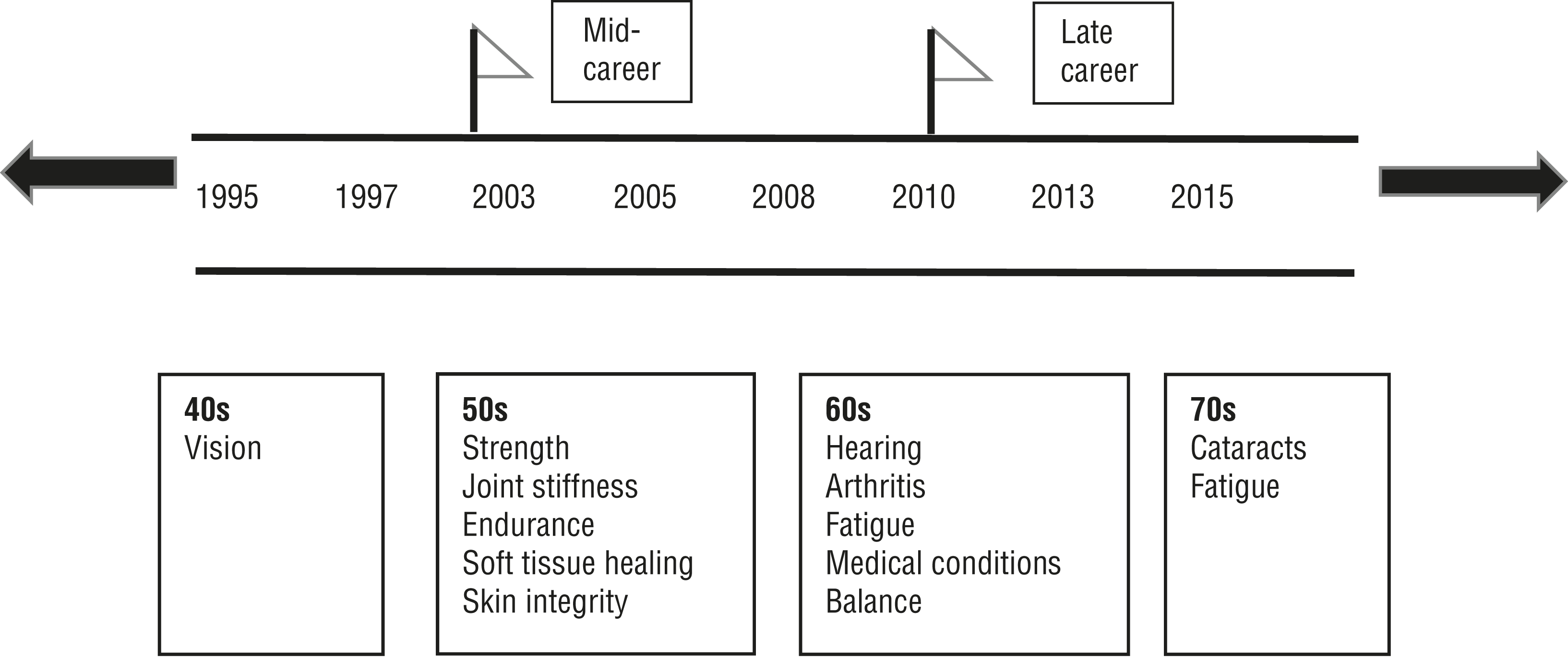
Timeline for age-related changes affecting work.
In their 40s, 8 workers noticed changes in near vision while completing detailed tasks. Stan struggled to read blueprints when assembling electrical circuits. Art could not see the solder during fine assembly work. Mikey “got yelled at” for poor quality work, which he later realized was because he had difficulty seeing the burrs he was trying to remove.
In their 50s, musculoskeletal changes in grip, upper body strength, joint stiffness, and energy affected job tasks. Stan developed difficulty tightening bolts with his right hand; Art developed wrist pain when ripping open boxes. Pablo’s legs were “shot” from standing all day. Older workers stated that they “did not even try to lift the heavy stuff anymore” because they would “pay for it” physically. Although workers accepted joint stiffness as “part of the territory,” they were surprised when discomfort developed into painful disorders, assuming they were well conditioned for their jobs. At Company 2, Dick could not believe he felt elbow pain after performing the same machining tasks for 15 yr; John was surprised to develop wrist pain after using an air gun for 20 yr. At both companies, workers were not aware of how pain reflected the interaction of cumulative strains, repetitive work, and slower tissue recovery.
By their 60s, health conditions necessitated medication at work and medical leaves for some workers. Pablo developed diabetes, taking 10 medications throughout the day; Freddy had received a pacemaker 2 mo before the study and had chest discomfort when climbing a ladder. Jimmy, at age 74, had endured heart attacks and an angioplasty in his 60s and explained that his hands cramped up throughout the day because of arthritis. Daily medication usage did not affect these workers’ output. They met productivity demands and showed a positive attitude toward coworkers and supervisors. Reluctant to retire, Jimmy stated, “You gotta do something. My doctors said [regarding wrist pain], if you abuse your body and decide to keep working it’s gonna hurt. Deal with it!”
By workers’ mid-60s and 70s, decreased endurance became fatigue by the end of the day. Balance was sometimes a problem for the oldest workers. Freddy made sure to grip ladder rails, and Jimmy avoided ladders altogether. However, he still worked “wherever they need me,” showing no slowdown in problem solving. Freddy’s and Jimmy’s security with work routines and commitment to their coworkers were still apparent, although they relied on flexible work policies to balance medical conditions and daily work schedules.
Theme 3: Worker Adaptations and Environmental Modifications.
Workers modified tasks as they experienced discomfort, difficulty, or fear of getting hurt. Although workers acknowledged having a macho attitude when they were younger, they were now cognizant of their susceptibility to injury and took measures to avoid mishaps. Stan is a typical example of a worker who had adapted his work style and environment over time. Stan developed low back pain in his 50s and changed his sitting workstation to a standing one, finding a high cart on which to assemble electrical panels. At around age 55, he altered his procedure for tightening bolts from using a right-handed twist to using both hands to accommodate a weakening grip; he used a crane to move electrical panels instead of trying to move them himself. At age 63, he experienced back pain from standing all day, so he requested an ergonomic mat when he could not find one. Stan explained, “A gradual change over the past 10 years has been pacing myself and not pushing it. I set minigoals every day. I’m older and work smarter; I don’t rush around like before.”
Adaptation process.
Stan’s process was representative of workers in this sample. He initiated workplace adaptations himself using trial and error to adjust his body position or work style. He then used equipment available on the shop floor such as lifting cranes or tools. Finally, he sought the assistance of coworkers for difficult tasks (see Table 2). The organizational context allowed him and other workers the autonomy to adapt tasks and the camaraderie to ask for assistance without imposing. Pablo and Joey explained, “I always ask for help if I need it. Everyone is good about helping you, no questions asked.”
For the oldest workers, a close relationship with another coworker, akin to a buddy system, was the biggest source of workplace support. Freddy said with a wry smile, “We [pointing to a coworker] work together as a team; we have been together for the past 15 years—he’s the smart one.” Jimmy explained, “I always work with Tom; he and I are like this [holding up two arthritic fingers close together]. He helps me when I need it.” Workers commiserated with each other about aches and pains. However, they rarely shared strategies or sought input from supervisors with respect to alleviating pain, assuming their issues were personal and not work related.
Modifications for vision.
All workers bought prescription or reading glasses for near vision at work. At Company 1, bright industrial lighting facilitated near vision; at Company 2, magnification helmets were worn to view parts. No companywide efforts were made to increase the size of blueprints or to provide task lighting or contrasting backgrounds for detailed work.
Modifications for upper extremity strength.
Older workers in both companies used lifting equipment to compensate for diminished upper body strength. Stan stated, “It’s not worth hurting yourself—it doesn’t take much longer to use the crane, but it takes a lot longer to get better!” Joey agreed: “I used to lift things myself, but now you really have no other choice if you don’t want to get hurt.” Workers improved body mechanics by using makeshift tables to optimize working heights. At Company 2, Mikey positioned large metal piecework on waist-height benches to avoid bending his back: “I don’t really know when I started, but it doesn’t hurt my back as much.” Jimmy altered how he carried smaller items because of arthritis in his hands: “I hold things differently now. I kind of cradle them with my elbows so I don’t have to grasp them with my hands—it’s easier for me this way.”
Modifications for grip strength.
Workers accommodated decreasing grip strength by changing work styles and using available tools they once rejected. Art began using a wire stripper and a retractable-blade knife to remove casings on multiconductors. Freddy modified his tools by machining tool handles with increased diameters. Stan used both hands (right hand to set the screw; left hand to tighten) and routinely requested new tools with sharp edges. In four cases, workers had either eliminated a particular task or used wrist splints for tasks that caused hand pain.
Modifications for joint pain.
Older workers attempted to alleviate joint pain by changing work positions, but their efforts simply changed the pattern of discomfort. Stan changed his workstation from sitting to standing to minimize low back pain, but the pain reappeared; John did the opposite: “I used to stand to work, but then my back hurt; so I began to sit at the low bench, but then I developed back stiffness and shoulder pain.” Ernie was the only worker who periodically stretched and moved to alleviate stiffness when taking minibreaks to regularly visit the restroom (because he took diuretic medication). Workers who stood continuously to work found relief with ergonomic mats and shoe inserts to minimize leg discomfort.
Adaptations for endurance.
Older workers paced themselves to maintain energy throughout the day. At Company 1, projects had longer production times, so workers set minigoals over several days and did not push beyond these targets. At Company 2, turnaround time was shorter (2–3 hr), so workers completed highly precise tasks in the morning when their energy level was highest. They leaned on tables or benches to preserve energy.
Theme 4: Personal and Lifestyle Adaptations.
Workers developed individual strategies to sustain energy throughout the workday. Pablo explained, “I drink a lot of water all day; it really helps my energy and my weight.” Pablo, Joey, and Jimmy brought snacks to eat all day because no healthy food was available in the vending machines. Freddy and Art had recently begun to bring sandwiches for lunch rather than just smoking. Dick swore by his “green drink” every morning.
Workers had also adapted their personal lifestyle to meet the energy and physical demands of work. They had cut back on daily home maintenance because they were exhausted after work. Stan confided, “Forget chores at home; after 10 hours, I’m done for the day!” Workers in their 50s had eliminated outside jobs that supplemented income. Workers in their 60s and older described spending weekends catching up on chores and resting up for the week rather than engaging in social or leisure activities. Jimmy explained that, during the week, “I used to go to bed around 10:00, but now we go to bed at 8:30–9:00, otherwise I can’t make it through the day.” Aches and pains from work were increasingly managed at home. Jimmy used hot packs on his neck and shoulders every day after work, Joey took a daily acetaminophen, and Dick used an inversion table every night. Work continued to be a focal point in their lives, but personal occupations were compromised to sustain work productivity and involvement.
Discussion
This multiple-case study examined the age-related changes, modifications, and contextual elements that supported 10 older male workers to continue working in manufacturing. All workers experienced age-related changes that affected their ability to do their job, including difficulty with near vision, grip strength, upper body strength, endurance, and joint stiffness. The organizational context promoting job control, social support, respect among employees, and work schedule flexibility enabled older workers to adapt their work style and rely on coworkers for assistance, with the oldest workers using a buddy system. The personal context of strong work values and personal identity as a skilled worker appeared to drive the motivation to maintain skill mastery. Workers met job demands, but for the oldest workers the energy necessary to meet demands limited their full participation in home and leisure occupations.
Need for Individual and System Modifications
Similar to participants in other studies, workers did not communicate discomfort or age-related challenges to supervisors despite working in small, supportive organizations (Leijten et al., 2013; Ng & Law, 2014). They viewed age-related changes and adaptations as personal problems, distinct from work-related tasks. Workers’ lack of disclosure may have stemmed from the male-dominated culture, generational norms, or personal pride. Nonetheless, older workers (and supervisors) were unaware of potential task modifications and the ADA policy supporting accommodations. The broadened definition of disability may have been especially relevant to older workers with chronic conditions (ADA Amendments Act of 2008). Studies have found that accommodations tailored to older workers can improve job performance and reduce their likelihood of leaving the workplace and receiving long-term disability benefits (Bjelland et al., 2010). Welch, Haile, Boden, and Hunting (2009), in a study of 979 roofers, found that use of job accommodations increased longevity in the workforce for workers with musculoskeletal disorders. Thus, open communication about age-related challenges and discomfort may serve both workers and organizations. Environmental redesign at the systems level (including proper lighting, magnification devices, ergonomic mats, lift assists, and tool options) might optimize the work environment for older workers while benefiting the entire workforce (U.S. Department of Labor, 2015).
Worker Well-Being
This study supports the contention that work challenges older workers’ reserve capacity. Older workers compromised their home and leisure occupations to meet energy demands, resulting in an occupational imbalance—a finding that was consistent with those of previous studies (Sweet & Pitt-Catsouphes, 2010). Given that social and leisure participation is increasingly important to health as older adults transition from work into retirement, a TWH approach could address older workers’ work–life balance.
In fact, the workplace may be an ideal venue in which to promote health for older male workers given the centrality of work in their lives and the tendency for men to be less proactive about preventive health (Hughes et al., 2011). Workers in this sample reported good health, yet half the sample smoked, and most did not exercise and took more than three medications, similar to national findings. A TWH approach that includes workplace nutrition (healthy snack options), smoking cessation programs, and physical activity programs may benefit older workers (Schill & Chosewood, 2013). In a study of health promotion programs for older workers, Hughes et al. (2011) found positive results using a personal health coach to improve nutrition and energy level. Shin, Park, Yang, Park, and Yang (2012) found that a 2-mo worksite physical activity program significantly improved the physical stamina and workability of 100 workers who completed the program. In this study, 50% of the workers were older than age 45.
Adaptation Process
Finally, older workers’ process of adaptation and their personal drive to maintain mastery support the Occupational Adaptation framework (Schultz & Schkade, 1992). Older workers developed adaptive responses once tasks became difficult (trial and error) and then reconfigured their approaches (modified adaptive response) using environmental modifications. Feedback on the efficacy of adaptive responses was both internal (less discomfort) and external (meeting productivity demands). Similar to Ng and Law (2014), this study found that the adaptation process included pacing, setting realistic minigoals, and individual perseverance.
Implications for Occupational Therapy Practice
This study shows that occupational therapy practitioners can facilitate adaptation to age-related changes in the following ways:
Occupational therapy practitioners can consult with individual workers to develop adaptations that promote workers’ task performance.
Practitioners can advocate for ADA accommodations for workers who experience age-related changes that qualify as a disability. They can provide documentation to employers to support reasonable accommodations.
Occupational therapy practitioners can increase employers’ awareness of age-friendly workplaces and help design environmental modifications to promote task performance across the workforce.
Occupational therapy practitioners may expand workplace services, using a TWH approach to promote healthy lifestyles and a balance of work, home, and leisure occupations.
Limitations and Future Research
Findings from this study cannot be generalized to all male older workers because of the small sample size, personal values of these workers, organizational culture, and tasks performed. Future studies should develop population-based means to examine age-related changes and modifications to the workplace across multiple organizations and workforces. Experiences of older female workers should be addressed, particularly with regard to the values of work, workplace roles, and balancing expectations of work and caregiver roles.
Conclusion
This multiple-case study of older workers in manufacturing suggests that occupational therapy practitioners can provide individualized adaptations, environmental modifications, and health promotion strategies to help older workers meet manufacturing job demands while balancing work and home occupations.
Footnotes
Acknowledgments
The study was supported by a Quinnipiac University School of Health Sciences grant for 2014–2015. I thank Joann Clark and Dave Durity, who warmly welcomed us into their manufacturing companies. I also thank the workers who shared their perspectives and stories and the Quinnipiac University occupational therapy graduate students who assisted with this research.