





Abstract
This article describes a statistical model, structural equation modeling (SEM), for understanding the challenges of young adults with probable developmental coordination disorder (DCD) in their daily living as well as the contribution of executive functioning (EF) and internal factors to their success. DCD is clinically defined in the Diagnostic and Statistical Manual of Mental Disorders (5th ed., or DSM–5; American Psychiatric Association [APA], 2013) by four criteria:
The acquisition and execution of coordinated motor skill performance are substantially below expectations given the person’s age.
The deficiency substantially interferes with daily living, including academic productivity, prevocational and vocational activities, leisure, and play.
The symptoms begin during the early developmental period.
The deficits in motor coordination are not better explained by intellectual disability, visual impairment, or a neurological condition.
Recent years have seen increased awareness of the high occurrence of motor coordination deficits, not only in children but also in adults (Blank, Smits-Engelsman, Polatajko, & Wilson, 2012; Kirby, Edwards, & Sugden, 2011; Kirby, Sugden, Beveridge, & Edwards, 2008). Despite the lack of specific data about the prevalence of DCD in young adulthood, several studies have reported that difficulties in daily functioning continue into adulthood among 30%–70% of those diagnosed with DCD in childhood (Cousins & Smyth, 2003; Kirby et al., 2008; Tal-Saban, Zarka, Grotto, Ornoy, & Parush, 2012b). DCD in adulthood can be expressed as slow and clumsy motor performance and avoidance of everyday tasks, which can affect quality of life and participation in many activities (Cousins & Smyth, 2003; Kirby et al., 2011). Several studies have shown that these difficulties of young adults with DCD are not context specific but affect them in a wide range of environments, including home and educational settings (Cermak, Gubbay, & Larkin, 2002; Cousins & Smyth, 2003; Kirby et al., 2011; Tal-Saban, Ornoy, & Parush, 2014a).
Besides motor difficulties, young adults with DCD also experience academic, social, behavioral, and emotional difficulties (Rosenblum, 2013; Skinner & Piek, 2001; Tal-Saban, Ornoy, & Parush, 2014b; Tal-Saban, Zarka, et al., 2012). Adolescents and young adults with DCD tend to have more negative emotions and decreased feelings of competency and self-esteem compared with typical young adults (Kirby, Williams, Thomas, & Hill, 2013; Miyahara & Piek, 2006; Skinner & Piek, 2001). Hill and Brown (2013) found that adults with DCD have higher rates of anxiety, depression, and mood disorder than do their typical peers. These difficulties may increase the risk of mental health problems such as depression and anxiety (Cousins & Smyth, 2003; Miyahara & Piek, 2006; Sigurdsson, Van Os, & Fombonne, 2002; Skinner & Piek, 2001). Therefore, it is not surprising that adolescents and young adults with DCD perceive their quality of life and degree of life satisfaction to be lower than those of their peers without DCD (Hill, Brown, & Sorgardt, 2011). However, only a limited number of studies have focused on the long-term functional and emotional effects of adults with DCD.
Another important aspect of DCD is its relationship with EF, which has not been adequately addressed in the available literature (Diamond, 2000; Michel, Roethlisberger, Neuenschwander, & Roberts, 2011; Rigoli, Piek, Kane, & Oosterlaan, 2012). Executive functioning refers to a set of regulatory processes necessary for selecting, initiating, implementing, and overseeing thought, emotion, behavior, and certain motor and sensory functions (Barkley, 1997; Roth, Isquith, & Gioia, 2005). Studies that have investigated EF within the DCD population have largely focused on children (Rahimi-Golkhandan, Piek, Steenbergen, & Wilson, 2014; Rigoli et al., 2012). The few studies that have examined EF in young adults with DCD indicate that, like children, they also experience difficulties in performing complex daily functions involving EF, such as driving and writing (Cousins & Smyth, 2003; Hellgren, Gillberg, & Gillberg, 1994; Kirby et al., 2008; Rosenblum, 2013). Tal-Saban, Zarka, et al. (2012), in their study of young adults, found moderate to high correlations between motor coordination and daily activities, emotional state, and EF.
Although during the past 15 years increased evidence has demonstrated that DCD persists into young adulthood, research on this population is still limited (Cermak et al., 2002; Cousins & Smyth, 2003; Kirby et al., 2008). The purpose of this study was to examine the direct and indirect relationships of DCD on a wide range of functions, including the use of executive strategies, daily life activities, emotional states, and internal factors attributed to success. An additional purpose was to examine the mediating effects of these functions on the performance of people with DCD. The direct and mediated effects of DCD on these factors were tested using SEM.
Method
Participants
The initial sample included 2,379 young adults from throughout Israel, ages 19–25 yr (1,081 men; 45.4%). Randomness was ensured by basing participant selection on a code calculated from army identification numbers. Because military service is mandatory in Israel, the health survey provided a representative sample of young adults. None of the participants had experienced complications at birth or had known psychiatric, physical, or neurological deficits. All participants had attended high school in regular education frameworks, which implied normative cognition. Participants who did not respond to at least four out of the seven instruments were excluded from the analyses, leaving 2,309 participants (55% women). The mean age, 20.68 yr (standard deviation [SD] = 3.42) was calculated on the basis of a randomly selected subsample of 400 participants. The average age of all the soldiers upon discharge from military service is between 20 and 21 yr; this subsample is large and representative enough to generalize it to all participants in the study.
Instruments
All questionnaires described in this section were developed for this study with the aim of ensuring brief, easy-to-use, and psychometrically sound ecological assessments of a range of functional abilities of adolescents and young adults. Note that questionnaires suitable for adolescents and young adults in general and specifically for young adults with DCD are scarce.
Item recruitment was developed on the basis of several sources:
Literature on participation restrictions of adolescents and young adults with motor coordination deficits in various daily functions
Literature on handwriting, self-perception, socialization, emotion, and cognition
The clinical expertise of occupational therapists with experience in the assessment and treatment of adolescents and young adults with motor coordination deficits
Interviews with adolescents and young adults with such deficits.
All questionnaires underwent qualitative evaluation to assess item comprehensibility to adolescents and young adults; 12 expert occupational therapists administered the questionnaires to 14 typically functioning persons (age range: 18–25 yr). After professional feedback, minor corrections of syntax and grammar were made, and six items (across all the questionnaires) were removed. Thereafter, the psychometric properties of each questionnaire were assessed with a large sample (n = 2,379).
Adolescents and Adults Coordination Questionnaire.
The Adolescents and Adults Coordination Questionnaire (AAC–Q; Tal-Saban, Ornoy, Grotto, & Parush, 2012) is a user-friendly ecological tool to screen adolescents and young adults for motor coordination deficits (e.g., “I tend to be clumsy, fall often, drop items, or bump into objects”) using items that reflect common everyday activities of young adults. This standardized questionnaire has evidence of reliability and validity and uses cutoff scores to identify DCD and borderline DCD. It is graded on a 5-point Likert scale ranging from 1 (never) to 5 (always), with higher scores indicating more serious motor deficits (i.e., DCD). The internal consistency of the questionnaire was found to be high (Cronbach’s α = .90), and factor analysis performed on the 12 questionnaire items revealed one factor with an eigenvalue greater than 1, explaining more than 50% of the variance.
Test–retest reliability revealed a strong correlation between administrations (r = .94, p < .001). Differentiations between adolescents and adults with versus without DCD used the known-groups procedure (Benson & Clark, 1982) according to the original criteria for group placement. Independent-sample t tests revealed significant group differences, t(27) = 9.37, p < .001, and discriminant analysis was used to examine the percentage of participants correctly placed (DCD or control) according to the original criteria for group division. The AAC–Q correctly placed 88% of the participants in their respective study groups (Wilks Λ = .38, κ = .75, p < .001). On the basis of Geuze, Jongmans, Schoemaker, and Smits-Engelsman's (2001) recommendations, cutoff scores were calculated for suspected DCD diagnostic criteria (15th percentile, 1.00 SD), borderline DCD diagnostic criteria (5th–15th percentile, 1.00–1.65 SD), and clinical DCD diagnostic criteria (5th percentile, 1.65 SD). More details on questionnaire development and psychometric properties are described in Tal-Saban, Ornoy, et al. (2012).
Executive Strategy Use for Complex Task Achievement.
The Executive Strategy Use for Complex Task Achievement (Tal-Saban, Ornoy, et al., 2012) assesses the use of executive strategies while performing tasks that require organization and planning. It was developed on the basis of the “Goal–Plan–Do–Check” strategy in the Cognitive Orientation for daily Occupational Performance approach (Polatajko & Mandich, 2004). It uses a 4-point Likert scale ranging from 1 (absolutely not) to 4 (very much). The questionnaire is divided into two sections, based on a principal-components factor analysis followed by a Varimax rotation, which revealed two factors with eigenvalues greater than 1:
The first section (Executive Strategy Usability [EFy]) consists of 6 items on the use of executive strategies for problem solving (e.g., “I define a goal before performing a task”). Internal consistency was high (Cronbach’s α = .93). Higher scores indicate better functioning.
The second section (Decreased Use of Executive Strategies [EFn]) consists of 4 items that reflect decreased use of executive strategies for problem solving (e.g., “I didn’t plan ahead how to perform the task”). Internal consistency was high (Cronbach’s α = .76). Higher scores indicate poorer functioning.
Daily Life Functions Questionnaire.
The Daily Life Functions Questionnaire (DLF–Q; Tal-Saban, Ornoy, et al., 2012) assesses daily activities requiring coordination, organization, and planning as well as academic functioning in activities that require handwriting. It uses a 4-point Likert scale ranging from 1 (absolutely not) to 4 (very much) and includes two sections:
The first section (DLFQn), consisting of 12 items, assesses nonacademic functioning of adolescents and young adults in activities requiring coordination, organization, and planning (e.g., organizing living areas, organizing a bag, managing time). A factor analysis revealed one factor with an eigenvalue greater than 1, explaining more than 56% of the variance. The questionnaire’s internal consistency was high (Cronbach’s α = .93). Higher scores indicate reduced functioning.
The second section (DLFQa) includes four items designed to assess academic functioning of adolescents and young adults in activities requiring handwriting (e.g., “My handwriting is not organized, clear, or legible”). A factor analysis revealed one factor with an eigenvalue greater than 1, explaining more than 57% of the variance. Internal consistency was high (Cronbach’s α = .74). Higher scores indicate better functioning.
Recent Emotional State Test.
The Recent Emotional State Test (REST; Tal-Saban, Zarka, et al., 2012) includes 18 items that assess the feelings of adolescents and young adults about their performance of various tasks (e.g., frustration, sadness, happiness, anger). It uses a 4-point Likert scale ranging from 1 (absolutely not) to 4 (very much). A factor analysis revealed one factor with an eigenvalue greater than 1, explaining more than 90% of the variance. The questionnaire’s internal consistency was high (Cronbach’s α = .90). Higher scores indicate reduced functioning.
Internal Factors Attributed to Success.
The Internal Factors Attributed to Success (INT; Tal-Saban, Zarka, et al., 2012) is a six-item questionnaire that assesses the extent to which adolescents and young adults attribute their success to internal factors (e.g., learning ability, personality). It uses a 4-point Likert scale ranging from 1 (absolutely not) to 4 (very much). A factor analysis revealed one factor with an eigenvalue greater than 1, which explains more than 55% of the variance. The questionnaire’s internal consistency was high (Cronbach’s α = .82). Higher scores indicate internal factors contributing to success.
Procedure
Military service is mandatory in Israel, and at its completion, a random sample of discharged soldiers completes a standard health survey. Because the army uses simple random selection means, the health survey provides a systematic, representative sample of young Israeli adults. Our questionnaires were added to the health survey after approval by the ethics committee of the Israeli Defense Force (IDF). All persons signed an informed consent form before participation, consenting to the research and publication of the results.
Data Analysis
SEM was performed using the Mplus 7.11 program (Muthén & Muthén, 2012). The minimal covariance coverage in the variance–covariance matrix used in the analyses was .87. To take advantage of all the available data, models were fit using full-information maximum likelihood estimation with robust standard errors (Little & Rubin, 2002). Following the recommendations of Hu and Bentler (1999), we reported two types of fit indexes (Tucker–Lewis index [TLI] and comparative fit index [CFI]) and two indexes of misfit (root-mean-square error of approximation [RMSEA] and standardized root-mean-square residual [SRMR]). A TLI and CFI close to or greater than 0.95, combined with an RMSEA less than .06 and an SRMR less than .08, are considered indicative of acceptable fit. Each theoretical construct in the model was measured with four indicators, using the accepted approach of parceling (Bandalos, 2002; Stacy, Bentler, & Flay, 1994). The indicators for each construct were formed so that the average item-adjusted total correlations with the comprised items would be as similar as possible.
This research model tested (1) the direct effects of the independent variable (DCD) on the dependent variables (EF, academic and nonacademic daily functions, emotional state, and attribution to success) and (2) the mediated effects of the independent variable on the dependent variables. Following Kenny, Kashy, and Bolger (1998), we considered two pieces of evidence to be compatible with a mediation hypothesis: (1) a significant correlation between the independent variable (DCD) and a mediator (dependent variable) and (2) a significant indirect effect of the independent variable (DCD) on a dependent variable that facilitated function despite the DCD.
Results
Table 1 lists the descriptive statistics and intercorrelation matrix of the observed research variables. All the study variables were correlated as anticipated in the theoretical model (Figure 1). The AAC–Q score moderately intercorrelated with the EFn at r = .40 and with the DLFQn at r = .52. The DLFQn moderately intercorrelated with the REST at r = .43, which in turn intercorrelated with the INT at r = –.57.
Intercorrelations of Study Variables
Note. All correlations with an absolute value greater than –.08 are statistically significant at p < .001. — = autocorrelation; AAC–Q = Adolescents and Adults Coordination Questionnaire; DLFQa = Daily Life Functions Questionnaire, academic; DLFQn = Daily Life Functions Questionnaire, nonacademic; EFn = Decreased Use of Executive Strategies; EFy = Executive Strategy Usability; INT = Internal Factors Attributed to Success; M = mean; REST = Recent Emotional State Test; SD = standard deviation.
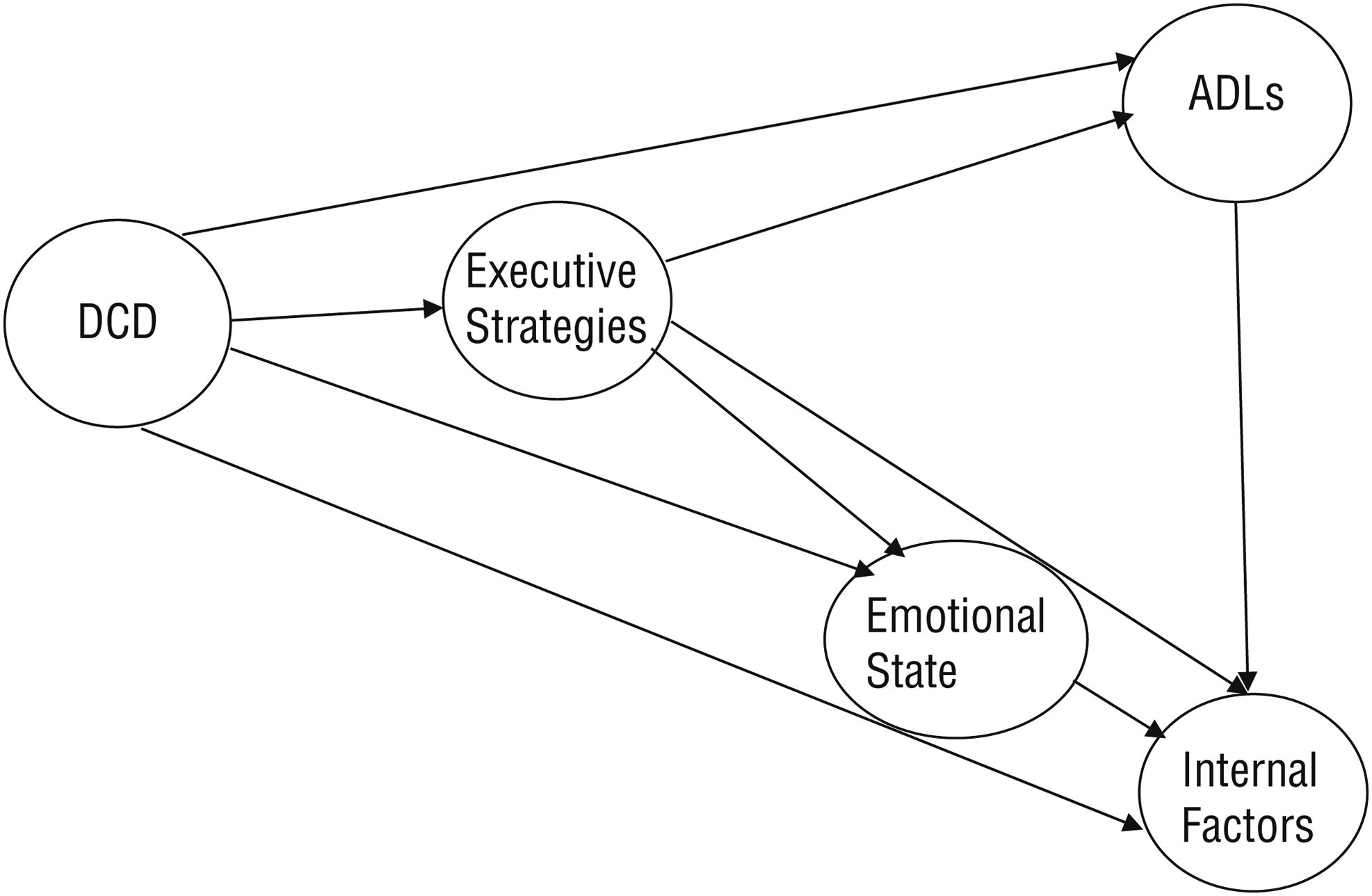
Theoretical model: Mediated effects of developmental coordination disorder (DCD) on executive strategies, activities of daily living (ADLs), emotional state, and internal factors attributed to success.
The structural equation model yielded acceptable results: χ2(329, N = 2,336) = 2,101.50, p < .001, TLI = .942, CFI = .950, SRMR = .045, RMSEA = .048 (90% confidence interval [.046, .050]). Because the model included the same interconnected variables as the measurement model, their fit and misfit indices were identical. The results (Figure 2) show that DCD had a direct and significant effect on all variables (p < .05) and on daily function in both nonacademic (β = 0.33) and academic abilities (β = 0.25) and in decreased use of executive strategies (β = 0.50). In addition, all indirect effects hypothesized in the model were found to be significant (p < .05), with one exception: DCD’s effect upon internal factors attributed to success mediated by executive strategy use (p = .06). Thus, the results were compatible with a partial mediation model. As seen in Figure 2, the effect of DCD on daily function, both nonacademic (β = 0.44) and academic (β = –0.28), was mediated by a decreased use of EF. Moreover, the model shows that the effect of DCD on internal factors attributed to success was mediated by the decreased use of EF strategies (β = 0.44) and a lowered emotional state (β = –0.60).
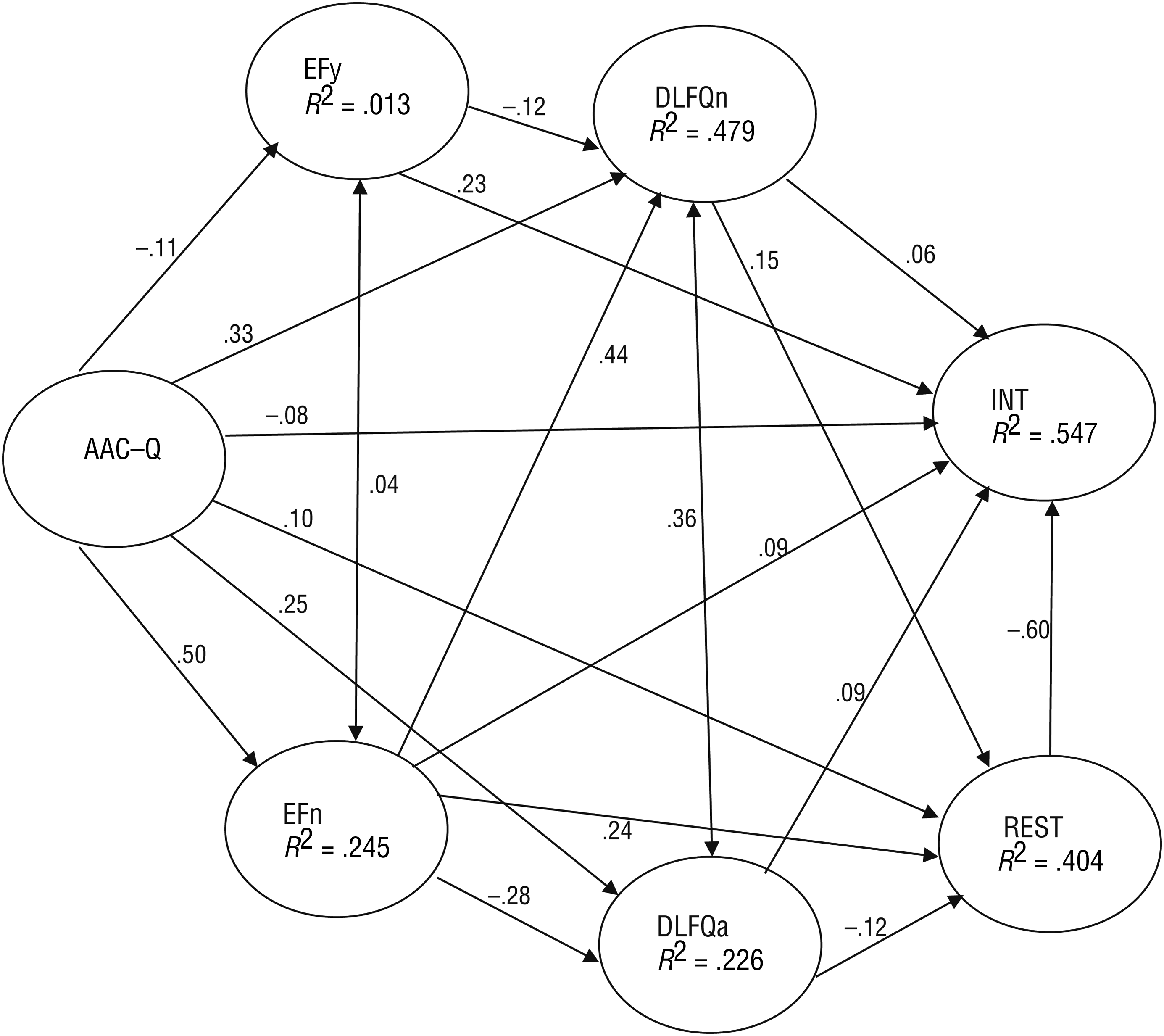
SEM of DCD as a predictor of executive strategy use, daily life activities, emotional state, and internal factors attributed to success.
Discussion
SEM provided a comprehensive picture of the influence of probable DCD in adult daily life. (We defined the participants as probable DCD because their diagnosis was based only on the AAC–Q as a reliable and valid self-reporting screening tool.) Our survey of the available literature indicated that this is the first study of its kind using SEM to test a broad spectrum of functions in a large sample of young adults. This unique analysis yielded multidimensional correlations between the variables and their influence on function. The SEM results were strong in clarifying the disparity between young adults with and without probable DCD in daily functioning, emotional state, attribution to success, and use of EF strategies. The results indicate that probable DCD affects all the independent variables tested in the model, especially daily function and decreased use of executive strategies. This finding suggests that probable DCD is a predictor for these symptoms.
The first section of the DLF–Q showed a direct correlation between DCD and difficulties in nonacademic tasks requiring coordination, organization, and planning (e.g., fine motor coordination, driving, and spatial orientation). These results are comparable with the findings of Kirby et al. (2008) on young adults with DCD who reported difficulties in daily functioning. The second part of the DLF–Q found difficulties in handwriting, which confirms the assertion by the World Health Organization (APA, 2013) that handwriting deficits have a major effect on participation and achievement in academic tasks. According to the DSM–5, DCD is identified by poor performance in daily activities and academic achievement. Our findings support these diagnostic criteria and indicate that poor performance continues to affect people with probable DCD during their young adult years.
Results of the Executive Strategy Use for Complex Task Achievement questionnaire indicated that young adults with probable DCD use fewer executive strategies. As mentioned previously, most existing studies regarding DCD and EF have focused primarily on children (Rahimi-Golkhandan et al., 2014; Rigoli et al., 2012), and only a few have focused on young adults (Kirby et al., 2008; Rosenblum, 2013; Tal-Saban et al., 2014b). The EF ability to formulate strategies and solve problems (Sangster Jokić & Whitebread, 2011) could have far-reaching implications for young adults with probable DCD. Decreased use of executive strategies could also contribute to the everyday difficulties they experience in motor coordination. The DCD literature reports a high comorbidity between attention and EF (Fliers et al., 2009; Kaplan, Dewey, Crawford, & Wilson, 2001; Kirby et al., 2008), confirming the significance of the findings by Tal-Saban et al. (2014b) that young adults with DCD display poorer EF even when reanalyzed with attention as a covariate; specifically interesting was the indication that decreased use of executive strategies is a mediator for reduced daily functioning and lower emotional states.
The REST in the SEM model showed that the more severe the young adult’s probable DCD was, the lower the self-esteem and the stronger the negative feelings were. Other studies describing older people with DCD have also reported a range of emotional difficulties (Miyahara & Piek, 2006; Rasmussen & Gillberg, 2000; Skinner & Piek, 2001). These results strengthen the multidimensional view of motor coordination difficulties in young adults and the direct influence of probable DCD on a range of functions (Cermak et al., 2002; Kirby et al., 2013; Tal-Saban, Zarka, et al., 2012). Likewise, the results showed the important role of executive strategy use in mediating daily functions and emotional states. We note, cautiously, that the reduced use of executive strategies may be attributed to the existence of probable DCD and that EF impairment can help explain the functional difficulties experienced by young adults with probable DCD. This finding strengthens the current perception that EF and motor coordination difficulties share a common neurological foundation (Diamond, 2000; Michel et al., 2011; Rigoli et al., 2012). Emotionally, young adults with probable DCD develop more negativity and attribute their success less to internal factors. Our findings emphasize the influence of probable DCD on their performance, emotional state, and attribution of success (Tal-Saban, Zarka, et al., 2012; Tal-Saban et al., 2014b).
Implications for Occupational Therapy Practice
This study has the following implications for occupational therapy practice:
Early screening for probable DCD and intervention at an early age may reduce potential future complications.
Intervention that includes instruction on the use of EF strategies may be used to circumvent the difficulties of young adults with probable DCD.
It is urgent to formulate policies to finance the development of DCD assessment and intervention programs for the older population.
Study Limitations and Recommendations
The same sample of persons was used both for instrument development and to investigate their motor deficits. In addition, the participants were diagnosed only by the AAC–Q as a valid self-reporting screening tool; no use was made of direct motor testing. There is a need to strengthen the psychometric aspects of the questionnaires, for example, by continuing to analyze their construct validity.
Because the structural model included the same interconnected variables as the measurement model, their fit and misfit indices were identical. Note that the SEM was based only on self-report questionnaires; this approach may have affected the results because answers may have been influenced by respondents’ specific state of mind at the time of response. However, it is likely that the large sample size and its heterogeneity minimized the risks arising from the use of self-informant methods.
As a result of the comorbidity between DCD and attention deficits, as well as the relationship between attention and EF abilities, this study should be repeated with attention included as another measure to ensure that the model is not unduly influenced by attention or learning problems. There is also a need to test this model separately in the probable DCD population and the typical population and to follow up on participants long term. In addition, it is important to assess young adults not drafted into the IDF.
Conclusion
Our findings provide several important contributions to the existing literature on DCD in general and specifically on DCD in young adulthood. The study highlights the far-reaching implications of probable DCD among young adults that results in decreased participation in daily life activities and effects on their emotional state and EF. Moreover, these results strengthen the link proposed in the literature between motor coordination deficits, emotional state, attribution to success, and EF (Rigoli et al., 2012; Skinner & Piek, 2001; Tal-Saban et al., 2012b).
Footnotes
Acknowledgments
The authors thank all the young adults who agreed to participate in this study. In addition, special thanks are due to Aviva Keller for her editorial assistance and to Ilan Roziner for his statistical analysis.