





Abstract
Research measuring sensory processing in children with autism spectrum disorder (ASD) has shown variability in terms of measures used and participant ages, contributing to difficulty in interpreting and summarizing the findings of these studies. In an attempt to clarify the status of the literature, we conducted a systematic review of studies that focused on participation in daily occupations and evaluated sensory processing in children with ASD aged 5–13 yr using Dunn’s sensory processing framework. Evidence from 7 studies shows that sensory processing has a significant impact on participation in daily life of children with ASD. Included studies demonstrated medium and low levels of evidence. Additional research using more robust scientific methods is needed.
Occupational therapy for children with autism spectrum disorder (ASD) and their families emphasizes participation in daily life occupations as an important service outcome. Families of children with ASD often identify participation goals related to activities of daily living (ADLs), social participation, and play (Schaaf et al., 2015). Teachers and care providers at schools often identify participation outcomes related to learning and classroom activities for children with ASD (Ashburner, Ziviani, & Rodger, 2008).
Evidence suggests that sensory processing is a significant factor affecting participation in children with ASD (Askari et al., 2015; Little, Ausderau, Sideris, & Baranek, 2015; Tomchek, Little, & Dunn, 2015). An understanding of sensory processing patterns in children with ASD can enhance occupational therapy practitioners’ understanding of the experiences of everyday life for these children and their families and of the ways sensory patterns shape participation in daily occupations. We conducted a systematic review to summarize the evidence on the contribution of sensory processing to participation in children with ASD.
Sensory Processing and Autism Spectrum Disorder
Strong evidence indicates that, compared with typically developing children, sensory processing differs in children with ASD, who often display patterns of hypo- and hyperresponsivity to sensory stimuli (Ben-Sasson et al., 2009). Multiple models have been used to describe sensory processing; these models generally agree on the patterns of sensory hypo- and hyperresponding and of seeking sensory input (Ashburner et al., 2008; Ben-Sasson et al., 2009). Dunn’s (2014) sensory processing framework grounds these patterns in participation and addresses the individual’s neurological thresholds, self-regulation strategies, and the interaction between neurological thresholds and self-regulation strategies. In addition, this framework facilitates an understanding of sensory processing in authentic contexts in the home, school, and community.
According to Dunn’s (2014) sensory processing framework, a person’s reactions to daily sensory events reflect both a particular threshold (high or low) and a self-regulation or responding strategy (passive or active). Four patterns of sensory processing result:
Registration represents a high threshold and a passive self-regulation strategy. People with the registration sensory pattern do not notice sensory events that others easily do.
Sensation seeking represents a high threshold and an active self-regulation strategy. People with the sensation seeking pattern enjoy and extend their sensory experiences.
Sensory sensitivity represents a low threshold and a passive self-regulation strategy. People with the sensory sensitivity pattern notice more sensory events than others usually do.
Sensation avoiding represents a low threshold and an active self-regulation strategy. People with the sensation avoiding pattern find ways to limit sensory events and prefer to create rituals for their daily routines.
Many instruments have been developed to measure sensory processing; the instruments vary in target ages, conceptual frameworks, and purposes. For example, the Sensory Experience Questionnaire (SEQ; Baranek, 2009) is a parent-report instrument used to characterize sensory features in children with ASD or developmental disabilities ages 2–12 yr (Ausderau et al., 2014). The SEQ is designed for children with ASD and has a primary use in research. The Sensory Processing Measure forms (Ecker & Parham, 2010; Miller Kuhaneck, Henry, & Glennon, 2010) are questionnaires completed by a parent or caregiver or by a teacher or day care provider; they are designed to measure performance skills related to sensory processing in young children (aged 2–5 yr). Other sensory processing measures include the Sensory Sensitivity Questionnaire (Talay-Ongan & Wood, 2000), which provides scores for one sensory pattern, and the Sensory Questionnaire (Saulnier, 2003), which has been used sparingly in research and practice.
The Sensory Profile series (Brown & Dunn, 2002; Dunn, 1999, 2006) has been widely used to measure sensory processing and is based on Dunn’s sensory processing framework. Early studies (e.g., Kientz & Dunn, 1997; Watling, Deitz, & White, 2001) showed that the Sensory Profile discriminates sensory processing patterns of children with and without ASD. In a meta-analysis investigating sensory modulation patterns in people with ASD (Ben-Sasson et al., 2009), 11 of the 14 included studies used the Sensory Profile. The meta-analysis found significant differences between ASD and typically developing groups of different age ranges in the presence and frequency of sensory hyporesponsivity, hyperresponsivity, and sensation seeking. Researchers have used the Sensory Profile to understand sensory processing in individuals with ASD (Dunn, Myles & Orr, 2002; Myles et al., 2004) and dozens of other conditions (Dunn, Little, Dean, Robertson, & Evans, 2016). The Sensory Profile allows caregivers, teachers, and professionals to understand sensory processing patterns of children with ASD and the effect of these patterns on children’s participation at home, at school, and in the community (Dunn, 2014).
Children’s everyday learning occurs in the context of activity settings (Dunst, Hamby, Trivette, Raab, & Bruder, 2000), so occupational therapy interventions to support generalization of skills take into account the natural context (Baranek, 2002). The focus of intervention is on children’s and families’ daily routines, and sensory processing knowledge is used to facilitate effective interventions within clients’ daily routines (Dunn, 2007; Dunn, Cox, Foster, Mische-Lawson, & Tanquary, 2012). Occupational therapy practitioners evaluate children’s participation in the context of everyday activities to provide interventions that match children’s and families’ daily routines in natural contexts.
Research measuring sensory processing in children with ASD has shown variability in terms of instruments used and participant age ranges, contributing to difficulty in interpreting and summarizing the findings of these studies. In an attempt to clarify the status of the literature, we conducted a systematic review of studies that evaluated sensory processing in children with ASD using Dunn’s (2014) sensory processing framework. Dunn’s framework focuses on activity demands and environmental aspects of participation rather than emphasizing performance skills and client factors as outlined in the Occupational Therapy Practice Framework: Domain and Process (3rd ed.; OTPF–3; American Occupational Therapy Association [AOTA], 2014). Moreover, Dunn’s framework emphasizes a strengths-based perspective on the use of sensory patterns to highlight children’s assets and support their participation in daily life.
In this systematic review, we also aimed to summarize the literature on participation in children with ASD. We used a definition of participation based on the OTPF–3: “engagement in desired occupations in ways that are personally satisfying and congruent with expectations within culture” (AOTA, 2014, p. S35). As implied in this definition, participation includes different areas of occupation in natural contexts. In part because a variety of sensory processing models have been proposed, it still is unclear how different sensory processing styles interfere with daily life occupations. Therefore, the research question was, Using Dunn’s sensory processing framework, what is the relationship between sensory processing and participation in daily occupations in children with ASD?
Method
This systematic review followed the Preferred Reporting Items for Systematic Reviews and Meta-Analyses (PRISMA) guidelines (Moher, Liberati, Tetzlaff, & Altman, 2009). A research librarian (Julie Hartwell) was consulted to improve search terms and conduct the electronic search. The electronic search included the following databases: CINAHL, PubMed, ProQuest, Cochrane, ERIC, and OTseeker. Table 1 lists the search terms by sensory pattern (e.g., sensory processing, hyposensitivity, hypersensitivity, seeking), population (e.g., autism, Asperger, pervasive developmental disorder), and participation (e.g., activities of daily living, routine, social participation). Hand searches were conducted of reference lists of selected studies obtained from the electronic search and the American Journal of Occupational Therapy to locate additional potential studies.
Search Terms Used
Note. CAPE = Children’s Assessment of Participation and Enjoyment; COPM = Canadian Occupational Performance Measure; PAC = Preferences for Activities of Children.
Inclusion and Exclusion Criteria
To locate evidence generated since the evolution of Dunn’s sensory processing framework, the search was limited to peer-reviewed research articles available in full text that were published in English between 1997 and 2015. The search was also limited to studies that included children aged 5–13 with an ASD diagnosis. Limiting the age range allowed us to focus on patterns of participation.
Studies considered for selection evaluated sensory processing using Dunn’s sensory processing framework and the Sensory Profile series of assessments, including the Sensory Profile Caregiver Questionnaire (Dunn, 1999), the Sensory Profile School Companion (Dunn, 2006), and the Adolescent/Adult Sensory Profile (Brown & Dunn, 2002); see Table 2 for brief descriptions of these assessments. Outcomes included participation in different daily occupations, categorized according to the OTPF–3 categories of ADLs, instrumental activities of daily living (IADLs), rest and sleep, education, work, play, leisure, and social participation. Studies were excluded if they did not meet the inclusion criteria, used tools to measure sensory processing other than the Sensory Profile series, focused on specific skills in addition to or rather than participation, focused on sensory processing disorder, or did not include children with ASD. In addition, studies that evaluated solely person factors (client factors and performance skills) as outcome measures were excluded.
Sensory Profile Versions Used in Included Studies
Analysis
After screening titles and abstracts for consistency with inclusion and exclusion criteria, Noor Ismael and Lisa Mische Lawson assigned eligible studies a level of evidence (Law & MacDermid, 2014) and assessed their strengths and limitations. We used the Oxford Centre for Evidence-Based Medicine (2016) system of five levels of evidence in which Level 1 is the highest (e.g., systematic reviews and meta-analyses) and Level 5 the lowest (e.g., expert opinion; Law & MacDermid, 2014). Levels 1, 2, and 3 are further subdivided into a, b, and c sublevels of evidence. Ismael and Mische Lawson met several times to discuss the process and resolve any disagreement.
Results
The first stage of the search identified 608 articles after removal of duplicates (Figure 1). Screening of titles and abstracts yielded 25 potential articles for full-text eligibility assessment. Seven studies met the inclusion criteria. The 18 excluded studies used tools to measure sensory processing other than the Sensory Profile (n = 6), focused on client factors or performance skills rather than participation (n = 2), focused on sensory processing disorder (n = 1), did not include children with ASD (n = 3), described an intervention study that included both participation and performance skills (n = 2), or were not available in English or in full text (n = 4). All 7 studies that met the inclusion criteria were quantitative and formed the quantitative synthesis of this systematic review. Supplemental Table 1 (available online at http://otjournal.net; navigate to this article, and click on “Supplemental”), summarizes the 7 studies.
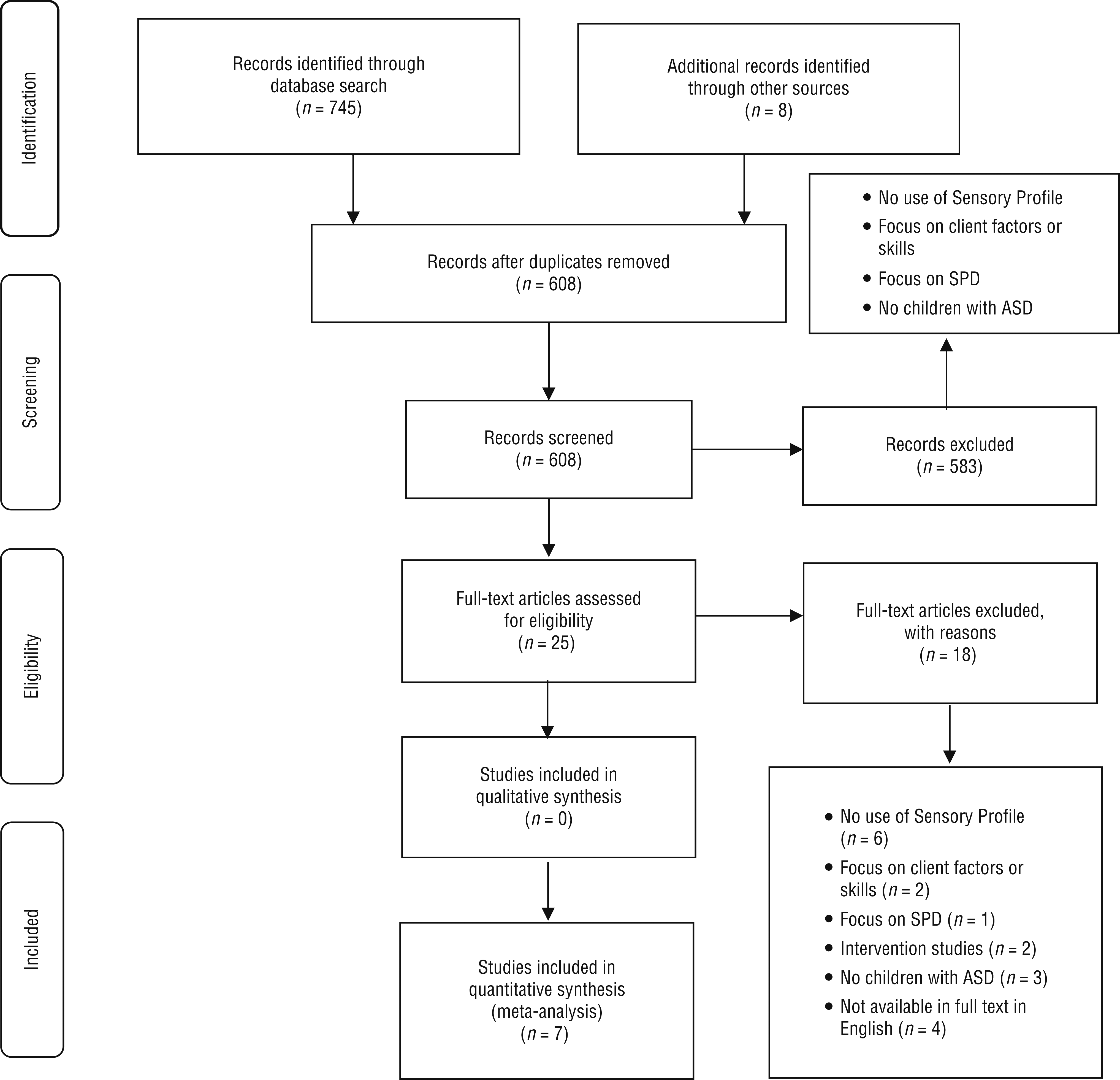
Flow diagram of articles identified, screened, eligible for, and included in the systematic review.
Participants
The 7 studies investigated the impact of sensory processing for a total of 277 children with ASD; 83% (n = 230) were boys and 17% (n = 47) were girls. The age range was 3–12 yr; only 1 study (Brown & Dunn, 2010) included children younger than age 5. All participants had an official ASD diagnosis from a professional provider.
Research Design and Level of Evidence of Included Studies
Three studies (Ashburner et al., 2008; Hochhauser & Engel-Yeger, 2010; Zobel-Lachiusa, Andrianopoulos, Mailloux, & Cermak, 2015) used a case-control research design in which the control group included typically developing children who were matched on age. The remaining 4 studies implemented descriptive correlational (Brown & Dunn, 2010; Watson et al., 2011) or cross-sectional (Reynolds, Bendixen, Lawrence, & Lane, 2011; Reynolds, Lane, & Thacker, 2012) research designs. The case-control studies provide Level 3b (medium-level) evidence, whereas the descriptive studies provide Level 4 (low-level) evidence.
Measures of Participation
Included studies measured participation in a variety of ways. Ashburner et al. (2008) measured educational outcomes using two teacher-reported questionnaires, Conners’ Teacher Rating Scale–Revised Long Version (CTRS–RL; Conners, 1997) and the Achenbach System of Empirically Based Assessment: Teacher Report Form (ASEBA:TRF; Achenbach & Rescorla, 2001). Hochhauser and Engel-Yeger (2010) used the Children’s Assessment of Participation and Enjoyment (King et al., 2004) to measure leisure participation; children rated their participation in everyday activities outside the school. Watson et al. (2011) measured social participation using the Vineland Adaptive Behavior Scales–Survey Edition (VABS; Sparrow, Balla, & Cicchetti, 1984), and Zobel-Lachiusa et al. (2015) measured mealtime participation using the Brief Autism Mealtime Behavior Inventory (BAMBI; Lukens & Linscheid, 2008).
The remaining studies measured multiple participation areas. Brown and Dunn (2010) correlated the Sensory Profiles from home (Sensory Profile Caregiver Questionnaire; Dunn, 1999) and from school (Sensory Profile School Companion; Dunn, 2006) to measure how sensory processing influenced participation in the two contexts. Reynolds et al. (2011) used the Child Behavior Checklist (CBCL, part of ASEBA:TRF; Achenbach & Rescorla, 2001), a parent-report questionnaire about children’s participation in different areas, including home, school, and social activities. Reynolds et al. (2012) also used the CBCL but focused on outcomes related to sleep quality and duration and behavior.
Key Findings on the Impact of Sensory Processing on Participation
Evidence from the 7 studies showed that sensory processing significantly influenced participation in daily life for children with ASD. The following sections highlight the studies’ results by participation area.
Education.
Ashburner et al. (2008) focused on educational outcomes in the classroom and found that scores on the Underresponsive/Sensation Seeking, Auditory Filtering, and Tactile Sensitivity sections of the Short Sensory Profile (SSP; McIntosh, Miller, Shyu, & Dunn, 1999) were significantly negatively associated with academic performance and attention to cognitive tasks as measured by the CTRS–RL. The study suggested that children with ASD who had difficulty tuning in to verbal instructions in the presence of background noise and who often focused on sensory-seeking behaviors underachieved academically. The authors reported that the choice of assessment tools was limited because of budget constraints and that future research should implement more valid and reliable measures of classroom outcomes.
Leisure.
Hochhauser and Engel-Yeger (2010) found that children with higher sensation seeking performed more self-improvement activities in their home. Also, they found that the higher the child’s tactile sensitivity, the higher the intensity of his or her participation in physical activities and that the higher the child’s taste and smell sensitivity, the lower the intensity of his or her participation. In addition, children with higher movement sensitivity performed more recreational and informal activities in their home, whereas children with higher visual or auditory sensitivity performed more self-improvement activities with others. The study was limited to a small convenience sample with little variation in ethnic or socioeconomic background.
Social Participation.
Watson et al. (2011) focused on social participation and found that hyposensitivity and sensory seeking were significantly negatively associated with social adaptive skills as measured by the VABS. The authors reported limitations in terms of sample heterogeneity, the possibility of multiple interpretations of the results, and threats to the validity of some measures.
Mealtime.
Zobel-Lachiusa et al. (2015) focused on mealtime participation and found significant correlations between children’s sensory processing patterns and their eating behaviors. Children with ASD showed higher scores on both the SSP and the BAMBI, suggesting more extreme sensory patterns and more challenging mealtime behaviors. The study was conducted with a convenience sample from one geographic area of parent volunteers with an interest in or concern about their child’s sensory responses and eating behaviors.
Sleep.
Reynolds et al. (2012) found that children with ASD had a high prevalence of sleep disturbances compared with typically developing children. They also showed a relationship between sensory avoiding and sleep problems in children with ASD. The authors considered the use of a parent-report measure to identify sleep disturbances to be a study limitation.
Other Areas of Participation.
Two studies addressed multiple or other areas of occupation. Brown and Dunn (2010) compared Sensory Profile scores from home and school and showed that the avoiding and seeking quadrants in both contexts were significantly correlated, suggesting that children’s reactions of being overwhelmed by sensory experiences were similar at home and at school. Reynolds et al. (2011) showed that children who displayed more sensory sensitivity and avoiding behaviors demonstrated lower levels of competence in the CBCL categories. The study was limited to a small sample, and a disproportionate number of girls in the typically developing group may account for the differences found in activity choices. Also, the study used the caregiver questionnaire for children older than age 10. Although it is often used for children with disabilities aged older than 10, the caregiver scale is validated for use with children ages 3–10 and includes questions specific to younger children.
Discussion
The results of this literature review suggest that sensory processing influences participation in everyday life activities across occupations and contexts for children with ASD. Children’s patterns of sensory processing have been found both to support and to hinder participation. For example, children reported interests in leisure activities that matched their sensory needs (Hochhauser & Engel-Yeger, 2010). Whereas the nature of leisure activities allows children with ASD to freely choose those that match their sensory preferences, other obligatory occupations, such as education, self-care, and sleep, may be challenging for children with extreme sensory patterns. For example, children with ASD who displayed increased sensation seeking demonstrated difficulties with academic performance and attention in the classroom (Ashburner et al., 2008) and with social participation (Watson et al., 2011). Children who are sensation seeking may seek movement or sound inputs and therefore may miss teachers’ instructions on classroom tasks or cues from their peers to engage in social interactions.
The results also showed that children with ASD who were sensation avoiding experienced difficulties with mealtime, sleep, and school activities (Reynolds et al., 2011, 2012; Zobel-Lachiusa et al., 2015). Children who are sensation avoiding are overwhelmed by sensory inputs (Brown & Dunn, 2010), which makes dynamic activities that involve rich sensory inputs, such as mealtime, more problematic. They are also challenged by activities requiring quiet, such as studying and sleep. They may be distracted by stimuli that others do not notice (e.g., a whirring fan, family members’ movement around the house), making it impossible to concentrate on their studies or fall asleep. Because environmental stimuli vary greatly, Brown and Dunn (2010) concluded that both knowing children’s sensory processing patterns and considering contextual factors are essential in planning interventions to increase participation for children with ASD.
The level of evidence of studies examining the relationship between sensory processing and participation in children with ASD is limited; the few studies available provide medium and low levels of evidence. In addition, current evidence has addressed leisure and education participation, whereas participation in ADLs and IADLs remains uninvestigated, even though parents have identified participation in ADLs as their top goal area for their child with ASD (Schaaf et al., 2015). Occupational therapy services for children aged 3 and older focus on meeting their educational needs (Individuals With Disabilities Education Improvement Act of 2004 (Pub. L. 108-446), and individualized education plans for school-age children mostly address classroom educational and behavioral outcomes. This systematic review suggests that children with ASD also need occupational therapy services outside of the school setting to address ADLs and community participation goals.
Strengths, Limitations, and Future Research
The strengths of this systematic review include consistency with the PRISMA guidelines for conducting searches and refining the results, consultation with a health professions librarian with experience in conducting systematic reviews, use of well-defined definitions of sensory processing and participation, and inclusion of studies that used the same measures of sensory processing. The low level of evidence of the included studies limited our ability to follow PRISMA guidelines in reporting results.
Higher levels of research evidence require greater control of variables, making it challenging to investigate participation, which may be considered highly individualized (Law et al., 1996). Additionally, occupational theory models (e.g., Ecology of Human Performance, Person–Environment–Occupation) emphasize the importance of considering context, particularly “authentic” context (i.e., children’s naturally occurring environments), when addressing participation, and contexts may also be highly variable. Currently, higher level sensory processing research is limited to measuring skills (e.g., motor, adaptive) because those outcomes have established measures. This systematic review exposed the need for well-developed measures of participation across all occupational therapy domains. Development of participation measures would also support future investigation of occupation-based interventions to improve children’s participation.
Implications for Occupational Therapy Practice
Although the research regarding sensory processing and participation in children with ASD is limited, the findings of this systematic review have the following implications for occupational therapy practice:
Children who have low thresholds of sensory processing tend to be challenged by activities that require specific sensory environments (e.g., mealtime, sleep).
Occupational therapy practitioners should consider context to be a crucial factor that can either support or hinder participation.
Future research should attempt to develop measures of participation to support investigation of interventions to improve children’s participation.
Supplemental Material
Supplementary material for Relationship Between Sensory Processing and Participation in Daily Occupations for Children With Autism Spectrum Disorder: A Systematic Review of Studies That Used Dunn’s Sensory Processing Framework
Supplementary material, sj-pdf-1-aot-10.5014_ajot.2018.024075.pdf for Relationship Between Sensory Processing and Participation in Daily Occupations for Children With Autism Spectrum Disorder: A Systematic Review of Studies That Used Dunn’s Sensory Processing Framework by Noor Ismael, Lisa Mische Lawson and Julie Hartwell in The American Journal of Occupational Therapy
Footnotes
*
Indicates studies included in the systematic review.
References
Supplementary Material
Please find the following supplemental material available below.
For Open Access articles published under a Creative Commons License, all supplemental material carries the same license as the article it is associated with.
For non-Open Access articles published, all supplemental material carries a non-exclusive license, and permission requests for re-use of supplemental material or any part of supplemental material shall be sent directly to the copyright owner as specified in the copyright notice associated with the article.
