





Abstract
Using a phenomenological approach, this study investigated visibility and perception of the profession of occupational therapy in three media outlets. Content analysis occurred on LexisNexis Academic (LNA), Google Images, and Twitter platforms. Analysis of LNA identified the prevalence of articles about occupational therapy in domestic newspapers and similar media avenues, MaxQDA qualitative software coded Google Images from a search on occupational therapy, and AnalyzeWords evaluated Twitter feeds of four health care professions for presence and tone in a social media context. Results indicate that although occupational therapy is 100 years old, its presence in news and online platforms could be stronger. This study suggests that a clear professional identity for occupational therapy practitioners must be strategically communicated through academic and social platforms. Such advocacy promotes the profession, meets the next iteration of occupational therapy’s professional vision, and allows occupational therapy to remain a prominent and formidable stakeholder in today’s health care marketplace.
The profession of occupational therapy was founded in 1917 by seven people whose mission was improved health and function through “curative” occupations for invalids (Bing, 1997). Curative occupations, or activities of daily life, focused on patient health and rehabilitation. This philosophy was strongly influenced by psychologist Adolph Meyer, who was an early supporter of occupational therapy through his psychobiologic approach to occupations: the influence of biological, psychological, and social factors on the person. Meyer found value in the concept of a work–life balance that incorporated social and environmental components for health improvement (Bing, 1997; Litterst, 1992; Meyer, 1977). For the first 20 years, occupational therapy formed and functioned with the primary purpose of improving patients’ daily experience, a patient-advocacy approach.
Health care delivery is ever-changing. In the 1940s and 1950s, health service delivery occurred almost exclusively in traditional hospitals and mental institutions. The medical model of service delivery was diagnosis driven, with treatment focused on management by medication. The new profession of occupational therapy was pressured to conform to the vision of the medical model versus its idea of a cure through doing. Therefore, the medical model approach quickly overshadowed the patient-centric approach used by occupational therapy practitioners, who soon realized that, as a profession, they would need to follow the medical model to remain in health care and reimbursement arenas and, more generally, as a viable stakeholder of service delivery. This mentality persisted for many years.
In the late 1980s through the mid-1990s, the American Occupational Therapy Association (AOTA) had a vision for the profession that refocused on incorporating science-driven, evidence-based decision making (Lee & Miller, 2003). This shift quickly advanced the profession in traditional health care delivery settings with its prescriptive focus; however, this vision did not fully embrace the biopsychosocial elements of treatment that practitioners can give their clients. For the longevity of the profession, both facets must be equally integrated into the foundation of everyday practice (Gillen, 2013).
Dilemma
In 2005–2006, AOTA collaborated within its constituency to generate the Centennial Vision (AOTA, 2007), celebrating 100 years of the profession in 2017. This vision states,
We envision that occupational therapy is a powerful, widely recognized, science-driven, and evidence-based profession with a globally connected and diverse workforce meeting society’s occupational needs. (AOTA, 2007, p. 613)
The Centennial Vision attempted to meld the early patient-advocacy approach with the current need for stakeholder claim, or professional advocacy approach, in the competitive arena of modern health care. The idea and need for professional advocacy is further supported in today’s influence of the Patient Protection and Affordable Care Act of 2010 (ACA; Pub. L. 111-148). The ACA is not very clear about which health care providers are involved in which modes of health service delivery, just that services are to be provided. Clarity should come out in the implementation of rules and regulations related to the law; however, this is not always the case. The reality is that there is an increased need for clarity with implementation. This need for clarity has definitely affected occupational therapy and is seen in the following example: Even with strong advocacy efforts begun in 2011, occupational therapy was left off the list of service providers for the Protecting Access to Medicare Act of 2014 (Pub. L. 113-93). The profession continues to address that deletion into 2018, 4 years later. Not having a prominent seat at the political table becomes even more critical as the current legislative environment threatens to repeal the ACA and, thus, continues to add challenges to professional advocacy efforts.
Successful advocacy for professions and professional image has been undertaken by occupational therapy’s contemporaries: physicians, nurses, and social workers. In each case, this political entrepreneurism, coupled with grassroots advocacy and targeted media portrayal, has been key in securing a foothold in health care’s changing market (Jacobs, Greene, & Bindman, 2013; Kenner, 1995; Leonard, 1994; Rocha, Poe, & Thomas, 2010). A review of occupational therapy literature about awareness of the profession’s distinct value returns a few publications spread over many years without consensus about how occupational therapy is, or should be, portrayed (Ambrosi & Schwartz, 1995a, 1995b; Brintnell, Madill, & Wood, 1981; Kirsh, 2015; Litterst, 1992).
Over the decades, occupational therapy has had a difficult time remaining front and center with traditional medical professions and has been forced to bulk up efforts to clarify professional domains through advocacy actions (Royeen, 2002). Although the profession has been successful at times, it appears that it needs an even stronger professional voice as evidenced by continued incorrect definitions about occupational therapy’s domains; incorrect substitution of professional identity; and at times, a complete deletion of occupational therapy’s contribution in the social context of television, news, and online venues. In addition, few studies have specifically addressed or examined the perception of occupational therapy in social media.
An environmental scan of the occupational therapy profession was performed to assess how well the profession is represented to the everyday person. A content analysis of three media outlets was used to investigate this phenomenon. Results indicate that there may be limited success with public awareness and continued confusion about how occupational therapy is a vital part of current health care delivery teams.
Method
A descriptive, qualitative approach was selected to investigate how much the general public is exposed to and can interpret what the profession of occupational therapy is all about. A phenomenological approach appeared appropriate because the purpose of this study was to determine a baseline of public awareness and understanding of occupational therapy as a relevant health care profession. Three media outlets were investigated: LexisNexis Academic (LNA; LexisNexis Group, New York), an academic database, and two popular social media venues, Google (Alphabet, Inc., Mountain View, CA) Images and Twitter (Twitter, Inc., San Francisco). A retrospective time frame of the year 2014 was used with LNA for a preliminary and exploratory look into professional presence. This time frame was selected for convenience and ease of data manipulation. Google Images and AnalyzeWords (Pennebaker Conglomerates, Austin, TX; http://www.analyzewords.com) analyses took place in early 2015.
LNA is a database of legal, news, and business publications that comprises more than 17,000 credible searchable sources. A news article query for occupational therapy alone and in combination with other health-related terms was performed. The search engine Google is one of the most popular avenues for online information queries. A search for occupational therapy in Google Images was performed, and the first 40 images were selected and coded using MaxQDA qualitative software (VERBI, Berlin, Germany). A comparative analysis of AOTA’s Twitter page (@AOTAInc) against the pages of three similar organizations using the text analysis software AnalyzeWords revealed the language use and tone of an online public profile.
The LNA database was chosen because of its high value in searching for news stories. It also has the ability to search state and federal legislative cases, law reviews, and corporate business profiles; however, this ability was not necessary for the study inquiry. LNA allows a query to specify whether a search word occurs in the headline or body of an article or within a certain word count of another term. However, this study’s query was broader, looking for occupational therapy in any of these locations within a news article. LNA has the ability to condense duplicate data with moderate or high similarity, and this option was used in the investigation. A second approach searched the main term occupational therapy in combination with advocate, telemedicine, and stroke. This approach was used to investigate whether specific health-related conditions yielded any additional articles or publications within the LNA database.
MaxQDA software was used to analyze the content of the first 40 Google Images results delivered in a search for occupational therapy. Pictures are an easy mode to deliver content, but interpretation of content across a wide audience may reveal that what appears to be clear to a professional audience may be vague or misinterpreted by the layperson. Forty pictures were used because this is the number that a typical search results page contained and it gave the researcher enough content to begin decision making. Additionally, for qualitative inquiry, an acceptable subject number typically falls between 4 and 40 participants (Holloway & Wheeler, 2010). By using qualitative data analysis software, the coded outcomes would be an objective content analysis of the occupational therapy Google Images search.
The author coded photographs by answering these questions: (1) What is the image of the practitioner, (2) what is the practice setting, and (3) how would an occupational therapist document the activity? Documentation terms were taken from the Occupational Therapy Practice Framework: Domain and Process (3rd ed.; OTPF–3; AOTA, 2014), which specifically and exactly details the components of occupational therapy’s scope and domain of practice. The OTPF–3 is used to justify evaluation, intervention, and goal setting and attainment and is evidence for reimbursement.
AnalyzeWords, a Twitter feed analysis tool and an offshoot of the Linguistic Inventory and Word Count (LIWC; Tausczik & Pennebaker, 2010; Pennebaker Conglomerates, Austin, TX), was used to analyze the Twitter feeds of four health care organizations. The LIWC is a text analysis program that accounts for the junk words (i.e., they, a, an, to, for; small words that hold together sentences but do not add much to content) that are tied to the tone and feeling of written text. Tausczik and Pennebaker (2010) further elaborated that “the words we use in daily life reflect who we are and the social relationships we are in” (p. 25). AnalyzeWords uses the LIWC’s extensive database of a coded lexicon to evaluate the last 1,000 tweet words in a given Twitter feed.
Four organizations’ main Twitter accounts were selected and compared for this study: AOTA (@AOTAInc), American Physical Therapy Association (APTA; @APTAtweets), American Nurses Association (ANA; @ANANursingWorld), and American Medical Association (AMA; @AmerMedicalAssn). Each was selected for specific reasons: AOTA as the main comparator, APTA as occupational therapy’s most direct contemporary, ANA as a patient advocate profession within the medical model (similar to occupational therapy’s philosophy of patient advocacy), and the AMA as the most influential group spearheading the medical model. AnalyzeWords looks retrospectively at the last 1,000 tweet words; however, the platform does not have the capability to set date parameters. Twitter analysis for this study occurred on March 17, 2015; thus, the analysis of tweets spans the latter half of 2014 into 2015 for each of the organizations.
Results
LexisNexis Academic: Database
There are more than 17,000 searchable sources in the LNA database. An initial search for the broad term occupational therapy in all U.S. newspaper media was performed on May 1, 2015. Selecting the “newswire and press release” and the “newspaper” categories revealed 997 total articles for 2014. “Web-based publications” and “magazines and journals” were excluded because all articles in these two categories were published outside of the United States. “Industry trade press” was also excluded because laypersons would not typically access this mode.
Newswire and press release services are used to quickly send syndicated stories to news and other relevant agencies electronically. There were 883 articles for 2014 in this category. The results were analyzed and collapsed, with the moderate similarity duplicate option selected, resulting in a total of 278 total articles, of which 247, or 88.8%, were for employment opportunities. Of the 31 remaining articles, 11 were excluded because they were announcements for obtained patents or state licensing board meeting alerts, which are mandated to be publicly announced. After all exclusions, 20 newswire and press release publications remained. The concentration areas of the remaining news articles were media/event (45%), donation (20%), appointment/student announcement (15%), general announcements (15%), and legislative issues (5%). In sum, for the 2014 newswire and press releases, only 20 of 883, or 2.3%, were related to or were about occupational therapy professional issues or interest stories.
A review of the traditional newspaper publications category yielded similar findings to the newswire and press release results, with a total of 114 entries for the search occupational therapy. Collapsing for moderate similarity duplicates yielded 95 newspapers that ran articles involving occupational therapy. After excluding international sources, results yielded only 37 articles. In 2014, the U.S. presence of all articles that had occupational therapy cited in their content was only 37 out of 95, or 38.9%, of worldwide exposure. A categorical breakdown of the 37 domestic articles is 18 (48.6%) general announcements related to school, student achievement, or scholarship; 12 (32.4%) stories about occupational therapy practitioners or events and stories directly involving occupational therapy; 6 (16.2%) opinion/editorial letters; and 1 (2.7%) legislative issue. Only 8 of the 95 articles cited the words occupational therapy in the title or heading.
The state of Georgia had the highest number of overall articles for all categories (newswire, press release, newspaper, Web-based publication, or news), at 505. Although initially promising, all of the articles were from U.S. Official News, a newswire organization, and all were for employment. There were no news articles about occupational therapy in Georgia for all of 2014.
Limiting an inquiry to newspapers only and expanding the parameters of search terms to include occupational therapy linked with another relevant term had similar findings. Advocate, telemedicine, and stroke were selected as additional search terms. Advocate was selected because it is a main concept and purpose for this study. The other two terms were chosen to reflect areas where the profession of occupational therapy has an emerging niche (telemedicine) or has traditionally been seen as a primary practitioner (stroke). Occupational therapy AND advocate returned 59 newspaper articles, with 0 having the term occupational therapy in the headline; occupational therapy AND telemedicine returned only 7 domestic newspaper articles, with 0 having occupational therapy in the headline; and occupational therapy AND stroke returned 97 articles, with 2 having occupational therapy in the headline. Unfortunately, the addition of a second search term with occupational therapy did not have a drastic increase in viable returns. However, noted in the last query, either rehab or rehabilitation was a prominent word, appearing in the headlines in 7 occurrences. Table 1 summarizes these findings. Although occupational therapy does appear in the news context, very little evidence suggests the prominence of the term in headlines or first paragraphs of stories; rather, noteworthiness exists further down in the articles.
LexisNexis Academic Search Term Results
Google Images: Search Engine
MaxQDA software was selected and used for a second inquiry about occupational therapy. The first 40 pictures found on a search for occupational therapy in Google Images were collected, coded, and analyzed. The images were evaluated using three questions: (1) What is the image of the practitioner, (2) what is the practice setting, and (3) how would an occupational therapist document the activity? Elements within these three questions generated a total of 34 categories of context codes, with 207 total codes applied to the 40 images. Table 2 shows the coding tally and relative percent of coded data equaling 100%.
MaxQDA Codes and Percentile Rank
Note. ADLs = activities of daily living; IADLs = instrumental activities of daily living; — = not applicable.
Qualitative coding is a process of categorizing content within written documents, interviews, or other types of media, like photographs. When content information falls into existing codes and no new codes are generated, it is said that coding saturation has occurred (Saldaña, 2016). For the Google Images query, coding saturation occurred by the 21st “occupational therapy” image. The researcher who performed coding (the author) is a licensed occupational therapist. Within the data, three themes emerged in response to the photo queries: professional image, practice setting, and intervention context.
Professional Image.
The first theme infers the image of an occupational therapy practitioner through clothing choice. Given the subcodes of “scrubs/white coat” or “no scrubs/no white coat” under the parent code of Attire (see Table 2), the results indicate that 14 images (42.4%) contained practitioners wearing traditional hospital scrub uniforms and 19 images (57.6%) contained practitioners wearing street clothes.
Practice Setting.
When the practice setting was divided into subcodes of “hospital/clinic” and “community,” a traditional medical model theme was apparent. There were 33 occurrences (94.3%) for the traditional medical model setting of a hospital or clinic and only 2 occurrences (5.7%) of therapy provided in a community-type setting.
Intervention Context.
Context of occupational therapy service delivery was examined in terms of activities of daily living (ADLs) and instrumental activities of daily living (IADLs). ADLs are defined as “activities oriented toward taking care of one’s own body,” whereas IADLs are defined as “activities to support daily life within the home and community that often require more complex interactions than those used in ADLs” (AOTA, 2014, p. S19). Of the 40 images collected, 5 (12.5%) depicted a specific ADL-type activity, subcoded as eating/feeding (7.5%), self-care (2.5%), and tub transfer (2.5%). For IADLs, 18 of the 40 images (45%) depicted an IADL-type activity, subcoded as play/leisure (25%), meal preparation (10%), work/school (5%), driving (2.5%), and care of others (2.5%).
The results of the context identification (either ADLs or IADLs) are summative of all contexts and are heavily concentrated in the areas of eating/feeding and play/leisure. Although this study looked specifically at ADL and IADL contexts, which compose the majority of the occupational therapy domain of practice at 57%, other contexts also weighed in. Table 3 lists all of the context areas (n = 34) for the coded Google Image search. Exercise (55.88%) and pediatrics (44.11%) weigh almost as heavily as ADLs and IADLs, whereas functional mobility (20.59%), hand therapy (8.82%), and logo (5.88%) complete the list. Pediatrics and hand therapy are not interventions; they are practice settings. Exercise was not considered because the OTPF–3 indicates that exercise is viewed as a preparatory activity and should not be exclusive of occupational therapy treatment (AOTA, 2014). The prevalence of other contexts comes from images having multiple codes. For example, a woman performing meal preparation (IADL) while using a walker (functional mobility) would have both activities coded on that image. When looking at all codes for each of the images, note that although multiple codes occur per image, it is the prevalence of codes that best communicates information to the viewer.
Coded Context Areas (n = 34)
Note. ADLs = activities of daily living; IADLs = instrumental activities of daily living.
In summary, the Google Images search for occupational therapy portrays the typical practitioner in street clothes. The overwhelmingly predominant work location is a hospital/clinic, and although a few intervention context themes emerge, most images are related to self-care and daily activities, with exercise and pediatrics weighing in heavily. Pictures tell the layperson that the occupational therapy practitioner is a casually dressed hospital worker whose focus is exercise, especially with children.
Twitter: Social Media
The Twitter feeds of AOTA (@AOTAInc), APTA (@APTAtweets), ANA (@ANANursingWorld), and AMA (@AmerMedicalAssn) were analyzed using AnalyzeWords. AnalyzeWords reports the emotional, social, and thinking styles of a Twitter feed, evaluating approximately the last 1,000 tweet words of the feed.
Emotional, thinking, and social are broad categories, or “styles,” that AnalyzeWords uses to sort tweet words, which then portray the tone of an online presence. These constructs are somewhat subjective and fluid because AnalyzeWords does not allow for date parameter selection; that is, it portrays the tone of the Twitter handle the day the analysis is run. According to R. Booth (personal communication, March 18, 2015) of Pennebaker Conglomerates, because of the fluid nature of Twitter, global explanations in a context for which the tweet makes most sense are the best explanations for any comparisons between groups, thus offering only face validity for AnalyzeWords. However, a side-by-side comparison of the four biggest health care professions still proves informational. Results of the three style categories for the four organizations are reported in Figure 1 for March 17, 2014.
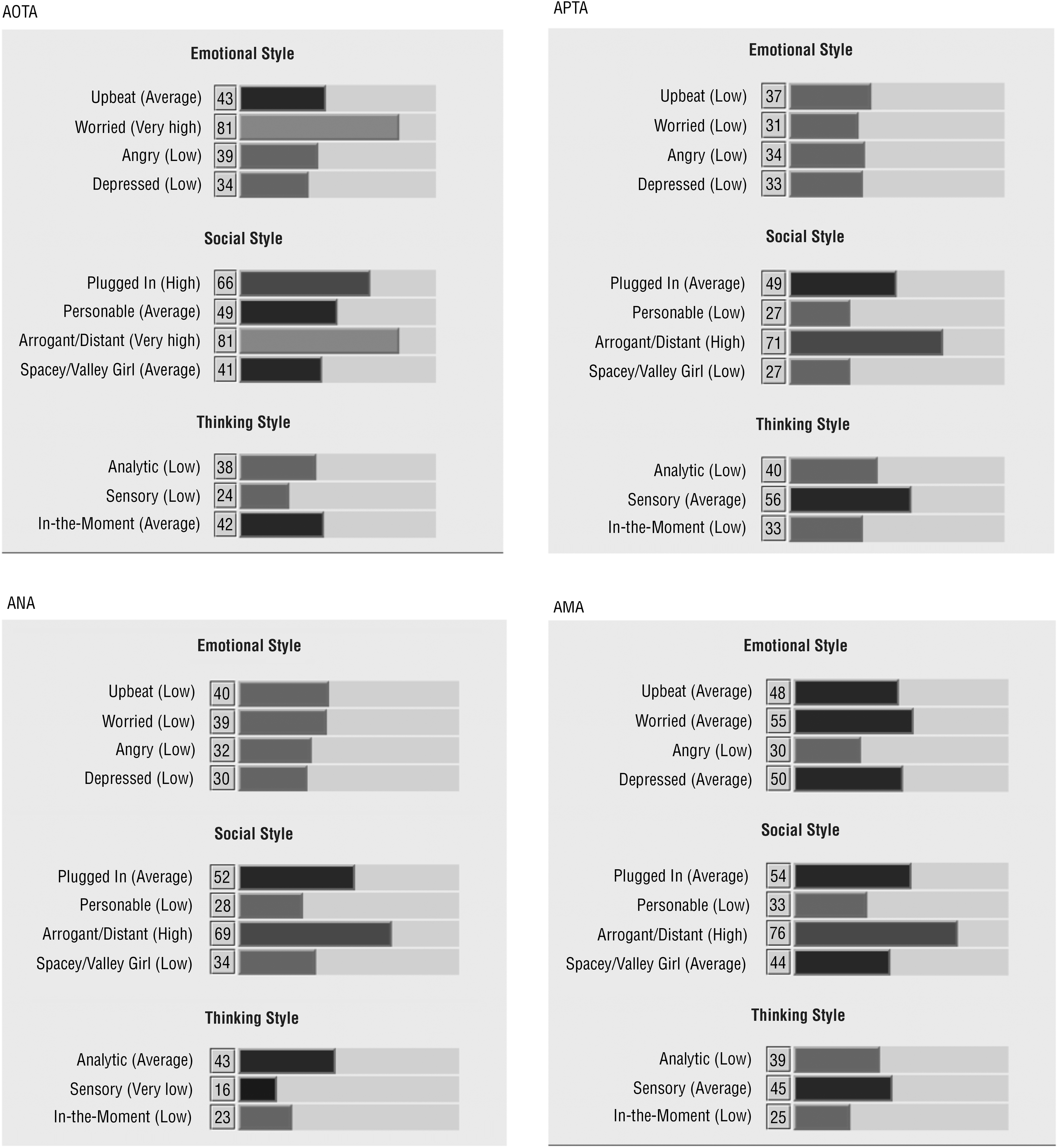
Analysis of American Occupational Therapy Association (AOTA), American Physical Therapy Association (APTA), American Nurses Association (ANA), and American Medical Association (AMA) Twitter feeds, March 17, 2015.
The thinking styles of the four organizations are very similar and reflect an analytical and complex thinking approach to tweet construction. Use of sensory words ranges from very low to just average. The social styles for each account demonstrate arrogance (associated with use of “action words” and the use of scholarly language) at high to very high levels. This result is not surprising because all the professions represented by the organizations require a college-level degree or above, and all offer doctoral education paths. The emotional style of the organizations shows much more variation. ANA and APTA rank in the low range for upbeat, worried, angry, and depressed language. AMA comes in at the average range, whereas AOTA has very high worried, average upbeat, and low angry and depressed language. This result can connote an online presence filled with nervous questions (e.g., Need to have a conversation with an older driver? What is bullying? How will it affect my practice? Are you ready for fieldwork?) and dominant anxious tweet words (e.g., empowerment, targeting, network). To the average Twitter user, predominantly unsure or apprehensive words can be misconstrued as instability within an organization.
Discussion
Having a strong presence in the public eye is advantageous for the longevity of a profession and can help maintain stakeholder status in today’s competitive health care marketplace. With occupational therapy crossing the centennial year mark, there still exists a significant struggle by the profession to project a clear identity easily and accurately as defined by the common person. A comparison of different venues was undertaken to see how occupational therapy is portrayed in three diverse media outlets. Litterst (1992) said it best: “Ideas influence behavior” (p. 25). The prevalence of occupational therapy can, and should, influence public behavior.
LNA was chosen because of the type of content it comprises. This news media database was carefully analyzed selecting only domestic articles occurring in 2014. A 12-mo retrospective analysis was used to gather enough data for conclusive evidence. When taking a phenomenological approach, evidence strengthens an argument. Evidence-based decision making is used to guide practice and support stances on current topics. Unfortunately, even though LNA housed the type of inventory most commonly viewed by the layperson, the results demonstrated a lack of exposure for occupational therapy, and the exposure given was detrimental to occupational therapy’s professional persona in the public eye. A limitation of LNA is that it is a somewhat fluid database. The rights to publication of content for newspaper organizations can end or begin at any point in time. Should a second study attempt to replicate the methods here, exact article match might not be possible. In addition, LNA indicates a display of +1,000 entries but will return only the first 1,000. For the purposes of this study, that figure was acceptable; however, it may be limiting for further analysis.
The analysis of Google Images proved interesting. The proverb “A picture is worth a thousand words” was the impetus for coding photographs depicting occupational therapy. Communicating a lot of information with a thumbnail picture is a novel approach to determine an online presence. A few limitations arose during data manipulation. First, this was the first attempt by the researcher to code photographs. Second, as the task proceeded, most codes were established by the time Image 21 was coded, indicating the likelihood of coding saturation. In an attempt to clarify categories, a few additional codes were added during the multiple data manipulation sessions. Third, because there was only one coder, intercoder agreement was not possible. As a result, some categories such as “scrubs/white coat” and “no scrubs/no white coat” needed to be taken literally. In today’s health care settings, occupational therapy practitioners are sometimes required to wear work-specific uniforms that are neither scrubs nor street clothes (mostly khaki pants and shirt with a collar). If these uniforms had been included in the analysis, the 57% of images of casually dressed practitioners probably would have been less, with these images included in the “scrubs/white coat” category. This situation is a conundrum because occupational therapy’s philosophy of a health-through-doing approach to intervention is counter to the strong medical model approach. There is no way to definitively know whether images contain work-mandated dress.
Some confusion around the prevalent categories of occupational therapy context existed. This study concentrated on the treatment approach depicted in the 40 images. Pediatrics (44.11%) and hand therapy (8.82%) are practice settings. Exercise (55.88%) was not considered because the OTPF–3 indicates that it should not be exclusive of occupational therapy treatment (AOTA, 2014). Notably, there were no images of some main occupational therapy niches or emerging practice settings such as mental health, telemedicine, the virtual context, cognition, and group treatment. Unfortunately, Google Images does not encompass all relevant settings where an occupational therapy practitioner would be found. Additionally, only 3 out of 40 images had the term occupational therapy displayed.
Twitter analysis was a modern twist on an evidence search. Running AnalyzeWords on March 17, 2015, gave a snapshot of the four professional organizations. AOTA’s Twitter account was a clear standout in its worried, anxious language as well as its high account activity for this social media platform compared with the other groups. This result leads to the question, Should we be concerned about the utility of this prominent social media platform as a way to project the professional image of occupational therapy in a manner fitting of the profession?
Compared with the other three groups, AOTA’s presence on Twitter appears uncertain and nervous. A limitation to using Twitter for research is that it is ever-changing and feeds are constantly being updated and edited. Capturing the fluid nature of the platform is difficult; thus, a one-time snapshot was deemed the best approach for this initial inquiry, noting that analysis over multiple observations would give the most consistent evidentiary data. The use of AnalyzeWords was another limitation because of the lack of a date selection parameter. Depending on how much is tweeted, the time span analyzed could vary greatly. For the organizations investigated, most tweets occurred from the last quarter of 2014 to March 17, 2015. Last, AnalyzeWords relies on the generated lexicon database of the LIWC. Although well researched for decades, the interpretation of analysis is directly related only to the work of Pennebaker Conglomerates. Thus, having only face validity, only a loose association between image and a profession can be made. However, in social media, this face validity is still valuable information for laypeople—as is seen with current-day “fake news” claims and requests to fact check statements. In 2018, organizations that use platforms such as Twitter should not ignore social media face-value opinions.
Implications for Occupational Therapy Practice
This investigation into the perception of occupational therapy derived from content accessible by laypersons has the following implications:
Language in news outlets must specifically highlight the words occupational therapy or risk burying the value of the profession deep within an article. People often skim news articles; if occupational therapy is not prominently mentioned at the beginning of a news item, an opportunity to identify the profession is missed. When practitioners, educators, or students have contact with those who publish news articles or interviews, asking that the words occupational therapy be in the title or first paragraph of the article will significantly change the profession’s visibility, as evidenced by the LexisNexis search.
Google Images analysis reveals a casually dressed hospital worker whose focus is exercise, especially with children. Occupational therapy must do a better job at accurately representing in pictures what practitioners do—specifically for mental health, health promotion, and community health outreach, all of which are Vision 2025 benchmarks of effective, collaborative leaders who deliver accessible care for all (AOTA, 2017).
Cyberspace is a busy, subjective, cumulonimbus of somewhat random perceptions and context. If occupational therapy can be at the fingertips of Americans, positive, research-based announcements should be the norm.
Conclusion and Future Inquiry
The results of this primary investigation lean toward the profession of occupational therapy needing to more strongly and proactively address its media presence. Making reporter contacts and insisting that the term occupational therapy be included in article titles will counteract the weak presence seen in 2014 news and newspaper outlets. The early sentiments of occupational therapy’s founding mother, Eleanor Clark Slagle, about the need to be a prominent profession have been restated many times over the years, each calling to action but falling short on execution of strong advocacy efforts until recently (Bing, 1997; Cottrell, 2005; Kirsh, 2015). Limiting exercise images and proactively placing photos of all practice settings, specifically emerging niches and mental health areas, helps viewers better understand the unique and distinct value that occupational therapy has to rehabilitation as well as habilitation. Engaging social media experts and researching modern social media platform utility will help project an image of a confident, purposeful, and connected profession to younger and tech-savvy audiences.
As a not-so-young profession, occupational therapy must advocate more efficiently and effectively for its stake and purpose. Multiple authors have addressed occupational therapy’s pervasive identity crisis, both internal and external to the profession (Ambrosi & Schwartz, 1995a, 1995b; Bing, 1997; Brintnell et al., 1981; Litterst, 1992; Kirsh, 2015). Political scientists Shipan and Volden (2012) explained that, as a profession, occupational therapy needs to be politically savvy and driven much like entrepreneurship. This concept of political entrepreneurship is critical for the profession to embrace to remain competitive in today’s health care marketplace. If pictures tell the layperson that occupational therapy practitioners are casually dressed hospital workers who focus on exercise, is this the image that accurately depicts the profession’s distinct value and meets its Centennial Vision?
Occupational therapy has strong professional advocacy methods in place, which have resulted in many changes and advancements for the profession over the past 5 yr. However, the efficacy of such methods may need to be further examined to maximize external impact. Future research should investigate how to effectively advocate for the profession by using media in different modes. Incorporating social media research and experts to guide a high-profile account is one way to proactively and strategically increase public awareness and understanding about the dynamic profession of occupational therapy.
According to Vision 2025 (AOTA, 2017), the value of occupational therapy is to “[maximize] health, well-being, and quality of life for all people, populations, and communities through effective solutions that facilitate participation in everyday living” (p. 1). The results of this study should be a call to action for practitioners and scholars of occupational therapy to use media outlets in ways that facilitate their political entrepreneurship to create accurate and powerful images of the distinct value of the occupational therapy profession.
Footnotes
Acknowledgments
The author acknowledges two persons without whom this work would not have been possible. Jeanette McVeigh, librarian from the J. W. England Library at University of the Sciences, Philadelphia, is thanked for her assistance with the ever-daunting task of navigating library resources and databases. Claudia F. Parvanta, currently professor at University of South Florida and former professor and chair of the Department of Behavioral and Social Sciences at University of the Sciences, is deeply thanked for her mentorship, guidance, and support in this research process.