





Abstract
Obesity has become a major public health issue, with a prevalence of 20%–25% in Canada in 2011 (Gotay et al., 2013) and nearly 38% in the United States in 2013–2014 (Flegal et al., 2016). Canadian health guidelines define obesity as a body mass index (BMI; weight divided by height squared, i.e., kg/m2) of >30 (Health Canada, 2003). Obesity is further categorized on the basis of health risks related to BMI as Class 1, 30–34.9; Class 2, 35–39.9; and Class 3, ≥40 (Health Canada, 2003). Obesity is associated with the development of serious chronic diseases including diabetes, hypertension, sleep apnea, and some cancers (Buchwald et al., 2004), and people with obesity in Canada are reported to experience more mood disorders and lower self-perceived quality of life than people without obesity (Padwal et al., 2012).
Bariatric surgery has become an increasingly common treatment for obesity. Approximately 1.5 million Canadians meet the two eligibility criteria for publicly funded bariatric surgery (Padwal et al., 2012): (1) BMI of ≥40 (Class 3 obesity) or >35 with medical comorbidities expected to improve with weight loss and (2) failure to achieve beneficial weight loss through all appropriate nonsurgical weight loss measures over ≥6 mo (Padwal et al., 2012). Although not all people with high BMI experience poor health, bariatric surgery candidates are a specific subgroup who are negatively affected by their obesity and who have not been successful in addressing their weight issues through modifications in diet and exercise. Bariatric surgery has led to excellent outcomes related to weight reduction and the resolution of some medical comorbidities, but some studies have reported adverse events related to the surgery or the requirement for reoperations (Colquitt et al., 2014).
Mental Health and Obesity
Previous research offers considerable evidence that mental health is an important consideration for people with obesity and for bariatric surgery patients in particular, both before and after surgery. Recent findings from a 3-yr pre- and postsurgery longitudinal cohort study from Ontario, Canada, showed that although the risk of self-harm emergencies was a concern in both pre- and postsurgery patients, the risk increased after bariatric surgery (Bhatti et al., 2016).
Lower levels of satisfaction and higher levels of obesity after bariatric surgery have been associated with higher levels of depression and anxiety, poor self-esteem, and maladaptive eating behaviors (Blanchard, 2009; Kofman et al., 2010; Mitchell & de Zwaan, 2012; Ogden et al., 2011). Depression has been negatively correlated with weight loss after bariatric surgery (Mitchell & de Zwaan, 2012). In addition, a meta-analysis of data from 59 studies estimated that 19% of people seeking and undergoing bariatric surgery reported depression (Dawes et al., 2016).
Franks and Kaiser (2008) suggested that anxiety requires more attention in this population because its role appears to be underrecognized, especially given prevalence rates ranging up to 24%. The findings of a 2-yr bariatric postsurgery study indicate that anxiety may hinder weight loss and that weight loss may increase with improved coping abilities (Rydén et al., 2003).
Another important mental health factor among bariatric surgery patients is self-esteem, which has been found to correlate with negative affect and body image dissatisfaction (Masheb et al., 2006). In addition, the prevalence of dysfunctional eating or maladaptive eating patterns, such as loss of control over eating, binge eating, or grazing (a pattern of eating or nibbling continuously over an extended period of time), ranged from 12% to 30% in bariatric pre- and postsurgery samples (Kofman et al., 2010; Franks & Kaiser, 2008). Unhealthy eating behaviors have been associated with poor postsurgical outcomes, including weight regain, reduced satisfaction, and lower self-reported quality of life (Kofman et al., 2010; Ogden et al., 2011). Dysfunctional eating behaviors and exercise avoidance may be exacerbated by the experience of stigmatization of and discrimination against people on the basis of weight (Bacon & Aphramor, 2011).
Occupation and Obesity
The impact of mental health factors on self-reported quality of life can be investigated through the exploration of occupational performance. According to the Canadian Model of Occupational Performance and Engagement (CMOP–E; Law et al., 2008), occupation describes the participatory engagement of people, which is determined by the interplay among the person, the occupation, and the environment in which the person functions. The client-centered CMOP–E places the person at the core of the model and stipulates three performance components: physical, cognitive, and affective traits (Townsend & Polatajko, 2007).
Forhan et al. (2010) conducted a qualitative phenomenological study of 10 adults with obesity in Ontario, Canada, in which participants described engaging in most daily activities but were not necessarily satisfied with their participation, some stating that they were avoiding certain activities until they lost weight. Forhan et al. (2011) followed with a cross-sectional study of 128 adults in treatment for obesity (which was not reported to include occupational therapy) and found that respondents spent most of their time engaged in daily living tasks; however, 75% reported that obesity limited their daily occupations. Among the investigators’ recommendations was further examination of the psychological characteristics of people with obesity. To our knowledge, no published research specifically with bariatric surgery candidates has investigated their occupational performance or the influence of mental health factors.
In summary, the existing literature points to mental health as a key factor requiring consideration for bariatric surgery candidates. Therefore, it is important to investigate the occupational performance issues reported by this population and to determine whether mental health factors may be contributing to occupational performance or satisfaction. The purpose of this study was to describe the occupational performance issues of bariatric surgery candidates, taking into account the contribution of mental health factors. The research questions were as follows:
What self-perceived occupational performance issues do bariatric surgery candidates identify?
What levels of occupational performance and satisfaction with performance are reported?
Are there relationships among demographic characteristics (age, sex, BMI), mental health factors (anxiety, depression, self-esteem, eating behavior), and levels of occupational performance and satisfaction in this population?
For factors found to correlate significantly with occupational performance and satisfaction, how much do they contribute to the variance in performance and satisfaction?
Method
Design and Participants
We reviewed health records from a bariatric surgery program in British Columbia, Canada. Retrospective review was determined to be an appropriate methodology to address the descriptive nature of the research questions with the purpose of capturing data from a wide cross-section of people without introducing response bias or the Hawthorne effect. Methodology was designed to meet recommendations for defined research questions, appropriate sampling, standardized abstraction procedures, explicit inclusion criteria, pilot testing, and maintenance of confidentiality (Gearing et al., 2006; Vassar & Holzmann, 2013). Ethics approval was received from the University of British Columbia Research Ethics Board and the Vancouver Coastal Health Research Institute.
The study sample consisted of health records of adults who met the Canadian eligibility criteria for publicly funded bariatric surgery. All referred patients who met the criteria completed an occupational therapy evaluation as part of the multidisciplinary preoperative care services offered by the bariatric surgery program. Data were extracted from the health records of all patients who received an occupational therapy evaluation regardless of comorbidities.
Data Collection
Data collection methods followed recommended strategies, which included creating a data abstraction instrument (DAI) and codebook to guide the collection of data from program intake reports and occupational therapy documentation (Gregory & Radovinsky, 2012). Data from <10% of the sample (n = 20) were entered as a pilot trial of the DAI and were reentered after coding adjustments to ensure accuracy. All data were entered into IBM SPSS Statistics (Version 21; IBM Corp., Armonk, NY). Data were abstracted using alphanumeric codes, with all personal identifiers redacted at the time of data input to maintain respondent anonymity.
Variables and Measures
Demographics.
Demographic descriptors included age, BMI, employment status, marital status, and level of education. BMI was calculated from height and weight measurements documented by a registered dietitian. Employment status was recorded according to the National Occupational Classification (Human Resources and Skills Development Canada, 2011), with categories added to account for people who were retired, unemployed, full-time homemakers, students, or reliant on disability benefits.
Occupational Performance.
Data representing occupational performance consisted of scores on the Canadian Occupational Performance Measure (COPM; Law et al., 2008) administered by an occupational therapist. The COPM measures occupational performance from the client’s perspective and can be used with any client who is able to engage in a discussion regarding daily function and self-perceived experience. Clients are not restricted to selecting from a predetermined set of tasks or activities but are encouraged to define their priority issues in their own words. When administering the COPM, occupational therapists guide clients to rate their level of occupational performance and their level of satisfaction with that performance on a scale of 1–10 for the five issues they deem to be most important in their daily lives. In this manner, the COPM provides a quantifiable measurement of occupational performance and satisfaction. The COPM has been validated across a wide range of populations and practice settings, including clients with mental health issues and outpatient treatment programs (Eyssen et al., 2011). Total scores on the Performance and Satisfaction subscales were calculated according to COPM guidelines.
Mental Health.
Data representing mental health status were collected from patient-reported outcome measures that were routinely administered during the occupational therapy evaluation. Data on psychiatric medication, substance use history, and physician-diagnosed mental disorders were not extracted as part of this study. Data on anxiety, depression, self-esteem, and eating behavior were obtained from scores on the Beck Anxiety Inventory (BAI; Beck et al., 1988), Beck Depression Inventory–II (BDI–II; Beck et al., 1996), Rosenberg Self-Esteem Scale (RSES; Rosenberg, 1965), and Eating Disorder Evaluation Questionnaire (EDE–Q; Fairburn & Beglin, 1994), respectively.
The BAI has demonstrated reliability and validity in community-dwelling adults (Sanford et al., 2008). The BDI–II has demonstrated validity for depression screening in a bariatric surgery population using a cut score of 13 (Hayden et al., 2012). The RSES has demonstrated good reliability and validity in heterogeneous U.S. adult samples (Sinclair et al., 2010). EDE–Q scores were collected separately for each of the subscales (Dietary Restraint, Eating Disturbance, Appearance Concerns, and Shape/Weight Overvaluation), in keeping with the recommendation of Hrabosky et al. (2008) to consider the subscales as distinct constructs.
Analysis
Tabulation was completed in Excel (Microsoft Corp., Redmond, WA), and all other statistical analyses were performed in IBM SPSS Statistics. Descriptive statistics were calculated to check the distributions of all variables, and measures of central tendency were obtained for continuous variables. Attempts were made to locate missing data by consulting with program clinicians.
To address the research questions, three data analyses were performed. First, occupational performance issues were tabulated and categorized according to topic constructs. Categories were validated in consultation with the program occupational therapist. The resulting categories were reviewed by the first author (Barclay) and coded according to the CMOP-E. Second, data on occupational performance and satisfaction were collected using the COPM total mean scores (out of 10 for each issue, divided by the number of issues), as recommended by Eyssen et al. (2011). To study relationships between mental health factors (anxiety, depression, self-esteem, and eating behavior) and occupational performance and satisfaction, we used Pearson correlation coefficients (rs) for normally distributed data and Spearman rank-order correlations (ρs) for skewed data. Statistical significance was set at p < .05. Third, variables with correlations >.30 were selected for linear regression analysis. Hierarchical multiple regression was used when assumptions regarding lack of multicollinearity, normality, linearity, homoscedasticity, and independence of residuals were met.
Results
Data were collected from the health records of 242 bariatric surgery candidates who completed the COPM between July 2011 and July 2013. One person did not meet the inclusion criteria (BMI <35) and was removed from the study, leaving a final sample of 241 records.
Sample Characteristics
Sample characteristics are summarized in Table 1. Mean age was 45.9 (standard deviation [SD] = 10.5), and women were represented 5:1 over men (82.6%). The majority were married or in a common law relationship (55.4%), had completed (44.0%) or had some (22.8%) postsecondary education, and were employed (72.9%). On the BDI–II, 38.2% scored >13, indicating a need for further assessment, and BAI scores indicated that 18.7% had moderate or severe anxiety. On the RSES, 20.3% scored <15, indicating low self-esteem. Disordered eating scores were highest on the Shape/Weight Overvaluation subscale of the EDE–Q.
Respondent Demographic and Mental Health Characteristics (N = 241)
Note. BAI = Beck Anxiety Inventory; BDI–II = Beck Depression Inventory–II; BMI = body mass index; EDE–Q = Eating Disorder Evaluation Questionnaire; M = mean; max = maximum score; RSES = Rosenberg Self-Esteem Scale; SD = standard deviation.
Higher scores represent higher levels of pathology.
Lower scores represent lower self-esteem.
Types of Occupational Performance Issues
A total of 1,105 occupational performance issues were collected from the 241 COPM records. About 84% (n = 203) of respondents identified 5 issues (the maximum permitted by COPM assessment procedures), whereas nearly 6% (n = 14) reported no issues. We created categories to represent the primary constructs described by individual occupational performance issues. For example, “I have no one to lean on,” “I have difficulty seeking assistance from others,” and “I wish I had people around me that I could trust” were all recorded in the Support Network category. Thirty-eight categories of occupational performance issues were endorsed more than once; 6 issues were unique to single individuals and were excluded from further analysis to preserve privacy (results not shown; available on request). The 23 categories representing issues endorsed by ≥10 respondents are shown in Figure 1.
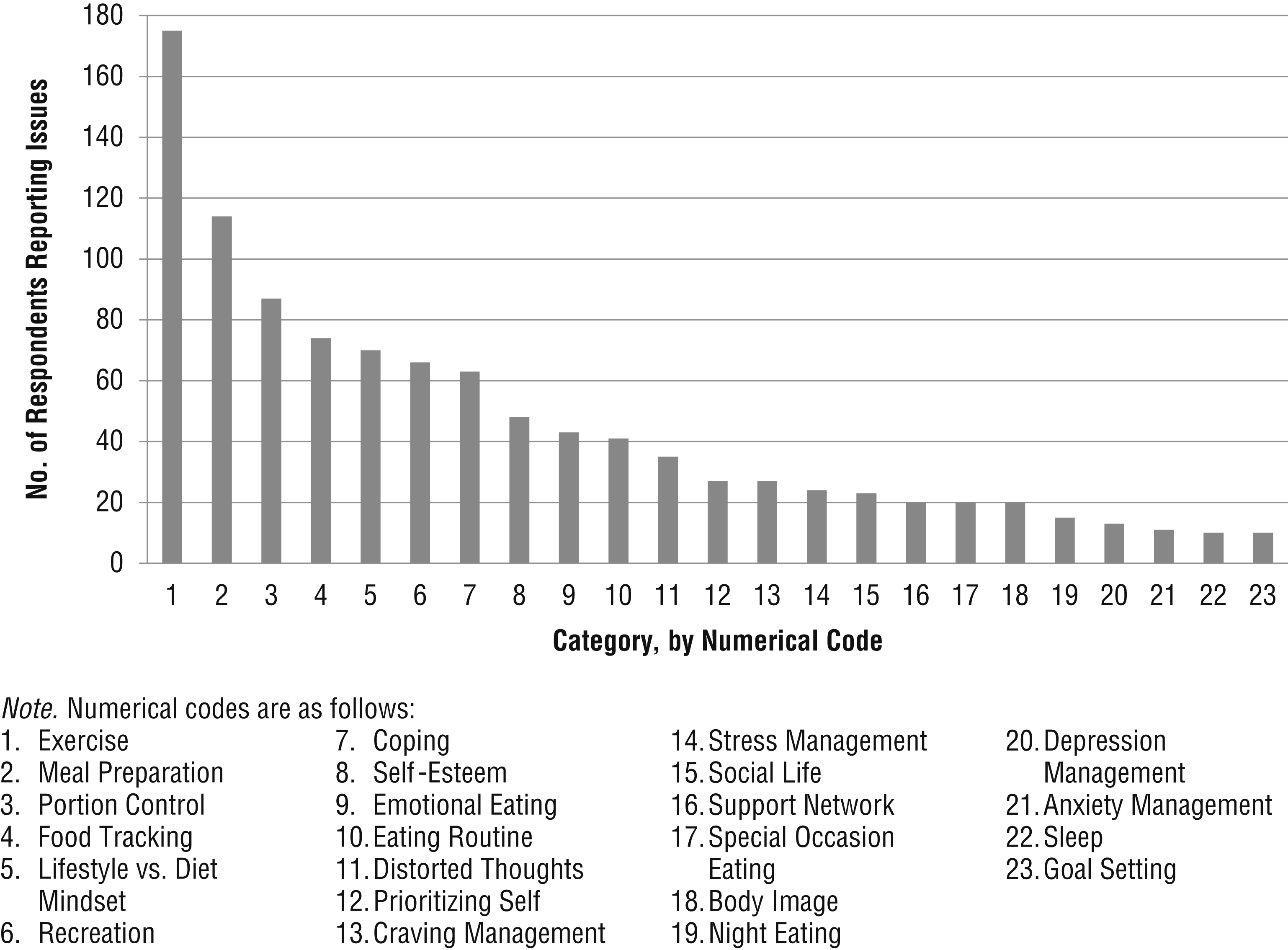
Distribution of categories representing occupational performance issues in Canadian bariatric surgery candidates.
Occupational performance issues in the Exercise category were reported by the most respondents (72.6%; n = 175). The next three most frequently reported categories were related to food intake and eating behavior: Meal Preparation (47.3%; n = 114), which represented problems with planning, selecting, and cooking healthy food; Portion Control (36.1%; n = 87), which was specific to difficulties controlling the amount of food and beverage intake; and Food Tracking (30.7%; n = 74), which involved the activity of keeping a food diary (a required task for all bariatric surgery candidates). Of the 38 categories, 14 (37%) were directly related to food and eating behavior.
We compared our categories with the person-level components of the CMOP–E (Law et al., 2008)—cognitive, affective, and physical—to determine which component each category corresponded with. Thirty-seven percent of issues that respondents identified as priorities referred specifically to cognitive, affective, and physical components. For example, Lifestyle Versus Diet Mindset (29.0%; n = 70) was labeled a cognitive category because it captured the desire to change cognitive patterns to focus on living a healthier life rather than being preoccupied by thoughts about dieting, such as “I want to stop thinking about food all the time.” Emotional Eating (17.8%; n = 43) was labeled an affective category, as in “I eat whenever I feel sad or worried. I want to stop doing this.” In many cases, cognitive and affective components could not be clearly separated. For example, the Self-Esteem (19.9%; n = 48) category described difficulties with both thoughts and feelings, such as “I want to feel better about myself, but I don’t think people respect me.”
Although the CMOP–E places the person at the center of the occupation model, it defines occupational performance and engagement as the interaction among the person, occupation, and environment. Therefore, when further comparing the study categories with the model, we determined that the remaining 63% of issues were reported at the level of occupation. The Exercise category (72.6%; n = 175) was coded as a self-care occupation because statements revealed that respondents regarded exercise as a required activity that was necessary for their health, as seen in obligatory language such as “I have to walk every day.” Physical activity for recreation and enjoyment, which was categorized as Recreation (27.4%; n = 66) and included statements such as “I’d love to be able to go golfing again,” corresponded to the leisure occupation in the CMOP–E.
Multivariate Model
Total COPM Performance scores ranged from 1.0 to 8.4 out of 10, with a mean of 4.56 (SD = 1.74). Total Satisfaction scores ranged from 1.0 to 8.8, with a mean of 3.76 (SD = 1.98). Performance scores were normally distributed, so correlations with mental health measures were performed using Pearson product–moment correlations. Satisfaction scores demonstrated a positive skew, so Spearman rank order correlations were used (Table 2).
Correlations Between Occupational Performance and Satisfaction and Measures of Mental Health
Pearson product–moment correlations.
Spearman rank order correlations.
p < .05, two-tailed.
p < .01, two-tailed.
Hierarchical multiple regression was used to assess how much variance in Performance scores was explained by scores on the BAI, BDI–II, RSES, and EDE–Q subscales after controlling for age, sex, and BMI. Preliminary analyses were conducted to confirm assumptions of normality, linearity, multicollinearity, and homoscedasticity. Scores from the BAI and the EDE–Q Dietary Restraint subscale did not correlate >.30 with COPM Performance scores and thus were not entered into the model. Age, sex, and BMI were entered at Step 1 and were found to account for <1% of the variance in Performance scores. After entering the remaining scales at Step 2, we found that RSES scores explained 27% of the variance, R 2 change = .272, F (8, 135) = 6.421, p < .001 (results not shown; available on request). Only RSES scores reached significance (p < .05), making the largest unique contribution to the variance in Performance scores (β = .259, p < .05). Satisfaction scores could not be modeled because of skewed distribution that violated the assumptions of regression analysis.
Discussion
The purpose of this study was to describe the self-perceived occupational performance and satisfaction with performance of bariatric surgery candidates. To our knowledge, this is the first study using COPM data to measure occupational performance and satisfaction in adults seeking bariatric surgery. This information can assist clinicians in conducting appropriate assessments and designing evidence-informed interventions for clients with obesity.
Demographics
The mean age (45.9) and sex distribution (82.6% women) of this sample were closely aligned with values reported by Padwal et al. (2012) in their study on Canadians receiving publicly funded bariatric surgery (mean age = 43.6, 82% women). Mean BMI in this study (49.6) was within 1 kg/m2 of Forhan et al.’s (2011) Canadian sample (48.8), and the percentage of this sample with postsecondary education (66.8%) was marginally lower than in Forhan et al. (75%). On the BDI–II, 38% of this sample scored >13, similar to 32.4% in Hayden et al.’s (2012) Australian sample.
Occupational Performance Issues
The COPM data provided a rich source of information about occupational performance issues affecting bariatric surgery candidates. People seeking bariatric surgery are required to modify their activity levels and eating behavior in an attempt to lose weight, improve surgical accessibility to the stomach, and decrease risk of surgical complications, and these changes may not be easy for many. Respondents personalized the challenges they faced with specific details that described their unique environments and contexts—for example, “When my mother-in-law cooks, I lose all my good intentions.” In addition, people with high levels of obesity experience several barriers to exercise, including physical discomfort, fear, intimidation, embarrassment, and environmental restrictions (Mitchell & de Zwaan, 2012). These issues are reflected in the four most commonly identified categories of occupational issues: Exercise, Meal Preparation, Portion Control, and Food Tracking. A substantial number of our occupation categories corresponded with the cognitive and affective components of the CMOP–E, which suggests that psychosocial factors limit engagement in activities even when the activities are physical in nature.
In this study, the mean Performance total score was 4.56 out of 10 and the mean Satisfaction score was 3.76, suggesting substantial room for improvement. This finding contrasts with Forhan et al.’s (2011) results from a survey of 128 adults with Class 3 obesity, in which participants believed they performed their daily activities well (mean score of 2 [SD = 0.52] on a scale ranging from 1 to 5 on which lower scores represent higher performance). Forhan et al. used the Occupational Questionnaire (Smith et al., 1986), which measures only activities respondents report participating in during a typical day and thus would miss activities they may wish to do but do not typically engage in. The Occupational Questionnaire also may not be as sensitive as the COPM in detecting variations in the occupational performance of this population.
Mental Health Factors Associated With Occupational Performance
Anxiety.
We found only small correlations between anxiety and occupational performance (r = −.246, p < .01) and between anxiety and satisfaction with occupational performance (ρ = −.297, p < .01). It is possible that bariatric surgery candidates reported anxiety that was related to their referral for surgery but that did not directly affect their daily function. It is also possible that the BAI reflected anxiety about other physical health issues commonly concurrent with obesity, such as cardiac or digestive issues. The measurement properties of the BAI should be studied specifically with a population of bariatric surgery candidates to see whether anxiety issues are widespread.
Depression.
A substantial number of candidates (38.2%) met the threshold for physician assessment to determine whether a diagnosis of clinical depression is warranted. Careful assessment is particularly important in this population to differentiate between a true mood disorder (which may contribute to lack of physical activity and weight gain) and situational depression that results from negative feelings associated with being overweight (Mitchell & de Zwaan, 2012). The moderate strength of the correlation between depression and occupational performance (r = −.419, p < .01) and satisfaction (ρ = −.380, p < .01) suggests a reasonable level of interrelatedness in this sample.
Self-Esteem.
We found a moderate relationship between RSES and COPM Performance scores (r = .445, p < .01), with higher levels of self-esteem associated with higher levels of occupational performance, and between RSES and COPM Satisfaction scores (r = .365, p < .01). The significant relationship between self-esteem and occupational performance and satisfaction is a potential modifiable target for intervention.
Eating Behavior.
Scores on the Dietary Restraint subscale of the EDE–Q correlated only marginally with COPM Performance (r = −.196, p < .05) and Satisfaction scores (ρ = −.178, p < .05). This finding may be explained by the fact that many questions on the Dietary Restraint subscale pertain to restrictive eating patterns that are more typical in people with anorexia, such as going 8 hr or more without eating and wanting a completely flat stomach. The other subscales had stronger correlations, perhaps because they were more related to occupational performance. For example, questions on the Shape/Weight Overvaluation subscale ask how uncomfortable respondents feel about others seeing their body shape in changing rooms or when swimming. Discomfort in this area could be related to lack of participation in exercise or recreational activities.
Multivariate Analysis
In this study, age, sex, and BMI were not found to significantly influence occupational performance. Forhan et al. (2011) also reported a lack of a significant association between participation and BMI. Both study samples consisted solely of people with high levels of obesity, suggesting that above 35–40, the effects of BMI may plateau.
Furthermore, the findings of this study offer support for previous research that has challenged the assumption that high BMI causes disability. For instance, Tylka et al. (2014) argued that weight stigma, manifested either as negative weight-related stereotypes about people with higher weights or as negative internalized judgments, is related to the increased health risks and functional disability typically attributed to being obese. The lack of association between BMI and occupational performance, and the finding that psychosocial factors are a key consideration in bariatric surgery candidates, may signify that further research is needed to understand the relationship between weight stigma and occupational performance of people with obesity.
RSES scores were found to contribute 27% of the variance in COPM Performance total scores. This means that self-esteem could explain more than a quarter of the variance in occupational performance. Similarly, Burtaverde (2012) found a small negative correlation (r = −.25, p < .05) between BMI and self-esteem in a sample in which the BMI of half of participants was <25. In clinical practice, interventions aimed at improvements in self-esteem may lead to improvements in occupational performance. Improved self-esteem may lead people to feel more self-assured and confident, which may support increased levels of occupational performance and increased engagement. This finding is supported by research indicating that positive self-esteem can strengthen the ability to take care of oneself, leading to healthy behaviors (Bacon & Aphramor, 2011).
Strengths and Limitations
A primary strength of this study is its large sample size. Although data were collected from one regional program and the majority of respondents were women, the sample’s demographic characteristics were similar to those of national and international samples, increasing generalizability. A limitation was that all data were collected by one occupational therapist, which introduces the possibility that the therapist’s specific approach may have influenced scores. This potential issue was minimized by the use of standardized assessment tools. This study was limited to the examination of relationships; therefore, inferences regarding cause and effect cannot be established.
Implications for Occupational Therapy Practice
The findings of this study have the following implications for occupational therapy practice:
The COPM appears to function well in helping bariatric surgery candidates identify a wide range of occupational performance issues that might not be captured using a predefined set of assessment questions. Occupational therapists are encouraged to use the COPM as part of their evaluation process.
Given the tendency of some clients with obesity to focus on personal factors (particularly affective and cognitive components), occupational therapy practitioners may need to make a concerted effort to support their clients to recognize the impact of affective and cognitive issues on the performance of meaningful daily activities. The COPM can be used as a pretest–posttest measure when encouraging clients to translate improvements in personal factors into increased levels of occupational performance.
The greatest occupational performance challenges the respondents faced were related to changing their diet and exercising to lose weight. This finding suggests that COPM data can be used to guide graded occupation-based interventions aimed at encouraging people to adopt healthy eating behaviors and exercise. The long-term effects of these interventions can facilitate and support overall functioning, mental and physical health, and social well-being.
Because more than one-third of respondents required further assessment for depression, occupational therapists are strongly urged to include depression screening in their routine practice. Interventions should include a psychosocial approach to ensure that the influences of associated mental health factors are adequately addressed.
Given that self-esteem accounted for the majority of the variance in occupational performance, occupational therapists are encouraged to explicitly discuss self-esteem with their clients and make use of strategies to support the development of positive self-image.
Conclusion
This study is an important step toward addressing the gap in the published research regarding the occupational performance of bariatric surgery candidates. The COPM was a useful clinical tool that revealed a high prevalence of problems related to exercise and eating behavior, with cognitive and affective issues revealed as key components. Thus, psychosocial issues may be a key factor influencing self-perceived occupational performance after bariatric surgery. BMI did not correlate with occupational performance in this sample, showing that factors other than BMI are important to consider in people seeking bariatric surgery and pointing to the potential of occupational therapy to promote self-esteem, self-care, and healthy behaviors through engagement in meaningful activities for this population.
Further research using a qualitative approach would be useful to understand the occupational performance issues faced by people seeking bariatric surgery. Furthermore, a critical analysis of current assessment tools used preoperatively and postoperatively with the bariatric surgery population would be valuable. Future research should also investigate occupational therapy interventions and outcomes, including change in occupational performance, after bariatric surgery.
Footnotes
Acknowledgments
We thank Monica Redekopp for advice on the study design and Robyn Emde for managing the data.